This entry was originally posted 16 January 2013, it has been edited and expanded a bit.
Bama Theatre
600 Greensboro Avenue
Tuscaloosa
Architect David O. Whilldin employed a theme of simplicity versus the exotic in his design for the Bama Theatre. The façade of the theatre utilizes limestone (a stone that may conduct paranormal energy) cut in the simplified geometry of Art Deco and Moderne lines. Step into the lobby, and a patron will find themselves immersed in the exuberance of an Italian Renaissance courtyard modeled on that of the Davanzati Palace in Florence. Perhaps Whilldin’s theme was meant to illustrate the condition of so many Americans during the Great Depression: leading simple and austere lives on the outside while their inner selves are vivacious, imaginative and highly cultured. Opening in 1938 and built with funds from the Works Progress Administration, the Bama Theatre can be considered one of the last of the great American atmospheric movie palaces.
Marquee of the Bama Theatre, 2010, by Carol M. Highsmith. Courtesy of the George F. Landegger Collection of Alabama Photographs in Carol M. Highsmith’s America, Library of Congress, Prints and Photographs Division.
The identities of the spirits at the Bama Theatre are unknown. While research into the theatre’s past has revealed no deaths to link to the haunting, this may be a case of residual energy remaining after years of audiences and performers in the theatre. One particularly interesting story involves an employee who arrived early one morning. As he was making coffee, he heard the elevator moving. He stood at the doors expecting to greet the passenger, but when the doors opened, a blast of icy air greeted him, this is perhaps the most chilling of the paranormal events in this building.
Others working in the building have reported shadow figures, odd lights, and the distinct feeling of being watched. The building was probed by the Alabama Paranormal Research Team in recent years, though little evidence to support a haunting was uncovered.
Sources
Alabama Paranormal Research Team. Investigation Report on The Bama Theatre, Tuscaloosa, AL. Accessed 29 November 2012.
Higdon, David & Brett J. Talley. Haunted Tuscaloosa. Charleston, SC: History Press, 2012.
“History.” The Bama Theatre (bamatheatre.org). Accessed 4 March 2013.
Bluff Hall 405 North Commissioners Avenue Demopolis
The fortunes of Demopolis’ Lyon family reflect the rise and fall of the entire state during the 19th century. While the family owned a large plantation, Bermuda Hill, outside of town, it required a home in town for business and social functions. This home, Bluff Hall, was constructed in 1832 by Allen Glover for his daughter Sarah and her husband, Francis Strother Lyon.
Bluff Hall, 2008, by Altairisfar. Courtesy of Wikipedia.
The revised WPA guide to the state describes the house as “fortress-like in its strength and severity,” an apt description for the magnificently sited home. Occupying one of the bluffs above the Tombigbee River, the home illustrates the Lyon family’s remarkable and powerful position in the region. Francis Lyon, the home’s first owner, served in the Alabama State Senate, the U.S. House of Representatives, and the Confederate Congress, all the while running his plantation at Bermuda Hill. The home remained in the Lyon family until just after the turn of the 20th century when another family purchased it as a residence. The Marengo County Historical Society purchased the home in 1967 and restored it to its antebellum glory.
Since its purchase by the historical society, evidently no one had stayed the night in the home until 2003. A group of people staying overnight encountered odd sounds during the evening. When the President of the local Chamber of Commerce went to investigate, she was confronted with the apparition of a child on the stairs. Local historians have suggested that the child was the spirit of Leonidas Mecklenburg “Merk” Polk, Francis Lyon’s grandson and grandson to Confederate General Leonidas Polk, who passed away in the home of scarlet fever in 1877.
Sources
“Area rich in ghost stories, folk lore.” Demopolis Times. 30 October 2008.
Bluff Hall. Wikipedia, the Free Encyclopedia. Accessed 14 December 2012.
Francis Strother Lyon. Wikipedia, the Free Encyclopedia. Accessed 14 December 2012.
Hendrix, Barry H. “Image may have been real.” Demopolis Times. 5 November 2003.
Walker, Alyce Billings. ed. Alabama: A Guide to the Deep South, New Revised Edition. NYC: Hastings House, 1975.
Interstate 65 Between Evergreen and Greenville
This roughly 40-mile stretch of I-65 between Evergreen, in Conecuh County, and Greenville, in Butler County, is the setting for a legend. Like much of the state of Alabama, this area was initially part of the vast nation of the Muscogee, or Creek, people. After Alabama’s creation in 1819, land-hungry white pioneers flooded the area and tensions rose as the Muscogee watched the theft and degradation of their homeland. Skirmishes between the two groups brought violence and orders of removal from Washington. Thousands of Muscogees were forcibly removed from their rich and fertile homeland and resettled in the dry and barren Oklahoma territory.
The Muscogee left behind villages, farmland, hunting grounds, trails, and the bones of their ancestors. According to legend, I-65 cuts a swath through part of this sacred Muscogee territory and, as a result, this section of interstate is cursed. One commonly quoted statistic on this stretch of road states that “between 1984 and 1990, there were 519 accidents, 208 injuries, and 23 deaths on this 40-mile stretch of highway, though the road is straight, even, and well maintained.”
Many of these accidents are supposedly caused by something, possibly a human figure, darting across the road. A 2002 Birmingham News article says that Native American spirits have been seen in this area, “some as tall as 50 feet, towering over the pine trees in the interstate median.” Other reports involve mysterious, bright lights temporarily blinding drivers. Then again, this may just be another old Indian curse legend.
Sources
Granato, Sherri. “Haunted America: Interstate 65 in Evergreen, Alabama.” Yahoo Voices. 24 October 2011.
Hauck, Dennis William. Haunted Places: The National Directory. NYC: Penguin, 2002.
Haveman, Christopher. “Creek Indian Removal.” Encyclopedia of Alabama. 23 February 2012.
MacDonald, Ginny. “Boootiful Alabama: Don’t let night catch you driving alone.” Birmingham News. 31 October 2002.
N.B. This page was edited and revised 26 May 2020.
Among theatre folks there’s an old saying, “no good theatre, worth its salt, will be without a ghost.” The South is not immune to this phenomenon and its landscape is dotted with many theatres claiming to be haunted. The variety of theatres is astonishing; from 1920s-era movie palaces, to opera houses to performance spaces that have been created out of old buildings, and even cinemas, so many of these sites have wonderful and creepy stories to tell.
Mary G. Hardin Center for Cultural Arts 501 Broad Street Gadsden, Alabama
This prominent corner of Broad and 5th Streets has witnessed much of Gadsden’s history. A home stood on this corner until 1860 when the First Baptist Church erected a church here with a graveyard surrounding the building. Around the turn of the 20th century, the church was sold and the graves—most of them—were relocated to nearby Forrest Cemetery. A furniture store operated on the site until the building of the Imperial Theatre which opened in 1920. The theatre changed hands a few years later, was extensively remodeled and reopened as the Princess Theatre in 1926. The Princess—a vaudeville and motion picture house—provided the citizens of Gadsden the utmost in comfort and technology until it’s destruction by fire in 1963.
The Mary G. Harden Center for Cultural Arts on a grey day in October 2019. Photo by Lewis O. Powell IV, all rights reserved.
The starkly modern Mary G. Hardin Center for Cultural Arts now occupies the corner. Within its modern corridors, galleries, studios and performance spaces there are spirits. Betty McCoy reports that two visitors encountered the spirit of a child who was apparently quite confused. The spirit of a young girl appeared at the Princess Theatre just after it opened in 1920 and many patrons encountered the young and quite curious entity. The identity of this young entity has always been a mystery. Was she attached to one of the graves formerly on the site? Is she one of the spirits in the modern arts center? As long as spirits linger, the questions will remain.
Sources
Goodson, Mike. Haunted Etowah County, Alabama. Charleston, SC: History Press, 2011.
Hardin Center for Cultural Arts. “About the Center for Cultural Arts.” Accessed 18 March 2013.
McCoy, Betty S. Haints, Haunts and Hullabaloos: Etowah and Surrounding Counties. CreateSpace, 2011.
H Street Playhouse 1365 H Street, Northeast Washington, D.C.
Things have a strange way of disappearing at the H Street Playhouse. Some believe that these odd disappearances may be linked to a spirit within the old theatre, besides, these disappearances are truly strange. Take for instance, the matter of the disappearance of the theatre’s router from the office during a meeting. Members of one of the theatre companies that uses the theatre were meeting in the building when the Wi-Fi suddenly went out. Heading back to the office, which was only accessible through the room where the meeting was being held, the router seems to have completely vanished.
H Street Playhouse, 2012, by Smallbones. Courtesy of Wikipedia.
Costumes pieces and props also have a tendency to disappear right before performances. A t-shirt hanging on a rack disappeared without a trace while prop money seemed to have departed briefly from the bag it was stored in during the show. As money was required during the scene, the actors pulled together what bills they had on them to use, though when the props master opened the bag to dole out money for the upcoming scene, the prop money had reappeared.
If the kleptomaniac of the H Street Playhouse is, in fact, a spirit, then there is the question of identity. Tour guide and author Tim Krepp speculates that the spirit may either be the shade of Bruce Robey, who founded the H Street Playhouse with his wife, or perhaps the spirit of a young boy who was severely burned in a fire across the street in 1905. But, perhaps the spirit lies somewhere in the playhouse’s marvelous history.
The Romanesque Revival-styled building was built in 1928 as an automobile showroom. At the time, this particular stretch of H Street boasted so many dealerships it was called “Autombile Row.” This building served as a showroom until 1942 when the building was renovated for use as a cinema for the African-American community that occupied this area. As the social upheavals of the mid-20th century led to the neighborhood’s decline, the building was used for a variety of purposes until its conversion to a live theatre in 2002.
The H Street Playhouse closed in 2012. A gym currently occupies the building.
Sources
Bell, T. David. National Register of Historic Places nomination form for Plymouth Theatre. December 2003.
Krepp, Tim. Capitol Hill Haunts. Charleston, SC: History Press, 2012.
Coconut Grove Playhouse 3500 Main Highway Miami, Florida
The Coconut Grove Playhouse is like a famous actor in a vegetative state. The doctors are faced with a hard choice: unplug him from life-support to let him die or revive him with an expensive, experimental treatment and hope that he makes a full recovery. As of now, the doctors are still arguing over the best course to take.
This most famous of Florida theatres went suddenly into a vegetative state in 2006 under mounting debt. Since the theatre company’s closure, the theatre has been embroiled in mounting drama between a cast of politicians, preservationists, thespians and developers. Occupying a prominent corner on Main Highway at Charles Avenue, the location has developers salivating over the money that could come from a luxury condominium development on the site. Some government officials, preservationists and thespians would reopen the playhouse as a theatre and hopefully revive its cherished name. Before its closure, the theatre was a major economic driver in the Coconut Grove, one of the oldest neighborhoods in the city.
Coconut Grove Playhouse, 2011, by Ebyabe. Courtesy of Wikipedia.
As the drama fills courtrooms, offices and boardrooms outside of the theatre, faces have been seen peering from the buildings upper windows: spiritual guardians of this 1927 edifice. Ghost tours pass by the site regularly as the Mediterranean Revival structure sits forlornly with its doors locked. The theatre opened gloriously as the Player’s State Theatre on New Year’s Day 1927—a jewel in the Paramount crown. All the amenities of the best theatres were incorporated here including a huge Wurlitzer Concert Grand Organ and air conditioning. Riding high on the great Florida Land Boom of the 20s, the theatre’s fortunes ran out when the real estate bubble burst. The theatre closed in the early 1930s. It was not until 1955 that it would resume use as a theatre, but only after being transformed for use as a live-performance venue.
It struggled even as a legitimate theatre, though it did host a grand assortment of prominent actors and productions on its boards. Samuel Becket’s Waiting for Godot had its American premiere here and the stage has seen the work of such noted thespians as Jose Ferrer, Hume Cronyn, Jessica Tandy, and Ethel Merman. But, until the actors in the current drama come to a resolution, the theatre and the spirits peering from its windows will continue to wait for Godot’s eminent arrival.
Sources
Bandell, Brian. “Coconut Grove Playhouse hit with foreclosure.” South Florida Business Journal. 17 January 2013.
Feldman, Hal. “Do ghosts walk among us?” Pinecrest Tribune. 28 June 2012.
Uguccioni, Ellen and Sarah E. Easton. Designation Report: Coconut Grove Playhouse. City of Miami. 2005.
Viglucci, Andres. “Coconut Grove Playhouse board decides not to fight imminent state takeover.” Miami Herald. 2 October 2012.
Viglucci, Andres. “Plan for larger theatre at coconut Grove Playhouse remains alive.” Miami Herald. 12 March 2015.
Viglucci, Andres. “State says shuttered Coconut Grove Playhouse could be sold to private bidders.” Miami Herald. 14 December 2012.
Viglucci, Andres. and Christine Dolan. “FIU, Miami-Dade in possible deal to save Grove Playhouse.” Miami Herald. 13 March 2013.
Springer Opera House 103 10th Street Columbus, Georgia
As a kid, the Springer Opera House was the first local haunting I was familiar with. I recall the intense jealousy I felt when my sister got invited to a birthday party at the Springer and I wasn’t allowed to tag along to “see the ghost.” As a theatre major at Columbus State University, I visited the Spring a number of times and saw a few performances, though still I was distracted by the fact that there may be ghosts wandering about the antique promenades and still taking their seats in the boxes on either side of the stage.
In school, I also began to hear stories from my friends who had worked in the old theatre. Some of the experiences seemed incredible—like the story of a sound technician being levitated in the booth—while others seemed quite credible—a friend’s encounter with a little girl in a hallway who seemingly wanted to play tag but disappeared. When I got hired to work on a book about this theatre, I was excited to possibly experience the spirits there myself.
Interior of the Springer Opera House, 1979. Courtesy of the Library of Congress, Prints and Photographs Division.
I was asked by F. Clason Kyle to work as an editor on his book, In Order of Appearance, a history of the theatre and the many famous personalities—Edwin Booth and John Philip Sousa to Minnie Maddern Fiske and Burt Reynolds—to have trod its boards. Mr. Kyle and I first began by organizing much of the archival material the theatre had. We had our own little room stuffed with boxes of old programs, promotional materials, business papers and the occasional artifact. Among the artifacts was a beaded purse once owned by famed Polish actress, Helena Modjeska. We weren’t sure where the purse was, so we went looking for it.
Before we left the archives room, Mr. Kyle and I had been sorting through the various boxes. We returned to the room after a search of about an hour and I walked straight back to the box I had been searching through. There, sitting on top of the papers within the box was an antique purse. While it was not the Modjeska purse, almost as a consolation prize, an antique pocket watch had been placed on top of the purse. Obviously, if the purse had been there as we were discussing the Modjeska purse I would have asked about it. But to appear after we returned from the search was very odd. Perhaps the Springer’s ghost is similar to the H Street Playhouse’s kleptomaniac spirit.
During my two years working on the book, I also heard footsteps on the second floor and a door slamming shut by itself during a rehearsal. But many others have had more spectacular experiences. The educational director whose office was located on the second floor regularly saw a man walking past her doorway. She also felt a strong bond, motherly really, towards the spirit of a little girl that had been reported throughout the building as well.
There is apparently a host of spirits within the 1871 building, though it seems that the male spirit and the little girl may be the more active. The theatre’s artistic director, Paul Pierce, wrote a book about many of the experiences in the Victorian theatre including his own experience. Pierce had arrived at the theatre early one morning to open the tool room for technicians who were setting up for an event. As he walked through the scene shop, Pierce realized there was a man walking next to him. “Slight of build, he was a young gentleman with a thin, unruly, Van Dyke beard and wearing an ill-fitting tweed suit.”
Pierce walked through the shop with this figure playfully mirroring his stride through the room. They turned a corner and the figure walked behind a screen leaning against the wall. The figure did not emerge from the other side.
Sources
Kyle, F. Clason and Lewis O. Powell, IV, editor. In Order of Appearance: Chronicling 135 Years on America’s Most Celebrated Stage. Columbus, GA: Communicorp, 2006.
Pierce, Paul. The Springer Ghost Book. Columbus, GA: Communicorp, 2003.
Paramount Arts Center 1300 Winchester Avenue Ashland, Kentucky
The Paramount Arts Center gained its ghost fairly early in the theatre’s history when, as legend holds, a worker somehow became entangled in the rigging above the stage and died. If this act was an accident or suicide is unknown, but strange things began to be reported in the building. Over time, theatre staff members dubbed the entity “Paramount Joe.”
Just seven months after the Ashland Opera House was destroyed by fire in 1931, the Paramount Theatre opened as a movie palace for the citizens of the city. When the Art Moderne style theatre closed its doors in 1971, locals purchased the building as a performing arts center.
Paramount Arts Center, 2007, by YoungAmerican. Courtesy of Wikipedia.
In 1992, local musician Billy Ray Cyrus (father of Miley Cyrus) chose the theatre for the filming of the video of his hit song, “Achy Breaky Heart.” While there, he was told the story of “Paramount Joe,” and Cyrus claimed that he spoke with the spirit during a break and signed a poster for Paramount Joe. Some years later when an executive removed the poster from its place in the box office the staff returned the next day to find all the pictures had fallen from the walls some having their glass and frames broken. After Paramount Joe’s signed poster was restored, all has returned to normal in terms of the pictures.
Sources
Ball, Linda Larimore. National Register of Historic Places Nomination Form for the Paramount Theatre. October 1975.
Abbey Players Theatre 200 South State Street Abbeville, Louisiana
The Abbey Players had its founding in 1976 when a small group of thespians staged a successful production of Neil Simon’s Last of the Red Hot Lovers. The theatre company was incorporated the next year with the intention of presenting quality theatre to the region. After spending a few years staging shows at various venues throughout town, the group began renting an old building on South State Street. Previously housing the Reaux Lumber Company, the building dates to 1908 and was originally opened as a saloon.
After adapting the building for use as an arena stage, the company settled in and now produces 3-4 shows per season as well as children’s productions. Additionally, company members have had experiences in the building that may be paranormal. These include the shade of an elderly woman and the voice of a young girl among other unexplained noises. An investigation by Louisiana Spirits Paranormal Investigations captured a number of personal experiences for the team as well as EVPs.
A couple of these experiences are highlighted in Chere Coen’s Haunted Lafayette, Louisiana. During the investigation, Louisiana Spirits discovered a cold spot that seemed to move around a dressing room. The investigators also heard a disembodied voice greet them with a “hi.”
Patapsco Female Institute 3655 Church Road Ellicott City, Maryland
The immortal words of Shakespeare have been uttered within the walls of the Patapsco Female Institute for almost two centuries. Even with only the exterior stone walls remaining, the ruins now provide a perfect backdrop for productions by the Chesapeake Shakespeare Company. Shakespeare’s numerous ghosts may even provide a camouflage for the ghosts that reside among the romantic ruins.
The Patapsco Female Institute opened in 1837 as an elite finishing school for young women. Among some of the more well known alumnae is Winnie Davis, daughter of Confederate President Jefferson Davis. Sally Randolph, the great granddaughter of Thomas Jefferson, served as a headmistress. It was during this time in the balmy days leading up to the Civil War that a daughter of a Southern planter was enrolled here.
An illustration of the Patapsco Female Institute in 1857, from The Book of Great Railway Celebrations of 1857.
The young girl hated the school, longed for home and her father would not allow her to return home. The student contracted pneumonia and her body left the school in a coffin. The student’s spirit, however, has remained to wander the ruins of her former school.
The school closed its doors in 1891 and throughout the 20th century the building served as variety of uses including a convalescent home after World War I, a private residence and a theatre. After local officials condemned the building in the late 1950s, the owner gutted the building of its woodwork leaving just the yellow-tinted local stone walls standing. The space is now owned and operated by the Howard County Government as a historic site and an events space.
The white-gowned apparition of the former student still wanders the grounds.
Sources
Hannon, Jean O. Maryland Historic Trust Worksheet for Patapsco Female Institute. January 1978.
Hirsch, Rona S. “Ghostly images, spirited debate.” Baltimore Sun. 31 October 2001.
Cinemark Movies 8 Mall at Barnes Crossing 1001 Barnes Crossing Road Tupelo, Mississippi
An entrance to the Mall at Barnes Crossing, 2015. Photo by Mike Kalasnik, courtesy of Wikipedia.
Any location can be haunted. While most people would not expect to encounter a spirit within a fast food restaurant, big-box retailer (like Wal-Mart or Toys R Us) or a recently constructed building, it does happen. In some cases, recent tragic events may spur such a haunting, but other times, there is no obvious reason at all. Such is the case of this haunted multiplex theatre. According to CinemaTreasures.org, this theatre was opened in 1992, seating 1920 people and a couple spirits. A female spirit, nicknamed Lola, quite mischievously moves things and has been seen peering into the break room trashcan. She apparently gets the brunt of the blame when things go wrong or missing. A male spirit seems to be more elusive and sticks to the projection room.
Steed, Bud. The Haunted Natchez Trace. Charleston, SC: History Press, 2012.
Mountainside Theatre 688 Drama Drive Cherokee, North Carolina
Part of my own heart lies in the mountains of Western North Carolina around Cherokee. While I was in college I spent the three greatest summers of my life working on the historical drama, Unto These Hills, which has been performed at the Mountainside Theatre since 1950. It’s a humbling experience to be able to tell the story of the Cherokee people who have existed in this area for millennia. Even more humbling is being able to tell that story surrounded by the spirits of the characters and their living descendants.
The theatre is truly a sacred space where we can commune with the spirits of the past, both figuratively and literally. From my first day here, we were always made aware of the presence of spirits in this enormous amphitheatre. Among the host of spirits are Cherokee, sacred spirits from Cherokee mythology (see my entry on my own experience with the Cherokee little people) and former cast members. Some of these spirits can be truly frightening while others provide comfort.
Entrance to the Mountainside Theatre, 2012, by Lewis O. Powell, IV. All rights reserved.
In recent years, the Cherokee Historical Association—which operates the drama as well as the Oconaluftee Indian Village (it’s also haunted)—has operated a “Haunted Village” attraction around Halloween. This includes a ghost walk through the theatre and cast housing. In 2013, a zombie run was held at the theatre. During this event participants were chased through the theatre complex and cast housing by a variety of zombies. This included an area just behind the theatre called the ready room. This space is a partially enclosed area where actors may wait once they have put on their costumes. On the wall here is an old pay phone.
The ready room phone, 2014, by Lewis O. Powell, IV. All rights reserved.
I was told this story last summer when I was working in Cherokee. One evening in 2013, an hour or so after the zombie run the local police department received a panicked phone call from the Mountainside Theatre. A terror-filled voice begged for help from the theatre. The Cherokee Police Department responded and sent police up the driveway behind the theatre. The theatre complex was quiet and empty without a living soul to be found. The call had been traced to the theatre pay phone. It was discovered, however, that the phone was disconnected.
This is one of countless stories that have been told about the theatre.
Sources
Connor, William P., Jr. History of the Cherokee Historical Association 1946-1982. Cherokee, NC: Cherokee Historical Association, 1983.
Dock Street Theatre 135 Church Street Charleston, South Carolina
St. Philip’s Episcopal Church aggressively pushes itself into Church Street. Its columned porches thrust out so far that the street must curve to accommodate it. Above the street, the tremendous spire rises like an upright, moral finger, a reminder of the moral duties of the citizens of The Holy City. In the next block south of the church and within the shadow of the spire sits the Dock Street Theatre grinning garishly with its whimsical columns at St. Philip’s and the stringent Gothic Revival face of the French Huguenot Church directly across Church Street.
Theatre has always thumbed its nose at the self-righteous morality of good, church-going folk while often lampooning their foibles and failures on its boards, pulling down the saints from their lofty niches. In turn, the righteous have worked to reign in and silence the heckling theatre. This certainly was the case in Colonial America, a place still reeking of the Puritanism and strict morality that afflicted and bound the earliest settlers. Theatre most certainly struggled to gain a foothold on this steep religious mountain. The original Dock Street Theatre opened its doors in 1736 as, quite possibly, the second oldest edifice devoted to theatrical performance in the colonies.
As a part of a city in its early evolution, the original structure lasted a little less than two decades before that spark of a city’s growth, fire, reduced it to a hollowed shell of brick. The theatre was rebuilt and remained a theatre through the remainder of the 18th century. In 1809 the structure became home to the Calder House Hotel (later known as the Planter’s Hotel) run by Alexander Calder—an ancestor of the 20th century American artist of the same name—to serve wealthy visitors to the city. During the Great Depression, the Works Progress Administration cobbled together the collection of old buildings on this site into the current reincarnation of the Dock Street Theatre which incorporates an 18th century styled theatre and possibly a few brick walls dating to the original 1736 theatre.
Dock Street Theatre, 2011. Photo by Lewis O. Powell, IV. All rights reserved.
The building incorporates a certain spiritual fabric within its aged physical fabric. Most sources refer to two spirits who reside within the old theatre, though I venture that with the Dock Street Theatre’s long history, there’s also quite a good bit of residual energy manifesting itself.
One of the spirits has been identified as the great British thespian, Junius Brutus Booth. Renowned for his portrayals of Shakespearean characters, Booth fathered three sons who were also destined for the stage: Junius Brutus Jr., Edwin and John Wilkes, three thespians who left their mark on the theatrical world and one who would leave a mark upon the world stage. Edwin followed in his father’s footsteps to become one of the greatest tragedians of his day whilst Junius Jr. found better success in the managing of theatres. John Wilkes earned his notoriety as Abraham Lincoln’s assassin.
According to numerous—mostly paranormal in nature—sources, Booth the elder did stay in the Planter’s Hotel and that the well-dressed gentleman’s spirit seen in and around the theatre is his shade. Though it does ask the question of why would Booth haunt this hotel of all the numerous hotels where he stayed? According to the managing director of the theatre Booth was an alcoholic and possibly mentally unstable. During a stay in Charleston Booth allegedly beat his manager with a fire iron. Just as modern actors and performers are prone to bouts of bad behavior, so were the actors and performers of old. It seems this may belong to the phenomenon of historic landmarks picking among their most famous patrons or residents in order to identify their spirits.
Nevertheless, the spirit is still seen within the theatre. A man in a tall hat and overcoat is sometimes seen in the balcony and may sit in on rehearsals. In her Ghosts and Legends of Charleston, Denise Roffe reports on a young woman who saw this gentleman standing in the balcony when she visited.
Though, other stories center on a spirit known as “Netty” or “Nettie.” Likely dating to the same time as the gentleman’s spirit, legend has it that Nettie was a “working girl” who provided entertainment to the gentlemen who patronized the hotel. The legend continues with her dying a violent death on the balcony of the hotel, just above the entrance. While she was out on the balcony one evening, the steel beam supporting the balcony was struck by lightning and she was electrocuted. According to author Terrance Zepke, her spirit form has been observed by passersby and also captured on film. Additionally, she lingers in the second floor backstage hall where she apparently appears to be walking on her knees as the floor was raised during the building’s renovations in the 1930s. Netty is still walking on the original floors.
Sources
Bull, Elias B. National Register of Historic Places nomination form for the Dock Street Theatre. 2 January 1972.
Macy, Ed and Geordie Buxton III. Haunted Charleston: Stories from the College of Charleston, the Citadel and the Holy City. Charleston, SC: History Press, 2004.
Poston, Jonathan H. The Buildings of Charleston. Columbia, SC: U. of SC Press, 1997.
Roffe, Denise. Ghosts and Legends of Charleston, South Carolina. Atglen, PA: Schiffer, 2010.
Zepke, Terrance. Best Ghost Tales of South Carolina. Sarasota, FL: Pineapple Press, 2004.
Paramount Center for the Performing Arts 518 State Street Bristol, Tennessee
In 1991 at the age of 60 the Paramount Theatre, run down and virtually abandoned, rose like its “Mighty Wurlitzer” organ once did from the depths to be reborn as the Paramount Center for the Performing Arts. Opened in 1931, the theatre was meant as a cinema and its small stage had to be enlarged to accommodate live performance in the modern day. Sitting proudly on State Street not far from the Tennessee/Virginia state line, which divides this city, the theatre continues to attract people from all over the region.
The Paramount Center for the Performing Arts by Carole M. Highsmith, courtesy of the Carol M. Highsmith Archive, Library of Congress, Prints and Photographs Division.
According to a 2009 article from the Bristol Herald Courier, the site of the Paramount Theatre was previously haunted. On that site, Bristol’s first hospital stood, a building that had previously been a hotel. During its time as a hotel, a man was shot and killed there. After that, the hotel had trouble renting his room after that as patrons reported hearing and feeling odd things in that room. There is a spirit still hanging around the theatre, though no indication it is the same from the old hotel. The Executive Director has reported that footsteps are still heard in the empty building with the sound of doors opening and closing as well.
Sources
Netherland, Tom. “A Timeless Stage: Memories of the Paramount Center.” Originally published in Bristol Herald Courier, 17 February 2009. Republished in A! Magazine for the Arts, March 2013.
State Street divides city of Bristol and marks the state line between Tennessee and Virginia. The Cameo Theatre, on the north side of the street, is in Virginia while the Paramount Center for the Performing Arts, just a few blocks down, sits on the south side of the street in Tennessee. The division between the theatres also marks a gulf of fortunes between them as well. While the Paramount Theatre remains open as a performing arts center the Cameo is currently for sale. Two years older than the Paramount, the 1925 theatre was opened as a vaudeville house and recently served as an arts facility, hosting arts classes for children. Sadly, finances did not allow that to continue and the theatre was put up for sale in 2010.
According to V.N. Phillips’ book, Ghosts of Bristol: Haunting Tales from the Twin Cities, the Cameo replaces The Black Shawl, Bristol’s most infamous brothel. Pocahontas Hale, the establishment’s madam, is said to notoriously patrol the sidewalk in front of the Cameo Theatre. Her shade has been spotted wearing the black clothes and wrapped in the black shawl that she always wore in life.
Sources
McGee, David. “Cameo Theatre annex’s inventory being sold off to make way for new owner.” Bristol Herald Courier. 16 June 2010.
Phillips, V.N. Ghosts of Bristol: Haunting Tales from the Twin Cities. Charleston, SC: History Press, 2010.
Old Main Campus of Marshall University Huntington, West Virginia
With a cornerstone laid in 1869—just 32 years after the founding of Marshall Academy on the same spot—Old Main continues to carry Marshall University towards the horizon of the future. The structure’s nomination form for the National Register of Historic Places contains the sentimental statement that “alumni consider Old Main and school itself to be identical. Old Main is Marshall University and Marshall University is Old Main.” Not only does this monumental Tudor structure carry students and faculty forward as a university centerpiece and administration building, but it carries a spirit or two as well.
Old Main, 2013, by WVFunnyman. Courtesy of Wikipedia.
Old Main embodies the history of the school itself in its walls. It is not actually a single building, but five buildings that have been joined over time. Originally one of these building contained an auditorium, though the space has been unused since 1990. School legend relates that a well-dressed man was sometimes seen back stage during performances. Actors and crew back stage would see the man who would be gone with a second glance. This man was identified as a theatre director from the 1920s. The director supposedly disappeared after it was discovered he had embezzled money from the school.
Sources
Bleau, Edward R. National Register of Historic Places nomination form for Old Main—Marshall University. 28 December 1972.
Bozzoli, Carlos. “Old Main Building.” Marshall University Architectural Guide. Accessed 14 March 2013.
Donahue, Kelly. “Untitled article.” The Parthenon. 29 October 1996.
Alumni Hall Campus of McDaniel College Westminster
As can be expected, McDaniel College, a small four-year, private liberal arts college has a number of spirits. Founded in 1867—in the turbulent years following the Civil War—the school was founded as Western Maryland College. It was renamed after a benefactor in 2002 to avoid confusion over the school’s affiliations and geography. The name change, however, had no effect over the campus’ lingering spirits.
The massive Renaissance Revival-styled Alumni Hall has dominated the campus since its construction just before the turn of the 20th century. Originally it was constructed to hold commencement exercises, serve as a meeting hall and house religious services for this Methodist Church affiliated school (the school is no longer affiliated with the church). Since the creation of the school’s theatre department, the building has come to house classes, workshops and serves as the main performance space.
Alumni Hall, on the right, in 2006, by Alan Levine. Courtesy of Wikipedia.
A McDaniel student began documenting the school’s spirits in a blog in 2010. While incomplete, the blog does provide a student’s view into the school’s myriad legends. The student recounts three spirits that have been identified in Alumni Hall: Harvey, Dorothy (or Dorthy) and Mr. Steve. It appears that two legends explain Harvey’s presence in the building. One explains that Harvey was a student torn between his love of theatre and his parents’ expectation that he become a Methodist minister. Unable to bear his life without theatre, Harvey killed himself by throwing himself from the auditorium’s balcony just before graduation. The second story involves Harvey becoming inebriated at a college party and falling out of one of the building’s windows. Apparently, it is considered a sign of luck when this former student’s shade is sometimes seen backstage before productions. It is Harvey who is also blamed when things in the building malfunction.
The other two ghosts encountered within this building are Dorothy and Mr. Steve. Dorothy, who is honored by having her portrait in the theatre’s Green Room, is believed to be the source of a woman’s footsteps heard in the hallway just outside that room. When a production is bad she is also said to cry blood, most certainly a ridiculous notion. Mr. Steve, said to be the spirit of a former costume shop foreman, still zealously watches over his former shop. He is said to occasionally steal scissors and measuring tapes while also expressing anger when students make a mess in “his” shop.
McDaniel College. “History.” Accessed 18 March 2013.
J. Richard and James F. Ridenour. National Register of Historic Places nomination form for Western Maryland College Historic District. 9 May 1975.
Avalon Theatre 40 East Dover Street Easton
The ghost that haunts the Avalon Theatre demonstrates a fascination with technology. The theatre’s elevator may be operated by an unseen force while the stage’s fire curtain was once dropped without anyone touching it. The theatre opened in 1921 and wowed the public so that one critic described the theatre as the “Showplace of the Eastern Shore.” Acquired by the Schine Theatre Chain in 1934, the theatre was entirely renovated in the Art Deco style. It remained open as a cinema until 1985 when it closed. After extensive restoration, the theatre reopened in 1989 as a performing arts center for the Eastern Shore region.
Baltimore Theatre Project 45 West Preston Street Baltimore
A mysterious man likes to tickle the ivories in a practice room of the Baltimore Theatre Project. He’s known to enter a room, take a seat and play the most wonderful music. Startled listeners have often remarked on how well he plays. Then he’ll disappear.
The building now occupied by the Baltimore Theatre Project does have quite a history. It was originally constructed in 1887 for a male fraternal order, the Improved Order of Heptasophs, and served as Heptasoph Hall until the organization moved to a new structure in 1924. The building’s new owners transformed it into a dance hall, Farson’s Dance Academy and it later became a recreation building and school for the Greek Orthodox church across the street. Its first theatrical use came in 1963 when it served as a performance space for CENTERSTAGE. The founder of Baltimore Theatre Project acquired the building in 1971 and it has served as their home ever since.
Okonowicz, Ed. The Big Book of Maryland Ghost Stories. Atglen, PA: Stackpole, 2010.
Old Opera House—Odd Fellows’ Hall 140 East Main Street Westminster
Ghost stories rarely appear in official government records, though the story from the old Westminster Opera House does. The ghost part of the story does not appear in the Maryland Inventory of Historic Properties but the story of the murder that produced the ghost does appear. So far, it doesn’t appear that anyone has looked for documentation to back up the story and even the person compiling the history of the structure for the inventory seems a bit wary of it, noting that the story only came from the owner of the building.
The ghost story takes us back to the ill-tempered days of Reconstruction (perhaps actually during the Civil War, according to some sources). Maryland, though a slave-owning state, never seceded from the Union and many of its citizens sympathized with their more Southern brothers. During this tumultuous period an Alabama comedian named Marshall Buell took the stage of the opera house to perform. Initially, his politically-charged humor entertained the audience, though they became quite restless as his feckless impersonations of Ulysses Grant and other Union officials crossed the line into insults.
As stones and other projectiles began to be hurled from the enraged audience, Buell hurried and finished his act. At the theatre manager’s suggestion he decided to leave town as quickly as possible, though he would wait in the stable until the opera house cleared to avoid unfriendly encounters in the street. This was Mr. Buell’s last decision. His body, bloodied and bruised, was found in the stable the following morning. Depending on the version of the story, his head is either missing or his throat is cut, ear to ear. In the legends where he was decapitated, his head sometimes appears—almost in the manner of the French Revolution—on a post outside of the theatre, a warning to other actors that beloved leaders should not be mocked.
In the days following the comedian’s untimely demise, he was seen on the streets near the opera house. In one description he was waving and gesticulating as if he was still performing his act. There don’t appear to be any modern witnesses to the unfortunate spirit.
The massive three-story brick structure was constructed in the mid-1850s for the Independent Order of Odd Fellows, an altruistic and benevolent fraternal organization. Space on the second floor provided a performance venue and actors and theatre companies on the road utilized this space for many years. During the 20th century, the building served a number of other uses including use as a factory and a printing company.
Sources
Carroll County Office of Tourism. Ghost Walk in Carroll County. No date.
Okonowicz, Ed. The Big Book of Maryland Ghost Stories. Atglen, PA: Stackpole, 2010.
Weeks, Christopher. Maryland Inventory of Historic Properties form for Opera House—Odd Fellows’ Hall. December 1976.
Tawes Fine Arts Building Campus of the University of Maryland College Park
Though no longer home to the Department of Theatre, the Tawes Fine Arts Building retains its theatre and recital hall. The current home to the university’s English department, the building may still also retain its resident spook. Not long after the building’s opening in 1965, students began noticing the sound of footsteps in the empty theatre and would occasionally have mischievous jokes played on them, seemingly from beyond.
With quite a population of resident ghosts on campus, the university archivists have started documenting the stories. According to one of the archivists quoted in Michael J. and Michael H. Varhola’s Ghosthunting Maryland, Mortimer, Tawes’ ghost, may actually be a dog rather than a human spirit. According to campus lore, Mortimer was brought into the theatre during its construction and would frolic on the stage. The theatre’s seats had yet to be completely installed and the house was filled with metal frames the seats would be attached to. The frolicsome canine jumped from the stage into the house and impaled himself on one of the frames. Supposedly, he was buried in the building’s basement.
Sources
Okonowicz, Ed. The Big Book of Maryland Ghost Stories. Mechanicsburg, PA, Stackpole, 2010.
Tawes Theatre. Wikipedia, the Free Encyclopedia. Accessed 5 April 2013.
Varhola, Michael J. and Michael H. Ghosthunting Maryland. Cincinnati, OH: Clerisy Press, 2009.
Weinberg Center for the Arts formerly the Tivoli Theatre 20 West Patrick Street Frederick
Among the many haunted buildings in this nearly 300 year old town, the old Tivoli Theatre is relatively new. When it opened in 1926, it was one of the largest buildings in town and the most refined theatre in the area. Uniformed ushers, refined surroundings including crystal chandeliers and marble and a Wurlitzer organ to add music to the silent films added to the theatre’s opulence. That opulence drew crowds for many years, though as downtown Frederick declined, so did the crowds drawn to the Tivoli.
Dan and Alyce Weinberg, who had bought the theatre in the late 1950s owned the theatre during its lowest period. After declining sales, and with a theatre on the verge of closure, the Weinbergs witnessed as nearby Carroll Creek flooded downtown Frederick filling the theatre with water and mud. As the flood waters receded, demolition was proposed for the theatre, but the Weinbergs saw that the noble structure deserved more than just that. The theatre was presented to the City of Frederick and it was restored as a performing arts center bearing the Weinberg’s name.
Does the theatre’s restored opulence still attract a few spirits? Perhaps.
One spirit is the rather testy spirit of a former projectionist who supposedly died of a heart attack. His lingering spirit, named Jimmy, is not happy with new employees and he is known to mess up the restrooms when employees are hired. Though, he has been appeased when the final employee to leave wishes him a goodnight. Goodnight, Jimmy!
Sources
Ricksecker, Mike. Ghosts of Maryland. Atglen, PA: Schiffer, 2010.
Rigaux, Pamela. “Walking with the dead.” Frederick News Post. 23 October 2005.
The sun was rising on what had been a small backwater town in the early twentieth century. The population was growing rapidly and one of the most prominent of local businessmen, Rupert Koblegard, wanted to invest some of his fortune into something that would benefit the citizens of what was being called, “The Sunrise City.” When he approached the city council, the response was, “build a theatre.” After getting a design from architect John N. Sherwood, Koblegard presented the plans to the city council again. He was told that the theatre was too big, to which he replied, “better too large than too small.”
Described as the largest theatre between Jacksonville and Miami, the SUNRISE THEATRE (117 South 2nd Street) opened on 1 August 1923 with a grand parade through downtown. Onstage, the Fort Pierce Band gave a concert. On screen, the newsreel was followed by a pair of films including a Charlie Chaplin comedy, The Vagabond. The opening of this grand, vaudeville theatre was heralded by the local paper as, “one of the most important events in the development of the town into a wide-awake city.”
Sunrise Theatre, 2009, by SebasTorrente. Courtesy of Wikipedia.
The stage attracted some of the top vaudeville acts including cowboy entertainer Tom Mix and his wonder horse, fan-dancer Sally Rand and actor Edward G. Robinson. Management passed from Rupert Koblegard, Sr. to his son, Rupert Jr. in 1928 just as the first talking picture equipment was installed in the theatre. Even as other businesses generally limped through the Depression and through World War II, the theatre remained quite vital. The theatre closed in 1983 when its business was sapped by strip malls and development away from downtown.
After sitting derelict for many years, the theatre was purchased by the St. Lucie Preservation Association and was restored in 2006 as a centerpiece for a renovated downtown. The theatre features top-rung entertainment and, quite possibly, some resident spirits. In 2009, three years after its grand reopening, paranormal investigators from the Florida Ghost Team explored the theatre.
In two investigations, the team found evidence to support the assertion that the theatre had paranormal activity. While a group of investigators were investigating the third floor apartment of the theatre’s founder and owner, Rupert Koblegard, Sr., several members of the group had the batteries in the cameras drain. Shortly after, knocking was heard in possible response to an investigator’s questions. Another team member watched as an exit door opened and closed on its own volition. While the evidence is scant, it may very well prove the existence of some spiritual activity within the theatre.
From the stage of the Sunrise Theatre, one must only make a short jaunt to see real sunrises over the Atlantic Ocean from the steps of the majestic BOSTON HOUSE (239 Indian River Drive) which has wistfully been staring out to sea since 1909. Now sidled up next to a starkly modern neighbor, the house seems to retain its peaceful, old-fashioned aura as well as some of its tales. Like the Sunrise Theatre, these tales originate in the sunrise of the city of Fort Pierce.
Along the Atlantic Coast of Florida, many tales begin with Henry Morrison Flagler. Originally a partner of John D. Rockefeller in Standard Oil, two visits to Florida in the late 1870s provided him with the impetus to develop this rural state into a vacationer’s paradise. Flagler’s project built a railroad line, the Florida East Coast Railroad (FEC), from Jacksonville all the way to Key West. Along the way, the trains stopped in towns and cities graced with Flagler’s grand hotels. This little Florida project for Flagler developed into a lifelong obsession for him and a coup for a backwater state that has turned it into one of America’s greatest “Vacationlands.”
It was the FEC that brought William Turpin Jones to Florida, initially as a mechanic but he rose to be an engineer and was relocated to Fort Pierce. Around this time, Jones was an engineer on a train that struck dynamite that was left on the tracks by careless workers. Jones was seriously injured but after his recovery he returned to work. He was awarded a settlement of $6000 for his injuries. With this princely settlement Jones constructed a magnificent home in Fort Pierce which he named Cresthaven. The house was completed in 1909 and William Jones moved in with his wife and five children.
The Boston House, 2009, by SebasTorrente. Courtesy of Wikipedia.
It was the FEC that brought William Turpin Jones to Florida, initially as a mechanic but he rose to be an engineer and was relocated to Fort Pierce. Around this time, Jones was an engineer on a train that struck dynamite that was left on the tracks by careless workers. Jones was seriously injured but after his recovery he returned to work. He was awarded a settlement of $6000 for his injuries. With this princely settlement Jones constructed a magnificent home in Fort Pierce which he named Cresthaven. The house was completed in 1909 and William Jones moved in with his wife and five children.
Jones retired from the FEC and worked on maintaining his groves of oranges and pineapples and selling real estate until he was unexpectedly appointed as sheriff of St. Lucie County in 1915. This unexpected turn of events took place after the previous sheriff, D.S. Carlton, was shot to death downtown by Marshall D.J. Disney in what was described as a “wild west shootout.” Known for his honesty, the governor appointed Jones to the position and he held it until he resigned in 1920. Though he had commanded much respect as sheriff, Jones’ business interests were taking a financial loss and he resigned to turn his attention back to those interests. Eventually, he returned to work for the FEC.
During his time as sheriff, a shade of tragedy was drawn over this home. In 1918, Jones’ 10-year-old son, Clifford, was involved in an incident with one of his playmates. The boys were playing in the home’s living room. Clifford reached for his father’s gun and it fired striking his young friend, William Fee. The young friend was mortally wounded and died later that evening in the hospital.
After the Depression hit, Jones struggled just as many did throughout the country. From a friend he accepted a loan using his home as collateral. The friend passed away and the note on Cresthaven passed to Rose Whitney, a sister of the friend. Unable to meet the terms of the loan, Jones was forced to sell the house to Ms. Whitney who moved in with her sister. Since the sale of the house to the sisters, the house has passed through a series of owners. Subsequent owners have used the large house for offices and most recently it housed law offices. The grand edifice is currently for sale.
Some of the earliest stories of paranormal activity in the house date back to the early 1970s. These reports include the sightings of Native Americans on the home’s front lawn, a red-haired maiden and “hanging victims.” There is also mention made of possible séances being held in the house, though there is no record to support that assertion.
The activity that seems more believable (to me, at least) is the activity reported while the house was occupied by law offices for almost 30 years. During that time employees would sometimes open the building in the morning to be greeted by the odor of coffee brewing. The smell of flowery perfume has also been associated with activity.
The second and third floors seem to have hosted much of the activity. One office employee was shocked as her keyboard levitated and a plant bent over. The daughter of one of the partners watched as random letters appeared on the screen of a word processor monitor, though it was turned off. Lights would turn off and on and on one occasion a passerby called one of the lawyers to report that every light in the building was on late one night. When the lawyer opened the building the next morning, not one light was on.
Even more curious is the apparition of a woman. One poor copy machine repairman was surprised to see a woman in Victorian clothing on the third floor. The figure disappeared into a wall. One of the lawyers watched as the silhouette of a woman appeared in a third floor window. He was standing with a group of eight people and all but one saw the shadow.
At some point in the past few decades a story has sprung up to explain this feminine shade. The story states that the elderly spinsters who took over the house after William Jones lost it utilized the house as a bed and breakfast. Among the vacationers staying there was a family named Perkins. The father and his young son went fishing and did not return. The spirit of the wife, Mrs. Aleacon Perkins, is still waiting for her family to return.
Research conducted by members of the GRIM (Ghostly Research into the Metaphysical) Society has found no historical record to support this tragic story. However, the group has compiled an impressive history of house, some of which was used in compiling this profile. So for now, the lady staring into the sunset from the upper windows of the Boston House remains lost in the twilight of history.
Sources
Brown, Alan. Stories from the Haunted Southland. Jackson, MS: University Press of Mississippi, 2004.
Grigas, Catherine Enns. “Living History: Boston House Home to Haunting Tales.” Indian River Magazine. 21 January 2011.
Harrington, Tim; W. Carl Shiver and Brent A. Tozzer. National Register of Historic Places Nomination form for the Sunrise Theatre. September 2001.
“Koblegard Theatre Interests Sold.” The News Tribune (Fort Pierce, FL). 3 April 1955.
Mattise, Jonathan. “At Sunrise Theatre, things did go ‘bump’ in the night, Paranormal investigators said.” Fort Pierce Tribune. 28 September 2009.
Mattise, Jonathan. “Unsettling experiences noted when Florida Ghost Team returns to Sunrise Theatre in Fort Pierce.” Fort Pierce Tribune. 5 October 2009.
Pincus, J.h. and Michael F. Zimny. National Register of Historic Places nomination form for Boston House. 20 February 1985.
“The Restoration of the Sunrise Theatre.” Palm Beach Post. 19 February 2006.
Sunrise Theatre. “History.” Accessed 5 April 2013.
I’m feeling a bit of umbrage for the spirits of the Upstate region of South Carolina. A recent Halloween related article appeared on the website of a Charlotte, NC news station (I’d rather not just call them out) regarding haunted places in the region. Included with the article is a slideshow of 43 locations that are purported to be haunted. But that’s all that’s included: a slideshow. The slides show pictures of some of these haunted hotspots with a name and town, but no further information. While it’s all fine and good to say a place is haunted, it is a serious disservice to pronounce a place haunted but provide no further information regarding it.
There is a link within the article to a list of haunted places on the website of a local paranormal investigation organization. While it’s obvious that this list is the only source for the locations included in the slideshow, what I find so annoying is the fact that the organization’s source is the notorious Shadowlands Index of Haunted Places. After briefly comparing the lists, it became very clear that the paranormal organization’s list was simply cut and pasted from the Shadowlands list.
My problems with Shadowlands stems from the fact that it is made of user submitted entries. Someone, anyone, can go to the website and submit information on a haunted place. The information submitted is not checked or vetted, it is added to the list and readers often take this information as fact. It is such shoddy information gathering and publishing that I’m working hard to combat with this blog.
To post information about hauntings in such a willy-nilly manner is not just disrespectful for the spirits which may haunt these locations, but shows a lack of respect for the locations and their respective histories. Reputable sources on this region are not lacking and most are still in print. In fact, the article quotes the author of one of those primary sources. So, a much better list can be provided with a modicum of research.
While my coverage here is not as lengthy as the news station’s list, hopefully this article will help to provide a far better alternative. For your consideration, I’m presenting a few of the more interesting—and documented—stories from the Upstate region.
Abbeville County
Abbeville, the county seat and namesake for the county, is a fascinating town with a number of hauntings including its historic opera house which I covered a few years back.
Burt-Stark Mansion 400 North Main Street Abbeville
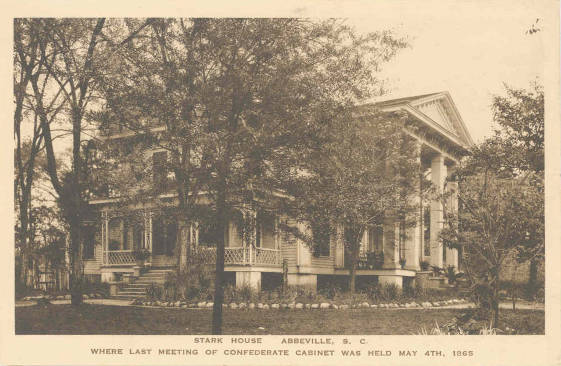
Sometimes called the “Grave of the Confederacy,” the Burt-Stark Mansion was the scene of the Confederacy’s final council of war; where Jefferson Davis met with some of his cabinet officials and generals following the fall of Richmond and General Lee’s surrender at Appomattox. The Confederate government was in disarray, and its officials on the run through the war-weary South.
Varina, Confederate President Jefferson Davis’ wife, had arrived at Major Armistead Burt’s elegant Abbeville home in mid-April with her family in tow. She stayed with the Burts for a little more than a week before continuing their journey into Georgia. On May 2nd, Jefferson Davis arrived in Abbeville. Stopping by a small cabin on the edge of town, Davis asked for a drink of water from the lady of the house. As he drank, a small child wandered across the porch towards him. The woman asked, “Ain’t you President Davis?” After he answered in the affirmative, the woman nodded at the child, “he’s named for you.”
Producing a small gold coin from his pocket, Davis handed it to the woman saying, “Please keep this for him and tell him about it when he’s old enough.” Davis whispered to Postmaster General John H. Reagan and told him that that was the last coin he had to his name.
Undated postcard image of the Burt-Stark Mansion. Published by the Echo Novelty Store, Albertype Company.
Soon after, Davis took up residence at the Burt home where his wife had stayed previously. Later that afternoon, the remaining cabinet met in the parlor. It was there that Davis responded, “all is indeed lost,” conceding to the loss of the Confederacy.
The mansion has been preserved as a museum, and due to the nature of the final meeting of the Confederate cabinet is now listed as a National Historic Landmark. Though very little paranormal activity had been witnessed in the mansion, due to the numerous other hauntings in Abbeville it was decided to allow a paranormal investigation team to investigate the home in 2007. According to John Boyanoski’s description of the investigation in his More Ghosts of Upstate South Carolina, the team came away with a great deal of evidence.
Members of the Heritage Paranormal team felt the presence of a man in the bedroom where Davis had slept. Moments later, one of the lead investigators witnessed the clear outline of a woman in period dress descending the staircase. Lending credence to his experience, the team’s equipment near the staircase registered some disturbances at the time the investigator saw the specter. In the separate kitchen building, the team detected two spirits, possibly those of slaves.
Sources
Bearss, Edwin C. National Historic Landmark nomination form forBurt-Stark Mansion. 28 April 1992.
Boyanoski, John. Ghosts of Upstate of South Carolina. Mountville, PA: Shelor & Son Publishing, 2006.
Burt-Stark Mansion. “About Us.” Accessed 13 October 2014.
Anderson County
Anderson Municipal Business Center 601 South Main Street Anderson
Unlike the Burt-Stark Mansion with its flood of history, the Anderson Municipal Business Center is a rather utilitarian government building with little history. The building opened in August 2008 and odd events began to occur less than a year after it opened. The security person in charge of the building—a 15 year veteran of the local police department—began to notice odd things on the security monitor installed in the Anderson credit union office. A white blur appeared on the video and would flit around the room. It returned night after night.
The room was checked for bugs and the camera was cleaned, but the white blurs continued to return. Workers in the office reported hearing odd sounds after hours including knocking and the sounds of furniture being moved. A customer, who supposedly knew nothing of the activity, reported the feeling of being grasped by the shoulder. The activity lasted for a few months, but then petered out by late 2009.
The property has a fairly quiet history, certainly nothing that would explain the odd white blurs that appeared for a period.
Sources
“Ghostly images leave people wondering.” 30 October 2011.
Smith-Miles, Charmaine. “Anderson employee to appear on TV’s ‘My Ghost Story.’” Anderson Independent Mail. 13 April 2011.
Cherokee County
Ford Road Bridge Ford Road at Peoples Creek Gaffney
It was obvious that the killer wanted to play when he called reporter Bill Gibbons of The Gaffney Ledger on a day in early February 1968. He instructed the reporter to pull out three pieces of paper and then gave the reporter directions to find the bodies of two of his victims. The killer even provided the victims’ names. The reporter summoned the sheriff and traveled to the two sites provided by the caller, finding bodies at each location. The body of the third victim had been previously found, and the woman’s husband had been convicted of the murder. Gaffney woke to the fact that it had a serial killer on its hands.
The Gaffney Ledger headline, 9 February 1968.
The killer would kill once more before he was arrested. Lee Roy Martin, the killer, was found guilty and sentenced to four terms of life imprisonment. He was killed by another inmate in 1972.
Just below the lonely Ford Road Bridge over Peoples Creek, one of Martin’s victims was found. Her nude body lay on the creek bank with her face in the water. She had been raped and strangled with a belt. Over the years, locals have reported hearing a woman screaming and moaning below the bridge where the body was found. An investigation conducted as part of the filming of Haunted Echoes: The Gaffney Strangler, a documentary that was posted on YouTube, did not hear any screams, just the trilling of bullfrogs in the creek.
Sources
Dalton, Robert W. “Gaffney Strangler terrorized town 40 years ago, murdering 4 women.” Spartanburg Herald-Journal. 5 July 2009.
Gibbons, Bill. “Search underway here for slayer of 2 women; Tip to newsman leads officers to scene.” The Gaffney Ledger. 9 February 1968.
Johnson, Tally. Ghosts of the South Carolina Upcountry. Charleston, SC: History Press, 2005.
Greenville County
Herdklotz Park 126 Beverly Road Greenville
Jason Profit, owner and operator of Greenville Ghost Tours, describes Herdklotz Park in his book, Haunted Greenville, South Carolina, as having “all the ingredients for an active paranormal soup.” This tranquil city park was once home to the Greenville Tuberculosis Hospital, which closed in the 1950s after operating for some 20 years. For some time, the building sat abandoned but was then reopened in the 1990s for a brief period of time as part of a prison work-release program.
As with many abandoned buildings of this nature, the building served as a playground for teens and the occasional vandal who would leave with stories of the supernatural there. Of course, the building also attracted the local homeless. It is believed that they may have accidentally caused the fire that destroyed the building in November of 2002. The remains of the building were demolished.
But, the spirits have remained. Jason Profit recounts an EVP session that he held on the steps of the old hospital (the building’s foundation remains intact) in 2008. He was able to capture the sounds of what he described as “a busy lunchroom. It sounded like the echoing of voices in a hallway or large room.” He reports that many residents of the neighborhood around the park have witnessed shadow people in their homes and in the area that may be related to the old hospital. In a 2009 report for the local CBS affiliate WSPA, Profit states, “I would have to say that beyond a shadow of a doubt that Herdklotz Park is one of the most haunted parks you’re going to find in Upstate South Carolina.”
Sources
Cato, Chris. “Greenville County Park Haunted by Hospital’s Ghosts?” WSPA. 31 October 2009.
Profit, Jason. Haunted Greenville, South Carolina. Charleston, SC: History Press, 2011.
Greenwood County
Ninety Six National Historic Site 1103 Highway 248 Ninety Six
Scholars still argue as to how Ninety Six got its odd name, some say it’s that the town was 96 miles from the Cherokee village of Keowee (which is incorrect) and some say that it’s a reference to the many creeks in the area. Nevertheless, this oddly named village was the scene of a siege during the American Revolution. General Nathanael Greene led his Patriot troops against loyalists entrenched in the village. Despite having far more troops, Greene’s 28-day siege failed to capture the village, and he withdrew his troops. Perhaps, though, he did leave some spirits behind. Residents living near the battlefield and re-enactors camping on the battlefield have heard voices throughout the site.
Siege of Ninety-Six. Wikipedia, the Free Encyclopedia. Accessed 24 February 2011.
Toney, B. Keith. Battlefield Ghosts. Berryville, VA: Rockbridge Publishing, 1997.
Pickens County
Colony Theatre 315 West Main Street Easley
Ghost stories often grow out of odd bits of natural phenomena. That may just well be the story behind this small town movie theatre in the Upstate. A member of the family who built this theatre in 1948 and owned it until it closed claimed the “ghost” was simply the curtains in the projection room being blown by air from the projector. Though, locals have a different theory: it’s the ghost of a woman who hanged herself on this site before the building of the theatre.
In his marvelous collection of ghost stories from the Upstate region, Ghosts of Upstate South Carolina, John Boyanoski documents the story of a passerby who saw the spirit peering from a window of the empty theatre one night. While driving home to Greenville from a football game in Clemson one night in 1989, the driver slowed to admire the old, art moderne-style theatre. Looking up, he saw a woman staring out of one of the building’s second floor windows. She didn’t move and she appeared to have a faint glow about her. He continued driving and then turned around to catch a second glimpse. The theatre was quiet and dark. Nothing appeared in the windows. Even after parking and walking around the front of the building, nothing stirred.
At the time of this writing the theatre serves as a church and remains as a landmark along South Carolina Highway-93 through Easley. The theatre is owned by Robinson’s Funeral Home and it plans to maintain the theatre as a local landmark.
Sources
Boyanoski, John. Ghosts of Upstate of South Carolina. Mountville, PA: Shelor & Son Publishing, 2006.
Robinson, Ben. “Colony Theater not in danger from Robinson’s expansion.” Easley Progress. 16 December 2011.
Spartanburg County
Old Main Building Campus of Wofford College Spartanburg
Wofford College, a private, independent school associated with the Methodist Church, has about 130 faculty and staff members, 1,500 students, and more than a handful of ghosts. The old campus features some noted historic structures including the campus’ centerpiece, the Old Main Building which may have a few of its own spirits flitting about the halls. South Carolina folklorist, Tally Johnson, an alumnus of the school, witnessed Old Main’s legendary “Old Green Eyes” when he was a student. He and another student crept into the auditorium one night and witnessed the odd pair of lights that appear above the drapes over one of the auditorium’s windows. The “eyes” appeared and Johnson and his companion were unable to find a source for the lights.
Old Main Building, 2010, by PegasusRacer28, courtesy of Wikipedia.
The odd, green orbs have not been identified and there’s no apparent explanation. Regardless, that’s not the only odd activity. The blog of the college’s archives recounts that the spirit of Dr. James Carlisle—one of the first faculty members and president of the school for the latter half of the 19th century—has been seen and heard prowling the halls.
Sources
Brabham, William C. National Register of Historic Places nomination form for the Wofford College Historic District. 29 August 1974.
Johnson, Tally. Ghosts of the South Carolina Upcountry. Charleston, SC: History Press, 2005.
Stone, Phillip. “Are there ghosts at Wofford?” From the Archives. 31 October 2011.
I recently had an inquiry from a friend who’s a student at Shenandoah University in Winchester, Virginia regarding a “haunted road trip” he and his friends want to take next month. After consulting my resources, I’ve devised a suitable tour of the area’s numerous haunts.
This tour makes a circle through the Shenandoah Valley, beginning and ending in Winchester. It heads south on I-81 towards Staunton with a few stops along the way. After Staunton the tour heads east to include the famous Exchange Hotel in Gordonsville before returning to Winchester. The tour includes a range of haunted places from historic homes to government buildings, churches, battlefields, commercial buildings, cemeteries, a train depot, a former mental hospital and a cave. Some of these locations are open to the public while a few are private and should only be viewed from the street.
N.B. This article has been reworked a bit and I have begun separating these cities into their own distinct articles.
Winchester
The Winchester section of this article has been broken off into its own, separate article, “The Wraiths of Winchester.”
Middletown
1797 WAYSIDE INN (7783 Main Street) This building sits at the core of history of this small town. The motley of old buildings forming the tavern were built over a period ranging from the 18th century through to the late 19th century. The oldest portion of the building, containing Larrick’s Tavern, may have been constructed around 1750. The road in front was once part of the Great Wagon Road—the road used by settlers pouring into the American “backcountry.” In this area, the Great Wagon Road was originally a Native American trail called the Great Indian Warpath and used by a multitude of Native American tribes including the Cherokee.
In 1797, this collection of buildings became an inn for the many travelers passing on the road. Leo Bernstein, the garrulous personality who took over the inn the latter half of the 20th century, would always claim that this inn was the oldest continuously operating inn in the nation. There does seem to be a good deal of truth behind his claim. It is known that this inn was in operation as war raged up and down the valley during the Civil War and that the inn served both sides.
Wayside Inn. Photo 2008, by DwayneP, courtesy of Wikipedia.
Like most buildings in the area, the inn has a number of Civil War related spirits, though there is the possibility that the inn may have been haunted before that time. Lord Fairfax, who had been given much the land in the area, did live nearby and died in Winchester (he’s buried at Christ Episcopal Church) is claimed as the spirit that moans on a nightly basis in the oldest portion of the inn. Bernstein describes the space in Sheila Turnage’s Haunted Inns of the Southeast, “Upstairs is about a three foot space. There was a set of steps going up there. The straw is still there.” The loft is located just above one of the bars and Turnage mentions that people gather to listen for the moan at 11:30 PM nightly.
Besides odd moans, the inn is home to numerous other spirits and employees and guests have witnessed much activity. Objects have moved on their own accord, a dishwasher had his apron untied repeatedly by unseen hands, and full apparitions have been seen including those of Civil War soldiers. Paranormal investigations have captured much evidence including EVPs of horses whinnying and photographs featuring specters.
WAYSIDE THEATRE (7853 Main Street, now closed) The sad fate of the Wayside Theatre echoes the fate of so many theatres throughout the country. The company was established in 1961, by Leo Bernstein, the owner of the Wayside Inn just down the street. The summer stock theatre provided training for actors such as Susan Sarandon, Peter Boyle, Kathy Bates and Donna McKechnie. After a precipitous drop in revenue, the theatre closed its doors in 2013.
The building was originally constructed as a cinema and it is from this period that the theatre’s ghost may come from. “George,” is supposedly the spirit of an African-American man who either worked in the theatre or was a caretaker at some point. His spirit is said to haunt the stage, balcony and basement of the building.
CEDAR CREEK AND BELLE GROVE NATIONAL HISTORICAL PARK (Belle Grove, 336 Belle Grove Road) Historically and architecturally, Belle Grove is one of the most important houses in the region and listed as a National Historic Landmark. It is currently owned and operated by the National Trust and most sources state that the docents are discouraged from talking about the spirits which still reside here.
Belle Grove, 2013, by AgnosticPreachersKid. Courtesy of Wikipedia.
The history of Belle Grove begins in the late 18th century with the land being acquired by Isaac Hite, the grandson of Jost Hite, a German immigrant and one of the early pioneers in this area. Construction of the house began in 1794 and ended in 1797. The house remained in the Hite family until just before the beginning of the Civil War when it was bought by John and Benjamin Cooley. The first of two ghost stories begin with this family. Not long after acquiring the house, Benjamin Cooley married a local woman named Hetty. Not long after her arrival in the home, Hetty became the subject of ire from one of the slave woman working there.
Though the details are unclear, Hetty was attacked by the slave and her beaten body was thrown either into the smokehouse or the icehouse on the property. Hetty’s spirit reportedly returns frequently and has been seen throughout the house. According to two sources, she actually let a deliveryman into the house one afternoon after the home had been closed for the day. The deliveryman was returning the antique carpets which had been removed for cleaning. After arriving late, he was let into the house by a woman in a period dress who did not speak but only gestured to where the carpets should be placed. When the staff discovered the carpets had been returned and put in place, they called the cleaning company who put the driver on the phone. They were shocked to hear about the woman who let him in.
A few years after Mrs. Cooley’s death, the estate became the scene of the Battle of Cedar Creek. During that battle, Major General Stephen Ramseur of North Carolina was gravely wounded. He was taken to a room at Belle Grove where he passed away the following morning surrounded by some of his former classmates from West Point from both armies including George Custer. This scene was witnessed by a gentleman some years ago. While idly passing through the house, he glanced into a room to see a group of Civil War soldiers in both blue and grey standing around someone in a bed. Later, when he asked who had been presenting the tableaux that day, he was informed that nothing of the sort was taking place in the house.
Employees have told various paranormal writers that voices and other odd noises are regularly heard in the house, while singing is heard in the slave cemetery on the property.
Early on the morning of October 19, 1864, Confederate General Jubal Early launched an attack upon Union forces camping in the area. These forces under General Sheridan (who was headquartered at the Lloyd Logan House in Winchester, see stop #3H) had spent their time clearing the Shenandoah Valley of Confederates. Known as “The Burning,” this period included the destruction of much of the area. Early’s early morning attack was one of the last chances for Confederates to stop the decimation of the valley.
While Early’s attack was initially successful in beginning to route the Federals, Sheridan, hearing the sounds of battle from Winchester, jumped upon his horse and made a triumphant ride to Middletown to rally his troops to victory. At the end of the day, Early’s forces had been driven from the field.
The stories of spirits on this battlefield began not long after the battle ended. These stories included spectral soldiers on the battlefield both singly and in groups and even stories of headless horsemen. Michael Varhola notes, however, that the gentlemen he met working in the visitor’s center, refused to answer his questions about the battlefield being haunted.
Grottoes
Formations within Grand Caverns. Photo 2010 by P199. Courtesy of Wikipedia.
GRAND CAVERNS (5 Grand Caverns Drive) From the oldest continuously operating inn in the country to the oldest operating show cave, Grand Caverns has been open for tourists since 1806. I’ve covered this cave and its ghosts in a blog entry here.
New Hope
PIEDMONT BATTLEFIELD (Battlefield Road) Outside of New Hope, near the community of Piedmont, is an open field that was the scene of a battle, the 5th of June 1864.
Around 5 AM, June 5, 1996, a group of reenactors camping on the southern edge of the battlefield were awakened by an unusual ruckus: the sounds of wagons approaching. In an effort to greet the approaching wagons, a few of the reenactors stepped towards a nearby fence. The sounds, the creak of wagon wheels, the tinkle of chains, the clop of horses hooves and their whinnies, increased for a moment as they apparently neared the awed witnesses then they suddenly ceased. Some of those present later discovered an overgrown trace or wagon road in the woods near the spot where they’d heard the sounds. It is believed that this road may have been in existence at the time of the battle.
Of course, there’s no way to know if the sounds were related to battle or simply spiritual residue from the road’s history. Either way, the reenactors will likely tell this story for years to come.
Staunton
Like Winchester, Staunton has a myriad of haunted locales and a ghost tour. Black Raven Paranormal presents a handful of different tours; see their website for further information.
MRS. ROWE’S FAMILY RESTAURANT (74 Rowe Road) This popular restaurant has been investigated twice in the past few years after employees and guests have had run-ins with spirits. In addition to activity in the building’s attic and basement, the back dining room and men’s room have reportedly had activity. Two local news articles describe the activity as ranging from full apparitions to employees being touched.
DeJARNETTE CENTER (located behind the Frontier Culture Museum, 1290 Richmond Avenue, the center is closed and private property though one of the tours offered by the Ghosts of Staunton tours the grounds, don’t ask for further information at the Frontier Culture Museum, they can’t tell you much of anything) There’s a good deal of misinformation about this location. Of course, mental and psychiatric hospitals tend to be haunted, along with other medical facilities. Among those with a paranormal bent, there is a tendency to exploit these types of places and often repeat misinformation.
DeJarnette Center. Photo 2011, by Ben Schumin, courtesy of Wikipedia.
With the DeJarnette Center, there is a tendency to confuse it with Western State Hospital, which also may be haunted. Though their histories are intertwined, these are two separate facilities. Western State was founded early in the 19th century to handle the overflow from the Williamsburg Hospital which handled the insane and mental cases. The complex that once house Western State has recently been converted into condominiums called The Villages at Staunton.
During the first half of the 19th century, Western State was under the aegis of Dr. Joseph DeJarnette, a revolutionary figure in the field of mental health. His controversial legacy included institutionalizing a eugenics program that forcibly sterilized numerous patients throughout the state.
This facility opened in 1932 originally as the DeJarnette State Sanitarium, a private pay unit of Western State. The state assumed control of this facility in 1975 and renamed it the DeJarnette Center for Human Development. The facility experienced severe budget cuts starting in the mid-70s and continuing until the patients were moved into a newer, smaller facility adjacent to Western State in 1996. Since 1996, the site has been abandoned and waiting for the wrecking ball. Countless ghost stories have been told about the facility, though few have actually been published.
DOWNTOWN STAUNTON Like downtown Winchester, Staunton has a number of haunted places, though the information on them is not as readily available (as opposed to Winchester with Mac Rutherford’s book on its hauntings). I imagine many of these locations will be presented on the Ghosts of Staunton tour.
STAUNTON COFFEE AND TEA (32 South New Street) This building was the scene of a homicide in August of 1951. Elmer Higgins, a heavy gambler who lived in an apartment on the building’s second floor was shot in the head, execution-style. The murder remains unsolved and it is believed his spirit remains on the premises.
AMTRAK STATION (1 Middlebrooks Avenue) There has been a train station on this site since 1854. The first station was burned during the Civil War while the second station was destroyed April 28, 1890 by train. The New York Times described the event, “This morning about 3 o’clock a railroad wreck occurred at the Staunton (Chesapeake and Ohio) Station. The vestibule train, due here from the west at 1 o’clocl was two hours late. About 3 o’clock it came whirling on at a speed of seventy miles an hour, the engine having the appearance of a sheet of fire…As the train reached the passenger station the rear sleeper careened, striking the platform covering, tearing away the iron posts, and demolishing the whole platform structure.”
Staunton Amtrak Station. Photo 2009, by Ben Schumin, courtesy of Wikipedia.
The train was carrying members of a traveling operatic troupe out of Cincinnati, Ohio. The only death to occur was one of the company’s singers, Miss Myrtle Knox who was badly mangled by the accident and bled to death.
Myrtle’s sad spirit has been spotted on the platform wearing a nightgown. Women with long blonde hair have had their hair tugged and it is believed that Myrtle’s spirit may be to blame for that as well.
An old rail car at the depot once contained a restaurant. Visitors to the station have seen odd lights, shadows and heard voices around the old Pullman car. Along the tracks the apparition of a Civil War soldier has been seen. A Confederate soldier was walking these tracks after having a bit too much to drink at a local saloon. He was hit by a train and killed.
THE CLOCK TOWER BUILDING (27 West Beverly Street) This 1890 structure has been the scene of at least three deaths. Two early deaths on the premises, which was originally constructed as a YMCA facility, include a heart attack and a young woman who fell down a coal chute. Recently, someone fell to their death from the third floor in a possible suicide. These spirits are still said to linger in this old building.
MARY BALDWIN COLLEGE (Intersection of Frederick Street and New Street) According to the National Register of Historic Places nomination form for this college’s main building, Mary Baldwin is the oldest women’s institution of higher learning associated with the Presbyterian Church. The school was opened in 1842 as the Augusta Female Seminary. In the midst of the Civil War, Mary Baldwin and Agnes McClung, former students of the seminary were appointed as principals. They would serve the school through the latter half of the 19th century and Mary Baldwin’s contribution would be recognized in 1895 when the school was renamed for her. The spirits of Mary Baldwin and Agnes McClung may remain on campus along with a few other assorted spirits.
In the old Main Building, one of the first buildings constructed on campus, a male spirit named Richard likes to occasionally cause trouble. McClung Residence Hall, just behind the Main Building includes the rooms where Baldwin and McClung lived during their tenure here. Students living there have reported the spirits of both women, with one student even waking up to find a white figure hovering over her as she slept. The Collins Theatre, located inside the Deming Fine Arts Center, also features a spirit, possibly that of one of Mary Baldwin’s most illustrious alums, the actress Tallulah Bankhead. The spirit in the theatre is known to mess with the stage lights.
Gordonsville
Exchange Hotel, 2008, by Rutke421. Courtesy of Wikipedia.
CIVIL WAR MUSEUM AND EXCHANGE HOTEL (400 South Main Street) The Exchange Hotel has, in recent years, become one of the Southern meccas for ghost hunters. Opened on the eve of the Civil War, this hotel became one of the premier hospitals for the wounded during the Civil War. With so many deaths here, it’s no wonder that the place is crawling with ghosts. In one of my early blog entries, I’ve covered this location. At one time, the museum offered ghost walks, but I can currently find no information about these. This haunting was also covered on the Biography Channel show, My Ghost Story, first season, episode six.
Sources
Abram’s Delight. Winchester-Frederick County Historical Society. Accessed 19 September 2014.
Armstrong, Derek Micah. “A true ghost story.” The News Virginian. 22 October 2012.
Ash, Linda O’Dell. “Respect the spirits, ‘Ghost Hunters International’ star Dustin Pari tells Wayside Inn paranormal investigators.” The Northern Virginia Daily. 7 November 2011.
Austin, Natalie. “Local ghost expert shares stories of the supernatural.” The Northern Virginia Daily. 30 October 2004.
Brown, Beth. Haunted Plantations of Virginia. Atglen, PA: Schiffer, 2009.
Rutherford, Mac. Historic Haunts of Winchester: A Ghostly Trip Through the Past. Charleston, SC: History Press, 2007.
Shulman, Terry. “Did ghostly soldiers pay reenactors a courtesy call?” The News Leader (Staunton, VA). 10 July 2004.
Smith, Morgan Alberts & Marisol Euceda. “The Ghosts of MBC.” Up Hill and Down. January/February 2003.
Stanley, K.W. “The history of Western State and the Dejarnette Sanitarium.” The News Progress. 20 May 2008.
Toney, B. Keith. Battlefield Ghosts. Berryville, VA: Rockbridge Publishing, 1997.
Tripp, Mike. “DeJarnette’s ugly, complicated legacy.” The Daily News Leader. 22 March 2014
“Trying to get a glimpse of a ghost at Staunton’s Mrs. Rowe’s.” News Leader. 24 June 2012.
Turnage, Sheila. Haunted Inns of the Southeast. Winston-Salem, NC: John F. Blair, 2001.
Varhola, Michael J. Ghosthunting Virginia. Cincinnati, OH: Clerisy Press, 2008.
Virginia Historic Landmarks Commission Staff. National Register of Historic Places nomination form for the Cedar Creek Battlefield and Belle Grove. 24 April 1969.
Virginia Historic Landmarks Commission Staff. National Register of Historic Places nomination form for Mary Baldwin College, Main Building. 26 July 1973.
Virginia Historic Landmarks Commission Staff. National Register of Historic Places nomination form for the Winchester Historic District. April 1979.
Higher education has always nodded towards the traditions of ancient universities especially during rituals like graduation when students and faculty wear traditional scholars’ gowns and regalia. Among those traditions that can be found are ghost stories passed from student to student, though often these tales include a kernel of truth. Included here are a few stories from Virginia.
Alderman Library Campus of the University of Virginia Charlottesville
The website for the University of Virginia Libraries notes that the university’s library system incorporates 13 buildings, possesses 5.1 million books and includes reports of two ghosts. The university’s grand Alderman Library was built during the Great Depression as part of FDR’s Public Works Administration. Opening in 1938, the building housed the university’s growing library which originally was house in the magnificent rotunda designed as a centerpiece for the university by Thomas Jefferson.
Alderman Library, 2009, by Vtn5n, courtesy of Wikipedia.
According to accounts from library staff, the two spirits within the library don’t actually haunt the building, but two particular collections of books. Like the inverted and bookish Jefferson, Dr. Bennett Wood Green and Muscoe Garnett were both obsessed with their own personal libraries. When Dr. Green, a Virginia physician, died in 1913, he left his large library to the university. His books were originally shelved in the Rotunda library and that is where his curious spirit was first encountered checking up on his precious books. When his books were moved to the new Alderman Library, he tagged along and his spirit has been seen roaming the old stacks. Footsteps echoing through those same stacks have also been attributed to him. Upon encountering Green’s bookish spirit, one library staff member began bringing her large dog to work with her.
Alumnus and later member of the university’s Board of Visitors, politician Muscoe Russell Hunter Garnett housed his extensive library in his home, Elmwood, in Essex County, Virginia. Upon Garnett’s death just before the end of the Civil War, the house was closed and left to decay. While the house decayed, the books seemingly did not. Rumors spread that the library was taken care of by the spirit of a friend of Garnett’s who would rise from his grave nightly to dust and care for the library. The books were donated by the family to the university in 1938 and were shelved in the new Alderman Library. The spirit seen among these books may be the caring spirit or perhaps that of Garnett, himself.
Sources
Barefoot, Daniel W. Haunted Halls of Ivy: Ghosts of Southern Colleges and Universities. Winston-Salem, NC: John F. Blair, 2004.
Foster, Gaelyn and Jiaer Zhuang. “Alderman Library turns 75.” The Cavalier Daily. 16 October 2013.
Pflager, Henry. “Alderman to celebrate 75th” The Cavalier Daily. 3 October 2013.
Strand, Megan. “Terrifying Tales.” The Cavalier Daily. 13 April 2001.
Truong, Tiffany. “Spirits, ghosts reportedly haunt University grounds.” The Cavalier Daily. 30 October 2013.
Ferguson Center for the Arts Campus of Christopher Newport University Newport News
Though Christopher Newport University is the youngest comprehensive public university in Virginia, it seems to have acquired a ghost. The building now housing the Ferguson Center for the Arts originally opened in 1957 as Warwick Junior High School. In 1961, the school reopened as Homer L. Ferguson High School and remained a high school until it closed in 1996. Christopher Newport University, which opened in 1960 not long after Warwick Junior High, acquired the building and hired noted architect I.M. Pei to renovate it into a performing arts center.
Along with the old high school, the university also acquired the ghost of a former student. According to the university’s student newspaper, The Captain’s Log, the spirit requires acknowledgement and the theatre students working in the building know to say hello to her when they enter the sound booths. Otherwise, the student may see things in their peripheral vision. The paper notes that a 15-year-old female student died in 1968.
Sources
Christopher Newport University. “Our Campus.” Accessed 12 September 2014.
“Ferguson High School Closing: Ferguson Memories.” Daily Press. 9 June 1996.
Lurie, Victoria. “A Ghost Story.” The Captain’s Log. 30 October 2013.
Payne Hall Campus of Washington & Lee University Lexington
The Colonnade of Washington and Lee University may be one of the most dramatic collections of college buildings in America. Oddly, this section of campus was not “the product of a single architectural concept,” as is stated in the university’s National Register of Historic Places nomination form. In fact, the Colonnade evolved as “an evolutionary product of a building program, extending over nearly one hundred and fifty years.” So remarkable is this collection of buildings that it is now a National Historic Landmark.
The Colonnade, 2008, by Bobak Ha’Eri, courtesy of Wikipedia. Payne Hall is the second building from the left.
The second oldest building in the Colonnade is Payne Hall built in 1831. The building was originally called The Lyceum and used to teach biology. It was renamed Payne Hall after a renovation in the 1930s and is currently used by the university’s English department. After an English class studied James Merrill’s epic poem, “The Book of Ephraim”—a poem composed using an Ouija board—some students and an English professor attempted to communicate with the spirits of Payne Hall via Ouija board. The group possibly communicated with a few spirits. When one spirit was asked which building on campus was the most haunted, it replied by spelling out “B-I-O.” Sometime later, the professor discovered that Payne Hall had historically been used for biology.
Among the stories from Payne Hall are accounts of doors opening and closing by themselves, disembodied footsteps and apparitions. A university press release describes three apparitions that have been seen around this building including, “a dark presence moving swiftly down the back stairs, a person dressed in black swirling down the Colonnade, and a cape-wearing figure that whisks into the building.”
Sources
Balfour, Amy C. “Payne Hall Restoration: A Marriage of Old and New.” News @ Washington and Lee. 14 September 2011.
Hanna, Jeff. “Payne Hall Ghost: Spooked by Renovations?” News @ Washington and Lee. 27 October 2011.
Virginia Historic Landmarks Commission. National Register of Historic Places nomination form for Washington and Lee Historic District. 6 October 1970.
Williamsburg Theatre formerly the Kimball Theatre 428 West Duke of Gloucester Street
N.B. This article was updated and edited 17 February 2019.
Williamsburg is more reconstruction than restoration. The passage of time had taken its toll on the city when John D. Rockefeller, Jr. and W. A. R. Goodwin began their project to return part of the town to what it had been in the mid-18th century. Some buildings were long gone and had to be reconstructed, while others had modern additions that needed removal. Plus, there was a need to provide accommodations and conveniences that modern visitors would expect.
Merchant’s Square with the Kimball Theatre as the two-story brick building on the right. Photo 2008, by Ser Amantio di Nicolao. Courtesy of Wikipedia.
Rockefeller envisioned Merchant’s Square as providing modern shopping and entertainment conveniences while still maintaining a colonial atmosphere. Among the entertainment options was the Williamsburg Theatre which offered live performances and films in a graceful and air-conditioned Georgian structure.
The theatre opened in January of 1933, with a performance of George Farquhar’s Restoration Comedy, The Recruiting Officer. According to the Colonial Williamsburg Foundation, this play was the first play performed in British North America when it was produced in Williamsburg. Interestingly, this play was the first play performed in the haunted Dock Street Theatre in Charleston, South Carolina, which is also a reconstruction for that matter. The Williamsburg Theatre was restored in 2000 and named for Bill and Gretchen Kimball, who sponsored the restoration.
As of 2017, the College of William & Mary has signed a lease to the Kimball as a production space for its Department of Theatre & Dance.
As one might expect, not all the spirits in Colonial Williamsburg are from the 18th century. As Virginia was at the heart of much of the fighting during the Civil War, that conflict has left a spiritual impression on the area. Legend holds that the spirit within the Kimball is a Union soldier.
The land now occupied by the Kimball Theatre was once the home of the Ware family. During the Civil War, the women of the family, as many did during the war, took in and nursed wounded soldiers. They took in a young Confederate soldier who had been wounded in the Battle of Williamsburg, though their care was in vain. The soldier passed away and the ladies took his body to the parlor to await removal.
After Union soldiers captured the town, they went house to house in search of Confederates hiding among the civilians. Upon reaching the Ware House, one soldier was shown to the parlor and the sheet covering the young soldier’s body pulled back. The young Union soldier was horrified to see the body of his own brother who with his different political biases had joined the Confederate army. Sadly, the young Union soldier was not long for this earth and was killed not long afterwards.
A blue-clad spirit, possibly that of the Union soldier, has been seen within the theatre. He appears to be frantically searching for something among the backstage rooms and then suddenly disappears.
Behrend, Jackie Eileen. The Hauntings of Williamsburg, Yorktown, and Jamestown. Winston-Salem, NC: John F. Blair, 1998.
Chappell, Edward, Mary Harding Sadler and Llewellyn Jewell Hensley. National Register of Historic Places nomination form for Merchants Square and Resort Historic District. 28 February 2006.
Colonial Williamsburg. “Kimball Theatre.” Accessed 6 April 2013.
Hanover Tavern 13181 Hanover Courthouse Road Hanover Courthouse, Virginia
For nearly three centuries, Hanover Tavern has served as a center of this small community just outside of Richmond. It’s not hard to imagine patrons, guests, slaves and proprietors telling stories and singing songs over pints of ale around the tavern’s fireplaces over the years. Appropriately, this amateur theatre in the building was elevated to a professional level when the Barksdale Theatre took over the building—ghosts and all—in 1953.
Taverns were a mainstay throughout Colonial America. They served as centers for the communities, gathering places for people from outlying plantations and farms, courthouses in rural areas, stage coach stops, post offices and stops along lonely roads providing a warm meal and bed. The tavern in Hanover was licensed in 1733 and, by the time it was sold a decade later, was the center of a 550 acre plantation. The tavern was owned by John and Eleanor Shelton in the mid-18th century, parents of Sarah Shelton who married a country lawyer named Patrick Henry. Henry, of course, would become one of the founding fathers of the nation. Incidentally, Scotchtown, the nearby plantation where Henry and Sarah settle with their family, is haunted by Sarah’s spirit.
Hanover Tavern, 2007 by BrandlandUSA. Courtesy of Wikipedia.
Besides Patrick Henry, Hanover Tavern saw a great many important people pass through its corridors including George Washington, General Lord Cornwallis, the Marquis de Lafayette and countless Union and Confederate soldiers during the Civil War. In 1800, slaves here whispered of rebellion: an attempt by the slaves in this region to destroy Richmond, capture the governor and destroy slavery in Virginia, later known as Gabriel’s Rebellion. The rambling wooden building had nearly fallen into ruins when it was bought in the middle of the 20th century for use as a professional theatre.
Six professional actors from New York, two children and a dog created the professional Barksdale Theatre here. The basement was converted into a performance space while the main floor was used for serving dinner to the patrons. Here the theatre produced some of the first professional productions in the state of Virginia by many of the 20th century’s greatest playwrights like Tennessee Williams, Thornton Wilder, Edward Albee and Lorraine Hansberry. Defiantly thumbing their nose at the state’s Jim Crow laws, the theatre offered one of the first integrated public spaces in the region.
Unable to keep up with repairs on the theatre’s ancient structure, the building was sold to the Hanover Tavern Foundation, an organization charged with a mission to preserve and utilize the structure for historic and educational purposes while maintaining space for the theatre company’s performances. In order to accommodate a full restoration of the Hanover Tavern, the Barksdale Theatre moved to a new facility and created a new performing season at the Hanover Tavern in 2006. In 2012, the still vigorous theatre company merged with Theatre IV, a nationally recognized local children’s theatre company, to create the Virginia Repertory Company.
It has been reported that motorists driving past the darkened tavern at night have reported seeing a face peering at them from a third floor window. Perhaps this is the same spirit whom actors and servers have encountered wearing all black and crying in the tap room on the main floor. One former artistic director heard running footsteps in the empty building one evening. He was working in his third floor office when he heard footsteps in the hallway outside. As they passed his office, he saw nothing but heard the footsteps running down the hall, down the stairs, through the dining room then down the stairs again and through the tap room. While perplexing, the director said there was something child-like and playful about the experience. Remarkably, another actor had the vision of a collie in the dining room one evening; a collie was a part of the founding group of actors who founded the theatre.
Sources
Hanover Tavern Foundation. “Hanover Tavern Foundation History.” Accessed 4 April 2013.
Hanover Tavern Foundation. “Tavern History.” Accessed 4 April 2013.
Harding, Jayne. “Ghostly Events.” The Free Lance-Star. 27 October 2007.
Persinger, Mark. “The Haunts of Hanover Tavern.” Virginia Rep Blog. 25 October 2012.
Virginia Rep. “History of the Barksdale Theatre.” Accessed 4 April 2013.
Among ghost hunters, theories correlate limestone and paranormal activity. This may be the case in the Macon City Auditorium which is faced with Indiana limestone with an interior composed of Georgia marble, a form of limestone. Conceivably all this limestone may be the cause of the residual paranormal activity that has been experienced within the grand structure.
When the building is empty, its halls still sometimes echo with the sounds of events: parties, performances and other gatherings. Music and the buzz of murmuring voices are sometimes heard in darkened spaces. One staff member reported to Mary Lee Irby that he and another person witnessed a “dark distinctive shadow or mist” drifting in the balcony of the auditorium.
City Auditorium, 2007, by Macon Dude, courtesy of Wikipedia.
The numerous Greek Revival structures throughout Macon inspired the architect, Edgerton Swarthout, to create this classical masterpiece. The building matches the size of the Pantheon in Rome and the vast expanse is covered by what is—reportedly—the largest copper roof in the world. Completed in 1925, the City Auditorium has played host to numerous performances, conventions, meetings and events.
Sources
History of Macon: The First One Hundred Years, 1823-1923. Macon, GA: Printed by Williams and Canady, no date.
Irby, Mary Lee. Ghosts of Macon. Macon, GA: Vestige Publishing, 1998.
McKay, John J. A Guide to Macon’s Architectural and Historical Heritage. Macon, GA: Middle Georgia Historical Society, 1972.