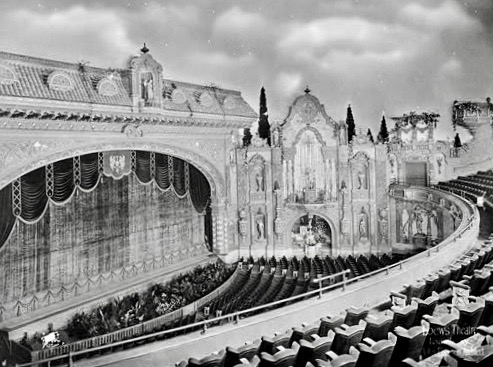
Town and Gown–Ghosts of Athens and the University of Georgia

A Haunted Southern Book of Days–27 January

This article is a part of an occasional blog series highlighting Southern hauntings or high strangeness associated with specific days. For a complete listing, see “A Haunted Southern Book of Days.”


The roots of both Athens and the University of Georgia are inextricably linked. Land for the university was purchased in 1801 by John Milledge who would later serve the state as governor. The land, on a hill overlooking Cedar Shoals on the Oconee River, was to house the state-supported university and parcels of land adjacent to the campus were sold to private interests. The town was incorporated as “Athens” in 1806 with a handful of residents, faculty and students. Athens grew quickly into a regional center for trade and education as well as a social center.

After the Civil War and the emancipation of slaves, Athens became a regional center for the African-America community. A school, The Knox School, was created and a prosperous African-American middle class emerged towards the end of the 19th century. The entire city saw rapid growth throughout the 20th century, some of it tied with the growth of the university. The city continues to expand with the university which has brought a world-class cultural experience to the region.

Alpha Gamma Delta House
(Thomas-Carithers House)
530 South Milledge Avenue

Alpha Gamma Delta House, 2011. Photo by Lewis Powell IV, all rights reserved.
Alpha Gamma Delta House showing the bas-relief that gives the house its wedding cake appearance, 2011. Photo by Lewis Powell IV, all rights reserved.

Built as a private home in 1896 and used as a sorority house since 1939, this exuberant wedding-cake like house is now listed on the National Register of Historic Places. William Winstead Thomas, a local engineer, built the house which was later bought by James Yancey Carithers as a wedding gift for his daughter, Susie. As legend tells, when Susie’s groom failed to show up for the ceremony on time, the distraught woman hung herself in the attic. The groom finally did show, having been delayed on the way to the nuptials, but Susie was dead. Her spirit has been seen throughout the house while girls living in her old room often become engaged, thus the suite’s name, “The Engagement Suite.” 

Classic Center
300 North Thomas Street
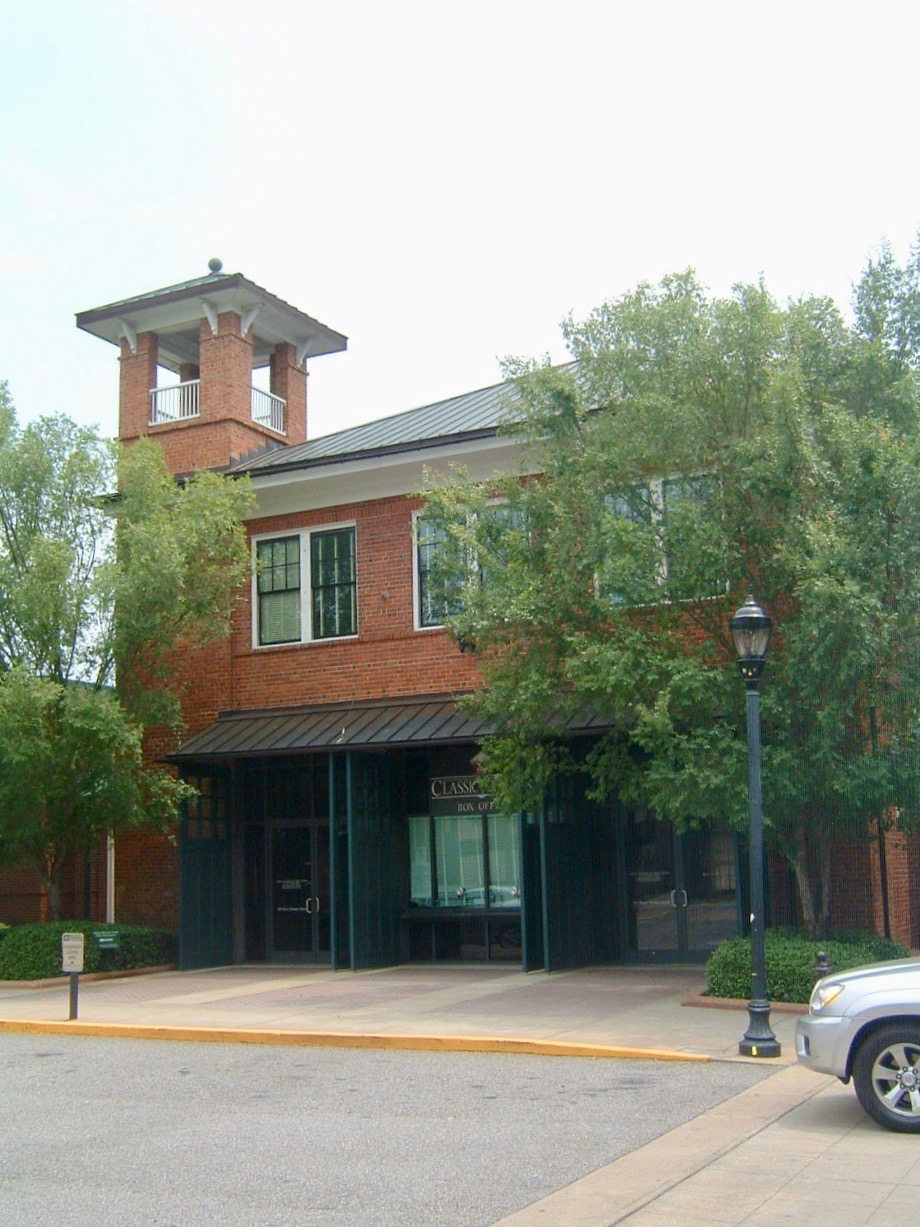
 

Firehouse No. 1, now the Classic Center, 2011. Photo by Lewis Powell IV, all rights reserved.

When it was decided to build a performing arts center in Athens, the original plans called for the demolition of the warehouses and the old 1912 Firehouse Number 1 which were standing on the site. However, local citizens fought to have the firehouse incorporated in the design. The firehouse was remodeled and now serves as a box office for the performing arts center that stands around it. Captain Hiram Peeler had had a distinguished career as head of the Athens Fire Department when he plunged to his death in an elevator shaft in 1928. It is believed to be his spirit that remains in the firehouse. Reports of activity were reported in the building while it still served as a firehouse. The activity continued through the building’s use as the Chamber of Commerce and has continued while it serves as the Classic Center.  

For further information on the Classic Center, see my article, “A chain-rattling, Classic spirit–Athens, Georgia.”

Morton Theatre
199 West Washington Street

Morton Theatre, 2011. Photo by Lewis Powell IV, all rights reserved.

Actors in the dressing room of this restored theatre have reported odd activity in the dressing room. Sadly, that’s all the information I can find in terms of the paranormal. The Morton Theatre was built by African-American businessman Monroe Bowers “Pink” Morton starting in 1909. The theatre was one of the main anchors of “Hot Corner,” the intersection of Washington and Hull Streets, that was the center of African-American life in Athens. It opened as a vaudeville house for the black community and such names as Butterbeans and Susie, Louie Armstrong and Cab Calloway appeared there. The building has since been restored as a performing arts center for the community and is one of the few remaining black vaudeville houses in the nation.

Oconee Hill Cemetery
297 Cemetery Street

Oconee Hill Cemetery, 2011. Photo by Lewis Powell IV, all rights reserved.

When the main city cemetery (now known as the Old Athens Cemetery) began sprawling close to the campus and the homes of the university president and professors, steps were taken to create a new cemetery nearby. Since it’s opening in 1855, the university has sprawled close to the cemetery with massive Sanford Stadium now looming across the street. The cemetery now hosts a number of prominent Georgians including two governors, eight university presidents and at least one ghost. The legend exists of a ghostly carriage appearing on the bridge between the old and newer portions of the cemetery.

View from Oconee Hill Cemetery towards Sanford Stadium, 2011. Photo by Lewis Powell IV, all rights reserved.

Old Athens Cemetery
Jackson Street

Old Athens Cemetery, 2011. Photo by Lewis Powell IV, all rights reserved.

The original city cemetery before Oconee Hill Cemetery was created; the cemetery was created around 1810. The last burial occurred in 1898, not long after the university first tried to reclaim the land. This would be a struggle that would continue through the 1980s. The cemetery was deeded back to school in 2004 and in 2006 a preservation program was instituted under the university’s grounds department. Kathleen Wall mentions that the ghost of a young girl has been seen in the cemetery. The location was investigated by the Georgia Haunt Hunters team in 1998 and the team discovered some temperature fluctuations.

Grave at the Old Athens Cemetery, 2011. Photo by Lewis Powell IV, all rights reserved.

Phi Kappa Psi House
398 South Milledge Avenue

Phi Kappa Psi House, 2011. Photo by Lewis Powell IV, all rights reserved.

In researching Athens, I keep coming across locations that are mentioned as being haunted, but there are few specifics given. This is one location that is briefly mentioned. Daniel Barefoot mentions that the brothers in this house have heard the crying of a baby. This Queen Anne style home was built in 1890.

Phi Mu House
(Hamilton-Phinizy-Segrest House)
250 South Milledge Avenue

Phi Mu House, 2011. Photo by Lewis Powell IV, all rights reserved.

The legend of the Phi Mu House, according to the sorority, concerns a young woman named Anna Powell. Her husband shot himself, either purposefully or accidentally at the bottom of the stairs. At times, it is said, a cross will appear on the floor where this horrific incident took place. Anna’s spirit has been encountered frequently by sisters in the house. Knocking and sobbing have been heard in the house and one young woman had the door unlocked for her late one night by unseen hands. The house was constructed by Colonel Thomas Hamilton, reportedly Georgia’s first millionaire, and finished in 1858 by his widow, Sarah. It has served as a sorority house since 1964. 

Taylor-Grady House
634 Prince Avenue

Taylor-Grady House, 2011. Photo by Lewis Powell IV, all rights reserved.

Built by Irish immigrant turned cotton merchant and planter, Robert Taylor, in 1844, the Taylor-Grady House was purchased by Major William S. Grady in 1863, at the height of the Civil War which he was fighting in. Major Grady was killed in the Battle of Petersburg and his spirit is said to have returned to his family’s home. Henry Grady, the major’s son, was a staunch advocate for the “New South” as managing editor for the Atlanta Constitution and a famed orator. As the only existing of Grady’s homes, the Taylor-Grady House was named a National Historic Landmark in 1976.

T. R. R. Cobb House
175 Hill Street
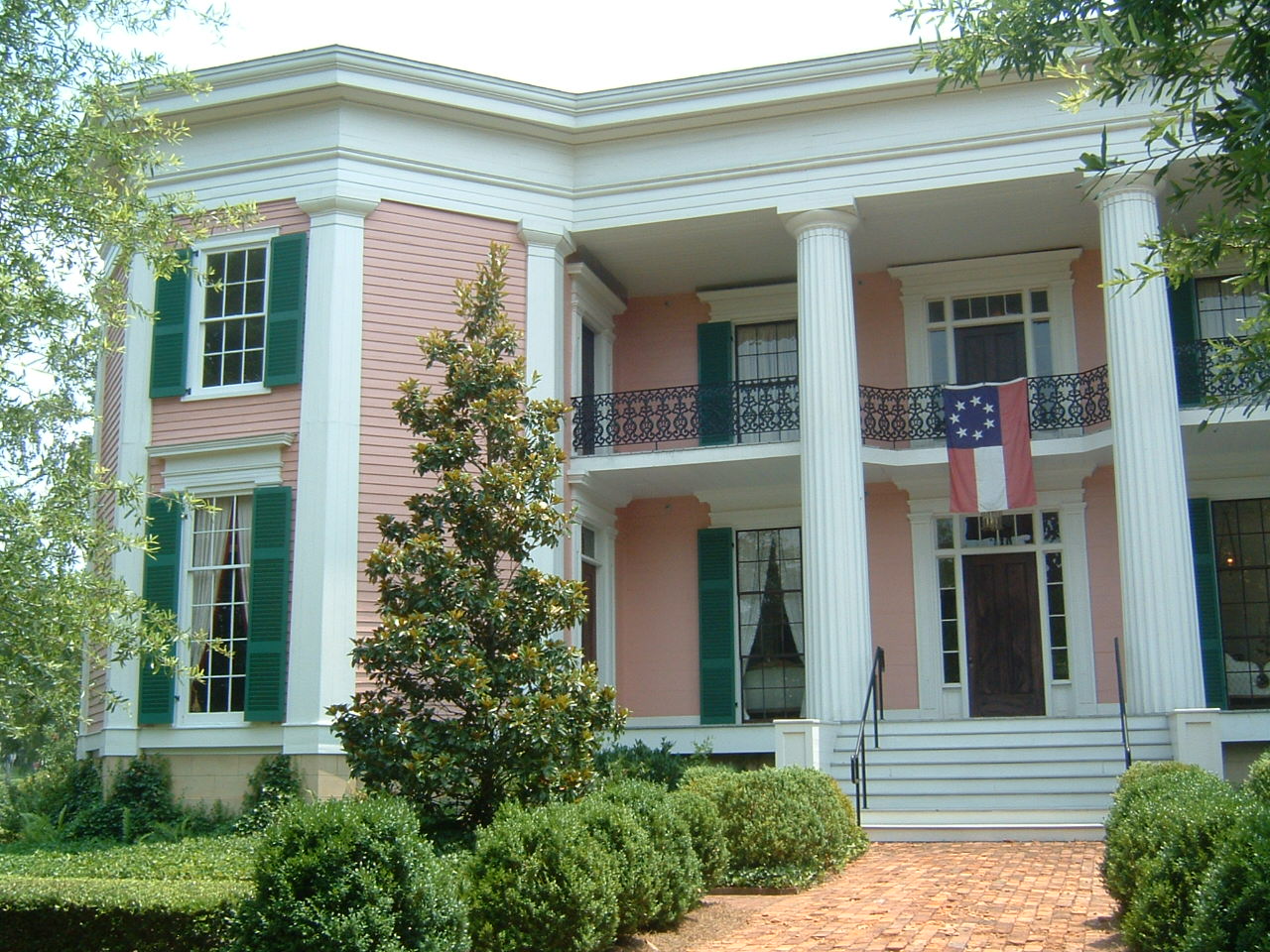
T. R. R. Cobb House, 2011. Photo by Lewis Powell IV, all rights reserved.

This noteworthy home with octagonal wings took the scenic route in its move from nearby Prince Avenue. It faced the wrecking ball in 1985, and was moved to Stone Mountain Park, just outside of Atlanta, to be restored as a part of the living history village there (which also has some notable haunted structures). After languishing 20 years, the home was returned to Athens and restored. A ghost story from this house was collected as part of the WPA Writers’ Project and recalls the spirit of “a gentleman wearing a gay dressing gown” who is seen descending the stairs and sitting in front of the fire in the drawing room. For further information, see my in-depth entry on this home, “A firebrand phantom.”

University of Georgia Campus

Joe E. Brown Hall

Joe E. Brown Hall, 2011. Photo by Lewis Powell IV, all rights reserved.

This 1932 building, built as a dormitory is home to a staircase to nowhere. Legend states that not long after the building was built, a student hung himself during Christmas break. His decomposing body was found when students returned. Though the mess was cleaned up, the blood stains were said to return. According to Daniel Barefoot, when the building was remodeled for office space, the room was sealed and the staircase leading to it blocked. In an article in the university newspaper, The Red and Black, a photograph of the staircase to nowhere was published in an article on campus legends. Supposedly knocking still issues from the sealed room.

Lustrat House 

Lustrat House, 2011. Photo by Lewis Powell IV, all rights reserved.

Like many of the oldest campus buildings, the Lustrat House has served a variety of functions. Currently the office of Legal Affairs, the building initially served as a residence for professors. Towards the end of the 19th century, it was home to Dr. Charles Morris, chair of the English Department. When the university decided to relocate the house in 1903, Dr. Morris attempted to assuage officials away from that plan. He refused to move with the home. After his death, the family of Professor Joseph Lustrat began to see Dr. Morris has surprisingly taken up residence, sitting in his favorite chair by the fire. 

Waddel Hall

Waddel Hall, 2011. Photo by Lewis Powell IV, all rights reserved.

The oldest building on campus still in its complete form according to Daniel Barefoot, Waddel Hall was built in 1821 as Philosophical Hall. The sounds of a tragic lovers quarrel are still heard in this building that now houses the university special events office. During World War I, a young man left his female love who fell for another in his absence. When he returned, he confronted his beloved and the quarrel ended in a murder-suicide.

Sources

  • Athens-Clarke Heritage Foundation. Milledge Avenue Walking TourNo date.
  • Barefoot, Daniel W. Haunted Halls of Ivy: Ghosts of Southern Colleges and Universities. Winston-Salem, NC: John F. Blair, 2004.
  • Bender, William N. Haunted Atlanta and Beyond. Toccoa, GA: Currahee Books, 2005.
  • Beynon, Valerie. “Morton Theatre.” The New Georgia Encyclopedia. 26 March 2005.
  • Burnett, Daniel. “Mythbusters UGA.” The Red and Black. 28 January 2009.
  • Hendricks, Bill. “Ghost trackers look for proof of afterlife: Athens haunt club checks Georgia sites.” The Atlanta Journal and Constitution. 1 December 1998.
  • History.” The Classic Center. Accessed 17 June 2011.
  • History.” Oconee Hill Cemetery. Accessed 17 June 2011.
  • History.” The Taylor-Grady House. Accessed 21 June 2011.
  • Jackson Street CemeteryWikipedia, the Free Encyclopedia. Accessed 17 June 2011.
  • Killion, Ronald G. and Charles T. Waller. A Treasury of Georgia Folklore. Atlanta, GA: Cherokee Publishing, 1972.
  • Miles, Jim. Weird Georgia. NYC: Sterling Publishers, 2006.
  • Miles, Jim. “Weird Georgia T.R.R. Cobb Haunts Athens Home.” Brown’s Guide to Georgia. Accessed 18 June 2011.
  • Roberts, Nancy. Georgia Ghosts. Winston-Salem, NC: John F. Blair, 1997.
  • Thomas, Frances Taliaferro. “Athens.” The New Georgia20 October 2010.
  • Thomas-Carithers House.” Accessed 15 June 2011.
  • R. R. Cobb House. Wikipedia, the Free Encyclopedia. Accessed 18 June 2011.
  • Walls, Kathleen. Georgia’s Ghostly Getaways. Global Authors Publications, 2002.

A jumble of legends–Western Kentucky University

Van Meter Hall
Western Kentucky University
Bowling Green, Kentucky

N.B. This article was edited and revised 5 February 2019.

The approach to the campus from downtown Bowling Green is quite grand. A tree-lined avenue runs up a hill to monumental Cherry Hall crowning the hill with an assemblage of other monumental buildings including Van Meter Hall. Built to resemble the Erechtheion, a temple on the Acropolis, Van Meter Hall was the first building on campus when it was completed in 1911. The new hall included office space, classrooms and a large auditorium. The hall has seen a variety of uses over the years and was renovated a handful of times including most recently in 2009, when additions improved the backstage space of the auditorium.

For such a comparatively young university (it was founded in 1906), the campus of Western Kentucky certainly has a number of ghosts. Similarly,  the University of Tennessee in Knoxville (which is more than a century older), the school has no qualms discussing its ghosts. A series of web pages from the University Archives provides an official record of the many legends across this architecturally significant campus.

Van Meter Hall, 2008. Photo by OPMaster, courtesy of Wikipedia.

The spectral history of Van Meter Hall is less clear. Various sources pick and choose from the various legends creating a confusing jumble of tales. The University Archives takes pains to point out the three main legends that exist in reference to Van Meter.

The first two stories involve deaths in the building. One story tells of a construction worker during the building’s construction who fell from scaffolding in the lobby and died in a pool of blood. An interesting detail that is sometimes included is that the worker was distracted by an airplane, a novelty in 1911. Similar versions of the story have the doomed worker falling through the skylight in the lobby or the skylight over the stage—a ridiculous notion as the stage does not have a skylight. The second story involves a student plunging to his death while hanging lights onstage. Both of these stories also include an indelible bloodstain either on the floor of the lobby or onstage.

The third story is more unusual. Kentucky is riddled with caves and this story tells of a cave underneath the hill inhabited by a hermit who would emerge into the building late at night with a blue lantern. Alan Brown’s Haunted Kentucky provides an interesting version of this story. He states that during construction of the building, the contractor discovered that cement being poured was flowing into an underground cave. Fearing possible bankruptcy, the contractor threw himself into the pit and was entombed in the concrete. The building was completed by a different contractor. He continues with a story about blue lights appearing in the darkened auditorium during performances, one episode causing a student working on lights to fall to his death—an interesting mix of legends, certainly.

While there is little concrete evidence (pardon the pun) to back up any of these legends, there still are numerous stories of strange phenomena within Van Meter’s walls. Daniel Barefoot’s Haunted Halls of Ivy speaks of lighting malfunctions, props moving on their own accord, and the curtains opening and closing on their own accord.

William Lynwood Montell’s monumental Ghosts Across Kentucky tells a story of a Mark Twain impersonator performing at in the hall around 1981 (the only report with a date). The actor asked the stage manager to get him from his dressing room a minute before he was to appear onstage. A few minutes before the performance, the stage manager saw a man dressed like Twain standing backstage and assumed this was the actor. When the actor failed to go onstage on time, the stage manager rushed to the dressing room and found the actor there.

Add into this mix, reports of the voices of a woman and a small child and the reports become more clouded. What, precisely, is going on in Van Meter Hall? It appears there is activity, but everything else is difficult to pinpoint. Nevertheless, one must wonder if the activity will continue after the most recent major renovations. We shall see.

Sources

  • Barefoot, Daniel W. Haunted Halls of Ivy: Ghosts of Southern Colleges and Universities. Winston-Salem, NC: John F. Blair, 2004.
  • Brown, Alan. Haunted Kentucky: Ghosts and Strange Phenomena of the Bluegrass State. Mechanicsburg, PA: Stackpole, 2009.
  • Hawkins, Jenna. “Building History—Van Meter Hall.” WKU Hilltopper Heritage. 2008.
  • Montell, William Lynwood. Ghosts Across Kentucky. Lexington, KY: University Press of Kentucky. 2000.
  • Van Meter Hall. Wikipedia, the Free Encyclopedia. Accessed 25 May 2011.
  • Western Kentucky University. Wikipedia, the Free Encyclopedia. Accessed 25 May 2011.
  • WKU Ghosts—Van Meter.” WKU Department of Library Special Collections—University Archives. Accessed 25 May 2011.

Haunted Southern College & University Buildings – Georgia

Demosthenian Hall
University of Georgia
Athens, Georgia 

One of the oldest organizations on the UGA campus, the Demosthenian Literary Society, a debating society, was founded in 1803. Among its alumni roster are many who would help shape the state of Georgia as well as the nation including Robert Toombs. Known for his fiery disposition and oration, Toombs represented Georgia in the United States House of Representatives, the Senate in the turbulent years leading up to the Civil War and served as the first Secretary of State for the Confederacy.

Robert Toombs, c. 1870-80. Photo by Matthew Brady or Levin Handy. Courtesy of the Brady-Handy Photograph Collection, Library of Congress, Prints and Photographs Division.

Toombs entered the university at the ripe age of 14. Under the firm rule of University President Moses Waddell, who was later described as having been “a born educator and strict disciplinarian,” Toombs was more than once on the receiving end of Waddell’s discipline. One evening, only a year or so into his schooling, a proctor caught Toombs and a group of other students playing cards—a vice worthy of expulsion. Instead of awaiting a dishonorable dismissal from the school, Toombs sought out Waddell and received an honorable dismissal before the proctor’s report arrived. Encountering Toombs later that day on campus, Waddell harangued him for this deception to which Toombs replied that he was no longer a student and simply a free-born American citizen.

Demosthenian Hall, 1934. Photo by Branan Sanders for the Historic American Buildings Survey (HABS), courtesy of the Library of Congress, Prints and Photographs Division.

However, the legend does not end there. During graduation exercises, Toombs took a position outside the university chapel (located just next door to Demosthenian Hall) next to an oak. He launched into a compelling oration and soon the students emptied out of the chapel to hear him speak. That oak was later named the “Toombs Oak” and remained for many decades. Legend says that the oak was later struck by lightning at the same time that Toombs died in 1885, however records show that the oak was dying, but still alive into the 1890s. According to Barbara Duffey, the oak was struck by lightning at the moment of Toombs’ death, but lived on and was finally taken down in 1908. Regardless, upon the tree’s death the stump was removed to Demosthenian Hall where it remains to this day.

Starting in the Georgia legislature in 1837, Toombs record of service to the state is lengthy. He entered the U.S. House of Representatives in 1844 and there forged a lifelong relationship with another Georgia representative, Alexander Stephens, who would later serve as vice president of the Confederacy. Toombs entered the Senate in 1853 and served until his resignation in 1861 when Georgia seceded from the Union. Jefferson Davis asked him to serve as the first Secretary of State, but Toombs became increasingly frustrated with the Confederacy and stepped aside to become a military commander for Georgia. He escaped the South as the Confederacy fell in 1865 and returned two years later as an “unreconstructed” Southerner.

Just as he returned to his beloved Georgia after the fall of the Confederacy, perhaps Toombs’ spirit has returned to his beloved Demosthenian Hall after his death. Students studying in the quiet of Demosthenian Hall have reported hearing pacing footsteps in the empty chamber above. Other students have felt a presence urging them to get out, but when they exclaim, “Bob, no!” the feeling dissipates. A hazy grey figure has also been spotted and other sources claim that the figure is outfitted as a Confederate soldier.

Demosthenian Hall, 2017. Photo by Lewis Powell IV, all rights reserved.

William N. Bender, in his Haunted Atlanta and Beyond, states that Toombs’ spirit has also been seen at his home in Washington, Georgia. He asks whether it is possible for a spirit to travel. In my opinion, it seems there is nothing to actually indicate that the Demosthenian Hall spirit is actually Robert Toombs. I have observed that in historic locations—especially those associated with famous people—there is a tendency to identify any spiritual activity with those famous people, even in cases where is unlikely. While it’s not unimaginable that Toombs might haunt his home, it appears that the activity within Demosthenian Hall is simply residual energy associated with the many students that have passed through the hall’s portals.

Henry Ford Building Complex
Berry College
Mount Berry, Georgia

Located on part of the largest college campus in the world (at more than 26,000 acres), the Gothic-style Henry Ford Building Complex now is mostly used for administration. The complex was built through a gift from automobile manufacturer, Henry Ford, one of many prominent philanthropists to aid this institution built on philanthropy. Martha Berry, the daughter of a local planter, was shocked by the ignorance of the children in this city at the foot of the Appalachians. She built a series of school to educate these impoverished children and of them, Berry College has survived as a symbol of her kind work.

Henry Ford Building Complex, 2008. Photo by TheCustomofLife, courtesy of Wikipedia.

According to Daniel Barefoot’s Haunted Halls of Ivy, Berry College’s two campuses, the Main and Mountain Campuses, are practically crawling with spirits. From the spirit of Frances Berry, Martha’s sister, at Berry’s home, Oak Hill to the female wraith haunting Stretch Road, the road between the campuses, to the ghost of the House o’ Dreams, a mountain retreat cottage. In the Henry Ford Building Complex, the spirit of a female student who hung herself after her boyfriend was killed in World War II, is said to still roam the building. Of course, with the beauty of Berry’s enormous campus, who wouldn’t want to return?

Pearce Auditorium
Brenau University
Gainesville, Georgia

Two sensitives associated with the Southeastern Institute of Paranormal Research in Pearce Auditorium encountered a wet female. Working independently, the sensitives discovered this sad form wearing a white dress with dark, matted hair. Perhaps this was Agnes, the auditorium’s resident spirit. Legend speaks of a young woman who hung herself in the building at some point during the 1920s. She’s been roaming the halls ever since.

Old postcard of the Brenau Campus. Pearce Auditorium is the building just right of center. Published by the Asheville Post Card Company, courtesy of the Georgia State Archives,
Historic Postcard Collection.

Opened as a private women’s school in 1878, Brenau gained its unusual name when the school was acquired by H. J. Pearce (for whom the auditorium is named) in 1900. The name is an amalgam of the German “brennen,” “to burn” and Latin “aurum,” “gold;” reflecting the school’s motto, “as gold refined by fire.”  The school has continued as a force for education in the region and opened its doors to men in the 1960s while retaining its historical Women’s College and acquiring a few ghosts along the way.

Pearce Auditorium, dedicated in 1897, was built to serve the needs of the campus as well as Gainesville. Over the years, the auditorium has seen names ranging from noted American dancers Ruth St. Denis and Ted Shawn to the Vienna Boys Choir and, if legend holds true, a slight dark haired young woman named Agnes. Since Agnes passed through the doors of the auditorium, numerous stories have been told about this dark-haired waif.

As with most legends, there are numerous versions and sources do vary. The basic story tells of a young music student who fell in love with a rakish music professor. He kissed her during a lesson and when he married another woman, the distraught student committed suicide by hanging herself in the building. All of this took place around 1926.

Investigators interested in Agnes’ legend have thoroughly searched school records and discovered one young lady who may be the real Agnes: Agnes Galloway, whose picture appears in the 1926 yearbook. Records indicate that Ms. Galloway, from Mount Airy, North Carolina, died young, though in 1929 and the reason given for her death was tuberculosis. While suicide was often covered up by image-conscious families, the year of her death obviously doesn’t agree with the legend. Nancy Roberts in her Georgia Ghosts published an interview that adds some fuel to the legend’s fire.

Roberts interviewed a student whose grandmother had attended Brenau and who had known Agnes. The interview includes the story of the music professor and has Agnes hanging herself in her room in Pearce. The student coincidently was assigned to the very room where Agnes’ life had ended. The student was awakened one evening and saw the ghostly image of Agnes hanging from the light fixture. But, what would account for the sensitives seeing a young woman who was wet?

Another investigation in 2005 by the Ghost Hounds did capture an EVP during an investigation, but who or what is actually haunting Pearce Auditorium may never be known.

Sources

  • Atkins, Jonathan M. “Berry College.” New Encyclopedia of Georgia. 15 April 2009.
  • Barefoot, Daniel W. Haunted Halls of Ivy. Winston-Salem, NC: John F. Blair, 2004.
  • Bender, William N. Haunted Atlanta and Beyond: True Tales of the Supernatural in Atlanta, Athens, and North Georgia. Toccoa, GA: Currahee Books, 2005.
  • Berry College. Wikipedia, the Free Encyclopedia. 20 May 2011.
  • Brenau University. Wikipedia, the Free Encyclopedia. Accessed 17 May 2011.
  • Coulter, E. Merton. The Toombs Oak, The Tree That Owns Itself, and Other Chapters of Georgia. Athens, GA: UGA Press, 1966.
  • Davis, Mark. “Ghost Hunter: His Mission: To chat with a School spirit.” The Atlanta Journal-Constitution. 31 October 2005.
  • “Exploring haunted history.” The Athens Banner-Herald. 31 October 2010.
  • Jordan, Julie Phillips. “Happy hauntings.” The Athens Banner-Herald. 31 October 1999.
  • Justice, George. “Robert Toombs.” New Encyclopedia of Georgia. 9 February 2009.
  • Mahefkey, Ann. “Brenau University.” New Georgia  Encyclopedia. 6 June 2006.
  • Robert Toombs. Wikipedia, the Free Encyclopedia. Accessed 16 May 2011.
  • Roberts, Nancy. Georgia Ghosts. Winston-Salem, NC: John F. Blair, 1997.
  • Stovall, Pleasant A. Robert Toombs: Statesman, Speaker, Soldier, Sage. NYC: Cassell Publishing, 1892.
  • Thomas, Brandee A. “Spirits of the past draw a crowd to History Center.” Gainesville Times. 30 October 2010.
  • Underwood, Corinna. Haunted History: Atlanta and North Georgia. Atglen, PA: Schiffer, 2008.
  • Walls, Kathleen. Georgia’s Ghostly Getaways. Global Authors Publications, 2003.

Mountainside Theatre: A Personal Experience

Mountainside Theatre
688 Drama Drive
Cherokee, North Carolina

If you’ve read this blog for awhile or have checked the very brief bio to the right of this entry you’ll know that I’m an actor. If you didn’t know, my secret is out. By nature, theatre people tend to be very superstitious and it’s noted that any theatre worth its salt should have a ghost. The Mountainside Theatre is no exception.

Three of the best summers of my life were spent working in Cherokee at the Mountainside where the outdoor historical drama, Unto These Hills, has been performed every summer since 1950. The Appalachians hold a particular charm and having lived there, even just a few months, I truly feel that part of my heart is there. Of course the atmosphere of living among fellow theatre people—who possess tremendous energy, intelligence and creativity—enhances that experience. And the parties and Bohemian life was awesome as well!

Cherokee lies at the heart of the Qualla Boundry Cherokee Indian Reservation, the seat of the Eastern Band of Cherokee. The Mountainside Theatre was built to house Kermit Hunter’s play, Unto These Hills, which tells the story of these particular Cherokee people. The drama utilizes both hired actors and members of the Cherokee community in telling the story and for many of the locals the drama has become a family tradition with grandparents performing alongside their grandchildren and sometimes great-grandchildren.

My first year in Cherokee, I played the role of the Lieutenant, a rather gruff, white Federal officer who viewed the Cherokee with contempt. In the scene depicting the beginning of the Trail of Tears, I led the march just behind Major Davis and took a position standing on a boulder on the side stage, rifle in hand, watching as the Cherokee marched off towards Oklahoma. Nightly I would look into the faces of these people walking in the steps of their ancestors and would see scowls and expressions of outright hatred, even from people that I considered friends offstage. It was a moving experience to see history recreated and see the consequences of that same history juxtaposed into that.

Entrance to the Mountainside Theatre, November 2012. Photo by Lewis Powell IV, all rights reserved.

The theatre itself is a huge open air amphitheatre that can seat a few thousand. The theatre is surrounded by forest and the backstage area has been constructed to preserve the tree line that gives the theatre a wonderful sylvan quality. The stage and side stages include trees, shrubbery and boulders to complete the picture. Behind the back wall of the stage there is a covered walkway with a props storage area just off stage left. Below this walkway, the terrain drops a bit further which is spanned by a covered walkway, called “The Bridge,” that connects the stage to the rest of the backstage area. Wrapping around the side of the mountain is a long building with the stage manager’s office, costume shop and dressing rooms. At the very end of this building, parallel to the driveway leading up the hill to cast housing, is the laundry room and a small porch called the “laundry porch.”

Entrance to the Mountainside Theatre, November 2012. Photo by Lewis Powell IV, all rights reserved.

Except for the very top tier of the actors hired for the production, most other performers in the show served double duty either doing technical work (the Actor Techs or ATs) or working in the costume shop. I worked in the costume shop and part of my duty was to do laundry once a week after the show. Once the show was up and running, everyone went on to “Cherokee Time” where bedtime was sometime between 4AM to sunrise and wake up time was around noon or sometime thereafter. None of us usually had to be at work at the theatre until 6PM, so many of us became partially nocturnal.

Within a few days of my first arrival on “The Hill,” I began to hear stories and legends about the area. One of the costumers in those first few days had gone down to the theatre late one evening for some quiet. As he sat in the empty theatre he heard the sound of a horse running around the theatre. Interestingly, there were no horses in the area nor had any ever been used in the show. Other stories began to surface from some of the longtime cast members of others having odd experiences in the theatre at night. I can recall hearing one story of someone sitting in the theatre alone only to turn his head to see someone sitting in the row behind him staring straight ahead, trancelike.

Another story involved a particular former cast member, since deceased, who would sit on the laundry porch during the show. It was said that people driving past the theatre would still occasionally glimpse her sitting on the porch. An even further tale told of the techies who fired guns offstage for sound effects seeing a Cherokee dancing among the trees in the dark woods offstage. In some versions of the story he was seeing floating some feet off the ground as he danced.

The one legend that I heard almost invariably involved the Cherokee Little People, or Yun’wi Tsundsdi. I described this mythic race in my article on Chimney Rock, please see the article for a better description. In the lore of the area, the Mountainside Theatre had been constructed on ground that was sacred to the Yun’wi Tsundsdi. During the day, the theatre was lent to humans for their uses, but at night it returned to their territory. We were taught to announce ourselves whenever we went to the theatre at night. When we reached the bridge we would call out, “I mean you no harm, don’t mind me.” Failure to do so would cause the Little People to play tricks on you.

However, theatre people do love a good story. I’m not sure how much of this was truly real and how much had been concocted to scare naïve new “Hillbillies.” Nonetheless, this was the mythology that was in place.

At least I thought this was mostly mythology until one night. It was my laundry night and I had dutifully put a load of laundry in the wash. The evening was fairly quiet and there wasn’t much partying. Not really being a partier myself I had been in my room reading a book about the Yun’wi Tsundsdi. Around 3AM I walked down the hill to the laundry room to put the load of laundry in the dryer. As I walked, I muttered the Cherokee name of the Little People repeatedly in an attempt to commit it to memory. It’s a fun name to say. However, I didn’t realize that it also calls them.

I put the laundry in the dryer and started back up the hill to my room in the Boy’s Dorm. Between the end of the laundry porch and the first of the cabins of “Lower Suburbia” there is maybe 100 feet (by my estimation and I’m a poor judge of distance). On one side of the drive is forest with laurel and rhododendron growing thickly among the pines. From this thick forest I suddenly heard the sound of high pitched giggling. It was not drifting down from the ever present crowd at the picnic table outside of the Girl’s Dorm, it was coming from the forest next to me. I stopped for a moment and tried to peer into the shadows. There wasn’t anything to be seen. I uttered a tentative, “Hello?” but it was met with silence.

The view from the laundry porch towards the woods where I heard giggling, October 2012. Photo by Lewis Powell IV, all rights reserved.

Again, the giggle issued from the thick shrubbery and again I said hello. No answer. The night time cacophony of the Appalachians can be quite startling to an outsider from the scream of the bobcat (which I thought was a woman being raped when I first heard it) to the various night birds (nighthawks and owls), but this was none of those. It was a childish giggle. Once more I heard it coming from the thick woods directly in front of me. At that point the instinct of fight or flight kicked in and I flew; up the hill and back to the safety of my room. Having been reading about the Yun’wi Tsundsdi, I assumed that it was them that I heard. This was confirmed the next day by a close Cherokee friend.

I can only describe what happened. I’ve thought about it many times since and searched for a more likely explanation, but I can find none. That was my only experience on The Hill. There were times when I would find myself alone at the theatre during my laundry night and I would feel uncomfortable; that feeling of not being alone and sometimes being watched.

While I cannot say for certain that the Mountainside Theatre is haunted, it’s certainly a place that could easily inspire such stories. The play Unto These Hills, although in a different form from Kermit Hunter’s original version, is still performed nightly during the summer and the theatre is open to visitors during the day. Tickets for the show may be purchased at the Cherokee Historical Association Offices, also known as “The Hut,” (which is also haunted) at the bottom on the hill in the village at 564 Tsali Boulevard.

Sources 

Spirited Soldiers and Sailors–West Virginia

Soldiers and Sailors Memorial Building
200 South Kanawha Street
Beckley, West Virginia

So far, West Virginia has been this blog’s Achilles heel. While Mississippi has not been well documented in terms of its ghosts, it seems that West Virginia is in the same quandary. So far, I’ve found 2 books about the ghosts of Mississippi and 4 on the ghosts of West Virginia. Therefore, whenever I find anything on either state I get excited.

Halloween is a wonderful time to pull newspaper articles on ghosts and I was excited to find a great article on the Soldiers and Sailors Memorial Building in Beckley, West Virginia. The article, “Stories of Beckley’s ghosts to be told Friday” from The Register-Herald, is regarding a fundraiser presentation for Theatre West Virginia which has just recently moved into the building. The presentation, called “Beckley’s Ghosts, Legends & Lore,” included storytellers describing experiences with the paranormal, including their own, in Beckley. The article then turns to the stories about the Soldiers and Sailors Memorial Building.

The article quotes Scott Worley, Raleigh County Historic Landmarks commissioner and historian, as stating that many people have had strange experiences in the building. He includes a story about a phantom saxophone solo that was heard during a show in the theatre. Of course, no one with a saxophone was in the building at the time.

A quick search online produced an investigation report from Eastern States Paranormal, a ghost hunting organization out of Virginia. The investigation, evidently conducted this year but otherwise no date is provided, produced some very interesting results. While the first few hours of the investigation was fairly quiet, the final few hours were particularly active starting during the group’s break with a noise like “a herd of elephants r[unning] across the stage.” For the next few hours the group was bombarded with many noises including “footsteps and doors closing…along with knocks, bangs and every other thing you could expect at a ghost hunt.”

According to the background information provided in the investigation report, the theatre opened in 1931 as a memorial to the veterans of World War I. During the opening ceremony, a set of makeshift bleachers collapsed injuring some including a tuba player who survived despite a broken neck. “Bob,” the tuba player, at some point later took up residence in an apartment in the basement of the building and it is there that his apparition has been seen. James Foster Robinson’s 2008 book, A Ghostly Guide to West Virginia, provides a brief mention of this building and simply identifies the ghost as a “gentleman ghost cloaked in gray” though he also mentions that music and children’s laughter are also heard in the building.

The Soldiers and Sailors Memorial Building is owned by the Raleigh County Commission which has just recently handed over use of the building to Theatre West Virginia, a noted theatre company in the area. At the moment, the company is renovating the building for future use.

UPDATE 14 July 2011 

In an earlier article, I covered this location in Beckley and recently, a little bit more information has been released about it. Briefly, the building is a theatre opened in 1931 as a memorial to veterans of World War I. During the opening ceremonies for the building, hastily erected bleachers collapsed with a few injuries but no deaths. Legend holds that one of those injured was a band member named Bob. For the remainder of his life, Bob suffered neck problems and was offered a small apartment in the basement of the building. After his death, his spirit has reportedly been encountered.

As I pointed out in the original article, the structure was investigated by Eastern States Paranormal who encountered a great deal of evidence. Patricia Marin, a writer on the paranormal for Examiner.com recently wrote an article about some of the evidence from that investigation that has recently been publicized by the group. The investigation began slowly, but when the group took a break they heard a sound similar to “a herd of elephants running across the stage.” After that, activity filled the space. Sounds included someone, possibly Bob, walking across the stage, response knocking and a sound akin to tap dancing. Some of this evidence has been posted to the website of Eastern States Paranormal, here.

Theresa Racer’s marvelous blog, Theresa’s Haunted History of the Tri-State, includes an entry on this location and provides a few more details on the history and the haunting of this structure. According to her, the building has served a variety of uses including a temporary courthouse, county library, YMCA and community center. After my last entry on the building, a good friend of mine who is from Beckley revealed that he had taught art classes in the building.

Racer includes the rumor that the building may be built near a Civil War era graveyard which was used by a local hospital during the war. She notes that two locations nearby, the old Beckley Junior High School (occupied by Mountain State University) and a radio station, may all be haunted by Civil War era spirits associated with the cemetery.

According to Marin’s Examiner article, the building will be taken over by Theatre West Virginia next month.

Sources

  • Eastern States Paranormal. Soldiers and Sailors War Memorial Theater. Accessed 8 November 2010.
  • Kuykendall, Taylor. “Stories of Beckley’s ghosts to be told Friday.” The Register-Herald. 28 October 2010.
  • Lannom, Andrea. “County hands TWV control of Soldiers and Sailors Building. The Register-Herald. 25 June 2010.
  • Marin, Patricia. “Eastern States Paranormal investigates haunted theatre in West Virginia.” Examiner.com. 6 July 2011.
  • Racer, Theresa. “Soldier’s Memorial Theater, Beckley.” Theresa’s Haunted History of the Tri-State. 2 March 2011.
  • Robinson, James Foster. A Ghostly Guide to West Virginia. WV: Winking Eye Books, 2008.

The haunting of Columbus, Mississippi

The Google News Search feature is quite useful for web-based ghost hunting, especially around Halloween. Newspapers throughout the world are printing articles about local ghosts and ghost tours. I stumbled on an article about a ghost tour being held in Columbus, Mississippi and it put me on the path to a handful of articles. I’ve been able to connect those with a few entries in some books, and voila; I have the basis for a blog entry.

As I stated in one of the first entries, it appears to me that Mississippi has not been as well documented as other Southern states. I still believe this. Where my research might turn up mounds of information, I can usually only find a trickle for the Magnolia State. That’s why I’ve been surprised to find so much information on Columbus. Certainly, this city could be called the best documented city in Mississippi, at least in terms of its ghosts. Of course, it does help that three of the state’s better known hauntings: Waverly, Errolton and Temple Heights; are located in the city.

The banks of the Tombigbee River near Columbus, Mississippi. Undated postcard courtesy of the Mississippi State Archives, Cooper Postcard Collection.

“Sprawling leisurely along the banks of the Tombigbee and Luxapalila Rivers, is a city in which there is room to breathe.” That’s how the opening line of the city’s entry in the 1938 WPA Guide to Mississippi begins. It continues and describes the “gracious lines of Georgian porticos forming a belt of mellowed beauty about a modern business district.” Certainly, Columbus is a city known for its concentration of old homes, many of them antebellum. The city was later the birthplace of famed American playwright, Tennessee Williams, who would preserve and analyze the South in his plays; among them, A Cat on a Hot Tin Roof and A Streetcar Named Desire.

Columbus was originally named “Possum Town,” for Spirus Roach who was “gray and bent and wizened” and reminded the local Native Americans of a possum. Roach set up a tavern there in 1817. However, with the arrival of other white men who “expressed their distaste for Indian humor,” the town was given the more respectable name of Columbus in 1821. The city grew as a center for the many planters in the area as well as a center for education with the establishment of Franklin Academy and later, the Columbus Female Institute (now Mississippi University for Women). During the Civil War, the city hosted the state government while Jackson was in Union hands. A story told of the 1863 visit of Confederate President, Jefferson Davis, describes the townspeople gathering under Davis’ bedroom window and serenading him. After being awakened by the joyous throng, Davis addressed the crowd, still in his nightshirt, from his balcony. History aside, though, we came about the ghosts…

The following list has been created not just from articles on the ghost tour, but other resources as well.

Friendship Cemetery
Fourth Street South

Created on land by the Order of the Odd Fellows in 1849, Friendship Cemetery includes local citizens and soldiers who fell at the Civil War Battle of Shiloh in 1862. It is a Confederate soldier that is said to still walk through the military section of the cemetery. Visitors to the cemetery are also attracted to the weeping angel that stands over the grave of the Reverend Thomas Teasdale. People grasping the angel’s hand have remarked that it feels lifelike. While the angel’s hand might be explainable phenomena, the soldier’s apparition may not be as easily explained away. I would be interested to find out if the cemetery has been investigated by a ghost hunting organization.

Lincoln Home
714 Third Avenue South

Built in 1833, the Lincoln Home was home to one of the first mayors of the city. Now a bed and breakfast, the home has been marvelously restored and may still be visited by former residents. A woman in white has been reported by neighbors and guests while a dark, black and grey cloud has been witnessed by the owners drifting though the parlor.

Waverly
1852 Waverly Mansion Road

 
Waverly in 1936, this is probably as the house probably first appeared to the Snows. This was taken nearly 30 years before the house was rescued. Photo by James Butters for
the Historic American Building Survey (HABS), courtesy of the Library of Congress, Prints and Photographs Division.

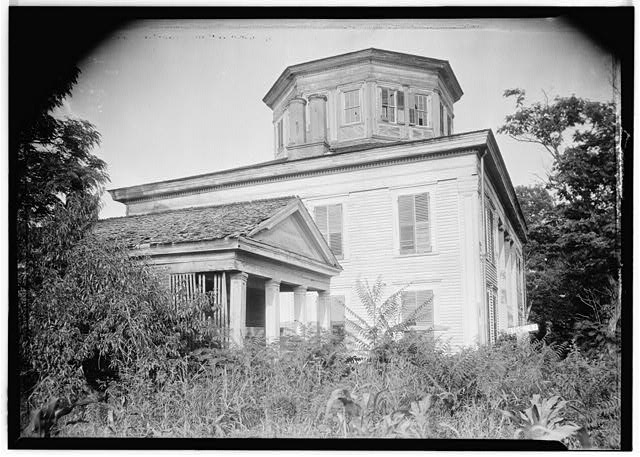
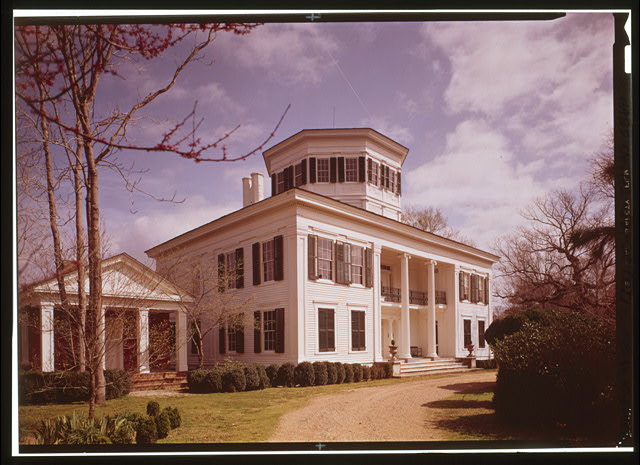
Located between Columbus and West Point in Clay County, Waverly was named a National Historic Landmark in 1974. This graceful house features an octagonal rotunda that rises above the roof of the house. When Robert and Donna Snow discovered the house in the early 1960s, it was an immense, magnificent mess, uninhabited for nearly 50 years that had been left to its ghosts. Though ghosts were not at all on their mind when they began restoration, the spirits of Waverly announced their presence with a loud crash that awoke the family. Locals began to tell stories of hearing the sound of parties coming from the ruined manse as well as the spirit of an Indian riding a stallion through the nearby fields. But no one prepared Mrs. Snow for the plaintive cries of a little girl that she began hearing. Occasionally, between two and four in the afternoon, the impression of a little girl would appear on the bed of one of the upstairs bedrooms.

Waverly after restoration. Photo for the Historic American Building Survey (HABS), courtesy of the Library of Congress, Prints and Photographs Division.

The voice of the little girl was heard for about five years and then no more, but her spirit is still seen around the house. According to Alan Brown’s Haunted Places in the American South, the identity of this little girl was a mystery until 1997 when records revealed that two little girls staying in the house during the Civil War died during a single, tragic week. One girl died of diphtheria, the other, while playing on the stairs, got her head stuck between two of the spindles. During the struggle to free herself, she died as well.

The magnificent rotunda of Waverly. Photo for the Historic American Building Survey (HABS), courtesy of the Library of Congress, Prints and
Photographs Division.

Since her death in 1991, the ghost of Mrs. Snow has been reported sitting on the third floor stairs smoking. Apparently, the ghosts of Waverly are still quite active. The North Mississippi After Life (NMAL), a paranormal investigation group, performed an investigation at the house, though only a small amount of evidence was uncovered.

Princess Theatre
217 Fifth Street South

The 1924 Princess Theater was constructed originally as a vaudeville theater, then converted to cinema as the popularity of vaudeville waned. According to Adelle Elliott, with the Columbus Convention and Visitor’s Bureau, the ghost of the theater’s original owner, Mr. Kirkendall, has been seen throughout the theater. A paranormal team photographed a figure standing in the balcony, possibly one of many ghosts within the theater. The theater is still utilized as a performance space.

Errolton
216 Third Avenue South

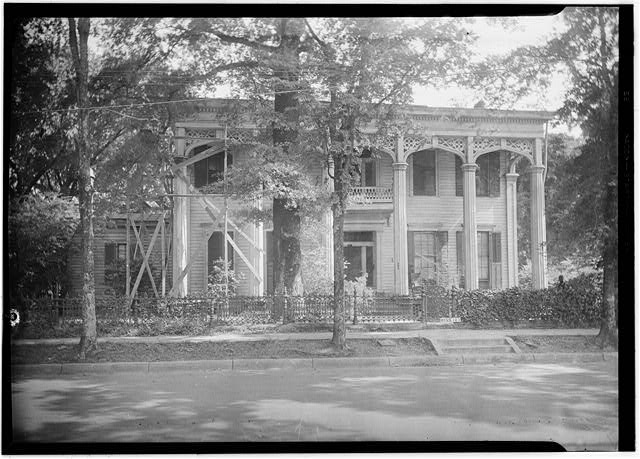
For more than half a century, the familiar figure of Miss Nellie Weaver rocked on the porch of her father’s home telling stories of Columbus’ past that she had witnessed herself. Until her death in the 1930s, the story of Miss Nellie, as she was affectionately called, was well known in town. Born and raised in the magnificent house on Third Avenue, she had had numerous suitors, but Charles Tucker caught her eye and they were married 1878. In her nuptial mirth, Miss Nellie carved her name with her diamond engagement ring on one of the windows in the south parlor. Charles Tucker left his wife and young daughter, Ellen, a few years later.

Errolton, around the time of Miss Nellie’s death. Photo by James Butters for the Historic American Building Survey (HABS), courtesy of the Library of Congress, Prints and
Photographs Division.

Miss Nellie and her daughter remained in the home and she supported herself by teaching, though the house slowly decayed. In 1950, the house was purchased by Mrs. Erroldine Hay Bateman who set about restoring the home. It was during this restoration that a careless worker broke the pane of glass bearing Miss Nellie’s signature. The glass was replaced and after the restoration, the residents were surprised to notice the atching had reappeared. Besides this reappearing signature, no other spiritual activity has been reported in this regal, “Columbus eclectic” styled home.

Temple Heights
515 Ninth Street North

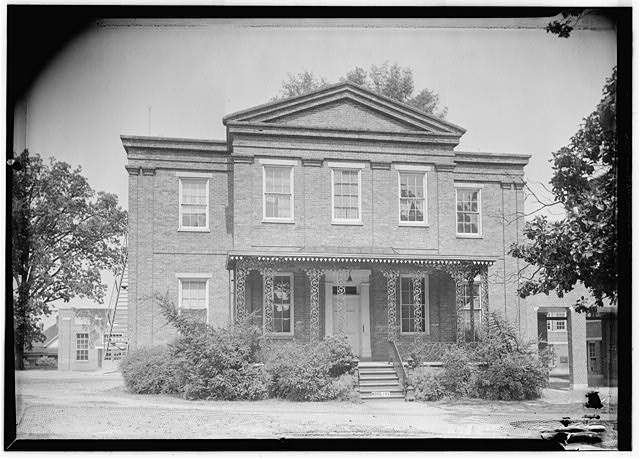
Built in the style of a Doric Temple with an odd (at least to me) roof rising above it, Temple Heights is one of the more well known restoration jobs in the city. Dennis William Hauck states that the ghost in this circa 1837 home is that of Miss Elizabeth Kennebrew, whose father purchased the house in 1887. Miss Kennebrew died a spinster and was known for her eccentric behavior. Her ghost has been spotted throughout the house and she may also be responsible for the voices heard throughout. The house is open for visitors and events.

Temple Heights, 1936. Photo by James Butters for the Historic American Building Survey (HABS), courtesy of the Library of Congress, Prints and Photographs Division.

Wisteria Place
524 Eight Street North

Upon the death of William Cannon, who built Wisteria Place around 1854, Jefferson Davis remarked, “I have lost my best friend.” While Cannon did die in this house, the identity of the home’s resident spirit is unknown. According to the Beth Scott and Michael Norman’s Haunted America, a figure in a white shirt has been seen scurrying past the kitchen window towards the door. This house is a private residence.

Highland House
810 Highland Circle

Highland House. Undated postcard courtesy of the Mississippi State Archives, Cooper Postcard Collection.

According to the Convention and Visitor’s Bureau Historic Driving Tour pamphlet, this house was built by W. S. Lindamood in the “Robber Baron style” around 1902. This was in love with Lindamood. Garthia Elena Burnett, author of one of the articles highlighting the city’s ghost tour states that some interesting EVPs have been captured in this historic residence.

Lee House
316 Seventh Street North

Once the home of General Stephen D. Lee, the youngest Confederate lieutenant general during the Civil War, this house was built circa 1847. Lee was later involved with the creation of Vicksburg Military Park. His ghost has been seen sitting in the parlor of his former home, while the shade of his wife has been seen during the annual pilgrimage tours. Her form was so solid, she was mistaken for a costumed guide.

Lee House, 1936. Photo by James Butters for the Historic American Building Survey (HABS), courtesy of the Library of Congress, Prints and Photographs Division.

Sources 

  • —–. Lincoln Home circa 1833. AmziLoveLincolnHomes.com. 2010. Accessed 24 October 2010.
  • Breland, David. “Local Haunts: Columbus Ghost and Legend Tour offers look into town’s spooky past.” The Reflector. 21 October 2010.
  • Breland, David. “Visit to Columbus haunts makes for Halloween not easily forgotten.” The Reflector. 29 October 2007.
  • Brown, Alan. Haunted Places in the American South. Jackson, MS: University Press of Mississippi, 2002.
  • Burnett, Garthia Elena. “Ghosts and Legends: A tour of local haunts.” The Commercial Dispatch. 14 October 2010.
  • Columbus Mississippi Convention and Visitor’s Bureau. Historic Driving Tour, Columbus, Mississippi. July, 2008.
  • Federal Writer’s Project of the WPA. Mississippi: A Guide to the Magnolia State. NYC: Viking, 1938.
  • Hauck, Dennis William. Haunted Places: The National Directory. NYC: Penguin, 2002.
  • Hubbard, Sylvia Booth. Ghosts! Personal Accounts of Modern Mississippi Hauntings. Brandon, MS: Quail Ridge Press, 1992.
  • Lowndes County, Mississippi History and Genealogy. Friendship Cemetery. Accessed 24 October 2010.
  • North Mississippi After Life. Waverly Mansion. Accessed 24 October 2010.
  • Scott, Beth and Michael Norman. Haunted America. NYC: TOR, 1994.
  • Stephen D. Lee. Wikipedia, the Free Encyclopedia. Accessed 25 October 2010.
  • Taylor, Troy. “Haunted Mississippi, Errolton, Columbus, Mississippi.” Ghosts of the Prairie. 1998. Accessed 22 October 2010.
  • Taylor, Troy. “Haunted Mississippi, Temple Heights, Columbus, Mississippi.” Ghosts of the Prairie. 1998. Accessed 22 October 2010.
  • Taylor, Troy. “Haunted Mississippi, Waverly, Columbus, Mississippi.” Ghosts of the Prairie. 1998. Accessed 22 October 2010.
  • Windham, Kathryn Tucker. 13 Mississippi Ghosts and Jeffrey. Tuscaloosa, AL: U. of Alabama Press, 1974.

Louisville Palace Theater–A Photographic Tour

Louisiville Palace Theatre
625 South Fourth Street
Louisville, Kentucky

The facade of the Louisville Palace Theater, 2006. Opened in 1928 as the Loew’s Theater, this grand movie house was designed by noted movie palace designer, John Eberson (1875-1964). Photo by StevietheMan and courtesy of Wikipedia.
Wall detail in the outer lobby. Eberson utilized the Spanish Baroque style for the theater. He often used “exotic” architectural styles for his theaters. This magnificent edifice The theater remained open as a movie house until 1978 when it closed as a movie house. It was purchased by investors and opened as a nightclub. The club closed in the mid-1980s and the theater was purchased in 1991 by a company with the intention of restoring it and creating a venue for live performance. Photograph by Jack Boucher, 1979 for the Historic
American Buildings Survey (HABS), courtesy of the Library of Congress, Prints and Photographs Division.
The house and stage of the Louisville Palace. The theater is designed to ensconce the audience in a Spanish Baroque courtyard. The ceiling is an atmospheric ceiling with clouds. In the 1960s, this balcony was enclosed as a second theater, but this alternation was removed during the restoration in the 1990s. It’s not hard to imagine spirits spending their afterlife in such a magnificent edifice. A handful of spirits have been reported here including a man in 1930s clothing that has been seen in this balcony. When approached by ushers, the man disappears. Photo taken after 1933, courtesy of the Historic American Building Survey (HABS) collection, Library of Congress, Prints and Photographs Division.
The lobby with the Grand Staircase leading to the mezzanine lobby. A staff member has reported seeing a woman in a 1940s era outfit climbing the stairs. When the spirit stops and turns, she has no face. Photo taken after 1933, courtesy of the Historic American Building Survey (HABS) collection, Library of Congress, Prints and Photographs Division.
The upper lobby with its magnificent coffered ceiling. The sculptural details on the ceiling feature the heads of 138 “immortals” including John Eberson, the theater’s architect, Socrates and Beethoven. Photo taken after 1933, courtesy of the Historic American Building Survey (HABS) collection, Library of Congress, Prints and Photographs Division.
The entrance to the Ladies Parlor. Theater employees have heard a young child’s giggling coming from the restroom just beyond this door. One staff member reports seeing a pair of child’s feet in a stall and heard stall doors slamming. Photo taken after 1933, courtesy of the Historic American Building Survey (HABS) collection, Library of Congress, Prints and Photographs Division.
The house from the stage. The projector room towards the back, now used as the lighting booth is where the spirit of a former projectionist may roam. Legend speaks of a loyal projectionist who suffered a major heart attack while on the job. As he was being carried from the booth on a door, he fell off and down the stairs, dying instantly. Staff have encountered his spirit in his old booth. Photo taken after 1933, courtesy of the Historic American Building Survey (HABS) collection, Library of Congress, Prints and Photographs Division.
The mezzanine promenade. During the restoration, the spirit of a man in 1940s era clothing appeared throughout the theater. Workers had tools moved and would hear voices. One of the workers who fell asleep on scaffolding while painting a ceiling was awakened by a voice moments before he nearly rolled off. This spirit continues to be seen throughout the theater and has been identified as Ferdinand Frisch, a theater employee who died in the building in 1965. Photo taken after 1933, courtesy of the Historic American Building Survey (HABS) collection, Library of Congress, Prints and Photographs Division.

Sources

  • Historic American Buildings Survey. Loew’s Theatre, 625 South Fourth Street, Louisville, Jefferson, KY. HABS Collection, Library of Congress, 1979.
  • Gravatte, Jay. The Palace Theatre. Louisville Ghost Hunters Society. Accessed 2 October 2010.
  • John Eberson. Wikipedia, the Free Encyclopedia. Accessed 2 October 2010.
  • Louisville Palace. History. Accessed 2 October 2010.
  • The Louisville Palace. Wikipedia, the Free Encyclopedia. Accessed 2 October 2010.
  • Parker, Robert W. Haunted Louisville: History and Hauntings from the Derby City. Decatur, IL, Whitechapel Press, 2007.

“Our law is joy”–Abbeville Opera House

Abbeville Opera House
100 Court Square
Abbeville, South Carolina

Ruth, it’s these fellows are fooling you! It’s they who keep your head set on the wages of sin, and all that rubbish. What have we got to do with suffering and sacrifice? That may be the law for some, and I’ve tried hard to see it as outlaw, and I thought I had succeeded. But I haven’t! Our law is joy, and selfishness; the curve of your shoulder and the light on your hair as you sit there says that as plain as preaching.
—William Vaughn Moody, The Great Divide, 1906, the first play to open the Abbeville Opera House.

I’ve discovered, with much joy, that the state of South Carolina, like Virginia, has placed all of its National Register nomination forms online! Therefore, research for this state has been made much easier. Since I haven’t written much yet on South Carolina, I’ve been focusing on it this week.

As you may notice in my brief bio at the right of this text, I’m an actor first. I’ve been performing onstage since the ripe old age of four; starting as a singer and in musicals and working my way up to earning a theatre degree from Columbus State University in Columbus, Georgia. Following college, I have continued to play various roles both on and off stage including helping to found a Shakespeare company and editing and co-writing a history of the Springer Opera House in Columbus, as well. The Springer is haunted, of course, and I do plan on writing about it in the future. So, theatres, especially haunted theatres, combine two of the great passions in my life. What could be better?

Abbeville Opera House, 2004. This public domain image is by
K. Armstrong of National Scenic Byways Online.

Theatre has been a part of American culture from quite early on. Native Americans included theatre and dance as a part of their rituals. Many of the earliest European settlers shunned such cultural extravagances as being sinful—“they who keep your head set on the wages of sin”– but theatre took hold in the mid-18th century and did not let go. Travelling companies formed and trooped through the frontier bringing Shakespeare with them to people starved for any entertainment. Towards the end of the 19th century, theatres were springing up in any city that wished to call itself such. These theatres were the stopping places for thousands of performers travelling “the Road.”

Legend has it that Abbeville, South Carolina was just a nightly stopping place for major companies on the Road. When the citizens of Abbeville realized the benefits of having these companies perform in town, they built a theatre to accommodate performances. On an early evening in October of 1908 (sources differ as to the exact date), the opera house opened with a performance of the melodramatic The Great Divide. The local paper, The Abbeville Medium, raved that “the show was far above the average show that hails this way.” Later that month, Thomas F. Dixon’s controversial play, The Clansman, appeared. The play had caused riots and government officials in some towns had prevented performances due to its “sensitive” subject matter: the Ku Klux Klan, but the Medium described the play as being in no “sense offensive, as we thought it would be.” Another popular show of the era that played the Abbeville Opera House was one of the stage adaptations of Lew Wallace’s classic, Ben Hur. The story of a wealthy Jewish prince whose life is turned upside down by a minor accident, Ben Hur ends with the title character finding redemption after encountering Christ. Broadway producers turned the show into a family spectacle that included an actual chariot race with live horses onstage running on a treadmill. The show was a nationwide hit.

The Opera House also hosted popular minstrel shows, vaudeville (quickly becoming the most popular form of entertainment) and even the Ziegfeld Follies all straight from the boards of the Great White Way in distant new York City. These performances were gala events with the citizens turning out in their best finery. The Southern Railroad would even run special trains to and from the surrounding towns to see names like the great female comedienne, Fannie Brice or the Great Jimmy Durante. Certainly, with the lack of theatre in small towns now, it’s hard to imagine even a small town seeing many of the greatest performers of the day in a live performance.

Starting just two years after it opened, the Abbeville Opera House’s lights were dimmed to the flicker of the movie projector. For nearly the next two decade, film would slowly begin to edge out live performances. According to the Opera House website, nearly 3,250 films played in the Opera House between 1914 and 1930. By 1930, the Road was dying and film had begun to dominate American entertainment. The grande dames that were originally built to accommodate live theatre performances were slowly closed and demolished towards the middle of the 20th century. At this time, as the Abbeville Opera House started to take its final curtain call, George Settles formed a group, Abbeville Community Theater (the group performing in the Opera House is now the Opera House Players, though I’m not sure what relation they have to Settles’ group) to preserve live theatre in the area. Plans were made to restore the grand lady and fifty years after the house had opened so dramatically, the restored theatre was reopened with a production of Thornton Wilder’s Our Town.

The theatre world is rife with superstition and nearly every theatre is known to harbor a ghost and the Abbeville Opera House is no exception. Rumors of ghosts spread quite early. Local Larry Pursley recalls in his book, Abbeville, SC: A Backward Glance, that he was told as a child “a man had been hanged out of the small window near the top of the back of the Opera House.” He states that with his knowledge of local history now, he knows the story is ludicrous and completely untrue. But, other stories, however, have a ring of truth.

Theatre company members have had many experiences in this 102 year old theatre. Most of the experiences seem to center on the second balcony. This balcony, which in some theaters might be referred to as “the nose-bleed section,”was originally intended for non-white patrons during the era of segregation. Often these seats were the worst and the most uncomfortable and the entrance to this balcony was accessed through a different entrance so the two groups of patrons wouldn’t mix. The balcony, nowadays, is reserved for the “techies” or theatre technicians who run lights and sound and a ghost or two.

When the theatre was restored the second balcony was cleared except for a single chair. This single chair, known as the “ghost chair,” is untouched. Jerry Solomon, a set builder, remarked in a 2005 article in the Columbia, South Carolina paper, The State, that would not move or even touch the chair for fear that something would go wrong during the show. “The curtain won’t go down; lights will go out.” This sentiment has been expressed by many associated with the theatre. Theatre people, especially actors who are bound by routine during a show, are especially superstitious, but that doesn’t explain the strange reports coming out of the theatre.

One actor glancing up the second balcony during a show saw a woman standing there staring down at the stage. Cheralyn Lambeth, author of Haunted Theaters of the Carolinas, states an actor saw a woman in period dress applauding in the same balcony during the curtain call of a show. Other actors report the sound a lone applause coming from the same balcony while actors and techies have described add sounds coming from the balcony and the catwalks above the stage during shows.

Two legends exist to explain this phenomena. One speaks of an actress with a touring company who died while or shortly after performing in the Opera House possibly during the 1920s. The other mentions an African-American man who fell in love with a white actress and was murdered in the balcony by a racist mob when the relationship was discovered. Whatever the cause, there is something going on in the theater.

Cheri Standridge, director of the Greater Abbeville Chamber of Commerce, mentions that she accompanied a psychic on a walk of the Opera House. The woman encountered a number of spirits including a family sitting in one of the boxes and a man in a military uniform. One Georgia ghost-hunting team has investigated the Opera House at least four times, but has not published its results. Of course the number of times says something: if they hadn’t found anything, they would not have investigated it numerous times.

The Opera House continues to stage shows that are loudly applauded by the living and even some of the dead.

Sources

  • Abbeville Opera House. History. Accessed 28 September 2010.
  • Bordsen, John. “A Boo’s Who of Ghosts.” The State. 30 October 2005.
  • Fant, Mrs. James. National Register of Historic Places Nomination form for the Abbeville Opera House. Entered in the National Register 1 July 1970.
  • Jones, Jennifer. “Abbeville Opera House Known for ‘ghost chair.’” Anderson (SC) Independent-Mail. 23 October 2005.
  • Kyle, F. Clason. Lewis Powell, IV, editor. In Order of Appearance: 135 Years on America’s Most Celebrated Stage. Columbus, GA:  Communicorp, 2006.
  • Lambeth, Cheralyn. Haunted Theaters of the Carolinas. Atglen, PA: Schiffer, 2009.
  • Pursely, Larry. Abbeville, SC: A Backward Glance. Alpharetta, GA: WH Wolfe and Associates, 1993.
  • Ware, Lowery. Old Abbeville: Scenes of the Past of a Town Where Old Time Things Are Not Forgotten. Columbia, SC: SCMAR, 1992.