“But a walking shadow”—Birmingham, Alabama

N.B. This article replaces the 4 October 2010 article about the Alabama Theatre.

Life’s but a walking shadow, a poor player
That struts and frets his hour upon the stage
And then is heard no more.
Williams Shakespeare, Macbeth, Act V, Scene 5
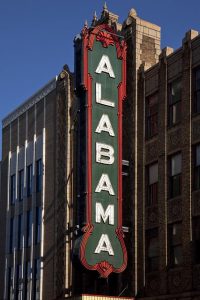
Sign for the Alabama Theatre,
Photo by Carol Highsmith, 2010. Courtesy of the Library of Congress.

The theatre world is full of superstition and spirits. In nearly every theatre I have worked, there are stories of ghosts. The theatre world is filled with mystery and mysticism, especially when it comes to actors. There is a ritual in preparing a character for his hour of strutting and fretting upon the stage before they are banished back to the world of fiction. Perhaps that may be a clue to why theatres are haunted.

While many haunted places may be locations of tragedy and death, that’s not always the case with theatres. As most theatre people are passionate about their profession, it’s not unheard of to imagine that they remain to rekindle that passion. In his Ghost Hunter’s Guide to New Orleans, Jeff Dwyer contends that one can be almost certain that a theatre will be haunted.

There are few certainties in ghost hunting. But when it comes to haunted places, ships and theaters offer ghost hunters the greatest opportunities for encounters with the spirit world. Theaters often harbor the ghosts of actors, writers, musicians and directors because something about their creative natures ties them to the place where they experienced their greatest successes or failures. Stagehands and other production staff may haunt backstage areas where they worked and, perhaps suffered a fatal accident. They may also be tied to room where props are stored. The ghosts of patrons remain long after death because they love the theater or, more likely, they loved an actor who performed regularly at that location.
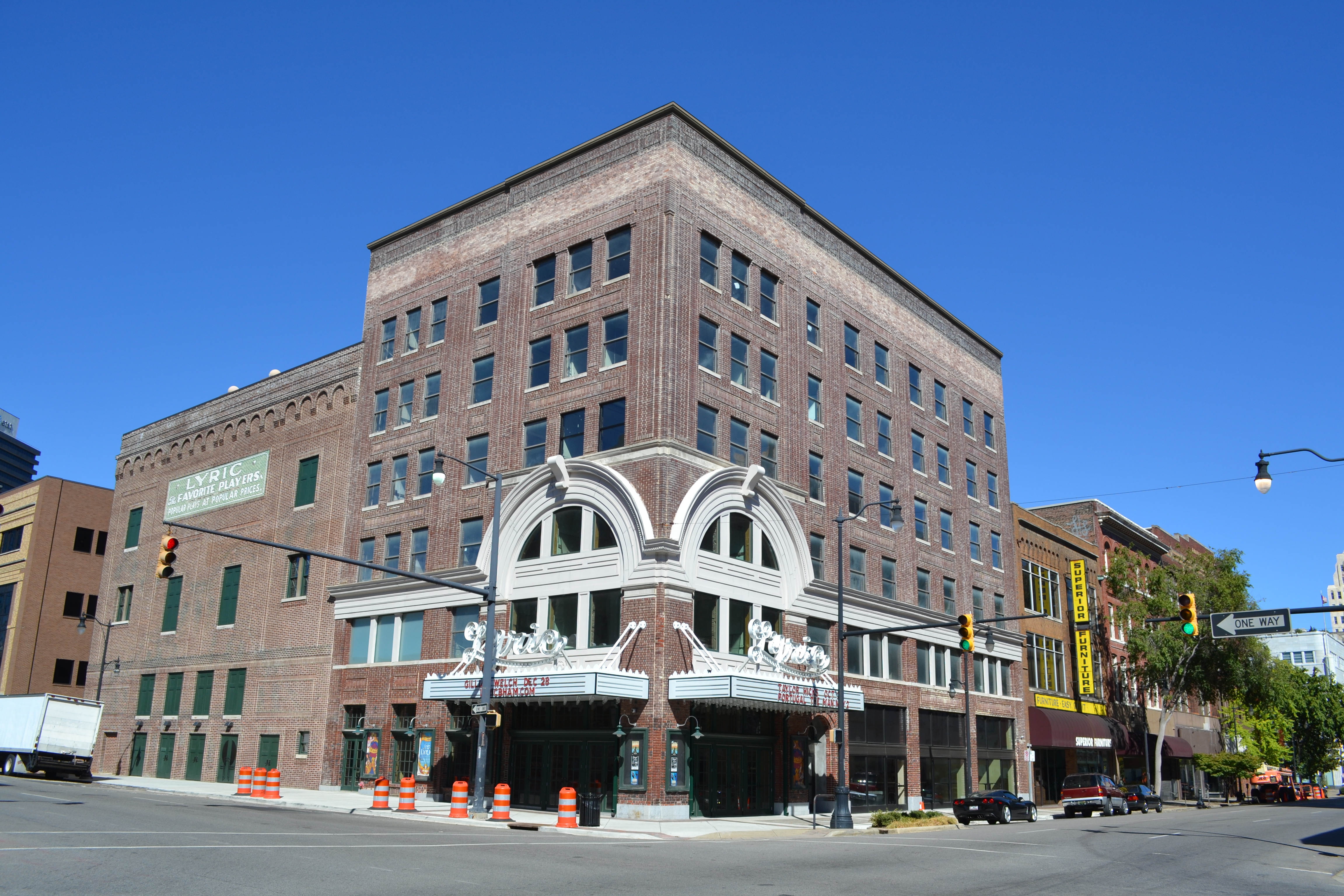
Lyric Theatre, 2016, by Lewis O. Powell IV. All rights reserved.

I can agree with some of this. Yes, the creative natures of thespians, writers, musicians, directors and other members of the creative staff may cause them to linger in the places where they happily created their art. As for stagehands and other members of the production staff, with the higher rate of accidents for such people, there are cases where their deaths have left them in limbo within the theatre. The haunting of the Wells Theatre in Norfolk, Virginia comes to mind. One of the spirits in this 1913 theatre may be that of a careless stagehand who became entangled in the hemp rope-operated fly system (a system that is still in use) and accidentally hung himself.

Within a modern theatre, I do have an issue with Dwyer’s contention that spirits may be connected to props rooms. Most modern theatres serve mostly as general performing arts spaces and unless they have a theatre company attached, they are not likely to have props storage. In my research, I cannot recall any stories of haunted props storage spaces.
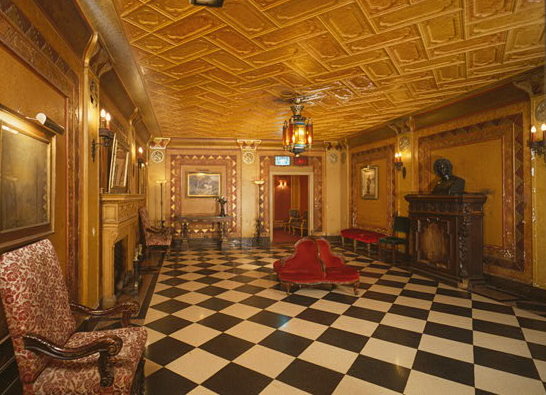
The Alabama Theatre’s Spanish Lounge. Photo taken for the Historic American Buildings Survey (HABS), courtesy of the Library of Congress.

As for lingering spirits of theatre patrons, there are a few love stories involving patrons and performers, though it does seems that most of the hauntings by members of the audience are apparently residual in nature with phantom laughter and applause sometimes being heard.

Contributing to theatres’ haunted natures, I would add the fact that theatres are often created in old buildings. These repurposed buildings may already be haunted and the spirits adapt to the new use of the location. Among the numerous examples of these types of theatres are the Baltimore Theatre Project in Maryland in an old building originally constructed for a men’s fraternal organization and the Hippodrome State Theatre in Gainesville, Florida, formerly a post office and courthouse.

Balconies of the Lyric Theatre. Photo by Andre Natta, 2006, courtesy of Flickr.

Regardless, some of these assertions can be seen in play with two haunted theatres in Birmingham, Alabama. Theatres that happen to be located directly across the street from each other, though they have wildly differing histories: the Lyric and the Alabama Theatres, located on 3rd Avenue, North.

Standing in the shadow of the Alabama Theatre, its well-restored, gaudier and haunted sister across the street, the LYRIC THEATRE (1800 3rd Avenue) is finally coming into her own after many years of neglect. The Lyric opened in 1914 at the height of American vaudeville. Upon its now dusty boards passed many of the top headliners of B.F. Keith’s vaudeville circuit: the curvaceous and naughty humor of Mae West; the last Red Hot Mama, Sophie Tucker; the Marx Brothers with their goofily brilliant brand of comedy; Buster Keaton and his family of acrobats; and legions of hoofers, singers, comedians and other weird and wonderful vaudevillians.

With the opening of the nearby Ritz Theatre in 1926, big time vaudeville departed the Lyric leaving its stage to second and third tier performers. Films were shown, but even these were overshadowed by the Alabama Theatre. The theatre limped on until 1958 when its doors were shut. In the 1970s under the flashy name, the Roxy, the grand lady became an adult theatre. Legend holds that the last film shown was the infamous “Deep Throat,” after which the projectionist was arrested. The theatre closed its doors to sit quietly and crumble for a few decades.

Efforts to revive the Lyric have reached a fever pitch and activity now hums in its once forlorn halls. Soon, it’s expected that the Lyric will stand proudly across the street from the Alabama Theatre again. And the ghosts of vaudeville will have found a new life.

There’s no question why the vaudeville performers of old would want to continue gracing the stage of the Lyric. It may be one of the best preserved vaudeville houses in the nation and it is also known for its superb acoustics. Those same acoustics and its remarkably well-preserved interior are the very reasons that local arts groups are clamoring to see the theatre restored for live performance.

On recent investigations of the Lyric, paranormal investigators have witnessed much activity that can possibly be traced to the ghosts of vaudeville. A reporter observing an investigation in 2012 saw what she believed to be a man with a cane move across the empty theatre’s stage. The figure stood in the wings for a few moments before disappearing. Another group of investigators smelled the distinct odors of lit matches and cigar smoke.

The crown jewel of Birmingham, the ALABAMA THEATRE (1817 3rd Avenue), was opened as the southeastern flagship theater for the Paramount-Publix chain in 1927. This most exuberant of theatrical monuments was named the Historic State Theatre of Alabama in 1993 and continues to serve the citizens of Birmingham and the region.
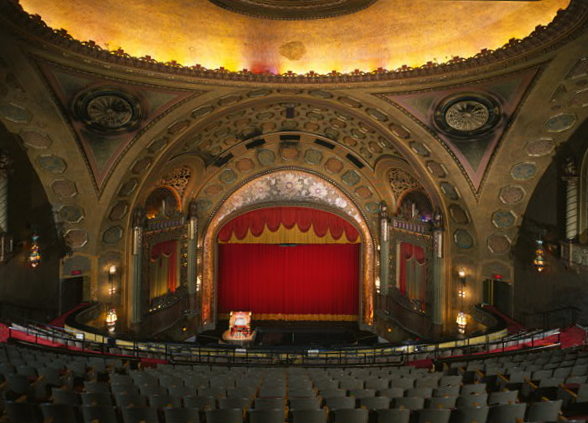
Interior of the Alabama Theatre before restoration. Photo taken for HABS, courtesy
of the Library of Congress.

Designed by the Chicago architectural firm of Graven and Mayger, the Alabama Theatre is one of only two extant theatres they designed, the other being Knoxville’s Tennessee Theatre which opened a year after its Alabama counterpart. The first air-conditioned building in the state of Alabama, the theatre features an opulent interior in the Spanish Colonial style that has wowed patrons for almost 90 years. A booming Wurlitzer organ still graces the auditorium and is featured in concerts and sing-alongs.

The theater served as a movie house until the owners declared bankruptcy in 1981. The theater had been sitting empty when Birmingham Landmarks, Inc. purchased the theater as a performing arts center. The theater edifice was fully restored in 1998 and hosts a wide array of events throughout the year.

Since reopening as a performing arts center, the Alabama Theatre has had varied reports of ghostly activity. One legend remembers a construction worker falling to his death during construction who allegedly haunts the balcony. A theatre staff member in the balcony checking sightlines did watch as a seat near her lowered by itself—the seats are spring-loaded to pop back up. Perhaps the construction worker enjoys watching the activity onstage?

HABS photo of the Alabama Theatre’s exterior. Courtesy of the Library of
Congress.

Southern Paranormal Researchers were granted permission to investigate the theatre in 2006. They encountered a variety of activity. As one investigator ascended the stairs to the balcony, they encountered a force that pushed them down. While investigating the film room shortly after that two investigators heard something descending a staircase.

According to Dr. Alan Brown, the now retired, long time theatre organist Cecil Whitmire told of many encounters in the building. While rehearsing with a singer in 1986, Mr. Whitmire reported that the singer watched a shadowy figure emerge from behind the edge of the curtain just offstage and disappear. He believes the spirit may be that of one of the former theatre organists. The extravagant theatre and its “walking shadows” still surprise and delight theatre patrons and visitors today.

Sources

  • Alabama Theatre. Accessed 8 March 2013.
  • Brown, Alan. Haunted Birmingham. Charleston, SC: History Press, 2009.
  • Brown, Alan.Stories from the Haunted South. Jackson, MS: University Press of Mississippi, 2004.
  • Dobrinski, Rebecca. “Wandering the Lyric at midnight.” Weld for Birmingham. 17 September 2012.
  • Dwyer, Jeff. Ghost Hunter’s Guide to New Orleans. Gretna, LA: Pelican, 2007.
  • “Haunted Places: the Lyric Theatre in Alabama.” The Most Haunted Places in America Blog. 21 April 2011.
  • The Heritage of Jefferson County, Alabama. Clanton, AL: Heritage Publishing, 2002.
  • Huebner, Michael. “Birmingham’s Lyric Theatre: Heightened anticipation for long-awaited restoration.” The Birmingham News. 29 Spetember 2012.
  • Seale, Kathy. “Happy Haunting!” Birmingham News. 29 October 2006.
  • Southern Paranormal Researchers. Investigation Report for Alabama Theatre. 24 November 2006.
  • Underwood, Madison. “Lyric Theatre set to host its ‘first concert in the 21st’”AL.com. 26 September 2012.

Newsworthy Florida–October 2013

There are articles about hauntings blooming all around the South for the Halloween season. Florida, the floral state, is at full bloom. Here’s an overview of recently reported Florida hauntings.

St. Cloud Greater Osceola Chamber of Commerce
1200 New York Avenue
St. Cloud

The Southern literary magazine, The Oxford American, explores Southern culture. As ghosts, ghostlore and ghost hunting (Southerners love their hunting) have permeated Southern culture in recent decades, it’s appropriate that the magazine would publish an article about it. An article by Chantel Tattoli explores this through the experiences of GhostStop, a St. Cloud business specializing in ghost hunting equipment. They also conduct investigations and the St. Cloud Chamber investigation included the article’s author.

According to the investigation team she was working with, the building dates to 1910, when it opened as a bank. One major robbery occurred in the building as well as, if local lore is accurate, a double homicide. The activity in the building includes the requisite footsteps in conjunction with what the author describes as “shadows, rattles and whistles.”

The article ends with the author wistfully asking, “What is a ghost but a smear in the air? A memory, willful and invincible, determined to keep living its life.” I really like that statement.

Source

Florida Theatre
128 East Forsyth Street
Jacksonville

When the Florida Theatre opened in 1927, it was the fifteenth movie palace in the city, but definitely the most lavish. The Mediterranean revival-style architecture was very popular throughout Florida throughout that decade. The grand theatre served the citizens of Jacksonville very well for more than five decades even as many other glorious movie palaces and other theatres were shuttered and demolished.


The marquee of the Florida Theatre, 2008, by Craig O’Neal. Courtesy of Wikipedia.

It was here in 1956 that a young singer named Elvis Presley performed. Seated among the screaming fans in the audience was a juvenile court judge to monitor Presley’s notorious hips for movements that were deemed “too suggestive.”

The theatre closed in 1980, but efforts were quickly underway to revive the grand dame. In October of 1983, the theatre opened its doors once again as a performing arts center, a use that has kept the marvelous building open for three decades.

A press release from PR Newswire announces that the theatre will be the scene of a paranormal investigation on Halloween night. The press release includes a remark from the theatre’s house manager that recounts her experience with a strange humming in the theatre. “I’ve heard a strange humming sound that made the hair on the back of my neck stand up. I thought it was a bar refrigerator, so I unplugged it, but the humming noise continued.”

The ghosts of the Florida Theatre are fairly well documented, especially after an investigation in 2010 captured the image of someone sitting in a seat in the balcony.

An article in the Florida Times-Union from July recounts the experience. The crew was filming with infrared cameras when they began to detect movement in the balcony. “The cameras captured something in Seat E2, Section 500, up in the balcony, where the original 1927 seats are still in place.” The video captured what appears to be someone sitting in the seat and moving their arm.

Perhaps the figure will make an appearance on Halloween.

Sources

The Petite Boutiques
1002 East New Haven Avenue
Melbourne

The Petite Boutiques describes themselves as an “upscale mini-mall” that “hosts a collection of small retail businesses located inside a historic landmark.” The landmark building was once the Brownlie-Maxwell Funeral Home which moved to new location some years ago. After the building’s conversion to retail space, people working in the building began experiencing odd activity including Christmas trees in the Christmas shop being rearranged.

A member of the family who owns the building was quoted in Florida Today speaking about the Christmas trees. “Every morning, I would come into find a bird on one of our trees that was upside down, and I would have to rearrange it. It happened all the time. Then one night, I closed and knew the bird was on the tree right side up. But when I got there the next morning, it was upside down again.”

The article mentions that various customers have picked up on various entities within the building.

Sources

Eau Gallie Cemetery
Intersection of Avocado Avenue and Masterson Street
Melbourne

Eau Gallie was an independent city until 1969 when it merged with Melbourne. The name may be a reference in French to the salt water found around the town.

In the Eau Gallie Cemetery sleep many of Eau Gallie’s founding and prominent family. But, their rest may not be so easy. The cemetery has been rumored for years as being haunted and has been investigated by Florida Unknown, a local paranormal investigation team.

According to an article from Florida Today, the team did succeed in capturing a female voice responding to a direct question.

Sources

Crooked Mile Cemetery
aka Georgiana Cemetery
Crooked Mile Road
Merritt Island

It appears that the Crooked Mile Cemetery may be quite a bit more active than the Eau Gallie Cemetery. Indeed, the cemetery plays a part in one of the area’s most well-known ghost stories—the haunting of Ashley’s Restaurant in nearby Rockledge.

On November 21, 1934, the badly mutilated and decomposing body of a young woman was found near the river. Nineteen year old Ethel Allen had been seen just a few days before when she stopped at a local packing house to say goodbye to a friend. Ethel was leaving to visit her mother. She may have also stopped by her favorite local hangout, Jack’s Tavern, now Ashley’s of Rockledge. The Tudor style restaurant, on U.S. 1, still has activity, which has been attributed to Ethel Allen.

The gentleman with whom Ms. Allen was travelling was identified, but never questioned. Ms. Allen was laid to rest in the Crooked Mile Cemetery where she continues to interact with the living. In yet another article from Florida Today, the Brevard Ghost Hunters report that they received an EVP saying “yes” at the grave of Ethel Allen. The investigators had asked if Ms. Allen was present.

Within the moss-draped graveyard, others have reported seeing and hearing apparitions, but scarier still, hands have been known to reach out of graves here.

Sources

Pritchard House
424 South Washington Avenue
Titusville

It is said that Lola Pauline Smith Pritchard, known as Miss Lovie, never liked people in her house. Perhaps it is she who is upset about tourists regularly visiting her magnificent Queen Anne-style house.


Pritchard House, 2012, by Jigar,brahmbhatt. Courtesy of Wikipedia.

As of late, Florida Today has been ramping up on paranormal articles. Interestingly, the reporter interviewed Michael Boonstra whose blog I used for information concerning Ethel Allen’s murder in the above location. As the director and archivist for the Brevard County Historical Commission, he was invited on an investigation two years ago of the Pritchard House.

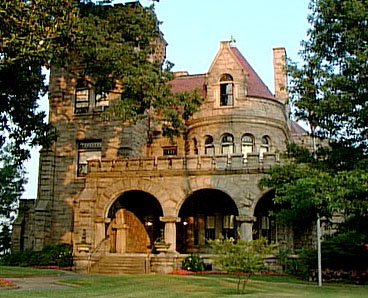
Recently restored, the home has been returned to its original color scheme, an orange color with coral colored trim. Captain James Pritchard, a businessman important in the development of the area, built the home in 1891. Until Brevard County purchased the home in 2005, it had remained in the Pritchard family.

The investigation uncovered evidence that members of the Pritchard family may still remain in the house. Voices were heard, a light turned on by itself and a grandfather clock that was not in working order was heard pinging.

Sources

Apparitions of Atlanta

N.B. Last Thursday, I did a presentation on Atlanta ghosts for the Atlanta History Center’s event, Party with the Past. The presentation began with the 1908 New York Times story of a ghost in the governor’s mansion. This has since been broken out into its own article here.

Atlanta doesn’t have a very good record of preserving its historic environments. Historic preservation not only preserves the historic fabric of a location, but the spiritual fabric as well. That can most certainly explain cities such as Savannah, New Orleans, Charleston, SC and St. Augustine—cities known for their ghosts.

Disturbances in the historic fabric of a location can also uncover spirits. This is evident throughout the Atlanta area as the sacred ground where many gave their lives during the Civil War is developed. One of the better documented occurrences of this phenomenon took place on a development called Kolb Creek Farm in Marietta, just north of here.

Valentine Kolb House, 2011, Photo by Lewis O. Powell IV, all rights reserved.

This house and a small family cemetery on Powder Springs Road in Marietta are all that remain of the Valentine Kolb farm where a minor battle was fought June 22, 1864, a battle leading up to the vicious Battle of Kennesaw Mountain which would be fought a few days later.

Behind this house, the farm fields have been developed into subdivisions. A couple, James and Katherine Tatum, purchased a home in the neighborhood in 1986. After a quiet first year in the house, the couple began to experience unexplained activity. The television show Unsolved Mysteries publicized their story and they were interviewed by Beth Scott and Michael Norman, interviews that were included in their 2004 book, Haunted America.

The first encounter occurred early one morning. “My husband and I had gotten up to go to the bathroom at the same time, about 2:30 AM. Our bedroom is upstairs. My husband used the bedroom bath and I went into the hall bath. The bathroom door was open. I saw a man walking down the hall in front of the open bathroom door. I assumed it was my husband looking for me since I was not in bed.”

After calling out to her husband with no response, Mrs. Tatum returned to the bedroom where she found her husband and asked if he’d been in the hall. He had not and he was disturbed by the idea that someone else might be in the out. Climbing out of bed, he retrieved his gun and searched the house to no avail, no one else was there.

Mrs. Tatum realized that the figure she had seen was wearing a hat and a coat. “I came to realize that when the man walked past me there had been no sound, as you would normally hear whenever someone is walking down the hall.”

For the Tatums, this would begin a series of odd events including something playing with an electric drill, pocket change on a dresser jingling on its own accord and a small bell ringing by itself.

Sources

  • Battle of Kolb’s Farm. Wikipedia, the Free Encyclopedia. Accessed 28 October 2013.
  • Scott, Beth and Michael Norman. Haunted America. NYC: Tor, 2004.

Apparently, this isn’t the only modern house with spiritual residue possibly left over from the war, homes and businesses throughout the area have activity as well.

Among the multiple stories coming out of the area, one recent story stands out.

On the night of October 8, 2007, a gentleman and his teenage son were driving across one of the many roads that cross the battlefield at Kennesaw Mountain. They spotted something about to cross the road and were amazed to see a horse with a Union cavalry officer upon it appear in their headlights.

“I quickly locked on my brakes as the horse proceeded to come right in front of us,” the anonymous driver told 11 Alive News, an Atlanta news station. The father and son watched in awe as the figure moved across the road and through a fence opposite before fading into the night.

Keep in mind, as you traverse Atlanta’s battlefield, keep on the lookout for ghosts.

Sources

  • Crawley, Paul. “Ghost rider at Kennesaw Mtn.?” 11 Alive News. 1 November 2007.

The Civil War left a heavy, spiritual pall around the city, a pall that has been detected by visitors to Atlanta’s great necropolis, Oakland Cemetery.

[I have covered Oakland in depth here]

[the section that once covered the Ellis Hotel, formerly the Winecoff, has been broken out into its own article.]

Moving on to a happier place on Peachtree in Midtown, we find ourselves at the Fabulous Fox which may possess a handful of “phantoms of the opera.” When this building opened, Christmas Day, 1929, one of the local papers called it “a picturesque and almost disturbing grandeur beyond imagination.” The grandeur, however did not last and the theatre floundered during the Depression. Under threat of demolition in the 1970s, Atlantans banded together to save the theatre and it has since been restored.

Fox Theatre, 2005. Photo by Scott Ehardt, courtesy of Wikipedia.

Some of the mysteries among the minarets include the holy grail of ghost hunting, a full body apparition seen by an investigator. An investigator with the Georgia Ghost Hounds, Denise Roffe (who, incidentally, wrote a book on the ghosts of Charleston, SC), had to use the restroom during an investigation. In the dark she found her way to the ladies restroom and upon entering a stall was shocked to see a young woman. “She was just standing there wearing a long, period dress and a hat.”

Startled, she screamed and other members of the group quickly joined her but the image was gone.

Another popular story involves a man hired to stoke the theatre’s furnaces. He lived down in the basement with a cot and his few, meager possessions. After his death, he has possibly continued to stay in the basement. He is said to like women and when they enter the basement they will, at times, detect a peaceful and relaxing atmosphere while men are sometimes harassed by the spirit.

Sources

  • Fox Theatre (Atlanta, Georgia). Wikipedia, the Free Encyclopedia. Accessed 28 October 2013.
  • Underwood, Corinna. Haunted History: Atlanta and North Georgia. Atglen, PA: Schiffer, 2008.

Just before Peachtree crosses over I-85, visitors to the city may be surprised to see what appears to be a castle looming above the road. Built with granite supplied from Stone Mountain, Rhodes Memorial Hall was constructed in 1904 for local furniture bigwig, Amos Rhodes. After serving as the home of the State Archives the building played a haunted house for a few years in the 1980s and 90s, despite actually being haunted.

Rhodes Hall in an undated photo from the Georgia Trust for Historic Preservation. Courtesy of Wikipedia.

The house was investigated by the Atlantic Paranormal Team from SyFy’s paranormal investigation show, Ghost Hunters. To aid in this endeavor, the show’s producers called in the Real Housewives of Atlanta to perhaps scare up a few ghosts with their attitudes and fashion sense. While some scant evidence was uncovered, Rhodes Hall got to show off its ghostly activity which includes the typical unexplained footsteps, doors opening and closing by themselves and apparitions, though with a sardonic sense of humor that includes a bouquet of dead flowers supposedly being left on the desk of a staff member in the house.

Sources

  • Merwin, Laura. “Ghost Hunters meet Real Housewives of Atlanta and nothing.” com. 2 December 2010.
  • Rhodes Hall. Wikipedia, the Free Encyclopedia. Accessed 28 October 2013.

In terms of Atlanta hauntings, these are just the very tip of the iceberg. While some of these hauntings have been documented, I believe there are many more that should be documented from private homes to office complexes. 

A MARTA train passes by Oakland Cemetery. Photo 2011, by Lewis Powell IV, all rights reserved.

I’d like to leave you with one final story. Ghosts do not just appear in old houses or buildings, but they’re also found in planes, trains and automobiles. Curt Holman in an article a few years ago from Creative Loafing Atlanta relates a story from MARTA, the Metro-Atlanta Rapid Transit Authority which operates a system of trains and buses throughout the city.

Holman relates that a young man riding on a nearly empty train on a winter’s afternoon. The young man was absorbed in the music he was listening to on his headphones and was startled to feel someone sit next to him. Looking at his reflection in the window, the young man saw a man in his 40s with dark hair and wearing a business suit sitting next to him.

Turning to speak to the man he found the seat empty.

Thank you very much and support your local ghosts!

Sources

  • Holman, Curt. “The hauntings of Atlanta.” Creative Loafing Atlanta. 27 October 2011.

Seeing the Light–Shreveport, Louisiana

Shreveport Municipal Memorial Auditorium
705 Elvis Presley Avenue
Shreveport, Louisiana

I saw the light! I saw the light!
No more darkness, no more night!
Now I’m so happy, no sorrow in sight.
Praise the Lord, I saw the light!
–“I Saw the Light,” Hank Williams, 1948

Elvis Presley haunted Municipal Memorial Auditorium Shreveport Louisiana ghosts
The great Elvis Presley, a son of Tupelo, Mississippi,  as he appeared in his 1957 film, Jailhouse Rock. His appearance at the Shreveport Muni catapulted him to fame. Courtesy
of Wikipedia.

On October 18, 1954, a nervous young man stepped to the microphone at the Municipal Memorial Auditorium in Shreveport. Surely, he could not have imagined that his performance that night would eventually lead to the street outside being renamed in his honor. The young crooner with the provocatively swaying hips and sensuous baritone was Elvis Presley and he was making his first appearance on the radio show, Louisiana Hayride, a popular country music program that would launch many important careers. The “Muni” stage saw the likes of many great singers in the flush of youth: names such as Johnny Cash, George Jones and Hank Williams.

Besides hosting Louisiana Hayride from its beginning in 1948 to the end of its first run in 1960, the Municipal Memorial Auditorium accommodated graduations, local theatrical events, a variety of musical performances, and billeted soldiers during World War II. The building served as a center for Shreveport’s cultural life as well as playing a role among the city’s dead. The exuberant Art Deco façade of the auditorium hides a darker function: the building was reportedly used as a temporary city morgue.

haunted Municipal Memorial Auditorium Shreveport Louisiana ghosts
The elaborate facade of the Shreveport Municipal Memorial Auditorium. Photo by Michael Barera, 2015, courtesy of Wikipedia.

This plethora of functions have left a spiritual imprint on the building. One paranormal investigation of the building captured an EVP—electronic voice phenomena—of a woman’s voice ardently stating, “I love Johnny Cash,” while another investigation yielded the sound of applause in the empty auditorium. The stories from this historic edifice are numerous and fascinating.

In an article by Debe Branning on Examiner.com, she relates the story of a workman who was in the building setting up for a sporting event. Though no one else was supposed to be in the building, the workman kept spotting a young man sitting in the auditorium. He would see the man sitting in one section and moments later, the man would have moved to a different section. Eventually, the workman stepped outside to retrieve a tool from his truck and encountered the strange man outside the building. The workman inquired if he could help the young man.

“I just come by to see what time the fights start,” replied the young man. With a smile he faded away before the workman’s bewildered eyes. The workman was later told of a young boxer who was killed in a car accident on his way to fight a match in the auditorium.

According to Drs. Gary Joiner and Cheryl White, authors of Historic Haunts of Shreveport, there have been two notable investigations of the building: Louisiana Spirits Paranormal Investigations—the first team to investigate the building—and Everyday Paranormal who investigated the building for the Discovery Channel show, Ghost Lab.

Investigating rumors of shadow figures, voices and doors opening and closing on their own, both teams captured a great deal of evidence. Louisiana Spirits captured numerous EVPs during their investigation aside from some personal experiences including some team members smelling flowers and baby powder in one of the dressing rooms. In addition, one of the team members was pushed and scratched by something in the basement area that once served as the morgue.

haunted Municipal Memorial Auditorium Shreveport Louisiana ghosts Hank Williams
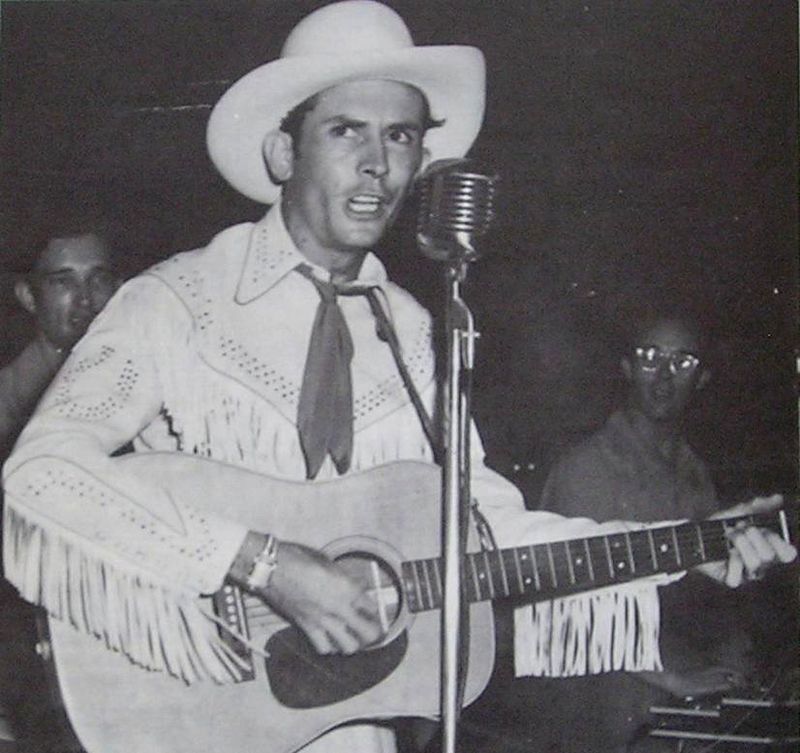
Hank Williams performing in 1951. Courtesy of Wikipedia.

During Everyday Paranormal’s investigation, the team collected one particularly good A-Class EVP stating, “We saw the light.” No one on the show made the connection with the well-known Gospel song by Hank Williams (which I’ve quoted above). The connection grows even stronger when it’s noted that Hank Williams’ fame was propelled by his appearances on the Louisiana Hayride the same year his song, “I Saw the Light” was released.

Also during the course of the investigation a door in the ballroom opened on its own volition after a team member specifically closed it. Another door closed after the team hired a band to play rockabilly music in hopes of stirring up the spirits of this most spirited location.

The auditorium continues to feature the living and the dead of Shreveport.

Less than a mile away from the Municipal Auditorium in downtown is the Spring Street Historical Museum, which occupies a haunted former bank.

Sources

Spirits at the Heart of American Theatre–Actors Theatre of Louisville

Actors Theatre of Louisville
316 West Main Street
Louisville

The two buildings at this address are at the heart of modern American Theatre. The theatre company here, the Actors Theatre of Louisville, has striven to become one of the premier theatre companies in the nation and they have succeeded. From humble beginnings in a former tea-room, the company moved to an old train station which was renovated to house a 350-seat theatre. At that time, Jon Jory, son of Hollywood actor Victor Jory, joined the company as an artistic director. He expanded the horizons of the company and oversaw their move to this current space after the train station was demolished in 1972.

With the company, Jory envisioned and created the Humana Festival of New American Plays, now considered the “preeminent annual showcase of new theatrical work.” The festival has introduced new American plays such as David Margulies’ Dinner with Friends and Beth Henley’s Crimes of the Heart to the American theatrical consciousness; both of which garnered Pulitzer Prizes for drama.

Western theatre’s deepest roots lie in Ancient Greece, thus it’s appropriate that the entrance and lobby for this venerable theatrical institution is a remarkable Greek Revival structure. Built in the mid-1830s, for the Bank of Louisville, this building’s marvelous architecture and the participation of noted architect Gideon Shryock in its construction have led it to be named a National Historic Landmark. The adjoining late-19th century commercial building also belongs to the theatre.

Bank of Louisville Building, now the lobby of the Actors Theatre.
Photograph taken in 1987 by William G. Johnson for the Historic
American Buildings Survey. Courtesy of Wikipedia.

Part of the ghost story of this venerable institution begins in a field in the Hamptons in 1970. Rodney Anderson and his wife, Pamela Brown—an actress and scion of Kentucky’s prominent Brown family—were setting off on a journey with pilot Malcolm Brighton to cross the Atlantic in a Roziere balloon (a hybrid between a hot-air balloon and one held aloft by gases like helium or hydrogen). Friends and family gathered to fete the trio and watch as the intrepid voyagers headed into the horizon aboard The Free Life. One of the friends in attendance recalled that the event was “kind of a last hurrah.” She continued, describing the atmosphere as“all that hope and joy of the 60s that seems to have gone so sour, a last little flickering flame before everybody got serious again.” Grasping the euphoric hopes of a libertine decade the balloon ascended heavenwards into a perfect sky. Some thirty hours later, those hopes were dashed when fate caught up with them off the rocky coast of Newfoundland.

In the Brown family’s grief, the Actors Theatre was granted a substantial sum to build a theatre in Pamela’s honor. Built directly behind the antique buildings fronting the street, the 643-seat Pamela Brown Auditorium stands as a memento mori to the idealism of youth. The young, promising actress who was lost so young is still glimpsed in the theatre bearing her name while another specter is seen as well: the shade of an African-American male, possibly from the 19th century. He quietly goes about his business and disappears when he detects he has been spotted by the living.

Sources

  • Actors Theatre of Louisville. “The History of the Actors Theatre.” Accessed 15 March 2013.
  • Cummings, Mary. “The Day a Dream From Springs Crashed.” New York Times. 22 January 1995.
  • Free Life (balloon). Wikipedia, the free Encyclopedia. Accessed 15 March 2013.
  • Parker, Robert W. Haunted Louisville. Alton, IL: Whitechapel Productions, 2007.

Lingering Memories–Lyric Theatre

Lyric Theatre
201 North Broadway
Tupelo

He appeared first in a Lee County community called Black Zion near the Pontotoc County line. He was a dark, shadowy figure stretching from the leaden clouds to the dusty ground. The winds surrounding him stirred up dust in the still and humid air of a warm spring Palm Sunday. He tore through Black Zion and then slammed into the town of Tupelo with great fury around 8:30 that evening.

April 5, 1936 had been a pleasant Palm Sunday in Tupelo until the twister touched down flattening 48 blocks of the city. Believed to have been a 5 on the Fujita scale—the scale for judging the strength of tornados—this Palm Sunday visitor was part of a line of storms that struck the South with another powerful tornado destroying parts of Gainesville, Georgia the following day. Local officials counted 216 deaths, but in this era of Jim Crow that was only counting whites among the dead. The deaths of African-Americans—and this tornado struck a part of Tupelo that was largely black—went unrecorded.

As the dead and injured were pulled from the twisted wreckage of the city the broken bodies were moved to a temporary hospital and morgue set up in the Lyric Theatre. The sounds of agony from the injured and the dying, as well as the clink of metal medical instruments and trays replaced the laughter that usually echoed through the building. Stories speak of the popcorn machines in the lobby being pressed into service to sterilize the instruments. These bad memories still may linger.

Undated postcard of the Comus Theatre. The facade now features Art Deco elements and marquee. Postcard from the Cooper Postcard Collection, Mississippi Department of Archives and History.

The Lyric opened as the Comus Theatre in 1912. The Comus hosted vaudeville and other live performances until the prevalence of films lead to vaudeville’s untimely demise. The theatre became a part of the M. A. Lightman Company (Malco), a chain of cinemas, acquiring a new name, the Lyric, and it’s Art Deco façade and marquee. It’s appropriate that this theatre, having been built for live theatre would ultimately be saved by it as well. In the mid 1980s when the theatre had outlived its usefulness as a cinema, it was saved from the wrecker’s ball by the Tupelo Community Theatre and has been slowly but surely restored by them.

With TCT’s acquisition of the Lyric Theatre, they also acquired some lingering memories; memories that will mischievously play tricks on actors and theatre staff. One executive director had his keys taken and hidden from him. After searching for about 45 minutes he gave up and decided to call someone to come get him. The phone sat on a Plexiglas stand with a small slot for papers clips. As he lifted the receiver he glanced down to see his keys stuffed into the small slot. Puzzled, he locked up the building and quickly left. He could come up with no explanation except to blame Antoine, the theatre’s lingering spirit.

Exactly who the spirit is or why his name is Antoine is unknown. Perhaps he’s one of the injured, dying or dead brought into the building following the tragic tornado or perhaps a more recent theatre associate who has returned to his beloved theatre?  All that is known is that he enjoys playing tricks including playing with the lights, slamming doors when he may be unhappy and possibly making a surprise appearance in a theatergoer’s photograph.

There are other lingering memories that are more obviously connected with the theatre’s tragic past. The clank of metal medical instruments still resounds through the building while the popcorn machines, once pressed into such ghastly service, are said to turn on by themselves. In a place where such happy memories are now made, these negative memories linger to remind us that even the beauty of a warm spring evening can be shattered in an instant by a terrible storm.

Sources

  • 1936 Tupelo-Gainesville tornado outbreak. Wikipedia, the Free Encyclopedia. Accessed 28 March 2013.
  • History of the Lyric Theatre. Tupelo Community Theatre. Accessed 28 March 2011.
  • Rutherford, Joe. “Tupelo tornado: Scars, united in spirit.” NEMS Daily Journal. 3 April 2011.
  • Sillery, Barbara. The Haunting of Mississippi. Gretna, LA: Pelican, 2011.
  • Steed, Bud. The Haunted Natchez Trace. Charleston, SC: History Press, 2012.
  • Tupelo Community Theatre. org. Accessed 28 March 2013.

Playhouse Phantoms of Pensacola

Pensacola Cultural Center
400 South Jefferson Street

Florida has a glut of haunted theatres; not that that’s a bad thing. A recent project has me researching theatres throughout the South and it seems that Florida has more than any other state. Perhaps it’s geography or something in the air or all the seawater that surrounds the state; it gives one pause.

On the official website for the Pensacola Cultural Center, one statement stands out, “The spaces where judges handed out justice and criminals served their time are now filled with the positive energy of dancers, actors, artists, and students.” The building was initially constructed in 1911 as the Escambia County Building, housing the county Court of Records and the jail. Places where criminals were tried, sentenced, incarcerated and executed now thrum with the rhythm of the arts in this old building.

It seems that some of the criminals are still doing time in this Neo-classical structure. A man has been seen lurking within the building. A staff member working in the building afterhours heard the operating of a nearby elevator. Shortly afterwards the dark shadow of a man walked past the staff member’s open door. She called out but did not get a response. When she looked into the hallway, it was empty.

The Pensacola Cultural Center, 2007. Courtesy of Pensapedia.com.

A couple staff members working late in the auditorium saw a man sitting in one of the seats. They both saw him simultaneously and turned to look at each other. When they turned back, the man was sitting in a different seat, on the opposite side of the house. They described him as wearing a worn suit and having a gaunt face. Some have identified this male spirit as that of Hosea Poole, a small time criminal who murdered his brother. Poole was the last man executed in the jail when he was hung July 31, 1920. However, there is little evidence, other than coincidence, to solidly identify the spirit as Poole’s.

The playful spirit of a young girl, possibly from the 1920s or 30s has also been witnessed. Unlike the male spirit’s almost menacing presence, the young girl has been heard giggling and she has been seen playfully skipping through the hallways. She is known to peer curiously over shoulders and she is occasionally seen peering from shadowed corners.

Saenger Theatre
118 South Palafox Place

Known as the “Grande Dame of Palafox Street,” the Saenger Theatre was literally built from the ruins—the bricks and other fittings—of the Pensacola Opera House which was destroyed in the 1917 Nueva Gerona hurricane (so named for the destruction it caused to the Cuban town of Nueva Gerona). The theatre opened in 1925 as a venue for live performances and film. Broadway shows and vaudevillians on “The Road” played here as well as films like Cecil B. DeMille’s The Ten Commandments which opened the theatre.

Saenger Theatre, 2010, by Ebyabe. Courtesy of Wikipedia.

The Saenger thrived as a cinema for a few decades until competition from multiplex big screens and the small television screens now found in homes began to shrink the audiences to the Grande Dame. The theatre closed in 1975 but was reopened as a cultural center in 1981. The theatre was extensively renovated in 1996.

With the crowds that have passed through the theatre’s doors since its opening and whatever spiritual residue may be left on the old bricks and other fittings from the old opera house, it’s no wonder that the Saenger Theatre has some paranormal activity on hand. Voices have been heard in the balcony of the building and spirits may affect the electrical circuits at times. Author Alan Brown records an incident that happened to the electricians working on a touring show. Just after hanging and adjusting the lighting for a show, the lights began to flash erratically on their own volition. The blame for this activity is laid upon the spirit of a worker who died when the boiler in the basement exploded, though—like Hosea Poole at the Pensacola Cultural Center—there is nothing to specifically identify the culprit.

Sources

  • Brown, Alan. Haunted Pensacola. Charleston, SC: History Press, 2010.
  • Jenkins, Greg. Florida’s Ghostly Legends and Haunted Folklore, Vol. 3: The Gulf Coast and Pensacola. Sarasota, FL: Pineapple Press, 2007.
  • Pensacola Cultural Center. About PCC. Accessed 26 February 2013.
  • Saenger Theatre (Pensacola, Florida). Wikipedia, the Free Encyclopedia. Accessed 26 February 2013.

Haunting Huntsville, Alabama

Early in this blog’s history I explored (or tried to) the ghosts of Huntsville, Alabama. The problem was that there was very little available. I found a few poorly written and unsourced articles that basically just repeated each other in terms of information. Besides those articles, there was very little, or so I thought. Just days before I posted the entry, Jessica Penot’s marvelous Haunted North Alabama had been released and in it, there were good, reliable information on a number of Huntsville’s hauntings plus information on locations that were not included in the few articles on the subject. After getting my copy of Ms. Penot’s book, I also began reading her blog which has included more locations in Huntsville. Since, I’ve kept an eye out for articles relating to Huntsville. In my usual search through Google News, I was surprised to find two articles about Huntsville tonight.

The first article, from the local ABC station, WAAY, concerns a business located on courthouse square, Huntsville’s historic heart. In many towns and cities in the South (and really throughout the nation), the courthouse or main square is also ground zero for hauntings, often due to the historic fabric that may be intact there. Huntsville is no exception, with a starkly modern courthouse sitting amid historic commercial buildings. The business is a pizzeria, SAM & GREG’S PIZZERIA AND GELATERIA (119 North Side Square), which is located in one of those historic commercial buildings.

The pizzeria’s website describes the building as having been built in the early nineteenth century and being one of the original buildings on the square. It continues by saying that the building has served as a general store, a dress shop and a gallery before becoming a pizzeria. The article states that the main floor of the pizzeria is quite normal, but it’s the large, unrestored room upstairs that has activity. The building was recently investigated by the Alabama Paranormal Association who certified the building as haunted.

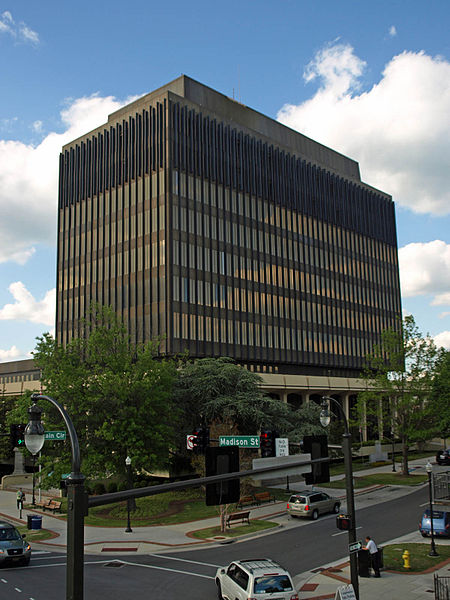
The pizzeria’s location reminded me of an article from Jessica Penot’s blog, Ghost Stories and Haunted Places, regarding the MADISON COUNTY COURTHOUSE (100 North Side Square). A brief internet search does not reveal the history of the current courthouse building, but I would assume from the architecture that it was built anytime between the 1960s and the 1980s. I did discover, however, that the building sits on the site of the original courthouse that was constructed in 1818. According to the blog’s entry, apparitions have been seen in the building along with orbs and odd sounds and lights. One of the spirits may be that of Horace Maples, an African-American who was lynched by a mob on the courthouse lawn.

Madison County Courthouse, 2011, by Spyder_Monkey. Courtesy of Wikipedia.

The second article I stumbled across concerns an upcoming investigation at the VETERANS MEMORIAL MUSEUM (2060 Airport Road, SW) a museum displaying memorabilia from wars dating back to the American Revolution. Interestingly, the article points out that the investigation will not be in search of spirits that haunt the museum, but those attached to the artifacts within, specifically those from World Wars I and II. While it has been known that spirits may attach themselves to objects, interest in this has increased in the paranormal community, especially with the recent television show, Haunted Collector. The show features investigator John Zaffis who investigates a variety of hauntings usually centered on a specific object.

Tucked away in my files on the paranormal South is another article on an investigation at another Huntsville location, MERRIMACK HALL PERFORMING ARTS CENTER (3320 Triana Boulevard). Opened in 2007, the performing arts center is located in an 1898 structure that once served as the company store for the mill village serving Merrimack Mills. This building and some 200 mill houses are all that remain of this important textile hub.

The investigation, conducted by the Alabama Paranormal Society, appears to have uncovered some interesting evidence. Among the evidence mentioned in the article, odd bangs heard in response to questions, a mysterious drop in temperature in the theatre and orbs are seen on video wheeling about the building. According to the article, the building may be inhabited by multiple spirits.

I imagine this is just the tip of the iceberg of haunted Huntsville.

Sources

Mad Rivers, Mills and Merrehope—Meridian, Mississippi

Meridian, Mississippi was founded competitively. Lewis Ragsdale and John Ball bet on making a profit from the proposed junction of the Mobile and Ohio and the Vicksburg and Montgomery Railroads. Both purchased land in the area and they began laying out lots, yet they could not agree on the orientation of the streets thus creating streets that sometimes turn at odd angles. There was also disagreement over the new city’s name. Ball favored the name “Meridian,” while Ragsdale had a Native American name in mind, “Sowashee,” meaning “mad river” for a nearby creek. The competition progressed to the point where supporters of the two founders would change the train station’s name nightly.

The cloud of war arrived in the city just after the name Meridian was established, but it brought it many opportunities for the burgeoning town. The town’s strategic location brought an arsenal, military hospital, prisoner of war stockade and many state offices. The city’s importance also caught the eye of Union General William Tecumseh Sherman who decided to capture the city from Confederate General Leonidas Polk. On Valentine’s Day, 1864, the city fell to Sherman who intended to wipe this upstart town off the map. The city, already heavily damaged from the battle, was put to the torch.

Early 20th Century view of 22nd Avenue. The building with the rounded corner, just left of center is the Grand Opera House. This view now looks towards the large Threefoot Building. Postcard from the Cooper Postcard Collection, Mississippi Department of Archives and History.

Like so many other cities put to the torch by the Union army, such as Atlanta and Columbia, Meridian rose phoenix-like from the ashes.  For the next half century the city served as a shining example of the “New South.” Mills and factories sprang up next to the railroads and workers poured in from the agricultural fields. Businessmen opened businesses to cater to the workers and business districts spring up. Among the many commercial buildings constructed were three in the 800 block of 22nd Avenue: THE PIGFORD BUILDING (818 22nd Avenue), THE MERIDIAN STAR BUILDING (814 22nd Avenue) and  813 22nd AVENUE (formerly the Peavey Melody Music store), all of which are believed to be haunted. The Meridian Star Building still houses the newspaper and takes up a large portion of the east side of the block and sits in the shadow of the Pigford Building which towers above. (I’ve just recently covered the hauntings here.)

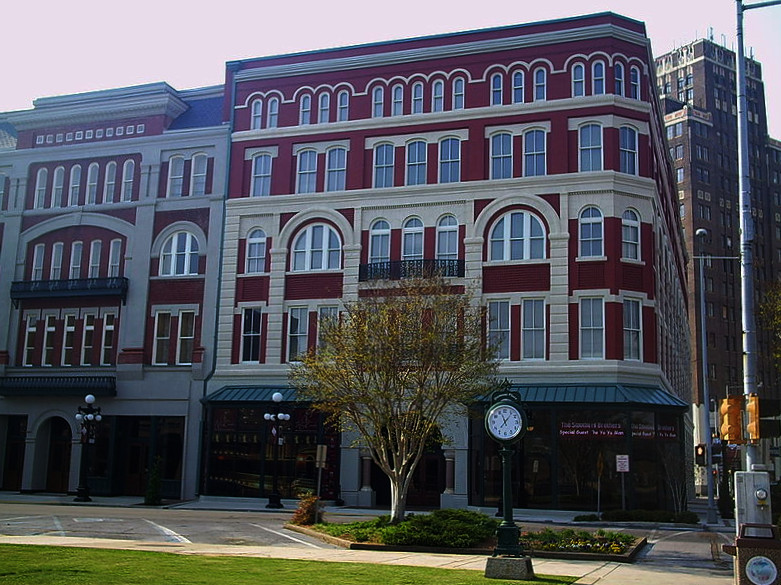
The Pigford Building, 2008. Photo by Dudemanfellabra, courtesy of Wikipedia.

The Pigford Building has a fairly well-investigated and documented haunting. The building was constructed around 1915 for the Knights of Pythias, a secret fraternal organization, and was called Pythian Castle Hall. In the 1920s, the building was purchased by Pigford Realty who rented out the building for retail and office space while the third floor held a ballroom. The retail space on the ground floor has seen many tenants and at some point in the last decade, the top floors have been closed. The windows to those two floors have remained boarded up.

Most of the activity has centered around a dress shop located in the retail space adjacent to the Meridian Star Building. Three different dress shops have occupied the space and both shops have had activity. The haunting was first noticed by employees in the form of spectral female laughter then later, whimpering and crying. Footsteps were heard upstairs in the empty building. Soon enough, clothing and jewelry which had been hung up the night before were being found scattered on the floor the following morning. In 1999, an employee saw an apparition: a lady with long hair in a white gown gliding across the balcony.

The shop’s owner worked late one night and had her young daughter with her when the little girl heard a woman’s voice on the intercom. She responded, thinking it was her mother, the mother asked her daughter who she was talking to and discovered someone else was on the intercom. The same owner had her three-year-old cousin with her another time. The little boy wandered upstairs and came down later saying, “I don’t like the lady in the long dress. She doesn’t like me.” Again, no one else was or should have been in the building. Not long after, the owner saw the lady in white for herself, silently gliding along the balcony.

Owners of the current dress shop had experiences with a vacuum cleaner. In both cases, the vacuum cleaner had been unplugged and moments after leaving the room, the machine turned itself on. The spirit may also have an affinity for a clock in the store. During one investigation, the clock moved forward by two minutes while witnesses were in the room.

Across the street the even older Wagoner Annex No. 3 Building housed the Peavey Melody Music store for many years. The store was opened in this building in 1945 by J. B. Peavey whose son, Hartley, started selling electronics out of the upstairs of this building, eventually creating Peavey Electronics. The store closed its doors in 2006 and the building appears to be unoccupied at the moment.

Devastation from the 1906 tornado. Postcard from the Cooper Postcard Collection, Mississippi Department of Archives and History.

This building, however, has a much darker history. The same year the building was completed, a devastating tornado struck the central business district of Meridian, killing nearly 50 people. The Wagoner Annex No. 3 building housed the Smith Funeral Parlor which handled many of the bodies. The morticians were so overwhelmed with bodies that many were stacked on the second floor. Legend holds that there was so much blood that it was swept out of the first floor with a broom. During its time as the music store, employees in the building would occasionally hear the sound of children upstairs. At times they would hear children laughing and running up and down the hall only to discover no one upstairs.

A little ways down 22nd Avenue between Fifth and Sixth Streets stands another building from the post-war Golden Era, a building that brought prestige and culture to this backwoods town, the GRAND OPERA HOUSE (now called the Riley Center for the Performing Arts, 2206 Fifth Street). Built in 1889 by the owners of the neighboring department store, Israel Marks and Levi Rothenberg, this opera house brought the world to Meridian’s stage including the great French actress Sarah Bernhardt and the actress Lily Langtry, who was a mistress to Albert, Prince of Wales. The theatre operated successfully into the next century and part of it was converted for use as a movie house in the 1920s. The building was leased to Saenger Films of New Orleans and after a dispute over use of the structure, Saenger wanted to convert the building to offices so it wouldn’t compete with the Temple Theatre, the second floor opera house was closed. It remained shut up until the late 20th century, when it was rediscovered. It was recently fully restored and is now owned by Mississippi State University – Meridian Campus.

Grand Opera House, now the Riley Center, 2008. Photo by Dudemanfellabra, courtesy of Wikipedia.

Before the Grand Opera House was reopened, people began to tell stories of a ghost. The executive director first encountered a spirit there while giving a tour to a young woman he was dating. Leading the young woman through the dark halls, the pair walked into a cold spot. Later the director would hear from a woman who worked in one of the retail stores that once operated on the street level. She would sometimes eat lunch on the old stairs to the opera house and would hear a woman singing in the dark theatre. Others have witnessed a woman in a white gown in the theatre. Most recently, a member of the cleaning staff and her daughter saw the woman who they said resembled the woman painted in a medallion above the stage. While the model for that painting is unknown, she certainly still gazes down upon audiences over nearly a hundred and twenty-five years since she was first painted.

When the curtain for the Grand Opera House was drawn in 1927, it was done to prevent competition with Meridian’s new grand showplace, the TEMPLE THEATRE (2320 Eighth Street). The Temple was constructed as a temple for the Hamasa Shrine organization, part of the Freemason order. In 1927, the temple was leased to the Saenger Corporation for use as a movie house. The Moorish revival-designed structure house the second largest stage in the country at the time, after New York’s Roxy and contained a marvelous Robert Morgan pipe organ to provide accompaniment for the silent films of the era.

Temple Theatre, 2008. Photo by Dudemanfellabra, courtesy of Wikipedia.

The theatre was in regular use until the early 1970s when the Saenger’s lease expired. The building saw nominal use and was only very recently purchased by a Dallas businessman for use as a performing arts center. Staff members have begun reporting odd occurrences. One woman saw a dark human shaped form standing in a doorway while a group of people saw a white haired man standing in the corner of the room just beneath the stage. A group of stage hands who dared spend the night on the stage of the old theatre were frightened by numerous odd noises throughout the building all through the night.

With the Great Depression, Meridian’s economy faltered, but it picked up quite a bit of steam with World War II. Into the 1950s, the economy began a decline as the importance of the railroad waned with the advent of the car and the interstate highway system. The fight for civil rights during the 1960s brought the city some notoriety. When three young civil rights workers were killed in nearby Neshoba County, Michael Chaney, a citizen of Meridian, was among them. These deaths, among many, coupled with the work of the African-American community, helped spur Federal Civil Rights legislation. Meridian later honored Chaney by renaming part of 49th Avenue after him.

While repairing its race relations and reputation, the city has worked to preserve some of its history; though this fight is far from over. As industrialization has pulled out of the South, and the nation as a whole, cities like Meridian have watched their cores rot and crumble. Where the bells of streetcars one rang a peal of prosperity, the rumble of the bulldozer brought only despair and emptiness. The 1980s and 90s saw a good deal of work to preserve the historical fabric of Meridian; work that continues today and includes the preservation of the monumental Threefoot Building just down the street from the Grand Opera House and the 800 block of 22nd Avenue. A city landmark, this 16-story 1929 structure is mostly abandoned and was named to the National Trust for Historic Preservation’s 2010 list of America’s Most Endangered Places. The building, named for the Threefoot family, since 2002 has also served as the centerpiece for the Threefoot Arts Festival. There is hope that this building will be saved and revitalized with much of the rest of downtown.

The name for MERREHOPE (905 Martin Luther King, Jr. Memorial Drive), the culmination of that hope that Meridian has to preserve its history, is derived from “Meridian,” “restoration” and “hope.” Merrehope carries that hope into the future after witnessing so much of Meridian’s history.

Merrehope, 2008. Photo by Dudemanfellabra, courtesy of Wikipedia.

Merrehope’s history begins with one of its first settlers, Richard McLemore. A Virginian, McLemore settled the area in 1831, just after the Choctaw signed away much of their land in central Mississippi with the Treaty of Dancing Rabbit Creek. When Lewis Ragsdale arrived in the area to create his city, he purchased McLemore’s property. John Ball arrived only a few days later and purchased land adjacent to Ragsdale’s property which would all eventually become downtown Meridian. McLemore moved to an area north of his old property and in 1858 built a small house for his daughter Juriah and her husband, W. H. Jackson.

This small house, a few years later, served as headquarters for “The Fighting Bishop,“ Confederate General Leonidas Polk, who also served as the Episcopalian bishop for Diocese of Louisiana. Polk tried to ward off Sherman as he advanced on the city in February of 1864, but he was unsuccessful. The Jackson cottage would be one of only a handful of buildings that Sherman spared and it housed some of his officers. After the war, the house passed to John H. Gary who resided there with his wife and family. He added on to the cottage as did the next few owners; each adding and remodeling portions of the residence.

The house was carved into small rooms for a boarding house in the 1930s and remained that way for some 30 years. It was during this time that a young schoolteacher boarded in the house. Addicted to alcohol and gambling, the young man one night lined the mantelpiece of his room with whiskey bottles and shot them off one by one, then shot himself. His playful, yet mischievous spirit is one of the first that was encountered by the staff after the house was purchased by the Meridian Restorations Foundation and restored as a house museum and events facility in 1968. It is believed that his spirit haunts what is now the Periwinkle Room. The bed in that room is sometimes discovered to have a human-shaped indention in it.

In addition sounds of breaking glass sometimes emanate from this room. Jennifer Jacob, a reporter for The Meridian Star captured a possible EVP when she visited the home in 2007. She took and tour and recorded it on her recorder. When she played back the recording, she was surprised to hear a loud scream in the background. The other people speaking at the time took no notice of it.

Merrehope’s other spirit may be that of one of John Gary’s daughters. Eugenia Gary never lived at Merrehope, as she died before her parents moved there, but her spirit may be connected with her portrait that was acquired by the Foundation not long after they bought the home. Staff members have had run-ins with a young woman in a dress with a solid green top and a green plaid hoop skirt. Evidently, she bears a striking resemblance to the portrait of Eugenia. Staff members have also heard the rustle of her skirts and smelled rosewater perfume on occasions.

The hope of Merrehope has spread to another house, the FRANK W. WILLIAMS HOUSE that is now located just behind Merrehope. Built in 1886 on once fashionable 8th Street, this marvelous Queen Anne Style house was built by Frank W. Williams, the owner of an insurance agency for his bride, Mamie Watson. Williams had found success in this booming city and love with his new bride. After they married, they lived happily in the house until Mamie’s unfortunate death. In her later years, Mamie had become wheelchair bound and an elevator had been installed in the house. One day Mamie opened the door and backed on the elevator, but it was still on the first floor and she succumbed to her injuries a few weeks later. 

Frank W. Williams House, 2008. Photo by Dudemanfellabra, courtesy of Wikipedia.

Mamie’s devastated husband became a recluse, locking himself in his library until his death in 1949. In the 1970s as the city’s core began to deteriorate, the house was given to the Merrehope Restorations Foundations in order to save it. The house was moved and is being restored. With the restorations, staff and visitors have noted that the spirits of Frank and Mamie Williams remain. Most recently, a couple visiting last year noted the spirits and left hurriedly after feeling odd sensations. But, in their house as well as the rest of Meridian’s historic structures, hope and spirits linger on.

Sources

  • Brown, Alan. Haunted Places in the American South. Jackson, MS: University Press of Mississippi. 2002.
  • Brown, Alan. Stories from the Haunted South. Jackson, MS: University Press of Mississippi, 2004.
  • Brown, Jennifer Jacob. “Elusive ‘lady’ spotted at Grand Opera House.” The Meridian Star. 14 September 2009.
  • History of Meridian, Mississippi. Wikipedia, the Free Encyclopdia. Accessed 27 August 2011.
  • Hubbard, Sylvia Booth. Ghosts! Personal Accounts of Modern Mississippi Hauntings. Brandon, MS: Quail Ridge Press, 1992.
  • Jacob, Jennifer. “The legendary ‘lady’ of the Grand Opera House.” The Meridian Star. 29 October 2007.
  • Jacob, Jennifer. “Merrehope: Meridians Haunted Mansion.” The Meridian Star. 28 October 2007.
  • Jacob, Jennifer. “The Pigford building’s ‘Lady in White.’” The Meridian Star. 25 October 2008.
  • Knights of Pythias. Wikipedia, the Free Encyclopedia. Accessed 30 August 2011.
  • Livingston, Brian. “Experience creepy with Temple tour.” The Meridian Star. 10 October 2010.
  • Meridian, Mississippi. Wikipedia, the Free Encylopedia. Accessed 27 August 2011.
  • Pigford Building. Wikipedia, the Free Encyclopedia. Accessed 30 August 2011.
  • Riley Center. Wikipedia, the Free Encyclopedia. Accessed 31 August 2011.
  • Sillery, Barbara. The Haunting of Mississippi. Gretna, LA: Pelican Publishing, 2011.
  • Temple Theater (Meridian, Mississippi)Wikipedia, the Free Encyclopedia. Accessed 1 September 2011.
  • Threefoot Building. Wikipedia, the Free Encyclopedia. Accessed 28 August 2011.

Ghosts of Georgetown, South Carolina

N.B. This article was edited and revised 14 July 2019. 

While visiting Charleston a few weeks ago, I took a quick day trip to Georgetown, just up the coast. The drive from Charleston passes numerous roadside stands selling traditional sweetgrass baskets, marshes, and haunted plantations like Hopsewee and Hampton. Driving into Georgetown on US-17, the first glimpse of the city is decidedly industrial. Turning towards town, the view changes quickly to broad, residential streets with sunlight dappled by the moss-laden ancient oaks.

The main street, Front Street, passes through a downtown of lovingly restored old commercial buildings filled with small shops, cafes and restaurants. (Sadly, the southwest side of the 700 block of Main Street was destroyed in a terrible fire in 2013.) Just beyond those buildings, the Sampit River slowly winds its way towards communion with Winyah Bay.

The residential streets beyond are lined with beautifully restored homes and the whole effect of the town is marvelously drowsy and quiet. The town seems lost in an aged and blissful dementia, unaware of time and the rush of the outside world. So many of Georgetown’s stories are just as timeless.

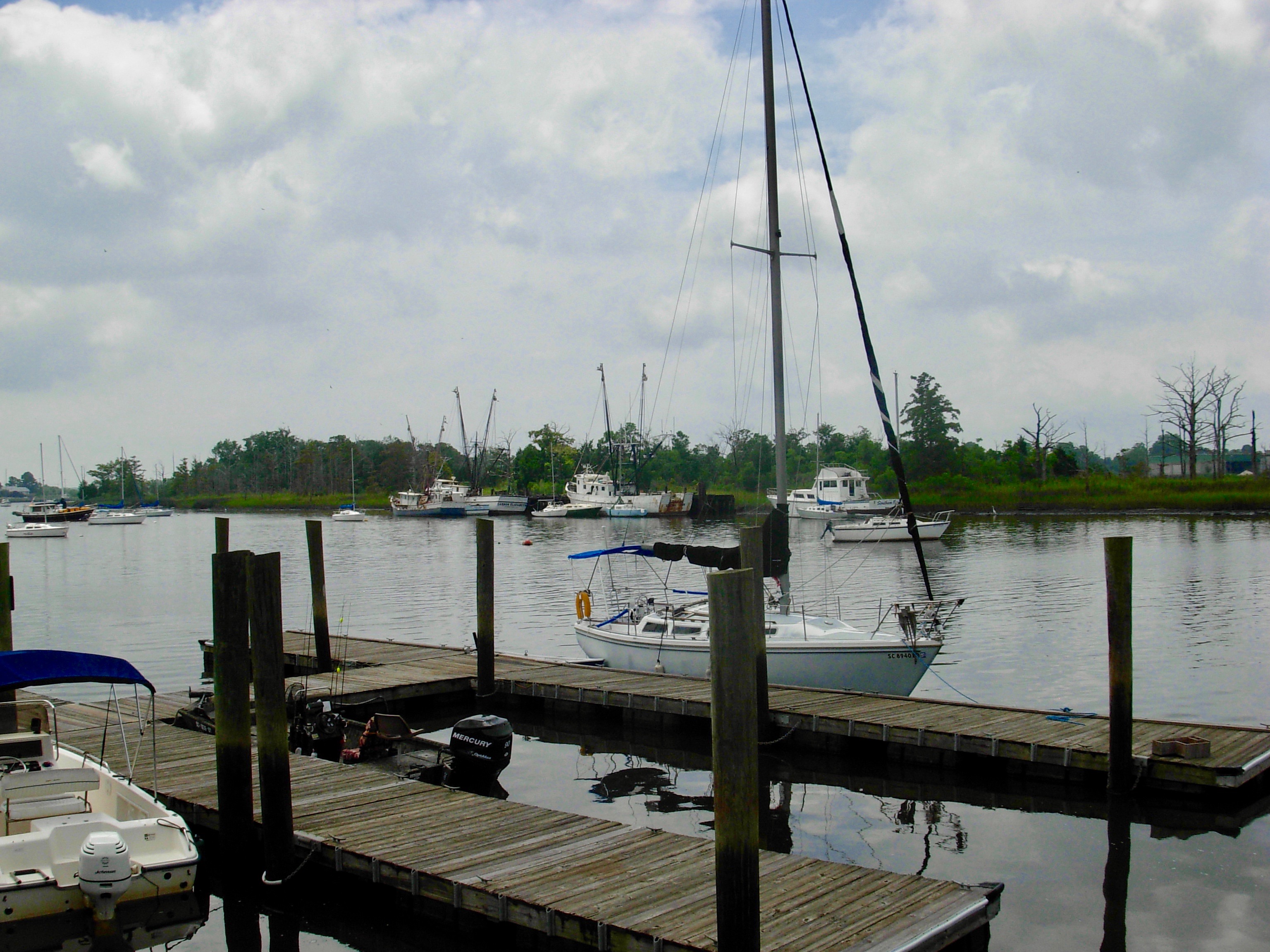
Sampit River Georgetown South Carolina ghosts haunted
Sampit River just off of Front Street. Photo 2011, by Lewis Powell IV, all rights reserved.

Georgetown is recognized as the third oldest city in South Carolina, though this is argued as the Spanish settled the area in the early 16th century, thus making it one of the oldest cities in the New World. Officially, the city was founded by the English in 1721 and served as a wealthy port city and center for agriculture for this fertile region. Initially, wealth flowed in from the trade in indigo, but following the American Revolution, cultivation of indigo was supplanted by rice which grew especially well in this wet, marshy area. By 1840, almost half of the rice produced in the United States was grown in this region, and Georgetown became the largest port for rice exportation in the world.

The Civil War brought horrors to the country and a blockade to Georgetown’s port, though the war did not scar the city like its neighbor, Charleston. With the loss of slave labor, many of the large plantations in the area struggled to produce the vast amounts of rice that had been produced before the war. Rice, once the port’s main export was replaced by timber and an International Paper plant gave a much needed boost to the local economy following the Great Depression. With such a large an intact historic district, the city has been able to capitalize on its heritage and now attracts tourists and retirees.

Many of the area’s ghosts have been documented by Elizabeth Huntsinger Wolf, in her three volumes: Ghosts of Georgetown, More Ghosts of Georgetown, and Georgetown Mysteries and Legends. Many of these stories appear to be old legends though a few have modern postscripts with activity that has been recently reported. Please note that many of these homes are private residences; please respect the owner’s privacy.

Sources

  • Georgetown, South Carolina. Wikipedia, the Free Encyclopedia. Accessed 11 August 2011.
  • Ruhf, Nancy R. National Register of Historic Places Nomination Form for the City of Georgetown Historic District. 3 February 1971.
  • Workers of the Writers’ Program of the Work Projects Administration in the State of South Carolina. South Carolina: A Guide to the Palmetto State. NYC: Oxford University Press, 1941.

Beth Elohim Cemetery
400 Broad Street

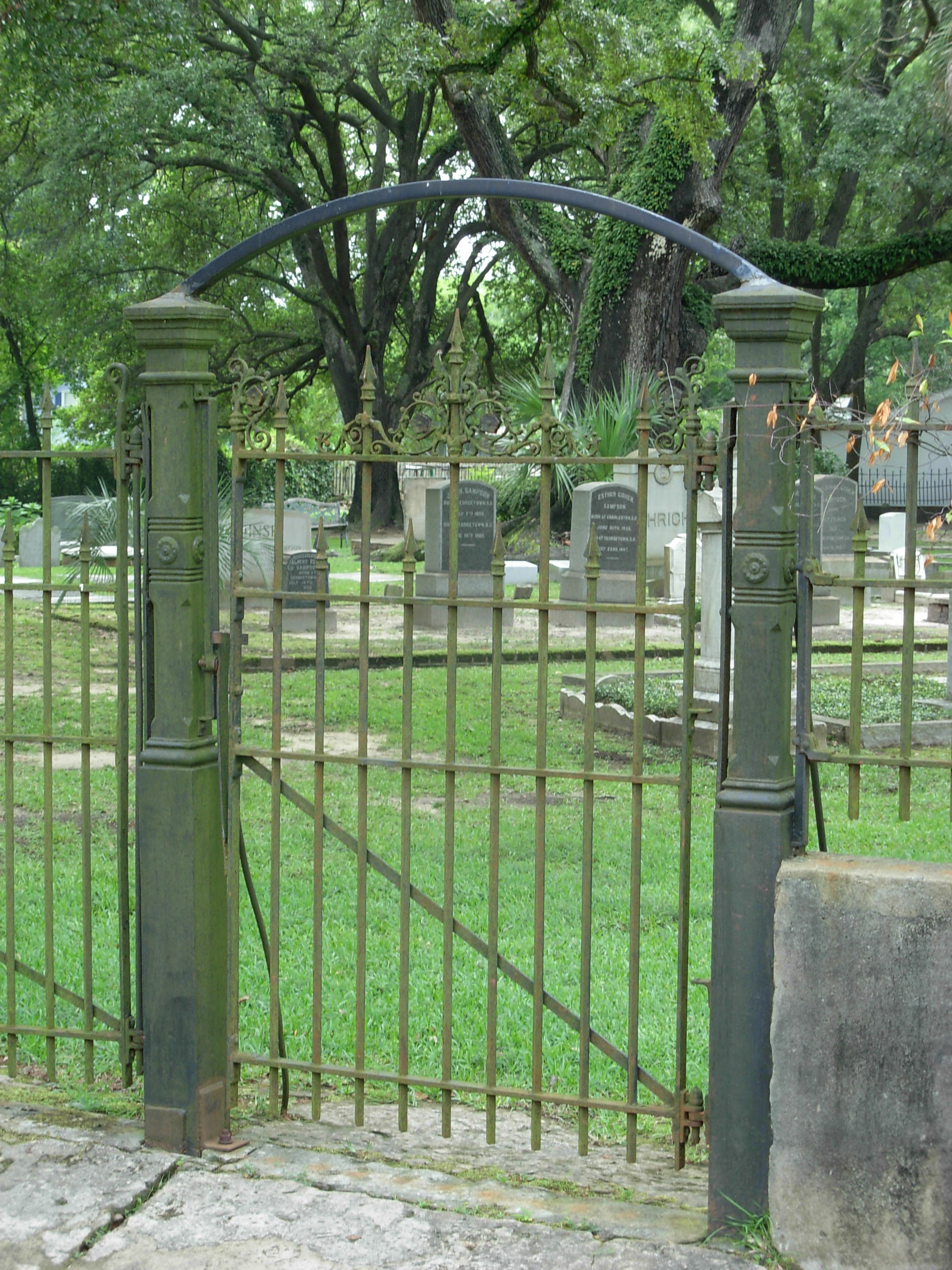
Beth Elohim Cemetery Georgetown South Carolina ghosts haunted
Gate of the Beth Elohim Cemetery. Photo 2011, by Lewis Powell IV, all rights reserved.

The second oldest Jewish cemetery in the state, the Beth Elohim Cemetery contains graves of many of the most prominent citizens of Georgetown, including three of the city’s six Jewish mayors. The legend associated with this graveyard involves Pauline Moses who, with her best friend Eliza Munnerlyn, had planned to be wed on the same day at the same time, though in different locations. Both girls contracted yellow fever and died a few days before the weddings. Subsequently, girlish laughter heard emanating from this cemetery as well as the cemetery of Prince George Winyah Episcopal Church just across the street, where Munnerlyn is buried, is thought to be theirs.

Sources

  • Beth Elohim Cemetery. Find-A-Grave. Accessed 13 August 2011.
  • Huntsinger, Elizabeth Robertson. Ghosts of Georgetown. Winston-Salem, NC: John F. Blair, 1995.

Bolem House (private)
719 Prince Street

Bolem House Georgetown South Carolina ghosts haunted
Bolem House. Photo 2011, by Lewis Powell IV, all rights reserved.

Possibly the oldest home in Georgetown, recent evidence indicates that it was originally constructed as a tavern. With the influx of sailors into the port, Georgetown would have had at least a few establishments to house and serve them. Residents of the house have since occasionally heard and seen the revenants of some of these long dead sailors. Huntsinger describes the surprise of a family member when he encountered a sailor on Christmas of 1993. The family member went into the kitchen and “encountered a very old man in an old-time sailor’s outfit, and he appeared to have no teeth. The man wandered around the kitchen, then into the hallway, never saying anything and looking somewhat displaced.” The witness asked the rest of the family if they had seen someone and they had not. Hopefully, the poor sailor will soon figure out where he needs to be.

Sources

  • Huntsinger, Elizabeth Robertson. More Ghosts of Georgetown. Winston-Salem, NC: John F. Blair, 1998.

Cleland House (private)
405 Front Street

Cleland House Georgetown South Carolina ghost haunted
The Cleland House, 2011, by Lewis O. Powell IV, all rights reserved.

The article for the Cleland House has been broken out into a separate article, “The scarab’s sting–Georgetown, South Carolina.”

DuPre House (private)
921 Prince Street

DuPre House Georgetown South Carolina ghosts haunted
DuPre House. Photo 2011, by Lewis Powell IV, all rights reserved.

This house has in the recent past served as a bed and breakfast, but there was a large for sale sign in the yard when I visited a few weeks ago. An internet search doesn’t say if the inn is still open. I do hope that the little girl and the mother who have resided there since before the Civil War are okay. Guests in this home constructed around 1740 have reported seeing and hearing a woman and small girl who may have been victims of a fire in the 19th century. In addition to occasionally smelling smoke, occupants have come face to face with the two spirits and have heard childish giggling and singing. At times, small footprints have even appeared in freshly vacuumed carpet.

Sources

  • Huntsinger, Elizabeth Robertson. Ghosts of Georgetown. Winston-Salem, NC: John F. Blair, 1995.
  • Turnage, Sheila. Haunted Inns of the Southeast. Winston-Salem, NC: John F. Blair, 1995.

Henning-Miller House
331 Screven Street

Henning-Miller House Georgetown South Carolina ghosts haunted
Henning-Miller House. Photo 2011, by Lewis Powell IV, all rights reserved.

This lovely, circa 1760 (some accounts state the house is circa 1800, which would make this story false), home boasts a helpful spirit on the staircase. During the American Revolution, British soldiers often imposed themselves on the hospitality of both Tory (British sympathizers) and Patriot families alike. The family living in the Henning House was Tory but had a daughter with Patriot sympathies.

Throughout the South Carolina Low Country, the British had chased Patriot hero, Francis “Swamp Fox” Marion through the swamps and marshes. One evening as the British were sleeping upstairs, of their officers overheard the daughter talking downstairs of Francis Marion being in town. He rose quickly and, in his rush, tripped on the stairs breaking his neck, killing him instantly. Since that incident, anyone losing their footing on the same stairs has felt a hand keeping them from meeting the same fate as that young British officer.

Sources

  • Barefoot, Daniel W. Spirits of ’76: Ghost Stories of the American Revolution. Winston-Salem, NC: John F. Blair, 2009.
  • Huntsinger, Elizabeth Robertson. Ghosts of Georgetown. Winston-Salem, NC: John F. Blair, 1995.

Heriot-Tarbox House
(formerly the Harbor House Bed & Breakfast, private)
15 Cannon Street

See my article, “A host of stories–Georgetown, South Carolina,” for the stories behind this home.

Prince George Winyah Episcopal Church
300 Broad Street

Prince George Winyah Episcopal Church Georgetown South Carolina ghost haunted
Prince George Winyah Episcopal Church. Photo 2011, by Lewis Powell IV, all rights reserved.

Opened in 1747, the marvelous church of Prince George Winyah has served the citizens of Georgetown for centuries. For the legend surrounding the churchyard, see the above entry on the Beth Elohim Cemetery.

Pyatt-Doyle House (private)
630 Highmarket Street

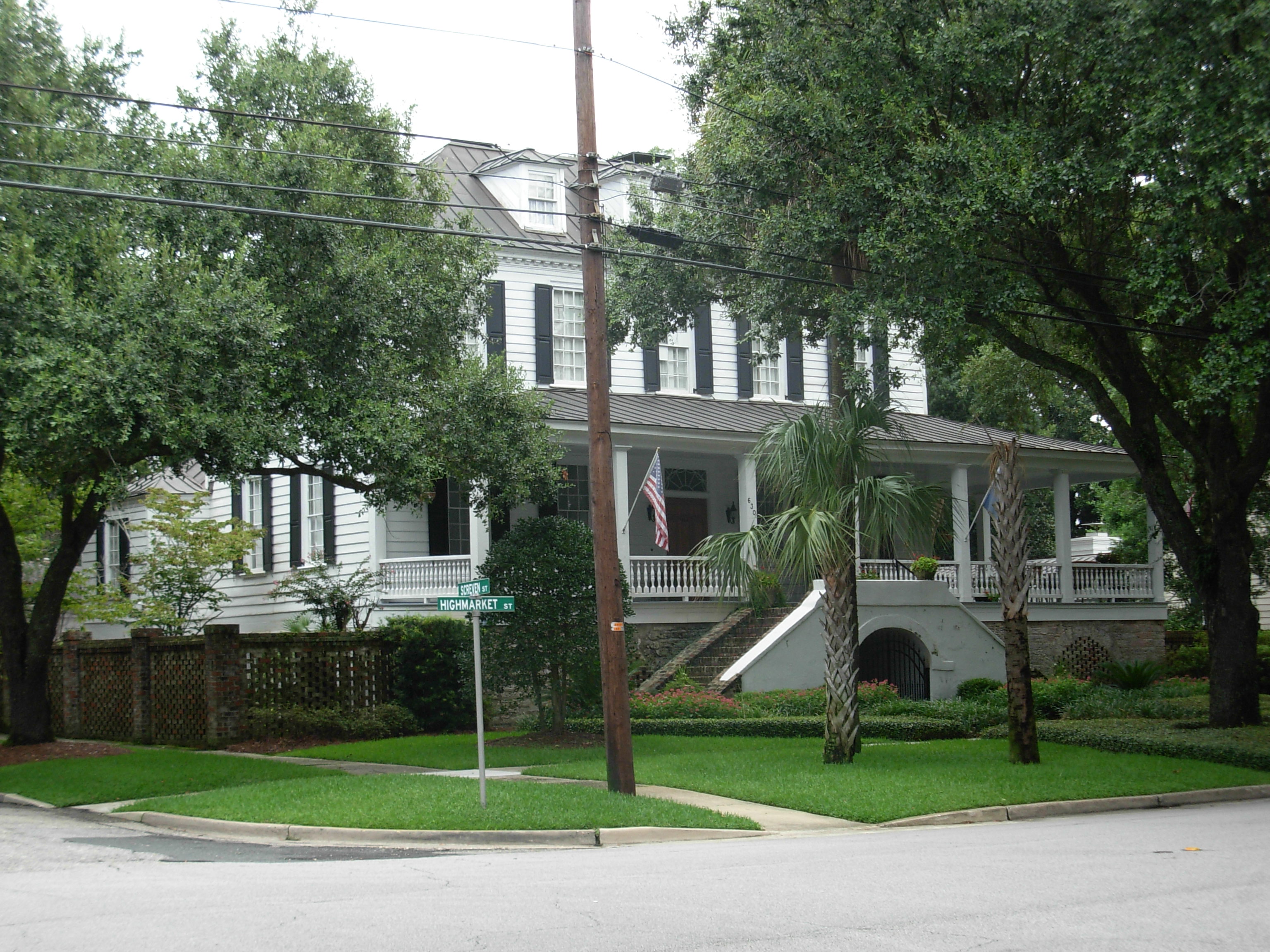
Pyatt-Doyle House Georgetown South Carolina ghosts haunted
Pyatt-Doyle House. Photo 2011, by Lewis Powell IV, all rights reserved.

This 1790 home is home to what appears to be mostly residual activity. It is noted that when a rocking chair is placed in one bedroom, it will rock on its own. Some visitors have even witnessed a woman holding a baby sitting in the chair. Others have heard the sound of footsteps throughout the house.

Sources

  • Huntsinger, Elizabeth Robertson. Ghosts of Georgetown. Winston-Salem, NC: John F. Blair, 1995.
  • Turnage, Sheila. Haunted Inns of the Southeast. Winston-Salem, NC: John F. Blair, 1995.

Rice Museum
633 Front Street

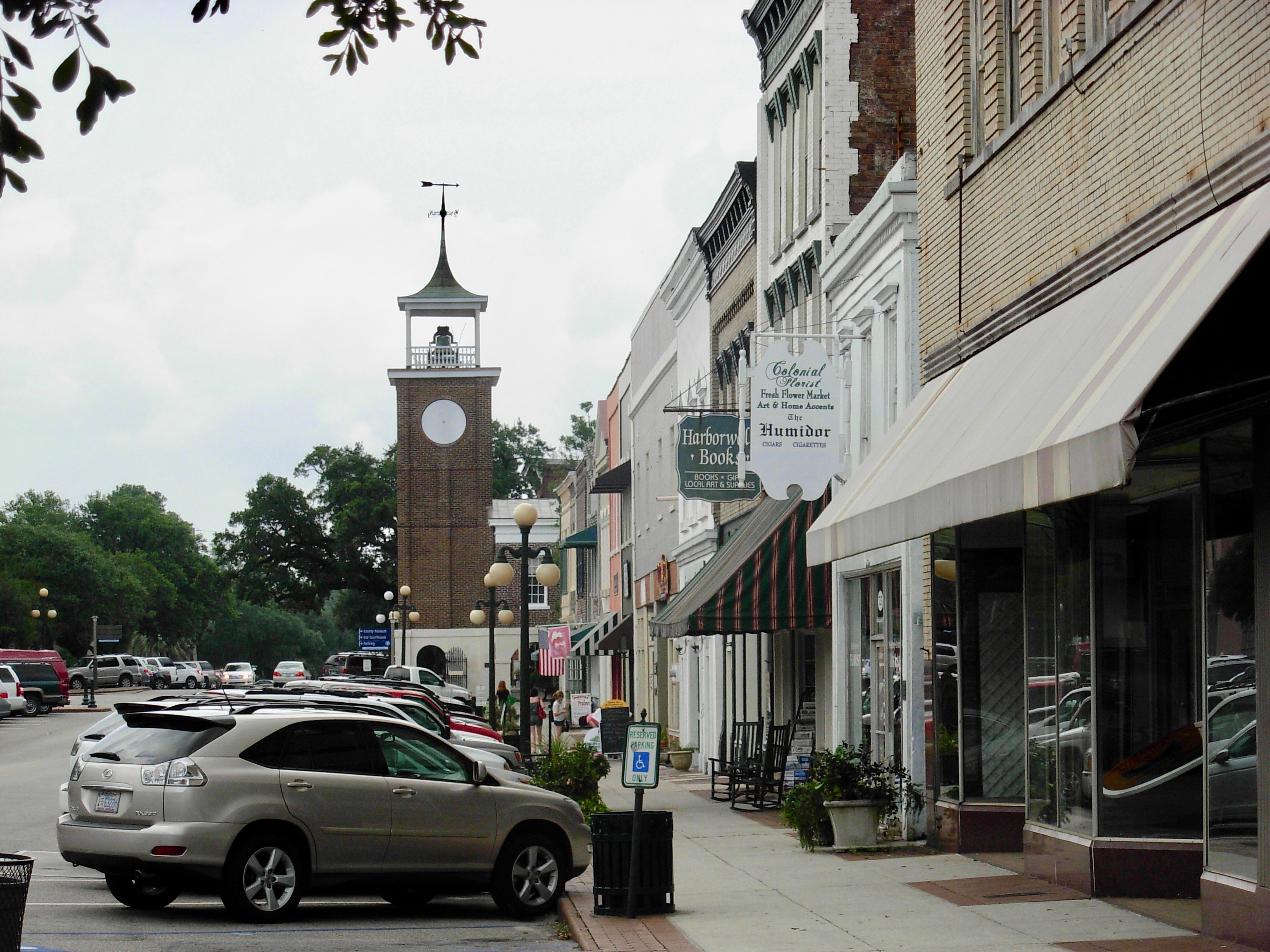
Front Street Georgetown South Carolina Rice Museum clock tower fire 2013 ghosts haunted
A view of the block that burned this morning. The SC Maritime Museum in the foreground, sustained some damage, while the buildings towards the Rice Museum were gutted by the early morning fire. 2011, by Lewis O. Powell IV, all rights reserved.
Kaminski Building Rice Museum Georgetown South Carolina ghosts haunted
Kaminski Building. Photo 2011, by Lewis Powell IV, all rights reserved.

Georgetown’s Rice Museum, documenting the history of rice cultivation in the South Carolina Lowcountry, occupies two historic buildings on Front Street: the Old Market Building with its landmark clock tower, and the adjacent Kaminski Building. The Old Market Building once housed, as the name implies, the local market selling produce, livestock and slaves while the upper portions housed the town hall. Over the years the building has served as a jail, a printing shop, and the town police department.

The Kaminski Building, constructed in 1842, the same year as the market, served as retail space for many years. With so much activity over the years, it’s hard to imagine that these buildings wouldn’t contain a ghost or three. Footsteps, particularly those of someone with a peg-leg have been heard in the art gallery in the Kaminski Building. Elizabeth Huntsinger, author of Ghosts of Georgetown and More Ghosts of Georgetown, points out a particular antique sideboard in the museum that may even be associated with the spirit of an enslaved woman.

Sources

  • Fant, Mrs. James W. National Register of Historic Places Nomination form for the Georgetown County Rice Museum. 8 November 1969.
  • Huntsinger, Elizabeth Robertson. More Ghosts of Georgetown. Winston-Salem, NC: John F. Blair, 1998.

Strand Theatre
710 Front Street

Strand Theatre Georgetown South Carolina ghosts haunted
Strand Theatre. Photo 2011, by Lewis Powell IV, all rights reserved.

This plot of land on Front Street has been occupied by a cinema since the Peerless Theatre was constructed here in 1914. The Strand Theatre opened in 1941 and closed in the 1970s. In 1982 the Swamp Fox Players, a local community theatre company took over the building, slowly restoring its Art Moderne glory.

Almost immediately after taking over the building, company members began noticing the sounds of footsteps in the balcony. During a performance of an original show, Ghosts of the Coast, based upon a series of ghost stories and other haunting tales, actors leaving the theatre began to notice odd cold spots and the sounds of whispers began to emanate from the backstage area. They summoned a local ghost hunter who blamed the occurrence on a scene in the show involving a hoodoo spell. While the cold spots and whispers have since ceased, the footsteps continue.

Sources

  • Wolf, Elizabeth Huntsinger. Georgetown Mysteries and Legends. Winston-Salem, NC: John F. Blair, 2007.

Waterman-Kaminski House
622 Highmarket Street

Waterman-Kaminski House Georgetown South Carolina ghosts haunted
Waterman-Kaminski House. Photo 2011, by Lewis Powell IV, all rights reserved.

Next door to the Pyatt-Doyle House is the even earlier Waterman House, built around 1770. This house is home to two separate legends. One speaks of a little boy whose family left him in the care of the home’s owners while they journeyed north during the summer. The family was lost at sea and the little eight-year-old soon fell sick with grief and died. His pitiful spirit is still seen here occasionally.

The other legend concerns a young woman who fell for a faithless sea captain. Returning from a trip he presented his love with a vial of exotic perfume. After her lover left her home, the sweetheart watched him from a third-floor window. With horror she observed him entering a local tavern, eventually emerging with another young lady. Distraught, the young woman drank the contents of the vial and died. Her sad spirit is said to still watch from the window on summer evenings.

Sources

  • Georgetown Paranormal. “Waterman-Kaminski House.” Haunted Places in Georgetown, SC. Accessed 13 August 2011.
  • Huntsinger, Elizabeth Robertson. Ghosts of Georgetown. Winston-Salem, NC: John F. Blair, 1995.