The Distant Past and the Very Near Future—Tennessee Brewery

Tennessee Brewery
495 Tennessee Street
Memphis, Tennessee

I covered the Tennessee Brewery about two years ago as part of an article on abandoned and possibly haunted buildings in Memphis. There have been developments with the Sears Crosstown Building as the local arts community has begun using the building for arts functions. The Sterick Building remains closed and for sale as far as I know while the Tennessee Brewery has been scheduled a date with destiny.

The owners of the building have announced that the building will be demolished on August 1st if no one steps forward to purchase the abandoned structure before then. However, innovative plans have recently been hatched to temporarily use the building ahead of the possible demolition in an effort to arouse interest. Six weeks of events, titled “Tennessee Brewery Untapped,” will be held in the building and expected to draw a crowd. Live music will echo through the aging halls of the brewery while beer—the products of local micro-breweries—will be served in a café that will operated in the building. Other events will include food trucks, mobile retail, movie screenings and workshops.

The massive Tennessee Brewery, 2010, by C ammerman. Courtesy of Wikipedia.

With so many people expected to crowd into the massive structure, it will be interesting to see how the spirits react. Laura Cunningham in Haunted Memphis states that the spirits “appear to be angry.” This is assumed from the loud noises that can sometimes cause the building to shake while some investigators have been touched, pinched and pushed.

Interestingly, in a 2012 article for the Memphis Commercial Appeal, Michael Einspanjer, founder of Memphis Paranormal Investigators states that “the spirits stuck in the building just couldn’t let go in life, they aren’t threatening.” The article notes that Einspanjer’s group has investigated the brewery at least 12 times and he states that the building is “a very haunted place.”

In looking through the material on the haunting of the brewery, it is very interesting to note that most sources do not speculate as to why the brewery may be haunted. Spurred on by the articles relating to Tennessee Brewery Untapped, I decided to check Newspapers.com to see what may be found relating to the brewery’s history. Indeed, I came up with a few very interesting leads.

The first event dates to 1888, just before the brewery’s construction. Papers in early August report a massive fire at the brewery that destroyed parts of the brewery as well as adjacent structures. The current structure dates to 1890. No deaths are reported in any of the articles, though a massive fire may have left a spiritual imprint on the site.

The second event dates to 1903 and involves at least one death. On April 15 of that year, Adolph Heinz, a German citizen and employee of the brewery was shot and killed. The article appeared in countless papers, obviously pulled from wire services and does not state exactly where the shooting took place. Reportedly, an African-American man named Gary Morgan asked Heinz to bring him a pail of beer. When Heinz refused, Morgan—“a negro with a picturesque police record”—shot him. The article notes that members of the local German community assembled to hunt down Morgan to lynch him. As of yet, nothing has turned up to reveal if Morgan was apprehended.

A third event was reported by the Associated Press in 1950. Prior to December 17th, an employee at the brewery fell from a stairway at the brewery and was killed when his head struck the floor. Perhaps his spirit is among the spirits remaining in the building.

Tennessee Brewery Untapped is scheduled to begin April 24th and run through June 1st.

Sources

  • Cunningham, Laura. Haunted Memphis. Charleston: History Press, 2009.
  • Douglas, Andrew. “Group pushes to save old Tennessee Brewery building.” 31 March 2014.
  • “FLAMES IN A BREWERY: The Tennessee Brewery at Memphis Badly Damaged—Other Fires Yesterday.” Chicago Daily Tribune. 11 August 1888.
  • “Killed in fall.” Kingsport Times-News. 17 December 1950.
  • Meek, Andy. “New Partners Sign On to Tennessee Brewery Effort.” Memphis Daily News. 4 April 2014.
  • Meek, Andy. “Plans Coming Together for Tennessee Brewery Untapped.” Memphis Daily News. 26 March 2014.
  • “One of the Kaiser’s Subjects Killed by Memphis Negro.” The Atlanta Constitution. 16 April 1903.
  • Pickrell, Kayla. “Haunted Memphis: Brewery a piece of history.” The Commercial Appeal. 24 July 2012.
  • Poe, Ryan. “Tennessee Brewery Untapped gets beer license.” Memphis Business Journal. 2 April 2014.

An Independent Spirit—Winchester, Virginia

Abram’s Delight
1340 South Pleasant Valley Road
Winchester, Virginia

With the recent winter weather, I imagine Mary Hollingsworth is livid if the snow around her house has not been cleared. A 2003 article from the Winchester Star mentions that she was rather upset by a large snow pile outside the house and expressed her displeasure by slamming doors and messing with the lights. Mary Hollingsworth still resides in her old house, but she doesn’t “live” there. She’s been dead since 1917.

Even in death Mary Hollingsworth independent spirit shines through. It may be Mary’s spirit that once turned up the volume on a stereo in one office and a jukebox in another. She also occasionally rearranges the furniture and once even pushed a heavy filing cabinet in an attic room against the door, preventing anyone from entering. In addition to watching over her former home, Mary may also be occasionally visiting her family’s mill next door. Employees of the mill—now the home of the Winchester-Frederick County Historical Society—have had doors open and close on their own while one employee experienced “an unexplained flash of light and felt a whoosh of cool air” as she walked through the building’s first floor.

In life, Mary was just as unique a character. She was born into wealth at Abram’s Delight in 1836. At that time, Mary’s father, David, was a wealthy businessman and community leader as well as being fond of entertaining in his grand home. Among the spectacular additions to the house was a lake with a series of islands featuring summer houses. A fleet of boats was kept on hand to ferry guests to these islands during social events.

With the coming of the Civil War, Winchester, located in the most northern tip of Virginia, changed sides many times. Devastation was visited upon Abram’s Delight. The farm lost much of its timber, the fields went untilled and Union soldiers commandeered the livestock. Mary, in her mid-20s and unmarried, quite possibly served the cause of the Confederates by donning men’s clothing and slipping back and forth between the ever changing lines of occupation.

To keep her family’s estate functioning after the war, Mary left Virginia again donning men’s clothing to work for a living. Different sources have her doing different things: one source has her driving a “chuck wagon” out west while others have her working in a Pittsburgh lumber mill. Regardless, she evidently acquired a lady love during her charade and proposed marriage. Later, she broke off the engagement and returned home though her former fiancée and her father did file a lawsuit.

Abram’s Delight, 2012, by Joel Bradshaw. Courtesy of Wikipedia.

Some years later, the City of Winchester acquired the water rights to the spring near Mary’s home and constructed a sewage facility. Angered at the prospect of having her family land defiled by the city’s sewage, Mary proposed to never set foot in the city of Winchester again. She passed away in the home where she had been born in 1917. Her sister Annie remained in the home.

As Marguerite DuPont Lee was compiling her book, Virginia Ghosts, she spoke with Annie about the spirits remaining in Abram’s Delight. Mary, it seems, is not the first spirit to take up residence. Annie Hollingsworth reported that as a young girl she would sit at the piano and sing. While singing, another woman’s voice would sometimes mysteriously join in. Commonly, at night, the sounds of people carousing would echo from the parlor below. Lee in her politely Southern fashion notes that these sounds “did not annoy, being as familiar to her as the call of the whippoorwills outside the window.”

While it seems that Mary is the most active spirit at Abram’s Delight, as of late, another spirit has been active much longer: the possible shade of Abraham Hollingsworth, the family’s and Winchester’s patriarch. This marvelous home remains as a testament to the fortitude of Mr. Hollingsworth. A Quaker, Abraham traveled to the Shenandoah Valley around 1728 in search of a prime location to farm and build a home and a mill. Supposedly, upon discovering a group of Shawnee camped near a small spring, Hollingsworth exclaimed that the place was “a delight to behold.” He constructed a small cabin on the property and was granted nearly 600 acres. Construction on the large, limestone house began a few years before Hollingsworth’s death in 1748.

The spirit of a large man in Quaker dress and a large hat has been seen for years within and without the house. At one time, the appearance of this spirit was so frequent that workmen would amuse themselves by watching the figure. The figure would appear and walk up the front steps of the house and pass through the front door. The workmen would pause and watch the figure and then patiently wait about ten minutes for the figure to reappear. After passing through the front door again, the figure would walk down the stairs and disappear again.

This familiar spirit was also reported in 1951 while the house was being restored. L. B. Taylor reports another story from the early 20th century where the spirit would often shoo away cows that were being brought in.

Of course, based on the evidence, it is difficult to determine whether these spirits are actually the shades of Mary and Abraham but based on what we know of their personalities, it’s altogether conceivable that these are the very independent spirits of them.

I just hope the staff at Abram’s Delight have shoveled the snow away.

For a tour of the Shenandoah Valley, including Winchester and Abram’s Delight, see my Spectral Tour of the Shenandoah Valley.

Sources

  • Abram’s Delight. Winchester-Frederick County Historical Society. Accessed 31 March 2014.
  • Abram’s Delight Museum. Washington’s Frontier Forts Association. Accessed 19 November 2013.
  • Lee, Marguerite DuPont. Virginia Ghosts. Berryville, VA: Virginia
  • Book Company, 1966.
    Libby, Elizabeth. “Haunting happenings at Abram’s Delight.” The North Virginia Daily. 27 October 1995.
  • Mangino, Stephanie M. “Scandal and sadness marked Mary Hollingsworth’s life.” Winchester Star. 25 October 2003.
  • Shufelt, Gail. “Homes, ghost stories part of Winchester history.” The Daily Gazette. 11 August 1996.
  • Taylor, L. B., Jr. The Big Book of Virginia Ghost Stories. Mechanicsburg, PA: Stackpole, 2010.
  • Virginia Historic Landmarks Commission Staff. National Register of Historic Places nomination form for Abram’s Delight. September 1972.

‘His ghostship’—Salisbury, NC

Fisher Street
Salisbury, North Carolina

Lately, I’ve been enjoying exploring a new resource, Newspapers.com. A subsidiary of Ancestry.com, the site provides historic newspapers from the early 18th century virtually to the modern day. Though the coverage is inconsistent—rarely complete runs of newspapers are provided and their holdings of Deep South papers are poor—there are still 64 million, plus pages of newspapers to search.

Newspapers of the 19th and early 20th were more apt to report on supernatural events and that’s true in this case from Salisbury, North Carolina. On September 1, 1898, The Hickory Press in Hickory, North Carolina—a little more than 50 miles away—picked up this item from the Salisbury Sun.

A genuine ghost was seen on Fisher Street last night. It was discovered by Theo. Hartman, in his room and made its way from the room to the street below by going through the second story window. On the street it was seen by a lady who happened to look out the front door of her house while his ghostship was resting on the fence. The ghost was very tall and perfectly white.

Besides the almost tongue in cheek humor of referring to the ghost as “his ghostship,” this note is very interesting. The movement of the ghost from a room, through the window and down to the street is odd. Generally ghosts are bound to move as living beings. Modern ghost hunters surmise that when ghosts do walk through walls or doors, they are usually following a path available to them in life—i.e. using doors that have since been walled up.

Of course, this is a single event and no information is provided as to if this is a regular occurrence. In a search for information about ghosts on Fisher Street I did come across a listing on a site called ParanormalHotspots.com. The site claims to provide information on haunted businesses directly from the business owners and subsequently has few listings. The only listing for the state of North Carolina is the, now defunct, Brick Street Tavern on East Fisher Street.

Fisher Street is now delineated as East Fisher and West Fisher with Main Street as the dividing line. The 100 block of East Fisher appears to be lined with mostly late 19th and early 20th century commercial buildings and Brick Street Tavern was located at number 122. According to the history at ParanormalHotspots, a large house was on this site in 1885 that may have been a flop house. The current structure was erected in 1912 as part of a wholesale goods company. It has served a variety of uses since that time. Reported activity at the location includes objects moving, apparitions, shadow people and a number of EVPs that have been captured.

With the information provided in the article it is difficult to know if “his ghostship” is still around or if he is responsible for activity at the Brick Street Tavern. If he is, next time I’m in Salisbury, I’ll be sure to buy “his ghostship” a drink.

Sources

Exclusive spirits—The Willcox

The Willcox
100 Colleton Avenue, SW
Aiken, South Carolina

The Willcox is so exclusive that it once turned away the Prince of Wales. Granted, it was Master’s Week while the Masters Golf Tournament was being played in Augusta, Georgia, just across the Savannah River and there was no room at the inn. Then again, having once turned away such a prestigious guest only adds to the mystique of this haunted grand hotel in horse country.

Interestingly, it was the visit of another prestigious guest that lead to national exposure for these exclusive spirits. While in the hotel during a campaign stop for presidential candidate, John McCain, a crew from NBC was alerted to possible paranormal activity in the hotel. As a result, the hotel was featured in a segment on haunted hotels on the Today Show. While taping an interview for the show, the exclusive spirits pulled some of their antics.

While interviewing the hotel’s general manager, “they asked, ‘How do you know ghosts are here?’ and—boom!—all the lights went out.” Even after changing equipment, the lights (I’m assuming the crew’s lighting, not the lights in the hotel) refused to work.

Aiken rose to prominence as a resort town for Southern planters. Before and after the Civil War, the town gained a reputation as a health resort where the ill and invalid could recover or ease the symptoms of their maladies. It was this reason that brought Louise Eustis to Aiken in 1872. An equestrian, Eustis took advantage of the mild climate to pursue her horsey pursuits and after her marriage to sportsman Thomas Hitchcock, they began encouraging their wealthy friends to visit Aiken.

The Willcox, 2012, by Bill Fitzpatrick. Courtesy of Wikipedia.

The Aiken Winter Colony, as it was known, began to attract the country’s elite. Politicians, scions of industry and business, the idle rich and fashionable began to swell the town’s population. Names like Astor, Vanderbilt and Whitney became common names around town. Noble sports like polo and fox hunting were introduced into the area with large hotels and estates constructed to house and serve the moneyed.

While the reasons for Frederick Willcox’s arrival in Aiken from his home country of England are unclear, he found success within the ashes of the Highland Park Hotel. Opened by Thomas Hitchcock, the Highland Park Hotel burned in 1898 and Willcox opened his small hotel in 1900. The Willcox built its reputation on “atmosphere, impeccable service and excellent cuisine.” The hotel’s reputation brought its guests back year after year and it served as a center of life in town during the height of the days of the Winter Colony. British politician Sir Winston Churchill, cosmetics maven Elizabeth Arden, architect Thomas Hastings and the British Army in India polo team all sought after the spacious rooms of The Willcox.

World War II cut deeply into the sparkling, carefree existence that had been experienced by many in Aiken. As the face of America had been changed by war, the upper echelons of society were changed as well and in 1957, Albert Willcox, Frederick’s son, decided to close and sell the hotel. For decades, the grand dame would sit idle and Aiken would return to a quiet existence as a small town.

With the hotel’s restoration and reopening, The Willcox has garnered awards and accolades including being named among the world’s top hotels by Conde Nast Traveler.

The exclusive spirits of The Willcox still make their presence known as well. The Georgia Paranormal Society investigated the hotel in 2006 and they described the Roosevelt Suite as one of the most active places they have encountered. Setting up equipment in this room that was occupied many times by President Franklin Roosevelt, the team captured things on tape the entire evening.

The hotel’s manager carefully pointed out in a 2007 article that most of the activity consisted of small things happening. Those things include books moving around on their own in a 3rd floor suite, a telephone ringing with no one on the other line and Christmas tree ornaments flying off the tree and landing nearby unbroken. A guest on the third floor heard footsteps and voices above her. The hotel has no 4th floor.

While it is noted that activity has been seen in most of the hotel’s rooms, it should be noted that guests have nothing to fear. The activity is simply the exclusive spirits of “swells and dandies of the Gilded Age” still living it up on the other side.

Sources

  • Baughman, Tony. “’Today’ show features inn’s hauntings.” The Aiken Standard. 1 November 2007.
  • History of the Willcox. com. Accessed 26 March 2014.
  • Marion, Margaret. National Register of Historic Places nomination form for Willcox’s. 19 March 1982.
  • Wylie, Suzanne Pickens and Margaret Marion. National Register of Historic Places nomination form for Aiken Winter Colony. 13 August 1984.

Night Nurse on Duty—Key West, Florida

Eduardo H. Gato House
1209 Virginia Street
Key West, Florida

A registered nurse who occupied a first floor apartment in this house in 1976 was awakened in the middle of the night. “I leaped with my hands over my face to protect myself. A white sort of energy was crossing from one end of the room to the other. I had the feeling of being invaded—that something that was not me was in the room.”

Gato House Key West Florida former hospital ghosts haunted
The Mercedes Hospital in the 1920s. Photo from the Monroe County Library Collection.

Some years later in another apartment, another woman was sleeping next to her boyfriend when she was suddenly awakened. “Something had touched her. She saw a short, stoutish woman at her bedside. The woman’s hair was in a bun, and she was wearing a grey dress with long sleeves and a high collar. Next to her was a man.” The figures seemed to be conferring about her as she lay in bed. The sleeper realized after a few moments that the woman was holding her wrist, checking her pulse.

Yet another woman in an apartment in the building experienced the ethereal nurse more recently. She had been sick with the flu and in bed for the day when she was started awake by something cold on her forehead. Waking, she found a nurse standing over her with her hand on her forehead while checking her pulse. She tried to scream and pull away but could not. The spirit quickly faded.

Gato House Key West Florida former hospital ghosts haunted
Courtyard of the Gato House in 1966 after the home’s conversion to apartments. Taken for the Historic American Buildings Survey, courtesy of the Library of Congress, Prints and Photographs Division.

The spirit, however, returned the next evening. After hearing about the spirit from another women living in the building, the woman was not so frightened. The woman addressed the spirit and said that while she appreciated the attention, she was frightened. “She took a step back from the bed, gave me an understanding smile and faded away.”

This large, grand home was not built to house the sick and the dying. It was a grand home for cigar magnate Eduardo Gato. At the outbreak of the Ten Years’ War—the first of three wars fought as Cuba tried to break away from Spain—Key West was filled with Cuban émigrés who built up the cigar-making industry on the island.

Eduardo Gato built the home around 1890 possibly using Cuban carpenters though he only lived in the house for a few years before returning to Cuba in 1898. The building was briefly used as a school, and then in 1911, the house opened as the Casa del Pobre (Home for the Poor) Mercedes Hospital.

Named for Eduardo Gato’s wife, the Mercedes Hospital was opened by Maria Valdez de Gutsens and a handful of other ladies who had been concerned with medical care for the poor and indigent. She was known around town as a marvelous fundraiser and personally collected money to keep the hospital running. Gutsens would haunt the exits of the local cigar factories on pay day asking for quarters for her beloved hospital.

While she was only an administrator, Gutsens aided the hospital’s small medical staff in their duties when needed. From 1911 until her death in 1941, Gutsens was a constant fixture in the hospital. She may still be there.

Gato House Key West Florida former hospital ghosts haunted
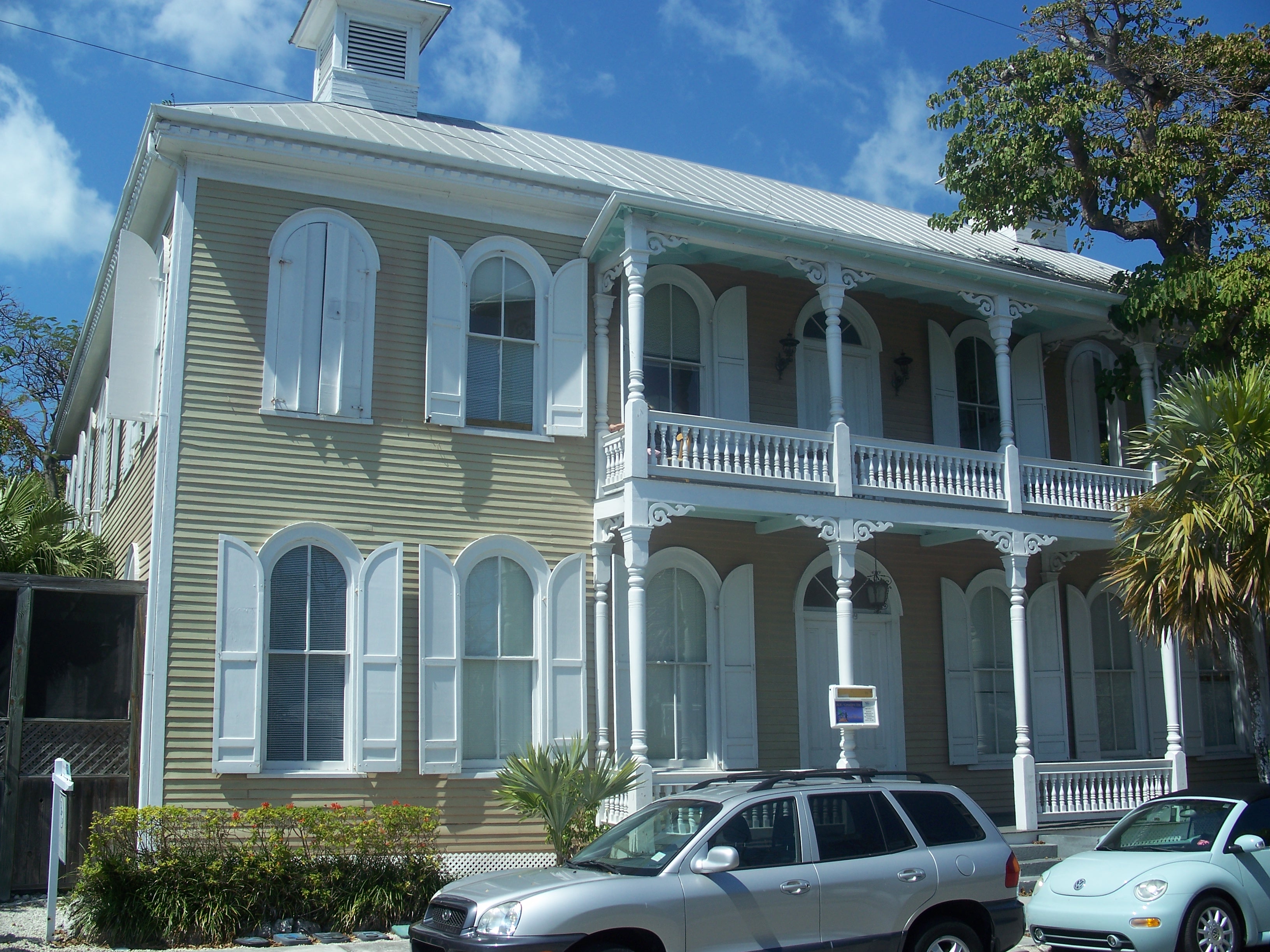
Gato House, 2011 by Ebyabe. Courtesy of Wikipedia.

The tale is told that just a few months after her death a patient was in the hospital with severe pneumonia. Not being in contact with his wife and children the man pleaded for help writing to his family. An older woman appeared at his bedside and calmly wrote the letter the man dictated. Feeling better the next morning, he asked who the kindly woman was so that he could offer his thanks. The night nurse insisted that she was the only person who had been on duty and she was shocked to see the letter the man had dictated in the hand of the late Maria de Gutsens.

A year after Gutsen’s death, the hospital closed its doors and cockfights were held in the building’s Spanish courtyard. The large home then was renovated into an apartment building and remains so to this day. Tenants still encounter the grey shade of the good Maria de Gutsens checking the pulses of the living while Dr. Fogarty—one of the many doctors who served the hospital—stands quietly by.

Sources

  • “Ghost of Nurse Haunts Key West House.” Playground Daily News. 4 November 1976.
  • Eyman, Scott. “Ghost Houses in Old Key West, The Walls Have Ears— And Eyes. Here Are Four Guests Whose Names You Won’t See on The Register. But They’re There.” Sun-Sentinel. 4 August 1985.
  • McCoy, Charles E., Jr. Report on Eduardo H. Gato House for the Historic American Buildings Survey. 16 Septrember 1966.
  • Sloan, David. Ghosts of Key West. Key West, FL: Phantom Press, 1998.
  • Williams, Joy. The Florida Keys: A History and Guide, 10th NYC: Random House, 2010.

Auditorium apparitions–Macon, Georgia

Macon City Auditorium
415 1st Street

Among ghost hunters, theories correlate limestone and paranormal activity. This may be the case in the Macon City Auditorium which is faced with Indiana limestone with an interior composed of Georgia marble, a form of limestone. Conceivably all this limestone may be the cause of the residual paranormal activity that has been experienced within the grand structure.

When the building is empty, its halls still sometimes echo with the sounds of events: parties, performances and other gatherings. Music and the buzz of murmuring voices are sometimes heard in darkened spaces. One staff member reported to Mary Lee Irby that he and another person witnessed a “dark distinctive shadow or mist” drifting in the balcony of the auditorium.

City Auditorium, 2007, by Macon Dude, courtesy of Wikipedia.

The numerous Greek Revival structures throughout Macon inspired the architect, Edgerton Swarthout, to create this classical masterpiece. The building matches the size of the Pantheon in Rome and the vast expanse is covered by what is—reportedly—the largest copper roof in the world. Completed in 1925, the City Auditorium has played host to numerous performances, conventions, meetings and events.

Sources

  • History of Macon: The First One Hundred Years, 1823-1923. Macon, GA: Printed by Williams and Canady, no date.
  • Irby, Mary Lee. Ghosts of Macon. Macon, GA: Vestige Publishing, 1998.
  • McKay, John J. A Guide to Macon’s Architectural and Historical Heritage. Macon, GA: Middle Georgia Historical Society, 1972.

A Passing in the Southland

Will my soul pass through the Southland
To my old Virginia grant?
— “The Legend of the Rebel Soldier,” traditional

I hope that when we pass on we have a chance to pass through the places that mean the most to us. I’d like to imagine that L. B. Taylor, Jr. of Williamsburg, Virginia is still touring the haunted grants of Virginia that he wrote so fervidly about.

Perhaps he’s meeting the ghosts that became so familiar to him through his many books of Virginia ghost lore. Perhaps he’s being greeted by ghostly coach and horses from Rosewell Plantation in Gloucester. Perhaps he’s touring the grand plantations along the James River and the historic farms and battlefields of the western part of the state. Perhaps he’s meeting the heroes and villains from the pages of the Old Dominion’s history: Jeb Stuart, Robert E. Lee, Thomas Jefferson, John Wilkes Booth, Nathaniel Bacon and Powhatan.

Taylor never set out to write about ghosts. After the Lynchburg, Virginia native graduated from Florida State University with a degree in journalism he worked as a writer for NASA and later for the BASF Corporation. After working in a book about haunted houses he focused his research on his home state publishing his first volume on Virginia ghosts in 1983. He would pick up the tradition of documenting Virginia folklore from Marguerite DuPont Lee, who first published her landmark Virginia Ghosts in 1930.

His first volume would serve as a basis for more than twenty volumes on the state’s ghost lore. While some books focus on the state in general, Taylor did tighten his focus for other volumes specific to the Tidewater, Richmond, Williamsburg, Lynchburg and Roanoke, among others. Initially, he self-published many of his books, but later worked with Stackpole Books and History Press to publish a few volumes. Taylor leaves behind a marvelous legacy: a well-researched, written and meticulously cataloged oeuvre documenting the hauntings of one of the paranormally active states in the South.

To Mr. Taylor, I wish you a fine journey! You have left many grateful readers and researchers behind and it is my sincere wish that our paths will cross once I make my final journey through the Southland. Bon voyage, sir!

Death at the train station—Bristol, Virginia

Bristol Train Station
101 Martin Luther King, Jr. Boulevard

 “I’m a thousand miles away from home just waitin’ for a train.”
–Jimmie Rodgers, “Waitin’ for a train,” 1928

Until it was replaced by the interstate highway system, the railroad was the predominant mode of transportation in the nation for more than a century. For small towns and communities, the train station served as a link with the outside world and, even deeper, as a place of transition. From these stations, children began the transition to adulthood, leaving behind provincial life to pursue opportunities in the larger world. All who left would be changed; some for the better, some for the worse and some would never return.

Still, others would transition from life to death at the very beginning of their journeys: they would find death awaiting them at the train station.

Bristol’s State Street straddles the state line between Tennessee and Virginia,  with the street’s north side in Virginia and its south side in Tennessee. Originally part of a large plantation, the land now occupied by the town was developed once the owner was notified that two railroads would be converging at that spot. Joseph R. Anderson—son-in-law to the plantation’s owner—erected a home and business house just south of what is now State Street, directly across the street for what would become the site for the town’s train station.

haunted Bristol Train Station Virginia ghosts
A train pulls into the Bristol Station on a cold morning. Photo 2013 by Hunterrr, courtesy of Flickr.

The first train pulled into the original depot at this site in 1856. With it, the train brought decades of prosperity to the town. Local historian, V. N. “Bud” Phillips, notes that, “there would have been no Bristol had it not been for the coming of the railroad.” The massive brick station that currently stands was constructed in 1902 and is the third building on the site. Once passenger service ended in 1969, the depot was used briefly for shopping and dining but then stood empty for some years. In 1999, the Romanesque structure was purchased by a foundation and renovated into an events facility.

The great country singer, Jimmie Rodgers began his transition here from itinerant musician and railroad employee to the Father of Country Music when he stepped from a train in 1927 and recorded two songs in a makeshift local studio. Those two songs would inspire a recording career that would propel Rodgers into history.

While no longer the scene of arrivals and departures, there remain some lingering spirits from those who made dramatic transitions at this spot.

On the platform of the previous depot, a young lady, Emma Tompkins, stood with her travel bag on the morning of May 5, 1887. Her good-for-nothing husband, “Big Will,” cajoled her to stay. Emma had spent the previous night, like many nights, alone while her husband caroused among the town’s saloons and brothels. In despair, Emma had finally decided to leave her husband and join her sister in Radford, Virginia.

As she marched herself towards the station, Emma encountered her husband and he followed her to the station platform. With the train pulling into the station, Big Will grabbed the arm of his wife and the couple tumbled onto the track. Emma screamed but it was cut short as the train decapitated her. Her husband was cut in half by the train. Emma’s spirit joined the throng of spirits that already flit through the vast halls of the station.

haunted Bristol Train Station Virginia ghosts
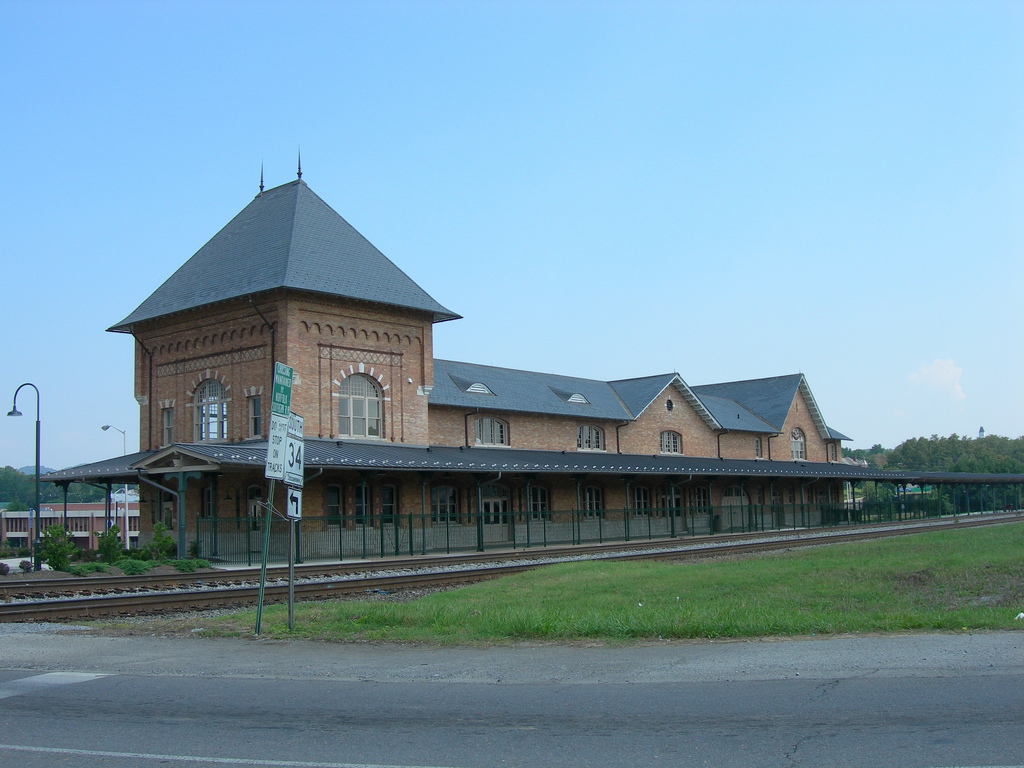
Bristol Train Station, 2008, by Tim Emerson. Courtesy of Flickr.

One ghost hunting organization somehow determined that some 68 spirits haunt the building. Besides Emma’s wailing spirit, the spirit of a man by the name of Joseph Chalmers King has been known to appear in the building. Dressed in black pants, a white shirt, bowtie, and derby hat, the spirit is apparently still waiting on his lost lady-love to arrive. King’s spirit was known to appear when southwestern trains would pull into the depot. His last known appearance was in 1969, when the last southwestern train pulled in.

Throughout the building it still seems there is activity from former railroad passengers. In 2008, the building’s manager clearly heard the main door open followed by footsteps across the great hall. Peering down from a balcony near his office, the manager was unable to see anyone present and was shocked to hear a cough from the invisible being. He also reports the sounds of people talking, coins rattling in an unseen pocket, a clock that always stopped at 8:50 PM, and elevators moving without passengers.

The paranormal group, HAUNT Paranormal (Hunting and Understanding National Terrors), investigated the building in 2010, which was documented by a reporter from the Bristol Herald Courier. Apparently, the group captured an EVP of a scream, perhaps the same scream that escaped the throat of Emma Tompkins before her neck was severed by the train’s iron wheels.

A 2011 investigation by Appalachian Truth Seekers was featured on an episode in season four of My Ghost Story: Caught on Camera. The episode concentrates on a few pieces of evidence by that group. The most compelling piece of evidence is a video that was captured by accident. One of the investigators was testing out a video camera in what appears to be one of the station’s main halls. In the few seconds of video, a dark figure moves past an upstairs doorway. At the time, none of the investigators or station staff were upstairs.

While investigating the station’s basement, a female investigator was shoved by something that she claims rushed her. After she became angry and told the spirit to stop, an EVP was captured proclaiming that “I did not do it. Not here, not me.”

While the station has transitioned into its modern usage as an events facility, it seems that the spirits residing there may still be trying to make the transition into the afterlife.

In this blog, I have covered several other locations in Bristol, Tennessee/Virginia. Two theatres on State Street–the Paramount Center for the Performing Arts on the Tennessee side, and the Cameo Theatre on the Virginia side–have been covered in my article, “Phantoms of the Operas, Y’all–13 Haunted Southern Theatres.” I have also covered East Hill Cemetery, which straddles the state line.

Sources

  • Appalachian Truth Seekers. “Appalachian Truth Seekers Case—Bristol Virginia Train Station Summary.” 3 December 2011.
  • “End of the Line.” My Ghost Story: Caught on Camera. Biography Channel. 12 May 2012. Season 4, Episode 6.
  • Galofaro, Clare. “Ghost hunters gather at Bristol station.” Bristol Herald Courier. 1 March 2010.
  • History. Bristol Train Station. Accessed 5 February 2014.
  • Jimmie Rodgers (country singer). Wikipedia, the Free Encyclopedia. Accessed 5 February 2014.
  • Phillips, Bud. “History of Bristol.” org. Accessed 5 February 2014.
  • Phillips, Bud. “Tragedy at The Depot Claimed Bristol Couple.” Bristol Herald Courier. 22 March 2009.
  • Tennis, Joe. Haunts of Virginia’s Blue Ridge Highlands. Charleston, SC: History Press, 2010.
  • Virginia Historic Landmarks Commission Staff. National Register of Historic Places nomination form for the Bristol Union Railway Station. August 1980.

Pillar of the community—Augusta, Georgia

Haunted Pillar
North Corner, Intersection of Broad and 5th Streets
Augusta, Georgia

“If you wouldn’t mind,” I explained to my boyfriend, “I’d like to get my picture in front of the pillar, but I won’t touch it. Supposedly, if you touch it, you die. And I’m far too superstitious to risk it.”

“Well, he’s not,” my boyfriend said looking towards the infamous “Haunted Pillar.” Glancing across the street, I saw a young boy casually passing the landmark and running his hand along it as he passed. He seemed totally unaffected by the curse.

After dodging traffic, we finally crossed the street and approached the curious landmark. There’s not much to it, though it’s a bit taller than I assumed from pictures. Given its sinister name and legendary history, I expected something more frightening. Other than being located on a section of Broad Street that was dodgy, the pillar looks rather forlorn and innocent. Just behind it is a tattoo parlor bearing the name of the accursed column with a gaudy sign painted above it.

The Haunted Pillar with the Haunted Pillar Tattoo Shop behind it. Photo 2014, by Lewis Powell IV,
all rights reserved.

The drab gray pillar glowers sourly in the middle of the sidewalk like a grumpy old man. After the rough history it has witnessed, I’m sure I’d glower too.

The pillar once proudly stood as part of the Old Lower Market in the middle of Broad Street. Built around 1830, Augusta’s market consisted of two buildings, two hundred feet long by one hundred feet wide. Under its expansive roof, agricultural goods were sold and traded; trade that possibly included slaves. As with any place that’s been tainted by the stench of slavery, the pillar’s history, both factual and legendary, still reeks with it. The historic marker near the pillar makes no statement as to the selling of slaves in the market but other sources involve the pillar with the inglorious industry.

Slavery is alluded to in the account of the Haunted Pillar collected in the mid to late 1930s by the WPA’s Writers’ Project. It mentions that at one point the pillar bore the handprint of a slave. Scott A. Johnson in his The Stately Ghosts of Augusta (2005) suggests that the pillar may have possibly been part of the slave-trading platform. Sean Joiner in his Haunted Augusta & Local Legends (2002) goes further by suggesting that the pillar’s curse may be “the residue of a curse being uttered by a man being sold into slavery.”

However, this is where slavery’s involvement in the story ends and the general legend takes up, jumping to the late 1870s. According to the legend, shortly before the night of February 8, 1878, an itinerant preacher began exhorting sinners within the market. Perhaps his condemnations drowned out the cries of vendors or his strong words upset customers, for whatever reason he was asked to leave. Before leaving, he warned those within earshot that a great storm would smash the building but leave one column standing. Anyone attempting to move that lone column would most surely die.

In the early morning hours of February 8, 1878, the market’s destruction commenced as a rare mid-winter tornado ripped through downtown Augusta. In the flowery language of the period, Patrick Walsh, editor of The Augusta Chronicle editorialized: “While thousands slept in what seemed perfect security, tremendous agencies of destruction were abroad on the wings of the wind, and but for the mercy of heaven, few of the slumberers would have escaped.” Indeed, two slumberers did not escape and were killed a short distance from where the Broad Street sentinel now stands.

Later that day, the Chronicle reported that the market was a “heap of ruins.” “The whole roof of the structure was thrown into a mass of ruins. Timbers were broken and many piled in utter confusion.” With a dramatic flourish, the reporter added that the market’s bell rang out as it crashed to the ground. Opinions on the market were quite strong as evidenced in papers published later that week: “It was, at best, an unsightly edifice and marred the grand boulevard upon which it was mistakenly located.”

But, among the broken timbers and toppled brick, the pillar remained standing like a scolding finger. At this point, the column’s history becomes murky again. Jim Miles writes in his 2000 book, Weird Georgia, that a local grocer, Theodore Eye of Lavasseur & Eye paid workmen to move the column the year after the market’s destruction. As the workmen began, a young boy set off a firecracker scaring the workers (and the horses as well, I imagine). The effort was abandoned.

Other attempts to move the column are not as well documented and include workmen being struck and killed by lightning while trying to move the column during a road-widening project. Another story mentions a bulldozer operator suddenly dying of a heart attack just as he begins moving towards the column. Like most legends, these are just embellishments that beef up the story.

The historic marker erected to briefly outline the pillar’s history mentions that the pillar has moved successfully at least once during its history. From other sources, it appears it has been moved a number of times. A 1997 article from The Atlanta Journal and The Atlanta Constitution quotes the owner of a business across the street from the pillar as noting that “it’s been moved several times because it was too close to the street.”

The historic marker located at the original site of the pillar, in the median of Broad Street. Photo 2014 by Lewis Powell IV, all rights reserved.

Still, there seems to be a mythos surrounding the cracking brick and cement creation. On two occasions, the pillar has been nearly demolished. In 1935, the pillar was struck by an automobile, but the driver was not injured. In 1958, on a Friday the 13th, the pillar was knocked over by a large bale of cotton from a truck. Again, the driver was uninjured. That incident led city leaders to move the pillar eight feet back from the street.

While the stories of deaths associated with the pillar seem to be urban legends, Jim Miles does note that there is apparently paranormal activity associated with the pillar. This includes the sounds of “whispered conversations between phantoms and footsteps of invisible beings pacing alongside.” The grim structure also seems to attract bad luck. The 1997 AJC article notes that the local sheriff counted eleven traffic accidents over the course of ten months of that year at the intersection where the pillar stands. The sense of bad luck was so forbidding that a group of people gathered that January to surround the pillar in an attempt to pray away the evil that dwelled there.

While most locals scoff at the legend they still don’t touch it.

Posing with the pillar. I didn’t touch it. Photo 2014 by Lewis Powell IV, all rights reserved.

Both my boyfriend and I posed next to the pillar, but we also took care not to touch it. Neither of us needs any more bad luck in our lives. 

Update 31 December 2016

It’s seemingly been a bad year for everyone. Even haunted places have had a terrible year as demonstrated by Augusta, Georgia’s Haunted Pillar. In the early morning hours of December 18, the pillar was struck by a vehicle and toppled into a pile of broken brick and mortar.

Taking cues from the Augusta Convention and Visitors Bureau and other local organizations, money is being collected to rebuild the pillar. While the pillar and its lingering curse has served for years as a bleak reminder of oppression, death, and destruction, we can take hope from its story. The pillar’s recent toppling is not the first time it has been toppled. Every time it has been damaged, locals have banded together to restore and rebuild this odd monument. 

Update 5 July 2018

The remains of the Haunted Pillar are lingering in a city storage facility. The location of this curiosity is haunted by a pedestrian orange cone. The last word from local media regarding the landmark’s fate states that some city workers are still afraid to touch it and that it will eventually be restored. Hopefully, the columns will be restored to its rightful position as a pillar of the community.

Sources

  • Anderson, Meredith. “Plans for restoring Augusta’s Haunted Pillar.” 31 October 2017.
  • “Augusta still haunted by tale of cursed pillar.” The Augusta Chronicle. 29 August 2010.
  • Johnson, Scott A. The Mayor’s Guide: The Stately Ghosts of Augusta. Augusta, GA: Harbor House, 2005.
  • Joiner, Sean. Haunted Augusta & Local Legends. Coral Springs, FL, Llumina Press, 2002.
  • Killion, Ronald G. & Charles T. Waller. A Treasury of Georgia Folklore. Atlanta, GA: Cherokee Publishing, 1972.
  • Kirby, Bill. “Cyclone of 1878 left story to tell.” The Augusta Chronicle. 8 February 2009.
  • Miles, Jim. Weird Georgia: Close Encounters, Strange Creatures & Unexplained Phenomena. Nashville, TN: Cumberland House, 2000.
  • Miles, Jim. Weird Georgia: Your Travel Guide to Georgia’s Local Legends and Best Kept Secrets. NYC: Sterling Publishing, 2006.
  • Scott, Peter. “Even the skeptical respect eerie Augusta landmark.” The Atlanta Journal and The Atlanta Constitution. 31 October 1997.
  • Wiley K, Bilmyer B. Augusta CVB raising money to rebuild haunted pillar. The Augusta Chronicle. 20 December 2016.

Preserving the Ghosts of the Past—Amory Regional Museum

Amory Regional Museum
801 3rd Street South
Amory, Mississippi

By Mississippi standards, the roots of the town of Amory—in the northeast part of the state, near the Alabama state line—by comparison, are not very deep. The town’s history dates to 1887 while the state’s history reaches back millennia towards Native American settlement and Hernando de Soto hacking his way through the region and the local inhabitants in the 16th century. Amory owes its creation to the railroad as it began to wend its way through the state following the Civil War.

haunted Amory Regional Museum Mississippi Frisco locomotive Frisco Park ghosts
The Frisco 1529 Locomotive, one of the trains that helped to create Amory, is preserved in Frisco Park, a few blocks from the Amory Regional Museum. Photo 2005, courtesy of Wikipedia.

When the Kansas City, Memphis & Birmingham Railroad needed a stop halfway between Memphis and Birmingham, a location in Monroe County was chosen and named for railroad magnate Harcourt Amory. As town lots were sold, citizens of nearby Cotton Gin Port slowly abandoned their much older town—established as a base for French explorations of the region in the early 18th century—to settle in the brand new planned town.

Much of this regional history is recalled in the Amory Regional Museum. The building housing the museum is woven into the history of the region as the birthplace of many locals including the museum’s director. The building originally served as the town’s hospital, the Gilmore Sanitarium, opened in 1916. It served as a hospital until 1961 when the hospital opened its current location. After that, it was converted into a nursing home for four years. After closing as a nursing home in 1965, the aging, though still vital, building stood empty until it opened as a museum in 1976.

It’s unclear when exactly the tales of the building being haunted began to spring up. One tale concerns Dr. M. Q. Ewing, the hospital’s chief of staff around the time the hospital closed. Supposedly, he’s still keeping watch over the old hospital and has been seen and heard around the building. Of course, like any hospital, birth and death are ever present and the veil between life and death here may be quite thin.

The activity within the facility is significant enough that the local paranormal investigation team, the Independent Paranormal Research Team, has hosted two public paranormal investigations in the museum. In December 2013, the group hosted a benefit investigation for a local child suffering from a rare illness.

An August 2013 article about the museum states, “Exhibits at the museum showcase Amory’s earliest inhabitants.” That statement is even more literal now that investigators are uncovering evidence that those inhabitants may still be around. The director notes a bit later in the article that, “Every town needs to preserve their heritage, it’s who you are. It’s where you come from.”

Sources

  • Amory, Mississippi. Wikipedia, the Free Encyclopedia. Accessed 31 December 2013.
  • “Amory Regional Museum.” Monroe County Magazine. 2009
  • Barnett, Sheena. “Join paranormal team on benefit investigation.” Northeast Mississippi Daily Journal. 12 December 2013.
  • Cotton Gin Port, Mississippi. Wikipedia, the Free Encyclopedia. Accessed 31 December 2013.
  • Federal Writers’ Project of the WPA. Mississippi: A Guide to the Magnolia State. NYC: Viking Press, 1938.
  • Garrigues, Jillian. “Video—Hidden Treasures: Amory Regional Museum.” WCBI-TV. 21 August 2013.
  • History. Amory Regional Museum. Accessed 31 December 2013.
  • Van Dusen, Ray. “Paranormal group hosts fundraiser for museum.” Monroe Journal. 22 October 2013.