The Siren of Pope Lick Trestle—Kentucky

Pope Lick Trestle
Over Pope Lick Road and Pope Lick Creek
Jeffersontown, Kentucky

The ghastly siren of Pope Lick Trestle has claimed yet another victim. The terror experienced by a young couple from Ohio while visiting this lonely railroad trestle is unimaginable. The couple was exploring the paranormal wonders of Louisville, of which there are many, and expected to tour Waverly Hills Sanitarium last Saturday evening. While trespassing at Pope Lick in search of the famed Pope Lick Monster or Goatman the couple was caught in the middle of the railroad trestle by an approaching train. The female was struck, thrown from the trestle, and killed. Her boyfriend was able to hang from the trestle until the train passed.

In Homer’s The Odyssey, Odysseus encounters the Sirens, beautiful maiden-like creatures who lured sailors to their death with their enchanting song. It seems the Pope Lick Monster is a variation of the sirens. In this case however, the monster lures teens with the thrill of viewing his ghastly form and when they walk the trestle in search of him some of them have been killed by a train on this busy thoroughfare.

The legend of the Pope Lick Monster is, like most urban legends, rather hard to pin down. The tales appear to have begun circulating in the mid-20th century. At that time, the trestle was a remote place where local teens would congregate to party and “neck” (in other words, to make out or have sex in the parlance of the period). Perhaps it is one of these teens who first saw the mysterious creature described as being half-human and half-sheep or goat. David Domine, a local writer, historian and expert on area legends and lore describes him as having muscular legs “covered with course dark hair. He’s got the same dark hair on the parts of his body. His face is alabaster they say and he has horns as well.” 

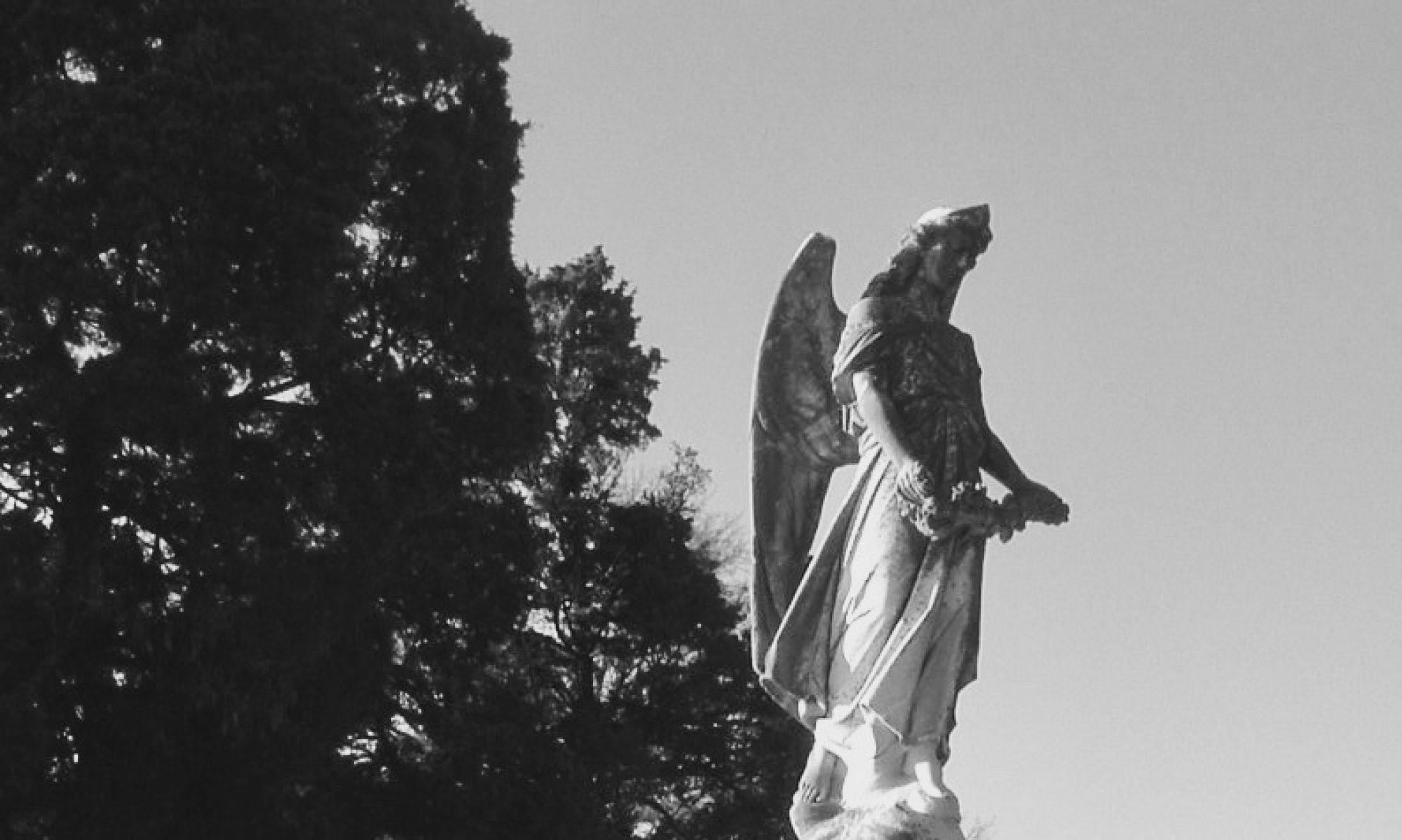
The Pope Lick Trestle over Pope Lick Creek, 2013, by David Kidd. From Flickr.

Some descriptions state that the creature uses hypnosis or other mind-altering methods to lure victims onto the trestle. Other stories note that he uses mimicry to recreate the voice of a child or loved-one. Once on the trestle, it’s too late for the victim to escape a passing train. Perhaps nowadays with the preponderance of thrill-seekers especially looking for paranormal thrills, just the thought of seeing the Goat Man’s visage is enough to lure the unwary.

Since the late 1980s, the siren of the trestle has claimed its fair share of victims. A young man died from injuries sustained in a fall from the trestle in 1987. The next year a young man was killed here in February. In 2000 local headlines note another young man killed after falling from the dangerous trestle. With the most recent victim, that makes four, though I suspect there may be more that didn’t immediately appear in newspaper searches. The trestle was constructed in 1929 and there may have been many deaths here over the years.

The exact identity of this murderous creature is also hidden in lore. Some stories make the connection between this creature and the Goatman that haunts the woods of Prince George’s County, Maryland. That creature is supposed to have escaped from a Beltsville, MD government lab, though the creature must do quite a bit of traveling between the two locations. Other stories indicate that the Goatman is the product of an illicit relationship between a local farmer and a member of his flock. Still other stories note that there may have been some type of Satanic ritual involved. The tale of a traveling circus involved in a railroad accident near here tells of the escape of a freak from the car carrying the circus’ freak show is also mentioned as an explanation for the monster here.

In 1988, Louisville filmmaker Ron Schildknecht premiered his short film, The Legend of the Pope Lick Monster. Norfolk Southern immediately expressed concern that the film might encourage locals to trespass on the trestle. Schildknecht added a note about this to the film to appease the railroad. It does appear that the film and the ensuing controversy served to stir up interest in the legend and perhaps add a bit to it.

Walking along railroad tracks, bridges, and trestles is considered trespassing. While these places are seemingly open to the public, they are private railroad property. The young woman killed at Pope Lick isn’t the isn’t the first ghost hunter or legend tripper killed on railroad property in recent years. In 2010, as a group of ghost hunters explored Bostian Bridge near Statesville, North Carolina, a train appeared and one of the young men was struck and killed by it. The victim pushed a young woman to safety and she was injured in the fall. This group of ghost hunters were looking for the ghost train that is known to appear here reliving the horrific train crash that occurred here in 1891.

Pope Lick Trestle may be safely viewed if one travels down Pope Lick Road. A walking trail also parallels the road and passes under the trestle as well. Do not trespass on the trestle! If you hear the siren call of the Goat Man of Pope Lick Trestle, shut your ears and leave the area, he may be calling you to your death.

Sources

  • Brown, Alan. Haunted Kentucky: Ghosts and Strange Phenomena of the Bluegrass State. Mechanicsburg, PA: Stackpole, 2009.
  • Bryant, Judy. “Trestle of death: Film depicting legend stirs fear of life imitating art.” The Courier-Journal. 30 December 1988.
  • Bryant, Judy and Lisa Jessie. “Film puts Pope Lick trestle” fatal attraction in the spotlight.” The Courier-Journal. 4 January 1989.
  • Gast, Phil. “’Ghost train’ hunter killed by train in North Carolina.” 28 August 2010.
  • Gee, Dawna. “Numerous urban legends tell of Louisville’s Goat Man.” WAVE3. 9 May 2014.
  • Holland, Jeffrey Scott. Weird Kentucky. NYC: Sterling, 2008.
  • Kuwicki, Holden. “Local legend may have contributed to Pope Lick death. 25 April 2016.
  • Strikler, Lon. “The Pope Lick Monster’s Deadly Trestle.” Phantoms and Monsters Blog. 30 May 2014.
  • Tangonan, Shannon. “19-year-old does after falling from railroad trestle.” The Courier-Journal. 7 November 2000.
  • Wilder, Annie. Trucker Ghost Stories. NYC: Tor, 2012.
  • Yoo, Sharon and John Paxton. “Coroner: Woman killed by train while investigating ‘goatman’ myth.” KLTV. 23 April 2016.
Life Returns to the Dead of Belmont—Elkridge, Maryland

Belmont Manor & Historic Park
6555 Belmont Woods Road
Elkridge, Maryland

 Last year just about this time, life began to return to Belmont Manor when it was reopened to the public. The estate had been a private residence for almost two centuries before it was donated to the Smithsonian Institution in 1964 for use as a conference center. The Smithsonian sold the property in 1982 to the American Chemical Society which used it as a meeting facility. They sold the property to Howard Community College which closed the property in 2010 after facing financial difficulties. Until the property sold in 2012, the grand house quietly sat in a pall of silence. Only the dead stirred.

As the house was being renovated and restored by Howard County, its new owner, the dead continued to stir. Workers on the estate observed a little girl running about. The county contacted Inspired Ghost Tracking who investigated and was able to captured an image of the spectral girl peering around a corner.

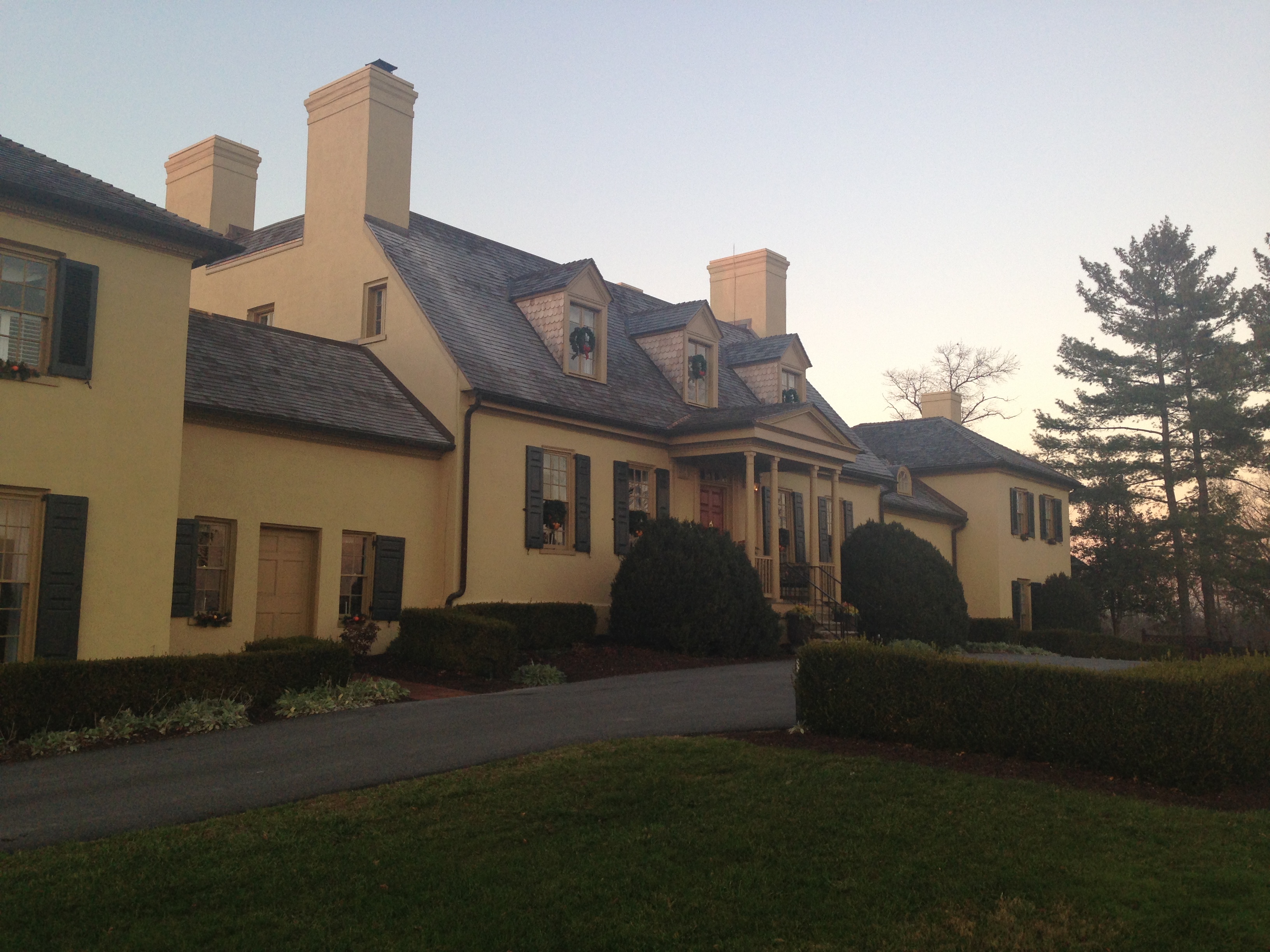
Belmont Manor, 2015, by Scott218. Courtesy of Wikipedia.

This ghostly child can be added to the legend recorded a little more than a hundred years ago in John Martin Hammond’s 1914 book, Colonial Mansions of Maryland and Delaware. In addition to relating the histories of these magnificent estates, Hammond included the occasional ghost story when they popped up. The Belmont Ghost, as Hammond dubs the spectral event, usually happened at least once every winter. On a dark, windy night, residents and visitors to Belmont would hear the sounds of an invisible carriage approach the house. Upon opening the door, the living would see nothing but continue to hear the sounds of an invisible retinue enter the house. Once unloaded, the carriage would be heard to head towards the stable.

Since opening to the public last year, Belmont is now playing host to weddings and other events while the public explores the historic woodlands that remain unchanged since the building of the house in 1738. Now that the dead have been discovered on the estate, Howard County has brought out paranormal investigators and those interested in learning about the spirits around us to learn about paranormal investigating here. According to the Baltimore Sun, the next public paranormal investigation will be held this summer. 

Sources

  • Bonk, Valerie. “Ghost investigations at Belmont gather people curious about the paranormal.” Baltimore Sun. 6 April 2016.
  • Gunts, Edward. “The past is prologue for Elkridge’s Belmont Mansion.” Baltimore Sun. 20 September 2012.
  • Okonowicz, Ed. The Big Book of Maryland Ghosts. Mechanicsburg, PA: Stackpole Books, 2010.
  • Yeager, Amanda. “Elkridge’s historic Belmont Manor reopens.” Baltimore Sun. 13 April 2015.

Crime and Punishment in South Georgia

Crime and Punishment Museum
(Old Turner County Jail)
241 East College Avenue
Ashburn, Georgia

The war in Europe had been heating for only a few months when the front page of The Atlanta Constitution noted that a touch of winter was being felt in Georgia. The paper was almost entirely taken up with news from the fighting that the minor note on page 7 might be totally disregarded by the average reader.

12 September 1914
Page 7

 HANGED FOR THE MURDER OF HIS MOTHER-IN-LAW

Ashburn, Ga., September 11.—(Special.)—Miles L. Cribb paid the death penalty on the gallows in the county jail here this afternoon at 1 o’clock for the murder of his mother-in-law, Mrs. Mary E. Hancock, near Rebecca, in November, 1913. Only a few close friends of the family were allowed to witness the execution.

After bidding his aged mother, brothers and little 9-year-old son goodbye the condemned man mounted the scaffold with signs of nervousness.

Sheriff King sprang the trap at exactly 1 o’clock. Twelve minutes later Cribb was pronounced dead. The body was turned over to relatives who will leave tonight for Jones county where Cribb will be buried tomorrow.

The murder for which Cribb was hanged was serious enough to make a headline on the front page of The Atlanta Constitution’s front page.

8 November 1913
Page 1

THREE WOMEN ARE VICTIMS OF ENRAGED FARMER’S FURY; ONE DEAD AND TWO DYING

Miles Cribb of Rebecca, Ga., Kills His Mother-in-Law and Seriously Wounds His Wife and Sister-in-Law.

EFFORT MADE BY WIFE TO SECURE ONLY CHILD LEADS TO THE TRAGEDY

Estrangement Between South Georgia Farmer and His Wife Leads to the Death of Aged Woman and Wounding of Her Daughters

Cordele, Ga., November 7.—(Special.) Enraged because his wife would not agree to a reconciliation with him after a brief separation of two weeks, M. L. Cribb, a Turner county farmer, living about two miles from Rebecca, tonight about 6 o’clock shot and instantly killed his mother-in-law, Mrs. J. G. B. Hancock, fired two bullets into the body of his wife, probably fatally wounding her, and then turning the pistol on his sister-in-law, Miss Sallie Hancock, fired the remaining bullets, inflicting a wound from which she will probably die during the night.

 Reports are to the effect that Cribb went to the Hancock home about 6 o’clock and, pushing open the dining room door without a word of warning, ripped out a revolver and shot Mrs. Hancock, 70 years of age, dead in her chair at the supper table, fatally wounded his wife and seriously wounded his sister-in-law, Miss Sallie Hancock.

[…]Cribb hastily left the scene before aid from nearby neighbors reached the wounded women and sought a hiding place in the woods nearby.

Miles Cribb made his way to his brother’s home where he attempted suicide by putting his revolver to his head but his brother, Rev. W. J. Cribb, was able to grab the weapon from him and urged him to surrender. The article notes that this horrific incident stemmed from his mother-in-law’s attempt to get custody of the couple’s child, presumably the son mentioned in the article about the hanging. The 1913 article concludes with the gathering of a mob wishing to lynch Mr. Cribb.

[…] Feeling is strong against Cribb in the Rebecca district, and is rapidly growing stronger, and it is believed that Warden Putman is trying to get Cribb to a place of safety early enough prevent mob violence.

[…] Late reports from the little town are that a mob has formed near the scene of the shooting and will make an effort to take Cribb from the officers f they are located. These reports have not been verified.

The streets of Rebecca are practically deserted, nearly all the male citizens having gone to the scene of the tragedy.

The following day Mr. Cribb again was in the front page headlines of The Atlanta Constitution:

9 November 1913
Page 1

 I Know I Must Pay Penalty But Save Me From Lynchers, Cries Cribb, Women’s Slayer

 Cordele, Ga., November 8.—(Special.) Miles L. Cribb who was the principal actor in one of the dastardly and horrible crimes ever enacted in the section of Georgia…is now safely confined in the Dougherty county jail [in Albany, GA]. While he is now probably safe from mob violence, feeling in the community near the scene of the tragedy continues [to be] very intense, and it is thought that until he is given trial, if then, it will not be advisable to return him to the Turner county jail.

[…]Upon the arrival of Putnam [the warden who arrested Cribb] and Cribb on the outskirts of Ashburn they found a mob had gathered there, intending to do violence to Cribb if he was brought there. [Sheriff John A.] King was notified of the whereabouts of Cribb, and eluding the angry citizens, he took him in an automobile as rapidly as possible to Sylvester and then to Albany.

Once the furor died down, Mr. Cribb was eventually transferred to the Turner County Jail where he faced a jury next door in the Italianate halls of the Turner County Courthouse on January 6, 1914. Both Cribb’s wife and sister-in-law survived their wounds and were present. Word of the trial was not published in The Atlanta Constitution until nearly a month had passed.

7 February 1914
Page 12

 CRIBB MUST HANG FOR BLOODY DEED

Wife Smiles as Ashburn Man Is Sentenced for the Killing of His Mother-in-Law.

 Ashburn, Ga., January 6.—(Special.) “We, the jury, find the defendant guilty,” was the verdict returned this afternoon by the twelve men who had been chosen to decide the fate of Miles Cribb, who was placed on trial in Turner superior court this morning at 8:30 o’clock charged with the murder of Mrs. Mary E. Hancock, hos mother-in-law, in the Rebecca district last November.

Silence pervaded the crowded courtroom from the time the bailiff in charge of the jury announced to the court that they were ready to enter until the last word of the sentence of death was uttered by Judge Cox, fixing Tuesday, March 3, 1914, as the date of execution.

Between his aged mother on the right and the Rev. W. J. Cribb, his brother, on the left, the unfortunate man sat with bowed head for the most part throughout the trial which lasted from 10 a. m. to 1:30 p.m. The mother of the defendant sobbed constantly, as did the defendant, himself, as his counsel feelingly pleaded for mercy from the jury.

[…]The wife of the defendant, together with her relatives, who occupied the front seat, smiled her approval of the verdict and sentence as the condemned man was turned over to the sheriff.

[…]It is very likely that Cribb will remain in the jail here until his execution as the bitter feeling toward him immediately after the crime has almost subsided.

Cribb languished in the Turner County Jail for a number of months before he was executed there in September, less than a year after his heinous deed. The Turner County Jail is not atypical of turn of the century jails that remain in small towns throughout the South. It’s a heavy brick building in the reigning vernacular style of the period with some Romanesque-revival elements. The building takes on a very solemn air, especially when compared to the righteous flamboyancy of the courthouse next door. The jail features a tower-like element on its west corner that echoes the clock tower on the courthouse and the steeple of the Baptist church that can be seen between the two when viewed from College Street. This solemnity gives the building the air of strength, order, and as a place to avoided.

Old Turner County Jail, 2015, by Jud McCranie. Courtesy of Wikipedia.

According to a 2003 article, the jail’s strict architectural lines led it to be referred to as the “Turner Castle” by locals. It was constructed in 1906 for Turner County which had been established the previous year. The jail opened in 1907 for inmates. As was common in small town jails, the building provided a home for the sheriff and his family as well as room for inmates. The sheriff’s wife was tasked with providing meals for the inmates as well as her husband and family.

At the back of the building a metal staircase leads to the second floor where male inmates were confined in small 7’X 7’ cells. Two bunks on either side provided sleeping accommodations for the inmates, four of which could be confined in a single cell. The second floor also held a “death cage” where Cribb would have been confined in the hours leading up to his meeting with state-sanctioned fate. This cell is just a few steps from the steel trap door that would drop Cribb to his death at the end of a strong rope. This harsh conditions persisted until the county opened a new jail in 1994.

According to the jail’s documentation in the Georgia Architectural and Historic Properties Survey, the solemn mood of the jail sounded like something akin to a revival service for Cribb’s hanging, the last hanging conducted in Turner County and the second hanging in the jail (the other was in 1907). Mrs. Netta Shingler, who sang a hymn before the execution, described the event as a “once in a lifetime” event attended by the sheriff, deputy sheriff, school superintendent, and a prominent local Methodist minister. A service was held where Mrs. Shingler notes that “if the prisoner heard us he made no signs but those conducting the service were overcome.”

The jail has been preserved as a museum examining the harsh jail conditions that once existed throughout the South. Among the artifacts displayed here is a bloody shirt collar of Miles Cribb’s shirt from his execution. While the museum explores the spirit of crime and punishment in the South, spirits persist here as well, trying to tell their own stories. The spirits slam doors, shake beds, and have been noted to leave indentions in the old mattresses in the cells. Museum staff have allowed a number of paranormal investigation groups investigate the jail with one of the groups, Southeastern Paranormal Investigative and Information Team (S.P.I.R.I.T. Paranormal), having a piece of tile thrown at investigators in the basement during their 2012 investigation. Reportedly, the tile shattered on an opposite wall.

During this investigation members of the team had a variety of personal experiences seeing, hearing, and feeling things. A member of the Ghosts of Georgia Paranormal reported that during their investigation in 2013 that he heard voices throughout the building. The Albany Herald has just recently reported on ghost tours of the jail that are now being conducted on Friday and Saturday nights by the Paranormal Society of Middle Georgia. Perhaps Miles Cribb is still pitifully pleading forgiveness for his heinous deeds.

Sources

  • “Ashburn, GA. Museum puts a lock on history.” com. 15 July 2003.
  • “Ashburn man spends the night in haunted jail.” 12 June 2015.
  • Big Bend Ghost Trackers. “Investigation Report for the Crime and Punishment Museum.” 6 October 2007.
  • Blanchard, Haley. Georgia Architectural and Historic Properties Survey: Turner County Jail. No date.
  • “Cribb must hang for bloody deed.” Atlanta Constitution. 7 February 1914.
  • Ghosts of Georgia Paranormal Investigations. “Investigation Report for Old Jail Museum, Ashburn, Ga.” 13 April 2013.
  • “Hanged for the murder of his mother-in-law.” Atlanta Constitutition. 12 September 1914.
  • “Historic jail in Ashburn offering ghost tours.” Albany Herald. 27 March 2016.
  • “I know I must pay penalty but save me from lynchers. Atlanta Constitution. 9 November 1913.
  • P.I.R.I.T. Paranormal. “Investigation Report for Crime & Punishment Museum.” 23 June 2012.
  • “Three women are victims of enraged farmer’s fury.” Atlanta Constitution. 8 November 1913.

Getting Personal–Cherokee, North Carolina

Nota Bene: My thoughts regularly return to my second home, Cherokee, NC and recently these wonderful memories have been jarred again. This is a freshly edited account from 2012 of some of my paranormal experiences in Unto These Hills Cast Housing, a place lovingly referred to as “The Hill,” and at the Oconaluftee Indian Village.

“To the Cherokee, the supernatural is just natural.” a Native friend said in and I think it succinctly sums up the attitude of the Cherokee towards the spirit world. They are simply blasé about it; it is just another facet of the world that exists around them. Overall, this world is very different from the world of Western thought where magic and superstition, in the name of science, are banished to the remote deserts of distasteful fiction. Working here among the Cherokee has been a challenge to how I think about the paranormal.

Since late May I have been working in Cherokee, North Carolina, at the heart of the Qualla Boundary Reservation, as a reenactor at the Oconaluftee Indian Village. The village is a recreation of a mid-18th century Cherokee village and is operated by the Cherokee Historical Association which also operates the outdoor historical drama Unto These Hills where I spent three glorious summers in college. While I’m working in the Village, I’m living in cast housing for the drama (known as “The Hill”). When I worked up here previously, I heard stories from the Mountainside Theatre and a few stories from The Hill, even having an experience of my own (which I discussed here). Returning some nine years later with a paranormal blog, I began asking for stories just after arrival and I’ve been bowled over as the stories have poured forth.

The Cherokee possess a deeply engrained spirituality and connection with nature. Certainly they are so much more open to the interactions between the living world and the spirit world and in inquiring about their experiences, their responses are often related in a mundane tone than those I would find elsewhere. From an early age, children here are warned by parents and elders about sgi-li or boogers and how they should not fear them. Children will be taught about the Yun-wi Tsuns-di or Little People, mischievous and protective beings that live all around. Their world is populated by wonderful, scary and magical creatures like the Nunne-hi, Uktena and the witch, Spearfinger, who steals children’s livers while they slumber. Truly the world of the Cherokee is a marvelous place of signs and omens, spirits and boogers, good and bad medicine. To truly appreciate the Cherokee universe, one must adjust their worldview and see it through very different eyes. These are also eyes that see spirits everywhere and not just in specific, “haunted” locations.

 It’s unusual for me to have paranormal experiences. I’ve had a few throughout my life, but they are scattered and fairly rare. But since my arrival here in May, I’ve had a variety of unusual experiences; personal experiences that have, at times, even left me questioning my own sanity. Perhaps I’m too eager to experience things. After all, I’m fascinated by ghosts and I’m surrounded by people who have unusual experiences frequently. However, I do believe these experiences should be documented, thus adding to the plethora of information available on the weird world that we live in.

Only a couple weeks into my stay I had my first experience. Two of my fellow reenactors were hanging out on the lower porch of the Boys Dorm. Joining them, we discussed, joked and laughed about a number of things including ghosts. The hours stretched on and we found ourselves still chatting around three in the morning. Everyone else on The Hill appeared to be in bed. My two friends were sitting and I was standing at the top of the porch stairs with my back to them.

The porch of the Boys Dorm where something poked me. Photo September 2012 by Lewis O. Powell IV, all rights reserved.

I felt a finger poke me in the middle of my back. It had definite pressure and it lasted for a moment just as someone would poke someone to get their attention. I immediately felt with my hand, in the event that it was an insect, but the pressure had been too much to be from that. There was nothing there and I turned to see if someone was standing behind me. The Hill was quiet and empty. Nothing else stirred. I mentioned it to my two companions, both of whom are Native American. Both simply raised their eyebrows and one addressed the spirit, “Thank you for letting us know you’re here. “Please, leave us alone.” he said calmly.

Until just a couple weeks ago that was my only experience on The Hill this summer. The drama had its final performance and most of the cast left fairly quickly to resume their normal lives. I’ll remain, with the other reenactors, until the Village closes. Only a few people were left and I was off to watch a movie with a few people in the day room of the Boys Dorm (on the opposite end of the building from where I was poked). While walking up the hill towards the building I hear the whinny of an Eastern Screech Owl (Megascops asio). Being a birder, usually I would have thought, “Eastern Screech Owl, very cool!” but being in Cherokee, the sound sent a shiver through me. The whinny of the owl is considered to be an omen of death to the Cherokee. In accordance with Cherokee tradition, I tied a knot in my shirt to acknowledge that I’d heard the “laugh of death” and I continued into the building.

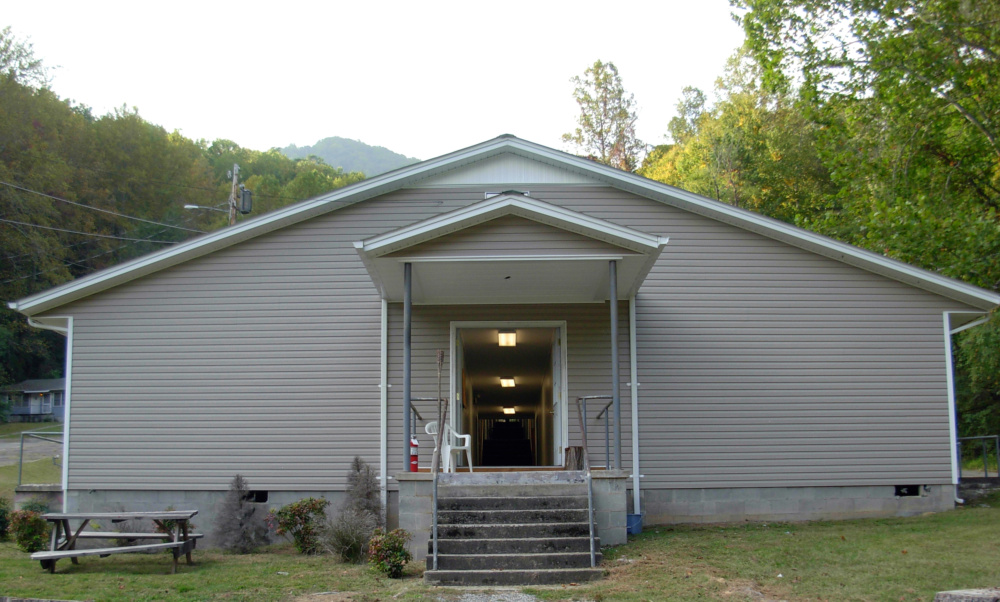
The Boys Dorm. The Day Room where I saw something pass the window is at the top of the building at the left side of this picture. Photo September 2012 by Lewis O. Powell IV, all rights reserved.

While watching the movie I turned to one of the young ladies sitting near me. I had intended on saying something when I saw something white and vaguely human-shaped move past the window next to her. For a moment I watched to see if it would happen again and nothing happened. I waited also to see if someone else saw it. Alas, no one else saw anything; they were all intently watching the movie. I turned to the window behind me and looked towards the door expecting someone to enter, but there was nothing but darkness. After mentioning the incident and finding that no one had witnessed the figure but me, I stepped outside to see if anyone else was about on The Hill, nothing else stirred. Perhaps this was the same sgi-li or booger that I’d heard before entering the building.

Just last week I’d headed out with a native friend to see the Thomas Divide Lights, we saw them and spent the time discussing many of the haunted places in Cherokee. When she dropped me off back on The Hill, we spent some time talking in the parking lot, directly in front of the Boys Dorm porch where I’d been poked. As we stood talking, I began seeing a dark shape move back and forth across the porch. This was all in my peripheral vision. When I looked directly towards the porch, there was nothing there. I began to wonder if I was seeing the frames of my glasses but I was not sure. I asked my companion if she was seeing anything. “You mean the thing on the porch?” she replied.

“Yeah.”

“Yep, there’s something up there. I keep seeing it out of the corner of my eye.” And she was not wearing glasses. Nothing else was stirring.

In the Village there seems to be a good deal of activity that’s being witnessed by employees, myself included. Just last week during my lunch break I decided to lie down and close my eyes on the porch just off the costume shop. Twice I heard the definite sounds of footsteps on the porch. Raising my head, the footsteps ceased. These were definite footsteps from a hard soled shoe on the deck. I was alone on the porch.

Within the Village I spend most of my time in one of the cabins. Interestingly, this seems to be the cabin that has been the subject of numerous stories. One afternoon while returning to the cabin with some firewood I glanced up to see a figure enter the cabin. Usually, it’s not uncommon to find tourists or other employees in or around my cabin when I return. I sped up my pace to greet the visitor, but arrived to find the cabin empty.

The beds in the cabin are sometimes too inviting and I may nap when there’s no one around. While napping one afternoon I was awakened by the sound of a man’s voice speaking in Cherokee. Before opening my eyes, I imagined a small Cherokee man standing in the corner, though I could not understand what he was saying. I raised my head and no one was in the cabin. Getting up, I looked outside and even looked behind the cabin and no one was around. Nearby, nothing else stirred.

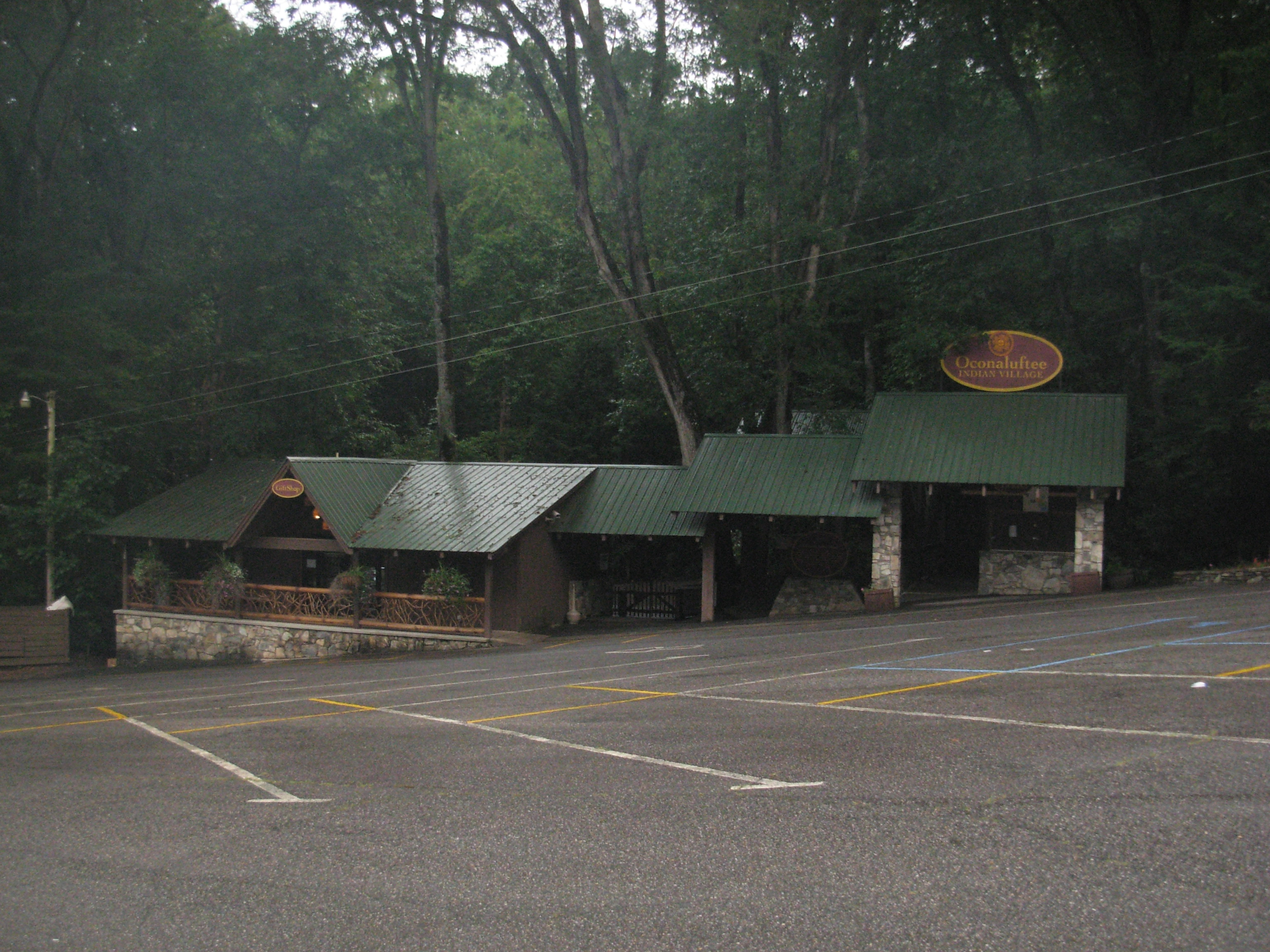
The entrance to the Oconaluftee Indian Village. The box office in under the round sign on the right and the gift shop is located on the left side. I saw a figure walking between these two sections. Photo September 2012 by Lewis O. Powell IV, all rights reserved.

My parents came up for a visit about a week before the drama ended. We saw the show together and I walked them to their car afterwards. They had parked in front of the Village visitor’s center and as we approached I saw a shadowy form move under the breezeway between the gift shop and the box office, an area that is not well lit. The figure passed behind a column and I fully expected to see someone emerge into the light on the opposite side of the column. No one did. My parents saw nothing, but I walked over to see if someone was walking around. Not a soul was there.

A native friend suggested that perhaps I may have become more sensitive as I have spent more time in the mountains. Or perhaps all of this is simply the product of an over-eager imagination. All I can say is that these things happened and I have no immediate explanation for them. Perhaps the spirits really are getting personal.

Tragedies in a Tourist Town—Gatlinburg, TN

N.B. This article was edited and updated 21 April 2020.

In the mountains of southern Appalachia, Gatlinburg is one of the premier tourist towns. Growth in tourism here has been exponential over the past few decades, as Gatlinburg, nearby Pigeon Forge, and Sevierville have fought to capture the most market share of tourists. With that growth has come countless tourist inns, motels and hotels; restaurants; candy stores; t-shirt shops; and even haunted house attractions. While most of these are inauthentic experiences created to attract tourists, in Gatlinburg one has to only look as far as a few hotels and restaurants to find authentic ghosts.

Gatlinburg Tennessee space needle Historic Nature Trail
View of the Gatlinburg Space Needle, ca. 2005. The Space Needle sits at the foot of Historic Nature Trail. The Edgewater Hotel is located across Cliff Branch. Courtesy of Wikipedia.

Before it became a burgeoning mountain tourist town, Gatlinburg was a quiet hamlet with very little crime. With the arrival of hordes of tourists has come crime; some of them horrific. In his Ghosts and Haunts of Tennessee, Christopher K. Coleman writes about the Edgewater Hotel and Conference Center (402 River Road) where in 1972, a 7-year-old child plunged to her death from a hotel room balcony. When the police began to suspect the father’s involvement in his child’s death, the parents fled.  Their car overturned on a winding mountain road pitching the vehicle, and its occupants into the Little Pigeon River. According to Coleman, the child is seen on the anniversary of her death standing in the stream below the hotel pointing towards the balcony she fell from. While this is a fascinating story, I can find nothing to corroborate the horrible details of this event.

River Road Gatlinburg Tennessee Edgewater Hotel
The view down River Road towards the Edgewater Hotel which rises above the trees in the middle of the photo. Photo 2014, by Evan Nichols, courtesy of Wikipedia.

Branching off from US-441, the main road through Gatlinburg, is Historic Nature Trail which was the scene of two horrible crimes in the 1980s. In July of 1980 two teenage girls visiting from Kentucky were found dead at the Holiday Inn. One girl was found in a stairwell leading to the roof while her friend was found a few hours later in her room lying on the floor next to the bed. The girls, friends from Crestwood, Kentucky, were taking a short vacation to Gatlinburg before the start of their senior year of high school. After going out to a local lounge and steakhouse, The Rafters, the girls were seen leaving with a local drifter. He was arrested the following day and charged with strangling the teens.

US-441 and Historic Nature Trail Gatlinburg Tennessee
The intersection of US-441 and Historic Nature Trail in 2014. Photo by Evan Nichols, courtesy of Wikipedia.

Like many ghost stories, later retellings often embellish the circumstances of the murders, and this is no different. Coleman’s and internet versions of the events have one girl being drowned in a bathtub while her friend was strangled and her body dragged to the roof; contemporary articles on the murder from one of the state’s most prestigious papers, Nashville’s The Tennessean, dispute those details. One article does note that the girls were staying on the fourth floor in separate rooms: 401 and 413. The ghost stories do center on room 413, so these stories are correct in that aspect.

It seems that reports of paranormal activity in 413 mostly concern odd noises within the room, noises that often frighten staff working there. But this isn’t the only haunting within the hotel. A spirit named Alvin, supposedly the spirit of a longtime employee, has been reported in the kitchen, though this story cannot be corroborated. Alvin seems to cause more poltergeist-type activity with kitchen utensils flying through the air. Another more spectacular ghost story has been told about the hotel’s seventh floor where a scout leader murdered members of his troop. This is a story that would have probably found its way to the front page of The Tennessean and many other newspapers. No information exists on this so it must be chalked up as just a story.

The Holiday Inn was later renamed the Garden Plaza Hotel (formerly 520 Historic Nature Trail) and operated until fairly recently when it was demolished. The hotel has been replaced with a Hampton Inn It’s unknown if any of the spirits have remained here.

If you follow Historic Nature Trail from the site of the old Holiday Inn back towards US-441, you’ll pass a very new Courtyard by Marriott. It occupies the site of one of Gatlinburg’s most notorious murders. On 13 September 1986, a desk clerk and security guard were brutally murdered by a pair of thieves intending to rob the inn. Two lives were snuffed out violently for $499 and the purse of the young desk clerk. Shortly after the murders a shadowy figure was frequently seen in the parking lot and a guest was awakened to see a young woman standing at the foot of his bed whose description matched that of the young clerk. Despite the demolition of the Rocky Top Village Inn (formerly 311 Historic Nature Trail) stories of the horrific tragedy and the resulting spirits continue to be told.

One of Gatlinburg’s oldest tragic spirits still resides at the Greenbrier Restaurant (370 Newman Road). Originally the Greenbrier Lodge, this quaint log inn catered to wealthy hunters and tourists. The lodge was renamed and reopened as the Greenbrier Restaurant in 1980. Legend holds that at some point in its early history, a young lady named Lydia stayed here on the eve of her wedding. On her wedding day she dressed in white and headed into town to marry. When her fiancée failed to show at the church Lydia returned to the lodge heart-stricken. Still clad in her wedding dress Lydia hung herself from the rafters over the second floor landing. A postscript added to one version of the story states that days later Lydia’s fiancée was found dead after being mauled by a mountain cat.

Still broken-hearted, Lydia roams the Greenbrier Restaurant generally frightening staff and guests, and causing a bit of trouble when she knocks food off the shelves of the restaurant’s pantry. The sad revenant has possibly been observed by the owners who saw a figure pass a doorway after closing time. Some years ago, the young son of the owners did see a woman who vanished when he called his father’s attention to it. In 2007 the Greenbrier’s owners allowed the members of the East Tennessee Paranormal Research Society investigate the restaurant. The investigation did capture some photographic anomalies, though the best evidence was an EVP. In it a female investigator addressed the spirit, “God bless you, Lydia, I’d be happy to hear from you if you’d like to speak to me.” A moment later a female voice cheekily responded, “Then I’m not dead.”

Sources

  • Coleman, Christopher K. Ghost and Haunts of Tennessee. Winston-Salem, NC: John F. Blair, 2011.
  • Kinney, Rachel. “’Rocky Top’ murderer killed in prison fight.” WBIR. 11 March 2015.
  • Madden, Tom. “2 women found slain at resort.” The Tennessean. 30 July 1980.
  • Nauman, Tesa. “Paranormal groups hunts for G’burg ghost.” Sevier County News. 23 February 2007.
  • “Strangled teen’s mother thought Gatlinburg was safe.” The Tennessean. 31 July 1980.
  • Whittle, Dan. “’Ghost Lydia’ legend adds to Smoky Mountains haunting haze & lore.” Mufreesboro Post. 19 October 2014.
  • Williams, Michael. “Walking among the dead.” Tennessee Star Journal. 15 October 2014.

The Haunted Jukebox and Associates—Earnestine & Hazel’s, Memphis

Earnestine & Hazel’s
531 South Main Street
Memphis, Tennessee

N.B. Revised and edited 21 February 2019.

On Christmas Day 2006, Karen Brownlee, bartender and manager of Earnestine & Hazel’s in Memphis, was discussing the death of “The Godfather of Soul,” James Brown, earlier that morning. As the discussion continued the voice of the recently silenced singer erupted from the jukebox proclaiming, “I feel good!” The shocked employees stared at each other as Brown joyfully crooned, “I got you!” Was the soul singer speaking through the jukebox or was it just a coincidence?

At Earnestine & Hazel’s, the jukebox is known to have a mind of its own. It is known to play according to discussion or sometimes the thoughts of patrons and employees at the bar. Another time a group of friends celebrating a woman’s divorce were greeted by the jukebox blaring Tammy Wynette’s “D-I-V-O-R-C-E.” Some time later a paranormal investigator was discussing exorcisms and the jukebox cheekily piped up from the corner with the Rolling Stones’ “Sympathy for the Devil.” Interestingly, many of the performers of these songs passed across the floors of this most historic dive bar, and some even slept here when Earnestine and Hazel were renting the rooms upstairs.

Sisters Earnestine Mitchell and Hazel Jones owned this bar for many years. The unassuming commercial building standing in the shadow of Memphis Central Station was initially a pharmacy. When the pharmacist, Abe Plough, became famous from his line of hair products and Coppertone brand suntan lotion, he gave this modest building to the sisters. They ran the business as a café and rented rooms upstairs by the hour. While not outright supporting the trade of the many prostitutes who plied their trade here, Earnestine and Hazel chose to turn a blind eye. Earnestine’s husband owned a nightclub nearby and would often bring the performers to the café after their shows. Many of the best names in music ranging from B.B. King to Wilson Pickett to Tina Turner passed through the doors of Earnestine and Hazel’s establishment.


Earnestine & Hazel's Memphis Tennessee ghosts haunted jukebox
Earnestine and Hazel’s, 2012, by Thomas R. Machnitzki, courtesy of Wikipedia.

In turn, Earnestine and Hazel became confidants to many patrons and, as Karen Brownlee writes, continue to do so even after their deaths in the 1990s. Tragedy struck Brownlee in 2007 when her son was shot and killed. Sobbing over the death of her son, she sat at the end of the bar and began to talk to God and the late Mrs. Earnestine in earnest. After asking for a sign that her son was alright she noticed a baby bird emerge from one of the booths, walk towards the door and fly off. Moments later and older woman entered the bar and asked if she was ok. Brownlee told her what had happened and the woman comforted her. The woman left but soon returned with a sterling silver necklace with a bird. Brownlee had not seen the woman before nor since, but she’s adamant that it was Mrs. Earnestine.

Not only are the stalwart former owners still around, but many of the former patrons are still living it up at Earnestine and Hazel’s. Former owner George Russell would regularly hear voices and clinking glasses when the bar was empty. The sounds of partying would carry on long after the living patrons had departed. But its not only sounds that are experienced, apparitions are sometimes seen here as well. The apparition of a man carrying a white pillar candle has been observed walking in the bar and paranormal investigators captured the apparition walking on the street in front of the bar about 3 AM.

Stories circulate of prostitutes either committing suicide or being murdered upstairs as well. Perhaps that explains the patrons who feel someone grab their hands at the top of the staircase. This feeling is sometimes accompanied by an overwhelming sense of sadness. When in Memphis if you wish to spend some time among the past, stop into Earnestine & Hazel’s, enjoy a Soul Burger, say hello to the sisters, perhaps take the hand of a long-dead prostitute at the top of the stairs, and maybe the jukebox will cheekily pipe up with an appropriate song to accompany your visit.

Sources

  • Brownlee, Karen. “This is what it’s like to work at the Most Haunted Bar in America.” 31 May 2015.
  • Coleman, Christopher K. Ghosts and Haunts of Tennessee. Winston-Salem, NC: John F. Blair, 2011.
  • History. Earnestine and Hazel’s. Accessed 29 February 2016.
  • Holmes, Kevin. “Is Memphis a hotbed for paranormal activity?” ABC 24. 29 October 2010.
  • Pickrell, Kayla. “Haunted Memphis: Earnestine & Hazel’s. Memphis Commercial Appeal. 17 July 2012.

Southern Index of Higher Ed Haunts—West Virginia

I’ve embarked on a project to comprehensively document haunted college and university sites throughout the South. When I first conceived of this project, I imagined I would only have about 200 or 300 locations, but after scouring my personal indices of locations, I ended up with over 500, so I’m breaking this up by state.

Please note that the references quoted at the end of each entry are only those sources that specifically note the hauntings. If you have experienced a haunting at any of these locations, know of other haunted college and university locations not included here, or have a correction, please email me at southernspiritguide@gmail.com. I’d love to hear your story and include that information here.

Bethany College, Bethany

ALEXANDER CAMPBELL MANSION & GOD’S ACRE CEMETERY – This mansion and cemetery, the former home and burial site of religious leader and Bethany college founder Alexander Campbell, are now owned by Bethany College. Campbell’s spirit has supposedly been spotted within the small, hexagonal study building on this estate. The spirit of Campbell’s young son Wickliffe, who drowned nearby, may make appearances within the house. Legend holds that the low stone wall entirely surrounding the cemetery across the road may hold spirits within this historic family cemetery, thus the numerous stories involving encounters here between the living the dead. 6, 10, 16, 22

COCHRAN HALL – A spirit in this 1910 residence hall’s first floor guest apartment still makes its presence known, though it has yet to be identified. 25, 27

GRACE PHILLIPS JOHNSON MEMORIAL VISUAL ARTS CENTER – Originally constructed as Irvin Gymnasium in 1919, this structure is home to visual arts classes and possibly the spirit of the building’s namesake. Security guards have reported that they encountered the spirit of Ms. Johnson while others have reported that the eyes in her portrait follow people around the room. 25, 27

OLD MAIN CLOCK TOWER – A student’s suicide is reenacted at the iconic clock tower on Old Main. Lore states that a female may have committed suicide here by leaping from the clock tower to her death. 11

PHILLIPS HALL – This 1929 residence hall may be home to two ghosts: Sarah, a student who hung herself in the attic and a sailor who died as he was either visiting a student or sneaking out of the building when it served as navy housing during World War II. 8, 11, 27

Bluefield State College, Bluefield

MAHOOD HALL – One of the oldest buildings on the campus of this historically black college, Mahood Hall is believed to be the home of a little girl’s spirit. For years, students have awakened here to find themselves face to face with a little girl who quickly disappears. A 2010 investigation by Black Diamond Paranormal Society captured several EVPs and a brief video showing a figure passing by an open doorway in the supposedly empty building. 12

Concord University, Athens

SARVAY HALL – Comments on Theresa Racer’s blog post about Concord University note that this dormitory may be fairly active. 13

WILSON HALL – The third floor of this early-1960s era dormitory is supposed to be quite paranormally active. Blogger Theresa Racer’s post on Concord University notes that a student may have committed suicide in room 320, though comments on this post reveal that other rooms on the floor may also be active. 13

Halliehurst at Davis & Elkins College, 2014. Photo by Generic1139, courtesy of Wikipedia.

Davis & Elkins College, Elkins

GRACELAND INN AND CONFERENCE CENTER (100 Campus Drive)One of two Victorian mansions (the other being Halliehurst, see below) constructed as summer homes for a pair of friends, businessmen and later senators, Henry Gassaway Davis and Stephen Benton Elkins. Their families later donated the grand estates to create a campus for the small, Presbyterian-affiliated college established by Henry Davis. Built by Henry Davis, Graceland may be haunted by the spirit of Grace Davis, one of his daughters. During a 2008 walkthrough of the house with paranormal investigator Chris Fleming, students were treated to some EVPs and the gas burners in the kitchen turning themselves on. 5, 24

HALLIEHURST – Like its Victorian sister, Graceland, students, staff members, and visitors have experienced the unexplained in Stephen Elkin’s former summer home, Halliehurst for many years. Stories at Halliehurst date to the home’s use as a women’s dormitory in the 1950s. Gavenda and Shoemaker note in their A Guide to Haunted West Virginia that nearly all of the encounters with the paranormal here are positive and helpful with students being saved by phantom hands from injury or death. 24, 26

Glenville State College, Glenville

CLARK HALL– An October 2011 edition of The Barr Bulletin a college newsletter written by Betsy Barr, wife of GSC’s president Peter Barr, makes note of the college’s most famous ghost, “Sis Linn.” Sarah Louisa Linn, known familiarly as “Sis” Linn, was an 1877 graduate of the Glenville Normal School that preceded the state college. She later owned a boarding house where she was bludgeoned to death in 1919. The boarding house was later torn down to construct a women’s dormitory Verona Maple Hall. Sis Linn’s spirit was observed here in the years before the building was replaced with Clark Hall. Linn’s spirit may still be present here as well as in other places on campus. Here, Linn’s spirit seems to cause much noise. 1, 14

HARRY B. HEFLIN ADMINISTRATION BUILDING – According to legend, a bell that hung in this building would often chime thirteen times until it was recently removed. Within this building lights flicker, keys left in doorknobs jingle on their own accord and disembodied whispering is heard. 28

LOUIS BENNETT HALL – When it served as a men’s dormitory students in Bennett Hall were sometimes awakened by a Lady in White. After the building’s conversion into offices, odd phenomena is still observed here. 28

OLD GLENVILLE CEMETERY – Sis Linn, the college’s resident spirit was buried here after she was bludgeoned to death in 1919. Her spirit is said to be observed walking through the cemetery. 14

PICKENS HALL – According to author Tom Ogden, students in this residence hall have reported hearing furniture being moved on the floor above them and the sound of marbles rolling across the floor. 28

Old Main at Marshall University, 2013. Photo by WVFunnyMan, courtesy of Wikipedia.

Marshall University, Huntington

ALPHA CHI OMEGA HOUSE (Fifth Avenue)Legend holds that a little boy killed here in a fire now haunts this sorority house. Sisters in the house have reportedly experienced flickering lights, unexpected cool breezes, and objects being moved. 2, 27

ERMA ORA BOYD CLINICAL CENTER– Built on the site of Fairfield Stadium, this 2007 building is reportedly filled with activity after hours. Elevators operate on their own accord, televisions turn on by themselves, and the sound of two men chanting has been heard in the commons area. 2, 27

MORROW LIBRARY – Library patrons are sometimes interrupted in this 1930 library by the sounds of arguing, though the source is never found. Originally the main university library building, this building now houses special collections. 2, 27

OLD MAIN – The oldest and most iconic building on campus, Old Main also harbors ghosts. One of the more recognizable spirits haunts the old auditorium within this building. Believed to be the spirit of a former theatre director, the spirit has been seen backstage and walking the catwalks. A 1996 article notes that in addition to the auditorium, the attic and Yeager Suite are also the domain of spirits. For further information see my blog post, “Phantoms of the Opera, Y’all.”2, 27

SIGMA PHI EPSILON HOUSE (1401 5th Avenue) – Like the Alpha Chi Omega House nearby, this fraternity house is purported to be haunted by the victims of a fire, though in this case the victims were a mother and her two children. The lore states that this fire took place in the late 1960s or early 1970s and residents still hear the sounds of sobbing. 2, 27

TWIN TOWERS EAST – The spirit of a student who committed suicide is said to remain in his room, 1218, of this 1969 residence hall. A student reported in a 1996 article in The Parthenon that he awakened to see the image of a young man sitting in his room. The apparition disappeared after the student pulled his covers over his head. 2, 27

Mountwest Community & Technical College, Huntington

ACADEMIC BUILDING – Mountwest Community & Technical College took up residence in its main academic building in 2012. Built in 1980 as an office building for the Ashland Coal Company, the building may be occupied by the spirit of an employee of one of the companies that occupied this modern office building previous to the college’s occupation. Theresa Racer notes in her blog that after the death of an employee here from a heart attack in 2002, people on the fourth floor began to experience doors opening and closing by themselves, a feeling of being watched and the smell of pipe tobacco. 17  

McMurren Hall at Shepherd University, 2012. Photo by Acroterion, courtesy of Wikipedia.

Shepherd University, Shepherdstown

GARDINER HALL – The spirit of a former homecoming queen named Patty still stirs in this residence hall. She supposedly died here after falling in the shower and hitting her head sometime in the late 1980s. A portrait of Mabel Gardiner, the building’s namesake, is supposedly hung upside down to appease Patty’s restless spirit. 4, 27

KENNEMOND HALL – Residents of this residence hall regularly encounter the spirit of a young boy wearing knickers and a driving cap. His story says that he was killed in a fall at a local construction site. He is known to play with student’s electronic devices. Author Rosemary Ellen Guiley reports that there is also a spirit encountered in the building’s basement. 4, 27

McMURRAN HALL – Construction began on this building on the eve of the Civil War and it remained unfinished for a few years following the war. After the bloody Battle of Antietam was fought nearby in Maryland, this was among local buildings commandeered for use treating the wounded. The spirit of a soldier is often seen peering from the bell tower. For further information see my article on Shepherdstown, “None of the town is spared a ghost story—Shepherdstown, WV.”3, 9

MILLER HALL– A young girl who died in a fall from a hayloft on this property prior to the construction of Miller Hall has been seen roaming the halls of this building. Local lore also notes the death of a nursing student by her own hand here, but her spirit has not been spotted. Lore also mentions that an exorcism was performed in room 201, though a residence life staff member told the student newspaper in 2014 that this was likely just a blessing of the room to put paranormal activity at rest. 4, 27

SHAW HALL – The apparition of a woman has been seen at some of the windows of this building. 27

THATCHER HALL – The spirits of those of those interred in the nearby cemetery haunt the B Wing of this residence hall. 4, 27

TURNER HALL – The Victorian girl who haunts Miller Hall has also been seen here while the spirit of a construction worker also roams the halls. During the construction of Turner Hall a construction worker fell to his death on the rocks that are now a part of the building’s basement. 4, 27

YELLOW HOUSE (ENTLER-WELTZHEIMER HOUSE) – One of the oldest houses in Shepherdstown and the oldest on campus, the Yellow House is purported to still be the residence of a cobbler who was killed here in 1910. The tapping of his cobbler’s tools are still heard. For further information see my article on Shepherdstown, “None of the town is spared a ghost story—Shepherdstown, WV.”3, 21

University of Charleston, Charleston

EAST APARTMENTS – Built on the former site of haunted Dickinson Hall, this dormitory may have inherited the paranormal activity from that building. 27

GEARY STUDENT UNION – This student union building is apparently haunted, though little information is available as to the exact nature of the paranormal activity. 18, 27

RIGGLEMAN HALL – Built in 1950, Riggleman Hall may have a few spectral residents including a female suicide victim and Leonard Riggleman, former president of Morris Harvey College, predecessor to the University of Charleston. The activity blamed on these spirits includes odd noises and shadows. 18, 27 

Woodburn Hall at West Virginia University, 2008. Photo by Swimmerguy269, courtesy of Wikipedia.

West Virginia University, Morgantown

BETA THETA PI HOUSE – Two spirits may haunt this fraternity house: the spirit of a butler who served the brothers in the 1940s and the spirit of a homeless man who committed suicide in the basement in the 1980s. 24

BOREMAN HALL – Odd sounds and other paranormal activity has been encountered throughout the north section of this residence hall. 24

DOWNTOWN CAMPUS LIBRARY – Studious spirits inhabit this 1931 library. One staff member was studying here when he heard the elevator doors open and someone walk to the desk on the other side of the partition and pull the chair out. When he looked shortly after that, no one was there. Legend blames this activity on a staff member who died after falling down an open elevator shaft.  7, 19

ELIZABETH MOORE HALL – Built in the late 1920s, this historic building may be haunted by the spirit of its namesake, Elizabeth Moore. 19, 24

WV ROUTE 857 – While not on the campus of WVU, this haunting involves two students who were abducted from the campus January 18, 1970. A few months later, the headless bodies of the two females were discovered near Cheat Lake. The heads have never been recovered. An arrest and conviction was garnered in this case. Drivers at night near the site where the coeds’ bodies were discovered have spotted the apparitions of two females in the woods. 24, 27

THE MOUNTAINLAIR – A spectral girl dancing in a yellow party dress has been observed here. 27

WOODBURN HALL – Perhaps one of the more unique ghost stories in West Virginia involve the spectral bovine mooing that is heard here. Legend speaks of a student prank gone awry when students lead a cow up the stairs to the clock tower of this building. When the students could not get the cow back down the stairs the cow apparently had to be killed and butchered. 19

West Virginia University Institute of Technology, Montgomery

RATLIFF HALL – Besides very typical paranormal activity including footsteps and slamming doors, one female student claimed to have seen the specter of a firefighter in this dormitory building. 20

West Virginia Wesleyan University, Buckhannon

AGNES HOWARD HALL – Named for a student who was stricken with a sudden illness while at school here and passed away, Agnes Howard Hall may have paranormal activity including shaking beds and a student hearing her name whispered three times. 15, 23

Sources

Articles

  1. Barr, Betsy. The Barr Bulletin. October 2011
  2. Donohue, Kelly. Unnamed article. The Parthenon. 29 October 1996.
  3. Engle, Georgia Lee. “Restless spirit roams campus, haunts High Street Cottage.” Shepherd College Picket. 28 October 1954.
  4. “Ghouls & Ghosts: Legends and hauntings of Shepherd University.” The Picket. 28 October 2014.
  5. Higgins, Carra. “Paranormal says hauntings present at Graceland, Halliehurst.” The Inter-Mountain. 28 October 2008.
  6. Jackson, Mary Robb. “Paranormal activity spooking up some fun at Bethany College.” 30 October 2013.
  7. Kinney, Hilary. “Spooky stories surface throughout campus.” The Daily Athenaeum. 31 October 2013.
  8. McQuillan, Kayla. “The haunts of Bethany College.” The Tower. No Date.
  9. Molenda, Rachel. “Town serves as home to ghosts from past.” Shepherdstown Chronicle. 28 October 2011.
  10. Racer, Theresa. “Alexander Campbell Mansion.” Theresa’s Haunted History of the Tri-State. 20 April 2012.
  11. Racer, Theresa. “Bethany College.” Theresa’s Haunted History of the Tri-State. 22 January 2012.
  12. Racer, Theresa. “Bluefield State College.” Theresa’s Haunted History of the Tri-State. 5 September 2012.
  13. Racer, Theresa. “Concord College.” Theresa’s Haunted History of the Tri-State. 29 February 2012.
  14. Racer, Theresa. “Ghost of Glenville State.” Theresa’s Haunted History of the Tri-State. 12 September 2011.
  15. Racer, Theresa. “The Ghost of West Virginia Wesleyan.” Theresa’s Haunted History of the Tri-State. 2 March 2012.
  16. Racer, Theresa. “God’s Acre Cemetery.” Theresa’s Haunted History of the Tri-State. 23 May 2011.
  17. Racer, Theresa. “Mountwest Community & Technical College inherits a ghost!” Theresa’s Haunted History of the Tri-State. 21 September 2013.
  18. Racer, Theresa. “University of Charleston.” Theresa’s Haunted History of the Tri-State. 7 October 2012.
  19. Racer, Theresa. “WVU haunts around campus.” Theresa’s Haunted History of the Tri-State. 20 May 2012.
  20. Racer, Theresa. “WVU Tech’s Phantom Fire Fighter.” Theresa’s Haunted History of the Tri-State. 4 September 2012.
  21. Shepherd University. “The Legend of the Yellow House.” Accessed 2 October 2011.
  22. Shinn, Emma. “Stone wall said to keep spirits, stories in Bethany cemetery.” Observer-Reporter. 28 October 2013.
  23. Wagoner, Becky & John Wickline. “Bone chilling tales of ghostly wails.” The Inter-Mountain. 27 October 2007.

Books

  1. Barefoot, Daniel. Haunted Halls of Ivy: Ghosts of Southern Colleges and Universities. Winston-Salem, NC: John F. Blair, 2004.
  2. Carney, Brent. Bethany College. Charleston, SC: Arcadia, 2004.
  3. Gavenda, Walter & Michael T. Shoemaker. A Guide to Haunted West Virginia. Glen Ferris, WV: Peter’s Creek Publishing, 2001.
  4. Guiley, Rosemary Ellen. The Big Book of West Virginia Ghost Stories. Mechanicsburg, PA: Stackpole, 2014.
  5. Ogden, Tom. Haunted Colleges and Universities: Creepy Campuses, Scary Scholars, and Deadly Dorms. Guilford, CT: Globe Pequot Press, 2014.

An unexpected seafarer—Delray Beach, Florida

Blue Anchor Pub
804 East Atlantic Avenue
Delray Beach, Florida

On the evening of September 29, 1888, two ladies departed from the Blue Anchor Pub into the foggy evening. Elizabeth Stride and Catherine Eddowes, though they were only looking for a customer to pay for a few minutes of pleasure, had appointments with Fate on the dark streets that evening. Around 1 AM the next morning, Stride’s ravaged body was discovered. Eddowes’ mutilated and disfigured body, cut open with a ferocious surgical precision, was discovered nearby about 45 minutes later. Jack the Ripper—as the still unidentified murderer became known—had struck again.

The doors of the Blue Anchor Pub in Chancery Lane off Fleet Street in London would remain open for journalists, barristers, ladies of the evening, and perhaps Jack the Ripper himself, for many decades before they closed for good to London traffic in the mid-1980s. Within roughly a decade of their closing, the doors reopened to customers along Atlantic Avenue in Delray Beach, Florida. When the pub was torn down to allow for a widening project on Chancery Lane, an American developer purchased the exterior of the mid-19th century public house. With its authentic exterior, the Blue Anchor reopened in 1996 and quickly became a popular watering hole for journalists including many from American Media, Inc., publisher of the tabloid magazine, the National Enquirer.

Along with imported ales, beers, and spirits available at the bar, there is one spirit that was apparently imported with the original parts of the Blue Anchor and available only when she decides to appear. Seafaring tradition holds that sailors would gain luck from drinking at a pub called “Blue Anchor” before embarking on a journey over the sea. Perhaps this is the reason that Bertha Starkey was at the Blue Anchor with her seafarer husband the fateful night that she was stabbed by him in a fit of jealousy. Of course no one knew that Bertha’s spirit would eventually go seafaring as her spirit supposedly followed the pub’s exterior to Florida.

A sous-chef at the restaurant met Bertha one evening when a heavy 30-gallon pot hanging from a hook above the stove unhooked itself and fell upon him knocking him down. Not long after, the owner and the head chef later saw a veiled woman walk through the bar. Staff members heard footsteps that are seemingly coming from upstairs, though the bar is only one story. Legend associates this activity with Bertha Starkey, though the activity could also be connected to the various former patrons and staff who walked through the heavy oak doors of the Blue Anchor to escape the foggy streets of London and now exit to the palm tree-lined streets of Delray Beach.

Sources

  • Lomartire, Paul. “’Enquirer’ boss sent pub owner to Key Biscayne to test Nixon’s pool.” The Palm Beach Post. 22 October 2001.
  • Lomartire, Paul. “Hoist a pint, drink up the history.” The Palm Beach Post. 22 October 2001.
  • Meyer, Meghan. “A pub’s haunting tale.” The Palm Beach Post. 4 March 2004.
  • Pearce, Jamie Roush. Historic Haunts Florida II. Jamie Roush Pearce, 2014.
  • Thuma, Cynthia & Catherine Lower. Haunted Florida: Ghosts and Strange Phenomena of the Sunshine State. Mechanicsburg, PA: Stackpole, 2008.

Haunt in the Horseshoe—Sanford, North Carolina

House in the Horseshoe State Park
288 Alston House Road
Sanford, North Carolina

By all accounts, Philip Alston was trouble. A member of the prominent Alston family, some might describe him as a spoiled brat. The house Alston constructed at this horseshoe bend in the Deep River was among the first large plantation homes constructed in this region when it was built in 1772. As revolutionary tensions heated up throughout the colonies, Alston sided with the Patriot cause. Though he was fighting for the same ideals, even the Patriots took umbrage with Philip Alston. Another Patriot, Robert Rowan, even spoke to the governor of his dislike for Alston’s “domineering” and “tyrannical” attitude.

With the outbreak of fighting, squabbles between neighbors took on more deadly overtones throughout the frontier. Planter David Fanning of South Carolina remained loyal to the British crown and steadfastly rooted out Patriots throughout the area. A small militia under Fanning’s command attacked Alston’s home on the morning of August 5, 1781 in retaliation for the death of one of his men at the hands of some of Alston’s comrades. That morning, Alston, his wife Temperance, two children, and a small band of his men were at the large white house. When Fanning’s men attempted to attack the house one of the Tories was quickly felled by a bullet to the heart. Soon gunfire poured from the home’s windows while Alston’s children cowered in a fireplace inside.

A cart of straw was set alight and pushed towards the house which began to burn. Fearful of being burned out of the house, Alston sent his wife with a flag of truce to arrange surrender. Fanning agreed to allow Alston and his men to surrender. The Tories plundered the bullet-riddled house but did not burn it.

House in the Horseshoe, 2007, by Jerrye and Roy Klotz, MD. Courtesy of Wikipedia.

Philip Alston remained on his plantation for some years after the war and served in the state senate, though his roguish attitude lead to his fall from grace and in 1790, he was forced to sell his beloved home. Some believe that the rascal spirit of Alston may remain here in the form of footsteps heard in the home, disembodied whispers in the fireplace where the children were hidden, and orbs of light seen in the yard.

Source

  • Barefoot, Daniel W. Spirits of ’76: Ghost Stories of the American Revolution. Winston-Salem, NC: John F. Blair. 2009.
  • Bishir, Catherine W. and Michael T. Southern. A Guide to the Historic Architecture of Piedmont North Carolina. Chapel Hill, NC: University of North Carolina Press, 2003.
  • Hauck, Dennis William. Haunted Places: The National Directory. NYC: Penguin, 1996.
  • House in the Horseshoe: Overview.” NC Historic Sites. Accessed 3 January 2016.
  • Thompson, Jessica Lee. “House in the Horseshoe.” North Carolina History Project. Accessed 3 January 2016.

Apparitions at Allatoona—Cartersville, Georgia

Allatoona Pass Battlefield
Old Allatoona Road
Cartersville, Georgia

Despite Atlanta’s sprawl and the construction of the nearby I-75 corridor, Allatoona Pass Battlefield remains as one of the most pristine battlefields in the country. Located about a mile and a half from bustling I-75, the battlefield seems remote and almost lost in time. The village of Allatoona that existed in 1864 is mostly gone, replaced instead by the Lake Allatoona reservoir and a few buildings of more recent vintage. Even the railroad has abandoned the area, having been rerouted with the building of the reservoir.

Allatoona Pass by George Bernard, 1864. The house on the far left is still standing.
The same house from the photograph above, 2011. Photo by Lewis Powell IV, all rights reserved.
The railroad cut, 2011. Photo by Lewis Powell IV, all rights reserved.

At the time of the Civil War, the Western & Atlantic Railroad provided the vital link between Atlanta and Chattanooga, Tennessee which found itself very close to Union territory following the Confederate defeat at Shiloh. This somewhat mountainous region provided one of the first obstacles as the railroad made its way north. Just north of the tiny village of Allatoona slave labor was used to dig a cut through the Allatoona Mountains allowing trains to move easily towards Chattanooga. The village at the south end of the cut mostly consisted of a depot, some warehouses and an odd assortment of houses and shops. After the pass was captured by Federal forces in June of 1864, Sherman ordered that the pass be heavily fortified and three star-shaped earthen forts were constructed to stand guard.

The railroad cut looking south, 2012. Photo by Lewis Powell IV, all rights reserved.
Panoramic view of one of the star forts built to guard the cut with the author standing by. Photo 2011, by Lewis Powell IV, all rights reserved.

In a last-ditch attempt by the Confederates to capture and destroy Sherman’s supply line to federally held Atlanta, they attacked these forts on October 5th. Under the command of Major General Samuel G. French, the Point Coupee Artillery from Louisiana poured shells onto the well-entrenched units from Illinois, Wisconsin and Minnesota under the command of Brigadier General John M. Corse. After two hours, French sent an order for Corse to surrender, which was refused.

Grave of the Unknown Soldier, who may be one of the spirits haunting this battlefield. Photo 2012, by Lewis Powell IV, all rights reserved.

Legends at this site date to not long after the war when a Confederate soldier (believed to be the spirit of an unknown soldier buried next to the tracks) was seen. More recently, the sounds of battle, cries of the wounded, spectral soldiers and an overpowering sense of dread have been reported here.

Sources

  • Battle of Allatoona. Wikipedia, the Free Encyclopedia. Accessed 15 April 2011.
  • Lake Allatoona. Wikipedia, the Free Encyclopedia. Accessed 8 April 2011.
  • Scaife, William R. Allatoona Pass Battlefield: The Official Website. 2000.
  • Underwood, Corinna. Haunted History: Atlanta and North Georgia. Atglen, PA: Schiffer, 2008.