“A multitude of the heavenly host”—Old Gray Cemetery

And suddenly there was with the angel a multitude of the heavenly host praising God, and saying, Glory to God in the highest, and on earth peace, good will toward men. – Luke 2: 13-14 (KJV)

Old Gray Cemetery
543 North Broadway
Knoxville, Tennessee

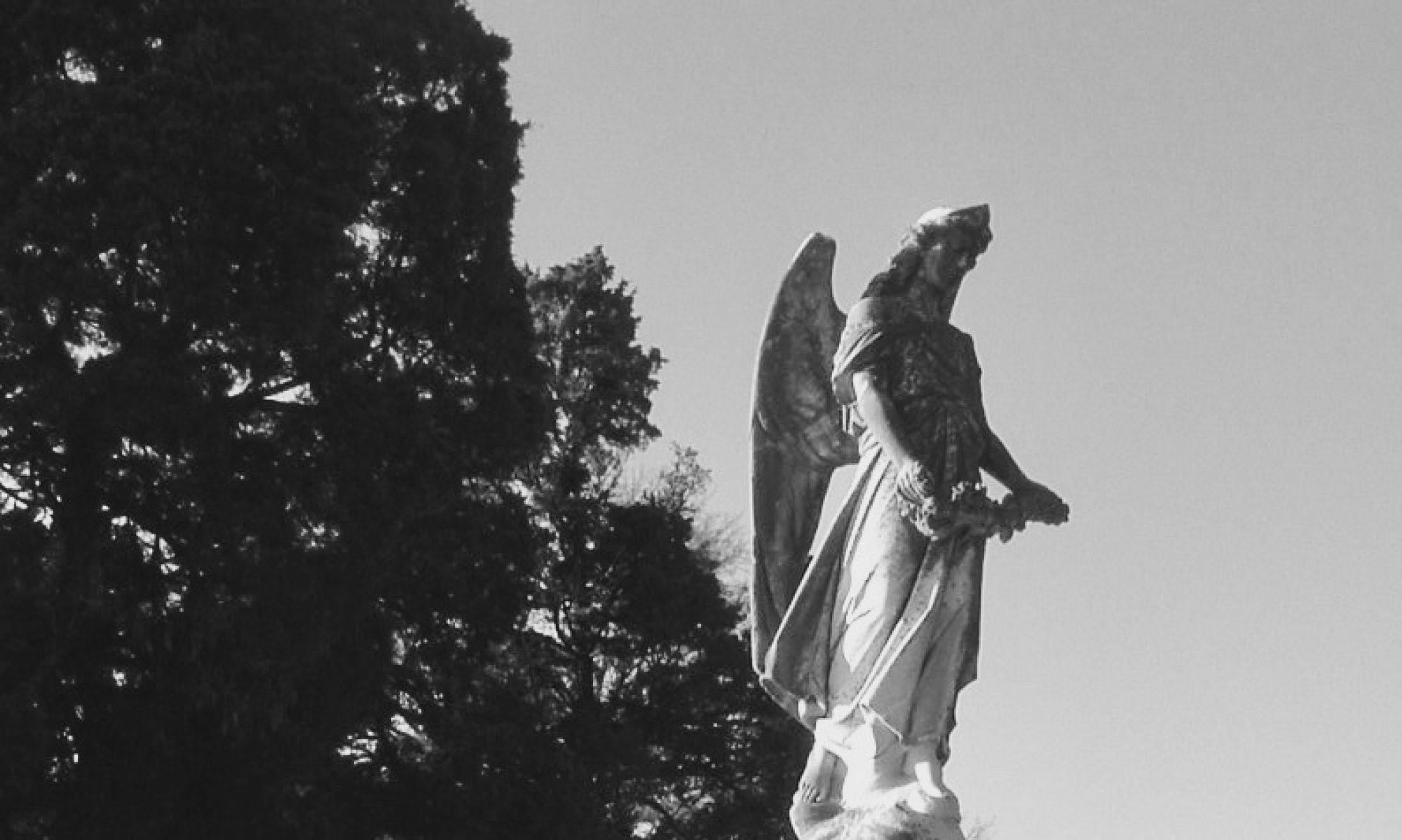
One of the host of angels at Old Gray. This one adorns the monument Ora Brewster. Photo 2010 by Brian Stansberry. Courtesy of Wikipedia.

Like so many Victorian cemeteries, Old Gray Cemetery is adorned with a host of angels guiding us towards heaven, mourning the deceased, or standing silent vigil over the dead. The cemetery traces its founding to 1850 and it was joined by the neighboring Knoxville National Cemetery in 1863, when General Ambrose Burnsides needed a location for the burial for Union troops occupying the city. Since its founding, Old Gray–named for English poet Thomas Gray who penned Elegy in a Country Churchyard–has become the resting place of many notable citizens of Knoxville.

Of course, the cemetery is also the home of specters, otherwise, I wouldn’t be writing about it here. Legends have circulated for decades regarding a “Black Aggie” that has been seen on the grounds. The Black Aggie appears as a figure in a dark robe prowling about the grounds. Initially, the legend sprouted from the Adams Memorial in Rock Creek Cemetery, Washington, D. C. The memorial features a statue representing grief by the noted sculptor Augustus Saint-Gaudens. Since its installation, legends have evolved regarding this haunting figure. However, the name for the specter actually stems from a copy of the statue that was sold to General Felix Agnus in Druid Ridge Cemetery, Pikesville, Maryland, just outside of Baltimore. This statue inspired so many legends and endured so much vandalism it was removed and now graces the garden of the Dolley Madison House in Washington. Since this time, Black Aggies have been associated with numerous cemeteries throughout the world.

A pair of angels. Photo 2011 by Lewis Powell IV, all rights reserved.

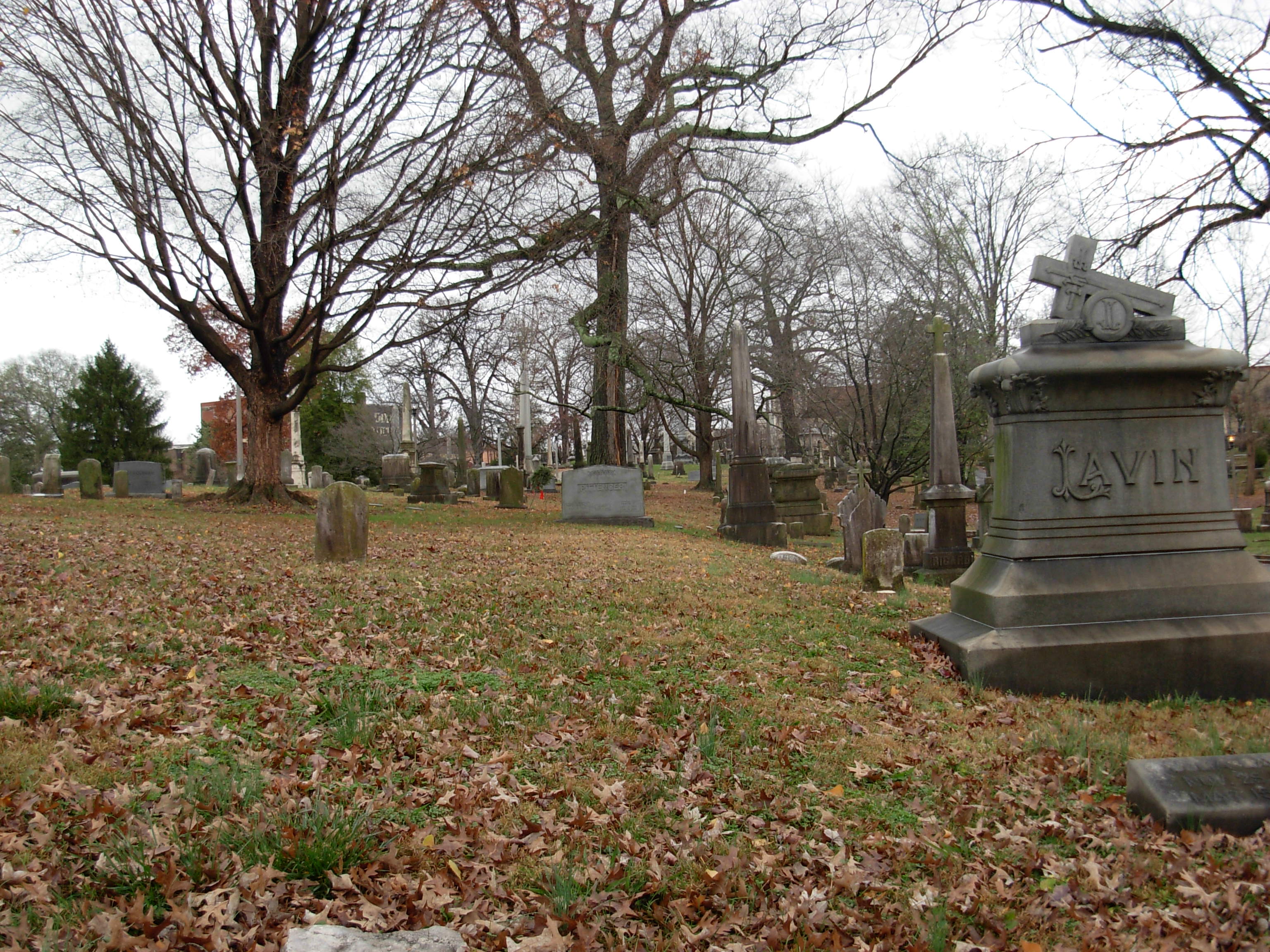
When I visited the cemetery last year in early December, it was cold and the stones sat huddled on the hills under leaden skies; skies that would later that day produce light snow. While I did not encounter any Black Aggies, I did see a number of apparently homeless people wandering through. In fact, I was greeted at the cemetery gates by a young woman shouting profanities as she strolled down the street. That, coupled with the homeless people, did add a sense of unease to this otherwise peaceful resting place.

Numerous sources say simply that the Black Aggie has been reported by many people, though there are no specific reports provided. Dr. Alan Brown in his 2009 book, Haunted Tennessee, provides one unique report. In the 1990s, two teenage boys emboldened by beer, decided to try to photograph the spirit. They drove out to the cemetery and drank while hurling epithets towards the wraith. After urinating on one of the graves, one of the young men saw something black begin to ooze from the ground and form into a black shape. The boy fled as the shape began to pursue him and he jumped into the car shouting for the driver to go. The fleeing teens did, however, get a photo of the spirit before leaving, though, according to Brown, no one else has seen this picture.

Detail from the Mead Monument. Photo by Lewis Powell IV, all rights reserved.

In searching online, it does seem that some of the local paranormal organizations have investigated the cemetery during the day, though they have yielded little if any, evidence of paranormal activity. If you, dear reader, happen to find yourself in Knoxville, I would encourage a visit to Old Gray, and be sure to watch for the Black Aggie.

The magnificently decorated Mead Monument. Photo 2011 by Lewis Powell IV, all rights reserved.
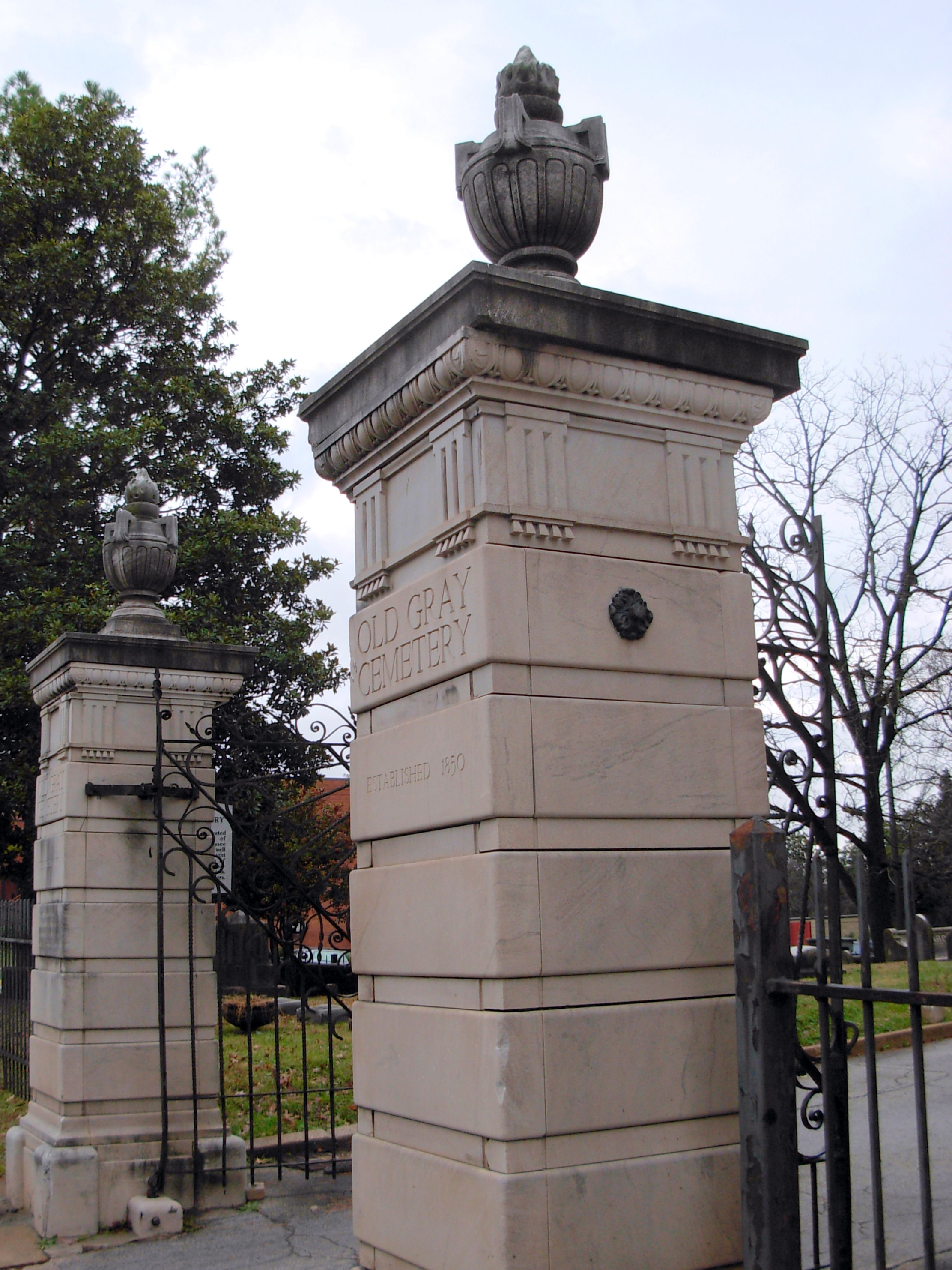
The gates of Old Gray Cemetery,  Photo 2011 by Lewis Powell IV, all rights reserved.
A circle of important monuments greets visitors to Old Gray. Photo 2011 by Lewis Powell IV, all rights reserved.
The cemetery is perched on a series of rolling hills. The gleaming, white stones are apart of neighboring Knoxville National Cemetery. Photo 2011 by Lewis Powell IV, all rights reserved.
The lovely monument to Lillian Gaines. Photo 2011 by Lewis Powell IV, all rights reserved.
The unique Horne monument pays homage to two Confederate soldiers.  Photo 2011 by Lewis Powell IV, all rights reserved.
A hillside of monuments.  Photo 2011 by Lewis Powell IV, all rights reserved.
Monuments dot a gentle slope.  Photo 2011 by Lewis Powell IV, all rights reserved.

Other haunted places in the area covered in this blog include the campus of the University of Tennessee; Greystone House, which now houses the studios of WATE; and the Baker-Peters Jazz Club.

Sources

  • Brown, Alan. Haunted Tennessee: Ghosts and Strange Phenomena of the Volunteer State. Mechanicsburg, PA: Stackpole, 2009.
  • Brown, John Norris. “Old Gray Cemetery.” Ghosts & Spirits of Tennessee. Accessed 23 September 2012.
  • Guiley, Rosemary Ellen. “Black Aggie.” The Encyclopedia of Ghosts and Spirits, 3rd Edition. NYC: Checkmark Books, 2007.
  • Knoxville National Cemetery. Wikipedia, the Free Encyclopedia. Accessed 24 September 2012.
  • Welcome. Old Gray Cemetery. Accessed 24 September 2012.

Down, Though Not Quite Out, in Memphis

It seems that the further I read about hauntings in Memphis, the more I see a city that has been down on its luck for the past few decades. So many of Memphis’ haunted sites are incredible architectural treasures, yet they sit empty and crumbling. Certainly, it reflects the ill fortune of large cities over the second half of the 20th century as they sprawled outwards while their hearts withered. Among Memphis’ haunted locales are a number that have been abandoned (or, in one case, partially abandoned) and legends have sprouted up concerning them.

At least two of these buildings have legends that may have been invented to accompany their lonely states: the SEARS CROSSTOWN BUILDING (495 North Watkins Street) and the STERICK BUILDING (8 North 3rd Street).

Opening in 1927, the Sears Crosstown Building was once the showplace of Memphis. Looming over North Watkins Street, just north of downtown, the enormous Art Deco structure housed retail, catalog, a merchandise warehouse and distribution space for Sears Roebuck and Company, at that time, the largest retailers in the nation. The building’s 11 stories and 17 story tower encompass 1.4 square feet of space. When the building opened on August 8th of that year, many sources say an estimated 47,000 people walked through the doors.

The Sears Crosstown building, 2008. Photo by Anthonyturducken, released under a Creative Commons License.

Until the store closed in 1983 (the building totally closed for good in 1993), it was considered the height of retailing in the city. Since that time a single person patrols the monstrous structure keeping vandals and curiosity seekers out. His only companions may be the occasional ghosts that may or may not exist.

Laura Cunningham’s 2009, Haunted Memphis includes a description of some of the activity supposedly witnessed in the building. This includes apparent residual activity such as the sounds of shoppers and escalators as well as doors opening and closing on their own accord. Cunningham also mentions that the parking garage may be haunted by the spirit of a homeless man who was killed there and buried nearby. Unfortunately, there are no specific reports of any of this activity, nor are the witnesses identified, therefore this has to be chalked up to urban legend.

Perhaps, more evidence will come to light as the building is used. An organization is already formulating plans to create an arts hub within the cavernous building. Late last year an artist installed a lighting installation that lit up various windows in an array of colors. We can hope that as the building sees more activity that more reports of paranormal activity will filter out.

In downtown Memphis, the Sterick Building has dominated the skyline for nearly a century. Opened in 1930, the building’s name is a combination of the surnames of its owners, R. E. Sterling and Wyatt Hedrick. The building was the tallest building in the South for some years and a grand jewel in the crown of Memphis. The building rises 29 grand floors in the Gothic Revival Style.

That grand jewel has been tarnished quite a bit over the years and the massive structure now sits empty. Financial issues have taken their toll over the decades. As development in Memphis expanded outward, the building’s tenants vacated one by one until the last tenants left in 1986. It has been empty since. The valuable land that the building rests upon is only leased and the building reverts to the landlord’s ownership at the end of its 99 year lease in 2025. Therefore, the current owners and anyone who tries to do anything to the building before that point will lose most of their investment. The Downtown Memphis Commission has made recommendations, but these may only join the past recommendations that have been nixed as too expensive.

The Sterick Building rises 29 stories above 3rd Street. Photo 2011, by Reading Tom. Released under a Creative Commons License.

So, for now, this massive white elephant sits on 3rd Street longing for people to fill its corridors and offices again while the occasional spirit may still prowl about. Again, like the reports of activity from Sears Crosstown, the reports from the Sterick Building are somewhat vague. Cunningham points out two specific incidents that may have left a spiritual mark upon the building: both involving people plunging to their deaths. One vague incident involved a young woman committing suicide to “save herself from a loveless marriage.” Another incident occurred in 1981 when a man attacked a woman in the building. As building security pursued the man he broke a window and climbed out onto the ledge from which he plunged to his death. Cunningham notes that employees in the building reported hearing the screams of someone falling outside their windows. Additionally, there are also reports of residual activity including lights on in empty offices and the sounds of people working.

While specific details of the hauntings of the Sears Crosstown and Sterick buildings may be hard to come by, details from the TENNESSEE BREWERY (477 Tennessee Street) are quite prevalent. The massive Romanesque Revival structure looms over Tennessee Street quite close to the muddy Mississippi River. According to Memphis Paranormal Investigations, LLC, this building is quite active and they have captured quite a bit of evidence in their 12 investigations of the structure.

The Tennessee Brewery at the height of its operations in 1909. Courtesy
of Wikipedia.

Investigations have uncovered the sounds of footsteps and numerous photographic anomalies. Cunningham mentions that “loud noises, strong enough to rattle windows, can be heard throughout the building.”

Organized in 1877, this massive brewery was constructed in 1890. By the turn of the 20th century the Memphis Brewing Company was the largest brewery in the South and among the largest in the nation. Like most breweries throughout the nation, the brewery closed during Prohibition. With the repeal of the 18th Amendment, the brewery reopened under the auspices of John Schorr, the son of one of the early owners. The brewery’s beer was named “Goldcrest 51” in 1938 and was the most popular brand of beer in the region until the brewery closed in 1954.

The Tennessee Brewery, 2008, by Otto42. Courtesy of Wikipedia.

Following its closure, the building was used as a scrap metal company until 1982. As the scrap metal company, the building was little changed and it has been a virtual time capsule with few changes made except those to keep the building in compliance with building codes. The city almost demolished the building in the 1990s, but a buyer jumped in and purchased the structure and brought it up to code. However, the building still remains vacant, though plans have been considered for its use as an arts space similar to Sears Crosstown. Certainly, such a magnificent edifice deserves to be cared for and maintained.

Sources

  • Bailey, Tom, Jr. “Towering vision: Project would remake Sears Crosstown into Memphis arts village.” The Commerical Appeal. 13 February 2011.
  • Cunningham, Laura. Haunted Memphis. Charleston, SC: History Press, 2009.
  • Lauderdale, Vance. “When the Sterick Building was Supreme.” Ask Vance: The Blog of Vance Lauderdale. 28 November 2008.
  • McCoy, Chris. “Signs of Life at Sears Crosstown Tower.” Live from Memphis. 21 October 2011.
  • Patterson, Sara. “Tennessee Brewery has intoxicating beauty, sobering challenges for developers.” The Commercial Appeal. 28 August 2011.
  • Pickrell, Kayla. “Haunted Memphis: Brewery a piece of history.” The Commercial Appeal. 24 July 2012.
  • Risher, Wayne. “Memphis officials pushing for plan to redevelop long-vacant Sterick Building.” The Commercial Appeal. 3 May 2012.
  • Risher, Wayne. “Skyline Orphan: Once the towering jewel of Downtown Memphis, rehabbing of Sterick Building poses tall order.” The Commercial Appeal. 27 December 2011.
  • Tennessee Brewery. Wikipedia, the Free Encyclopedia. Accessed 24 July 2012.
  • Wolf, Cindy. “Sears Crosstown, before the doors closed.” The Commercial Appeal. 27 February 2011.

Beyond 133 – Chattanooga Public Library

Chattanooga Public Library
1001 Broad Street
Chattanooga, Tennessee

N.B. This article was revised 20 February 2019.

Most libraries have ghosts, though usually these are confined to the 133 section of the Dewey Decimal System: the section for ghosts and the paranormal. The Chattanooga Public Library in downtown Chattanooga, Tennessee has a ghost (or possibly more than one) whose range lies far beyond its Dewey Decimal classification. Over the years, patrons and staff have had a variety of experiences ranging from hearing footsteps and voices to seeing apparitions. According to two recent articles from the Times Free Press, books have been thrown off shelves, and chairs have been moved about.

There has been enough activity to warrant the Young Adult Librarian to bring in a paranormal investigation group, the Global Paranormal Society, to investigate. The group spent six hours investigating the library on March 17. The results were publicized recently.

Chattanooga Public Library Tennessee
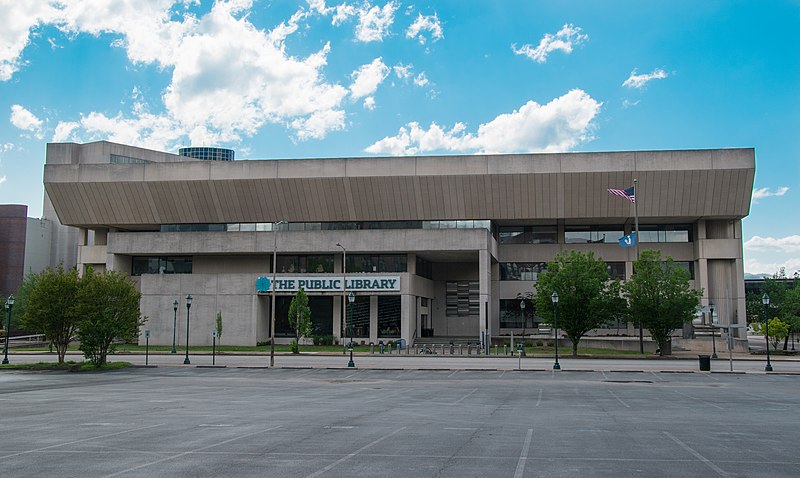
Chattanooga Public Library in 2019, by Ɱ.

The staff has named the resident spirit “Eugene,” though the spirit’s actual identity is unknown. The building itself is only 36 years old, and neither article mentions any deaths associated with the building, though the land upon which it was constructed, does have quite a history. It was on here that the city of Chattanooga was originally settled.

Evidence shows that Native Americans lived in the area for a few thousand years prior to the Historic Era: that period following European expansion into the Americas. It was here that the powerful Cherokee chief, Tsiyu Gansini or Dragging Canoe, settled with his followers in 1777. The chief’s father, Chief Attakullakulla, and other chiefs including Oconostota, made the decision to ally themselves with the Patriot cause following General Griffith Rutherford’s destruction of many Cherokee towns the previous year. Dragging Canoe set up a series of towns around the Tennessee River and Chickamauga Creek, with the settlers uniting under the name Chickamauga.

Later, another influential Cherokee, John Ross, settled in the same area and named this stop on the Tennessee River “Ross’ Landing.” The natives living here were forced on the Trail of Tears during the Removals in the 1830s. The name was changed in 1838 by the US Post Office to Chattanooga.

Where the library now stands, one of Dragging Canoe’s villages as well as being near to the actual site of Ross’ Landing. So, it’s possible that the library spirit may be from this period. Indeed, the investigators did find some evidence of activity, though they did not conclusively pronounce the library as being “haunted.” Still, Eugene continues to roam I can imagine the public library is pretty interesting place to haunt.

Sources

Newsworthy Hauntings 5/23/2012

I’m starting a new regular segment where I’ll briefly highlight hauntings or haunted places in the news and in some of the regular blogs I read.

The NIKAWSI MOUND (Nikwasi Lane), an ancient Native American mound in Franklin, North Carolina, is still stirring up controversy a few thousand years after it was built. The City of Franklin, which owns the mound that is still considered sacred to the local Cherokee people, recently sprayed herbicide on the mound. The herbicide was sprayed because mowing of the mound has lead to some deterioration of it. Local Cherokee, however, are not pleased with the actions, have expressed their opinions and demanded an apology from the city.

The mound’s builders are not known, but scholars believe that it was built by one of the early Mississippean peoples. The Cherokee utilized the site and it became part of Cherokee mythology as one of the locations where the Nunne’hi lived. This was a mythical race of beings that lived underground. Nineteenth century anthropologist James Mooney recorded a story that during a battle near the site, the Nunne’hi emerged to defeat the Cherokee’s enemy. Roger Manley records in Weird Carolinas that the Nunne’hi may have also guarded the town during the Civil War when a contingent of Federal troops attempted to the seize the Confederate stronghold. The Federal troops retreated when they saw a huge number of troops when in actuality there were only a few Confederates guarding the town. Manley also notes that some claim to hear drumbeats within the mound.

The mound is listed on the National Register of Historic Places, but there has been controversy about its preservation. Some have considered creating a park, but there is contention as to who will pay for it and control it. Hopefully, the herbicide will not adversely affect this place where the heartbeats and drumbeats of Native America may still be heard.

Sources

  • Dalrymple, Maria. “Nikwasi Mound deed could be transferred to create park.” Macon County News. 3 September 2009.
  • Manley, Roger. Weird Carolinas. NYC: Sterling, 2007.
  • McKie, Scott. “Chief: Tribe wants apology on Nikwasi Mound issue.” Cherokee One Feather. 21 May 2012.
  • Mooney, James. History, Myths, and Sacred Formulas of the Cherokees. Asheville, NC: Bright Mountain Books, 1992.
  • Nikwasi. Wikipedia, the Free Encyclopedia. Accessed 21 May 2012.


In Chesterfield, Virginia, the Chesterfield Historical Society has announced that they will be hosting ghost tours of MAGNOLIA GRANGE (10020 Ironbridge Road). The magnificent Federal plantation, one among the many famous James River Plantations, was constructed in 1821 and named for the circle of magnolia trees that once, with formal boxwoods, constituted its formal gardens. These gardens were destroyed after the Civil War.

Magnolia Grange, 2012, by James Shelton32. Courtesy of Wikipedia.

The home is now owned by the county and administered by historical society. The ghost tours are being conducted by Spirited History, a local paranormal group that is working to help local historical sites with funding by investigating and educating the public about the sites’ paranormal history. Among the activity that has been reported in the house is the appearance of a beautiful, blond woman seen standing on the steps. A photographer taking wedding pictures in the house some years ago encountered her and mentioned the woman he had seen in period clothing to the staff. The staff informed him that no one was working in period clothing. Investigations of the house have also yielded a number of EVPs.

Sources

  • Gregory, Donna C. “The past lives on at Magnolia Grange.” The Chesterfield Observer. 26 October 2011.
  • “Historical Society to host ‘Spirited History’ at Magnolia Grange May 19.” Midlothian Exchange. 17 May 2012.
  • National Park Service. “Magnolia Grange” James River Plantations. Accessed 21 May 2009.
  • Virginia Historic Landmarks Commission Staff. National Register of Historic Places nomination form for Magnolia Grange. November 1979.


Over at the “eco-gossip” blog, Ecorazzi, two locations in the South have been featured in a list of the top 10 “naturally haunted” places in the world. While I give little credence to such lists (so many of them are just silly, unsubstantiated fluff), I was excited to see these two places in the list.

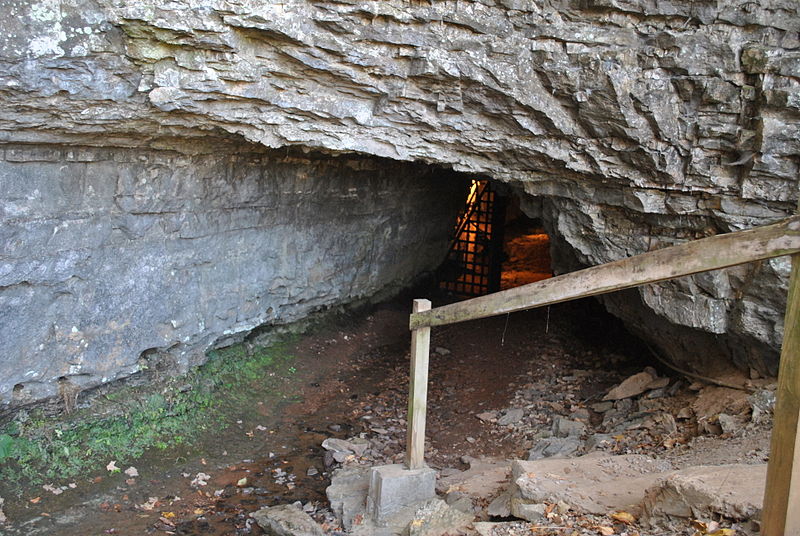
Inside the Bell Witch Cave, 2010, by Www78. Courtesy of Wikipedia.

Adams, Tennessee’s BELL WITCH CAVE (430 Keysburg Road) is probably the most well-known of the two locations. Located on property once owned by the Bell family, the cave is believed to be the current residence of the famous Bell Witch who terrorized the Bell family in the early 19th century. Of the spirits in the American South, this spirits is perhaps the most well-known and certainly one of the most publicized spirits having a number of books written solely on the subject as well as a recent feature film, An American Haunting. Visitors to the cave have had a variety of experiences in and around it. The cave is privately owned and tours are given.

On the western shores of Louisiana’s Lake Pontchartrain, near New Orleans is MANCHAC SWAMP, home to ghosts and the French Creole werewolf, the Loup-Garou. It was here that a number of small towns were wiped off the map in the New Orleans Hurricane of 1915. Tours now travel through this haunted wetland at night by torchlight scaring up alligators and the spirits of the victims of the hurricane.

Sources

  • 1915 New Orleans hurricane. Wikipedia, the Free Encyclopedia. Accessed 23 May 2012.
  • Bell Witch Cave. Wikipedia, the Free Encyclopedia. Accessed 23 May 2012.
  • Coleman, Christopher K. Ghosts and Haunts of Tennessee. Winston- Salem, NC: John F. Blair, 2011.
  • Freeman, China Despain. “The 10 Naturally Creepiest Places on Earth.” 23 May 2012.
  • Smith, Katherine. Haunted History Tours Presents Journey Into Darkness…Ghosts and Vampires of New Orleans. New Orleans: De Simonin Publishing, 1998.

Preserving Haunted History–Tennessee

N.B. This article originally included a section on the Tennessee State Prison in Nashville. That has since been moved into a new article.

Temperance Building
Walden and Roane Avenues
Harriman, Tennessee

Historic preservation and hauntings go hand in hand. Most often, those places known for their paranormal activity are also places that have preserved a great deal of their history: Savannah, Georgia; Charleston, South Carolina; St. Augustine, Florida and Natchez, Mississippi would most certainly qualify. This notion has made strange bedfellows at times with historians, scholars and preservationists teaming up with ghost hunters and paranormal investigators to help preserve historic locations. This was recently seen in an article from Britain’s Daily Mail, though the author takes it in more of a tongue in cheek fashion.

Temperance Building, 2010. Photo by Brian Stansberry, courtesy of Wikipedia.

I’d be interested to know how the citizens of Harriman, Tennessee and their efforts to restore their city hall reached the ears of the British Press. One wonders if they hacked the cellphones of the local city government in order to extract some of the details. Really, a story made the rounds via the Reuters News agency in a more respectful article by Tim Ghianni.

Harriman, Tennessee is a quiet town in East Tennessee, just off of Interstate 40 near Knoxville. The town was founded in 1889 by leaders in the Temperance Movement, the Victorian movement to free the country from the vise-grip of the vice of alcohol. Hopefully this utopia would provide a cleansing presence among the moonshiners of Appalachian Tennessee. In the Panic of 1893, the East Tennessee Land Company, which had been established to create the city, was forced into bankruptcy, though the Temperance leaders involved in the town marched forward. The large Romanesque revival structure on Roane Avenue was constructed to house the land company and with its closure, the building became the main hall for American Temperance University.

In the second year of the university’s existence (1894), it boasted some 345 students but that number dwindled by 1908 and the university shut its doors. The large building then served as a jail and went through a number of other uses before being occupied by the City of Harriman as a City Hall. Recently, the over 120-year-old building has required more and more maintenance; work that a city in the grips of the economic recession that has plagued the US can ill afford.

Locals have described the antique edifice as haunted for quite some time. The building is listed in John Norris Brown’s encyclopedic Ghosts and Spirits of Tennessee website. Brown mentions that shadowy apparitions have been reported in the structure which have been identified as some of the early city leaders. These reports brought out the investigative team from G.H.O.S.T., the Ghost Hunters Of Southern Tennessee to investigate the building recently.

During their investigation, the team captured possible video evidence of spiritual activity as well as EVPs which they presented to the city council. In displaying this evidence, they have suggested that the city consider hosting tours and paranormal investigators with the city taking half of that revenue for use in restoring the building. This is a concept which has been employed successfully elsewhere including the Old Jail in Charleston, South Carolina.

Sources

  • American Temperance University. Wikipedia, the Free Encyclopedia. Accessed 18 January 2012.
  • Brown, John Norris. “Temperance Building.” Ghost & Spirits of Tennessee. Accessed 18 January 2012.
  • Ghianni, Tim. “Ghost Hunters to raise money for ‘haunted’ Temperance Building in Harriman, Tenn.” The Huffington Post. 15 January 2012.
  • Harriman, Tennessee. Wikipedia, the Free Encyclopedia. Accessed 18 January 2012.
  • Keneally, Meghan. “Modern-day ghostbusters hoping to save their haunted house with guided tours may have a problem: lack of scary ghosts.” Daily Mail. 17 January 2012.

A Sunless Sea—Craighead Caverns and the Lost Sea

In Xanadu did Kublai Khan
A stately pleasure-dome decree:
Where Alph, the sacred river, ran
Through caverns measureless to man
Down to a sunless sea.
–Samuel Taylor Coleridge, “Kublai Khan” (1797)

The Lost Sea
140 Lost Sea Road
Sweetwater, Tennessee

Many moons ago a large, prehistoric jaguar stumbled into this cave in eastern Tennessee between the modern metropolises of Chattanooga and Knoxville. The large cat may have wandered in but it never saw the light again. Lost in the inky darkness of the cave, the cat stumbled, fell and died. Its remains and a couple paw prints remained undisturbed until two curious cavers discovered them in Craighead Caverns in 1939. Since then, according to Christopher Coleman’s Ghosts and Haunts of Tennessee, “visitors have felt something akin to the tail of a large animal brush against them. Locals swear that a phantom jaguar haunts the cave.” 

Visitor’s center. Photo, 2011, by Lewis Powell, IV, all rights reserved.

On a weekday morning in early December, I was visiting the cave long past the usual tourist season. The visitor’s center was quiet with a few employees putting up Christmas decorations. As a child, I always collected travel brochures when I went on family vacations and brochures for The Lost Sea were always available. I was thrilled to be finally visiting and even more thrilled to see that I was getting a private tour as one of the few visitors that morning.

The modern entrance to the caverns. Photo 2011, by Lewis Powell, IV. All rights reserved.

I descended the futuristic tunnel with my guide to the caverns and he began his spiel: explaining the stalagmites and stalactites and how they were formed. We entered a round room called the “Council Room” where the Cherokee who once owned the cave may have gathered. The ceiling of this room bears beautiful and rare ornamentations known as “anthodites,” a fragile, flower-like formation. The Cherokee were among the earliest explorers of the cave and they left behind some artifacts. In the 1820s, the property was owned by a Chief Craighead for whom the cave was named. At some point after this time the cave was “discovered” by the white pioneers moving into the old Cherokee lands. Initially, families living in the area used the large, cold and dark cave rooms for food storage, but eventually an operation was set up to extract saltpeter for gunpowder.

A cave formation. Photo 2011, by Lewis Powell IV, all rights reserved.

As with so many caves throughout the South, during the Civil War the cave’s saltpeter works became strategically important. In fact, the ceilings still bear signatures that were left there by soldiers and visitors. According to an old diary from the period, the cave’s guard was infiltrated by a Union spy who intended on blowing up the whole operation. Once discovered, the spy was dragged out of the cave, tied to a large gum tree and shot. Of course, some have tied this story with the spirits that may haunt the cave, though, as of yet, there’s no real evidence to make that connection.

Replica of a saltpeter leeching vat. Photo 2011, by Lewis Powell, IV, all rights reserved.
A date smoked into the ceiling. Photo 2011, by Lewis Powell, IV, all rights reserved.
A soldier’s name smoked into the ceiling. Photo 2011, by Lewis Powell, IV, all rights reserved.

Following the tumult of the Civil War, the cave saw a variety of uses including mushroom farm, a setting for moonshine operations and as a fallout shelter during the Cold War. In 1947, the cave opened as the Cavern Tavern, a nightclub in the Big Room just inside the historical entrance of the cave. The tavern owners installed a bar and a dance floor with a band in an adjacent room which aided the acoustics. Patrons entering the tavern would traverse a steep staircase to descend into the club and once they’d had a few drinks and danced the night away, would again have to traverse the staircase again. According to the guide, resulting injuries from drunk patrons forced the closer of the club after a few months.

A cave formation. Photo 2011, by Lewis Powell IV, all rights reserved.

We were standing in the Hanging Rock Chamber (a round room created by a whirlpool with a ceiling of jagged rock) as the guide told me about the club in the adjacent Big Room. The room is not usually open during regular tours, though it is used as part of the Wild Cave Tours and groups spending the night within the cave stay here. No mention of legends had come up at this point, so I decided to ask about ghosts.

“I’ve read that there are a few legends of ghosts associated with this cave.”

The guide looked rather uneasy so I added a postscript, “I’d be interested in hearing anything you may know if you’re not forbidden to talk about it.” The guide relaxed a bit.

“I’ve had some experiences here.” He went on to explain that he had had an experience in the Big Room. He was in the cave with a group spending the night and was seated on the infamous staircase reading. He was startled by a sudden drop in temperature at which point he said he heard voices around him whispering. He jumped up and went outside for a little while.

“The Hell Hole” within the upper portion of the cave. Photo 2011, by Lewis Powell IV, all rights reserved.

He went on to relate the experience of a maintenance man who was gathering bags of trash in the same room. The maintenance man heard the sound of footsteps following him as he moved through the room. As he began to leave, a voice uttered his name from just behind him. He fled.

The guide and I began to leave the Hanging Rock Chamber, but I wanted to get a photograph of the entrance to the Big Room. Since we were on a private tour, I was allowed to venture into the room to see the dance floor and the staircase. The way into the room was steep and I was out of breath by the time we were inside. The room felt colder and there was an odd, possibly chaotic energy there. My instincts said, “You shouldn’t be here.” I ignored them and took a few pictures, though I could tell the guide wanted to go as well. As we hurried out, I remarked on the energy. He felt it too.

The best picture I could get of the old dance floor in the Big Room. Photo 2011, by Lewis Powell IV, all rights reserved.

I recalled something a guide said when I was visiting Kentucky’s monstrous Mammoth Cave last year. After turning out the lights we were treated to the pitch black darkness that can only be found in caves and at the deepest reaches of the ocean. The guide spoke of how caves can wreck havoc on the senses, especially where there is the sound of water: the ears can be tricked into hearing voices. In the case of Craighead Caverns, the cave is quite humid and there are large amounts of water, though mostly in the lower reaches. In the upper reaches, I occasionally heard water dripping, but it was fairly sporadic and not noisy enough to be mistaken for voices.

Anthodite “flowers.” Photo 2011, by Lewis Powell IV, all rights reserved.

We discussed spirits as we moved through the caverns towards the Lost Sea. My guide mentioned that he occasionally saw shadowy figures dart through the caverns. I inquired about the spirits of the ancient jaguar and the Union spy. He had heard the stories but didn’t elaborate any further.

The guide returned to his spiel about the discovery of the Lost Sea. As it turns out, the sea really was lost for quite a time. A young man playing in the cave in 1905 was the first to discover the large, flooded chamber. When he told others about it, they tried to find the room, but were met only with passages that were flooded. As Ben Sands grew older he continued to tell about the lost sea that only he had seen. It wasn’t until many years later that the sea was found and the entire cave developed as a commercial “show cave.” It opened as The Lost Sea in 1965.

The sea itself is immense. The only words I could utter when it was first revealed were, “Oh my!” As we got out on the second largest underground lake (as they call it) in the world, I did feel a bit of a chill peering into the darkness beyond the boat. The lake is lit with occasional lights along the edge and this allows visitors to see the large Rainbow Trout that have been stocked within the lake, but it is still fairly dark. Seeing the large, dark shape in the water of the first trout approaching the boat was a bit disconcerting and soon the water around the boat was swarming with them. They’re fed on every tour and that has contributed to their large size.

The Rainbow Trout in the sea. Photo 2011, by Lewis Powell IV, all rights reserved.

After exiting the boat the guide and I began our ascent back to the entrance. We paused for a moment near a dark, narrow passage that was another part of the Wild Cave Tour. The guide mentioned that he didn’t like to walk that area alone and he offered to let me take a quick look. We walked a few yards into the passage and something in the back of my mind kept repeating, “You don’t need to be here.” My guide remarked that he felt another energy change and felt a heaviness in his chest. I didn’t sense any of that, but it felt warmer in the space, a feeling that I somehow equated in my mind with hot breath. I knew I did not want to go any further so I took a quick picture and we returned to the trail.

Overall, the cave tour is quite pleasant. Where some cave experiences can be overdone (using music, colored lights and other nonsense), this cave is perfectly lovely and it has been left in its mostly natural state. The wonder of nature’s creation and the cave’s unique history shows through. My guide (and he knows who he is) was friendly and very interesting. I’m grateful he shared his experiences with me. If you’re looking for an interesting tour in East Tennessee, be sure to stop at Exit 60 for The Lost Sea!

A reader of this blog provided me with a fascinating encounter she had at the Lost Sea.

Sources

  • Coleman, Christopher K. Ghosts and Haunts of Tennessee. Winston-Salem, NC: John F. Blair, 2010.
  • The Lost Sea Adventure. The History of The Lost Sea Adventure: America’s Largest Underground Lake. Sweetwater, TN, No date.
  • Matthews, Larry F. Caves of Knoxville and the Great Smokey Mountains. Huntsville, AL: National Speleological Society, 2008.

Blazing Trails Through History and Lore—Review of “Haunted Chattanooga”

Research is a form of trailblazing. There are mountains and unexplored regions of data and information. A researcher combs through this wilderness, marking the trail and finding their way to the most scenic and interesting vistas. In publishing, the researcher is publicizing that trail and permanently marking it for their readers and other researchers to follow. In publishing a book, a researcher is establishing a grand trunk line that many will follow and they enable those other intrepid explorers to blaze their own trails from that.

Chattanooga, Tennessee stretches out before Lookout Mountain along the banks of the Tennessee River. Photo 2077, by Lewis Powell IV, all rights reserved.

When I first started researching the paranormal a few years ago, I was amazed to find that there were many places where authors had blazed few trails. Major Southern cities like Chattanooga, Tennessee; Montgomery, Alabama; Jacksonville, Florida and Columbia, South Carolina, among others, lacked books and in some cases, even basic resources on their ghosts and hauntings. However, that list has recently gotten shorter with Jessica Penot and Amy Petulla’s recently published Haunted Chattanooga. A trail has finally been blazed through Chattanooga, a city whose ghosts had, until recently, not been fully explored in print.

Penot and Petulla are marvelous guides to Chattanooga’s spiritual side. Among the the locations they discuss are places that have been explored elsewhere, but they include quite a few locations that I’ve not seen discussed. They explore Hales Bar Dam which has very recently become a hotspot for paranormal investigation along with the ghosts of the Chattanooga Campus of the University of Tennessee which could be just as much a hotspot. Here the Hunter Museum’s elderly wraith is documented with a singing spirit in the Thurman Cemetery.

The authors have done a good job at plumbing the depths of Chattanooga’s history of hauntings as well. Legends and stories of haunted places that no longer exist are woven in with modern experiences. Stories of the old Hamilton County jail, which no longer exists, rub shoulders with modern hauntings in the Raccoon Mountain Caverns.

Both authors have a marvelously readable and relaxed writing style. This contributes much to the readers’ journey through the text. Overall, Penot and Petulla have carved a wonderful trail to be followed by future researchers into the haunted heart of Chattanooga.

Haunted Chattanooga By Jessica Penot and Amy Petulla is a part of the Haunted America series by History Press, $19.99.

Southside Spirits–Chattanooga

Southside Saloon and Bistro
1301 Chestnut Street
Chattanooga, Tennessee

Until quite recently, Chattanooga was a city whose ghosts were ill documented. Jessica Penot and Amy Petulla’s recent book, Haunted Chattanooga, has helped to fix that. I’ve only just gotten my copy of the book and will review it as soon as I’ve finished reading it. It doesn’t seem to include this location, though it’s noted that many stories were not included in this book due to space constraints. Therefore, I’m also quite happy to see this recent article. Adding locations to my list always is a joy!

The Southside Saloon and Bistro is located in an unassuming brick building in downtown Chattanooga. A bit over a century old, the building was built initially as a saloon while the upstairs included cubicles for use as a brothel. Over the decades, the building has seen a number of other uses including use as a bottling company. Some spirits still linger here as well. The article mentions three ghosts believed to remain in the building including a man whom the staff has nicknamed George. Activity has included apparitions, swinging pots and other moving objects.

So, next time you’re in Chattanooga, check out the Southside Saloon and Bistro for good food and a variety of spirits.

Sources

A Crying Shame—Bethesda Presbyterian Church

Bethesda Presbyterian Church
Russellville, Tennessee

Pardon my absence, please. Initially, I was busy working on some new articles, but after lightning struck and killed my router and Internet; my time for work was limited. I’m getting back to work now. Since I haven’t done a good newsbyte in awhile, I’m doing one now; and boy, it’s a doozy.

You may notice that I have not included the exact location of this church, there’s a good reason for that. After recent events, I have a feeling the people working to protect Bethesda Presbyterian Church really don’t want ghost hunters around.  According to an article and video from KSDK in St. Louis, Missouri, the church was vandalized recently by teen “ghost hunters.”

This is utterly ridiculous. Unfortunately, these teens have given real ghost hunters and others with an interest in the paranormal a bad name. Two teenage boys spent time in this historic church overnight burning candles on floors that once held wounded from the Civil War. Windows were shattered and they spray-painted and toppled a number of monuments in the adjacent cemetery. As the idiots did leave a bicycle on the property, the police were able to apprehend these young hooligans.

Reading about such an event makes me livid, especially when “ghost hunting” is involved. A ghost hunter should have utmost respect for the places they investigate as well as for the dead. Part of that respect for the dead is by protecting the places where they once walked or are buried.

Please do check out the video for some wonderful shots of this historic structure. The reporter does state that the church is on the “National Registry of Historic Landmarks.” This is incorrect. It is called the “National Register of Historic Places.” There are places that are known as National Historic Landmarks, but that is a step up from the National Register and reserved for those places of national importance.

Sources

Legends of Long Island—Long Island of the Holston

Long Island of the Holston
Kingsport, Tennessee

Had this four mile long, half mile wide island been located in any other river in Tennessee it would not possess the significance that it has. This spit of land could be called the birthplace of Tennessee and even Kentucky for the treaties signed with the Cherokee that opened their lands to settlements by the white man. One possible origin for the name for the state of Tennessee, from the language of the Yuchi Indians, “Tana-see,” possibly meaning “the meeting place,” may be derived from this island. It is no wonder that the Federal government named Long Island a National Historic Landmark in 1960.

Aerial view of Long Island of the Holston, 2009. Photo by Worldislandinfo, courtesy of Wikipedia.

The island is located near the junction of the North and South forks of the Holston. The Holston flows southwest towards Knoxville where it meets the French Broad River creating the mighty Tennessee River. Nearby, the Great Indian Warpath, a major trail leading to the northeast from central Tennessee, brought many natives past this island. This island served as an important ceremonial site for the Cherokee Indians who occupied this area until the late 18th century. The island was a sacred ground for rituals but also for councils and treaties. So sacred was this island that, according to a number of sources, it was forbidden to kill or molest anyone on this sacred ground.

The first major intrusion of whites into the area occurred with Colonel William Byrd’s expedition in 1761 which constructed Fort Robinson near the river junction. When the outpost was abandoned a short while later, the Cherokee resumed control of the area. However, the building of the fort only emboldened white incursions into the area. Hunters, explorers and the occasional courageous settler were soon found in the lands surrounding the island. When Daniel Boone, that great trailblazer to the Kentucky territory, arrived in March of 1775 with an axe-wielding crew to cut a trail to the new territory, the real trouble began. Long Island became the starting point for Boone’s Wilderness Road, bringing hundreds of thousands of white settlers through the area.

With the outbreak of war, many of the Cherokee sided with the British due to the increasing pressure from frontiersmen and by the middle of 1776 they had worked to free the area from whites. Colonial soldiers set out from Eaton’s Fort near the junction of the Holston’s two forks and crushed the Cherokee in battle at the Long Island Flats on August 20. The next year, a treaty was negotiated on Long Island ceding much of the Cherokee lands in East Tennessee and everything east of the Blue Ridge to white settlers. However, the Cherokee still maintained possession of Long Island, though Joseph Martin and his Native American wife, Betsy, established a trading post there; the first white settler on the island.

While many Cherokee had cleared out of the newly claimed area, there were still attacks on white settlements. A peace was negotiated at Long Island in 1781 just before the end of the Revolution. The activity of settlers increased and a boat yard was established on the river, opposite the western tip of the island. The year 1805 saw a number of treaties ceding the remaining Cherokee land in the area to white settlers including Long Island. Legend says that among the natives to leave the island for the last time was a medicine man who laid a curse on the island that no white would be able to comfortably settle on the island. Around the island, the city of Kingsport was created with the merger of Christianville and Rossville in 1822. The island was later incorporated into the town.

Parts of the island were developed and residences sprang up, but, according to the legends, insanity and crime occurred on the island in higher rates than elsewhere in Kingsport. Perhaps the curse was beginning to take its toll? Over time, the legend has been oft-repeated receiving additions on occasions such as the addition from the era of World War II.

Folklorist Charles Edwin Price recounts this tale in his Haints, Witches, and Boogers: Tales from Upper East Tennessee; this tale is recounted in a few other sources, but apparently based upon Price’s version of the tale. The tale, according to Price, tells of Amos Ross, whose son was a Marine in the war. On leave, his son and his son’s girlfriend at the time, went out to Long Island one evening to spend some time together. Ross, a fine upstanding Christian, worried that his son was committing a mortal sin followed the couple out to the island. Finding the couple in flagrante delicto, Ross became enraged and attacked, killing them both. After the incident, legend says, he was never seen again, though couples necking on the island, which may have been a “Lovers Lane” were occasionally attacked by the enraged man or at least his spirit. While this is a marvelous tale, it does leave some questions. Unfortunately, without access to the Kingsport papers of the World War II, era, I cannot prove this is just a legend or if it is grounded in fact.

Besides this violent morality tale, there are other incidents occurring on the island. Again, these tales are told without specific reports of incidents. After dark, it is said that Native Americans have been seen on the island. Campfires are seen blazing with natives dancing about and performing rituals. In the early morning mist on the river, warriors have been seen gliding along silently in their canoes.

Sadly, much of the historic nature of the island is now gone. In 1996, the historical integrity of the island had been so depleted that the National Park Service, administrators of the list of National Historic Landmarks, suggested that the island be delisted. While the landmark designations has not been removed, much of the island is now heavily industrialized. Viewing the island via Googles Maps, it appears that most of the island is now paved over and covered with industrial development. The western portion of the island is now the location of a park and baseball fields are quite obvious, but little of the island’s original sylvan nature remains. The city of Kingsport, realizing the enormous value of having this marvelous landmark in town has done some work towards attracting visitors.

In 1976, a mere three acres of the island were given to the Eastern Band of Cherokee. These acres are a part of a park on the western end of the island, but the island still remains heavily industrial. It’s not hard to imagine that spirits returning to this haunted island, paddling around in the morning mist, don’t even recognize their spoiled sacred island.

Sources

  • Brown, Alan. Haunted Tennessee: Ghosts and Strange Phenomena of the Volunteer State. Mechanicsburg, PA: Stackpole Books, 2009.
  • Brown, John Norris. “The Long Island Curse.” Ghosts & Spirits of Tennessee. Accessed 14 July 2011.
  • Lane, Matthew. “Tribes discuss role of Long Island in King’s Port on the Holston.” Kingsport Times-News. 17 May 2007.
  • Long Island (Tennessee). Wikipedia, the Free Encyclopedia. Accessed 14 July 2011.
  • McGuiness, Jim. “Tales of paranormal activity abounds in Tri-Cities region.” Kingsport Times-News. 28 October 2007.
  • Mooney, James. History, Myths and Sacred Formulas of the Cherokees. Asheville, NC: Bright Mountain Books, 1992.
  • Price, Charles Edwin. Haints, Witches, and Boogers: Tales from Upper East Tennessee. Winston-Salem, NC: John F. Blair, 1992.
  • Rettig, Polly M. National Historic Landmark Nomination form for Long Island of the Holston. 4 June 1976.