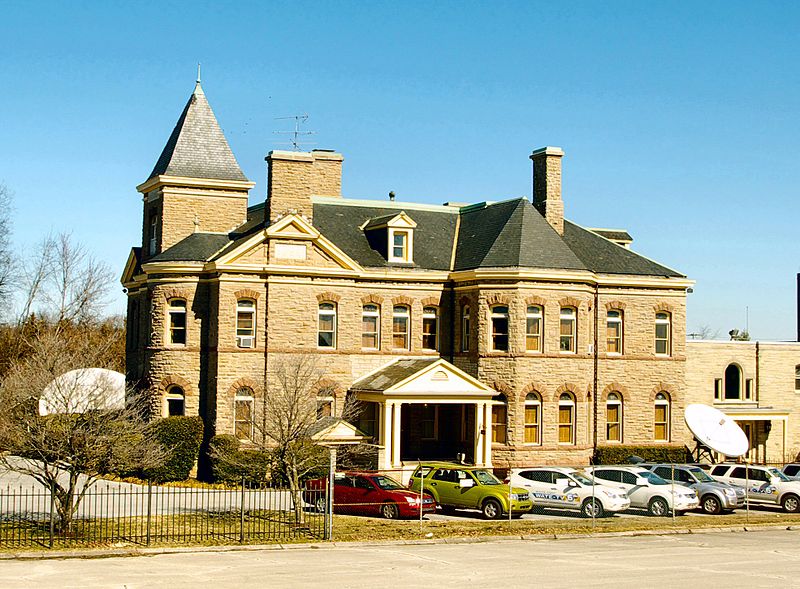
Tennessee Brewery 495 Tennessee Street Memphis, Tennessee
The Tennessee Brewery will be saved. A local businessman and school board member has taken up the cause of the massive, decaying Romanesque structure and is transforming it into a residential building that will join the efforts to remake this specific part of town into an arts district.
In April of last year, when last I wrote about this story, plans were underway to hold a beer garden in the old building under the name “Tennessee Brewery Untapped.” This effort was successful in arousing local interest in the structure. The owner at that time had indicated that he would likely demolish the building by the end of the summer unless a buyer came forward. “If not for Untapped, I don’t think people would have focused on the building,” said Billy Orgel, the building’s new owner.
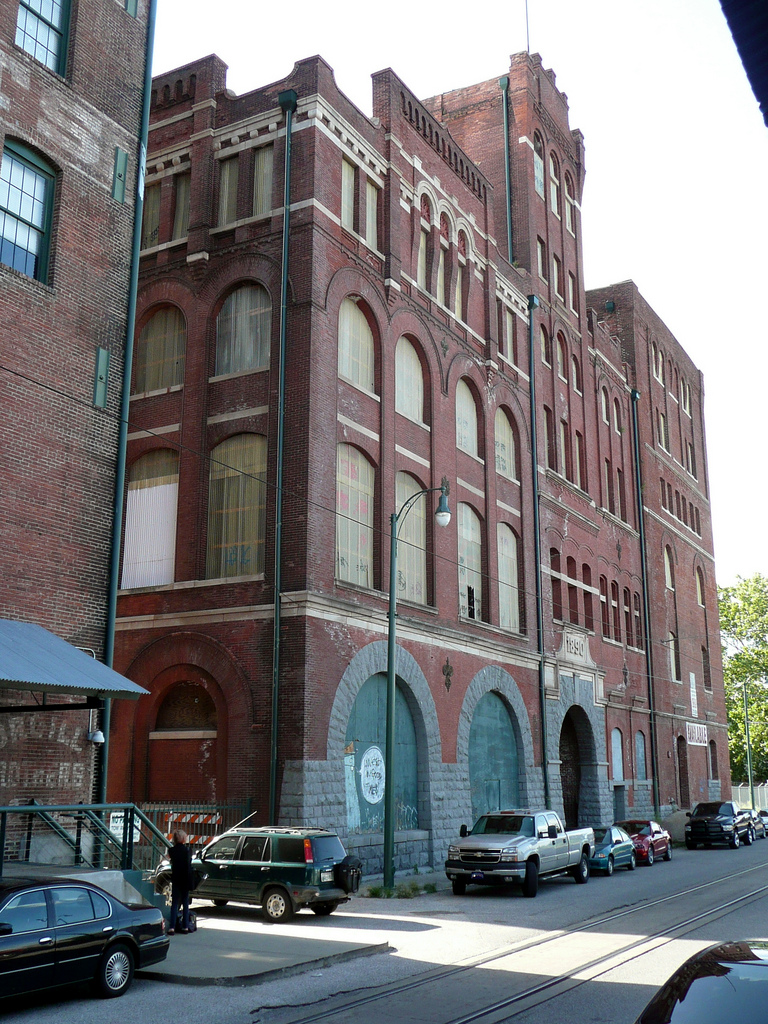
2011 view of the Tennessee Brewery by Reading Tom. Courtesy of Flickr.
Orgel, CEO of cell phone tower developer, Tower Ventures and also a Shelby County School Board member, led a small group of investors in purchasing the building. Plans have been made to turn the building into lofts with a small amount of possible commercial space on the ground floor. The new owner has said that project will require “a leap of faith by a lot of people.”
There’s no word on what the brewery’s spirits may think of this, though the building’s new owner doesn’t believe there may be anything there. After being approached by a production company wishing to produce something about the building’s haunted history for the Discovery Channel, Orgel responded, “we said we are not interested. We’re not really sure if anything ever even happened in there.” Perhaps the spirits are just enjoying a cold one before resuming their regular haunting activity.
Sources
Maki, Amos. “Brewery developer calls for ‘leap of faith.” Memphis Daily News. 14 January 2015.
Poe, Ryan. “Developer unveils details about Tennessee Brewery’s future.” Memphis Business Journal. 3 October 2014.
Woodruff-Fontaine House 680 Adams Avenue Memphis, Tennessee
A professor from the University of Alabama wasn’t expecting to meet any of the spectral occupants of the Woodruff-Fontaine House during his visit. During his tour he first witnessed “a presence forming before his eyes” and his wife mentioned to the guide that her husband had a sixth sense. In Mollie’s bedroom, the professor began talking with one docent and sent his family on to see the rest of the house. As they stood there they witnessed the sheets of the bed move as if as they were being smoothed by an unseen hand. Moments later, the pillows moved as if being fluffed followed by an indention forming on the bed as if someone had just laid down.
Mollie’s bed in the Woodruff-Fontaine House, 2011. Courtesy of the Memphis CVB on Flickr.
Later that day after the house museum closed, the professor and his family drove past the house and stopped. Glancing up towards the windows of the same room where he’d had his spectral encounter, the family witnessed the window shutters moving on their own accord. They quickly left having had enough of the paranormal for one day.
The Woodruff-Fontaine House was built as and remains one of the finest homes in Memphis. The noble French Second Empire-style home was built for businessman Amos Woodruff who had made his fortune as a carriage maker and banker while dabbling in many other businesses including the railroad. Woodruff spent $40,000 on his magnificent manse, a tremendous sum especially in the Reconstruction era South. Upon the home’s completion, Woodruff and his family moved in, just in time for the wedding of his daughter, Mollie.
Mollie and her husband, Egbert Woolridge, took up residence in the home along with her parents after her marriage. It was here in 1875 where the young couple’s first child died just after his birth. A few short months later, Mollie’s husband passed in the house after a bout with pneumonia. Mollie married in 1883, just before her parents sold the house to cotton trader Noland Fontaine.
Fontaine maintained the home’s elegant reputation and during his residency luminaries alighted upon the house including President Grover Cleveland, Vice President Adlai Stevenson, and musician John Philip Sousa. The home remained in the Fontaine family until 1929 when it was sold and became home to an art school until 1959. The home was acquired by the Association for the Preservation of Tennessee Antiquities and has been a house museum for many years paying tribute to the Woodruff and Fontaine families.
The Woodruff-Fontaine House, 2011. Courtesy of the Memphis CVB on Flickr.
Stories about the home’s spectral occupants have been circulating for years. Many who have had encounters with these mostly unseen residents have speculated that one of the primary spirits is Mollie Woodruff. More recently, the home was investigated by The Atlantic Paranormal Society (TAPS) team for the TV show Ghost Hunters. It’s interesting that Adams Street, where the Woodruff-Fontaine House sits was once known as “Millionaire’s Row,” and is now known as Victorian Village. Here, many of the mansions remain and many of them are noted as being haunted. Perhaps this is the most paranormally active street in Memphis?
Sources
Brown, Alan. Haunted Places in the American South. Jackson, MS: University Press of Mississippi, 2002.
Cunningham, Laura. Haunted Memphis. Charleston, SC: History Press, 2009.
Harper, Herbert L. National Register Nomination form for The Lee and Fontaine Houses of the James Lee Memorial. 4 November 1970.
Hudson, Patricia L. and Sandra L. Ballard. The Smithsonian Guide to Historic America: The Carolinas and The Appalachian States. NYC: Stewart, Tabori and Chang, 1989.
Longo, Jim. Ghosts Along the Mississippi, Haunted Odyssey II. Louis, MO: Ste. Anne’s Press, 1993.
Our History. Woodruff-Fontaine House. Accessed 25 February 2015.
Following on the heels of my article, “Dining With Spirits,” I’ve decided to revamp my Halloween article from 2010 on haunted inns and hotels. That article was so large I published it in two parts so I’m breaking it into a smaller article with just 13 hostelries, one from each of the states that I cover. See part two of this article in “13 More Southern Rooms with a Boo.”
St. James Hotel 1200 Water Street Selma, Alabama
The Queen City of the Black Belt, Selma, has a remarkable history that is intimately connected with the Civil War and the Civil Rights Movement, events that, despite their names, were hardly civil. The city is perched on a bluff overlooking the Alabama River and among the collection of buildings that peer down upon the river is the St. James Hotel. Built some 17 years after the incorporation of the town in 1820, the St. James has served patrons for nearly two centuries. The structure was occupied by Union forces during the Civil War, one reason the hotel was not burned like much of the city. Towards the late nineteenth century, the hotel fell on hard times and served a variety of functions. Keeping up with Selma’s drive to bill itself as a tourist destination, the St. James underwent a $6 million restoration in the 1990s which has provided 42 guest rooms, 4 riverfront suites with balconies overlooking the Alabama, the Troup House Restaurant (which utilizes the hotel’s name during the Civil War) and a number of spiritual guests.
The St. James Hotel, 2010, by Carol M. Highsmith. Courtesy of the Library of Congress, Prints and Photographs Division.
Outlaw Jesse James and his gang were frequent guests in the hotel and a male apparition seen in guest rooms on the second and third floors and in the bar may possibly be Jesse or a member of his gang. The spirit has been accompanied by the distinct jangle of spurs. Investigators in one of the hotel’s ballrooms asked “Is anyone there?” during an EVP session. The voice of a male answered on tape, “Well, that’s a stupid question.” Among other spirits still walking the halls of the St. James are a female and a dog whose barking is heard. So, if you check into the St. James, chances are high that you may encounter something, just don’t ask any stupid questions.
Sources
“Dead walk.” The Selma Times-Journal. 23 October 2005.
Lewis, Herbert J. “Selma.” Encyclopedia of Alabama. 12 August 2008.
“St. James hosts ‘spirit.’” The Selma Times-Journal. 30 October 2003.
Turnage, Sheila. Haunted Inns of the Southeast. Winton-Salem, NC: John F. Blair, 2001.
Omni Shoreham Hotel 2500 Calvert Street, NW Washington, D.C.
Suite 870 of this 1930 hotel has seen three deaths. Juliette Brown, a live-in maid to the hotel’s owner, Henry Doherty and his family, died there unexpectedly as well as Doherty’s wife and daughter some time later. The apartment remained abandoned for some 50 years while guests staying in rooms around the suite would complain of late-night sounds coming from the room. Hotel staff has experienced being locked out of the room and cold breezes in and around the suite which is now known as the “Ghost Suite.”
The Omni-Shoreham Hotel, 2009, by Jurden Matern. Courtesy of Wikipedia.
Writer Eric Nuzum spent a night in the room in 2007 and was awakened in the night by an odd, unexplained creaking that happened five times during the early morning hours. Just before he checked out of the room he discovered that lights he had left on were off. As he stood in the dining room pondering the lights, they turned back on by themselves.
The blog, Phantoms and Monsters published an account in 2012 of a hotel guest who stayed in room 866, just down the hall from the Ghost Suite. Around 2:25 AM he was awakened by moaning that seemingly came from the room next door. This was followed by a woman’s scream that issued from just underneath the guest’s bed. The terrified guest then observed a female form that began to take shape next to the bed. The form was a beautiful, nude female who smiled at the guest before turning and dissipating in a nearby wall.
Crowne Plaza Key West – La Concha 430 Duval Street Key West, Florida
La Concha Hotel, 2012, by Acroterion. Courtesy of Wikipedia.
The theme that runs through the ghost stories of the La Concha Hotel in Key West is falling from a great height, both deliberately and accidentally. This seven-story hotel, opened in 1926, is the tallest building in the city and has been the scene of suicides and a horrible accident. The building’s history has also experienced some great falls as well. Opened to great acclaim, this luxury hotel was visited by many of the notable names of the age: Ernest Hemingway, Tennessee Williams, even possibly Al Capone and his cronies, but with the stock market crash in 1929, business seriously dropped. The 1935 Labor Day Hurricane which swept the Keys destroyed the Key West Extension of the East Coast Railway which was one of the island’s major arteries.
Following World War II, the La Concha, much decayed, staggered on through the middle of the twentieth century with only the kitchen and the famous rooftop bar open to the public. The hotel was restored and reopened in 1986 to much fanfare. The La Concha Hotel has recovered from its fall, but, perhaps its spirits have not.
On New Year’s Eve, 1982 or ’83 (sources differ), a young man, unfamiliar with the hotel’s ancient service elevator, fell down the elevator shaft while cleaning up after a party. His spirit seems most active on the fifth floor and obviously, around the elevator. More deliberately, according to Dave Lapham’s Ghosthunting Florida, some 13 people have committed suicide from the rooftop bar of the hotel. Some of their spirits may also remain. One gentleman who took the leap in 2006 reportedly downed a glass of Chardonnay before doing so. Since then, patrons have reported their glasses of Chardonnay were sometimes suddenly jerked from their hands by an unseen force. Hopefully, these fallen spirits have found comfort in the Other Side.
Sources
Jenkins, Greg. Florida’s Ghostly Legends and Haunted Folklore, Volume 1, South and Central Florida. Sarasota, FL: Pineapple Press, 2008.
Rodriguez, Stacy. “La Concha Hotel turns 80.” The Key West Citizen. 20 January 2006.
Jekyll Island Club Resort 371 Riverview Drive Jekyll Island, Georgia
The grand and glorious spirit of the Victorian Era is evident at the Jekyll Island Club Hotel, both in the atmosphere but also in the spiritual energy that persists there among the ancient oaks dripping with Spanish moss. Opened in 1888 by a consortium of America’s elite families, the Jekyll Island Club was an exclusive hideaway for families with names such as Vanderbilt, Carnegie, Morgan, Rockefeller, Macy and Goodyear. In addition to the grand clubhouse, some families built mansion-sized “cottages.” As America entered into war in 1942, the club closed its doors and sat vacant until the State of Georgia, who now owned the island, attempted, unsuccessfully, to open the club as a resort in the early 1970s. The club opened as a private resort in 1985.
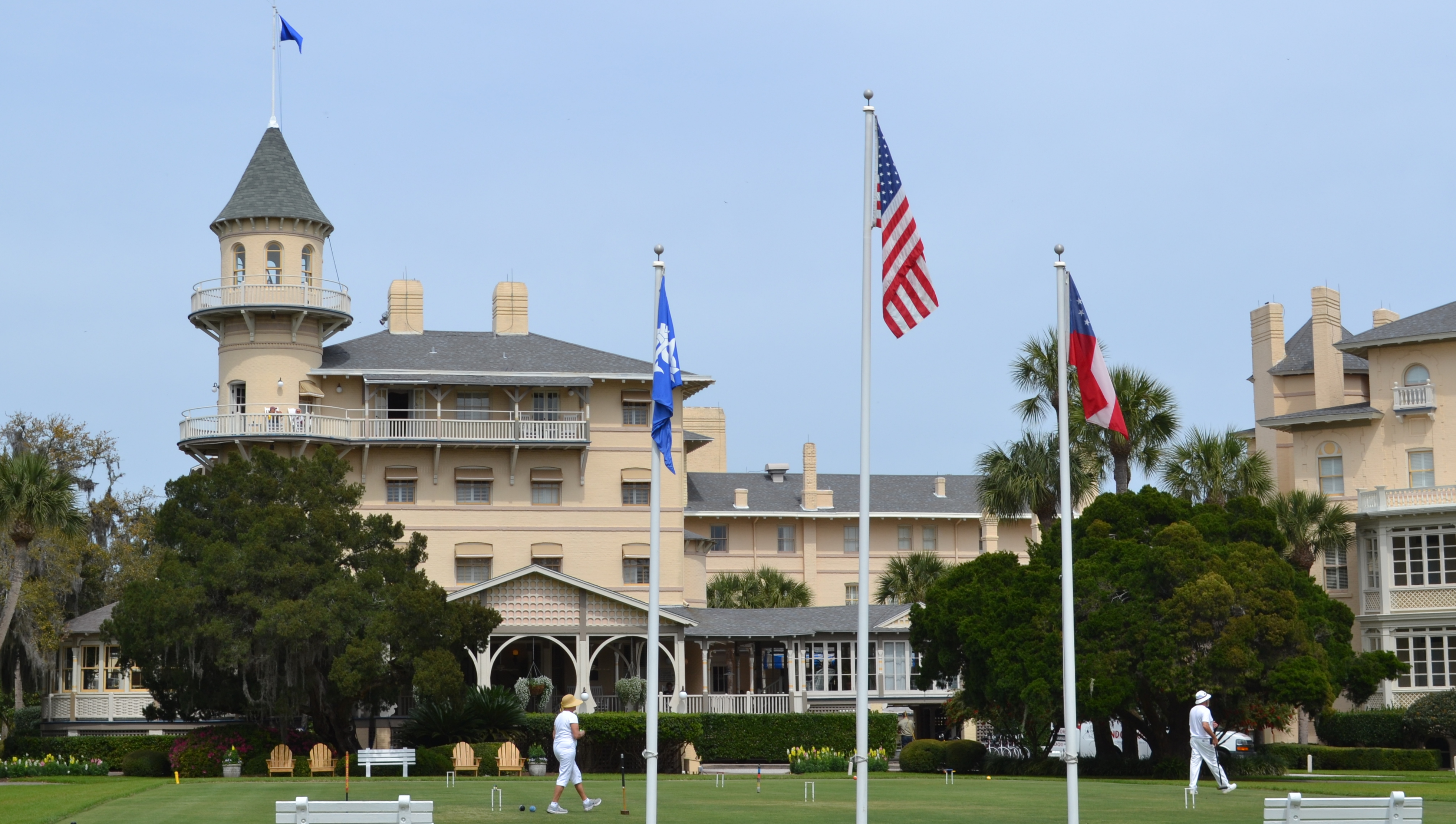
Jekyll Island Club, 2012, by Lewis Powell IV. All rights reserved.
Almost from the moment the club opened its doors, tales of ghosts were being told. The president of the club, Lloyd Aspinwall, died during the club’s construction, but some in the crowd spotted him stiffly gliding through the crowd in his usual military manner. He has also been encountered on the Riverfront Veranda of the club. In the annex of the clubhouse, a three-story apartment building called Sans Souci (“without care”), the apparition of Samuel Spenser, former head of the Southern Railroad Company, has been reported, still reading his morning paper. The shade of a former bellhop still knocks on doors requesting laundry.
Sources
de Bellis, Ken. National Register of Historic Places Nomination Form for the Jekyll Island Historic District. Listed 20 January 1972.
Turnage, Sheila. Haunted Inns of the Southeast. Winton-Salem, NC: John F. Blair, 2001.
The Brown Hotel 335 West Broadway Louisville, Kentucky
A sculpted likeness of businessman James Graham Brown stands on the sidewalk just outside the magnificent 16-story hotel he built at the corner of Fourth and Broadway. At his feet sits his little canine friend, Woozem, who, as the story goes, Mr. Brown rescued from a circus that had recently cut the dog’s act. The dog and Mr. Brown lived in the lap of luxury there until the end of their days, perhaps they remain.
Brown Hotel, 2005, by Derek Cashman. Courtesy of Wikipedia.
Opening in 1923, the Brown Hotel provided four-star accommodations to the citizens of Louisville for a number of decades. The famous Hot Brown was developed in the hotel’s restaurant. The hotel operated until 1971, just two years after the death of James Brown, when it closed its doors. The grand dame held offices for the public school system and when the downtown began a resurgence in the late 1980s, the hotel was renovated and restored to its former glory.
The fifteenth floor of the hotel is currently an unimproved storage space for the hotel and seems to be the center of spiritual activity. It’s believed that it was on this floor that Mr. Brown has his suite and perhaps his spirit still roams the floor. The elevator is often called to this floor by an unseen presence. Two employees reported going up to the floor and as they exited they noticed a third set of footprints in the plaster dust on the floor. A guest who had stayed on the fourteenth floor complained of hearing heavy footsteps and furniture moving all night. Perhaps Mr. Brown and Woozem are just making themselves comfortable.
Sources
Brown, Alan. Haunted Kentucky: Ghosts and Strange Phenomena of the Bluegrass State. Mechanicsburg, PA: Stackpole, 2009.
Parker, Robert W. Haunted Louisville: History and Hauntings from The Derby City. Decatur, IL: Whitechapel Press, 2007.
Bourbon Orleans Hotel 717 Orleans Street New Orleans, Louisiana
Located just behind St. Louis Cathedral and running along the partier’s paradise of Bourbon Street is the grand Bourbon Orleans Hotel. On my first visit to New Orleans, my family stayed in this marvelous hotel. While we didn’t encounter anything paranormal, I remember spending a few wonderful hours sitting on the balcony watching the crowd below on Bourbon Street.
This graceful building was first opened as the Orleans Ballroom in 1817. It was host to the famous Quadroon Balls, balls where mixed race women (a “Quadroon” was someone whose ancestry was 1/4 of African descent) were introduced to wealthy white men. While these people could not legally marry, the system of plaçage provided these men with mistresses or concubines whom the men would support and provide for. By 1881, the building, with the adjoining Orleans Theatre, had begun to fall into ruin and the buildings were taken over by the Sisters of the Holy Family for use as an orphanage, school and convent. This convent, according to Sheila Turnage, was the first convent for African-Americans in the nation. After some 83 years as a convent, the building was converted into a hotel to serve the booming New Orleans tourist trade.
During my stay, I recall reading or hearing a story from the renovation of the building (though I cannot source it). A worker in the building hurt himself and uttered a vulgarity when an unseen hand slapped him across the face. Certainly, the spirits of nuns and the children that they tended have lingered in this building. Guests often encounter the spirits of children throughout the building. But also, the spirits from the structure’s wilder days as a ballroom do appear as well. Dancing couples have been seen in the ballroom and frock-coated gentlemen are sometimes reported in the men’s restroom off the lobby (once a room for playing poker).
Sources
“History.” com. Accessed 30 October 2010.
Turnage, Sheila. Haunted Inns of the Southeast. Winton-Salem, NC: John F. Blair, 2001.
Lord Baltimore Hotel 20 West Baltimore Street Baltimore, Maryland
Blogger Lon Strickler of the blog, Phantoms and Monsters, wrote about a visit to the Lord Baltimore Hotel in 1980. Sitting with a friend in the hotel’s lobby, he writes, “I sensed many raw emotions, good and bad…We sat in the lobby over drinks and conversed about our past…but, in the meantime, I was being bombarded by distant sounds of yesteryear. It became so bad that I started to feel claustrophobic and had to make a ‘polite as possible’ excuse to leave.” He has never returned to the hotel.
Authors Melissa Rowell and Amy Lynwander include an account of a hotel employee named Fran in their book, Baltimore Harbor Haunts. In it, Fran describes her personal experiences as well as those of employees working under her. Fran’s account mentions a little girl she encountered on the nineteenth floor. The girl ran past an open doorway and when Fran ran after her, she found the hallway deserted. She turned and saw a couple in formal attire walking towards her. Asking if the little girl belonged to them, she turned towards the direction of the now missing child. Fran turned back to the couple and discovered they had disappeared as well.
Lord Baltimore Hotel in a 1942 postcard.
Evidently, Fran is not the only person to witness the apparition of a little girl as a guest was awakened to find a young girl in her room crying. When approached, the girl vanished. One of Fran’s coworkers encountered three or four spirits standing in the hotel’s darkened ballroom. When she turned on the lights, all figures were gone.
Certainly, the Lord Baltimore Hotel could be haunted. Built in 1928, the hotel was the largest in the state of Maryland. As one of the tallest buildings in the area at the time, the hotel attracted jumpers after great stock market crash of 1929. Another writer and psychic, Paul Schroeder, had some possible interactions with some of these vestiges of suicides past when he stayed at the hotel. Entering a suite on the 18th floor, he encountered “the reek near the window overlooking the corner was of death and suicide.” After deeming the room unsatisfactory, Schroeder was given another suite where he had “persistent and intermittent visions of a young girl emotionally bereft screaming a face of frozen horror.” He was later told, by the staff, that a young woman had committed suicide on that floor which was believed to be behind much of the paranormal activity on that floor of the hotel.
Anchuca 1010 First East Street Vicksburg, Mississippi
One guest at Anchuca remarked to the owners that she couldn’t stay in the house because it was too emotional. Indeed, Anchuca’s history is marked with periods of intense emotional turmoil. The house has seen the deaths of some of its past owners, members of their families and then soldiers who came through the home’s doors wounded and ill during the Civil War. Some of them most surely died here as well. Throw in Joe Davis, the brother of Confederate President Jefferson Davis, and you have quite the contingent of spirits roaming the halls of Anchuca.
A 1936 photo of Anchuca taken for the Historic American Buildings Survey by James Butters. Courtesy of the Library of Congress, Prints and Photographs Division.
With a name derived from a Choctaw word meaning “happy home,” Anchuca has hosted a number of families during its long history. It was originally constructed in 1830 for politician J. W. Mauldin and was sold to merchant Victor Wilson some years later. Wilson added the Greek revival portico to the house and he and his wife lived here through the tumult of the Siege of Vicksburg when the house served as a hospital. After the war, the home was owned by Joseph Davis who died here in 1870. The house was then purchased by the Hennessy family.
Portraits believed to be Mr. and Mrs. Hennessy grace the wall above the sideboard and with their portraits hang a tale. Some years ago, one of Anchuca’s owners discovered water leaking from the dining room ceiling. He rushed upstairs to the bathroom above the dining room to find that water is coming from the bathroom ceiling and then making its way into the dining room below. He called in a plumber to check the hot water heater and air conditioning unit that were in the attic above the bathroom. As he was looking for the leak, the plumber plunged his hand into the insulation and pulled out these two portraits. The plumber did not find any dampness to suggest a leak and the leaking water mysteriously subsided. Perhaps Mr. and Mrs. Hennessy wished to have their portraits restored to a rightful place within their former home?
Besides mysterious water leaks, the spirits of Anchuca also do a bit of redecorating on occasion. Just after purchasing the house, a friend of one of the owners witnessed a spirited display of displeasure. The owner had hung three South American masks on the wall of his quarters. A friend of his watched one afternoon as one of the masks lifted itself off the wall, hung for a moment in midair and then dropped to the floor. The friend fled in fear. The owner picked up the mask and hung it in its spot on the wall and asked the spirits to leave it alone. The masks have not been cast to floor since. The owners, staff and guests have also encountered a female spirit throughout the house.
Sources
Brown, Alan. Haunted Vicksburg. Charleston, SC: History Press, 2010.
Miller, Mary Warren. National Register of Historic Places nomination form for Anchuca. 25 February 1981.
Sillery, Barbara. The Haunting of Mississippi. Gretna, LA: Pelican, 2011.
Turnage, Sheila. Haunted Inns of the Southeast. Winton-Salem, NC: John F. Blair, 2001.
Grand Old Lady Inn (formerly Balsam Mountain Inn) 68 Seven Springs Drive Balsam, North Carolina
Balsam Mountain Inn, 2012, by Lewis Powell IV. All rights reserved.
Passengers departing from their trains in Balsam, North Carolina just after the turn of the century were met with an inviting and palatial hotel overlooking the station. They would enjoy the cool mountain air from the double porch with views of the town below. Though the train no longer brings them, visitors today can enjoy the same air and views and, if they stay in room 205, perhaps a nice back rub from a spirit. One guest staying in this room with her husband had a bad back and was awaken by a back rub from him, until she realized he was sound to sleep next to her. The unidentified ghost on the second floor of this hotel which opened in 1908 also rattles doorknobs of rooms on that floor.
Sources
Bordsen, John. “Room with a Boo.” The Charlotte Observer. 25 October 2009.
Kermeen, Frances. Ghostly Encounters: True Stories of American’s Haunted Inns and Hotels. NYC: Warner Books, 2002.
Turnage, Sheila. Haunted Inns of the Southeast. Winton-Salem, NC: John F. Blair, 2001.
20 South Battery (formerly Battery Carriage House Inn) 20 South Battery Charleston, South Carolina
Sign for the Battery Carriage House Inn, 2011, by Lewis Powell, IV. All rights reserved.
Located at the Southern tip of the city of Charleston overlooking the meeting point of the Cooper, Stono, Wando and the Ashley Rivers is The Battery, one of Charleston’s “best” neighborhoods. It was at The Battery where many of the city’s and state’s best families built grand homes. From the rooftops of these grand homes and White Point Gardens fronting Charleston Harbor that citizens, including the diarist Mary Chestnut watched as the Confederacy laid siege to Fort Sumter in Charleston Harbor. Number 20 South Battery is home to the Battery Carriage House Inn, possibly one of the more spiritually active locations in the city.
A few of the Battery Carriage House Inn’s eleven sumptuous guest rooms are apparently haunted. A couple staying in room 3 were awakened by noise from a cellphone; while this may be quite common, phones are not supposed to make noise when powered off as this phone was. But this activity seems minor compared to the reports from rooms 8 and 10. Guests staying in Room 8 have encountered the apparition of a man’s torso. There is no head or limbs, just a torso dressed in a few layers of clothing. One guest sensed that this figure was quite negative. The spirit in Room 10 is much more pleasant and even described as a gentleman. The innkeepers believe this may be the spirit of the son of a former owner who committed suicide.
Sources
“Ghost Sightings.” com. Accessed 31 October 2010.
Kermeen, Frances. Ghostly Encounters: True Stories of American’s Haunted Inns and Hotels. NYC: Warner Books, 2002.
Spar, Mindy. “Local haunts among treats for Halloween.” The Post and Courier. 26 Otcober 2002.
Turnage, Sheila. Haunted Inns of the Southeast. Winton-Salem, NC: John F. Blair, 2001.
The Union Station Nashville Yards 1001 Broadway Nashville, Tennessee
Ghosts are associated with certain types of stone, primarily granite and limestone, water and also iron. The iron rails of railroads that have stretched around the globe have given rise to many ghostly legends associated with railroads. Nashville’s Union Station, first opened in 1900, while no longer hosting the iron rails or even the old train shed, still hosts a few ghosts associated with the railroad. Legend has it that on nights of the full moon, a ghostly train still pulls into the station, while that legend may be a bit ridiculous, staff and guests of the hotel have reported hearing the scream of a steam whistle at times; perhaps a residual noise.
Union Station Hotel, 2008, by The Peep Holes. Courtesy of Wikipedia.
During World War II, Union Station was the point of departure for tens of thousands of troops departing for battlefronts around the world. Two spirits remain from this period. One is the revenant of a young soldier who stands near the tracks seemingly waiting for something. The other is the spirit of a young woman who legend states was killed when she fell onto the tracks in front of a train. With the demolition of the train shed, it is unknown if these spirits are still active.
In the second half of the twentieth century, the grand station saw fewer and fewer passengers as the automobile became the dominant mode of transportation in America. The last train departed the station in 1978 and the station closed its door only to be reopened as a luxury hotel some years later. A more recent legend tells of a middle-aged couple that would meet at the hotel on a weekend once a month. By all accounts, the man appeared to be married, but perhaps not the woman. The lovers would spend the entire weekend in their room but one month, the man did not show up. The woman, in distress, spent the weekend in her room and was later discovered dead with a revolver at her feet. Her room, 711, has seen a good deal of activity, with one guest reporting her bag, which she had unpacked, had been repacked upon while she had stepped into the bathroom. Activity seems to revolve around this room with the spirit of young woman being encountered in the hall outside this room and in surrounding rooms as well.
Sources
Harris, Frankie and Kim Meredith. Haunted Nashville. Atglen, PA: Schiffer, 2009.
Kermeen, Frances. Ghostly Encounters: True Stories of American’s Haunted Inns and Hotels. NYC: Warner Books, 2002.
Traylor, Ken and Delas M. House, Jr. Nashville Ghosts and Legends. Charleston, SC: History Press, 2007.
Turnage, Sheila. Haunted Inns of the Southeast. Winton-Salem, NC: John F. Blair, 2001.
The Martha Washington Inn & Spa 150 West Main Street Abingdon, Virginia
War changes many things and the Civil War certainly changed Martha Washington College. The young girls that had studied and gossiped in the college’s rooms became nurses for the wounded young soldiers brought from battlefields far and near and some of those rooms housed able young men who were training on the grounds. Like so many buildings that served as hospitals during the Civil War, the pain and death left its mark upon the college. A number of soldiers still are rumored to walk the halls and occasionally shock guests and staff alike. In addition a ghostly horse, still looking for its long-dead master, still walks the grounds outside.
Martha Washington Inn, 2006, by RebalAt. Courtesy of Wikipedia.
Built as a private residence, General Francis Preston’s 1832 home became an upscale women’s college in 1858. The Great Depression’s punch to the nation led to the school’s closure in 1932 and “The Martha” was later reopened as an inn. The inn is now a part of The Camberley Collection, a group of fine, historic properties.
Sources
Hauck, Dennis William. Haunted Places: The National Directory. NYC: Penguin, 2002.
“History.” The Martha Washington Hotel and Spa. Accessed 10 March 2011.
Kermeen, Frances. Ghostly Encounters: True Stories of America’s Haunted Inns and Hotels. NYC: Warner Books, 2002.
Lee, Marguerite DuPont. Virginia Ghosts, Revised Edition. Berryville, VA: Virginia Book Company, 1966.
Rosenberg, Madelyn. “History and Legend Abound at Abingdon’s Martha Washington Inn.” The Roanoke Times. 31 July 1999.
Taylor, L. B., Jr. The Ghosts of Virginia. Progress Printing, 1993.
Turnage, Sheila. Haunted Inns of the Southeast. Winston-Salem, NC: John F. Blair, 2001.
Varhola, Michael J. Ghosthunting Virginia. Cincinnati, OH, Clerisy Press, 2008.
Lowe Hotel 401 Main Street Point Pleasant, West Virginia
N.B. This article was originally published September 24, 2013, as a newsworthy haunt.
Paranormal events rarely resonate so much within a community or even on a national scale as the sightings of the Mothman have. A series of sightings of this creature occurred between November of 1966 and December of 1967; events that inspired a handful of books, a movie and, for over a decade, a festival in Point Pleasant.
Postcard of the Lowe Hotel circa 1930-45. Courtesy of the Boston Public Library.
The annual festival has certainly boosted “paranormal tourism” in Point Pleasant and one of the more popular paranormal spots in the city is the Lowe Hotel. During the festival tours will be lead through this haunted, turn of the 20th century hotel. According to an article from the Point Pleasant Register, the current owners of the hotel were initially bothered by the idea that their hotel might be haunted, though as attitudes towards the paranormal have changed, the haunting has become an attraction to tourists.
Theresa Racer, of the blog, Theresa’s Haunted History of the Tri-State, presents the best history of the hotel to be found online. The hotel was opened as the Hotel Spencer in the nascent years of the 20th century. The four-story hotel was popular with riverboat traffic operating on the Kanawha and Ohio Rivers which meet at Point Pleasant. The hotel was purchased by Homer Lowe in 1929 who renamed it the Lowe Hotel. It operated until the late 1980s when the owner put it up for sale. The current owners purchased the hotel in 1990.
According to Racer, there is a large contingent of spirits within the hotel. The spirit of a beautiful, but disheveled woman has been reported on the mezzanine between the first and second floors. This section houses the dining room and it is here that the spirit is seen dancing to music that only she can hear. On the second floor, a tyke on a tricycle has been seen prowling the halls. Sometimes the sound of a little girl’s laughter will accompany the sound of a squeaky tricycle.
The third floor seems to be the most active with a few of the rooms there being haunted. One of the most remarkable stories involves the suite at 316. A female staying in this suite entered the room one evening to find a man standing by the window looking out. She asked him who he was and he replied that he was Captain Jim and he was waiting on a boat. After noticing the man did not have legs, the woman fled.
Two chairs on the fourth floor seem to have activity surrounding them. The recent article mentions a wheelchair on that apparently moved on its own volition. The chair vanished for about three years only to reappear out of the blue. Racer reports that an old rocking chair in a storage room on that floor is supposed to rock on its own.
In celebration of Halloween, I’m exploring 13 haunted restaurants throughout the South. This article has two companion pieces exploring haunted hotels, inns, and bed & breakfasts: “13 Southern Rooms with a Boo” and “13 More Southern Rooms with a Boo.”
Trowbridge’s Ice Cream Bar 316 North Court Street Florence, Alabama
Walking into Trowbridge’s, one can certainly get a sense of stepping back in time. With a checkerboard floor, mint green upholstery and food prepared using original recipes; the restaurant seems to be a holdover from the first half of the 20th century. But there is something else at Trowbridge’s that hearkens back to an earlier time: a spirit from the Civil War.
Trowbridge’s opened in 1918 primarily selling ice cream and eventually serving sandwiches and hot dogs at its lunch counter. The site where Trowbridge’s would eventually stand was originally occupied the home of the Stewart family. During the Civil War, Charles Daniel Stewart left his family’s home carrying the Confederate banner for the Florence Battalion. It was that same flag that Stewart was bearing when he was wounded during the First Battle of Manassas, one of the first serious engagements of the Civil War.
The young standard bearer lived for almost a month after being wounded in the battle. Restaurant staff members in the building that now occupies the site of his home have seen a young man within the restaurant. He’s most often seen briefly in passing but when the viewer turns he has vanished. Perhaps Stewart’s spirit just enjoys the shakes.
Sources
Johnston, Debra. Skeletons in the Closet: True Ghost Stories of the Shoals Area. Debra Johnston, 2002.
Wok and Roll Chinese and Japanese Restaurant 604 H Street, NW Washington, DC
While Charles Daniel Stewart may have to develop a taste for milkshakes and hot dogs, the spirits of Mary Surratt and the conspirators involved in the assassination of Abraham Lincoln may have to develop a taste for General Tso’s Chicken and sushi. Wok and Roll Chinese and Japanese Restaurant is housed in the building that once housed Mrs. Surratt’s Boarding House where the conspirators met in the days leading up to Lincoln’s fateful night at Ford’s Theatre. Legends tell of spirits still flitting through the historic structure.
The building was constructed in 1843 as a single-family residence. Mary Surratt’s husband, John, purchased the property in 1853 and rented the building while he constructed a tavern at a crossroads in nearby Prince George’s County, Maryland. He was later named postmaster of the community that formed around his family’s tavern. After the outbreak of war, John Surratt passed away leaving his wife and family in somewhat dire financial straits. John’s son, John Junior was named postmaster in his father’s place, but he was arrested about two years later for working as a mail courier for the Confederacy with whom he sympathized.
The Surratt Boarding House, 1890, by Matthew Brady.
After the arrest of her son and being deprived of his income as a postmaster, Mary Surratt moved her family to their Washington home while she rented the family’s Maryland tavern. The family began taking on boarders and was drawn into the conspiracy to kidnap the president. To what extent Mary Surratt was involved is still rather unclear, but in the roundup that followed John Wilkes Booth’s shooting of Lincoln at Ford’s Theatre, Mary was arrested and charged in the conspiracy. She was tried before a military tribunal and subsequently found guilty.
Even after she was found guilty, many requested that she be pardoned including her daughter, Anna. Mary Surratt was executed on the hot summer afternoon of July 7, 1865, along with three of the conspirators; the first woman executed by the Federal Government. After her execution, Mary Surratt’s Boarding House was attacked by a mob which began to strip the building for souvenirs before they were stopped by police.
Wok & Roll Restaurant now occupies the old Surratt Boarding House. Photo 2008, by Leoboudv. Courtesy of Wikipedia.
Anna Surratt sold her mother’s boarding house not long after the execution and subsequent owners reported that they encountered “muffled sounds,” whispers and sobs. When John Alexander was putting together the 1998 edition of his book on Washington ghosts, he met with the owner of the Chinese grocery that existed in the building at that time. The Chinese grocer replied that he “had no complaints.”
Sources
Alexander, John. Ghosts, Washington Revisited: The Ghostlore of the Nation’s Capitol. Atglen, PA: Schiffer, 1998.
Mary Surratt. Wikipedia, the Free Encyclopedia. Accessed 4 November 2014.
Pousson, Eli. National Register of Historic Places nomination form for the Mary E. Surratt Boarding House. May 2009
Ashley’s of Rockledge 1609 US 1 Rockledge, Florida
Some believe that Ethel Allen’s rough road to her grave included a stop at Jack’s Tavern, her favorite local hangout. Last year, I wrote about paranormal investigators conducting an EVP session at Ms. Allen’s grave in the Crooked Mile or Georgiana Cemetery on Merritt Island. After asking if she was present, investigators received a reply, “yes.”
On November 21, 1934, Ethel Allen’s mutilated body was found on the banks of the Indian River in Eau Gallie, some 16 miles away. The nineteen year old had been seen just a few days before when she stopped at a local packing house to say goodbye to a friend. Ethel was leaving to visit her mother, accompanied by a male acquaintance and she may have also stopped by her favorite local hangout, Jack’s Tavern, now Ashley’s of Rockledge. The Tudor-style restaurant has paranormal activity, some of which has been attributed to Ethel Allen.
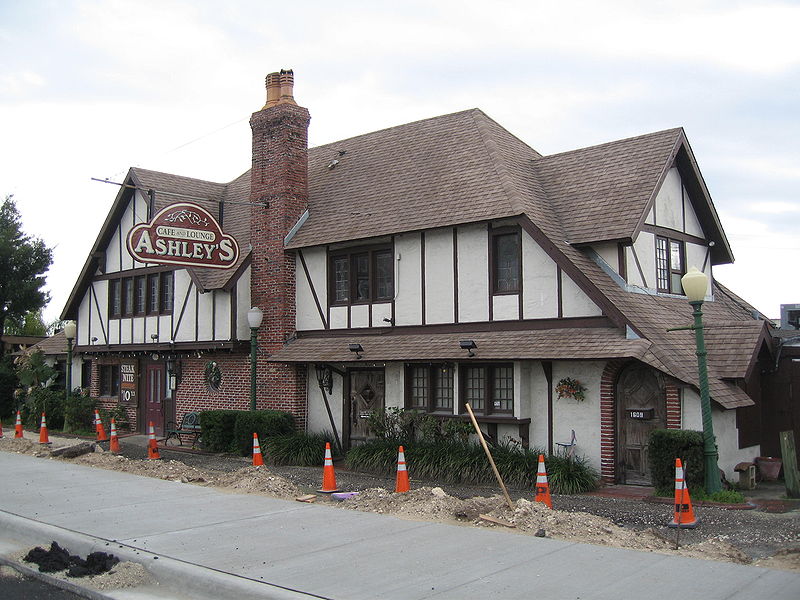
Ashley’s, 2010, by Leonard J. DeFrancisci. Courtesy of Wikipedia.
A variety of sources state that Ethel may have been murdered within the walls of the restaurant in a storeroom (possibly near the famously haunted ladies restroom) or just outside the building. A local genealogy blog makes no mention of where Ethel may have met her end, but I get the feeling it probably was not in or around the busy tavern. The stories of the restaurant’s haunting are quite readily available though they seem to sometimes perpetuate different variations of the murder.
The activity runs the gamut from simple, cold breezes being felt to voices and screams to full apparitions being seen and captured on film. Some sources also note that the activity does not seem to be limited to just the possible shade of Ethel Allen. There are other possible spirits including a child and an adult male. It does seem that Ashley’s may be one of the most paranormally active restaurants in the state.
Walls, Kathleen. Finding Florida Phantoms. Global Authors Publications, 2004.
Tondee’s Tavern 7 East Bay Street Savannah, Georgia
With the immense host of spirits that inhabit the city of Savannah, chances are high that activity may be found most anywhere. Occupying part of a mid-19th century bank building, Tondee’s Tavern utilizes the name of a important colonial era tavern that existed in the city. The building’s history dates to 1853 when its lower floors were occupied by the Central Railway and Banking Company. The upper floors of the building were used as offices for a slave dealer, Joseph Bryan.
Stories of spirits within the building have evidently existed for some time, but the spirits made themselves very well-known recently. In late June of this year, a passerby on the street left a cigarette in a flower box in front of the building. The cigarette smoldered for a few hours before erupting into flames early in the morning. Meanwhile, two employees slept downstairs; a fairly common practice when employees close the previous night and must open the next day.
A closed-circuit security camera picked up the scene at the front of the restaurant. Over the course of two hours, as the flames can be seen building outside the window, a number of white orbs are seen almost frantically zipping through the air. Something woke the two young women asleep in the basement and they were able to begin extinguishing the flames before they could do more damage. The tavern’s owner, however, is still wondering if the orbs were spirits trying to save the building and his business.
Jailhouse Pizza 125 Main Street Brandenburg, Kentucky
In a fairly creative use of a historic building, the old Meade County Jail is now a pizzeria. Built in 1906 by the Pauly Jail Company, this building was the third jail built for Meade County. The pizzeria’s website states that some of the inmates have apparently never left, including one who has been dubbed, “Bigsby.” These spirits have been both seen and heard.
Old Meade County Jail, 2011, by Nyttend. Courtesy of Wikipedia.
A recent investigation by the Hopkins County Paranormal Society was able to capture, what one investigator calls, “the best evidence ever.” Video taken during the investigation shows a blanket being pulled out and down. Audio evidence was also captured that includes footsteps, a scream and possibly a female child.
Sources
“History.” Jailhouse Pizza. Accessed 31 October 2014.
Johnson, William G. Kentucky Historic Resources Inventory form for Meade County Jail. Summer 1983.
Landon, Heather. “Best Creepy Historic Sites in the US.” The Daily Meal. 14 October 2014.
Antoine’s 713 St. Louis Street New Orleans, Louisiana
Antoine’s, 2007 by Infrogmation. Courtesy of Wikipedia.
Antoine Alciatore, like so many Europeans at that time, dreamed of making it big in the United States and immigrated in 1838 to make good on those dreams. After a couple years of struggling in New York City, he set his sights on that most French of cities, New Orleans and this is where he opened Antoine’s. In 1868, the restaurant moved to its current location that now boasts 14 unique dining rooms. Alciatore left New Orleans in 1874 bound for Marseilles where he died; his beloved restaurant was left in the hands of his son and his family has continued to own and run the restaurant. Antoine continues to return to check up on this famed New Orleans institution and he continues to be seen in the Japanese and Mystery Dining Rooms. Other specters in 19th century clothing have been seen peering from the mirrors in the washrooms as well.
Sources
Dwyer, Jeff. Ghost Hunter’s Guide to New Orleans. Gretna, LA: Pelican, 2007.
Antoine’s Restaurant. Accessed 8 January 2011.
Puccini Restaurant 12901 Ali Ghan Road, NE Cumberland, Maryland
At Puccini, patrons may get a bit of the paranormal with their pasta. With your fettuccini, you may hear disembodied footsteps or perhaps there may be some voices heard as you enjoy your vino. Don’t mind them, they won’t hurt you.
The building now housing Puccini was near fighting on August 1, 1864 as Confederates were defeated in the Battle of Folck’s Mill. Many of the wounded were brought into the George Hinkle house (as it was known at that time) where they were treated. Of course there may also have been a few deaths in the house during that time. Some of those soldiers may have also written or carved their names on the walls in the attic.
Employees of the restaurant as well as guests have reported quite a bit of activity over the years. From footsteps to shadow figures to full apparitions, people in this building have had many experiences. The restaurant was investigated a few years ago by member of the team from City Lights Paranormal Society of Easton, Pennsylvania. The investigators were able to capture a good deal of audio evidence including a number of EVPs.
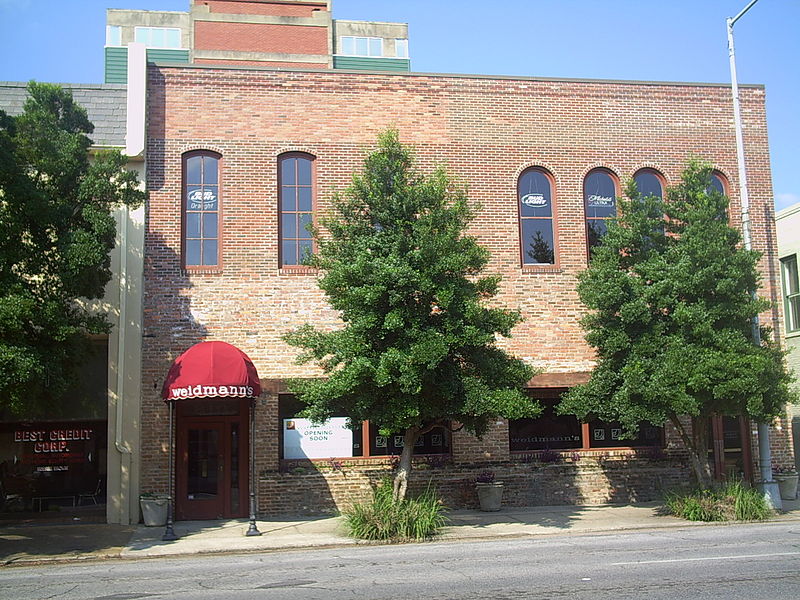
Like Antoine’s in New Orleans, Meridian’s Weidmann’s restaurant was also started by an immigrant and has become a local institution after more than a century. Weidmann’s was opened by Felix Weidmann, a Swiss immigrant. While Antoine’s has remained in the same location, Weidmann’s location changed a number of times before it settled into a location in 1923.
Weidmann’s, 2010, by Dudemanfellabra. Courtesy of Wikipedia.
The haunting of Weidmann’s seems to be mostly residual activity. Sounds echo through the restaurant with no obvious source. For his 2011 book, Haunted Meridian, Mississippi, Alan Brown spoke with one employee who recalls hearing sounds associated with livestock near the restaurant’s freezers where livestock may have been kept before Weidmann’s moved in. But animal sounds are just a small part of the repertoire associated with the spirits of Weidmann’s.
At table one, a legend is oft told of a young couple visiting the restaurant during the Great Depression. The couple had recently become engaged and had enough money to treat themselves to a meal in the restaurant. Henry Weidmann, the restaurant’s owner at the time, picked up the tab and encouraged the couple to return for their first anniversary. The legend continues that the young couple did not return to their table in the restaurant in life, but they have continued to return in death. They are supposed to be seen on occasion sitting quietly at the table holding hands under the table.
Sources
Brown, Alan. Haunted Meridian, Mississippi. Charleston, SC: History Press, 2011.
Four Square Restaurant 2701 Chapel Hill Road Durham, North Carolina
Bartlett Mangum built his house in 1908 on the outskirts of Durham and the house is now the only part of his 80-acre farm that has remained standing. The house remained in the family until Mangum’s daughters were moved to a nursing home in 1956. The house passed through a variety of owners who rented out the house or used it for commercial purposes including a variety of restaurants. During the early 1960s, the house was even used as a racially-integrated church.
The Mangum daughters, Inez and Bessie, inherited the house in 1927 and tradition holds that they did not speak to each other for many years due to a feud. According to an article by Colin Warren-Hicks in the local progressive paper, Indy Week, restaurant staff believes that the spirit of Inez Mangum still flits about her old house. Cooks in the kitchen reported to Warren-Hicks that pots and pans would move on its own accord. Dinner and glassware left on a certain mantelpiece in one of the restaurant’s dining rooms would often be inexplicably knocked to the floor.
UPDATE 4/23/2018: Four Square has closed.
Sources
Dickinson, Patricia S. National Register of Historic Places nomination form for Bartlett Mangum House. 5 December 1988.
Warren-Hicks, Colin. “The Devil went down to Four Square Restaurant.” Indy Week. 22 October 2014.
Connolly’s Irish Pub 24 East Court Square Greenville, South Carolina
This unassuming Irish pub in downtown Greenville, South Carolina is a front for a secret. Just outside the pub and behind the street door that provides access to this old commercial building’s second floor is an unused floor that is supposed to have served as a brothel some years ago. A recent investigation of this building by local investigator and ghost tour operator Jason Profit produced video of small orbs of light flitting through the corridor.
It’s my sincerest hope that the victims of the horrible event that happened here in 1997 are at rest; they most certainly deserve to be. On March 23, 1997, Paul Dennis Reid forced his way into this McDonald’s at closing time. After shooting three of the employees, he stabbed a fourth employee seventeen times before leaving with the restaurant’s money. The three shooting victims died while the stabbing victim survived. Just a month before, Reid had robbed a nearby Captain D’s brutally shooting and killing two employees. Before he was captured by the police, he managed to kill a total of seven people, all fast food employees. Reid passed quietly in prison just last year.
According to the Nashville Haunted Handbook, published in 2011, this restaurant has been plagued by a general sense of unease as well as shadow figures. After viewing this location on Google Streetview, it appears that this McDonald’s location may have a new building—the chain has been tearing down older restaurants and replacing them with new buildings. Though, since the building has been replaced, it is unknown whether this activity has persisted.
Sources
“2 Slain at Nashville McDonald’s.” Chicago Tribune. 24 March 1997.
Morris, Jeff; Donna Marsh and Garett Merk. Nashville Haunted Handbook. Cincinnati, OH: Clerisy Press, 2011.
Wilson, Brian. “Tennessee mass murderer Paul Dennis Reid dead.” 1 November 2013.
Coffee Pot 2902 Brambleton Avenue, SW (US 221) Roanoke, Virginia
Just who or what is causing the odd activity at Roanoke’s landmark roadhouse, The Coffee Pot, is still a question. Primarily, the activity generally involves the movement of objects. One bartender was cleaning ashtrays and stacking them on the bar one evening after the restaurant had closed. They had already stacked a number of ashtrays when they witnessed the stack rise into the air and then drop back down on the bar. Startled, she returned to work only to have the stack of ashtrays rise and fall again. After that, she grabbed her things and left.
The Coffee Pot, 2009, by Patriarca12. Courtesy of Wikipedia.
A manager noted that spices would often disappear from their accustomed spot only to reappear in a very different location sometimes days later. Bottles of wine and other cooking utensils have been known to fly across rooms, while paranormal investigators have been able to photograph orbs and have captured EVPs within the restaurant.
The Coffee Pot, with its distinctive large coffee pot, was constructed in 1936 along what had been a fairly rural road. Over time, US 221 has grown along with the restaurant’s business. As a roadhouse, the restaurant has become known for its musical entertainment including Willie Nelson who played an impromptu concert at the restaurant in 1970s.
Sources
Hill, Helen. National Register of Historic Places nomination form for The Coffee Pot. December 1995.
Hurst, Chris. “Looking for ghosts at The Coffee Pot in Roanoke.” 24 October 2010.
Taylor, L. B. Jr. Haunted Roanoke. Charleston, SC: History Press, 2013.
Yellow Bank Restaurant 201 East German Street Shepherdstown, West Virginia
In the historic town of Shepherdstown, the 1906 Jefferson Security Bank now houses the Yellow Bank Restaurant. The bank was converted to a restaurant some years ago and now houses the restaurant where table 25 was the scene of some activity in the 1990s when a patron reported to the restaurant’s manager that she couldn’t sit at the table because of the ghost. The bartender also reported that he had glasses fall from the glass rack and break.
UPDATE 4/23/2018: Yellow Bank Restaurant has closed.
Sources
Molenda, Rachel. “Town serves as home to ghosts from past.” The Shepherdstown Chronicle. 28 October 2011.
N.B. This article was revised and expanded 7 March 2019.
In time for Halloween, two Tennessee locations–Ruby Falls and Bolivar’s Magnolia Manor (see my article “13 More Southern Rooms with a Boo“)–have announced that they’ve been declared certifiably haunted after being investigated by paranormal investigators.
Ruby Falls 1720 South Scenic Highway Chattanooga
If you’ve spent any time driving within 100 miles of Ruby Falls, you will recognize this name. Along with Rock City—located just up the mountain—Ruby Falls has engaged in an extensive advertising campaign for decades along roadsides, on barn roofs, and in hotel lobby brochure racks throughout the Deep South. Their advertising campaigns have made both attractions synonymous with tourism throughout the region.
Ruby Falls Visitors’ Center. Photo 2006, by Oydman, courtesy of Wikipedia.
Ruby Falls—not to be confused with Anna Ruby Falls in Unicoi State Park in North Georgia—is a cave in Lookout Mountain that ends with a marvelous waterfall. The cave is accessible via elevator from a castle-like visitors’ center above. Earlier this month, paranormal investigators searched for evidence of the paranormal both in the visitors’ center and in the cave itself. After looking at the evidence, Stones River Paranormal determined that there are spirits in the location.
Ruby Falls Cave is actually part of a larger cave system: the Lookout Mountain Caverns. Lookout Mountain Cave was known for centuries by Native Americans in the area as well as early settlers and it was also heavily utilized during the Civil War. Sadly, the natural entrance to the cave was closed off when a railroad tunnel was constructed in the area. In the 1920s, a chemist and amateur spelunker, Leo Lambert, created the Lookout Mountain Cave Company to reopen the cave as a commercial venture. As workers were drilling an elevator shaft into Lookout Mountain Cave, a smaller cave was discovered above. Wriggling into the small cave, Lambert explored the passages and admired the cave’s intricate formations ultimately finding the falls at the end of the cave which he named for his wife, Ruby.
The titular waterfall in Ruby Falls Cave. Photo 2009, by Jtesla, courtesy of Wikipedia.
Both caves were opened as commercial, “show” caves, but Ruby Falls Cave became much more popular. Tours were eventually ended to Lookout Mountain Cave and over time, lighting and music have been added to “enhance” the cave experience there.
Stones River Paranormal discovered the presence of at least five spirits in the cave and its visitors’ center. Leo Lambert and his wife, Ruby, as well as the spirit of a security guard who died after falling down an elevator shaft were named as possible spirits within the facility. Oddly, the spirits of several children may also be haunting the visitors’ center.
A couple years ago, I corresponded with Amy Petulla, co-author with Jessica Penot, of Haunted Chattanooga (which I reviewed here), and owner of the Chattanooga Ghost Tour. She provided me with a bit more information on the spirits at Ruby Falls:
The security guide that died there has a couple of ways of making his presence known. They say that his spirit is accompanied by the smell of sugar cookies, which his wife used to pack in his lunch every day. He is also a bit of a prankster and is fond of unscrewing the light bulb in a particular section of the cave.
I had a previous guide tell me that while he and his girlfriend were enjoying the fake haunted house that Ruby Falls puts on in October, something invisible grabbed his girlfriend’s glowstick necklace and yanked it up towards her head. There was no one close to them at the time. My guess is this was NOT the security guard, but another entity.
Sources
Jenkins, Gary C. “Ruby Falls.” The Tennessee Encyclopedia of History and Culture. 25 December 2009.
Personal Correspondence with Amy Petulla. 15 May 2017.
Phipps, Sean. “Ruby Falls deemed an official haunted location.” Nooga.com. 29 September 2014.
Ruby Falls. Wikipedia, the Free Encyclopedia. Accessed 30 September 2014.
Tennessee Brewery 495 Tennessee Street Memphis, Tennessee
I covered the Tennessee Brewery about two years ago as part of an article on abandoned and possibly haunted buildings in Memphis. There have been developments with the Sears Crosstown Building as the local arts community has begun using the building for arts functions. The Sterick Building remains closed and for sale as far as I know while the Tennessee Brewery has been scheduled a date with destiny.
The owners of the building have announced that the building will be demolished on August 1st if no one steps forward to purchase the abandoned structure before then. However, innovative plans have recently been hatched to temporarily use the building ahead of the possible demolition in an effort to arouse interest. Six weeks of events, titled “Tennessee Brewery Untapped,” will be held in the building and expected to draw a crowd. Live music will echo through the aging halls of the brewery while beer—the products of local micro-breweries—will be served in a café that will operated in the building. Other events will include food trucks, mobile retail, movie screenings and workshops.
The massive Tennessee Brewery, 2010, by C ammerman. Courtesy of Wikipedia.
With so many people expected to crowd into the massive structure, it will be interesting to see how the spirits react. Laura Cunningham in Haunted Memphis states that the spirits “appear to be angry.” This is assumed from the loud noises that can sometimes cause the building to shake while some investigators have been touched, pinched and pushed.
Interestingly, in a 2012 article for the Memphis Commercial Appeal, Michael Einspanjer, founder of Memphis Paranormal Investigators states that “the spirits stuck in the building just couldn’t let go in life, they aren’t threatening.” The article notes that Einspanjer’s group has investigated the brewery at least 12 times and he states that the building is “a very haunted place.”
In looking through the material on the haunting of the brewery, it is very interesting to note that most sources do not speculate as to why the brewery may be haunted. Spurred on by the articles relating to Tennessee Brewery Untapped, I decided to check Newspapers.com to see what may be found relating to the brewery’s history. Indeed, I came up with a few very interesting leads.
The first event dates to 1888, just before the brewery’s construction. Papers in early August report a massive fire at the brewery that destroyed parts of the brewery as well as adjacent structures. The current structure dates to 1890. No deaths are reported in any of the articles, though a massive fire may have left a spiritual imprint on the site.
The second event dates to 1903 and involves at least one death. On April 15 of that year, Adolph Heinz, a German citizen and employee of the brewery was shot and killed. The article appeared in countless papers, obviously pulled from wire services and does not state exactly where the shooting took place. Reportedly, an African-American man named Gary Morgan asked Heinz to bring him a pail of beer. When Heinz refused, Morgan—“a negro with a picturesque police record”—shot him. The article notes that members of the local German community assembled to hunt down Morgan to lynch him. As of yet, nothing has turned up to reveal if Morgan was apprehended.
A third event was reported by the Associated Press in 1950. Prior to December 17th, an employee at the brewery fell from a stairway at the brewery and was killed when his head struck the floor. Perhaps his spirit is among the spirits remaining in the building.
Tennessee Brewery Untapped is scheduled to begin April 24th and run through June 1st.
Sources
Cunningham, Laura. Haunted Memphis. Charleston: History Press, 2009.
Douglas, Andrew. “Group pushes to save old Tennessee Brewery building.” 31 March 2014.
“FLAMES IN A BREWERY: The Tennessee Brewery at Memphis Badly Damaged—Other Fires Yesterday.” Chicago Daily Tribune. 11 August 1888.
“Killed in fall.” Kingsport Times-News. 17 December 1950.
Meek, Andy. “New Partners Sign On to Tennessee Brewery Effort.” Memphis Daily News. 4 April 2014.
Meek, Andy. “Plans Coming Together for Tennessee Brewery Untapped.” Memphis Daily News. 26 March 2014.
“One of the Kaiser’s Subjects Killed by Memphis Negro.” The Atlanta Constitution. 16 April 1903.
Pickrell, Kayla. “Haunted Memphis: Brewery a piece of history.” The Commercial Appeal. 24 July 2012.
Poe, Ryan. “Tennessee Brewery Untapped gets beer license.” Memphis Business Journal. 2 April 2014.
Engel Stadium 1130 East Third Street Chattanooga, Tennessee
N.B. This article was revised 10 March 2019.
Despite its name—“engel” is German for “angel”—Engel Stadium was not likely built with the spiritual in mind. Though, according to a recent article from the Chattanooga-area news blog, Nooga.com, there may be spiritual activity here.
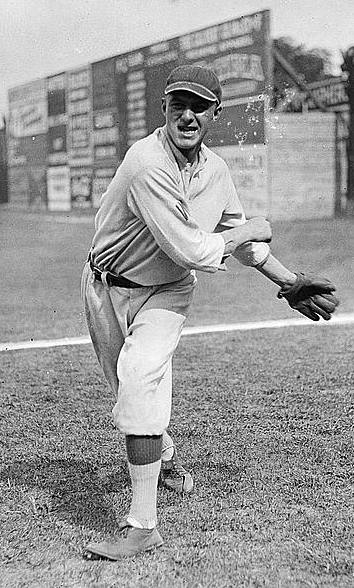
Following a career as a pitcher with the Washington Senators, Joe Engel worked as a promoter for the Chattanooga Lookouts. Photo courtesy of the Library of Congress, Prints and Photographs Division.
In the context of baseball stadiums throughout the country, Engel Stadium could be considered hallowed ground. This stadium has heard the crack from the holy bats of baseball saints such as Babe Ruth, Lou Gehrig, Satchel Paige, and Willie Mays. It bears the name of Washington Senators pitcher, Joe Engel. Engel served as a recruiter and promoter following his Senators career and took over the Chattanooga Lookouts after it was purchased by the Senators’ owner, Clark Griffith.
Engel immediately embarked on a plan to build one of the finest minor league ballparks in the country. Ground was broken for Engel Stadium in 1929 and the 12,000-seat park opened the next year. Engel’s zealous and raucous promotion of the park led to his being nicknamed “the Barnum of Baseball.” He would remain with the Lookouts for 34 years.
The stadium was used as a minor league stadium until 1999, when it was turned over to the University of Tennessee, Chattanooga. In 2009 the Engel Foundation was formed to help preserve and restore the old park.
Recently, the park was investigated by Stones River Paranormal (SRP) out of Murfreesboro, Tennessee, a location known for a plethora of spiritual activity, mostly centered on the Stones River Battlefield. The team, in an effort to explore places in Chattanooga that may be haunted, approached the executive director of the Engel Foundation and was granted permission to explore the stadium for paranormal activity.
Engel Stadium, 2010. Photo by Andrew Jameson, courtesy of Wikipedia.
The group split up into various teams and they explored different sections of the park with a variety of investigative techniques. John McKinney, leader of the newly form Chattanooga branch of SRP, stated that the group found possible activity in a number of places throughout the park. “Definitely, the home locker was more active than I thought it would be at first,” he said. He continued by saying that “the entire right side was active” as well as the baseball diamond. While in the press box, the group believes it may have made contact with the spirit of Joe Engel himself.
The final results of the investigation will be revealed in a few weeks.
Perhaps the Engel has angels after all.
Sources
Engel Stadium. Wikipedia, the Free Encyclopedia. Accessed 19 November 2013.
Joe Engel. Wikipedia, the Free Encyclopedia. Accessed 19 November 2013.
Rippavilla Plantation 5700 Main Street Spring Hill, Tennessee
N.B. This post was edited and revised 13 May 2019.
Phantoms and ghosts are very fickle things. Like birding for a rare species, it’s very difficult to find them even in their natural habitat. I was contemplating all of this as I sat alone in a bedroom at Rippavilla around 2:30 AM, towards the end of my first, formal paranormal investigation.
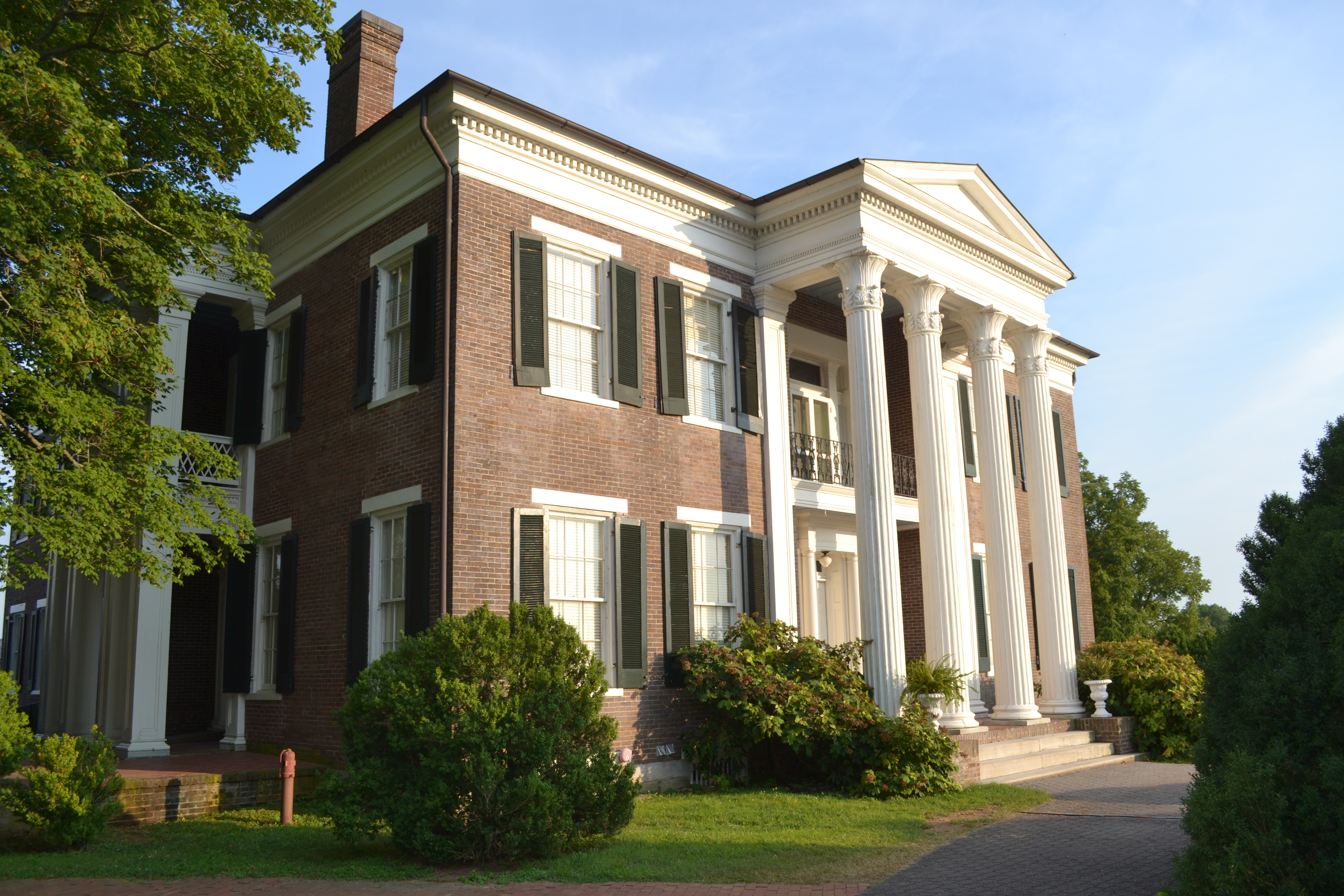
The facade of Rippavilla. Photo 2013 by Lewis O. Powell IV, all rights reserved.
As Nashville, Tennessee sprawls its fingers outwards, it’s beginning to take over middle Tennessee. Small towns like Franklin and Spring Hill have been caught up in the web of development as these charming, and once rural towns are paved over with asphalt and chain businesses. Franklin, just north of Spring Hill and closer to Nashville, has only in recent decades begun fighting back and working to preserve its historic and battle-scarred heart.
Middle Tennessee was one of the areas that saw the brunt of fighting during the Civil War. As the last state to join the waltz of the Confederacy, Nashville became an immediate target for the Union and was the first state capitol to fall into their hands. Those cities and towns south of Nashville—Franklin, Spring Hill and Columbia, among them—were captured and held by armies of both sides during this turbulent period. After Sherman’s capture of Atlanta, far south, the Confederates under General Hood—who had lost Atlanta—attempted to capture Nashville and redeem themselves in the eyes of the Confederates.
Spring Hill and its surrounding estates had seen an influx of Confederate wounded into the small town. Many of the homes—including Rippavilla—had been requisitioned for use as hospitals. According to my guides in the house, the house had seen a smallpox epidemic among the wounded in 1862. During Hood’s Nashville campaign, wounded soldiers once again began to pour in followed by a series of generals, including Hood himself. During the fighting here in Spring Hill, Rippavilla’s fields were the scene of fighting.
Spring Hill saw battle the day before the Battle of Franklin in 1864. While not a major battle, it did leave a few hundred dead or wounded on both sides. Spring Hill was just a stepping-stone in Confederate General Hood’s attempt to dislodge the Union army from Nashville. As the fighting edged on towards Christmas, hope for the Confederacy faltered. Sherman held Atlanta and was marching to the sea destroying much in his path to Savannah, while Hood was defeated at Nashville and routed to Tupelo, Mississippi.
Part of that battle was fought on the grounds of Rippavilla Plantation, just south of town and like so many buildings throughout the South, the house was used as a hospital. This house has many layers of history, each leaving spirits within the house. One source reports spirits from Native Americans, through the Civil War and a smallpox epidemic during that era through to the 20th century, when rumors indicate the house may have seen use as a brothel.
The Egyptian-Greek capitals of Rippavilla’s columns. Photo 2013 by Lewis O. Powell IV, all rights reserved.
The home is very similar to a number of other remaining plantation homes in the area in its brick construction and Greek Revival design. The columns, however, show the influence of Egyptian Revival design with capitals depicting papyrus but with the addition of the Greek-style acanthus leaf. This adds a unique touch. Apparently, while the exterior of the home has not changed much, the interior has changed greatly. Downtown Nashville’s First Presbyterian Church—now a National Historic Landmark—features Egyptian Revival elements, one must wonder if there’s a connection.
Visitors being shown inside will encounter a dramatic, sweeping staircase that splits at the landing to rise to the second floor. This feature was added in the early 20th century to replace the smaller, less dramatic staircase. Electricity, plumbing and air conditioning were installed in the house as well as bathrooms.
The home was built by Nathaniel Cheairs, a wealthy cotton planter. It was modeled on Ferguson Hall—the nearby home of his brother, Martin. Work was begun in 1851 and it took four years to complete. The large kitchen building behind the house was completed first and the family lived there until the mansion was finished. Legend holds that the mansion’s walls were pulled down three times to correct Nathaniel’s perceived deficiencies in the masonry.
Rippavilla flourished along with other nearby plantations owned by Cheairs, and by 1860, the census reports some 75 slaves working the estate. Though, with the coming war, all that would be swept away.
The back of the house from the courtyard. Photo 2013 by Lewis O. Powell IV, all rights reserved.
Many have automatically assumed that I’m a paranormal investigator. That’s not really the case. I consider myself a writer and researcher—more adept at sussing out information and presenting it in a palatable form—as opposed to an investigator tramping through historic places with loads of technology. I can say, that I’m very much a Luddite. Not that I reject technology, but I do grow weary of having to keep up with it.
This brings me to sitting alone in a bedroom at Rippavilla Plantation last weekend as the clock neared 3 AM. We’d been told to pick a room and then just sit for a little while and see what happens. Always being the “different” one, I chose the room that a number of people didn’t “like.” One of the volunteers helping with the investigation had told me that she could not enter this particular room. If she did, she’d usually end up having an emotional reaction.
This bedroom, in particular, had been used as a surgery. Blood stains on the floor attested to that fact. A military style bed had been installed in the room with soldier’s accoutrements sitting upon and around it. I found a single chair within in the room next to the door leading into the next bedroom. Through the door I could see the door of another bedroom, one that had bloodstains from a more recent murder still staining the floor.
All of this did make me uncomfortable. Glancing at the floor around my chair I did see about five drops of something staining the floor. My active imagination envisioned these drops possibly dripping from a surgeon’s knife or a spurting artery as a soldier writhed in pain. In fact, I had nothing to indicate it was actually even blood.
Still, sitting in this room, I found it hard to imagine the air filled with moans and cries, as it would have been during the war. Though, it seems that other, far more sensitive souls had had experiences in this room. Earlier in the evening, as I was awaiting the start of the investigation, a volunteer who had been working in the house that weekend began to report the smell of tobacco in that room along with the smell of an astringent—possibly witch hazel. She’d been one of the first people in the house that morning when it was discovered that the antique dresses so carefully laid on the beds had been moved.
Civil War hospital display in one of the bedrooms. This is the bedroom that staff members do not like. Photo 2013 by Lewis O. Powell IV, all rights reserved.
The senses can play tricks on you. At various times through the night, I was convinced that I saw things, but realized my eyes were fooling me. At times I may have heard things, but I was listening so hard my brain could have simply misinterpreted other, more common, sounds. For these reasons it is imperative for ghost hunters to obtain clear evidence and that exists for Rippavilla. During previous investigations, many Class A EVPs have been captured that point to the conclusion that this house is active. A haunting photograph with a couple of possible spiritual images and video of some type of phenomena that was captured on three different cameras also exists.
The investigation’s leader suggested that the site was very quiet that night. A fair had been held on the grounds of the house and many visitors had passed through the house in the days leading up to the investigation. Perhaps the spirits were resting?
The highlight of the evening took place in a small, modern building at the back of the property. Built on part of the battlefield, this structure is used for various meetings and consists of a large room with restrooms and a small kitchen. The entire group of investigators was seated in this room around an empty chair with a ball on it. Dudley Pitts, the lead investigator, encouraged the spirits to move the ball and we waited in earnest for something to happen. Mr. Pitts spoke up again, saying that if the ball moved, we would all leave. Not two seconds after he said that, a very small, male voice was heard from a side of the room where no one was sitting. The voice asked, “All of you?” A gasp went up among the group and, as promised, we made a quick exit.
As the group I was with concluded their first investigation of the second floor I walked through two of the bedrooms: the nursery and the master bedroom. We left the upstairs in the dark. We had not turned on any lights during the time we were up there. We returned to the kitchen and no one else was in the house. We returned to the upstairs about 15 minutes later to discover that lamps in both rooms were on. The lead investigator turned off the lamp in the master bedroom and then as he approached the lamp in the nursery it turned itself off. Were the spirits saying hello?
The evidence is still being reviewed. Personally, the experience was really wonderful. Though, in the words of one of the investigators, a paranormal investigation “is 7 hours of waiting and 60 seconds of a thrill.” To spend time in such a marvelous historic home, quietly contemplating darkened rooms is actually marvelous. Especially in today’s hyper world of fast technology, instant gratification and even quick tours of historic tours, the experience of sitting and listening and imagining is often lost.
This investigation at Rippavilla lead by Dudley Pitts of Innovative Paranormal Research (IPR) and resident paranormal investigator is held monthly. I’d like to thank Mr. Pitts and the investigators for their help and leadership during the investigation and especially Laura Bentley and Lisa Webber for their kindness. For further information, contact Rippavilla Plantation on their website or through their FaceBook page, “Whispers of the Past.”
It’s a gloomy stormy day in the Deep South, a perfect time to check for news of Southern ghosts.
TacoLu Baja Mexicana 1712 Beach Boulevard Jacksonville Beach, Florida
The famous and haunted Homestead Restaurant has gone south, south of the border, that is. Opened in 1947, The Homestead Restaurant was, until a few years ago, a Jacksonville Beach landmark known for its fried chicken and other Southern specialties. Sadly, recent years have not been so kind to the restaurant or fat, sugar and cholesterol laden Southern cuisine in general. The restaurant was closed for a while but then reopened. Evidently, it was not the same and the restaurant closed again. Recently, a local taco joint has taken up residence in this haunted landmark and, according to a recent article in The Florida Times-Union, they’re still being visited by something otherworldly.
After inheriting the 1932 structure, Alpha Paynter opened the building that would become the restaurant as a boarding house. As boarding houses fell out of fashion, Mrs. Paynter opened the place as a restaurant, The Homestead Restaurant. The place became known for its fried chicken as much as its kitschy interior. Mrs. Paynter sold the restaurant in the early 1960s and died that same year, though her indomitable spirit that built the successful restaurant remained.
The tales of ghosts in the building go back many years and have been widely recorded. A spirit, believed to be Alpha Paynter, has been spirits and causes the occasional lighthearted disturbance. But two other spirits in the restaurant may not be so lighthearted. Dave Lapham reports in his Ghosthunting Florida that there may be two other female spirits: the unhappy shades of two former residents who committed suicide in the building 10 years apart.
A glance at the menu shows no sign of a Fried Chicken Taco, perhaps that might be a good idea to pay homage to Mrs. Paynter and her two spiritual companions.
Sources
FitzRoy, Maggie. “Local legend lives on at Beaches restaurant.” The Florida Times-Union. 27 January 2013.
Mills, Gary T. “Dining Notes: TacoLu plans move to former Homestead spot in Jacksonville Beach.” The Florida Times-Union. 31 August 2012.
Ijams Nature Center 2915 Island Home Avenue Knoxville, Tennessee
The Ijams Nature Center is reveling in its haunted side. The famed nature center is hosting a ghost hunt for the public this upcoming Saturday. If I didn’t have a previous engagement, I’d love to attend.
This public park, established by bird expert Henry Ijams and the “First Lady of Knoxville Garden Clubs,” Alice Yoe Ijams, serves to preserve nature within Knoxville and educate the public. Except for information on the ghost hunt, I’ve not been able to locate any details on the ghosts of the park, though I’ll be looking forward to finding out more.
Sources
“History.” Ijams Nature Center. Accessed 30 January 2013.
News Sentinel Staff. “Ijams Nature Center to host ghost hunt. Knoxville News Sentinel. 23 January 2013.
Longwood Village Inn 300 North Ronald Reagan Boulevard Longwood, Florida
I really want to find out how George Clark died. The owner of the then St. George Hotel, Clark died in April 1923 during an ice cream social he was hosting there for the community. So far, none of the sources have revealed the actual circumstances of his death, though most report that he died at the rear of the building.
Longwood Village Inn, 2007. Photo by Ebyabe, courtesy of Wikipedia.
The latest news about the Longwood Village Inn is that the building is for sale. Built during Florida’s first railroad boom in 1885, this historic hotel may get a second chance during Florida’s second railroad boom in the very near future. With support from the Federal government, state and local governments, SunRail is being constructed. This rail system will connect Poinciana to DeLand through the heart of downtown Orlando. The station linking Longwood will be constructed just across the street from the inn.
But it seems that George Clark’s spirit is not the only one in the 30 room hotel. The hotel has most recently been used as office space and workers in the old rooms have reported the sounds of giggling and tapping while others have smelled cigar smoke. Strange lights and apparitions round out the paranormal activity.
Sources
Busdeker, Jon. “Historic Longwood Village Inn for sale in anticipation of SunRail.” Orlando Sentinel. 17 January 2013.
WATE-TV Studios in Greystone Mansion
1306 North Broadway Street, Northeast
Knoxville, Tennessee
N.B. This article was revised and expanded 31 January 2019 and 13 June 2021.
Throughout the South, hauntings can be found in unlikely places: Walmart stores, fast food restaurants (I’ve covered the haunted McDonald’s in Hermitage, Tennessee), and amusement parks among them. Some years ago, WATE-TV 6, the Knoxville ABC affiliate, revealed that their own studios may be haunted.
The studios occupy a rambling Victorian mansion that resembles a classic haunted house. The Richardsonian Romanesque mansion was constructed for Major Eldad Cicero Camp, Jr., the wealthiest man in East Tennessee at the time. He initially arrived in the area towards the end of the Civil War while he was serving Ohio Volunteer Infantry. Impressed at the region’s untapped mineral resources, he decided to make Knoxville his permanent home
Major Eldad Cicero Camp, circa 1917. From Knoxville Men of Affairs.
Camp settled here when the city was still reeling from the divisions brought about by the war, and Camp had his own lingering dispute to settle. During the war, a number of men under his command had been held as prisoners of war under Colonel Henry Ashby in atrocious conditions. Camp held Ashby personally responsible for their mistreatment and, after the war, pressed charges of war crimes and treason against him. Ashby fled Knoxville but returned when the charges were eventually dropped.
On the afternoon of July 9, 1868, Ashby ran into Camp on the street. The gentlemen struggled as Ashby struck Camp with his cane while Camp fought back with his umbrella. The following day, Ashby appeared at Camp’s law office near the corner of Walnut and Main Streets. The two took their quarrel outside where Camp drew his revolver and fired. Henry Ashby was struck in the chest and killed. Camp was arrested and charged with murder, but the charges were dropped.
The following year, President Grant appointed him as the United States Attorney for the Eastern District of Tennessee. Taking advantage of the region’s natural resources, he organized the Coal Creek Coal Company and served as president of two other companies, building a name for himself as a businessman.
With his wealth, Camp began building Greystone Mansion in 1885. The home took five years to construct and featured elaborate woodwork, jeweled stained glass windows, and imported marble mantelpieces. He lived in the house for some 30 years until his death in 1920. He was buried in Old Gray Cemetery not far from where Henry Ashby was also laid to rest. The house remained in the family until 1935 when it was sold and divided into apartments. WATE-TV purchased the house in the 1965, restoring it and adding studio space at the back.
Oblique view of Greystone. Photo 2010 by Brian Stansberry. Courtesy of Wikipedia.
Since moving in, station employees have had experiences throughout the old house. Footsteps and other odd noises have been heard, and a door on the second floor closes by itself. Several years ago, a custodian filmed something moving on the second floor with her phone.
The building has been investigated by Appalachian Paranormal Investigations several times with the group capturing video and audio evidence. According to a WATE, that evidence points to the presence of four possible spirits on the premises.
Sources
Booker, Robert J. “Greystone Mansion builder shot, killed man downtown.” Knoxville News-Sentinel. 26 February 2018.