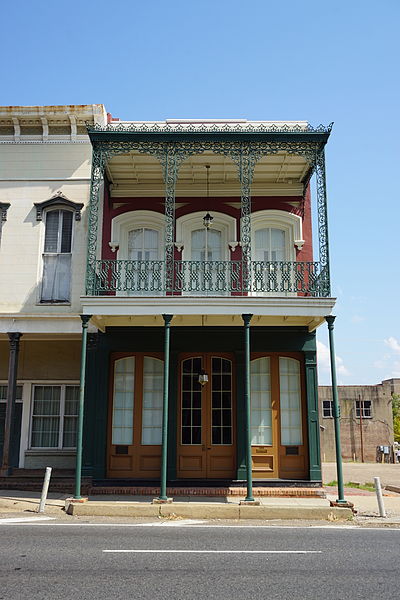
Lafitte’s Blacksmith Shop Bar 941 Bourbon Street New Orleans, Louisiana
In the world of paranormal stories and legends, many people often speak in generalities when talking about hauntings. Singular personal encounters are sometimes grouped together in describing hauntings therefore, a frightening encounter of hearing a voice may be reduced to “disembodied voices have been heard.” A singular incident which may be very telling may sometimes be stripped of detail and even importance as an author retells the event. Indeed, I am guilty of this as well, though I’d like to rectify this in highlighting specific encounters with Southern ghosts.
As I have been searching for events, I have come to realize just how these generalizations sometimes harm the subjects they are describing. Where a plethora of fascinating stories may exist, these encounters may be grouped together rendering the nature of a particular haunting in general terms. At times, generalizations about a particular location may serve to obscure the singular encounters. This problem often tends to rear its head when places gain notoriety for being haunted; places like the famous Lafitte’s Blacksmith Shop Bar in New Orleans.
After searching a number of sources on New Orleans ghosts, I finally was able to locate a long and very detailed description of an encounter at this most famous and historic of NOLA watering holes. This encounter is documented in Dan Asfar’s 2007 Ghost Stories of Louisiana. The author tells of a couple spending their honeymoon in New Orleans. After taking a ghost tour, the couple stumbled upon the bar and was drawn into the curious building, though their ghost tour had made no mention of it being haunted.
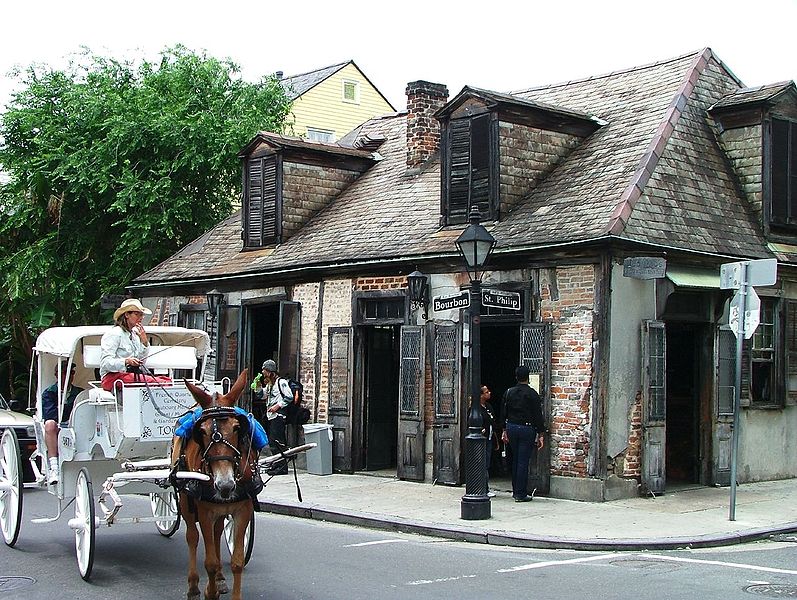
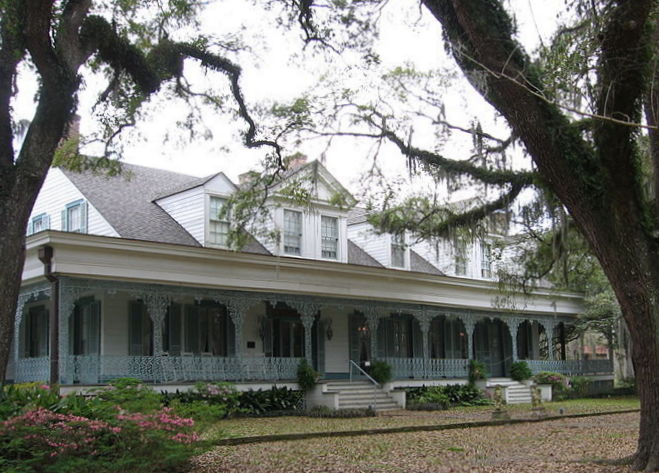
Lafitte’s Blacksmith Shop Bar, 2004, by Lobberich. Courtesy of Wikipedia.
Once inside, the wife was enchanted by the dark and crowded bar: “You couldn’t see across the bar because it was so dark and crowded inside, but it was so special. It’s hard to explain, but it was so real inside, you know? We could have been sitting down there 200 years ago, and I think it would have looked very much the same.” After sitting down, the wife felt an odd chill, though she dismissed it after it dissipated quickly.
The chill returned a few minutes later, “It wasn’t like a normal cold from cold weather. It was more as though the cold was coming from inside. I felt it like a cold hand in my back. It came so fast it made me jump in my seat.” Her husband noticed behavior and asked if she was ok. She asked him if he felt the cold, but he did not. The woman rose to head to the restroom and she felt something following her as she walked. The feeling left her in the restroom and she calmly returned to her table.
Upon sitting, she noticed an odd gentleman nearby. He was standing among a group of people talking, though they did not seem to notice him. “It was dark, but from what I could see, he was a very handsome man. He had broad shoulders. It was hard to see his face clearly, but I could see that he had a very big mustache, and also a big hat.”
She saw him and the cold, clammy feeling she had felt before resolved and the young woman felt “normal again.” “Even though I couldn’t see his face too clearly in the dark, I knew this man was smiling at me.” She felt herself smiling back. Her husband noticed and inquired as to who she was smiling. She turned away for a couple to second to ask, “Can you see that man?” When she pointed to where the smiling gentleman had been standing there was no one there.
An anonymous, early 19th-century portrait purported to be Jean Lafitte. From the Rosenberg Gallery.
Later, when the couple was on a history tour, the guide described Jean Lafitte and mentioned that his spirit is supposedly seen within this building that he supposedly built.
This ramshackle structure may be one of the oldest buildings in this ancient city, but like everything else in this city, that is arguable. Most likely, the building was built in the 18th century, most likely the latter portion of that century. Legends hold that this building was associated with the famous pirate, Jean Lafitte, a swashbuckling and romantic hero who appears in countless Louisiana legends and ghost stories.
Lafitte is supposed to have used this building as a cover for his operations within the city. Here he may have carried on operations dealing with ill-gotten goods as well as some of the “black ivory” (African slaves) that may have also dealt with. Historians have argued that the building may have never actually been used as a blacksmith shop, though others imagine that a hammering blacksmith may have served as a good cover for the illicit dealings taking place in the back of the building.
Woven into this legendary history are mentions of ghosts, including the possible shade of Lafitte. While imbibing in Lafitte’s Blacksmith Shop Bar, be on the lookout for a smiling gentleman. If you see him, smile back but don’t look away.
Sources
Ambrose, Kala. Spirits of New Orleans: Voodoo Curses, Vampire Legends, and Cities of the Dead. Cincinnati, OH: Clerisy Press, 2012.
Asfar, Dan. Ghost Stories of Louisiana. Auburn, WA: Lone Pine Publishing, 2007.
Dwyer, Jeff. Ghost Hunter’s Guide to New Orleans. Gretna, LA: Pelican Publishing, 2007.
Following on the heels of my article, “Dining With Spirits,” I’ve decided to revamp my Halloween article from 2010 on haunted inns and hotels. That article was so large I published it in two parts so I’m breaking it into a smaller article with just 13 hostelries, one from each of the states that I cover. See part two of this article in “13 More Southern Rooms with a Boo.”
St. James Hotel 1200 Water Street Selma, Alabama
The Queen City of the Black Belt, Selma, has a remarkable history that is intimately connected with the Civil War and the Civil Rights Movement, events that, despite their names, were hardly civil. The city is perched on a bluff overlooking the Alabama River and among the collection of buildings that peer down upon the river is the St. James Hotel. Built some 17 years after the incorporation of the town in 1820, the St. James has served patrons for nearly two centuries. The structure was occupied by Union forces during the Civil War, one reason the hotel was not burned like much of the city. Towards the late nineteenth century, the hotel fell on hard times and served a variety of functions. Keeping up with Selma’s drive to bill itself as a tourist destination, the St. James underwent a $6 million restoration in the 1990s which has provided 42 guest rooms, 4 riverfront suites with balconies overlooking the Alabama, the Troup House Restaurant (which utilizes the hotel’s name during the Civil War) and a number of spiritual guests.
The St. James Hotel, 2010, by Carol M. Highsmith. Courtesy of the Library of Congress, Prints and Photographs Division.
Outlaw Jesse James and his gang were frequent guests in the hotel and a male apparition seen in guest rooms on the second and third floors and in the bar may possibly be Jesse or a member of his gang. The spirit has been accompanied by the distinct jangle of spurs. Investigators in one of the hotel’s ballrooms asked “Is anyone there?” during an EVP session. The voice of a male answered on tape, “Well, that’s a stupid question.” Among other spirits still walking the halls of the St. James are a female and a dog whose barking is heard. So, if you check into the St. James, chances are high that you may encounter something, just don’t ask any stupid questions.
Sources
“Dead walk.” The Selma Times-Journal. 23 October 2005.
Lewis, Herbert J. “Selma.” Encyclopedia of Alabama. 12 August 2008.
“St. James hosts ‘spirit.’” The Selma Times-Journal. 30 October 2003.
Turnage, Sheila. Haunted Inns of the Southeast. Winton-Salem, NC: John F. Blair, 2001.
Omni Shoreham Hotel 2500 Calvert Street, NW Washington, D.C.
Suite 870 of this 1930 hotel has seen three deaths. Juliette Brown, a live-in maid to the hotel’s owner, Henry Doherty and his family, died there unexpectedly as well as Doherty’s wife and daughter some time later. The apartment remained abandoned for some 50 years while guests staying in rooms around the suite would complain of late-night sounds coming from the room. Hotel staff has experienced being locked out of the room and cold breezes in and around the suite which is now known as the “Ghost Suite.”
The Omni-Shoreham Hotel, 2009, by Jurden Matern. Courtesy of Wikipedia.
Writer Eric Nuzum spent a night in the room in 2007 and was awakened in the night by an odd, unexplained creaking that happened five times during the early morning hours. Just before he checked out of the room he discovered that lights he had left on were off. As he stood in the dining room pondering the lights, they turned back on by themselves.
The blog, Phantoms and Monsters published an account in 2012 of a hotel guest who stayed in room 866, just down the hall from the Ghost Suite. Around 2:25 AM he was awakened by moaning that seemingly came from the room next door. This was followed by a woman’s scream that issued from just underneath the guest’s bed. The terrified guest then observed a female form that began to take shape next to the bed. The form was a beautiful, nude female who smiled at the guest before turning and dissipating in a nearby wall.
Crowne Plaza Key West – La Concha 430 Duval Street Key West, Florida
La Concha Hotel, 2012, by Acroterion. Courtesy of Wikipedia.
The theme that runs through the ghost stories of the La Concha Hotel in Key West is falling from a great height, both deliberately and accidentally. This seven-story hotel, opened in 1926, is the tallest building in the city and has been the scene of suicides and a horrible accident. The building’s history has also experienced some great falls as well. Opened to great acclaim, this luxury hotel was visited by many of the notable names of the age: Ernest Hemingway, Tennessee Williams, even possibly Al Capone and his cronies, but with the stock market crash in 1929, business seriously dropped. The 1935 Labor Day Hurricane which swept the Keys destroyed the Key West Extension of the East Coast Railway which was one of the island’s major arteries.
Following World War II, the La Concha, much decayed, staggered on through the middle of the twentieth century with only the kitchen and the famous rooftop bar open to the public. The hotel was restored and reopened in 1986 to much fanfare. The La Concha Hotel has recovered from its fall, but, perhaps its spirits have not.
On New Year’s Eve, 1982 or ’83 (sources differ), a young man, unfamiliar with the hotel’s ancient service elevator, fell down the elevator shaft while cleaning up after a party. His spirit seems most active on the fifth floor and obviously, around the elevator. More deliberately, according to Dave Lapham’s Ghosthunting Florida, some 13 people have committed suicide from the rooftop bar of the hotel. Some of their spirits may also remain. One gentleman who took the leap in 2006 reportedly downed a glass of Chardonnay before doing so. Since then, patrons have reported their glasses of Chardonnay were sometimes suddenly jerked from their hands by an unseen force. Hopefully, these fallen spirits have found comfort in the Other Side.
Sources
Jenkins, Greg. Florida’s Ghostly Legends and Haunted Folklore, Volume 1, South and Central Florida. Sarasota, FL: Pineapple Press, 2008.
Rodriguez, Stacy. “La Concha Hotel turns 80.” The Key West Citizen. 20 January 2006.
Jekyll Island Club Resort 371 Riverview Drive Jekyll Island, Georgia
The grand and glorious spirit of the Victorian Era is evident at the Jekyll Island Club Hotel, both in the atmosphere but also in the spiritual energy that persists there among the ancient oaks dripping with Spanish moss. Opened in 1888 by a consortium of America’s elite families, the Jekyll Island Club was an exclusive hideaway for families with names such as Vanderbilt, Carnegie, Morgan, Rockefeller, Macy and Goodyear. In addition to the grand clubhouse, some families built mansion-sized “cottages.” As America entered into war in 1942, the club closed its doors and sat vacant until the State of Georgia, who now owned the island, attempted, unsuccessfully, to open the club as a resort in the early 1970s. The club opened as a private resort in 1985.
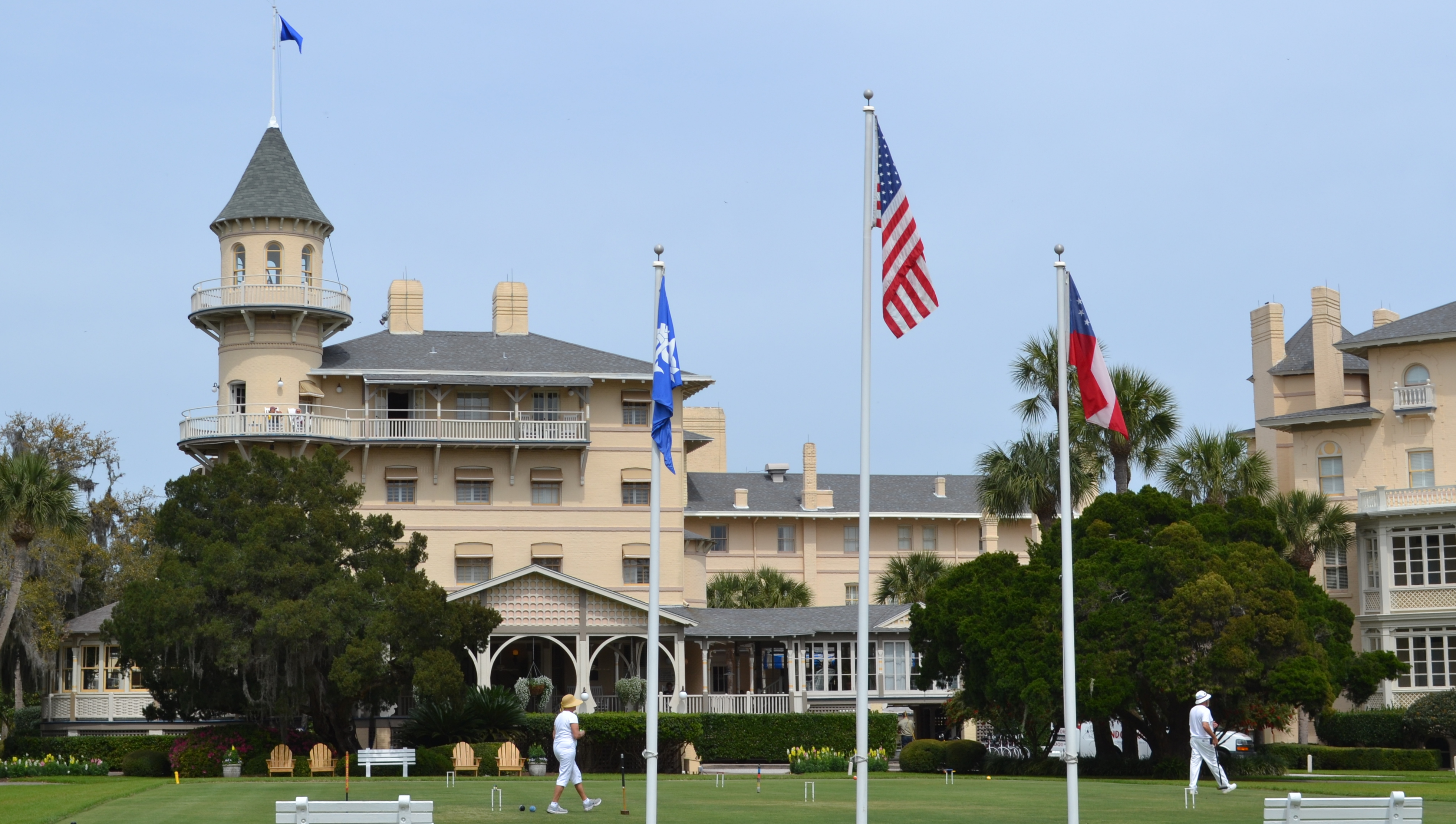
Jekyll Island Club, 2012, by Lewis Powell IV. All rights reserved.
Almost from the moment the club opened its doors, tales of ghosts were being told. The president of the club, Lloyd Aspinwall, died during the club’s construction, but some in the crowd spotted him stiffly gliding through the crowd in his usual military manner. He has also been encountered on the Riverfront Veranda of the club. In the annex of the clubhouse, a three-story apartment building called Sans Souci (“without care”), the apparition of Samuel Spenser, former head of the Southern Railroad Company, has been reported, still reading his morning paper. The shade of a former bellhop still knocks on doors requesting laundry.
Sources
de Bellis, Ken. National Register of Historic Places Nomination Form for the Jekyll Island Historic District. Listed 20 January 1972.
Turnage, Sheila. Haunted Inns of the Southeast. Winton-Salem, NC: John F. Blair, 2001.
The Brown Hotel 335 West Broadway Louisville, Kentucky
A sculpted likeness of businessman James Graham Brown stands on the sidewalk just outside the magnificent 16-story hotel he built at the corner of Fourth and Broadway. At his feet sits his little canine friend, Woozem, who, as the story goes, Mr. Brown rescued from a circus that had recently cut the dog’s act. The dog and Mr. Brown lived in the lap of luxury there until the end of their days, perhaps they remain.
Brown Hotel, 2005, by Derek Cashman. Courtesy of Wikipedia.
Opening in 1923, the Brown Hotel provided four-star accommodations to the citizens of Louisville for a number of decades. The famous Hot Brown was developed in the hotel’s restaurant. The hotel operated until 1971, just two years after the death of James Brown, when it closed its doors. The grand dame held offices for the public school system and when the downtown began a resurgence in the late 1980s, the hotel was renovated and restored to its former glory.
The fifteenth floor of the hotel is currently an unimproved storage space for the hotel and seems to be the center of spiritual activity. It’s believed that it was on this floor that Mr. Brown has his suite and perhaps his spirit still roams the floor. The elevator is often called to this floor by an unseen presence. Two employees reported going up to the floor and as they exited they noticed a third set of footprints in the plaster dust on the floor. A guest who had stayed on the fourteenth floor complained of hearing heavy footsteps and furniture moving all night. Perhaps Mr. Brown and Woozem are just making themselves comfortable.
Sources
Brown, Alan. Haunted Kentucky: Ghosts and Strange Phenomena of the Bluegrass State. Mechanicsburg, PA: Stackpole, 2009.
Parker, Robert W. Haunted Louisville: History and Hauntings from The Derby City. Decatur, IL: Whitechapel Press, 2007.
Bourbon Orleans Hotel 717 Orleans Street New Orleans, Louisiana
Located just behind St. Louis Cathedral and running along the partier’s paradise of Bourbon Street is the grand Bourbon Orleans Hotel. On my first visit to New Orleans, my family stayed in this marvelous hotel. While we didn’t encounter anything paranormal, I remember spending a few wonderful hours sitting on the balcony watching the crowd below on Bourbon Street.
This graceful building was first opened as the Orleans Ballroom in 1817. It was host to the famous Quadroon Balls, balls where mixed race women (a “Quadroon” was someone whose ancestry was 1/4 of African descent) were introduced to wealthy white men. While these people could not legally marry, the system of plaçage provided these men with mistresses or concubines whom the men would support and provide for. By 1881, the building, with the adjoining Orleans Theatre, had begun to fall into ruin and the buildings were taken over by the Sisters of the Holy Family for use as an orphanage, school and convent. This convent, according to Sheila Turnage, was the first convent for African-Americans in the nation. After some 83 years as a convent, the building was converted into a hotel to serve the booming New Orleans tourist trade.
During my stay, I recall reading or hearing a story from the renovation of the building (though I cannot source it). A worker in the building hurt himself and uttered a vulgarity when an unseen hand slapped him across the face. Certainly, the spirits of nuns and the children that they tended have lingered in this building. Guests often encounter the spirits of children throughout the building. But also, the spirits from the structure’s wilder days as a ballroom do appear as well. Dancing couples have been seen in the ballroom and frock-coated gentlemen are sometimes reported in the men’s restroom off the lobby (once a room for playing poker).
Sources
“History.” com. Accessed 30 October 2010.
Turnage, Sheila. Haunted Inns of the Southeast. Winton-Salem, NC: John F. Blair, 2001.
Lord Baltimore Hotel 20 West Baltimore Street Baltimore, Maryland
Blogger Lon Strickler of the blog, Phantoms and Monsters, wrote about a visit to the Lord Baltimore Hotel in 1980. Sitting with a friend in the hotel’s lobby, he writes, “I sensed many raw emotions, good and bad…We sat in the lobby over drinks and conversed about our past…but, in the meantime, I was being bombarded by distant sounds of yesteryear. It became so bad that I started to feel claustrophobic and had to make a ‘polite as possible’ excuse to leave.” He has never returned to the hotel.
Authors Melissa Rowell and Amy Lynwander include an account of a hotel employee named Fran in their book, Baltimore Harbor Haunts. In it, Fran describes her personal experiences as well as those of employees working under her. Fran’s account mentions a little girl she encountered on the nineteenth floor. The girl ran past an open doorway and when Fran ran after her, she found the hallway deserted. She turned and saw a couple in formal attire walking towards her. Asking if the little girl belonged to them, she turned towards the direction of the now missing child. Fran turned back to the couple and discovered they had disappeared as well.
Lord Baltimore Hotel in a 1942 postcard.
Evidently, Fran is not the only person to witness the apparition of a little girl as a guest was awakened to find a young girl in her room crying. When approached, the girl vanished. One of Fran’s coworkers encountered three or four spirits standing in the hotel’s darkened ballroom. When she turned on the lights, all figures were gone.
Certainly, the Lord Baltimore Hotel could be haunted. Built in 1928, the hotel was the largest in the state of Maryland. As one of the tallest buildings in the area at the time, the hotel attracted jumpers after great stock market crash of 1929. Another writer and psychic, Paul Schroeder, had some possible interactions with some of these vestiges of suicides past when he stayed at the hotel. Entering a suite on the 18th floor, he encountered “the reek near the window overlooking the corner was of death and suicide.” After deeming the room unsatisfactory, Schroeder was given another suite where he had “persistent and intermittent visions of a young girl emotionally bereft screaming a face of frozen horror.” He was later told, by the staff, that a young woman had committed suicide on that floor which was believed to be behind much of the paranormal activity on that floor of the hotel.
Anchuca 1010 First East Street Vicksburg, Mississippi
One guest at Anchuca remarked to the owners that she couldn’t stay in the house because it was too emotional. Indeed, Anchuca’s history is marked with periods of intense emotional turmoil. The house has seen the deaths of some of its past owners, members of their families and then soldiers who came through the home’s doors wounded and ill during the Civil War. Some of them most surely died here as well. Throw in Joe Davis, the brother of Confederate President Jefferson Davis, and you have quite the contingent of spirits roaming the halls of Anchuca.
A 1936 photo of Anchuca taken for the Historic American Buildings Survey by James Butters. Courtesy of the Library of Congress, Prints and Photographs Division.
With a name derived from a Choctaw word meaning “happy home,” Anchuca has hosted a number of families during its long history. It was originally constructed in 1830 for politician J. W. Mauldin and was sold to merchant Victor Wilson some years later. Wilson added the Greek revival portico to the house and he and his wife lived here through the tumult of the Siege of Vicksburg when the house served as a hospital. After the war, the home was owned by Joseph Davis who died here in 1870. The house was then purchased by the Hennessy family.
Portraits believed to be Mr. and Mrs. Hennessy grace the wall above the sideboard and with their portraits hang a tale. Some years ago, one of Anchuca’s owners discovered water leaking from the dining room ceiling. He rushed upstairs to the bathroom above the dining room to find that water is coming from the bathroom ceiling and then making its way into the dining room below. He called in a plumber to check the hot water heater and air conditioning unit that were in the attic above the bathroom. As he was looking for the leak, the plumber plunged his hand into the insulation and pulled out these two portraits. The plumber did not find any dampness to suggest a leak and the leaking water mysteriously subsided. Perhaps Mr. and Mrs. Hennessy wished to have their portraits restored to a rightful place within their former home?
Besides mysterious water leaks, the spirits of Anchuca also do a bit of redecorating on occasion. Just after purchasing the house, a friend of one of the owners witnessed a spirited display of displeasure. The owner had hung three South American masks on the wall of his quarters. A friend of his watched one afternoon as one of the masks lifted itself off the wall, hung for a moment in midair and then dropped to the floor. The friend fled in fear. The owner picked up the mask and hung it in its spot on the wall and asked the spirits to leave it alone. The masks have not been cast to floor since. The owners, staff and guests have also encountered a female spirit throughout the house.
Sources
Brown, Alan. Haunted Vicksburg. Charleston, SC: History Press, 2010.
Miller, Mary Warren. National Register of Historic Places nomination form for Anchuca. 25 February 1981.
Sillery, Barbara. The Haunting of Mississippi. Gretna, LA: Pelican, 2011.
Turnage, Sheila. Haunted Inns of the Southeast. Winton-Salem, NC: John F. Blair, 2001.
Grand Old Lady Inn (formerly Balsam Mountain Inn) 68 Seven Springs Drive Balsam, North Carolina
Balsam Mountain Inn, 2012, by Lewis Powell IV. All rights reserved.
Passengers departing from their trains in Balsam, North Carolina just after the turn of the century were met with an inviting and palatial hotel overlooking the station. They would enjoy the cool mountain air from the double porch with views of the town below. Though the train no longer brings them, visitors today can enjoy the same air and views and, if they stay in room 205, perhaps a nice back rub from a spirit. One guest staying in this room with her husband had a bad back and was awaken by a back rub from him, until she realized he was sound to sleep next to her. The unidentified ghost on the second floor of this hotel which opened in 1908 also rattles doorknobs of rooms on that floor.
Sources
Bordsen, John. “Room with a Boo.” The Charlotte Observer. 25 October 2009.
Kermeen, Frances. Ghostly Encounters: True Stories of American’s Haunted Inns and Hotels. NYC: Warner Books, 2002.
Turnage, Sheila. Haunted Inns of the Southeast. Winton-Salem, NC: John F. Blair, 2001.
20 South Battery (formerly Battery Carriage House Inn) 20 South Battery Charleston, South Carolina
Sign for the Battery Carriage House Inn, 2011, by Lewis Powell, IV. All rights reserved.
Located at the Southern tip of the city of Charleston overlooking the meeting point of the Cooper, Stono, Wando and the Ashley Rivers is The Battery, one of Charleston’s “best” neighborhoods. It was at The Battery where many of the city’s and state’s best families built grand homes. From the rooftops of these grand homes and White Point Gardens fronting Charleston Harbor that citizens, including the diarist Mary Chestnut watched as the Confederacy laid siege to Fort Sumter in Charleston Harbor. Number 20 South Battery is home to the Battery Carriage House Inn, possibly one of the more spiritually active locations in the city.
A few of the Battery Carriage House Inn’s eleven sumptuous guest rooms are apparently haunted. A couple staying in room 3 were awakened by noise from a cellphone; while this may be quite common, phones are not supposed to make noise when powered off as this phone was. But this activity seems minor compared to the reports from rooms 8 and 10. Guests staying in Room 8 have encountered the apparition of a man’s torso. There is no head or limbs, just a torso dressed in a few layers of clothing. One guest sensed that this figure was quite negative. The spirit in Room 10 is much more pleasant and even described as a gentleman. The innkeepers believe this may be the spirit of the son of a former owner who committed suicide.
Sources
“Ghost Sightings.” com. Accessed 31 October 2010.
Kermeen, Frances. Ghostly Encounters: True Stories of American’s Haunted Inns and Hotels. NYC: Warner Books, 2002.
Spar, Mindy. “Local haunts among treats for Halloween.” The Post and Courier. 26 Otcober 2002.
Turnage, Sheila. Haunted Inns of the Southeast. Winton-Salem, NC: John F. Blair, 2001.
The Union Station Nashville Yards 1001 Broadway Nashville, Tennessee
Ghosts are associated with certain types of stone, primarily granite and limestone, water and also iron. The iron rails of railroads that have stretched around the globe have given rise to many ghostly legends associated with railroads. Nashville’s Union Station, first opened in 1900, while no longer hosting the iron rails or even the old train shed, still hosts a few ghosts associated with the railroad. Legend has it that on nights of the full moon, a ghostly train still pulls into the station, while that legend may be a bit ridiculous, staff and guests of the hotel have reported hearing the scream of a steam whistle at times; perhaps a residual noise.
Union Station Hotel, 2008, by The Peep Holes. Courtesy of Wikipedia.
During World War II, Union Station was the point of departure for tens of thousands of troops departing for battlefronts around the world. Two spirits remain from this period. One is the revenant of a young soldier who stands near the tracks seemingly waiting for something. The other is the spirit of a young woman who legend states was killed when she fell onto the tracks in front of a train. With the demolition of the train shed, it is unknown if these spirits are still active.
In the second half of the twentieth century, the grand station saw fewer and fewer passengers as the automobile became the dominant mode of transportation in America. The last train departed the station in 1978 and the station closed its door only to be reopened as a luxury hotel some years later. A more recent legend tells of a middle-aged couple that would meet at the hotel on a weekend once a month. By all accounts, the man appeared to be married, but perhaps not the woman. The lovers would spend the entire weekend in their room but one month, the man did not show up. The woman, in distress, spent the weekend in her room and was later discovered dead with a revolver at her feet. Her room, 711, has seen a good deal of activity, with one guest reporting her bag, which she had unpacked, had been repacked upon while she had stepped into the bathroom. Activity seems to revolve around this room with the spirit of young woman being encountered in the hall outside this room and in surrounding rooms as well.
Sources
Harris, Frankie and Kim Meredith. Haunted Nashville. Atglen, PA: Schiffer, 2009.
Kermeen, Frances. Ghostly Encounters: True Stories of American’s Haunted Inns and Hotels. NYC: Warner Books, 2002.
Traylor, Ken and Delas M. House, Jr. Nashville Ghosts and Legends. Charleston, SC: History Press, 2007.
Turnage, Sheila. Haunted Inns of the Southeast. Winton-Salem, NC: John F. Blair, 2001.
The Martha Washington Inn & Spa 150 West Main Street Abingdon, Virginia
War changes many things and the Civil War certainly changed Martha Washington College. The young girls that had studied and gossiped in the college’s rooms became nurses for the wounded young soldiers brought from battlefields far and near and some of those rooms housed able young men who were training on the grounds. Like so many buildings that served as hospitals during the Civil War, the pain and death left its mark upon the college. A number of soldiers still are rumored to walk the halls and occasionally shock guests and staff alike. In addition a ghostly horse, still looking for its long-dead master, still walks the grounds outside.
Martha Washington Inn, 2006, by RebalAt. Courtesy of Wikipedia.
Built as a private residence, General Francis Preston’s 1832 home became an upscale women’s college in 1858. The Great Depression’s punch to the nation led to the school’s closure in 1932 and “The Martha” was later reopened as an inn. The inn is now a part of The Camberley Collection, a group of fine, historic properties.
Sources
Hauck, Dennis William. Haunted Places: The National Directory. NYC: Penguin, 2002.
“History.” The Martha Washington Hotel and Spa. Accessed 10 March 2011.
Kermeen, Frances. Ghostly Encounters: True Stories of America’s Haunted Inns and Hotels. NYC: Warner Books, 2002.
Lee, Marguerite DuPont. Virginia Ghosts, Revised Edition. Berryville, VA: Virginia Book Company, 1966.
Rosenberg, Madelyn. “History and Legend Abound at Abingdon’s Martha Washington Inn.” The Roanoke Times. 31 July 1999.
Taylor, L. B., Jr. The Ghosts of Virginia. Progress Printing, 1993.
Turnage, Sheila. Haunted Inns of the Southeast. Winston-Salem, NC: John F. Blair, 2001.
Varhola, Michael J. Ghosthunting Virginia. Cincinnati, OH, Clerisy Press, 2008.
Lowe Hotel 401 Main Street Point Pleasant, West Virginia
N.B. This article was originally published September 24, 2013, as a newsworthy haunt.
Paranormal events rarely resonate so much within a community or even on a national scale as the sightings of the Mothman have. A series of sightings of this creature occurred between November of 1966 and December of 1967; events that inspired a handful of books, a movie and, for over a decade, a festival in Point Pleasant.
Postcard of the Lowe Hotel circa 1930-45. Courtesy of the Boston Public Library.
The annual festival has certainly boosted “paranormal tourism” in Point Pleasant and one of the more popular paranormal spots in the city is the Lowe Hotel. During the festival tours will be lead through this haunted, turn of the 20th century hotel. According to an article from the Point Pleasant Register, the current owners of the hotel were initially bothered by the idea that their hotel might be haunted, though as attitudes towards the paranormal have changed, the haunting has become an attraction to tourists.
Theresa Racer, of the blog, Theresa’s Haunted History of the Tri-State, presents the best history of the hotel to be found online. The hotel was opened as the Hotel Spencer in the nascent years of the 20th century. The four-story hotel was popular with riverboat traffic operating on the Kanawha and Ohio Rivers which meet at Point Pleasant. The hotel was purchased by Homer Lowe in 1929 who renamed it the Lowe Hotel. It operated until the late 1980s when the owner put it up for sale. The current owners purchased the hotel in 1990.
According to Racer, there is a large contingent of spirits within the hotel. The spirit of a beautiful, but disheveled woman has been reported on the mezzanine between the first and second floors. This section houses the dining room and it is here that the spirit is seen dancing to music that only she can hear. On the second floor, a tyke on a tricycle has been seen prowling the halls. Sometimes the sound of a little girl’s laughter will accompany the sound of a squeaky tricycle.
The third floor seems to be the most active with a few of the rooms there being haunted. One of the most remarkable stories involves the suite at 316. A female staying in this suite entered the room one evening to find a man standing by the window looking out. She asked him who he was and he replied that he was Captain Jim and he was waiting on a boat. After noticing the man did not have legs, the woman fled.
Two chairs on the fourth floor seem to have activity surrounding them. The recent article mentions a wheelchair on that apparently moved on its own volition. The chair vanished for about three years only to reappear out of the blue. Racer reports that an old rocking chair in a storage room on that floor is supposed to rock on its own.
We’ve all seen them and we’ve probably posted links to them on Facebook. They come with a seemingly infinite variety of name, superlative and number combinations: “Top 10 Scariest Haunted Places,” “6 Most Terrifying Places to Eat Dinner,” “50 Academically Prestigious Colleges and Universities with Ghosts,” “23 Super-Duper Awesome Most Haunted Prisons.” During Halloween especially, these “articles” sprout like veritable weeds along the sides of the information superhighway.
Usually, these articles simply rehash the same stories about the same locations and rarely do they ever provide much useful information. The author usually puts in just a modicum of research and produces something that is simply entertaining without providing much depth. It’s like a picture of Kim Kardashian that gets retweeted a million times, it provides nothing useful yet it gets passed around ad nauseum to the enlightenment of no one.
This is my attempt at one-upping these “articles.” There are countless haunted locations that are rarely covered, yet, in my humble opinion, are fascinating and worthy of a bit more attention.
University of Montevallo Montevallo, Alabama
My friend, Jenna, had some roommate issues her freshman year at this small Alabama liberal arts college. At night in her dorm room in Old Main Residence Hall Jenna and her living roommate would hear whispering and footsteps both in her room and outside her door. These are not uncommon issues for college freshmen, though Jenna’s problem roommate was a former student who died in a fire in 1908. When the school operated as a women’s college in the early 20th century, a student, Condie Cunningham, caught her nightgown on fire while trying to heat fudge in a chafing dish. She went screaming down the hall and collapsed. She died a few days later in the hospital.
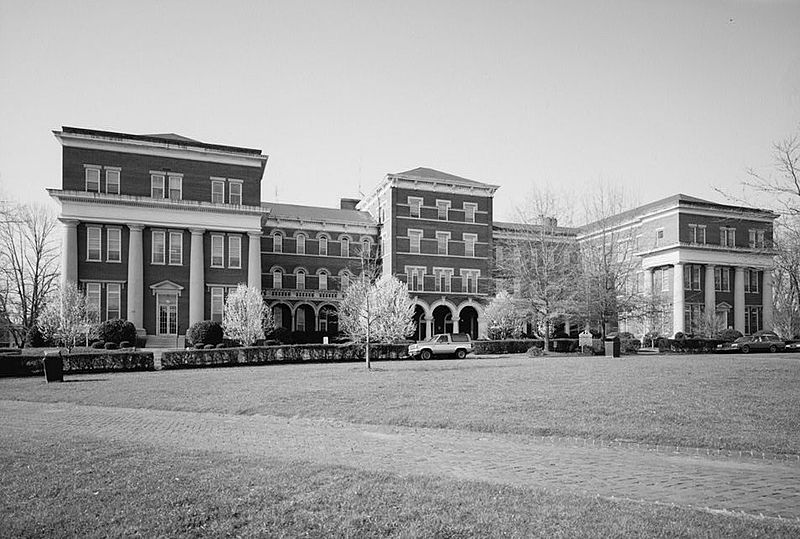
Main Residence Hall, 1993. Photo by Jet Lowe for the Historic American Buildings Survey (HABS). Courtesy of the Library of Congress, Prints and Photographs Division.
Set in the small, central Alabama town of Montevallo, the university has a wide-ranging roster of revenants, one of which even plays an annual part in one of the university’s most celebrated events: College Night. This annual event pits the students against each other producing competing musicals. Created in 1923, this event is adjudicated from the other side by the spirit of the competition’s founder, Dr. Walter Trumbauer, known affectionately as “Trummy.” According to Jenna, during dress rehearsals and performances, Trummy “gets crazy in Palmer.” Pipes are known to shake backstage and his spirit is seen in and around Palmer Hall where the competition is held. Trummy swings the battens of the curtains onstage during performances of the show that gets his approval. Usually, that show will win.
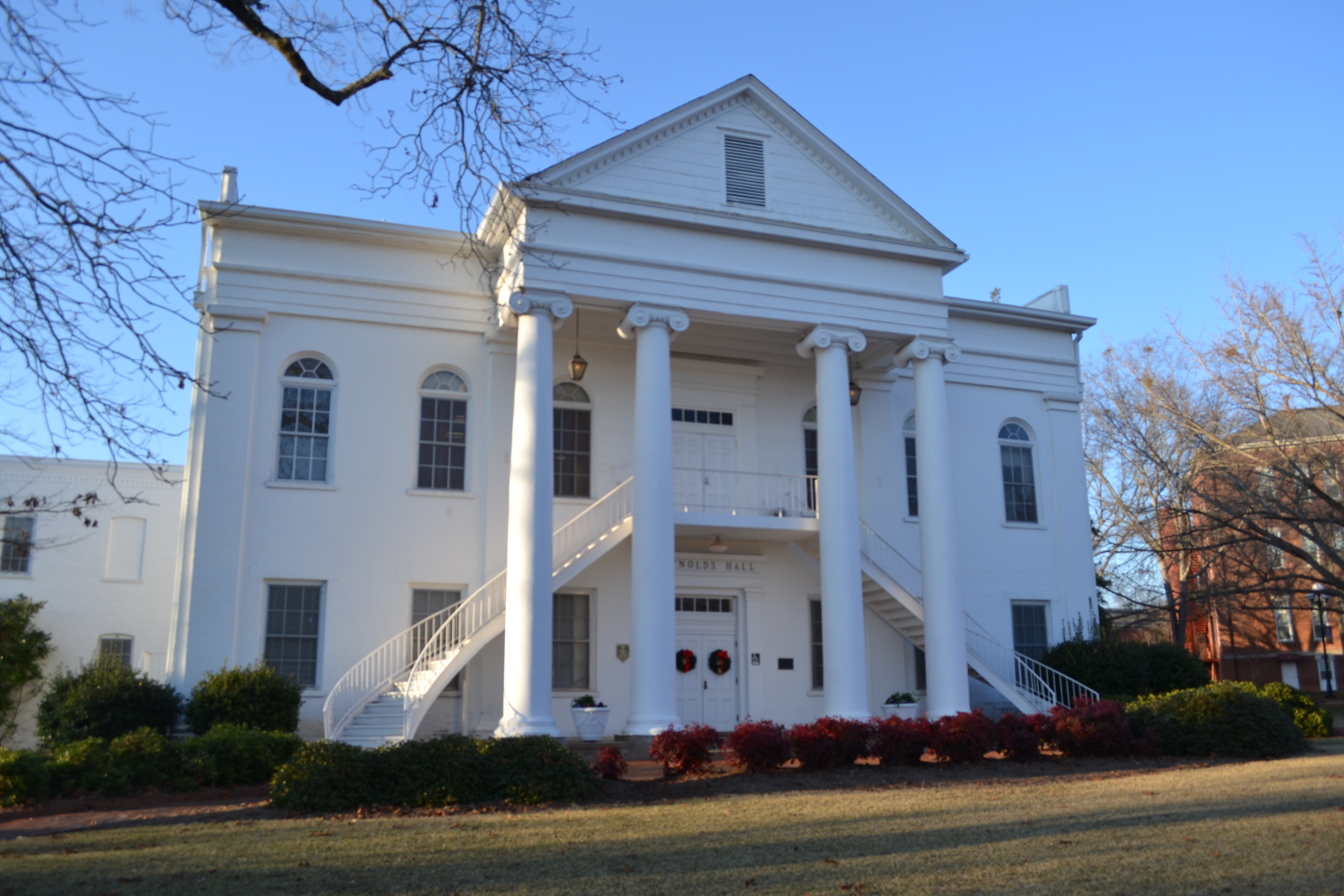
Among the many other spirits on this campus are Confederate soldiers seen in and around Reynolds Hall. The oldest building on campus, Reynolds was used as a makeshift hospital during the Civil War. Under the watch of Captain Henry Clay Reynolds, the wounded and sick soldiers were abandoned when Reynolds and his men left to defend the nearby Briarfield Iron Works. When he returned, he discovered the sick and wounded had been massacred by Union troops.
Reynolds Hall, 2014, by Lewis Powell, IV. All rights reserved.
Now home to the university’s Department of Theatre, Reynolds Hall is still plagued by spirits from that horrible, war-time event. Another student, Mia, told me she had experiences while working alone in an office on the second floor of the building. The room suddenly grew cold and the blinds started shaking violently. She fled. A visiting artist was walking backstage when he encountered a man in a Confederate uniform. He was later informed that there was no period production going on or re-enactors in the building.
By no means are these the only or most active spirits on campus, many buildings are haunted. These include the mid-19th century King House which may be one of the most active buildings on campus, Hanson Hall with its ghostly housemother and Napier Hall with its marble rolling ghost.
Sources
Brown, Alan. Haunted Birmingham. Charleston, SC: History Press, 2009.
Interview with Jenna M., Cherokee, North Carolina, June 2012.
Interview with Mia S., Cherokee, North Carolina, June 2012.
Halcyon House 3400 Prospect Street Georgetown, District of Columbia
Just as the recent real estate bubble touched properties throughout the country, this very large, imposing haunted house was also affected. The house was put up for sale for around $30 million in 2008, just as the bubble began to burst, and sold for less than half of that in 2011. Of course, such an eccentric house with the dramatic history that Halcyon House has would probably have trouble selling in good times.
This 30,500 square foot manse comes complete with a “whimsical” library, a large studio space, a ballroom, a chapel, six apartments, a very large garage and a panoply of ghosts. A sealed tunnel in the basement of the house is supposed to have been used as part of the Underground Railroad. In the early 20th century, a carpenter was asked to seal the tunnel and as he did he heard cries and mournful sobs issuing from it. Over the years, various owners have reported apparitions in the house as well as phantom knocking. In one particular bedroom, several people have reported being levitated by an unknown force.
Halcyon House, 1999. Photo by Jack E. Boucher for the Historic American Buildings Survey (HABS). Courtesy of the Library of Congress, Prints and Photographs Division.
The home’s history is just as dramatic as the hauntings. It was built in the late 18th century by Benjamin Stoddert, the first Secretary of the Navy, and was later owned by the eccentric Albert Adsit Clemons, who claimed to be a nephew of Mark Twain. Clemons extensively remodeled the house and refused to install electricity. Since Clemons death, the house was owned briefly by Georgetown University and recently by a sculptor who, with his wife, lovingly restored the home. During their residence, they claimed to have had no odd experiences within the home’s most historic walls.
Sources
Alexander, John. Ghosts, Washington Revisited. Atglen, PA: Schiffer Publishing, 1998.
Cavanaugh, Stephanie. “Centuries of Drama at Halcyon House.” The Washington Post. 30 August 2008.
Krepp, Tim. Ghosts of Georgetown. Charleston, SC: History Press, 2013.
Taylor, Nancy C. National Register of Historic Places nomination form for Halcyon House. 3 November 1970.
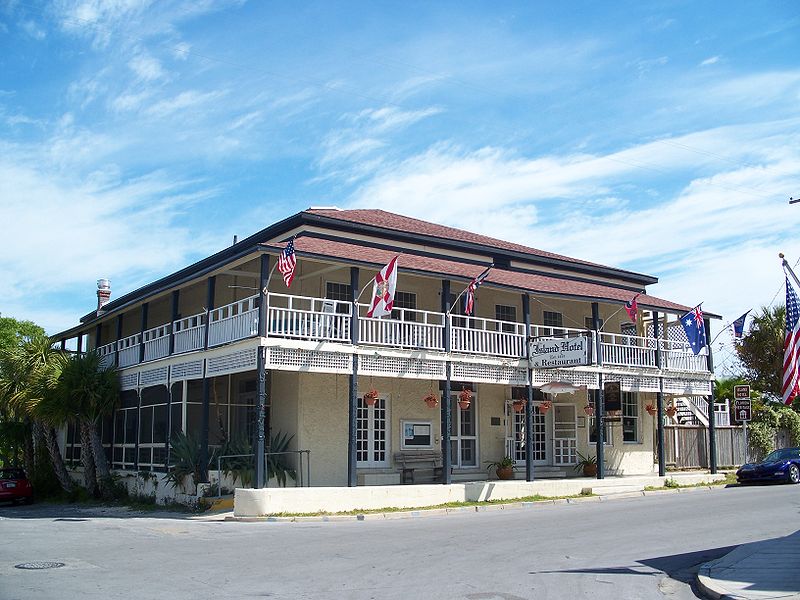
Island Hotel 373 2nd Street Cedar Key, Florida
Most people head to Cedar Key to avoid the crowds, though visitors to the Island Hotel may encounter a crowd of spirits. According to a number of sources including the hotel’s website, thirteen—a very appropriate number—spirits walk the halls of this hotel.
Island Hotel, 2007. Photo by Ebyabe, courtesy of Wikipedia.
The building was built as a general store in 1860, the eve of the Civil War. In 1862, Cedar Key, at that time a small railroad town, became the first town in Florida to fall under Federal occupation. Some buildings were burned, but the general store was spared and quite possibly used as a barracks and warehouse for the occupying troops. After the war, the building returned to its commercial use as a general store and operated successfully until the collapse of the cedar industry and business began to slow. In 1915, the store was purchased by Simon Feinberg who converted the building into a hotel. It has served as a hotel, under a variety of owners, for the last hundred years.
According to a recent article in the Ocala Star-Banner, the spirit of a Confederate soldier has been quite active recently. Guests have spotted him standing guard throughout the upstairs portion of the hotel. Joining the soldier is a small African-American boy, possibly the spirit of a slave who legend holds drowned in a cistern on the property. Former owners, including Simon Feinberg and Bessie Gibbs still patrol the hotel checking up on guests to see that they are being taken care of.
Sources
Allen, Rick. “Cedar Key offers island life, complete with ghosts and clams.” Ocala Star-Banner. 7 August 2014.
Lewis, Chad and Terry Fisk. The Florida Road Guide to Haunted Locations. Eau Claire, WI: Unexplained Research Publishing, 2010.
Nolan, David and Micahel Zimny. National Register of Historic Places Nomination form for the Island Hotel. 1 October 1984.
Magnolia Springs State Park 1053 Magnolia Springs Road Millen, Georgia
Of the many transgressions committed by both sides during the American Civil War, the neglect and contempt visited upon the prisoners of war looms large. Large-scale prisons were constructed and packed with prisoners who were underfed and sometimes virtually unclothed often under the open sky. Pestilence and lawlessness prevailed among the tightly packed men with death swooping among them picking off victims like a hawk.
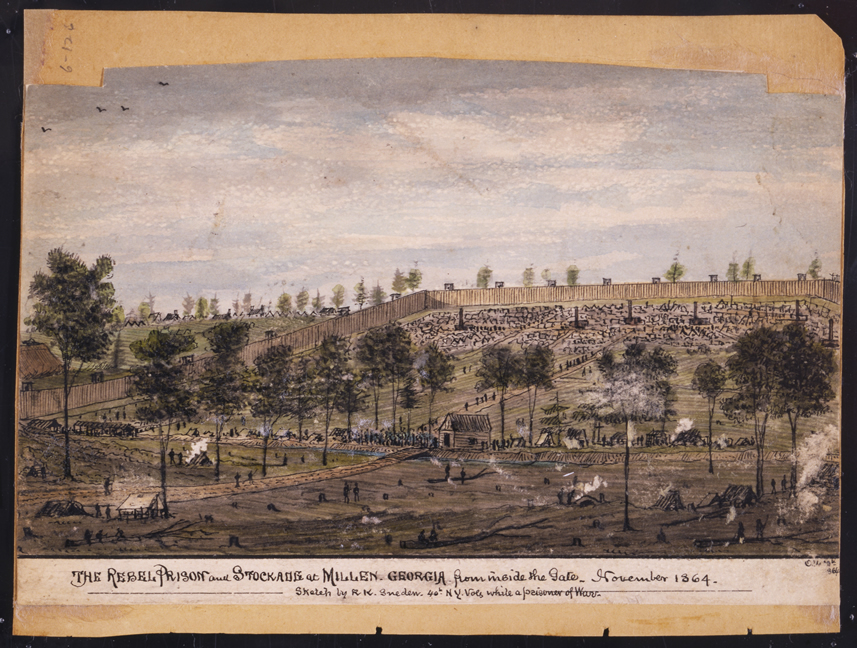
Contemporary illustration of Camp Lawton by Robert Sneden, a Union soldier who was incarcerated here. Courtesy of the U.S. Fish and Wildlife Service.
In this sordid history, Andersonville Prison in West Central Georgia is the most tragic tale and the prison’s site has been spiritually scarred with many spirits still roaming the piney landscape. While it was possibly the worst of these horrendous prisons, Andersonville is not the only one to mar the Southern landscape. Camp Lawton, near the eastern Georgia town of Millen, was one of the largest prison camps erected by the Confederates. Encompassing some 42 acres, the camp was constructed in 1864 and used for only three months.
It was built to house 40,000 prisoners but in its short lifespan only held about 10,000 prisoners in conditions that were far better than Andersonville. However, there were about 500 deaths in the camp during its service. When Sherman found the camp during his march from Atlanta to Savannah in 1864, he burned it to the ground along with Millen. The site of the camp is now part of Magnolia Springs State Park.
Employees have reported spirits in the park, particularly around one of the cabins occupied by park staff. One manager reported being awakened by a uniformed apparition standing at the end of his bed. Another staff member approached the cabin and saw a face peering out one of the windows at him when he knew the house was empty. At night, staff members have reported that they get the feeling of being followed or watched.
Sources
Wilkinson, Chris. “Civil War Prisons.” New Georgia Encyclopedia. 9 September 2014.
Miles, Jim. Civil War Ghosts of Central Georgia and Savannah. Charleston, SC: History Press, 2013.
Hayswood Hospital West Fourth Street at Market Street Maysville, Kentucky
The large Neo-Classical building crowns a hill above West Fourth Street and turns its face towards the majestic Ohio River beyond the city’s downtown. It’s obvious that the building has been long abandoned. Windows stand open like empty eye sockets while other closed windows hold broken panes that stare jaggedly towards the river. Along the first floor, plywood covers the windows and doors, a thin barrier to intruders, both human and natural.
Hayswood Hospital has endured a long jag of bad luck since its closure in 1983. Just last year, the building was almost sold to collect on a nearly $6,000 unpaid tax bill, but at the last minute, the sale was withdrawn. Nearly a decade after its closure, the building was purchased with the intent of renovating it into apartments, though that has fallen through. In 1999, a condemnation order was placed on the structure requiring the owner to either demolish or renovate the building, but nothing has come of that. The order still stands like a death sentence over a weary prisoner.
Not only is the crumbling building a blight on the city’s face, but asbestos and lead paint within the building are a danger to the health of the community. The blight also attracts vandals and thieves including the two men who were arrested in the building as they tried to steal copper wiring. In addition to the health dangers, the building’s falling ceilings and weak floors are a physical danger to the curious who decide to investigate the building.
With the constant stream of legends flowing forth from abandoned (and even not so abandoned) medical facilities, it’s no surprise to hear that Hayswood has many of its own stories. Nothing about the reports of apparitions and voices provided in the article from the blog Most Haunted Places in America is particularly unusual. The blog reports apparitions throughout the building including that of a woman holding a baby in the old maternity ward.
A video posted on YouTube on Halloween 2006 purportedly shows a spirit in the building. The very grainy video taken of the exterior of the building at night shows a white figure appearing in one of the windows. The videographer focuses in on the figure and it appears to take on the features of a very large face then quickly vanishes. Personally, something doesn’t really look right about the video, but I cannot positively describe it as fake.
The grand hospital was constructed in 1915 and served the community well. The 87 bed hospital was bought by Hospital Corporation of America (HCA) in 1981 and it was closed when a new facility was opened nearby. The building remains in its uneasy slumber awaiting its fate and comforted only by the occasional spirit from its past.
The Hayswood Hospital building is closed to visitors, trespassers will be prosecuted.
Sources
Barker, Danetta. “Out of the hospital and into custody: Police make arrests at Hayswood.” The Ledger Independent. 22 September 2005.
“The Haunted Hayswood Hospital.” Most Haunted Places in America. 18 June 2012.
Maynard, Misty. “Video of ‘ghost’ at Hayswood Hospital getting planty of attention.” The Ledger Independent. 22 October 2007.
Toncray, Marla. “For Sale: Hayswood Hospital.” The Ledger Independent. 22 March 2013.
Toncray, Marla. “Hayswood sale plan halted.” The Ledger Independent. 26 April 2013.
Juju Road Off of Swan Lake Road Bossier City, Louisiana
Depending on the version of the legend, his crime ranged from simply looking at a white woman to the murder of two children who were simply fishing. Regardless, legend holds that he took his final breath somewhere along the road that still bears his name and possibly his lingering spirit. His name is said to be “Juju” or more properly “Juju Montgomery” in various versions of the legend, regardless, his name has been applied to this lonely country road outside Bossier City.
Like the countless cry baby bridges and haunted lovers lanes, the old dirt road is a popular hangout for local residents looking for a scare. Online accounts of the haunting describe people encountering the figure of an African-American man standing in the road or hanging from one of the trees with a rope around his neck.
Local paranormal enthusiasts, Marie Edgerly, her husband and son have formed a group called Louisiana Paranormal Addicts which explored Juju Road during the day. While they describe the location as “eerie,” they did not have any direct experiences with the spirit. Arriving home after their investigation, however, they were startled to discover a shadowy human form in one of their photographs from this location. Is it Juju?
Sources
Edgerly, Marie. “Juju Road.” Louisiana Paranormal Addicts. 31 October 2014.
Patton, Devon. “A Bossier Parish Ghost Story.” 29 April 2014.
Edgar Allen Poe House & Museum 203 Amity Street Baltimore, Maryland
Of course the home to Baltimore’s favorite son of creepiness is haunted! Why would anyone think otherwise? When Vincent Price, one of the modern masters of creepiness, visited this house he said, “This house gives me the creeps.”
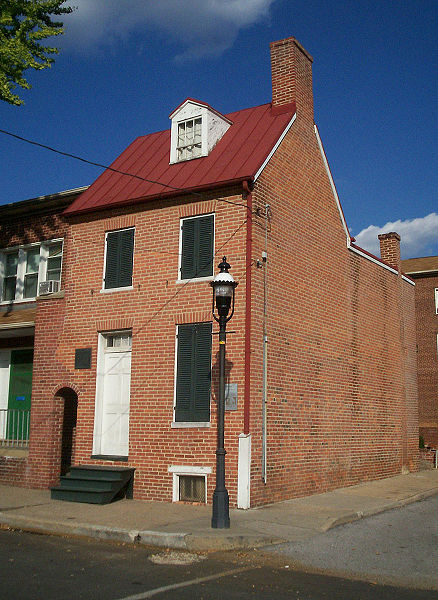
Edgar Allen Poe was born in Boston and lived intermittently in a number of cities including Baltimore where he would ultimately die in 1849. There are a few buildings where he lived that remain, including this small, unassuming house in Baltimore where Poe lived for about two years. The house had been rented by Poe’s aunt, Maria Clemm, in the spring of 1832 and was occupied by her daughter, Virginia, and his grandmother. Poe probably moved in the following year and he used the garret room at the top of the house for his writing. He would remain in these cramped quarters until 1835.
Edgar Allan Poe House, 2007. Photo by Midnightdreary, courtesy of Wikipedia.
Over the years that the house has operated as a museum, some visitors have had unusual experiences, among them the feeling of being tapped on the shoulder by an unseen entity. In the mid-1980s, an actress preparing for a performance in the house had a scary encounter. As she was dressing, she noticed that the window sash was moving in the frame, then was shocked when the sash flew out of the frame and landed at her feet. A 2012 investigation by the Pennsylvania-based Ghost Detectives did turn up some odd voices on the team’s voice recorders.
Sources
Hayes, Anthony C. “Ghost Detectives investigate ghostly voices inside the Edgar Allan Poe House.” Baltimore Post-Examiner. 16 July 2012.
Hayes, Anthony C. “Is the Edgar Allan Poe House haunted?” Baltimore Post-Examiner. 11 May 2012.
Hutchisson, James M. Jackson, MS: University Press of Mississippi, 2005.
Mendinghall, Joseph S. National Register of Historic Places nomination form for the Edgar Allan Poe House. 11 November 1971.
Okonowicz, Ed. Baltimore Ghosts: History, Mystery, Legends and Lore. Elkton, MD: Myst and Lace Publishers, 2006.
Kuhn Memorial Hospital 1422 Martin Luther King, Jr. Boulevard Vicksburg, Mississippi
A Haunted Southern Book of Days–6 February
This article is a part of an occasional blog series highlighting Southern hauntings or high strangeness associated with specific days. For a complete listing, see “A Haunted Southern Book of Days.”
In a recent series on haunted Mississippi for Jackson, Mississippi’s The Clarion-Ledger, reporter Therese Apel remarks that she heard “completely improbable stories from completely sane people.” While researching for the series, Apel explored the deteriorating carcass of Kuhn Memorial State Hospital and had an improbable experience of her own. On the dusty top of an autopsy table a finger—possibly spectral—had spelled out “pleh,” the word “help” backwards.
The oldest part of this hospital was built in 1832 following an epidemic of smallpox that swept the area. In 1871, the state took over operations of the hospital rendering it a charity hospital for all those in need. During an outbreak of yellow fever in 1878, the dreaded mosquito-borne virus claimed the lives of some sixteen doctors and six Sisters of Mercy working here.
A modern wing was added to the building in 1959. The hospital faithfully served the citizens of Vicksburg and the surrounding area until the state cut funding and the hospital closed in 1989. The building has deteriorated under absentee owners for the past twenty-five years, visited only by urban explorers, filmmakers and ghost hunters. It was during a film shoot here that filmmakers may have unwittingly caught a voice exclaiming “oh my God,” upon the appearance of an evil clown, the film’s protagonist.
Further paranormal investigations of the facility have uncovered a plethora of voices in this most haunted of hospitals.
Sources
Apel, Therese. “Creepy phenomena recorded at abandoned hospital.” The Clarion-Ledger. 30 October 2014.
Apel, Therese. “Haunted Mississippi: Where are the most spiritually active places in the state?” The Clarion-Ledger. 22 September 2014.
Associated Press. “Owner of former hospital given deadline.” Mississippi Business Journal. 29 September 2013.
Russell, Randy. The Ghost Will See You Now: Haunted Hospitals of the South. Winston-Salem, NC: John F. Blair, 2014.
Stagville State Historic Site 5828 Old Oxford Road Durham, North Carolina
While psychic and author Kala Ambrose was visiting Stagville as research for her book, Ghosthunting North Carolina, she took a moment, sat quietly and opened herself up in hopes of communicating with a spirit or two. Instead, she found herself thronged by them. She described it in her book, “the crowd of people was so large that I couldn’t see all of their faces. Instead, I felt the pressure of all of their bodies coming closer to me wanting to talk.”
Bennehan House at Stagville, 2008. Photo by Cotinis, courtesy of Wikipedia.
One of the largest plantations in the South at its height, ghost stories have been a mainstay of Stagville Plantation for many years. Neighbors have reported strange lights on the property as well as screams in the night. The apparitions of an African-American girl and a group of African-American men have been reported near the Great Barn. The fire department has been summoned several times by reports of the slave quarters being ablaze. Upon arrival, there is no evidence of fire. Staff working in the remaining buildings have found that doors open and close and lock and unlock on their own. The site has been investigated by a number of groups who have captured a number of EVPs there.
The property itself has been the scene of much history. There is evidence of inhabitation by Native Americans and their possible burial on the site. Ambrose states that the remains of settlers have been found bearing evidence of attack from Native Americans. In the mid-19th century, this land was part of the huge holdings of the Bennehan and Cameron families and consisted of some 30,000 acres that were worked by some 900 slaves. Stagville State Historic Site preserves about 71 acres of the original plantation along with a number of remaining buildings and ruins.
Sources
Ambrose, Kala. Ghosthunting North Carolina. Cincinnati, OH: Clerisy Press, 2011.
Haunted North Carolina. “Historic Stagville.” Accessed 12 December 2014.
McDonald, Glenn. “Go ghost hunting with Haunted NC.” Indy Week. 22 October 2014.
Stagville. Wikipedia, the Free Encyclopedia. Accessed 12 December 2014.
Longstreet Theatre Campus of the University of South Carolina Columbia, South Carolina
The building housing the Longstreet Theatre at the University of South Carolina has seen a good deal of joy and a great deal of sorrow. According to the 1941 WPA guide to the state, the 1855 building has twice been pressed into service as a hospital: between 1862 and 1865 during the Civil War and then again in 1918 during the horrible influenza epidemic that swept the world. Legend holds that the room that is used as the theatre’s green room, where actors relax when they’re not onstage, was utilized as the hospital morgue during the Civil War.
To “ward off the Civil War ghosts,” according to a 2011 article from the student newspaper, The Daily Gamecock, students now employ a “buddy system” in the building. This may very well be a good idea as it seems that many of the reports of activity seem to stem from people who find themselves alone in the building. A secretary had her glasses “slapped off” her face as she walked through the building late one afternoon. “There was no one in the building but me, but I felt an impact on my face and my glasses flew off,” she told a reporter later.
A student was quoted as having a feeling of being watched while she was in the green room and then having the sensation of having “a wall of cold air being pushed across and around her.” Other students tend to get a very creepy feeling or even feel vibrations within the ancient structure. However, most students and professors take the spirits in stride. Alan Brown quotes a theatre professor, “I love to tease students and tell them the ghosts are real friendly unless you’re a Yankee.”
Sources
Brown, Alan. Haunted South Carolina. Mechanicsburg, PA: Stackpole Books, 2010.
Carmichael, Sherman. Eerie South Carolina. Charleston, SC: History Press, 2013.
Ellis, Sarah. “Ghost tours highlight USC’s haunted history.” The Daily Gamecock. 28 October 2011.
Kearns, Taylor. “The phantom of Longstreet Theatre?” Carolina Reporter & News. No date.
Mitchell, Wes. “Ghosts and legends plentiful on USC campus.” Carolina Reporter & News. No date.
Steimle, Douglas. “The Ghosts of Longstreet Theatre.” com. 31 October 2011.
Workers of the Writers’ Program of the WPA. South Carolina: A Guide to the Palmetto State. NYC: Oxford University Press, 1941.
Baker-Peters Jazz Club 9000 Kingston Pike Knoxville, Tennessee
It’s not hard to imagine that soldiers throughout the Civil War began to quickly feel their own mortality. As they lay wounded in the homes and taverns, churches and barns that had been hastily converted into hospitals throughout the nation, many scratched their names into adjacent plaster walls and floorboards, perhaps in hopes of gaining some type of immortality. With so much of this graffiti obliterated by the buildings caretakers and time, these exercises into immortality have become increasingly rare, despite their importance to historians and the residents of the modern age.
Graffiti House, 2013. Photo by Cecouchman, courtesy of Wikipedia.
Built near a small railroad stop on the Orange & Alexandria Railroad, Graffiti House was built by James Barbour in 1858 as a residence and possible commercial building. As battles raged around Virginia, Mr. Barbour’s building was converted into a hospital and the patients began to scrawl on the walls of the structure. In June of 1863, the war that had been trickling into the community until then arrived as a deluge when Brandy Station was the scene of the largest cavalry battle fought on American soil.
The graffiti was only rediscovered in the early 1990s and the building was later purchased by the Brandy Station Foundation, an organization devoted to preserving the local battlefield and associated sites. But it’s not just graffiti that remains in the building, spirits are still active as well. A handful of paranormal investigation organizations have investigated Graffiti House and captured evidence.
A reporter from The Free Lance-Star in nearby Fredericksburg in 2007 observed a paranormal investigation by the Virginia Paranormal Institute. About an hour into the investigation he was apparently touched by something while an investigator had something grab her hand. During a more recent investigation by Transcend Paranormal, video of an anomalous light in an empty room was captured. The video is available on YouTube.
Sources
Johnston, Donnie. “What was that touching my back?” The Free Lance-Star. 23 November 2007.
Neville, Ashley and John S. Salmon. National Register of Historic Places Nomination form for Graffiti House. June 2005.
Old Biomedical Research (CREST) Building
Louisiana Tech University 711 South Vienna Street
If a building can resemble a person, then the CREST Building’s white brick and severe lines resemble the old fashioned, white-clad nurses of days gone by: stiff, strict, and starched. Author Jeanne Frois ascribes a more sinister appearance to the building’s windows as looking “like hollow eye sockets holding an empty presence within.”
Perhaps these nurses are still patrolling the halls of this former hospital. The building opened in 1928 as the Ruston-Lincoln Sanitarium. At that time, the morgue was located on the first floor with the hospital’s surgical suite located on the fourth floor. In 1963, the facility was transformed into a nursing home and served that purpose until the 1970s, when it was turned over for use by Louisiana Tech.
While the academic faculty and students are working to improve the lives of the disabled, it seems that the old nursing staff may continue to check up on them as well. In a 2007 article from the university’s newspaper The Tech Talk, one staff member reported that she believes the spirit may be the nursing home’s former director of nurses. According to the article, this woman had an apartment on the fourth floor so that she could respond quickly if there was a problem. This particular staff member worked under this nursing director whom she describes as “never mean,” though she was “strict and firm; she was a stickler for every detail.” She told the newspaper that, “She had a good heart, though, the patients all loved her, and the doctors loved her because she kept the patients happy.”
Perhaps this devoted nursing director has maintained her devotion in the afterlife, though none of the reports of paranormal activity point to a specific spirit haunting the building. The activity is varied and most commonly includes the sound of doors opening and closing. One staff member working in the building after hours heard the sounds of doors opening and closing all up and the down the hall on the fourth floor. Annoyed and curious, he checked all the doors on the hall to find them all closed and securely locked.
Electronic equipment also sometimes has odd issues. One student watched as a printing calculator began to print random numbers. Another person put fresh batteries in a number of toys in preparation for young patients only to find the batteries drained the next day.
There are also issues with the elevator which regularly makes the journey from the first floor to the fourth floor without being called. In his recently published book, The Ghost Will See You Now: Haunted Hospitals of the South, Randy Russell states that the ghost will often open the doors to anyone carrying doughnuts. It’s an absurd notion, but in the world of the paranormal, anything can happen.
UPDATE: It seems that Louisiana Tech has moved it’s Center for Biomedical Research to a new building on its campus. The old hospital building it once occupied is currently for sale.
Sources
Frois, Jeanne. “Around Louisiana: Northern Louisiana.” Louisiana Life. September-October 2009.
“History: Building.” Louisiana Tech University. Accessed 10 November 2014.
Jones, Davey. “Frightening encounters flourish in old Biomedical Engineering Building. The Tech Talk. 25 October 2007.
Russell, Randy. The Ghost Will See You Now: Haunted Hospitals of the South. Winston-Salem, NC: John F. Blair, 2014.
In celebration of Halloween, I’m exploring 13 haunted restaurants throughout the South. This article has two companion pieces exploring haunted hotels, inns, and bed & breakfasts: “13 Southern Rooms with a Boo” and “13 More Southern Rooms with a Boo.”
Trowbridge’s Ice Cream Bar 316 North Court Street Florence, Alabama
Walking into Trowbridge’s, one can certainly get a sense of stepping back in time. With a checkerboard floor, mint green upholstery and food prepared using original recipes; the restaurant seems to be a holdover from the first half of the 20th century. But there is something else at Trowbridge’s that hearkens back to an earlier time: a spirit from the Civil War.
Trowbridge’s opened in 1918 primarily selling ice cream and eventually serving sandwiches and hot dogs at its lunch counter. The site where Trowbridge’s would eventually stand was originally occupied the home of the Stewart family. During the Civil War, Charles Daniel Stewart left his family’s home carrying the Confederate banner for the Florence Battalion. It was that same flag that Stewart was bearing when he was wounded during the First Battle of Manassas, one of the first serious engagements of the Civil War.
The young standard bearer lived for almost a month after being wounded in the battle. Restaurant staff members in the building that now occupies the site of his home have seen a young man within the restaurant. He’s most often seen briefly in passing but when the viewer turns he has vanished. Perhaps Stewart’s spirit just enjoys the shakes.
Sources
Johnston, Debra. Skeletons in the Closet: True Ghost Stories of the Shoals Area. Debra Johnston, 2002.
Wok and Roll Chinese and Japanese Restaurant 604 H Street, NW Washington, DC
While Charles Daniel Stewart may have to develop a taste for milkshakes and hot dogs, the spirits of Mary Surratt and the conspirators involved in the assassination of Abraham Lincoln may have to develop a taste for General Tso’s Chicken and sushi. Wok and Roll Chinese and Japanese Restaurant is housed in the building that once housed Mrs. Surratt’s Boarding House where the conspirators met in the days leading up to Lincoln’s fateful night at Ford’s Theatre. Legends tell of spirits still flitting through the historic structure.
The building was constructed in 1843 as a single-family residence. Mary Surratt’s husband, John, purchased the property in 1853 and rented the building while he constructed a tavern at a crossroads in nearby Prince George’s County, Maryland. He was later named postmaster of the community that formed around his family’s tavern. After the outbreak of war, John Surratt passed away leaving his wife and family in somewhat dire financial straits. John’s son, John Junior was named postmaster in his father’s place, but he was arrested about two years later for working as a mail courier for the Confederacy with whom he sympathized.
The Surratt Boarding House, 1890, by Matthew Brady.
After the arrest of her son and being deprived of his income as a postmaster, Mary Surratt moved her family to their Washington home while she rented the family’s Maryland tavern. The family began taking on boarders and was drawn into the conspiracy to kidnap the president. To what extent Mary Surratt was involved is still rather unclear, but in the roundup that followed John Wilkes Booth’s shooting of Lincoln at Ford’s Theatre, Mary was arrested and charged in the conspiracy. She was tried before a military tribunal and subsequently found guilty.
Even after she was found guilty, many requested that she be pardoned including her daughter, Anna. Mary Surratt was executed on the hot summer afternoon of July 7, 1865, along with three of the conspirators; the first woman executed by the Federal Government. After her execution, Mary Surratt’s Boarding House was attacked by a mob which began to strip the building for souvenirs before they were stopped by police.
Wok & Roll Restaurant now occupies the old Surratt Boarding House. Photo 2008, by Leoboudv. Courtesy of Wikipedia.
Anna Surratt sold her mother’s boarding house not long after the execution and subsequent owners reported that they encountered “muffled sounds,” whispers and sobs. When John Alexander was putting together the 1998 edition of his book on Washington ghosts, he met with the owner of the Chinese grocery that existed in the building at that time. The Chinese grocer replied that he “had no complaints.”
Sources
Alexander, John. Ghosts, Washington Revisited: The Ghostlore of the Nation’s Capitol. Atglen, PA: Schiffer, 1998.
Mary Surratt. Wikipedia, the Free Encyclopedia. Accessed 4 November 2014.
Pousson, Eli. National Register of Historic Places nomination form for the Mary E. Surratt Boarding House. May 2009
Ashley’s of Rockledge 1609 US 1 Rockledge, Florida
Some believe that Ethel Allen’s rough road to her grave included a stop at Jack’s Tavern, her favorite local hangout. Last year, I wrote about paranormal investigators conducting an EVP session at Ms. Allen’s grave in the Crooked Mile or Georgiana Cemetery on Merritt Island. After asking if she was present, investigators received a reply, “yes.”
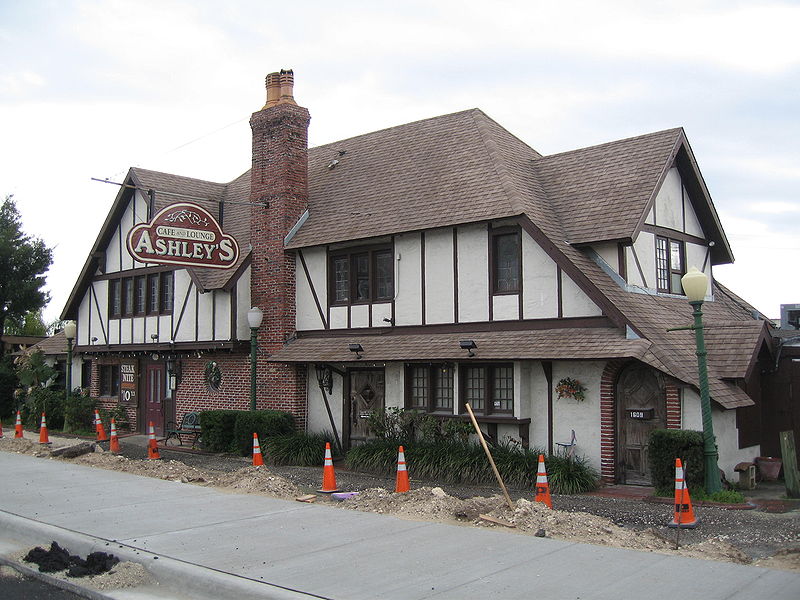
On November 21, 1934, Ethel Allen’s mutilated body was found on the banks of the Indian River in Eau Gallie, some 16 miles away. The nineteen year old had been seen just a few days before when she stopped at a local packing house to say goodbye to a friend. Ethel was leaving to visit her mother, accompanied by a male acquaintance and she may have also stopped by her favorite local hangout, Jack’s Tavern, now Ashley’s of Rockledge. The Tudor-style restaurant has paranormal activity, some of which has been attributed to Ethel Allen.
Ashley’s, 2010, by Leonard J. DeFrancisci. Courtesy of Wikipedia.
A variety of sources state that Ethel may have been murdered within the walls of the restaurant in a storeroom (possibly near the famously haunted ladies restroom) or just outside the building. A local genealogy blog makes no mention of where Ethel may have met her end, but I get the feeling it probably was not in or around the busy tavern. The stories of the restaurant’s haunting are quite readily available though they seem to sometimes perpetuate different variations of the murder.
The activity runs the gamut from simple, cold breezes being felt to voices and screams to full apparitions being seen and captured on film. Some sources also note that the activity does not seem to be limited to just the possible shade of Ethel Allen. There are other possible spirits including a child and an adult male. It does seem that Ashley’s may be one of the most paranormally active restaurants in the state.
Walls, Kathleen. Finding Florida Phantoms. Global Authors Publications, 2004.
Tondee’s Tavern 7 East Bay Street Savannah, Georgia
With the immense host of spirits that inhabit the city of Savannah, chances are high that activity may be found most anywhere. Occupying part of a mid-19th century bank building, Tondee’s Tavern utilizes the name of a important colonial era tavern that existed in the city. The building’s history dates to 1853 when its lower floors were occupied by the Central Railway and Banking Company. The upper floors of the building were used as offices for a slave dealer, Joseph Bryan.
Stories of spirits within the building have evidently existed for some time, but the spirits made themselves very well-known recently. In late June of this year, a passerby on the street left a cigarette in a flower box in front of the building. The cigarette smoldered for a few hours before erupting into flames early in the morning. Meanwhile, two employees slept downstairs; a fairly common practice when employees close the previous night and must open the next day.
A closed-circuit security camera picked up the scene at the front of the restaurant. Over the course of two hours, as the flames can be seen building outside the window, a number of white orbs are seen almost frantically zipping through the air. Something woke the two young women asleep in the basement and they were able to begin extinguishing the flames before they could do more damage. The tavern’s owner, however, is still wondering if the orbs were spirits trying to save the building and his business.
Jailhouse Pizza 125 Main Street Brandenburg, Kentucky
In a fairly creative use of a historic building, the old Meade County Jail is now a pizzeria. Built in 1906 by the Pauly Jail Company, this building was the third jail built for Meade County. The pizzeria’s website states that some of the inmates have apparently never left, including one who has been dubbed, “Bigsby.” These spirits have been both seen and heard.
Old Meade County Jail, 2011, by Nyttend. Courtesy of Wikipedia.
A recent investigation by the Hopkins County Paranormal Society was able to capture, what one investigator calls, “the best evidence ever.” Video taken during the investigation shows a blanket being pulled out and down. Audio evidence was also captured that includes footsteps, a scream and possibly a female child.
Sources
“History.” Jailhouse Pizza. Accessed 31 October 2014.
Johnson, William G. Kentucky Historic Resources Inventory form for Meade County Jail. Summer 1983.
Landon, Heather. “Best Creepy Historic Sites in the US.” The Daily Meal. 14 October 2014.
Antoine’s 713 St. Louis Street New Orleans, Louisiana
Antoine’s, 2007 by Infrogmation. Courtesy of Wikipedia.
Antoine Alciatore, like so many Europeans at that time, dreamed of making it big in the United States and immigrated in 1838 to make good on those dreams. After a couple years of struggling in New York City, he set his sights on that most French of cities, New Orleans and this is where he opened Antoine’s. In 1868, the restaurant moved to its current location that now boasts 14 unique dining rooms. Alciatore left New Orleans in 1874 bound for Marseilles where he died; his beloved restaurant was left in the hands of his son and his family has continued to own and run the restaurant. Antoine continues to return to check up on this famed New Orleans institution and he continues to be seen in the Japanese and Mystery Dining Rooms. Other specters in 19th century clothing have been seen peering from the mirrors in the washrooms as well.
Sources
Dwyer, Jeff. Ghost Hunter’s Guide to New Orleans. Gretna, LA: Pelican, 2007.
Antoine’s Restaurant. Accessed 8 January 2011.
Puccini Restaurant 12901 Ali Ghan Road, NE Cumberland, Maryland
At Puccini, patrons may get a bit of the paranormal with their pasta. With your fettuccini, you may hear disembodied footsteps or perhaps there may be some voices heard as you enjoy your vino. Don’t mind them, they won’t hurt you.
The building now housing Puccini was near fighting on August 1, 1864 as Confederates were defeated in the Battle of Folck’s Mill. Many of the wounded were brought into the George Hinkle house (as it was known at that time) where they were treated. Of course there may also have been a few deaths in the house during that time. Some of those soldiers may have also written or carved their names on the walls in the attic.
Employees of the restaurant as well as guests have reported quite a bit of activity over the years. From footsteps to shadow figures to full apparitions, people in this building have had many experiences. The restaurant was investigated a few years ago by member of the team from City Lights Paranormal Society of Easton, Pennsylvania. The investigators were able to capture a good deal of audio evidence including a number of EVPs.
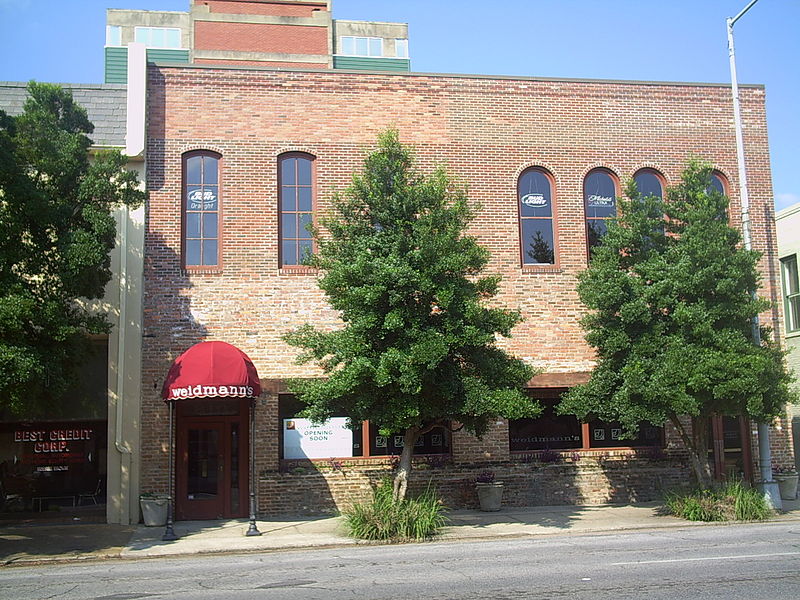
Like Antoine’s in New Orleans, Meridian’s Weidmann’s restaurant was also started by an immigrant and has become a local institution after more than a century. Weidmann’s was opened by Felix Weidmann, a Swiss immigrant. While Antoine’s has remained in the same location, Weidmann’s location changed a number of times before it settled into a location in 1923.
Weidmann’s, 2010, by Dudemanfellabra. Courtesy of Wikipedia.
The haunting of Weidmann’s seems to be mostly residual activity. Sounds echo through the restaurant with no obvious source. For his 2011 book, Haunted Meridian, Mississippi, Alan Brown spoke with one employee who recalls hearing sounds associated with livestock near the restaurant’s freezers where livestock may have been kept before Weidmann’s moved in. But animal sounds are just a small part of the repertoire associated with the spirits of Weidmann’s.
At table one, a legend is oft told of a young couple visiting the restaurant during the Great Depression. The couple had recently become engaged and had enough money to treat themselves to a meal in the restaurant. Henry Weidmann, the restaurant’s owner at the time, picked up the tab and encouraged the couple to return for their first anniversary. The legend continues that the young couple did not return to their table in the restaurant in life, but they have continued to return in death. They are supposed to be seen on occasion sitting quietly at the table holding hands under the table.
Sources
Brown, Alan. Haunted Meridian, Mississippi. Charleston, SC: History Press, 2011.
Four Square Restaurant 2701 Chapel Hill Road Durham, North Carolina
Bartlett Mangum built his house in 1908 on the outskirts of Durham and the house is now the only part of his 80-acre farm that has remained standing. The house remained in the family until Mangum’s daughters were moved to a nursing home in 1956. The house passed through a variety of owners who rented out the house or used it for commercial purposes including a variety of restaurants. During the early 1960s, the house was even used as a racially-integrated church.
The Mangum daughters, Inez and Bessie, inherited the house in 1927 and tradition holds that they did not speak to each other for many years due to a feud. According to an article by Colin Warren-Hicks in the local progressive paper, Indy Week, restaurant staff believes that the spirit of Inez Mangum still flits about her old house. Cooks in the kitchen reported to Warren-Hicks that pots and pans would move on its own accord. Dinner and glassware left on a certain mantelpiece in one of the restaurant’s dining rooms would often be inexplicably knocked to the floor.
UPDATE 4/23/2018: Four Square has closed.
Sources
Dickinson, Patricia S. National Register of Historic Places nomination form for Bartlett Mangum House. 5 December 1988.
Warren-Hicks, Colin. “The Devil went down to Four Square Restaurant.” Indy Week. 22 October 2014.
Connolly’s Irish Pub 24 East Court Square Greenville, South Carolina
This unassuming Irish pub in downtown Greenville, South Carolina is a front for a secret. Just outside the pub and behind the street door that provides access to this old commercial building’s second floor is an unused floor that is supposed to have served as a brothel some years ago. A recent investigation of this building by local investigator and ghost tour operator Jason Profit produced video of small orbs of light flitting through the corridor.
It’s my sincerest hope that the victims of the horrible event that happened here in 1997 are at rest; they most certainly deserve to be. On March 23, 1997, Paul Dennis Reid forced his way into this McDonald’s at closing time. After shooting three of the employees, he stabbed a fourth employee seventeen times before leaving with the restaurant’s money. The three shooting victims died while the stabbing victim survived. Just a month before, Reid had robbed a nearby Captain D’s brutally shooting and killing two employees. Before he was captured by the police, he managed to kill a total of seven people, all fast food employees. Reid passed quietly in prison just last year.
According to the Nashville Haunted Handbook, published in 2011, this restaurant has been plagued by a general sense of unease as well as shadow figures. After viewing this location on Google Streetview, it appears that this McDonald’s location may have a new building—the chain has been tearing down older restaurants and replacing them with new buildings. Though, since the building has been replaced, it is unknown whether this activity has persisted.
Sources
“2 Slain at Nashville McDonald’s.” Chicago Tribune. 24 March 1997.
Morris, Jeff; Donna Marsh and Garett Merk. Nashville Haunted Handbook. Cincinnati, OH: Clerisy Press, 2011.
Wilson, Brian. “Tennessee mass murderer Paul Dennis Reid dead.” 1 November 2013.
Coffee Pot 2902 Brambleton Avenue, SW (US 221) Roanoke, Virginia
Just who or what is causing the odd activity at Roanoke’s landmark roadhouse, The Coffee Pot, is still a question. Primarily, the activity generally involves the movement of objects. One bartender was cleaning ashtrays and stacking them on the bar one evening after the restaurant had closed. They had already stacked a number of ashtrays when they witnessed the stack rise into the air and then drop back down on the bar. Startled, she returned to work only to have the stack of ashtrays rise and fall again. After that, she grabbed her things and left.
The Coffee Pot, 2009, by Patriarca12. Courtesy of Wikipedia.
A manager noted that spices would often disappear from their accustomed spot only to reappear in a very different location sometimes days later. Bottles of wine and other cooking utensils have been known to fly across rooms, while paranormal investigators have been able to photograph orbs and have captured EVPs within the restaurant.
The Coffee Pot, with its distinctive large coffee pot, was constructed in 1936 along what had been a fairly rural road. Over time, US 221 has grown along with the restaurant’s business. As a roadhouse, the restaurant has become known for its musical entertainment including Willie Nelson who played an impromptu concert at the restaurant in 1970s.
Sources
Hill, Helen. National Register of Historic Places nomination form for The Coffee Pot. December 1995.
Hurst, Chris. “Looking for ghosts at The Coffee Pot in Roanoke.” 24 October 2010.
Taylor, L. B. Jr. Haunted Roanoke. Charleston, SC: History Press, 2013.
Yellow Bank Restaurant 201 East German Street Shepherdstown, West Virginia
In the historic town of Shepherdstown, the 1906 Jefferson Security Bank now houses the Yellow Bank Restaurant. The bank was converted to a restaurant some years ago and now houses the restaurant where table 25 was the scene of some activity in the 1990s when a patron reported to the restaurant’s manager that she couldn’t sit at the table because of the ghost. The bartender also reported that he had glasses fall from the glass rack and break.
UPDATE 4/23/2018: Yellow Bank Restaurant has closed.
Sources
Molenda, Rachel. “Town serves as home to ghosts from past.” The Shepherdstown Chronicle. 28 October 2011.
This article was originally published on 18 December 2012. This is a rewrite and edit.
Myrtles Plantation 7747 US Highway 61 St. Francisville, Louisiana
I’ve tried to avoid writing about The Myrtles for some time. Certainly of famous haunted properties in the United States—if not the world—The Myrtles ranks very high, if not at the top. There is plenty written about this location, almost to the detriment of other hauntings nearby. As it is now the Halloween season, The Myrtles has been popping up frequently in articles recounting various authors’ versions of the top hauntings in the country.
It seems that every book about American ghosts includes this haunting while it has become a mecca for ghost hunting organizations. Nearly every paranormal reality show has also featured the location. The Myrtles may very well be one of the best-documented hauntings of our time. So why avoid it?
Interestingly, one of the pieces that got me into writing about ghosts is an article about The Myrtles. It appears in Troy Taylor’s 2001 book, The Haunting of America. When I first encountered Taylor’s piece on The Myrtles, I presumed it to be a straightforward exploration of this most famous of hauntings. It’s not a straightforward profile of hauntings and it’s not exactly the haunting that he’s concerned with; it’s the history. Taylor’s piece reads like a newspaper expose as he uncovers the reality behind The Myrtles.
The Myrtles, 2005, by Bnet504. Courtesy of Wikipedia.
Southerners are natural storytellers, but they enjoy hearing a good story just as much. One only has to witness the long line of Southern storytellers and writers to see this fact: from Joel Chandler Harris to Tennessee Williams, and Eudora Welty to dear Kathryn Tucker Windham, the South has had more than its fair share of gifted storytellers. But, as Taylor (a Yankee from Illinois, bless his heart) states early in the piece, “some of the people who have owned the house have never let the truth stand in the way of a good story.” This is certainly a sentiment found throughout the South.
The stories that are told about The Myrtles are fraught with tragedy. According to guides, some ten murders have taken place within the confines of the home. The most famous of these is the tale of a slave, Chloe. Amongst the enslaved people on plantations there was a hierarchy; with the house servants—those that worked directly with the family—being the most important but also the longer lived slaves than those toiling in the heat of the fields. Chloe was one of the more fortunate slaves, working in the house and helping care for the children of Clark Woodruff, the owner of Laurel Grove (as The Myrtles was called at that time). According to legend, she was also on intimate terms with Mr. Woodruff and possibly a guest of his bed.
Continuing the legend, Mr. Woodruff began to make advances towards another slave, and Chloe feared that she would be banished to the fields (and certain death). Soon, she was listening at the doors hoping to learn of her fate. It was there that she was caught by Mr. Woodruff and as punishment, one of her ears was cut off. Afterwards, she began wrapping a long green cloth around her head like a turban to cover her shame.
Chloe then devised a plan to endear herself to the Master and his family. She would poison the master and his family, and then miraculously cure them. She baked a cake containing the poison of oleander leaves, but the master did not eat it. However, his pregnant wife and two young daughters did, and all three died. For her misdeeds, Chloe was hung in one of the ancient oaks on the property by an angry mob. Along with the spirits of her victims, Chloe’s green-turbaned spirit still supposedly walks the property.
This story is marvelous and operatic in proportions. But, sadly, it is just that, an antebellum soap opera. Troy Taylor dug into the records of the families who owned The Myrtles and found no record of a slave with that name. The victims in the story: Clark Woodruff’s pregnant wife and her two children: a boy and a girl, not two daughters as the tale recounts, did not die from poisoning and lived long, fruitful lives. Most likely they did eventually pass in the home, though, which might easily add their spirits to the spiritual jambalaya that may exist at this property.
More digging by Taylor produced the facts that most of the other tales of murder are also the product of great Southern storytellers, with the exception of the murder of William Winter who was shot and killed at the home in 1871.
In cases where the history is debunked, that often debunks the haunting as well. In the case of The Myrtles, however, I don’t believe that is so. It appears there may be quite a bit of activity within this home. Another piece of which may have been captured recently.
While taping a story for WGNO, the ABC affiliate serving the New Orleans area, something appears on tape behind reporter Vanessa Bolano. The video segment is a “stand up” filmed in the French Room of the house. As Ms. Bolano is speaking, something whizzes by behind her. The reporter slowed down the footage to reveal the misty object moving at very high speed.
The video has begun making news both here and in Britain where it has been a headline in both The Daily Mail and The Sun. The latter even taking a single frame of the video and reporting that it resembles a face. While yes, it does resemble a face in that particular frame, it’s also in motion and only resembles the face for a brief moment. It appears to me to be a case of pareidolia—that is simply the brain trying to make sense of something random like someone seeing the face of Christ in a bit of burned toast. The New York Daily News article linked below features the video.
Again, it should be said that regardless of my misgivings about the home’s history, it does appear that The Myrtles has a great deal of activity, some of which may have been captured by this hapless reporter. If you love great Southern ghost stories or want to experience great Southern ghost stories, by all means, book a stay at The Myrtles, just don’t believe all the storytellers’ words.
Sources
Durante, Thomas. “Did ABC reporter catch a GHOST on camera while reporting from one of America’s most haunted houses?” The Daily Mail. 12 December 2012.
In the past two months, a number of locations in the South have been investigated and written up in local media.
Antiques and Uniques Collectibles 7 Aviles Street St. Augustine, Florida
In the old quarter of one of the oldest cities in the country, it’s no surprise that ghosts are found everywhere. The building housing this small antique store is a quaint, commercial structure with a balcony that overhangs the sidewalk. Painted a bright, gay yellow, the color gives no clue to the spirits that lurk within. According to a historian quoted in Elizabeth Randall’s Haunted St. Augustine and St. John’s County, part of the building was originally built as a jail, specifically a drunk tank, in the late 19th century. The building was enlarged and has mostly been used as a commercial building throughout the 20th century and into the 21st.
Aviles Street from Constitution Plaza, 2014. Antiques and Uniques Collectibles is the yellow building on the left side of the street just under the sign. Photo by Michael Rivera, courtesy of Wikipedia.
According to an article by paranormal investigator and writer Jamie Pearce for Historic City News, the building houses several spirits including a spectral cat. Pearce states that, “the last time we investigated, five members of my team heard two distinct ‘meows’ inside the store, a store with no cats.” Other spirits, including two possible children, are known to occasionally raid the refrigerator and play with toys. The store’s owner captured video of the refrigerator door opening and closing on its own accord.
Sources
Pearce, Jamie. “Make some paranormal friends on Aviles Street.” Historic City News. 24 August 2014.
Randall, Elizabeth. Haunted St. Augustine and St. John’s County. Charleston: History Press, 2013.
Beauvoir 2244 Beach Boulevard Biloxi, Mississippi
In 2005, when Hurricane Katrina slammed into the Gulf Coast, many of the homes along Beach Boulevard—which look out to the Gulf—sustained extensive damage with some being swept away completely. Beauvoir, the last home of Jefferson Davis, the former president of the Confederacy, sustained terrible damage. Some outbuildings were swept away and others damaged severely while some 35% of the museum’s collections were lost. By 2008, the 200th anniversary of Davis’ birth, the house had been restored and reopened to the public.
Even after the hurricane’s extensive damage, the spirits have remained. While paranormal investigation groups have lobbied unsuccessfully for years to investigate the estate, a recent shakeup in the museum’s administration finally allowed Mississippi Gulf Coast Paranormal (MGCP) to investigate over a weekend earlier this month.
Beauvoir, 2010. Photo by Altairisfar, courtesy of Wikipedia.
According to articles regarding the investigation, paranormal activity is a very common occurrence at the stunning antebellum home. One paranormal investigation team member stated that while full-body apparitions are a rarity elsewhere, they’re quite normal here. They continued saying that a staff member in the house “sees Jeff Davis a couple times a week standing in the main hall.” In addition to the former president of the Confederacy, apparitions of Davis’ wife, Varina, and his daughter, Winnie, have been captured on film. In addition, a Confederate soldier is commonly encountered on the grounds by staff and visitors alike.
The MGCP investigation apparently captured a few occurrences the first night of the investigation including a rocking chair rocking on its own accord in Davis’ bedroom and many hits on the team’s K2 meters. It will likely be a few weeks before all the video and audio is thoroughly reviewed.
Ochs, Patrick. “Ghost hunters return for Round 2 at Beauvoir in Biloxi.” The Sun Herald. 9 August 2014.
Ochs, Patrick. “We ain’t afraid of no ghosts: Paranormal group investigates Beauvoir.” The Sun Herald. 7 August 2014.
T’Frere’s Bed & Breakfast 1905 Verot School Road Lafayette, Louisiana
I’ve previously covered the “Little Brother’s” House a few years ago when I started this blog. For background information, please see my previous entry here. I was delighted recently to see that an investigation of this house was recently carried out.
Louisiana Spirits Paranormal Investigations, who has methodically investigated haunted places throughout the state of Louisiana, were granted access to investigate T’Frere’s recently after 9 years of trying to get permission.
Like the investigation at Beauvoir, a few minor things happened, the result will not be available for a few weeks.
Sources
Coen, Chere. “Ghost hunters search for inn’s oldest ‘resident.’” IND Monthly. 18 August 2014.
Ponseti, Valerie. “Ghost Hunt at T-Frere’s.” KATC. 17 August 2014.
Demopolis Public Library 211 East Washington Street Demopolis, Alabama
Eunice Public Library 222 South Second Street Eunice, Louisiana
If there is a spirit haunting the public library in the small town of Eunice, then it may really like children’s literature. According to the librarian, a book by Mary Alice Fontenot, a local children’s author, “has gone missing from our shelves, and after replacing this book, the replacement went missing as well.” But this is only one of a number of incidents that remain unexplained including the staff opening the library in the morning and discovering that the restroom door is locked with the light on inside.
After discovering that a local psychic and paranormal investigator had had odd experiences at the library as a child, the library asked the investigator’s group, On the Edge Soul Seekers, to conduct an investigation. The results were presented to the public on May 29th, with nothing published yet on what those findings were.
Sources
Johnson, William. “Is the Eunice Public Library haunted?” Daily World 29 May 2014.
Spring Street Historical Museum 525 Spring Street Shreveport, Louisiana
At the Spring Street Historical Museum in the old Tally’s Bank Building in Shreveport, the ghost is more interested in the welfare of the employees there than children’s literature. A 2013 article mentions that a museum employee was about to get up on a ladder when he saw the museum’s front door open by itself. The sturdy door was not prone to open easily and the employee was a bit frightened. When he returned to the ladder, he discovered he had not set it up properly and may have fallen should he have climbed upon it.
Spring Street Historical Museum, 2015, by Michael Barera. Courtesy of Wikimedia Commons.
The museum occupies the Tally’s Bank Building, considered one of the oldest in Shreveport. It was constructed as a bank just after the close of the Civil War. With the South’s economy still rather unstable, the building housed three different banks. The first two failed, but the third—B. Jacob’s Bank—became First National Bank of Shreveport in 1885. That bank occupied this Italianate-style building until the 1950s when the bank needed more space. The structure served as a bar for a number of years until it was donated to the local Colonial Dames organization for use as a museum.
The stories of paranormal activity from the building have led to its being investigated three times. According to a recent article in the Shreveport Times, the primary spirit is of a former bank manager named Edward.
Sources
Louisiana State Historic Preservation Office. Document on Tally’s Bank. Accessed 1 June 2014.
Spradlin, Courtney. “City Explorer: Step inside downtown’s Spring Street Historical Museum.” Shreveport Times. 28 May 2014.
Thomas, Angela. “Before ‘Ghost Hunters,’ Louisiana Spirits Explored Shreveport’s Haunted Past.” KEEL News Radio 710. 13 June 2013.
Last month, a group of seven men dealt a heavy blow to Southern identity and to the reputation of paranormal investigation. In search of ghosts, these men broke into the historic LeBeau House in Arabi, Louisiana. Apparently frustrated by the lack of paranormal activity provided by the home’s resident spirits, they set fire to the ancient structure. By the early morning hours of November 22, a small piece of Southern identity lay in ashes, the reputation of paranormal investigation lay open to derision and seven suspects were in jail with their futures in question.
In an article following the fire in The Times-Picayune, Richard Campanella remarked on the “exceptional nature” of the LeBeau House in Arabi, Louisiana. Architecturally, the home was a treasure that showed the mélange of influences at work—French, Creole, American—in the region at the time. But also in terms of identity, the house served as an identifying feature of Arabi and extending further afield to St. Bernard Parish, the New Orleans metro area, the state of Louisiana and the South as a whole.
The LeBeau House in 2006. Photo by Infrogmation, courtesy of Wikipedia.
Campanella continues, “the identity and economy of our region rest on the aged timbers and piers of our historical structures.” Indeed, the identity of the South rests on the many historic structures that dot the landscape like tombstones or mile markers to our history. While some of these places are protected, there are still many places like the LeBeau House that are unprotected and desolately waiting for a savior.
Though, it was not just the South’s identity that took a blow in the early morning hours of November 22, the pursuit of paranormal investigation also received a blow from a group of so-called “ghost hunters.” As the news of the home’s spectacular loss was splashed across newspapers from coast to coast some authors looked to blame paranormal investigation itself as one of the reasons for the home’s destruction.
Allegedly, a group of seven men broke into the LeBeau House in search of the home’s storied ghosts. Some of the men had been smoking marijuana and alcohol may have also been involved. An officer from the St. Bernard Parish Sheriff’s office remarked that the men became frustrated trying to summon spirits and decided to set the house ablaze. Within minutes, the 10,000 square foot mostly wood frame structure became fully involved and by sunrise had been reduced to smoldering ashes.
Though they had already broken the tenants of responsible paranormal investigation by breaking into the secured house for an unauthorized investigation, their abject stupidity led them further to destroy the landmark. Even if the fire was set without the intent to destroy the home, the men were obviously too dense to think through the possible consequences of doing such a thing in an old wood structure.
The circa 1854 home was one of the largest unrestored antebellum structures in the New Orleans Metropolitan area. The Mereaux Foundation, which owned the property, had been looking for ways to preserve the home and had done basic work to shore up the decaying structure. They’d also secured the structure with a chain-link fence and by boarding up the windows and doors.
According to the St. Bernard Parish Sheriff, Jimmy Pohlmann, “we all heard ghost stories [about the LeBeau House] while growing up.” Those same stories drew the seven suspects to the house where they may have tried provoking the spirits before destroying the house. Most stories involve a very typical woman in white who is seen within the ancient structure.
In an article from Mother Nature Network, the author derides paranormal investigation by describing it as “harmless (and fruitless) fun,” that can have a “dark, dangerous side.” It continues by recounting a few recent incidents where ghost hunters have been injured or even killed while pursuing ghosts. Among them, a 2010 incident where a ghost hunter was killed by a train while investigating Bostian Bridge near Statesville, North Carolina, the scene of a tragic, 19th century rail disaster.
These seven men—it’s interesting that they come in a sacred number—have, with their selfish actions, wounded the reputation of paranormal investigation as well. Granted, the reputation was not the greatest to begin with, but as this story has spread the reputation has been furthered sullied.
To hopefully begin the process of repairing our public image I have two proposals.
First, there is a need to rebrand ourselves a bit. To accomplish this there is a need for us to retire the phrase “ghost hunting” in describing what we do. It’s an issue of implications. By describing what we do as “investigating,” we are implying a methodical, organized search that may involve evidence—exactly what a detective does. “Hunting” on the other hand, implies seeking out and killing, certainly the opposite of what we’re intending to do. Therefore, “paranormal investigation” is the best choice. We’re seeking to understand spirits, not destroy them.
Second, there is a need for a code of conduct. I would suggest an oath similar to the Hippocratic Oath taken by health professionals. There are a number of points I think should be included:
“First, do no harm.” The Latin phrase primum non nocere does not actually appear in the Hippocratic Oath, though often it is thought to be adapted from it. Most certainly, this sums up in four words what paranormal investigators need to consider: the further implications of what they do. There should be no harm to the locations, the spirits, the property owners or the investigators. Hikers often use the phrase “leave no traces, only footprints.” This is much along the same lines.
Respect above all. This is respect for everyone and everything. While we’re trying to protect everything and do no harm, holding everyone and everything in high regard is also important. This includes not provoking the spirits. If we hold them in high regard then bullying them should be out of the question. But also respect for other investigators and their findings.
Pay heed to cultural norms. Investigators may often encounter cultural and religious norms that may be opposite of or contradict their own staunchly held beliefs. If we are to respect everyone, spirits included, there is a need to understand and tolerate these differences in others.
Respect for history. Not only is it important to be respectful of history in its physical sense, but being respectful of historical facts. Do the research and have respect for the sources. Too often legends are taken at face value while actual historical facts are ignored. Historical research is not a simple task and does not end once the investigation begins. It is an ongoing process.
Keep an open mind. Not only that, but keep what a friend of mine called the “Eleventh Commandment: Do not take thyself so f—ing seriously.”
This is a rough outline. If something else should be added, please let me know.
Of course, I understand that an oath does little to prevent people from straying, it does instill a sense of honor, something that will help immensely with creating a cohesive sense of identity.
Sources
Alexander-Bloch, Benjamin. “Seven suspects in LeBeau Plantation fire were looking for ghosts, sheriff says.” Times-Picayune. 22 November 2013.
Campanella, Richard. “In LeBeau House’s ashes, a lesson in carpe diem.” Times- Picayune. 25 November 2013.
Monteverde, Danny. “Historic LeBeau Plantation in Arabi burns to the ground.” New Orleans Advocate. 27 November 2013.
Radford, Benjamin. “Ghost hunters burn historic mansion near New Orleans.” Mother Nature Network. 2 December 2013.
Shreveport Municipal Memorial Auditorium 705 Elvis Presley Avenue Shreveport, Louisiana
I saw the light! I saw the light! No more darkness, no more night! Now I’m so happy, no sorrow in sight. Praise the Lord, I saw the light! –“I Saw the Light,” Hank Williams, 1948
The great Elvis Presley, a son of Tupelo, Mississippi, as he appeared in his 1957 film, Jailhouse Rock. His appearance at the Shreveport Muni catapulted him to fame. Courtesy of Wikipedia.
On October 18, 1954, a nervous young man stepped to the microphone at the Municipal Memorial Auditorium in Shreveport. Surely, he could not have imagined that his performance that night would eventually lead to the street outside being renamed in his honor. The young crooner with the provocatively swaying hips and sensuous baritone was Elvis Presley and he was making his first appearance on the radio show, Louisiana Hayride, a popular country music program that would launch many important careers. The “Muni” stage saw the likes of many great singers in the flush of youth: names such as Johnny Cash, George Jones and Hank Williams.
Besides hosting Louisiana Hayride from its beginning in 1948 to the end of its first run in 1960, the Municipal Memorial Auditorium accommodated graduations, local theatrical events, a variety of musical performances, and billeted soldiers during World War II. The building served as a center for Shreveport’s cultural life as well as playing a role among the city’s dead. The exuberant Art Deco façade of the auditorium hides a darker function: the building was reportedly used as a temporary city morgue.
The elaborate facade of the Shreveport Municipal Memorial Auditorium. Photo by Michael Barera, 2015, courtesy of Wikipedia.
This plethora of functions have left a spiritual imprint on the building. One paranormal investigation of the building captured an EVP—electronic voice phenomena—of a woman’s voice ardently stating, “I love Johnny Cash,” while another investigation yielded the sound of applause in the empty auditorium. The stories from this historic edifice are numerous and fascinating.
In an article by Debe Branning on Examiner.com, she relates the story of a workman who was in the building setting up for a sporting event. Though no one else was supposed to be in the building, the workman kept spotting a young man sitting in the auditorium. He would see the man sitting in one section and moments later, the man would have moved to a different section. Eventually, the workman stepped outside to retrieve a tool from his truck and encountered the strange man outside the building. The workman inquired if he could help the young man.
“I just come by to see what time the fights start,” replied the young man. With a smile he faded away before the workman’s bewildered eyes. The workman was later told of a young boxer who was killed in a car accident on his way to fight a match in the auditorium.
According to Drs. Gary Joiner and Cheryl White, authors of Historic Haunts of Shreveport, there have been two notable investigations of the building: Louisiana Spirits Paranormal Investigations—the first team to investigate the building—and Everyday Paranormal who investigated the building for the Discovery Channel show, Ghost Lab.
Investigating rumors of shadow figures, voices and doors opening and closing on their own, both teams captured a great deal of evidence. Louisiana Spirits captured numerous EVPs during their investigation aside from some personal experiences including some team members smelling flowers and baby powder in one of the dressing rooms. In addition, one of the team members was pushed and scratched by something in the basement area that once served as the morgue.
Hank Williams performing in 1951. Courtesy of Wikipedia.
During Everyday Paranormal’s investigation, the team collected one particularly good A-Class EVP stating, “We saw the light.” No one on the show made the connection with the well-known Gospel song by Hank Williams (which I’ve quoted above). The connection grows even stronger when it’s noted that Hank Williams’ fame was propelled by his appearances on the Louisiana Hayride the same year his song, “I Saw the Light” was released.
Also during the course of the investigation a door in the ballroom opened on its own volition after a team member specifically closed it. Another door closed after the team hired a band to play rockabilly music in hopes of stirring up the spirits of this most spirited location.
The auditorium continues to feature the living and the dead of Shreveport.
Less than a mile away from the Municipal Auditorium in downtown is the Spring Street Historical Museum, which occupies a haunted former bank.
Sources
Go Go Luckey Entertainment & Paper Route Productions. Ghost Lab, Episode 1.01, “Disturbing the Peace.” Premiered 6 October 2009.
Hank Williams. Wikipedia, the Free Encyclopedia. Accessed 11 June 2013.
Joiner, Gary D. & Cheryl H. White. Historic Haunted Shreveport. Charleston, SC: History Press, 2010.
Louisiana Hayride. Wikipedia, the Free Encyclopedia. Accessed 1 March 2013.