After my recent entry on Alabama, I had a comment on Facebook, “Interesting, but there’s more than the library in Birmingham…” Indeed.
I’ve previously covered two magnificent Birmingham theatres: the Alabama and Lyric; and the Tutwiler Hotel, in addition to the Linn-Henley Library which I covered in the Haunted Alabama entry. So here are a few more locations to add to the Birmingham list.
When Alan Brown wrote his 2009, Haunted Birmingham, he noted that this city’s ghostlore “is not nearly as rich as that found in much older cities.” Certainly, Birmingham is the youngest of Alabama’s large cities, having only been founded in 1871. Still, the city has some very interesting ghostlore including the iconic Sloss Furnaces.
Sloss Furnaces 20 32nd Street, North
Perhaps one of the most iconic haunted places in the whole state, this National Historic Landmark site is iconic of Birmingham’s history. Birmingham was built on industrial facilities like this producing iron during the latter half of the 19th and into the 20th centuries. While the facility opened in 1882, nothing remains of the original furnaces here. The oldest building on this site dates to 1902 with much equipment installed and added in later years. This facility closed in 1971 and local preservationists began work to save the facility. Their efforts paid off and the facility is open as a museum and events facility.
Sloss Furnaces, 2006. Photo by Timjarrett, courtesy of Wikipedia.
There is always a chance for death in industrial sites, even more so around molten metal in a furnace. In 1887, Theophilus Jowers, assistant foundryman at the Alice furnace (one of the first furnaces on this site) fell to his death into the molten iron in the furnace. Some of his remains—his head, bowels, two hip bones and some ashes—were fished out of the molten iron. Jowers’ death remains one of the most spectacular and grisly, though many more men died throughout the time that the furnaces were in operation.
After Jowers’ death, his spirit was observed by co-workers. Kathryn Tucker Windham quotes one former employee, “We’d be getting ready to charge the furnace, and we’d see something, something like a natural man walking around on the hearth. Just walking slow and looking around like he was checking to make sure everything was all right.” Windham describes the first time that Jowers’ son saw his father’s spirit in 1927. The now grown son took his son for a drive over the First Avenue Viaduct and there, while watching the action at the furnace, they observed a man walking through the showers of sparks and flames.
Two more spirits are believed to be in residence at this site, but less historically based. A white deer that has been seen on the grounds is believed to be the spirit of a pregnant girl who committed suicide by throwing herself into the furnace. The other “apocryphal”—as Alan Brown describes him—spirit is that of a fiendish foreman named James “Slag” Wormwood. Like Jowers and the pregnant girl, Wormwood supposedly fell to his death into one of the furnaces, though it is suspected that he was really pushed by an angry employee. It is Wormwood’s angry spirit that is responsible for pushing employees.
The furnaces are known as a hotbed of paranormal activity and were investigated for the first time in 2005 by Ghost Chasers International out of Kentucky. They were joined by psychic Chip Coffey who would soon make his name working on the A&E show, Paranormal State. During the investigation, Coffey made contact with the spirit of a man who had lost a limb in an accident there. Moments after losing contact with the spirit, team members noticed blood on Coffey’s hands. After investigating him for scratches or another injury that could have produced blood, nothing was found. Over the past 10 years of paranormal investigations at the site, a slag heap of evidence has been produced.
Sources
Brown, Alan. Haunted Birmingham. Charleston, SC: History Press, 2009.
“History.” Sloss Furnaces National Historic Landmark. Accessed 12 June 2015.
Parks, Megan. “Sloss Fright Furnace: The haunts heat up in Alabama.” USA Today. 14 October 2014.
Windham, Kathryn Tucker. The Ghost in the Sloss Furnaces. Birmingham, AL: Birmingham Historical Society, 2005.
East Lake Park 400 Graymont Avenue, West
On the 1st December 1888, Richard Hawes accompanied his daughter to the newly built lake here. Sometime later, he left without the seven-year-old. On December 4th, two boys playing on a boat in the lake discovered the child’s half-naked body in the water. The discovery caused a sensation among the citizens who thronged the funeral home where she was taken to view the body. Eventually, she was identified as May Hawes. As his train pulled into Birmingham, Richard Hawes, May’s father, was arrested.
May Hawes’ body as pictured in a local paper, 1888.
Richard Hawes was aboard the train with his new bride and still in his wedding suit. He told investigators that he had divorced his wife and was paying for the support of the children. His new wife, from Columbus, Mississippi, was described as being prostrate with grief after finding that her new husband was suspected of murder. Hawes’ wife Emma and daughter, Irene, age six. As newspapers stirred the city’s emotions, Emma’s body was found in a lake in the Lakeview neighborhood. Outrage overtook countless Birminghamians who gathered outside the city jail demanding Hawes be brought to justice immediately. A militia that had been called out to protect the jail eventually opened fire on the crowd killing ten including the city’s postmaster and wounding many others. A few days later, the pathetic body of Irene Hawes was found in the same lake where her mother had been found.
Postcard of East Lake from the roller coaster that once perched on the shores, 1909.
After a swift trial, Richard Hawes faced the gallows and was hung for the murder of his wife and two daughters. Hawes’ second wife was granted from her depraved husband. The lake in Lakeview where Emma and Irene were drowned is now a golf course while East Lake is the centerpiece of East Lake Park, which became a city park 1917. Little May Hawes is still seen in and around the lake where she is sometimes called the “Mermaid of East Lake.”
Sources
East Lake Park. Accessed 12 June 2015.
Jones, Pam. “The Hawes Murders.” Alabama Heritage. Spring 2006.
Kazek, Kelly. “’Tis the season: Haunting tales from ghost tours in 3 Alabama cities.” com. 2 October 2012.
Arlington Antebellum Home & Gardens 331 Cotton Avenue
Described as the “Birthplace of Birmingham,” Arlington is the oldest remaining home in Jefferson County. The core of this house was constructed in 1822 with additions being made to the house in 1842. As it served as the headquarters for Union General James H. Wilson during the closing months of the Civil War, the house was spared while the orders for the destruction of the University of Alabama, the arsenal at Selma and iron works throughout the region were issued from this home. As can be expected in a house of this age, there is some paranormal activity. Alan Brown notes that docents have heard doors slamming and witnessed rocking chairs rocking on their own accord.
Arlington by Jet Lowe. Photo for the Historic American Buildings Survey, courtesy of the Library of Congress.
Sources
Brown, Alan. Haunted Birmingham. Charleston, SC: History Press, 2009.
Floyd, W. Warner and Mrs. Catherine M. Lackmond. National Register of Historic Places nomination form for Arlington. 9 September 1970.
Carraway Methodist Medical Center 1600 Carraway Boulevard
This defunct hospital was, for many years, one of Birmingham’s leading medical facilities. In the 2000s, the hospital was plagued with financial difficulties that lead to its closure in 2008. The facility has been deteriorating since and it has attracted homeless people, vandals, copper thieves and some ghost hunters. A November 2014 article by Kelly Kazek reports on an investigation conducted by investigator and author, Kim Johnston. After touring the facility with the owner, Johnston reported that the Emergency Room had a “palpable heaviness.” Her group did have the experience of hearing muffled voices in the cardiac surgery area of the third floor. Even after bringing in local police, no one was found to be in that area. This building is closed and tresapssers will be prosecuted, please only observe from a distance.
Sources
Carraway Methodist Medical Center. Acc. 6 Jun 2015.
Kazek, Kelly. “Abandoned Alabama Part 2: The ghost of cities past.” com. 28 Nov 2014.
Hotel Indigo Birmingham Five Points South (formerly The Hotel Highland at Five Points South) 1023 20th Street, South
Originally constructed as the Medical Arts Building in 1931, this building served as offices for surgeons and dentists for many years. In the 1980s, a former cardiac surgeon renovated the Art Deco structure into a hotel, the Pickwick Hotel. During this time, stories emerged of a nurse still making rounds on the eighth floor. Sheila Turnage quotes a former director of sales who said that the elevator would mysteriously be called to the eighth floor unexpectedly. The hotel was transformed into a boutique hotel in 2007.
Sources
Turnage, Sheila. Haunted Inns of the Southeast. Winston-Salem, NC: John F. Blair, 2001.
“History of the Hotel” The Hotel Highland at Five Points South. Accessed 18 May 2015.
N. B. This article was overhauled 8 December 2019.
Shortly after starting this blog, I created a series of articles covering each state. When I moved this blog, I removed those articles and I have slowly, but surely reposted edits of these articles. The only article to remain intact is the one I created for Washington, D.C. Some of the edited articles have been reposted for Florida, North Carolina, South Carolina, Tennessee, and Virginia.
After publishing my Haunted Alabama book as an eBook in 2015, I redid the haunted Alabama article using entries from the original manuscript. When I republished the book in print, the text received a major overhaul, though this article wasn’t updated. Now, in 2019, I’m finally getting around to updating this article.
Alabama State Capitol 600 Dexter Avenue Montgomery
One of the most important sites in the entire state stands on a place called Goat Hill. This building is the second capitol building on this site, the first having been destroyed by fire in 1849. The current building opened in 1851 and has witnessed a panorama of much of Alabama’s history. It was here in 1861 that representatives of six Southern states met to create the Confederate government. Later that year, Jefferson Davis and Alexander Stephens were inaugurated here, respectively, as the President and Vice President of the Confederacy. A little more than a hundred years later, Martin Luther King, Jr. would lead a civil rights march to the steps of this building.
With such history, it’s no surprise that spirits may still wander the capitol’s corridors. One legend concerns a Confederate widow. Desperate to find where her husband had died and the location of his grave, she made inquiries, but no information was forthcoming. She continued haunting the corridors in life and, evidently, in death. Security guards and staff members have seen this desperate woman and continue to hear her footsteps.
Alabama State Capitol, 2006, by Jim Bowen. Courtesy of Wikipedia.
A security guard is quoted in a 1994 Birmingham News article as having seen a female spirit standing near the statue of Governor Lurleen Wallace. The woman was wearing white opera-length gloves which are reminiscent of the gloves Wallace is wearing in her official state portrait.
Faith Serafin notes in her book Haunted Montgomery, Alabama that bathroom sinks near the offices of the state board of convicts are often found with the water running. This activity may be related to a 1912 murder that occurred here. When a property dispute did not turn out in his favor, Will Oakley shot and killed his stepfather, P. A. Woods, in the offices of the president of the convict board. Legend holds that Will Oakley’s spirit may still be trying to wash the blood off his hands.
Sources
Lindley, Tom. “Ghosts or good stories haunt Capitol’s halls: This Confederate widow will never tell.” The Birmingham News. 27 November 1994.
Schroer, Blanche Higgins. National Register of Historic Place nomination form for the Alabama State Capitol. 29 September 1975.
Serafin, Faith. Haunted Montgomery, Alabama. Charleston, SC: History Press, 2013.
Bear Creek Swamp County Road 3 Prattville
On Halloween of 2014, twenty-one dolls tied to bamboo stakes appeared in Bear Creek Swamp. The Autauga County Sheriff’s Office thought they were simply a harmless Halloween prank, but after reports of the dolls began to spread through the media, the sheriff’s office decided to remove them. The reason for the dolls’ placement in the swamp remains mysterious, but then again, Bear Creek Swamp abounds in mystery.
A newspaper article regarding the incident described the swamp as “a massive bog with a bit of a reputation locally.” The article continues, “As a rite of passage, generations of teenagers have entered the area at night looking for the creatures and haints said to roam the mist-covered realm. And it’s not unusual to hear reports of loud booms coming from its depths.”
Before the arrival of white settlers, local Native Americans knew the swamp as a place with pure water and medicinal springs. This area was once the home of the Autauga or Tawasa Indians who were members of the Muscogee Creek Confederacy. The Muscogee Creek were removed by force in the 1830s and forced west on the Trail of Tears.
Some Native spirits may have remained in the swamp. A hunter told author Faith Serafin about seeing a female apparition with- in the swamp while tracking a deer. A couple hiking through the area encountered a wild-looking woman with a gaunt face who screamed and disappeared into the underbrush when they approached. Others, including an investigation team from Southern Paranormal Researchers, have witnessed strange orbs of light in the depths of this mysterious bog.
Sources
Roney, Marty. “21 dolls on bamboo stakes found in Alabama swamp.” Hattiesburg American. 27 November 2014
Serafin, Faith. Haunted Montgomery, Alabama. Charleston, SC: History Press, 2013.
Sutton, Amber. “Officers remove more than a dozen dolls from Autauga County swamp.” AL.com. 25 November 2014.
Southern Paranormal Researchers. “Bear Creek Swamp—September 3, 2006.” Accessed 29 November 2012.
Belle Mont 1569 Cook Lane Tuscumbia
Built between 1828 and 1832 by Dr. Alexander Mitchell, Belle Mont is now a house museum owned by the Alabama Historical Commission. This house represents a rare example of what is sometimes termed “Jeffersonian Classicism,” the distinctive style of Palladian architecture created by Thomas Jefferson. While most likely not directly designed by Jefferson himself, the house may be the work of one of his disciples.
Belle Mont, 2010, by Carol M. Highsmith. Courtesy of the Library of Congress, Prints and Photographs Division.
Around the time the house was completed Dr. Mitchell lost his wife and both daughters to a fever, and he subsequently sold the property. A family renting this house in 1938 had a frightening experience. Just after moving their things into the house, the family began to hear sounds throughout the house including footsteps and voices crying “help me.” Time passed with these events growing more and more frightening until one rainy night when the family watched with horror as a group of apparitions: a man, a woman and one, possibly two, small girls, appeared at the top of the staircase. The woman and children, dressed in night- clothes that were dirty and torn, wore expressions of horror as they descended the staircase and out the front door. After this frightening vision, the family continued to hear odd sounds. The last reported paranormal incident is recorded in 1968 with nothing seen or heard since.
Sources
Gamble, Robert S. National Register of Historic Places nomination form for Belmont. Jan. 1981.
Belle Mont. Alabama Historical Commission. Accessed 16 December 2010.
Johnston, Debra. Skeletons in the Closet: True Ghost Stories of The Shoals Area. Debra Johnston, 2002.
Bragg-Mitchell Mansion 1906 Springhill Avenue Mobile
Bragg-Mitchell Mansion, 2006, by Altairisfar. Courtesy of Wikipedia.
In the years following the Civil War, General Braxton Bragg was considered one of the most inept generals to have served in the Confederate Army. Bragg had earned victories though lost tactically in battle at Perryville, Kentucky; Chickamauga, Georgia, and Stones River (Murfreesboro), Tennessee. He lived here in the home once occupied by his brother Judge John Bragg, from 1869 until he moved to Texas in 1874. He would die in Galveston two years later having found about as much success in civilian life as he found in military life. From time to time, docents and visitors to the Bragg-Mitchell Mansion have seen the gray form of a man, believed to be the form of General Bragg. Once, as a docent was opening the house for wedding photographs, she saw a man striding across the parking lot behind the house. The strange man neared the tool shed and vanished. A thorough search of the property by the docent and the wedding party did not uncover the gentleman.
The Bragg-Mitchell House was built by Judge John Bragg in 1855. After construction, the house was the scene of gatherings by prominent Alabamians of the period and members of the Bragg family including John’s brothers: Braxton, former North Carolina governor Thomas Bragg, Captain William Bragg, and Alexander Bragg, who may have had a hand in designing his brother’s home. During the Civil War, Judge Bragg’s wife anxiously sent the family’s furnishing and many of their possessions to the family’s inland cotton plantation for safe keeping. Unfortunately, the estate was destroyed along with the contents of her city home, something from which Mrs. Bragg never quite recovered. After Judge Bragg’s death in the late 1870s, the house passed through a few different hands before being purchased by the Mitchell family who lovingly restored the home and left it to the City of Mobile.
The house has served as a wedding venue and events facility for many years. Over time, guests and docents have had many encounters with the spectral residents of the house including a ghostly feline that was first noted by Mrs. Mitchell when she owned the house. A spectral woman, possibly Judge Bragg’s wife, has been seen peering from one of the upstairs windows. Others have had more mischievous encounters including an AC installer who was locked in the attic and others who have been irritated by the ghosts turning lights on just after they have been turned off.
Sources
Coleman, Christopher K. Dixie Spirits: True Tales of the Strange and Supernatural, 2nd Edition. Nashville, Cumberland House, 2002.
Parker, Elizabeth. Mobile Ghosts: Alabama’s Haunted Port City. Apparition Publishing, 2001.
Fort Morgan State Historic Site 51 AL 180 Baldwin County
Along with Fort Gaines on Dauphin Island, Fort Morgan guards the entrance to Mobile Bay. Construction of the fort began in 1819, following the British capture of the area in 1815, during the misnamed War of 1812. Using slave labor, this enormous masonry fort was constructed in 1834. With rising tension after Alabama’s secession from the Union, the fort was peacefully turned over to the state’s Confederate militia.
Fort Morgan, 2002, by Edibobb. Courtesy of Wikipedia.
The fort saw action on August 5, 1864, during the Battle of Mobile Bay when it was attacked and besieged by Union warships; the fort surrendered a few days later. It remained in operation until it was abandoned by the military in 1924. It was then re-militarized during World War II and turned over to the State of Alabama in 1946.
Southern Paranormal Researchers investigated the fort in 2006 and witnessed a bevy of activity including disembodied voices, fleeting shadow figures, and having fully charged batteries drained. They also captured a few anomalies in photographs and one EVP. Visitors to the fort have encountered phantom smells of gunsmoke, the sounds of battle, and figures in period clothing.
Sources
Langella, Dale. Haunted Alabama Battlefields. Charleston, SC: History Press, 2013.
Schroer, Blanche Higgins. National Register of Historic Places nomination form for Fort Morgan. 4 Oct 1975.
Southern Paranormal Investigation Team. Fort Morgan Investigation. 16 Dec 2006.
Horseshoe Bend National Military Park 11288 Horseshoe Bend Road Dadeville
A bend on the Tallapoosa River formed an ideal site for the Muscogee Creek village of Tohopeka. During the Creek War of 1813-14—a civil war within the Muscogee Creek Nation that eventually embroiled the American government—a band of Red Stick Creeks under Chief Menawa defended this position against American troops and Native American allies under the command of General Andrew Jackson. Some 800 Red Stick warriors were slaughtered here on March 27, 1814, bringing an end to the Creek War of 1813-14 and leaving the Tallapoosa River at Horseshoe Bend stained red with blood.
With the slaughter that occurred here, it’s no wonder that visitors have reported a plethora of paranormal activity here ranging from smells and odd noises to full apparitions. A paranormal investigation by the Alabama Paranormal Research Team produced some photographic anomalies as well as the sound of someone screaming in the vicinity of the Muscogee Creek village site.
The riverbank at the Horseshoe Bend Battlefield, 2015. Photo by Lewis Powell IV, all rights reserved.
Sources
Langella, Dale. Haunted Alabama Battlefields. Charleston, SC: History Press, 2013.
Alabama Paranormal Research Team. Investigation of Horseshoe Bend National Military Park. Accessed 18 Dec 2010.
Linn-Henley Research Library 2100 Park Place Birmingham
Linn-Henley Library, 2009, by DwayneP. Courtesy of Wikipedia.
This building opened in 1927 as the Birmingham Public Library and now houses archives, government documents, a southern history library, and a ghost. Blogger Jessica Penot visited in 2012 and noted the “uncanny quiet that fills the building like a tangible presence.” The spirit of Fant Thornley, the library’s dedicated director from 1953 until the 1970s, still makes occasional appearances here. The spirit has been seen by an electrician, and library staffers have smelled the smoke from his cigarettes.
Monroe County Heritage Museum (Old Monroe County Courthouse) 31 North Alabama Avenue Monroeville
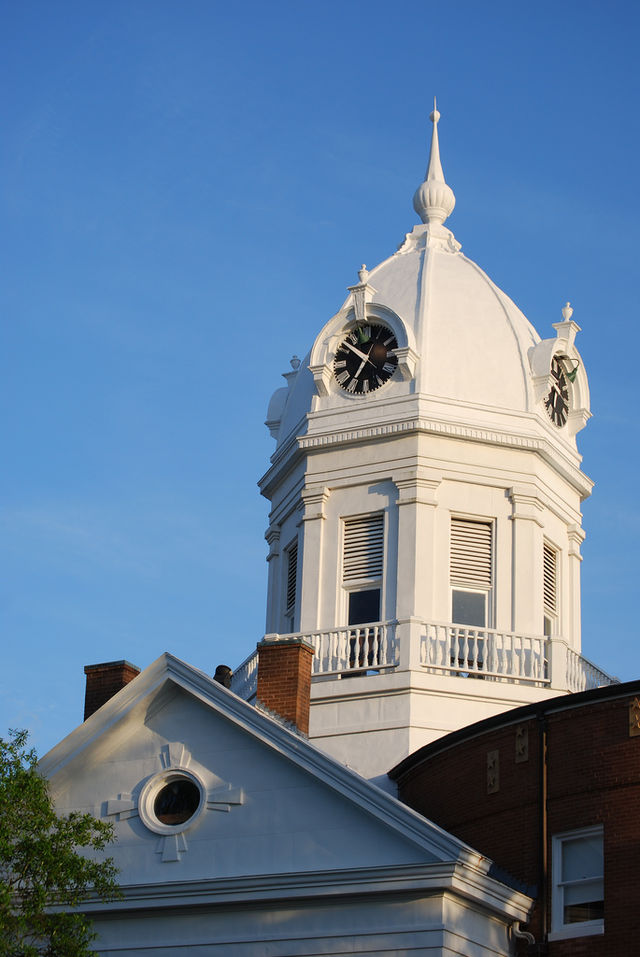
In 1903, this structure was constructed as the Monroe County Courthouse. It was here that a young Harper Lee, Monroeville’s most famous resident and author of the classic novel, To Kill a Mockingbird, would watch her attorney father as he argued cases. When Hollywood put the story on celluloid, the set designers replicated the courtroom on a California sound stage. This building was used by Monroe County as a courthouse until 1967.
Dome of the Old Monroe County Courthouse, 2008, by Melinda Shelton. Courtesy of Wikipedia.
The upper floors of this building still seem to retain some of the energy from the building’s judicial use. Blogger Lee Peacock quotes one man as saying, “Things blow in the breeze but there is no breeze. You hear sounds that don’t belong, and I have smelled pipe tobacco smoke when no one was smoking or there to be smoking.” Staff members working late here often get the feeling of not being alone and have heard mysterious sounds within this storied building.
Sources
Higdon, David & Brett Talley. Haunted Alabama Black Belt. Charleston, SC: History Press, 2013
W. Warner Floyd. National Register of Historic Places nomination form for Old Monroe County Courthouse. 29 March 1973.
Moundville Archaeological Park 634 Mound State Parkway Moundville
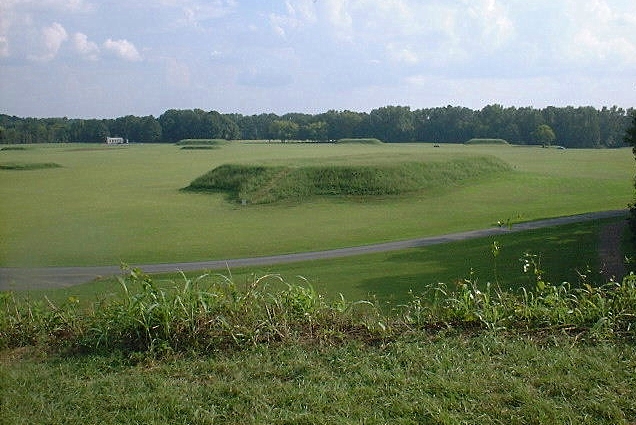
Between approximately 1120 C.E. and 1450 C.E., Moundville was the site of a large city inhabited by the Mississippian people, predecessors to the tribes that the Europeans would encounter when they began exploring the South about a century later. At its height, this town was probably home to nearly 1,000 inhabitants. Stretching to 185 acres, the town had 29 mounds of various sizes and uses: some were ceremonial while others were topped with the homes of the elite.
One of the mounds at Moundville, 1998, by Altairisfar. Courtesy of Wikipedia.
Visitors and staff have often mentioned a certain energy emanating from this site. A Cherokee friend of mine visited and while atop one of the mounds let out a traditional Cherokee war cry. Afterward, he noted that there was a palpable change in the energy. Dennis William Hauck speaks of the “powerful spirit of an ancient race” that “permeates this 317-acre site” in his Haunted Places: The National Directory. Southern Paranormal Researchers notes that park staff has witnessed shadow figures, odd noises, and doors opening and closing by themselves in the buildings on the site. Higdon and Talley add orbs and cold spots found throughout the location to the list of paranormal activity here.
Sources
Hauck, Dennis William. Haunted Places: The National Directory. NYC: Penguin, 2002.
Southern Paranormal Researchers. Investigation Report for Moundville Archaeological Park. Investigated 10 February 2007.
Higdon, David & Brett Talley. Haunted Alabama Black Belt. Charleston, SC: History Press, 2013.
Old Depot Museum 4 Martin Luther King, Jr. Street Selma
Old Depot, 2010, by Carol M. Highsmith. Courtesy of Library of Congress, Prints and Photographs Division.
A part of the Alabama Ghost Trail, a series of haunted places linked by the Southwest Alabama Regional Tourism and Film Office, the Old Depot Museum features a ghost that reportedly has an affinity for the museum’s elevator. The museum occupies the Romanesque Revival circa 1890 Louisville & Nashville Railroad Depot.
Sources
Besser, Susan A. National Register of Historic Places nomination form for the Water Street Historic District. March 2002.
Old Depot Museum. Alabama Ghost Trail. YouTube. Posted 19 July 2009.
Timmons Cemetery Buxton Road Redstone Arsenal
When the Army took over some 40,000 acres in Huntsville in 1941, it swallowed up many old farms and plantations including some 46 cemeteries. Located in the woods off of Buxton Road, the Timmons Cemetery is considered, by some, the spookiest place on the Arsenal. Guards patrolling Buxton Road at night have seen a little girl running across the road near the cemetery.
To explain the little girl’s spirit, a legend has surfaced, though apparently not backed up by historical documentation. Margaret Ann Timmons was an energetic child and sometimes difficult to control. When work required the family to be in the fields, Margaret would be tied to a chair inside the house. The energetic child wiggled out of her restraints, and kicked over an oil lamp that destroyed the house and killed the child. Now, not even death and the stone wall that surrounds the family’s cemetery can restrain her.
Sources
“Does a little girl really haunt Redstone Arsenal.” WAAY. 31 Oct 2014.
“Redstone Report: Ghost story still haunts Redstone Arsenal.” WAFF. 31 Oct 2011.
Woodruff-Fontaine House 680 Adams Avenue Memphis, Tennessee
A professor from the University of Alabama wasn’t expecting to meet any of the spectral occupants of the Woodruff-Fontaine House during his visit. During his tour he first witnessed “a presence forming before his eyes” and his wife mentioned to the guide that her husband had a sixth sense. In Mollie’s bedroom, the professor began talking with one docent and sent his family on to see the rest of the house. As they stood there they witnessed the sheets of the bed move as if as they were being smoothed by an unseen hand. Moments later, the pillows moved as if being fluffed followed by an indention forming on the bed as if someone had just laid down.
Mollie’s bed in the Woodruff-Fontaine House, 2011. Courtesy of the Memphis CVB on Flickr.
Later that day after the house museum closed, the professor and his family drove past the house and stopped. Glancing up towards the windows of the same room where he’d had his spectral encounter, the family witnessed the window shutters moving on their own accord. They quickly left having had enough of the paranormal for one day.
The Woodruff-Fontaine House was built as and remains one of the finest homes in Memphis. The noble French Second Empire-style home was built for businessman Amos Woodruff who had made his fortune as a carriage maker and banker while dabbling in many other businesses including the railroad. Woodruff spent $40,000 on his magnificent manse, a tremendous sum especially in the Reconstruction era South. Upon the home’s completion, Woodruff and his family moved in, just in time for the wedding of his daughter, Mollie.
Mollie and her husband, Egbert Woolridge, took up residence in the home along with her parents after her marriage. It was here in 1875 where the young couple’s first child died just after his birth. A few short months later, Mollie’s husband passed in the house after a bout with pneumonia. Mollie married in 1883, just before her parents sold the house to cotton trader Noland Fontaine.
Fontaine maintained the home’s elegant reputation and during his residency luminaries alighted upon the house including President Grover Cleveland, Vice President Adlai Stevenson, and musician John Philip Sousa. The home remained in the Fontaine family until 1929 when it was sold and became home to an art school until 1959. The home was acquired by the Association for the Preservation of Tennessee Antiquities and has been a house museum for many years paying tribute to the Woodruff and Fontaine families.
The Woodruff-Fontaine House, 2011. Courtesy of the Memphis CVB on Flickr.
Stories about the home’s spectral occupants have been circulating for years. Many who have had encounters with these mostly unseen residents have speculated that one of the primary spirits is Mollie Woodruff. More recently, the home was investigated by The Atlantic Paranormal Society (TAPS) team for the TV show Ghost Hunters. It’s interesting that Adams Street, where the Woodruff-Fontaine House sits was once known as “Millionaire’s Row,” and is now known as Victorian Village. Here, many of the mansions remain and many of them are noted as being haunted. Perhaps this is the most paranormally active street in Memphis?
Sources
Brown, Alan. Haunted Places in the American South. Jackson, MS: University Press of Mississippi, 2002.
Cunningham, Laura. Haunted Memphis. Charleston, SC: History Press, 2009.
Harper, Herbert L. National Register Nomination form for The Lee and Fontaine Houses of the James Lee Memorial. 4 November 1970.
Hudson, Patricia L. and Sandra L. Ballard. The Smithsonian Guide to Historic America: The Carolinas and The Appalachian States. NYC: Stewart, Tabori and Chang, 1989.
Longo, Jim. Ghosts Along the Mississippi, Haunted Odyssey II. Louis, MO: Ste. Anne’s Press, 1993.
Our History. Woodruff-Fontaine House. Accessed 25 February 2015.
And, behold, the veil of the temple was rent in twain from the top to the bottom… — St. Matthew 27:51 (KJV)
One of Eufaula’s magnificent mansions seen through the veil of trees of North Eufaula Avenue. Photo 2014 by Lewis Powell IV, all rights reserved.
Frequent travelers on Alabama Highway 431 know the short section that passes through north Eufaula as a verdant meditation, a brief respite from the normal hustle of this four lane highway. For about a quarter mile, the road narrows from four to two lanes; the speed limit drops while ancient oaks spread their branches over the road, and historic homes keep watch from the sides. Travelers throughout north Georgia and Alabama know this lush drive, called North Eufaula Avenue, as they head towards the Florida Panhandle. Movie-goers may recognize this street from the Reese Witherspoon film, Sweet Home Alabama. In the film, the lead character drives down this historic roadway on the way to her Alabama home.
Historic preservationists often talk about the “historical fabric” which includes the concrete things that actually make up a historic structure, but also the things surrounding a structure that help to provide a complete historical picture, or context, if you will. Within a historic district this may include outbuildings, the roads and streets, sidewalks and other fixtures, plantings and the arboreal canopy. North Eufaula Avenue and its trees are a major feature of the historic fabric of the Seth Lore and Irwinton Historic District, which encompasses the residential neighborhoods to the north and west of Eufaula’s downtown.
The Alabama Department of Transportation is ramping up to rend part of the fabric of North Eufaula Avenue, considered by many to be the most iconic street in the city, if not the whole state. In an effort to ease occasional congestion on Highway 431—proponants argue that the congestion only occurs a few times a year—the DOT has decided to expand the two lanes to four through the historic district. This will require the destruction of part of the median and the removal of a few trees as well as trimming the arboreal canopy. Aside from this minor destruction to the physical fabric, the construction would cause some drastic changes to the aesthetics and spiritual fabric of the district.
Quite simply, the increased traffic will destroy the quiet beauty of the district. But there’s also the possibility that the spiritual fabric of the district may be harmed. In cities ranging from New Orleans, Louisiana to Savannah, Georgia to Frederick, Maryland and Williamsburg, Virginia—places where the historical fabric is very much intact—there often seem to be many ghosts. Perhaps the ghosts remain because the historical fabric has not been disturbed. While documentation for Eufaula’s spirited side is sorely lacking, there is one documented haunting on North Eufaula Avenue. The grand SHORTER MANSION (340 North Eufaula Avenue) has graced this lovely street since 1884, though it was remodeled into its current form starting in 1901.
The Shorter Mansion, 2014. Photo by Lewis Powell IV, all rights reserved.
Considered an outstanding example of neoclassical architecture, the house remained in the politically prominent Shorter family until 1965 when it was purchased by the Eufaula Heritage Association which has operated the house as a museum, memorial and events facility since. The house has been used frequently for weddings and it is in some of the wedding photos taken here that two spirits are purported to appear, though the man in the top hat and the woman in pink have also made some rare appearances in person as well. In one case, a staff member encountered the woman in pink and spoke to her in the parlor. The staff member turned away from the woman for a moment and turned back to her to find she had disappeared.
In 2007, Southern Paranormal Researchers, a paranormal investigation organization out of Montgomery, investigated the house. In their investigation report they note that there is other activity that has been witnessed within the house including phantom smells, items being moved and a feeling of being watched. Over the course of two investigations, the investigators had a few personal experiences including hearing “loud laughing” and banging in the next room. A possible apparition was observed as well as shadow figures. The investigators concluded that the house had residual energy manifesting itself, though there is the possibility of an intelligent spirit at work here as well.
While the activity at the Shorter Mansion is the only documented paranormal activity on North Eufaula Avenue, I imagine there is activity in many of the other graceful structures along the avenue. It is accepted in the paranormal community that renovation and remodeling can stir up activity, though it may also eventually lead to a decrease. Certainly, the activity from cities that have lost much of their historic fabric is decreased, witness Southern cities like Atlanta, which has little-reported activity from its core.
A sign advertising the Eufaula Pilgrimage in the median in front of the Shorter Mansion, 2014. Photo by Lewis Powell IV, all rights reserved.
The battle of North Eufaula Avenue is turning into a David and Goliath type fight. The city government, citizens and supporters of historic preservation have taken a stand against the state DOT and the Governor, who has come out in support of the road widening. Walking down North Eufaula Avenue just last month, I observed that nearly every house had signs against the widening prominently displayed. But the saddest sight seemed to be a large sign advertising the Eufaula Pilgrimage that is held annually in the spring. As if to rub in the destruction, the DOT originally scheduled the widening to be completed by the start of the pilgrimage.
One of the many anti-widening signs lining North Eufaula Avenue, 2014. Photo by Lewis Powell IV, all rights reserved.
Proponents of the widening have tried to stop or at least put the construction on hold through legal means. A lawsuit in federal court was dismissed just before the new year because the federal government is not involved in this battle. The judge suggested that the heart of the matter is really who owns the median of North Eufaula Avenue. Just yesterday (January 2), the mayor and members of the city council voted to not sue the state over the median’s ownership. It now appears that barring any further delays, Eufaula’s verdant veil will be rent beginning on Monday.
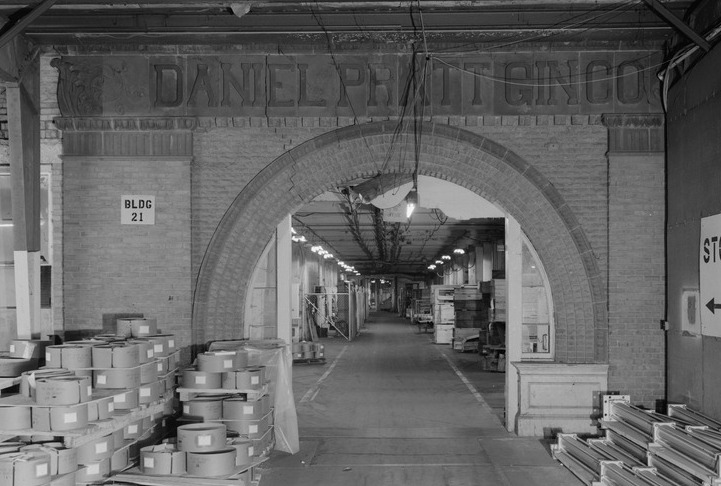
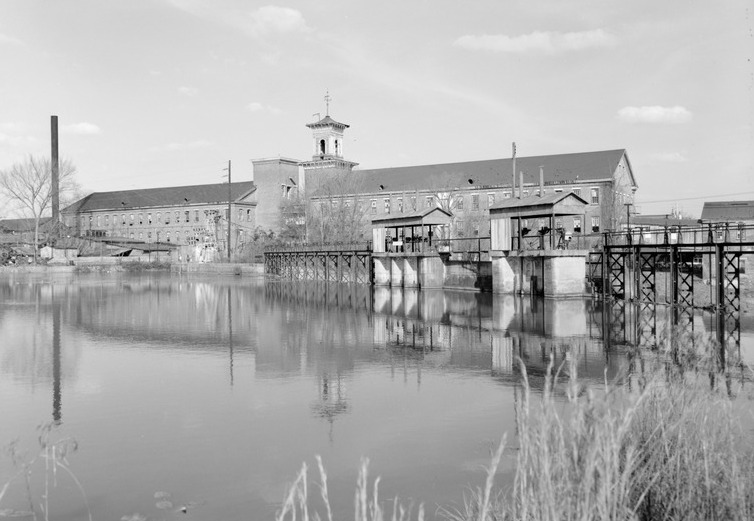
While the fate of North Eufaula Avenue looks bleak, another historic and haunted Alabama site appears to be off the chopping block. The future of Prattville’s landmark PRATT COTTON GIN (Bridge Street) building has been up in the air for a few years. The huge mill complex, which provides a background for downtown Prattville, has been abandoned since 2011. Recently, developers have taken an interest in the buildings, some wishing to demolish the buildings for their brick and wood while others have bandied the idea of renovating the mill into residential lofts.
One of the old entrances to the building now locked within the more modern structure. Photo 1997, by Jet Lowe for the Historic American Buildings Survey (HABS), courtesy of the Library of Congress, Prints and Photographs Division.
On Monday, the mill complex was sold on the courthouse steps to the Historic Prattville Redevelopment Authority, which will immediately begin to stabilize the buildings and begin creating a plan to reuse the old mill. The HPRA purchased five large mill buildings constructed between 1843 and 1912, some 40 acres of mill property, the millpond, and a few spirits.
Downtown Prattville with the Daniel Pratt Cotton Gin in the background. Photo 2010 by Spyder_Monkey, courtesy of Wikipedia.
Before the advent of child labor laws, mills throughout the country employed young children. Often lacking safety policies and devices, millworkers were sometimes seriously injured or killed. At some point in the late 19th or early 20th centuries, sources do not provide a date, a young boy named Willie Youngblood was killed in one of the mill buildings. After his death, a woman was observed near the mill clad in black. Legend says that she threw herself off the mill dam.
The Pratt Cotton Gin with the mill dam in the foreground. Photo by Jack E. Boucher, 1974 for the Historic American Buildings Survey (HABS), courtesy of the Library of Congress, Prints and Photographs Division.
Believed to be the spirit of Willie’s mother, the darkly dressed figure has been seen by millworkers for decades. Recently, the mill buildings were investigated as part of the SyFy Channel show, Deep South Paranormal. While the team was able to capture some evidence during their investigation, the most impressive evidence was video of a black-clad figure walking on the mill dam. Perhaps the veiled figure won’t be rent from her nightly dam walk by the mill’s renovation.
Z. D. Ramsdell House 1108 B Street Ceredo, West Virginia
Zopher Deane Ramsdell moved to Ceredo, West Virginia at the invitation of Eli Thayer, the town’s founder. An abolitionist, Thayer invited his abolitionist associates from New England to join him in colonizing this area of—what was at that time—the slave state of Virginia. Thayer had founded this town on the southern side of the Ohio River to further his own abolitionist agenda.
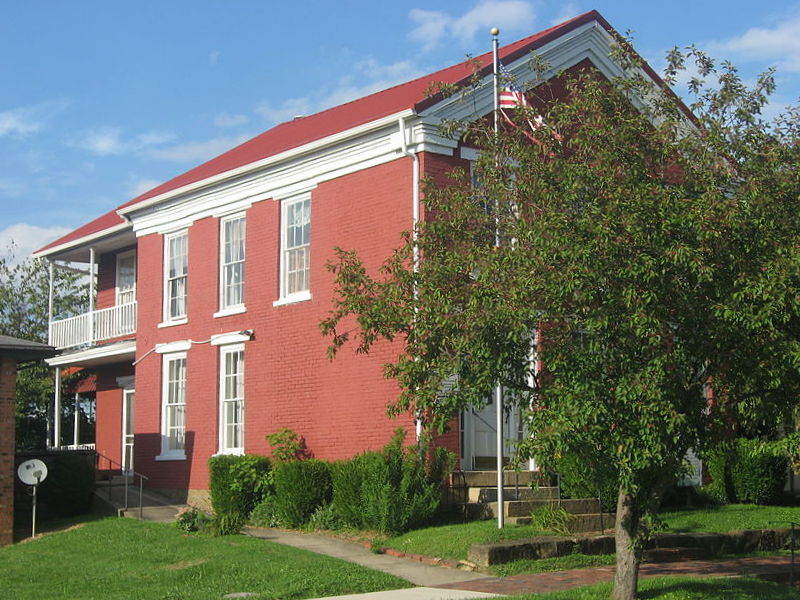
A businessman from Abingdon, Massachusetts, Ramsdell arrived in Ceredo in the late 1850s and began building this brick house that still bears his name in 1857 or 1858. It was the first brick house in the area and was possibly constructed atop a Native American burial mound. Part of the home’s basement may have been constructed to hide slaves being guided to freedom on the Underground Railroad. With the outbreak of war not long after his home was complete, Ramsdell immediately joined the war effort on the side of the Union and rose to prominence within the army.
Ramsdell House, 2013, by Nyttend. Courtesy of Wikipedia.
Following the war’s end, Ramsdell was asked by President Ulysses S. Grant to help in the reconstruction of the postal infrastructure in the area. Serving as a state legislator, Ramsdell was active in the creation of free schools for educating local children. The house remained in the Ramsdell family until 1977. The house was restored in the early 1980s and is operated as a small museum.
Tradition holds that the house is paranormally active due to the home’s location atop a burial mound and its use as an Underground Railroad stop. Doors opening and closing and lights turning off and on, all on their own accord are among the types of reported activity. Apparitions and sounds associated with the enslaved people who possibly moved through the house have also apparently been reported. There’s also some belief that both slaves and veterans of the Civil War are also buried on the property.
The home has been investigated three times by Huntington Paranormal with evidence being captured on the first two investigations. Blogger Theresa Racer, the organization’s historic research manager, posits that the evidence the group has collected points to the Ramsdell family as the source of the hauntings rather than Native Americans or slaves.
This article was originally published on 18 December 2012. This is a rewrite and edit.
Myrtles Plantation 7747 US Highway 61 St. Francisville, Louisiana
I’ve tried to avoid writing about The Myrtles for some time. Certainly of famous haunted properties in the United States—if not the world—The Myrtles ranks very high, if not at the top. There is plenty written about this location, almost to the detriment of other hauntings nearby. As it is now the Halloween season, The Myrtles has been popping up frequently in articles recounting various authors’ versions of the top hauntings in the country.
It seems that every book about American ghosts includes this haunting while it has become a mecca for ghost hunting organizations. Nearly every paranormal reality show has also featured the location. The Myrtles may very well be one of the best-documented hauntings of our time. So why avoid it?
Interestingly, one of the pieces that got me into writing about ghosts is an article about The Myrtles. It appears in Troy Taylor’s 2001 book, The Haunting of America. When I first encountered Taylor’s piece on The Myrtles, I presumed it to be a straightforward exploration of this most famous of hauntings. It’s not a straightforward profile of hauntings and it’s not exactly the haunting that he’s concerned with; it’s the history. Taylor’s piece reads like a newspaper expose as he uncovers the reality behind The Myrtles.
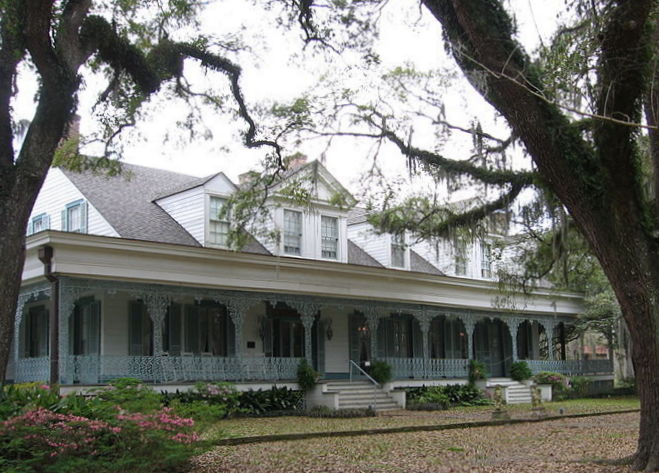
The Myrtles, 2005, by Bnet504. Courtesy of Wikipedia.
Southerners are natural storytellers, but they enjoy hearing a good story just as much. One only has to witness the long line of Southern storytellers and writers to see this fact: from Joel Chandler Harris to Tennessee Williams, and Eudora Welty to dear Kathryn Tucker Windham, the South has had more than its fair share of gifted storytellers. But, as Taylor (a Yankee from Illinois, bless his heart) states early in the piece, “some of the people who have owned the house have never let the truth stand in the way of a good story.” This is certainly a sentiment found throughout the South.
The stories that are told about The Myrtles are fraught with tragedy. According to guides, some ten murders have taken place within the confines of the home. The most famous of these is the tale of a slave, Chloe. Amongst the enslaved people on plantations there was a hierarchy; with the house servants—those that worked directly with the family—being the most important but also the longer lived slaves than those toiling in the heat of the fields. Chloe was one of the more fortunate slaves, working in the house and helping care for the children of Clark Woodruff, the owner of Laurel Grove (as The Myrtles was called at that time). According to legend, she was also on intimate terms with Mr. Woodruff and possibly a guest of his bed.
Continuing the legend, Mr. Woodruff began to make advances towards another slave, and Chloe feared that she would be banished to the fields (and certain death). Soon, she was listening at the doors hoping to learn of her fate. It was there that she was caught by Mr. Woodruff and as punishment, one of her ears was cut off. Afterwards, she began wrapping a long green cloth around her head like a turban to cover her shame.
Chloe then devised a plan to endear herself to the Master and his family. She would poison the master and his family, and then miraculously cure them. She baked a cake containing the poison of oleander leaves, but the master did not eat it. However, his pregnant wife and two young daughters did, and all three died. For her misdeeds, Chloe was hung in one of the ancient oaks on the property by an angry mob. Along with the spirits of her victims, Chloe’s green-turbaned spirit still supposedly walks the property.
This story is marvelous and operatic in proportions. But, sadly, it is just that, an antebellum soap opera. Troy Taylor dug into the records of the families who owned The Myrtles and found no record of a slave with that name. The victims in the story: Clark Woodruff’s pregnant wife and her two children: a boy and a girl, not two daughters as the tale recounts, did not die from poisoning and lived long, fruitful lives. Most likely they did eventually pass in the home, though, which might easily add their spirits to the spiritual jambalaya that may exist at this property.
More digging by Taylor produced the facts that most of the other tales of murder are also the product of great Southern storytellers, with the exception of the murder of William Winter who was shot and killed at the home in 1871.
In cases where the history is debunked, that often debunks the haunting as well. In the case of The Myrtles, however, I don’t believe that is so. It appears there may be quite a bit of activity within this home. Another piece of which may have been captured recently.
While taping a story for WGNO, the ABC affiliate serving the New Orleans area, something appears on tape behind reporter Vanessa Bolano. The video segment is a “stand up” filmed in the French Room of the house. As Ms. Bolano is speaking, something whizzes by behind her. The reporter slowed down the footage to reveal the misty object moving at very high speed.
The video has begun making news both here and in Britain where it has been a headline in both The Daily Mail and The Sun. The latter even taking a single frame of the video and reporting that it resembles a face. While yes, it does resemble a face in that particular frame, it’s also in motion and only resembles the face for a brief moment. It appears to me to be a case of pareidolia—that is simply the brain trying to make sense of something random like someone seeing the face of Christ in a bit of burned toast. The New York Daily News article linked below features the video.
Again, it should be said that regardless of my misgivings about the home’s history, it does appear that The Myrtles has a great deal of activity, some of which may have been captured by this hapless reporter. If you love great Southern ghost stories or want to experience great Southern ghost stories, by all means, book a stay at The Myrtles, just don’t believe all the storytellers’ words.
Sources
Durante, Thomas. “Did ABC reporter catch a GHOST on camera while reporting from one of America’s most haunted houses?” The Daily Mail. 12 December 2012.
I’m feeling a bit of umbrage for the spirits of the Upstate region of South Carolina. A recent Halloween related article appeared on the website of a Charlotte, NC news station (I’d rather not just call them out) regarding haunted places in the region. Included with the article is a slideshow of 43 locations that are purported to be haunted. But that’s all that’s included: a slideshow. The slides show pictures of some of these haunted hotspots with a name and town, but no further information. While it’s all fine and good to say a place is haunted, it is a serious disservice to pronounce a place haunted but provide no further information regarding it.
There is a link within the article to a list of haunted places on the website of a local paranormal investigation organization. While it’s obvious that this list is the only source for the locations included in the slideshow, what I find so annoying is the fact that the organization’s source is the notorious Shadowlands Index of Haunted Places. After briefly comparing the lists, it became very clear that the paranormal organization’s list was simply cut and pasted from the Shadowlands list.
My problems with Shadowlands stems from the fact that it is made of user submitted entries. Someone, anyone, can go to the website and submit information on a haunted place. The information submitted is not checked or vetted, it is added to the list and readers often take this information as fact. It is such shoddy information gathering and publishing that I’m working hard to combat with this blog.
To post information about hauntings in such a willy-nilly manner is not just disrespectful for the spirits which may haunt these locations, but shows a lack of respect for the locations and their respective histories. Reputable sources on this region are not lacking and most are still in print. In fact, the article quotes the author of one of those primary sources. So, a much better list can be provided with a modicum of research.
While my coverage here is not as lengthy as the news station’s list, hopefully this article will help to provide a far better alternative. For your consideration, I’m presenting a few of the more interesting—and documented—stories from the Upstate region.
Abbeville County
Abbeville, the county seat and namesake for the county, is a fascinating town with a number of hauntings including its historic opera house which I covered a few years back.
Burt-Stark Mansion 400 North Main Street Abbeville
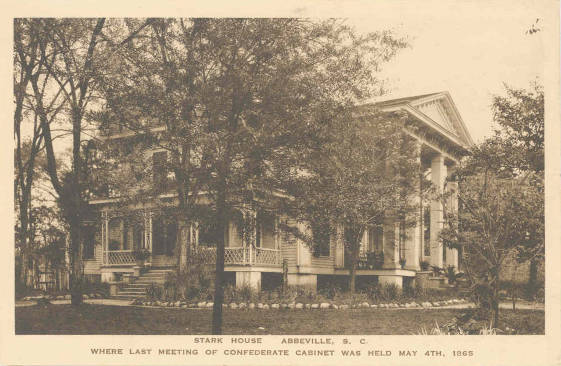
Sometimes called the “Grave of the Confederacy,” the Burt-Stark Mansion was the scene of the Confederacy’s final council of war; where Jefferson Davis met with some of his cabinet officials and generals following the fall of Richmond and General Lee’s surrender at Appomattox. The Confederate government was in disarray, and its officials on the run through the war-weary South.
Varina, Confederate President Jefferson Davis’ wife, had arrived at Major Armistead Burt’s elegant Abbeville home in mid-April with her family in tow. She stayed with the Burts for a little more than a week before continuing their journey into Georgia. On May 2nd, Jefferson Davis arrived in Abbeville. Stopping by a small cabin on the edge of town, Davis asked for a drink of water from the lady of the house. As he drank, a small child wandered across the porch towards him. The woman asked, “Ain’t you President Davis?” After he answered in the affirmative, the woman nodded at the child, “he’s named for you.”
Producing a small gold coin from his pocket, Davis handed it to the woman saying, “Please keep this for him and tell him about it when he’s old enough.” Davis whispered to Postmaster General John H. Reagan and told him that that was the last coin he had to his name.
Undated postcard image of the Burt-Stark Mansion. Published by the Echo Novelty Store, Albertype Company.
Soon after, Davis took up residence at the Burt home where his wife had stayed previously. Later that afternoon, the remaining cabinet met in the parlor. It was there that Davis responded, “all is indeed lost,” conceding to the loss of the Confederacy.
The mansion has been preserved as a museum, and due to the nature of the final meeting of the Confederate cabinet is now listed as a National Historic Landmark. Though very little paranormal activity had been witnessed in the mansion, due to the numerous other hauntings in Abbeville it was decided to allow a paranormal investigation team to investigate the home in 2007. According to John Boyanoski’s description of the investigation in his More Ghosts of Upstate South Carolina, the team came away with a great deal of evidence.
Members of the Heritage Paranormal team felt the presence of a man in the bedroom where Davis had slept. Moments later, one of the lead investigators witnessed the clear outline of a woman in period dress descending the staircase. Lending credence to his experience, the team’s equipment near the staircase registered some disturbances at the time the investigator saw the specter. In the separate kitchen building, the team detected two spirits, possibly those of slaves.
Sources
Bearss, Edwin C. National Historic Landmark nomination form forBurt-Stark Mansion. 28 April 1992.
Boyanoski, John. Ghosts of Upstate of South Carolina. Mountville, PA: Shelor & Son Publishing, 2006.
Burt-Stark Mansion. “About Us.” Accessed 13 October 2014.
Anderson County
Anderson Municipal Business Center 601 South Main Street Anderson
Unlike the Burt-Stark Mansion with its flood of history, the Anderson Municipal Business Center is a rather utilitarian government building with little history. The building opened in August 2008 and odd events began to occur less than a year after it opened. The security person in charge of the building—a 15 year veteran of the local police department—began to notice odd things on the security monitor installed in the Anderson credit union office. A white blur appeared on the video and would flit around the room. It returned night after night.
The room was checked for bugs and the camera was cleaned, but the white blurs continued to return. Workers in the office reported hearing odd sounds after hours including knocking and the sounds of furniture being moved. A customer, who supposedly knew nothing of the activity, reported the feeling of being grasped by the shoulder. The activity lasted for a few months, but then petered out by late 2009.
The property has a fairly quiet history, certainly nothing that would explain the odd white blurs that appeared for a period.
Sources
“Ghostly images leave people wondering.” 30 October 2011.
Smith-Miles, Charmaine. “Anderson employee to appear on TV’s ‘My Ghost Story.’” Anderson Independent Mail. 13 April 2011.
Cherokee County
Ford Road Bridge Ford Road at Peoples Creek Gaffney
It was obvious that the killer wanted to play when he called reporter Bill Gibbons of The Gaffney Ledger on a day in early February 1968. He instructed the reporter to pull out three pieces of paper and then gave the reporter directions to find the bodies of two of his victims. The killer even provided the victims’ names. The reporter summoned the sheriff and traveled to the two sites provided by the caller, finding bodies at each location. The body of the third victim had been previously found, and the woman’s husband had been convicted of the murder. Gaffney woke to the fact that it had a serial killer on its hands.
The Gaffney Ledger headline, 9 February 1968.
The killer would kill once more before he was arrested. Lee Roy Martin, the killer, was found guilty and sentenced to four terms of life imprisonment. He was killed by another inmate in 1972.
Just below the lonely Ford Road Bridge over Peoples Creek, one of Martin’s victims was found. Her nude body lay on the creek bank with her face in the water. She had been raped and strangled with a belt. Over the years, locals have reported hearing a woman screaming and moaning below the bridge where the body was found. An investigation conducted as part of the filming of Haunted Echoes: The Gaffney Strangler, a documentary that was posted on YouTube, did not hear any screams, just the trilling of bullfrogs in the creek.
Sources
Dalton, Robert W. “Gaffney Strangler terrorized town 40 years ago, murdering 4 women.” Spartanburg Herald-Journal. 5 July 2009.
Gibbons, Bill. “Search underway here for slayer of 2 women; Tip to newsman leads officers to scene.” The Gaffney Ledger. 9 February 1968.
Johnson, Tally. Ghosts of the South Carolina Upcountry. Charleston, SC: History Press, 2005.
Greenville County
Herdklotz Park 126 Beverly Road Greenville
Jason Profit, owner and operator of Greenville Ghost Tours, describes Herdklotz Park in his book, Haunted Greenville, South Carolina, as having “all the ingredients for an active paranormal soup.” This tranquil city park was once home to the Greenville Tuberculosis Hospital, which closed in the 1950s after operating for some 20 years. For some time, the building sat abandoned but was then reopened in the 1990s for a brief period of time as part of a prison work-release program.
As with many abandoned buildings of this nature, the building served as a playground for teens and the occasional vandal who would leave with stories of the supernatural there. Of course, the building also attracted the local homeless. It is believed that they may have accidentally caused the fire that destroyed the building in November of 2002. The remains of the building were demolished.
But, the spirits have remained. Jason Profit recounts an EVP session that he held on the steps of the old hospital (the building’s foundation remains intact) in 2008. He was able to capture the sounds of what he described as “a busy lunchroom. It sounded like the echoing of voices in a hallway or large room.” He reports that many residents of the neighborhood around the park have witnessed shadow people in their homes and in the area that may be related to the old hospital. In a 2009 report for the local CBS affiliate WSPA, Profit states, “I would have to say that beyond a shadow of a doubt that Herdklotz Park is one of the most haunted parks you’re going to find in Upstate South Carolina.”
Sources
Cato, Chris. “Greenville County Park Haunted by Hospital’s Ghosts?” WSPA. 31 October 2009.
Profit, Jason. Haunted Greenville, South Carolina. Charleston, SC: History Press, 2011.
Greenwood County
Ninety Six National Historic Site 1103 Highway 248 Ninety Six
Scholars still argue as to how Ninety Six got its odd name, some say it’s that the town was 96 miles from the Cherokee village of Keowee (which is incorrect) and some say that it’s a reference to the many creeks in the area. Nevertheless, this oddly named village was the scene of a siege during the American Revolution. General Nathanael Greene led his Patriot troops against loyalists entrenched in the village. Despite having far more troops, Greene’s 28-day siege failed to capture the village, and he withdrew his troops. Perhaps, though, he did leave some spirits behind. Residents living near the battlefield and re-enactors camping on the battlefield have heard voices throughout the site.
Siege of Ninety-Six. Wikipedia, the Free Encyclopedia. Accessed 24 February 2011.
Toney, B. Keith. Battlefield Ghosts. Berryville, VA: Rockbridge Publishing, 1997.
Pickens County
Colony Theatre 315 West Main Street Easley
Ghost stories often grow out of odd bits of natural phenomena. That may just well be the story behind this small town movie theatre in the Upstate. A member of the family who built this theatre in 1948 and owned it until it closed claimed the “ghost” was simply the curtains in the projection room being blown by air from the projector. Though, locals have a different theory: it’s the ghost of a woman who hanged herself on this site before the building of the theatre.
In his marvelous collection of ghost stories from the Upstate region, Ghosts of Upstate South Carolina, John Boyanoski documents the story of a passerby who saw the spirit peering from a window of the empty theatre one night. While driving home to Greenville from a football game in Clemson one night in 1989, the driver slowed to admire the old, art moderne-style theatre. Looking up, he saw a woman staring out of one of the building’s second floor windows. She didn’t move and she appeared to have a faint glow about her. He continued driving and then turned around to catch a second glimpse. The theatre was quiet and dark. Nothing appeared in the windows. Even after parking and walking around the front of the building, nothing stirred.
At the time of this writing the theatre serves as a church and remains as a landmark along South Carolina Highway-93 through Easley. The theatre is owned by Robinson’s Funeral Home and it plans to maintain the theatre as a local landmark.
Sources
Boyanoski, John. Ghosts of Upstate of South Carolina. Mountville, PA: Shelor & Son Publishing, 2006.
Robinson, Ben. “Colony Theater not in danger from Robinson’s expansion.” Easley Progress. 16 December 2011.
Spartanburg County
Old Main Building Campus of Wofford College Spartanburg
Wofford College, a private, independent school associated with the Methodist Church, has about 130 faculty and staff members, 1,500 students, and more than a handful of ghosts. The old campus features some noted historic structures including the campus’ centerpiece, the Old Main Building which may have a few of its own spirits flitting about the halls. South Carolina folklorist, Tally Johnson, an alumnus of the school, witnessed Old Main’s legendary “Old Green Eyes” when he was a student. He and another student crept into the auditorium one night and witnessed the odd pair of lights that appear above the drapes over one of the auditorium’s windows. The “eyes” appeared and Johnson and his companion were unable to find a source for the lights.
Old Main Building, 2010, by PegasusRacer28, courtesy of Wikipedia.
The odd, green orbs have not been identified and there’s no apparent explanation. Regardless, that’s not the only odd activity. The blog of the college’s archives recounts that the spirit of Dr. James Carlisle—one of the first faculty members and president of the school for the latter half of the 19th century—has been seen and heard prowling the halls.
Sources
Brabham, William C. National Register of Historic Places nomination form for the Wofford College Historic District. 29 August 1974.
Johnson, Tally. Ghosts of the South Carolina Upcountry. Charleston, SC: History Press, 2005.
Stone, Phillip. “Are there ghosts at Wofford?” From the Archives. 31 October 2011.
I recently had an inquiry from a friend who’s a student at Shenandoah University in Winchester, Virginia regarding a “haunted road trip” he and his friends want to take next month. After consulting my resources, I’ve devised a suitable tour of the area’s numerous haunts.
This tour makes a circle through the Shenandoah Valley, beginning and ending in Winchester. It heads south on I-81 towards Staunton with a few stops along the way. After Staunton the tour heads east to include the famous Exchange Hotel in Gordonsville before returning to Winchester. The tour includes a range of haunted places from historic homes to government buildings, churches, battlefields, commercial buildings, cemeteries, a train depot, a former mental hospital and a cave. Some of these locations are open to the public while a few are private and should only be viewed from the street.
N.B. This article has been reworked a bit and I have begun separating these cities into their own distinct articles.
Winchester
The Winchester section of this article has been broken off into its own, separate article, “The Wraiths of Winchester.”
Middletown
1797 WAYSIDE INN (7783 Main Street) This building sits at the core of history of this small town. The motley of old buildings forming the tavern were built over a period ranging from the 18th century through to the late 19th century. The oldest portion of the building, containing Larrick’s Tavern, may have been constructed around 1750. The road in front was once part of the Great Wagon Road—the road used by settlers pouring into the American “backcountry.” In this area, the Great Wagon Road was originally a Native American trail called the Great Indian Warpath and used by a multitude of Native American tribes including the Cherokee.
In 1797, this collection of buildings became an inn for the many travelers passing on the road. Leo Bernstein, the garrulous personality who took over the inn the latter half of the 20th century, would always claim that this inn was the oldest continuously operating inn in the nation. There does seem to be a good deal of truth behind his claim. It is known that this inn was in operation as war raged up and down the valley during the Civil War and that the inn served both sides.
Wayside Inn. Photo 2008, by DwayneP, courtesy of Wikipedia.
Like most buildings in the area, the inn has a number of Civil War related spirits, though there is the possibility that the inn may have been haunted before that time. Lord Fairfax, who had been given much the land in the area, did live nearby and died in Winchester (he’s buried at Christ Episcopal Church) is claimed as the spirit that moans on a nightly basis in the oldest portion of the inn. Bernstein describes the space in Sheila Turnage’s Haunted Inns of the Southeast, “Upstairs is about a three foot space. There was a set of steps going up there. The straw is still there.” The loft is located just above one of the bars and Turnage mentions that people gather to listen for the moan at 11:30 PM nightly.
Besides odd moans, the inn is home to numerous other spirits and employees and guests have witnessed much activity. Objects have moved on their own accord, a dishwasher had his apron untied repeatedly by unseen hands, and full apparitions have been seen including those of Civil War soldiers. Paranormal investigations have captured much evidence including EVPs of horses whinnying and photographs featuring specters.
WAYSIDE THEATRE (7853 Main Street, now closed) The sad fate of the Wayside Theatre echoes the fate of so many theatres throughout the country. The company was established in 1961, by Leo Bernstein, the owner of the Wayside Inn just down the street. The summer stock theatre provided training for actors such as Susan Sarandon, Peter Boyle, Kathy Bates and Donna McKechnie. After a precipitous drop in revenue, the theatre closed its doors in 2013.
The building was originally constructed as a cinema and it is from this period that the theatre’s ghost may come from. “George,” is supposedly the spirit of an African-American man who either worked in the theatre or was a caretaker at some point. His spirit is said to haunt the stage, balcony and basement of the building.
CEDAR CREEK AND BELLE GROVE NATIONAL HISTORICAL PARK (Belle Grove, 336 Belle Grove Road) Historically and architecturally, Belle Grove is one of the most important houses in the region and listed as a National Historic Landmark. It is currently owned and operated by the National Trust and most sources state that the docents are discouraged from talking about the spirits which still reside here.
Belle Grove, 2013, by AgnosticPreachersKid. Courtesy of Wikipedia.
The history of Belle Grove begins in the late 18th century with the land being acquired by Isaac Hite, the grandson of Jost Hite, a German immigrant and one of the early pioneers in this area. Construction of the house began in 1794 and ended in 1797. The house remained in the Hite family until just before the beginning of the Civil War when it was bought by John and Benjamin Cooley. The first of two ghost stories begin with this family. Not long after acquiring the house, Benjamin Cooley married a local woman named Hetty. Not long after her arrival in the home, Hetty became the subject of ire from one of the slave woman working there.
Though the details are unclear, Hetty was attacked by the slave and her beaten body was thrown either into the smokehouse or the icehouse on the property. Hetty’s spirit reportedly returns frequently and has been seen throughout the house. According to two sources, she actually let a deliveryman into the house one afternoon after the home had been closed for the day. The deliveryman was returning the antique carpets which had been removed for cleaning. After arriving late, he was let into the house by a woman in a period dress who did not speak but only gestured to where the carpets should be placed. When the staff discovered the carpets had been returned and put in place, they called the cleaning company who put the driver on the phone. They were shocked to hear about the woman who let him in.
A few years after Mrs. Cooley’s death, the estate became the scene of the Battle of Cedar Creek. During that battle, Major General Stephen Ramseur of North Carolina was gravely wounded. He was taken to a room at Belle Grove where he passed away the following morning surrounded by some of his former classmates from West Point from both armies including George Custer. This scene was witnessed by a gentleman some years ago. While idly passing through the house, he glanced into a room to see a group of Civil War soldiers in both blue and grey standing around someone in a bed. Later, when he asked who had been presenting the tableaux that day, he was informed that nothing of the sort was taking place in the house.
Employees have told various paranormal writers that voices and other odd noises are regularly heard in the house, while singing is heard in the slave cemetery on the property.
Early on the morning of October 19, 1864, Confederate General Jubal Early launched an attack upon Union forces camping in the area. These forces under General Sheridan (who was headquartered at the Lloyd Logan House in Winchester, see stop #3H) had spent their time clearing the Shenandoah Valley of Confederates. Known as “The Burning,” this period included the destruction of much of the area. Early’s early morning attack was one of the last chances for Confederates to stop the decimation of the valley.
While Early’s attack was initially successful in beginning to route the Federals, Sheridan, hearing the sounds of battle from Winchester, jumped upon his horse and made a triumphant ride to Middletown to rally his troops to victory. At the end of the day, Early’s forces had been driven from the field.
The stories of spirits on this battlefield began not long after the battle ended. These stories included spectral soldiers on the battlefield both singly and in groups and even stories of headless horsemen. Michael Varhola notes, however, that the gentlemen he met working in the visitor’s center, refused to answer his questions about the battlefield being haunted.
Grottoes
Formations within Grand Caverns. Photo 2010 by P199. Courtesy of Wikipedia.
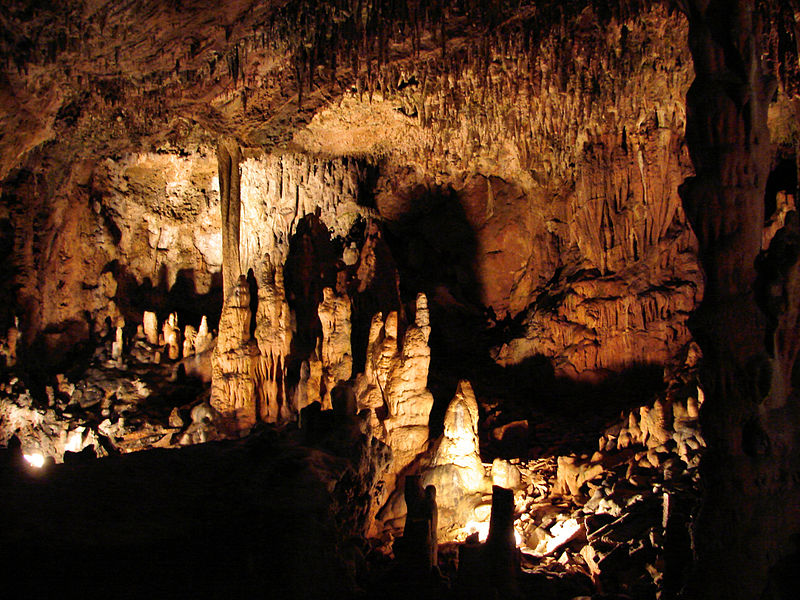
GRAND CAVERNS (5 Grand Caverns Drive) From the oldest continuously operating inn in the country to the oldest operating show cave, Grand Caverns has been open for tourists since 1806. I’ve covered this cave and its ghosts in a blog entry here.
New Hope
PIEDMONT BATTLEFIELD (Battlefield Road) Outside of New Hope, near the community of Piedmont, is an open field that was the scene of a battle, the 5th of June 1864.
Around 5 AM, June 5, 1996, a group of reenactors camping on the southern edge of the battlefield were awakened by an unusual ruckus: the sounds of wagons approaching. In an effort to greet the approaching wagons, a few of the reenactors stepped towards a nearby fence. The sounds, the creak of wagon wheels, the tinkle of chains, the clop of horses hooves and their whinnies, increased for a moment as they apparently neared the awed witnesses then they suddenly ceased. Some of those present later discovered an overgrown trace or wagon road in the woods near the spot where they’d heard the sounds. It is believed that this road may have been in existence at the time of the battle.
Of course, there’s no way to know if the sounds were related to battle or simply spiritual residue from the road’s history. Either way, the reenactors will likely tell this story for years to come.
Staunton
Like Winchester, Staunton has a myriad of haunted locales and a ghost tour. Black Raven Paranormal presents a handful of different tours; see their website for further information.
MRS. ROWE’S FAMILY RESTAURANT (74 Rowe Road) This popular restaurant has been investigated twice in the past few years after employees and guests have had run-ins with spirits. In addition to activity in the building’s attic and basement, the back dining room and men’s room have reportedly had activity. Two local news articles describe the activity as ranging from full apparitions to employees being touched.
DeJARNETTE CENTER (located behind the Frontier Culture Museum, 1290 Richmond Avenue, the center is closed and private property though one of the tours offered by the Ghosts of Staunton tours the grounds, don’t ask for further information at the Frontier Culture Museum, they can’t tell you much of anything) There’s a good deal of misinformation about this location. Of course, mental and psychiatric hospitals tend to be haunted, along with other medical facilities. Among those with a paranormal bent, there is a tendency to exploit these types of places and often repeat misinformation.
DeJarnette Center. Photo 2011, by Ben Schumin, courtesy of Wikipedia.
With the DeJarnette Center, there is a tendency to confuse it with Western State Hospital, which also may be haunted. Though their histories are intertwined, these are two separate facilities. Western State was founded early in the 19th century to handle the overflow from the Williamsburg Hospital which handled the insane and mental cases. The complex that once house Western State has recently been converted into condominiums called The Villages at Staunton.
During the first half of the 19th century, Western State was under the aegis of Dr. Joseph DeJarnette, a revolutionary figure in the field of mental health. His controversial legacy included institutionalizing a eugenics program that forcibly sterilized numerous patients throughout the state.
This facility opened in 1932 originally as the DeJarnette State Sanitarium, a private pay unit of Western State. The state assumed control of this facility in 1975 and renamed it the DeJarnette Center for Human Development. The facility experienced severe budget cuts starting in the mid-70s and continuing until the patients were moved into a newer, smaller facility adjacent to Western State in 1996. Since 1996, the site has been abandoned and waiting for the wrecking ball. Countless ghost stories have been told about the facility, though few have actually been published.
DOWNTOWN STAUNTON Like downtown Winchester, Staunton has a number of haunted places, though the information on them is not as readily available (as opposed to Winchester with Mac Rutherford’s book on its hauntings). I imagine many of these locations will be presented on the Ghosts of Staunton tour.
STAUNTON COFFEE AND TEA (32 South New Street) This building was the scene of a homicide in August of 1951. Elmer Higgins, a heavy gambler who lived in an apartment on the building’s second floor was shot in the head, execution-style. The murder remains unsolved and it is believed his spirit remains on the premises.
AMTRAK STATION (1 Middlebrooks Avenue) There has been a train station on this site since 1854. The first station was burned during the Civil War while the second station was destroyed April 28, 1890 by train. The New York Times described the event, “This morning about 3 o’clock a railroad wreck occurred at the Staunton (Chesapeake and Ohio) Station. The vestibule train, due here from the west at 1 o’clocl was two hours late. About 3 o’clock it came whirling on at a speed of seventy miles an hour, the engine having the appearance of a sheet of fire…As the train reached the passenger station the rear sleeper careened, striking the platform covering, tearing away the iron posts, and demolishing the whole platform structure.”
Staunton Amtrak Station. Photo 2009, by Ben Schumin, courtesy of Wikipedia.
The train was carrying members of a traveling operatic troupe out of Cincinnati, Ohio. The only death to occur was one of the company’s singers, Miss Myrtle Knox who was badly mangled by the accident and bled to death.
Myrtle’s sad spirit has been spotted on the platform wearing a nightgown. Women with long blonde hair have had their hair tugged and it is believed that Myrtle’s spirit may be to blame for that as well.
An old rail car at the depot once contained a restaurant. Visitors to the station have seen odd lights, shadows and heard voices around the old Pullman car. Along the tracks the apparition of a Civil War soldier has been seen. A Confederate soldier was walking these tracks after having a bit too much to drink at a local saloon. He was hit by a train and killed.
THE CLOCK TOWER BUILDING (27 West Beverly Street) This 1890 structure has been the scene of at least three deaths. Two early deaths on the premises, which was originally constructed as a YMCA facility, include a heart attack and a young woman who fell down a coal chute. Recently, someone fell to their death from the third floor in a possible suicide. These spirits are still said to linger in this old building.
MARY BALDWIN COLLEGE (Intersection of Frederick Street and New Street) According to the National Register of Historic Places nomination form for this college’s main building, Mary Baldwin is the oldest women’s institution of higher learning associated with the Presbyterian Church. The school was opened in 1842 as the Augusta Female Seminary. In the midst of the Civil War, Mary Baldwin and Agnes McClung, former students of the seminary were appointed as principals. They would serve the school through the latter half of the 19th century and Mary Baldwin’s contribution would be recognized in 1895 when the school was renamed for her. The spirits of Mary Baldwin and Agnes McClung may remain on campus along with a few other assorted spirits.
In the old Main Building, one of the first buildings constructed on campus, a male spirit named Richard likes to occasionally cause trouble. McClung Residence Hall, just behind the Main Building includes the rooms where Baldwin and McClung lived during their tenure here. Students living there have reported the spirits of both women, with one student even waking up to find a white figure hovering over her as she slept. The Collins Theatre, located inside the Deming Fine Arts Center, also features a spirit, possibly that of one of Mary Baldwin’s most illustrious alums, the actress Tallulah Bankhead. The spirit in the theatre is known to mess with the stage lights.
Gordonsville
Exchange Hotel, 2008, by Rutke421. Courtesy of Wikipedia.
CIVIL WAR MUSEUM AND EXCHANGE HOTEL (400 South Main Street) The Exchange Hotel has, in recent years, become one of the Southern meccas for ghost hunters. Opened on the eve of the Civil War, this hotel became one of the premier hospitals for the wounded during the Civil War. With so many deaths here, it’s no wonder that the place is crawling with ghosts. In one of my early blog entries, I’ve covered this location. At one time, the museum offered ghost walks, but I can currently find no information about these. This haunting was also covered on the Biography Channel show, My Ghost Story, first season, episode six.
Sources
Abram’s Delight. Winchester-Frederick County Historical Society. Accessed 19 September 2014.
Armstrong, Derek Micah. “A true ghost story.” The News Virginian. 22 October 2012.
Ash, Linda O’Dell. “Respect the spirits, ‘Ghost Hunters International’ star Dustin Pari tells Wayside Inn paranormal investigators.” The Northern Virginia Daily. 7 November 2011.
Austin, Natalie. “Local ghost expert shares stories of the supernatural.” The Northern Virginia Daily. 30 October 2004.
Brown, Beth. Haunted Plantations of Virginia. Atglen, PA: Schiffer, 2009.
Rutherford, Mac. Historic Haunts of Winchester: A Ghostly Trip Through the Past. Charleston, SC: History Press, 2007.
Shulman, Terry. “Did ghostly soldiers pay reenactors a courtesy call?” The News Leader (Staunton, VA). 10 July 2004.
Smith, Morgan Alberts & Marisol Euceda. “The Ghosts of MBC.” Up Hill and Down. January/February 2003.
Stanley, K.W. “The history of Western State and the Dejarnette Sanitarium.” The News Progress. 20 May 2008.
Toney, B. Keith. Battlefield Ghosts. Berryville, VA: Rockbridge Publishing, 1997.
Tripp, Mike. “DeJarnette’s ugly, complicated legacy.” The Daily News Leader. 22 March 2014
“Trying to get a glimpse of a ghost at Staunton’s Mrs. Rowe’s.” News Leader. 24 June 2012.
Turnage, Sheila. Haunted Inns of the Southeast. Winston-Salem, NC: John F. Blair, 2001.
Varhola, Michael J. Ghosthunting Virginia. Cincinnati, OH: Clerisy Press, 2008.
Virginia Historic Landmarks Commission Staff. National Register of Historic Places nomination form for the Cedar Creek Battlefield and Belle Grove. 24 April 1969.
Virginia Historic Landmarks Commission Staff. National Register of Historic Places nomination form for Mary Baldwin College, Main Building. 26 July 1973.
Virginia Historic Landmarks Commission Staff. National Register of Historic Places nomination form for the Winchester Historic District. April 1979.
I occasionally get emails from people wanting information on hauntings within a specific location. Last week I received an email regarding haunted places in Asheville, North Carolina and I gave five suggestions off the top of my head. So I decided to create a blog entry.
Located in Western North Carolina, Asheville is certainly one of the most scenic of major cities in the state. Until European intrusion into the area, the Asheville region was a part of the Cherokee territory. In the years following the American Revolution and the little known Cherokee War of 1776 (which was fought in this area between the patriot colonists and the Cherokee people), settlers began to make inroads into this captivating place at the confluence of the Swannanoa and French Broad Rivers.
The city of Asheville grew rather slowly with the pace of growth picking up after the railroads began building lines through the city. After George Vanderbilt began work on his magnificent estate, Biltmore, just south of the city, other wealthy elites began to visit the city as a mountain playground. The Depression brought crushing debt to the city and it stagnated for decades until that debt was paid off.
During the last decades of the 20th century and into the new century, Asheville has remolded itself into a Bohemian gathering place and a Mecca for artists and travelers.
The city’s unique blend of all things hip with a very interesting history has ranked it among the most interesting cities in the South.
In this blog I’ve already covered a few haunted locations within the city including the Grove Park Inn and Helen’s Bridge. Asheville is city with numerous haunted places and this is a selection of those places.
Asheville City Hall 70 Court Plaza
Asheville City Hall, July 2012, by Lewis O. Powell, IV. All rights reserved.
Asheville is most certainly a quirky city and the city’s marvelous collection of Art Deco buildings adds to that quirkiness. The city’s skyline is dominated by its Art Deco styled courthouse where a tragedy supposedly played out not long after the building’s construction. The building was built between 1926 and 1928 on the eve of the 1929 stock market crash that would mire the country in depression for many years. The building’s exuberant Art Deco styling was created by one of the city’s architectural masters, Douglas Ellington. The city’s fathers boasted that upon completion, no town in the nation could boast a finer municipal building.
On the 30th of November 1930, Central Bank & Trust went bankrupt taking all of Asheville’s optimism for the future with it. As the holder of most of the city’s funds, the city entered a period of penury that would last until the city’s debt was paid off in 1976. According to Ken Traylor and Delas House’s Asheville Ghosts and Legends, the city’s failed finances led the city’s financial manager to take a suicidal plunge from the building. It is believed that it is his spirit wearing a three-piece suit that has been seen within the building.
Barley’s Taproom and Pizzeria 42 Biltmore Avenue
While mass-shooting events have become commonplace in our news recently, they are not a new phenomenon. Barley’s Taproom may still ring with the echoes of one particular bloody night in 1906. An escaped convict by the name of Will Harris went on a rampage after he made advances on a woman he barely knew. He shot and killed two police officers nearby then began shooting random passersby in the area including a gentleman killed near the corner of Biltmore Avenue and Eagle Street, near to where Barley’s now stands. Will Harris escaped into the night, but a posse of local citizens hunted him down and shot him south of the city near Fletcher.
While this single event may have led to some of the activity within Barley’s, according to Kala Ambrose’s Ghosthunting North Carolina, the area also once was the site of the city’s gallows and paranormal activity has been witnessed in the area since the early 20th century. She reports that a man in black has been seen walking down Biltmore Avenue and disappearing at the door to Barley’s. Perhaps this was also the spirit seen by one of Barley’s owners. His experience, as reported in a 2005 Asheville Citizen-Times article, was of seeing a man walk past the windows of the bar. While seeing people outside is not uncommon, it’s very uncommon to see someone walk past the second floor windows.
Though it’s not just outside the building where there is activity. Ambrose reports that the spirit of a woman may haunt the interior with her perfume detected when she is present.
Biltmore House 1 Approach Road
The Biltmore House is the crowning jewel of the marvelous Biltmore Estate constructed by George Vanderbilt over the course of six years in the late 19th century. The house remains the largest privately owned house in the country and is still owned by Vanderbilt’s descendants. It seems that the spirits of former owners and employees still may roam the estate. Spirits identified as those of George Vanderbilt and his wife, Edith, have been encountered as well as those of servants.
Riverside Cemetery 53 Birch Street
Riverside Cemetery is one of Asheville’s most storied cemeteries. It is the resting place of two well-known authors: Thomas Wolfe and William Sydney Porter (known by his nom-de-plume, O. Henry) as well as senators, a couple state governors and three noted Confederate generals. With these noted men rest many of Asheville’s most prominent citizens as well as Confederate soldiers and a number of German sailors who were incarcerated nearby during World War I. Monuments and graves crown stately hills overlooking the French Broad River and lend the cemetery an air of elegance.
Riverside Cemetery, October 2012, by Lewis O. Powell IV. All rights reserved.
Among these hills, soldiers from the Civil War apparently still march. They have been both seen and heard.
Smith-McDowell House 283 Victoria Road
Asheville’s oldest brick antebellum era building, the Smith-McDowell House has had a long and illustrious history. Built around 1840 by local entrepreneur, James McConnell Smith, the house remained in his family until 1880. The house went through a number of owners until it came into the possession of Asheville-Buncombe Technical Community College in 1974. The campus of the college now surrounds the house.
Smith-McDowell House, October 2012, by Lewis O. Powell IV. All rights reserved.
As it is with many historic house museums, the Smith-McDowell House has experienced paranormal activity for years. In 2006, the museum called in a local paranormal group, the League of Energy Materialization and Unexplained Phenomena Research (LEMUR), to investigate. The group identified four spirits residing within the home as well as two unidentified paranormal entities.
Sources
Ambrose, Kala. Ghosthunting North Carolina. Cincinnati, OH: Clerisy Press, 2011.
Clark, Paul. “Ghosts are his business Asheville’s own Joshua Warren makes a living from the unliving.” Asheville Citizen-Times. 28 October 2005.
Hinson, Mary Alice. National Register of Historic Places nomination form for Asheville City Hall. No date.
“Museum looks into paranormal activity.” Hendersonville Times-News. 13 October 2006.
National Park Service. “Riverside Cemetery.” National Register of Historic Places Travel Itinerary: Asheville, North Carolina. Accessed 6 September 2014.
National Park Service. “Smith-McDowell House.” National Register of Historic Places Travel Itinerary: Asheville, North Carolina. Accessed 6 September 2014.
Traylor, Ken & Delas M. House, Jr. Asheville Ghosts and Legends. Charleston, SC: History Press, 2006.
Ward, Kevin Thomas. North Carolina Haunts. Atglen, PA: Schiffer, 2011.
In the past two months, a number of locations in the South have been investigated and written up in local media.
Antiques and Uniques Collectibles 7 Aviles Street St. Augustine, Florida
In the old quarter of one of the oldest cities in the country, it’s no surprise that ghosts are found everywhere. The building housing this small antique store is a quaint, commercial structure with a balcony that overhangs the sidewalk. Painted a bright, gay yellow, the color gives no clue to the spirits that lurk within. According to a historian quoted in Elizabeth Randall’s Haunted St. Augustine and St. John’s County, part of the building was originally built as a jail, specifically a drunk tank, in the late 19th century. The building was enlarged and has mostly been used as a commercial building throughout the 20th century and into the 21st.
Aviles Street from Constitution Plaza, 2014. Antiques and Uniques Collectibles is the yellow building on the left side of the street just under the sign. Photo by Michael Rivera, courtesy of Wikipedia.
According to an article by paranormal investigator and writer Jamie Pearce for Historic City News, the building houses several spirits including a spectral cat. Pearce states that, “the last time we investigated, five members of my team heard two distinct ‘meows’ inside the store, a store with no cats.” Other spirits, including two possible children, are known to occasionally raid the refrigerator and play with toys. The store’s owner captured video of the refrigerator door opening and closing on its own accord.
Sources
Pearce, Jamie. “Make some paranormal friends on Aviles Street.” Historic City News. 24 August 2014.
Randall, Elizabeth. Haunted St. Augustine and St. John’s County. Charleston: History Press, 2013.
Beauvoir 2244 Beach Boulevard Biloxi, Mississippi
In 2005, when Hurricane Katrina slammed into the Gulf Coast, many of the homes along Beach Boulevard—which look out to the Gulf—sustained extensive damage with some being swept away completely. Beauvoir, the last home of Jefferson Davis, the former president of the Confederacy, sustained terrible damage. Some outbuildings were swept away and others damaged severely while some 35% of the museum’s collections were lost. By 2008, the 200th anniversary of Davis’ birth, the house had been restored and reopened to the public.
Even after the hurricane’s extensive damage, the spirits have remained. While paranormal investigation groups have lobbied unsuccessfully for years to investigate the estate, a recent shakeup in the museum’s administration finally allowed Mississippi Gulf Coast Paranormal (MGCP) to investigate over a weekend earlier this month.
Beauvoir, 2010. Photo by Altairisfar, courtesy of Wikipedia.
According to articles regarding the investigation, paranormal activity is a very common occurrence at the stunning antebellum home. One paranormal investigation team member stated that while full-body apparitions are a rarity elsewhere, they’re quite normal here. They continued saying that a staff member in the house “sees Jeff Davis a couple times a week standing in the main hall.” In addition to the former president of the Confederacy, apparitions of Davis’ wife, Varina, and his daughter, Winnie, have been captured on film. In addition, a Confederate soldier is commonly encountered on the grounds by staff and visitors alike.
The MGCP investigation apparently captured a few occurrences the first night of the investigation including a rocking chair rocking on its own accord in Davis’ bedroom and many hits on the team’s K2 meters. It will likely be a few weeks before all the video and audio is thoroughly reviewed.
Ochs, Patrick. “Ghost hunters return for Round 2 at Beauvoir in Biloxi.” The Sun Herald. 9 August 2014.
Ochs, Patrick. “We ain’t afraid of no ghosts: Paranormal group investigates Beauvoir.” The Sun Herald. 7 August 2014.
T’Frere’s Bed & Breakfast 1905 Verot School Road Lafayette, Louisiana
I’ve previously covered the “Little Brother’s” House a few years ago when I started this blog. For background information, please see my previous entry here. I was delighted recently to see that an investigation of this house was recently carried out.
Louisiana Spirits Paranormal Investigations, who has methodically investigated haunted places throughout the state of Louisiana, were granted access to investigate T’Frere’s recently after 9 years of trying to get permission.
Like the investigation at Beauvoir, a few minor things happened, the result will not be available for a few weeks.
Sources
Coen, Chere. “Ghost hunters search for inn’s oldest ‘resident.’” IND Monthly. 18 August 2014.
Ponseti, Valerie. “Ghost Hunt at T-Frere’s.” KATC. 17 August 2014.
Demopolis Public Library 211 East Washington Street Demopolis, Alabama