Street Guide to the Phantoms of the French Quarter—Chartres Street

N.B. This article was edited and revised 30 April 2020.

This article is part of my series, Street Guide to the Phantoms of the French Quarter, which looks at the haunted places of this neighborhood in a street by street basis. Please see the series main page for an introduction to the French Quarter and links to other streets.

Chartres Street

Chartres Street, which is often pronounced CHAR-terz or CHAR-trez, was named for the Duc de Chartres in 1724 and is among several of the earliest streets in town. Initially, Chartres only ran from Canal Street to Jackson Square. From Jackson Square to Esplanade, the street was called Condé.

Mahogany Jazz Hall Burlesque and Absinthe House
125 Chartres Street

100 block Chartres Stree French Quarter New Orleans
The building that now contains the Mahogany Jazz Hall is on the right of this photo under the sign of Don Juan’s (which formerly occupied this space). Photo 2007, Infrogmation, courtesy of Wikipedia.

This 19th century building served as a boarding house for many years during which two tenants committed suicide. In 1892, a laborer was shot to death in front of the building with his murderer escaping into the dark of night. These deaths may contribute to the building’s haunted reputation with patrons and staff witnessing shadowy figures, hearing disembodied whispers, and feeling the cold touch of hands from the other side.

Sources

  • “Murder in New Orleans.” The Daily Commercial Herald. 22 November 1892.
  • Pinheiro, Maria. “Four little-known paranormal hotspots in New Orleans.” Malay Mail Online. 11 October 2016.

204 Chartres Street

204 Chartres Street Crescent City Books French Quarter New Orleans
204 Chartres in 2007. The building on the left was still Crescent City Books at this time. Photo by Infrogmation, courtesy of Wikipedia.

Formerly the home to Crescent City Books, one of the more prominent second-hand bookstores in the city, this late 19th century commercial building is apparently haunted by ghosts on every floor, including the specter of a young boy on the first floor. An investigation by the New Orleans based International Society for Paranormal Research (ISPR) identified a number of children’s spirits on the first and second floor as spirits that may also haunt Le Petite Theatre de Vieux Carré on St. Peter Street. Other spirits were discovered on the third floor and attic.

Sources

  • Dwyer, Jeff. Ghost Hunter’s Guide to New Orleans, Revised Edition. Gretna, LA: Pelican, 2016.
  • Montz, Larry and Daena Smoller. ISPR Investigates the Ghosts of New Orleans. Atglen, PA: Schiffer, 2000.

W New Orleans – French Quarter
316 Chartres Street

Formerly the Hotel de la Poste, the W Hotel is made up of a collection of old buildings many of which are occupied by their own collections of spirits. ISPR investigated the hotel in July of 1996. On the second floor of the hotel, investigators encountered the spirit of a white woman in her 30s who may be causing some activity there. In another section of the building which may have once held slave quarters, the spirits of three enslaved children were discovered. A middle-aged enslaved man, Gerald, was found by the group near the hotel’s parking garage, which may have been the site of stables were this man labored.

Sources

The Bottom of the Cup Tearoom
327 Chartres Street

Since 1929, The Bottom of the Cup Tearoom has served as one of New Orleans’ psychical landmarks. The tearoom popularly featured psychics who would read the tea leaves left at the bottoms of customers’ teacups. Over time, the shop has added other forms of divination and psychic readings including tarot cards to its menu. While the shop’s second location (open from 1972-2003) at 734 Royal Street possessed the well-known spirit of Julia, there are no documented ghost stories associated with this building, though Jeff Dwyer has noted that the spirit may have moved to the shop after the closure of the Royal Street location. A quote from the shop’s manager indicates there may be some activity there, telling Country Roads Magazine, “There’s a lot of history ground into this neighborhood. Each decade leaves its traces and emotional resin, which helps us tune into the intuitive mind.”

Sources

  • Dwyer, Jeff. Ghost Hunter’s Guide to New Orleans, Revised Edition. Gretna, LA: Pelican, 2016.
  • McGunnigle, Nora. “The Bottom of the Cup.” Country Roads Magazine. 21 September 2018. 

Williams Research Center
410 Chartres Street

The Williams Research Center occupies one of three campuses that houses parts of The Historic New Orleans Collection, which preserves and collects historic items and archives covering the history of the city and the region. The largest items in this collection are a number of historic properties including the building that houses the research collection. Built in 1915, this Beaux-Arts structure originally housed the Second City Criminal Court and the Third District Police Station. The Historic New Orleans Collection purchased the building in 1993 after it had been vacant for many years.

The renovation of this structure required gutting the interior at which time construction workers began to have odd experiences. These included hearing the slamming of cell doors, despite the doors having been removed, and seeing apparitions of police officers in old-fashioned uniforms.

Sources

  • Chartres Street Campus.” Historic New Orleans Collection. Accessed 14 January 2020.
  • Montz, Larry and Daena Smoller. ISPR Investigates the Ghosts of New Orleans. Atglen, PA: Schiffer, 2000.

Napoleon House
500 Chartres Street

Postcard Chartres Street Napoleon House French Quarter New Orleans
An early 20th century postcard showing the Napoleon House. Postcard published by A. Hirschwitz.

Built in 1797, this home was significantly expanded for early mayor, Nicholas Girod, who served from 1812-15. According to local lore, offered it as a refuge for Napoleon after he was exiled from France. While he died before he could travel, the house still bears his name. In 1834, some thirteen years after Napoleon’s death, his former physician, Dr. Antommarchi, opened a free clinic in the building, thus continuing its association with the deposed emperor. During the Civil War, wounded soldiers were treated in a hospital that operated on the second floor. In 1914, the Impastato family acquired the property and opened the restaurant and bar that remains in operation.

The over 200-year old history of the building has left spiritual activity. Some stories speak of a Confederate soldier who is seen to stroll the Chartres Street balcony before vanishing or hiding. Another story tells of an old lady who is spotted sweeping on the second floor. While yet others have witnessed the apparition of an enslaved woman in the courtyard.

Over the years, guests and staff have been surprised by lights turning off and on, sometimes on request. During a renovation of the building in the mid-1990’s the spirits expressed their displeasure with a heavy and oppressive feeling throughout. Bartenders also reported that bottles would occasionally fall from their perch behind the bar during this time. A paranormal group that investigated the building recently noted several entities on the property including a young lady in the courtyard who may have died in an accident and an old sailor who drinks at the bar late at night.

Sources

  • Bailey, Shan. “Strange ghosts: Drinking sailor, sweeping lady haunt the Napoleon House.” NOLA Weekend. No Date.
  • Brown, Alan. The Haunted South. Charleston, SC: History Press, 2014.
  • Duplechien, Brad. “Napoleon House Bar – New Orleans, LA (A Ruler’s Hideout).” Haunted Nation Blog. 26 September 2016.
  • Dwyer, Jeff. Ghost Hunter’s Guide to New Orleans, Revised Edition. Gretna, LA: Pelican, 2016.
  • Montz, Larry and Daena Smoller. ISPR Investigates the Ghosts of New Orleans. Atglen, PA: Schiffer, 2000.
  • Napoleon House Historic Past.” Napoleon House. Accessed 2 June 2016.

New Orleans Pharmacy Museum (La Pharmacie Francais)
514 Chartres Street

When Louis Dufilho opened his pharmacy here in 1823, this was the first licensed pharmacy established in the country. Dr. Dufilho operated his business here for some 35 years before retiring and selling his business to Dr. Joseph Dupas. Many sources suggest that Dupas performed medical experiments on slaves, especially pregnant slave women.
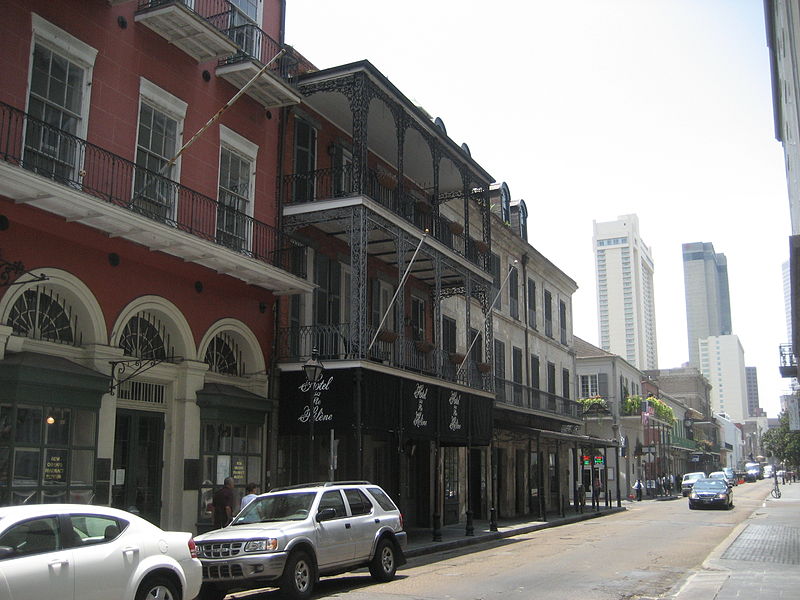
Chartres Street French Quarter Pharmacy Museum Hotel Ste. Helene Napoleon House
The view looking down Chartres Street. From the left, the buildings are the New Orleans Pharmacy Museum, Hotel Ste. Helene, and the Napoleon House. Photo 2008, by Infrogmation, courtesy of Wikipedia.

Tour guide Katherine Smith suggested in her book, Journey Into Darkness: Ghosts and Vampires of New Orleans, that Dupas also treated wounded soldiers here during the Civil War. Perhaps the pain and death from the medical experiments and the soldiers being treated have left a mark on the energy of this building. Some visitors have reported being suddenly overcome with nausea while others have encountered a figure in a brown suit and white lab coat that may be the spirit of Dr. Dupas.

Sources

  • Dwyer, Jeff. Ghost Hunter’s Guide to New Orleans. Gretna, LA: Pelican Publishing, 2007.
  • Oldfield, Eileen. “Things that go bump in the haunted pharmacy.” Pharmacy Times. 30 October 2014.
  • Smith, Katherine. Journey Into Darkness: Ghosts & Vampires of New Orleans. New Orleans, LA: De Simonin Publications, 1998.

Chartres House (Gally House)
540 Chartres Street

The large building occupying this corner of Chartres and Toulouse Streets is sometimes known as Keuffers Building. Built sometime after 1830, the building was intended to house businesses on the first floor with apartments on the second and third floors. If you walk alongside the building on Toulouse Street, you can see the separate slave quarters at the back of the building. Some passersby have noticed a young lady peering from the upper windows on this side of the building, despite the fact that these rooms were vacant at the time. Venture into the parking lot off Toulouse Street and look at the first small window. Tour guides will point out this window and encourage visitors to plunge their hand in. Some visitors have felt the feeling of their hands being grasped by small hands. Jeff Dwyer notes that these hands may belong to slave children who were housed in this room.

Gally House French Quarter New Orleans Frances Johnston
The Gally House in the 1930s as photographed by Frances Johnston for the Historic American Buildings Survey (HABS). Courtesy of the Library of Congress, Prints and Photographs Division.

Recently, the Chartres House restaurant, which opened originally in the former Reynes Mansion (see below) across the street, relocated into the majestic Gally House.

Sources

  • Dwyer, Jeff. Ghost Hunter’s Guide to New Orleans. Gretna, LA: Pelican Publishing, 2007.
  • HistoryChartres House. Accessed 30 April 2020.

Reynes Mansion (formerly the Chartres House)
601 Chartres Street

Originally built as a residence for the Reynes family following the Great Fire of 1788, this home was eventually occupied by the popular Victor’s Café in the late 19th century. Known as a hangout for artists and bohemians, Victor’s was a favorite of the writer William Faulkner.

An apartment located on the second-floor was the scene of a shooting death in the 1970s. The young man who lived there is supposed to have been involved in drugs. Following his death, the building’s owners had trouble renting the apartment as prospective tenants often detected bad energy and some became physically ill while touring the apartment.

Reynes Mansion French Quarter New Orleans
The Reynes Mansion in 2008, when it was still the Chartres House. Photo by Infrogmation, courtesy of Wikipedia.

This building was occupied by the Chartres House restaurant until it relocated across the street to the Gally House (see above).

Sources

Bosque House
617 Chartres Street, private

Bosque House French Quarter New Orleans
The Bosque House in 2011. Photo by Elisa.rolle, courtesy of Wikipedia.

This classic late 18th century Creole townhouse was built to replace a home destroyed in the Great Fire of 1788. Legend holds that this fire started on this site. Don Vicente Jose Nuñez, the army treasurer, owned the house at this site where curtains caught fire from a candle on the family’s personal altar on Good Friday. Tradition prohibited the ringing of bells on this most holy day and the priests of St. Louis Church would not allow the church’s bells to be rung to alarm the citizens. The fire eventually destroyed the church and nearly 900 other buildings in the city. Residents of this private home have heard the sounds of muffled bells. Perhaps better late than never?

Sources

  • Klein, Victor C. New Orleans Ghosts III. Metarie, LA: Lycanthrope Press, 2004.
  • Smith, Katherine. Journey Into Darkness: Ghosts & Vampires of New Orleans. New Orleans, LA: De Simonin Publications, 1998.

The Cabildo
701 Chartres Street

The younger twin of The Presbytère, The Cabildo was constructed to replace the city hall that was destroyed in the Great Fire of 1788. Of all the buildings in this city, this building has witnessed more important historic events than any other. Within the walls of the Cabildo the Louisiana Purchase was finalized in 1803. During the building’s time housing the Louisiana Supreme Court, the case of Plessy v. Ferguson was heard before it headed to the U.S. Supreme Court where it enshrined the concept of “separate but equal” into American racial law. The building became a part of the Louisiana State Museum in 1908.
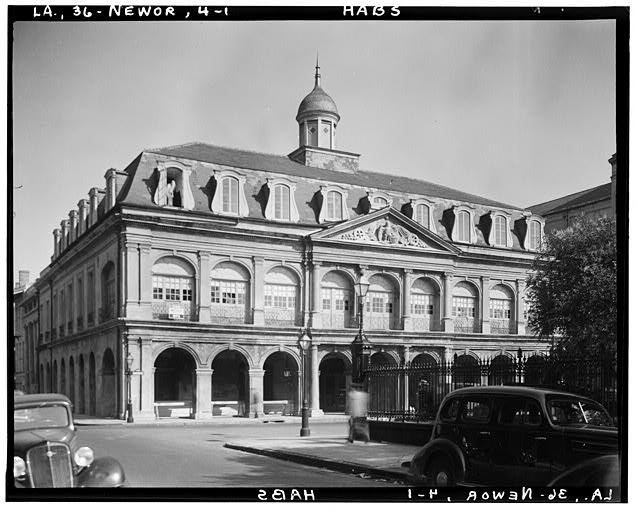
Cabildo French Quarter New Orleans
The Cabildo, 1936, by Richard Koch for the Historic American
Buildings Survey (HABS). Courtesy of the Library of Congress,
Prints and Photographs Division.

While this building served as a seat of government for many years, a prison once stood behind it (see my entry on Pirate Alley for more information on this structure) which may explain the presence of a young soldier. Legend holds that the young man was imprisoned in the prison and, after a trial before a military tribunal, was summarily executed in the courtyard. Some of the museum’s staff and visitors have felt the sensation of someone rushing past them. Others have seen the pathetic form of a soldier in a ragged uniform.

Sources

  • The Cabildo. Louisiana State Museums. Accessed 2 June 2016.
  • Dwyer, Jeff. Ghost Hunter’s Guide to New Orleans. Gretna, LA: Pelican Publishing, 2007.

St. Louis Cathedral
Jackson Square

interior of St. Louis Cathedral New Orleans
Interior of St. Louis Cathedral by Carol M. Highsmith.
Courtesy of the Carol M. Highsmith Archive, Library of Congress, Prints and Photographs Division.

The Grande Dame of New Orleans, St. Louis Cathedral has stood at the sacred heart of this city since the construction of the first church on this site in 1718. The current building was originally constructed between 1789 and 1794 and heavily reconstructed in the mid-19th century. Legend holds that the black-robed form of Father Antonio de Sedella, often known by his French moniker, Père Antoine, appears during the Christmas Midnight Mass. The specter of this most beloved of curates appears to the left of the altar holding a candle.

Sources

  • Brown, Alan. The Haunted South. Charleston, SC: History Press, 2014.
  • Our History.” Cathedral Basilica of Saint Louis. Accessed 2 June 2016.

The Presbytère
751 Chartres Street

The Presbytere New Orleans
The Presbytère, 2007, by Infrogmation. Courtesy of Wikipedia.

The Presbytère is one of the pair of buildings flanking St. Louis Cathedral. Originally constructed in 1791 to match The Cabildo, this structure was known as “Casa Curial” or “Ecclesiastical House,” and provided housing for the Capuchin monks who ran the cathedral. In 1911, the building was taken over to house the Louisiana State Museum. The museum houses two permanent exhibits: one commemorating Hurricane Katrina and the other celebrating the city’s Mardi Gras traditions. While visiting the museum should you see a tall and slim maintenance man in a dark uniform with curly brown hair, be assured that you have just seen a ghost.

Sources

  • Dwyer, Jeff. Ghost Hunter’s Guide to New Orleans. Gretna, LA: Pelican Publishing, 2007.
  • The Presbytère. Louisiana State Museums. Accessed 2 June 2016.

Muriel’s Jackson Square
801 Chartres Street

Originally built as a grand residence for the noted Destrehan family (who also owned haunted Destrehan Plantation found along the famed River Road), the building that now houses Muriel’s partially burned in the Great Fire of 1788 that ravaged the city. Supposedly, the burned house was purchased by Pierre Antoine Lepardi Jourdan who restored the home but sadly lost it in a card game. Not willing to simply leave the home, he quietly resigned to the second floor where he committed suicide in what is now known as the Séance Lounge.

Muriel's Restaurant New Orleans
Muriel’s in 2008. Photo by Infrogmation, courtesy of Wikipedia.

At least this is the story that is commonly told about this building. It is even included on the restaurant’s website. According to a 2013 blog post entitled, “The ‘Ghost’ of Muriel’s Restaurant,” this story is partially bunk. The blog notes that the current building was constructed sometime around the turn of the 20th century after the house on that site was torn down. While the history may not match up to the legend, there still may be paranormal activity with staff and visitors hearing knocking from inside the brick walls of the Séance Lounge, and disembodied voices, while encountering shadowy figures throughout the building. In order to keep some of the activity at bay, the restaurant maintains a special table for the ghost of Monsieur Jourdan.

Sources

  • Brown, Alan. The Haunted South. Charleston, SC: History Press. 2014.
  • Dwyer, Jeff. Ghost Hunter’s Guide to New Orleans. Gretna, LA: Pelican Publishing, 2007.
  • The ‘Ghost’ of Muriel’s Restaurant.” Myth Busters! 4 July 2013.
  • Our Ghost.” Muriel’s Jackson Square. Accessed 2 June 2016.
  • Tipping, Joy. “Ghost trails and Halloween haunts in New Orleans.” Dallas Morning News. 23 October 2008.

Hotel Provincial
1024 Chartres Street

Hotel Provincial French Quarter New Orleans
Hotel Provincial in 2019. Photo by Infrogmation, courtesy of Wikipedia.

Like many hotels throughout the quarter, this hotel consists of an amalgam of different buildings, each with different histories. The 500 building seems to be the one with activity. The building was constructed on a site that was originally occupied by an Ursuline Hospital. It was here that the wounded from the 1814 Battle of New Orleans were treated. During the Civil War the buildings on the site were commandeered for use as a military hospital. That building burned and was replaced by the current structure. Guests and staff have, according to tradition, encountered bloodstains that disappear before their eyes, wounded soldiers in the rooms and corridors, doctors and nurses in bloodstained clothing, and one unlucky security guard using an elevator had the doors open to reveal the scene of a Civil War era surgery.

Sources

  • Brown, Alan. The Haunted South. Charleston, SC: History Press. 2014.
  • Dwyer, Jeff. Ghost Hunter’s Guide to New Orleans. Gretna, LA: Pelican Publishing, 2007.
  • The Hauntings of the Provincial Hotel.” Ghost Eyes Blog. 20 August 2009.

Old Ursuline Convent
1100 Chartres Street

One of the oldest buildings in New Orleans, the old Ursuline Convent has survived hurricanes, fires, and the nuns have provided aid during plagues and epidemics. It’s no surprise that their old convent would house spirits. According to Jeff Dwyer, the spirits of Ursuline sisters have been seen gliding throughout the building while the spirit of a Civil War era soldier has been seen in the garden. (For a couple photos of the Old Ursuline Convent see my entry here.)

Sources

  • Dwyer, Jeff. Ghost Hunter’s Guide to New Orleans. Gretna, LA: Pelican Publishing, 2007.

Beauregard-Keyes House
1113 Chartres Street

See my entry, “Creepiness on Chartres Street,” for an in depth look at the history and hauntings of this famous home.

Le Richelieu Hotel
1234 Chartres Street

Housed in two buildings, one dating from 1845, the other from 1902, the Le Richelieu Hotel occupies the site where five French patriots were executed in the late 18th century. The spirits of these five men may still reside here. For further pictures see, “A Handful of Haunts—Photos from New Orleans.”

Sources

  • A Brief History.” Le Richelieu. Accessed 3 June 2016.
  • Smith, Katherine. Journey Into Darkness: Ghosts & Vampires of New Orleans. New Orleans, LA: De Simonin Publications, 1998.

The Battlefield on Chartres Street

Beauregard-Keyes House
1113 Chartres Street
New Orleans, Louisiana

N.B. This article was edited and updated 8 August 2019.

For information on neighboring spirits see my Chartres Street guide and the main page for my Phantoms of the French Quarter series.

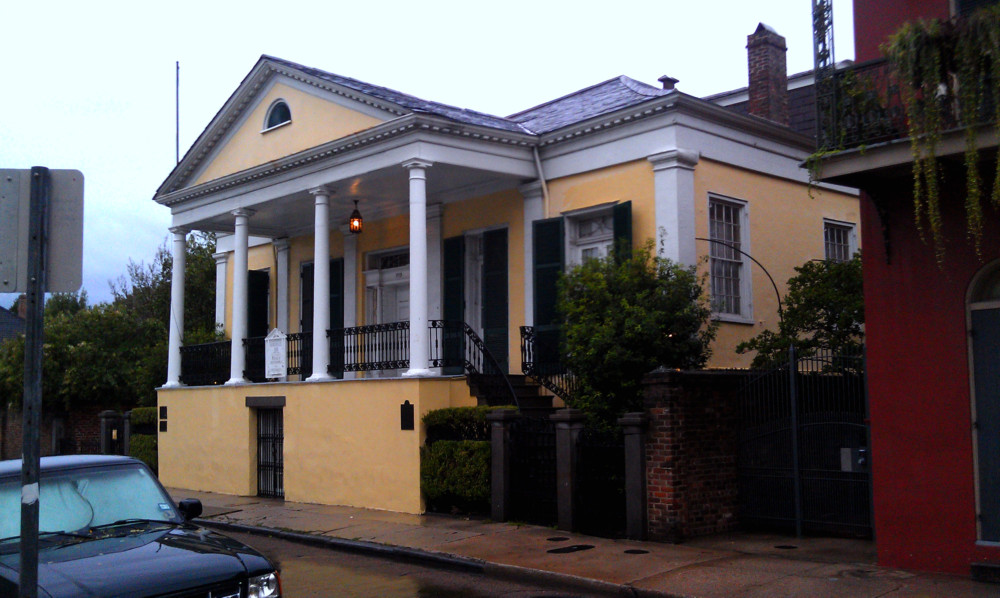
The sunny, yellow façade of the Beauregard-Keyes House on a relatively quiet section of Chartres Street does not belie the sometimes tragic history that has taken place within its walls. That quiet demeanor is shattered frequently by tour guides, with gawking tourists in tow,  intoning one of the many “legends” about this house as they pass. According to their spiels, the house is inhabited by a pantheon of shades, some quite famous.


Beauregard-Keyes House French Quarter New Orleans ghosts haunted
The sunny facade of the Beauregard-Keyes House on a bleak day in 2011. Photo by Ben Lewis, all rights reserved.

General Pierre Gustave Toutant-Beauregard, who occupied the house for about three years following the Civil War, was supposedly haunted by his defeat at the Battle of Shiloh. “…it’s General Beauregard whose presence at 1113 Chartres Street, and whose ghost seems obsessed with returning to the bloody scene of battle that traumatized him for the rest of his life—and beyond.”

Mary Beth Crain in her 2008 book, Haunted U.S. Battlefields continues, “In 1893, the year of the general’s death, people walking by the house late at night reported hearing ‘the voice.’ Someone seemed to be gasping ‘Shiloh…Shiloh’ over and over in a raspy chant that sounded as if it were coming from a great distance…Who else could ‘the voice’ belong to but General P.G.T. Beauregard, the man who throughout his life was haunted by the demons of the battle he needlessly lost? …There was terror in that one word, a sense of horror that was so convincing, those who heard it bolted as fast as they could.”

PGT Beauregard Beauregard-Keyes House French Quarter New Orleans ghosts haunted
P. G. T. Beauregard during his time as a Confederate general by photographer Matthew Brady.

A Haunting Battle

For a name that is Hebrew for “place of peace,” Shiloh, Tennessee is associated with the stench of death and quite possibly haunted Beauregard after his defeat there. The battle, fought in early April, 1862, is often described as the first of the many bloody battles that would be fought during the Civil War.

Union troops under General Ulysses S. Grant were encamped on the banks of the Tennessee River near Pittsburg Landing, Tennessee, while some twenty-odd miles away Confederate troops under General Albert Sidney Johnston and Beauregard, his second in command, were camped at Corinth, Mississippi. Union reinforcements under General Don Carlos Buell were expected to arrive from Columbia, Tennessee after which Grant would sweep down into Mississippi to begin slow disemboweling the Confederacy. Johnston, over Beauregard’s objections, aimed at attacking Grant’s forces before Buell’s arrival. Beauregard bowed to Johnston’s commands and prepared a battle plan along the lines of Napoleon’s advance at the Battle of Waterloo. Coincidently, Beauregard, due to his short stature and French heritage was known as “The Little Napoleon.”

The first assault hit the Union camps around 9:30 on the morning of April 6. Union troops were taken by surprise in the middle of breakfast as Confederate troops charged into their camps bearing the red battle flag emblazoned with the blue, starred St. Andrews Cross that had been designed by Beauregard. Many troops on both sides along the three-mile battle line were still green, and scared by the ferocity of battle, fled, with many of the Union troops fleeing towards the safety of the Tennessee River where they cowered under the bluffs. But one Union line held: composed mainly of Illinois and Iowa farmers. This line, along a sunken road through thick woods and a peach orchard under the command of Brigadier General Benjamin M. Prentiss, kept the Confederates at bay for some six hours. They endured charge after charge and almost point blank artillery fire. General Johnston led the final Confederate charge when a bullet severed his femoral artery from which he died a short time later. Command then passed to Beauregard.

battle of Shiloh Tennessee Beauregard-Keyes House French Quarter New Orleans ghosts haunted
The Hornet’s Nest during the Battle of Shiloh in a chromolithograph by Thure de Thulstrup, 1888.

Prentiss’ division maintained their position along the sunken road where the ferocity of fighting was dubbed “The Hornet’s Nest.” Confederates surrounded the area on three-sides and they massed artillery onto the position, pouring volley upon volley of cannon-fire onto the Union troops. At 5:30 in the afternoon, Prentiss and his remaining 2,200 troops surrendered. The remaining Yankees had been pushed back to the Tennessee. Surveying the situation, Beauregard surmised that he could easily wipe out the remaining troops the following morning.

The sun rose the next day on a Federal force of nearly 50,000 as Buell’s reinforcements had arrived during the night. This huge force now faced Beauregard’s 30,000 troops. Slowly but surely, Union forces sliced into the Confederates with the troops falling back all the way to Corinth, Mississippi. The battlefield was thoroughly littered with the dead and dying, more than had ever been killed in any war previously fought by the United States: some 3,477 dead with some 23,000 wounded.

Historian Shelby Foote described the battle as “a disorganized, murderous fistfight of one hundred thousand men slamming away at each other.” It was this murderous and costly battle that sickened Beauregard so that he took immediately sick leave without permission of Jefferson Davis, who demoted him. Grant’s responsibility in the blood bath led to his being replaced by General Henry Wager Halleck.

Beauregard’s Haunting Legacy

After losing his military rank, Beauregard’s rank was restored and he went on to serve admirably through the end of the war. He retired to the house in New Orleans that now bears his name where his lived quietly for three years. Over time, legend has risen speaking of a more sinister legacy left by Beauregard in the house. Some tenants of the house have spoken of hearing the sounds of battle, perhaps from Shiloh, within and without the house. Even more interesting is the story that tenants being awakened by the sound of battle have stepped into the ballroom only to walk into the midst of the battlefield of Shiloh. While perhaps the story of the battlefield appearing in the ballroom may be only the product of the story passing through a “multi-generational telephone game.”

Beauregard-Keyes House French Quarter New Orleans ghosts haunted
Sign at the front of the Beauregard-Keyes
House, 2011. Photo by Benjamin Lewis,
all rights reserved,

Of course the lone, contemplative shade of Beauregard has also been reported throughout the house. Jeff Dwyer in his Ghost Hunter’s Guide to New Orleans reports that the General’s spirit has been seen peering out the home’s windows, even seen waltzing with a female, most likely his second wife (his first wife, Marie, died in 1850), Caroline. Interestingly, Beauregard and his wife, Caroline, never lived in the house together. The dashing military man and his bride married in 1860 on the eve of the war. The young couple spent much of the war apart and Caroline died in New Orleans in March of 1864 while it was under Union occupation. After receiving news of his wife’s passing, the stunned Beauregard continued to carry out his duties.

Following the war, without a job, money, or a wife, a chastened Beauregard refused to take the loyalty oath until after he was counseled to do so by his former Confederate peers, Generals Robert E. Lee and Albert Sidney Johnston. He took the oath before the mayor of New Orleans around the time he took up residence in the elegant house on Chartres Street. He was offered positions in the militaries of Brazil, Romania and Egypt but refused the offers saying, “I prefer to live here poor and forgotten, than be endowed with honor and riches in a foreign country.” Perhaps he spent his time in the house in Chartres pining for his darling Caroline and regretting his military blunders, but that is only speculation. Novelist Frances Parkinson Keyes, who lived in the house in the mid-20th century promulgated this mythos in her 1962 novel, Madame Castel’s Lodger. The novel portrays a defeated Beauregard looking back over the remains of his life.

History of 1113 Chartres

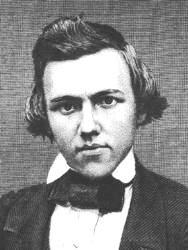
Besides it’s three-year occupation by Beauregard, the home possesses quite an illustrious history. Built by Joseph Le Carpentier, an auctioneer, the house was designed by Francois Correjolles incorporated elements of Roman and Greek architecture. Le Carpentier is said to have started his business selling goods for the pirate, Jean Lafitte (who, incidentally, figures into many local ghost stories and legends), and was also grandfather to the master chess player Paul Morphy, who was born in the house.

Paul Morphy chess player Beauregard-Keyes House French Quarter New Orleans ghosts haunted
An undated image of Paul Morphy. Courtesy of Wikipedia.

A few writers mention Morphy among the pantheon of spirits in the house, though much of their information appears to be incorrect. Mary Beth Crain refers to Morphy as “Paul Munni,” though I can’t discern why. It states that he went insane while living in the house. While I have been able to determine that Morphy was in fact born in the house, his mother was Le Carpentier’s daughter, I can find nothing about his residency in the house as an adult. He returned to New Orleans towards the latter part of his life and “retired” from chess, having been victorious over all the world’s chess masters. While I’ve yet to find anything that specifically states that Morphy lost his sanity, he did live his life in seclusion. Morphy died at his home, which is now Brennan’s Restaurant at 417 Royal Street (which has a number of spirits, possibly even Morphy’s), after taking his usual afternoon constitutional and then taking a cold bath.

After leaving the hands of the Le Carpentier family, the house passed through a number of hands including those of Swiss Consul, John A Merle, whose wife created the garden surrounding the house. As the owners changed, the neighborhood changed; filling with Italian immigrants towards the end of the nineteenth century. The house was bought by Sicilian wine merchant, Pietro Giacona in 1904.

Beauregard-Keyes House French Quarter New Orleans ghosts haunted
The house around the time the Giacona family owned it. Image by the Detroit Publishing Company, courtesy of the Library of Congress, Prints and Photographs Division.
Beauregard-Keyes House French Quarter New Orleans ghosts haunted
A bright spot of sunshine on a dreary day, the Beauregard-
Keyes House, 2011. Photo by Benjamin Lewis, all rights reserved.

The Battle of Chartres Street

The Black Hand or La Mano Nero was an extortion racket commonly used among Italians and Italian Americans throughout the nineteenth and into the early part of the twentieth century, when the Mafia took on subtler methods of crime. New Orleans had already seen the tragic effects of such crime in 1890 with the assassination of police chief David Hennessy. The most common modus operandi for The Black Hand was to send the victims a letter, signed with a black handprint, threatening harm unless a specific amount of money was paid.

The Giacona family while living here found themselves victims of The Black Hand, in 1908, after receiving a letter demanding payment of $3000 or certain death. Events reached a zenith in the early morning hours of June 17. When Commander Thomas Capo of the Third Precinct Station arrived at the house around 2:45 AM, he witnessed everything in confusion:

I saw the old man standing on the gallery with the shotgun in his hand, while his son stood almost in the doorway with a rifle in his hands. On the gallery, two of the men were stretched out in death. Their shirts were covered with blood. In the yard, at the foot of the stairs, another man was lying. From its position in the yard, I judged that he was shot while running down the stairs, and had rolled to the ground. The table around which the men were seated before the shooting commenced was littered with watermelon rind and egg shells. Some half-filled wine goblets were also on the table.

A trail of blood led from the yard, over a wall and up and down a number of streets in the area. The trail led to Francisco Vitale who was found wounded at Bourbon and Ursulines Streets.

Pietro Giacona, his son Corrado, and a nephew, Pietro Bellonde, were all arrested for the murders of the Barraca brothers, Giovanni and Nuncy, and Cero Cusimano. Eventually, the Giaconas and the nephew were released. Upon their return, it is said that the house was turned into a fortress. The events of that early June morning were not easily forgotten and may continue to be re-enacted. Reports from people passing the house late at night have included the sounds of gunfire and shouting, the acrid smell of gunpowder and shadowy figures flitting around the fountain in the garden. 

Frances Keyes Beauregard-Keyes House French Quarter New Orleans ghosts haunted
Frances Keyes, 1921., by the National Photo Company. Courtesy of the Library of Congress, Prints and Photographs Division.

When the house was sold in 1925, Antonio Mannino, the new owner considered demolishing the house for either a warehouse or a macaroni factory. This possibility riled local preservationists who were disturbed by the loss of such a landmark. Beauregard House Inc. took over the house and in 1944, the group rented the house to novelist Frances Parkinson Keyes who occupied the house for some 25 years. During this time, she spearheaded a major renovation of the house while writing novels that included the house and former residents. She also created the Keyes Foundation which bought and now operates the house as a museum.

Spiritual remnants from this era may include Mrs. Keyes’ beloved cocker spaniel, Lucky. The dog died only a few days after his mistress’ death. Stories also tell of a large cat that is seen darting through and around the house but then disappearing. The cat is likely the shade of Caroline, a cat that took up in the house museum’s garden. Guests and guides in the house have felt a feline rubbing against their legs.

Though the current directors of the Beauregard-Keyes House deny the existence of spiritual activity in the house, it apparently hosts a legion of spirits. These denials keep investigators at bay, though the city’s many tour operators still walk and drive tourists past the house spinning creepy, and somewhat fictional tales battles on Chartres Street.

Sources

  • Battle of Shiloh. Wikipedia, the Free Encyclopedia. Accessed 2 December 2010.
  • Bruno, Stephanie. “A House Where the Tall-Tales Are True.” The Times-Picayune. 5 March 2005.
  • Crain, Mary Beth. Haunted U. S. Battlefields. Guilford, CT: Globe Pequot Press, 2008.
  • “Death of Paul Morphy.” The Daily Picayune. 11 July 1884.
  • Dwyer, Jeff. Ghost Hunter’s Guide to New Orleans. Gretna, LA: Pelican Press, 2007.
  • Frances Parkinson Keyes. Wikipedia, the Free Encyclopedia. Accessed 23 May 2016.
  • “Giacona hearing fixed for Thursday.” The Daily Picayune. 7 July 1908.
  • “Giaconas held, but allowed bail.” The Daily Picayune. 10 July 1908.
  • “Giaconas held without bond.” The Daily Picayune. 19 June 1908.
  • Klein, Victor C. New Orleans Ghosts. Chapel Hill, NC: Professional Press, 1993.
  • Paul Morphy. Wikipedia, the Free Encyclopedia. Accessed 2 December 2010.
  • G. T. Beauregard. Wikipedia, the Free Encyclopedia. Accessed 2 December 2010.
  • Sillery, Barbara. The Haunting of Louisiana. Gretna, LA: Pelican Publishing, 2001.
  • Ward, Geoffrey C., Ric Burns and Ken Burns. “A Bloody Affair (1862). The Civil War. American Documentaries, Inc. 1990.
  • Ward, Geoffrey C., Ric Burns and Ken Burns. The Civil War: An Illustrated History. NYC: Knopf, 1990.

Life Returns to the Dead of Belmont—Elkridge, Maryland

Belmont Manor & Historic Park
6555 Belmont Woods Road
Elkridge, Maryland

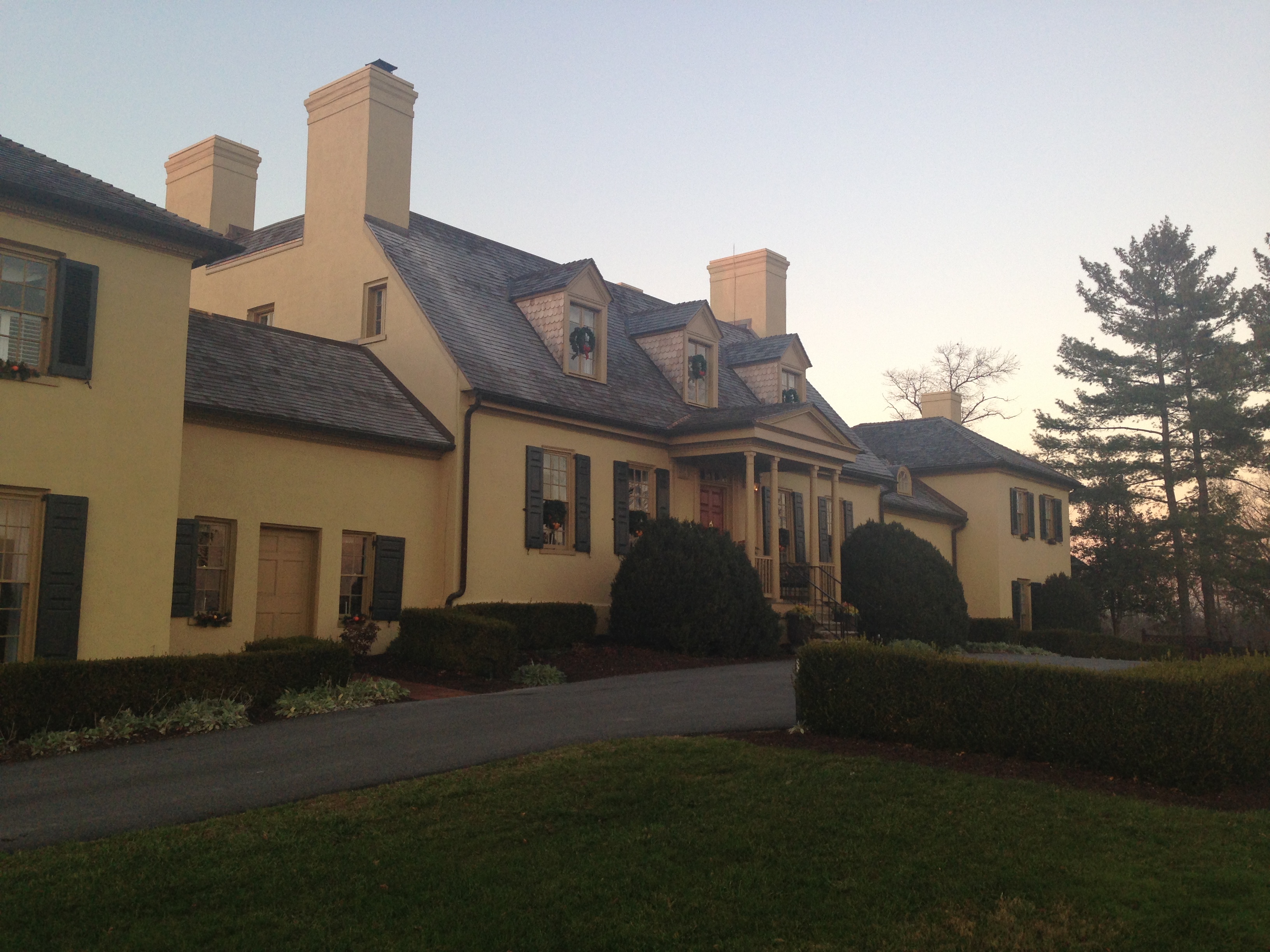
 Last year just about this time, life began to return to Belmont Manor when it was reopened to the public. The estate had been a private residence for almost two centuries before it was donated to the Smithsonian Institution in 1964 for use as a conference center. The Smithsonian sold the property in 1982 to the American Chemical Society which used it as a meeting facility. They sold the property to Howard Community College which closed the property in 2010 after facing financial difficulties. Until the property sold in 2012, the grand house quietly sat in a pall of silence. Only the dead stirred.

As the house was being renovated and restored by Howard County, its new owner, the dead continued to stir. Workers on the estate observed a little girl running about. The county contacted Inspired Ghost Tracking who investigated and was able to captured an image of the spectral girl peering around a corner.

Belmont Manor, 2015, by Scott218. Courtesy of Wikipedia.

This ghostly child can be added to the legend recorded a little more than a hundred years ago in John Martin Hammond’s 1914 book, Colonial Mansions of Maryland and Delaware. In addition to relating the histories of these magnificent estates, Hammond included the occasional ghost story when they popped up. The Belmont Ghost, as Hammond dubs the spectral event, usually happened at least once every winter. On a dark, windy night, residents and visitors to Belmont would hear the sounds of an invisible carriage approach the house. Upon opening the door, the living would see nothing but continue to hear the sounds of an invisible retinue enter the house. Once unloaded, the carriage would be heard to head towards the stable.

Since opening to the public last year, Belmont is now playing host to weddings and other events while the public explores the historic woodlands that remain unchanged since the building of the house in 1738. Now that the dead have been discovered on the estate, Howard County has brought out paranormal investigators and those interested in learning about the spirits around us to learn about paranormal investigating here. According to the Baltimore Sun, the next public paranormal investigation will be held this summer. 

Sources

  • Bonk, Valerie. “Ghost investigations at Belmont gather people curious about the paranormal.” Baltimore Sun. 6 April 2016.
  • Gunts, Edward. “The past is prologue for Elkridge’s Belmont Mansion.” Baltimore Sun. 20 September 2012.
  • Okonowicz, Ed. The Big Book of Maryland Ghosts. Mechanicsburg, PA: Stackpole Books, 2010.
  • Yeager, Amanda. “Elkridge’s historic Belmont Manor reopens.” Baltimore Sun. 13 April 2015.

Southern Index of Higher Ed Haunts—West Virginia

I’ve embarked on a project to comprehensively document haunted college and university sites throughout the South. When I first conceived of this project, I imagined I would only have about 200 or 300 locations, but after scouring my personal indices of locations, I ended up with over 500, so I’m breaking this up by state.

Please note that the references quoted at the end of each entry are only those sources that specifically note the hauntings. If you have experienced a haunting at any of these locations, know of other haunted college and university locations not included here, or have a correction, please email me at southernspiritguide@gmail.com. I’d love to hear your story and include that information here.

Bethany College, Bethany

ALEXANDER CAMPBELL MANSION & GOD’S ACRE CEMETERY – This mansion and cemetery, the former home and burial site of religious leader and Bethany college founder Alexander Campbell, are now owned by Bethany College. Campbell’s spirit has supposedly been spotted within the small, hexagonal study building on this estate. The spirit of Campbell’s young son Wickliffe, who drowned nearby, may make appearances within the house. Legend holds that the low stone wall entirely surrounding the cemetery across the road may hold spirits within this historic family cemetery, thus the numerous stories involving encounters here between the living the dead. 6, 10, 16, 22

COCHRAN HALL – A spirit in this 1910 residence hall’s first floor guest apartment still makes its presence known, though it has yet to be identified. 25, 27

GRACE PHILLIPS JOHNSON MEMORIAL VISUAL ARTS CENTER – Originally constructed as Irvin Gymnasium in 1919, this structure is home to visual arts classes and possibly the spirit of the building’s namesake. Security guards have reported that they encountered the spirit of Ms. Johnson while others have reported that the eyes in her portrait follow people around the room. 25, 27

OLD MAIN CLOCK TOWER – A student’s suicide is reenacted at the iconic clock tower on Old Main. Lore states that a female may have committed suicide here by leaping from the clock tower to her death. 11

PHILLIPS HALL – This 1929 residence hall may be home to two ghosts: Sarah, a student who hung herself in the attic and a sailor who died as he was either visiting a student or sneaking out of the building when it served as navy housing during World War II. 8, 11, 27

Bluefield State College, Bluefield

MAHOOD HALL – One of the oldest buildings on the campus of this historically black college, Mahood Hall is believed to be the home of a little girl’s spirit. For years, students have awakened here to find themselves face to face with a little girl who quickly disappears. A 2010 investigation by Black Diamond Paranormal Society captured several EVPs and a brief video showing a figure passing by an open doorway in the supposedly empty building. 12

Concord University, Athens

SARVAY HALL – Comments on Theresa Racer’s blog post about Concord University note that this dormitory may be fairly active. 13

WILSON HALL – The third floor of this early-1960s era dormitory is supposed to be quite paranormally active. Blogger Theresa Racer’s post on Concord University notes that a student may have committed suicide in room 320, though comments on this post reveal that other rooms on the floor may also be active. 13

Halliehurst at Davis & Elkins College, 2014. Photo by Generic1139, courtesy of Wikipedia.

Davis & Elkins College, Elkins

GRACELAND INN AND CONFERENCE CENTER (100 Campus Drive)One of two Victorian mansions (the other being Halliehurst, see below) constructed as summer homes for a pair of friends, businessmen and later senators, Henry Gassaway Davis and Stephen Benton Elkins. Their families later donated the grand estates to create a campus for the small, Presbyterian-affiliated college established by Henry Davis. Built by Henry Davis, Graceland may be haunted by the spirit of Grace Davis, one of his daughters. During a 2008 walkthrough of the house with paranormal investigator Chris Fleming, students were treated to some EVPs and the gas burners in the kitchen turning themselves on. 5, 24

HALLIEHURST – Like its Victorian sister, Graceland, students, staff members, and visitors have experienced the unexplained in Stephen Elkin’s former summer home, Halliehurst for many years. Stories at Halliehurst date to the home’s use as a women’s dormitory in the 1950s. Gavenda and Shoemaker note in their A Guide to Haunted West Virginia that nearly all of the encounters with the paranormal here are positive and helpful with students being saved by phantom hands from injury or death. 24, 26

Glenville State College, Glenville

CLARK HALL– An October 2011 edition of The Barr Bulletin a college newsletter written by Betsy Barr, wife of GSC’s president Peter Barr, makes note of the college’s most famous ghost, “Sis Linn.” Sarah Louisa Linn, known familiarly as “Sis” Linn, was an 1877 graduate of the Glenville Normal School that preceded the state college. She later owned a boarding house where she was bludgeoned to death in 1919. The boarding house was later torn down to construct a women’s dormitory Verona Maple Hall. Sis Linn’s spirit was observed here in the years before the building was replaced with Clark Hall. Linn’s spirit may still be present here as well as in other places on campus. Here, Linn’s spirit seems to cause much noise. 1, 14

HARRY B. HEFLIN ADMINISTRATION BUILDING – According to legend, a bell that hung in this building would often chime thirteen times until it was recently removed. Within this building lights flicker, keys left in doorknobs jingle on their own accord and disembodied whispering is heard. 28

LOUIS BENNETT HALL – When it served as a men’s dormitory students in Bennett Hall were sometimes awakened by a Lady in White. After the building’s conversion into offices, odd phenomena is still observed here. 28

OLD GLENVILLE CEMETERY – Sis Linn, the college’s resident spirit was buried here after she was bludgeoned to death in 1919. Her spirit is said to be observed walking through the cemetery. 14

PICKENS HALL – According to author Tom Ogden, students in this residence hall have reported hearing furniture being moved on the floor above them and the sound of marbles rolling across the floor. 28

Old Main at Marshall University, 2013. Photo by WVFunnyMan, courtesy of Wikipedia.

Marshall University, Huntington

ALPHA CHI OMEGA HOUSE (Fifth Avenue)Legend holds that a little boy killed here in a fire now haunts this sorority house. Sisters in the house have reportedly experienced flickering lights, unexpected cool breezes, and objects being moved. 2, 27

ERMA ORA BOYD CLINICAL CENTER– Built on the site of Fairfield Stadium, this 2007 building is reportedly filled with activity after hours. Elevators operate on their own accord, televisions turn on by themselves, and the sound of two men chanting has been heard in the commons area. 2, 27

MORROW LIBRARY – Library patrons are sometimes interrupted in this 1930 library by the sounds of arguing, though the source is never found. Originally the main university library building, this building now houses special collections. 2, 27

OLD MAIN – The oldest and most iconic building on campus, Old Main also harbors ghosts. One of the more recognizable spirits haunts the old auditorium within this building. Believed to be the spirit of a former theatre director, the spirit has been seen backstage and walking the catwalks. A 1996 article notes that in addition to the auditorium, the attic and Yeager Suite are also the domain of spirits. For further information see my blog post, “Phantoms of the Opera, Y’all.”2, 27

SIGMA PHI EPSILON HOUSE (1401 5th Avenue) – Like the Alpha Chi Omega House nearby, this fraternity house is purported to be haunted by the victims of a fire, though in this case the victims were a mother and her two children. The lore states that this fire took place in the late 1960s or early 1970s and residents still hear the sounds of sobbing. 2, 27

TWIN TOWERS EAST – The spirit of a student who committed suicide is said to remain in his room, 1218, of this 1969 residence hall. A student reported in a 1996 article in The Parthenon that he awakened to see the image of a young man sitting in his room. The apparition disappeared after the student pulled his covers over his head. 2, 27

Mountwest Community & Technical College, Huntington

ACADEMIC BUILDING – Mountwest Community & Technical College took up residence in its main academic building in 2012. Built in 1980 as an office building for the Ashland Coal Company, the building may be occupied by the spirit of an employee of one of the companies that occupied this modern office building previous to the college’s occupation. Theresa Racer notes in her blog that after the death of an employee here from a heart attack in 2002, people on the fourth floor began to experience doors opening and closing by themselves, a feeling of being watched and the smell of pipe tobacco. 17  

McMurren Hall at Shepherd University, 2012. Photo by Acroterion, courtesy of Wikipedia.

Shepherd University, Shepherdstown

GARDINER HALL – The spirit of a former homecoming queen named Patty still stirs in this residence hall. She supposedly died here after falling in the shower and hitting her head sometime in the late 1980s. A portrait of Mabel Gardiner, the building’s namesake, is supposedly hung upside down to appease Patty’s restless spirit. 4, 27

KENNEMOND HALL – Residents of this residence hall regularly encounter the spirit of a young boy wearing knickers and a driving cap. His story says that he was killed in a fall at a local construction site. He is known to play with student’s electronic devices. Author Rosemary Ellen Guiley reports that there is also a spirit encountered in the building’s basement. 4, 27

McMURRAN HALL – Construction began on this building on the eve of the Civil War and it remained unfinished for a few years following the war. After the bloody Battle of Antietam was fought nearby in Maryland, this was among local buildings commandeered for use treating the wounded. The spirit of a soldier is often seen peering from the bell tower. For further information see my article on Shepherdstown, “None of the town is spared a ghost story—Shepherdstown, WV.”3, 9

MILLER HALL– A young girl who died in a fall from a hayloft on this property prior to the construction of Miller Hall has been seen roaming the halls of this building. Local lore also notes the death of a nursing student by her own hand here, but her spirit has not been spotted. Lore also mentions that an exorcism was performed in room 201, though a residence life staff member told the student newspaper in 2014 that this was likely just a blessing of the room to put paranormal activity at rest. 4, 27

SHAW HALL – The apparition of a woman has been seen at some of the windows of this building. 27

THATCHER HALL – The spirits of those of those interred in the nearby cemetery haunt the B Wing of this residence hall. 4, 27

TURNER HALL – The Victorian girl who haunts Miller Hall has also been seen here while the spirit of a construction worker also roams the halls. During the construction of Turner Hall a construction worker fell to his death on the rocks that are now a part of the building’s basement. 4, 27

YELLOW HOUSE (ENTLER-WELTZHEIMER HOUSE) – One of the oldest houses in Shepherdstown and the oldest on campus, the Yellow House is purported to still be the residence of a cobbler who was killed here in 1910. The tapping of his cobbler’s tools are still heard. For further information see my article on Shepherdstown, “None of the town is spared a ghost story—Shepherdstown, WV.”3, 21

University of Charleston, Charleston

EAST APARTMENTS – Built on the former site of haunted Dickinson Hall, this dormitory may have inherited the paranormal activity from that building. 27

GEARY STUDENT UNION – This student union building is apparently haunted, though little information is available as to the exact nature of the paranormal activity. 18, 27

RIGGLEMAN HALL – Built in 1950, Riggleman Hall may have a few spectral residents including a female suicide victim and Leonard Riggleman, former president of Morris Harvey College, predecessor to the University of Charleston. The activity blamed on these spirits includes odd noises and shadows. 18, 27 

Woodburn Hall at West Virginia University, 2008. Photo by Swimmerguy269, courtesy of Wikipedia.

West Virginia University, Morgantown

BETA THETA PI HOUSE – Two spirits may haunt this fraternity house: the spirit of a butler who served the brothers in the 1940s and the spirit of a homeless man who committed suicide in the basement in the 1980s. 24

BOREMAN HALL – Odd sounds and other paranormal activity has been encountered throughout the north section of this residence hall. 24

DOWNTOWN CAMPUS LIBRARY – Studious spirits inhabit this 1931 library. One staff member was studying here when he heard the elevator doors open and someone walk to the desk on the other side of the partition and pull the chair out. When he looked shortly after that, no one was there. Legend blames this activity on a staff member who died after falling down an open elevator shaft.  7, 19

ELIZABETH MOORE HALL – Built in the late 1920s, this historic building may be haunted by the spirit of its namesake, Elizabeth Moore. 19, 24

WV ROUTE 857 – While not on the campus of WVU, this haunting involves two students who were abducted from the campus January 18, 1970. A few months later, the headless bodies of the two females were discovered near Cheat Lake. The heads have never been recovered. An arrest and conviction was garnered in this case. Drivers at night near the site where the coeds’ bodies were discovered have spotted the apparitions of two females in the woods. 24, 27

THE MOUNTAINLAIR – A spectral girl dancing in a yellow party dress has been observed here. 27

WOODBURN HALL – Perhaps one of the more unique ghost stories in West Virginia involve the spectral bovine mooing that is heard here. Legend speaks of a student prank gone awry when students lead a cow up the stairs to the clock tower of this building. When the students could not get the cow back down the stairs the cow apparently had to be killed and butchered. 19

West Virginia University Institute of Technology, Montgomery

RATLIFF HALL – Besides very typical paranormal activity including footsteps and slamming doors, one female student claimed to have seen the specter of a firefighter in this dormitory building. 20

West Virginia Wesleyan University, Buckhannon

AGNES HOWARD HALL – Named for a student who was stricken with a sudden illness while at school here and passed away, Agnes Howard Hall may have paranormal activity including shaking beds and a student hearing her name whispered three times. 15, 23

Sources

Articles

  1. Barr, Betsy. The Barr Bulletin. October 2011
  2. Donohue, Kelly. Unnamed article. The Parthenon. 29 October 1996.
  3. Engle, Georgia Lee. “Restless spirit roams campus, haunts High Street Cottage.” Shepherd College Picket. 28 October 1954.
  4. “Ghouls & Ghosts: Legends and hauntings of Shepherd University.” The Picket. 28 October 2014.
  5. Higgins, Carra. “Paranormal says hauntings present at Graceland, Halliehurst.” The Inter-Mountain. 28 October 2008.
  6. Jackson, Mary Robb. “Paranormal activity spooking up some fun at Bethany College.” 30 October 2013.
  7. Kinney, Hilary. “Spooky stories surface throughout campus.” The Daily Athenaeum. 31 October 2013.
  8. McQuillan, Kayla. “The haunts of Bethany College.” The Tower. No Date.
  9. Molenda, Rachel. “Town serves as home to ghosts from past.” Shepherdstown Chronicle. 28 October 2011.
  10. Racer, Theresa. “Alexander Campbell Mansion.” Theresa’s Haunted History of the Tri-State. 20 April 2012.
  11. Racer, Theresa. “Bethany College.” Theresa’s Haunted History of the Tri-State. 22 January 2012.
  12. Racer, Theresa. “Bluefield State College.” Theresa’s Haunted History of the Tri-State. 5 September 2012.
  13. Racer, Theresa. “Concord College.” Theresa’s Haunted History of the Tri-State. 29 February 2012.
  14. Racer, Theresa. “Ghost of Glenville State.” Theresa’s Haunted History of the Tri-State. 12 September 2011.
  15. Racer, Theresa. “The Ghost of West Virginia Wesleyan.” Theresa’s Haunted History of the Tri-State. 2 March 2012.
  16. Racer, Theresa. “God’s Acre Cemetery.” Theresa’s Haunted History of the Tri-State. 23 May 2011.
  17. Racer, Theresa. “Mountwest Community & Technical College inherits a ghost!” Theresa’s Haunted History of the Tri-State. 21 September 2013.
  18. Racer, Theresa. “University of Charleston.” Theresa’s Haunted History of the Tri-State. 7 October 2012.
  19. Racer, Theresa. “WVU haunts around campus.” Theresa’s Haunted History of the Tri-State. 20 May 2012.
  20. Racer, Theresa. “WVU Tech’s Phantom Fire Fighter.” Theresa’s Haunted History of the Tri-State. 4 September 2012.
  21. Shepherd University. “The Legend of the Yellow House.” Accessed 2 October 2011.
  22. Shinn, Emma. “Stone wall said to keep spirits, stories in Bethany cemetery.” Observer-Reporter. 28 October 2013.
  23. Wagoner, Becky & John Wickline. “Bone chilling tales of ghostly wails.” The Inter-Mountain. 27 October 2007.

Books

  1. Barefoot, Daniel. Haunted Halls of Ivy: Ghosts of Southern Colleges and Universities. Winston-Salem, NC: John F. Blair, 2004.
  2. Carney, Brent. Bethany College. Charleston, SC: Arcadia, 2004.
  3. Gavenda, Walter & Michael T. Shoemaker. A Guide to Haunted West Virginia. Glen Ferris, WV: Peter’s Creek Publishing, 2001.
  4. Guiley, Rosemary Ellen. The Big Book of West Virginia Ghost Stories. Mechanicsburg, PA: Stackpole, 2014.
  5. Ogden, Tom. Haunted Colleges and Universities: Creepy Campuses, Scary Scholars, and Deadly Dorms. Guilford, CT: Globe Pequot Press, 2014.

Haunt in the Horseshoe—Sanford, North Carolina

House in the Horseshoe State Park
288 Alston House Road
Sanford, North Carolina

By all accounts, Philip Alston was trouble. A member of the prominent Alston family, some might describe him as a spoiled brat. The house Alston constructed at this horseshoe bend in the Deep River was among the first large plantation homes constructed in this region when it was built in 1772. As revolutionary tensions heated up throughout the colonies, Alston sided with the Patriot cause. Though he was fighting for the same ideals, even the Patriots took umbrage with Philip Alston. Another Patriot, Robert Rowan, even spoke to the governor of his dislike for Alston’s “domineering” and “tyrannical” attitude.

With the outbreak of fighting, squabbles between neighbors took on more deadly overtones throughout the frontier. Planter David Fanning of South Carolina remained loyal to the British crown and steadfastly rooted out Patriots throughout the area. A small militia under Fanning’s command attacked Alston’s home on the morning of August 5, 1781 in retaliation for the death of one of his men at the hands of some of Alston’s comrades. That morning, Alston, his wife Temperance, two children, and a small band of his men were at the large white house. When Fanning’s men attempted to attack the house one of the Tories was quickly felled by a bullet to the heart. Soon gunfire poured from the home’s windows while Alston’s children cowered in a fireplace inside.

A cart of straw was set alight and pushed towards the house which began to burn. Fearful of being burned out of the house, Alston sent his wife with a flag of truce to arrange surrender. Fanning agreed to allow Alston and his men to surrender. The Tories plundered the bullet-riddled house but did not burn it.

House in the Horseshoe, 2007, by Jerrye and Roy Klotz, MD. Courtesy of Wikipedia.

Philip Alston remained on his plantation for some years after the war and served in the state senate, though his roguish attitude lead to his fall from grace and in 1790, he was forced to sell his beloved home. Some believe that the rascal spirit of Alston may remain here in the form of footsteps heard in the home, disembodied whispers in the fireplace where the children were hidden, and orbs of light seen in the yard.

Source

  • Barefoot, Daniel W. Spirits of ’76: Ghost Stories of the American Revolution. Winston-Salem, NC: John F. Blair. 2009.
  • Bishir, Catherine W. and Michael T. Southern. A Guide to the Historic Architecture of Piedmont North Carolina. Chapel Hill, NC: University of North Carolina Press, 2003.
  • Hauck, Dennis William. Haunted Places: The National Directory. NYC: Penguin, 1996.
  • House in the Horseshoe: Overview.” NC Historic Sites. Accessed 3 January 2016.
  • Thompson, Jessica Lee. “House in the Horseshoe.” North Carolina History Project. Accessed 3 January 2016.

Some Alabama Hauntings, Briefly Noted

This entry was originally posted 16 January 2013, it has been edited and expanded a bit.

Bama Theatre
600 Greensboro Avenue
Tuscaloosa

Architect David O. Whilldin employed a theme of simplicity versus the exotic in his design for the Bama Theatre. The façade of the theatre utilizes limestone (a stone that may conduct paranormal energy) cut in the simplified geometry of Art Deco and Moderne lines. Step into the lobby, and a patron will find themselves immersed in the exuberance of an Italian Renaissance courtyard modeled on that of the Davanzati Palace in Florence. Perhaps Whilldin’s theme was meant to illustrate the condition of so many Americans during the Great Depression: leading simple and austere lives on the outside while their inner selves are vivacious, imaginative and highly cultured. Opening in 1938 and built with funds from the Works Progress Administration, the Bama Theatre can be considered one of the last of the great American atmospheric movie palaces.

Marquee of the Bama Theatre, 2010, by Carol M. Highsmith. Courtesy of the George F. Landegger Collection of Alabama Photographs in Carol M. Highsmith’s America, Library of Congress, Prints and Photographs Division.

The identities of the spirits at the Bama Theatre are unknown. While research into the theatre’s past has revealed no deaths to link to the haunting, this may be a case of residual energy remaining after years of audiences and performers in the theatre. One particularly interesting story involves an employee who arrived early one morning. As he was making coffee, he heard the elevator moving. He stood at the doors expecting to greet the passenger, but when the doors opened, a blast of icy air greeted him, this is perhaps the most chilling of the paranormal events in this building.

Others working in the building have reported shadow figures, odd lights, and the distinct feeling of being watched. The building was probed by the Alabama Paranormal Research Team in recent years, though little evidence to support a haunting was uncovered.

Sources

  • Alabama Paranormal Research Team. Investigation Report on The Bama Theatre, Tuscaloosa, AL. Accessed 29 November 2012.
  • Higdon, David & Brett J. Talley. Haunted Tuscaloosa. Charleston, SC: History Press, 2012.
  • “History.” The Bama Theatre (bamatheatre.org). Accessed 4 March 2013.

Bluff Hall
405 North Commissioners Avenue
Demopolis

The fortunes of Demopolis’ Lyon family reflect the rise and fall of the entire state during the 19th century. While the family owned a large plantation, Bermuda Hill, outside of town, it required a home in town for business and social functions. This home, Bluff Hall, was constructed in 1832 by Allen Glover for his daughter Sarah and her husband, Francis Strother Lyon.

Bluff Hall, 2008, by Altairisfar. Courtesy of Wikipedia.

The revised WPA guide to the state describes the house as “fortress-like in its strength and severity,” an apt description for the magnificently sited home. Occupying one of the bluffs above the Tombigbee River, the home illustrates the Lyon family’s remarkable and powerful position in the region. Francis Lyon, the home’s first owner, served in the Alabama State Senate, the U.S. House of Representatives, and the Confederate Congress, all the while running his plantation at Bermuda Hill. The home remained in the Lyon family until just after the turn of the 20th century when another family purchased it as a residence. The Marengo County Historical Society purchased the home in 1967 and restored it to its antebellum glory.

Since its purchase by the historical society, evidently no one had stayed the night in the home until 2003. A group of people staying overnight encountered odd sounds during the evening. When the President of the local Chamber of Commerce went to investigate, she was confronted with the apparition of a child on the stairs. Local historians have suggested that the child was the spirit of Leonidas Mecklenburg “Merk” Polk, Francis Lyon’s grandson and grandson to Confederate General Leonidas Polk, who passed away in the home of scarlet fever in 1877.

Sources

  • “Area rich in ghost stories, folk lore.” Demopolis Times. 30 October 2008.
  • Bluff HallWikipedia, the Free Encyclopedia. Accessed 14 December 2012.
  • Francis Strother Lyon. Wikipedia, the Free Encyclopedia. Accessed 14 December 2012.
  • Hendrix, Barry H. “Image may have been real.” Demopolis Times. 5 November 2003.
  • Walker, Alyce Billings. ed. Alabama: A Guide to the Deep SouthNew Revised Edition. NYC: Hastings House, 1975.

Interstate 65
Between Evergreen and Greenville

This roughly 40-mile stretch of I-65 between Evergreen, in Conecuh County, and Greenville, in Butler County, is the setting for a legend. Like much of the state of Alabama, this area was initially part of the vast nation of the Muscogee, or Creek, people. After Alabama’s creation in 1819, land-hungry white pioneers flooded the area and tensions rose as the Muscogee watched the theft and degradation of their homeland. Skirmishes between the two groups brought violence and orders of removal from Washington. Thousands of Muscogees were forcibly removed from their rich and fertile homeland and resettled in the dry and barren Oklahoma territory.

The Muscogee left behind villages, farmland, hunting grounds, trails, and the bones of their ancestors. According to legend, I-65 cuts a swath through part of this sacred Muscogee territory and, as a result, this section of interstate is cursed. One commonly quoted statistic on this stretch of road states that “between 1984 and 1990, there were 519 accidents, 208 injuries, and 23 deaths on this 40-mile stretch of highway, though the road is straight, even, and well maintained.”

Many of these accidents are supposedly caused by something, possibly a human figure, darting across the road. A 2002 Birmingham News article says that Native American spirits have been seen in this area, “some as tall as 50 feet, towering over the pine trees in the interstate median.” Other reports involve mysterious, bright lights temporarily blinding drivers. Then again, this may just be another old Indian curse legend.

Sources

  • Granato, Sherri. “Haunted America: Interstate 65 in Evergreen, Alabama.” Yahoo Voices. 24 October 2011.
  • Hauck, Dennis William. Haunted Places: The National Directory. NYC: Penguin, 2002.
  • Haveman, Christopher. “Creek Indian Removal.” Encyclopedia of Alabama. 23 February 2012.
  • MacDonald, Ginny. “Boootiful Alabama: Don’t let night catch you driving alone.” Birmingham News. 31 October 2002.

A Southern Feast of All Souls—Newsworthy Souls

A collection of hauntings from recent news.

Marty’s Blues Café
(formerly Brandi’s Blues Cafe)
424 West Beacon Street
Philadelphia, Mississippi

N.B. This location has been covered in more detail in “Death on the move–Philadelphia, Mississippi.

The chef at Brandi’s Blues Café was working in the kitchen early one recent morning. Startled by a loud bang he continued working until he heard water running in the sink. He walked over, turned the sink off and returned to his work. Glancing up he saw a figure standing near the kitchen door. It was “about 6 ft. It had a little pot belly. I saw it for three or four seconds.” Thinking it was a co-worker, the chef returned to work. After discovering he was alone in the building he began to hear footsteps and he left the building until his coworkers showed up.

After researching the history of the building and the area, it was discovered that a man was executed nearby in the 1940s. Paranormal investigators brought in to investigate did pick up an EVP response when they spoke the name of the man executed.

Sources

  • Gater, Harold. “Is this Mississippi blues café haunted?” The Clarion-Ledger. 24 September 2015.
  • Jennings, Lindsey. “Haunted Philadelphia Café Investigated.” 24 September 2015.

McRaven House
1445 Harrison Avenue
Vicksburg, Mississippi

The new owners of the McRaven House, often described as the most haunted house in the state, have been very busy restoring the historic house and mingling with the home’s famous ghosts. In one interaction, the new owners captured an EVP of a female’s voice saying, “That’s a funny old clock.” The house has a number ghosts covering nearly all periods of the home’s history from the late 18th century to the present day. McRaven is now open to visitors for history and haunted history tours.

McRaven House, 2016, by Zamburak. Courtesy of Wikipedia.

Sources

  • Norris, Alana. “McRaven House opens its doors Friday.” Vicksburg Post. 28 September 2015.

Old Chatham County Jail
145 Montgomery Street
Savannah, Georgia

The Savannah Ghost Research Society has recently deemed the Old Chatham County Jail to be “the most haunted place” in this paranormally active city. Ryan Dunn, founder and head of the society told the Savannah Morning News, “We came in with a lot of equipment and pretty much investigated the place. We caught a lot with audio. We did capture a couple with thermal imaging and thermal cameras.” Dunn notes that the group captured more audio evidence here than they have captured at any other investigation.

The old jail is a formidable modern building that stands out from the historic buildings which surround it within the venerable Savannah Historic District. In use as a detention facility until 1989, the building has since been used for storage of archival records and, for Halloween, the building is being used for a haunted house called “Panic in the Pen,” and hosting paranormal tours as a fundraiser by the Chatham County Sheriff’s Office. The sheriff called in paranormal investigators to help add some real life terror to this already terrifying building.

Employees in the old facility have noted paranormal activity here since the building’s retirement as a correctional facility. One of the sheriff’s deputies remarked that he remembers hearing doors slam and footsteps in the building at night.

Sources

  • Hoagland, Karen. “Old Chatham County Jail investigated for paranormal activity.” Savannah Morning News. 13 September 2015.
  • Ray, Brittini. “Investigators: Old Chatham County jail ‘’most haunted place in Savannah.” Savannah Morning News. 1 October 2015.

A Southern Feast of All Souls—A Soul on the Stairs

The Myrtles
7747 US Highway 61
St. Francisville, Louisiana

Despite my own misgivings (see my entry here) about the stories that have been told for years about The Mytles, which is often described as “America’s most haunted house,” I still believe there is an excess of paranormal activity here. In conversation with a friend last night, she sent me two very interesting photos that she took.

The Myrtles, June 2012, by Lyna Howells. All rights reserved.

My friend, Lyna Howells, loves visiting haunted places and took a trip in June of 2012 with friends to check out The Mytles. During their tour of the house the group saw the famous mirror in the home’s foyer. Howells took a series of pictures of the mirror. After the group returned to the hotel, she was shocked to discover that someone appeared sitting on the stairs. The first photo shows the empty stairs, while the second photo, taken from a different angle, shows a woman sitting on the stairs.

Howells stated that the stairs were roped off to keep visitors off them while none of the group members were dressed like the mysterious figure on the stairs. When asked if there was anything at the time that could have indicated the presence of a spirit, Howells replied that the lights in the foyer were flickering.

Howells’ first photograph with an empty staircase. All rights reserved.
Howells’ second photograph with the odd figure on the stairs. All rights reserved.
Closeup on the figure on the stairs. Is this
one of the host of spirits who inhabit The
Myrtles? All rights reserved.

A Southern Feast of All Souls—“Hellish Paradises”

My earlier articles on the haunted plantations of Louisiana’s River Road are among the most visited articles on my blog. Therefore, I’ve decided to revisit and update some of these articles.

The plantation is one of the most iconic images of historical South and Louisiana has preserved many of these cherished places. Some of these grand homes are run as museums while others host guests as bed and breakfasts. Others still have been reduced to ruins.

What is often forgotten, however, is that these plantations were built on the backs of enslaved labor, mostly African. While these grand estates served as paradises for the ruling class—which in Louisiana included people of French and Spanish origin as well as occasionally mixed race people and even freedmen—these same estates were often pure hell for the enslaved. It’s no wonder that these hellish paradises have been imprinted by all the tragedy and triumph they have been witness to. These are some of their stories.

Oak Alley Plantation
3645 Louisiana Highway 18
Vacherie

Of Louisiana’s plantations, Oak Alley is certainly the most iconic with its alley of 14 majestic oaks that frame the view of the house from the river. When viewed from the river, the main house appears tiny, but up close, the home’s 28 peripteral columns seem to translate the trunks of the oaks into classical architectural terms. The oak alley was planted some years prior to the construction of the grand, colonnaded house which was begun in 1837 and was completed two years later. Jacques Telesphore Roman, for whom the house was constructed, owned the house until 1866 when it was sold and passed through the hands of a number of landowners. When Andrew and Josephine Stewart purchased the property in 1925, the house was in a state of serious decay. With the help of architect, Richard Koch, the house was returned to its former glory. It was the restoration of this plantation that started the movement to preserve other plantations in the area.

The house and its majestic grounds have been used in a number of films including 1964’s Bette Davis thriller, Hush…Hush Sweet Charlotte, Interview with a Vampire and Primary Colors. Additionally, the music video for Beyoncé’s 2006 song, “Déjà Vu,” shows the singer dancing under the canopy of the oaks in front of the house.

Oak Alley Plantation. Photo 2012, by Emily Richarson, courtesy of Wikipedia.

Among the shadows of the oaks and the house’s massive colonnade numerous spirits have been reported. At least two female spirits have been seen in and around the house including one that appeared in a photograph in 1987. A couple from Texas was taking pictures in the master bedroom of the house. A dress form that stands in that room appeared in one of the photographs to have a head on it. Oddly, the “head” is not reflected in a nearby mirror. Perhaps, Monsieur Roman’s wife, Celine has returned to have her photograph made.

Jeff Dwyer in his 2007, Ghost Hunter’s Guide to New Orleans, describes the sound of a carriage, complete with the rattle of chains and the neighing of horses, has been heard on the drive leading to the house. The Oak Alley website features a page of ghost stories including a note from a pair of tour guides who recall witnessing billowing dust and sound of horse’s hooves upon the gravel driveway when there was nothing to be seen.

A view of the main house at Oak Alley Plantation. Photo 2011, by Emily Richardson, courtesy of Wikipedia.

One of the home’s staff members related a story to author Jill Pascoe which she included in her 2004 book, Louisiana’s Haunted Plantations. The staff member had begun securing the house for the night and was waiting on the final tour to finish. She took a seat in the parlor to wait. As she was sitting there she saw a woman dressed entirely in black and wearing a black veil approach the bottom of the staircase. The staff member stood to confront this visitor when the figure turned towards her and disappeared.

Investigations by Louisiana Spirit Paranormal Investigators have produced EVPs and many recorded personal experiences. In 2008, Oak Alley was investigated by the The Atlantic Paranormal Society (TAPS) as part of the Syfy Channel series, Ghost Hunters. The investigators came up with some interesting evidence. One piece of thermal imaging video shows something with a heat signature moving outside of a window. When Jason Hawes asked Grant Wilson (the main investigators) to step outside on the veranda outside of the window, nothing can be seen. Other evidence include a flashlight coming on by itself and hits on a K2 meter in response to questions.

Sources

  • Dwyer, Jeff. Ghost Hunter’s Guide to New Orleans. Gretna, LA: Pelican Publishing, 2007.
  • Episode 408, “Oak Alley Plantation.” Ghost Hunters. Syfy Channel. Originally aired 8 October 2008.
  • Ghost Tales.” Oak Alley Plantation. Accessed 31 January 2015.
  • Goeldner, Paul. National Register of Historic Places nomination form for Oak Alley Plantation. 3 July 1974.
  • Louisiana Spirits Paranormal Investigations. Investigation Report for Oak Alley Plantation. Accessed 7 September 2010.
  • Louisiana Spirits Paranormal Investigations. Investigation Report for Oak Alley Plantation, Follow Up. Accessed 7 September 2010.
  • National Park Service. “Oak Alley Plantation.” Southeastern Louisiana: A National Register of Historic Places Travel Itinerary. Accessed 6 September 2010.
  • Oak Alley Plantation. Wikipedia, the Free Encyclopedia. Accessed 30 Janurary 2015.
  • Pascoe, Jill. Louisiana’s Haunted Plantations. Gilbert, AZ: Irongate Press, 2004.
  • Sillery, Barbara. The Haunting of Louisiana. Gretna, LA: Pelican Press, 2001.

San Francisco Plantation
2646 Louisiana Highway 44
Garyville

It’s not hard to imagine that San Francisco Plantation was designed by a deranged carnival clown. The house is representative of Steamboat Gothic architecture, a style the National Park Service describes as a “potpourri of architectural designs.” A dozen highly skilled slaves were purchased to aid in the construction of this brightly painted home. The immense cost of the house’s construction in 1849, may have led to the name of the house, a bastardization of “saint-frusquin” or “without all that one possesses.” Edmond Marmillion started off in enormous debt after he purchased the land from a free man of color, Elisée Rillieux, for nearly $100,000, a huge sum of money in the early 19th century.

Facade of San Francisco, 2011, by Elisa Rolle. Courtesy of Wikipedia.

Marmillion created an extensive sugar plantation and eventually found financial success in the 1850s. But a pall of sickness hung over this successful period. Marmillion’s wife contracted tuberculosis and died in 1843. The couple’s eight children also contracted the dread disease and six of them died over a period of about 20 years. The marvelous plantation remained in the family until the late 19th century when it passed out of the family. Following the disastrous Great Mississippi Flood of 1927, many riverside plantations, including San Francisco, were threatened with destruction as the Army Corps of Engineers constructed a levee to contain the river. Some plantations were saved and the levee was rerouted to save San Francisco. The house remains, though a massive petroleum plant looms behind the house museum.

Oblique view of San Francisco, 2011, by Elisa Rolle. Courtesy of Wikipedia.

With the dearth of complex and rich history at San Francisco, it is surprising that descriptions of the plantation’s spirits only amount to a few paragraphs. Most sources mention that the spirit of Charles Marmillion, one of Edmond’s sons, has been seen in the house. Psychics with one investigation team noted his sickly form in the office and one of the bedrooms. The apparitions of two young girls have been encountered playing under the trees around the house.

Sources

  • Brown, Alan. The Haunted South. Charleston, SC: History Press, 2014.
  • Dwyer, Jeff. Ghost Hunter’s Guide to New Orleans. Gretna, LA: Pelican Publishing, 2007.
  • Goeldner, Paul. National Register of Historic Places nomination form for San Francisco Plantation. 17 January 1974.
  • Malone, Paul and Lee. The Majesty of River Road. Gretna, LA:Pelican Publishing, 1991.
  • National Park Service. “San Francisco Plantation House.” Southeastern Louisiana: A National Register of Historic Places Travel Itinerary. Accessed 6 September 2010.
  • Plantation History.” San Francisco Plantation. Accessed 31 January 2015.
  • Sexton, Richard. Vestiges of Grandeur: The Plantations of Louisiana’s River Road. San Francisco, CA: Chronicle Books, 1999.

The Cottage Plantation
River Road at Duncan Point
Baton Rouge

On the 18th of February 1960, firefighters battling the lightning-caused blaze that destroyed The Cottage Plantation reported that they saw a man looking out one of the upper windows of the grand home. The firefighters yelled at him trying to encourage the gentleman to jump, but the man didn’t seem to notice the firefighters on the lawn or the flames that were engulfing the house in which he stood. Shortly after the man’s appearance, the roof collapsed. Human remains were not found in the smoldering ruins of The Cottage. Perhaps this may have been the same man whose visage was captured on film just ten years earlier peering out of the moldering house through a broken window.

Only forlorn columns standing in a weedy privately owned field mark the site of The Cottage alongside River Road just south of Baton Rouge. The home was constructed in 1824 as a wedding gift from Colonel Abner Duncan to his daughter, Frances and her husband, Frederick Daniel Conrad. It was under Conrad’s ownership that a certain Ezra Holt was brought to work at the plantation, though stories differ as to what his function was. All stories, however, point to Mr. Holt’s dedication to the Conrad family and The Cottage Plantation.

Legend speaks of Mr. Holt returning to the house after the Civil War to maintain it for the Conrad family. Living alone in the huge house, Holt became a recluse and is said to have grown a long, white beard. After he passed, he was buried in a family cemetery on the site, though stories emerged describing his spirit as continuing to wander the house and grounds. There is some indication that these stories may have been produced to keep vandals and curiosity-seekers away from the decaying house. The house was restored by members of the Conrad family in 1920 and was used as a museum, even appearing in a few films including the 1957 Clark Gable vehicle, Band of Angels.

Even before it was destroyed by fire, visitors and staff reported seeing a man with a long beard wandering the halls of the house. Even now, many years after its destruction, stories of a man seen among the ruins persist. Some, who have trespassed beyond the electric fence that now surrounds the ruins (I cannot recommend anyone breaking the law to see the ruins up close), have reported hearing voices and the sounds of a spectral party among the decrepit columns of the once grand home.

Sources

  • Duvernay, Adam. “Several Baton Rouge sites said to be haunted.” The Daily Reveille. 27 October 2009.
  • Dwyer, Jeff. Ghost Hunter’s Guide to New Orleans. Gretna, LA: Pelican Publishing, 2007.
  • Franklin, Wade. “Ghostly Thought—Haunted House Tour.” Waukesha Daily Freeman (Waukesha, WI). 21 April 1977.
  • Pascoe, Jill. Louisiana’s Haunted Plantations. Gilbert, AZ: Irongate Press, 2004.
  • Steed, Bud. Haunted Baton Rouge. Charleston, SC: History Press, 2013.
  • Stefko, Jill. “Haunted Cottage Plantation: One Ghost is Mr. Holt.” Suite 101. 21 October 2011.
  • Taylor, Troy. “The Cottage Plantation.” Ghosts of the Prairie. 1999.

Montgomery, Alabama’s Haunted Five

N.B. This article was edited and revised 18 May 2019.

Alabama’s state capital, Montgomery, appears to play second fiddle to Birmingham, the largest city in the state. But Montgomery has a complex history that has put it often at the forefront of many historical movements in the South. Starting as a frontier trading post, the city served as the first capital of the young Confederacy until the rebel government moved to Richmond, Virginia.

After the Civil War, the city became known for technological achievements in the form of an electric trolley system, and in 1910, a flying school opened by the Wright brothers. In the mid-20th century, the city’s sad racial history placed it at the forefront of the Civil Rights movement presenting us with a mighty lion in the form of a petite seamstress named Rosa Parks.

bird's eye view of Montgomery Alabama ghosts haunted Southern ghosts
1887 Bird’s Eye View of Montgomery by H. C. Davidson.

Paranormally speaking, the city has a fascinating panoply of spirits, many of which have been covered in two recent books: Faith Serafin’s Haunted Montgomery and Shawn Sellers and Jake Bell’s Montgomery: A City Haunted by History, both published in 2013.

Capital Towers Apartments
7 Clayton Street, private

On February 7, 1967, fire ravaged the swanky restaurant on the top floor of this building. Dale’s Penthouse restaurant was one of the most fashionable dining options at the time in Montgomery. As the fire broke out on this frigid February night, rapidly moving flames blocked the elevator and the stairwell, trapping and killing 26 patrons including several well-known politicians and local personalities. While some conspiracy theories exist as to the origin of the fire, the official explanation points to a lit pipe left in a coat pocket.

haunted Capital towers apartment building Montgomery Alabama Dale's Penthouse fire ghosts haunted Southern ghosts
The headline of the Montgomery Advertiser on 8 February 1967 report the fire at Dale’s Penthouse.
Capitol Towers Apartments Montgomery Alabama haunted
Capitol Towers Apartments in October of 2016. Photo by Lewis O. Powell IV, all rights reserved.

The building itself only received slight damage and the penthouse that once housed the restaurant is now a private residence. Former residents of the building have reported hearing screams of “help,” while residents in the penthouse have spotted misty, black forms. Shawn Sellers notes that passersby near the building have smelled smoke and heard screams coming from near the top floor.

Sources

Chris’s Hot Dogs
138 Dexter Avenue

While the hot dogs are legendary around these parts, the good food is not the only reason Montgomery citizens still flock to Chris’ Hot Dogs, it’s the atmosphere; an atmosphere still punctuated by spirits. Founded in 1917 as the Post Office Café, this restaurant has become an institution in its 98 years of business. For three decades, this café was a popular late night hotspot serving hot dogs and liquor and attracting the likes of country singer, Hank Williams.

Chris' Hot Dogs Montgomery Alabama ghosts haunted Southern ghosts
Chris’ Hot Dogs, 2016, photo by Lewis O. Powell IV, all rights reserved.

Shawn Sellers and his investigation team explored the restaurant and discovered that the staff has countless stories about employees still working their shifts from beyond the grave. Perhaps Hank Williams can be heard still singing under the green and white striped awning?

Sources

  • Cumuze, Greg. “My Immutable Heaven.” Chris’ Hot Dogs History. Accessed 26 May 2015.
  • Sellers, Shawn & Jake Bell. Montgomery: A City Haunted by History. Shawn Sellers, 2013.

Downtown Montgomery’s Lady in White

Dexter Avenue fountain Montgomery Alabama Lady in White ghosts haunted Southern ghosts
Montgomery’s main street, Dexter Avenue, from the fountain looking up towards the state capitol on Goat Hill, 2016. Photo by Lewis O. Powell IV, all rights reserved.

The identity of this mysterious woman is unknown, but her apparition is quite frightening. Seen throughout downtown Montgomery, the Lady in White is dressed entirely in white with long and dark hair and animal-like, ferocious teeth. In a 2013 article, Shawn Sellers is quoted as saying, “She’s actually the most reported ghost of anywhere in downtown Montgomery. She’s always seen outside. She’s never looking at anybody. She’s just always walking up the street, and people say they feel her before they see her. She’s just a creepy, creepy energy.”

Sources

  • Sellers, Shawn & Jake Bell. Montgomery: A City Haunted by History. Shawn Sellers, 2013.
  • Sutton, Amber. “Ghosts, curses and more: Take a walk on the supernatural side with Haunted Montgomery Tours.” AL.com. 2 Oct 2013.

F. Scott and Zelda Fitzgerald Museum
919 Felder Street

In Fitzgerald’s classic novel of the Jazz Age, The Great Gatsby, Daisy Buchanan remarks on the birth of her daughter, “I’m glad it’s a girl. And I hope she’ll be a fool—that’s the best thing a girl can be in this world, a beautiful little fool.” Some suspect that Fitzgerald’s Montgomery-born wife, Zelda, may have made a similar remark on the birth of their daughter. Zelda, whose zest for life strongly influenced her husband as well as legions of young women, lived her life as the epitome of the “foolish” Flapper.

Zelda and her husband lived in this house for a scant five months—October 1931 to February 1932—but during that time F. Scott Fitzgerald completed his novel, Tender is the Night, while Zelda outlined her one and only novel, Save Me the Waltz. The house was saved from demolition in 1986, and later opened as a museum to the literary couple. The upper floor of the house now has several private apartments, and residents there have reported hearing faint jazz music and disembodied footsteps. The museum’s director has reported that Zelda’s “foolish” spirit has remained active in the house and is believed to be the spirit responsible for flinging a painting from the wall while a staff member watched.

Sources

  • Curnutt, Kirk. “Zelda Sayre Fitzgerald.” Encyclopedia of Alabama. 15 Mar 2007.
  • Herbert, Katherine. “Scott and Zelda Fitzgerald Museum.” Encyclopedia of Alabama. 14 Aug 2014.
  • Sellers, Shawn & Jake Bell. Montgomery: A City Haunted by History. Shawn Sellers, 2013.
  • Serafin, Faith. Haunted Montgomery, Alabama. Charleston, SC: History Press, 2013.

Montgomery Riverwalk Stadium
200 Coosa Street

Home to the Montgomery Biscuits, the city’s minor league baseball team, Riverwalk Stadium is located on the site of a former Civil War prisoner of war camp. During the war, this site was occupied by a cotton warehouse. After the Battle of Shiloh in April of 1862, Union prisoners were housed in the warehouse in reportedly deplorable conditions until they were moved to Tuscaloosa in December of that year. Faith Serafin notes that some 200 prisoners died while in captivity at this site.

Riverwalk Stadium Montgomery Alabama ghosts haunted Southern ghosts
The field at Riverwalk Stadium, 2008. Photo by markcbrennan, courtesy of Wikipedia.

According to Shawn Sellers, before groundbreaking took place for the ballpark, this site was occupied by a hotel. Maids would sometimes find rooms disturbed after they had cleaned them, while guests observed mysterious figures in their rooms. After the hotel closed, the building was occupied by offices where similar activity was reported. The stadium may host activity including shadow figures, the sounds of weeping and screaming, and the occasional apparition.

Sources

  • Sellers, Shawn & Jake Bell. Montgomery: A City Haunted by History. Shawn Sellers, 2013.
  • Serafin, Faith. Haunted Montgomery, Alabama. Charleston, SC: History Press, 2013.

Other Montgomery Hauntings

Several other Montgomery hauntings have been covered elsewhere in this blog. Coverage of Alabama’s State Capitol Building can be found in my “Southern Spirit Guide to Haunted Alabama.” Two locations at Huntingdon College have been covered: Houghton Memorial Library in my “Guide to the Haunted Libraries of the South –Alabama,” and Pratt Hall as the representative haunting for Montgomery County in my “Alabama Hauntings–County by County, Part VI.”