Alabama Hauntings—County by County Part V

Alabama Hauntings–County by County landing page.

One of my goals with this blog is to provide coverage of ghost stories and haunted places in a comprehensive manner. Perhaps one of the best ways to accomplish this is to examine ghost stories county by county, though so far, researching in this manner has been difficult. In my 2015 book, Southern Spirit Guide’s Haunted Alabama, I wanted to include at least one location for every county, though a lack of adequate information and valid sources prevented me from reaching that goal. In the end, my book was published covering only 58 out of 67 counties.

Further research has uncovered information for a few more counties and on Halloween of 2017, Kelly Kazek published an article on AL.com covering the best-known ghost story for every county. Thanks to her excellent research, I’ve almost been able to achieve my goal for the state.

Lee County

Opelika Chamber of Commerce
601 Avenue A
Opelika

Known also as the Whitfield-Duke-Searcy House for the three families that called this place home, the Opelika Chamber of Commerce may remain the residence of a child’s spirit. Stories from family members reveal that a child may have died in the house in the early 20th century. Chamber staff believes the child may still be in this 1895 home.
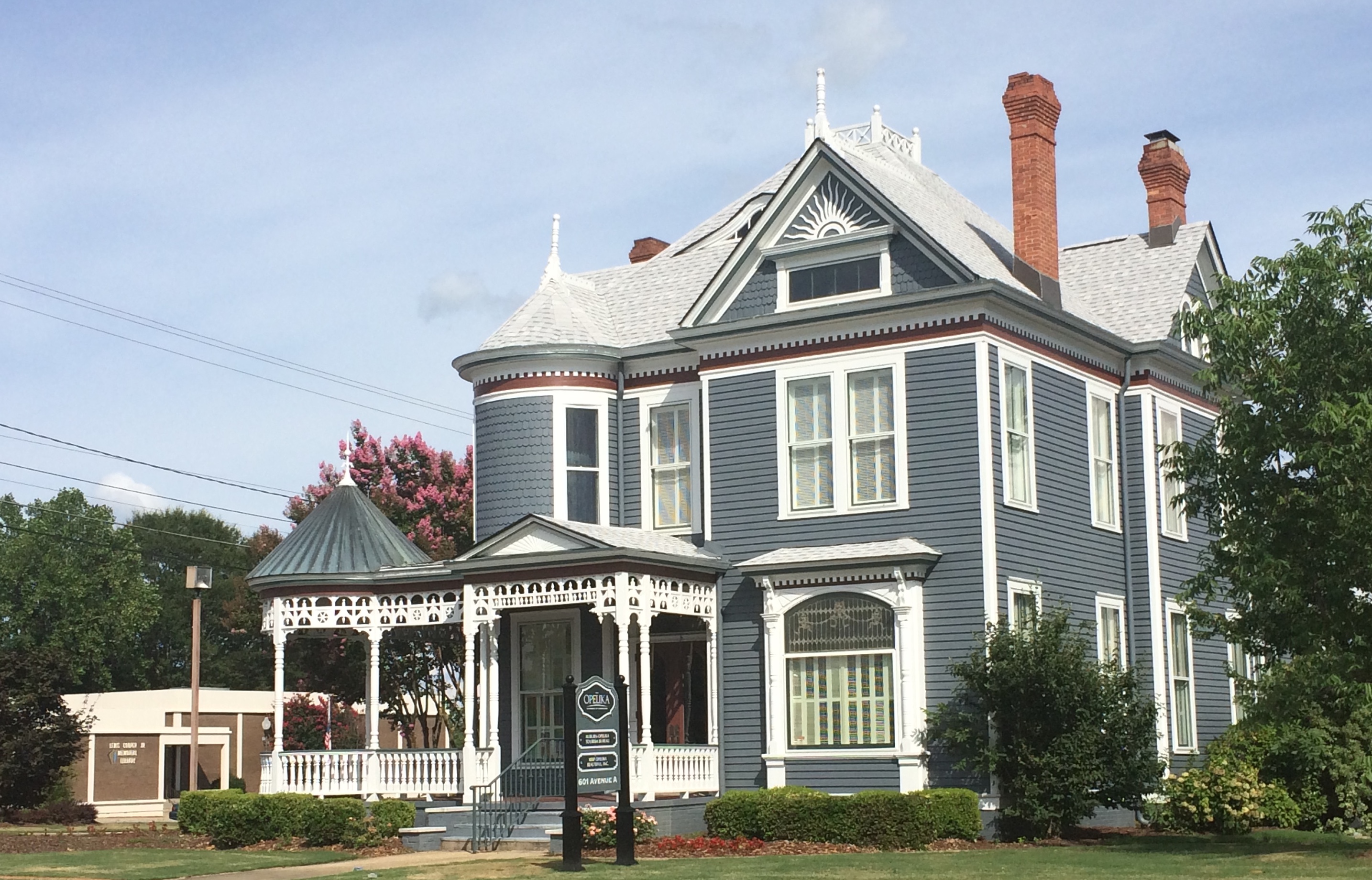
Opelika Chamber of Commerce, 2016. Photo by Lewis O. Powell IV, all rights reserved.

Some years ago, three employees witnessed a “bright flash of light” descend the home’s front staircase. Another staff member noticed child-sized footprints in the carpet on the back staircase when no children had been in the house. Chairs and other objects here sometimes playfully move on their own accord.

Sources

  • Hines, Nikolaus. “A young ghost toyingly haunts an old house.” Auburn Plainsman. 17 October 2014.
  • Lee County Heritage Book Committee. Heritage of Lee County, Alabama. Clanton, AL: Heritage Publishing Consultants, 2000.
  • Mission and History.” Opelika Chamber of Commerce. Accessed 29 June 2015.

Limestone County

Houston Memorial Library
101 North Houston Street
Athens

On the morning of New Year’s Eve 1879, former governor George S. Houston awoke from sleep. At that time a senator representing Alabama in Congress, Houston called out, “John, bring me my shoes. I must return to Washington!” He then closed his eyes and passed away.

While Houston did not make it back to Washington, he is believed to remain in his former home. After Houston’s death, his wife lived here until her death in 1909. The house was turned over to the city for use as a library in 1936. One of the reminders that the library was once a former residence is the chiming of the grandfather clock. This chiming occurs on occasion though no grandfather clock exists in the building.

Governor Houston House, 1934, by W.N. Manning for the Historic American Buildings Survey (HABS). Courtesy of the Library of Congress, Prints and Photographs Division.

Two gentlemen within this building installing central air were bothered by something in the attic some years ago. As they worked, they continued to hear a rustling behind them. At one point both men saw something standing near them out of their peripheral vision. When they turned to look directly at the figure it vanished. Exasperated, the pair told the former governor firmly that they were doing no harm. The kindly spirit allowed them to continue unimpeded.

Sources

  • Black, Shane. Spirits of Athens: Haunting Tales of an Alabama Town. NYC: iUniverse. 2009.
  • Rogers, William Warren. “George S. Houston (1874- 78).” Encyclopedia of Alabama. 21 April 2008.

Lowndes County

Marengo
100 North Broad Street
Lowndesboro

Lowndesboro remains a sleepy town, lost in the haze of its past. North Broad Street, lined with historic structures, many of which date to before the Civil War, is, despite its name merely a country road passing through the community. Among those grand 19th century homes is a transplant, Marengo, which was originally built around 1835 in Autauga County but moved here sometime between 1843 and 1847. If local tradition is to be believed, Marengo’s second owner, Dr. Charles Edwin Reese, is responsible for this remarkable collection of antebellum structures surviving the Civil War.

As General Wilson and his Union troops swept through this part of Alabama destroying anything of military importance as well as other property, Dr. Reese met with the general urging him to spare the town as it was suffering an epidemic of smallpox. To provide proof, Dr. Reese brought a patient with a serious rash. Though it was all a ruse, the general was convinced and spared the town.

It seems, however, that despite the good doctor’s work in the community, his wife Sarah was fearful whenever her husband was called out to visit a patient. She never felt safe in her home, regardless of the large, brass lock that her husband had installed on the front door. Like Sarah Reese, the wife of Lindsay James Powell, Jr., a subsequent owner of the home, also felt unsafe in the house. Powell bought a gun for his wheelchair-bound wife Kathleen’s protection and peace of mind. When, in 1961, Powell discovered his wife shot to death in her bed with the same gun at her side. Kathleen Powell’s death was ruled a suicide while evidence pointed to a possible murder.

Marengo, 2012, by Rivers Langley. Courtesy of Wikipedia.

Owners of the home since that time have heard the sound of a woman laughing. A psychic visiting the home confirmed that one of the spirits is that of Kathleen. Another psychic flatly stated that no one that had lived in the home had been happy adding that an additional female spirit haunts the home. The house was donated to the Lowndesboro Landmarks Foundation in 1975 and has been used as an events space for many years.

Sources

  • Brown, Alan. Haunted Places in the American South. Jackson, MS: University Press of Mississippi, 2002.
  • Floyd, W. Warner. National Register of Historic Places Nomination form for Lowndesboro. 1 November 1973.
  • Higdon, David and Brett J. Talley. Haunted Alabama Black Belt. Charleston, SC: History Press, 2013.
  • Windham, Kathryn Tucker. Jeffrey’s Latest 13: More Alabama Ghosts. Tuscaloosa, AL: University of Alabama Press, 1982.

Macon County

Tuskegee National Forest

The smallest national forest in the country, Tuskegee National Forest was created from abused and eroded farmland purchased by the federal government at the height of the Great Depression. Consisting of nearly 11,000 acres, the forest provides recreational opportunities and conservation of natural habitat for the region.

During the Satanic worship scare of the 1980s, rumors spread that teens and young people were engaging in occult rituals deep in the forest here. Higdon and Talley note that some of the spirits raised by these rituals may remain in the more remote woods. Indeed, the forest may also be home to Sasquatch or Bigfoot, as well.

Sources

  • Higdon, David and Brett J. Talley. Haunted Alabama Black Belt. Charleston, SC: History Press, 2013.
  • Tuskegee National Forest.” USDA Forest Service. Accessed 14 June 2015.

Madison County

Huntsville Depot
320 Church Street, Northwest
Huntsville

Huntsville Depot, 2010. by Chris Pruitt. Courtesy of Wikipedia.

The Huntsville Depot has witnessed much of the panoply of railroad history in the area since its construction in 1860. The building has seen the tumult of the Civil War, and a changing transportation picture until its closure as a railroad depot in 1968. It now stands as a museum preserving one of the oldest rail depots in the nation.

As Union troops under Brigadier General Ormsby M. Mitchell swept through North Alabama in 1862, one of his primary objectives was Huntsville and its depot. With the city, Ormsby also captured some 200 ill and wounded Confederate troops. The soldiers were held on the depot’s third floor before being shipped to prisoner of war camps in the North. Graffiti covering the walls preserves some of the experiences of soldiers here.

Visitors and staff within the building have had a variety of experiences. A frequent visitor reported to Alan Brown that she felt a cold spot on the second-floor landing of the staircase. She also described how she and a group of reenactors watched an apparent Confederate soldier peer down at them from a third-floor window. Also on the third-floor, the bust of a Civil War soldier tends to turn on its own accord. A psychic passing through the building described a “cluster of ghosts” within the historic structure.

Sources

  • Brown, Alan. Stories from the Haunted South. Jackson, MS: University Press of Mississippi, 2004.
  • Gray, Jacquelyn Proctor. When Spirits Walk. Bloomington, IN: AuthorHouse, 2006.
  • Madison County Heritage Book Committee. Heritage of Madison County, Alabama. Clanton, AL: Heritage Publishing Consultants, 1998.
  • Penot, Jessica. Haunted North Alabama. Charleston, SC: History Press, 2010.

Marengo County

Gaineswood
805 South Cedar Avenue
Demopolis

Gaineswood can be considered a historical, architectural, and paranormal treasure. According to the home’s National Register of Historic Places nomination form, Gaineswood is considered by many authorities to be one of the grandest and most important American houses built in the antebellum era. Part of the home’s uniqueness is found in its innovative and extraordinary design, which was conceived and realized by the home’s owner and builder, Nathan Bryan Whitfield. A self-taught architect, Whitfield spent much of his time and energy constructing his magnificent Neo-Classical home starting in 1842 and finishing on the eve of the Civil War in 1861.

After having his fortunes nearly wiped out by war, Whitfield sold the home to his son who allowed it to deteriorate. During this time a tree took root in the floor of the dining room, and goats roamed the halls. The house was restored in the 1890s and passed through a few hands before being bought by the State of Alabama in 1966 and opened as a house museum in 1971. Gaineswood was designated as a National Historic Landmark in 1973.

Gaineswood, 1939, by Frances Benjamin Johnston for the Carnegie Survey of the Architecture of the South. Courtesy of the Library of Congress, Prints and Photographs Division.

Besides the architectural importance of Gaineswood, the house is home to a classic Alabama ghost story originally told by Kathryn Tucker Windham. Mrs. Windham contends that after Nathan Whitfield’s wife died, he engaged Evelyn Carter, the daughter of a U.S. Consul to Greece, to care for his children. The delightful young woman was educated, musically inclined, and added a cultural touch to the home and the children’s lives. Unfortunately, she was taken ill and died during a particularly harsh winter. Miss Carter had requested that her body be returned to Virginia where she could be buried in the family cemetery, yet the harsh winter weather would not allow that. Instead, her body was sealed in a wooden casket and placed underneath the stairs until it could be shipped home.

Soon after, Miss Carter’s unhappy spirit began to roam the house noisily expressing her displeasure. Eerie melodies were heard playing on the piano accompanied by the swish of rustling skirts and disembodied voices. Even after Miss Carter’s remains were returned to her home, the spirit has remained in residence, though sources argue if she may have finally left the house.

Sources

  • Hand, Janice P. National Register of Historic Places Nomination form for Gaineswood. 13 September 1971.
  • “The Haunts of Gaineswood Plantation.” Ghost Eyes Most Haunted Places in America <www.GhostEyes.com>. 4 August 2009.
  • Higdon, David and Brett J. Talley. Haunted Alabama Black Belt. Charleston, SC: History Press, 2013.
  • Norman, Michael and Beth Scott. Historic Haunted America. NYC: TOR, 1995.
  • Windham, Kathryn Tucker and Margaret Gillis Figh. 13 Alabama Ghosts and Jeffrey. Tuscaloosa, AL: University of Alabama, 1969.

Marion County

Pikeville
Intersection of CR-21, CR-31, and CR-470

Little remains of the town of Pikeville, a small town built alongside the Jackson Military Road. The town served as the county seat of Marion County from 1820 until 1882, when the seat was moved to nearby Hamilton. The old county courthouse still stands, though it is now a private residence, and the town’s cemetery continues to memorialize the dead of Pikeville. This ghost town may also be populated with ghosts.

Sources

Marshall County

Main Street
Albertville

On April 24, 1908, a tornado roared through northeast Alabama killing some 35 residents and destroying a portion of Albertville including much of Main Street. According to Faith Serafin, there has been quite a bit of paranormal activity reported along Main Street including the spirit of a young boy in khaki knee-pants, a white shirt, and suspenders who has been observed running down the street at night. Residents have seen children wearing period clothing playing on the street in the evenings while business owners have reported the front doors of their businesses opening and closing on their own accord.

Main Street, Albertville, 2012, by Rivers Langley. Courtesy of Wikipedia.

Sources

Mobile County

Phoenix Fire Museum
203 South Claiborne Street
Mobile

Originally located on Conti Street, the old Phoenix Volunteer Fire Company No. 6 building was a state of the art rehouse when it was constructed in 1858. Slightly more than a hundred years later, the neglected building faced demolition for the construction of the Mobile Civic Center. The building was saved by the Mobile Historic Preservation Society, dismantled, and moved to its current location where it now serves as a part of the Mobile Museum of History. Artifacts relating to the history of firefighting within the city are displayed here including antique firefighting vehicles. Not on display, but present within the old building, is a spirit that has been heard stomping around the second-floor and occasionally rifling through an antique secretary located there.

Sources

  • Parker, Elizabeth. Mobile Ghosts: Alabama’s Haunted Port City. Apparition Publishing, 2001.

Monroe County

Rikard’s Mill Historic Park
4116 AL-265
Beatrice

Fleeting shadow figures have been spotted at this mill established in 1845. While the original structure is gone, the current mill, built in the 1860s, has been preserved by the Monroe County Museum. The mill has been probed by paranormal investigators, though little evidence of paranormal activity was uncovered.

Sources

Haunted Tennessee, Briefly Noted

Cherry Mansion
265 West Main Street
Savannah

The great Alabama storyteller, Kathryn Tucker Windham, provides the account of three people who witnessed an odd event while sitting on the porch of the Cherry Mansion one evening in 1976. Around 11 PM, the trio watched as a man in a white suit and wide-brimmed hat approached the historical marker in front of the house. The man read the marker and then, in full view of the spectators on the porch, vanished.

haunted Tennessee Cherry Mansion Savannah Civil War
Cherry Mansion, 1974, by Jack Boucher for the Historic American Buildings Survey (HABS). Courtesy of the Library of Congress, Prints and Photographs Division.

The house is magnificently sited on an ancient bluff overlooking the Tennessee River. This home was constructed around 1830 by David Robinson, possibly as a gift to his daughter who was the wife of businessman William Cherry. An ardent Unionist during the Civil War, Cherry offered the use of his home to several Union generals in 1862 who used it in the days leading up to the Battle of Shiloh, which took place about 9 miles south of Savannah. General Charles Ferguson Smith, suffering from a recent leg injury passed away in the house during that time.

On the morning of April 6th, legend holds that General Ulysses Grant’s breakfast was interrupted by an overture of cannon-fire announcing the Confederates’ surprise attack on Union forces camped at Pittsburg Landing on the Tennessee River. Furious fighting over a sunken road where Union Generals Benjamin Prentiss and W. H. L. Wallace defended their position against heavy artillery fire from Confederate batteries gave a head wound to Wallace and the area to be nicknamed, “The Hornet’s Nest.” Wallace was taken to Cherry Mansion to receive medical attention.

Legend holds that Wallace’s devoted wife, Martha Ann, had received a premonition of her husband’s death and traveled to Tennessee in hopes that he was unharmed. Arriving in the midst of the battle, she was stunned to find that her husband had been wounded and took up residence at his side in Cherry Mansion. When her husband died a few days later, she was still at his side. People passing the mansion have reported seeing the form of a gentleman in a uniform looking out one of the upstairs windows. This form is widely believed to be that of General Wallace.

This home is a private residence.

Sources

  • Brown, Alan. Haunted Tennessee: Ghosts and Strange Phenomena of the Volunteer State. Mechanicsburg, PA: Stackpole, 2009.
  • Charles Ferguson Smith. Wikipedia, the Free Encyclopedia. Accessed 30 December 2017.
  • Cherry Mansion. Wikipedia, the Free Encyclopedia. Accessed 30 December 2017.
  • Coleman, Christopher K. Ghosts and Haunts of Tennessee. Winston-Salem, NC: John F. Blair, 2010.
  • Hammerquist, Gail. National Register of Historic Places Nomination form for the Cherry Mansion. February 1976.
  • West, Mike. “Tennessee home to tragic Civil War ghost story.” Murfreesboro Post. 26 October 2008.
  • Windham, Kathryn Tucker. 13 Tennessee Ghosts and Jeffrey. Tuscaloosa, AL: U. of AL Press, 1977.

Cocke County Memorial Building
103 North Cosby Highway
Newport

This unassuming building in the small town of Newport in Eastern Tennessee bears the weight of a tragedy. The sadness of this tragic moment in the mid 1960s still echoes now, more than fifty years later.

haunted Tennessee Cocke County Memorial Building Newport ghosts
Cocke County Memorial Building, 2011, by Dwight Burdette. Courtesy of Wikipedia.

Opened in 1931 as an American Legion post, the Cocke County Memorial Building was constructed to memorialize locals who had given their lives in the First World War. The building includes a gym with a stage, as well as office and meeting space for the post and the community at large.

On July 9, 1964, near the Cocke County community of Parrottville, a witness observed a plane with a “violet red light burning on the fuselage.” A short time later other witnesses saw the plane flying low with smoke trailing from it. The plane veered off course and crashed on a wooded mountain slope. Moments before the impact, witnesses observed something falling from the aircraft. A search revealed that one of the plane’s emergency exits had been opened and a passenger had fallen. That passenger, as well as the plane’s remaining passengers and crew, a total of 39 souls, perished in the accident.

As Newport had no large facilities to accommodate the remains of the 39 who had died in the accident, investigators and rescue personnel commandeered the Cocke County Memorial Building for use during the operation. Since most of the bodies were in pieces, remains were spread out on the gym floor to aid in identification. After studying the wreckage of the plane and the remains, authorities ascertained that a fire had broken out in the passenger compartment in mid-air. After two weeks, the investigators and the human remains left the Memorial Building, but spirits have lingered.

Author John Norris Brown, who once maintained the excellent blog, Ghosts and Spirits of Tennessee (the website is no longer extant, though it can still be found on the Web Archive), was one of the first people to document this haunting in Newport. Though some of his facts about the plane crash were incorrect, he described some of the experiences visitors to the building have experienced: “[they have] felt presences, heard voices, as well as the screams of a woman, and the cries of babies. Feelings of being watched are said to be almost unbearable in the building.”

In an article in Supernatural Magazine, paranormal investigator Anthony Justus describes the experiences of him and his paranormal team during a 2008 investigation. While investigating the building’s sub-basement, Justus encountered an entity that he described as “an intelligence without form.” He eloquently continued: “I saw nothing, heard little but I felt it. A deep resonant cold that chilled me to the bone. I felt threatened and oppressed. As I left the area, I felt its heavy presence behind me, following up those rickety stairs, so close I could feel it on my neck. It was death, it was sadness and it was hate, a predatory thing that lurked in the darkness.”

Later, the team members found balls from a Bingo game being thrown from the bleachers in the gym, bouncing and rolling across the wooden floor. During this time, Justus caught a glimpse of a young boy standing in the corner of the room who disappeared as he approached. The most spectacular event of the evening was noted as being a moment when a set of doors that were locked violently threw themselves open gouging the plaster walls and cracking one of the wooden doors. It seems that the spirits from the plane crash are unhappy at being stuck in this plane of existence.

Sources

Cragfont
300 Cragfont Road
Castalian Springs

Cragfont was built to impress. Constructed of stone on a bluff over a spring that feeds into nearby Bledsoe’s Creek, this was the first stone house constructed on the Tennessee frontier. With craftsmen and artisans brought from Maryland, James Winchester began work on his home in 1798, finishing around 1802. Besides providing a fine home for his family, Cragfont served as a gathering spot for locals and as a stop for travelers.

haunted Tennessee Cragfont Castalian Springs ghosts
Cragfont, 2008, by Brian Stansberry. Courtesy of Wikipedia.

James Winchester was already an accomplished individual when he built his home, having served as a Patriot officer during the American Revolution. In the latter years of the 18th century, Winchester had served in the North Carolina Constitutional Convention and worked towards the establishment of the state of Tennessee, after which he served in the newly created legislature. During the War of 1812, Winchester left Cragfont to serve his country. He died here in 1826.

A home that has witnessed the whirlwind of history that Cragfont has witnessed must surely be haunted. Caretakers of the home have noted that furniture and objects apparently move during the night when the house is locked up, while beds will appear to have been slept in. Both visitors and staff have reported seeing apparitions and hearing disembodied footsteps and voices within the house.

Sources

  • Brown, John Norris. “Cragfont Mansion Hauntings.” Ghosts & Spirits of Tennessee. Accessed 31 January 2011.
  • Coop, May Dean. National Register of Historic Places Nomination form for Cragfont. 16 June 1969.
  • James Winchester. Wikipedia, the Free Encyclopedia. Accessed 31 December 2017.
  • Morris, Jeff; Donna Marsh; & Garett Merk. Nashville Haunted Handbook. Cincinnati, OH: Clerisy Press, 2011.
  • MTSU Center for Historic Preservation. Cragfont, Sumner County, Tennessee, Historic Structure Report. July 2012.

Hunt-Phelan House
533 Beale Street
Memphis

Legend holds that at the height of a yellow fever epidemic in 1873, the Hunt family fled their Memphis home after entrusting a chest of gold to a manservant, Nathan Wilson. Upon their return, Wilson was found dead in his room and the chest missing. The only clue to the whereabouts of the chest being mud on the servant’s boots indicating that he may have buried the chest. Stories have emerged that Wilson’s specter is sometimes seen around the house and will guide fortunate witnesses to the buried fortune.

haunted Tennessee Hunt-Phelan House Memphis ghosts
Hunt-Phelan House, 2010, by Thomas R. Machnitzki. Courtesy of Wikipedia.

Marking the Lauderdale Street end of the “infamous section” of Beale Street where Blues music first developed, the Hunt-Phelan House has just as infamous a history. Built in 1832 by George Wyatt, during the Civil War the house was used a headquarters for Confederate General Leonidas Polk while planning the Siege of Corinth, Mississippi and a few months later after the fall of Memphis, the house was headquarters for Union General Ulysses S. Grant while he planned the Vicksburg Campaign. The house then served as a Freedmen’s Bureau and was finally returned to the family by President Andrew Johnson in 1865. More recently, the house was operated as The Inn at Hunt-Phelan featuring four-star accommodations and restaurants.

Sources

  • Brown, Alan. Haunted Tennessee: Ghosts and Strange Phenomena of the Volunteer State. Mechanicsburg, PA: Stackpole, 2009.
  • Coleman, Christopher K. Ghosts and Haunts of Tennessee. Winston-Salem, NC: John F. Blair, 2010.
  • Lester, Dee Gee. “Hunt-Phelan House.” Tennessee Encyclopedia of History and Culture. 25 December 2009.
  • Lovett, Bobby L. “Beale Street.” Tennessee Encyclopedia of History and Culture. 25 December 2009.

Orpheum Theatre
203 South Main Street
Memphis

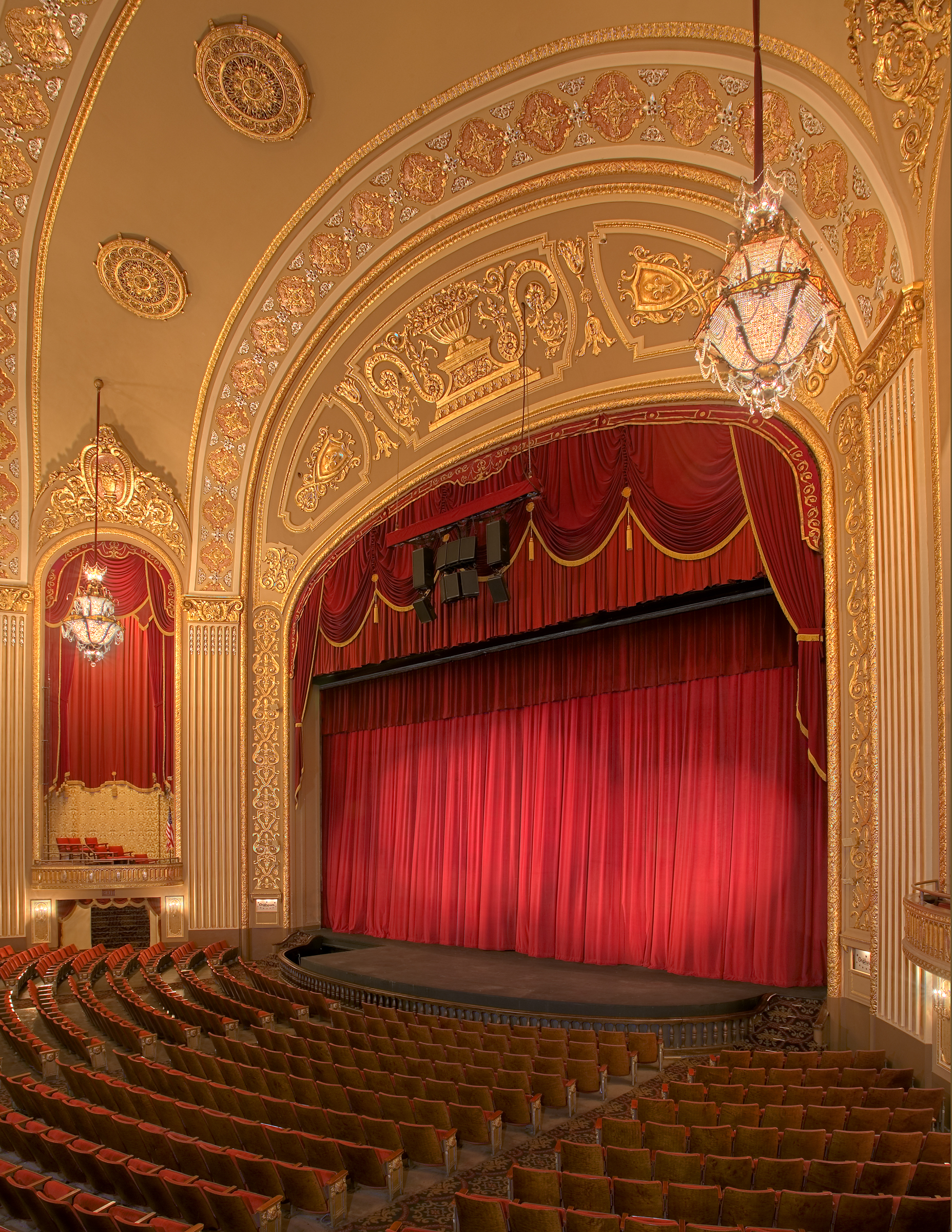
At the other end of the “infamous section” of Beale Street from the Hunt-Phelan House is the dazzling Orpheum Theatre. Opened in 1928, the “New” Orpheum replaced the opera house that originally occupied this site from 1890 until its destruction by a fire in 1923. The Orpheum is among the ranks of hundreds of theatres throughout the country designed by the Chicago architectural firm of Rapp and Rapp, which designed hundreds of theatres throughout the country some of which, like the Paramount in Ashland, Kentucky; and the Tivoli in Chattanooga, are known to be haunted.

haunted Tennessee Orpheum Theatre Memphis ghosts
The proscenium arch of the Orpheum Theatre, 2010, by Orpheummemphis. Courtesy of Wikipedia.

The Grand Opera House was added to the Orpheum circuit in 1907. Made up of the finest theatres from coast to coast, the Orpheum circuit featured the top vaudeville headliners, bringing them to Memphis audiences for almost two decades. Following a performance by singer Blossom Seeley on October 17, 1923, the theatre was gutted by a fire causing approximately $250,000 (about $3.5 million in today’s dollars) in damage. A new, state-of-the-art theatre was constructed on the site opening on November 19, 1928. This new theatre continued to bring cream of the crop stars to Memphis as well as films, which were accompanied by a huge Wurlitzer organ.

As any good theatre has a ghost, it’s no surprise that the Orpheum features some very well-known ghost stories. Around the time that the theatre was sold to the Memphis Development Foundation in 1976, Vincent Astor, a local historian, took some friends to the theatre to show them the Wurlitzer organ. While the group was watching him play, someone asked about the little girl they observed playing in the lobby. Wearing a white dress, black stockings, and with long braids, but no shoes, this girl was repeatedly seen in the theatre sometimes sitting in a specific seat in the balcony.

During an investigation by a class from the University of Memphis, a Ouija board was used to contact the playful spirit. At that time, the spirit was identified as “Mary,” a little girl who died in 1921. In a video posted by the theatre, Astor relates that, including Mary, there may be as many as seven spirits within the theatre.

Sources

  • Brown, Alan. Haunted Tennessee: Ghosts and Strange Phenomena of the Volunteer State. Mechanicsburg, PA: Stackpole, 2009.
  • Coleman, Christopher K. Ghosts and Haunts of Tennessee. Winston-Salem, NC: John F. Blair, 2010.
  • Orpheum Memphis. “Orpheum Ghost Stories with Vincent Astor.” YouTube. 29 October 2012.
  • Orpheum Theatre (Memphis). Wikipedia, the Free Encyclopedia. Accessed 2 January 2018.
  • Williamson, James Floyd, Jr. National Register of Historic Places nomination form for the Orpheum Theatre. January 1977.

Spectral Selfies in the News

In the past few weeks, several people visiting haunted places here in the South have been photobombed in a spectral fashion. Visitors to St. Francisville, Louisiana’s The Myrtles Plantation and Homestead, Florida’s Hotel Redland have captured images of someone in their photographs, someone who wasn’t physically present when the photos were taken.

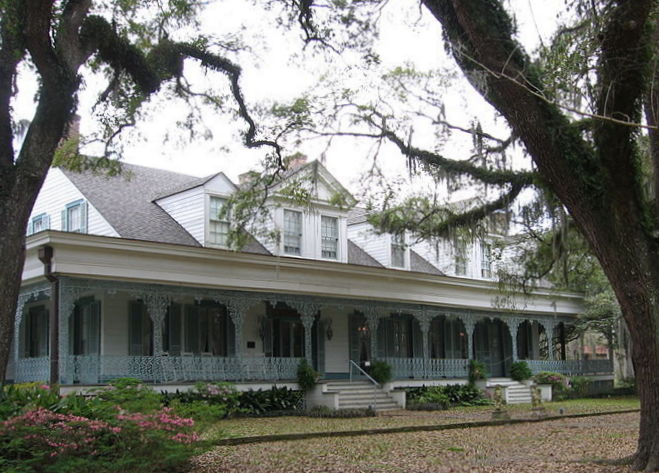
Six friends visiting The Myrtles decided to take a group selfie just outside of the house. Upon closer inspection, the photographer noticed the face of a seventh woman peering from behind a window pane behind the group. While all the women in the group are smiling, the women in the window pane appears to be scowling. Photographs of the this nature are easy to fake, so I cannot say this photograph is authentic. Surely, this is not the first photograph taken at The Myrtles to possibly show something spectral. In 2015, I published a photograph taken by an acquaintance that appears to show someone sitting on the staircase.

The Myrtles, 2005, by Bnet504. Courtesy of Wikipedia.

Perhaps the most famous haunted places in the country, The Myrtles (7747 US-61, St. Francisville, Louisiana) is a late 18th-century plantation with a tragic history. Of course, much of that tragic history has literally come back to haunt the home. The house is preserved as a museum, bed & breakfast, and haunted attraction. In my opinion, at least some of that tragic history has been created to make the haunting more interesting. I looked into these stories in a blog entry several years ago.

It’s interesting that the other selfie that has been published in the news is from a place that also has a doubtful history. The history of the Hotel Redland (5 South Flagler Avenue, Homestead, Florida) is not as long or as varied as The Myrtles, though it has also left spectral impressions. Those spectral impressions led a friend of a hotel staff member to investigate the hotel recently. During the investigation, the visitor snapped a selfie standing in the lobby. In the selfie, a face appears which the British tabloid, the Daily Mirror, described as resembling the horror movie villain, Michael Myers, from John Carpernter’s movie franchise, Halloween.

My opinion on the photograph is that this is a case of pareidolia, when the brain tries to make sense of something chaotic by finding patterns in it. In this case, light reflected in the window pane creates a “face,” within the reflection.

The first building on this site was constructed in 1904 as a boarding house for railroad employees called the Homestead Inn. This building’s history was rather quiet until the fateful day of November 10, 1913. I’ll allow the Miami Metropolis to take over the story from here:

A few minutes before 2 o’clock in the afternoon the large steam roller, being used in rolling the streets, puffed down in front of the Homestead Inn, and it was only a few seconds later that the roof of the hotel was discovered on fire, having caught from a flying spark from the engine. Soon the entire fire-fighting population of the town was on the scene, and all efforts were brought to bear to save the burning building, but to no avail. However, the furnishings were carried to safety and the loss of the building is just about covered by insurance.

Flames spread to five adjoining buildings destroying several other businesses. The paper ends the article by mentioning that a fire caused by sparks from the same steamroller had damaged the city’s other hotel across the street that morning. “It is likely that some action will be taken to curb the chances of another such conflagration starting from the same cause.”

Hotel Redland, 2011, by Ebyabe. Courtesy of Wikipedia.

While the damage to the structure led to much of it being rebuilt, the story of this dramatic fire continued to be told and expanded. The story of the fire as told now sets the scene late at night where the fire takes the lives of a number of guests soundly asleep in their rooms. These same guests now haunt the hotel.

An article in the August 16th Miami New Times detailed a paranormal investigation of the hotel by the South Florida team of PRISM Miami, lead by investigator David Rodriguez. That article hints at the hotel actually being haunted, though the details are somewhat vague.

Sources

Haunts from the Halloween season

After spending much of the Halloween season engrossed in the blog move, I’m just starting to catch up on newsworthy haunts from this season’s news.

Tivoli Theatre
Home to the GALA Hispanic Theatre
3333 14th Street NW
Washington, DC

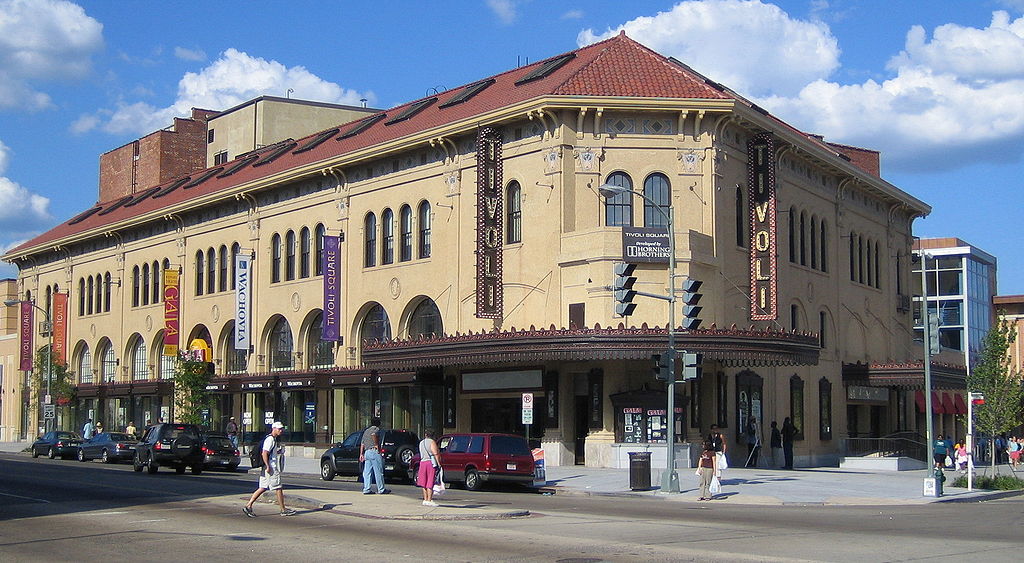
Alone in a one-room apartment, Harry Crandall wrote a note ending with “To whom it may concern: it is now 2:45 a. m., and I am turning on the gas.” He signed the note with his initials and soon slipped out of the bonds of this plane. Crandall had been on top of the world just 15 years previous, but a snowstorm brought difficulties to his theatre empire and fortune in 1922. As a blizzard dumped snow onto Washington on January 28th of that year, patrons of Crandall’s Knickerbocker Theatre were cozily watching Get-Rich-Quick Wallingford when snow piled on the building’s roof caused a collapse leading to the deaths of 98. The city immediately closed all theatres until snow could be removed from their roofs.

The jewel in Crandall’s crown was the Tivoli. When the Knickerbocker disaster took place, the Tivoli was still in the planning stages. After government officials began to question the architectural integrity of Crandall’s architect, Reginal Geare, Crandall asked the eminent theatre architect, Thomas Lamb, to step in as architect. The Tivoli is considered a masterpiece of Lamb’s art. Geare’s replacement and the questions around his design led him to commit suicide in 1927.

Tivoli Theatre, 2005, by D Monack. Courtesy of Wikipedia.

The same year of Geare’s suicide, Crandall sold his theatre chain to Warner Brothers, but continued several businesses related to the film industry. From the day the Tivoli opened its doors in 1924, the Tivoli’s marquee glittered for many decades. Following the assassination of Dr. Martin Luther King, Jr. in 1968, riots rocked many cities including large parts of Washington. Much of the neighborhood around the Tivoli was devastated, though the theatre survived unscathed. The Tivoli limped into the 1970s when a precipitous drop in business led to the theatre’s closure.

While the theatre sat unoccupied, locals recognized the building’s historical importance and had it listed on the National Register of Historic Places in 1985. In the early 2000s the theatre underwent restoration, with the GALA (Grupo de Artistas Latino Americanos) Hispanic Theatre set to occupy the theatre space. In January of 2005, the theatre reopened its doors to the theatre-going public. From opening day, GALA Hispanic Theatre has continued to present the best of Hispanic and Latino theatre in a space where spirits of the past still may wander.

A Halloween article in American Theatre magazine notes that staff and crew members of the GALA Hispanic Theatre have had paranormal encounters which they believe may be the spirit of Harry Crandall. While Crandall did not die in the theatre, it would not be surprising that his spirit would return to this theatre that he was very closely associated with. In the theatre, staff has dealt with light turning off and on and making a general spectral ruckus while a painter saw a figure while painting a set late one night. Perhaps Crandall still wants to be a part of showbiz.

Sources

  • Darris, Cranston. National Register nomination form for the Tivoli Theatre. March 1985.
  • Dembin, Russell. “Keep that ghost light on!” American Theatre. 31 October 2017.
  • “Once wealthy theater head is a suicide.” Daily Mail (Hagerstown, MD). 27 February 1937.
  • Tivoli Theatre (Washington, D.C.). Wikipedia, the Free Encyclopedia. Accessed 14 November 2017.
  • The Venue – History of the Tivoli Theatre.” GALA Hispanic Theatre. Accessed 14 November 2017.

Philippe Park
2525 Philippe Parkway
Safety Harbor, Florida

Grave of Odet Philippe, 2010 by TimT1006. Courtesy of Wikipedia.

Overlooking the western shore of Tampa Bay, Philippe Park encapsulates some of the early history of the area. Among the moss-draped oaks and palmy vistas is a mound constructed by the Tocobaga people who occupied this area until the Spanish invasion in the 16th century. A marker within the park also notes the burial of Odet Philippe, a free black man who settled here in the early 19th century. Philippe is credited as planting the first grapefruit tree here, thus aiding in the establishment of a multi-billion-dollar industry.

An article from the Tampa Bay Times, notes that “supernatural stories abound in the park,” and that the article’s author heard “lots of weird rustling,” which she did not stick around to investigate. The park has been the scene of a serious paranormal investigation conducted by Tampa Bay Spirits. A report on their website includes the experiences of three sensitives who walked the park. Each encountered energy around the mound.

Sources

  • Guerra, Melissa, & Eric Smithers. “Odet Philippe: The story behind the namesake of Philippe Park in Safety Harbor.” South Tampa Magazine. 15 July 2014.
  • Hayes, Stephanie. “5 spooky sites around Tampa Bay that aren’t theme parks.” Tampa Bay Times. 27 September 2017.
  • Tampa Bay Spirits, LLC. “Philippe Park, Safety Harbor.” Tampa Bay Spirits. Accessed 4 October 2017.

Lapham-Patterson House
626 North Dawson Street
Thomasville, Georgia

Lapham-Patterson House, 2010, by Ebyabe. Courtesy of Wikipedia.

Shoe manufacturer Charles Lapham had good reason to fear a house fire. After all, he was from Chicago, a city that had nearly been destroyed during the Great Chicago Fire in 1871. He was also interested in the Spiritualism movement, which was in vogue at that time. Perhaps these things informed the design of this strange and exuberant South Georgia vacation home?

While the house contains an overabundance of exits, which would be ideal in the event of a fire, an odd stained glass window in the gentleman’s parlor projects the image of a cow’s head onto the floor during the spring and fall equinoxes. Some believe this may be a strange homage to Mrs. O’Leary’s cow, the scapegoat of the Chicago fire.

Staff and visitors to the house, which is now operated as a historic site by the state of Georgia, have had some chilling experiences. A performer sitting on the staircase during a reading of Edgar Allan Poe was tapped on the shoulder by the form of a little girl. The curator of the house noted that, “she firmly believed it was Lapham’s daughter, who died in the house of pneumonia.”

Sources

  • Lapham-Patterson House. Wikipedia, the Free Encyclopedia. Accessed 15 November 2017.
  • Warrender, Sarah. “’Supposedly, she roams around’: Haunting tales of the paranormal from South Georgia, North Florida.” Daily Citizen (Dalton, GA). 28 October 2017.
  • Wright, Russell. National Register nomination form for the Lapham-Patterson House. 5 December 1969.

Eight-sided Spirits–Kentucky

N. B. This article has been expanded and revised 16 December 2019.

Octagon Hall
6040 Bowling Green Road
Franklin, Kentucky

As the birthplace of both Abraham Lincoln and his Confederate counterpart Jefferson Davis, Kentucky could be considered the birthplace of the American Civil War. Though, when its Southern neighbors began to secede from the Union, the state attempted to remain neutral. When the Confederate army invaded the state and occupied Columbus, Kentucky on the Mississippi River, all hell began to break loose. A Confederate shadow government was created to oppose the Unionist state government already in place and the state joined the Confederacy in December of 1861. The provisional capital at Bowling Green had to be evacuated the following year and some eight to ten thousand fleeing soldiers camped on the grounds of Andrew Caldwell’s estate with its unique eight-sided home outside of Franklin. The soldiers only camped on the estate overnight before heading into Tennessee.

Two days later, pursuing Union troops swept through the plantation and continued to frequently search the grounds for hidden Confederates while they held the area. Wounded soldiers, knowing of the Caldwell’s pro-Confederate leanings, sought out the house as a hiding place. A story told by the Caldwell family involves soldiers being hidden in the cupola that once topped the house. Mr. Caldwell kept bees in the cupola and Confederates would be dressed in bee suits and hidden there. When Union troops would search the house, the bees prevented them from searching the cupola

haunted Octagon Hall Franklin Kentucky ghosts
Octagon Hall, 2008, by Kentondickerson. Courtesy of Wikipedia.


Andrew Jackson Caldwell began construction on this unique plantation home in 1847 completing it in 1859. The home’s location: on the Nashville & Louisville Turnpike (now U. S. Route 31W) and the Louisville & Nashville Railroad (about a mile east of the road) made this home a landmark for travelers and locals alike. Throughout the home’s history it remained a private residence until 2001, when the Octagon Hall Foundation took over the house transforming it into a house museum.

A host of spirits remain at Octagon Hall. Some investigators have suggested that the building’s unusual shape and limestone bricks may exacerbate the hauntings. Keith Fournier, a paranormal investigator who investigated the house many times, told the Bowling Green Daily Times that the house is “probably one of the most haunted sites in the country. For its size…there’s more evidence caught in that location than for any other location oi its size in the country.”

haunted Octagon Hall Franklin Kentucky ghosts
Rear view of Octagon Hall, 2008, by Kentondickerson. Courtesy of Wikipedia.

One of the primary spectral residents is the spirit of Mary Elizabeth Caldwell, daughter of Octagon Hall’s builder. Young Mary was around seven years of age when she died in 1854. Legend purports that the child was playing in the kitchen when her dress caught fire. During some of his investigations, Fournier has heard the child weeping in the house accompanied by the deep male voice speaking in a Southern drawl.

The museum’s executive director had an experience with the child’s spirit only three or four weeks after his arrival. “We were doing renovations in the basement and I saw a little girl. I thought she was a tourist and I said, ‘can I help you?’’ When the child vanished, he stood there with his mouth agape. Many others have seen other spirits roaming the grounds including Confederate soldiers and shadow figures.

Sources

  • Episode 2. “Octagon Hall.” Most Terrifying Places in America, Season 7. Travel Channel. Originally aired 22 October 2010.
  • French, Jackson. “SyFy’s ‘Ghost Hunters’ to lead ghost hunt at Octagon Hall.” Bowling Green Daily News. 13 April 2018.
  • History.” Octagon Hall Museum. Accessed 16 December 2019.
  • Kentucky in the American Civil War. Wikipedia, the Free Encyclopedia. Accessed 13 December 2010.
  • Swietek, Wes. “Sites throughout the region full of ghostly lore.” Bowling Green Daily News. 10 October 2015.
  • Westmoreland-Doherty, Lisa. Kentucky Spirits Undistilled. Atglen, PA: Schiffer, 2009.

‘Twas the Night Before Halloween—Recycled Revenants

‘Twas the night before Halloween and all through the blog, little was stirring…

This move from Blogger to this new site has been tedious and time-consuming. I’ve tossed out a great deal of junky posts and put many posts aside that need to be updated and refreshed leaving me with many bits and pieces that should be republished in a different context. This is a selection of recycled pieces for Halloween.

East Coast/West Coast
138 St. George Street
St. Augustine, Florida

This modest commercial building once housed Kixie’s Men’s Store and some odd activity. The shop employed a young tailor, Kenneth Beeson who would later serve as mayor for the city. While working late one evening he noticed a door opening by itself followed by the sweet scent of funereal flowers. After experiencing odd activity for a while, Beeson put out a tape recorder and set it to record just before he left. When he returned the following morning, he was shocked to discover a plethora of sounds including marching feet and guttural growls. Disturbed by these incidents, Beeson had a priest exorcise the building. The activity ceased.

Sources 

  • Cain, Suzy & Dianne Jacoby. A Ghostly Experience: Tales of St. Augustine, Florida. City Gate Productions, 1997.
  • Lapham, Dave. Ghosts of St. Augustine. Sarasota, FL: Pineapple Press, 1997.

Western & Atlantic Railroad Tunnel
Chetoogeta Mountain
Tunnel Hill, Georgia

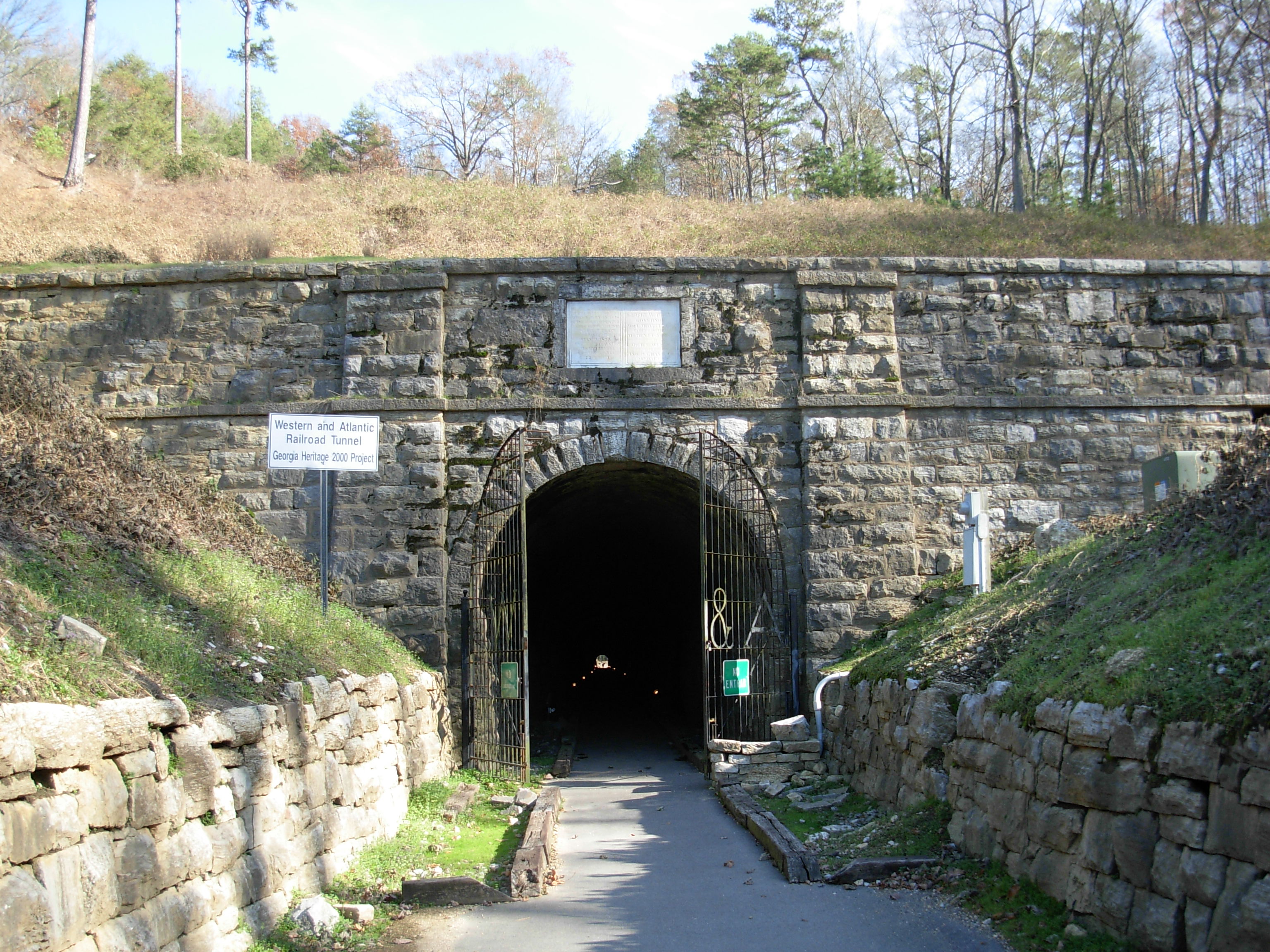
As the railroad spread its tentacles throughout the nation before the tumult of the Civil War, a route was needed from Augusta, Georgia to Chattanooga, Tennessee. Numerous obstacles stood in the way, but the biggest was Chetoogeta Mountain. Plans for a railroad tunnel dated to the second half of the 1830s, but work did not commence until 1848 with work completed two years later. The new tunnel was instrumental in Atlanta’s growth as a railroad hub and was a strategic feature for the Confederacy to protect during the Civil War.

The tunnel’s strategic importance led to a series of skirmishes being fought here leading up to the Battle of Atlanta. Following the war, the tunnel remained in service until 1928 when a new tunnel was built a few yards away. The old tunnel became overgrown with kudzu and was largely forgotten until 1992 when preservationists fought to save the tunnel. It is now the centerpiece of a park that features reenactments of the skirmishes fought at the site.

Entrance to the old Western & Atlantic Railroad Tunnel, 2011. Photo by Lewis O. Powell, IV, All rights reserved.

It is often re-enactors who have encountered anything supernatural at the site. I’ve been pleasantly surprised by the number of documented accounts of spirits at Tunnel Hill. At least four books and a handful of good articles document the high levels of activity at this site. Accounts include the apparitions of soldiers seen both inside the tunnel and around it. Ghostly campfires, disembodied screams, spectral lantern light and the smell of rotting flesh (minus the presence of actual rotting flesh) have all been reported by re-enactors and visitors alike.

Sources

  • DeFeo, Todd. “Antebellum railroad tunnel still a marvel after all These years.” com. 22 June 2009.
  • Kotarski, Georgiana C. Ghosts of the Southern Tennessee Valley. Winston-Salem, NC: John F. Blair, 2006.
  • Underwood, Corinna. Haunted History: Atlanta and North Georgia. Atglen, PA: Schiffer, 2008.
  • Western and Atlantic Railroad Tunnel. Tunnel Hill Heritage Center. Accessed 28 November 2010.

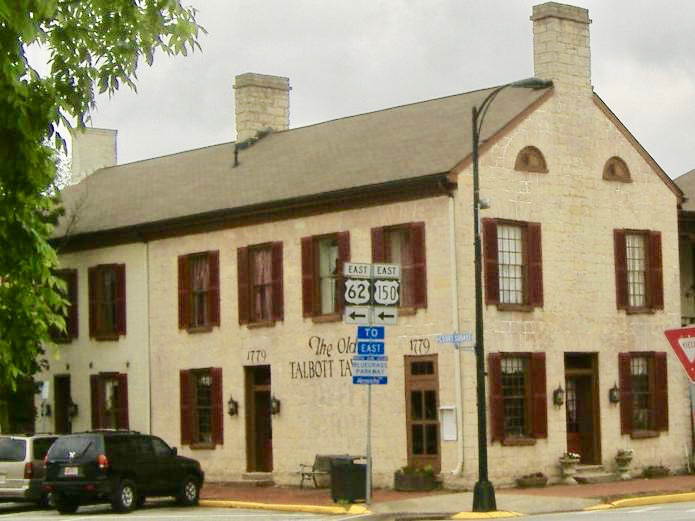
Old Talbott Tavern
107 West Stephen Foster Avenue
Bardstown, Kentucky

Old Talbott Tavern, 2008, by C. Bedford Crenshaw. Courtesy of Wikipedia.

Continuously open since the late 18th century except for a period in the late 1990s when the tavern was being renovated following a disastrous fire, the Old Talbott Tavern has hosted an impressive array of visitors ranging from Daniel Boone to General George Patton. Perhaps one of the famous guests who has never checked out is outlaw Jesse James who stayed frequently in the tavern while visiting his cousin who was the local sheriff. With the claims of Jesse James’ spirit which may also roam the halls of Selma, Alabama’s St. James Hotel, James’ spirit may split the hereafter between two favorite locales. But James’ spirit is not the only spirit acting up in the Old Talbott Tavern. Other ghosts may include formers guests, owners and their families.

Sources

  • Brown, Alan. Haunted Kentucky. Mechanicsburg, PA: Stackpole Books, 2009.
  • Brown, Alan. Stories from the Haunted South. Jackson, MS: University Press of Mississippi, 2004.
  • Starr, Patti. Ghosthunting Kentucky. Cincinnati, OH, Clerisy Press, 2010.

Old Louisiana State Capitol
100 North Boulevard
Baton Rouge, Louisiana

When the state capitol was moved from New Orleans to Baton Rouge in 1846, the city donated land atop a bluff over the Mississippi for the capitol building. Architect James Dakin designed a Neo-Gothic building very much unlike the other state capitols which were often modeled on the U.S. Capitol building in Washington. The magnificent crenellated and be-towered structure was used as a prison and garrison for soldiers under the city’s Union occupation and during this time it caught fire twice leaving it a soot-stained shell by the war’s end. The building was reconstructed in 1882 but abandoned in 1932 for Governor Huey Long’s new state capitol.

Old State Capitol, 2009, by Avazina. Courtesy of Wikipedia.

Even before the capitol burned during the war, there was a ghost gliding through its halls. Pierre Couvillon, a legislator representing Avoyelles Parish, enraged by his colleagues’ corruption, suffered a heart attack and died. Though he was buried in his home parish, his spirit was said to reside in the capitol; perhaps checking up on his colleagues. When the capitol building underwent restoration in the 1990s, the spirit or spirits in the building were stirred up and activity has increased. Staff members and visitors have reported odd occurrences. One security guard watched as movement detectors were set off through a series of rooms while nothing was seen on the video.

Two organizations investigated the building in 2009 and uncovered much evidence. Louisiana Spirits Paranormal Investigations picked up a number of interesting EVPs including someone singing the old song, “You Are My Sunshine.” Everyday Paranormal, in their investigation had a few encounters in the basement of the building, the area used as a prison during the Union occupation. It seems that there are many spirits within the crenellated walls of the Old Capitol.

Sources

  • Duvernay, Adam. “Several Baton Rouge sites said to be haunted.” The Daily Reveille. 27 October 2009.
  • Dwyer, Jeff. Ghost Hunter’s Guide to New Orleans. Gretna, LA: Pelican, 2007.
  • Louisiana Spirits Paranormal Investigations. Old State Capitol, Baton Rouge, LA. Accessed 11 November 2011.
  • Manley, Roger. Weird Louisiana. NYC: Sterling Publishers, 2010.
  • Old Louisiana State Capitol. Wikipedia, the Free Encyclopedia. Accessed 9 November 2011.
  • Southeastern Students. “Old State Capitol Still Occupied by Former Ghosts.” com. 29 October 2009.

Jericho Covered Bridge
Jericho Road at Little Gunpowder Falls
Harford County Near Jerusalem, Maryland

Jericho Covered Bridge, 2009, by Pubdog. Courtesy of Wikipedia.

Straddling the county line between Harford County and Baltimore County over the Little Gunpowder Falls is the Jericho Covered Bridge, constructed in 1865. According to Ed Okonowicz in his Haunted Maryland, there are legends of people seeing slaves hanging from the rafters inside this nearly 88-foot bridge. Certainly, there is an issue with this as the bridge was constructed in 1865, after the end of both slavery and the Civil War. Other, more realistic legends, speak of a woman seen on the bridge wearing old-fashioned clothing and people having their cars stop inexplicably in the middle of the bridge.

Sources

  • Jericho Covered Bridge. Wikipedia, the Free Encyclopedia. Accessed 20 January 2011.
  • Ed. Haunted Maryland. Mechanicsburg, PA: Stackpole Books, 2007.
  • Varhola, Michael J. and Michael H. Varhola. Ghosthunting Maryland. Cincinnati, OH: Clerisy Press, 2009.

Corinth Battlefield
Corinth, Mississippi

Following the Confederate’s disastrous attack in April of 1862 on the Union forces at Shiloh, Tennessee (for a battle description see my entry on the Beauregard-Keyes House in New Orleans), the Union army laid siege for two days to the vital railroad town of Corinth, just over the state line. To save his army from annihilation, General P.T.G. Beauregard gave the appearance of reinforcement troops arriving and being put in place while efficiently moving his troops out of the city to nearby Tupelo. The Union army entered the city the following day to find it devoid of Confederates. In October of the same year, Confederates tried once again and failed to capture the city losing some 4,000 men (including dead, wounded and missing) in the process.

The railroad junction at the heart of Corinth. Photo 2013, by Ron Cogswell. Courtesy of Wikipedia.

The battlefield on which these two battles were fought is now incorporated into the mid-sized city of Corinth. Portions of the battlefield and earthworks are now preserved as the Corinth unit of Shiloh National Military Park. As one might expect, some of those portions have spiritual artifacts remaining. Some of the best stories from Civil War battlefields come from re-enactors who have experiences while re-enacting battles and one of the primary reports of ghosts from the Corinth battlefield comes from a re-enactor whose story was documented by Alan Brown. This particular re-enactor heard the sound of a phantom cavalry and a few nights later, the sound of someone rummaging through her tent while camping on the battlefield.

Sources

  • Brown, Alan. Stories from the Haunted Southland. Jackson, MS: University Press of Mississippi, 2004.
  • Second Battle of Corinth. Wikipedia, the Free Encyclopedia. Accessed 27 January 2011.
  • Siege of Corinth. Wikipedia, the Free Encyclopedia. Accessed 27 January 2011.

North Carolina Zoological Park
4401 Zoo Parkway
Asheboro, North Carolina

North Carolina lawyer and folklorist Daniel Barefoot has done much to preserve North Carolina and Southern legends and ghost stories in his books. His series, North Carolina’s Haunted Hundred provides a single ghost story or legend from each of the state’s one hundred counties. From Randolph County, smack dab in the middle of the state, comes the legend of the aptly named, Purgatory Mountain, now home to the NC Zoo. The state-owned zoo is the largest walk-through habitat zoos in the world and a major attraction in the region.

NC Zoo sign, 2010, by Eleazar. Courtesy of Wikipedia.

During the Civil War, much of rural North Carolina was resistant to seceding from the Union and, as a result, the state was the final state to secede. Still, many citizens, including the peaceable Quakers of Randolph County resisted joining the butternut ranks. Recruiters were sent to these areas to nudge and sometimes force the inhabitants to join. One particular recruiter in this area earned the nickname, “The Hunter,” for his harsh methods.  He rounded up a group of Quaker boys, tied them roughly and marched them to Wilmington to join the army, but a few escaped and returned, bedraggled to their rural homes. When the recruiter returned, this group of escaped boys shot him outside of his cabin at Purgatory Mountain. His malevolent spirit is still supposedly stalking the crags of his mountain home.

Sources

  • Barefoot, Daniel W. North Carolina’s Haunted Hundred, Vol. 2: Piedmont Phantoms. Winston-Salem, NC, John F. Blair, 2002.
  • North Carolina Zoo. Wikipedia, the Free Encyclopedia. Accessed 11 April 2012.

Carter House
1140 Columbia Avenue
Franklin, Tennessee

By some accounts, the Battle of Franklin, November 30, 1864, was one of the bloodiest battles of the war. Some historians have even deemed it the “Gettysburg of the South.” Fought right on the edge of the town of Franklin, the battle hit very close to the home front and absolutely hammered the farm of the Carter family which was located at the center of the main defensive line. During the furious fighting, the Carters, neighbors and slaves cowered in the basement of the house, emerging after the battle to witness the carnage spread through their yard and around their house. The house and outbuildings still bear bullet holes, attesting to their experience.

Fanny Courtney Carter, who was 8 years old when the battle overtook her family’s farm, later recalled the day following the battle: “Early the next morning after the Battle I went to the field. The sight was dreadful. It seemed I could scarcely move for fear of stepping on men either dead or wounded. Some were clod and stiff, others with the lifeblood ebbing out, unconscious of all around, while others were writing in agony and calling ‘Water! Water!’ I can hear them even now.” Fanny’s brother, Tod, who had enlisted in the Confederate army was found some yards from the house, his body riddled with eight bullets, but still clinging to life. The family brought him into the parlor of his home where he died on December 2.

Carter House by Hal Jesperson, 2009. Courtesy of Wikipedia.

The pastoral fields that once surrounded the Carter House as well as the town of Franklin that saw so much blood that November day have mostly been lost to development though the spiritual imprint of the battle is still felt throughout the city. The spirit of Tod Carter may be one of the more active spirits at the Carter House. He has been seen sitting on the edge of the bed where he may have died and according to Alan Brown, he took a tour of the house, correcting the tour guide when she didn’t use the correct name or date and disappearing before he and the guide could descend to the basement.

Apparently he’s not the only lingering spirit. Poltergeist activity in the house has been attributed to Tod’s sister, Annie. Objects have moved from room to room and one visitor on a tour watched a figurine that jumped up and down.

Sources

  • Battle of Franklin (2009). Wikipedia, the Free Encyclopedia. Accessed 13 December 2010.
  • Brown, Alan. Haunted Tennessee: Ghosts and Strange Phenomena Of the Volunteer State. Mechanicsburg, PA: Stackpole, 2009.
  • O’Rear, Jim. Tennessee Ghosts. Atglen, PA: Schiffer, 2009.

Rockledge Mansion
440 Mill Street
Occoquan, Virginia

The town website for Occoquan (pronounced OK-oh-qwahn), Virginia states that the city, “has an inordinate amount of spooks per capita” and then goes on to list a number of locations in the town with ghosts. Among this remarkable collection of haunted locations is the magnificent Georgian mansion, Rockledge, which commands a literal rock ledge above Mill Street. The town was founded in the mid-eighteenth century as a port on the Occoquan River and during the Civil War this northern Virginia town served as a post office between the North and the South.

Rockledge Mansion by AlbertHerring, 2008. Courtesy of Wikipedia.

Quite possibly the work of colonial architect, William Buckland, Rockledge was built in 1758 by local industrialist John Ballandine. In the yard of this house the ghost of a Confederate soldier has been seen and possibly heard. One witness saw the soldier then noticed peculiar wet footprints on the front steps that appeared to be from hobnail boots, the kind that would have been worn by soldiers during the war. Many people have heard loud footsteps in the house as well as someone knocking at the door. So far, no source has identified this soldier.

Sources 

  • Occoquan History. com. Accessed 16 November 2010.
  • Occoquan, Virginia. Wikipedia, the Free Encyclopedia. Accessed 13 December 2010.
  • Streng, Aileen. “Benevolent ghost believed to haunt mansion.” com. 27 October 2010.
  • Virginia Historic Landmarks Commission. National Register of Historic Places Nomination Form for Rockledge Mansion. Listed 25 June 1973.

Berkeley Castle
WV-9
Berkeley Springs

Berkeley Castle by Jeanne Mozier. Courtesy of Wikipedia.

Berkeley Springs, also known as “Bath,” has attracted visitors who come to take the waters of the mineral springs located there. Overlooking this quaint town from a commanding position on Warm Spring Mountain sits Berkeley Castle, seemingly a piece of medieval Britain transplanted. Modeled and named after Britain’s own Berkeley Castle, the castle was built as a wedding gift from Colonel Samuel Suit for his bride, Rosa Pelham. The Colonel, who was quite a bit older than his bride, died before the castle was finished and his widow finished the building. She lived in the castle after his death and squandered the fortune she inherited and died penniless well away from the castle, but legends speak of her return.

The castle was purchased by paranormal investigators in 2000 but sold fairly shortly after that. Once open for tours, the castle is now primarily a private residence, though it may be rented for weddings, parties and other events.

Sources

  • Fischer, Karin. “Castle in Eastern Panhandle could be in need of a new lord this spring.” Charleston (WV) Daily Mail. 21 November 2000.
  • History Berkeley Castle. Berkeley Castle. Accessed 19 March 2011.
  • Robinson, James Foster. A Ghostly Guide to West Virginia. Winking Eye Books, 2008.

Florida Hauntings, County by County—Part II

This is part two of a project to examine a ghost story from every single county in Florida.

See part I (Alachua-Brevard Counties) here.
See part II (Broward-Clay Counties) here.

Broward County

Stranahan House
335 Southeast 6th Avenue
Fort Lauderdale

View of the Stranahan House from the New River, 2010. Photo by Ebyabe, courtesy of Wikipedia.

When viewed from the New River, the Stranahan House is nestled among many large buildings, an apt context for the site from which this city sprang. Frank Stranahan moved to Florida in 1893 to operate the ferry across the New River here. He also built a trading post to encourage trade with the Seminole Indians who lived on the opposite shore. After marrying the local schoolteacher, Ivy Cromartie, Stranahan eventually constructed the current house in 1901 as a wedding gift. The house served as an office for Stranahan’s many business interests as well as a family home for many years until a series of events in the 1920s began to sap his business interests.

In 1926, Florida was struck by a massive hurricane that moved ashore near Miami resulting in hundreds of deaths and striking a tremendous blow to business interests throughout the state. Saddled with financial ruin and a diagnosis of prostate cancer—which was untreatable at the time—Frank Stranahan attempted suicide. As a result, Stranahan was confined to a local sanitarium. With his death being imminent, his wife wrote to the sanitarium pleading for her husband’s release so he could die at home. Once he was finally released, Stranahan could not find his way out of the abyss of depression and not long after his homecoming, he chained himself to a sewer grate and threw himself into the river. Despite valiant attempts to rescue him, Stranahan drowned.

Ivy Stranahan continued living in the house and filled its rooms with borders to make ends meet. Continuing her husband’s community activism, Stranahan worked to build Fort Lauderdale into a modern and vibrant community. Eventually, she rented out the first floor of the house as a restaurant while continuing to live on the second floor. She died in 1971 and left the house to her church who eventually sold it to the local historical society. The house was restored as a house museum in the early 1980s and is open to the public.

The house remains the home of Frank and Ivy Stranahan who are still very much spiritually in residence along with several other spirits including a small Seminole girl who collapsed and died at the front door. The house has opened at various times for ghost tours. In 2003, an article in the local paper described the spooky experiences a group of schoolchildren had on a tour, “”Some smelled perfume, the eyes in Frank’s portrait downstairs moved, laughter came from the vents in the dining room, and one child felt someone tap him on the shoulder when he was upstairs.” An article from later that year recounts that docents in the house have experienced doors opening and closing by themselves, beds being found in disarray moments after being made, and the odor of lilac perfume believed to be one of Ivy Stranahan’s favorite.

Sources

  • Carr, John Marc. Haunted Fort Lauderdale. Charleston, SC: History Press, 2008.
  • Kneale, Dennis. “Campaign planned to save historic Stranahan house.” Fort Lauderdale News. 13 August 1981.
  • LeClaire, Jennifer. “Stranahan House gets in the Halloween spirit.” Sun-Sentinel. 24 October 2003.
  • Wallaman, Brittany. “Putting tourists in good spirits.” Sun-Sentinel. 1 September 2003.

Calhoun County

Information on a Calhoun County haunt was not available when this article was first created. I have recently explored the haunting of the Old Calhoun County Jail in Blountstown.

Charlotte County

Indian Spring Cemetery
5400 Indian Spring Road
Punta Gorda

The resting place of the 20th governor of Florida and founder of Punta Gorda, Albert Gilchrist, Indian Spring Cemetery was laid out by him on land donated to the city by city councilman, James Sandlin. A nearby spring feeding into Alligator Creek may have been used by Native Americans, thus the name. Over its nearly 150 years of existence, more than 2000 souls have been laid to rest here under the moss-draped oaks.

Paranormal activity here consists of audio phenomena with sounds of weeping, wailing heard within the empty cemetery. Cemetery lights, a phenomenon where orbs of lights are scene around burial locations, have also been experienced here. Dave Lapham includes the experience of a local who, while walking with her mother and her dog, witnessed orbs of light floating about three to four feet above the ground. Fearing the lights, the group fled.

Sources

  • Charlotte County Government. “Indian Spring Cemetery.” Accessed 4 September 2017.
  • Lapham, Dave. Ghosthunting Florida. Cincinnati, OH: Clerisy Press, 2010.

Citrus County

Crystal River Archaeological State Park
3400 North Museum Point
Crystal River

The Crystal River on Florida’s west coast is one of many natural wonders in the state. Fed by warm waters from some 30 natural springs, the Crystal River is known for its large numbers of West Indian Manatees who luxuriate in the gently heated water. On the river banks, Native Americans built their own utopia, the remains of which are preserved in Crystal River Archaeological State Park.

Sunlight falls on one of the mounds at Crystal River Archaeological State Park, 2007. Photo by Ebyabe, courtesy of Wikipedia.

This state park encompasses a complex of six mounds that include burial mounds; middens, or refuse mounds; and platform mounds atop which high-status officials may have lived. Among the mounds are two remarkable steles, or stone monuments, one of which features the crude likeness of a human face. Steles are generally regarded as a feature found among the civilizations of Central America, and very rarely found among North American civilizations.

For her 2004 book, Finding Florida Phantoms, Kathleen Walls spoke with a ranger who reported that voices had been heard among the mounds when no one was present, and some apparitions have apparently been spotted here as well.

Sources

  • Cox, Dale. “Crystal River Archaeological State Park—Crystal River, Florida: Prehistory on the Crystal River.” com. Accessed 5 September 2017.
  • Walls, Kathleen. Finding Florida’s Phantoms. Global Authors Publications, 2004.

Clay County

Old Clay County Jail
21 Gratio Place
Green Cove Springs

The Florida Times-Union has deemed the Old Clay County Jail to be a place where it is always Halloween. Paranormal investigators have deemed the building to be one of the most active that many of them have seen.

Built by the Pauly Jail Company in 1894, the building saw its last inmate in 1972. The building now serves as home to the Clay County Archives. Like most corrections facilities, this building has seen the worst of society and a number of tragedies in its long history. Among the tragedies was the assassination of a sheriff, an inmate suicide, five executions and another suicide on the front lawn.

Old Clay County Jail, 2010. Photo by Ebyabe, courtesy of Wikipedia.

Reports of activity from the jail include voices, apparitions, and hair-pulling. Activity has become so well known that the Clay County Historical Archives website features a page describing the haunted conditions of the building.

Sources

  • Buehn, Debra W. “Old Clay County Jail stars in Local Haunts’ TV show Sunday.” Florida Times-Union. 1 April 2010.
  • Clay County Historical Archives. Ghosts in the Old Jail. Accessed 9 October 2014.

“Dude, Scary Lady!”—New Bern, North Carolina

The British most certainly love their ghosts. A few grainy seconds of Snapchat video that may show a ghost at New Bern, North Carolina’s Tryon Palace, has been making waves in Britain and here, “across the pond.” Articles in the Daily Mail and the Daily Mirror, both British newspapers known for their snarky and sensational, tabloidesque reporting, discuss the “chilling” video.

Two visitors from Goldsboro, North Carolina were touring the palace with their cellphone capturing everything on video. In one of the building’s parlors, the camera scans over a doorway that is first seen empty. As the camera scans back over the same doorway, a woman in period clothing is seen walking past. The video is captioned, “Dude Scary Lady.”

The woman appears for about a second as she walks quickly past the doorway holding a basket, or perhaps, a hat to her side. The figure reminds me of the servant girl that French painter Jean-Etienne Liotard painted in his circa 1745 painting, The Chocolate Girl. Could these two young visitors have captured the image of a ghost?

Jean-Etienne Liotard’s 1745 painting of a servant girl with a cup of chocolate. The “scary lady” in the Tryon Palace video is similarly dressed.

Tryon Palace is a reconstruction of North Carolina’s colonial capitol and governor’s residence. It was constructed overlooking the Trent River just before it meets the Neuse River and quickly spills into Pamlico Sound. From this powerful vantage point, the Royal Governor could reign over his colonial subjects in this wild, new land. Royal Governor William Tryon hired an English architect, John Hawk, to design a graceful and substantial public palace fitting for the King’s representative in the colony. This handsome Georgian palace was constructed over about three years, from 1767-1770, much to the chagrin of the locals who bore the costs of the building through increased taxation.

Construction caused considerable discord among the citizenry, particularly the farmers in the western Piedmont region. Angered by corrupt and greedy tax collectors, these harried farmers, frontiersmen, and landowners rose against the royal government officials in what is now called the War of Regulation. Fought between 1765 and 1771, this series of backcountry skirmishes led to an actual battle fought at Great Alamance Creek in May 1771, one of the many blights on the King’s name leading to the American Revolution.

Tryon Palace, 2017, by Smallbones. Courtesy of Wikipedia.

Governor Tryon only occupied the completed palace for about a year before being reassigned as governor of the colony of New York. Governor James Hassell occupied the royal capitol followed by Josiah Martin who fled on the eve of the Revolution. After rebels seized the building, it served as the governmental seat of North Carolina until Raleigh was established as the state capital in 1792. Afterward, the building was infrequently used for other functions including a boarding house, school, and a Masonic lodge. In February 1798, hay stored in the basement caught fire and destroyed the main building.

Interest in reconstructing the palace surfaced almost a hundred years later and was discussed until the mid-20th century when money was finally raised to rebuild it. Building on the original foundations, the structure arose through the 1950s. The palace now serves as a focal point for history in this most historic of North Carolina cities. Today, costumed interpreters guide visitors through the recreated rooms and moments of daily life from the colonial period.

Despite my years of collecting ghostlore from throughout the South—including numerous stories from New Bern—I have yet to encounter stories from Tryon Palace. Of course, that doesn’t mean there are not stories, just that they don’t appear in any of the material I have collected. According to the articles from the British papers, there are tales of a young servant girl dying in the 1798 fire who may remain in residence in the reconstruction. This is not unheard of as there are stories of ghosts from the Governor’s Palace in Williamsburg, Virginia, the history of which parallels the history of Tryon Palace—it was destroyed by fire during the American Revolution and subsequently rebuilt for Colonial Williamsburg in the 1930s.

As for the video that recently surfaced, there is nothing to indicate that the “scary lady” is a spirit. With the number of costumed interpreters roaming through the palace, the figure in the video is most likely one of them. Having served as a costumed interpreter myself, I have been asked several times if I was a ghost. While we can sometimes be a bit scary, we’re still perfectly alive, thank you very much!

Sources

A Road of Legend —US-1 in Maryland

Stretching from Key West, the southernmost point in the country to the Canadian border at the St. John River in Fort Kent, Maine, US-1 connects the East Coast. In the South it links together important cities from Miami to Jacksonville, Florida; Augusta, Georgia; Columbia, South Carolina; Raleigh, North Carolina; Richmond and Arlington, Virginia; Washington, D. C.; to Baltimore, Maryland before entering into Yankee territory. It also links historic and haunted cities like St. Augustine, Florida; Aiken and Camden, South Carolina; Petersburg, Fredericksburg, and Alexandria, Virginia before it solemnly passes The Pentagon, with Arlington National Cemetery beyond it, before crossing the Potomac into Washington.

US-1 in Maryland, 2004 by Doug Kerr. Courtesy of Wikipedia.

US-1 may be considered among the most haunted roads in the country. Not only does it directly pass a number of haunted places, but many more can be found within a short drive of this legendary road. This tour samples just a few of the legendary spots found alongside or near this legendary road.

Pig Woman Legend
Cecil County

As US-1 dips south out of Pennsylvania into the countryside of Maryland, it enters Cecil County, the domain of the Pig Woman. According to local folklorist, Ed Okonowicz, the Pig Woman stalks the northern counties of the state as well as the marshes of the Eastern Shore, though the primary setting is usually in Cecil County. Okonowicz’s version of the tale begins near the town of North East where a farmhouse caught fire in the 19th century. The lady of the house was horribly burned in the fire and witnesses watched her flee into the nearby woods. She usually confronts drivers near a certain old bridge and causes cars to stall. The drivers see the specter of the Pig Woman who scratches and beats on the car. Terrified drivers who flee their vehicles are never seen again, though those who stay in their cars are left with horrible memories and odd scratches as well as dents on their vehicles.

This tale has been told around Cecil County for decades with hotspots for Pig Woman encounters being reported around North East, Elkton, and, in the 1960s, near Rising Sun, through which US-1 passes. Matt Lake, author of Weird Maryland, associates this tale with tales from Europe that tell of a woman with a pig-like face, particularly stories that ran rampant in early 19th century London. Despite deep European roots, the Pig Woman Legend remains fairly unique among Southern ghostlore.

Sources

  • Lake, Matt. Weird Maryland. NYC: Sterling Publishing, 2005.
  • Okonowicz, Ed. The Big Book of Maryland Ghost Stories. Mechanicsburg, PA: Stackpole, 2010.
  • Wormuth, Laura. “Decoding the Pig Lady of Elkton legend.” 31 October 2013.

Susquehanna River
At the Conowingo Dam
Between Cecil and Harford Counties

 The Conowingo Dam, built between 1926 and 1928, carries US-1 over the Susquehanna River. Only five miles from the Pennsylvania border, this area was rife with activity when the Underground Railroad was in operation before the Civil War. Slaves seeking freedom in Pennsylvania would ply the river at night looking for red lanterns on the riverbanks that marked the safe houses. Slave catchers also used red lanterns to capture contraband slaves only a scant few miles from freedom in order to return them to their owners. Flimsy rafts were often employed here that led to the drowning deaths of some.

1930s era postcard of the Conowingo Dam. Courtesy of Wikipedia.

Along the river, the red lights are supposed to bob and dance on the riverbanks even today while the moans of slaves and even spectral bodies floating in the water are encountered by hikers, campers, and fishermen in the area.

Sources

  • Okonowicz, Ed. Haunted Maryland. Mechanicsburg, PA: Stackpole, 2007.
  • Ricksecker, Mike. Ghosts of Maryland. Atglen, PA: Schiffer, 2010.

Peddler’s Run
Flowing parallel to Glen Cove Road and MD-440
Near Dublin

On the western side of the river, one of the tributaries offering up its waters to the Susquehanna is named for a ghost; it’s called Peddler’s Run. As the legend states, in 1763 a poor peddler on the Dublin-Stafford Road (now MD-440) was found decapitated near John Bryarley’s Mill on Rocky Run. Locals buried the body near the creek where it was discovered. Not long after the peddler’s burial, his specter was seen walking along the creek without his head. In 1843 a skull was found by another local farmer. Presuming it to be that of the now legendary peddler, the skull was buried with the traveler’s remains. The peddler’s spirit was not seen again, though his name still graces the creek.

Sources

  • Dublin, Maryland. Wikipedia, the Free Encyclopedia. Accessed 17 September 2016.
  • Hauck, Dennis William. Haunted Places: The National Directory. NYC: Penguin Press, 1995.
  • Varhola, Michael J. and Michael H. Varhola. Ghosthunting Maryland. Cincinnati, OH: Clerisy Press, 2009.

Tudor Hall
17 Tudor Lane
Bel Air

As it hurries towards Baltimore, US-1 passes through the county seat of Harford County, Bel Air. Northeast of downtown is Tudor Hall, the former home of the famous and infamous Booth family. Junius Brutus Booth, one of the greatest American Shakespearian actors of the first half of the 19th century, built this Gothic-style home for his family. In this fine home, Booth’s family were immersed in the family occupation of acting. The halls rang with snippets of Sheridan and Etheredge while family members are supposed to have performed the balcony scene from Shakespeare’s Romeo and Juliet using the balcony on the side of the house. Some of the elder Booth’s children would achieve their own celebrity including his sons Edwin, Junius Brutus Jr., and his daughter, Asia. Booth’s son, John Wilkes, who inherited his father’s fiery personality, would achieve notoriety after he assassinated President Lincoln after the end of the Civil War heaping infamy of Shakespearean proportions on the family name.

As word of Lincoln’s assassination spread, troops began to seek out members of the Booth family. Troops searched Tudor Hall which was still owned by the Booths but being rented to another family. The house passed out of family hands a few years later and has been owned by a host of individuals. Now owned by Harford County, the house is home to the Center for the Arts and is open a few times a month for tours.

Tudor Hall, 1865. Courtesy of Wikipedia.

The Booth’s legacy has extended from the theatrical realm into the spiritual. The spirits of several Booth family members have been reported throughout the South including John Wilkes Booth’s spirit which may still stalk Ford’s Theatre in Washington and Dr. Mudd’s farm in Waldorf, Maryland, where he was treated for a broken leg after his dastardly deed at the theatre. Legend holds (wrongly so) that Edwin’s dramatic spirit still appears on the stage of Columbus, Georgia’s Springer Opera House where he appeared in the early 1870s as well as in the halls of the Players’ Club in New York City where he died. Junius Brutus Booth’s fiery spirit may still roam the halls of Charleston, South Carolina’s Dock Street Theatre, formerly the Planter Hotel, where he stayed in the 1850s. Appropriately the building was transformed into a theatre in the 1930s.

Of course, the family’s seat in Bel Air may also be haunted by members of the spirited family. One couple who owned the house told the Washington Post in 1980 that they once were greeted by small brown and white pony. The curious creature looked into the couple’s car and then peeked into the house through a rear window. Moments later the creature vanished. The couple believed the animal was the spirit of Junius Booth’s favorite pony, Peacock. The same couple had a dinner party interrupted by spectral antics when a guest asked for seconds. The hosts and their guests were astonished as the top of a cake lifted up and landed at the place of that guest. People who have lived and worked in the house continue to tell stories of unexplained footsteps, voices, and things moving on their own accord with this storied house.

Sources

  • Allen, Bob. “In Maryland, a couple preserves the estate of the ill-starred Booth family.” The Inquirer (Philadelphia, PA). 21 December 1986.
  • Meyer, Eugene L. “House Booth built is slightly spooky.” Washington Post. 10 January 1980.

Perry Hall Mansion
3930 Perry Hall Road
Perry Hall

It is arguable that the namesake of this Baltimore suburb is actually haunted. This grand colonial mansion sat derelict for many years and acquired a reputation of being haunted. The legend that has persisted about this house states that builder of this home and his wife both died on Halloween night in the late 18th century and that in the time since, some 50 other people have died here under mysterious circumstances some of whom still haunt the house. Though, according to the mansion’s website, none of this is true.

Baltimore businessman Harry Dorsey Gough acquired this vast estate in the 1770s and constructed this mansion which he named for his family’s ancestral home in Britain. Gough lived the life of a colonial playboy for a while after Perry Hall was constructed but after a visit to a Methodist meeting in Baltimore, he converted to the new Christian denomination. After distinguishing himself as a planter, businessman and politician, Gough passed away here in May of 1808 (not Halloween as the legend states). The estate remained in the family until 1852 when it began its long journey in the hands of others. Baltimore County acquired the derelict house recently and will be used as a museum and events facility.

In a 2011 article for the Perry Hall Patch Jeffrey Smith, then president of the Friends of Perry Hall Mansion debunked some of the legends around Perry Hall. Using the version of the legend in Matt Lake’s 2006 book, Weird Maryland, Smith breaks down the points of the legend. While there have likely been deaths in the house, the 50 deaths under mysterious circumstances that the legend purports are absurd. Smith notes that the house is hooked up to electricity and lights seen inside may have simply been left on by a previous visitor. Where the legend states that visitors have been unable to capture video of the house is also preposterous. While this house has reasons to be haunted on account of its history, there are no stories to support that assertion.

Sources

  • Coffin, Nelson. “Perry Hall Mansion shuttered while updates considered.” Baltimore Sun. 1 March 2016.
  • History of the Perry Hall Mansion.” Historic Perry Hall Mansion. Accessed 23 September 2016.
  • Lake, Matt. Weird Maryland. NYC: Sterling Publishing, 2004.
  • Smith, Jeffery. “Perry Hall’s most renowned and mistaken ghost story.” 31 October 2011.

Green Mount Cemetery
1501 Greenmount Avenue
Baltimore

As US-1 bypasses downtown Baltimore it forms a northern border for this venerated cemetery. After visiting Boston’s Mount Auburn Cemetery, the first “garden cemetery” in the country, Samuel Walker, a Baltimore merchant, began to draw up plans for a similar cemetery to occupy a former estate called Green Mount. Hiring Benjamin Latrobe, architect for the U.S. Capitol Building, to design this park-like cemetery which opened in 1838. In the decades since, the cemetery has become the resting place for famed statesmen, artists, writers, and military figures, as well as the infamous including John Wilkes Booth who is buried with his family.

Gates of Green Mount Cemetery, 2010, by Pubdog. Courtesy of Wikipedia.

While numerous articles state that Green Mount is haunted, none of them connect specific stories with this august resting place. However, the cemetery has one very interesting connection to the paranormal, the grave of Elijah Bond, the creator of the Ouija Board. It was not until recently that Bond’s grave was marked, appropriately with a stone engraved with his Ouija board design.

Sources

  • “Baltimore headstones, horrors for a hair-raising, haunted Halloween.” The Towerlight (Towson University). 27 October 2013.
  • History.” Green Mount Cemetery. Accessed 23 September 2016.
  • Oordt, Darcy. Haunted Maryland: Dreadful Dwellings, Spine Chilling Sites, and Terrifying Tales. Guilford, CT: Globe Pequot Press, 2016.

Hilton Mansion
Campus of the Community College of Baltimore County
Catonsville

Hilton 2009, by Pubdog. Courtesy of Wikipedia.

As US-1 leaves Baltimore it swings by the suburb of Catonsville. According to a 2004 lecture given on the haunts of Catonsville, community college faculty held contests to select a member to attempt to spend the night in this haunted mansion. Some encountered the sword-wielding Confederate soldier who is supposed to guard the home’s main staircase. Author Tom Ogden notes that the apparition of a woman wearing a nightgown and holding a candle has also been encountered here. The house dates to the early 19th century, though the interior was completely replaced in the early 20th century. The home now serves as the college’s Center for Global Education.

Sources

  • Hagner-Salava, Melodie. “’Spirited’ talk evokes ghosts of Catonsville’s past.” Catonsville Times. 4 March 2004.
  • Ogden, Tom. Haunted Colleges and Universities: Creepy Campuses Scary Scholars and Deadly Dorms. Guilford, CT: Globe Pequot Press, 2014.

Historic Savage Mill
8600 Foundry Street
Savage

Located between Baltimore and Laurel, Savage, Maryland is a quiet, unincorporated community on the banks of the Little Patuxent River. Downtown Savage lies between busy I-95 and slightly less busy US-1. The community was created as a mill town providing employees for the Savage Manufacturing Company’s textile mill which was constructed in the 1820s. The mill was in operation for more than a hundred years before it closed just after World War II. The old mill complex was used for the manufacture of Christmas ornaments for a few years before it was purchased for use as a warehouse. In 1985, the mill was reopened as a venue for boutiques, restaurants, and antiques dealers.

Aerial view of Savage Mill and the Little Patuxent River, 1970, by William E. Barrett for the Historic American Buildings Survey. Courtesy of the Library of Congress, Prints and Photographs Division.

The mill has since become one of the driving forces for tourism to the area drawing more than a million people in 2010, but not all those people are attracted by shopping and attractions at the mill, some are brought because of the ghosts. The owners of the mill started ghost tours in the mid-2000s to capitalize on the ghost stories surrounding the mill complex.

Throughout the mill complex, spirits of former millworkers still linger. Merchants and patrons of the mill have heard their names called, been tripped by the puckish little girl’s spirit on the steps of the New Weave Building, seen faces at the windows, or perhaps encountered the spirit of Rebecca King who fell down the steps in the mill’s tower.

Sources

  • Alexander, Sandy. “Using the supernatural to sell Howard County.” Baltimore Sun. 4 October 2004.
  • “Ghostly history.” Washington Times. 23 October 2004.
  • Hoo, Winyan Soo. “At Maryland’s Savage Mill, history and commerce converge.” Washington Post. 28 April 2016.

St. John’s Episcopal Church
11040 Baltimore Avenue
Beltsville

Like a moralizing parent looking over wild children, St. John’s Episcopal Church presides over the sprawl of US-1 (known as Baltimore Avenue here) as it passes through Beltsville. During the Civil War this commanding site featured a Federal artillery battery. The wife of a rector here in the 1970s recorded a number of experiences with spirits both in the church and in the churchyard. One evening while the wife and her children picked flowers in the churchyard they were startled to hear the sounds of a service coming from the church. After intently listening, the family entered the sanctuary to find it darkened and empty.

Sources

  • Carter, Dennis. “Hunting for haunts.” The Gazette. 25 October 2007.

Tawes Fine Arts Building
Campus of the University of Maryland
College Park

Moving south out of Beltsville, US-1 passes through College Park and the University of Maryland Campus. Though no longer home to the Department of Theatre, the Tawes Fine Arts Building retains its theatre and recital hall. The current home to the university’s English department, the building may still also retain its resident spook. Not long after the building’s opening in 1965, students began noticing the sound of footsteps in the empty theatre and would occasionally have mischievous jokes played on them, seemingly from beyond.

With quite a population of resident ghosts on campus, the university archivists have started documenting the stories. According to one of the archivists quoted in Michael J. and Michael H. Varhola’s Ghosthunting Maryland, Mortimer, Tawes’ ghost, may actually be a dog rather than a human spirit. According to campus lore, Mortimer was brought into the theatre during its construction and would frolic on the stage. The theatre’s seats had yet to be completely installed and the house was filled with metal frames the seats would be attached to. The frolicsome canine jumped from the stage into the house and impaled himself on one of the frames. Supposedly, he was buried in the building’s basement.

Sources

  • Okonowicz, Ed. The Big Book of Maryland Ghost Stories. Mechanicsburg, PA, Stackpole, 2010.
  • Tawes TheatreWikipedia, the Free Encyclopedia. Accessed 5 April 2013.
  • Varhola, Michael J. and Michael H. Ghosthunting Maryland. Cincinnati, OH: Clerisy Press, 2009.

Bladensburg Dueling Ground
Bladensburg Road and 38th Street
Colmar Manor

When Washington outlawed dueling within the limits of the district, the hotheaded politicians and gentlemen of the district needed a place to “defend their honor.” They chose a little spot of land just outside the district in what is now Colmar Manor, Maryland. The activities at the dueling ground provided the name for the nearby waterway, Dueling Creek or Blood Run, now blandly called Eastern Branch. When the city of Colmar Manor was established in 1927, the city used dueling imagery on its town crest including a blood red background, a pair of dueling pistols and crossed swords.

Senators, legislators and military heroes are among the hundred or so men who dueled at this place in some fifty duels that are known and countless others that took place at this spot. Commodore Stephen Decatur was killed here in a duel with Commodore James Barron in 1820 and Representative John Cilley of Maine, who knew little of firearms, died here after combat in 1838 with Representative William Graves of Kentucky. The spirit of Stephen Decatur has been seen here along with other dark, shadowlike spirits that still stalk the old dueling grounds. The bloody grounds are now a park that stands silently amid the roaring sprawl of suburbia.

Sources

  • Hauck, Dennis William. Haunted Places: The National Directory. NYC: Penguin, 2002.
  • Taylor, Troy. “The Bladensburg Dueling Grounds, Bladensburg, Maryland.” Ghosts of the Prairie. 1998.
  • Varhola, Michael J. and Michael H. Varhola. Ghosthunting Maryland. Cincinnati, OH: Clerisy Press, 2009.

Those Old Campus Spirits—University of North Alabama

On a cold day in January of 1830, a small Methodist school was carved out of the North Alabama wilderness and named LaGrange College. The college was built in the community of LaGrange, near what is now Leighton in Colbert County. With 70 male students and 3 professors, the college was fairly successful. Twenty-five years after opening, the Methodist conference decided to move the school to Florence, renaming the school Florence Wesleyan University. A large, Gothic structure, named Wesleyan Hall, was constructed for the school and it was here that Union General Sherman stayed as he and his forces passed through the city during the Civil War.

Harrison Plaza Bibb Graves Hall University of North Alabama ghosts haunted Florence Alabama
Harrison Plaza and Bibb Graves Hall, the school’s administration building. Bibb Graves Hall is said to be haunted. Photo 2007 by Burkeanwhig, courtesy of Wikipedia.

The school struggled during and following the war. In 1870, the Methodist conference offered the school to the state of Alabama. After the state’s acquisition, the college became a teachers’ college and has operated successfully under a series of different names until it took on the current name in 1974. Operating on a campus designed by the sons of landscape architect Frederick Law Olmstead, and within a mix of historic and modern structures, the university has over 7,000 students, over 350 faculty members, and a number of spirits.

Off Campus Bookstore
472 North Court Street

Occupying a corner of the intersection of North Court Street and East Irvine Avenue, the Off Campus Bookstore is a part of what could very well be named the most haunted intersection in Florence. Just next door to the bookstore is the Edward Asbury O’Neal House, the haunted home to two state governors. Across North Court is historic and haunted Coby Hall, then across East Irvine is the modern and haunted hulk of Norton Auditorium with antebellum Rogers Hall (also known as Courtview) next door. While Rogers Hall is purported to be haunted, there is little documentation.

In the presence of these grand buildings, the Off Campus Bookstore, located in an early 20th century bungalow, may seem out of place, but its story is perhaps the saddest and most terrifying. The story began with the young daughter of the family living here being bitten by her dog. The dog was foaming at the mouth, and when the little girl extended her hand, it bit her, infecting her with rabies. With no treatment options at that time, the child died painfully in one of the upstairs bedrooms.

Since the girl’s death, she has continually been seen both in and around the house, sometimes in the presence of her beloved pet. Debra Johnston recounts an evening once, during the time that this house served as the Kappa Sigma fraternity house, when some brothers in conversation were interrupted by the apparition of a small girl asking, “Have you seen my dog?” In the 1980s, while the house was being renovated for use as a bookstore, a gentleman in the house witnessed a floating pink mist accompanied by the sound of a child walking barefoot.

Store employees still see the little girl around the store and note that candy often turns up missing when the store is opened in the mornings. Passersby still see the little girl looking from the windows of the bookstore at night and sometimes report hearing a child inquiring about her dog.

Directly across the street from the bookstore stands graceful COBY HALL which served as a private residence until the early 1990s when a school benefactor bought the house and donated it to the university in memory of his wife. Originally named Courtland Mansion, the home was constructed in the 1830s, and it has had an interesting history. During the Civil War, the house was occupied by troops of both sides including Confederate General John Bell Hood. The home is now an events space for the university.

Coby Hall, 2006 by Burkeanwhig, courtesy of Wikipedia.

Many staff members and students working in the house have experienced paranormal activity. The apparition of a woman wearing a navy skirt and white blouse has been seen on the first floor of the house, though her identity hasn’t been established. Jessica Penot reports that the spirit of Margaret Patton Simpson, wife of John Simpson who built the home, is still in residence here and dislikes disorder and chaos within her former home.

Across East Irvine from Coby Hall sits modern NORTON AUDITORIUM. During construction of this auditorium in the 1960s, tradition holds that a worker was killed in a fall and subsequently remains in the building in spirit. Interestingly, this common feature in ghostlore can also be related to two other Southern college theatres: Price Theatre, LaGrange College, LaGrange, Georgia and Van Meter Hall, Western Kentucky University, Bowling Green, Kentucky.

While the exact identity of the spirit remains unknown, the spirit has been named “George” by those working in the auditorium. George has become notorious for causing odd sounds throughout the building and messing with the lights. Two young men spending the night in the building actually witnessed all the lights in the building turning on at once, though the main electrical breaker was switched off. Members of the staff of the campus newspaper, The Flor-Ala, were able to communicate with George via a Ouija board in 2011 (not something I can recommend for amateurs).

Behind the auditorium Oakview Circle branches off of North Pine Street. Along this street of gracious old Southern homes is the PHI GAMMA DELTA HOUSE (523 Oakview Circle) where the brothers of the Phi Upsilon Chapter reside along with a female ghost named Ella. According to legend, Ella fell down the stairs here and died. Her screams are sometimes heard here and the spirit acts out when brothers bring their girlfriends into the house.

Phi Gamma Delta House, 2007 by Burkeanwhig, courtesy of Wikipedia.

Continuing down North Pine Street, the long, International Style LaGRANGE HALL stretches off to the right just after the bridge. This 1960s era residence hall has been the scene of some paranormal activity. A recent article from The Flor-Ala recounts the experiences of a student in this residence hall during the 2014-2015 school year. She reported a feeling of being watched in the bathroom and seeing stall doors open on their own.

Towards the east side of campus along North Wood Avenue is the oldest building on campus, WESLEYAN HALL, where the pathetic form of a young boy still wet from his fatal swim has been observed. At times, the young boy’s wet footprints have been seen on the floor, but questions still linger as to the youngster and how he downed. Tradition holds that the boy is Jeremiah, a young Union drummer boy, and the son of one of General Sherman’s officers. Sherman is traditionally thought to have occupied the building during the Civil War.

In some versions of the legend, young Jeremiah was kidnapped by locals and used as a pawn to prevent Sherman from burning the town. After Sherman threatened to do that very thing if the boy was not returned, the boy was returned unharmed. In other stories, the boy simply went for a swim in a nearby creek and drowned.

Wesleyan Hall, 2007 by Burkeanwhig, courtesy of Wikipedia.

Wesleyan Hall is considered a magnificent example of Gothic Revival architecture and was constructed in 1855. During the Civil War, troops of both sides occupied the building. An investigation conducted by the staff of the Flor-Ala, the campus newspaper, in a number of haunted buildings on campus in 2011 turned up doors opening and closing by themselves here, and a computer turning itself on and off.

A product of President Franklin Roosevelt’s Works Progress Administration, WILLINGHAM HALL was constructed as a men’s dormitory in 1939. It has seen a variety of uses in the years since and currently houses offices for history, English and political science faculty. It was an English instructor who had a fearful experience here late one night a few years ago. He had returned to his office to retrieve a book when he heard a loud pounding that seemed to come from the basement. Looking in the basement, the instructor saw nothing and returned to his office. The pounding started up again accompanied by male voices. At that point the instructor calmly fled the building.

Willingham Hall, 2007 by Burkeanwhig, courtesy of Wikipedia.

Willingham Hall sits on what was the site of the Locust Dell Academy which was operated by Nicholas Hentz. Local historian and ghost author Debra Glass noted that Hentz was known to play music very loudly into the night. Perhaps he is still responsible for the spectral racket that is heard here.

Towards the center of campus sits the massive GUILLOT UNIVERSITY CENTER. Built in 1986, this structure replaced O’Neal Hall which had originally stood on this site since 1913. The resident spirit of O’Neal Hall was Priscilla, who legend holds committed suicide by hanging herself in an elevator shaft. The reasons behind her pain have been lost to history, though her form was seen a number of times within the old building. In 1984 a student locking up the building after a fraternity meeting was drawn by the sounds of a woman sobbing. Venturing upstairs, the young man encountered the diaphanous form of a young woman weeping. He fled.

Guillot University Center, 2007 by Burkeanwhig, courtesy of Wikipedia.

Author and local ghost expert Debra Johnston has recounted that while giving tours in front of the Guillot Center after hours the elevator doors were seen to open and close despite no one being inside the building. The front door of the building then opened by itself, though the building was locked for the night. She ventured that perhaps Priscilla had come out to hear her own ghost story.

Sources

  • Delinski, Bernie. “UNA possesses lion’s share of ghost stories.” Times-Daily. 31 October 2015.
  • “Haunting at UNA.” The Flor-Ala. 27 October 2011.
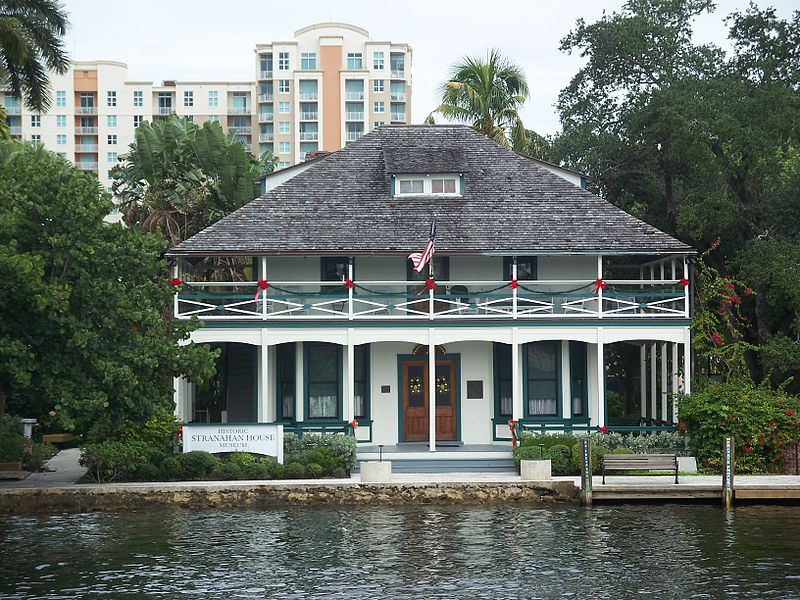
  • Honeycutt, Lauren. “Ghost encounters on campus.” The Flor-Ala. 22 July 2016.
  • Johnston, Debra. Skeletons in the Closet: True Ghost Stories of the Shoals Area. Debra Johnston, 2002.
  • Johnston, Debra. Skeletons in the Closet: More True Ghost Stories of the Shoals Area. Debra Johnston, 2003.
  • Lindley, Alex. “University of North Alabama (UNA).” Encyclopedia of Alabama. Accessed 22 July 2016.
  • Penot, Jessica. Haunted North Alabama. Charleston, SC: History Press, 2010.
  • Tew, Kaitlyn. “UNA alumna, faculty recount campus ghost stories.” The Flor-Ala. 31 Oct 2013.
  • University of North Alabama. Wikipedia, the Free Encyclopedia. Accessed 22 July 2016.
  • Willingham Hall. UNA. Acc. 30 Jun 2015.