Built around 1725 by wealthy planter Paul Hamilton, this French style home burned in 1929. While the house is now just a shell, there’s still a ghostly legend attached to it. Two different authors have recorded this story more than 40 years apart, but there are some differences. The basic premise is that a young bride was killed in the house on her wedding day by a jealous and spurned suitor.
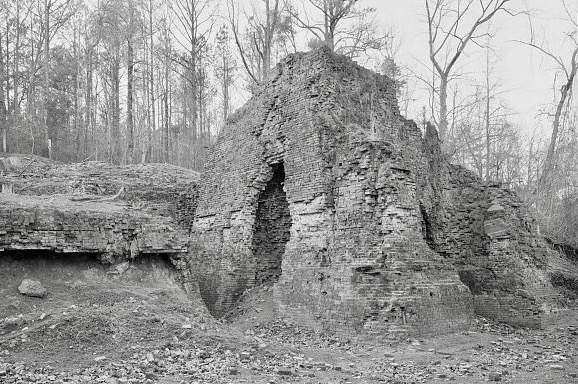
Brick House Ruins, 1938, by Thomas T. Waterman for the Historic American Buildings Survey (HABS), courtesy of the Library of Congress, Prints and Photographs Division.
The main differences in the story concern the identity of the suitor and his method of killing. Margaret Rhett Martin in 1963 identifies the suitor as a local Native American who shot the bride with an arrow; while Geordie Buxton in 2007 identifies the suitor as a Charlestonian, who shot the bride with a pistol. Nevertheless, the spirit of the bride is supposedly still seen staring from the window where she was shot. Buxton also includes that that window sill is still stained with her blood.
Sources
Buxton, Geordie. Haunted Plantations: Ghosts of Slavery and Legends of the Cotton Kingdoms. Charleston, SC: Arcadia Press, 2007.
Dillon, James. National Register of Historic Places Nomination form for Brick House Ruins. Listed 15 April 1970.
Martin, Margaret Rhett. Charleston Ghosts. Columbia, SC: U. of SC Press, 1963.
The Castle 411 Craven Street Beaufort
Reading something written about the paranormal by someone who is not an acolyte of the subject is always an interesting adventure. Certainly, hauntings don’t usually get written up in the business magazine, Forbes; but then again, the ghost of The Castle is one of the more unusual ghosts in the South. One sentence, in particular, stands out to me, “Though likely the only haunted house in town, ‘The Castle’ is hardly the only antebellum mansion in Beaufort.” A ludicrous statement if there ever was one! Beaufort is one of the many Low Country towns visited by flocks of the living and the dead; hardly a “one haunted house” kind of town.
Stereograph view of The Castle during the Civil War. The house had been commandeered for use as as hospital. Photo by Sam A. Cooley, circa 1862. Courtesy of the Library of Congress, Prints and Photographs Division.
This 2006 article highlighted this magnificent estate that had just been put up for sale for $4.6 million, of course that was nearing the height of the real estate market. In researching the house, I stumbled across the house listed on a real estate website for $2.9 million. I can’t be sure that the house has been for sale all this time, but I can’t help wondering what Grenauche or Gauche, the resident spirit, thinks of all this.
The home’s resident ghost is that of a dwarf. Legend holds that the small being only reveals himself to children who are ill. Terrence Zepke records a conversation that the spirit had with a child in which he said he does not reveal himself to fools. The article in Forbes mentions that the daughter of a recent owner saw the spirit when she was in bed with the chicken pox. Nancy Roberts has the spirit appearing to the daughter of the home’s builder, Dr. James Johnson, while she played in the basement. She saw a jaunty and wizened man in a cap, breeches and pointed shoes.
The exact identity of the funny little man is lost in the haze of legend. Some identify him as a court jester who was among the early French Huguenots who settled nearby during the 16th century. Another legend claims him to be a Portuguese dwarf killed in an Indian raid in the early years of the 18th century. According to the stories, the dwarf told a child that he had taken up residence in the old manse because it resembled his old home in the old world. Regardless, his petite spirit may still haunt “The Castle.”
Sources
Bordsen, John. “Find the most haunted place in these Carolina towns.” Dispatch-Argus. 31 October 2010.
Roberts, Nancy. South Carolina Ghosts from the Coast to the Mountains. Columbia, SC: U. of SC Press, 1983.
Rose, Lacey. “Carolina Castle.” 17 April 2006.
Zepke, Terrance. Best Ghost Tales of South Carolina. Sarasota, FL: Pineapple Press, 2004.
Hotel Aiken 235 Richland Avenue West Aiken
The Hotel Aiken, known for many years as the Holley House, has been a center of the Aiken community since its construction in 1898. Originally constructed to accommodate visitors to Aiken during its time as a winter resort town for the wealthy elite, the hotel is reported to have a handful of spirits who have not checked out.
According to South Coast Paranormal, who investigated the hotel in 2011, rooms 302, 320 and 328 feature spirits. Activity in these rooms includes apparitions, shadows and unexplained noises. While their investigation did not apparently pick up much in these rooms, investigators heard unexplained noises in the attic and witnessed an odd shadow in the basement. South Carolina paranormal researcher Tally Johnson notes that activity is also reported in room 225 where the television regularly turns itself on.
Sources
Johnson, Tally. Ghosts of the South Carolina Midlands. Charleston, SC: History Press, 2007.
Old Post Office Building Park Avenue & Laurens Street Aiken
Modeled on Thomas Jefferson’s home, Monticello, the Old Post Office Building has been remodeled and restored into an office for Savannah River Nuclear Solutions, a company providing management and operations for the nearby Savannah River Site. The post office opened in 1912 and remained as a postal facility until 1971. Also during that time, the basement of the building was renovated into offices for Senator Strom Thurmond. Since retirement, the building has served a variety of uses.
Old Post Office, 2010, by Todd Lista. Courtesy of Wikipedia.
According to the owner of Aiken Ghost Tours, the flag atop the building was raised and lowered every day. Unfortunately, there was a good deal of danger walking the roof, especially in inclement weather. Legend holds that one of these brave souls fell and died one evening. Ever since, locals have regularly seen and reported a man walking on the roof of building.
Sources
Bordsen, John. “Find the most haunted place in these Carolina towns.” Dispatch-Argus. 31 October 2010.
Savannah River Nuclear Solutions, LLC. Newsletter. February 2010.
This article is part of my series, Street Guide to the Phantoms of the French Quarter, which looks at the haunted places of this neighborhood in a street by street basis. Please see the series main page for an introduction to the French Quarter and links to other streets.
Decatur Street
Decatur Street originally ran alongside the levee that protected the city from flooding and was called Rue de la Quai,Rue de la Levee, or Levee Street until 1870 when it was renamed for early American naval hero Stephen Decatur. Until the early 20th century, much of Decatur Street was a working-class and immigrant area with “Upper Decatur Street” (the portion of the street near to Canal Street) serving sailors during their stopovers in port.
Ryan’s Irish Pub
241 Decatur Street
Patrons sitting near the back wall of this popular Irish pub have seen the apparition of an African-American workman. Jeff Dwyer posits that he may be a victim of the fire that swept through this section of the city in December of 1794.
Sources
Dwyer, Jeff. Ghost Hunter’s Guide to New Orleans, Revised Edition. Gretna, LA: Pelican Publishing, 2017.
Bienville House
320 Decatur Street
This elegant boutique hotel began life in the early 19th century as a rice mill and warehouse. The property was transformed in 1835 into the North American Hotel and has served as a hotel for much of its existence. When Decatur Street began to see revitalization efforts in the mid-20th century, the building was renovated as a private apartment building. In 1972 the Monteleone family, owners of the famed and haunted Hotel Monteleone, purchased the building for use as a hotel again.
According to psychic and paranormal investigator Cari Roy, the Bienville is home to several spirits. One is the wraith of a young woman whom guests have awakened to find standing at their bedside. Often, the guests are unable to move for a moment, though the apparition vanishes after they are released from their momentary paralysis.
Sources
“About Us.” Bienville House. Accessed 16 May 2016.
Roy, Cari. “Haunted Hotels.” Paranormal New Orleans. Accessed 16 May 2016.
Kerry Irish Pub
331 Decatur Street
Ad from The Town Talk of Alexandria, LA, 10 August 1914. This business once occupied the building that now houses the Kerry Irish Pub.
This three-story commercial building was probably constructed in the 19th century. Ads in early 20th century papers show this building was utilized by the Southern Mattress Company, though that does little to explain the cold spots, disembodied footsteps and voices that staff and patrons have encountered within the warm interior of this pub.
Dwyer, Jeff. Ghost Hunter’s Guide to New Orleans, Revised Edition. Gretna, LA: Pelican Publishing, 2017.
French Market Inn
509 Decatur Street
Originally a bakery for the Dreux family, this 18th century structure has hosted an inn since the Baroness de Pontalba purchased the property in the 1830s. Reports of ghosts began to surface shortly after the building opened to guests. Shadowy figures slipping in and out of rooms and the sounds of metallic clanging, possibly the same sounds produced by a pulley system that operated in the original bakery, have haunted the inn for its almost 200 years of history.
The 500 Block of Decatur Street, 2007. The gold colored building is the French Market Inn. Photo by Infrogmation, courtesy of Wikipedia.
Stories of guests waking to find a bloody handprint on their sheets have also surfaced. A paranormal investigator staying in room 218 was kept awake throughout the night by the feeling of unseen presences, an alarm clock going off periodically, her shower turning off and on on its own accord, and bangs and thuds of unknown origin.
Klein, Victor C. New Orleans Ghosts III. Metarie, LA: Lycanthrope Press, 2004.
Tujague’s
823 Decatur Street
The second oldest restaurant in the city after Antoine’s, Tujague’s (pronounced TOO-zhagz) has operated since 1856. Opened by Guillaume Tujague and his wife, Marie Abadie, the restaurant initially served the dock workers and laborers who crowded this neighborhood. For years, the restaurant’s biggest competitor was Beague’s which operated at the corner of Decatur and Madison, on Jackson Square. The owners of both restaurants teamed up and opened the Begue’s space as Tujague’s in 1914.
Tujague’s 2007, by Infrogmation. Courtesy of Wikipedia.
One of the more interesting spirits here is believed to be that of Julian Eltinge, the famous vaudevillian female impersonator. Eltinge always made a point to stop here when he was in town and a photograph of him once graced the dining room. After this photograph was moved to the attic, his image appeared in a selfie taken by some patrons in 2013.
On the second floor, which once housed the kitchen, the sounds of breaking glass and china is sometimes heard. This is thought to be related to a love triangle that existed between Madame Beague, who owned the restaurant, her second husband Hypolite, and a young lady who worked in the kitchen.
Writer Alison Fensterstock notes that the 1100 block of Decatur Street “is a particularly fertile area for haunting,” in her 2009 article, “When Ghosts Attack.” In fact, when she visited Turtle Bay while researching the article, her presence may have riled the restaurant’s resident spirit, “Boudreaux.” When she returned to the restaurant the following day, she discovered that the spirit had thrown a tantrum, throwing a couple knives and a pan in the kitchen. This activity, however, is not limited to visits by writers, the cook explained to Fensterstock that the business’ owner was not liked by the spirit and had once pushed a table into him.
Sources
Fensterstock, Alison. “When Ghosts Attack.” Gambit Weekly. 9 August 2005.
Santos Bar 1135 Decatur Street
Santos, a Rock n’ Roll bar, is the latest of many bars and clubs that have occupied this 19th century building. Spirits here include former patrons and staff members. For further information, see my writeup, “Sipping with Spirits—New Orleans.”
North Carolina has a plethora of haunted, mystic, and legendary places. Some of these locations were covered in the early days of my blog, though they have been updated and rewritten when necessary.
Biltmore Greensboro Hotel 111 West Washington Street Greensboro
Built in 1903, the building that now houses the Biltmore was constructed as an “up-to-date and well appointed” office building for a textile manufacturer. When that company moved its offices to larger quarters, the building hosted other businesses and a post office before becoming an apartment building. According to a local ghost tour, during this time the apartments were used by ladies of the evening. After a disastrous fire, new owners in the late 1960s sought to turn the building into an upscale hotel. They hired noted local interior designer, Otto Zenke (who may be the spirit inhabiting the Guilford County Sheriff’s Department), to create an elegant and sumptuous boutique hotel that was opened under the name The Greenwich Inn. After renovations in 1992, the hotel reopened as the Biltmore Greensboro.
Two deaths within the building have left spiritual impressions on the Biltmore. During the building’s initial incarnation as offices for the Cone Export and Commission Company, which operated a number of a local textile mills, a young accountant, named as Philip in local legend, was discovered dead one morning in an alley outside. The reason for his death never came to light and speculation purports that he may have discovered inconsistencies in the company’s books. In fact, questions remain as to if Philip was murdered or died by his own hand.
Room 332 is believed to have once served as Philip’s office and his restless spirit has been blamed for activity in and around that room. Guests have been disturbed by the sounds of footsteps in the corridor that sound like someone walking on a bare wooden floor, despite carpeting. Others have seen the spirit standing at the foot of their beds or at the window.
The spirit of Lydia, a former resident and perhaps, a lady of the evening, also makes her presence known. Room 223 is her former room and guests have complained that the light in the room’s bathroom often turns itself on along with the faucet. The door to the room has problems staying closed while housekeepers continue to find long strands of red hair next to the sink in the bathroom, as well. A mother staying in the room several years ago reported that her son encountered a “pretty red-headed lady” in the bathroom. That room has been decorated in pink and gifts of lipstick have been left in the closet in order to appease the feminine specter.
Sources
Biltmore Greensboro Hotel. “History.” Accessed 4 May 2018.
Bordsen, John. “Find the most haunted place in these Carolina towns.” Dispatch-Argus. 31 October 2010.
Ford, Hope. “Haunted Biltmore: the Ghost Stories of Greensboro’s Hotel.” 4 July 2016.
Harper House Bentonville Battlefield State Historic Site 5466 Harper House Road Four Oaks
With the exception of the coast, North Carolina was spared much of the fighting during the Civil War. It’s hard to imagine what John Harper and his family endured when they found their farm embroiled in battle in 1865. The family’s home was commandeered as a field hospital and their inner sanctum was disturbed by the screams and cries of the wounded, blood staining the floor, and piles of amputated limbs stacking up outside. The Harper family abandoned their home not long after the battle; perhaps due to the phantom screams and cries that were still heard in the house at night. The Harper House and the Bentonville battlefield have been preserved as a state park and visitors and staff continue to encounter paranormal phenomena.
Harper House on the Bentonville Battlefield, 2009, by Straitgate. Courtesy of Wikipedia.
One of the most interesting encounters was experienced in 1990 by a family who visited the Harper House. The family was guided by a woman through what they believed was a living history reenactment with wounded soldiers being brought into the house and treated as well as a civilian man who appeared as John Harper. When the family described what they saw to the staff at the visitor’s center, they were told that there was no such living history exhibition at the house.
Sources
Barefoot, Daniel W. North Carolina’s Haunted Hundred, Vol. 2: Piedmont Phantoms. Winston-Salem, NC, John F. Blair, 2002.
Toney, B. Keith. Battlefield Ghosts. Berryville, VA: Rockbridge Publishing, 1997.
High Hampton Inn 1525 Highway 107, South Cashiers
Set amid some 1400 acres in the Appalachians, the High Hampton Inn looks over a sheer mountainside that rises above a 55-acre lake. When I visited a few years ago, I was struck by the serenity and beauty but also the old-fashioned charm that seemed to envelop the resort. That same beauty and charm have given rise to a legend concerning a white owl.
High Hampton began as a hunting lodge for the wealthy Hampton family of South Carolina and in 1922, an inn was constructed on the property and the grounds opened to the public. Prior to the ownership of E.L. McKee, who built the inn, the property was owned by noted surgeon, Dr. William Halstead. Halstead did much to expand the property, purchasing nearby land and farms, among them the property of Louisa Emmeline Zachary.
The High Hampton Inn, 2006, by RichardKenni. Courtesy of Wikipedia.
Upon her marriage, Zachary’s property passed to her husband, Hannibal Heaton, who sold it to Halstead despite his wife’s threats to kill herself if he did. Shortly after the sale, Heaton discovered his wife’s body hanging in a barn with a large barn owl flying about. According to legend, a large white owl continues to haunt the grounds of the High Hampton Inn.
Williams, Stephanie Burt. Haunted Hills, Ghosts and Legendsof Highlands and Cashiers, North Carolina. Charleston, SC: History Press, 2007.
Horace Williams House 610 East Rosemary Street Chapel Hill
The Horace Williams House, 2007, by Jerrye and Roy Klotz, MD. Courtesy of Wikipedia.
An interest in phrenology, the study of how the shape of the head affects intelligence and character, led to the interesting octagon design of the Horace Williams House. Construction on the home was begun in the mid-1850s by University of North Carolina chemistry professor Benjamin Hedrick, whose designs were based on the book, A Home for All or the Gravel Wall and Octagon Mode of Building, by phrenologist Orson Fowler. Fowler posited that the design of the home affected and influenced harmony between those living in the home. Subsequently, this book was important in the building of many octagon homes throughout the nation.
The home passed through a few hands until it ended up with Professor Horace Williams, a beloved and noted professor of philosophy. Upon Williams’ death in 1940, the home and contents were left to the university and the house has been preserved as a museum. Native American and Civil War artifacts discovered around the house indicate that some spiritual activity may be caused by a range of people who have inhabited the property in the past. Activity in the home includes the appearance of a professorial apparition of a gentleman, most likely that of Williams.
Sources
Ambrose, Kala. Ghosthunting North Carolina. Cincinnati, OH: Clerisy Press, 2011.
Bordsen, John. “Find the most haunted place in these Carolina towns.” Dispatch-Argus. 31 October 2010.
Körner’s Folly 413 South Main Street Kernersville
After a paranormal investigation of Körner’s Folly revealed evidence that the house may be haunted, the 85-year old granddaughter of the home’s builder Jule Körner, stated that, “he would be thrilled to death to know this was haunted. He always liked things that were out of the ordinary.” Indeed, Körner’s legacy is unique. The house was begun in 1878 and “completed” in 1880, though Körner continued to remodel the house until his death in 1924. Jule Körner made his name as an advertising painter for Bull Durham Tobacco but was also talented as a designer and he put his talents on display throughout the house.
Körner’s Folly, photo by Carol M. Highsmith. Courtesy of the Carol M. Highsmith Archive, Library of Congress, Prints and Photographs Division.
It is believed that a number of spirits may dwell within this unparalleled edifice. Visitors and staff have spotted a woman as well as a child in Victorian clothing, but much of the activity is aural. During some recent paranormal investigations digital recorders have picked up a number of voices. One voice responded with curiosity to an investigator asking about setting up for EVPs, “What is EVP?” Another recorder picked up a voice saying. “Hauuuuunted.” According to the house museum’s paranormal advisor the spirits in the home are curious and happy to remain in this unique place. Strange stuff, indeed.
Sources
Ambrose, Kala. Ghosthunting North Carolina. Cincinnati, OH: Clerisy Press, 2011.
“Paranormal News: Korner’s Folly Certified Haunted.” Ghost Eyes: Most Haunted Places in America Blog. Accessed 6 February 2011.
Renegar, Michael and Amy Spease. Ghosts of The Triad: Tales from the Haunted Heart of the Piedmont. Charleston, SC: History Press, 2011.
Old Burying Ground Ann Street Beaufort
Among the oldest cemeteries in the state, Beaufort’s Old Burying Ground lies in a verdant peace under ancient oaks. Established in the early 18th century, this burying ground holds victims of the Tuscarora War which was fought in the area from 1711-1715. Other conflicts are also well-represented including the War of 1812, and the American Civil War which provides a member of the Union Army’s Colored Infantry.
Old Burying Ground, 2012, by Carl Griffith. Courtesy of Wikipedia.
Perhaps the most poignant grave here is that of a little girl. Bearing the inscription, “Little girl buried in rum keg,” this small plot is the origin of many stories, including a ghost legend. The girl was the progeny of a local family who longed to see Britain. Despite her mother’s worries, the girl’s father took her abroad with a promise that he would return the child to her mother. When the child passed during the journey home, the father preserved the frail corpse in a keg of rum. Instead of placing the small body in a coffin for burial, the parents decided to bury the child in the keg of rum.
The small grave is marked with trinkets and toys visitors have left as offerings to the little girl’s spirit and she is said to stroll the burying ground after dark. A member of the local historical society noted that the legend is bunk, but ghost tours continue to tell the story.
Sources
Ambrose, Kala. Ghosthunting North Carolina. Cincinnati, OH: Clerisy Press, 2011.
Bordsen, John. “Find the most haunted place in these Carolina towns.” Dispatch-Argus. 31 October 2010.
“Attention, blog readers! Cleanup on the Florida aisle!” Since the move from Blogger, I’ve been sitting on several articles that needed a bit of cleanup before being reposted. This article combines the remains of my original “Haunted Florida” article along with some theatre entries that were written for a book on haunted Southern theatres, that was never completed.
Athens Theatre—Sands Theatre Center 124 North Florida Avenue DeLand
Henry Addison DeLand dreamed of creating the “Athens of the South” when he began developing land around a small Florida settlement called Persimmon Hollow. He opened a small academy, DeLand Academy, but after a freeze in 1885 destroyed the orange crop, DeLand returned north short his investment. Wealthy Philadelphia hat maker, John B. Stetson, took over the academy and reopened it as John B. Stetson University, later just Stetson University.
DeLand grew over the next few decades, becoming a center of learning and culture on the east coast of Florida. The Athens Theatre was opened in 1922 with the hope of continuing that cultural influence. The magnificent Beaux Arts style theatre opened as a vaudeville and movie house. In 2009, the building was renovated, restored and reopened as the Sands Theatre Center, a performing arts center for the community.
Athens Theatre, 2007, by Ebyabe. Courtesy of Wikipedia.
Within the walls of the theatre two spirits linger. The shade of a stagehand who fell to his death still resides here, but it is the lively spirit of a young actress who is most often felt. Legend speaks of a young actress starring in a show who began a torrid affair with the theatre’s manager. The manager’s wife appeared one day to find the two in flagrante delicto and, after a shouting match, the wife bludgeoned the pretty, young actress to death with a lamp. Actors using the actress’ old dressing room sometimes incur her contempt which is sometimes expressed through objects being thrown or the room’s temperature drastically lowered.
Sources
DeLand, Florida. Wikipedia, the Free Encyclopedia. Accessed 18 March 2013.
Martin, C. Lee. Florida Ghosts and Pirates. Atglen, PA: Schiffer, 2008.
Coral Castle 28655 South Dixie Highway Homestead
Coral sculptures at Coral Castle, 2005, by Christina Rutz. Courtesy of Wikipedia.
Edward Leedskalnin, an eccentric and possibly brilliant Latvian immigrant, began work on his masterpiece in nearby Florida City in 1923. In 1936 he moved himself and the castle to Homestead where he worked until he died in 1951. There have been questions about how Leedskalnin, who was five feet tall and weighed less than a hundred pounds, maneuvered the massive blocks of coral that sometimes weighed a few tons. When visitors would ask how he did it, he would only answer, “It’s not difficult if you know how.” This has given rise to numerous theories of how this massive complex was constructed including the help of aliens, though engineers surmise that much of his work was done using known techniques.
It is only appropriate that this legendary place has legends attached. More sensitive visitors have noted the existence of energy vortices throughout the complex. Throughout the site, Mr. Leedskalnin’s presence is felt. Other visitors have seen figures appear among the castle’s huge coral blocks.
Sources
Coral Castle. Wikipedia, the Free Encyclopedia. Accessed 26 March 2012.
Walls, Kathleen. Finding Florida’s Phantoms. Global Authors Publications, 2004.
Deering Estate 16701 Southwest 72nd Avenue Miami
It seems that the former estate of Charles Deering, the founder of International Harvester, may be just crawling with spirits. And a variety of spirits at that. One investigation photographed the possible spirit of a Victorian woman while spirits of Native Americans may be associated with burial grounds nearby. The Deering Estate also features ghost tours of the estate that the League of Paranormal Investigators (LPI) dubbed, “ground-zero for lost spirits.” LPI has documented at least two full-bodied apparitions as well as numerous EVPs.
Richmond Cottage on the Deering Estate, 2010, by Zoohouse. Courtesy of Wikipedia.
The estate has been preserved by the State of Florida and Miami-Dade County as a cultural and educational facility. Two buildings dating from 1896 and 1922 remain and are surrounded by swaths of land in its natural state. Battered by Hurricane Andrew in 1992, restoration of the estate took years and the grounds did not reopen to the public until 1999.
Sources
Charles Deering. Wikipedia, the Free Encyclopedia. Accessed 27 December 2010.
Cohen, Howard. “Halloween howling.” The Miami Herald. 27 October 2011.
Malone, Kenny. “Miami’s Deering Estate: A real haunted house?” 28 October 2009.
“Miami-Dade Estate deemed ‘severely haunted.’” The Miami Herald. 22 October 2009.
Henegar Center for the Arts 625 East New Haven Avenue Melbourne
Henegar Center, 2010, by Leonard J. DeFrancisci. Courtesy of Wikipedia.
A fine example of adaptive reuse, the Henegar Center is located within an old school building. Having opened in 1920, the Melbourne school was named after a former principal, Ruth Henegar in 1963. The building was closed as a school in 1975 and reopened as the Henegar Center for the Arts in 1991. In addition to opening with a 493-seat theatre, the building also came with a resident ghost, Jonathan. According to Kathleen Walls, Jonathan’s antics include the usual noises attributed to spirits as well as moving actors’ props. The theatre’s balcony seems to be his favorite area of the theatre and he has been spotted there on occasion.
Sources
Henegar Center for the Arts. “Our Rich History.” Accessed 25 March 2013.
Walls, Kathleen. Finding Florida’s Phantoms. Global Authors Publications, 2004.
Hotel Blanche 212 North Marion Street Lake City
For decades, travelers heading down Highway 441 from Georgia to Florida would stop at the luxurious Hotel Blanche in Lake City, among them, gangster Al Capone on his way to Miami. This landmark, the heart of downtown Lake City, has been witness to the city’s history for more than a hundred years. Recently, one of the building’s owners described part of the building as a “death trap.”As the hotel’s clientele dwindled towards the middle part of the 20th century, the hotel began to deteriorate. The ground floors have remained occupied with businesses and the second floor has occasionally been used for office space and meetings, but the third floor has not been in use for some time. In fact, the door to the third floor has been screwed shut; perhaps to contain some force from the Other Side?
Over the past few years, arguments have arisen over what to do with the massive white elephant. The city has considered purchasing the building, though I can find nothing to definitively say if that has occurred. Taking up nearly a block of downtown Lake City, directly across from City Hall, the Hotel Blanche was once the heart of Lake City. The hotel was constructed in 1902 by Will Brown and named for his daughter. The hotel added two wings amidst the tourist boom of the 1920s. The hotel closed in 1967 and its third floor has not been used since that time.
Hotel Blanche, 1908, from a postcard. Courtesy of the State Archives of Florida.
The paranormal history of the hotel is less clear. Greg Jenkins reports in his Florida’s Ghostly Legends and Haunted Folklore that the hotel may very well have a “large collection of spirits,” though this hasn’t been officially investigated. Apparently many sounds are heard including children running and giggling. The sounds of door slamming have also been heard as well as many odd smells including perfume, vinegar, and sulfur (which may be an indication of a malevolent entity). The spirits, though, do seem as unsettled as the recent plans for the building.
Sources
Burkhardt, Karl. “Renovation of the Blanche Hotel, Lake City’s most famous historic structure, may restore it as a downtown centerpiece.” Lake City Journal. 18 July 2011.
Hotel Blanche. Wikipedia, the Free Encyclopedia. Accessed 27 December 2010.
Lilker, Stew. “Conversation with Steve Smith, Blanche investment trust spokesman.” Columbia County Observer. 21 October 2009.
Lilker, Stew. “The Blanche Hotel: The seventh inning stretch.” Columbia County Observer. 3 March 2010.
Lilker, Stew. “The Blanche: The city steps up, Councilman Hill wants to slow down.” Columbia County Observer. 21 October 2009.
Miami International Airport 2100 Northwest 42nd Avenue Miami
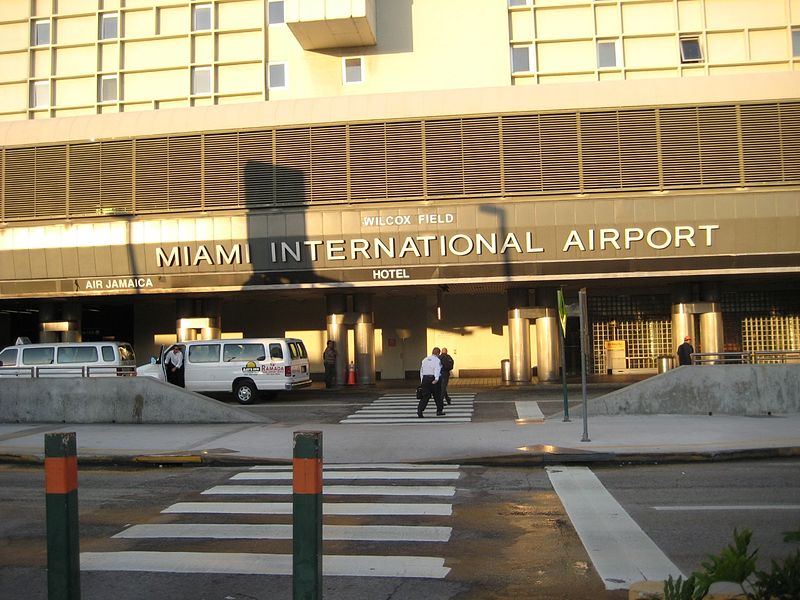
It’s not unheard of that an airport could be haunted. An airport may be the last place that a plane may board before an accident or perhaps a destination that is not reached. Either way, an airport may attract spirits. Miami International was the destination for Eastern Airlines Flight 401 on December 29, 1972. As the plane flew over the Everglades on its approach to the airport, it crashed killing 77 including both pilots. While the plane never arrived, legend speaks of the form of the plane’s captain, Robert Loft, being seen in the airport near where the ticket counters for Eastern Airlines once stood and disappearing into the old Eastern concourse.
Miami International Airport, 2007, by Jason Walsh. Courtesy of Wikipedia.
In the annals of paranormal phenomena, this plane crash is the focus of many stories. Stories abound of the appearance of the captain and 2nd Officer Don Repo on planes that utilized parts recovered from the crash site. After these stories began to surface, Eastern Airlines reportedly removed all these parts from service. Additionally, during the recovery efforts for victims, many working in the swamps late at night heard whimpering and sobbing and saw phantom faces in the black water.
Richey Suncoast Theatre 6237 Grand Boulevard New Port Richey
The patron attended a performance at the theatre. He sat in his favorite seat, BB1 in the balcony, for the performance and a few hours after leaving was dead of a heart attack. Not only was Willard Clark not just a patron, he was the president of the theatre. Following his death in 1981, he has apparently returned to the theatre he loved so and is not happy when his favorite seat is occupied. Patrons unfamiliar with the story have experienced a distinct chill while watching performances from Clark’s favorite seat. Others have spotted a gentleman in a tuxedo in that seat. For awhile, the seat was simply reserved for the ghost and patrons were told it was broken.
The history of this theatre reflects much of the bumpy history of Florida in the early 20th century. Land booms, busts and the Great Depression fill the history of the state and the theatre felt shockwaves from all of these.
Richey Suncoast Theatre, 2010, by Karm Atwin. Courtesy of Wikipedia.
Thomas Meighan made a name for himself in silent films. After his 1919 film, The Miracle Man, he officially had become a “star” and he appeared opposite great leading ladies like Gloria Swanson, Mary Pickford (known popularly as “America’s Sweetheart”) and Norma Talmadge and under the direction of such greats as Cecil B. DeMille. Talking with his brother, James, a realtor, Meighan became very interested in Florida and bought land there in 1925. Inspired by dreams of making the New Port Richey area a celebrity winter playground, he built a home there and encouraged his friends to visit. When a new theatre opened in town in 1926, it was named, appropriately, the Thomas Meighan Theatre.
The grand opening of the theatre on July 1, 1926 was heralded with a showing of Meighan’s film, The New Klondike. The theatre experienced ups and downs in its business and improvements were made to allow for the latest in film technology: “talkies.” But with the hardships imposed on the area during the Great Depression, the theatre closed its doors. The theatre reopened under a new name in 1938 and continued operating under a variety of names until 1968 when competition from a local multiplex led to the theatre’s closure. It was purchased in 1972 for use as a community theatre. The Richey Suncoast Theatre has continued to operate as a successful community theatre ever since. And Willard Clark continues to watch fabulous performances from his favorite balcony seat.
Sources
Cannon, Jeff. “Ghostly Encounters in Pasco County.” com. 25 October 2012.
Fredericksen, Barbara L. “Attention ghost: Exit stage left, through wall.” Tampa Bay Times. 31 October 2006.
Spencer, Camille C. “Is New Port Richey a truly ghostly town? Or is it a myth?” Tampa Bay Times. 30 October 2009.
Thomas Meighan. Wikipedia, the Free Encyclopedia. Accessed 3 April 2013.
Venice Theatre 140 Tampa Avenue, West Venice
Venice Little Theatre has grown so much they dropped the “Little” from their name in 2008. Founded in 1950 and first performing in an airport hangar at the Venice Airport, Venice Theatre has expanded into one of the premier community theatre companies in the nation. After the city needed the airport hangar for storage in 1972, the company purchased its current building: a 1926 structure with a tower resembling the St. Mark’s Campanile in Venice, Italy, the town’s namesake.
Where actors now play, cadets from the Kentucky Military Institute—which summered in Venice—once sweated and occasionally the spirit of a small girl still roams. She has been seen curiously watching groups of juvenile actors and bouncing a ball in the corridors that once served as the military institute’s gymnasium. Who she is or what she’s doing in this particular building remains a mystery.
Mayflower Hotel 1127 Connecticut Avenue, NW Washington, D.C.
In researching Mississippi hauntings, I somehow stumbled on a 2000 article regarding haunted hotels. The hotels in the article mostly included the usual haunted hotel fare like Colorado’s Stanley Park Hotel, San Diego’s Hotel Coronado, and Arkansas’ Crescent Hotel, but I had not seen anything about Washington’s Mayflower Hotel in my previous research. The mysteries in this grandest of Washington hotels are very interesting, though I began to run into problems when I tried to match up the history and the hauntings.
The Mayflower Hotel after opening in 1925. Photo b y Harris & Ewing, courtesy of the Library of Congress, Prints and Photographs Division.
As one of the most impressive hotels in the city, the Mayflower has been deemed “the Hotel of Presidents,” due to the panoply of presidents and world leaders who have stayed or attended functions here. Construction began on this massive hotel in 1922 and the building officially opened for guests in mid-February of 1925. The hotel’s grand opening was boosted by the inaugural ball following the second inauguration of Calvin Coolidge. From 1925 until 1981, the Mayflower would host inaugural balls for every presidential inauguration.
From the left, Warren G. Harding, Florence Harding, Grace Coolidge, and Calvin Coolidge, 1921. Photo by the National Photo Company.
It is from Coolidge’s inaugural ball that the hotel’s mysteries stem. Coolidge, who had served as governor of Massachusetts, doesn’t seem to have wanted the tremendous spotlight that the presidency brought with it. He had been elected as Vice President under President Warren G. Harding–who while popular, was buffeted by scandal. In 1923, Harding undertook a cross-country trip he dubbed a “Voyage of Understanding,” expecting to boost his popularity and expand his reach throughout the American West. After becoming the first president to visit the Alaska territory (it would become a state in 1959), Harding visited Seattle and traveled south to San Francisco. He had begun to complain of illness and his doctor ordered bed rest. After the arrival of the entourage at San Francisco’s Palace Hotel, Harding was found to be suffering from pneumonia and confined to his bed. As his wife, Florence, read to him on the evening of August 2nd, he suffered a massive heart attack and died.
When the President passed away in San Francisco, Coolidge was visiting the family home in the community of Plymouth Notch, Vermont, which did not have a phone or electricity. A messenger delivered the news that Coolidge was to be sworn in as president. In the dead stillness of the early morning hours of August 3rd, Coolidge took the oath of office by the flicker of a kerosene lamp in the family’s parlor given by his father, a local notary and justice of the peace. “Silent Cal,” as he was known, retired to bed before traveling to Washington to take the full reigns of the country.
With the nation in mourning, there were no festivities for the new president. Coolidge allowed investigations into the scandals of the Hardin administration to be completed and all loose ends thoroughly tied up. With the election of 1924 looming, he threw his hat into the ring against the Democratic challenger, John W. Davis. In July, the President and his wife, Grace, were called the bedside of their son, Calvin, Jr. who had developed a blister which became infected. The blister, which had formed during a tennis match, developed into blood poisoning which was being treated at Walter Reed Army Hospital.
The Democratic National Convention was in full swing at New York City when word filtered in that Calvin Coolidge, Jr. had died in Washington. Out of the respect to the President and Mrs. Coolidge, the convention suspended its furious debate. The death pulled a pall over the election for Coolidge. He later recorded in his autobiography that “when he died, the power and glory of the Presidency went with him.” Coolidge went on to easily garner the electoral votes from every region of the country, except for the South which went for Davis, and Wisconsin which elected a favorite son, Senator Robert M. La Follette. Coolidge was sworn in the second time on March 4th, 1925.
The Mayflower Hotel, 2017, by Difference engine. Courtesy of Wikipedia.
Here’s where the Mayflower Hotel first enters the annals of the Presidency. Coolidge’s inaugural ball was held in the hotel’s Grand Ballroom, though he and his wife declined to attend as they were still mourning their son. The ball was held anyway despite the absence of the man of honor. The legend reports that on January 20th, at 10 PM, the lights in the ballroom will flicker and one of the elevators will stop on the 8th floor and stay there until descending at 10:15, around the time the president’s party would have made their entrance at the ball. A 1996 article further reports that a plate of hors d’oeuvres and a glass of wine will often be found in the ballroom’s balcony.
There are several problems with this legend. The first issue concerns the date that this activity occurs. Coolidge’s inauguration took place on March 4, though starting in 1937 (for FDR’s second term), the date was pushed back to January 20. Can spectral activity of this nature change the date? The second issue is that this activity seems to be motivated by the fact that Coolidge did not attend the inaugural ball. Though the ball did take place without the president and first lady’s attendance, it seems odd that paranormal activity would rise from something that didn’t happen. While this activity appears to be pure legend, the hotel’s long history does not preclude it from being haunted.
One of my goals with this blog is to provide coverage of ghost stories and haunted places in a comprehensive manner. Perhaps one of the best ways to accomplish this is to examine ghost stories county by county, though so far, researching in this manner has been difficult. In my 2015 book, Southern Spirit Guide’s Haunted Alabama, I wanted to include at least one location for every county, though a lack of adequate information and valid sources prevented me from reaching that goal. In the end, my book was published covering only 58 out of 67 counties.
Further research has uncovered information for a few more counties and on Halloween of 2017, Kelly Kazek published an article on AL.com covering the best-known ghost story for every county. Thanks to her excellent research, I’ve almost been able to achieve my goal for the state.
Autauga County
Cross Garden Autauga County Road – 86 Prattville
An odd collection of signs, crosses, and rusting appliances dots two hills along Autauga County Road 86; this is W. C. Rice’s Cross Garden, a testament to the South’s enduring religious fervor and one man’s personal religious devotion. After he was saved and healed of painful stomach issues in 1960, Rice began a journey to save those around him from eternal damnation. Created in 1976, the Cross Garden was maintained by Rice until his death in 2004.
Cross Garden, 2010, by Carol M. Highsmith. Courtesy The George F. Landegger Collection of Alabama Photographs in Carol M. Highsmith’s America, Library of Congress, Prints and Photographs Division.
Listed among Time Magazine’s “Top 50 American Roadside Attractions” in 2010, the Cross Garden has attracted a following fascinated with this place’s spiritual ambiance and the paranormal activity that supposedly permeates the area. There is a pair of visitors who claimed to have had their car held in place by an odd force. Others have heard strange sounds coming from some of the old appliances used in the display. Faith Serafin notes that in 2008 a man in a white robe seen stalking through the woods here.
Sources
Crider, Beverly. Legends and Lore of Birmingham and Central Alabama. Charleston, SC: History Press, 2014.
Cruz, Gilbert. “Miracle Cross Garden, Prattville, AL: Top 50 American Roadside Attractions.” Time Magazine. 28 July 2010.
Serafin, Faith. Haunted Montgomery, Alabama. Charleston, SC: History Press, 2013.
Baldwin County
Bay Minette Public Library 205 West 2nd Street Bay Minette
Bay Minette Public Library, 2013, by Chris Pruitt. Courtesy of Wikipedia.
It is believed that the spirit of Bay Minette Public Library’s first librarian, Mrs. Anne Gilmer, is still on duty. A librarian recently encountered Mrs. Gilmer’s spirit while shelving books when she observed a book slowly pulling itself off a shelf and tumbling to the floor. This book was joined by others falling by themselves off the shelves. The librarian realizing these books had been mis-shelved returned the books to their proper places.
After her long tenure at the library, Mrs. Gilmer’s portrait was removed from its position above the library’s main desk. After some time, the portrait was returned to its original spot and employees began to notice the smell of roses. This same odor returns whenever something good happens in the library; perhaps as a sign of Mrs. Gilmer’s happiness. When the library was moved to the old Baptist church across the street, the librarian issued a verbal invitation for the ghost to join them in the new building just before workers moved Mrs. Gilmer’s portrait. When the elevator began to act strangely, librarians knew that Mrs. Gilmer was continuing her spectral duties in the new library.
Sources
Brown, Alan. The Haunted South. Charleston, SC: History Press, 2014.
Barbour County
Kendall Manor 534 West Broad Street Eufaula
Crowning the hill of West Broad Street, Kendall Manor, with its white Italianate architecture and cupola resembles the front of a grand steamboat. It is certainly an architectural masterpiece among the hundreds of stately homes in Eufaula. The house, completed just after the Civil War, was constructed for James Turner Kendall, one of the few merchants and planters in the area whose fortune survived the war. A story circulated among the servants about a spirit that appeared near the house as a harbinger of bad luck. The Kendall family thought nothing of it until James Kendall’s manservant saw the spirit of a man in a gray uniform astride a white horse. Reportedly, James Kendall passed away the following day.
Kendall Manor, 2014, by Lewis O. Powell IV. All rights reserved.
For many years, this grand house served as a bed and breakfast with a unique staff member. A spectral nursemaid, known as Annie, is apparently on duty and has often been spotted by the children in the house. One family member told of seeing the specter wearing a black dress and starched white apron scowling at him as he and his siblings raced their tricycles on the home’s veranda. It seems Kendall Manor has returned to being a quiet, private residence in recent years, so please respect the home’s occupants.
Sources
Floyd, W. Warner. National Register of Historic Place Nomination form for Kendall Hall. 24 August 1971.
Mead, Robin. Haunted Hotels: A Guide to American and Canadian Inns and Their Ghosts. Nashville, TN: Rutledge Hill Press, 1995.
Bibb County
Brierfield Ironworks Historic State Park 240 Furnace Parkway Brierfield
Founded by a group of local businessmen in 1862—as the Civil War was ramping up—the Brierfield Ironworks quickly attracted the attention of the Confederate Government which was interested in the high-quality pig iron produced here. During the war, the ironworks saw the production of about 1,000 tons of pig iron per year. Later in the war was Union General James H. Wilson swept through central Alabama, destroying targets of military importance, Brierfield was targeted and destroyed. Production resumed here after the war and continued until the ironworks was closed in 1894.
The ruins of the Brierfield Furnace by Jet Lowe. Photo taken for the Historic American Buildings Survey, 1993.
In 1976, the county heritage association turned the ruins into a heritage park. Two years later, the state took over the park, moving several historic structures here including Mulberry Church, which arrived here from its original site near Centreville. Built in 1897, this church is where tradition holds that the daughter of a moonshiner eloped despite her father’s disapproval of her fiancé. At the completion of the couple’s vows, the bride’s father appeared, firing his gun into the church door. The bullet struck both the bride and her new husband who was standing behind her. As a reminder of this tragic incident, the bullet hole remains in the door while the living have encountered the specter of the young bride at the site of her death.
Sources
Johnston, Kim. Haunted Shelby County, Alabama. Charleston, SC: History Press, 2013.
Built in 1915, the John Garner Hotel was built to accommodate guests arriving in town via the train depot located nearby. The building now serves as home to several businesses that occupy the first floor of this three-story building. Southern Paranormal Investigators spent an evening in the building in 2007 and were awed by the “findings and activity detected” within. Occupants had reported the smell of brewing coffee and tobacco smoke while the sounds of furniture moving and papers shuffling have also been heard here when the building was empty. The paranormal investigation team captured a few EVPs and photographic anomalies leading them to conclude that possibly three different spirits are present in this old hotel.
Sources
Blount County Heritage Book Committee. Heritage of Blount County, Alabama. Clanton, AL: Heritage Publishing Consultants, 1999.
Southern Paranormal Researchers. Paranormal Investigation Report on The Lobby. Accessed 29 November 2012.
Bullock County
Josephine Arts Center 130 North Prairie Street Union Springs
The old Josephine Hotel is now home to the Josephine Arts Center. Built in 1880, the Josephine Hotel was a social center here in rural Southeast Alabama. Phantom odors of cigar and cigarette smoke are often encountered in this building along with the sounds of revelry from former patrons.
A 2012 investigation revealed some paranormal activity. At one point during the probe, members of the paranormal team witnessed an orb of light moving through a hallway which they captured on video.
Sources
Alabama Paranormal Research Team. Paranormal Investigation Report for the Bullock County Courthouse. Accessed 29 November 2012.
Higdon, David and Brett J. Talley. Haunted Alabama Black Belt. Charleston, SC: History Press, 2013.
Consolation Primitive Baptist Church and Cemetery Oakey Streak Road Red Level
On the morning of February 16, 2015, this historic church was lost to a fire. Local officials suspect that the church’s status as a haunted place led vandals to torch the small, rural building. Legend speaks of this place being the scene of a panoply of paranormal activity including demon dogs, or hellhounds; a banshee; and apparitions.
Organized in the 19th century, the church has not had an active congregation for many years, though a few locals maintained the building and cemetery and defended them against the rising tide of vandalism that had begun to overtake it. Teens and amateur “ghost hunters” had damaged the building by burning candles inside, carving their names on the structure, breaking windows, and even painting a pentagram on the floor of the lonely church. The Andalusia Star-News reports that 13 people were arrested in 2007 for burglary and criminal mischief after the police investigated reported illegal activity here.
Local investigator and author Shawn Sellers visited the church with his team in 2013. Upon arriving, two carloads of teens also appeared at the site. The group found the church standing open and showing signs of vandalism. One group of teens brought a Ouija board and attempted to make contact with spirits (something I cannot condone or recommend). A short time later, a man with a flashlight accosted the investigators and mysteriously disappeared after they attempted to speak with him.
Legends surrounding the church include the appearance of a banshee who wails as an omen that someone in the church will die. The grounds of the church are supposedly the domain of red-eyed “hellhounds,” as well as Confederate soldiers, two ghostly children, and a haunted outhouse where those who enter may be locked in. In 2012 reporters from The Greenville Advocate investigated the grounds and encountered nothing. In an article about the investigation, reporter Andy Brown suggested that the stories about this location are merely urban legend. Perhaps if there is paranormal activity here, it may have been drawn by irresponsible use of Ouija boards and rituals being performed here by amateurs attempting to summon spirits.
It is unknown if the loss of the church building has affected the spiritual activity here. Visitors should be warned to use extreme caution when visiting this location and to respect the site and the cemetery.
Sources
Bell, Jake. “The Church.” Shawn Sellers Blog. 18 January 2013.
Brown, Andy. “Butler County church haunted by tall tales.” Greenville Advocate. 5 October 2012.
Edgemon, Erin. “Church said to be haunted burns in Alabama.” com. 17 February 2015.
“Fire wasn’t first brush with vandalism for historic church.” Andalusia Star-News. 17 February 2015.
Higdon, David and Brett J. Talley. Haunted Alabama Black Belt. Charleston, SC: History Press, 2013.
Rogers, Lindsey. “Haunted Butler County church destroyed by fire.” WSFA. 16 February 2015.
Calhoun County
Boiling Springs Road Bridge Boiling Springs Road over Choccolocco Creek (This bridge is permanently closed to traffic) Oxford
Known locally as “Hell’s Gate Bridge,” local lore related that visitors to this bridge at night could stop in the middle of the bridge, look back over their shoulders and see the fiery gates of Hell. Other lore tells of a young couple who drowned in the creek here. A traditional ritual said that stopping your car in the middle of the bridge and turning o the lights could summon one of the two people who drowned here. A sign of their presence would appear in the form of a wet spot left on the back seat of the car.
This wooden-decked, steel truss bridge was constructed between 1890 and 1930 and closed permanently in 2005. The Oxford Paranormal Society investigated the bridge in January 2007 and encountered an armadillo that was very much alive; no paranormal evidence was captured. When visiting this site, use extreme caution as the bridge is no longer maintained.
Within this relatively modern cemetery stands a child-sized brick house complete with a front porch and chimney. The grave of Nadine Earles is among the most unique grave sites in the region. When four-year-old Nadine became ill with diphtheria just before Christmas in 1933, the child’s father had been building a playhouse as a gift for his daughter. After the child passed away on December 18th, the decision was made to erect the playhouse on the little girl’s grave. The playhouse has been well maintained ever since and remains filled with toys.
While not officially haunted, a recent interview with a friend revealed that she had a hard time photographing the grave when she visited. Using a smartphone camera, my friend’s attempts to photograph the grave resulted in black photographs. However, once she stepped away from the grave, the camera functioned properly.
Sources
Interview with Celeste Powell, LaGrange, GA. 23 July 2015.
Kazek, Kelly. “Alabama child’s playhouse mausoleum one of nation’s rare ‘dollhouse’ graves.” com. 5 June 2014.
Lost Regiment Legend Lookout Mountain Near the Blanche community
Extending from Chattanooga, Tennessee, through the northwest corner of Georgia, and into Alabama, the ridge of Lookout Mountain has played a prominent role in the history of the region. During the Civil War when its flanks were crawling with military activity, the mountain bore witness to several major battles and many skirmishes as the Union army attempted to extend its reach into the Deep South.
During this dark time, legend speaks of a group of Union soldiers getting lost in the mountain wilderness after a skirmish near Adamsburg, in DeKalb County. After retreating, the soldiers attempted to survive in the dangerous terrain. Fearful locals and enemy soldiers picked off a few of the men while others did not survive the harsh mountainous conditions. The last of these survivors was seen near the Blanche community in Cherokee County. Even decades after the disappearance of these soldiers, tales still circulate of sightings of the “Lost Regiment.” Others have discovered bootprints in the snow that suddenly stop, as if the men have vanished into thin air.
In the past few weeks, several people visiting haunted places here in the South have been photobombed in a spectral fashion. Visitors to St. Francisville, Louisiana’s The Myrtles Plantation and Homestead, Florida’s Hotel Redland have captured images of someone in their photographs, someone who wasn’t physically present when the photos were taken.
Six friends visiting The Myrtles decided to take a group selfie just outside of the house. Upon closer inspection, the photographer noticed the face of a seventh woman peering from behind a window pane behind the group. While all the women in the group are smiling, the women in the window pane appears to be scowling. Photographs of the this nature are easy to fake, so I cannot say this photograph is authentic. Surely, this is not the first photograph taken at The Myrtles to possibly show something spectral. In 2015, I published a photograph taken by an acquaintance that appears to show someone sitting on the staircase.
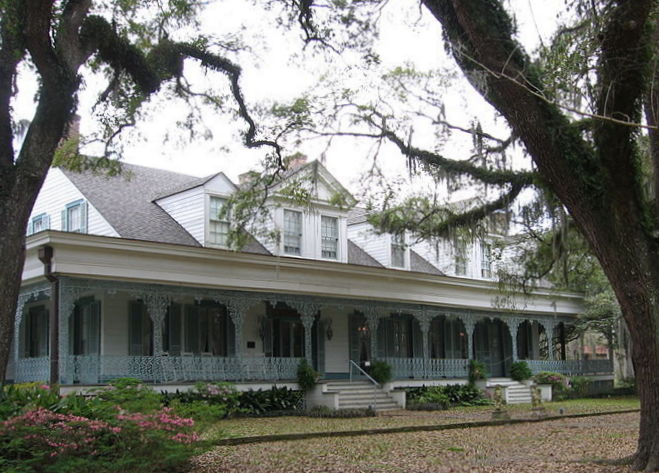
The Myrtles, 2005, by Bnet504. Courtesy of Wikipedia.
Perhaps the most famous haunted places in the country, The Myrtles (7747 US-61, St. Francisville, Louisiana) is a late 18th-century plantation with a tragic history. Of course, much of that tragic history has literally come back to haunt the home. The house is preserved as a museum, bed & breakfast, and haunted attraction. In my opinion, at least some of that tragic history has been created to make the haunting more interesting. I looked into these stories in a blog entry several years ago.
It’s interesting that the other selfie that has been published in the news is from a place that also has a doubtful history. The history of the Hotel Redland (5 South Flagler Avenue, Homestead, Florida) is not as long or as varied as The Myrtles, though it has also left spectral impressions. Those spectral impressions led a friend of a hotel staff member to investigate the hotel recently. During the investigation, the visitor snapped a selfie standing in the lobby. In the selfie, a face appears which the British tabloid, the Daily Mirror, described as resembling the horror movie villain, Michael Myers, from John Carpernter’s movie franchise, Halloween.
My opinion on the photograph is that this is a case of pareidolia, when the brain tries to make sense of something chaotic by finding patterns in it. In this case, light reflected in the window pane creates a “face,” within the reflection.
The first building on this site was constructed in 1904 as a boarding house for railroad employees called the Homestead Inn. This building’s history was rather quiet until the fateful day of November 10, 1913. I’ll allow the Miami Metropolis to take over the story from here:
A few minutes before 2 o’clock in the afternoon the large steam roller, being used in rolling the streets, puffed down in front of the Homestead Inn, and it was only a few seconds later that the roof of the hotel was discovered on fire, having caught from a flying spark from the engine. Soon the entire fire-fighting population of the town was on the scene, and all efforts were brought to bear to save the burning building, but to no avail. However, the furnishings were carried to safety and the loss of the building is just about covered by insurance.
Flames spread to five adjoining buildings destroying several other businesses. The paper ends the article by mentioning that a fire caused by sparks from the same steamroller had damaged the city’s other hotel across the street that morning. “It is likely that some action will be taken to curb the chances of another such conflagration starting from the same cause.”
Hotel Redland, 2011, by Ebyabe. Courtesy of Wikipedia.
While the damage to the structure led to much of it being rebuilt, the story of this dramatic fire continued to be told and expanded. The story of the fire as told now sets the scene late at night where the fire takes the lives of a number of guests soundly asleep in their rooms. These same guests now haunt the hotel.
An article in the August 16thMiami New Times detailed a paranormal investigation of the hotel by the South Florida team of PRISM Miami, lead by investigator David Rodriguez. That article hints at the hotel actually being haunted, though the details are somewhat vague.
Sources
“Business section of Homestead wiped out in big fire Monday.” Miami Metropolis. 11 November 1913.
‘Twas the night before Halloween and all through the blog, little was stirring…
This move from Blogger to this new site has been tedious and time-consuming. I’ve tossed out a great deal of junky posts and put many posts aside that need to be updated and refreshed leaving me with many bits and pieces that should be republished in a different context. This is a selection of recycled pieces for Halloween.
East Coast/West Coast 138 St. George Street St. Augustine, Florida
This modest commercial building once housed Kixie’s Men’s Store and some odd activity. The shop employed a young tailor, Kenneth Beeson who would later serve as mayor for the city. While working late one evening he noticed a door opening by itself followed by the sweet scent of funereal flowers. After experiencing odd activity for a while, Beeson put out a tape recorder and set it to record just before he left. When he returned the following morning, he was shocked to discover a plethora of sounds including marching feet and guttural growls. Disturbed by these incidents, Beeson had a priest exorcise the building. The activity ceased.
Sources
Cain, Suzy & Dianne Jacoby. A Ghostly Experience: Tales of St. Augustine, Florida. City Gate Productions, 1997.
Lapham, Dave. Ghosts of St. Augustine. Sarasota, FL: Pineapple Press, 1997.
Western & Atlantic Railroad Tunnel Chetoogeta Mountain Tunnel Hill, Georgia
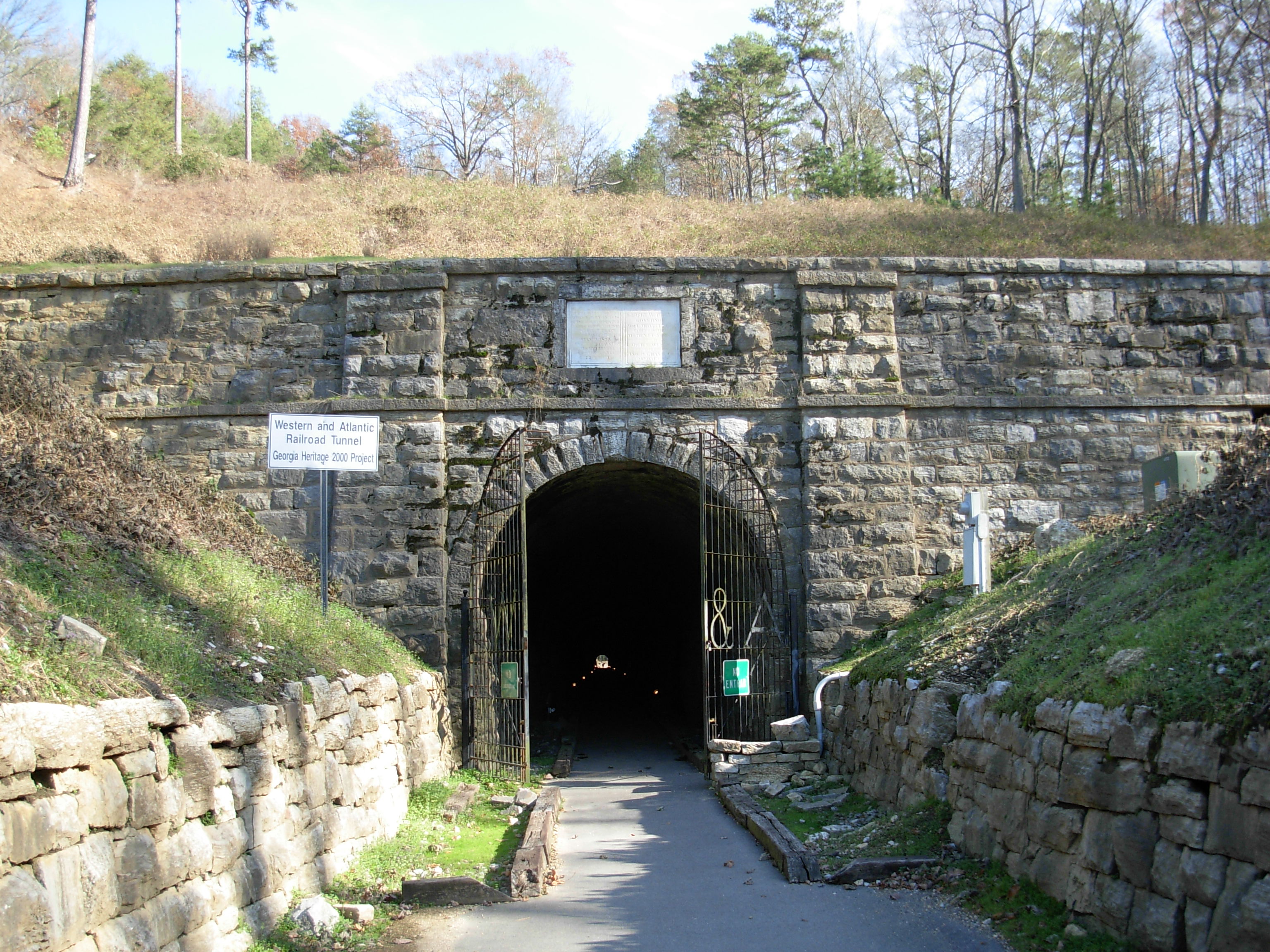
As the railroad spread its tentacles throughout the nation before the tumult of the Civil War, a route was needed from Augusta, Georgia to Chattanooga, Tennessee. Numerous obstacles stood in the way, but the biggest was Chetoogeta Mountain. Plans for a railroad tunnel dated to the second half of the 1830s, but work did not commence until 1848 with work completed two years later. The new tunnel was instrumental in Atlanta’s growth as a railroad hub and was a strategic feature for the Confederacy to protect during the Civil War.
The tunnel’s strategic importance led to a series of skirmishes being fought here leading up to the Battle of Atlanta. Following the war, the tunnel remained in service until 1928 when a new tunnel was built a few yards away. The old tunnel became overgrown with kudzu and was largely forgotten until 1992 when preservationists fought to save the tunnel. It is now the centerpiece of a park that features reenactments of the skirmishes fought at the site.
Entrance to the old Western & Atlantic Railroad Tunnel, 2011. Photo by Lewis O. Powell, IV, All rights reserved.
It is often re-enactors who have encountered anything supernatural at the site. I’ve been pleasantly surprised by the number of documented accounts of spirits at Tunnel Hill. At least four books and a handful of good articles document the high levels of activity at this site. Accounts include the apparitions of soldiers seen both inside the tunnel and around it. Ghostly campfires, disembodied screams, spectral lantern light and the smell of rotting flesh (minus the presence of actual rotting flesh) have all been reported by re-enactors and visitors alike.
Sources
DeFeo, Todd. “Antebellum railroad tunnel still a marvel after all These years.” com. 22 June 2009.
Kotarski, Georgiana C. Ghosts of the Southern Tennessee Valley. Winston-Salem, NC: John F. Blair, 2006.
Underwood, Corinna. Haunted History: Atlanta and North Georgia. Atglen, PA: Schiffer, 2008.
Western and Atlantic Railroad Tunnel. Tunnel Hill Heritage Center. Accessed 28 November 2010.
Old Talbott Tavern 107 West Stephen Foster Avenue Bardstown, Kentucky
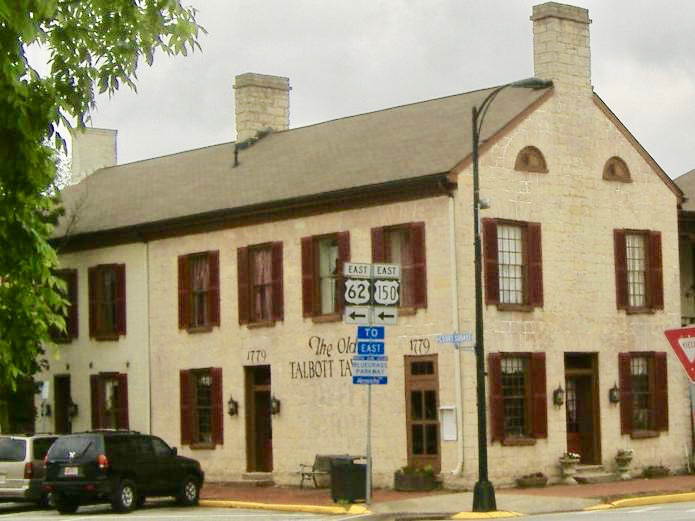
Old Talbott Tavern, 2008, by C. Bedford Crenshaw. Courtesy of Wikipedia.
Continuously open since the late 18th century except for a period in the late 1990s when the tavern was being renovated following a disastrous fire, the Old Talbott Tavern has hosted an impressive array of visitors ranging from Daniel Boone to General George Patton. Perhaps one of the famous guests who has never checked out is outlaw Jesse James who stayed frequently in the tavern while visiting his cousin who was the local sheriff. With the claims of Jesse James’ spirit which may also roam the halls of Selma, Alabama’s St. James Hotel, James’ spirit may split the hereafter between two favorite locales. But James’ spirit is not the only spirit acting up in the Old Talbott Tavern. Other ghosts may include formers guests, owners and their families.
Old Louisiana State Capitol 100 North Boulevard Baton Rouge, Louisiana
When the state capitol was moved from New Orleans to Baton Rouge in 1846, the city donated land atop a bluff over the Mississippi for the capitol building. Architect James Dakin designed a Neo-Gothic building very much unlike the other state capitols which were often modeled on the U.S. Capitol building in Washington. The magnificent crenellated and be-towered structure was used as a prison and garrison for soldiers under the city’s Union occupation and during this time it caught fire twice leaving it a soot-stained shell by the war’s end. The building was reconstructed in 1882 but abandoned in 1932 for Governor Huey Long’s new state capitol.
Old State Capitol, 2009, by Avazina. Courtesy of Wikipedia.
Even before the capitol burned during the war, there was a ghost gliding through its halls. Pierre Couvillon, a legislator representing Avoyelles Parish, enraged by his colleagues’ corruption, suffered a heart attack and died. Though he was buried in his home parish, his spirit was said to reside in the capitol; perhaps checking up on his colleagues. When the capitol building underwent restoration in the 1990s, the spirit or spirits in the building were stirred up and activity has increased. Staff members and visitors have reported odd occurrences. One security guard watched as movement detectors were set off through a series of rooms while nothing was seen on the video.
Two organizations investigated the building in 2009 and uncovered much evidence. Louisiana Spirits Paranormal Investigations picked up a number of interesting EVPs including someone singing the old song, “You Are My Sunshine.” Everyday Paranormal, in their investigation had a few encounters in the basement of the building, the area used as a prison during the Union occupation. It seems that there are many spirits within the crenellated walls of the Old Capitol.
Sources
Duvernay, Adam. “Several Baton Rouge sites said to be haunted.” The Daily Reveille. 27 October 2009.
Dwyer, Jeff. Ghost Hunter’s Guide to New Orleans. Gretna, LA: Pelican, 2007.
Louisiana Spirits Paranormal Investigations. Old State Capitol, Baton Rouge, LA. Accessed 11 November 2011.
Southeastern Students. “Old State Capitol Still Occupied by Former Ghosts.” com. 29 October 2009.
Jericho Covered Bridge Jericho Road at Little Gunpowder Falls Harford County Near Jerusalem, Maryland
Jericho Covered Bridge, 2009, by Pubdog. Courtesy of Wikipedia.
Straddling the county line between Harford County and Baltimore County over the Little Gunpowder Falls is the Jericho Covered Bridge, constructed in 1865. According to Ed Okonowicz in his Haunted Maryland, there are legends of people seeing slaves hanging from the rafters inside this nearly 88-foot bridge. Certainly, there is an issue with this as the bridge was constructed in 1865, after the end of both slavery and the Civil War. Other, more realistic legends, speak of a woman seen on the bridge wearing old-fashioned clothing and people having their cars stop inexplicably in the middle of the bridge.
Varhola, Michael J. and Michael H. Varhola. Ghosthunting Maryland. Cincinnati, OH: Clerisy Press, 2009.
Corinth Battlefield Corinth, Mississippi
Following the Confederate’s disastrous attack in April of 1862 on the Union forces at Shiloh, Tennessee (for a battle description see my entry on the Beauregard-Keyes House in New Orleans), the Union army laid siege for two days to the vital railroad town of Corinth, just over the state line. To save his army from annihilation, General P.T.G. Beauregard gave the appearance of reinforcement troops arriving and being put in place while efficiently moving his troops out of the city to nearby Tupelo. The Union army entered the city the following day to find it devoid of Confederates. In October of the same year, Confederates tried once again and failed to capture the city losing some 4,000 men (including dead, wounded and missing) in the process.
The railroad junction at the heart of Corinth. Photo 2013, by Ron Cogswell. Courtesy of Wikipedia.
The battlefield on which these two battles were fought is now incorporated into the mid-sized city of Corinth. Portions of the battlefield and earthworks are now preserved as the Corinth unit of Shiloh National Military Park. As one might expect, some of those portions have spiritual artifacts remaining. Some of the best stories from Civil War battlefields come from re-enactors who have experiences while re-enacting battles and one of the primary reports of ghosts from the Corinth battlefield comes from a re-enactor whose story was documented by Alan Brown. This particular re-enactor heard the sound of a phantom cavalry and a few nights later, the sound of someone rummaging through her tent while camping on the battlefield.
Sources
Brown, Alan. Stories from the Haunted Southland. Jackson, MS: University Press of Mississippi, 2004.
Siege of Corinth. Wikipedia, the Free Encyclopedia. Accessed 27 January 2011.
North Carolina Zoological Park 4401 Zoo Parkway Asheboro, North Carolina
North Carolina lawyer and folklorist Daniel Barefoot has done much to preserve North Carolina and Southern legends and ghost stories in his books. His series, North Carolina’s Haunted Hundred provides a single ghost story or legend from each of the state’s one hundred counties. From Randolph County, smack dab in the middle of the state, comes the legend of the aptly named, Purgatory Mountain, now home to the NC Zoo. The state-owned zoo is the largest walk-through habitat zoos in the world and a major attraction in the region.
NC Zoo sign, 2010, by Eleazar. Courtesy of Wikipedia.
During the Civil War, much of rural North Carolina was resistant to seceding from the Union and, as a result, the state was the final state to secede. Still, many citizens, including the peaceable Quakers of Randolph County resisted joining the butternut ranks. Recruiters were sent to these areas to nudge and sometimes force the inhabitants to join. One particular recruiter in this area earned the nickname, “The Hunter,” for his harsh methods. He rounded up a group of Quaker boys, tied them roughly and marched them to Wilmington to join the army, but a few escaped and returned, bedraggled to their rural homes. When the recruiter returned, this group of escaped boys shot him outside of his cabin at Purgatory Mountain. His malevolent spirit is still supposedly stalking the crags of his mountain home.
Sources
Barefoot, Daniel W. North Carolina’s Haunted Hundred, Vol. 2: Piedmont Phantoms. Winston-Salem, NC, John F. Blair, 2002.
North Carolina Zoo. Wikipedia, the Free Encyclopedia. Accessed 11 April 2012.
Carter House 1140 Columbia Avenue Franklin, Tennessee
By some accounts, the Battle of Franklin, November 30, 1864, was one of the bloodiest battles of the war. Some historians have even deemed it the “Gettysburg of the South.” Fought right on the edge of the town of Franklin, the battle hit very close to the home front and absolutely hammered the farm of the Carter family which was located at the center of the main defensive line. During the furious fighting, the Carters, neighbors and slaves cowered in the basement of the house, emerging after the battle to witness the carnage spread through their yard and around their house. The house and outbuildings still bear bullet holes, attesting to their experience.
Fanny Courtney Carter, who was 8 years old when the battle overtook her family’s farm, later recalled the day following the battle: “Early the next morning after the Battle I went to the field. The sight was dreadful. It seemed I could scarcely move for fear of stepping on men either dead or wounded. Some were clod and stiff, others with the lifeblood ebbing out, unconscious of all around, while others were writing in agony and calling ‘Water! Water!’ I can hear them even now.” Fanny’s brother, Tod, who had enlisted in the Confederate army was found some yards from the house, his body riddled with eight bullets, but still clinging to life. The family brought him into the parlor of his home where he died on December 2.
Carter House by Hal Jesperson, 2009. Courtesy of Wikipedia.
The pastoral fields that once surrounded the Carter House as well as the town of Franklin that saw so much blood that November day have mostly been lost to development though the spiritual imprint of the battle is still felt throughout the city. The spirit of Tod Carter may be one of the more active spirits at the Carter House. He has been seen sitting on the edge of the bed where he may have died and according to Alan Brown, he took a tour of the house, correcting the tour guide when she didn’t use the correct name or date and disappearing before he and the guide could descend to the basement.
Apparently he’s not the only lingering spirit. Poltergeist activity in the house has been attributed to Tod’s sister, Annie. Objects have moved from room to room and one visitor on a tour watched a figurine that jumped up and down.
Sources
Battle of Franklin (2009). Wikipedia, the Free Encyclopedia. Accessed 13 December 2010.
Brown, Alan. Haunted Tennessee: Ghosts and Strange Phenomena Of the Volunteer State. Mechanicsburg, PA: Stackpole, 2009.
Rockledge Mansion 440 Mill Street Occoquan, Virginia
The town website for Occoquan (pronounced OK-oh-qwahn), Virginia states that the city, “has an inordinate amount of spooks per capita” and then goes on to list a number of locations in the town with ghosts. Among this remarkable collection of haunted locations is the magnificent Georgian mansion, Rockledge, which commands a literal rock ledge above Mill Street. The town was founded in the mid-eighteenth century as a port on the Occoquan River and during the Civil War this northern Virginia town served as a post office between the North and the South.
Rockledge Mansion by AlbertHerring, 2008. Courtesy of Wikipedia.
Quite possibly the work of colonial architect, William Buckland, Rockledge was built in 1758 by local industrialist John Ballandine. In the yard of this house the ghost of a Confederate soldier has been seen and possibly heard. One witness saw the soldier then noticed peculiar wet footprints on the front steps that appeared to be from hobnail boots, the kind that would have been worn by soldiers during the war. Many people have heard loud footsteps in the house as well as someone knocking at the door. So far, no source has identified this soldier.
Sources
Occoquan History. com. Accessed 16 November 2010.
Occoquan, Virginia. Wikipedia, the Free Encyclopedia. Accessed 13 December 2010.
Streng, Aileen. “Benevolent ghost believed to haunt mansion.” com. 27 October 2010.
Virginia Historic Landmarks Commission. National Register of Historic Places Nomination Form for Rockledge Mansion. Listed 25 June 1973.
Berkeley Castle WV-9 Berkeley Springs
Berkeley Castle by Jeanne Mozier. Courtesy of Wikipedia.
Berkeley Springs, also known as “Bath,” has attracted visitors who come to take the waters of the mineral springs located there. Overlooking this quaint town from a commanding position on Warm Spring Mountain sits Berkeley Castle, seemingly a piece of medieval Britain transplanted. Modeled and named after Britain’s own Berkeley Castle, the castle was built as a wedding gift from Colonel Samuel Suit for his bride, Rosa Pelham. The Colonel, who was quite a bit older than his bride, died before the castle was finished and his widow finished the building. She lived in the castle after his death and squandered the fortune she inherited and died penniless well away from the castle, but legends speak of her return.
The castle was purchased by paranormal investigators in 2000 but sold fairly shortly after that. Once open for tours, the castle is now primarily a private residence, though it may be rented for weddings, parties and other events.
Sources
Fischer, Karin. “Castle in Eastern Panhandle could be in need of a new lord this spring.” Charleston (WV) Daily Mail. 21 November 2000.
History Berkeley Castle. Berkeley Castle. Accessed 19 March 2011.
Robinson, James Foster. A Ghostly Guide to West Virginia. Winking Eye Books, 2008.
Beaty Towers, 2011, by Porsche997SBS. Courtesy of Wikipedia.
Built in 1967, this modern student dormitory building is supposedly the domain of the spirit of a young woman who committed suicide. Local lore relates that this young woman, distraught over a failed relationship or a pregnancy leapt to her death from her dorm room window. The spirit has been heard sobbing and seen walking the halls. She also gets the blame when student’s things go missing. When pressed, most university officials have denied that anyone has died in this building, though Tom Ogden notes that a university historian spoke of a suicide here.
Williamson, Amanda. “Gainesville and surrounding areas boast a collection of haunted tales.” Gainesville Sun. 28 October 2012.
Baker County
Olustee Battlefield Historic State Park US-90 Olustee
In February of 1864, Union forces set out from occupied Jacksonville, Florida with the intent of making inroads into the state to cut supply lines, free slaves, and possibly recruit African-Americans for service in the Union army. Heading west towards Lake City, the Union forces under Brigadier General Truman Seymour encountered entrenched Confederates under the command of Brigadier General Joseph Finegan at Olustee Station near Ocean Pond. Among the union forces involved in this battle was the 54thMassachusetts Volunteer Infantry Regiment, one of the first and most well-known African-American units.
Olustee Battlefield entrance sign, 2007. Photo by Ebyabe. Courtesy of Wikipedia.
Fighting through the thick forest of palmetto and pine, the almost equally pitted troops (5,000 Confederates versus 5,500 Union troops) fought throughout the afternoon of February 20. The Confederates repulsed the Union troops and inflicted heavy casualties, causing the Union to lose some 40% of their forces (203 killed, 1,152 wounded, and 506 missing, a total of 1,861 men) while the Confederates lost about 20% of their forces (93 killed, 847 wounded, and 6 missing, a total of 946 casualties in all). Union forces retreated to Jacksonville after being beaten back.
The battlefield, created as Florida’s first state park in 1912, is home to an annual reenactment during which re-enactors have had a number of odd experiences primarily involving full-bodied apparitions. One of the more interesting of these was an encounter between a re-enactor on a horse and a spectral Union soldier. The specter appeared and tripped the horse throwing the rider. Before the re-enactor could recover, he was smacked in the face by a rifle butt. Looking around, the shaken re-enactor searched for evidence of the soldier who tripped him, no footprints or any evidence was found. While no other documented encounters have been as violent, many have seen apparitions of soldiers.
Other tales recall the spectral sounds of war frequently heard here including the sounds of men shouting and gunfire. Investigators here have also captured some very interesting EVPs including a voice that responded, “Damn, I’m dead” when told that the spirit died in battle here.
Sources
Battle of Olustee. Wikipedia, the Free Encyclopedia. Accessed 27 November 2010.
Brown, Alan. Stories from the Haunted South. Jackson, MS: University Press of Mississippi, 2004.
Messick, Bonnie. “’Local Haunts’ TV show features Jacksonville ghost hunters.” 29 September 2010.
Bay County
Holiday Inn Resort 11127 Front Beach Road Panama City Beach
Panama City Beach is often associated with the rowdy Spring Break activities of high school and college students. Over the past few decades as Spring Break has become more and more a riotous celebration, young men, feeling invincible thanks to youth and fortified by alcohol, have engaged in “balcony diving.” Climbing up buildings Spiderman-like, despite state laws banning the practice, some have fallen and been seriously injured or killed. The spirit that has been seen on the upper floors of this modern resort is reportedly decked out in typical Spring Break attire—a white t-shirt, colorful shorts, and sunglasses on a cord around his neck—but the figure is missing his head. Perhaps this spirit remains to warn others to not engage in the same dangerous behavior.
Sources
Lewis, Chad and Terry Fisk. The Florida Road Guide to Haunted Locations. Eau Claire, WI: Unexplained Research Publishing Company, 2010.
Bradford County
Florida State Prison 7819 Northwest 228th Street Raiford
When they find me they must kill me,
Oh Jesus, save my soul!
I can’t go back down to Raiford,
I can’t take that anymore.
–Lynyrd Skynyrd, “Four Walls of Raiford” (1987)
Shortly before his execution in the electric chair here, serial killer Ted Bundy confessed that he was afraid to die. Despite his personal fear, Bundy led more than 30 victims to face death throughout the west and in Florida. It was at the Chi Omega sorority house at Florida State University in Tallahassee in 1978 where Bundy attacked four sisters killing two of them and disappeared into the night. A few weeks later, Bundy abducted and killed a 12-year-old girl from her junior high school in Lake City. After being found guilty of these murders, Bundy was incarcerated here while he awaited his appointment with the electric chair, January 24, 1989.
A former guard reported in 2001 that several guards witnessed the apparition of Bundy “sitting casually on the electric chair,” smirking at them. So many staff members encountered the spirit that the warden could not find anyone willing to enter the execution chamber alone. Others saw Bundy in his former holding cell on death row. Blogger Lon Strikler of the blog, Phantoms and Monsters, published two emails he received regarding the spirit of Bundy. One email was from a local construction worker who saw a spirit resembling Bundy walk past him accompanied by the form of a young woman. Another email from an inmate reveals that inmates have frequently seen Bundy’s smirking spirit strolling through one of the housing units.
Sources
Ramsland, Katherine. “Ted Bundy’s Ghost.” Psychology Today. 27 October 2012
Strikler, Lon. “Recent ‘Ted Bundy’ Ghost Sighting.” Phantoms and Monsters Blog. 17 August 2015.
Word, Ron. “Survivors are haunted by memory of Ted Bundy 10 years after execution.” Seattle Times. 24 January 1999.
Brevard
Ashley’s of Rockledge 1609 US-1 Rockledge
Ashley’s, 2010, by Leonard J. DeFrancisci. Courtesy of Wikipedia.
Some believe that Ethel Allen’s rough road to her grave included a stop at Jack’s Tavern, her favorite local hangout. Several years ago, I wrote about paranormal investigators conducting an EVP session at Ms. Allen’s grave in the Crooked Mile or Georgiana Cemetery on Merritt Island. After asking if she was present, investigators received a reply, “yes.”
On November 21, 1934, Ethel Allen’s mutilated body was found on the banks of the Indian River in Eau Gallie, some 16 miles away. The nineteen-year-old had been seen just a few days before when she stopped at a local packing house to say goodbye to a friend. Ethel was leaving to visit her mother, accompanied by a male acquaintance and she may have also stopped by her favorite local hangout, Jack’s Tavern, now Ashley’s of Rockledge. The Tudor-style restaurant has paranormal activity, some of which has been attributed to Ethel Allen.
A variety of sources state that Ethel may have been murdered within the walls of the restaurant in a storeroom (possibly near the famously haunted ladies restroom) or just outside the building. A local genealogy blog makes no mention of where Ethel may have met her end, but I get the feeling it probably was not in or around the busy tavern. The stories of the restaurant’s haunting are readily available though they seem to perpetuate different variations of the murder.
The activity runs the gamut from simple, cold breezes to voices and screams to full apparitions being seen and captured on film. Some sources also note that the activity does not seem to be limited to just the possible shade of Ethel Allen. There are other possible spirits including a child and an adult male. It seems that Ashley’s may be one of the most paranormally active restaurants in the state.
It’s one of the few memories from my family’s visit to St. Augustine in 1987. My parents had taken the whole family to Jacksonville, Florida for the Ramses II exhibit and we decided to spend a day in St. Augustine as well. The mix of ancient buildings and gardens along with the mysterious tourist attractions was intoxicating to my ten-year-old self.
After exploring the battlements of the Castillo de San Marco, I was drawn to the castle a short walk down the street. The brochure—that I had undoubtedly picked up at the visitor’s center—promised dazzling things inside the RIPLEY’S BELIEVE IT OR NOT MUSEUM (19 San Marcos Avenue) and I begged to go inside. My parents allowed me to go into the lobby and I was greeted by a water spout seemingly suspended in mid-air with water pouring out of it. Running out the door again, I whined even more, though my parents held firm and wouldn’t let me explore the museum.
I was drawn to this mysterious, castle-like building that houses the Ripley’s Believe It or Not Museum. Photo Michael Rivera, 2016, courtesy of Wikipedia.
Instead, we went to see the Fountain of Youth where I distinctly remember being disappointed that the water—which Ponce de Leon had supposedly searched for—was poured from a Tupperware container into paper Dixie cups. And even worse, it didn’t even taste special. Perhaps my disenchantment stems from not being allowed to view the mysteries of the Ripley’s Museum? Regardless, I fell in love with St. Augustine that day.
Had I known about the ghosts that reside inside the museum, I would have begged even more. My interest in ghosts was burgeoning at the time, and I would have been thrilled to meet the spectral resident of the museum.
Florida has four Ripley’s Believe It or Not Museums and thanks to a recent article in the Northwest Florida Daily News regarding the Panama City Beach location; I now know that three of the four—the third location is Key West—have paranormal activity.
Of the three haunted locations, the St. Augustine museum is the oldest and the most historically significant. The museum occupies an enormous Moorish-style castle built as a private winter escape in 1887 by businessman William G. Warden. A business partner to John D. Rockefeller and Henry Flagler, two of the most influential businessmen of the day, Warden served as a senior executive for Standard Oil. Notably, Henry Flagler is credited with establishing Florida as a vacation destination. Warden contracted the noted New York City architectural firm of Carrère and Hastings to realize his Moorish fantasy.
Warden Castle, as it was called, was occupied by the Warden family until the late 1930s. Pulitzer Prize-winning Florida novelist Marjorie Kinnan Rawlings and her husband purchased the property in 1941 and remodeled it into a hotel. Tragedy visited the concrete castle early on the morning of April 23, 1944. What is believed to have been a carelessly dropped cigarette ignited a fire on the third and fourth floors. Two female guests died in the fire and the St. Augustine Record notes that both were seen standing and screaming for help from the windows of their rooms before they succumbed to smoke inhalation.
During the decade that the castle welcomed guests, cartoonist and traveler Robert Ripley visited and was intrigued by the castle. He realized that the dazzling Moorish castle would provide an apropos backdrop for his collection of wonders.
Ripley inquired of the Rawlings and her husband if the castle might be for sale, but they turned down his offer. Seeking an appropriate monument to Ripley after his death, his estate purchased the building after his death in 1949. In 1950, the first Ripley’s Believe It or Not Museum (or Odditoriums, as they are often billed) opened its doors to the curious public. According to Wikipedia, there are 32 museums worldwide since 2010.
Certainly, it can be expected that Ripley’s collection—which includes shrunken heads, objects of religious devotion, and shamanistic items—is replete with spirit energy and attachments, but it seems that the spirit of one of the women who died in the fire is quite active. A St. Augustine Record article from 1998 provides several reports of museum staff seeing a woman standing in one of the windows. One employee stated, “She was just standing in the window on the third floor, looking out. I thought it was a maintenance man, but then I realized there was no one in the building.” Another chimed in with her own encounter, “I was driving to work early in the morning. I was at the stop light (at Castillo and San Marco) and saw her at the penthouse window.” The penthouse window is on the fourth floor and once looked out of the room where one of the women died.
Two weeks previous to the article, yet another staff member saw a figure at the fourth floor window, this time, though he was able to make out some detail. “She had medium length hair and was wearing a robe or gown, but it was too dark to see her clearly. It was definitely feminine, though.”
More recently, author Dave Lapham explored the paranormal side of the museum in several of his book. He writes in his 2010 book, Ghosthunting Florida, that he had investigated the museum previously with a sensitive friend who picked up on the spirit of a female who had suffocated and died of smoke inhalation. According to many staff members that Lapham spoke with, the activity at the museum has continued unabated with some of them having a wide variety of sometimes frightening experiences. A few have felt someone pulling or playing with their hair while one tour guide had the feeling of someone clutching her by the throat rendering her unable to speak. When she was finally able to talk, she could only utter a few phrases in French. She retired the very next day.
Since uncovering the haunted nature of the building, the museum has begun haunted tours that lead visitors through the museum to point out spots associated with paranormal activity. The Key West RIPLEY’S BELIEVE IT OR NOT ODDITORIUM (108 Duval Street) also has a resident spirit that can get physical. In a 2014 Key West Citizen article, the general manager reported that he had been shoved by the unseen entity. This location is not the first haunted location on Key West that the museum has occupied. For a few years in the 1990s, the museum occupied the old Strand Theatre at 527 Duval Street. The theatre still stands, though it has now been ignominiously converted into a Walgreen’s Pharmacy.
According to author Leslie Rule, the Strand Theatre was the residence of a young boy’s spirit. The child was the son the theatre’s projectionist who had gone to work with his father on a July day in 1934. When the projector caught fire, the child was trapped behind a wall of flame and perished. Still mourning his son’s death, the father is believed to have returned to the building after his own death.
The Odditorium’s current location has a little girl’s spirit that is joined by spirits related to some of the objects in the museum’s collection and the museum offers overnight paranormal lockdowns to allow the public to meet these spirits. Perhaps the recently opened Panama City Beach location (9907 Front Beach Road) might also begin offering similar public tours now that a recent investigation has provided evidence of paranormal activity in this museum.
The Ripley’s Believe It or Not Odditorium, Panama City Beach, 2008. Photo by Joseph Kiernan, courtesy of Wikipedia.
The museum opened in 2006 in a building that is built to resemble the foundered stern of an ocean liner. In March, Two Crows Paranormal was called to the museum to investigate paranormal activity that had been witnessed by guests and staff. A host of odd sounds, disembodied footsteps, and even full apparitions had been witnessed in the building. The most striking piece of evidence involved a tribal African executioner’s table. Investigators using a Structured Light Sensor (SLS) camera detected a figure near the table. The figure appeared to kneel next to the table and its head disappeared.
The SLS camera is one of the newest tools in the paranormal investigator’s toolbox. The technology was initially in the Xbox Kinect gaming system to allow players to interact with the console through physical gestures. Recently, it was discovered that the system sometimes picks up beings that are not visible and the technology has been used in ghost-hunting to detect spirits. While I cannot vouch for the validity of using the camera, the results are still quite fascinating.
One of the other interesting bits of evidence captured came when the team was using a voice box near the figure of an African god. When one of the investigators set the voice box down near the figure, a voice came through the box saying, “get ready, Spinks” (one of the investigators was Dave Spinks) and “behold.” Moments later, the voice box stopped working and did not work for a few weeks after the investigation. If the figure was able to render the voice box inoperable, I wonder what effect it might have on living humans. Visit these museums to see if you believe they are haunted or not.