It was the last full night of the year and the weather In Birmingham was rainy and cold. Further up the eastern side of the country—where this duo of gentlemen was headed—the weather was getting nastier and causing travel delays. Despite the many miles the two had to go before they could properly sleep in Charleston, West Virginia, they decided to stop for the night at a hotel.
The car pulled into Birmingham and the driver carelessly made a U-turn in the middle of the street in order to pull up to the front of the city’s famed Tutwiler Hotel. The U-turn attracted the attention of a police officer who spoke to the college age driver. The passenger sitting in the back seat wearing a blue serge suit, white shoes, and a white felt hat, spoke up and ordered the young driver to mention to the officer that he was driving Hank Williams, the famed country music star. At the mention of Williams’ name, the officer was not impressed and he told the pair to move along.
Hank Williams, 1951 publicity photo.
Hank Williams slumped back into the car’s back seat as they headed towards Birmingham’s hotel row on 5th Avenue. At the REDMONT HOTEL (2102 5th Avenue, North), Williams and his driver, Charles Carr, a college student, procured two rooms for the night before making a 500-mile trek to West Virginia the following day. Before they could properly settle in, however, three women appeared. Williams asked where they were from and one breezily replied, “Heaven.” Looking over the trio with a sly grin, the music legend said, “Well, in that case, you’re the very reason I’m going to hell!”
The journey the next morning did not exactly lead to hell, but it took Hank Williams to the end of the line. After a stop the next night at Knoxville, Tennessee’s Andrew Johnson Hotel, the gentlemen drove through to West Virginia where they stopped in the small town of Oak Hill. When Carr opened the back door he discovered Hank Williams was dead.
Though he’s passed beyond the veil, it seems that Hank Williams spirit is almost as busy in the afterlife as he was alive. A specter wearing dark pants and a white shirt has been seen prowling the halls by staff, some of whom believe this is Williams’ shadow. He has also been reported at his mother’s home in Andalusia, Alabama where he spent part of his childhood, in the Andrew Johnson Hotel where he also stopped on this trip in Knoxville, the Elite Café in where he played his final performance, and near his grave in Oakwood Cemetery, both in Montgomery.
Hank Williams’ spirit may not be the only spirit in residence at the Redmont. A more sophisticated, gentlemanly spirit has been spotted checking up on the hotel staff. This may be Clifford Stiles, one of the hotel’s former owners. After he bought the hotel, he reserved the elegant penthouse for himself and his family. There he hosted glittering parties that drew luminaries and the city’s elite.
The Redmont Hotel, 1939. Photo by the Birmingham News, courtesy of the Birmingham Public Library.
In his introduction to Haunted Birmingham in 2009, author Alan Brown notes that the city’s ghostlore “is not nearly as rich as that found in much older cities, such as New Orleans, Charleston, and Savannah.” Indeed, Birmingham is not as old—it was incorporated after the Civil War in 1871—but it seems that it’s paranormal history has only recently seen much exploration. The city certainly possesses a magnificent handful of oft-explored major hauntings such as Sloss Furnaces, the Tutwiler Hotel, and the Linn-Henley Research Library, and there are numerous hauntings that have been brought to light in recent years.
The Birmingham Haunted Tour aims to introduce you to these spectral residents of Birmingham. From country to vaudeville stars, executed criminals, dedicated librarians, and the restless dead at points throughout the city. The tour is organized by author and investigator Kim Johnston (Haunted Shelby County, Alabama; Haunted Talladega County; and Haint Blue) with help from author, investigator, and haunted collector Kevin Cain (My Haunted Collection, The Legends of Indian Narrows, Tammy Baby, Patty Doll), and myself. The three of us will be taking over tour guiding duties. Please join us on this two-hour ride through Birmingham’s haunted past!
This article is part of my series, Street Guide to the Phantoms of the French Quarter, which looks at the haunted places of this neighborhood in a street by street basis. Please see the series main page for an introduction to the French Quarter and links to other streets.
Royal Street
Hotel Monteleone
214 Royal Street
This imposing hotel is the tallest building in the French Quarter and, at 600 rooms, among the largest. This building is a physical, literary, and paranormal landmark within the Quarter. When a lowly Sicilian cobbler, Antonio Monteleone, purchased a hotel in 1886, he probably did not imagine that it would be the beginning of a classic American rags-to-riches story. His hard work paid off and he acquired neighboring buildings and expanded his hotel. Since it opened its doors the hotel has attracted celebrities including numerous well-known writers who have mentioned the hotel in their works.
Hotel Monteleone, 2009 by Bart Everson, courtesy of Wikipedia.
One of the more well-known features of the Monteleone is the Carousel Bar featuring an actual carousel that was assembled in the bar in 1949 and rotates slowly as patrons enjoy craft cocktails. While patrons revolve at the bar, spirits revolve around patrons and staff throughout the hotel. Spirits here range from a trusty engineer to a little boy who supposedly died of a fever while his parents were out. Others include the spirits of a few people who committed suicide by jumping from the roof. The International Society of Paranormal Research investigated the hotel in 2003 and concluded that there are 12 individual entities patrolling the halls and corridors of this hotel.
Sources
Caskey, James. The Haunted History of New Orleans: Ghosts of the French Quarter. Savannah, GA: Manta Ray Books, 2013.
“History.” Hotel Monteleone. Accessed 7 June 2016.
Hudson, Shaney. “The Big Easy’s his haunt.” The Age (Melbourne, Australia). 27 February 2012.
Mroch, Courtney. “Why Hotel Monteleone’s Haunted 14th Floor Isn’t What it Seems.” Haunt Jaunts. 25 March 2011.
Cafe Beignet
334 Royal Street
The spirit of a Native American woman is occasionally seen strolling through this restaurant that occupies an old carriage house. Most likely she remains here from the time prior to the city’s existence. She is most often seen towards closing time.
Sources
Dwyer, Jeff. Ghost Hunters Guide to New Orleans. Gretna, LA: Pelican Publishing, 2007.
Muro, Maria. “Haunted Eats.” New Orleans Living Magazine. 9 October 2012.
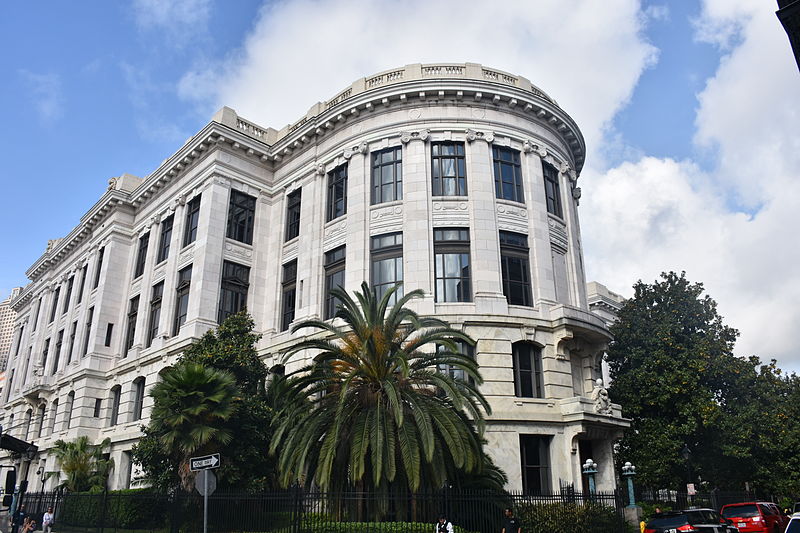
Louisiana Supreme Court Building 400 Royal Street
This monstrous white marble-clad building caused much controversy when the site was cleared starting in 1903. This block was originally a collection of 19th century buildings bisected by Exchange Alley which was lined with offices for architects, engineers, politicians and lawyers. The destruction that took place here contributed to the rise of preservation policies throughout the city. Upon completion of this building in 1910, the Louisiana Supreme Court, state Attorney General, and other courts moved in, though by 1934, the building was deemed inadequate. After years of deferred maintenance, the Supreme Court moved out in 1958. The building saw renovations starting in the 1990s and reopened in 2004 with the state Supreme Court returning to the building.
Rumors of the building being haunted began to arise during the building’s renovations. Author and researcher Victor C. Klein interviewed a construction supervisor and several workers and contractors who told similar tales of tools and equipment disappearing in the building. A number of them also encountered “a well dressed, middle age, white gentleman” whom they found looking out a window in the upper stories of the building. When confronted, the odd gentleman would disappear.
Louisiana Supreme Court Building, 2015 by MusikAnimal, courtesy of Wikipedia.
Klein continues by noting that guests of the Omni Royal Orleans Hotel on nearby St. Louis Street would report this man to the front desk staring intensely into their rooms. According to Klein, this was so frequent that the front desk had a scripted response to these calls, though they didn’t inform the guests that this gentleman is probably a ghost.
Jeff Dwyer remarks on several other spirits within the building including a pair of shooting victims who were supposedly gunned down in a courtroom during a Mafia trial in the 1930s and a panhandler who is sometimes seen just outside the building on Royal Street.
One of the more well-known and respected restaurants in the city, Brennan’s has made its home in this historic building since it opened in 1946. This 1795 structure once housed the Bank of Louisiana. Later on in the 19th century, Paul Morphy, one of the most famous chess players in the world lived and died here. He may be the apparition that is sometimes seen in the dining room.
Sources
Dwyer, Jeff. Ghost Hunters Guide to New Orleans. Gretna, LA: Pelican Publishing, 2007.
Taylor, Troy. Haunted New Orleans. Charleston, SC: History Press, 2010.
Brennan’s, 2015 by Infrogmation, courtesy of Wikipedia.
Court of the Two Sisters
613 Royal Street
One of the more romantic of New Orleans’ great restaurants, the Court of the Two Sisters possesses a number of legends including one about the gates through which patrons pass. The wrought iron gates are supposed to have been made in Spain where they were blessed by Queen Isabella with a charm that all those who touch them as they pass will be charmed. The restaurant occupies an 1832 building that housed a shop owned by two sisters, Bertha and Emma Camours. Apparently inseparable, the sisters operated a notions shop in this building for many years and, not being able to live without the other, died in 1944 two months apart.
The courtyard of this grand restaurant has a wishing well known as the “Devil’s Wishing Well” as it may have witnessed and been charmed by rites practiced here by Marie Laveau, the city’s great 19th century Queen of Voodoo. Until it was toppled by Hurricane Betsy in 1965, a willow tree grew here where pirate Jean Lafitte may have dueled with and killed three men. Those three men may be among the specters flitting throughout this courtyard. Enjoy one of the famous Jazz Brunches served here daily and be sure to pay homage to the sisters who may still be holding court.
Sources
Dwyer, Jeff. Ghost Hunters Guide to New Orleans. Gretna, LA: Pelican Publishing, 2007.
“Our History.” Court of the Two Sisters. Accessed 8 June 2016.
LaBranch Building
700 Royal Street
The delicate lacy ironwork of this large home hides one of crueler ghost stories in this city. In the early history of the city a system of plaçage was practiced by many of the wealthy white planters. This system, found in Spanish and French colonies, allowed these wealthy men to take on mistresses, often free women of color, whom they would support. Certainly such arrangements caused conflicts within the legal marriages of these men. Such a conflict is at the heart of the story here.
Upon the death Jean Baptiste LaBranche, who owned this home at one time, his wife, Marie, was able to find out the name of his mistress. She sent an invitation to the young woman inviting her to tea. When the unsuspecting mistress arrived, instead of exchanging pleasantries over tea, Marie LaBranche had the woman bound and chained to a wall in the attic where she was left to die a slow death from starvation. While this is a marvelously gory legend, it is clouded with a good deal of doubt. Occupants of this building have reported paranormal activity, however. Cold spots and feelings of panic have overtaken some working on the third floor, where the poor mistress supposedly met her untimely death.
Sources
Dwyer, Jeff. Ghost Hunters Guide to New Orleans. Gretna, LA: Pelican Publishing, 2007.
Taylor, Troy. Haunted New Orleans. Charleston, SC: History Press, 2010.
St. Anthony’s Garden
Behind St. Louis Cathedral across from Orleans Street
This meditative garden has existed here behind the cathedral since the establishment of the church. Located between two haunted alleys: Pere Antoine’s and Pirate’s Alleys, the garden is named in memory of Pere Antoine or Antonio de Sedella, whose spirit may haunt the alley named for him as well as St. Louis Cathedral. According to Jeff Dwyer, this garden was a popular place for duels in the mid-18th century. Some sensitives have detected wafts of smoke from those events.
Sources
Dwyer, Jeff. Ghost Hunters Guide to New Orleans. Gretna, LA: Pelican Publishing, 2007.
734 Royal Street
Just like the story of the LaBranche Building, the story from this classic New Orleans town house involves a mistress, in this case she was an octoroon (she was 1/8th black) and her name was Julie. She was kept by a wealthy young man who was officially unattached in a well-furnished apartment here. Despite her pleas to her lover to marry her, he could not do so without losing his social standing and perhaps his fortune with it. Carelessly, in order to appease her frequent requests for marriage, the young man said he would marry Julie if she spent the coldest night in December nude on the roof. On the coldest night in December she undressed and crawled onto the roof. Her lover discovered her lithe corpse frozen not long after.
Since that time, Julie’s nude form has been seen on the roof of this building on the coldest night in December. During the remainder of the year Julie lingers in the warmth of the building’s interior. The Bottom of the Cup Tearoom once occupied the ground floor of this building (it moved to 327 Chartres Street) where the shop offered tea and psychic readings. Many of the psychics working here noted Julie’s shade and they believe she may have moved with the shop to Chartres.
Sources
Dwyer, Jeff. Ghost Hunters Guide to New Orleans. Gretna, LA: Pelican Publishing, 2007.
Smith, Katheine. Journey Into Darkness: Ghosts and Vampires of New Orleans. New Orleans, LA: De Simonin Publications, 1998.
Cornstalk Hotel 915 Royal Street
This intimate boutique hotel occupies a mansion with a unique cast-iron fence featuring stalks of corn. Legend relates that the fence was commissioned to comfort the Iowa-born wife of a former resident by reminding her of the cornfields of home. Once the home of Judge François Xavier Martin, he may be one the spirits that still stalks the halls with his footsteps, rattling door knobs. The sounds of children have also been heard here.
Sources
Brown, Alan. The Haunted South. Charleston, SC: History Press, 2014.
Dwyer, Jeff. Ghost Hunters Guide to New Orleans. Gretna, LA: Pelican Publishing, 2007.
Cornstalk Hotel by Infrogmation, courtesy of Wikipedia.
Andrew Jackson Hotel
917 Royal Street
A tragedy on this site more than 200 years ago may still continue to resonate today. A boarding school or orphanage (sources differ) stood here that was destroyed by fire. Five young boys lost their lives and they still play throughout the courtyard and hallways of this hotel. Sheila Turnage notes the experience of a night manager who was diligently working at his desk when he realized he was being watched. Looking up he saw the heads of a group of children trying to peer above the top of his desk. The children vanished moments later.
Sources
Asfar, Dan. Ghost Stories of Louisiana. Auburn, WA: Lone Pine Publishing, 2007.
Dwyer, Jeff. Ghost Hunters Guide to New Orleans. Gretna, LA: Pelican Publishing, 2007.
Taylor, Troy. Haunted New Orleans. Charleston, SC: History Press, 2010.
Turnage, Sheila. Haunted Inns of the Southeast. Winston-Salem, NC: John F. Blair, 2001.
Starling Magikal Occult Shop
1022 Royal Street
If you care to test drive any of the ghost hunting equipment available for sale here, the Starling Magikal Occult Shop offers its own ghosts. In a 2015 article, the shop’s co-owner Claudia Williams noted that staff and patrons of the shop hear disembodied voices and feel the touch of invisible fingers. Objects occasionally move around on their own accord as well.
Sources
Lopez, Kenny. “Want to hunt ghosts? Here are the tools you’ll need…” 26 October 2015.
LaLaurie House
1140 Royal Street, private
Of the myriad haunted houses throughout the South, few have captured the public’s attention more than the hulking LaLaurie Mansion that looms over the intersection of Royal and Nicholls Streets. While the structure itself is significant historically and architecturally, it’s the legends of the atrocities that took place here and the ghosts from those events that draw crowds of tourists. Though the house is not open to the public, the legend still draws people here.
In 1831 this property was purchased by Delphine LaLaurie, the wife of Dr. Leonard Louis LaLaurie. Madame LaLaurie had been married and widowed twice before her marriage to the good doctor and she had five children by her previous husbands. After construction of the mansion in 1832, LaLaurie took up residence and became a central pillar to New Orleans society.
LaLaurie Mansion, 2011 by Reading Tom, courtesy of Wikipedia.
The legend goes back to a fateful report of a fire in the kitchen here April 10, 1834. Firefighters arrived to discover the kitchen in flames and an elderly slave cook chained to the stove. She admitted to setting the fire as a suicide attempt to prevent her being sent to attic from which she said no one ever escaped. A mob that had gathered broke their way into the slave quarters and soon discovered the mutilated remains of “seven slaves, more or less horribly mutilated … suspended by the neck, with their limbs apparently stretched and torn from one extremity to the other” as the New Orleans Bee described the events the next day. While the mob remained to destroy the house and grounds in anger, Madame LaLaurie and her family fled the city. No one ever faced justice for the cruelties inflicted on the slaves here. While this is the most commonly related legend about the house, there is quite a bit of controversy.
As the story has captured the imagination of many, it has found its way into books dating back to the late 19th century, film, television and even video games. Most recently, the legend of Madame LaLaurie was woven into the plethora of local legends in the story arc of American Horror Story: Coven. Portrayed by Kathy Bates, Madame LaLaurie is a simpering racist weighted down with a curse of immortality placed upon her by the immortal Voodoo Queen, Marie Laveau. Researchers looking into the legend in recent decades have revealed that Delphine LaLaurie’s reputation may have been targeted as part of a smear campaign.
Do the spirits of slaves still stalk this lovely mansion? Legends relate that former residents here encountered some horrific spirits, though there are few recent stories. Writer and psychic Kala Ambrose tried to commune with the spirits while standing outside of the house recently. While she stood there a number of curious tourists inquired if this was the famous LaLaurie House. A short time later when she placed her hand on the wall of the house a passing ghost tour group took photographs of her. She didn’t contact anything out of the ordinary, perhaps the house is now just haunted by tourists.
Sources
Ambrose, Kala. Spirits of New Orleans. Cincinnati, OH: Clerisy Press, 2012.
Caskey, James. The Haunted History of New Orleans: Ghosts of the French Quarter. Savannah, GA: Manta Ray Books, 2013.
Delphine LaLaurie. Wikipedia, the Free Encyclopedia. Accessed 10 June 2016.
N.B. This article was edited and revised 30 April 2020.
This article is part of my series, Street Guide to the Phantoms of the French Quarter, which looks at the haunted places of this neighborhood in a street by street basis. Please see the series main page for an introduction to the French Quarter and links to other streets.
Chartres Street
Chartres Street, which is often pronounced CHAR-terz or CHAR-trez, was named for the Duc de Chartres in 1724 and is among several of the earliest streets in town. Initially, Chartres only ran from Canal Street to Jackson Square. From Jackson Square to Esplanade, the street was called Condé.
Mahogany Jazz Hall Burlesque and Absinthe House 125 Chartres Street
The building that now contains the Mahogany Jazz Hall is on the right of this photo under the sign of Don Juan’s (which formerly occupied this space). Photo 2007, Infrogmation, courtesy of Wikipedia.
This 19th century building served as a boarding house for many years during which two tenants committed suicide. In 1892, a laborer was shot to death in front of the building with his murderer escaping into the dark of night. These deaths may contribute to the building’s haunted reputation with patrons and staff witnessing shadowy figures, hearing disembodied whispers, and feeling the cold touch of hands from the other side.
Sources
“Murder in New Orleans.” The Daily Commercial Herald. 22 November 1892.
Pinheiro, Maria. “Four little-known paranormal hotspots in New Orleans.” Malay Mail Online. 11 October 2016.
204 Chartres Street
204 Chartres in 2007. The building on the left was still Crescent City Books at this time. Photo by Infrogmation, courtesy of Wikipedia.
Formerly the home to Crescent City Books, one of the more prominent second-hand bookstores in the city, this late 19th century commercial building is apparently haunted by ghosts on every floor, including the specter of a young boy on the first floor. An investigation by the New Orleans based International Society for Paranormal Research (ISPR) identified a number of children’s spirits on the first and second floor as spirits that may also haunt Le Petite Theatre de Vieux Carré on St. Peter Street. Other spirits were discovered on the third floor and attic.
Sources
Dwyer, Jeff. Ghost Hunter’s Guide to New Orleans, Revised Edition. Gretna, LA: Pelican, 2016.
Montz, Larry and Daena Smoller. ISPR Investigates the Ghosts of New Orleans. Atglen, PA: Schiffer, 2000.
W New Orleans – French Quarter 316 Chartres Street
Formerly the Hotel de la Poste, the W Hotel is made up of a collection of old buildings many of which are occupied by their own collections of spirits. ISPR investigated the hotel in July of 1996. On the second floor of the hotel, investigators encountered the spirit of a white woman in her 30s who may be causing some activity there. In another section of the building which may have once held slave quarters, the spirits of three enslaved children were discovered. A middle-aged enslaved man, Gerald, was found by the group near the hotel’s parking garage, which may have been the site of stables were this man labored.
Montz, Larry and Daena Smoller. ISPR Investigates the Ghosts of New Orleans. Atglen, PA: Schiffer, 2000.
The Bottom of the Cup Tearoom
327 Chartres Street
Since 1929, The Bottom of the Cup Tearoom has served as one of New Orleans’ psychical landmarks. The tearoom popularly featured psychics who would read the tea leaves left at the bottoms of customers’ teacups. Over time, the shop has added other forms of divination and psychic readings including tarot cards to its menu. While the shop’s second location (open from 1972-2003) at 734 Royal Street possessed the well-known spirit of Julia, there are no documented ghost stories associated with this building, though Jeff Dwyer has noted that the spirit may have moved to the shop after the closure of the Royal Street location. A quote from the shop’s manager indicates there may be some activity there, telling Country Roads Magazine, “There’s a lot of history ground into this neighborhood. Each decade leaves its traces and emotional resin, which helps us tune into the intuitive mind.”
Sources
Dwyer, Jeff. Ghost Hunter’s Guide to New Orleans, Revised Edition. Gretna, LA: Pelican, 2016.
McGunnigle, Nora. “The Bottom of the Cup.” Country Roads Magazine. 21 September 2018.
Williams Research Center 410 Chartres Street
The Williams Research Center occupies one of three campuses that houses parts of The Historic New Orleans Collection, which preserves and collects historic items and archives covering the history of the city and the region. The largest items in this collection are a number of historic properties including the building that houses the research collection. Built in 1915, this Beaux-Arts structure originally housed the Second City Criminal Court and the Third District Police Station. The Historic New Orleans Collection purchased the building in 1993 after it had been vacant for many years.
The renovation of this structure required gutting the interior at which time construction workers began to have odd experiences. These included hearing the slamming of cell doors, despite the doors having been removed, and seeing apparitions of police officers in old-fashioned uniforms.
Montz, Larry and Daena Smoller. ISPR Investigates the Ghosts of New Orleans. Atglen, PA: Schiffer, 2000.
Napoleon House
500 Chartres Street
An early 20th century postcard showing the Napoleon House. Postcard published by A. Hirschwitz.
Built in 1797, this home was significantly expanded for early mayor, Nicholas Girod, who served from 1812-15. According to local lore, offered it as a refuge for Napoleon after he was exiled from France. While he died before he could travel, the house still bears his name. In 1834, some thirteen years after Napoleon’s death, his former physician, Dr. Antommarchi, opened a free clinic in the building, thus continuing its association with the deposed emperor. During the Civil War, wounded soldiers were treated in a hospital that operated on the second floor. In 1914, the Impastato family acquired the property and opened the restaurant and bar that remains in operation.
The over 200-year old history of the building has left spiritual activity. Some stories speak of a Confederate soldier who is seen to stroll the Chartres Street balcony before vanishing or hiding. Another story tells of an old lady who is spotted sweeping on the second floor. While yet others have witnessed the apparition of an enslaved woman in the courtyard.
Over the years, guests and staff have been surprised by lights turning off and on, sometimes on request. During a renovation of the building in the mid-1990’s the spirits expressed their displeasure with a heavy and oppressive feeling throughout. Bartenders also reported that bottles would occasionally fall from their perch behind the bar during this time. A paranormal group that investigated the building recently noted several entities on the property including a young lady in the courtyard who may have died in an accident and an old sailor who drinks at the bar late at night.
Sources
Bailey, Shan. “Strange ghosts: Drinking sailor, sweeping lady haunt the Napoleon House.” NOLA Weekend. No Date.
Brown, Alan. The Haunted South. Charleston, SC: History Press, 2014.
New Orleans Pharmacy Museum (La Pharmacie Francais)
514 Chartres Street
When Louis Dufilho opened his pharmacy here in 1823, this was the first licensed pharmacy established in the country. Dr. Dufilho operated his business here for some 35 years before retiring and selling his business to Dr. Joseph Dupas. Many sources suggest that Dupas performed medical experiments on slaves, especially pregnant slave women.
The view looking down Chartres Street. From the left, the buildings are the New Orleans Pharmacy Museum, Hotel Ste. Helene, and the Napoleon House. Photo 2008, by Infrogmation, courtesy of Wikipedia.
Tour guide Katherine Smith suggested in her book, Journey Into Darkness: Ghosts and Vampires of New Orleans, that Dupas also treated wounded soldiers here during the Civil War. Perhaps the pain and death from the medical experiments and the soldiers being treated have left a mark on the energy of this building. Some visitors have reported being suddenly overcome with nausea while others have encountered a figure in a brown suit and white lab coat that may be the spirit of Dr. Dupas.
Sources
Dwyer, Jeff. Ghost Hunter’s Guide to New Orleans. Gretna, LA: Pelican Publishing, 2007.
Oldfield, Eileen. “Things that go bump in the haunted pharmacy.” Pharmacy Times. 30 October 2014.
Smith, Katherine. Journey Into Darkness: Ghosts & Vampires of New Orleans. New Orleans, LA: De Simonin Publications, 1998.
Chartres House (Gally House)
540 Chartres Street
The large building occupying this corner of Chartres and Toulouse Streets is sometimes known as Keuffers Building. Built sometime after 1830, the building was intended to house businesses on the first floor with apartments on the second and third floors. If you walk alongside the building on Toulouse Street, you can see the separate slave quarters at the back of the building. Some passersby have noticed a young lady peering from the upper windows on this side of the building, despite the fact that these rooms were vacant at the time. Venture into the parking lot off Toulouse Street and look at the first small window. Tour guides will point out this window and encourage visitors to plunge their hand in. Some visitors have felt the feeling of their hands being grasped by small hands. Jeff Dwyer notes that these hands may belong to slave children who were housed in this room.
The Gally House in the 1930s as photographed by Frances Johnston for the Historic American Buildings Survey (HABS). Courtesy of the Library of Congress, Prints and Photographs Division.
Recently, the Chartres House restaurant, which opened originally in the former Reynes Mansion (see below) across the street, relocated into the majestic Gally House.
Sources
Dwyer, Jeff. Ghost Hunter’s Guide to New Orleans. Gretna, LA: Pelican Publishing, 2007.
Reynes Mansion (formerly the Chartres House)
601 Chartres Street
Originally built as a residence for the Reynes family following the Great Fire of 1788, this home was eventually occupied by the popular Victor’s Café in the late 19th century. Known as a hangout for artists and bohemians, Victor’s was a favorite of the writer William Faulkner.
An apartment located on the second-floor was the scene of a shooting death in the 1970s. The young man who lived there is supposed to have been involved in drugs. Following his death, the building’s owners had trouble renting the apartment as prospective tenants often detected bad energy and some became physically ill while touring the apartment.
The Reynes Mansion in 2008, when it was still the Chartres House. Photo by Infrogmation, courtesy of Wikipedia.
This building was occupied by the Chartres House restaurant until it relocated across the street to the Gally House (see above).
Muro, Maria. “Haunted Eats.” New Orleans Living. 9 October 2012.
Bosque House
617 Chartres Street, private
The Bosque House in 2011. Photo by Elisa.rolle, courtesy of Wikipedia.
This classic late 18th century Creole townhouse was built to replace a home destroyed in the Great Fire of 1788. Legend holds that this fire started on this site. Don Vicente Jose Nuñez, the army treasurer, owned the house at this site where curtains caught fire from a candle on the family’s personal altar on Good Friday. Tradition prohibited the ringing of bells on this most holy day and the priests of St. Louis Church would not allow the church’s bells to be rung to alarm the citizens. The fire eventually destroyed the church and nearly 900 other buildings in the city. Residents of this private home have heard the sounds of muffled bells. Perhaps better late than never?
Sources
Klein, Victor C. New Orleans Ghosts III. Metarie, LA: Lycanthrope Press, 2004.
Smith, Katherine. Journey Into Darkness: Ghosts & Vampires of New Orleans. New Orleans, LA: De Simonin Publications, 1998.
The Cabildo
701 Chartres Street
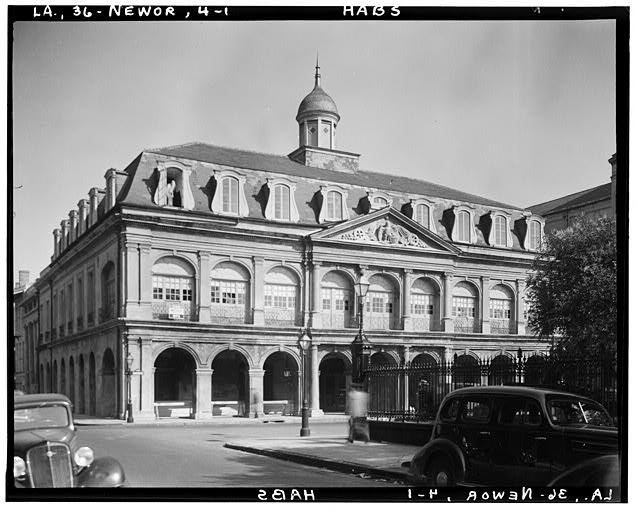
The younger twin of The Presbytère, The Cabildo was constructed to replace the city hall that was destroyed in the Great Fire of 1788. Of all the buildings in this city, this building has witnessed more important historic events than any other. Within the walls of the Cabildo the Louisiana Purchase was finalized in 1803. During the building’s time housing the Louisiana Supreme Court, the case of Plessy v. Ferguson was heard before it headed to the U.S. Supreme Court where it enshrined the concept of “separate but equal” into American racial law. The building became a part of the Louisiana State Museum in 1908.
The Cabildo, 1936, by Richard Koch for the Historic American Buildings Survey (HABS). Courtesy of the Library of Congress, Prints and Photographs Division.
While this building served as a seat of government for many years, a prison once stood behind it (see my entry on Pirate Alley for more information on this structure) which may explain the presence of a young soldier. Legend holds that the young man was imprisoned in the prison and, after a trial before a military tribunal, was summarily executed in the courtyard. Some of the museum’s staff and visitors have felt the sensation of someone rushing past them. Others have seen the pathetic form of a soldier in a ragged uniform.
Sources
The Cabildo. Louisiana State Museums. Accessed 2 June 2016.
Dwyer, Jeff. Ghost Hunter’s Guide to New Orleans. Gretna, LA: Pelican Publishing, 2007.
St. Louis Cathedral
Jackson Square
Interior of St. Louis Cathedral by Carol M. Highsmith. Courtesy of the Carol M. Highsmith Archive, Library of Congress, Prints and Photographs Division.
The Grande Dame of New Orleans, St. Louis Cathedral has stood at the sacred heart of this city since the construction of the first church on this site in 1718. The current building was originally constructed between 1789 and 1794 and heavily reconstructed in the mid-19th century. Legend holds that the black-robed form of Father Antonio de Sedella, often known by his French moniker, Père Antoine, appears during the Christmas Midnight Mass. The specter of this most beloved of curates appears to the left of the altar holding a candle.
Sources
Brown, Alan. The Haunted South. Charleston, SC: History Press, 2014.
“Our History.” Cathedral Basilica of Saint Louis. Accessed 2 June 2016.
The Presbytère
751 Chartres Street
The Presbytère, 2007, by Infrogmation. Courtesy of Wikipedia.
The Presbytère is one of the pair of buildings flanking St. Louis Cathedral. Originally constructed in 1791 to match The Cabildo, this structure was known as “Casa Curial” or “Ecclesiastical House,” and provided housing for the Capuchin monks who ran the cathedral. In 1911, the building was taken over to house the Louisiana State Museum. The museum houses two permanent exhibits: one commemorating Hurricane Katrina and the other celebrating the city’s Mardi Gras traditions. While visiting the museum should you see a tall and slim maintenance man in a dark uniform with curly brown hair, be assured that you have just seen a ghost.
Sources
Dwyer, Jeff. Ghost Hunter’s Guide to New Orleans. Gretna, LA: Pelican Publishing, 2007.
The Presbytère. Louisiana State Museums. Accessed 2 June 2016.
Muriel’s Jackson Square
801 Chartres Street
Originally built as a grand residence for the noted Destrehan family (who also owned haunted Destrehan Plantation found along the famed River Road), the building that now houses Muriel’s partially burned in the Great Fire of 1788 that ravaged the city. Supposedly, the burned house was purchased by Pierre Antoine Lepardi Jourdan who restored the home but sadly lost it in a card game. Not willing to simply leave the home, he quietly resigned to the second floor where he committed suicide in what is now known as the Séance Lounge.
Muriel’s in 2008. Photo by Infrogmation, courtesy of Wikipedia.
At least this is the story that is commonly told about this building. It is even included on the restaurant’s website. According to a 2013 blog post entitled, “The ‘Ghost’ of Muriel’s Restaurant,” this story is partially bunk. The blog notes that the current building was constructed sometime around the turn of the 20th century after the house on that site was torn down. While the history may not match up to the legend, there still may be paranormal activity with staff and visitors hearing knocking from inside the brick walls of the Séance Lounge, and disembodied voices, while encountering shadowy figures throughout the building. In order to keep some of the activity at bay, the restaurant maintains a special table for the ghost of Monsieur Jourdan.
Sources
Brown, Alan. The Haunted South. Charleston, SC: History Press. 2014.
Dwyer, Jeff. Ghost Hunter’s Guide to New Orleans. Gretna, LA: Pelican Publishing, 2007.
“Our Ghost.” Muriel’s Jackson Square. Accessed 2 June 2016.
Tipping, Joy. “Ghost trails and Halloween haunts in New Orleans.” Dallas Morning News. 23 October 2008.
Hotel Provincial
1024 Chartres Street
Hotel Provincial in 2019. Photo by Infrogmation, courtesy of Wikipedia.
Like many hotels throughout the quarter, this hotel consists of an amalgam of different buildings, each with different histories. The 500 building seems to be the one with activity. The building was constructed on a site that was originally occupied by an Ursuline Hospital. It was here that the wounded from the 1814 Battle of New Orleans were treated. During the Civil War the buildings on the site were commandeered for use as a military hospital. That building burned and was replaced by the current structure. Guests and staff have, according to tradition, encountered bloodstains that disappear before their eyes, wounded soldiers in the rooms and corridors, doctors and nurses in bloodstained clothing, and one unlucky security guard using an elevator had the doors open to reveal the scene of a Civil War era surgery.
Sources
Brown, Alan. The Haunted South. Charleston, SC: History Press. 2014.
Dwyer, Jeff. Ghost Hunter’s Guide to New Orleans. Gretna, LA: Pelican Publishing, 2007.
One of the oldest buildings in New Orleans, the old Ursuline Convent has survived hurricanes, fires, and the nuns have provided aid during plagues and epidemics. It’s no surprise that their old convent would house spirits. According to Jeff Dwyer, the spirits of Ursuline sisters have been seen gliding throughout the building while the spirit of a Civil War era soldier has been seen in the garden. (For a couple photos of the Old Ursuline Convent see my entry here.)
Sources
Dwyer, Jeff. Ghost Hunter’s Guide to New Orleans. Gretna, LA: Pelican Publishing, 2007.
Beauregard-Keyes House
1113 Chartres Street
See my entry, “Creepiness on Chartres Street,” for an in depth look at the history and hauntings of this famous home.
Le Richelieu Hotel
1234 Chartres Street
Housed in two buildings, one dating from 1845, the other from 1902, the Le Richelieu Hotel occupies the site where five French patriots were executed in the late 18th century. The spirits of these five men may still reside here. For further pictures see, “A Handful of Haunts—Photos from New Orleans.”
N.B. This article was edited and updated 21 April 2020.
In the mountains of southern Appalachia, Gatlinburg is one of the premier tourist towns. Growth in tourism here has been exponential over the past few decades, as Gatlinburg, nearby Pigeon Forge, and Sevierville have fought to capture the most market share of tourists. With that growth has come countless tourist inns, motels and hotels; restaurants; candy stores; t-shirt shops; and even haunted house attractions. While most of these are inauthentic experiences created to attract tourists, in Gatlinburg one has to only look as far as a few hotels and restaurants to find authentic ghosts.
View of the Gatlinburg Space Needle, ca. 2005. The Space Needle sits at the foot of Historic Nature Trail. The Edgewater Hotel is located across Cliff Branch. Courtesy of Wikipedia.
Before it became a burgeoning mountain tourist town, Gatlinburg was a quiet hamlet with very little crime. With the arrival of hordes of tourists has come crime; some of them horrific. In his Ghosts and Haunts of Tennessee, Christopher K. Coleman writes about the Edgewater Hotel and Conference Center (402 River Road) where in 1972, a 7-year-old child plunged to her death from a hotel room balcony. When the police began to suspect the father’s involvement in his child’s death, the parents fled. Their car overturned on a winding mountain road pitching the vehicle, and its occupants into the Little Pigeon River. According to Coleman, the child is seen on the anniversary of her death standing in the stream below the hotel pointing towards the balcony she fell from. While this is a fascinating story, I can find nothing to corroborate the horrible details of this event.
The view down River Road towards the Edgewater Hotel which rises above the trees in the middle of the photo. Photo 2014, by Evan Nichols, courtesy of Wikipedia.
Branching off from US-441, the main road through Gatlinburg, is Historic Nature Trail which was the scene of two horrible crimes in the 1980s. In July of 1980 two teenage girls visiting from Kentucky were found dead at the Holiday Inn. One girl was found in a stairwell leading to the roof while her friend was found a few hours later in her room lying on the floor next to the bed. The girls, friends from Crestwood, Kentucky, were taking a short vacation to Gatlinburg before the start of their senior year of high school. After going out to a local lounge and steakhouse, The Rafters, the girls were seen leaving with a local drifter. He was arrested the following day and charged with strangling the teens.
The intersection of US-441 and Historic Nature Trail in 2014. Photo by Evan Nichols, courtesy of Wikipedia.
Like many ghost stories, later retellings often embellish the circumstances of the murders, and this is no different. Coleman’s and internet versions of the events have one girl being drowned in a bathtub while her friend was strangled and her body dragged to the roof; contemporary articles on the murder from one of the state’s most prestigious papers, Nashville’s The Tennessean, dispute those details. One article does note that the girls were staying on the fourth floor in separate rooms: 401 and 413. The ghost stories do center on room 413, so these stories are correct in that aspect.
It seems that reports of paranormal activity in 413 mostly concern odd noises within the room, noises that often frighten staff working there. But this isn’t the only haunting within the hotel. A spirit named Alvin, supposedly the spirit of a longtime employee, has been reported in the kitchen, though this story cannot be corroborated. Alvin seems to cause more poltergeist-type activity with kitchen utensils flying through the air. Another more spectacular ghost story has been told about the hotel’s seventh floor where a scout leader murdered members of his troop. This is a story that would have probably found its way to the front page of The Tennessean and many other newspapers. No information exists on this so it must be chalked up as just a story.
The Holiday Inn was later renamed the Garden Plaza Hotel (formerly 520 Historic Nature Trail) and operated until fairly recently when it was demolished. The hotel has been replaced with a Hampton Inn It’s unknown if any of the spirits have remained here.
If you follow Historic Nature Trail from the site of the old Holiday Inn back towards US-441, you’ll pass a very new Courtyard by Marriott. It occupies the site of one of Gatlinburg’s most notorious murders. On 13 September 1986, a desk clerk and security guard were brutally murdered by a pair of thieves intending to rob the inn. Two lives were snuffed out violently for $499 and the purse of the young desk clerk. Shortly after the murders a shadowy figure was frequently seen in the parking lot and a guest was awakened to see a young woman standing at the foot of his bed whose description matched that of the young clerk. Despite the demolition of the Rocky Top Village Inn(formerly 311 Historic Nature Trail) stories of the horrific tragedy and the resulting spirits continue to be told.
One of Gatlinburg’s oldest tragic spirits still resides at the Greenbrier Restaurant(370 Newman Road). Originally the Greenbrier Lodge, this quaint log inn catered to wealthy hunters and tourists. The lodge was renamed and reopened as the Greenbrier Restaurant in 1980. Legend holds that at some point in its early history, a young lady named Lydia stayed here on the eve of her wedding. On her wedding day she dressed in white and headed into town to marry. When her fiancée failed to show at the church Lydia returned to the lodge heart-stricken. Still clad in her wedding dress Lydia hung herself from the rafters over the second floor landing. A postscript added to one version of the story states that days later Lydia’s fiancée was found dead after being mauled by a mountain cat.
Still broken-hearted, Lydia roams the Greenbrier Restaurant generally frightening staff and guests, and causing a bit of trouble when she knocks food off the shelves of the restaurant’s pantry. The sad revenant has possibly been observed by the owners who saw a figure pass a doorway after closing time. Some years ago, the young son of the owners did see a woman who vanished when he called his father’s attention to it. In 2007 the Greenbrier’s owners allowed the members of the East Tennessee Paranormal Research Society investigate the restaurant. The investigation did capture some photographic anomalies, though the best evidence was an EVP. In it a female investigator addressed the spirit, “God bless you, Lydia, I’d be happy to hear from you if you’d like to speak to me.” A moment later a female voice cheekily responded, “Then I’m not dead.”
Sources
Coleman, Christopher K. Ghost and Haunts of Tennessee. Winston-Salem, NC: John F. Blair, 2011.
Kinney, Rachel. “’Rocky Top’ murderer killed in prison fight.” WBIR. 11 March 2015.
Madden, Tom. “2 women found slain at resort.” The Tennessean. 30 July 1980.
Nauman, Tesa. “Paranormal groups hunts for G’burg ghost.” Sevier County News. 23 February 2007.
“Strangled teen’s mother thought Gatlinburg was safe.” The Tennessean. 31 July 1980.
Whittle, Dan. “’Ghost Lydia’ legend adds to Smoky Mountains haunting haze & lore.” Mufreesboro Post. 19 October 2014.
Williams, Michael. “Walking among the dead.” Tennessee Star Journal. 15 October 2014.
N. B. This article was updated 27 May 2023 to reflect new information.
Haunted Hotel 623 Ursulines Street New Orleans, Louisiana
Exodus, Chapter 12 King James Version
21 Then Moses called for all the elders of Israel, and said unto them, Draw out and take you a lamb according to your families, and kill the passover. 22 And ye shall take a bunch of hyssop, and dip it in the blood that is in the basin, and strike the lintel and the two side posts with the blood that is in the basin; and none of you shall go out at the door of his house until the morning. 23 For the Lord will pass through to smite the Egyptians; and when he seeth the blood upon the lintel, and on the two side posts, the Lord will pass over the door, and will not suffer the destroyer to come in unto your houses to smite you.
A dark lord passed over New Orleans on the night of March 18th, 1919. Instead of a demand that each home’s occupants paint their doors with lamb’s blood, he ordered that a jazz band be at full swing within each home. At fifteen minutes past midnight on this Tuesday night the city’s dance halls were filled to capacity while the strains of jazz poured out of homes throughout the city. Clarinets wailed while trombones tramped up and down scales stomping the precious blue notes that flavored this music. Crooners of all colors sang of love lost and regained against a backdrop of banjos, trumpets and tubas. Thousands of feet kicked up in time to the syncopated rhythms. This was a city at its most alive fearing the shroud of death that was lurking somewhere with axe and razors at the ready. Death did not sting that night. The dark lord would return in August to continue his spree.
The mysterious Axeman of New Orleans was never caught. Between May 1918 and October 1919, at least twelve people were attacked and killed at the hands of this heinous killer. As most of the victims were of Italian origin, many suspected that the crimes were associated with the Mafia that was active in the city. Someone claiming to be the killer wrote to The Times-Picayune:
Hell, March 13, 1919
Esteemed Mortal:
They have never caught me and they never will. They have never seen me, for I am invisible, even as the ether that surrounds your earth. I am not a human being, but a spirit and a demon from the hottest hell. I am what you Orleanians and your foolish police call the Axeman.
When I see fit, I shall come and claim other victims. I alone know whom they shall be. I shall leave no clue except my bloody axe, besmeared with blood and brains of he whom I have sent below to keep me company.
If you wish you may tell the police to be careful not to rile me. Of course, I am a reasonable spirit. I take no offense at the way they have conducted their investigations in the past. In fact, they have been so utterly stupid as to not only amuse me, but His Satanic Majesty, Francis Josef, etc. But tell them to beware. Let them not try to discover what I am, for it were better that they were never born than to incur the wrath of the Axeman. I don‘t think there is any need of such a warning, for I feel sure the police will always dodge me, as they have in the past. They are wise and know how to keep away from all harm.
Undoubtedly, you Orleanians think of me as a most horrible murderer, which I am, but I could be much worse if I wanted to. If I wished, I could pay a visit to your city every night. At will I could slay thousands of your best citizens, for I am in close relationship with the Angel of Death.
Now, to be exact, at 12:15 (earthly time) on next Tuesday night, I am going to pass over New Orleans. In my infinite mercy, I am going to make a little proposition to you people. Here it is:
I am very fond of jazz music, and I swear by all the devils in the nether regions that every person shall be spared in whose home a jazz band is in full swing at the time I have just mentioned. If everyone has a jazz band going, well, then, so much the better for you people. One thing is certain and that is that some of your people who do not jazz it on Tuesday night (if there be any) will get the axe.
Well, as I am cold and crave the warmth of my native Tartarus, and it is about time I leave your earthly home, I will cease my discourse. Hoping that thou wilt publish this, that it may go well with thee, I have been, am and will be the worst spirit that ever existed either in fact or realm of fancy.
The Axeman
The 600-block of Ursulines Street looking towards the Haunted Hotel in 2008, to the left of the cream colored building in the middle. Photo by Infrogmation, courtesy of Wikipedia.
An article from the New Orleans ABC affiliate, WGNO, highlighted the possible, albeit tenuous, connection between the axe murderer and the Haunted Hotel. The hotel, which bills itself as the city’s “oldest and best-known Haunted Hotel” claims that the infamous axeman lived here during his murder spree, though his identity is unknown. During renovations, a bloody axe was found on the premises that may have been the weapon in one of the murders. The article’s sources is provided by a ghost tour company, which are often not reliable. In this case, the hotel was apparently investigated and something indicated that a particular corner of the courtyard had paranormal activity. The readings somehow indicated that the spirit may have killed someone and hid in that particular corner.
A 1919 newspaper map of the Axeman’s killings. Courtesy of Wikipedia.
The 1919 map of the killings doesn’t show any murders taking place in the French Quarter, so there’s really nothing to connect the Axeman with this particular building, other than the bloody axe and some anomalous readings during a paranormal investigation. Ursulines Avenue, however, boasts a fairly unique roster of spirits as it slices through the famous French Quarter. As you stroll these ancient streets, think what it must have been like on the night of the Axeman’s Passover with jazz spilling from every open window warding off an axe bearing dark lord as he passes over.
After my recent entry on Alabama, I had a comment on Facebook, “Interesting, but there’s more than the library in Birmingham…” Indeed.
I’ve previously covered two magnificent Birmingham theatres: the Alabama and Lyric; and the Tutwiler Hotel, in addition to the Linn-Henley Library which I covered in the Haunted Alabama entry. So here are a few more locations to add to the Birmingham list.
When Alan Brown wrote his 2009, Haunted Birmingham, he noted that this city’s ghostlore “is not nearly as rich as that found in much older cities.” Certainly, Birmingham is the youngest of Alabama’s large cities, having only been founded in 1871. Still, the city has some very interesting ghostlore including the iconic Sloss Furnaces.
Sloss Furnaces 20 32nd Street, North
Perhaps one of the most iconic haunted places in the whole state, this National Historic Landmark site is iconic of Birmingham’s history. Birmingham was built on industrial facilities like this producing iron during the latter half of the 19th and into the 20th centuries. While the facility opened in 1882, nothing remains of the original furnaces here. The oldest building on this site dates to 1902 with much equipment installed and added in later years. This facility closed in 1971 and local preservationists began work to save the facility. Their efforts paid off and the facility is open as a museum and events facility.
Sloss Furnaces, 2006. Photo by Timjarrett, courtesy of Wikipedia.
There is always a chance for death in industrial sites, even more so around molten metal in a furnace. In 1887, Theophilus Jowers, assistant foundryman at the Alice furnace (one of the first furnaces on this site) fell to his death into the molten iron in the furnace. Some of his remains—his head, bowels, two hip bones and some ashes—were fished out of the molten iron. Jowers’ death remains one of the most spectacular and grisly, though many more men died throughout the time that the furnaces were in operation.
After Jowers’ death, his spirit was observed by co-workers. Kathryn Tucker Windham quotes one former employee, “We’d be getting ready to charge the furnace, and we’d see something, something like a natural man walking around on the hearth. Just walking slow and looking around like he was checking to make sure everything was all right.” Windham describes the first time that Jowers’ son saw his father’s spirit in 1927. The now grown son took his son for a drive over the First Avenue Viaduct and there, while watching the action at the furnace, they observed a man walking through the showers of sparks and flames.
Two more spirits are believed to be in residence at this site, but less historically based. A white deer that has been seen on the grounds is believed to be the spirit of a pregnant girl who committed suicide by throwing herself into the furnace. The other “apocryphal”—as Alan Brown describes him—spirit is that of a fiendish foreman named James “Slag” Wormwood. Like Jowers and the pregnant girl, Wormwood supposedly fell to his death into one of the furnaces, though it is suspected that he was really pushed by an angry employee. It is Wormwood’s angry spirit that is responsible for pushing employees.
The furnaces are known as a hotbed of paranormal activity and were investigated for the first time in 2005 by Ghost Chasers International out of Kentucky. They were joined by psychic Chip Coffey who would soon make his name working on the A&E show, Paranormal State. During the investigation, Coffey made contact with the spirit of a man who had lost a limb in an accident there. Moments after losing contact with the spirit, team members noticed blood on Coffey’s hands. After investigating him for scratches or another injury that could have produced blood, nothing was found. Over the past 10 years of paranormal investigations at the site, a slag heap of evidence has been produced.
Sources
Brown, Alan. Haunted Birmingham. Charleston, SC: History Press, 2009.
“History.” Sloss Furnaces National Historic Landmark. Accessed 12 June 2015.
Parks, Megan. “Sloss Fright Furnace: The haunts heat up in Alabama.” USA Today. 14 October 2014.
Windham, Kathryn Tucker. The Ghost in the Sloss Furnaces. Birmingham, AL: Birmingham Historical Society, 2005.
East Lake Park 400 Graymont Avenue, West
On the 1st December 1888, Richard Hawes accompanied his daughter to the newly built lake here. Sometime later, he left without the seven-year-old. On December 4th, two boys playing on a boat in the lake discovered the child’s half-naked body in the water. The discovery caused a sensation among the citizens who thronged the funeral home where she was taken to view the body. Eventually, she was identified as May Hawes. As his train pulled into Birmingham, Richard Hawes, May’s father, was arrested.
May Hawes’ body as pictured in a local paper, 1888.
Richard Hawes was aboard the train with his new bride and still in his wedding suit. He told investigators that he had divorced his wife and was paying for the support of the children. His new wife, from Columbus, Mississippi, was described as being prostrate with grief after finding that her new husband was suspected of murder. Hawes’ wife Emma and daughter, Irene, age six. As newspapers stirred the city’s emotions, Emma’s body was found in a lake in the Lakeview neighborhood. Outrage overtook countless Birminghamians who gathered outside the city jail demanding Hawes be brought to justice immediately. A militia that had been called out to protect the jail eventually opened fire on the crowd killing ten including the city’s postmaster and wounding many others. A few days later, the pathetic body of Irene Hawes was found in the same lake where her mother had been found.
Postcard of East Lake from the roller coaster that once perched on the shores, 1909.
After a swift trial, Richard Hawes faced the gallows and was hung for the murder of his wife and two daughters. Hawes’ second wife was granted from her depraved husband. The lake in Lakeview where Emma and Irene were drowned is now a golf course while East Lake is the centerpiece of East Lake Park, which became a city park 1917. Little May Hawes is still seen in and around the lake where she is sometimes called the “Mermaid of East Lake.”
Sources
East Lake Park. Accessed 12 June 2015.
Jones, Pam. “The Hawes Murders.” Alabama Heritage. Spring 2006.
Kazek, Kelly. “’Tis the season: Haunting tales from ghost tours in 3 Alabama cities.” com. 2 October 2012.
Arlington Antebellum Home & Gardens 331 Cotton Avenue
Described as the “Birthplace of Birmingham,” Arlington is the oldest remaining home in Jefferson County. The core of this house was constructed in 1822 with additions being made to the house in 1842. As it served as the headquarters for Union General James H. Wilson during the closing months of the Civil War, the house was spared while the orders for the destruction of the University of Alabama, the arsenal at Selma and iron works throughout the region were issued from this home. As can be expected in a house of this age, there is some paranormal activity. Alan Brown notes that docents have heard doors slamming and witnessed rocking chairs rocking on their own accord.
Arlington by Jet Lowe. Photo for the Historic American Buildings Survey, courtesy of the Library of Congress.
Sources
Brown, Alan. Haunted Birmingham. Charleston, SC: History Press, 2009.
Floyd, W. Warner and Mrs. Catherine M. Lackmond. National Register of Historic Places nomination form for Arlington. 9 September 1970.
Carraway Methodist Medical Center 1600 Carraway Boulevard
This defunct hospital was, for many years, one of Birmingham’s leading medical facilities. In the 2000s, the hospital was plagued with financial difficulties that lead to its closure in 2008. The facility has been deteriorating since and it has attracted homeless people, vandals, copper thieves and some ghost hunters. A November 2014 article by Kelly Kazek reports on an investigation conducted by investigator and author, Kim Johnston. After touring the facility with the owner, Johnston reported that the Emergency Room had a “palpable heaviness.” Her group did have the experience of hearing muffled voices in the cardiac surgery area of the third floor. Even after bringing in local police, no one was found to be in that area. This building is closed and tresapssers will be prosecuted, please only observe from a distance.
Sources
Carraway Methodist Medical Center. Acc. 6 Jun 2015.
Kazek, Kelly. “Abandoned Alabama Part 2: The ghost of cities past.” com. 28 Nov 2014.
Hotel Indigo Birmingham Five Points South (formerly The Hotel Highland at Five Points South) 1023 20th Street, South
Originally constructed as the Medical Arts Building in 1931, this building served as offices for surgeons and dentists for many years. In the 1980s, a former cardiac surgeon renovated the Art Deco structure into a hotel, the Pickwick Hotel. During this time, stories emerged of a nurse still making rounds on the eighth floor. Sheila Turnage quotes a former director of sales who said that the elevator would mysteriously be called to the eighth floor unexpectedly. The hotel was transformed into a boutique hotel in 2007.
Sources
Turnage, Sheila. Haunted Inns of the Southeast. Winston-Salem, NC: John F. Blair, 2001.
“History of the Hotel” The Hotel Highland at Five Points South. Accessed 18 May 2015.
Once, McDonough, Georgia was a quiet hamlet. It has now been enveloped by Atlanta’s sprawl and is not so quiet any longer. About thirty miles from downtown Atlanta, McDonough was the scene of the infamous Camp Creek Railroad disaster which is sometimes noted as “Georgia’s Titanic.”
Camp Creek shortly after the train crash, 1900. Courtesy of Wikipedia.
Rain had been falling for most of the month of June 1900 and it was beginning to affect the railroads. On the evening of June 23rd, Old Number 7, carrying 48 souls, was bound for Atlanta, but waited at the station in McDonough for another train to arrive from Columbus. When word reached the station that that train was stalled by a washed out bridge, the Old Number 7 was told to book it towards Atlanta. Before pulling out, the train’s engineer remarked, “We’ll either be having breakfast in Atlanta or in Hell.”
Henry County Courthouse and the McDonough Square. It was here that the bodies of the victims were laid out. Photo 2007, by John Trainor, courtesy of Wikipedia.
The Red Ball Freight sped ahead of the Old Number 7 and cleared the trestle over Camp Creek, a creek that’s usually mild-mannered, though it was swollen this night. The engineer of the No. 7 never could have seen the portion of the trestle that was now missing, having just been washed away and the train plunged into the raging waters of the creek. While some of those aboard died in the initial impact, some drowned and others died in the ensuing fire. Of the 48 souls aboard, only 9 survived. Rescuers pulled the bodies from the wreckage and were laid out in the McDonough town square until they could be taken to one of the two funeral homes, B. B. Carmichael’s or A. F. Bunn & Company. The nine survivors were put up in The Globe Hotel on the square.
As the citizens of McDonough recovered, the spirits from this horrendous disaster have remained. Spirit activity has been reported on the McDONOUGH SQUARE, possibly related to the bodies laid out there. The DUNN HOUSE/GLOBE HOTEL(20 Jonesboro Street), where the survivors recovered was moved just off the square, and now houses businesses. A weeping woman has been seen and heard in the building; someone possibly related to this accident. The building that once housed B. B. Carmichael’s Funeral Home, which handled many of the bodies, is now THE SEASONS BISTRO (41 Griffin Street). While it is regularly home to diners, there are also spirits in this building. A pair of diners in the restaurant saw a man preparing the body of a female in the area that now serves as the women’s restroom. When one of the diners described the man, the restaurant’s owner was shocked to realize that the man was B. B. Carmichael.
Sources
Beck, Carolyn F. “McDonough.” New Georgia Encyclopedia. 20 June 2013.
Walker, Caprice and Dan Brooks. Haunted Memories of McDonough, Georgia. McDonough, GA: Bell, Book and Candle Used Book Store, 2006.
Wells, Jeffrey C. In Atlanta or in Hell: The Camp Creek Train Crash of 1900. Charleston, SC: History Press, 2009.
This is the second half of my two-part article on Haunted Hotels and Inns of the South that I created just after the blog was first posted in 2010. It was my first really big (almost too big) article and I have attempted over the years to revisit it with the hope of updating, revising and completing it (I originally left off Virginia and West Virginia when I got tired of writing). This article with my article, 13 Southern Rooms with a Boo, is the replacement.
This article is just a sampling (2 from each of the 13 states that I cover here) of the vast array of haunted lodgings throughout the South. My article, “Dining with Spirits” is a companion piece to this article. Enjoy!
Tutwiler Hotel 2021 Park Place Birmingham, Alabama
The Tutwiler Hotel, like a ghost, has risen from the dead, almost. When it opened in 1914, the Tutwiler was the finest hotel in the city and was at the heart of its social scene hosting events such as actress Tallulah Bankhead’s wedding reception. The hotel was originally constructed to serve visiting steel company executives in this city that was built on the steel industry. When the industry began to die in the second half of the twentieth century, the hotel fell into disrepair and the 450-room landmark with its 1000-seat ballroom was imploded a year after closing its door in 1972.
Panoramic view of the Tutwiler Hotel, 2011, by Chris Pruitt. Courtesy of Wikipedia.
With the recovery of Birmingham’s economy, the need for a luxury hotel again arose. Investors purchased the Ridgeley Apartments, a large brick building on Park Avenue that had been constructed by Major Tutwiler at the same time his grand hotel had opened. The apartment building was restored and refurbished into the new Tutwiler Hotel. Not only has the hotel returned from oblivion, but some of its former residents have returned as well. A spiritual knocker raps on the doors of the hotel’s sixth floor late at night. Of course, when the door is answered, no one is seen. Jessica Penot in her Haunted North Alabama tells of the spirit of a young girl who is also seen on the sixth floor and may be the cause of the knocking.
According to Alan Brown, the bartender of the hotel had issues with the lights in the dining room. He would turn them off and leave for the night only to find them on in the morning. After coming in one morning to discover a fully cooked feast laid out on the table, the bartender began saying goodnight to Major Tutwiler upon leaving at night. The lights have remained off. “Good night, Major Tutwiler.”
Sources
Brown, Alan. “Knocking at the Tutwiler Hotel.” WierdUS,com. Accessed 28 October 2010.
Lewis, Herbert J. “Birmingham.” Encyclopedia of Alabama. 8 January 2008.
Penot, Jessica. Haunted North Alabama. Charleston, SC: History Press, 2010.
The Hay-Adams 800 16th Street, Northwest Washington, D.C.
Marian Adams, known by her nickname, “Clover,” is at the center of two ghost stories. One tale concerns her tragic spirit haunting the fourth floor of the Hay-Adams Hotel and the other concerns her eerie grave at Rock Creek Cemetery. Clover was the socialite wife of historian and writer Henry Adams whose autobiography, The Education of Henry Adams, won the 1919 Pulitzer Prize but omitted his late wife.
The December 10, 1885 edition of the Washington paper, The Critic, briefly notes Marian Adams’ funeral: “The funeral of Mrs. Marian Adams of 1607 H Street, wife of Mr. Henry Adams, took place from her late residence yesterday. The certificate of Dr. Hagner, filed in the Health office, was to the effect that the deceased died of paralysis of the heart superinduced by an overdose of potassium.” Mrs. Adams was an amateur photographer and used potassium cyanide in developing her photographs. It was believed that she had committed suicide, though rumors swirled throughout the city as to why and even if she had possibly been murdered.
Hay-Adams Hotel, 2008, by AgnosticPreachersKid. Courtesy of Wikipedia.
The H Street home where Adams had met her death was being rented by the Adams from art collector W. W. Cochran. The couple had been renting the house while an H. H. Richardson-designed home was being built for them on 16th Street. The home was being built next door to the home of John and Clara Hay, close friends of the Adams. Following his wife’s death, Henry Adams moved into the new house and stories came out of the couple’s old house on H Street where residents witnessed mysterious knocking and the ghost of a “sad-eyed lady.”
To mark his wife’s grave, Henry Adams commissioned the sculptor Augustus Saint-Gaudens to create a fitting memorial that was not “intelligible to the average mind.” The sculptor created a bronze figure that sat atop the grave shrouded in cloth. The figure’s face is hidden under a hood and is hidden in shadow. Though neither Saint-Gaudens or Adams called it such, the creepy statue became known as “Grief.” Over the years, tales have been spun to explain the statue’s effect on people and some have reported that the figure has supernatural powers.
Adams passed away in 1918 and the graceful pair of Richardsonian mansion that had been home to Adams and his friends the Hays became the victims of “progress” in 1927. A developer demolished the homes and constructed a large Italian Renaissance-styled hotel which he named for the former owners of the property. At some point, the hotel gained a permanent guest in the form of the shade of Marian “Clover” Adams.
Clover has apparently taken over the hotel’s fourth floor. Maids in unoccupied rooms on that floor have reported hearing the sounds of a woman sobbing, asking “what do you want?” and calling their name. The hotel’s Wikipedia page cites a source as saying that the spirit of Clover Adams is accompanied by the faint smell of almonds. Potassium cyanide is extracted from almonds.
Sources
Alexander, John. Ghosts: Washington Revisited. Atglen, PA: Schiffer, 1998.
“Funeral of Mrs. Adams.” The Critic. 10 December 1885.
Hay-Adams Hotel. Wikipedia, the Free Encyclopedia. Accessed 5 March 2015.
Rooney, E. Ashley and Betsy Johnson. Washington, D.C.: Ghosts, Legends and Lore. Atglen, PA: Schiffer, 2008.
Smith, Terry L. and Mark Jean. Haunted Inns of America. Crane Hill Publishers, 2003.
The Don CeSar 3400 Gulf Boulevard St. Pete Beach, Florida
Facing the sapphire waters of the Gulf of Mexico stands Thomas Rowe’s palatial pink dream, The Don CeSar. Opened in 1928, the resort was, for a time, the heart of the Jazz Age social scene in Florida, hosting luminaries ranging from novelist F. Scott Fitzgerald to baseball legend, Lou Gehrig. The resort survived the tumult of the Great Depression but with Thomas Rowe’s death in 1940, the hotel passed into the hands of his ex-wife. When Rowe died, he had been in the process of changing his will to write out his former spouse, but as this new will remained unsigned at the time of death, the old will was executed. The ex-wife, Mary, was not a business woman and the hotel began to fall into disrepair and was taken over by the government for back taxes.
The immense hotel was transformed by the government into a veteran‘s hospital, stripped of its Old World splendor. Following World War II, the building remained in government hands and served as offices for the Veteran’s Administration and later for other agencies. In 1967, the structure was abandoned and left to the elements. Vagrants, vandals and mice roamed the graffiti painted and trash-strewn corridors. During this time, stories began to circulate of Jazz Age phantoms roaming the beach near the resort and the sound of parties echoing from the ruined patios and terraces.
With the looming threat of demolition, a citizens group banded together to save the pink landmark. The hotel was reopened in 1973 and renovation starting in the early 1980s restored and expanded the resort. Renovations and work in old structures often tends to stir up spiritual activity and such was the case at the Don CeSar. The figure of a man in a tan suit and Panama hat began to be seen poking around the building. Sometimes alone and sometimes seen with a beautiful woman, the man has been identified as Thomas Rowe.
The Don Cesar in 2006 by Porkfork6. Courtesy of Wikipedia.
The woman is connected with the legend of the hotel. According to the story, Rowe built this pink palace as a monument to his first love, an opera singer. The couple was not allowed to marry and when Rowe built the hotel, he named it Don CeSar for the male lead in Wallace’s opera, Maritana. Supposedly, Rowe’s lady love was an opera singer whom he spotted first playing the female lead in the opera. Perhaps Rowe and his love have finally found the solace in death that they could ill afford in life.
Sources
1935 Labor Day hurricane. Wikipedia, the Free Encyclopedia. Accessed 29 October 2010.
Don CeSar. Wikipedia, the Free Encyclopedia. Accessed 28 October 2010.
Jenkins, Greg. Florida’s Ghostly Legends and Haunted Folklore, Volume 1, South and Central Florida. Sarasota, FL: Pineapple Press, 2008.
Riverview Hotel 105 Osborne Street St. Marys, Georgia
The verandas of the Riverview Hotel have faced the waters of the St. Marys River for nearly 100 years inviting visitors to stay and “set a spell.” This family-owned hotel has been operated by the Brandon family since the 1920s and has seen the likes of Marjorie Kinnan Rawlings, Admiral Chester Nimitz and Senator Richard Russell. Something, possibly not of this world, seems to occupy Room 8, even when the guest register shows it to be vacant. Innkeeper Jerry Brandon is quoted by Sheila Turnage in her Haunted Inns of the Southeast as saying that a male apparition has been spotted outside of Room 8 and people staying in that room have been touched by an unseen presence. He continues that during a power outage, the lights in the room stayed on. In St. Marys, the spirit world still leaves the light on for you.
Riverview Hotel, 2012, by Lewis Powell IV, all rights reserved.
Sources
Hampton, Liz. “Living history at the Riverview.” The Florida Times-Union. 21 February 2004.
Reddick, Marguerite. Camden’s Challenge: A History of Camden County, Georgia. St. Marys, GA: Camden County Historical Society, 1976.
Turnage, Sheila. Haunted Inns of the Southeast. Winton-Salem, NC: John F. Blair, 2001.
Maple Hill Manor 2941 Perryville Road Springfield, Kentucky
Some paranormal researchers speculate that ghosts may see a location as they once knew it rather than what exists now. Despite this speculation, I can imagine the ghosts looking out of the windows of Maple Hill Manor would be confused by the flocks of alpacas and llamas grazing outside. The current innkeepers, Todd Allen and Tyler Horton, raise the alpacas and llamas for their wool which may be used to make clothing, jewelry, and even teddy bears.
In addition to these exotic animals, the innkeepers appear to have a number of spirits on hand in this historic home built between 1848 and 1851. It was the home of Thomas and Sarah McElroy, their children (a few of whom died in infancy) and the family’s slaves. Some of the spirits that are still encountered may be family members, including a son who plunged to his death when a railing on the stairway gave way and the spirits of the McElroy’s slaves including “Mammy Anne” who has been seen sitting in her former room. These spirits are joined by the apparitions of soldiers who were wounded in the Battle of Perryville, fought nearby. The innkeepers have reported that activity, especially in Harriet Beecher Stowe room where the soldiers were treated, tends to spike around October 8, the anniversary of the battle.
Sources
Brown, Alan. Haunted Kentucky: Ghosts and Strange Phenomena of the Bluegrass State. Mechanicsburg, PA: Stackpole, 2009.
T’Frere’s House Bed and Breakfast 1905 Verot School Road Lafayette, Louisiana
During an investigation of T’Frere’s House Bed & Breakfast, Smoke and Mirrors Paranormal captured an EVP of a male voice whispering very gruffly, “that’s it, I want them out!” The spirits here speak a great deal in both English and French. An exterminator was working in the home’s attic when he encountered a small woman who asked him to “viens voir,” or come see. Not wanting to actually see what the mysterious woman wanted to show him, the exterminator fled.
Oneziphore Comeaux, the youngest of seven children, nicknamed T’Frere, meaning “little brother,” built his home in Lafayette in 1880. When the home’s owner, Peggy Moseley decided to open the home as a bed and breakfast in 1986, the name T’Frere’s was perfectly suited for it. When the Pastor family bought the bed and breakfast in 1994, they also didn’t realize their purchase included a ghost.
As the Pastors were moving in the family took a load of things to the house for the night. Their son had forgotten a paper needed for his math homework. He was worrying about it in his room when the sheet suddenly floated down from the ceiling. An investigation of the room did not reveal any reason that the missing paper could have just appeared.
Legend speaks of a young schoolteacher, Amelie, who died when she went to wash her face and fell in the well. When the Catholic Church judged her death a suicide, she was denied burial in the consecrated ground of the cemetery. Amelie’s spirit has been encountered throughout the house, with her mostly making her presence known by rattling pots and pans, turning lights off and on and other mischievous activity.
Sources
Coen, Chere. “Ghost hunters search for inn’s oldest ‘resident.’”IND Monthly. 18 August 2014.
Coen, Chere. Haunted Lafayette, Louisiana. Charleston, SC: History Press, 2013.
Ponseti, Valerie. “Ghost Hunt at T-Frere’s.”KATC. 17 August 2014.
Rose, Christopher. “Minding her manor.” The New Orleans Times-Picayune. 19 April 1992.
Turnage, Sheila. Haunted Inns of the Southeast. Winton-Salem, NC: John F. Blair, 2001.
The Wayside Inn 4344 Columbia Road Ellicott City, Maryland
The massive three-story granite Wayside Inn on the Columbia Turnpike outside of Ellicott City can claim that “George Washington slept here,” it can also claim a ghost. While the early history of the inn is lost in the shadows, it is known that Washington, as well as other colonial luminaries passed through the area. Most likely, they would have stayed in one of the inns that lined the Old Columbia Turnpike, between Washington, D. C. and Baltimore. Little has been written on the female ghost that haunts the premises, though an article written around the time of the inn’s reopening in 2004, mentions that a friend of the innkeepers heard a door open followed by footsteps to discover that no one was present.
Sources
History. WaysideInnMD.com. Accessed 29 October 2010.
Schissler, Eleanor. “B&B’s renovation doesn’t quiet talk of reputed ghost.” Howard County Times. 3 June 2004.
Cedar Grove Mansion Inn & Restaurant 2200 Oak Street Vicksburg, Mississippi
Cedar Grove is a house built for love. Built by John Klein as a wedding gift to his bride, Elizabeth Bartley Day, Cedar Grove was completed in 1852 following a grand tour of Europe with her. With the start of the Vicksburg Campaign during the Civil War, the house was one of the first houses in Vicksburg hit by the Union shelling of the city, in fact, a cannonball is still lodged in the wall of the parlor. Mrs. Klein, a native of Ohio, was also a relative of Union General William Tecumseh Sherman who had been a guest in the house. Sherman gave personal assurances to the Kleins that their home would be spared and he personally escorted the family to safety. Following the Kleins evacuation, the house was used by Union forces until after the fall of Vicksburg.
Foyer of the Cedar Grove Inn, 2004, by Flowerchild48. Courtesy of Wikipedia.
When the Kleins returned to the city after the war, they were met as traitors with turned backs and averted eyes. When the house was purchased in 1983 and conversion into a bed and breakfast began, the Klein’s proud house had fallen into disrepair. The owners have fully restored the house and included homes across the street as cottages including the cottage that John Klein used while the main house was under construction.
I’ve found two main sources on this inn. While there is no confusion about the history, the sources differ on the spiritual guests. Sheila Turnage mentions two spirits, a male spirit, possibly Mr. Klein, whose pipe smoke appears in the gentlemen’s parlor and a female spirit who has been heard and seen on the stairs. Interestingly, my other source, Sylvia Booth Hubbard’s Ghosts! Personal Accounts of Modern Mississippi Hauntings, provides more spirits. Hubbard mentions the possible spirit of Mr. Klein, but also includes the sounds of children playing and an infant crying. She continues by mentioning that a later owner of the home had a sister who committed suicide in the ballroom and that the sounds of a gunshot and a crash are sometimes heard there. Hubbard also indicates that the spirit of a tour guide who lead tours of the hours during the annual pilgrimage has been seen in the house as well. Nonetheless, it seems Cedar Grove has no shortage of history, charm or ghosts.
Sources
“Cedar Grove History.” CedarGroveInn.com. Accessed 31 October 2010.
Hubbard, Sylvia Booth. Ghosts! Personal Accounts of Modern Mississippi Hauntings. Brandon, MS: Quail Ridge Press, 1992.
Kermeen, Frances. Ghostly Encounters: True Stories of American’s Haunted Inns and Hotels. NYC: Warner Books, 2002.
Turnage, Sheila. Haunted Inns of the Southeast. Winton-Salem, NC: John F. Blair, 2001.
The Omni Grove Park Inn 290 Macon Avenue Asheville, North Carolina
Throughout ghost literature there are tales of female wraiths. Over time many of these female spirits have acquired nicknames, usually relating to the color of their clothing: “White Lady” and “Grey Lady” being the most common. Of course, they do appear in other colors; Huntingdon College in Montgomery, Alabama, for instance, has a “Red Lady, but I know of only one spirit that appears in that most feminine of colors, pink, and Asheville’s Grove Park Inn is her home.
The legend is almost typical in ghostlore: a young flapper in the 1920s plunged to her death from a fourth or fifth floor railing and her spirit has been seen ever since. Time has kept her anonymity, though I’m curious if a close scan of local papers might reveal her identity. Anonymous she may be, though, the details of her activity seem to be well known. People staying in rooms 545, 441, 448 and even 320 have experienced a variety of strange activity including the appearance of a young woman wearing a pink dress. A North Carolina police chief staying in room 448 felt someone sit on the edge of his bed while a female journalist staying in 441 the same night had doors in her room open and close mysteriously.
Postcard view of the Grove Park Inn, circa 1914. Courtesy of the Library of Congress, Prints and Photographs Division.
The Inn brought in writer and investigator Joshua Warren to investigate the legend of the Pink Lady in 1996. His results, published in his book Haunted Asheville, include some photographic anomalies, but also a number of personal experiences. The Pink Lady still walks this 1913 edifice.
Sources
“History.” GroveParkInn.com. Accessed 1 November 2010.
Kermeen, Frances. Ghostly Encounters: True Stories of American’s Haunted Inns and Hotels. NYC: Warner Books, 2002.
Turnage, Sheila. Haunted Inns of the Southeast. Winton-Salem, NC: John F. Blair, 2001.
Warren, Joshua P. Haunted Asheville. Johnson City, TN: Overmountain Press, 1996.
Rice Hope Plantation Inn 206 Rice Hope Drive Moncks Corner, South Carolina
Rice Hope Plantation’s resident spirit, Mistress Chicken, certainly ranks among the more amusing spirit names. She was born Catherine Chicken and her grandfather, James Child had founded the nearby community of Childsbury, which no longer exists. Captain George Chicken, Catherine’s father, had been a member of the Goose Creek militia and had been involved in the Yamassee War which helped to exterminate and exile the Yamassee people from the Low Country of South Carolina.
Catherine Chicken’s tale has been told for centuries in this region. After Catherine’s father’s death, her mother remarried and Catherine was placed in a boarding school in Childsbury under the care of Monsieur and Madame Dutarque. Catherine was a sensitive child who bore the strain of the Dutarque’s strict disciplinary methods and she was often punished for minor infractions. Little Catherine had been given some sewing as punishment, but as children are wont to do, she was distracted. Despite the Dutarque’s decree that no student shall possess pets, Catherine Chicken had brought a small pet turtle with her. While she sewed, the turtle had wandered away and Little Mistress Chicken dropped her sewing to pursue it.
Upon finding that the little girl had disappeared, the Dutarques were enraged and Monsieur began to search feverishly for the child. He found her and her small pet and decided to teach the child a lesson with a rather unusual punishment. The child was tied to a tombstone while the cruel schoolmaster threw the small turtle against a stone, killing it before the child’s eyes.
As darkness descended on the tombstones of Strawberry Chapel where the child had been left, the girl grew weary of struggling to cry out and free herself. A slave, out past curfew found her and alerted the locals who found the child limpid with terror and exhaustion. Her limp form was taken to her home where there was a fear she might not awaken. After discovering the culprits behind this travesty, the townsfolk considered hanging for the cruel schoolmasters. Little Mistress Chicken did awaken and exclaimed that she hoped nothing would happen to Monsieur Dutarque. The Dutarques were exiled from the settlement.
Strawberry Chapel where Catherine Chicken was tied to a tombstone. Photo circa 1940 by Frederick Nichols for the Historic American Buildings Survey.
Catherine never quite recovered from her ordeal, though she lived a long and fruitful life. Luckins Plantation, where young Catherine had spent happy days before her father’s death eventually became Rice Hope Plantation according to some sources. Joseph S. Freylinghausen, a former senator from New Jersey, purchased the plantation in the early 1920s and remodeled the house there in 1929. It is this house where Catherine is supposed to return to the Heron Room where she rocks in the rocking chair there. Her forlorn spirit is also occasionally heard still crying for help at Strawberry Chapel as well.
Sources
Chandler, Andrew W. et al. National Register of Historic Places Nomination Form for the Cooper River Historic District. Listed 5 February 2003.
Orr, Bruce. Ghosts of Berkeley County, South Carolina. Charleston, SC: History Press, 2011.
Turnage, Sheila. Haunted Inns of the Southeast. Winton-Salem, NC: John F. Blair, 2001.
Magnolia Manor Bed & Breakfast 418 North Main Street Bolivar, Tennessee
I am certain that one of the first things the citizens of Bolivar, Tennessee would like you to know is how to pronounce their name. While it is named for the South American revolutionary, Simon Bolivar, the town’s name is pronounced to rhyme with “Oliver,” Though I cannot be completely certain, I’m sure the second thing the citizens would want you to know is that Magnolia Manor has wonderful legends associated with it and quite possibly a few ghosts as well.
Just before the Battle of Shiloh, which took place just two counties over, four Union generals: Logan, Sherman, Grant and McPherson, supposedly planned the battle in the Gentleman’s Parlor. (It should be noted, however, that the battle was the result of a surprise attack by Confederate forces.) But the legend continues with the ill-mannered William Tecumseh Sherman making a very disagreeable and telling remark during a meal in suggesting that all Southerners: men, women and children, should be exterminated.
Magnolia Manor’s hostess, Mrs. Miller, the wife of Judge Austin Miller, the home’s builder, excused herself immediately left the room in tears. Ulysses Grant furiously ordered Sherman to apologize. He did so begrudgingly and stormed up the staircase afterwards slashing the banister with his saber. Mrs. Miller was the first of a long line of strong women to oversee this manse and leave a spiritual mark as well—one of Mrs. Miller’s grand-daughters would become the first woman elected to the Tennessee state legislature.
Activity in the 1849 home is at such a level that paranormal investigators have been at work in the house regularly for a number of years. Therefore, being certified as haunted is really just a formality for Memphis Mid-South Ghost Hunters who have been working in the house for quite some time.
The activity in the house ranges from full apparitions to the movement of objects. Guests in the home have witnessed a woman descend the staircase and others have been touched by a female spirit in their rooms while still others have reported a woman pulling the covers from them as they slept.
Sources
Brown, Alan. Haunted Tennessee: Ghosts and Strange Phenomena of the Volunteer State. Mechanicsburg, PA: Stackpole, 2009.
Ferree, Lyda Kay. “Magnolia Manor Bed & Breakfast to host ghost tours.” The Jackson Sun. 27 September 2014.
Phillips, Bianca. “Bumps in the Night.” Memphis Flyer. 12 July 2007.
Turnage, Sheila. Haunted Inns of the Southeast. Winston-Salem, NC: John F. Blair, 2001.
1797 Wayside Inn 7783 Main Street Middletown, Virginia
This building essentially sits at the center of history for this small town. The motley of old buildings forming the tavern were built over a period ranging from the 18th century through to the late 19th century. The oldest portion of the building, that containing Larrick’s Tavern, is considered the oldest portion and may have been constructed around 1750. The road in front was once part of the Great Wagon Road—the road that helped settle the American “backcountry.” The road here, through the Shenandoah Valley, which enters the valley in Winchester, was originally a Native American trail called the Great Indian Warpath, a trail used by the multitude of Native American tribes—including the Cherokee—throughout this region.
In 1797, this collection of buildings became an inn for the many travelers passing on the road. Leo Bernstein, the garrulous personality who took over the inn the latter half of the 20th century, would always claim that this inn was the oldest continuously operating inn in the nation. There does seem to be a good deal of truth behind his claim. It is known that this inn was in operation as war raged up and down the valley during the Civil War and that the inn served both sides.
The Wayside Inn, 2008, by DwayneP. Courtesy of Wikipedia.
Like most buildings in the area, the inn has a number of Civil War related spirits, though there is the possibility that the inn may have been haunted by the time the war rolled through the region. Lord Fairfax, who had been given much the land in the area, did live nearby and died in Winchester (he’s buried at Christ Episcopal Church) is claimed as the spirit that moans on a nightly basis in the oldest portion of the inn. Bernstein describes the space in Sheila Turnage’s Haunted Inns of the Southeast, “Upstairs is about a three foot space. There was a set of steps going up there. The straw is still there.” Bernstein would like to believe that Lord Fairfax is the source of the moan, who may have been a guest here with his young surveyor, George Washington, in tow. The loft is located just above one of the bars and Turnage mentions that people gather to listen for the moan at 11:30 PM nightly.
Besides odd moans, the inn is home to numerous other spirits and employees and guests have witnessed much activity. Objects have moved on their own accord, a dishwasher had his apron untied repeatedly by unseen hands, and full apparitions have been seen including those of Civil War soldiers. Paranormal investigations have captured much evidence including EVPs of horses whinnying and photographs featuring specters.
Sources
Ash, Linda O’Dell. “Respect the spirits, ‘Ghost Hunters International’ star Dustin Pari tells Wayside Inn paranormal investigators.” The Northern Virginia Daily. 7 November 2011.
Daly, Sean. “In Strasburg, a Medium Well Done.” The Washington Post. 31 July 2002.
Middletown Heritage Society. National Register of Historic Place nomination form for Middletown Historic District. 7 May 2003.
Turnage, Sheila. Haunted Inns of the Southeast. Winston-Salem, NC: John F. Blair, 2001.
Varhola, Michael J. Ghosthunting Virginia. Cincinnati, OH: Clerisy Press, 2008.
General Lewis Inn 301 East Washington Street Lewisburg, West Virginia
Last August the General Lewis Inn was purchased by a young couple who remarked that it felt surreal owning “the iconic center of Lewisburg.” The new owners are quoted in a Charleston Gazette-Mail article as saying, “quirkiness is what makes the Inn the Inn. It’s unique; it’s not like staying in a Days Inn or a Hampton Inn.” Most certainly, that quirkiness involves the spirits of the General Lewis Inn as well. When questioned about the inn’s haunted reputation, one of the innkeepers responded, “I haven’t met the ghost. Having them or not having them is fine with me.”
The inn’s history has many layers which have contributed spirits to the site. The oldest portion of the inn was originally constructed as a residence for James Withow in 1834. It is from sometime after this time that one of the inn’s spirits, a slave, comes. Legend speaks of a slave named Reuben who was sold after showing disrespect to an overseer. As punishment, he was sold to another plantation nearby. His new owner promised to free all his slaves upon his death, so Reuben hatched a plan to murder him and make it look like an accident. He killed his new master, but was caught and returned to his former owners in Lewisburg. They opted to execute him by hanging him in one of the outbuildings.
The old Withow house was remodeled and added to in the 1920s to create the General Lewis Inn. The new addition was constructed with beams from some of the outbuildings that stood behind the Withow house, those beams included the beam from which Reuben was hung. Reuben’s shade is joined by a black-clad woman who occasionally strolls into the restaurant and takes a seat. When she is approached by a server, she vanishes. A gingham-clad little girl who may have died in the 1850s also plays throughout the inn. She enjoys stealing socks from guests among other antics and it is believed she enjoys rocking in the lobby’s rocking chairs.
Strange sounds are sometimes heard emanating from Room 206. Ghastly moans have been heard by guests both in and out of the room while guests in Room 208 have encountered a female entity.
Sources
Gutman, David. “New owners, but same (haunted?) history for the General Lewis Inn.” Sunday Gazette-Mail. 31 August 2014.
Kermeen, Frances. Ghostly Encounters: True Stories of American’s Haunted Inns and Hotels. NYC: Warner Books, 2002.
Richmond, Nancy, Tammy Workman and Misty Murray Walkup. Haunted Lewisburg, West Virginia. Privately Published, 2011.
Following on the heels of my article, “Dining With Spirits,” I’ve decided to revamp my Halloween article from 2010 on haunted inns and hotels. That article was so large I published it in two parts so I’m breaking it into a smaller article with just 13 hostelries, one from each of the states that I cover. See part two of this article in “13 More Southern Rooms with a Boo.”
St. James Hotel 1200 Water Street Selma, Alabama
The Queen City of the Black Belt, Selma, has a remarkable history that is intimately connected with the Civil War and the Civil Rights Movement, events that, despite their names, were hardly civil. The city is perched on a bluff overlooking the Alabama River and among the collection of buildings that peer down upon the river is the St. James Hotel. Built some 17 years after the incorporation of the town in 1820, the St. James has served patrons for nearly two centuries. The structure was occupied by Union forces during the Civil War, one reason the hotel was not burned like much of the city. Towards the late nineteenth century, the hotel fell on hard times and served a variety of functions. Keeping up with Selma’s drive to bill itself as a tourist destination, the St. James underwent a $6 million restoration in the 1990s which has provided 42 guest rooms, 4 riverfront suites with balconies overlooking the Alabama, the Troup House Restaurant (which utilizes the hotel’s name during the Civil War) and a number of spiritual guests.
The St. James Hotel, 2010, by Carol M. Highsmith. Courtesy of the Library of Congress, Prints and Photographs Division.
Outlaw Jesse James and his gang were frequent guests in the hotel and a male apparition seen in guest rooms on the second and third floors and in the bar may possibly be Jesse or a member of his gang. The spirit has been accompanied by the distinct jangle of spurs. Investigators in one of the hotel’s ballrooms asked “Is anyone there?” during an EVP session. The voice of a male answered on tape, “Well, that’s a stupid question.” Among other spirits still walking the halls of the St. James are a female and a dog whose barking is heard. So, if you check into the St. James, chances are high that you may encounter something, just don’t ask any stupid questions.
Sources
“Dead walk.” The Selma Times-Journal. 23 October 2005.
Lewis, Herbert J. “Selma.” Encyclopedia of Alabama. 12 August 2008.
“St. James hosts ‘spirit.’” The Selma Times-Journal. 30 October 2003.
Turnage, Sheila. Haunted Inns of the Southeast. Winton-Salem, NC: John F. Blair, 2001.
Omni Shoreham Hotel 2500 Calvert Street, NW Washington, D.C.
Suite 870 of this 1930 hotel has seen three deaths. Juliette Brown, a live-in maid to the hotel’s owner, Henry Doherty and his family, died there unexpectedly as well as Doherty’s wife and daughter some time later. The apartment remained abandoned for some 50 years while guests staying in rooms around the suite would complain of late-night sounds coming from the room. Hotel staff has experienced being locked out of the room and cold breezes in and around the suite which is now known as the “Ghost Suite.”
The Omni-Shoreham Hotel, 2009, by Jurden Matern. Courtesy of Wikipedia.
Writer Eric Nuzum spent a night in the room in 2007 and was awakened in the night by an odd, unexplained creaking that happened five times during the early morning hours. Just before he checked out of the room he discovered that lights he had left on were off. As he stood in the dining room pondering the lights, they turned back on by themselves.
The blog, Phantoms and Monsters published an account in 2012 of a hotel guest who stayed in room 866, just down the hall from the Ghost Suite. Around 2:25 AM he was awakened by moaning that seemingly came from the room next door. This was followed by a woman’s scream that issued from just underneath the guest’s bed. The terrified guest then observed a female form that began to take shape next to the bed. The form was a beautiful, nude female who smiled at the guest before turning and dissipating in a nearby wall.
Crowne Plaza Key West – La Concha 430 Duval Street Key West, Florida
La Concha Hotel, 2012, by Acroterion. Courtesy of Wikipedia.
The theme that runs through the ghost stories of the La Concha Hotel in Key West is falling from a great height, both deliberately and accidentally. This seven-story hotel, opened in 1926, is the tallest building in the city and has been the scene of suicides and a horrible accident. The building’s history has also experienced some great falls as well. Opened to great acclaim, this luxury hotel was visited by many of the notable names of the age: Ernest Hemingway, Tennessee Williams, even possibly Al Capone and his cronies, but with the stock market crash in 1929, business seriously dropped. The 1935 Labor Day Hurricane which swept the Keys destroyed the Key West Extension of the East Coast Railway which was one of the island’s major arteries.
Following World War II, the La Concha, much decayed, staggered on through the middle of the twentieth century with only the kitchen and the famous rooftop bar open to the public. The hotel was restored and reopened in 1986 to much fanfare. The La Concha Hotel has recovered from its fall, but, perhaps its spirits have not.
On New Year’s Eve, 1982 or ’83 (sources differ), a young man, unfamiliar with the hotel’s ancient service elevator, fell down the elevator shaft while cleaning up after a party. His spirit seems most active on the fifth floor and obviously, around the elevator. More deliberately, according to Dave Lapham’s Ghosthunting Florida, some 13 people have committed suicide from the rooftop bar of the hotel. Some of their spirits may also remain. One gentleman who took the leap in 2006 reportedly downed a glass of Chardonnay before doing so. Since then, patrons have reported their glasses of Chardonnay were sometimes suddenly jerked from their hands by an unseen force. Hopefully, these fallen spirits have found comfort in the Other Side.
Sources
Jenkins, Greg. Florida’s Ghostly Legends and Haunted Folklore, Volume 1, South and Central Florida. Sarasota, FL: Pineapple Press, 2008.
Rodriguez, Stacy. “La Concha Hotel turns 80.” The Key West Citizen. 20 January 2006.
Jekyll Island Club Resort 371 Riverview Drive Jekyll Island, Georgia
The grand and glorious spirit of the Victorian Era is evident at the Jekyll Island Club Hotel, both in the atmosphere but also in the spiritual energy that persists there among the ancient oaks dripping with Spanish moss. Opened in 1888 by a consortium of America’s elite families, the Jekyll Island Club was an exclusive hideaway for families with names such as Vanderbilt, Carnegie, Morgan, Rockefeller, Macy and Goodyear. In addition to the grand clubhouse, some families built mansion-sized “cottages.” As America entered into war in 1942, the club closed its doors and sat vacant until the State of Georgia, who now owned the island, attempted, unsuccessfully, to open the club as a resort in the early 1970s. The club opened as a private resort in 1985.
Jekyll Island Club, 2012, by Lewis Powell IV. All rights reserved.
Almost from the moment the club opened its doors, tales of ghosts were being told. The president of the club, Lloyd Aspinwall, died during the club’s construction, but some in the crowd spotted him stiffly gliding through the crowd in his usual military manner. He has also been encountered on the Riverfront Veranda of the club. In the annex of the clubhouse, a three-story apartment building called Sans Souci (“without care”), the apparition of Samuel Spenser, former head of the Southern Railroad Company, has been reported, still reading his morning paper. The shade of a former bellhop still knocks on doors requesting laundry.
Sources
de Bellis, Ken. National Register of Historic Places Nomination Form for the Jekyll Island Historic District. Listed 20 January 1972.
Turnage, Sheila. Haunted Inns of the Southeast. Winton-Salem, NC: John F. Blair, 2001.
The Brown Hotel 335 West Broadway Louisville, Kentucky
A sculpted likeness of businessman James Graham Brown stands on the sidewalk just outside the magnificent 16-story hotel he built at the corner of Fourth and Broadway. At his feet sits his little canine friend, Woozem, who, as the story goes, Mr. Brown rescued from a circus that had recently cut the dog’s act. The dog and Mr. Brown lived in the lap of luxury there until the end of their days, perhaps they remain.
Brown Hotel, 2005, by Derek Cashman. Courtesy of Wikipedia.
Opening in 1923, the Brown Hotel provided four-star accommodations to the citizens of Louisville for a number of decades. The famous Hot Brown was developed in the hotel’s restaurant. The hotel operated until 1971, just two years after the death of James Brown, when it closed its doors. The grand dame held offices for the public school system and when the downtown began a resurgence in the late 1980s, the hotel was renovated and restored to its former glory.
The fifteenth floor of the hotel is currently an unimproved storage space for the hotel and seems to be the center of spiritual activity. It’s believed that it was on this floor that Mr. Brown has his suite and perhaps his spirit still roams the floor. The elevator is often called to this floor by an unseen presence. Two employees reported going up to the floor and as they exited they noticed a third set of footprints in the plaster dust on the floor. A guest who had stayed on the fourteenth floor complained of hearing heavy footsteps and furniture moving all night. Perhaps Mr. Brown and Woozem are just making themselves comfortable.
Sources
Brown, Alan. Haunted Kentucky: Ghosts and Strange Phenomena of the Bluegrass State. Mechanicsburg, PA: Stackpole, 2009.
Parker, Robert W. Haunted Louisville: History and Hauntings from The Derby City. Decatur, IL: Whitechapel Press, 2007.
Bourbon Orleans Hotel 717 Orleans Street New Orleans, Louisiana
Located just behind St. Louis Cathedral and running along the partier’s paradise of Bourbon Street is the grand Bourbon Orleans Hotel. On my first visit to New Orleans, my family stayed in this marvelous hotel. While we didn’t encounter anything paranormal, I remember spending a few wonderful hours sitting on the balcony watching the crowd below on Bourbon Street.
This graceful building was first opened as the Orleans Ballroom in 1817. It was host to the famous Quadroon Balls, balls where mixed race women (a “Quadroon” was someone whose ancestry was 1/4 of African descent) were introduced to wealthy white men. While these people could not legally marry, the system of plaçage provided these men with mistresses or concubines whom the men would support and provide for. By 1881, the building, with the adjoining Orleans Theatre, had begun to fall into ruin and the buildings were taken over by the Sisters of the Holy Family for use as an orphanage, school and convent. This convent, according to Sheila Turnage, was the first convent for African-Americans in the nation. After some 83 years as a convent, the building was converted into a hotel to serve the booming New Orleans tourist trade.
During my stay, I recall reading or hearing a story from the renovation of the building (though I cannot source it). A worker in the building hurt himself and uttered a vulgarity when an unseen hand slapped him across the face. Certainly, the spirits of nuns and the children that they tended have lingered in this building. Guests often encounter the spirits of children throughout the building. But also, the spirits from the structure’s wilder days as a ballroom do appear as well. Dancing couples have been seen in the ballroom and frock-coated gentlemen are sometimes reported in the men’s restroom off the lobby (once a room for playing poker).
Sources
“History.” com. Accessed 30 October 2010.
Turnage, Sheila. Haunted Inns of the Southeast. Winton-Salem, NC: John F. Blair, 2001.
Lord Baltimore Hotel 20 West Baltimore Street Baltimore, Maryland
Blogger Lon Strickler of the blog, Phantoms and Monsters, wrote about a visit to the Lord Baltimore Hotel in 1980. Sitting with a friend in the hotel’s lobby, he writes, “I sensed many raw emotions, good and bad…We sat in the lobby over drinks and conversed about our past…but, in the meantime, I was being bombarded by distant sounds of yesteryear. It became so bad that I started to feel claustrophobic and had to make a ‘polite as possible’ excuse to leave.” He has never returned to the hotel.
Authors Melissa Rowell and Amy Lynwander include an account of a hotel employee named Fran in their book, Baltimore Harbor Haunts. In it, Fran describes her personal experiences as well as those of employees working under her. Fran’s account mentions a little girl she encountered on the nineteenth floor. The girl ran past an open doorway and when Fran ran after her, she found the hallway deserted. She turned and saw a couple in formal attire walking towards her. Asking if the little girl belonged to them, she turned towards the direction of the now missing child. Fran turned back to the couple and discovered they had disappeared as well.
Lord Baltimore Hotel in a 1942 postcard.
Evidently, Fran is not the only person to witness the apparition of a little girl as a guest was awakened to find a young girl in her room crying. When approached, the girl vanished. One of Fran’s coworkers encountered three or four spirits standing in the hotel’s darkened ballroom. When she turned on the lights, all figures were gone.
Certainly, the Lord Baltimore Hotel could be haunted. Built in 1928, the hotel was the largest in the state of Maryland. As one of the tallest buildings in the area at the time, the hotel attracted jumpers after great stock market crash of 1929. Another writer and psychic, Paul Schroeder, had some possible interactions with some of these vestiges of suicides past when he stayed at the hotel. Entering a suite on the 18th floor, he encountered “the reek near the window overlooking the corner was of death and suicide.” After deeming the room unsatisfactory, Schroeder was given another suite where he had “persistent and intermittent visions of a young girl emotionally bereft screaming a face of frozen horror.” He was later told, by the staff, that a young woman had committed suicide on that floor which was believed to be behind much of the paranormal activity on that floor of the hotel.
Anchuca 1010 First East Street Vicksburg, Mississippi
One guest at Anchuca remarked to the owners that she couldn’t stay in the house because it was too emotional. Indeed, Anchuca’s history is marked with periods of intense emotional turmoil. The house has seen the deaths of some of its past owners, members of their families and then soldiers who came through the home’s doors wounded and ill during the Civil War. Some of them most surely died here as well. Throw in Joe Davis, the brother of Confederate President Jefferson Davis, and you have quite the contingent of spirits roaming the halls of Anchuca.
A 1936 photo of Anchuca taken for the Historic American Buildings Survey by James Butters. Courtesy of the Library of Congress, Prints and Photographs Division.
With a name derived from a Choctaw word meaning “happy home,” Anchuca has hosted a number of families during its long history. It was originally constructed in 1830 for politician J. W. Mauldin and was sold to merchant Victor Wilson some years later. Wilson added the Greek revival portico to the house and he and his wife lived here through the tumult of the Siege of Vicksburg when the house served as a hospital. After the war, the home was owned by Joseph Davis who died here in 1870. The house was then purchased by the Hennessy family.
Portraits believed to be Mr. and Mrs. Hennessy grace the wall above the sideboard and with their portraits hang a tale. Some years ago, one of Anchuca’s owners discovered water leaking from the dining room ceiling. He rushed upstairs to the bathroom above the dining room to find that water is coming from the bathroom ceiling and then making its way into the dining room below. He called in a plumber to check the hot water heater and air conditioning unit that were in the attic above the bathroom. As he was looking for the leak, the plumber plunged his hand into the insulation and pulled out these two portraits. The plumber did not find any dampness to suggest a leak and the leaking water mysteriously subsided. Perhaps Mr. and Mrs. Hennessy wished to have their portraits restored to a rightful place within their former home?
Besides mysterious water leaks, the spirits of Anchuca also do a bit of redecorating on occasion. Just after purchasing the house, a friend of one of the owners witnessed a spirited display of displeasure. The owner had hung three South American masks on the wall of his quarters. A friend of his watched one afternoon as one of the masks lifted itself off the wall, hung for a moment in midair and then dropped to the floor. The friend fled in fear. The owner picked up the mask and hung it in its spot on the wall and asked the spirits to leave it alone. The masks have not been cast to floor since. The owners, staff and guests have also encountered a female spirit throughout the house.
Sources
Brown, Alan. Haunted Vicksburg. Charleston, SC: History Press, 2010.
Miller, Mary Warren. National Register of Historic Places nomination form for Anchuca. 25 February 1981.
Sillery, Barbara. The Haunting of Mississippi. Gretna, LA: Pelican, 2011.
Turnage, Sheila. Haunted Inns of the Southeast. Winton-Salem, NC: John F. Blair, 2001.
Grand Old Lady Inn (formerly Balsam Mountain Inn) 68 Seven Springs Drive Balsam, North Carolina
Balsam Mountain Inn, 2012, by Lewis Powell IV. All rights reserved.
Passengers departing from their trains in Balsam, North Carolina just after the turn of the century were met with an inviting and palatial hotel overlooking the station. They would enjoy the cool mountain air from the double porch with views of the town below. Though the train no longer brings them, visitors today can enjoy the same air and views and, if they stay in room 205, perhaps a nice back rub from a spirit. One guest staying in this room with her husband had a bad back and was awaken by a back rub from him, until she realized he was sound to sleep next to her. The unidentified ghost on the second floor of this hotel which opened in 1908 also rattles doorknobs of rooms on that floor.
Sources
Bordsen, John. “Room with a Boo.” The Charlotte Observer. 25 October 2009.
Kermeen, Frances. Ghostly Encounters: True Stories of American’s Haunted Inns and Hotels. NYC: Warner Books, 2002.
Turnage, Sheila. Haunted Inns of the Southeast. Winton-Salem, NC: John F. Blair, 2001.
20 South Battery (formerly Battery Carriage House Inn) 20 South Battery Charleston, South Carolina
Sign for the Battery Carriage House Inn, 2011, by Lewis Powell, IV. All rights reserved.
Located at the Southern tip of the city of Charleston overlooking the meeting point of the Cooper, Stono, Wando and the Ashley Rivers is The Battery, one of Charleston’s “best” neighborhoods. It was at The Battery where many of the city’s and state’s best families built grand homes. From the rooftops of these grand homes and White Point Gardens fronting Charleston Harbor that citizens, including the diarist Mary Chestnut watched as the Confederacy laid siege to Fort Sumter in Charleston Harbor. Number 20 South Battery is home to the Battery Carriage House Inn, possibly one of the more spiritually active locations in the city.
A few of the Battery Carriage House Inn’s eleven sumptuous guest rooms are apparently haunted. A couple staying in room 3 were awakened by noise from a cellphone; while this may be quite common, phones are not supposed to make noise when powered off as this phone was. But this activity seems minor compared to the reports from rooms 8 and 10. Guests staying in Room 8 have encountered the apparition of a man’s torso. There is no head or limbs, just a torso dressed in a few layers of clothing. One guest sensed that this figure was quite negative. The spirit in Room 10 is much more pleasant and even described as a gentleman. The innkeepers believe this may be the spirit of the son of a former owner who committed suicide.
Sources
“Ghost Sightings.” com. Accessed 31 October 2010.
Kermeen, Frances. Ghostly Encounters: True Stories of American’s Haunted Inns and Hotels. NYC: Warner Books, 2002.
Spar, Mindy. “Local haunts among treats for Halloween.” The Post and Courier. 26 Otcober 2002.
Turnage, Sheila. Haunted Inns of the Southeast. Winton-Salem, NC: John F. Blair, 2001.
The Union Station Nashville Yards 1001 Broadway Nashville, Tennessee
Ghosts are associated with certain types of stone, primarily granite and limestone, water and also iron. The iron rails of railroads that have stretched around the globe have given rise to many ghostly legends associated with railroads. Nashville’s Union Station, first opened in 1900, while no longer hosting the iron rails or even the old train shed, still hosts a few ghosts associated with the railroad. Legend has it that on nights of the full moon, a ghostly train still pulls into the station, while that legend may be a bit ridiculous, staff and guests of the hotel have reported hearing the scream of a steam whistle at times; perhaps a residual noise.
Union Station Hotel, 2008, by The Peep Holes. Courtesy of Wikipedia.
During World War II, Union Station was the point of departure for tens of thousands of troops departing for battlefronts around the world. Two spirits remain from this period. One is the revenant of a young soldier who stands near the tracks seemingly waiting for something. The other is the spirit of a young woman who legend states was killed when she fell onto the tracks in front of a train. With the demolition of the train shed, it is unknown if these spirits are still active.
In the second half of the twentieth century, the grand station saw fewer and fewer passengers as the automobile became the dominant mode of transportation in America. The last train departed the station in 1978 and the station closed its door only to be reopened as a luxury hotel some years later. A more recent legend tells of a middle-aged couple that would meet at the hotel on a weekend once a month. By all accounts, the man appeared to be married, but perhaps not the woman. The lovers would spend the entire weekend in their room but one month, the man did not show up. The woman, in distress, spent the weekend in her room and was later discovered dead with a revolver at her feet. Her room, 711, has seen a good deal of activity, with one guest reporting her bag, which she had unpacked, had been repacked upon while she had stepped into the bathroom. Activity seems to revolve around this room with the spirit of young woman being encountered in the hall outside this room and in surrounding rooms as well.
Sources
Harris, Frankie and Kim Meredith. Haunted Nashville. Atglen, PA: Schiffer, 2009.
Kermeen, Frances. Ghostly Encounters: True Stories of American’s Haunted Inns and Hotels. NYC: Warner Books, 2002.
Traylor, Ken and Delas M. House, Jr. Nashville Ghosts and Legends. Charleston, SC: History Press, 2007.
Turnage, Sheila. Haunted Inns of the Southeast. Winton-Salem, NC: John F. Blair, 2001.
The Martha Washington Inn & Spa 150 West Main Street Abingdon, Virginia
War changes many things and the Civil War certainly changed Martha Washington College. The young girls that had studied and gossiped in the college’s rooms became nurses for the wounded young soldiers brought from battlefields far and near and some of those rooms housed able young men who were training on the grounds. Like so many buildings that served as hospitals during the Civil War, the pain and death left its mark upon the college. A number of soldiers still are rumored to walk the halls and occasionally shock guests and staff alike. In addition a ghostly horse, still looking for its long-dead master, still walks the grounds outside.
Martha Washington Inn, 2006, by RebalAt. Courtesy of Wikipedia.
Built as a private residence, General Francis Preston’s 1832 home became an upscale women’s college in 1858. The Great Depression’s punch to the nation led to the school’s closure in 1932 and “The Martha” was later reopened as an inn. The inn is now a part of The Camberley Collection, a group of fine, historic properties.
Sources
Hauck, Dennis William. Haunted Places: The National Directory. NYC: Penguin, 2002.
“History.” The Martha Washington Hotel and Spa. Accessed 10 March 2011.
Kermeen, Frances. Ghostly Encounters: True Stories of America’s Haunted Inns and Hotels. NYC: Warner Books, 2002.
Lee, Marguerite DuPont. Virginia Ghosts, Revised Edition. Berryville, VA: Virginia Book Company, 1966.
Rosenberg, Madelyn. “History and Legend Abound at Abingdon’s Martha Washington Inn.” The Roanoke Times. 31 July 1999.
Taylor, L. B., Jr. The Ghosts of Virginia. Progress Printing, 1993.
Turnage, Sheila. Haunted Inns of the Southeast. Winston-Salem, NC: John F. Blair, 2001.
Varhola, Michael J. Ghosthunting Virginia. Cincinnati, OH, Clerisy Press, 2008.
Lowe Hotel 401 Main Street Point Pleasant, West Virginia
N.B. This article was originally published September 24, 2013, as a newsworthy haunt.
Paranormal events rarely resonate so much within a community or even on a national scale as the sightings of the Mothman have. A series of sightings of this creature occurred between November of 1966 and December of 1967; events that inspired a handful of books, a movie and, for over a decade, a festival in Point Pleasant.
Postcard of the Lowe Hotel circa 1930-45. Courtesy of the Boston Public Library.
The annual festival has certainly boosted “paranormal tourism” in Point Pleasant and one of the more popular paranormal spots in the city is the Lowe Hotel. During the festival tours will be lead through this haunted, turn of the 20th century hotel. According to an article from the Point Pleasant Register, the current owners of the hotel were initially bothered by the idea that their hotel might be haunted, though as attitudes towards the paranormal have changed, the haunting has become an attraction to tourists.
Theresa Racer, of the blog, Theresa’s Haunted History of the Tri-State, presents the best history of the hotel to be found online. The hotel was opened as the Hotel Spencer in the nascent years of the 20th century. The four-story hotel was popular with riverboat traffic operating on the Kanawha and Ohio Rivers which meet at Point Pleasant. The hotel was purchased by Homer Lowe in 1929 who renamed it the Lowe Hotel. It operated until the late 1980s when the owner put it up for sale. The current owners purchased the hotel in 1990.
According to Racer, there is a large contingent of spirits within the hotel. The spirit of a beautiful, but disheveled woman has been reported on the mezzanine between the first and second floors. This section houses the dining room and it is here that the spirit is seen dancing to music that only she can hear. On the second floor, a tyke on a tricycle has been seen prowling the halls. Sometimes the sound of a little girl’s laughter will accompany the sound of a squeaky tricycle.
The third floor seems to be the most active with a few of the rooms there being haunted. One of the most remarkable stories involves the suite at 316. A female staying in this suite entered the room one evening to find a man standing by the window looking out. She asked him who he was and he replied that he was Captain Jim and he was waiting on a boat. After noticing the man did not have legs, the woman fled.
Two chairs on the fourth floor seem to have activity surrounding them. The recent article mentions a wheelchair on that apparently moved on its own volition. The chair vanished for about three years only to reappear out of the blue. Racer reports that an old rocking chair in a storage room on that floor is supposed to rock on its own.