Research is a form of trailblazing. There are mountains and unexplored regions of data and information. A researcher combs through this wilderness, marking the trail and finding their way to the most scenic and interesting vistas. In publishing, the researcher is publicizing that trail and permanently marking it for their readers and other researchers to follow. In publishing a book, a researcher is establishing a grand trunk line that many will follow and they enable those other intrepid explorers to blaze their own trails from that.
Chattanooga, Tennessee stretches out before Lookout Mountain along the banks of the Tennessee River. Photo 2077, by Lewis Powell IV, all rights reserved.
When I first started researching the paranormal a few years ago, I was amazed to find that there were many places where authors had blazed few trails. Major Southern cities like Chattanooga, Tennessee; Montgomery, Alabama; Jacksonville, Florida and Columbia, South Carolina, among others, lacked books and in some cases, even basic resources on their ghosts and hauntings. However, that list has recently gotten shorter with Jessica Penot and Amy Petulla’s recently published Haunted Chattanooga. A trail has finally been blazed through Chattanooga, a city whose ghosts had, until recently, not been fully explored in print.
Penot and Petulla are marvelous guides to Chattanooga’s spiritual side. Among the the locations they discuss are places that have been explored elsewhere, but they include quite a few locations that I’ve not seen discussed. They explore Hales Bar Dam which has very recently become a hotspot for paranormal investigation along with the ghosts of the Chattanooga Campus of the University of Tennessee which could be just as much a hotspot. Here the Hunter Museum’s elderly wraith is documented with a singing spirit in the Thurman Cemetery.
The authors have done a good job at plumbing the depths of Chattanooga’s history of hauntings as well. Legends and stories of haunted places that no longer exist are woven in with modern experiences. Stories of the old Hamilton County jail, which no longer exists, rub shoulders with modern hauntings in the Raccoon Mountain Caverns.
Both authors have a marvelously readable and relaxed writing style. This contributes much to the readers’ journey through the text. Overall, Penot and Petulla have carved a wonderful trail to be followed by future researchers into the haunted heart of Chattanooga.
Haunted Chattanooga By Jessica Penot and Amy Petulla is a part of the Haunted America series by History Press, $19.99.
Meridian, Mississippi was founded competitively. Lewis Ragsdale and John Ball bet on making a profit from the proposed junction of the Mobile and Ohio and the Vicksburg and Montgomery Railroads. Both purchased land in the area and they began laying out lots, yet they could not agree on the orientation of the streets thus creating streets that sometimes turn at odd angles. There was also disagreement over the new city’s name. Ball favored the name “Meridian,” while Ragsdale had a Native American name in mind, “Sowashee,” meaning “mad river” for a nearby creek. The competition progressed to the point where supporters of the two founders would change the train station’s name nightly.
The cloud of war arrived in the city just after the name Meridian was established, but it brought it many opportunities for the burgeoning town. The town’s strategic location brought an arsenal, military hospital, prisoner of war stockade and many state offices. The city’s importance also caught the eye of Union General William Tecumseh Sherman who decided to capture the city from Confederate General Leonidas Polk. On Valentine’s Day, 1864, the city fell to Sherman who intended to wipe this upstart town off the map. The city, already heavily damaged from the battle, was put to the torch.
Early 20th Century view of 22nd Avenue. The building with the rounded corner, just left of center is the Grand Opera House. This view now looks towards the large Threefoot Building. Postcard from the Cooper Postcard Collection, Mississippi Department of Archives and History.
Like so many other cities put to the torch by the Union army, such as Atlanta and Columbia, Meridian rose phoenix-like from the ashes. For the next half century the city served as a shining example of the “New South.” Mills and factories sprang up next to the railroads and workers poured in from the agricultural fields. Businessmen opened businesses to cater to the workers and business districts spring up. Among the many commercial buildings constructed were three in the 800 block of 22nd Avenue: THE PIGFORD BUILDING (818 22nd Avenue), THE MERIDIAN STAR BUILDING (814 22nd Avenue) and 813 22nd AVENUE (formerly the Peavey Melody Music store), all of which are believed to be haunted. The Meridian Star Building still houses the newspaper and takes up a large portion of the east side of the block and sits in the shadow of the Pigford Building which towers above. (I’ve just recently covered the hauntings here.)
The Pigford Building, 2008. Photo by Dudemanfellabra, courtesy of Wikipedia.
The Pigford Building has a fairly well-investigated and documented haunting. The building was constructed around 1915 for the Knights of Pythias, a secret fraternal organization, and was called Pythian Castle Hall. In the 1920s, the building was purchased by Pigford Realty who rented out the building for retail and office space while the third floor held a ballroom. The retail space on the ground floor has seen many tenants and at some point in the last decade, the top floors have been closed. The windows to those two floors have remained boarded up.
Most of the activity has centered around a dress shop located in the retail space adjacent to the Meridian Star Building. Three different dress shops have occupied the space and both shops have had activity. The haunting was first noticed by employees in the form of spectral female laughter then later, whimpering and crying. Footsteps were heard upstairs in the empty building. Soon enough, clothing and jewelry which had been hung up the night before were being found scattered on the floor the following morning. In 1999, an employee saw an apparition: a lady with long hair in a white gown gliding across the balcony.
The shop’s owner worked late one night and had her young daughter with her when the little girl heard a woman’s voice on the intercom. She responded, thinking it was her mother, the mother asked her daughter who she was talking to and discovered someone else was on the intercom. The same owner had her three-year-old cousin with her another time. The little boy wandered upstairs and came down later saying, “I don’t like the lady in the long dress. She doesn’t like me.” Again, no one else was or should have been in the building. Not long after, the owner saw the lady in white for herself, silently gliding along the balcony.
Owners of the current dress shop had experiences with a vacuum cleaner. In both cases, the vacuum cleaner had been unplugged and moments after leaving the room, the machine turned itself on. The spirit may also have an affinity for a clock in the store. During one investigation, the clock moved forward by two minutes while witnesses were in the room.
Across the street the even older Wagoner Annex No. 3 Building housed the Peavey Melody Music store for many years. The store was opened in this building in 1945 by J. B. Peavey whose son, Hartley, started selling electronics out of the upstairs of this building, eventually creating Peavey Electronics. The store closed its doors in 2006 and the building appears to be unoccupied at the moment.
Devastation from the 1906 tornado. Postcard from the Cooper Postcard Collection, Mississippi Department of Archives and History.
This building, however, has a much darker history. The same year the building was completed, a devastating tornado struck the central business district of Meridian, killing nearly 50 people. The Wagoner Annex No. 3 building housed the Smith Funeral Parlor which handled many of the bodies. The morticians were so overwhelmed with bodies that many were stacked on the second floor. Legend holds that there was so much blood that it was swept out of the first floor with a broom. During its time as the music store, employees in the building would occasionally hear the sound of children upstairs. At times they would hear children laughing and running up and down the hall only to discover no one upstairs.
A little ways down 22nd Avenue between Fifth and Sixth Streets stands another building from the post-war Golden Era, a building that brought prestige and culture to this backwoods town, the GRAND OPERA HOUSE (now called the Riley Center for the Performing Arts, 2206 Fifth Street). Built in 1889 by the owners of the neighboring department store, Israel Marks and Levi Rothenberg, this opera house brought the world to Meridian’s stage including the great French actress Sarah Bernhardt and the actress Lily Langtry, who was a mistress to Albert, Prince of Wales. The theatre operated successfully into the next century and part of it was converted for use as a movie house in the 1920s. The building was leased to Saenger Films of New Orleans and after a dispute over use of the structure, Saenger wanted to convert the building to offices so it wouldn’t compete with the Temple Theatre, the second floor opera house was closed. It remained shut up until the late 20th century, when it was rediscovered. It was recently fully restored and is now owned by Mississippi State University – Meridian Campus.
Grand Opera House, now the Riley Center, 2008. Photo by Dudemanfellabra, courtesy of Wikipedia.
Before the Grand Opera House was reopened, people began to tell stories of a ghost. The executive director first encountered a spirit there while giving a tour to a young woman he was dating. Leading the young woman through the dark halls, the pair walked into a cold spot. Later the director would hear from a woman who worked in one of the retail stores that once operated on the street level. She would sometimes eat lunch on the old stairs to the opera house and would hear a woman singing in the dark theatre. Others have witnessed a woman in a white gown in the theatre. Most recently, a member of the cleaning staff and her daughter saw the woman who they said resembled the woman painted in a medallion above the stage. While the model for that painting is unknown, she certainly still gazes down upon audiences over nearly a hundred and twenty-five years since she was first painted.
When the curtain for the Grand Opera House was drawn in 1927, it was done to prevent competition with Meridian’s new grand showplace, the TEMPLE THEATRE (2320 Eighth Street). The Temple was constructed as a temple for the Hamasa Shrine organization, part of the Freemason order. In 1927, the temple was leased to the Saenger Corporation for use as a movie house. The Moorish revival-designed structure house the second largest stage in the country at the time, after New York’s Roxy and contained a marvelous Robert Morgan pipe organ to provide accompaniment for the silent films of the era.
Temple Theatre, 2008. Photo by Dudemanfellabra, courtesy of Wikipedia.
The theatre was in regular use until the early 1970s when the Saenger’s lease expired. The building saw nominal use and was only very recently purchased by a Dallas businessman for use as a performing arts center. Staff members have begun reporting odd occurrences. One woman saw a dark human shaped form standing in a doorway while a group of people saw a white haired man standing in the corner of the room just beneath the stage. A group of stage hands who dared spend the night on the stage of the old theatre were frightened by numerous odd noises throughout the building all through the night.
With the Great Depression, Meridian’s economy faltered, but it picked up quite a bit of steam with World War II. Into the 1950s, the economy began a decline as the importance of the railroad waned with the advent of the car and the interstate highway system. The fight for civil rights during the 1960s brought the city some notoriety. When three young civil rights workers were killed in nearby Neshoba County, Michael Chaney, a citizen of Meridian, was among them. These deaths, among many, coupled with the work of the African-American community, helped spur Federal Civil Rights legislation. Meridian later honored Chaney by renaming part of 49th Avenue after him.
While repairing its race relations and reputation, the city has worked to preserve some of its history; though this fight is far from over. As industrialization has pulled out of the South, and the nation as a whole, cities like Meridian have watched their cores rot and crumble. Where the bells of streetcars one rang a peal of prosperity, the rumble of the bulldozer brought only despair and emptiness. The 1980s and 90s saw a good deal of work to preserve the historical fabric of Meridian; work that continues today and includes the preservation of the monumental Threefoot Building just down the street from the Grand Opera House and the 800 block of 22nd Avenue. A city landmark, this 16-story 1929 structure is mostly abandoned and was named to the National Trust for Historic Preservation’s 2010 list of America’s Most Endangered Places. The building, named for the Threefoot family, since 2002 has also served as the centerpiece for the Threefoot Arts Festival. There is hope that this building will be saved and revitalized with much of the rest of downtown.
The name for MERREHOPE (905 Martin Luther King, Jr. Memorial Drive), the culmination of that hope that Meridian has to preserve its history, is derived from “Meridian,” “restoration” and “hope.” Merrehope carries that hope into the future after witnessing so much of Meridian’s history.
Merrehope, 2008. Photo by Dudemanfellabra, courtesy of Wikipedia.
Merrehope’s history begins with one of its first settlers, Richard McLemore. A Virginian, McLemore settled the area in 1831, just after the Choctaw signed away much of their land in central Mississippi with the Treaty of Dancing Rabbit Creek. When Lewis Ragsdale arrived in the area to create his city, he purchased McLemore’s property. John Ball arrived only a few days later and purchased land adjacent to Ragsdale’s property which would all eventually become downtown Meridian. McLemore moved to an area north of his old property and in 1858 built a small house for his daughter Juriah and her husband, W. H. Jackson.
This small house, a few years later, served as headquarters for “The Fighting Bishop,“ Confederate General Leonidas Polk, who also served as the Episcopalian bishop for Diocese of Louisiana. Polk tried to ward off Sherman as he advanced on the city in February of 1864, but he was unsuccessful. The Jackson cottage would be one of only a handful of buildings that Sherman spared and it housed some of his officers. After the war, the house passed to John H. Gary who resided there with his wife and family. He added on to the cottage as did the next few owners; each adding and remodeling portions of the residence.
The house was carved into small rooms for a boarding house in the 1930s and remained that way for some 30 years. It was during this time that a young schoolteacher boarded in the house. Addicted to alcohol and gambling, the young man one night lined the mantelpiece of his room with whiskey bottles and shot them off one by one, then shot himself. His playful, yet mischievous spirit is one of the first that was encountered by the staff after the house was purchased by the Meridian Restorations Foundation and restored as a house museum and events facility in 1968. It is believed that his spirit haunts what is now the Periwinkle Room. The bed in that room is sometimes discovered to have a human-shaped indention in it.
In addition sounds of breaking glass sometimes emanate from this room. Jennifer Jacob, a reporter for The Meridian Star captured a possible EVP when she visited the home in 2007. She took and tour and recorded it on her recorder. When she played back the recording, she was surprised to hear a loud scream in the background. The other people speaking at the time took no notice of it.
Merrehope’s other spirit may be that of one of John Gary’s daughters. Eugenia Gary never lived at Merrehope, as she died before her parents moved there, but her spirit may be connected with her portrait that was acquired by the Foundation not long after they bought the home. Staff members have had run-ins with a young woman in a dress with a solid green top and a green plaid hoop skirt. Evidently, she bears a striking resemblance to the portrait of Eugenia. Staff members have also heard the rustle of her skirts and smelled rosewater perfume on occasions.
The hope of Merrehope has spread to another house, the FRANK W. WILLIAMS HOUSE that is now located just behind Merrehope. Built in 1886 on once fashionable 8th Street, this marvelous Queen Anne Style house was built by Frank W. Williams, the owner of an insurance agency for his bride, Mamie Watson. Williams had found success in this booming city and love with his new bride. After they married, they lived happily in the house until Mamie’s unfortunate death. In her later years, Mamie had become wheelchair bound and an elevator had been installed in the house. One day Mamie opened the door and backed on the elevator, but it was still on the first floor and she succumbed to her injuries a few weeks later.
Frank W. Williams House, 2008. Photo by Dudemanfellabra, courtesy of Wikipedia.
Mamie’s devastated husband became a recluse, locking himself in his library until his death in 1949. In the 1970s as the city’s core began to deteriorate, the house was given to the Merrehope Restorations Foundations in order to save it. The house was moved and is being restored. With the restorations, staff and visitors have noted that the spirits of Frank and Mamie Williams remain. Most recently, a couple visiting last year noted the spirits and left hurriedly after feeling odd sensations. But, in their house as well as the rest of Meridian’s historic structures, hope and spirits linger on.
Sources
Brown, Alan. Haunted Places in the American South. Jackson, MS: University Press of Mississippi. 2002.
Brown, Alan. Stories from the Haunted South. Jackson, MS: University Press of Mississippi, 2004.
Brown, Jennifer Jacob. “Elusive ‘lady’ spotted at Grand Opera House.” The Meridian Star. 14 September 2009.
Southside Saloon and Bistro 1301 Chestnut Street Chattanooga, Tennessee
Until quite recently, Chattanooga was a city whose ghosts were ill documented. Jessica Penot and Amy Petulla’s recent book, Haunted Chattanooga, has helped to fix that. I’ve only just gotten my copy of the book and will review it as soon as I’ve finished reading it. It doesn’t seem to include this location, though it’s noted that many stories were not included in this book due to space constraints. Therefore, I’m also quite happy to see this recent article. Adding locations to my list always is a joy!
The Southside Saloon and Bistro is located in an unassuming brick building in downtown Chattanooga. A bit over a century old, the building was built initially as a saloon while the upstairs included cubicles for use as a brothel. Over the decades, the building has seen a number of other uses including use as a bottling company. Some spirits still linger here as well. The article mentions three ghosts believed to remain in the building including a man whom the staff has nicknamed George. Activity has included apparitions, swinging pots and other moving objects.
So, next time you’re in Chattanooga, check out the Southside Saloon and Bistro for good food and a variety of spirits.
The Meridian Star 814 22nd Avenue Meridian, Mississippi
In my most recent check of news, I didn’t come across any articles of interest. Recently, however, I’ve discovered just how many wonderful newspapers put their archives online for free. Thank you! Until recently, I’ve been paying to use an online clipping service, but now with some free archives, I’ll be sure to check there first. Anyway, with little recent news, I moseyed on over to some Mississippi newspapers to see what I could find. Lo and behold, The Meridian Star has a free archive! And, even better, there’s an amusing article about the newspaper’s own offices being investigated.
Dr. Alan Brown, one of my paranormal writing heroes, is a resident of Meridian and has written about TheMeridian Star building. According to him, not only is the newspaper building haunted, but the Pigford Building next door and Peavy Melody Music across the street from the newspaper are also haunted. These are all covered in his 2002 book, Haunted Places in the American South.
But back to the newspaper, local lore tells of one death in the building when a worker was caught under a hydraulic lift in the newspaper’s shop. Another death occurred when a man fell from a second story window (in the Pigford Building?) into an alley that once ran beside the building. Though, it’s not known if any of these deaths are related to the activity that takes place within the building.
In one particularly intriguing story, an employee working late in the building walked to the break room. As she passed through an older section of the building, she was overcome with a feeling of dread. She looked around and saw a toddler walking a few feet away. She immediately looked around for the parents, but when she looked back towards the child, it had vanished. She spent a few minutes looking for the child but found no one. She returned to her office where another colleague was working and told him of what she had just seen.
The Meridian Star Building with the haunted Pigford Building next door. Photo 2008 by Dudemanfellabra, courtesy of Wikipedia.
The same colleague, a sport editor, had also had an odd experience. Walking through the pressroom very early one morning, he felt a chill and witnessed two filmy figures hovering near the ceiling above him. After a few moments, the figures ascended into the ceiling. A reporter had a similar experience a few weeks later.
The article I discovered, from 2006, tells of investigators from a group called Observations who investigated the office one Sunday afternoon. The group spent four hours investigating and did capture an orb on video near the press. One of the investigators mentioned that the orb moved very slowly and deliberately, unlike the movement from dust or an insect.
This article is one of a handful I’ve discovered from this Mississippi newspaper. Please tune in again for more on the mysteries of Meridian.
Sources
Brown, Alan. Haunted Places in the American South. Jackson, MS: University Press of Mississippi, 2002.
Brown, Ida. “Ghost hunters probe The Star for paranormal activity.” The Meridian Star. 23 April 2006.
When I was doing summer theatre a number of years ago, one young actor with little musical experience found himself cast in the pre-show choir. After a few days of relentless rehearsals and hours of trying to acquaint himself with music theory he blurted out, “Singing’s hard!” much to the delight of the rest of the choir.
Looking for the ghost pirate ship that appears at Folly Beach, SC. 2011, all rights reserved.
I can honestly say, “Blogging’s hard!” Not that I expected it to be easy, but it’s definitely much more involved than I imagined it to be: keeping up with other blogs and bloggers, research, writing, more writing, organizing, editing, catching up with the blogs you missed out on because you were researching and writing, posting entries, more researching and writing followed by more catching up on blogs, Facebooking (I cringe that that is now a verb), Tweeting (I cringe again), more catching up and everything endlessly cycles through. Oh, and I forgot the worry and stress that I get when one or more of those things fall behind or isn’t accomplished.
Today is Southern Spirit Guide’s first birthday and just a few days ago I finally reached 100 posts. I’m very surprised I’ve even gotten to this point. When I started this blog a year ago, I had that all too common worry that this would turn out like so many other projects I’ve embarked upon: unfinished. There’s always a fear that I will start with grandiose plans and only see them through halfway. So far, though, this blog has not fallen victim. In fact, it recently gave birth to another blog. Oh God, they’re breeding and multiplying, run for your life!
I’m proud of what I’ve accomplished and plan to continue another year and see where this leads me. There is an ultimate goal in mind of a book, though the actual subject still remains unclear. I definitely have tons of research I can rely on, though I find that the more research I have, the more I need. At least I usually feel that way.
Ok, I’ve patted myself on the back enough, there are some people I need to thank as well. I’ve said my thanks in a few previous posts, so I’ll be brief about it. My family and friends are very dear to me and have put up with endless discussions of ghosts, ghost stories and even accompanying me to haunted places. The bloggers who have so graciously helped me along: Jessica Penot, Courtney Mroch, Sharon Day and Pamela Kinney, without their support, this blog would be dead, not just about the dead. Finally, my readers and fans, thank you for reading, enjoying and commenting. Thank you! You all mean the world to me.
Still waiting on that damned ghost ship. Photo by Lewis Powell IV, 2011, all rights reserved.
Ok, now what?
Well, I have some thoughts for the future. I’m slowly working to make sure that I have good coverage for each state. Georgia, my beloved home state, is still leading with the most entries. I’d like to catch most other states up, especially Washington, DC and West Virginia which I’ve seemed to ignore. I’ve discovered a good deal more information on West Virginia that I can use in the near future.
There are some entries that I really would like to revisit, revise and expand. I started doing that with the haunted college and university building entry but I got distracted halfway through.
Dear readers, if you have any suggestions, please leave comments or email me. In addition, if you come across information that may be helpful in my research, please let me know!
Virginia’s Haunted Historic Triangle: Williamsburg, Yorktown, Jamestown, & Other Haunted Locations Pamela K. Kinney Schiffer Publishing, 2011
A paranormal researcher and writer is like a gardener. They tend to stories that have been cultivated by others; they add and correct facts; update reports of paranormal activity; and generally maintain stories. They also seek out seeds of information and work to grow these into full stories. If a story isn’t tended it may simply pass into the realm of legend.
Pamela K. Kinney works hard tending the large garden of ghost stories that abounds in Virginia’s Historic Triangle. Her recent book, Virginia’s Haunted Historic Triangle: Williamsburg, Yorktown, Jamestown, & Other Haunted Locations, covers a region that has served as a cradle of the nation, and a burial ground for so many who fought to create and preserve this union. Here are found battlefields and plantations, taverns and churches, historic hotels and Holiday Inns; all replete with a palpable sense of deep history. This is a region where spirits swarm over the land, reminding us of the lives they once lived.
This spiritually fertile ground has been well tended by other authors from the aristocratic Marguerite DuPont Lee in her Virginia Ghosts (first published in 1930), to the prolific L. B. Taylor, Jr. and his many volume Ghosts of Virginia. Kinney endeavors to tend stories that were first documented by these authors, adding new reports of activity as well as her own impressions and experiences at each of these locations. She covers such notable hauntings as Shirley and Berkeley Plantations, Williamsburg’s Ludwell-Paradise House and Peyton Randolph House, the Yorktown Battlefield, and Fort Monroe.
But Kinney does a good job tending to much lesser known locations as well, including the modern hotels along Richmond Road, Rosewell Plantation, and Bluebird Gap Farm. I was particularly impressed by her chapter on the Crawford Road Bridge in York County. It’s a somewhat forgotten place with a chilling history. I know this is my first introduction to this story and I cannot locate another published source on this location. Kinney has taken a location that’s poorly documented online, and grown a wonderful chapter on it.
Not only does Kinney cover the spiritual side of the area, but she includes chapters on Sasquatch sightings, UFOs, and the Cohoke Light. This a marvelous guide to the supernatural in this extraordinary region. With her previous books on Virginia ghosts, Haunted Virginia: Legends, Myths and True Tales, and Haunted Richmond, Virginia, I hope Pamela will continue her marvelous work in this state’s spiritual garden.
N.B. This article was edited and revised 14 July 2019.
While visiting Charleston a few weeks ago, I took a quick day trip to Georgetown, just up the coast. The drive from Charleston passes numerous roadside stands selling traditional sweetgrass baskets, marshes, and haunted plantations like Hopsewee and Hampton. Driving into Georgetown on US-17, the first glimpse of the city is decidedly industrial. Turning towards town, the view changes quickly to broad, residential streets with sunlight dappled by the moss-laden ancient oaks.
The residential streets beyond are lined with beautifully restored homes and the whole effect of the town is marvelously drowsy and quiet. The town seems lost in an aged and blissful dementia, unaware of time and the rush of the outside world. So many of Georgetown’s stories are just as timeless.
Sampit River just off of Front Street. Photo 2011, by Lewis Powell IV, all rights reserved.
Georgetown is recognized as the third oldest city in South Carolina, though this is argued as the Spanish settled the area in the early 16th century, thus making it one of the oldest cities in the New World. Officially, the city was founded by the English in 1721 and served as a wealthy port city and center for agriculture for this fertile region. Initially, wealth flowed in from the trade in indigo, but following the American Revolution, cultivation of indigo was supplanted by rice which grew especially well in this wet, marshy area. By 1840, almost half of the rice produced in the United States was grown in this region, and Georgetown became the largest port for rice exportation in the world.
The Civil War brought horrors to the country and a blockade to Georgetown’s port, though the war did not scar the city like its neighbor, Charleston. With the loss of slave labor, many of the large plantations in the area struggled to produce the vast amounts of rice that had been produced before the war. Rice, once the port’s main export was replaced by timber and an International Paper plant gave a much needed boost to the local economy following the Great Depression. With such a large an intact historic district, the city has been able to capitalize on its heritage and now attracts tourists and retirees.
Many of the area’s ghosts have been documented by Elizabeth Huntsinger Wolf, in her three volumes: Ghosts of Georgetown, More Ghosts of Georgetown, and Georgetown Mysteries and Legends. Many of these stories appear to be old legends though a few have modern postscripts with activity that has been recently reported. Please note that many of these homes are private residences; please respect the owner’s privacy.
Ruhf, Nancy R. National Register of Historic Places Nomination Form for the City of Georgetown Historic District. 3 February 1971.
Workers of the Writers’ Program of the Work Projects Administration in the State of South Carolina. South Carolina: A Guide to the Palmetto State. NYC: Oxford University Press, 1941.
Beth Elohim Cemetery 400 Broad Street
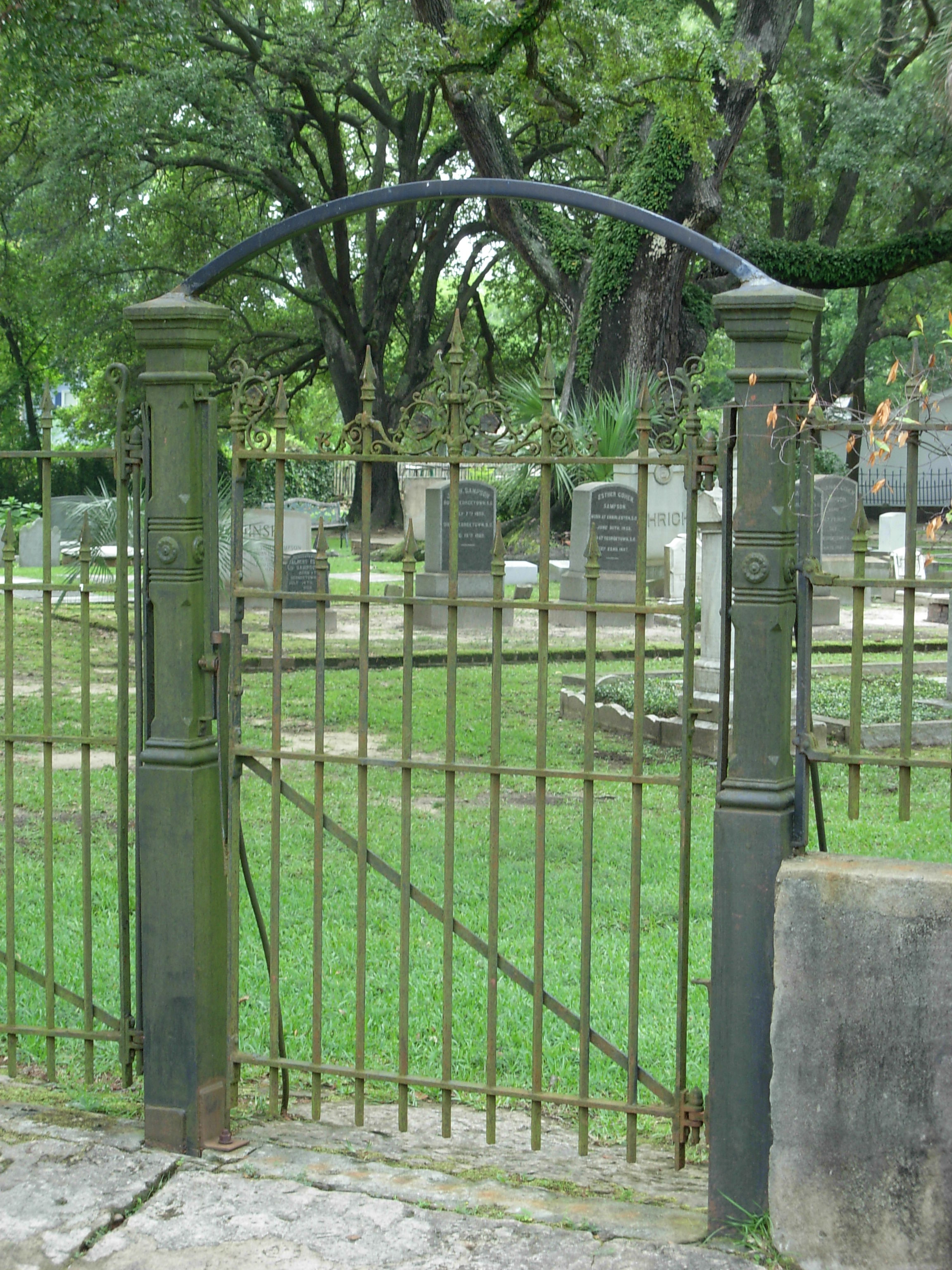
Gate of the Beth Elohim Cemetery. Photo 2011, by Lewis Powell IV, all rights reserved.
The second oldest Jewish cemetery in the state, the Beth Elohim Cemetery contains graves of many of the most prominent citizens of Georgetown, including three of the city’s six Jewish mayors. The legend associated with this graveyard involves Pauline Moses who, with her best friend Eliza Munnerlyn, had planned to be wed on the same day at the same time, though in different locations. Both girls contracted yellow fever and died a few days before the weddings. Subsequently, girlish laughter heard emanating from this cemetery as well as the cemetery of Prince George Winyah Episcopal Church just across the street, where Munnerlyn is buried, is thought to be theirs.
Huntsinger, Elizabeth Robertson. Ghosts of Georgetown. Winston-Salem, NC: John F. Blair, 1995.
Bolem House (private) 719 Prince Street
Bolem House. Photo 2011, by Lewis Powell IV, all rights reserved.
Possibly the oldest home in Georgetown, recent evidence indicates that it was originally constructed as a tavern. With the influx of sailors into the port, Georgetown would have had at least a few establishments to house and serve them. Residents of the house have since occasionally heard and seen the revenants of some of these long dead sailors. Huntsinger describes the surprise of a family member when he encountered a sailor on Christmas of 1993. The family member went into the kitchen and “encountered a very old man in an old-time sailor’s outfit, and he appeared to have no teeth. The man wandered around the kitchen, then into the hallway, never saying anything and looking somewhat displaced.” The witness asked the rest of the family if they had seen someone and they had not. Hopefully, the poor sailor will soon figure out where he needs to be.
Sources
Huntsinger, Elizabeth Robertson. More Ghosts of Georgetown. Winston-Salem, NC: John F. Blair, 1998.
Cleland House (private) 405 Front Street
The Cleland House, 2011, by Lewis O. Powell IV, all rights reserved.
DuPre House. Photo 2011, by Lewis Powell IV, all rights reserved.
This house has in the recent past served as a bed and breakfast, but there was a large for sale sign in the yard when I visited a few weeks ago. An internet search doesn’t say if the inn is still open. I do hope that the little girl and the mother who have resided there since before the Civil War are okay. Guests in this home constructed around 1740 have reported seeing and hearing a woman and small girl who may have been victims of a fire in the 19th century. In addition to occasionally smelling smoke, occupants have come face to face with the two spirits and have heard childish giggling and singing. At times, small footprints have even appeared in freshly vacuumed carpet.
Sources
Huntsinger, Elizabeth Robertson. Ghosts of Georgetown. Winston-Salem, NC: John F. Blair, 1995.
Turnage, Sheila. Haunted Inns of the Southeast. Winston-Salem, NC: John F. Blair, 1995.
Henning-Miller House 331 Screven Street
Henning-Miller House. Photo 2011, by Lewis Powell IV, all rights reserved.
This lovely, circa 1760 (some accounts state the house is circa 1800, which would make this story false), home boasts a helpful spirit on the staircase. During the American Revolution, British soldiers often imposed themselves on the hospitality of both Tory (British sympathizers) and Patriot families alike. The family living in the Henning House was Tory but had a daughter with Patriot sympathies.
Throughout the South Carolina Low Country, the British had chased Patriot hero, Francis “Swamp Fox” Marion through the swamps and marshes. One evening as the British were sleeping upstairs, of their officers overheard the daughter talking downstairs of Francis Marion being in town. He rose quickly and, in his rush, tripped on the stairs breaking his neck, killing him instantly. Since that incident, anyone losing their footing on the same stairs has felt a hand keeping them from meeting the same fate as that young British officer.
Sources
Barefoot, Daniel W. Spirits of ’76: Ghost Stories of the American Revolution. Winston-Salem, NC: John F. Blair, 2009.
Huntsinger, Elizabeth Robertson. Ghosts of Georgetown. Winston-Salem, NC: John F. Blair, 1995.
Heriot-Tarbox House
(formerly the Harbor House Bed & Breakfast, private) 15 Cannon Street
Prince George Winyah Episcopal Church 300 Broad Street
Prince George Winyah Episcopal Church. Photo 2011, by Lewis Powell IV, all rights reserved.
Opened in 1747, the marvelous church of Prince George Winyah has served the citizens of Georgetown for centuries. For the legend surrounding the churchyard, see the above entry on the Beth Elohim Cemetery.
Pyatt-Doyle House (private) 630 Highmarket Street
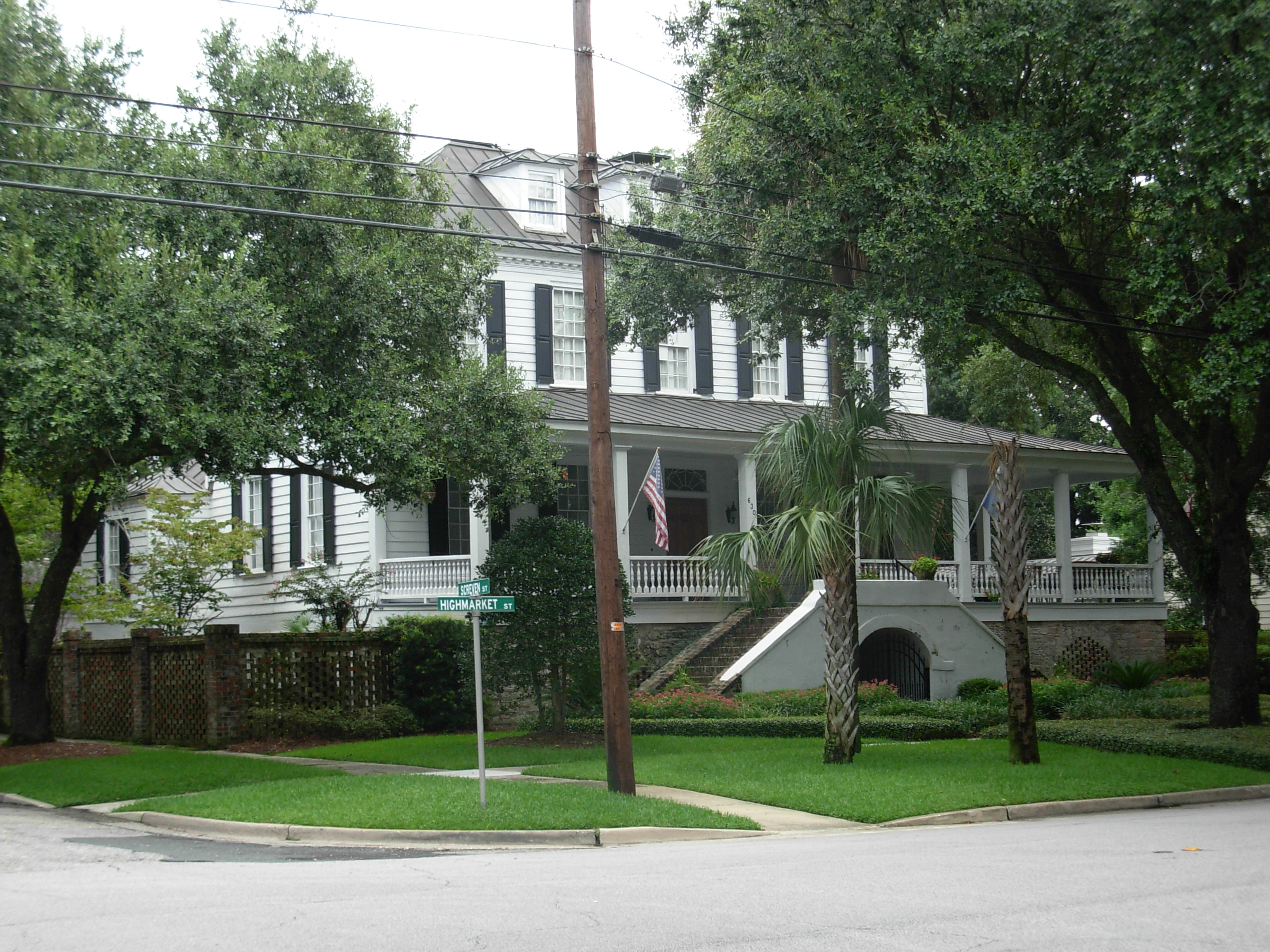
Pyatt-Doyle House. Photo 2011, by Lewis Powell IV, all rights reserved.
This 1790 home is home to what appears to be mostly residual activity. It is noted that when a rocking chair is placed in one bedroom, it will rock on its own. Some visitors have even witnessed a woman holding a baby sitting in the chair. Others have heard the sound of footsteps throughout the house.
Sources
Huntsinger, Elizabeth Robertson. Ghosts of Georgetown. Winston-Salem, NC: John F. Blair, 1995.
Turnage, Sheila. Haunted Inns of the Southeast. Winston-Salem, NC: John F. Blair, 1995.
Rice Museum 633 Front Street
A view of the block that burned this morning. The SC Maritime Museum in the foreground, sustained some damage, while the buildings towards the Rice Museum were gutted by the early morning fire. 2011, by Lewis O. Powell IV, all rights reserved.Kaminski Building. Photo 2011, by Lewis Powell IV, all rights reserved.
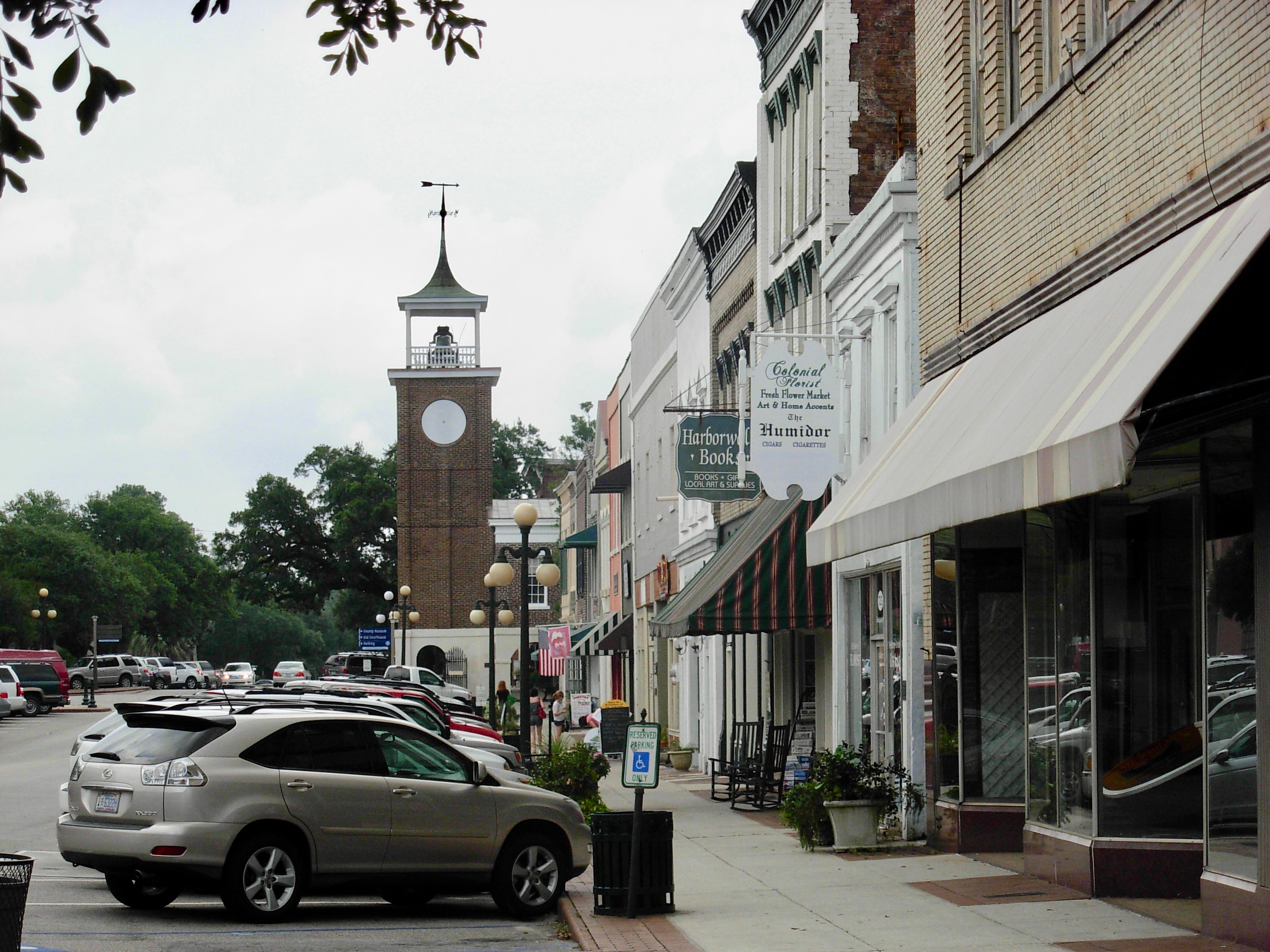
Georgetown’s Rice Museum, documenting the history of rice cultivation in the South Carolina Lowcountry, occupies two historic buildings on Front Street: the Old Market Building with its landmark clock tower, and the adjacent Kaminski Building. The Old Market Building once housed, as the name implies, the local market selling produce, livestock and slaves while the upper portions housed the town hall. Over the years the building has served as a jail, a printing shop, and the town police department.
The Kaminski Building, constructed in 1842, the same year as the market, served as retail space for many years. With so much activity over the years, it’s hard to imagine that these buildings wouldn’t contain a ghost or three. Footsteps, particularly those of someone with a peg-leg have been heard in the art gallery in the Kaminski Building. Elizabeth Huntsinger, author of Ghosts of Georgetown and More Ghosts of Georgetown, points out a particular antique sideboard in the museum that may even be associated with the spirit of an enslaved woman.
Sources
Fant, Mrs. James W. National Register of Historic Places Nomination form for the Georgetown County Rice Museum. 8 November 1969.
Huntsinger, Elizabeth Robertson. More Ghosts of Georgetown. Winston-Salem, NC: John F. Blair, 1998.
Strand Theatre 710 Front Street
Strand Theatre. Photo 2011, by Lewis Powell IV, all rights reserved.
This plot of land on Front Street has been occupied by a cinema since the Peerless Theatre was constructed here in 1914. The Strand Theatre opened in 1941 and closed in the 1970s. In 1982 the Swamp Fox Players, a local community theatre company took over the building, slowly restoring its Art Moderne glory.
Almost immediately after taking over the building, company members began noticing the sounds of footsteps in the balcony. During a performance of an original show, Ghosts of the Coast, based upon a series of ghost stories and other haunting tales, actors leaving the theatre began to notice odd cold spots and the sounds of whispers began to emanate from the backstage area. They summoned a local ghost hunter who blamed the occurrence on a scene in the show involving a hoodoo spell. While the cold spots and whispers have since ceased, the footsteps continue.
Sources
Wolf, Elizabeth Huntsinger. Georgetown Mysteries and Legends. Winston-Salem, NC: John F. Blair, 2007.
Waterman-Kaminski House 622 Highmarket Street
Waterman-Kaminski House. Photo 2011, by Lewis Powell IV, all rights reserved.
Next door to the Pyatt-Doyle House is the even earlier Waterman House, built around 1770. This house is home to two separate legends. One speaks of a little boy whose family left him in the care of the home’s owners while they journeyed north during the summer. The family was lost at sea and the little eight-year-old soon fell sick with grief and died. His pitiful spirit is still seen here occasionally.
The other legend concerns a young woman who fell for a faithless sea captain. Returning from a trip he presented his love with a vial of exotic perfume. After her lover left her home, the sweetheart watched him from a third-floor window. With horror she observed him entering a local tavern, eventually emerging with another young lady. Distraught, the young woman drank the contents of the vial and died. Her sad spirit is said to still watch from the window on summer evenings.
Sources
Georgetown Paranormal. “Waterman-Kaminski House.” Haunted Places in Georgetown, SC. Accessed 13 August 2011.
Huntsinger, Elizabeth Robertson. Ghosts of Georgetown. Winston-Salem, NC: John F. Blair, 1995.
Bethesda Presbyterian Church Russellville, Tennessee
Pardon my absence, please. Initially, I was busy working on some new articles, but after lightning struck and killed my router and Internet; my time for work was limited. I’m getting back to work now. Since I haven’t done a good newsbyte in awhile, I’m doing one now; and boy, it’s a doozy.
You may notice that I have not included the exact location of this church, there’s a good reason for that. After recent events, I have a feeling the people working to protect Bethesda Presbyterian Church really don’t want ghost hunters around. According to an article and video from KSDK in St. Louis, Missouri, the church was vandalized recently by teen “ghost hunters.”
This is utterly ridiculous. Unfortunately, these teens have given real ghost hunters and others with an interest in the paranormal a bad name. Two teenage boys spent time in this historic church overnight burning candles on floors that once held wounded from the Civil War. Windows were shattered and they spray-painted and toppled a number of monuments in the adjacent cemetery. As the idiots did leave a bicycle on the property, the police were able to apprehend these young hooligans.
Reading about such an event makes me livid, especially when “ghost hunting” is involved. A ghost hunter should have utmost respect for the places they investigate as well as for the dead. Part of that respect for the dead is by protecting the places where they once walked or are buried.
Please do check out the video for some wonderful shots of this historic structure. The reporter does state that the church is on the “National Registry of Historic Landmarks.” This is incorrect. It is called the “National Register of Historic Places.” There are places that are known as National Historic Landmarks, but that is a step up from the National Register and reserved for those places of national importance.
The view of White Point Gardens looking down South Battery towards East Battery. Photo 2011, by Lewis Powell, IV, all rights reserved.
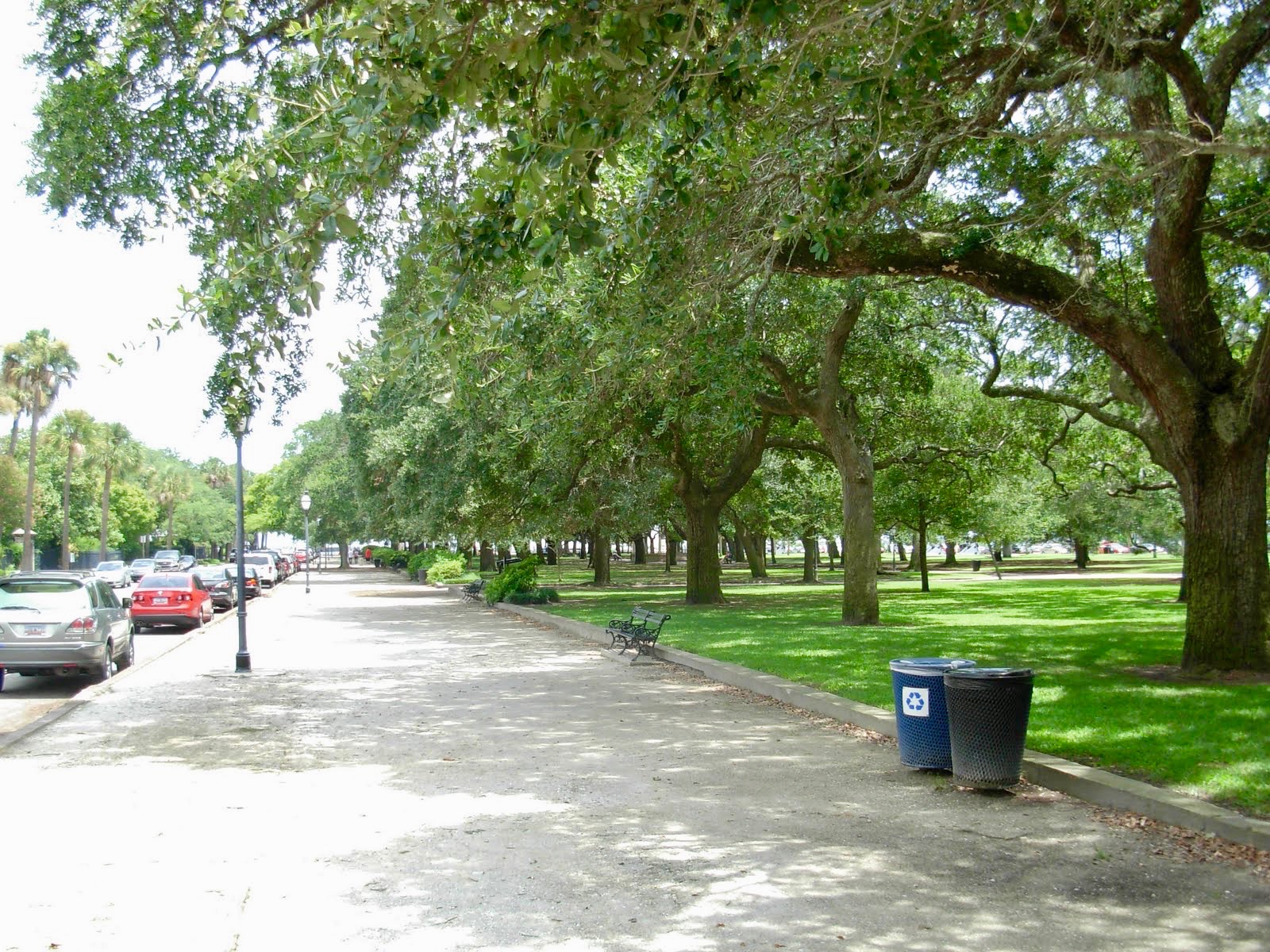
Throughout the South history creates layers. In some places there are literal layers that an archaeologist may sift through, in other places those layers can be formed through names; names that may span the centuries from the present day to another historical layer many centuries earlier. The Charleston Battery is one of those places with a few layers of names. I’ve encountered so many different names for this location; I’m not sure which is really correct. Wikipedia calls it The Battery and says that White Point Gardens is a part of that. I’ll just stick with that. A Post & Courier article from 2001 adds that even the use of “Gardens” (plural) as opposed to “Garden” (singular) is inconsistent. Nevertheless, the jumble of names adds to the layers of history that have accrued here.
In April of 1670 when the 93 passengers aboard the Carolina first sailed into what would be called Charleston Harbor, they were greeted by the tip of a peninsula at the point where two mighty rivers came together. The ship’s captain knew one of the rivers as the Ashley, as he had accompanied the earlier expedition that had named the river for Lord Anthony Ashley Cooper, one of the colony’s Lord Proprietors. The local Native Americans called the river Kiawah (which is now applied to a barrier island south of the city), and the Spanish had called it the San Jorge. At the tip of this peninsula was a Native American oyster shell midden, or trash heap. Over time, this point would be called alternately Oyster Point, or White Point, for the sun-bleached oyster shells piled there.
Initially, the settlers landed and began to build their city, named for King Charles I, on the opposite bank of the Ashley River on what would later be called Old Town Creek. Colonel William Sayle, the colony’s first governor saw the strategic importance of the peninsula’s tip, however. “It is as it were a Key to open and shutt [sic] this settlement into safety or danger,” he stated in a letter to Lord Ashley, and he began to grant land to settlers in this area. In 1679, it was decided that Oyster Point and the Cooper River side of the peninsula was a much better place for a town.
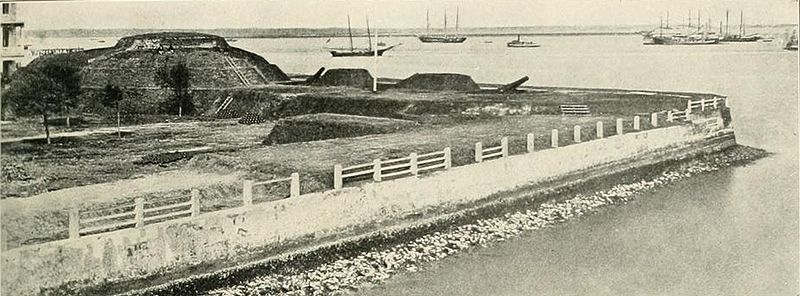
Guns and defenses on the Battery during the Civil War. This 1863 photo from The Photographic History of the Civil War (1911).
Throughout its three hundred some-odd years of existence, White Point Gardens has seen a variety of uses. It has been covered with shacks and tenements, served the defense of the city, been created as a pleasure park, and as a place for execution. Walter Fraser, Jr. in his Charleston! Charleston! The History of a Southern City, describes a storm surge sweeping over White Point during the Hurricane of 1752, with the poor people escaping their shacks there for more substantial shelter. Following the hurricane, the White Point remained “a desolate Spot” until 1770 when the low marshy areas were filled in and elegant homes began to be built there along with a sea wall on the eastern side created with palmetto logs. This held until 1804 when it was swept away by another hurricane and it was replaced with a wall of ballast stone.
It was in the space created here that open-air concerts were given during the summer months. When the British blockaded Charleston Harbor during the War of 1812, fifteen guns of large caliber were placed along the White Point aimed at the harbor and the point began to be known as The Battery.
The ruins of houses along the Battery in 1865 by George N. Barnard.
Following the war, this pleasant point was planted with oaks and gained the name White Point Gardens during a major period of building in the late 1830s. When English actress Fanny Kemble, who married Georgia cotton planter Pierce Butler, visited the city she delighted in the promenade and the “large and picturesque old houses.” Fraser notes that in the 1840s, African-Americans were not allowed to use the park between five and ten in the evening.
From this promenade and roofs of the pretentious mansions lining the battery, the citizens of Charleston witnessed the first shots of the Civil War as Confederate attacked Fort Sumter in the harbor. Gunfire from ships during the war destroyed some of those mansions, but they were later rebuilt even more ostentatiously. The tradition of promenading along the seawall and under the sprawling live oaks continued into the 20th century. The 1941 Works Progress Administration guide to the state of South Carolina describes the scene of “Charleston children, guarded by white-turbaned Negro ‘maumas,’ play[ing] among monuments and guns that recall the city’s war-torn history of more than 250 years.”
A monument under the cooling shade of the oaks. Photo by Brian Stansberry, 2010, courtesy of Wikipedia.
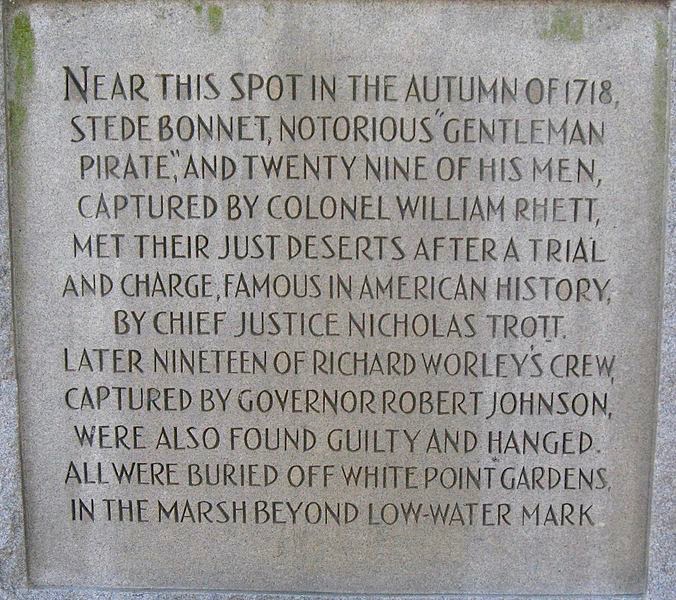
Today tourists stroll the Battery and under those oaks. They may pass a stone monument reminding them of the fact that they stand on an execution ground. In fact, this spot may still be haunted by those who hung here in 1718, when Charleston was still a small colonial port. Over the course of five weeks that year some 49 men were hung here for piracy.
As the colonies grew, piracy became a major problem for trade and many of the up and coming ports. Around late May or June of 1718, the notorious Edward Teach, or Blackbeard as he is more affectionately known, blockaded Charleston Harbor. Among the first ships he captured was a London-bound ship called the Crowley loaded with a number of prominent citizens. Word was sent to the Royal Governor that these people would be summarily executed unless the port offered up medical supplies. The governor complied and the citizens were released, though lightened of their purses, valuables, and even their clothes.
Stede Bonnet from A General History of the Pyrates, c. 1725.
In response, Governor Robert Johnson asked the Lord Proprietors for assistance, but received no response. When pirates again appeared in the waters near Charleston in August, a group of local merchants banded together and under the command of William Rhett, they set out to stop this threat to their business. In the waters of North Carolina, they encountered pirate Stede Bonnet refitting his ship in the Cape Fear River.
Stede Bonnet wasn’t born into a life of crime. The son of a wealthy English family on the island of Barbados, Bonnet had had a fairly successful life which enabled him to buy his way into piracy. It was the usual custom for pirates to begin their work by seizing a ship that they then used to prey on other ships, Bonnet, however, bought his ship, the Revenge. He also hired his crew and paid them regular wages. Due to lack of experience in sailing or piracy, Bonnet had to hire someone to command his men. After terrorizing shipping off the Virginia coast, Bonnet sailed for the pirate’s paradise of Nassau in the Bahamas. There, he met Blackbeard and decided to join forces.
After a night of maneuvering sloops back and forth to gain advantage in battle, the sun rose on the morning of September 27, 1718 with Bonnet sailing his one sloop, he had combined all of his men into one ship from three, towards the three sloops under Colonel Rhett. Nearly all the ship ran aground during the battle with a rising tide eventually freeing Rhett’s vessels, while Bonnet’s sloop, the Royal James, remained stuck. The Royal James was quickly boarded by Rhett’s men who outnumbered the pirates. In a last ditch effort, Bonnet ordered his gunner to blow up the ship’s powder stores, but this suicidal act was prevented by Bonnet’s men who surrendered instead. Rhett returned triumphantly to Charleston with Bonnet and twenty-nine of his men in chains.
In Charleston, Bonnet’s men were imprisoned in the Half-Moon Battery where the Exchange and Provost Dungeon were later constructed, and still stands today. Because of his gentlemanly upbringing, Bonnet was imprisoned with his boatswain, Ignatius Pell, in the home of the town’s Provost Marshall. Shortly thereafter, Bonnet and Pell, accompanied by a slave and a Native American, escaped the house possibly disguised as women, at least according to legend. The group however, wasn’t able to go very far and had only gotten as far as Sullivan’s Island, north of the city, when they were captured. Bonnet and his men were put on trial before Vice-Admiralty judge, Nicholas Trott and found guilty.
Monument in White Point Gardens near the spot of the pirate gallows. Photo courtesy of Wikipedia.
Bonnet’s own men were hung at White Point, two days before his trial, and their bodies left dangling from the gallows before the bloated, decaying corpses were cut down and unceremoniously dumped in the marsh just off the point. Those same marshes that would later be filled in for the building of homes. Reportedly, Bonnet begged for clemency and turned much of the Charleston female population to his side, so much so that the governor had to delay the execution seven times. Even Colonel Rhett offered help by escorting Bonnet to England for a new trial, but Judge Trott’s decision stood firm.
During the time between Bonnet being found guilty and his execution, 19 other pirates were found guilty and hung at White Point. Bonnet’s day of execution finally dawned on December 10. Walter Fraser describes the scene:
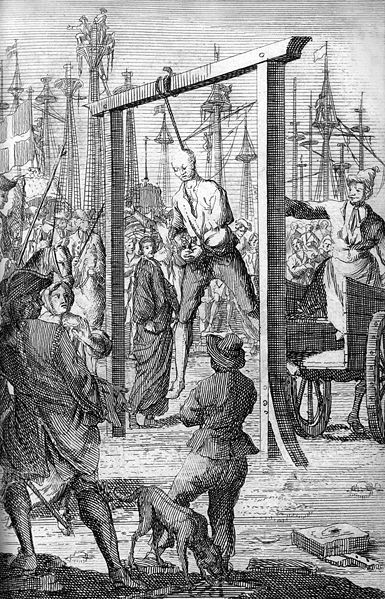
…manacled and clutching a nosegay of wildflowers, [he] was taken in a hurdle to the place execution near White Point where the once bold pirate appeared terrified and near collapse. The executioner dropped the noose over his head and around his neck and then Bonnet was ‘swung off’ the cart. He died an agonizing death of strangulation, the invention of the gallows that would break the victim’s neck being years away.
His body was left hanging for a few days then unceremoniously dumped in the marsh with the remains of his men and his pirate brothers where they were eaten by crabs, riddled with maggots, and pecked by the gulls.
The hanging of Stede Bonnet from the Dutch edition of A General History of the Pyrates,c. 1725.
Over the course of five weeks, forty-nine pirates swung from the gallows at White Point. Within a couple months, pirate Richard Worley and nineteen of his men met the same fate. While the leaves of White Point Gardens’ oaks calmly sway in the ocean breeze, their roots are feeding on the blood of pirates.
The view from South Battery towards Charleston Harbor. Photo 2011, by Lewis Powell, IV, all rights reserved.
There is a legend that the spirits of these pirates still stalk Battery Park and White Point Gardens. Denise Roffe includes a story of a couple who encountered an apparition hanging in midair beneath the oaks of the park. Alan Brown mentions that the spirits have been witnessed standing under the oaks and screaming at passersby. He notes that if one looks out on the bay from the foot of Water Street, where Vanderhorst Creek once met the waters of the Cooper River, when the moon is high, they may see the bloated faces of the long dead pirates just under the water’s surface. Like so many Charleston ghost stories, this story may be mostly legend, but it is grounded in a marvelous history.
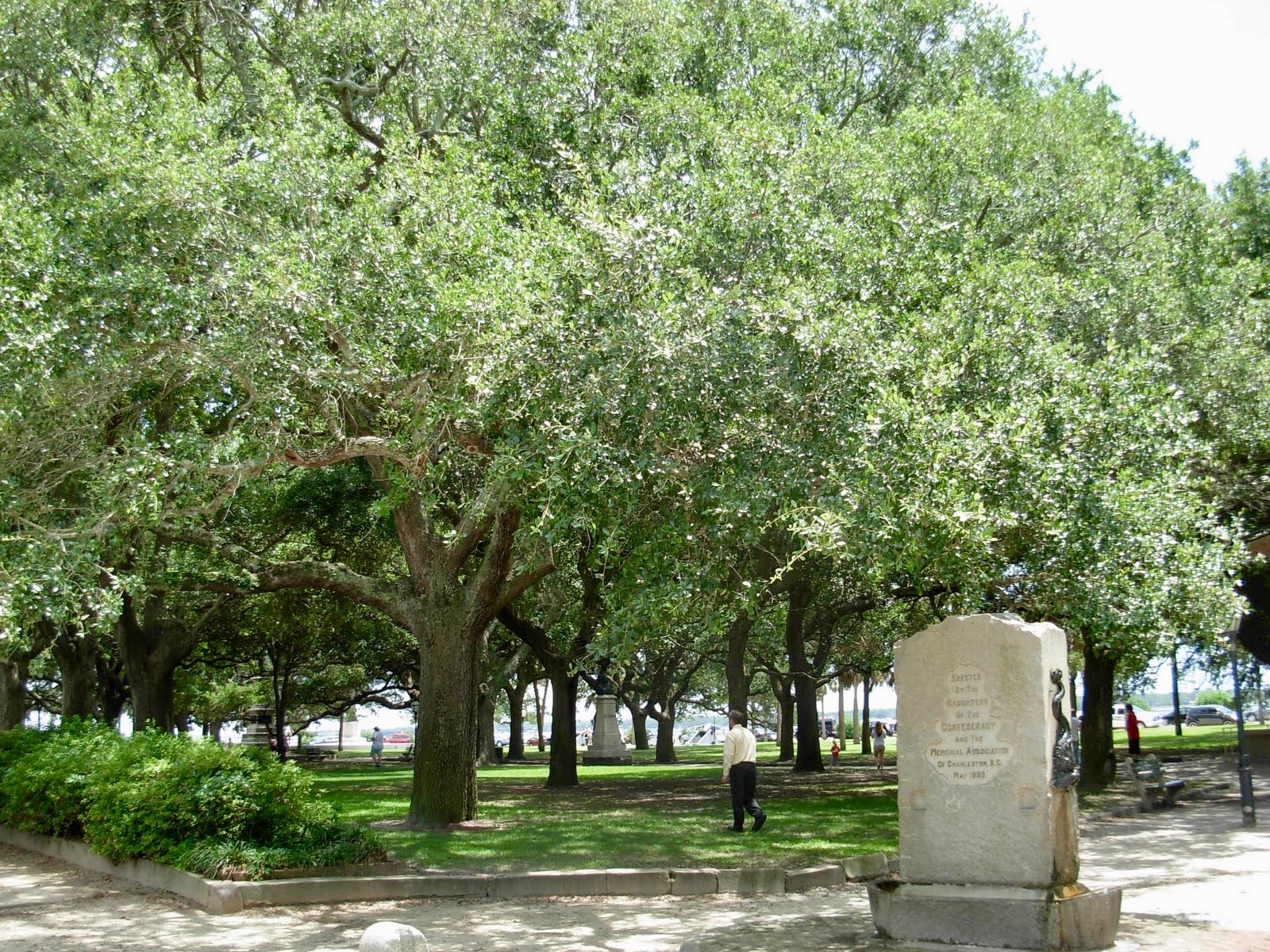
Do pirate spirits still walk here? Photo 2011, by Lewis Powell IV, all rights reserved.
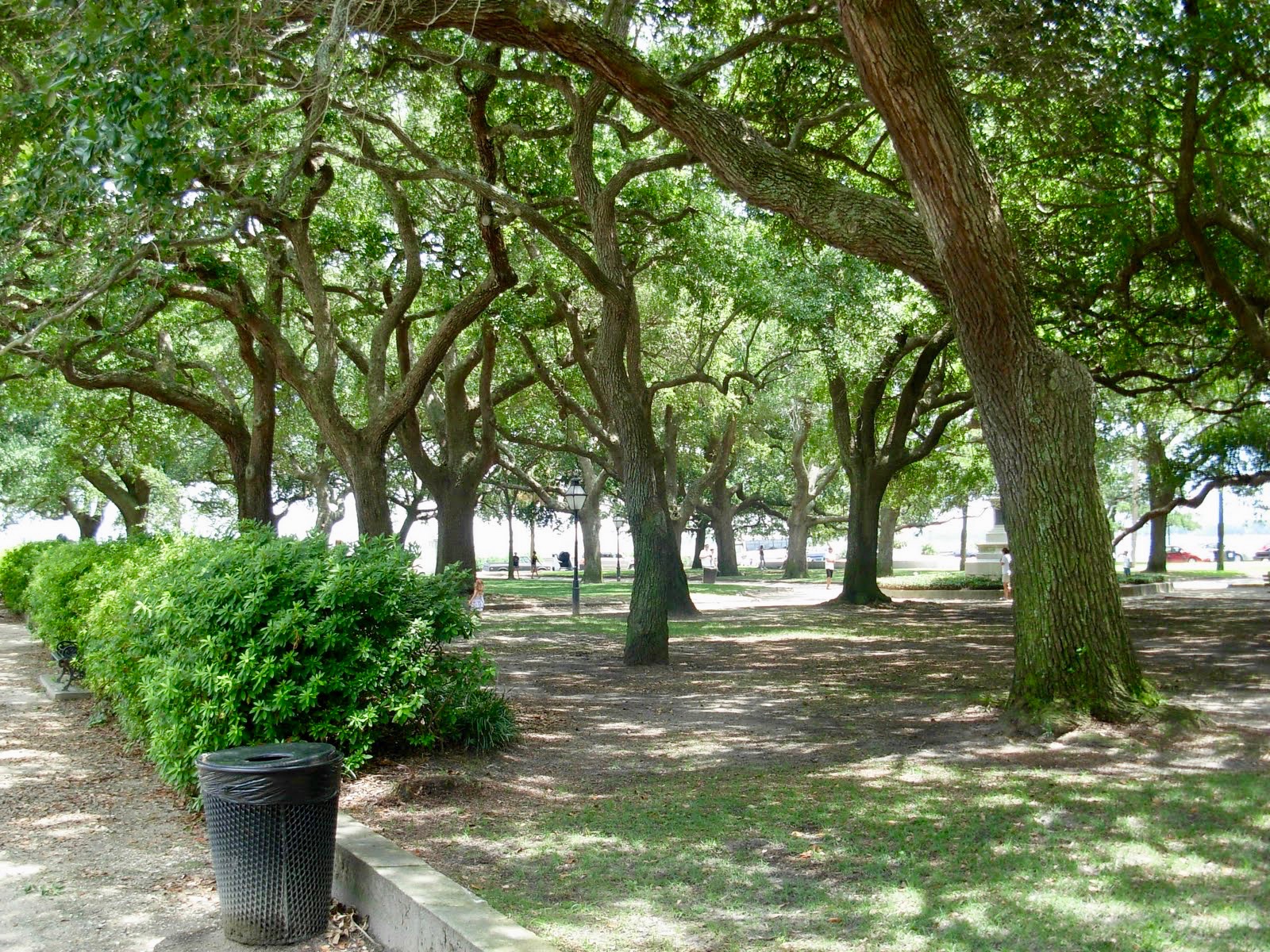
In this sylvan landscape do pirate spirits hang midair? Photo 2011, by Lewis Powell IV, all rights reserved.
Blackbeard. Wikipedia, the Free Encyclopedia. Accessed 1 August 2011.
Brown, Alan. Haunted South Carolina: Ghosts and Strange Phenomena of the Palmetto State. Mechanicsburg, PA: Stackpole Books, 2010.
Fraser, Walter J., Jr. Charleston! Charleston! The History of a Southern City. Columbia, SC: U. of SC Press, 1989.
Hardin, Jason. “You can say it with an ‘S,’ but early documents show there is just one garden.” Post & Courier. 2 September 2001.
Richard Worley. Wikipedia, the Free Encyclopedia. Accessed 1 August 2011.
Roffe, Denise. Ghosts and Legends of Charleston, South Carolina. Atglen, PA: Schiffer, 2010.
Stede Bonnet. Wikipedia, the Free Encyclopedia. Accessed 1 August 2011.
Workers of the Writer’s Program of the Works Progress Administration in the State of South Carolina. South Carolina: A Guide to the Palmetto NYC: Oxford University Press, 1941.
Magnolia Cemetery 70 Cunnington Street Charleston, South Carolina
A moss-draped drive through the cemetery. Photo 2011, by Lewis Powell IV, all rights reserved.
After wandering through Magnolia Cemetery in awe for almost two hours, I began to make my way out. The cemetery has winding drives through its oak shaded acres with a posted speed limit of 15 miles per hour. Not wanting to miss anything, I was probably driving slower than that when I approached the massive cemetery gates. The gates were closed with a chain and large padlock securing them. A number of expletives left my mouth and panic quickly set in. A couple of Northern Mockingbirds (Mimus polyglottis) loudly scolded me from atop an adjacent tombstone. The welcome sign listed rules for the cemetery but no number in the event that you’re locked in with the dead. As I dialed 911, I prayed that I would not face a fine or worse for missing the very obvious sign stating that the gates would close at 6PM. It was 6:15.
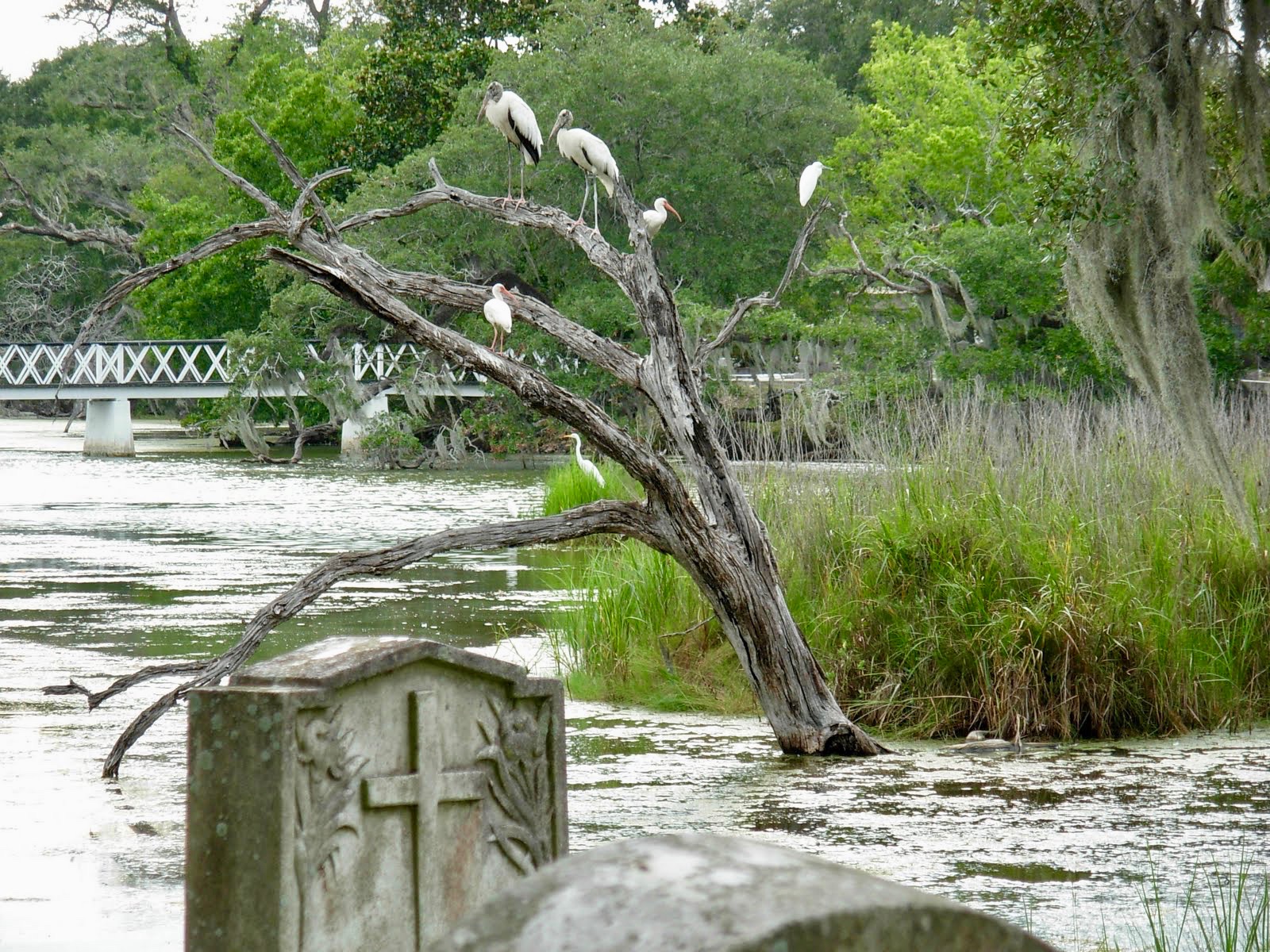
In this city of so many fine homes and buildings, only I would first head to the cemetery. But, this place is so much more than just a resting place for the dead, it’s truly an art museum, a guide to three centuries of art and architecture and a habitat for native plants and wildlife. Wandering among the graves were Domestic and Canada Geese (Branta canadensis) and Mallards (Anas platyrhynchos). I passed a couple of ponds within the cemetery and was excited to see a dead tree in the center of one pond with a number of water birds perching on it. Even better, were the two “Life Birds” I saw there: Wood Stork (Mycteria americana) and American White Ibis (Eudocimus albus).
A snag in the main pond with perching waterbirds. Two Wood Storks are perched at the top with two White Ibises underneath. A Cattle Egret is perched on the right with a Great Egret in the background. Photo 2011, by Lewis Powell IV, all rights reserved.
For a taphophile, Magnolia Cemetery is heavenly. Everywhere there is marvelous funerary art and symbolism. As I walked and was fed upon by legions of mosquitoes (I won’t acknowledge their scientific name as they don’t deserve it) I had to pass graves that in most cases I would be drawn to in order to pursue more interesting graves. By the end of the first hour, I took to riding in my car to avoid the mosquitoes and trying to photograph the most interesting graves closest to the drive.
The large, Gothic Revival monument to Elbert P. Jones, died 1 April 1852. Designed by architect Francis D. Lee and constructed by E. Greble of Philadelphia. Photo 2011, by Lewis Powell IV, all rights reserved.
Among the more notable monuments is the grave of Rosalie Raymond White. Situated next to one of the ponds, the White family plot has some fascinating art, but particularly interesting is the grave of young Rosalie who died less than a year after her birth. There is a hooded cradle and under the hood, the likeness of the child. According to Denise Roffe in her Ghosts and Legends of Charleston South Carolina, the likeness is a death mask and one of the few such things on a grave in the United States.
Grave of Rosalie Raymond White. Photo 2011, by Lewis Powell IV, all rights reserved.
The death mask of Rosalie Raymond White. Photo 2011, by Lewis Powell IV, all rights reserved.
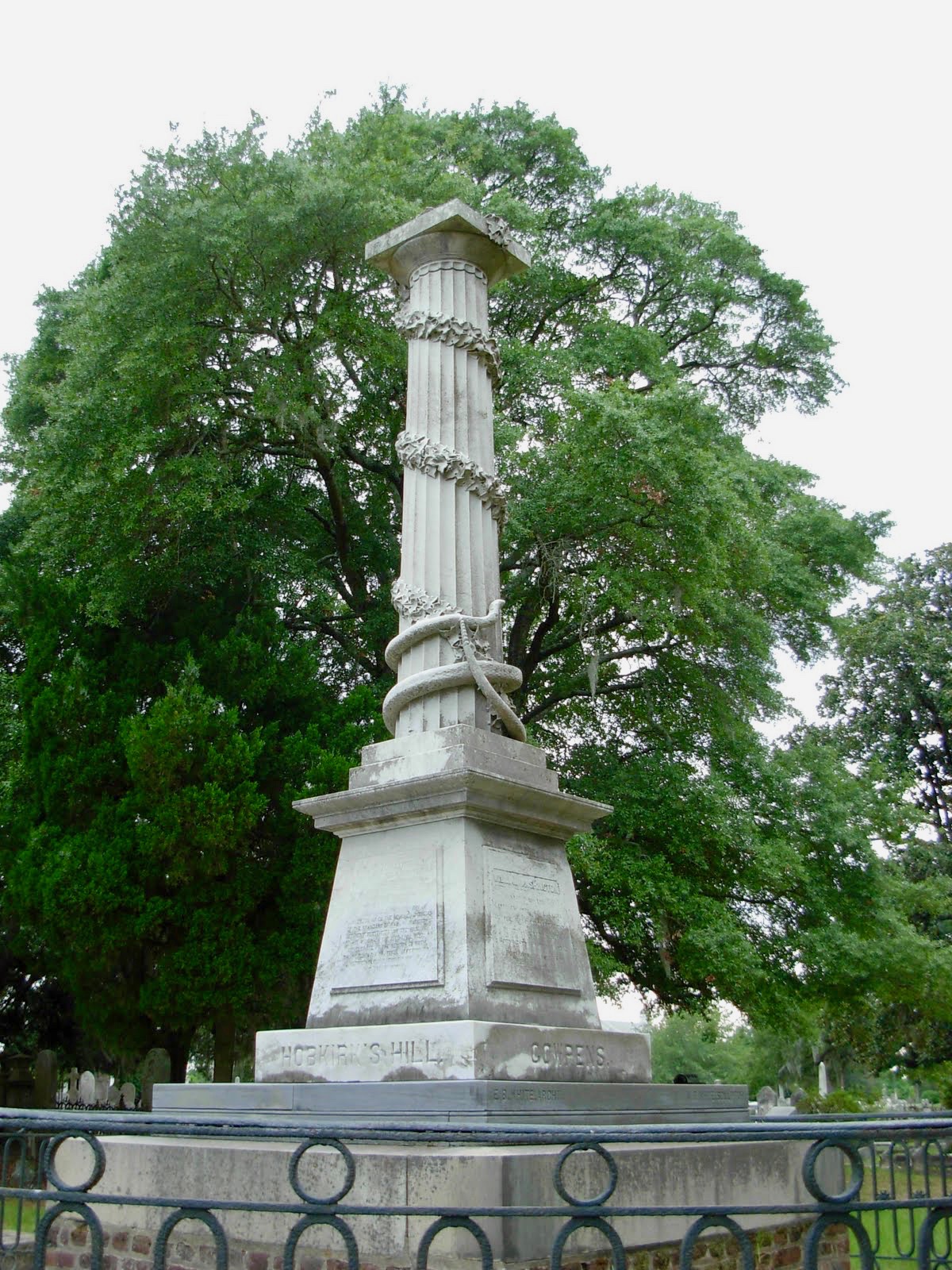
Another prominent monument is that William Washington. I viewed this one from the car, so I couldn’t get all the information, but it appears to be a cenotaph (a monument to someone who is buried elsewhere) to this notable figure from the American Revolution. The monument, surrounded by an unusual circular iron fence (I’ve not seen one, though they were numerous in this cemetery), is a large marble column with an ivy garland wrapped around it. At the base of the column is a rattlesnake, a creature I’ve not seen at all in funerary art. The snake is taken from the early American Gadsden flag, the first flag carried into battle by the Continental Marine Corps during the American Revolution, which bears the words, “Don’t Tread On Me.” This flag has most recently been adopted by the Tea Party.
The monument to William White; a Doric column with a rattlesnake entwined at the base. Photo 2011, by Lewis Powell IV, all rights reserved.
This monument was designed by E.B. White and constructed by W.T. White, the city’s most prominent stone carver and monument builder. As I wandered the cemeteries of Charleston, in nearly every graveyard I found monuments with White’s signature.
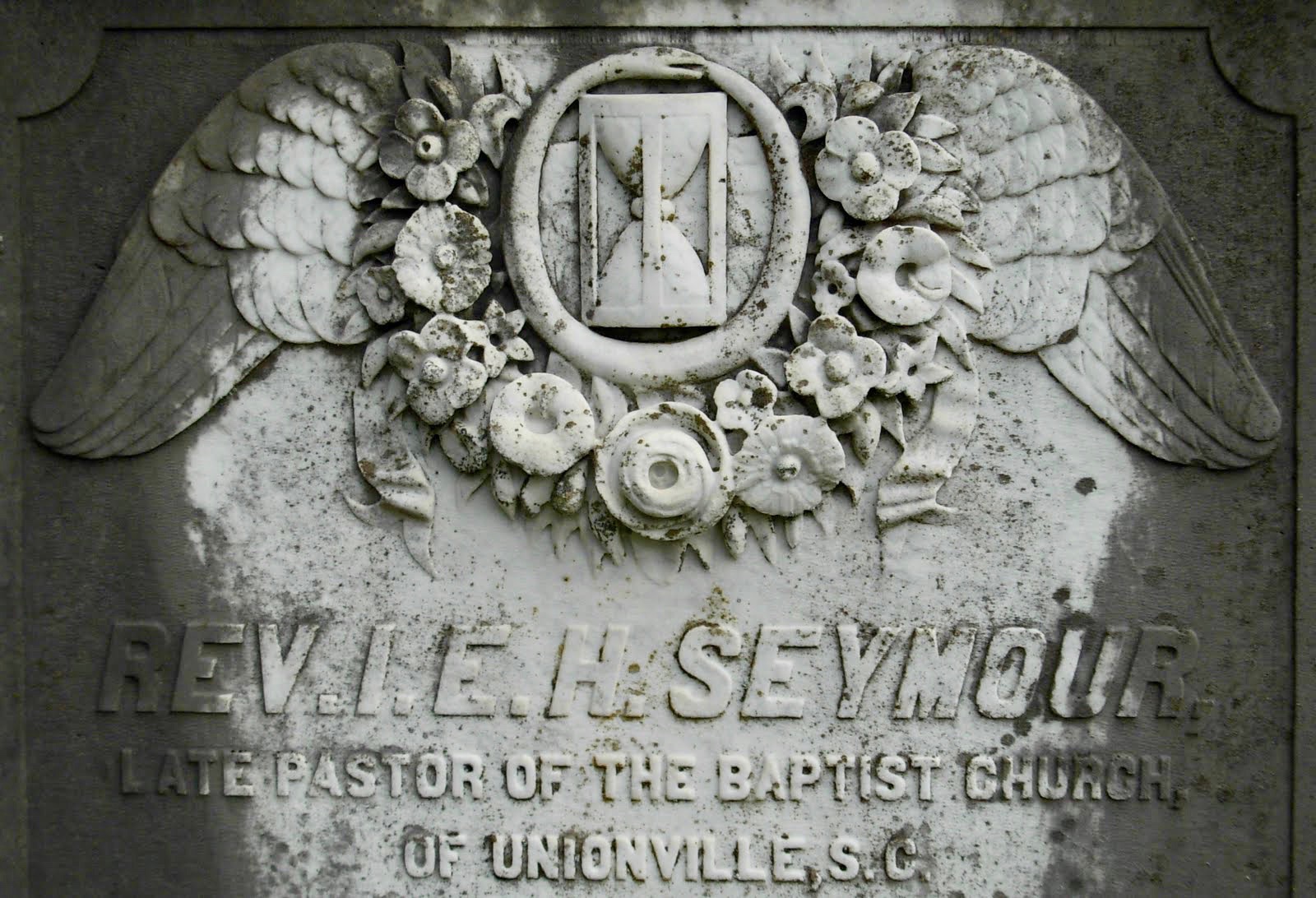
Nearby, another marvelous monument by White is the stone for the Rev. I. E. H. Seymour. Topped with the statue of a praying woman, the stone bears a wonderful crest. An hourglass is encircled by an ouroboros, an ancient symbol meaning cyclicality; thus in this, the cyclicality of time or that even in death, life is created. This idea is strengthened by a wreath which can mean victory in death. The wings, of course, reference the wings of angels.
The crest of the Seymour monument. Photo 2011, by Lewis Powell IV, all rights reserved.
Not far away is the monument for Hugh Swinton Legare, who served two years as a state legislator, South Carolina Attorney General, then as a state Representative to the United States House, and then United States Attorney General under President John Tyler. The monument consists of a large marble Corinthian column sitting on a large base. One side of the base is carved with the national crest with a bald eagle, while the opposite site bears images from the South Carolina state crest with a wonderfully carved palmetto tree with a pair of shields underneath back with 12 spears (representing the other 12 colonies); all sitting on a fallen tree. The palmetto’s significance comes from a battle fought on Sullivan’s Island near Charleston, June 28, 1776, between colonists and the British. The colonists had built a fort of palmetto logs and the British cannon fire seemed to bounce right off. The dead tree represents the defeated British fleet. This monument was also built by White and is signed “W.T. White/Steam Marble Works/115 Meeting St”.
The Legare monument. Photo 2011, by Lewis Powell IV, all rights reserved.
The South Carolina crest on the Legare monument. Photo 2011, by Lewis Powell IV, all rights reserved.
Lagare died in 1840 in Boston, Massachusetts while attending ceremonies for the unveiling of the monument at Bunker Hill. He was buried in the Mount Auburn Cemetery there. Interestingly, this is one of the cemeteries upon which the designs for Magnolia Cemetery are based. Mount Auburn, coupled with New York City’s Greenwood Cemetery, provided the inspiration for the “Garden Cemetery,” a type of cemetery found throughout the United States. These cemeteries, created in park and garden-like settings were a departure from the usual churchyards where most people were buried. In 1857, Lagare’s remains were exhumed and he was re-interred here amongst the lush magnolias.
Magnolia Cemetery was founded in 1850 on the grounds of the former Magnolia Umbra plantation. The old plantation house still stands in the center of the cemetery. Laid out by South Carolina architect Edward C. Jones, the rules for governing the cemetery were copied from those of Mount Auburn and Greenwood. This sacred parcel of land has become the resting place of many of Charleston’s most prominent people.
Nearby is another stone carved with state symbolism including a wonderful, freestanding palmetto. The monument is for James Brown Boyd, Sergeant of the Palmetto Guards of the 2nd South Carolina Regiment. He was killed at the battle of Sharpsburg, Maryland (usually called Antietam), September 17, 1862. This is not a White monument and is signed “D.A. Walker.” The palmetto sculpture is signed, “A. F. Chevreaux, Sculptor”.
The Confederate section. Photo 2011, by Lewis Powell IV, all rights reserved.
According to Denise Roffe, this cemetery may have a few spirits wandering around. In one story, a brother and sister were fishing in the nearby Cooper River. When the little girl’s favorite doll fell in the water, she dove in to retrieve it and her body was found later clutching the doll. Her spirit has been seen in the company of a Civil War soldier, said to be her father. When the two are approached, they both vanish as the little girl giggles. Another spirit is also a young girl seen near the burial site of Annie Aiken.
Part of the burial lot for the crew of the CSS Hunley, the Confederate submarine that sank in Charleston harbor after sinking the USS Housatonic. Photo 2011, by Lewis Powell IV, all rights reserved.
The cemetery is massive and I easily could have spent many hours here, but the swarms of mosquitoes feeding on me every time I got out of the car began to be too much. That’s when I decided to leave, and good thing, as I found the locked gates.
The Egyptian Revival W.B. Smith mausoleum. Photo 2011, by Lewis Powell IV, all rights reserved.
A jolly man in a pickup truck pulled up as I spoke to the 911 operator. He had the key. Thank God. I told him I was so bowled over with Magnolia Cemetery that I had lost track of time. Smiling he listed some facts about the place: it contained around 33,000 interments (a number that is still growing) on 154 acres. I’m glad I’m not yet one of those who have found their rest here.
Sources
Hugh Swinton Legare. Wikipedia, the Free Encyclopedia. Accessed 30 July 2011.
Jacoby, Mary Moore and John W. Meffert. Charleston: An Album from The Collection of the Charleston Museum. Dover, NH: Arcadia Press, 1997.
McNulty, Kappy and Nenie Dixon. National Register of Historic Places Nomination form for Magnolia Cemetery. 23 August 1976.
Roffe, Denise. Ghosts and Legends of Charleston, South Carolina. Atglen, PA: Schiffer, 2010.