Florida Hauntings, County by County—Part II

This is part two of a project to examine a ghost story from every single county in Florida.

See part I (Alachua-Brevard Counties) here.
See part II (Broward-Clay Counties) here.

Broward County

Stranahan House
335 Southeast 6th Avenue
Fort Lauderdale
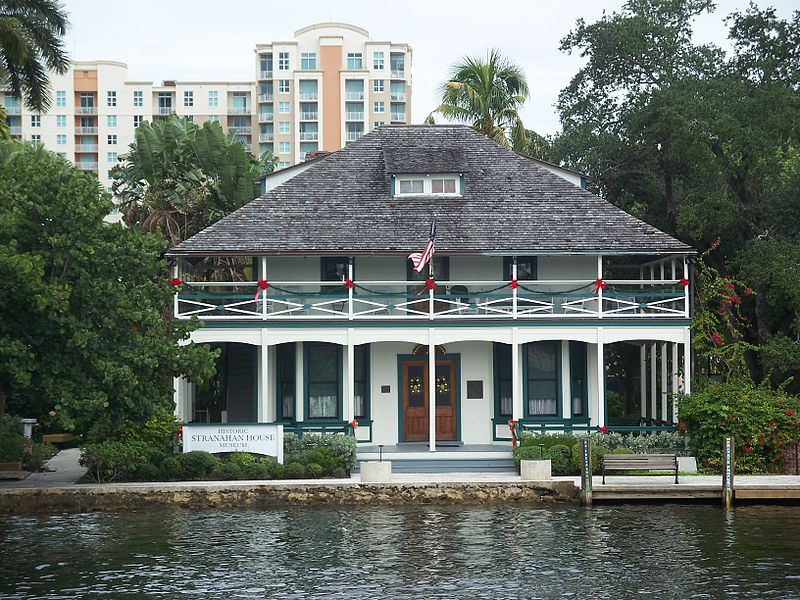
View of the Stranahan House from the New River, 2010. Photo by Ebyabe, courtesy of Wikipedia.

When viewed from the New River, the Stranahan House is nestled among many large buildings, an apt context for the site from which this city sprang. Frank Stranahan moved to Florida in 1893 to operate the ferry across the New River here. He also built a trading post to encourage trade with the Seminole Indians who lived on the opposite shore. After marrying the local schoolteacher, Ivy Cromartie, Stranahan eventually constructed the current house in 1901 as a wedding gift. The house served as an office for Stranahan’s many business interests as well as a family home for many years until a series of events in the 1920s began to sap his business interests.

In 1926, Florida was struck by a massive hurricane that moved ashore near Miami resulting in hundreds of deaths and striking a tremendous blow to business interests throughout the state. Saddled with financial ruin and a diagnosis of prostate cancer—which was untreatable at the time—Frank Stranahan attempted suicide. As a result, Stranahan was confined to a local sanitarium. With his death being imminent, his wife wrote to the sanitarium pleading for her husband’s release so he could die at home. Once he was finally released, Stranahan could not find his way out of the abyss of depression and not long after his homecoming, he chained himself to a sewer grate and threw himself into the river. Despite valiant attempts to rescue him, Stranahan drowned.

Ivy Stranahan continued living in the house and filled its rooms with borders to make ends meet. Continuing her husband’s community activism, Stranahan worked to build Fort Lauderdale into a modern and vibrant community. Eventually, she rented out the first floor of the house as a restaurant while continuing to live on the second floor. She died in 1971 and left the house to her church who eventually sold it to the local historical society. The house was restored as a house museum in the early 1980s and is open to the public.

The house remains the home of Frank and Ivy Stranahan who are still very much spiritually in residence along with several other spirits including a small Seminole girl who collapsed and died at the front door. The house has opened at various times for ghost tours. In 2003, an article in the local paper described the spooky experiences a group of schoolchildren had on a tour, “”Some smelled perfume, the eyes in Frank’s portrait downstairs moved, laughter came from the vents in the dining room, and one child felt someone tap him on the shoulder when he was upstairs.” An article from later that year recounts that docents in the house have experienced doors opening and closing by themselves, beds being found in disarray moments after being made, and the odor of lilac perfume believed to be one of Ivy Stranahan’s favorite.

Sources

  • Carr, John Marc. Haunted Fort Lauderdale. Charleston, SC: History Press, 2008.
  • Kneale, Dennis. “Campaign planned to save historic Stranahan house.” Fort Lauderdale News. 13 August 1981.
  • LeClaire, Jennifer. “Stranahan House gets in the Halloween spirit.” Sun-Sentinel. 24 October 2003.
  • Wallaman, Brittany. “Putting tourists in good spirits.” Sun-Sentinel. 1 September 2003.

Calhoun County

Information on a Calhoun County haunt was not available when this article was first created. I have recently explored the haunting of the Old Calhoun County Jail in Blountstown.

Charlotte County

Indian Spring Cemetery
5400 Indian Spring Road
Punta Gorda

The resting place of the 20th governor of Florida and founder of Punta Gorda, Albert Gilchrist, Indian Spring Cemetery was laid out by him on land donated to the city by city councilman, James Sandlin. A nearby spring feeding into Alligator Creek may have been used by Native Americans, thus the name. Over its nearly 150 years of existence, more than 2000 souls have been laid to rest here under the moss-draped oaks.

Paranormal activity here consists of audio phenomena with sounds of weeping, wailing heard within the empty cemetery. Cemetery lights, a phenomenon where orbs of lights are scene around burial locations, have also been experienced here. Dave Lapham includes the experience of a local who, while walking with her mother and her dog, witnessed orbs of light floating about three to four feet above the ground. Fearing the lights, the group fled.

Sources

  • Charlotte County Government. “Indian Spring Cemetery.” Accessed 4 September 2017.
  • Lapham, Dave. Ghosthunting Florida. Cincinnati, OH: Clerisy Press, 2010.

Citrus County

Crystal River Archaeological State Park
3400 North Museum Point
Crystal River

The Crystal River on Florida’s west coast is one of many natural wonders in the state. Fed by warm waters from some 30 natural springs, the Crystal River is known for its large numbers of West Indian Manatees who luxuriate in the gently heated water. On the river banks, Native Americans built their own utopia, the remains of which are preserved in Crystal River Archaeological State Park.

Sunlight falls on one of the mounds at Crystal River Archaeological State Park, 2007. Photo by Ebyabe, courtesy of Wikipedia.

This state park encompasses a complex of six mounds that include burial mounds; middens, or refuse mounds; and platform mounds atop which high-status officials may have lived. Among the mounds are two remarkable steles, or stone monuments, one of which features the crude likeness of a human face. Steles are generally regarded as a feature found among the civilizations of Central America, and very rarely found among North American civilizations.

For her 2004 book, Finding Florida Phantoms, Kathleen Walls spoke with a ranger who reported that voices had been heard among the mounds when no one was present, and some apparitions have apparently been spotted here as well.

Sources

  • Cox, Dale. “Crystal River Archaeological State Park—Crystal River, Florida: Prehistory on the Crystal River.” com. Accessed 5 September 2017.
  • Walls, Kathleen. Finding Florida’s Phantoms. Global Authors Publications, 2004.

Clay County

Old Clay County Jail
21 Gratio Place
Green Cove Springs

The Florida Times-Union has deemed the Old Clay County Jail to be a place where it is always Halloween. Paranormal investigators have deemed the building to be one of the most active that many of them have seen.

Built by the Pauly Jail Company in 1894, the building saw its last inmate in 1972. The building now serves as home to the Clay County Archives. Like most corrections facilities, this building has seen the worst of society and a number of tragedies in its long history. Among the tragedies was the assassination of a sheriff, an inmate suicide, five executions and another suicide on the front lawn.

Old Clay County Jail, 2010. Photo by Ebyabe, courtesy of Wikipedia.

Reports of activity from the jail include voices, apparitions, and hair-pulling. Activity has become so well known that the Clay County Historical Archives website features a page describing the haunted conditions of the building.

Sources

  • Buehn, Debra W. “Old Clay County Jail stars in Local Haunts’ TV show Sunday.” Florida Times-Union. 1 April 2010.
  • Clay County Historical Archives. Ghosts in the Old Jail. Accessed 9 October 2014.

The something near Sale Creek—Tennessee

Railroad tracks through Sale Creek not far from Shipley Hollow. Photo by Brian Stansberry, 2015, courtesy of Wikipedia.

North from the hubbub of Chattanooga lies the community of Sale Creek. Just north of Sale Creek, Daugherty Ferry Road guides travelers into the Tennessee backwoods through to a place called Shipley Hollow. After Shipley Hollow Road forks from Daugherty Ferry, travelers enter the domain of something that the locals have nicknamed the “Pitty Pat.”

For roughly two centuries travelers through Shipley Hollow have had run-ins with an entity or creature. The horrors of the first encounter are still whispered about, though many of the details have been lost through this inter-generational telephone game. Some iterations of the legend place the first encounter in the 1770s, while the primary source for the written version provides the date as during the 1860s. The 18th century setting is not likely as the area was occupied almost exclusively by the Cherokee people and the legend states definitively that the characters were settlers.

The basic version of the legend tells us of a settler woman and several small children travelling in a wagon at night through Shipley Hollow. From out of the darkness, something startles the horse causing the wagon to overturn on top of the mother killing her. The children disappear into the night, possibly taken by the entity, never to be seen again. Residents and travelers soon began to hear a strange sound pursuing them after dark a strange pitty-pat, pitty-pat, pitty-pat, led many to sprint towards their destination.

Over the next century, hapless travelers after dark, doctors on house-calls, and local residents were all frightened of the entity that sometimes climbed onto the backs of horses or buggies. In the 1950s, two residents driving down the road late one night had something crash into the side of their car. The impact caused the driver to step on the gas until the pair reached the safety of a nearby house. Expecting to find evidence of the terrible collision, the gentlemen found nothing. The side of the car was intact with nary a scratch or dent. The men returned to the road seeking the remains of what hit their car, but again, the search was fruitless.

These stories have filtered down to today, and the legend was documented in historian Curtis Coulter’s 1990 book, A Sentimental Journey Down Country Roads: Stories of Sale Creek, Tennessee. Coulter included the original legend and the 1950s collision described above. Georgiana Kotarski included information from Coulter’s book, but she also adds a story from November 2004. Early one morning a pair of deer hunters took up in two deer stands they had set up near Shipley Hollow. Using walkie-talkies to communicate, the pair arrived in the early morning darkness. One of the hunters noticed that the deer seemed to be moving about earlier than expected.

Communication between the hunters was interrupted by static over the walkie-talkies. Peering into the darkness of the woods, one of the hunters heard something moving in the forest. His eyes, having adjusted to the light, soon saw something blocking out the small slivers of light that filtered through the trees. The inky shadow surrounded him, and he felt it breathing on his neck. The feeling lifted after five fearful minutes. After this frightening incident, the hunter began asking around about ghost stories from the area and discovered Coulter’s book.

In 2010, curious teenagers were attracted to the area by tales of ghosts, but they found a gun-toting local who held them until the police arrived. Since the curious teens had not stepped out of their cars, nor had they entered the cemetery, the police arrested the man who held them for false imprisonment. While this incident is not terribly important, the articles do provide a picture of the things that people are still encountering in Shipley Hollow. One of the articles states that “those who visit the cemetery drive around a loop three times, then stop and listen.” One of the teens said, You are supposed to hear weird sounds and sometimes you can even see a light.” The loop is Shipley Cemetery Road, which branches off Shipley Hollow Road to the Shipley Cemetery and loops around to the main road.

Another article about the 2010 incident includes another brief story from the area. That story speaks of a woman being kidnapped, murdered, with her body tossed into a well near the cemetery.

If you head out to Shipley Hollow, you may want to run if you hear a pitty-pat, pitty-pat, pitty-pat sound, though also be on the lookout for gun-toting locals.

Sources

  • “Case bound to grand jury against teacher who held ‘ghostbusters’ with a rifle.” The Chattanoogan. 17 November 2010.
  • Kotarski, Georgiana C. Ghosts of the Southern Tennessee Valley. Winston-Salem, NC: John F. Blair, 2006.
  • Stone, Michael. “Popular haunt.” Chattanooga Times-Free Press. 11 September 2010.

Florida Hauntings, County by County–Part I

This is part one of a project to examine a ghost story from every single county in Florida.

See part I (Alachua-Brevard Counties) here.
See part II (Broward-Clay Counties) here.

 Alachua County

Beaty Towers
University of Florida
Gainesville

Beaty Towers, 2011, by Porsche997SBS. Courtesy of Wikipedia.

Built in 1967, this modern student dormitory building is supposedly the domain of the spirit of a young woman who committed suicide. Local lore relates that this young woman, distraught over a failed relationship or a pregnancy leapt to her death from her dorm room window. The spirit has been heard sobbing and seen walking the halls. She also gets the blame when student’s things go missing. When pressed, most university officials have denied that anyone has died in this building, though Tom Ogden notes that a university historian spoke of a suicide here.

Sources

  • Dailey, Erin. “Feeling brave? Gainesville’s greatest haunts.” Gainesville Scene. 30 October 2013.
  • Enkerud, Mark. “UF campus holds decades of legends, ghost stories.” Independent Florida Alligator. 16 August 2009.
  • Ogden, Tom. Haunted Colleges and Universities. Guilford, CT: Globe Pequot Press, 2014.
  • Williamson, Amanda. “Gainesville and surrounding areas boast a collection of haunted tales.” Gainesville Sun. 28 October 2012.

Baker County

Olustee Battlefield Historic State Park
US-90
Olustee

 In February of 1864, Union forces set out from occupied Jacksonville, Florida with the intent of making inroads into the state to cut supply lines, free slaves, and possibly recruit African-Americans for service in the Union army. Heading west towards Lake City, the Union forces under Brigadier General Truman Seymour encountered entrenched Confederates under the command of Brigadier General Joseph Finegan at Olustee Station near Ocean Pond. Among the union forces involved in this battle was the 54thMassachusetts Volunteer Infantry Regiment, one of the first and most well-known African-American units.

Olustee Battlefield entrance sign, 2007. Photo by Ebyabe. Courtesy of Wikipedia.

Fighting through the thick forest of palmetto and pine, the almost equally pitted troops (5,000 Confederates versus 5,500 Union troops) fought throughout the afternoon of February 20. The Confederates repulsed the Union troops and inflicted heavy casualties, causing the Union to lose some 40% of their forces (203 killed, 1,152 wounded, and 506 missing, a total of 1,861 men) while the Confederates lost about 20% of their forces (93 killed, 847 wounded, and 6 missing, a total of 946 casualties in all). Union forces retreated to Jacksonville after being beaten back.

The battlefield, created as Florida’s first state park in 1912, is home to an annual reenactment during which re-enactors have had a number of odd experiences primarily involving full-bodied apparitions. One of the more interesting of these was an encounter between a re-enactor on a horse and a spectral Union soldier. The specter appeared and tripped the horse throwing the rider. Before the re-enactor could recover, he was smacked in the face by a rifle butt. Looking around, the shaken re-enactor searched for evidence of the soldier who tripped him, no footprints or any evidence was found. While no other documented encounters have been as violent, many have seen apparitions of soldiers.

Other tales recall the spectral sounds of war frequently heard here including the sounds of men shouting and gunfire. Investigators here have also captured some very interesting EVPs including a voice that responded, “Damn, I’m dead” when told that the spirit died in battle here.

Sources

  • Battle of OlusteeWikipedia, the Free Encyclopedia. Accessed 27 November 2010.
  • Brown, Alan. Stories from the Haunted South. Jackson, MS: University Press of Mississippi, 2004.
  • Lapham, Dave. Ghosthunting Florida. Cincinnati, OH: Clerisy Press, 2010.
  • Messick, Bonnie. “’Local Haunts’ TV show features Jacksonville ghost hunters.” 29 September 2010.

Bay County

Holiday Inn Resort
11127 Front Beach Road
Panama City Beach

 Panama City Beach is often associated with the rowdy Spring Break activities of high school and college students. Over the past few decades as Spring Break has become more and more a riotous celebration, young men, feeling invincible thanks to youth and fortified by alcohol, have engaged in “balcony diving.” Climbing up buildings Spiderman-like, despite state laws banning the practice, some have fallen and been seriously injured or killed. The spirit that has been seen on the upper floors of this modern resort is reportedly decked out in typical Spring Break attire—a white t-shirt, colorful shorts, and sunglasses on a cord around his neck—but the figure is missing his head. Perhaps this spirit remains to warn others to not engage in the same dangerous behavior.

Sources

  • Lewis, Chad and Terry Fisk. The Florida Road Guide to Haunted Locations. Eau Claire, WI: Unexplained Research Publishing Company, 2010.

Bradford County

Florida State Prison
7819 Northwest 228th Street
Raiford

When they find me they must kill me,
Oh Jesus, save my soul!
I can’t go back down to Raiford,
I can’t take that anymore.

–Lynyrd Skynyrd, “Four Walls of Raiford” (1987)

Shortly before his execution in the electric chair here, serial killer Ted Bundy confessed that he was afraid to die. Despite his personal fear, Bundy led more than 30 victims to face death throughout the west and in Florida. It was at the Chi Omega sorority house at Florida State University in Tallahassee in 1978 where Bundy attacked four sisters killing two of them and disappeared into the night. A few weeks later, Bundy abducted and killed a 12-year-old girl from her junior high school in Lake City. After being found guilty of these murders, Bundy was incarcerated here while he awaited his appointment with the electric chair, January 24, 1989.

A former guard reported in 2001 that several guards witnessed the apparition of Bundy “sitting casually on the electric chair,” smirking at them. So many staff members encountered the spirit that the warden could not find anyone willing to enter the execution chamber alone. Others saw Bundy in his former holding cell on death row. Blogger Lon Strikler of the blog, Phantoms and Monsters, published two emails he received regarding the spirit of Bundy. One email was from a local construction worker who saw a spirit resembling Bundy walk past him accompanied by the form of a young woman. Another email from an inmate reveals that inmates have frequently seen Bundy’s smirking spirit strolling through one of the housing units.

Sources

  • Ramsland, Katherine. “Ted Bundy’s Ghost.” Psychology Today. 27 October 2012
  • Strikler, Lon. “Recent ‘Ted Bundy’ Ghost Sighting.” Phantoms and Monsters Blog. 17 August 2015.
  • Word, Ron. “Survivors are haunted by memory of Ted Bundy 10 years after execution.” Seattle Times. 24 January 1999.

Brevard

Ashley’s of Rockledge
1609 US-1
Rockledge

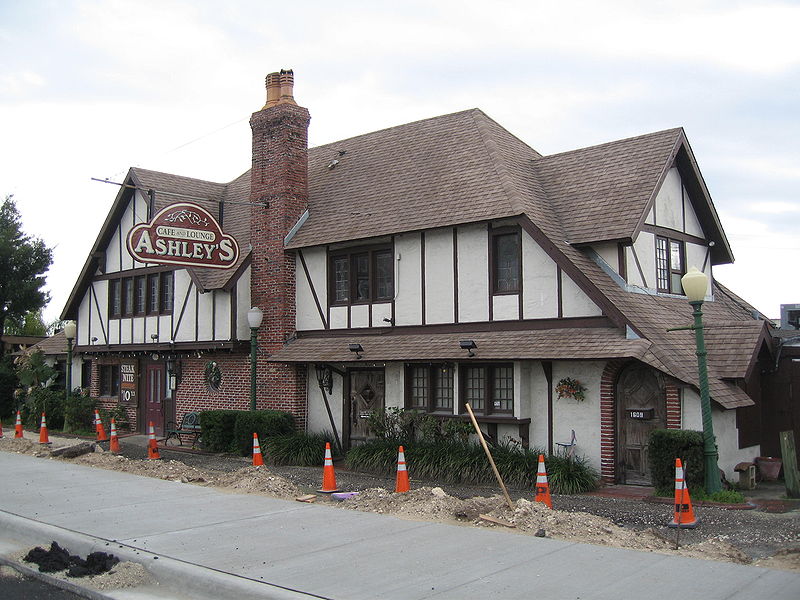
Ashley’s, 2010, by Leonard J. DeFrancisci. Courtesy of Wikipedia.

Some believe that Ethel Allen’s rough road to her grave included a stop at Jack’s Tavern, her favorite local hangout. Several years ago, I wrote about paranormal investigators conducting an EVP session at Ms. Allen’s grave in the Crooked Mile or Georgiana Cemetery on Merritt Island. After asking if she was present, investigators received a reply, “yes.”

On November 21, 1934, Ethel Allen’s mutilated body was found on the banks of the Indian River in Eau Gallie, some 16 miles away. The nineteen-year-old had been seen just a few days before when she stopped at a local packing house to say goodbye to a friend. Ethel was leaving to visit her mother, accompanied by a male acquaintance and she may have also stopped by her favorite local hangout, Jack’s Tavern, now Ashley’s of Rockledge. The Tudor-style restaurant has paranormal activity, some of which has been attributed to Ethel Allen.

A variety of sources state that Ethel may have been murdered within the walls of the restaurant in a storeroom (possibly near the famously haunted ladies restroom) or just outside the building. A local genealogy blog makes no mention of where Ethel may have met her end, but I get the feeling it probably was not in or around the busy tavern. The stories of the restaurant’s haunting are readily available though they seem to perpetuate different variations of the murder.

The activity runs the gamut from simple, cold breezes to voices and screams to full apparitions being seen and captured on film. Some sources also note that the activity does not seem to be limited to just the possible shade of Ethel Allen. There are other possible spirits including a child and an adult male. It seems that Ashley’s may be one of the most paranormally active restaurants in the state.

Sources

  • Boonstra, Michael. “1934 Murder of Cocoa’s Ethel Allen.” Michael’s Genealogy and Brevard County History Blog. 9 April 2011.
  • History. Ashley’s of Rockledge. Accessed 3 November 2014.
  • Jenkins, Greg. Florida’s Ghostly Legends and Haunted Folklore: Vol. 1 South and Central Florida. Sarasota, FL: Pineapple Press, 2005.
  • Neale, Rick. Brevard’s spookiest spots are dead center for teams of specter-spotters.” Florida Today. 27 October 2013.
  • Thuma, Cynthia and Catherine Lower. Haunted Florida. Mechanicsburg, PA: Stackpole, 2008.
  • Walls, Kathleen. Finding Florida Phantoms. Global Authors Publications, 2004.

Haunted? Believe it or not–Florida

It’s one of the few memories from my family’s visit to St. Augustine in 1987. My parents had taken the whole family to Jacksonville, Florida for the Ramses II exhibit and we decided to spend a day in St. Augustine as well. The mix of ancient buildings and gardens along with the mysterious tourist attractions was intoxicating to my ten-year-old self.

After exploring the battlements of the Castillo de San Marco, I was drawn to the castle a short walk down the street. The brochure—that I had undoubtedly picked up at the visitor’s center—promised dazzling things inside the RIPLEY’S BELIEVE IT OR NOT MUSEUM (19 San Marcos Avenue) and I begged to go inside. My parents allowed me to go into the lobby and I was greeted by a water spout seemingly suspended in mid-air with water pouring out of it. Running out the door again, I whined even more, though my parents held firm and wouldn’t let me explore the museum.

I was drawn to this mysterious, castle-like building that houses the Ripley’s Believe It or Not Museum. Photo Michael Rivera, 2016, courtesy of Wikipedia.

Instead, we went to see the Fountain of Youth where I distinctly remember being disappointed that the water—which Ponce de Leon had supposedly searched for—was poured from a Tupperware container into paper Dixie cups. And even worse, it didn’t even taste special. Perhaps my disenchantment stems from not being allowed to view the mysteries of the Ripley’s Museum? Regardless, I fell in love with St. Augustine that day.

Had I known about the ghosts that reside inside the museum, I would have begged even more. My interest in ghosts was burgeoning at the time, and I would have been thrilled to meet the spectral resident of the museum.

Florida has four Ripley’s Believe It or Not Museums and thanks to a recent article in the Northwest Florida Daily News regarding the Panama City Beach location; I now know that three of the four—the third location is Key West—have paranormal activity.

Of the three haunted locations, the St. Augustine museum is the oldest and the most historically significant. The museum occupies an enormous Moorish-style castle built as a private winter escape in 1887 by businessman William G. Warden. A business partner to John D. Rockefeller and Henry Flagler, two of the most influential businessmen of the day, Warden served as a senior executive for Standard Oil. Notably, Henry Flagler is credited with establishing Florida as a vacation destination. Warden contracted the noted New York City architectural firm of Carrère and Hastings to realize his Moorish fantasy.

Warden Castle, as it was called, was occupied by the Warden family until the late 1930s. Pulitzer Prize-winning Florida novelist Marjorie Kinnan Rawlings and her husband purchased the property in 1941 and remodeled it into a hotel. Tragedy visited the concrete castle early on the morning of April 23, 1944. What is believed to have been a carelessly dropped cigarette ignited a fire on the third and fourth floors. Two female guests died in the fire and the St. Augustine Record notes that both were seen standing and screaming for help from the windows of their rooms before they succumbed to smoke inhalation.

During the decade that the castle welcomed guests, cartoonist and traveler Robert Ripley visited and was intrigued by the castle. He realized that the dazzling Moorish castle would provide an apropos backdrop for his collection of wonders.

Ripley inquired of the Rawlings and her husband if the castle might be for sale, but they turned down his offer. Seeking an appropriate monument to Ripley after his death, his estate purchased the building after his death in 1949. In 1950, the first Ripley’s Believe It or Not Museum (or Odditoriums, as they are often billed) opened its doors to the curious public. According to Wikipedia, there are 32 museums worldwide since 2010.

Certainly, it can be expected that Ripley’s collection—which includes shrunken heads, objects of religious devotion, and shamanistic items—is replete with spirit energy and attachments, but it seems that the spirit of one of the women who died in the fire is quite active. A St. Augustine Record article from 1998 provides several reports of museum staff seeing a woman standing in one of the windows. One employee stated, “She was just standing in the window on the third floor, looking out. I thought it was a maintenance man, but then I realized there was no one in the building.” Another chimed in with her own encounter, “I was driving to work early in the morning. I was at the stop light (at Castillo and San Marco) and saw her at the penthouse window.” The penthouse window is on the fourth floor and once looked out of the room where one of the women died.

Two weeks previous to the article, yet another staff member saw a figure at the fourth floor window, this time, though he was able to make out some detail. “She had medium length hair and was wearing a robe or gown, but it was too dark to see her clearly. It was definitely feminine, though.”

More recently, author Dave Lapham explored the paranormal side of the museum in several of his book. He writes in his 2010 book, Ghosthunting Florida, that he had investigated the museum previously with a sensitive friend who picked up on the spirit of a female who had suffocated and died of smoke inhalation. According to many staff members that Lapham spoke with, the activity at the museum has continued unabated with some of them having a wide variety of sometimes frightening experiences. A few have felt someone pulling or playing with their hair while one tour guide had the feeling of someone clutching her by the throat rendering her unable to speak. When she was finally able to talk, she could only utter a few phrases in French. She retired the very next day.

Since uncovering the haunted nature of the building, the museum has begun haunted tours that lead visitors through the museum to point out spots associated with paranormal activity. The Key West RIPLEY’S BELIEVE IT OR NOT ODDITORIUM (108 Duval Street) also has a resident spirit that can get physical. In a 2014 Key West Citizen article, the general manager reported that he had been shoved by the unseen entity. This location is not the first haunted location on Key West that the museum has occupied. For a few years in the 1990s, the museum occupied the old Strand Theatre at 527 Duval Street. The theatre still stands, though it has now been ignominiously converted into a Walgreen’s Pharmacy.

According to author Leslie Rule, the Strand Theatre was the residence of a young boy’s spirit. The child was the son the theatre’s projectionist who had gone to work with his father on a July day in 1934. When the projector caught fire, the child was trapped behind a wall of flame and perished. Still mourning his son’s death, the father is believed to have returned to the building after his own death.

The Odditorium’s current location has a little girl’s spirit that is joined by spirits related to some of the objects in the museum’s collection and the museum offers overnight paranormal lockdowns to allow the public to meet these spirits. Perhaps the recently opened Panama City Beach location (9907 Front Beach Road) might also begin offering similar public tours now that a recent investigation has provided evidence of paranormal activity in this museum.

The Ripley’s Believe It or Not Odditorium, Panama City Beach, 2008. Photo by Joseph Kiernan, courtesy of Wikipedia.

The museum opened in 2006 in a building that is built to resemble the foundered stern of an ocean liner. In March, Two Crows Paranormal was called to the museum to investigate paranormal activity that had been witnessed by guests and staff. A host of odd sounds, disembodied footsteps, and even full apparitions had been witnessed in the building. The most striking piece of evidence involved a tribal African executioner’s table. Investigators using a Structured Light Sensor (SLS) camera detected a figure near the table. The figure appeared to kneel next to the table and its head disappeared.

The SLS camera is one of the newest tools in the paranormal investigator’s toolbox. The technology was initially in the Xbox Kinect gaming system to allow players to interact with the console through physical gestures. Recently, it was discovered that the system sometimes picks up beings that are not visible and the technology has been used in ghost-hunting to detect spirits. While I cannot vouch for the validity of using the camera, the results are still quite fascinating.

One of the other interesting bits of evidence captured came when the team was using a voice box near the figure of an African god. When one of the investigators set the voice box down near the figure, a voice came through the box saying, “get ready, Spinks” (one of the investigators was Dave Spinks) and “behold.” Moments later, the voice box stopped working and did not work for a few weeks after the investigation. If the figure was able to render the voice box inoperable, I wonder what effect it might have on living humans. Visit these museums to see if you believe they are haunted or not.

Sources

  • Cox, Dale. “Historic Warden Castle – St. Augustine, Florida.” com. Accessed 27 July 2017.
  • Dion, Eryn. “Paranormal team uncovers evidence of ghosts at PC museum.” Northwest Florida Daily News. 10 July 2017.
  • Grogan, Mike. “The spirit of Ripley’s past reappears.” Augustine Record. 22 August 1998.
  • Lapham, Dave. Ancient City Hauntings. Sarasota, FL: Pineapple Press, 2004.
  • Lapham, Dave. Ghosthunting Florida. Cincinnati: Clerisy Press, 2010
  • Miles, Mandy. “Believe it or not.” Key West Citizen. 21 December 2014.
  • Rule, Leslie. Coast to Coast Ghosts. Kansas City: Andrew McMeel Publishing, 2001.

“Dude, Scary Lady!”—New Bern, North Carolina

The British most certainly love their ghosts. A few grainy seconds of Snapchat video that may show a ghost at New Bern, North Carolina’s Tryon Palace, has been making waves in Britain and here, “across the pond.” Articles in the Daily Mail and the Daily Mirror, both British newspapers known for their snarky and sensational, tabloidesque reporting, discuss the “chilling” video.

Two visitors from Goldsboro, North Carolina were touring the palace with their cellphone capturing everything on video. In one of the building’s parlors, the camera scans over a doorway that is first seen empty. As the camera scans back over the same doorway, a woman in period clothing is seen walking past. The video is captioned, “Dude Scary Lady.”

The woman appears for about a second as she walks quickly past the doorway holding a basket, or perhaps, a hat to her side. The figure reminds me of the servant girl that French painter Jean-Etienne Liotard painted in his circa 1745 painting, The Chocolate Girl. Could these two young visitors have captured the image of a ghost?

Jean-Etienne Liotard’s 1745 painting of a servant girl with a cup of chocolate. The “scary lady” in the Tryon Palace video is similarly dressed.

Tryon Palace is a reconstruction of North Carolina’s colonial capitol and governor’s residence. It was constructed overlooking the Trent River just before it meets the Neuse River and quickly spills into Pamlico Sound. From this powerful vantage point, the Royal Governor could reign over his colonial subjects in this wild, new land. Royal Governor William Tryon hired an English architect, John Hawk, to design a graceful and substantial public palace fitting for the King’s representative in the colony. This handsome Georgian palace was constructed over about three years, from 1767-1770, much to the chagrin of the locals who bore the costs of the building through increased taxation.

Construction caused considerable discord among the citizenry, particularly the farmers in the western Piedmont region. Angered by corrupt and greedy tax collectors, these harried farmers, frontiersmen, and landowners rose against the royal government officials in what is now called the War of Regulation. Fought between 1765 and 1771, this series of backcountry skirmishes led to an actual battle fought at Great Alamance Creek in May 1771, one of the many blights on the King’s name leading to the American Revolution.

Tryon Palace, 2017, by Smallbones. Courtesy of Wikipedia.

Governor Tryon only occupied the completed palace for about a year before being reassigned as governor of the colony of New York. Governor James Hassell occupied the royal capitol followed by Josiah Martin who fled on the eve of the Revolution. After rebels seized the building, it served as the governmental seat of North Carolina until Raleigh was established as the state capital in 1792. Afterward, the building was infrequently used for other functions including a boarding house, school, and a Masonic lodge. In February 1798, hay stored in the basement caught fire and destroyed the main building.

Interest in reconstructing the palace surfaced almost a hundred years later and was discussed until the mid-20th century when money was finally raised to rebuild it. Building on the original foundations, the structure arose through the 1950s. The palace now serves as a focal point for history in this most historic of North Carolina cities. Today, costumed interpreters guide visitors through the recreated rooms and moments of daily life from the colonial period.

Despite my years of collecting ghostlore from throughout the South—including numerous stories from New Bern—I have yet to encounter stories from Tryon Palace. Of course, that doesn’t mean there are not stories, just that they don’t appear in any of the material I have collected. According to the articles from the British papers, there are tales of a young servant girl dying in the 1798 fire who may remain in residence in the reconstruction. This is not unheard of as there are stories of ghosts from the Governor’s Palace in Williamsburg, Virginia, the history of which parallels the history of Tryon Palace—it was destroyed by fire during the American Revolution and subsequently rebuilt for Colonial Williamsburg in the 1930s.

As for the video that recently surfaced, there is nothing to indicate that the “scary lady” is a spirit. With the number of costumed interpreters roaming through the palace, the figure in the video is most likely one of them. Having served as a costumed interpreter myself, I have been asked several times if I was a ghost. While we can sometimes be a bit scary, we’re still perfectly alive, thank you very much!

Sources

Of Werewolves and White Screamers—Dickson County, Tennessee

Sometimes aimless searching online produces serendipitous results. Thus, this was the case when I stumbled upon a mention of a place called “Werewolf Springs.” Reporter Josh Arntz of the Dickson Herald wrote a fabulous article about the legend of Werewolf Springs in 2011. He has since done some excellent reporting on several haunted locations within Dickson County. What’s interesting about this legend, is the possible connection with the more well-known story of the White Bluff Screamer located roughly 5 miles away in the same county.

The Dickson County Courthouse in Charlotte, the oldest courthouse still in use in the state of Tennessee. Photo by Brian Stansberry, 2008, courtesy of Wikipedia.

Dickson County retains its rural character despite being within (about 35 miles) listening distance of Nashville’s country music. Several sites within the county are the subject of ghost stories and legends including Montgomery Bell State Park (the location of Werewolf Springs), the small town of White Bluff (where the legend of the White Screamer may be found), and the Clement Railroad Hotel Museum in Dickson (the childhood home of Governor Frank Clement whose parents owned the hotel).

The legend of Werewolf Springs begins with a circus train passing through Dickson County in the late 1860s. The train derailed near the community of Burns, southeast of Dickson, and some of the animals escaped. Among the escapees were a pair of half-human, half-wolf creatures who were exhibited under the moniker, “The Wolfmen of Borneo.” Circus employees caught all the other escaped animals, though the wolfmen were nowhere to be found.

A couple of years later, two locals traveling on a nearby road—where modern State Route 47 now runs from Burns to White Bluff—found themselves being stalked by a large creature. The two men, a local landowner and a hired hand, attempted to outrun the creature, but it caught up with them, and the duo split up and fled into the forest.

The creature pursued the hired hand, and the landowner was shocked to hear the man’s screams and cries as he was presumably torn apart. The hired hand’s body was never located. A mob of locals, I imagine classically armed with pitchforks and torches, formed from nearby farms and towns to bring justice to this dreadful creature. Near the springs where the duo had encountered the beast, the mob led a live goat to a clearing where it was tied to bait the monster. Extinguishing their torches and lanterns, the posse waited with bated breath for the hungry creature to make its appearance.

The prowling creature eventually appeared. The group opened fire then quickly lit their torches and lanterns to see if they had bagged their quarry. The clearing was empty. The creature, goat, and two members of the posse had vanished into the thick night air. With terror, the group dispersed fearing to pursue the mysterious creature any further.

Later, a big game hunter attempted to kill the creature of Wolfman Springs. Setting himself up in a nearby cabin, he slept soundly the first two nights, but on the third night, he heard howling in the distance. A short time later, the frightened hunter began to hear the creature outside his cabin. When it appeared to pass by one of the windows, he aimed and fired. The gunshots only served to rile the creature’s wrath, and it broke down the door. The hunter fired all but two rounds at hairy bipedal, but it only seems to anger more with every shot. With only two rounds left in the chamber, dawn arrived, and the light from the rising sun caused the creature to flee into the shadows of the forest.

Replica of the cabin where the Cumberland Presbyterian Church was founded in Montgomery Bell State Park. Photo 2006, by Leylander, courtesy of Wikipedia.

Just as the sun rose to banish this creature of the night, Arntz sheds some light on the legend and the history of the area. Wolfman Springs is actually Hall Springs which is located in one of the areas of MONTGOMERY BELL STATE PARK (1020 Jackson Hill Road, Burns) that is only accessible by a hike. The springs are named for the Hall family who had a homestead near the springs. The family’s home is long gone, but a small family cemetery remains nearby. A few weeks after the appearance of the Wolfman Springs article, Arntz followed up with an article about a descendant of the Hall family who grew up near the infamous springs. She denied that she ever heard anyone speak of a mysterious creature in the area.

The land that the state park now occupies was purchased by a National Park Service in 1935 to develop the Montgomery Bell National Recreation Demonstration Area. The park’s namesake is local manufacturing entrepreneur, Montgomery Bell, who was instrumental in building the local iron-smelting industry. Interestingly, even he has been pulled into the Wolfman legend. Some tellers of the story feature Mr. Bell as the local landowner, though this wouldn’t be possible as he passed away before the Civil War.

The railroad tracks where the train derailed still run their original course along the southern edge of the park. Evidently, there were several train derailments on this stretch of line, though none that specifically involved a circus train.

What is the origin of this odd story? I can attest that in my research in Southern ghost and folklore, stories involving these type of creatures appear less frequently than ghost stories. Among these stories are the tales of the Pig Woman in Cecil County and a goat-man creature in southern Maryland; the “Bunny Man” who supposedly haunts a bridge in Virginia; the infamous Mothman of Point Pleasant, West Virginia; the Skunk Ape spotted in Florida; the Lizard-Man of South Carolina; Sasquatch activity that may be associated with the haunting of Spring Villa in Opelika, Alabama and throughout the nearby Tuskegee National Forest in Macon County; and the goat-man creature that has led, like a siren, a handful of young people to their deaths at Pope Lick Trestle in Kentucky. Among these stories, I only know of one other wolfman or werewolf-like creature, and that is a story from Talbot County, Georgia that Nancy Roberts documented in her 1997 opus, Georgia Ghosts.

Interestingly, just five miles from Montgomery Bell State Park and within the same county is the small town of White Bluff. For some time, stories have circulated regarding a creature or entity that is known to prowl the community emitting a terrifying scream. Known as the White Bluff Screamer, the explanations appear to fall into two camps: one believing that the screamer is a banshee while the other camp believes the screamer is a cryptid.

Alan Brown, one of the more venerable writers on Southern ghostlore, makes the argument for the banshee camp in his 2009 work, Haunted Tennessee. Relating the “standard version” of the story, he tells of a settler building a cabin in an isolated hollow near town. However, the man and his family were plagued by a high-pitched screaming that woke them every night. Determined to bring peace, the man took his rifle and hunting to pursue the source of the screams. As the man entered the forest, the screams began anew, and the dogs bounded towards them. Though a short time later the dogs returned frightened with their tails between their legs. The settler continued towards the wailing and climbed a hill to get a view of the surrounding landscape. Reaching the summit, the hunter’s ears were besieged with the screaming once again, though this time is seemed to come from the man’s cabin. He sprinted back to his home and discovered his family’s mangled remains.

The story is not really about a banshee as they are rarely known as malevolent spirits, mostly as heralds of death. A banshee would not typically use her wails to distract a man to kill his family. According to West Virginia writer Rosemary Ellen Guiley in her 2007 compendium, Encyclopedia of Ghosts and Spirits, a banshee (or Bean Shide in Gaelic, literally “woman of the fairies”) is “a female death omen spirit of Ireland and Scotland that attaches itself to families…and manifests to herald an approaching death in the family.” She continues, “the banshee most commonly is heard singing or crying, but is not seen.” Speaking with an Irish friend of mine, he noted that banshees are generally considered harbingers and occasionally provide protection to family members when traveling alone or at night. According to him, “the only legends of the banshee killing is if she is disturbed whilst combing her hair. She is reputed to throw her comb, piercing the heart and killing her victim.”

Guiley states that legends of banshees followed the Scots and Irish immigrants who settled throughout the South. One primary legend that appears in Southern folklore is the story of the Tarboro Banshee. Originating in the town of Tarboro, North Carolina on the banks of the Tar River, the story recalls the days during the American Revolution when a patriotic miller operated a grist mill on the banks of the river. Refusing to abandon his operation at the approach of the British, he was captured and drowned in the river, but not before warning his captors of a banshee that would avenge his death.

As the miller sank beneath the brackish water of the river, a wail arose from the watery grave. A feminine form began to take shape in the mist over the river while an agonizing cry was heard on the river banks. The beautiful maiden terrorized the British soldiers responsible for the miller’s death, eventually leading all to grisly deaths. Legend still speaks of the lovely creature appearing over the river waters still mourning the miller’s early departure from this world. I have covered the story of the Tarboro banshee here.

Returning to Middle Tennessee, I need to acknowledge the other camp of thought on the White Bluff Screamer, the camp that believes that the creature may be a cryptid and not a spirit. The authors of the 2011 Nashville Haunted Handbook remark that the creature is commonly heard and sometimes even seen. “Some who see the creature report that it is a white, misty apparition that flits through the woods quickly and ominously in the night…Others report that the source of the screams is an actual creature that resembles an alpaca [a domesticated relative of the llama]: a white furry beast that walks on all fours and stands about six feet tall with a face resembling a camel.” It should also be noted that alpacas can produce a high-pitched whine or scream when frightened.

Screaming is also a purported characteristic of the Sasquatch or Bigfoot. Some witnesses have been able to record the mysterious screaming that may be produced by a sasquatch. This leads me to believe that there may be a connection between this screaming creature and the Sasquatch, though the description that this creature is a quadruped rather than a biped puts that connection into jeopardy.

Returning to the creature that may haunt “Werewolf Springs,” in recent years screaming has been reported in the area. Josh Arntz in his Werewolf Springs article ends with a report from a local teacher who “heard ‘the most blood-curdling scream’ from a wild animal at 1 a.m.” near the park inn on Lake Acorn. The teacher also reported to have heard “plenty of eerie sounds while walking through the park’s woods at night.”

There are several creatures native to the area that can produce human-like screams in the night including fox and bobcat. Regardless of whether these stories contain any truth, they have left a marvelous mythological legacy on the landscape.

Sources

  • Arntz, Josh. “The half-wolf, half-man of Werewolf Springs.” Dickson Herald. 28 October 2011.
  • Arntz, Josh. “Hall Springs resident debunks werewolf myth.” Dickson Herald. 28 December 2011.
  • Brown, Alan. Haunted Tennessee: Ghosts and Strange Phenomena of the Volunteer State. Mechanicsburg, PA: Stackpole Books, 2009.
  • Corlew, Robert E. “Montgomery Bell.” Tennessee Encyclopedia of History and Culture. 25 December 2009.
  • Guiley, Rosemary Ellen. The Encyclopedia of Ghosts and Spirits, 3rd NYC: Checkmark Books, 2007.
  • Manley, Roger. Weird Tennessee. NYC: Sterling Publishing, 2010.
  • Morris, Jeff; Donna Marsh; and Garret Merk. Nashville Haunted Handbook. Cincinnati, OH: Clerisy Press, 2011.
  • Nichols, Ruth D. “Montgomery Bell State Park.” Tennessee Encyclopedia of History and Culture. 25 December 2009.

The Myth Keepers – Review of the Chattanooga Ghost Tour

Traveling through the Old Country one may find it so deeply rooted in myth that storied places crowd the landscape; by contrast, the vast American landscape is not so studded with stories, mythic or otherwise, for a variety of reasons. Americans, by their nature, are a forward thinking people who may disregard the relics of the past. With every historic site fated for a date with a bulldozer or old building that succumbs to a wrecking ball, fantastic stories are hauled off to the dump within every heap of earth, brick, steel, or wood. In places where history is not so carelessly razed in the name of progress, the myths are able to take root.

The thought occurred to me as I was on the Chattanooga Ghost Tour the other night, that in many places ghost tours are the only real keepers of local mythology in the classic oral tradition. Certainly, the stories being told on these tours are not myths in the sense of being fictitious, they often come directly from history and often include experiences that have occurred to the guides or their associates. But that these ghost stories are a way of explaining local history makes them myth-like. Ghost stories themselves also preserve some of the more gruesome and salacious moments from history, moments that can help to add living and emotive flesh to the skeletons of those long dead.

The original terracotta jail sign from the original Hamilton County Jail has been preserved in front of the current Justice Center. Photo 2017, by Lewis O. Powell IV, all rights reserved.

When the Hamilton County Jail was demolished in 1976 to make way for the modern Hamilton County Justice Center, wrecking crews presumably hauled away the remains of the jail’s gallows that had once stood in the building’s basement. The final executions on this gallows were of two young African-American men who had been charged with the murder of a saloon keeper. News of the execution appeared in a number of national papers including the Evening Star in Washington, D.C. which included this note on page two of its January 11, 1895 edition:

TWO MURDERERS HANGED.

George Mapp and Buddy Wooten Punished for Their Crime.

CHATTANOOGA, Tenn., January 11. – George Mapp and Buddy Wooten, two young negroes, were hanged in the execution room of the county jail a few minutes after 8 o’clock this morning. Wooten died a Catholic, and Rev. Father Walsh was with him on the scaffold.

Mapp, however, refused to have a minister with him. He requested that his body be thrown in the river, and said he would be back tonight to haunt the sheriffs and others who had anything to do with his conviction.

The two negroes murdered Marion L. Ross, an aged white saloon keeper, on Saturday night, December 17, 1892. Robbery was their intention in committing the crime. Wooten confessed, implicating Mapp.

It’s interesting to see Mapp’s threat (some newspapers report that it was Wooten making the threat) included in the newspaper accounts of the execution. Near the gallows in the basement of the jail, there was a series of holding cells—a kind of death row, if you will. Even after Mapp and Wooten’s executions when the gallows sat unused, these holding cells were used. It is reported that when one of these cells was occupied by a particularly rowdy prisoner, a mist would appear and pass over the cell calming the prisoner within.

According to our tour guide, Kevin Bartolomucci, a current jail employee has also noted that when a rowdy prisoner is placed in the holding cell in the processing area, a few times an odd mist has appeared and calmed the prisoner. It seems that death and the transition from and old building to a modern one hasn’t banished the spirits of these two prisoners.

Tour guide Kevin Bartolomucci spins tales about the Hamilton
County Courthouse behind him. Photo 2017 by Lewis O. Powell IV, all rights reserved.

The Chattanooga Ghost Tour was established in 2007 by Amy Petulla, and it has grown in the ten years it has haunted the streets of Chattanooga. As she was establishing the tour, Amy also joined forces with Jessica Penot to write Haunted Chattanooga, which was published in 2011. Amy sent me a personal invitation to take part in the tour’s grand reopening and tenth-anniversary last weekend. The tour recently had to relocate its offices after the collapse of the 1876 building that housed the offices along with a restaurant. Fortunately, the collapse affected the front portion of the structure only affecting the restaurant, though the building was found to be structurally unsound and demolished.

The new office has a marvelous steampunk feel and visitors are greeted by a talking skull appropriately named Yorick. The new location has also afforded Petulla the ability to introduce a new tour that was debuted along with the festivities. The “Murder and Mayhem Tour” leads visitors on a pleasant walk through some of Chattanooga’s most harrowing murders and history, many of which have left spiritual residue. Along the way, patrons are introduced to murderers, their victims, prostitutes, and a kindly theatre patron, all inhabitants of the pantheon of Chattanooga myths. Besides the new tour, Petulla offers a handful of different tour experiences, some of which involve using various types of ghost hunting instruments. Of the many ghost tours I have taken, this tour ranks among the best for keeping the myths of Southern history alive.

One of the more iconic views along the route of the Chattanooga Ghost Tour: looking up West 8th Street towards the Dome Building, formerly home to the Chattanooga Times. Photo 2017 by Lewis O. Powell IV, all rights reserved.

On your next jaunt through Chattanooga, be sure to enjoy an introduction to the mythological side of this city!

Please visit the tour’s website for further information. https://chattanoogaghosttours.com/.  

Sources

  • Chattanooga Ghost Tours. “Murder & Mayhem Tour.” Led by Kevin Bartolomucci. 10 June 2017.
  • “Two Murderers Hanged.” Evening Star (Washington, D.C.) 11 January 1895.

“Ghosts in High Carnival”—Atlanta, 1904

According to two 1904 editions of Atlanta Constitution, Atlanta’s phantasmagoric scene was in “high carnival.” The first article that appeared towards the end of January tells of an African-American family who was evidently plagued with a poltergeist. Generally, poltergeist activity centers on an adolescent female who may project the fears and confusion she is experiencing onto the physical environment around her, though, in this account the activity revolves around a young boy. The details of the story certainly show that this child’s situation was not ideal and likely put this young boy under a huge amount of stress.

Atlanta at this time, in fact, much of the South as a whole, was not a pleasant place for a young, poor, African-American child. The racism that permeated all levels of life is quite obvious here, but there is a much crueler subtext in the play on words in the title. “Spook” is not only a synonym for ghost but also a pejorative term for African-Americans.

The rental house where this took place does not appear to exist, and the address points to an area that is now quite developed.

 Atlanta Constitution

28 January 1904

 SPOOKS PLAY QUEER PRANKS

 Remarkable Ghost Story in Which Police Took a Hand.

 A remarkable spook story developed yesterday in a negro house at 360 Chapel street, in the rear of Smith & Simpson’s lumber yard. This spook story differs from the ordinary tales of the kind in that police officers took a hand and two of them actually saw the ghost doing his supernatural stunts.

Fully a thousand people visited the scene during the day and stories are told which have some very extraordinary features.

In the house there lived an old negro man, his aged wife and a little boy. The family moved into the house only a few days ago. Two nights ago, the table began to dance, the old man was hurled from a trunk and chairs in the house cut up all sorts of antics.

The negro told his neighbors about it and a large number of people saw the table moving about the house yesterday morning. The excitement became so great that three or four policemen went to the place. Among them was Call Officer Luck, who states that he saw the table jump about the floor, and, finally, turn over, breaking a lot of dishes. Sergeant Beavers also witnessed the remarkable phenomenon. What caused the table to move no one can say.

The old negro states that he has moved eighteen times during the past 12 months in order to get rid of spooks. In every house he has lived the table and chairs have moved about of their own free will, so he claims, and every dish he buys is broken. Chairs have also taken a notion to dancer over the house.

Yesterday afternoon the old man moved again, and the rent which he had paid in advance, was returned to him.

Sergeant Beavers says he believed the work is done by the negro child, for he noticed that whenever the boy approached a piece of furniture it began to move. He thinks the boy is possessed with some subtle electric power, such as made the exhibitions of Lula Hurst so remarkable.

When police officers saw the table skip across the room and beheld it overturned and all the dishes on it broken, they made an investigation, and could find nothing which would explain the matter.

The negroes in the neighborhood are greatly excited over the affair, and they believe firmly that the old negro is followed by ghosts. Somebody offered $100 to any negro who would sleep in the house last night, and the offer was not taken up.

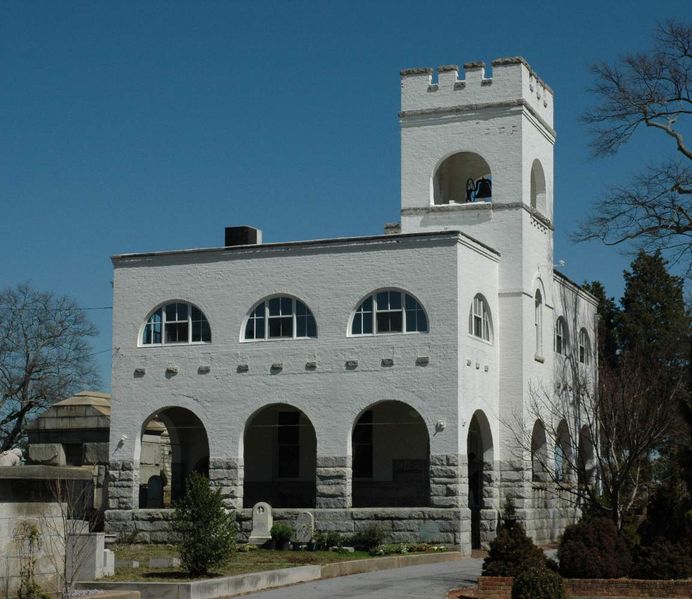
It’s also interesting to see the police investigating this odd case. Stories of similar poltergeist cases have also been investigated by law enforcement and sometimes even they come away having witnessed things they cannot explain. The next story from the Constitution also involves the police, but in this case this one officer was scared out of his wits by odd sounds within Oakland Cemetery. The keeper’s lodge where this officer had been stationed during his cemetery vigil remains and is now occupied by the offices of the Historic Oakland Foundation and visitors center. This building was still fairly new in 1904, having only been constructed in 1899.

The Oakland Cemetery Bell Tower and Keeper’s Lodge where a police officer heard disembodied footsteps in 1904. Photo 2005, by AUTiger, courtesy of Wikipedia.

Atlanta Constitution

25 May 1904

 GHOSTS IN HIGH CARNIVAL AROUND OAKLAND CEMETERY


According to all reports there are ghosts in Oakland cemetery, and even the members of the police department are giving the place a wide berth after nightfall.

Curious noises in all parts of the cemetery during the night are said to have been heard as of late, and at the keeper’s lodge, near the center of the burial place, the sound of footsteps can be heard stairs at all hours of the night. When these are investigated, no trace of anything living or moving can be found. As soon as those interested return to the office below the noise starts again.

A policeman, detailed for duty at the cemetery a few nights ago, tells an interesting story of his experience with the thing supernatural.

“I was in the keeper’s lodge, just starting to eat a lunch that had been brought me,” said the officer, “when I heard footsteps upstairs. Thinking possibly my ears were deceiving me, I refrained from speaking to the lad who had brought my lunch, but an instant later he called my attention to the fact that there was someone walking around on the upper floor.

“I drew my revolver and walked up the stairs, the boy folloing me. We searched every nook and corner of the place, but failed to find anything living, not even a fly being visible. We returned to the lower floor and no sooner had I resumed the eating of my lunch than the footsteps were heard again, this time even more distinct than on the first occasion.

“Thinking possibly I could see from the outside, I rushed into the open air, and as I stopped, when a few feet away, and turned to look at the upper story of the keeper’s house, I heard a slab fall in the one of the nearby vaults.

“Hurrying in the direction of the vault from which the sound came, thinking to surprise grave robbers at work, I was astounded to find the door to the vault securely locked, and not a trace of anything living in the neighborhood. This, despite the fact that I had heard, very distinctly, but an instant before, the falling of a marble slab in the vault.

“After a thorough search of the surrounding lots, I returned to the keeper’s house and the first thing that greeted my ears when I entered the door was the sound of footsteps upstairs again.

“For the second time I hurried to the upper floor and made a thorough search. Diligent, careful and complete as it was, I failed to find even a suspicion of a living object.

“I endured the unearthly noises until time for my relief next morning, but there can be no more Oakland cemetery jobs for me. The next time I am detailed to the graveyard I am certainly going to be sick. I can stand up and fight a live man and take the whipping, if he is the best man, but I absolutely refuse to have to treat with things that make all manner of noises and peculiar sounds but do not show anything to the eye.

Others in addition to this officer, have told of peculiar noises in Oakland at night, and quite a stir has been created among those living in the vicinity of the cemetery.

Oakland Cemetery is indeed believed to be haunted and I have written about some of the more recent experiences here.

Sources

  • “Ghosts in high carnival around Oakland Cemetery.” Atlanta Constitution. 25 May 1904.
  • “Spooks play queer pranks.” Atlanta Constitution. 28 January 1904.

The Unhappy-Go-Lucky Ghost–Georgia

Historic Baker County Courthouse
Courthouse Square
Newton, Georgia

 Georgia’s Southwest corner seems to have been mostly forgotten. The sparsely populated counties (mostly) that comprise the Plantation Trace region are some of the poorest in the state. Once served by the railroads, this area now lacks connection to any interstate highway which has led to much of the isolation from which the region suffers. Even one of the few major urban areas that anchors the region, Albany, is about 45 miles from I-75. Newton, the county seat of Baker County, has a long, quiet history marked by the flooding of the Flint River. Courthouse Square, once the beating heart of this rural county, is now a collection of weedy lots surrounding the still grand turn of the century courthouse, thanks to the severe 1994 flood that submerged the whole area.

Old Newton County Courthouse, 2017, by Michael Rivera. Courtesy of Wikipedia.

While many of the living residents have fled this dried-up region, they have left behind history and ghosts. Sometimes the most fascinating history and the occasional ghost story can be found in the merest of footnotes. Thus, is the case of the Historic Baker County Courthouse and its happy-go-lucky architect, J. W. Golucke. Here, in burgeoning Newton, Mr. Golucke’s luck ran out and he met his sad fate. Many sources now refer to Golucke’s magnificent courthouses that still adorn many of Georgia’s county seats, but few make much of his death. A brief webpage from the Union County, Georgia Historical Society mentions his death and the possibility that he is still in residence in Newton.

The son of a German cabinetmaker, James Wingfield Golucke was born in either Taliaferro or Wilkes counties in east central Georgia in 1857. He was self-taught and began working as an architect in 1891. He quickly rose to prominence with his ambitious designs that transformed the overused classical architectural vocabulary to create graceful structures that seemed to evoke the power of law and justice with stone, bricks, and mortar. In 1904 in Newnan, Golucke ambitiously designed the Coweta County Courthouse which “displays a colossal pride and verticality with which, portico, building mass, and clock dome virtually stand ‘at attention,’” and at the whopping cost of $56,998. Courthouse squares from Blairsville to Sylvester, and Crawfordville to Zebulon, were graced with Golucke designs. He also created a number of other public buildings including schools and hotels.

An advertisement from The Atlanta Constitution, 18 September 1904.

The one remaining photograph of Mr. Golucke gives the impression that the young architect was perhaps a dandy. He stares out of the black and white with a haughty expression belying his brashness. His long face is accented with artistically tousled hair and a stylish mustache. He could easily be one of the Bohemians inhabiting attics and studios in Paris at the time, but he was a self-made architect in Atlanta. It’s not hard to imagine that he was most probably a member of the local “smarter set.”

He was engaged to design the courthouse for Baker County in Newton, but then during the construction Golucke and R. F. Hemphill, president of the Atlanta Fireproofing Company, were arrested for forgery. The Atlanta Constitution explains: “The whole trouble grows out the fact that it is alleged these two men altered a bond for $50,000, bearing the date of May 3, 1906, and changed it to make it read May 1, 1906. This is claimed to have been done with the intention of defrauding not only the Aetna Indemnity company, who went the surety, but also the county of Baker.” The paper continues, “Both Golucke and Hemphill, it is further claimed, contracted to construct a court house for the county in Newton some two years ago, but it was not finished by the time named.”

I’m no legal expert, but it seems that the county was upset that the courthouse wasn’t completed on time and trumped up the forgery charges in order to hold someone accountable. The 1991 county history sympathically remarks that Golucke proclaimed his innocence and suggested that he had not followed the building of the courthouse very closely. The county history continues, “Some local residents of that era have indicated suspicion that Golucke may have been wrongfully blamed for the misappropriation of funds and that someone locally may have been involved and used the self-made designer as a scapegoat.”

Both Golucke and Hemphill were arrested September 20, 1907 and held in Newton under a $20,000 bond. The paper takes pains to note that Golucke was held in town under the bond, though not held in the jail. Perhaps he was getting celebrity treatment? The 1991 county history states that Golucke wrote that he “could not stand being confined in jail and the disgrace it had brought upon him and his family.”

A little more than two weeks later the paper reports that Golucke attempted suicide during his confinement in the county jail in Newton. The brash young architect used a piece of glass to cut his wrists and throat but was spied by an African-American prisoner who raised an alarm. Doctors suspected that he was under the influence of some type of drug as well as he “lingered in a comatose state last night and was believed to be in a desperate condition.” He had left a suicide note.

The paper was silent on the subject until a death announcement appeared a few days before Halloween. Evidently, Mr. Golucke had recovered from his injuries but his life was ended by an attack of gastritis. An obituary suggests that he died from a brain fever. Regardless, this brash, likely innocent wraith is still identified as the spirit that roams the courthouse that brought on his sad fate. The courthouse itself, still standing as a startling sentinel among the barren town square, no longer serves as a courthouse after the disastrous 1994 flooding of the Flint River. Instead, it has been resigned to serve, no less nobly I might add, as the local library.

Sources

  • “Atlanta Man Tries Suicide.” Atlanta Constitution. 8 October 1907.
  • Baker County Historical Society. The History of Baker County. Roswell, GA: WH Wolfe Associates, 1991.
  • “Death takes J. W. Golucke.” Atlanta Constitution. 28 October 1907.
  • “Two Atlantans Are Indicted.” Atlanta Constitution. 22 September 1907.
  • Union County Historical Society. “The Ghost of J. W. Golucke.” Accessed 26 March 2017.

A Big Fish of a Ghost Tale–Albany, Georgia

From the banks of the Flint River in Albany, Georgia, this ghost tale made the rounds of newspapers throughout the country in 1888. According to Dale Cox at the ExploreSouthernHistory blog, this story first appeared on July 9th of that year. Cox mentions that the tale of the headless equine is a holdover from Medieval culture and the spirit in the story is usually that of a woman cursed by God for her great sins. Whatever the origin of this spirit, ghosts do remain along the Flint as it passes through Albany especially in Bridge House, the home to the city’s welcome center.

Broad Avenue Bridge over the Flint River in Albany. Photo 2015, by Michael Rivera, courtesy of Wikipedia.

The Wilson Mirror
Wilson, North Carolina
22 August 1888

 A FISHING STORY.

 How Dink Melvin was Haunted by a Headless Horse.

 Everybody in Albany knows Dink Melvin, the fisherman and boatman, and doubtless every one who has ever been on a fishing expedition with him up the Muckalee or Kinchafoonee has heard the story he tells about a ghost that haunts the banks of the river in the vicinity of the Fair Grounds, says the Albany News and Advertiser.

The ghost that Dink describes most eloquently is in the shape of big white horse without a head. The horse is perfect in shape except he has no head, and Dink says that he has been seeing it for the five or six years. Its trysting place is along the river banks in the vicinity of the Fair Grounds, and Dink says that he can show it to any man that will go with him after nightfall. If he gets in his boat and rows across the river the big white horse follows him to a certain place, and then disappears. It has given him several bad frights, and one Sunday evening as he was returning from the creeks above, the thing came right up to his boat and seemed to be trying to put its fore feet in. Dink says that he has been scared a good many times, but this was the worse fright he had ever had in his life.

The reporter was one of a fishing party that camped on the Muckalee one night last week, and heard Dink tell this wonderful story.

“I’d just like to see some man that had the grit to shoot at the thing, but I wouldn’t care to close to be him when he done it,” said Dink.

“Well, sir, you take me there and show it to me, and I’ll shoot at it,” said the scribe.

“No, sir; boys don’t you do it,” interrupted Harrison Pettis, the scribe’s faithful boatman, from the outer edge of the tent, “Kase I tell you why—I knowed a man what shot at a ghos’, an’ he died in erbout three weeks. No, sir; don’t you shoot dat thing, for I don’t want you to die.”

An engagement was made with Dink to visit the haunted spot, but at the appointed time Dink begged to be excused saying that he was sick and did not feel well enough to take the walk and face the ghost. He then promised to call for the scribe between sundown and dark on the following evening, but he failed to show up.

Sources