Zak Bagans of the Travel Channel’s paranormal show, Ghost Adventures, described the history of the South’s most genteel port city, Charleston, as “just layers and layers on the dark history cake.” It’s certainly an interesting analogy, though I must confess that I often find Mr. Bagans’ antics annoying. In fact, I have been known to refer to his team’s techniques as the “ADHD method of ghost hunting.” However, I am excited to see they are investigating Charleston’s Old City Jail.
The Old City Jail. Photo 2011, by Lewis Powell IV, all rights reserved.
Back in July, my love affair with Charleston was rekindled when I spent nearly a week there. I spent my days wandering the streets making a pilgrimage to sites that I’ve spent years reading about, including the Old City Jail. The building is a massive, looming structure that seems to glower down upon anyone passing along Magazine Street. If a building could threaten someone, this building would threaten a horrible, miserable death. Staring up at the crenellated turrets, decaying bricks, windows like empty eye sockets, and the massive and thick brick walls, it’s hard to imagine this place could not be haunted. The memory of it sends a chill up my spine.
For 137 years, 1802 to 1939, this hulking castle groaned with the cries of prisoners. The property upon which the building was constructed had originally been set aside for public use in 1680, and contained, at various times, a hospital, and a poor house. For many years, a workhouse for slaves called the Sugar House stood next to the hulking jail.
Slaves found “wandering” the streets were held in the Sugar House until their owners bailed them out. While locked away here, slaves would be forced to work on a treadmill to grind corn for use in the jail. This constantly turning treadmill often injured and maimed the slaves, and at times their bodies or body parts would end up in the ground corn.
The jail itself was just as harsh with inmates locked away in large, group cells, instead of individual cells. The most dangerous prisoners, or those that were possible escape risks, were chained to the floor. Men and women were not separated, and all had to live in filth where vermin, infection, and disease were rampant.
The Robert Mills addition to the Old City Jail. Photo 2011, by Lewis Powell IV, all rights reserved.
Among the many unfortunate souls who passed through the building’s Gothic portal was the legendary couple, John and Lavinia Fisher, who lived their last days in the moldy, dark halls of this place. Their ghastly tale involved them murdering guests of the inn that they ran just outside town. While this legend is the focal point of many tour guides’ tales, A recent book has freed the couple from the shackles of their legendary crimes. Bruce Orr, a former Charleston homicide detective, explored the legend of the couple, their crimes, and their supposedly defiant ends discovering that all but the most basic facts were just myth. In fact, there is nothing to even corroborate that the spirits within the jail are even the revenants of the Fishers.
The harsh conditions led to the building of a new jail in the late 1930s. In recent years, a group led by the American School of Building Arts has been working to restore the crumbling castle on Magazine Street. Ghost tours now bring tourists through the damp halls that still echo with spirits.
Among the activity that Mr. Bagans and his crew might encounter inside the old jail are spirit voices, apparitions, and even physical contact. Staff and visitors have had numerous experiences. One of the more intriguing episodes was recorded in a 2002 article in the Charleston Post & Courier: a worker leaving the building late one evening felt that he wasn’t alone. This was confirmed when his flashlight beam picked up a grayish, gaunt man standing to the right of the exit door. He stared at the man for a moment and when he moved towards the man he disappeared, only to reappear on the left side of the door. The figure then vanished and the worker fled. Yet another layer in the cake of history…
Sources
ABC News 4. “’Ghost Adventures’ heads to spooky Charleston scene.” 19 October 2011.
Barbour, Clay. “Eerie, dark history haunts Old City Jail.” The Post & Courier. 27 October 2002.
Behre, Robert. “Old City Jail now a national treasure.” The Post & Courier. 28 May 1999.
National Park Service. “Old Jail.” Charleston’s Historic, Religious and Community Buildings. Accessed 7 August 2011.
Orr, Bruce. Six Miles to Charleston: The True Story of John and Lavinia Fisher. Charleston, SC: History Press, 2010.
Shaker Village of Pleasant Hill 3501 Lexington Road Harrodsburg, Kentucky
‘Tis a gift to be simple, ‘tis a gift to be free, ‘Tis a gift to come down where we ought to be And when we find ourselves in the place just right, ‘Twill be in the valley of love and delight.
When true simplicity is gained, To bow and to bend we shan’t be ashamed, To turn, turn, ‘twill be our delight, ‘Till by turning, turning, we come round right. –“Simple Gifts,” 1848 by Elder Joseph Brackett
Two restored buildings on a quiet winter afternoon. Photo by Local Louisville. Licensed with Creative Commons.
The members of the United Society of Believers in Christ’s Second Appearing are simply known as Shakers. It is a name that refers to their worship services that would include a form of spiritual cleansing by literally and symbolically shaking. This religious order appeared in eighteenth century England from among charismatic Christians reacting against the staid religious atmosphere at that time. The order spread across the Atlantic Ocean and communities appeared on the American landscape, a place where different religious creeds were tolerated.
A dormitory-like bedroom. Photo by Tom Allen, courtesy of Wikipedia.
The religious beliefs of the Shakers required them to create separate communities based upon their beliefs rather than living amongst other creeds in urban areas. Their beliefs dictated a simplicity, austerity and efficiency in their ordered lives. Celibacy was a covenant maintained by all. The Shakers only added to their ranks by inducting believers, though they also purchased slaves which they freed and they adopted orphaned children. The communities were organized into “families” which lived in large dormitory-like structures. The lives of the Shakers were spent joyfully producing things which would build the wealth of the community as a whole.
Inside a dwelling. Photo by Tim Brown Architects. Licensed under Creative Commons.
In all things, simplicity was the rule. In Shaker design an economy of line was practiced. Everything was produced with utilitarian function in mind and most adornment was considered wasteful. They saw that making something well was an act of prayer and devotion to the Creator. Even within their music, Shakers only rarely used harmony. They preferred a pure melodic line uncluttered by anything else. The music does however display a joy and ecstasy that is surprising. These songs reflect joy, happiness and could often inspire dancing.
While the numbers of Shakers diminished in the late nineteenth century, at least one community, Sabbathday Lake in Maine, remains. Other Shaker villages, like Pleasant Hill, Kentucky have been preserved as living history museums.
The spiral staircase in the Trustees’ House. Photo by Tom Allen, courtesy of Wikipedia.
The community at Pleasant Hill was founded by three missionaries and at its height supported some 500 souls. It is noted that the products of Pleasant Hill were so well made that they often sold for a third more than other products. The village became well known for its hardy livestock and its engineering accomplishments. The converts began to dwindle towards the end of the century and the village was dissolved in 1910. Renewed interest in Shaker life and the village led to preservation efforts that have preserved the village for modern visitors. Visitors may also stay overnight within these historic structures, as well.
Sweet spirits do surround us now I feel them gathering near. I can perceive their lowly bow And hear their heavenly cheer. –“Celestial Choir,” Anonymous
In Shaker belief, souls remain earthbound until the judgment. Therefore, it’s no surprise to find that the spirits of Shakertown remain. Throughout the village of some 30 restored structures, visitors and staff see plainly clothed Shakers apparently going about their daily business. They have been seen walking through the streets, sitting at looms and occasionally waking overnight guests. Often they may be mistaken for re-enactors, but witnesses soon find that re-enactors were not present in that particular building.
A re-enactor recreates a Shaker dance for visitors in the meeting house. Photo by David Jones. Licensed under Creative Commons.
In the 1820 meeting house, the sounds of singing, stomping and clapping have been heard. Thomas Freese, a re-enactor and Shaker singer who wrote a book on the Shaker ghosts of Pleasant Hill had an odd experience in the meeting house. He had gone there with another staff member and while she was upstairs he began vocalizing. As he sang a form appeared on a nearby bench and began to take human shape. Chilled, he left the building. Later, he discovered that the particular vocalization he was doing was used to call meetings.
Throughout Pleasant Hill staff and visitors alike have experienced the quiet simple spirits of the Shakers. One of the more extraordinary experiences happened to a woman staying in one of the restored buildings. Early in the morning she was awakened by a knock at the door. She heard a key turn and a woman in Shaker dress opened the door. She was carrying towels and set them down and slipped out of the room. The woman discovered that a towel she had used to clean her makeup off had been replaced by a clean towel. When she inquired with the staff she was told that the staff does not wear Shaker clothing. She also reported that it sounded that the dryer had been running all night. In Pleasant Hill, the Shakers still bow and bend in the spirit world with quiet simplicity.
Sing on, dance on, followers of Emmanuel! Sing on, dance on, ye followers of the Lamb! –“Brethren Ain’t You Happy?” Anonymous
A street through Pleasant Hill. Photo by Sarah Elizabeth Simpson. Licensed under Creative Commons.
Sources
Freese, Thomas. “Shaker Ghost Stories.” Fantasma: Kentucky’s Magazine of the Paranormal. Fall 2006.
Freese, Thomas. Shaker Ghost Stories from Pleasant Hill, Kentucky. Bloomington, IN: AuthorHouse, 2005.
Morton, W. Brown, III. National Register of Historic Place nomination form for Shakertown at Pleasant Hill Historic District.
Prior to the 19th century, Germany did not exist as a unified nation but rather as a confederation of nation states ruled by a panoply of aristocrats. There had been tension between many of these groups for centuries, but none more contentious than after Martin Luther stirred the religious pot in 1517 setting the stage for the Reformation. As a result, through part of the 17th century the Thirty Years War ravaged central Europe wreaking havoc throughout.
Exhausted with political, religious and economic strife, Germans turned their eyes towards the seemingly bountiful wilds of North America. The English settlers in Jamestown, Virginia had included a German in 1607 and he was followed by a group of German craftsmen the next year. Pennsylvania’s founder, William Penn, travelled through the German states and the Netherlands proclaiming the gospel of his colony. Germans began to flood the colony of Pennsylvania towards the end of the century and they also began to trickle from there into other parts of the east coast. Western Maryland, that part of the state west of the Chesapeake Bay, saw part of this influx of Germans, particularly in Frederick and Washington counties.
In 1739, German immigrant Jonathan Hager purchased 200 acres within the Cumberland Valley and named it Hager’s Fancy. Some years later, he established Elizabethtown on a nearby tract of land which he named for his wife. On the other side of South Mountain, which, at this point, forms the southern side of the valley, the town of Frederick was founded by a land speculator in 1745. This land was settled by German immigrants, among them, Josef Bruner, who purchased a portion of land from Daniel Dulaney, the land speculator, in 1746. Both Jonathan Hager and Josef Bruner would build large, German-style stone houses which remain as monuments to the Manifest Destiny that brought them to this New World.
Hager House 110 Key Street Hagerstown
Jonathan Hager, a native of Westphalia, arrived in Philadelphia in 1736. He moved into Western Maryland, an area that was sparsely settled, three years later settling on 200 acres. He built a crude cabin which was quickly replaced by yet another cabin most likely while constructing the stone house that still stands. Interestingly, this home is built over springs. It is supposed that this protected the family’s water supply in the event of attack by natives.
Hager House, 2008, by Acroterion. Courtesy of Wikipedia.
The house remained with Hager for seven years until he sold it to another German immigrant, Jacob Rohrer, who is believed to have enlarged the house from one and a half stories to two and a half stories. Meanwhile, Hager acquired a larger tract of land and built a fine log home there. Hager continued to purchase land and in 1762 he founded Elizabethtown. The town’s name was later changed to Hagerstown in his honor.
The home remained in Rohrer’s family until it was sold to the Hammond family in 1814. It remained with them through most of the 19th century until 1890. After that, it went through a series of owners until it was purchased by the Washington County Historical Society in 1944. Speculation among the staff working in the house lays the blame for most of the spiritual activity on the Hammonds. Research has uncovered that at one point in the mid-19th century, the Hammonds lost all of their children in quick succession during a six-month period, quite possibly due to an epidemic.
According to the site facilitator, “there are stories for each room in the Hager House from the attic to the basement.” The staff also states that at least 13 deaths have been recording within the 22” thick stone walls of this house. Among the numerous accounts of possibly supernatural phenomena are the appearances of two specters, one a man in 19th century attire seen on the porch and a woman in Victorian style dress seen in the upper hallway. Accompanying these apparitions are many odd sounds including screams heard in the basement, laughter, footsteps and phantom smells including perfume and tobacco.
Jonathan Hager’s town became a successful crossroads town. The town’s proximity to important cities such as Baltimore, Washington, D.C. and Pittsburgh brought national events to the front stoop of many Hagerstown citizens. Among these events, the Civil War brought a plethora of battles to the pastoral farmlands of the area including one of the bloodiest battles, Antietam which is just south of the city. This crossroads effect also brought success to the nearby town of Frederick.
Schifferstadt Architectural Museum 1110 Rosemont Avenue Frederick
Around the time of the French and Indian War, a couple years after British General Braddock had marched through the area on his way to Fort Duquesne in what is now Pittsburgh, Pennsylvania, where his troops would be repulsed by the French, Josef Bruner decided to replace the family’s modest wood home with a substantial stone structure. The farm had been named for Josef’s hometown in the Rhineland-Palatinate region of Germany and Josef’s son, Elias, owned the farm at the time and really could be credited with one of the finest examples of German Colonial architecture in the country. The house that the Bruners built has come down to the present with alterations, but many of the original features have remained including wood cabinets around the fireplaces, a squirrel-tail bake oven, arched windows, a winder staircase and a vaulted cellar.
Schifferstadt, 2008, by Acroterion. Courtesy of Wikipedia.
The home passed through many hands until the early 1970s when the suggestion was made to tear down the now ramshackle old house and replace it with a modern gas station. The owner, upset by this prospect, sold Schifferstadt to the Frederick County Landmarks Foundation to preserve. With its wealth of architectural features, the home made an ideal architectural museum and work was performed to restore the home and provide visitors a glimpse into the lives of the town’s original German settlers. Docents provide tours and lessons into historic daily life, but they’ve also encountered some of the original inhabitants themselves.
The first reports from staff members working in the house concerned hearing voices in the house when they were alone. Another reported hearing a door slam in the house after she had just checked all the doors. She quickly left but when she checked the next morning, all the doors were as she left them. Footsteps have been heard on the winder staircase. At some point in the early 80s, staff members heard hammering and other construction sounds with voices speaking German.
Over the years, reports have built up and include apparitions such as the man who walked into the gift shop and dematerialized in front of a staff member or the little boy who has been spotted in the attic. Investigators have spent time in the house and have been rewarded with EVPs including direct answers to questions and some replies in German. The Mason Dixon Paranormal Society investigated in 2008 and captured enough evidence to deem the house as actually being haunted.
Investigator Michael Varhola who, with his father, authored Ghosthunting Maryland, toured the house and documented much of the evidence. He explains that two of the more active spirits in the home have been identified by psychics as a young woman, Wilhelmina, and a young boy, Christian. Wilhelmina was a young midwife who died in the kitchen when her clothing caught fire. One staff member was physically hugged by a spirit in the kitchen, quite possibly that of Wilhelmina. The young boy, Christian, may possibly be three-year-old Christian Bruner who died of a fever in the house. He’s possibly the young boy seen occasionally hiding in the shadows of the attic. He may also be the little boy that children in the neighborhood have spent time playing with.
If, while visiting Schifferstadt, you feel a calm touch in the kitchen or see a slight spirit in the attic shadows, they’re only the kindly spirits of colonial Germans curious about the inhabitants of the country they helped create.
Sources
Frederick, Maryland. Wikipedia, the Free Encyclopedia. Accessed 14 October 2011.
Gallucci, Gina. “Schifferstadt’s spirits.” Frederick News-Post. 28 October 2007.
German American. Wikipedia, the Free Encyclopedia. Accessed 27 September 2011.
“The Hager House.” The City of Hagerstown. Accessed 14 October 2011.
N.B. This article has been revised and edited 24 September 2019.
Dear, when in your arms I creep, That divine rendezvous, Don’t wake me if I’m asleep, Let me dream that it’s true. –“How Long Has This Been Going On?” (1928) by George and Ira Gershwin
Biltmore Hotel 1200 Anastasia Avenue Coral Gables, Florida
When grandmama whose age is eighty In nightclub’s gettin’ matey With gigolos, Anything goes! –“Anything Goes” from the musical, Anything Goes (1934) by Cole Porter
N.B. Thank you for taking time to read through this experimental entry. I have a great love for music of the 1920s and 1930s and decided to see how much they could contribute to the narrative of this entry.
Biltmore Hotel by Milan Boers, 2009. Licensed under Creative Commons.
The cover of Leslie Rule’s Coast to Coast Ghosts, a marvelous collection of ghost stories from across America, features a lovely and haunting black and white photo of a colonnaded balcony. A door is open and the wind is pulling the sheer, white curtains outward. This photograph of a balcony at the Biltmore Hotel was shown by Rule to a psychic who exclaimed, “There has been a lot of raunchy activity here! A couple was murdered here. They were having an affair and were shot by the woman’s husband.” The psychic continued saying that the woman was naked except for her jewelry.
Photo by eflon, 2009. Licensed under Creative Commons.
In the mornin’, in the evenin’, Ain’t we got fun?
Night or daytime, it’s all playtime, Ain’t we got fun? Hot or cold days, any old days, Ain’t we got fun? –“Ain’t We Got Fun?” (1921) by Richard A Whiting, Raymond B. Egan, and Gus Kahn
Photo by eflon, 2009. Licensed under Creative Commons.
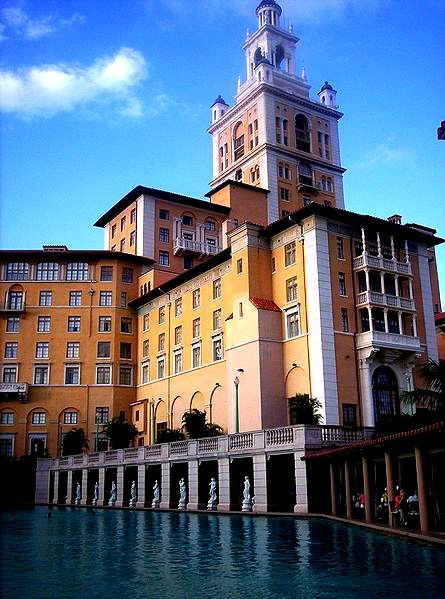
The Biltmore Hotel, in picturesquely named Coral Gables, was built as a beacon for fun and sumptuous pleasure at the height of the Roaring Twenties. With its Mediterranean Revival tower modeled on the Giralda Tower on Seville, Spain’s cathedral it featured the largest swimming pool in the world, containing 1,250,000 gallons of water, where synchronized swimmers and alligator wrestlers entertained guests. Johnny Weismuller, who would go on to portray Tarzan on the silver screen, taught and showed off his aquatic prowess in the gigantic pool. Luminaries gathered in the hotel’s ballrooms where they enjoyed top tier entertainment and even illegal gambling under the watchful eyes of gangsters Al Capone and Thomas “Fatty” Walsh. Popular bands of the era pumped out popular tunes with upbeat tempos, catchy lyrics, and jaunty tunes while couples danced foxtrots, the Charleston, tangos, and the Black Bottom under blazing chandeliers or glowing stars.
Photo by Averette, 2007. Courtesy of Wikipedia.
Stars fade but I linger on, dear… –“Dream a Little Dream of Me” (1931) by Fabian Andre, Wilbur Schwandt and
Gus Kahn
The hotel’s beauty began to fade when the United States War Department commandeered the hotel in 1942 for use as a convalescent hospital. Hotel rooms became rooms for patients and offices for doctors while public spaces became surgical suites. The floors were covered with linoleum, original furnishings were thrown out or painted over, windows were sealed with concrete, while the interior was painted a dismal, antiseptic green. Following the end of World War II, the hotel became an Army General Hospital and was later taken over by the Veterans Administration. Despite its utilitarian garb and atmosphere, the hospital attracted popular entertainers who performed for the patients. During its tenure as a VA hospital, the University of Miami established its medical school in the building. The grand hotel served as a hospital until 1968 when it was abandoned.
Sometimes I wonder why I spend The lonely nights Dreaming of a song. The melody haunts my reverie And I am once again with you. –“Stardust” (1927) by Hoagy Carmichael and Mitchell Parish
The now crumbling hotel sat abandoned while the City of Coral Gables attempted to save it as a historic structure. The city finally succeeded in 1973, but the building continued to sit empty while the city decided how best to utilize it. While empty, the building was used as a backdrop for the horror film, Shock Waves and can be seen briefly in the trailer. It also attracted attention for odd activity. In fact, Dennis William Hauck’s Haunted Places: the National Directory, states that, “Townspeople congregated on the golf course to observe the strange lights and eerie sounds coming from the empty building at night.”
The song is ended But the melody lingers on You and the song are gone But the melody lingers on. –“The Song is Ended” (1927) by Irving Berlin and Beda Loehner
Photo by tabitum, 2008. Licensed under Creative Commons.
While the locals who observed the activity in the abandoned building would often hear lingering melodies, that’s only part of the activity they witnessed. Greg Jenkins in his masterful three-volume series, Florida’s Ghostly Legends and Haunted Folklore, notes the witnesses as seeing windows opening and closing, figures within the building, and crashing sounds. The activity was so pronounced that in the summer of 1979 a team of policemen stormed the building in search of drug dealers and other malcontents believed to be hiding within. Their search turned up no one. When the humans failed to find anyone, a pair of police dogs was brought in only to have them flee after just five minutes, tails between their legs. After restoration began in the early 1980s, the activity increased.
Looking everywhere, Haven’t found him yet. –“Someone to Watch Over Me” (1926) by George and Ira Gershwin
Photo by Marc Kevin Hall, 2009. Licensed under Creative Commons.
A team of psychics and investigators visited the empty hulk in 1978. The psychics picked up on many energies throughout the building especially on the 13th floor and around the elevators. A recording device that was running during the investigation picked up a loud tapping that was not noticed by anyone present. Many of the psychics remarked that that floor possibly contained hundreds of spirits. Another group investigating in 1979 recorded the sounds of heavy breathing and a sigh. Could this be related to a tragedy from the hotel’s early years?
We lived our little drama… –“Stars Fell on Alabama” (1934) by Frank Perkins and Mitchell Parish
O, show us the way to the next whiskey bar. O, don’t ask why. –“Alabama Song” (1930) by Kurt Weill and Bertolt Brecht
In the late 1920s, a local gambler, Edward Wilson, rented out the suite on the 13th and 14th floors of the hotel and opened a speakeasy, This was a place where wealthy locals could drink and gamble away from the eyes of the law. Wilson became acquainted with New York mobster Thomas “Fatty” Walsh and his friend, Arthur Clark. Both had left the city to avoid an investigation in the death of an associate.
One evening in March of 1929, Wilson and Walsh began to argue in the speakeasy with nearly a hundred patrons in black-tie. Wilson pulled a gun and shot Walsh to death. When Clark rushed to his friend’s side, he was wounded. Police rushed to the hotel but it took some time to reach the murder scene. Once there, the room had been “cleaned” of any evidence of a speakeasy. Modern researchers believe the lack of police records on this event to be evidence of a police cover-up.
Now that I have found you, I must hang around you. Though you may refuse me… –“He Loves and She Loves” (1927) by George and Ira Gershwin
One popular tale about the suite on the 13th and 14th floor involves the private elevator leading to it. A young couple exploring the hotel somehow stumbled into the private elevator and was whisked to the dark, uninhabited suite though guests must have a key to operate the elevator. The young woman stepped off and the doors quickly shut behind her, leaving her husband wildly punching buttons as the elevator quickly descended to the lobby. The husband found a bellhop who used his passkey to get them back up to the empty suite. There they found the man’s wife standing in the dark, scared and befuddled.
Photo by eflon, 2009. Licensed under Creative Commons.
You must realize When your heart’s on fire Smoke gets in your eyes…
Now, laughing friends deride Tears I cannot hide. –“Smoke Gets in Your Eyes” from the operetta, Roberta (1933) by Jerome Kern and Otto Harbach
The young woman stated that when the doors closed behind her, she began walking through the silent suite calling, “Hello?” She heard the sound of distant conversation and occasionally people laughing. The sounds of things hitting the floor echoed from around her but nothing was out of place when she turned. She also remarked that there was the strong smell of cigar smoke with her throughout this experience. The elevator is still said to rise up to the suite on its own accord on a regular basis. This luxury suite (I checked the price and it’s around $1800 a night) is often used by celebrities, and President Bill Clinton stayed here in 1994. A number of sources note that he had troubled getting TV reception for a ball game he wanted to watch. His aides were unable to find a reason why the TV would not work properly.
It was just one of those nights, Just one of those fabulous flights, A trip to the moon on gossamer wings, It was just one of those things. –“Just One of Those Things” (1935) by Cole Porter
The apparition of a lady in white is also a part of the hotel’s folklore. According to legend, a couple was staying in the hotel with their young and very curious son. The child somehow made its way onto one of the hotel’s elaborate balconies and the child’s mother, fearing disaster, ran towards him. Unfortunately, she lost her balance reaching for her son and her body hurled over the railing towards certain death. Her spirit has been seen silently racing towards the balcony and at other times walking through nearby guest rooms.
Photo by Milan Boers, 2009. Licensed under Creative Commons.
There were chills up my spine And some thrills I can’t define. –“How Long Has This Been Going On?” (1928) by George and Ira Gershwin
There’s so much more still going on in the Biltmore Hotel. Numerous apparitions, often seen momentarily and disappearing, have been reported including a dancing couple in period attire, World War II era soldiers, and a man playing the piano in a top hat. The hotel actually employs a storyteller to keep up with the hotel’s histories: recorded, legendary, and paranormal. Perhaps the spirits have finally found their own, sumptuous heaven.
Photo by Ebyabe, 2011, courtesy of Wikipedia.
Heaven, I’m in heaven And my heart beats so that I can hardly speak And I seem to find the happiness I seek When we’re out together dancing cheek to cheek. –“Cheek to Cheek” (1935) by Irving Berlin
N.B. This article was edited and revised 6 April 2019.
Trans Allegheny Books 725 Green Street Parkersburg, West Virginia
Parkersburg Carnegie Library, formerly Trans Allegheny Books, 2010. Photo by Richie Diesterheft, licensed under Creative Commons 2.0.
Trans Allegheny Books truly sounds like heaven. A two-story former library, the building was crammed with some 500,000 volumes of used books with particular concentration on books relating to West Virginia and Appalachia. Until it closed just about this time last year, it was the largest bookstore in the state and a veritable tourist attraction in the region. Unfortunately, it was not to last.
The store was opened by Joe Sakach, a businessman with a passion for books and history, in the mid-1980s. The store flourished in the edifice on Green Street until the death of Mr. Sakach in April of last year. Upon his death the store was closed until his estate was settled by his children. They decided to sell the institution and a huge three-day sale was held in October, the store’s last dying breath.
The store is now a ghost along with the apparitions that lurked around its shelves while in operation. According to Theresa Racer in her marvelous blog on the ghosts of the Tri-State area (West Virginia, Ohio and Kentucky), Theresa’s Haunted History of the Tri-State, there are four distinct human and possibly three feline apparitions experienced within the century-old building. A small girl has been seen sitting on the magnificent iron stairs in the center of the building who sometimes may trip up patrons. A dapperly dressed man has been seen on the second floor and he may possibly be the same man seen browsing through the world history section. A female spirit may be that of a local newspaper reporter who was violently stabbed to death but who now returns to a place that she considered a second home.
The bookstore is home to living cats but possibly three feline apparitions have also been seen. All of these spirits may be the origins of other paranormal activity including disembodied footsteps, flickering lights, shadow figures and books that move from their shelves.
After its original function as a Carnegie Library, the building’s use as a bookstore is certainly the most appropriate use for the Neo-classical structure. Philanthropist Andrew Carnegie, who built magnificent libraries throughout the nation, presented Parkersburg with a gift of $34,000 to build a library. It opened in 1905 and served the area until 1975. The building was used briefly as a restaurant but that was unsuccessful. It was listed on the National Register of Historic Places in 1982 and it appears it is currently unused.
A story from WCHS ABC 8 in Charleston, West Virginia, provides a marvelous glimpse inside the bookstore.
Katherines (with a “K”), and I suppose Catherines, figure heavily in the Roswell, Georgia Ghost Tour. I recall at least three stories, among many, where the name came up. A friend of mine set up a private tour and our group of thirteen set out on what would become a three hour tour, a three hour tour. The weather did not start getting rough and was absolutely lovely; a cool, autumn evening with the slightest of nips in the air. As a private tour, our guide, Jonathan Crooks, departed from the usual script and provided us with literally masses of information including personal experiences he has had.
Ranked among the top ghost tours in the nation, it’s not difficult to see why. This tour departs from the usual ghost stories and historic lectures regurgitated by bored guides in dreadful costumes with spooky voices. The guides here provide just enough history and tell only stories when they are related to documented paranormal activity at each location. The guide did not attempt to scare the group with gimmicks; the tales of activity did enough by themselves and a few times I had chills up my spine. Even more haunting, at each location, much of the discussed activity was fairly recent and included much that had taken place on previous tours.
The facade of Bulloch Hall. Photo by Lewis Powell IV, all rights reserved.
The well behind Bulloch Hall that is a center for paranormal activity. According to the tour, a young slave girl may have died here. Photo by Lewis Powell IV, all rights reserved.
The tour met on the square and traveled first down Bulloch Avenue towards the fabled Bulloch Hall, a home that is both important historically and paranormally. The tour walked around the house with the guide pointing out a window where a number of odd photographs had been taken. Behind the house he pointed out a reconstructed slaves quarters and a well which both had paranormal activity connected with them. The tour continued up the street stopping in front of Mimosa Hall where phantom smells were discussed.
The park on Sloan Street where swings sometime swing on their own accord. The tour also pointed out that psychics have seen an African-American man join the tour at this point. One psychic claimed he said, “You white people are crazy!” Photo by Lewis Powell IV, all rights reserved.
We crossed over the square again heading for the “other side of town.” Historically, the other side of the square consisted of the mill village. We walked along Sloan Street all the way to the Founders Cemetery which we visited in the dark. All along Sloan Street there were many reports of activity ranging from swings swinging by themselves in the park to the doors of mailboxes opening one by one up and down the street as a tour group passed by. Houses along the street, particularly the line of brick townhouses, known as The Old Bricks, are known for activity as well as the homes surrounding the cemetery which are most likely built on graves.
Looking towards the grave of Roswell King in the Founders Cemetery. Photo by Lewis Powell IV, all rights reserved.
As we crossed over the square and were waiting to cross busy Atlanta Street, three in our group saw a man standing on the corner opposite us across Sloan Street. One group member described him as a large man, possibly African-American, standing in front of the building with his back to the group. He was hunched over and standing very still. Interestingly, no one else noticed him. I’m sure I looked in the man’s direction and most likely would have noted someone standing there. The guide also saw the guy and said that he thought the man was wearing a blue Union Army-style jacket, though this immediate jump to a Civil War connection bothered me.
The back of the “Creepy House,” a location known for intense energy. Photo by Lewis Powell IV, all rights reserved.
The tour wound past a law office haunted by a woman who was upset by “the fire in the walls,” known in modern terms as electricity. We were guided into the backyard of the “Creepy House,” an old home with a ghoulish reputation. According to our guide, psychic members of tour groups always sense a number of spirits here including a certain negative energy. It was also here that participants on previous tours have been attacked with one young girl feeling like she had been punched in the stomach and a woman being scratched on her back. Frankly, the house is very creepy, particularly at night. The tour ended at the square with a rundown of the hauntings of many of the buildings there.
Overall, the tour was astounding and incredibly informative. My one complaint was that it was too long, but then again, we had a private tour. The regular tour lasts two hours. The concentration on paranormal activity rather than history and stories, made the tour particularly interesting and his knowledge of and passion for the paranormal was particularly refreshing.
My thanks to my friend Chris who set this up and with his partner was a marvelous host for the evening. Also thanks to Ben who first suggested the tour and all the tour participants who made for a wonderful weekend.
Rhythm Night Club Memorial Museum 5 St. Catherine Street Natchez, Mississippi
N.B. This entry was revised 24 February 2019.
Goodbye, Goodbye, Fare you well, goodbye! I’m just gonna let all you people know What happened in that Natchez fire. — Gene Gilmore, “The Natchez Fire,” one of a number of jazz and blues songs written to memorialize the fire. See the YouTube video for a recording of the song with photographs from the fire.
One of my favorite books as a kid was Jay Robert Nash’s Darkest Hours: A Narrative Encyclopedia of Worldwide Disasters from Ancient Times to the Present. Not only providing stories of hundreds of disasters, the book includes rare photographs from the scenes, including some that are quite graphic. One of those photographs I remember clearly is from the 1940 fire at the Rhythm Night Club in Natchez. The photograph shows bodies of many of the African-American club goers laid out. These nicely dressed people are covered with soot with some almost frozen in dance-like attitudes.
As I’m reading through my blogs tonight, I came across an entry from Natchez Ghosts: The Devil’s Punchbowl, the official blog of the Natchez Area Paranormal Society regarding this recently opened museum. The museum is located on the site of the night club and serves as a memorial to this fire that claimed around 207 lives (there are discrepancies in the actual number) and affected many more.
Headline from the 24 April 1940 Delta Democrat-Times of Greenville, Mississippi.
Occupying a ramshackle wood frame building, the Rhythm Night Club was a swinging place on the spring evening of April 23, 1940. Walter Barnes and His Royal Creolians, a noted band from Chicago, was playing to a packed house of nearly 700. From the ceiling decorative Spanish moss had been hung. That moss that had been sprayed with a petroleum-based insecticide called Flit, in an attempt to kill the insects that lived within it.
Near the club’s front door, a fire broke out, quickly spreading through the highly-flammable moss. As patrons rushed to the windows and doors, they found most of them boarded up. Among those killed were Walter Barnes, the bandleader, and most of his band. While the fire destroyed so many lives, it did lead to some of the myriad fire regulations that save many lives today.
Opening last year, the Rhythm Night Club Memorial Museum seeks to tell the story of this tragedy as well as memorialize the site. The blog entry on Natchez Ghosts mentions that one of the founders has reported paranormal activity throughout the building. This activity includes the sounds of voices, music, and doors opening and closing. He has also found photographs apparently removed from the walls and then laid on the floor at interesting angles.
A riverside memorial plaque for the Rhythm Night Club fire. Photo 2015, by Bill Hathorn, courtesy of Wikipedia.
The blog entry also mentions that the Natchez Area Paranormal Society (NAPS) is ramping up to investigate the location in the very near future. I look forward to seeing their evidence.
Update: It appears that the Natchez Paranormal Society is no longer active. Their blog is still up, but has not been updated since 2015.
An incident occurred in 1862 as Confederate troops under General Stonewall Jackson marched through the picturesque Western Maryland town of Frederick September 10th. Union sympathizers in Frederick (Maryland never seceded from the Union) hung out American flags to antagonize Confederates moving through town. Seven days later, those troops would be embroiled in heavy fighting in neighboring Washington County near Sharpsburg, a battle that would forever be named by the lowly stream running through the idyllic pastures where the battle was fought, Antietam.
Among the sympathizers that hung out their flags was 96 year old Barbara Fritchie. Her actions that day became part of the oral tradition of Union troops and two years later were immortalized in a poem by John Greenleaf Whittier, actions that became a hallmark of patriotism that is still celebrated. The poem became a Union rallying cry towards the end of the brutal Civil War that raged over the bucolic farmlands of Western Maryland.
Barbara Fritchie in a contemporary portrait. Courtesy of Wikipedia.
The Ballad of Barbara Frietchie
By John Greenleaf Whittier, 1864
Up from the meadows rich with corn,
Clear in the cool September morn,
The clustered spires of Frederick stand
Green-walled by the hills of Maryland.
Round about them orchards sweep, Apple and peach tree fruited deep,
Fair as the garden of the Lord
To the eyes of the famished rebel horde,
On that pleasant morn of the early fall
When Lee marched over the mountain-wall;
Over the mountains winding down,
Horse and foot, into Frederick town.
Forty flags with their silver stars,
Forty flags with their crimson bars,
Flapped in the morning wind: the sun
Of noon looked down, and saw not one.
Up rose old Barbara Frietchie then,
Bowed with her fourscore years and ten;
Bravest of all in Frederick town,
She took up the flag the men hauled down;
In her attic window the staff she set,
To show that one heart was loyal yet,
Up the street came the rebel tread,
Stonewall Jackson riding ahead.
Under his slouched hat left and right
He glanced; the old flag met his sight.
‘Halt!’ – the dust-brown ranks stood fast.
‘Fire!’ – out blazed the rifle-blast.
It shivered the window, pane and sash;
It rent the banner with seam and gash.
Quick, as it fell, from the broken staff
Dame Barbara snatched the silken scarf.
She leaned far out on the window-sill,
And shook it forth with a royal will.
Barbara Fritchie waving her flag, by American painter N.C. Wyeth, c. 1922. Courtesy of the Library of Congress, Prints and Photographs Division.
‘Shoot, if you must, this old gray head,
But spare your country’s flag,’ she said.
A shade of sadness, a blush of shame,
Over the face of the leader came;
The nobler nature within him stirred
To life at that woman’s deed and word;
‘Who touches a hair of yon gray head
Dies like a dog! March on! he said.
All day long through Frederick street
Sounded the tread of marching feet:
All day long that free flag tost
Over the heads of the rebel host.
Ever its torn folds rose and fell
On the loyal winds that loved it well;
And through the hill-gaps sunset light
Shone over it with a warm good-night.
Barbara Frietchie’s work is o’er,
And the Rebel rides on his raids nor more.
Honor to her! and let a tear
Fall, for her sake, on Stonewalls’ bier.
Over Barbara Frietchie’s grave,
Flag of Freedom and Union, wave!
Peace and order and beauty draw
Round they symbol of light and law;
And ever the stars above look down
On thy stars below in Frederick town!
A political cartoon by J.S. Pughe, published in Puck, 1905, using the imagery of Barbara Fritchie. Courtesy of the Library of Congress, Prints and Photographs Division.
The historical marker located just outside Barbara Fritchie’s (Whittier spelled her name with an extra “e”) home notes that “spoilsport” historians have proven that this likely never happened. It is reported that while Jackson’s troops marched through the town, they never marched down this particular portion of West Patrick Street where the BARBARA FRITCHIE HOUSE (154 West Patrick Street) is located. In fact, some sources say that the elderly Fritchie was sick in bed that day though Mrs. Mary Quantrell did wave an American flag at Confederate troops, though she was ignored by them and later by history.
The Barbara Fritchie House, 2006. Photo by Hal Jespersen, courtesy of Wikipedia.
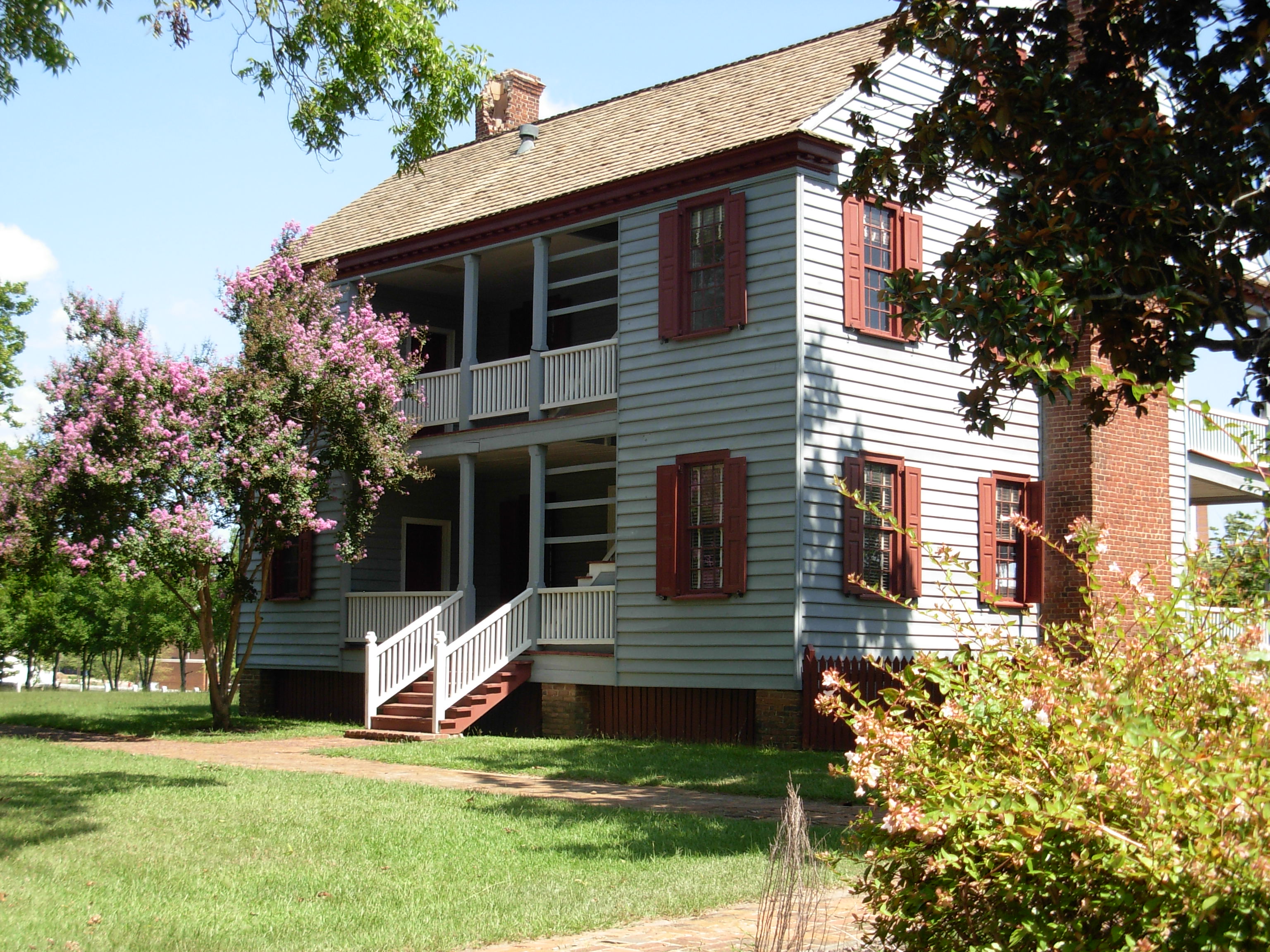
The house itself is a reconstruction built in the late 1920s. The original house, which had been built over a creek in 1785, was damaged during a flood and was demolished in 1868. The reconstruction now houses a small museum with artifacts relating to Mrs. Fritchie and possibly her spirit. The house is apparently not very active in a paranormal sense. A rocking chair is said to rock by itself and one staff member reported seeing a pair of feet underneath the quilt draped over the chair. It is also noted that the lights in the basement of the house next door (which was also occupied by Mrs. Fritchie) turn off and on by their own accord. While not terribly interesting paranormally, this house is one of a number of haunted locations within Frederick County, which appears to be a very active county.
Sources
Barbara Fritchie. Wikipedia, the Free Encyclopedia. Accessed 18 September 2011.
Rigaux, Pamela. “Walking with the dead.” Frederick News-Post. 23 October 2005.
Van Fossen, Nancy and Douglas M. Greene. Maryland Historical Trust Inventory Form for States Historic Sites Survey for Barbara Fritchie House. October 1974.
Varhola, Michael J. and Michael H. Varhola. Ghosthunting Maryland. Cincinnati, OH: Clerisy Press, 2009.
N.B. This is an edit and repost of the very first location I wrote about for this blog, back in August of last year. I’ve combined what was originally two separate entries, updated some information and added pictures.
Ezekiel Harris House 1822 Broad Street Augusta, Georgia
One of the very first books of ghost I read was the late Kathryn Tucker Windham’s 13 Georgia Ghosts and Jeffrey. Windham’s books covering various Southern states broke ground as some of the first books on the folklore of many of these areas. These books create an important foundation for writing about Southern ghosts. Being among the first stories I read a child, I figured this would be a good location to start with. We’ll start with the history books.
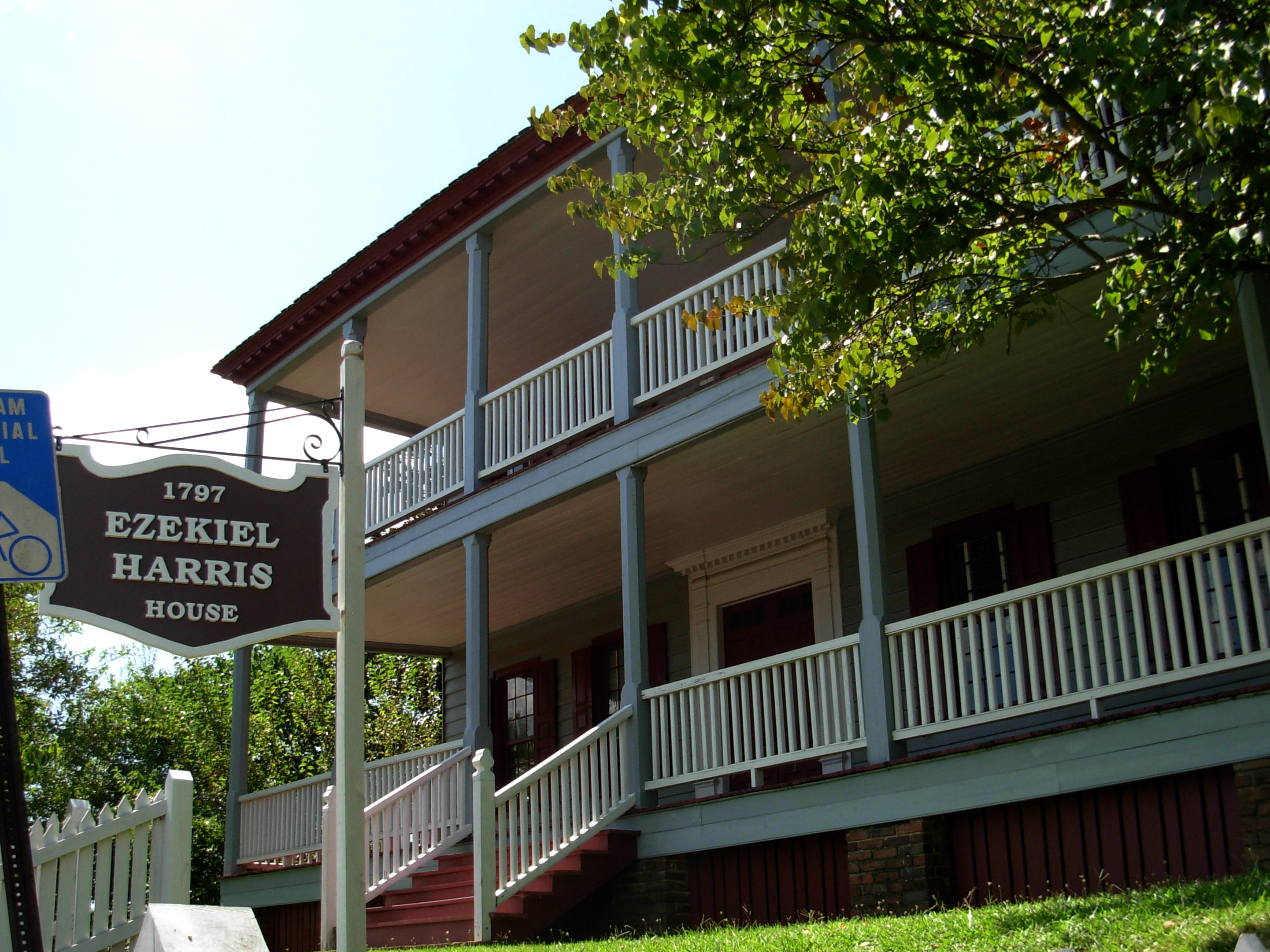
Sign on the back gate of the Ezekiel Harris House, 2011. Photo by Lewis Powell IV, all rights reserved.
The city of Augusta was laid out on the orders of the founder of Georgia, General James Oglethorpe, in 1736, three years after the establishment of the Georgia colony. Named for Princess Augusta of Saxe-Gotha, wife of the Prince of Wales, the city was one of the first inland cities founded in the colony. It is located roughly 127 miles northwest of Savannah at the end of the navigable portion of the Savannah River. The city briefly became the capital of Georgia in 1779 after the fall of Savannah during the American Revolution, but the city also soon fell to British forces. The British held the city briefly and then recaptured and held it from May 1780 to June 1781.
Just before the outbreak of hostilities, the Augusta region was placed under the purview of Thomas Brown by Royal Governor James Wright. Brown was a wealthy Englishman who, with a boatload of indentured servants, created the settlement of Brownsborough, north of Augusta. Anti-British sympathy had begun to smolder in the area and Brown worked hard to stamp out the rebellious feelings of groups like the Sons of Liberty. As an example to other Loyalists, the group captured Brown and subjected to tarring and feathering, a horrifically painful and sometimes fatal ordeal. Escaping the city, Brown travelled to South Carolina where, upon recovery, he began to gather Loyalists about him to fight the revolutionary threat. Brown returned to the city with troops in tow in May of 1780 quite possibly hell-bent on revenge.
Upon entering Augusta again, Brown began quickly exacting measures against its patriot inhabitants, stripping those families of their possessions and expelling them from the colony. Others were arrested and put to death. These actions soon spread beyond the limits of Augusta and throughout British-controlled Georgia and South Carolina. Under Brown’s orders, a contingent of soldiers travelled north of the city to what is now Lincoln County, Georgia and murdered revolutionary leader Colonel John Dooley in his home.
On September 14th, 1780, Colonel Elijah Clarke, commander of the revolutionary forces that had been dogging the British in the area for some time, attacked an Indian village near Augusta, this putting Brown in notice that they were in the area. American forces pushed towards Mackay’s Trading Post, also called the White House, situated outside the city of Augusta near the Savannah River. Brown reinforced his forces which held the trading post with British regulars and allied Native Americans. The Americans laid siege to the trading post and the surrounding area, a siege that would last nearly four days.
The American forces retreated in the morning of the 18th having sustained nearly sixty casualties, but it’s the proceeding events that really concern us. Charles C. Jones, Jr. spells the story out quite grotesquely in his 1890 Memorial History of Augusta, Georgia:
Thus did Captain Ashby, an officer noted for his bravery and humanity, and twenty-eight soldiers fell into the hands of the enemy. He and twelve of the wounded prisoners were forthwith hung upon the staircase of the White House, where Brown was lying wounded, that he might enjoy the demonical pleasure of gloating over their expiring agonies. Their bodies were then delivered to the Indians, who, after scalping and mutilating them, threw them into the river. Henry Duke, John Burgamy, Scott Reeden, Jordan Ricketson, Darling, and the two brothers Glass, youths seventeen and fifteen years of age, were choked to death under a hastily constructed gibbet. Their fate, however, was mild when contrasted with that reserved for the other prisoners who were delivered into the hands of the Indians that they might be avenged of the losses which they had sustained during the siege.
Back of the house. The staircase is behind the horizontal beams. Photo 2011, by Lewis Powell IV, all rights reserved.
This event was noted in a letter by Governor Wright to King George III: “Thirteen of the Prisoners who broke their Paroles & came against Augusta have been hang’d, which I hope will have a very good effect.” Windham notes that the number thirteen represented each of the rebellious American colonies. Though the Americans were repelled after this first siege and Thomas Brown was able to construct a small fortress closer to town, named Fort Cornwallis, British controlled Augusta was eventually broken following a siege in May of 1781.
Ezekiel Harris House, 1934 before it was purchased and restored. Photo by Branan Sanders for the Historic American Building Survey (HABS), courtesy of the Library of Congress, Prints and Photographs Division.
Fast forwarding ahead 165 years to 1946, the Richmond County Historical Society purchased an 18th century house near the river believing it to be the infamous Mackay Trading Post. According to Cherie Pickett, an associate with Historic Augusta in a 1999 article in The Augusta Chronicle (notably one of the oldest American newspapers still in print), historians clung steadfastly to the idea that this building was the Mackay Trading Post for many years, with architectural historians and archaeologists possibly skewing their results to lend credence. Even more importantly to our cause, the Writers’ Project of the WPA recorded stories about the “White House” haunting in 1938 among many other noted Georgia ghost stories.
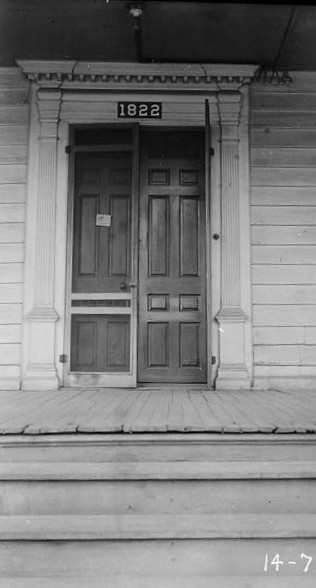
Front door, 1934. Photo by Branan Sanders, for HABS, courtesy of the Library of Congress, Prints and Photographs Division.Front door, 2011. Photo by Lewis Powell IV, all rights reserved.
Mrs. Windham’s 1973 book gave wings to the story, enshrining it in the Southern folklore tradition. Windham recounts the legends that had grown up about the house. These legends state that visitors standing in the stairwell and slowly counting to thirteen would sometimes hear the thud of the thirteen men as they are hung or moaning of the dying men. Additionally, a female spirit has been seen wandering the second story as if searching for someone. Many have identified this spirit as Mrs. Glass, the mother of the two executed brothers. Windham adds wistfully that this spirit is said to hold her hands out in supplication, perhaps begging the spirit of Colonel Brown for a reprise for her sons.
But, there’s a problem. There had been questions for many years about the history of the building preserved and identified as the Mackay Trading Post. Mary Mackay, mother-in-law to the post’s owner, Andrew McLean, remarked upon seeing the damaged structure after the battle, “I have never seen such destruction.” The building identified as the trading post, however, showed no evidence of damage. A 1975 study by the state of Georgia confirmed that the house was not the Mackay Trading Post and that the misidentified house was likely built almost two decades later. As a result, the house was renamed the Ezekiel Harris House after the first known owner and the possible builder. Interestingly, some have said that the house, which was called by the Smithsonian Institute’s Guide to Historic America, “the finest 18th Century house in the state of Georgia,” would likely have never been purchased and restored had it not been mistakenly identified as the scene for such the bloody events of the American Revolution.
The Harris House today. Photo 2011, by Lewis Powell IV, all rights reserved.Another view of the front. Photo 2011, by Lewis Powell IV, all rights reserved.
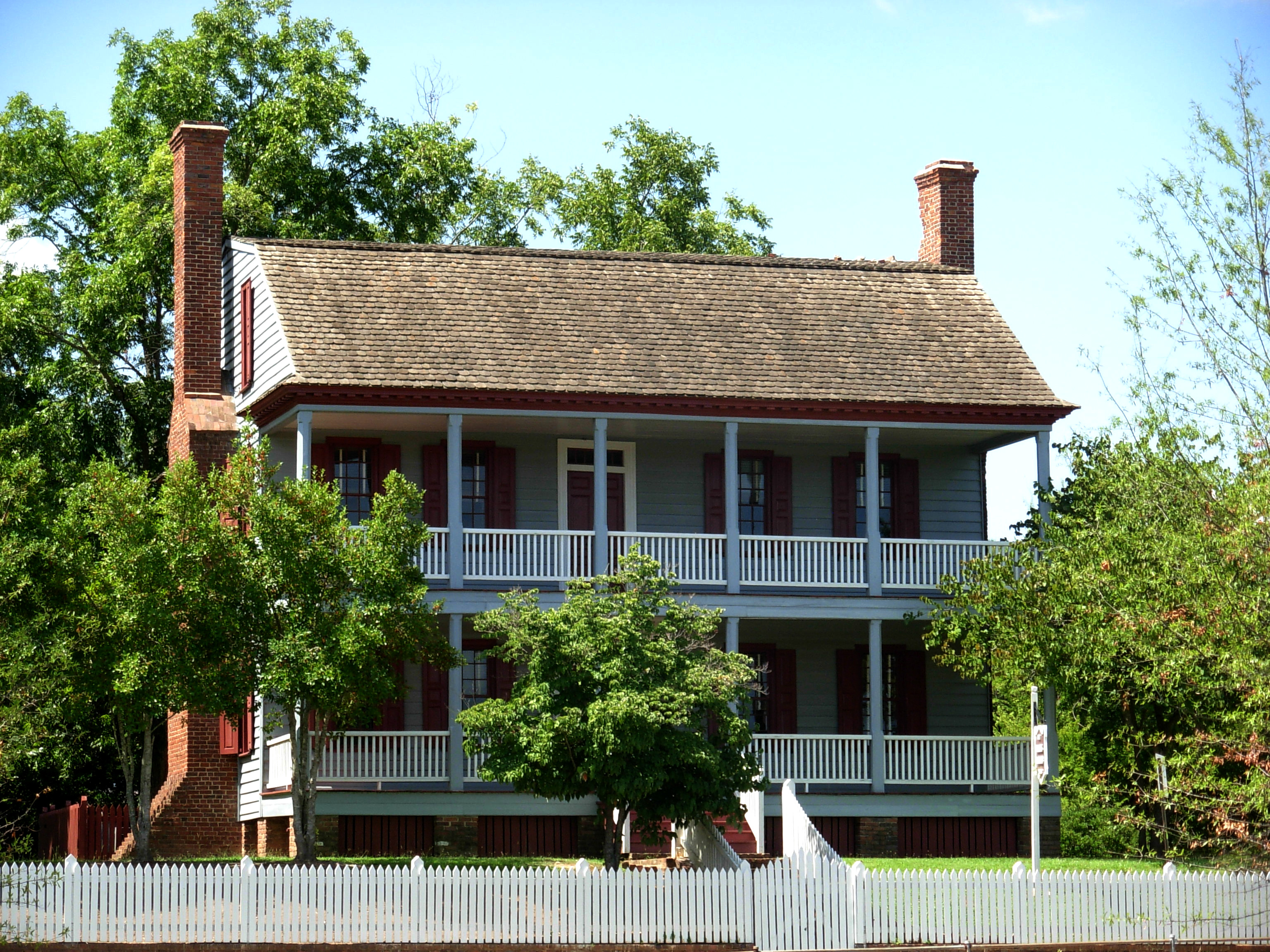
So, if the Ezekiel Harris House is not the Mackay Trading Post, are there still ghosts? Well, historians researching this first siege of Augusta have noted that the trading post was located somewhere in the vicinity of the Harris house, though the exact spot is unknown. We do know, however, that Ezekiel Harris, a tobacco merchant, built this house around 1797, though the exact date is unknown. Scott A. Johnson, author of The Mayor’s Guide to the Stately Ghosts of Augusta, posits that the ghosts may simply have taken up in the house after its construction. According to him, visitors still report odd occurrences on the staircase that includes the feeling of having a rope about your neck. He also reports that the female ghost is commonly seen as well.
It’s not uncommon for spirits to take up in a nearby structure if their regular haunt has been destroyed, but some remained unconvinced that this is the case here. Ben Baughman, manager of the house for the Augusta Museum, which has controlled the property since 2004, stated that he has had no experiences in the house. In 2006, two videos appeared on YouTube showing an investigation of the house. The first part of the video shows part of the usual tour of the house being led by Mr. Baughman as well as his docent’s spiel about the house’s history. The second video shows the beginning of a night investigation involving a Ouija board. The video ends just as the Ouija board is produced and there is no part II. So there is no indication that anything was discovered.
Interestingly, one of the females on the video states that the female apparition is probably not Mrs. Glass, but more likely Mrs. Ezekiel Harris. History may back her up on that assumption. While there are few records relating to either Mr. or Mrs. Harris, those that remain on Mr. Harris reveal that he was an ambitious businessman with some legal problems including an accusation of murder. In one surviving letter from 1805, Mr. Harris describes his wife as having breast cancer. She died the following year, quite possibly in the house. This does leave open the possibility that the spirit may be her still worrying over her husband’s troubles or the cancer in her breast.
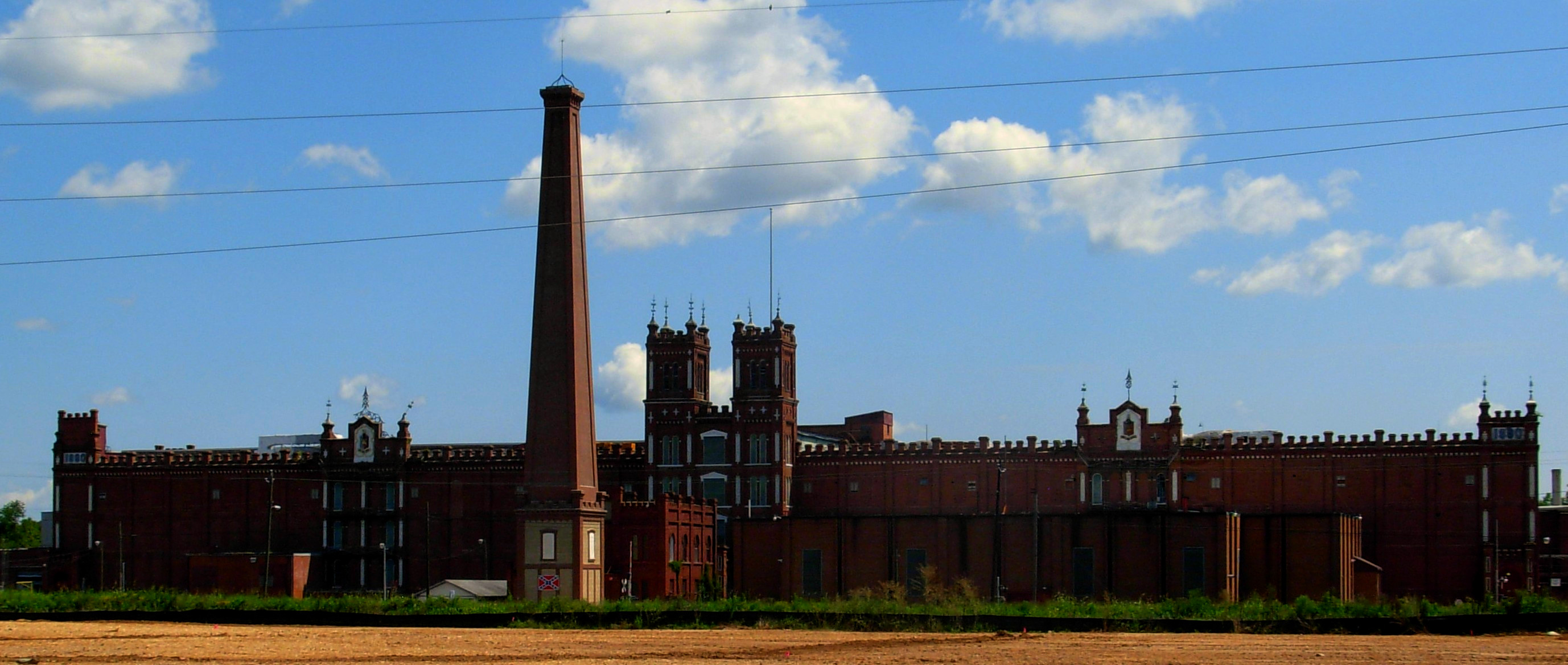
The remainder of the home’s history may be relatively free of violence. The house was owned by two other families before being bought by the company constructing the Sibley Mill. The house was turned into a boarding house and the porch of the upper story was enclosed. Of course, as a boarding house, there may have been some violence and some tenants may not have left.
Mill in view of the house. Photo 2011, by Lewis Powell IV, all rights reserved.
As for the question of whether this house is haunted, I cannot say. I would be interested in seeing the results of any paranormal investigations on the location. Certainly, with its age and history ghosts are likely, but I have not seen a single, identifiable report of paranormal activity. In other words, the descriptions of activity are always general and cannot be linked to any specific individual.
Postscript
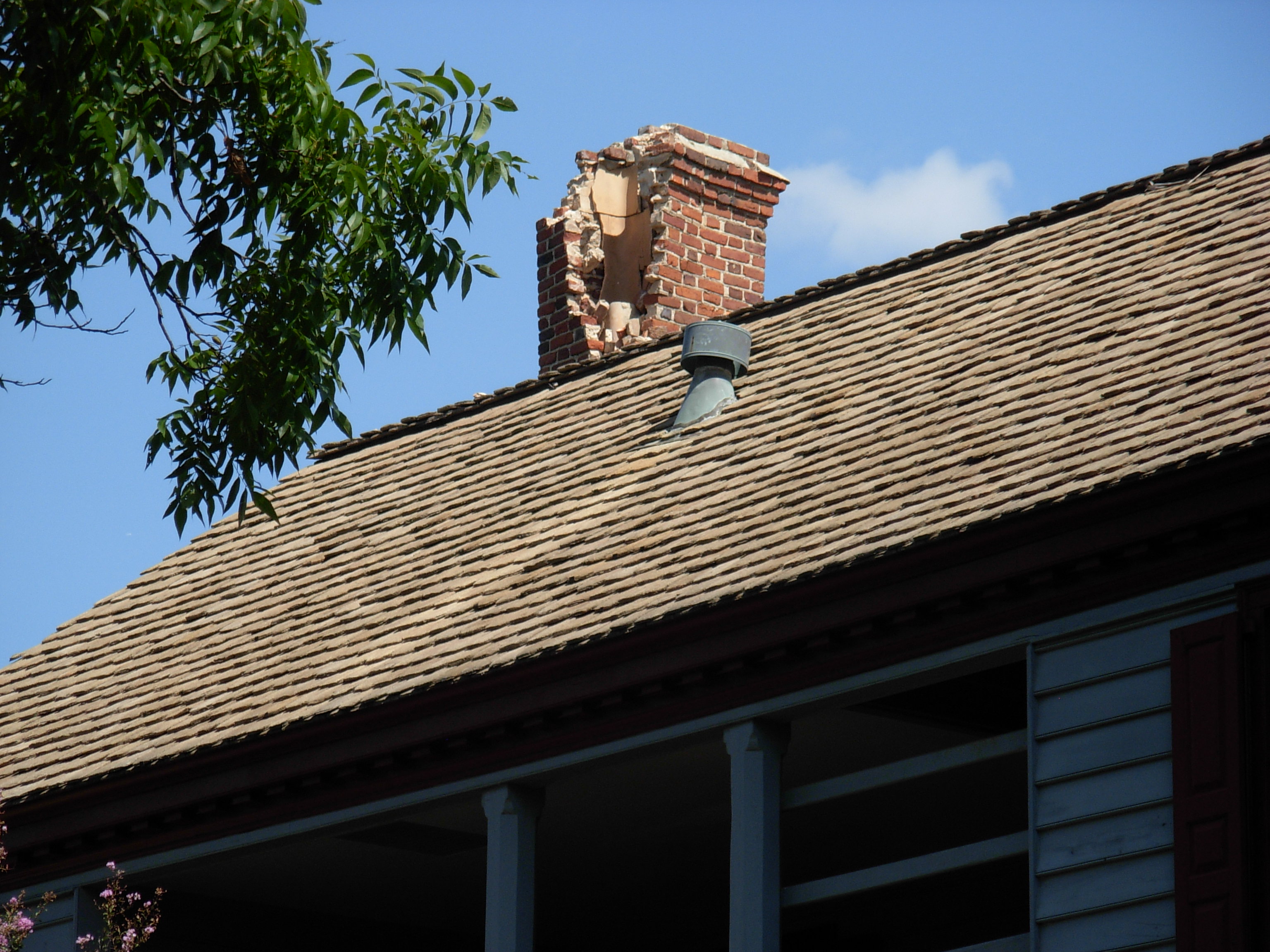
Back in July, I finally visited the Ezekiel Harris House for the first time. Presumably, due to budget cuts, tours of the house are now by appointment only and I only had time to take a few pictures and ponder the forlorn house from outside the white picket fence surrounding it. The house is a bit unkempt with grass needing mowing, a dead kitchen garden and a falling chimney. Even in that state, the house is a commanding presence, situated on a high hill with a vista of the grand Sibley Mill in the distance. I wonder if the spirits enjoy the solitude.
Crumbling chimney. Photo 2011, by Lewis Powell IV, all rights reserved.Dying kitchen garden. Photo 2011, by Lewis Powell IV, all rights reserved.
Labor Day Weekend was wild and wooley for New Orleans with Tropical Storm Lee hitting the city at the same time as numerous revelers for Southern Decadence and other events. A friend of mine, Benjamin Lewis, was able to take pics of a handful of haunted sites and I’m most grateful to him for these marvelous images!
Beauregard-Keyes House 1113 Chartres Street
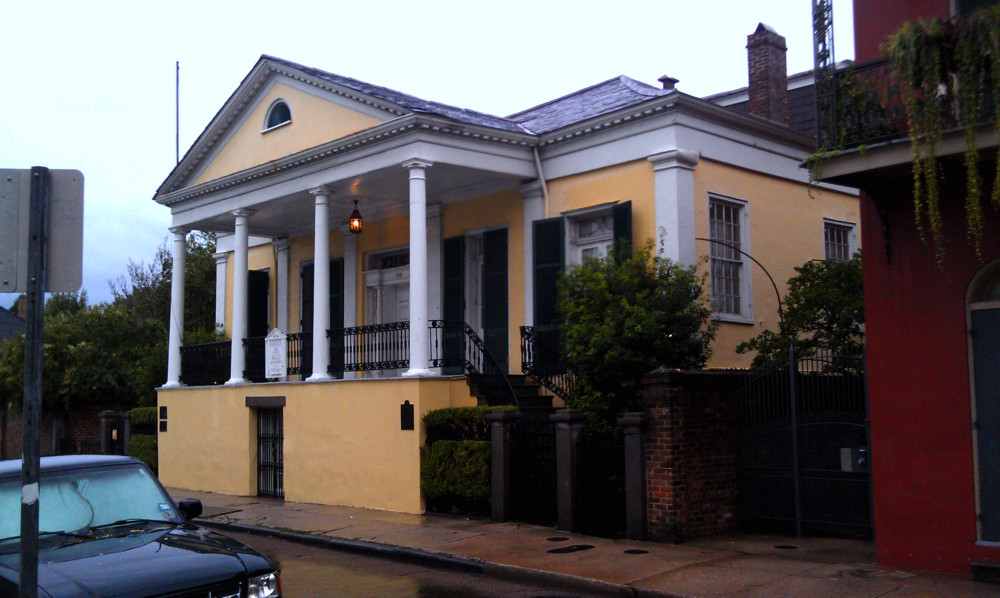
A bright spot of sunshine on a dreary day, the Beauregard-Keyes House, 2011. Photo by Benjamin Lewis, all rights reserved.
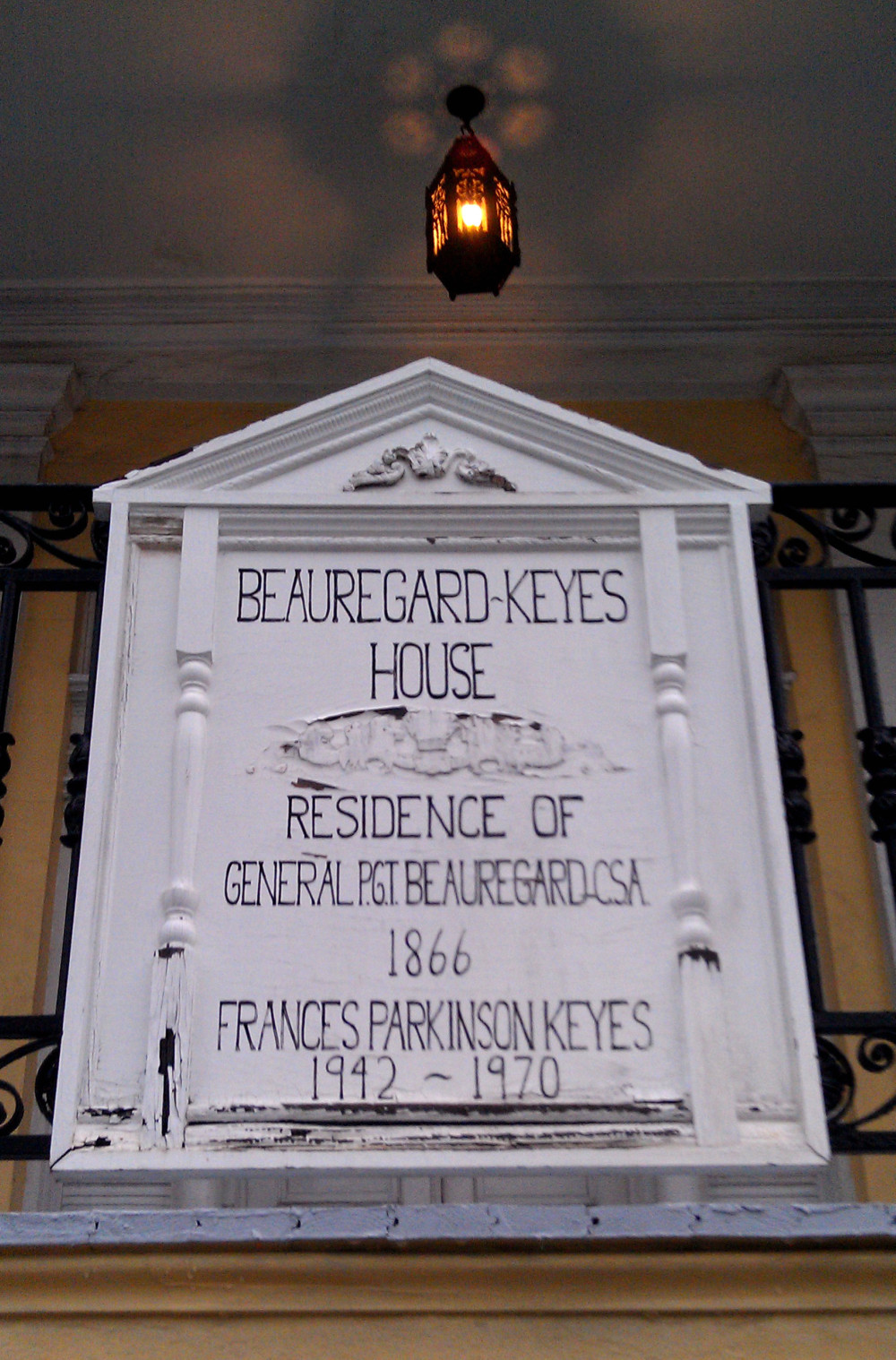
One of the most famous homes in the city, the Beauregard-Keyes House has served as the residence for a number of famous names including Confederate General P. T. G. Beauregard, chess master Paul Morphy and novelist Frances Keyes. Events in this house have ranged from glittering balls to a bloody Sicilian mafia massacre in the early 20th century. Gun shots from the massacre are still heard, a waltzing couple seen inside while some have heard the name of General Beauregard’s Waterloo, Shiloh, being repeated over and over again. One resident even claimed to have encountered the battle of Shiloh being fought in the ballroom. I’ve covered this site in depth here.
Sign at the front of the Beauregard-Keyes House, 2011. Photo by Benjamin Lewis, all rights reserved,
Le Richelieu 1234 Chartres Street
Front entrance to Le Richelieu, 2011. Photo by Benjamin Lewis, all rights reserved.
Housed in two buildings, one dating from 1845, the other from 1902, the Le Richelieu Hotel occupies the site where five French patriots were executed in the late 18th century. The spirits of these five men may still reside here.
Housed in two buildings, one dating from 1845, the other from 1902, the Le Richelieu Hotel occupies the site where five French patriots were executed in the late 18th century. The spirits of these five men may still reside here.
The two buildings that comprise Le Richelieu, 2011. Photo by Benjamin Lewis, all rights reserved.A view of Le Richelieu from Barracks Street, 2011. Photo by Benjamin Lewis, all rights reserved.Looking down this hallway at Le Richelieu one can almost imagine the Shining Twins appearing here. Photo by Benjamin Lewis, all rights reserved.Courtyard and pool where a group of Spanish soldiers may have been executed. Do their spirits still wander here? Photo by Benjamin Lewis, all rights reserved.
Old United States Mint 400 Esplanade Avenue
Front entrance to the old US Mint, now the Louisiana State Museum, 2011. Photo by Benjamin Lewis, all rights reserved.
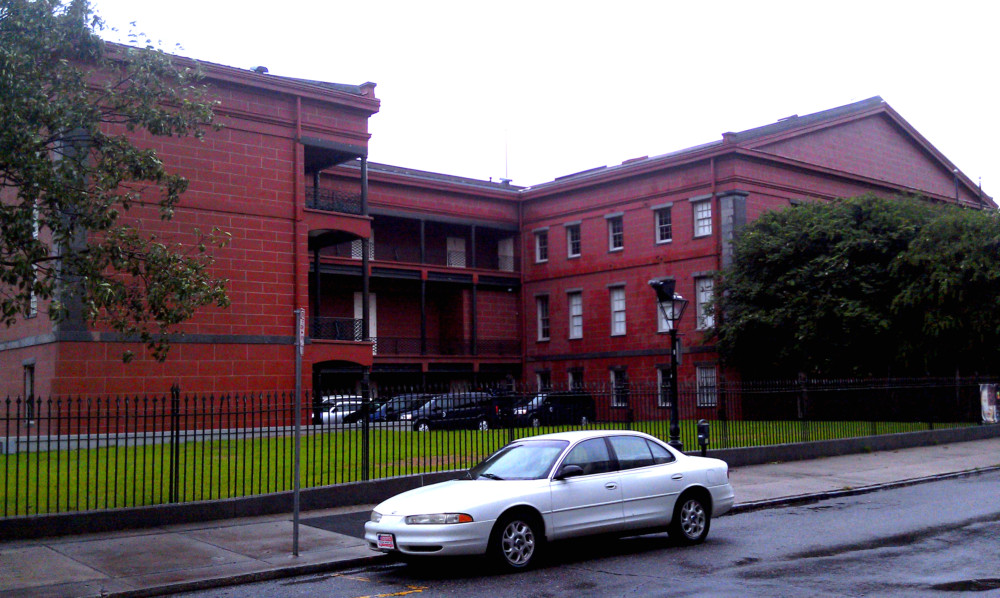
From 1838 to 1909, this building housed the New Orleans Mint, producing currency in all denominations. Since its closure as a mint, the building served a variety of functions until 1981 when it became a part of the State Museum of Louisiana, the capacity in which it functions today. In the second floor gallery a man in blue coveralls has been seen rolling a cigarette. He then places the cigarette into his mouth and walks into a nearby wall.
View down the length of the facade, 2011. Photo by Benjamin Lewis, all rights reserved.The massive old mint, 2011. Photo by Benjamin Lewis, all rights reserved.The rear of the old mint building, 2011. Photo by Benjamin Lewis, all rights reserved.
Old Ursuline Convent 1100 Chartres Street
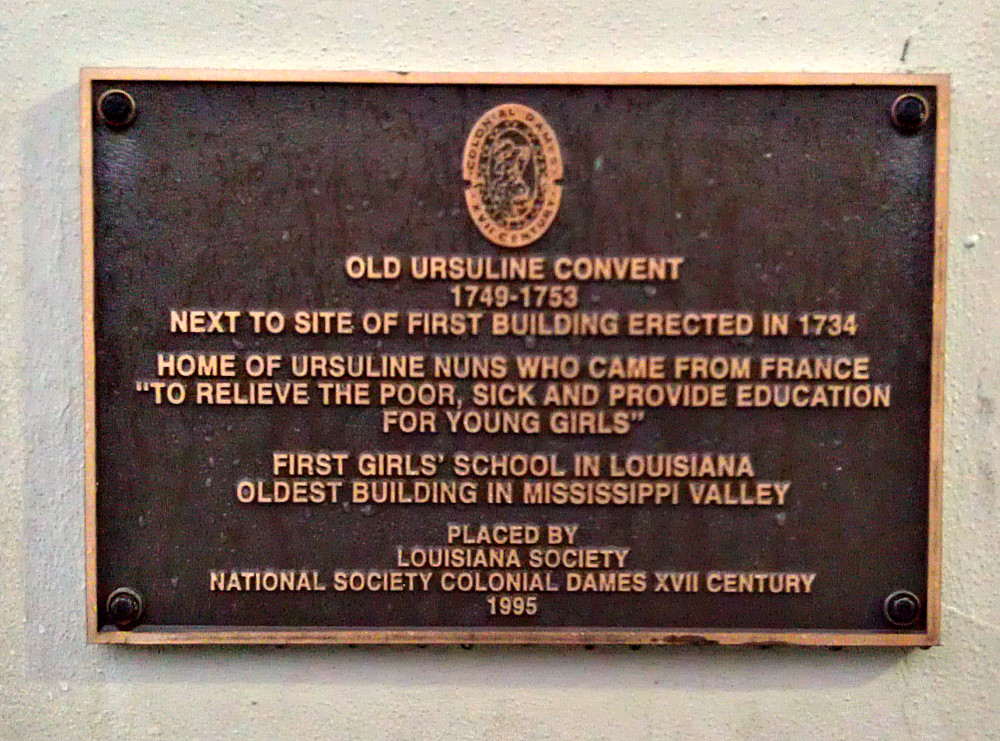
Plaque on the old convent, 2011. Photo by Benjamin Lewis, all rights reserved.
One of the oldest buildings in New Orleans, the Old Ursuline Convent has survived hurricanes, fires and the nuns have lent aid during plagues and epidemics. It’s no surprise that their old convent would house spirits. According to Jeff Dwyer, the spirits of Ursuline sisters have been seen gliding throughout the building while the spirit of a Civil War era soldier has been seen in the garden.
A brooding sky over the Old Ursuline Convent, 2011. Photo by Benjamin Lewis, all rights reserved.
Sources
Dwyer, Jeff. Ghost Hunter’s Guide to New Orleans.Gretna, LA: Pelican Press, 2007.
New Orleans Mint. Wikipedia, the Free Encyclopedia. Accessed 10 September 2011.
Powell, Lewis IV. “Beauregard-Keyes House, Part I.” Southern Spirit Guide.3 December 2010.
Powell, Lewis IV. “Beauregard-Keyes House, Part II.” Southern Spirit Guide.6 December 2010.
Smith, Katherine. Journey Into Darkness…Ghosts and Vampires of New Orleans. New Orleans: De Simonin Publications, 1998.