Rye Cove Intermediate School 158 Memorial School Lane Duffield, Virginia
Oh listen today and a story I tell With saddened and tear dimmed eyes Of a dreadful cyclone that came this way And blew our schoolhouse away. –“The Cyclone of Rye Cove” by A. P. Carter, originally covered by
The Carter Family
In the news business there’s the old maxim, “if it bleeds, it leads,” thus headlines are often gory. Americans were jarred on the 3rd of May, 1929, by headlines about the huge storm that passed through Virginia and the rural wooden schoolhouse in Rye Cove that didn’t stand a chance against one of the storm’s tornados. The Associated Press story about the tornado was printed in papers from Maine to California.
The story of the storm appeared on the front page of the Alton Evening Telegraph in the Mississippi River town of Alton, Illinois, incidentally noted to be one of most haunted cities in the Midwest.
RYE COVE, Va., May 3, (AP)—Grief stricken parents searched the debris of the Rye Cove Consolidated school today, fearful of finding additional victims of the tornado that yesterday claimed the lives of 13 children and one teacher in the greatest disaster ever known to this western Virginia mountain village.
The tragedy at Rye Cove has been the worst thing to occur in this tight-knit community in the mountains of southwest Virginia. Indeed, the spirit world will not let the community forget this tragedy and, according to folklorist Charles Edwin Price, the ghastly roar of the tornado’s wind and the accompanying cries of children are still heard on the anniversary of the fateful day.
The history of this quiet cove in the Appalachians began with a tragedy in 1773 when a group of settlers were attacked here. Despite treaties forbidding settlers from settling in territory claimed by Native Americans, settlers began to make their ways into that territory. On the evening of October 9, a group of settlers including James Boone—son of the famed frontiersman, Daniel Boone—were set upon by natives attempting to guard their territory. The sleeping settlers were fired upon as they slept with two killed instantly. Two others escaped into the woods while Boone and another settler were tortured before being killed. One African slave hid in the forest and witnessed the ordeal while another slave was taken by the natives.
Rye Cove’s baptism by blood was just the beginning. Other settlers filtering into the area had their lives cut short in similarly bloody ways. Permanent settlement did not begin until after the American Revolution, though Rye Cove—due to its isolation—grew very slowly. Additionally, farming in the area was made difficult by the large outcroppings of limestone that punctuated the land throughout the cove.
The hard-scrabble families in the cove eventually built a school in the mid-19th century which was replaced by a modern schoolhouse in 1907. By 1923, the Rye Cove Consolidated School had grown to eight rooms and an auditorium. This was the building that housed some 150 students around noon on May 2, 1929.
The school’s principal, A. S. Noblin, was at lunch when his landlady noted the storm that was brewing outside. As he left his boarding house to return to the school he saw the black shape that was quickly making its way up the valley. Noblin reached the schoolhouse just in time to watch one of the automobiles parked outside the school rise into the air. Moments later, the wooden building disintegrated into a mass of splintered wood with students, teachers, chalkboards, pot-bellied stoves and other debris careening through the air.
Noblin told a reporter for the Scott County Herald-Virginian, “Trees were swaying. As it neared the school building it became a black cloud…I think I yelled. It struck the building. The next thing I remembered I was standing knee deep in a pond 75 feet from where the building stood before it was demolished.”
The Bee, a newspaper in Danville, Virginia, picks up the story. “The two-story frame schoolhouse was ripped from its foundations, torn asunder and strewn over a distance of 300 to 400 yards, some of the children were blown almost 100 yards while others were buried in the wreckage.”
Anxious parents and neighbors from throughout the valley soon flooded the scene and began digging through the wreckage. Included among the many neighbors who came to help was A. P. Carter who would compose a song mourning that Rye Cove, “where in life’s early morn, I once loved to roam,” was now “so silent and lone.” The search was intensified when overturned pot-bellied stoves began to ignite the wooden debris of the school.
Headlines from The Bee of Danville, Virginia, 3 May 1929.
The Bee of Danville, Virginia, picks up the story: “Great confusion followed the tornado, anxious fathers worked feverishly in the ruins, fearful that they might discover the bodies of their children. The anxiety of parents was intensified because the injured children were hurriedly rushed away for hospital treatment before the parents arrived.” Rye Cove’s remote location lead rescuers to evacuate the most seriously injured to Clinchport, Virginia while some were taken by train to Kingsport, Tennessee.
In the end, the lives of twelve students and one teacher were lost amid the ruins of the schoolhouse. The remainder of the school term was canceled and a new school was constructed on the site with a memorial plaque installed in memory of the thirteen victims whose memory is still stirred by the sound of howling winds and screams every May 2.
Sources
Associated Press. “22 Dead and 100 hurt is state’s toll.” The Bee (Danville, Virginia). 3 May 1929.
Associated Press. “Death toll from storm reaches 49.” Alton Evening Telegraph (Alton, Illinois). 3 May 1929.
McDaid, Jennifer Davis. “Rye Cove Cyclone.” Encyclopedia Virginia 23 November 2010.
In celebration of Halloween, I’m exploring 13 haunted restaurants throughout the South. This article has two companion pieces exploring haunted hotels, inns, and bed & breakfasts: “13 Southern Rooms with a Boo” and “13 More Southern Rooms with a Boo.”
Trowbridge’s Ice Cream Bar 316 North Court Street Florence, Alabama
Walking into Trowbridge’s, one can certainly get a sense of stepping back in time. With a checkerboard floor, mint green upholstery and food prepared using original recipes; the restaurant seems to be a holdover from the first half of the 20th century. But there is something else at Trowbridge’s that hearkens back to an earlier time: a spirit from the Civil War.
Trowbridge’s opened in 1918 primarily selling ice cream and eventually serving sandwiches and hot dogs at its lunch counter. The site where Trowbridge’s would eventually stand was originally occupied the home of the Stewart family. During the Civil War, Charles Daniel Stewart left his family’s home carrying the Confederate banner for the Florence Battalion. It was that same flag that Stewart was bearing when he was wounded during the First Battle of Manassas, one of the first serious engagements of the Civil War.
The young standard bearer lived for almost a month after being wounded in the battle. Restaurant staff members in the building that now occupies the site of his home have seen a young man within the restaurant. He’s most often seen briefly in passing but when the viewer turns he has vanished. Perhaps Stewart’s spirit just enjoys the shakes.
Sources
Johnston, Debra. Skeletons in the Closet: True Ghost Stories of the Shoals Area. Debra Johnston, 2002.
Wok and Roll Chinese and Japanese Restaurant 604 H Street, NW Washington, DC
While Charles Daniel Stewart may have to develop a taste for milkshakes and hot dogs, the spirits of Mary Surratt and the conspirators involved in the assassination of Abraham Lincoln may have to develop a taste for General Tso’s Chicken and sushi. Wok and Roll Chinese and Japanese Restaurant is housed in the building that once housed Mrs. Surratt’s Boarding House where the conspirators met in the days leading up to Lincoln’s fateful night at Ford’s Theatre. Legends tell of spirits still flitting through the historic structure.
The building was constructed in 1843 as a single-family residence. Mary Surratt’s husband, John, purchased the property in 1853 and rented the building while he constructed a tavern at a crossroads in nearby Prince George’s County, Maryland. He was later named postmaster of the community that formed around his family’s tavern. After the outbreak of war, John Surratt passed away leaving his wife and family in somewhat dire financial straits. John’s son, John Junior was named postmaster in his father’s place, but he was arrested about two years later for working as a mail courier for the Confederacy with whom he sympathized.
The Surratt Boarding House, 1890, by Matthew Brady.
After the arrest of her son and being deprived of his income as a postmaster, Mary Surratt moved her family to their Washington home while she rented the family’s Maryland tavern. The family began taking on boarders and was drawn into the conspiracy to kidnap the president. To what extent Mary Surratt was involved is still rather unclear, but in the roundup that followed John Wilkes Booth’s shooting of Lincoln at Ford’s Theatre, Mary was arrested and charged in the conspiracy. She was tried before a military tribunal and subsequently found guilty.
Even after she was found guilty, many requested that she be pardoned including her daughter, Anna. Mary Surratt was executed on the hot summer afternoon of July 7, 1865, along with three of the conspirators; the first woman executed by the Federal Government. After her execution, Mary Surratt’s Boarding House was attacked by a mob which began to strip the building for souvenirs before they were stopped by police.
Wok & Roll Restaurant now occupies the old Surratt Boarding House. Photo 2008, by Leoboudv. Courtesy of Wikipedia.
Anna Surratt sold her mother’s boarding house not long after the execution and subsequent owners reported that they encountered “muffled sounds,” whispers and sobs. When John Alexander was putting together the 1998 edition of his book on Washington ghosts, he met with the owner of the Chinese grocery that existed in the building at that time. The Chinese grocer replied that he “had no complaints.”
Sources
Alexander, John. Ghosts, Washington Revisited: The Ghostlore of the Nation’s Capitol. Atglen, PA: Schiffer, 1998.
Mary Surratt. Wikipedia, the Free Encyclopedia. Accessed 4 November 2014.
Pousson, Eli. National Register of Historic Places nomination form for the Mary E. Surratt Boarding House. May 2009
Ashley’s of Rockledge 1609 US 1 Rockledge, Florida
Some believe that Ethel Allen’s rough road to her grave included a stop at Jack’s Tavern, her favorite local hangout. Last year, I wrote about paranormal investigators conducting an EVP session at Ms. Allen’s grave in the Crooked Mile or Georgiana Cemetery on Merritt Island. After asking if she was present, investigators received a reply, “yes.”
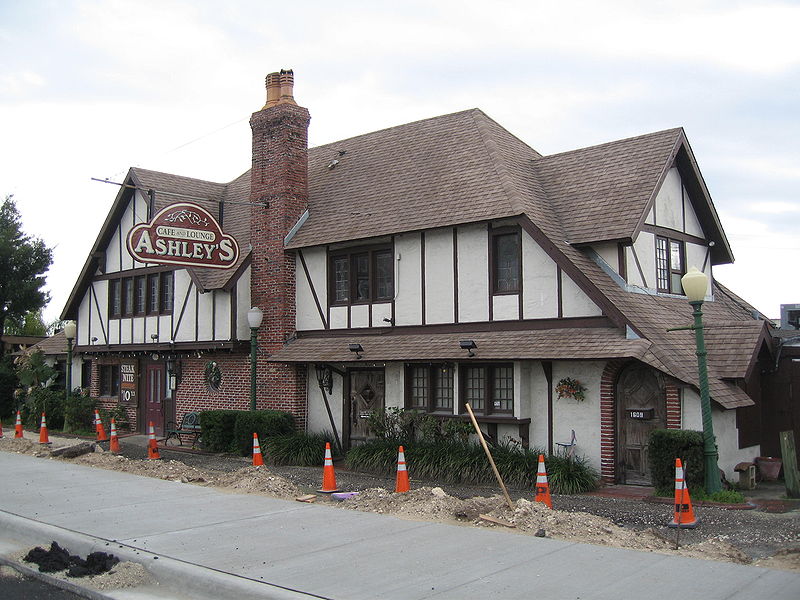
On November 21, 1934, Ethel Allen’s mutilated body was found on the banks of the Indian River in Eau Gallie, some 16 miles away. The nineteen year old had been seen just a few days before when she stopped at a local packing house to say goodbye to a friend. Ethel was leaving to visit her mother, accompanied by a male acquaintance and she may have also stopped by her favorite local hangout, Jack’s Tavern, now Ashley’s of Rockledge. The Tudor-style restaurant has paranormal activity, some of which has been attributed to Ethel Allen.
Ashley’s, 2010, by Leonard J. DeFrancisci. Courtesy of Wikipedia.
A variety of sources state that Ethel may have been murdered within the walls of the restaurant in a storeroom (possibly near the famously haunted ladies restroom) or just outside the building. A local genealogy blog makes no mention of where Ethel may have met her end, but I get the feeling it probably was not in or around the busy tavern. The stories of the restaurant’s haunting are quite readily available though they seem to sometimes perpetuate different variations of the murder.
The activity runs the gamut from simple, cold breezes being felt to voices and screams to full apparitions being seen and captured on film. Some sources also note that the activity does not seem to be limited to just the possible shade of Ethel Allen. There are other possible spirits including a child and an adult male. It does seem that Ashley’s may be one of the most paranormally active restaurants in the state.
Walls, Kathleen. Finding Florida Phantoms. Global Authors Publications, 2004.
Tondee’s Tavern 7 East Bay Street Savannah, Georgia
With the immense host of spirits that inhabit the city of Savannah, chances are high that activity may be found most anywhere. Occupying part of a mid-19th century bank building, Tondee’s Tavern utilizes the name of a important colonial era tavern that existed in the city. The building’s history dates to 1853 when its lower floors were occupied by the Central Railway and Banking Company. The upper floors of the building were used as offices for a slave dealer, Joseph Bryan.
Stories of spirits within the building have evidently existed for some time, but the spirits made themselves very well-known recently. In late June of this year, a passerby on the street left a cigarette in a flower box in front of the building. The cigarette smoldered for a few hours before erupting into flames early in the morning. Meanwhile, two employees slept downstairs; a fairly common practice when employees close the previous night and must open the next day.
A closed-circuit security camera picked up the scene at the front of the restaurant. Over the course of two hours, as the flames can be seen building outside the window, a number of white orbs are seen almost frantically zipping through the air. Something woke the two young women asleep in the basement and they were able to begin extinguishing the flames before they could do more damage. The tavern’s owner, however, is still wondering if the orbs were spirits trying to save the building and his business.
Jailhouse Pizza 125 Main Street Brandenburg, Kentucky
In a fairly creative use of a historic building, the old Meade County Jail is now a pizzeria. Built in 1906 by the Pauly Jail Company, this building was the third jail built for Meade County. The pizzeria’s website states that some of the inmates have apparently never left, including one who has been dubbed, “Bigsby.” These spirits have been both seen and heard.
Old Meade County Jail, 2011, by Nyttend. Courtesy of Wikipedia.
A recent investigation by the Hopkins County Paranormal Society was able to capture, what one investigator calls, “the best evidence ever.” Video taken during the investigation shows a blanket being pulled out and down. Audio evidence was also captured that includes footsteps, a scream and possibly a female child.
Sources
“History.” Jailhouse Pizza. Accessed 31 October 2014.
Johnson, William G. Kentucky Historic Resources Inventory form for Meade County Jail. Summer 1983.
Landon, Heather. “Best Creepy Historic Sites in the US.” The Daily Meal. 14 October 2014.
Antoine’s 713 St. Louis Street New Orleans, Louisiana
Antoine’s, 2007 by Infrogmation. Courtesy of Wikipedia.
Antoine Alciatore, like so many Europeans at that time, dreamed of making it big in the United States and immigrated in 1838 to make good on those dreams. After a couple years of struggling in New York City, he set his sights on that most French of cities, New Orleans and this is where he opened Antoine’s. In 1868, the restaurant moved to its current location that now boasts 14 unique dining rooms. Alciatore left New Orleans in 1874 bound for Marseilles where he died; his beloved restaurant was left in the hands of his son and his family has continued to own and run the restaurant. Antoine continues to return to check up on this famed New Orleans institution and he continues to be seen in the Japanese and Mystery Dining Rooms. Other specters in 19th century clothing have been seen peering from the mirrors in the washrooms as well.
Sources
Dwyer, Jeff. Ghost Hunter’s Guide to New Orleans. Gretna, LA: Pelican, 2007.
Antoine’s Restaurant. Accessed 8 January 2011.
Puccini Restaurant 12901 Ali Ghan Road, NE Cumberland, Maryland
At Puccini, patrons may get a bit of the paranormal with their pasta. With your fettuccini, you may hear disembodied footsteps or perhaps there may be some voices heard as you enjoy your vino. Don’t mind them, they won’t hurt you.
The building now housing Puccini was near fighting on August 1, 1864 as Confederates were defeated in the Battle of Folck’s Mill. Many of the wounded were brought into the George Hinkle house (as it was known at that time) where they were treated. Of course there may also have been a few deaths in the house during that time. Some of those soldiers may have also written or carved their names on the walls in the attic.
Employees of the restaurant as well as guests have reported quite a bit of activity over the years. From footsteps to shadow figures to full apparitions, people in this building have had many experiences. The restaurant was investigated a few years ago by member of the team from City Lights Paranormal Society of Easton, Pennsylvania. The investigators were able to capture a good deal of audio evidence including a number of EVPs.
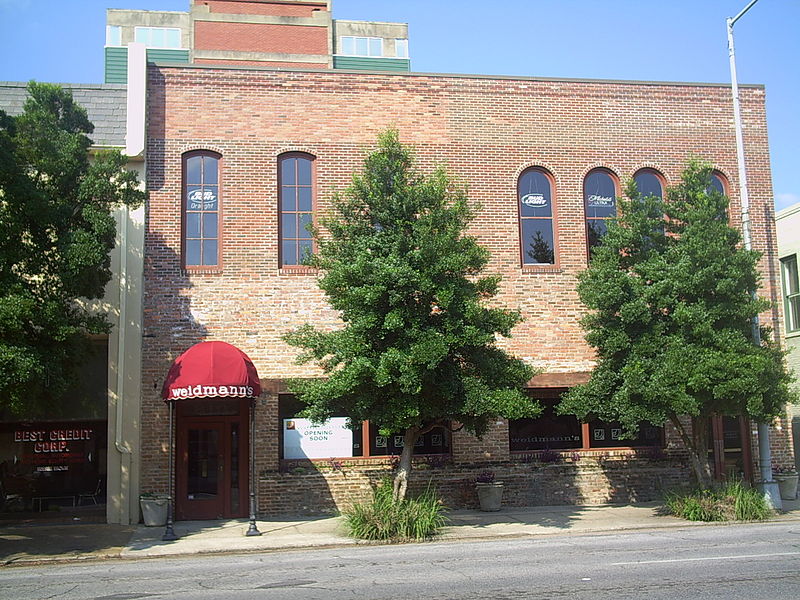
Like Antoine’s in New Orleans, Meridian’s Weidmann’s restaurant was also started by an immigrant and has become a local institution after more than a century. Weidmann’s was opened by Felix Weidmann, a Swiss immigrant. While Antoine’s has remained in the same location, Weidmann’s location changed a number of times before it settled into a location in 1923.
Weidmann’s, 2010, by Dudemanfellabra. Courtesy of Wikipedia.
The haunting of Weidmann’s seems to be mostly residual activity. Sounds echo through the restaurant with no obvious source. For his 2011 book, Haunted Meridian, Mississippi, Alan Brown spoke with one employee who recalls hearing sounds associated with livestock near the restaurant’s freezers where livestock may have been kept before Weidmann’s moved in. But animal sounds are just a small part of the repertoire associated with the spirits of Weidmann’s.
At table one, a legend is oft told of a young couple visiting the restaurant during the Great Depression. The couple had recently become engaged and had enough money to treat themselves to a meal in the restaurant. Henry Weidmann, the restaurant’s owner at the time, picked up the tab and encouraged the couple to return for their first anniversary. The legend continues that the young couple did not return to their table in the restaurant in life, but they have continued to return in death. They are supposed to be seen on occasion sitting quietly at the table holding hands under the table.
Sources
Brown, Alan. Haunted Meridian, Mississippi. Charleston, SC: History Press, 2011.
Four Square Restaurant 2701 Chapel Hill Road Durham, North Carolina
Bartlett Mangum built his house in 1908 on the outskirts of Durham and the house is now the only part of his 80-acre farm that has remained standing. The house remained in the family until Mangum’s daughters were moved to a nursing home in 1956. The house passed through a variety of owners who rented out the house or used it for commercial purposes including a variety of restaurants. During the early 1960s, the house was even used as a racially-integrated church.
The Mangum daughters, Inez and Bessie, inherited the house in 1927 and tradition holds that they did not speak to each other for many years due to a feud. According to an article by Colin Warren-Hicks in the local progressive paper, Indy Week, restaurant staff believes that the spirit of Inez Mangum still flits about her old house. Cooks in the kitchen reported to Warren-Hicks that pots and pans would move on its own accord. Dinner and glassware left on a certain mantelpiece in one of the restaurant’s dining rooms would often be inexplicably knocked to the floor.
UPDATE 4/23/2018: Four Square has closed.
Sources
Dickinson, Patricia S. National Register of Historic Places nomination form for Bartlett Mangum House. 5 December 1988.
Warren-Hicks, Colin. “The Devil went down to Four Square Restaurant.” Indy Week. 22 October 2014.
Connolly’s Irish Pub 24 East Court Square Greenville, South Carolina
This unassuming Irish pub in downtown Greenville, South Carolina is a front for a secret. Just outside the pub and behind the street door that provides access to this old commercial building’s second floor is an unused floor that is supposed to have served as a brothel some years ago. A recent investigation of this building by local investigator and ghost tour operator Jason Profit produced video of small orbs of light flitting through the corridor.
It’s my sincerest hope that the victims of the horrible event that happened here in 1997 are at rest; they most certainly deserve to be. On March 23, 1997, Paul Dennis Reid forced his way into this McDonald’s at closing time. After shooting three of the employees, he stabbed a fourth employee seventeen times before leaving with the restaurant’s money. The three shooting victims died while the stabbing victim survived. Just a month before, Reid had robbed a nearby Captain D’s brutally shooting and killing two employees. Before he was captured by the police, he managed to kill a total of seven people, all fast food employees. Reid passed quietly in prison just last year.
According to the Nashville Haunted Handbook, published in 2011, this restaurant has been plagued by a general sense of unease as well as shadow figures. After viewing this location on Google Streetview, it appears that this McDonald’s location may have a new building—the chain has been tearing down older restaurants and replacing them with new buildings. Though, since the building has been replaced, it is unknown whether this activity has persisted.
Sources
“2 Slain at Nashville McDonald’s.” Chicago Tribune. 24 March 1997.
Morris, Jeff; Donna Marsh and Garett Merk. Nashville Haunted Handbook. Cincinnati, OH: Clerisy Press, 2011.
Wilson, Brian. “Tennessee mass murderer Paul Dennis Reid dead.” 1 November 2013.
Coffee Pot 2902 Brambleton Avenue, SW (US 221) Roanoke, Virginia
Just who or what is causing the odd activity at Roanoke’s landmark roadhouse, The Coffee Pot, is still a question. Primarily, the activity generally involves the movement of objects. One bartender was cleaning ashtrays and stacking them on the bar one evening after the restaurant had closed. They had already stacked a number of ashtrays when they witnessed the stack rise into the air and then drop back down on the bar. Startled, she returned to work only to have the stack of ashtrays rise and fall again. After that, she grabbed her things and left.
The Coffee Pot, 2009, by Patriarca12. Courtesy of Wikipedia.
A manager noted that spices would often disappear from their accustomed spot only to reappear in a very different location sometimes days later. Bottles of wine and other cooking utensils have been known to fly across rooms, while paranormal investigators have been able to photograph orbs and have captured EVPs within the restaurant.
The Coffee Pot, with its distinctive large coffee pot, was constructed in 1936 along what had been a fairly rural road. Over time, US 221 has grown along with the restaurant’s business. As a roadhouse, the restaurant has become known for its musical entertainment including Willie Nelson who played an impromptu concert at the restaurant in 1970s.
Sources
Hill, Helen. National Register of Historic Places nomination form for The Coffee Pot. December 1995.
Hurst, Chris. “Looking for ghosts at The Coffee Pot in Roanoke.” 24 October 2010.
Taylor, L. B. Jr. Haunted Roanoke. Charleston, SC: History Press, 2013.
Yellow Bank Restaurant 201 East German Street Shepherdstown, West Virginia
In the historic town of Shepherdstown, the 1906 Jefferson Security Bank now houses the Yellow Bank Restaurant. The bank was converted to a restaurant some years ago and now houses the restaurant where table 25 was the scene of some activity in the 1990s when a patron reported to the restaurant’s manager that she couldn’t sit at the table because of the ghost. The bartender also reported that he had glasses fall from the glass rack and break.
UPDATE 4/23/2018: Yellow Bank Restaurant has closed.
Sources
Molenda, Rachel. “Town serves as home to ghosts from past.” The Shepherdstown Chronicle. 28 October 2011.
I recently had an inquiry from a friend who’s a student at Shenandoah University in Winchester, Virginia regarding a “haunted road trip” he and his friends want to take next month. After consulting my resources, I’ve devised a suitable tour of the area’s numerous haunts.
This tour makes a circle through the Shenandoah Valley, beginning and ending in Winchester. It heads south on I-81 towards Staunton with a few stops along the way. After Staunton the tour heads east to include the famous Exchange Hotel in Gordonsville before returning to Winchester. The tour includes a range of haunted places from historic homes to government buildings, churches, battlefields, commercial buildings, cemeteries, a train depot, a former mental hospital and a cave. Some of these locations are open to the public while a few are private and should only be viewed from the street.
N.B. This article has been reworked a bit and I have begun separating these cities into their own distinct articles.
Winchester
The Winchester section of this article has been broken off into its own, separate article, “The Wraiths of Winchester.”
Middletown
1797 WAYSIDE INN (7783 Main Street) This building sits at the core of history of this small town. The motley of old buildings forming the tavern were built over a period ranging from the 18th century through to the late 19th century. The oldest portion of the building, containing Larrick’s Tavern, may have been constructed around 1750. The road in front was once part of the Great Wagon Road—the road used by settlers pouring into the American “backcountry.” In this area, the Great Wagon Road was originally a Native American trail called the Great Indian Warpath and used by a multitude of Native American tribes including the Cherokee.
In 1797, this collection of buildings became an inn for the many travelers passing on the road. Leo Bernstein, the garrulous personality who took over the inn the latter half of the 20th century, would always claim that this inn was the oldest continuously operating inn in the nation. There does seem to be a good deal of truth behind his claim. It is known that this inn was in operation as war raged up and down the valley during the Civil War and that the inn served both sides.
Wayside Inn. Photo 2008, by DwayneP, courtesy of Wikipedia.
Like most buildings in the area, the inn has a number of Civil War related spirits, though there is the possibility that the inn may have been haunted before that time. Lord Fairfax, who had been given much the land in the area, did live nearby and died in Winchester (he’s buried at Christ Episcopal Church) is claimed as the spirit that moans on a nightly basis in the oldest portion of the inn. Bernstein describes the space in Sheila Turnage’s Haunted Inns of the Southeast, “Upstairs is about a three foot space. There was a set of steps going up there. The straw is still there.” The loft is located just above one of the bars and Turnage mentions that people gather to listen for the moan at 11:30 PM nightly.
Besides odd moans, the inn is home to numerous other spirits and employees and guests have witnessed much activity. Objects have moved on their own accord, a dishwasher had his apron untied repeatedly by unseen hands, and full apparitions have been seen including those of Civil War soldiers. Paranormal investigations have captured much evidence including EVPs of horses whinnying and photographs featuring specters.
WAYSIDE THEATRE (7853 Main Street, now closed) The sad fate of the Wayside Theatre echoes the fate of so many theatres throughout the country. The company was established in 1961, by Leo Bernstein, the owner of the Wayside Inn just down the street. The summer stock theatre provided training for actors such as Susan Sarandon, Peter Boyle, Kathy Bates and Donna McKechnie. After a precipitous drop in revenue, the theatre closed its doors in 2013.
The building was originally constructed as a cinema and it is from this period that the theatre’s ghost may come from. “George,” is supposedly the spirit of an African-American man who either worked in the theatre or was a caretaker at some point. His spirit is said to haunt the stage, balcony and basement of the building.
CEDAR CREEK AND BELLE GROVE NATIONAL HISTORICAL PARK (Belle Grove, 336 Belle Grove Road) Historically and architecturally, Belle Grove is one of the most important houses in the region and listed as a National Historic Landmark. It is currently owned and operated by the National Trust and most sources state that the docents are discouraged from talking about the spirits which still reside here.
Belle Grove, 2013, by AgnosticPreachersKid. Courtesy of Wikipedia.
The history of Belle Grove begins in the late 18th century with the land being acquired by Isaac Hite, the grandson of Jost Hite, a German immigrant and one of the early pioneers in this area. Construction of the house began in 1794 and ended in 1797. The house remained in the Hite family until just before the beginning of the Civil War when it was bought by John and Benjamin Cooley. The first of two ghost stories begin with this family. Not long after acquiring the house, Benjamin Cooley married a local woman named Hetty. Not long after her arrival in the home, Hetty became the subject of ire from one of the slave woman working there.
Though the details are unclear, Hetty was attacked by the slave and her beaten body was thrown either into the smokehouse or the icehouse on the property. Hetty’s spirit reportedly returns frequently and has been seen throughout the house. According to two sources, she actually let a deliveryman into the house one afternoon after the home had been closed for the day. The deliveryman was returning the antique carpets which had been removed for cleaning. After arriving late, he was let into the house by a woman in a period dress who did not speak but only gestured to where the carpets should be placed. When the staff discovered the carpets had been returned and put in place, they called the cleaning company who put the driver on the phone. They were shocked to hear about the woman who let him in.
A few years after Mrs. Cooley’s death, the estate became the scene of the Battle of Cedar Creek. During that battle, Major General Stephen Ramseur of North Carolina was gravely wounded. He was taken to a room at Belle Grove where he passed away the following morning surrounded by some of his former classmates from West Point from both armies including George Custer. This scene was witnessed by a gentleman some years ago. While idly passing through the house, he glanced into a room to see a group of Civil War soldiers in both blue and grey standing around someone in a bed. Later, when he asked who had been presenting the tableaux that day, he was informed that nothing of the sort was taking place in the house.
Employees have told various paranormal writers that voices and other odd noises are regularly heard in the house, while singing is heard in the slave cemetery on the property.
Early on the morning of October 19, 1864, Confederate General Jubal Early launched an attack upon Union forces camping in the area. These forces under General Sheridan (who was headquartered at the Lloyd Logan House in Winchester, see stop #3H) had spent their time clearing the Shenandoah Valley of Confederates. Known as “The Burning,” this period included the destruction of much of the area. Early’s early morning attack was one of the last chances for Confederates to stop the decimation of the valley.
While Early’s attack was initially successful in beginning to route the Federals, Sheridan, hearing the sounds of battle from Winchester, jumped upon his horse and made a triumphant ride to Middletown to rally his troops to victory. At the end of the day, Early’s forces had been driven from the field.
The stories of spirits on this battlefield began not long after the battle ended. These stories included spectral soldiers on the battlefield both singly and in groups and even stories of headless horsemen. Michael Varhola notes, however, that the gentlemen he met working in the visitor’s center, refused to answer his questions about the battlefield being haunted.
Grottoes
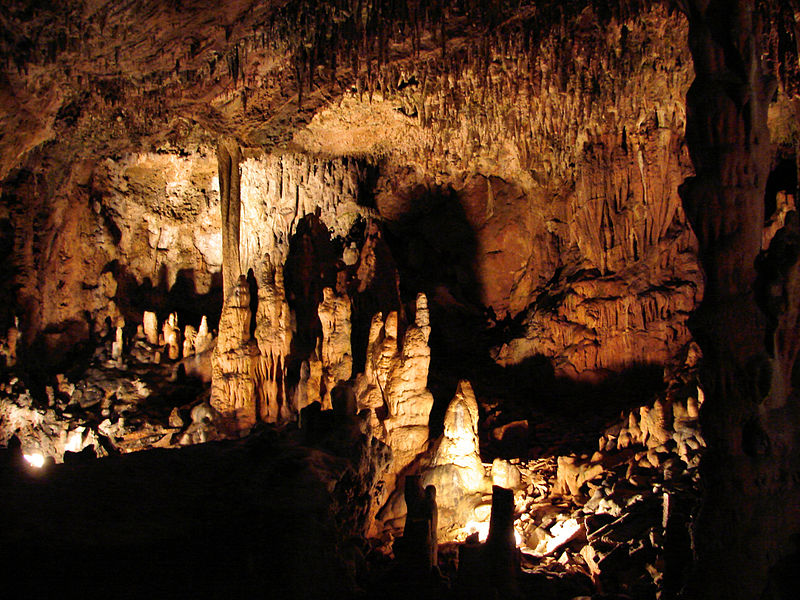
Formations within Grand Caverns. Photo 2010 by P199. Courtesy of Wikipedia.
GRAND CAVERNS (5 Grand Caverns Drive) From the oldest continuously operating inn in the country to the oldest operating show cave, Grand Caverns has been open for tourists since 1806. I’ve covered this cave and its ghosts in a blog entry here.
New Hope
PIEDMONT BATTLEFIELD (Battlefield Road) Outside of New Hope, near the community of Piedmont, is an open field that was the scene of a battle, the 5th of June 1864.
Around 5 AM, June 5, 1996, a group of reenactors camping on the southern edge of the battlefield were awakened by an unusual ruckus: the sounds of wagons approaching. In an effort to greet the approaching wagons, a few of the reenactors stepped towards a nearby fence. The sounds, the creak of wagon wheels, the tinkle of chains, the clop of horses hooves and their whinnies, increased for a moment as they apparently neared the awed witnesses then they suddenly ceased. Some of those present later discovered an overgrown trace or wagon road in the woods near the spot where they’d heard the sounds. It is believed that this road may have been in existence at the time of the battle.
Of course, there’s no way to know if the sounds were related to battle or simply spiritual residue from the road’s history. Either way, the reenactors will likely tell this story for years to come.
Staunton
Like Winchester, Staunton has a myriad of haunted locales and a ghost tour. Black Raven Paranormal presents a handful of different tours; see their website for further information.
MRS. ROWE’S FAMILY RESTAURANT (74 Rowe Road) This popular restaurant has been investigated twice in the past few years after employees and guests have had run-ins with spirits. In addition to activity in the building’s attic and basement, the back dining room and men’s room have reportedly had activity. Two local news articles describe the activity as ranging from full apparitions to employees being touched.
DeJARNETTE CENTER (located behind the Frontier Culture Museum, 1290 Richmond Avenue, the center is closed and private property though one of the tours offered by the Ghosts of Staunton tours the grounds, don’t ask for further information at the Frontier Culture Museum, they can’t tell you much of anything) There’s a good deal of misinformation about this location. Of course, mental and psychiatric hospitals tend to be haunted, along with other medical facilities. Among those with a paranormal bent, there is a tendency to exploit these types of places and often repeat misinformation.
DeJarnette Center. Photo 2011, by Ben Schumin, courtesy of Wikipedia.
With the DeJarnette Center, there is a tendency to confuse it with Western State Hospital, which also may be haunted. Though their histories are intertwined, these are two separate facilities. Western State was founded early in the 19th century to handle the overflow from the Williamsburg Hospital which handled the insane and mental cases. The complex that once house Western State has recently been converted into condominiums called The Villages at Staunton.
During the first half of the 19th century, Western State was under the aegis of Dr. Joseph DeJarnette, a revolutionary figure in the field of mental health. His controversial legacy included institutionalizing a eugenics program that forcibly sterilized numerous patients throughout the state.
This facility opened in 1932 originally as the DeJarnette State Sanitarium, a private pay unit of Western State. The state assumed control of this facility in 1975 and renamed it the DeJarnette Center for Human Development. The facility experienced severe budget cuts starting in the mid-70s and continuing until the patients were moved into a newer, smaller facility adjacent to Western State in 1996. Since 1996, the site has been abandoned and waiting for the wrecking ball. Countless ghost stories have been told about the facility, though few have actually been published.
DOWNTOWN STAUNTON Like downtown Winchester, Staunton has a number of haunted places, though the information on them is not as readily available (as opposed to Winchester with Mac Rutherford’s book on its hauntings). I imagine many of these locations will be presented on the Ghosts of Staunton tour.
STAUNTON COFFEE AND TEA (32 South New Street) This building was the scene of a homicide in August of 1951. Elmer Higgins, a heavy gambler who lived in an apartment on the building’s second floor was shot in the head, execution-style. The murder remains unsolved and it is believed his spirit remains on the premises.
AMTRAK STATION (1 Middlebrooks Avenue) There has been a train station on this site since 1854. The first station was burned during the Civil War while the second station was destroyed April 28, 1890 by train. The New York Times described the event, “This morning about 3 o’clock a railroad wreck occurred at the Staunton (Chesapeake and Ohio) Station. The vestibule train, due here from the west at 1 o’clocl was two hours late. About 3 o’clock it came whirling on at a speed of seventy miles an hour, the engine having the appearance of a sheet of fire…As the train reached the passenger station the rear sleeper careened, striking the platform covering, tearing away the iron posts, and demolishing the whole platform structure.”
Staunton Amtrak Station. Photo 2009, by Ben Schumin, courtesy of Wikipedia.
The train was carrying members of a traveling operatic troupe out of Cincinnati, Ohio. The only death to occur was one of the company’s singers, Miss Myrtle Knox who was badly mangled by the accident and bled to death.
Myrtle’s sad spirit has been spotted on the platform wearing a nightgown. Women with long blonde hair have had their hair tugged and it is believed that Myrtle’s spirit may be to blame for that as well.
An old rail car at the depot once contained a restaurant. Visitors to the station have seen odd lights, shadows and heard voices around the old Pullman car. Along the tracks the apparition of a Civil War soldier has been seen. A Confederate soldier was walking these tracks after having a bit too much to drink at a local saloon. He was hit by a train and killed.
THE CLOCK TOWER BUILDING (27 West Beverly Street) This 1890 structure has been the scene of at least three deaths. Two early deaths on the premises, which was originally constructed as a YMCA facility, include a heart attack and a young woman who fell down a coal chute. Recently, someone fell to their death from the third floor in a possible suicide. These spirits are still said to linger in this old building.
MARY BALDWIN COLLEGE (Intersection of Frederick Street and New Street) According to the National Register of Historic Places nomination form for this college’s main building, Mary Baldwin is the oldest women’s institution of higher learning associated with the Presbyterian Church. The school was opened in 1842 as the Augusta Female Seminary. In the midst of the Civil War, Mary Baldwin and Agnes McClung, former students of the seminary were appointed as principals. They would serve the school through the latter half of the 19th century and Mary Baldwin’s contribution would be recognized in 1895 when the school was renamed for her. The spirits of Mary Baldwin and Agnes McClung may remain on campus along with a few other assorted spirits.
In the old Main Building, one of the first buildings constructed on campus, a male spirit named Richard likes to occasionally cause trouble. McClung Residence Hall, just behind the Main Building includes the rooms where Baldwin and McClung lived during their tenure here. Students living there have reported the spirits of both women, with one student even waking up to find a white figure hovering over her as she slept. The Collins Theatre, located inside the Deming Fine Arts Center, also features a spirit, possibly that of one of Mary Baldwin’s most illustrious alums, the actress Tallulah Bankhead. The spirit in the theatre is known to mess with the stage lights.
Gordonsville
Exchange Hotel, 2008, by Rutke421. Courtesy of Wikipedia.
CIVIL WAR MUSEUM AND EXCHANGE HOTEL (400 South Main Street) The Exchange Hotel has, in recent years, become one of the Southern meccas for ghost hunters. Opened on the eve of the Civil War, this hotel became one of the premier hospitals for the wounded during the Civil War. With so many deaths here, it’s no wonder that the place is crawling with ghosts. In one of my early blog entries, I’ve covered this location. At one time, the museum offered ghost walks, but I can currently find no information about these. This haunting was also covered on the Biography Channel show, My Ghost Story, first season, episode six.
Sources
Abram’s Delight. Winchester-Frederick County Historical Society. Accessed 19 September 2014.
Armstrong, Derek Micah. “A true ghost story.” The News Virginian. 22 October 2012.
Ash, Linda O’Dell. “Respect the spirits, ‘Ghost Hunters International’ star Dustin Pari tells Wayside Inn paranormal investigators.” The Northern Virginia Daily. 7 November 2011.
Austin, Natalie. “Local ghost expert shares stories of the supernatural.” The Northern Virginia Daily. 30 October 2004.
Brown, Beth. Haunted Plantations of Virginia. Atglen, PA: Schiffer, 2009.
Rutherford, Mac. Historic Haunts of Winchester: A Ghostly Trip Through the Past. Charleston, SC: History Press, 2007.
Shulman, Terry. “Did ghostly soldiers pay reenactors a courtesy call?” The News Leader (Staunton, VA). 10 July 2004.
Smith, Morgan Alberts & Marisol Euceda. “The Ghosts of MBC.” Up Hill and Down. January/February 2003.
Stanley, K.W. “The history of Western State and the Dejarnette Sanitarium.” The News Progress. 20 May 2008.
Toney, B. Keith. Battlefield Ghosts. Berryville, VA: Rockbridge Publishing, 1997.
Tripp, Mike. “DeJarnette’s ugly, complicated legacy.” The Daily News Leader. 22 March 2014
“Trying to get a glimpse of a ghost at Staunton’s Mrs. Rowe’s.” News Leader. 24 June 2012.
Turnage, Sheila. Haunted Inns of the Southeast. Winston-Salem, NC: John F. Blair, 2001.
Varhola, Michael J. Ghosthunting Virginia. Cincinnati, OH: Clerisy Press, 2008.
Virginia Historic Landmarks Commission Staff. National Register of Historic Places nomination form for the Cedar Creek Battlefield and Belle Grove. 24 April 1969.
Virginia Historic Landmarks Commission Staff. National Register of Historic Places nomination form for Mary Baldwin College, Main Building. 26 July 1973.
Virginia Historic Landmarks Commission Staff. National Register of Historic Places nomination form for the Winchester Historic District. April 1979.
Higher education has always nodded towards the traditions of ancient universities especially during rituals like graduation when students and faculty wear traditional scholars’ gowns and regalia. Among those traditions that can be found are ghost stories passed from student to student, though often these tales include a kernel of truth. Included here are a few stories from Virginia.
Alderman Library Campus of the University of Virginia Charlottesville
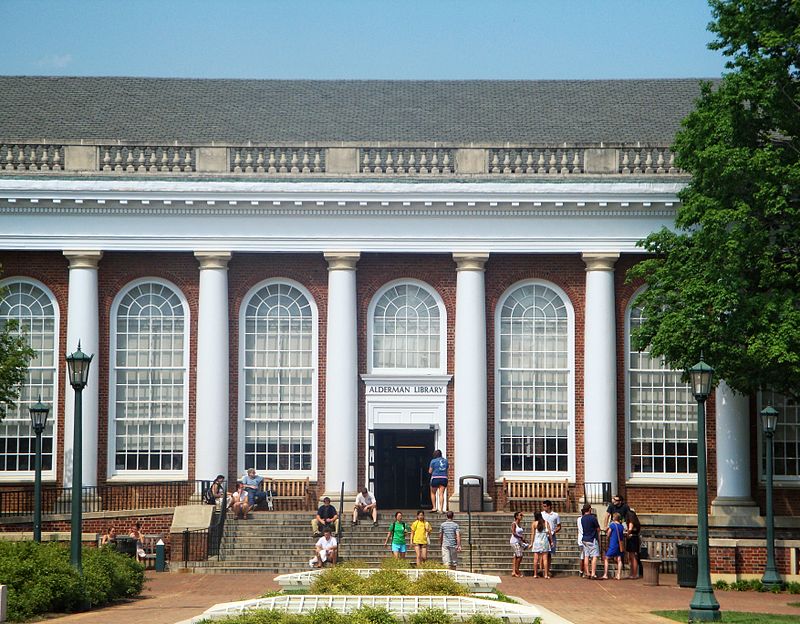
The website for the University of Virginia Libraries notes that the university’s library system incorporates 13 buildings, possesses 5.1 million books and includes reports of two ghosts. The university’s grand Alderman Library was built during the Great Depression as part of FDR’s Public Works Administration. Opening in 1938, the building housed the university’s growing library which originally was house in the magnificent rotunda designed as a centerpiece for the university by Thomas Jefferson.
Alderman Library, 2009, by Vtn5n, courtesy of Wikipedia.
According to accounts from library staff, the two spirits within the library don’t actually haunt the building, but two particular collections of books. Like the inverted and bookish Jefferson, Dr. Bennett Wood Green and Muscoe Garnett were both obsessed with their own personal libraries. When Dr. Green, a Virginia physician, died in 1913, he left his large library to the university. His books were originally shelved in the Rotunda library and that is where his curious spirit was first encountered checking up on his precious books. When his books were moved to the new Alderman Library, he tagged along and his spirit has been seen roaming the old stacks. Footsteps echoing through those same stacks have also been attributed to him. Upon encountering Green’s bookish spirit, one library staff member began bringing her large dog to work with her.
Alumnus and later member of the university’s Board of Visitors, politician Muscoe Russell Hunter Garnett housed his extensive library in his home, Elmwood, in Essex County, Virginia. Upon Garnett’s death just before the end of the Civil War, the house was closed and left to decay. While the house decayed, the books seemingly did not. Rumors spread that the library was taken care of by the spirit of a friend of Garnett’s who would rise from his grave nightly to dust and care for the library. The books were donated by the family to the university in 1938 and were shelved in the new Alderman Library. The spirit seen among these books may be the caring spirit or perhaps that of Garnett, himself.
Sources
Barefoot, Daniel W. Haunted Halls of Ivy: Ghosts of Southern Colleges and Universities. Winston-Salem, NC: John F. Blair, 2004.
Foster, Gaelyn and Jiaer Zhuang. “Alderman Library turns 75.” The Cavalier Daily. 16 October 2013.
Pflager, Henry. “Alderman to celebrate 75th” The Cavalier Daily. 3 October 2013.
Strand, Megan. “Terrifying Tales.” The Cavalier Daily. 13 April 2001.
Truong, Tiffany. “Spirits, ghosts reportedly haunt University grounds.” The Cavalier Daily. 30 October 2013.
Ferguson Center for the Arts Campus of Christopher Newport University Newport News
Though Christopher Newport University is the youngest comprehensive public university in Virginia, it seems to have acquired a ghost. The building now housing the Ferguson Center for the Arts originally opened in 1957 as Warwick Junior High School. In 1961, the school reopened as Homer L. Ferguson High School and remained a high school until it closed in 1996. Christopher Newport University, which opened in 1960 not long after Warwick Junior High, acquired the building and hired noted architect I.M. Pei to renovate it into a performing arts center.
Along with the old high school, the university also acquired the ghost of a former student. According to the university’s student newspaper, The Captain’s Log, the spirit requires acknowledgement and the theatre students working in the building know to say hello to her when they enter the sound booths. Otherwise, the student may see things in their peripheral vision. The paper notes that a 15-year-old female student died in 1968.
Sources
Christopher Newport University. “Our Campus.” Accessed 12 September 2014.
“Ferguson High School Closing: Ferguson Memories.” Daily Press. 9 June 1996.
Lurie, Victoria. “A Ghost Story.” The Captain’s Log. 30 October 2013.
Payne Hall Campus of Washington & Lee University Lexington
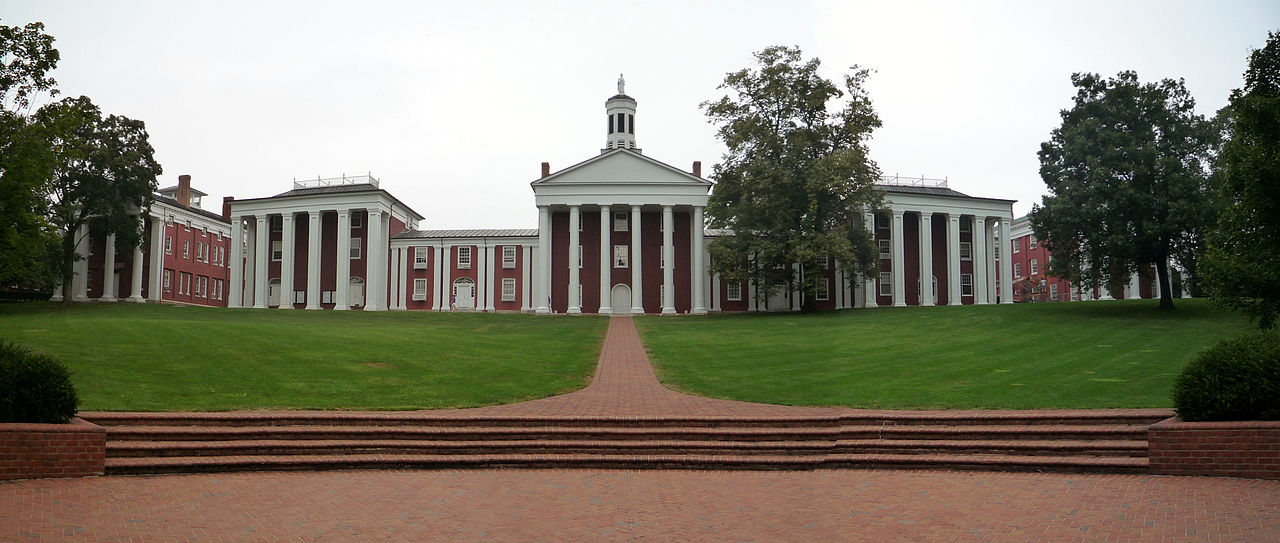
The Colonnade of Washington and Lee University may be one of the most dramatic collections of college buildings in America. Oddly, this section of campus was not “the product of a single architectural concept,” as is stated in the university’s National Register of Historic Places nomination form. In fact, the Colonnade evolved as “an evolutionary product of a building program, extending over nearly one hundred and fifty years.” So remarkable is this collection of buildings that it is now a National Historic Landmark.
The Colonnade, 2008, by Bobak Ha’Eri, courtesy of Wikipedia. Payne Hall is the second building from the left.
The second oldest building in the Colonnade is Payne Hall built in 1831. The building was originally called The Lyceum and used to teach biology. It was renamed Payne Hall after a renovation in the 1930s and is currently used by the university’s English department. After an English class studied James Merrill’s epic poem, “The Book of Ephraim”—a poem composed using an Ouija board—some students and an English professor attempted to communicate with the spirits of Payne Hall via Ouija board. The group possibly communicated with a few spirits. When one spirit was asked which building on campus was the most haunted, it replied by spelling out “B-I-O.” Sometime later, the professor discovered that Payne Hall had historically been used for biology.
Among the stories from Payne Hall are accounts of doors opening and closing by themselves, disembodied footsteps and apparitions. A university press release describes three apparitions that have been seen around this building including, “a dark presence moving swiftly down the back stairs, a person dressed in black swirling down the Colonnade, and a cape-wearing figure that whisks into the building.”
Sources
Balfour, Amy C. “Payne Hall Restoration: A Marriage of Old and New.” News @ Washington and Lee. 14 September 2011.
Hanna, Jeff. “Payne Hall Ghost: Spooked by Renovations?” News @ Washington and Lee. 27 October 2011.
Virginia Historic Landmarks Commission. National Register of Historic Places nomination form for Washington and Lee Historic District. 6 October 1970.
Williamsburg Theatre formerly the Kimball Theatre 428 West Duke of Gloucester Street
N.B. This article was updated and edited 17 February 2019.
Williamsburg is more reconstruction than restoration. The passage of time had taken its toll on the city when John D. Rockefeller, Jr. and W. A. R. Goodwin began their project to return part of the town to what it had been in the mid-18th century. Some buildings were long gone and had to be reconstructed, while others had modern additions that needed removal. Plus, there was a need to provide accommodations and conveniences that modern visitors would expect.
Merchant’s Square with the Kimball Theatre as the two-story brick building on the right. Photo 2008, by Ser Amantio di Nicolao. Courtesy of Wikipedia.
Rockefeller envisioned Merchant’s Square as providing modern shopping and entertainment conveniences while still maintaining a colonial atmosphere. Among the entertainment options was the Williamsburg Theatre which offered live performances and films in a graceful and air-conditioned Georgian structure.
The theatre opened in January of 1933, with a performance of George Farquhar’s Restoration Comedy, The Recruiting Officer. According to the Colonial Williamsburg Foundation, this play was the first play performed in British North America when it was produced in Williamsburg. Interestingly, this play was the first play performed in the haunted Dock Street Theatre in Charleston, South Carolina, which is also a reconstruction for that matter. The Williamsburg Theatre was restored in 2000 and named for Bill and Gretchen Kimball, who sponsored the restoration.
As of 2017, the College of William & Mary has signed a lease to the Kimball as a production space for its Department of Theatre & Dance.
As one might expect, not all the spirits in Colonial Williamsburg are from the 18th century. As Virginia was at the heart of much of the fighting during the Civil War, that conflict has left a spiritual impression on the area. Legend holds that the spirit within the Kimball is a Union soldier.
The land now occupied by the Kimball Theatre was once the home of the Ware family. During the Civil War, the women of the family, as many did during the war, took in and nursed wounded soldiers. They took in a young Confederate soldier who had been wounded in the Battle of Williamsburg, though their care was in vain. The soldier passed away and the ladies took his body to the parlor to await removal.
After Union soldiers captured the town, they went house to house in search of Confederates hiding among the civilians. Upon reaching the Ware House, one soldier was shown to the parlor and the sheet covering the young soldier’s body pulled back. The young Union soldier was horrified to see the body of his own brother who with his different political biases had joined the Confederate army. Sadly, the young Union soldier was not long for this earth and was killed not long afterwards.
A blue-clad spirit, possibly that of the Union soldier, has been seen within the theatre. He appears to be frantically searching for something among the backstage rooms and then suddenly disappears.
Behrend, Jackie Eileen. The Hauntings of Williamsburg, Yorktown, and Jamestown. Winston-Salem, NC: John F. Blair, 1998.
Chappell, Edward, Mary Harding Sadler and Llewellyn Jewell Hensley. National Register of Historic Places nomination form for Merchants Square and Resort Historic District. 28 February 2006.
Colonial Williamsburg. “Kimball Theatre.” Accessed 6 April 2013.
Hanover Tavern 13181 Hanover Courthouse Road Hanover Courthouse, Virginia
For nearly three centuries, Hanover Tavern has served as a center of this small community just outside of Richmond. It’s not hard to imagine patrons, guests, slaves and proprietors telling stories and singing songs over pints of ale around the tavern’s fireplaces over the years. Appropriately, this amateur theatre in the building was elevated to a professional level when the Barksdale Theatre took over the building—ghosts and all—in 1953.
Taverns were a mainstay throughout Colonial America. They served as centers for the communities, gathering places for people from outlying plantations and farms, courthouses in rural areas, stage coach stops, post offices and stops along lonely roads providing a warm meal and bed. The tavern in Hanover was licensed in 1733 and, by the time it was sold a decade later, was the center of a 550 acre plantation. The tavern was owned by John and Eleanor Shelton in the mid-18th century, parents of Sarah Shelton who married a country lawyer named Patrick Henry. Henry, of course, would become one of the founding fathers of the nation. Incidentally, Scotchtown, the nearby plantation where Henry and Sarah settle with their family, is haunted by Sarah’s spirit.
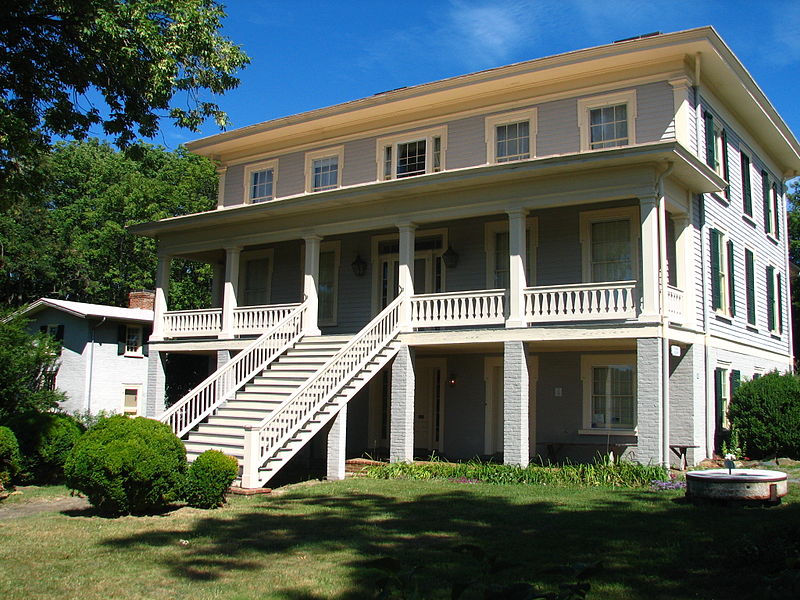
Hanover Tavern, 2007 by BrandlandUSA. Courtesy of Wikipedia.
Besides Patrick Henry, Hanover Tavern saw a great many important people pass through its corridors including George Washington, General Lord Cornwallis, the Marquis de Lafayette and countless Union and Confederate soldiers during the Civil War. In 1800, slaves here whispered of rebellion: an attempt by the slaves in this region to destroy Richmond, capture the governor and destroy slavery in Virginia, later known as Gabriel’s Rebellion. The rambling wooden building had nearly fallen into ruins when it was bought in the middle of the 20th century for use as a professional theatre.
Six professional actors from New York, two children and a dog created the professional Barksdale Theatre here. The basement was converted into a performance space while the main floor was used for serving dinner to the patrons. Here the theatre produced some of the first professional productions in the state of Virginia by many of the 20th century’s greatest playwrights like Tennessee Williams, Thornton Wilder, Edward Albee and Lorraine Hansberry. Defiantly thumbing their nose at the state’s Jim Crow laws, the theatre offered one of the first integrated public spaces in the region.
Unable to keep up with repairs on the theatre’s ancient structure, the building was sold to the Hanover Tavern Foundation, an organization charged with a mission to preserve and utilize the structure for historic and educational purposes while maintaining space for the theatre company’s performances. In order to accommodate a full restoration of the Hanover Tavern, the Barksdale Theatre moved to a new facility and created a new performing season at the Hanover Tavern in 2006. In 2012, the still vigorous theatre company merged with Theatre IV, a nationally recognized local children’s theatre company, to create the Virginia Repertory Company.
It has been reported that motorists driving past the darkened tavern at night have reported seeing a face peering at them from a third floor window. Perhaps this is the same spirit whom actors and servers have encountered wearing all black and crying in the tap room on the main floor. One former artistic director heard running footsteps in the empty building one evening. He was working in his third floor office when he heard footsteps in the hallway outside. As they passed his office, he saw nothing but heard the footsteps running down the hall, down the stairs, through the dining room then down the stairs again and through the tap room. While perplexing, the director said there was something child-like and playful about the experience. Remarkably, another actor had the vision of a collie in the dining room one evening; a collie was a part of the founding group of actors who founded the theatre.
Sources
Hanover Tavern Foundation. “Hanover Tavern Foundation History.” Accessed 4 April 2013.
Hanover Tavern Foundation. “Tavern History.” Accessed 4 April 2013.
Harding, Jayne. “Ghostly Events.” The Free Lance-Star. 27 October 2007.
Persinger, Mark. “The Haunts of Hanover Tavern.” Virginia Rep Blog. 25 October 2012.
Virginia Rep. “History of the Barksdale Theatre.” Accessed 4 April 2013.
Abram’s Delight 1340 South Pleasant Valley Road Winchester, Virginia
With the recent winter weather, I imagine Mary Hollingsworth is livid if the snow around her house has not been cleared. A 2003 article from the Winchester Star mentions that she was rather upset by a large snow pile outside the house and expressed her displeasure by slamming doors and messing with the lights. Mary Hollingsworth still resides in her old house, but she doesn’t “live” there. She’s been dead since 1917.
Even in death Mary Hollingsworth independent spirit shines through. It may be Mary’s spirit that once turned up the volume on a stereo in one office and a jukebox in another. She also occasionally rearranges the furniture and once even pushed a heavy filing cabinet in an attic room against the door, preventing anyone from entering. In addition to watching over her former home, Mary may also be occasionally visiting her family’s mill next door. Employees of the mill—now the home of the Winchester-Frederick County Historical Society—have had doors open and close on their own while one employee experienced “an unexplained flash of light and felt a whoosh of cool air” as she walked through the building’s first floor.
In life, Mary was just as unique a character. She was born into wealth at Abram’s Delight in 1836. At that time, Mary’s father, David, was a wealthy businessman and community leader as well as being fond of entertaining in his grand home. Among the spectacular additions to the house was a lake with a series of islands featuring summer houses. A fleet of boats was kept on hand to ferry guests to these islands during social events.
With the coming of the Civil War, Winchester, located in the most northern tip of Virginia, changed sides many times. Devastation was visited upon Abram’s Delight. The farm lost much of its timber, the fields went untilled and Union soldiers commandeered the livestock. Mary, in her mid-20s and unmarried, quite possibly served the cause of the Confederates by donning men’s clothing and slipping back and forth between the ever changing lines of occupation.
To keep her family’s estate functioning after the war, Mary left Virginia again donning men’s clothing to work for a living. Different sources have her doing different things: one source has her driving a “chuck wagon” out west while others have her working in a Pittsburgh lumber mill. Regardless, she evidently acquired a lady love during her charade and proposed marriage. Later, she broke off the engagement and returned home though her former fiancée and her father did file a lawsuit.
Abram’s Delight, 2012, by Joel Bradshaw. Courtesy of Wikipedia.
Some years later, the City of Winchester acquired the water rights to the spring near Mary’s home and constructed a sewage facility. Angered at the prospect of having her family land defiled by the city’s sewage, Mary proposed to never set foot in the city of Winchester again. She passed away in the home where she had been born in 1917. Her sister Annie remained in the home.
As Marguerite DuPont Lee was compiling her book, Virginia Ghosts, she spoke with Annie about the spirits remaining in Abram’s Delight. Mary, it seems, is not the first spirit to take up residence. Annie Hollingsworth reported that as a young girl she would sit at the piano and sing. While singing, another woman’s voice would sometimes mysteriously join in. Commonly, at night, the sounds of people carousing would echo from the parlor below. Lee in her politely Southern fashion notes that these sounds “did not annoy, being as familiar to her as the call of the whippoorwills outside the window.”
While it seems that Mary is the most active spirit at Abram’s Delight, as of late, another spirit has been active much longer: the possible shade of Abraham Hollingsworth, the family’s and Winchester’s patriarch. This marvelous home remains as a testament to the fortitude of Mr. Hollingsworth. A Quaker, Abraham traveled to the Shenandoah Valley around 1728 in search of a prime location to farm and build a home and a mill. Supposedly, upon discovering a group of Shawnee camped near a small spring, Hollingsworth exclaimed that the place was “a delight to behold.” He constructed a small cabin on the property and was granted nearly 600 acres. Construction on the large, limestone house began a few years before Hollingsworth’s death in 1748.
The spirit of a large man in Quaker dress and a large hat has been seen for years within and without the house. At one time, the appearance of this spirit was so frequent that workmen would amuse themselves by watching the figure. The figure would appear and walk up the front steps of the house and pass through the front door. The workmen would pause and watch the figure and then patiently wait about ten minutes for the figure to reappear. After passing through the front door again, the figure would walk down the stairs and disappear again.
This familiar spirit was also reported in 1951 while the house was being restored. L. B. Taylor reports another story from the early 20th century where the spirit would often shoo away cows that were being brought in.
Of course, based on the evidence, it is difficult to determine whether these spirits are actually the shades of Mary and Abraham but based on what we know of their personalities, it’s altogether conceivable that these are the very independent spirits of them.
I just hope the staff at Abram’s Delight have shoveled the snow away.
Will my soul pass through the Southland To my old Virginia grant? — “The Legend of the Rebel Soldier,” traditional
I hope that when we pass on we have a chance to pass through the places that mean the most to us. I’d like to imagine that L. B. Taylor, Jr. of Williamsburg, Virginia is still touring the haunted grants of Virginia that he wrote so fervidly about.
Perhaps he’s meeting the ghosts that became so familiar to him through his many books of Virginia ghost lore. Perhaps he’s being greeted by ghostly coach and horses from Rosewell Plantation in Gloucester. Perhaps he’s touring the grand plantations along the James River and the historic farms and battlefields of the western part of the state. Perhaps he’s meeting the heroes and villains from the pages of the Old Dominion’s history: Jeb Stuart, Robert E. Lee, Thomas Jefferson, John Wilkes Booth, Nathaniel Bacon and Powhatan.
Taylor never set out to write about ghosts. After the Lynchburg, Virginia native graduated from Florida State University with a degree in journalism he worked as a writer for NASA and later for the BASF Corporation. After working in a book about haunted houses he focused his research on his home state publishing his first volume on Virginia ghosts in 1983. He would pick up the tradition of documenting Virginia folklore from Marguerite DuPont Lee, who first published her landmark Virginia Ghosts in 1930.
His first volume would serve as a basis for more than twenty volumes on the state’s ghost lore. While some books focus on the state in general, Taylor did tighten his focus for other volumes specific to the Tidewater, Richmond, Williamsburg, Lynchburg and Roanoke, among others. Initially, he self-published many of his books, but later worked with Stackpole Books and History Press to publish a few volumes. Taylor leaves behind a marvelous legacy: a well-researched, written and meticulously cataloged oeuvre documenting the hauntings of one of the paranormally active states in the South.
To Mr. Taylor, I wish you a fine journey! You have left many grateful readers and researchers behind and it is my sincere wish that our paths will cross once I make my final journey through the Southland. Bon voyage, sir!
Bristol Train Station 101 Martin Luther King, Jr. Boulevard
“I’m a thousand miles away from home just waitin’ for a train.” –Jimmie Rodgers, “Waitin’ for a train,” 1928
Until it was replaced by the interstate highway system, the railroad was the predominant mode of transportation in the nation for more than a century. For small towns and communities, the train station served as a link with the outside world and, even deeper, as a place of transition. From these stations, children began the transition to adulthood, leaving behind provincial life to pursue opportunities in the larger world. All who left would be changed; some for the better, some for the worse and some would never return.
Still, others would transition from life to death at the very beginning of their journeys: they would find death awaiting them at the train station.
Bristol’s State Street straddles the state line between Tennessee and Virginia, with the street’s north side in Virginia and its south side in Tennessee. Originally part of a large plantation, the land now occupied by the town was developed once the owner was notified that two railroads would be converging at that spot. Joseph R. Anderson—son-in-law to the plantation’s owner—erected a home and business house just south of what is now State Street, directly across the street for what would become the site for the town’s train station.
A train pulls into the Bristol Station on a cold morning. Photo 2013 by Hunterrr, courtesy of Flickr.
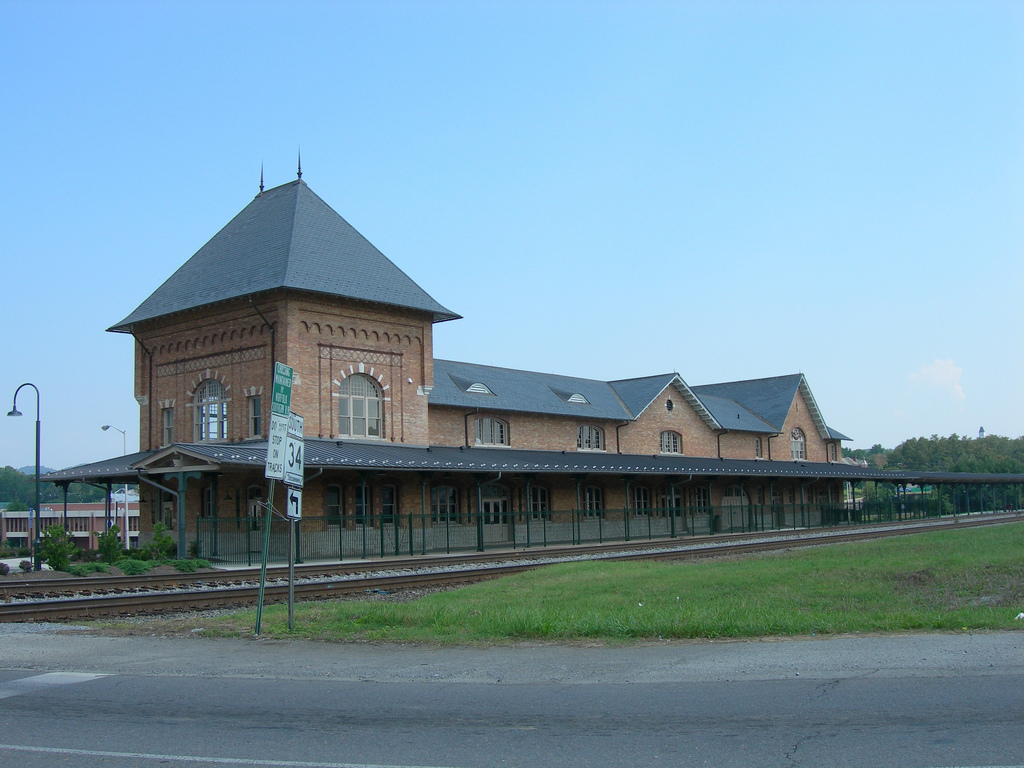
The first train pulled into the original depot at this site in 1856. With it, the train brought decades of prosperity to the town. Local historian, V. N. “Bud” Phillips, notes that, “there would have been no Bristol had it not been for the coming of the railroad.” The massive brick station that currently stands was constructed in 1902 and is the third building on the site. Once passenger service ended in 1969, the depot was used briefly for shopping and dining but then stood empty for some years. In 1999, the Romanesque structure was purchased by a foundation and renovated into an events facility.
The great country singer, Jimmie Rodgers began his transition here from itinerant musician and railroad employee to the Father of Country Music when he stepped from a train in 1927 and recorded two songs in a makeshift local studio. Those two songs would inspire a recording career that would propel Rodgers into history.
While no longer the scene of arrivals and departures, there remain some lingering spirits from those who made dramatic transitions at this spot.
On the platform of the previous depot, a young lady, Emma Tompkins, stood with her travel bag on the morning of May 5, 1887. Her good-for-nothing husband, “Big Will,” cajoled her to stay. Emma had spent the previous night, like many nights, alone while her husband caroused among the town’s saloons and brothels. In despair, Emma had finally decided to leave her husband and join her sister in Radford, Virginia.
As she marched herself towards the station, Emma encountered her husband and he followed her to the station platform. With the train pulling into the station, Big Will grabbed the arm of his wife and the couple tumbled onto the track. Emma screamed but it was cut short as the train decapitated her. Her husband was cut in half by the train. Emma’s spirit joined the throng of spirits that already flit through the vast halls of the station.
Bristol Train Station, 2008, by Tim Emerson. Courtesy of Flickr.
One ghost hunting organization somehow determined that some 68 spirits haunt the building. Besides Emma’s wailing spirit, the spirit of a man by the name of Joseph Chalmers King has been known to appear in the building. Dressed in black pants, a white shirt, bowtie, and derby hat, the spirit is apparently still waiting on his lost lady-love to arrive. King’s spirit was known to appear when southwestern trains would pull into the depot. His last known appearance was in 1969, when the last southwestern train pulled in.
Throughout the building it still seems there is activity from former railroad passengers. In 2008, the building’s manager clearly heard the main door open followed by footsteps across the great hall. Peering down from a balcony near his office, the manager was unable to see anyone present and was shocked to hear a cough from the invisible being. He also reports the sounds of people talking, coins rattling in an unseen pocket, a clock that always stopped at 8:50 PM, and elevators moving without passengers.
The paranormal group, HAUNT Paranormal (Hunting and Understanding National Terrors), investigated the building in 2010, which was documented by a reporter from the Bristol Herald Courier. Apparently, the group captured an EVP of a scream, perhaps the same scream that escaped the throat of Emma Tompkins before her neck was severed by the train’s iron wheels.
A 2011 investigation by Appalachian Truth Seekers was featured on an episode in season four of My Ghost Story: Caught on Camera. The episode concentrates on a few pieces of evidence by that group. The most compelling piece of evidence is a video that was captured by accident. One of the investigators was testing out a video camera in what appears to be one of the station’s main halls. In the few seconds of video, a dark figure moves past an upstairs doorway. At the time, none of the investigators or station staff were upstairs.
While investigating the station’s basement, a female investigator was shoved by something that she claims rushed her. After she became angry and told the spirit to stop, an EVP was captured proclaiming that “I did not do it. Not here, not me.”
While the station has transitioned into its modern usage as an events facility, it seems that the spirits residing there may still be trying to make the transition into the afterlife.
In this blog, I have covered several other locations in Bristol, Tennessee/Virginia. Two theatres on State Street–the Paramount Center for the Performing Arts on the Tennessee side, and the Cameo Theatre on the Virginia side–have been covered in my article, “Phantoms of the Operas, Y’all–13 Haunted Southern Theatres.” I have also covered East Hill Cemetery, which straddles the state line.
N.B. This article has been revised and edited 18 May 2019.
It’s not hard to imagine that investigating in pitch black darkness could be both terrifying and exhilarating. Ghost hunters are accustomed to stumbling about in dark spaces, but usually there is some dim light even if just from the moon or street lights outside. Within a cave there is no ambient light, and the inky darkness envelops you.
In an article from WHSV, the ABC affiliate out of Harrisonburg, Virginia in the Shenandoah Valley, the founder of the Twisted Paranormal Society of Virginia talks about the adrenaline rush that he gets from investigating the shadier side of things. In his investigation report he says, “Once the interior lights were turned off, [Grand Caverns] took on a whole new appearance.”
According to the history on its website, Grand Caverns is the oldest continually operating show cave in the nation. Show caves are those caverns that have been opened—exploited some say—for tourists and commercial use.
Like so many caves, Grand Caverns was discovered when someone simply stumbled on it, in this case a hunter retrieving traps. Bernard Weyer discovered the cave in 1804, and within two years tours were being led through it. In the early days, standing in the thick darkness tourists imagined ghosts, demons and all those denizens of the underworld were just at their heels. The weird formations were transformed into manifestations of nightmares and named accordingly: Dante’s Inferno and George Washington’s Ghost among them. At Dante’s Inferno especially—a hole-like formation with rock that seemingly melts towards the mouth of Hell—tourists were warned of evil spirits there that would extinguish candles or torches: the only sources of light here.
Formations within Grand Caverns. Photo 2010 by P199. Courtesy of Wikipedia.
Other areas inspired awe or whimsy. In one large room, grand balls were held, while the sacred space of The Chapel was actually used on occasion for religious services. These things brought the curious to visit these caverns for just over two centuries. When the Virginia countryside was overrun with battling armies during the Civil War, soldiers visited, easing their minds of the weariness of war.
The identities of the spirits within Grand Caverns are unknown. While the articles relating to the haunting point to the military visitors to the cave during the Civil War, it appears that the soldiers simply visited and none died or were killed within the cave. Twisted Paranormal’s investigation did produce some results that may indicate the presence of spirits here, though their investigation was only 3 hours long. The group presents some of the evidence they captured on their website including some photographs with orbs and video of EMF detectors being set off with no one around. Unexplained flashing lights were also encountered.
Sources
Adams, Cindy. “Strange activity found in Grottoes Grand Caverns by paranormal investigators.” Examiner.com. 26 June 2012.