Street Guide to the Phantoms of the French Quarter—Royal Street

This article is part of my series, Street Guide to the Phantoms of the French Quarter, which looks at the haunted places of this neighborhood in a street by street basis. Please see the series main page for an introduction to the French Quarter and links to other streets.

Royal Street

Hotel Monteleone
214 Royal Street

This imposing hotel is the tallest building in the French Quarter and, at 600 rooms, among the largest. This building is a physical, literary, and paranormal landmark within the Quarter. When a lowly Sicilian cobbler, Antonio Monteleone, purchased a hotel in 1886, he probably did not imagine that it would be the beginning of a classic American rags-to-riches story. His hard work paid off and he acquired neighboring buildings and expanded his hotel. Since it opened its doors the hotel has attracted celebrities including numerous well-known writers who have mentioned the hotel in their works.

Hotel Monteleone, 2009 by Bart Everson, courtesy of Wikipedia.

One of the more well-known features of the Monteleone is the Carousel Bar featuring an actual carousel that was assembled in the bar in 1949 and rotates slowly as patrons enjoy craft cocktails. While patrons revolve at the bar, spirits revolve around patrons and staff throughout the hotel. Spirits here range from a trusty engineer to a little boy who supposedly died of a fever while his parents were out. Others include the spirits of a few people who committed suicide by jumping from the roof. The International Society of Paranormal Research investigated the hotel in 2003 and concluded that there are 12 individual entities patrolling the halls and corridors of this hotel.

Sources

  • Caskey, James. The Haunted History of New Orleans: Ghosts of the French Quarter. Savannah, GA: Manta Ray Books, 2013.
  • History.” Hotel Monteleone. Accessed 7 June 2016.
  • Hudson, Shaney. “The Big Easy’s his haunt.” The Age (Melbourne, Australia). 27 February 2012.
  • Mroch, Courtney. “Why Hotel Monteleone’s Haunted 14th Floor Isn’t What it Seems.” Haunt Jaunts. 25 March 2011.

Cafe Beignet
334 Royal Street

The spirit of a Native American woman is occasionally seen strolling through this restaurant that occupies an old carriage house. Most likely she remains here from the time prior to the city’s existence. She is most often seen towards closing time.

Sources

  • Dwyer, Jeff. Ghost Hunters Guide to New Orleans. Gretna, LA: Pelican Publishing, 2007.
  • Muro, Maria. “Haunted Eats.” New Orleans Living Magazine. 9 October 2012.

Louisiana Supreme Court Building
400 Royal Street

This monstrous white marble-clad building caused much controversy when the site was cleared starting in 1903. This block was originally a collection of 19th century buildings bisected by Exchange Alley which was lined with offices for architects, engineers, politicians and lawyers. The destruction that took place here contributed to the rise of preservation policies throughout the city. Upon completion of this building in 1910, the Louisiana Supreme Court, state Attorney General, and other courts moved in, though by 1934, the building was deemed inadequate. After years of deferred maintenance, the Supreme Court moved out in 1958. The building saw renovations starting in the 1990s and reopened in 2004 with the state Supreme Court returning to the building.

Rumors of the building being haunted began to arise during the building’s renovations. Author and researcher Victor C. Klein interviewed a construction supervisor and several workers and contractors who told similar tales of tools and equipment disappearing in the building. A number of them also encountered “a well dressed, middle age, white gentleman” whom they found looking out a window in the upper stories of the building. When confronted, the odd gentleman would disappear.
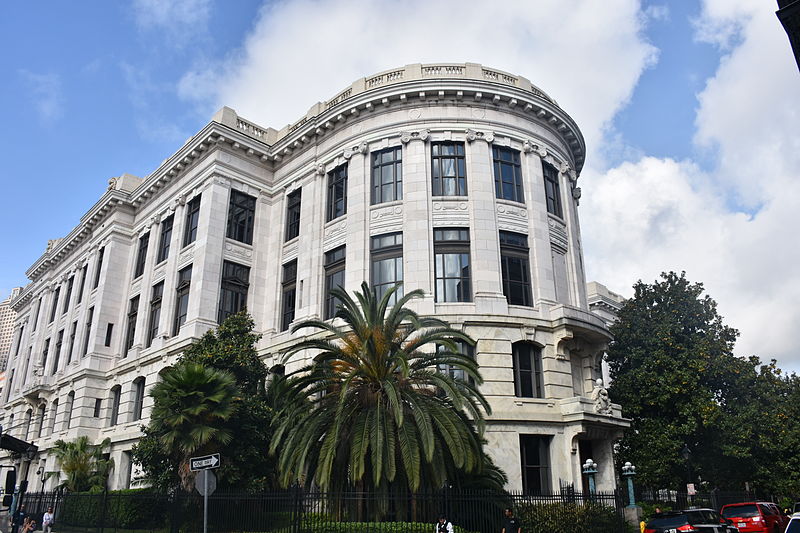
Louisiana Supreme Court Building, 2015 by MusikAnimal, courtesy of Wikipedia.

Klein continues by noting that guests of the Omni Royal Orleans Hotel on nearby St. Louis Street would report this man to the front desk staring intensely into their rooms. According to Klein, this was so frequent that the front desk had a scripted response to these calls, though they didn’t inform the guests that this gentleman is probably a ghost.

Jeff Dwyer remarks on several other spirits within the building including a pair of shooting victims who were supposedly gunned down in a courtroom during a Mafia trial in the 1930s and a panhandler who is sometimes seen just outside the building on Royal Street.

Sources

Brennan’s
417 Royal Street

One of the more well-known and respected restaurants in the city, Brennan’s has made its home in this historic building since it opened in 1946. This 1795 structure once housed the Bank of Louisiana. Later on in the 19th century, Paul Morphy, one of the most famous chess players in the world lived and died here. He may be the apparition that is sometimes seen in the dining room.

Sources

  • Dwyer, Jeff. Ghost Hunters Guide to New Orleans. Gretna, LA: Pelican Publishing, 2007.
  • Taylor, Troy. Haunted New Orleans. Charleston, SC: History Press, 2010.
Brennan’s, 2015 by Infrogmation, courtesy of Wikipedia.

Court of the Two Sisters
613 Royal Street

One of the more romantic of New Orleans’ great restaurants, the Court of the Two Sisters possesses a number of legends including one about the gates through which patrons pass. The wrought iron gates are supposed to have been made in Spain where they were blessed by Queen Isabella with a charm that all those who touch them as they pass will be charmed. The restaurant occupies an 1832 building that housed a shop owned by two sisters, Bertha and Emma Camours. Apparently inseparable, the sisters operated a notions shop in this building for many years and, not being able to live without the other, died in 1944 two months apart.

The courtyard of this grand restaurant has a wishing well known as the “Devil’s Wishing Well” as it may have witnessed and been charmed by rites practiced here by Marie Laveau, the city’s great 19th century Queen of Voodoo. Until it was toppled by Hurricane Betsy in 1965, a willow tree grew here where pirate Jean Lafitte may have dueled with and killed three men. Those three men may be among the specters flitting throughout this courtyard. Enjoy one of the famous Jazz Brunches served here daily and be sure to pay homage to the sisters who may still be holding court.

Sources

  • Dwyer, Jeff. Ghost Hunters Guide to New Orleans. Gretna, LA: Pelican Publishing, 2007.
  • Our History.” Court of the Two Sisters. Accessed 8 June 2016.

LaBranch Building
700 Royal Street

The delicate lacy ironwork of this large home hides one of crueler ghost stories in this city. In the early history of the city a system of plaçage was practiced by many of the wealthy white planters. This system, found in Spanish and French colonies, allowed these wealthy men to take on mistresses, often free women of color, whom they would support. Certainly such arrangements caused conflicts within the legal marriages of these men. Such a conflict is at the heart of the story here.

Upon the death Jean Baptiste LaBranche, who owned this home at one time, his wife, Marie, was able to find out the name of his mistress. She sent an invitation to the young woman inviting her to tea. When the unsuspecting mistress arrived, instead of exchanging pleasantries over tea, Marie LaBranche had the woman bound and chained to a wall in the attic where she was left to die a slow death from starvation. While this is a marvelously gory legend, it is clouded with a good deal of doubt. Occupants of this building have reported paranormal activity, however. Cold spots and feelings of panic have overtaken some working on the third floor, where the poor mistress supposedly met her untimely death.

Sources

  • Dwyer, Jeff. Ghost Hunters Guide to New Orleans. Gretna, LA: Pelican Publishing, 2007.
  • Taylor, Troy. Haunted New Orleans. Charleston, SC: History Press, 2010.

St. Anthony’s Garden
Behind St. Louis Cathedral across from Orleans Street

This meditative garden has existed here behind the cathedral since the establishment of the church. Located between two haunted alleys: Pere Antoine’s and Pirate’s Alleys, the garden is named in memory of Pere Antoine or Antonio de Sedella, whose spirit may haunt the alley named for him as well as St. Louis Cathedral. According to Jeff Dwyer, this garden was a popular place for duels in the mid-18th century. Some sensitives have detected wafts of smoke from those events.

Sources

  • Dwyer, Jeff. Ghost Hunters Guide to New Orleans. Gretna, LA: Pelican Publishing, 2007.

734 Royal Street

Just like the story of the LaBranche Building, the story from this classic New Orleans town house involves a mistress, in this case she was an octoroon (she was 1/8th black) and her name was Julie. She was kept by a wealthy young man who was officially unattached in a well-furnished apartment here. Despite her pleas to her lover to marry her, he could not do so without losing his social standing and perhaps his fortune with it. Carelessly, in order to appease her frequent requests for marriage, the young man said he would marry Julie if she spent the coldest night in December nude on the roof. On the coldest night in December she undressed and crawled onto the roof. Her lover discovered her lithe corpse frozen not long after.

Since that time, Julie’s nude form has been seen on the roof of this building on the coldest night in December. During the remainder of the year Julie lingers in the warmth of the building’s interior. The Bottom of the Cup Tearoom once occupied the ground floor of this building (it moved to 327 Chartres Street) where the shop offered tea and psychic readings. Many of the psychics working here noted Julie’s shade and they believe she may have moved with the shop to Chartres.

Sources

  • Dwyer, Jeff. Ghost Hunters Guide to New Orleans. Gretna, LA: Pelican Publishing, 2007.
  • Smith, Katheine. Journey Into Darkness: Ghosts and Vampires of New Orleans. New Orleans, LA: De Simonin Publications, 1998.

Cornstalk Hotel
915 Royal Street

This intimate boutique hotel occupies a mansion with a unique cast-iron fence featuring stalks of corn. Legend relates that the fence was commissioned to comfort the Iowa-born wife of a former resident by reminding her of the cornfields of home. Once the home of Judge François Xavier Martin, he may be one the spirits that still stalks the halls with his footsteps, rattling door knobs. The sounds of children have also been heard here.

Sources

  • Brown, Alan. The Haunted South. Charleston, SC: History Press, 2014.
  • Dwyer, Jeff. Ghost Hunters Guide to New Orleans. Gretna, LA: Pelican Publishing, 2007.
Cornstalk Hotel by Infrogmation, courtesy of Wikipedia.

Andrew Jackson Hotel
917 Royal Street

A tragedy on this site more than 200 years ago may still continue to resonate today. A boarding school or orphanage (sources differ) stood here that was destroyed by fire. Five young boys lost their lives and they still play throughout the courtyard and hallways of this hotel. Sheila Turnage notes the experience of a night manager who was diligently working at his desk when he realized he was being watched. Looking up he saw the heads of a group of children trying to peer above the top of his desk. The children vanished moments later.

Sources

  • Asfar, Dan. Ghost Stories of Louisiana. Auburn, WA: Lone Pine Publishing, 2007.
  • Dwyer, Jeff. Ghost Hunters Guide to New Orleans. Gretna, LA: Pelican Publishing, 2007.
  • Taylor, Troy. Haunted New Orleans. Charleston, SC: History Press, 2010.
  • Turnage, Sheila. Haunted Inns of the Southeast. Winston-Salem, NC: John F. Blair, 2001.

Starling Magikal Occult Shop
1022 Royal Street

If you care to test drive any of the ghost hunting equipment available for sale here, the Starling Magikal Occult Shop offers its own ghosts. In a 2015 article, the shop’s co-owner Claudia Williams noted that staff and patrons of the shop hear disembodied voices and feel the touch of invisible fingers. Objects occasionally move around on their own accord as well.

Sources

  • Lopez, Kenny. “Want to hunt ghosts? Here are the tools you’ll need…” 26 October 2015.

LaLaurie House
1140 Royal Street, private

Of the myriad haunted houses throughout the South, few have captured the public’s attention more than the hulking LaLaurie Mansion that looms over the intersection of Royal and Nicholls Streets. While the structure itself is significant historically and architecturally, it’s the legends of the atrocities that took place here and the ghosts from those events that draw crowds of tourists. Though the house is not open to the public, the legend still draws people here.

In 1831 this property was purchased by Delphine LaLaurie, the wife of Dr. Leonard Louis LaLaurie. Madame LaLaurie had been married and widowed twice before her marriage to the good doctor and she had five children by her previous husbands. After construction of the mansion in 1832, LaLaurie took up residence and became a central pillar to New Orleans society.

LaLaurie Mansion, 2011 by Reading Tom, courtesy of Wikipedia.

The legend goes back to a fateful report of a fire in the kitchen here April 10, 1834. Firefighters arrived to discover the kitchen in flames and an elderly slave cook chained to the stove. She admitted to setting the fire as a suicide attempt to prevent her being sent to attic from which she said no one ever escaped. A mob that had gathered broke their way into the slave quarters and soon discovered the mutilated remains of “seven slaves, more or less horribly mutilated … suspended by the neck, with their limbs apparently stretched and torn from one extremity to the other” as the New Orleans Bee described the events the next day. While the mob remained to destroy the house and grounds in anger, Madame LaLaurie and her family fled the city. No one ever faced justice for the cruelties inflicted on the slaves here. While this is the most commonly related legend about the house, there is quite a bit of controversy.

As the story has captured the imagination of many, it has found its way into books dating back to the late 19th century, film, television and even video games. Most recently, the legend of Madame LaLaurie was woven into the plethora of local legends in the story arc of American Horror Story: Coven. Portrayed by Kathy Bates, Madame LaLaurie is a simpering racist weighted down with a curse of immortality placed upon her by the immortal Voodoo Queen, Marie Laveau. Researchers looking into the legend in recent decades have revealed that Delphine LaLaurie’s reputation may have been targeted as part of a smear campaign.

Do the spirits of slaves still stalk this lovely mansion? Legends relate that former residents here encountered some horrific spirits, though there are few recent stories. Writer and psychic Kala Ambrose tried to commune with the spirits while standing outside of the house recently. While she stood there a number of curious tourists inquired if this was the famous LaLaurie House. A short time later when she placed her hand on the wall of the house a passing ghost tour group took photographs of her. She didn’t contact anything out of the ordinary, perhaps the house is now just haunted by tourists.

Sources

  • Ambrose, Kala. Spirits of New Orleans. Cincinnati, OH: Clerisy Press, 2012.
  • Caskey, James. The Haunted History of New Orleans: Ghosts of the French Quarter. Savannah, GA: Manta Ray Books, 2013.
  • Delphine LaLaurie. Wikipedia, the Free Encyclopedia. Accessed 10 June 2016.
Life Returns to the Dead of Belmont—Elkridge, Maryland

Belmont Manor & Historic Park
6555 Belmont Woods Road
Elkridge, Maryland

 Last year just about this time, life began to return to Belmont Manor when it was reopened to the public. The estate had been a private residence for almost two centuries before it was donated to the Smithsonian Institution in 1964 for use as a conference center. The Smithsonian sold the property in 1982 to the American Chemical Society which used it as a meeting facility. They sold the property to Howard Community College which closed the property in 2010 after facing financial difficulties. Until the property sold in 2012, the grand house quietly sat in a pall of silence. Only the dead stirred.

As the house was being renovated and restored by Howard County, its new owner, the dead continued to stir. Workers on the estate observed a little girl running about. The county contacted Inspired Ghost Tracking who investigated and was able to captured an image of the spectral girl peering around a corner.

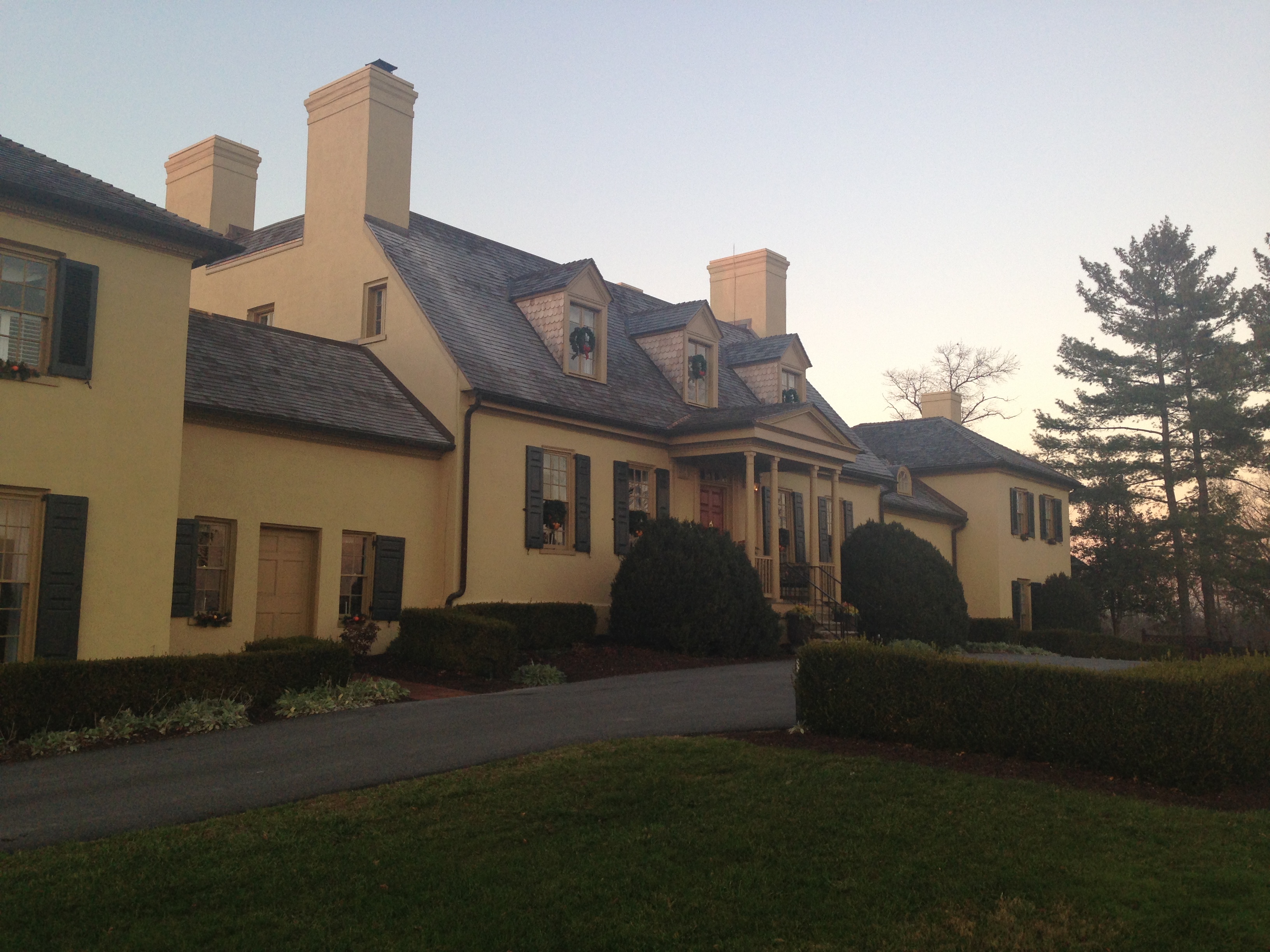
Belmont Manor, 2015, by Scott218. Courtesy of Wikipedia.

This ghostly child can be added to the legend recorded a little more than a hundred years ago in John Martin Hammond’s 1914 book, Colonial Mansions of Maryland and Delaware. In addition to relating the histories of these magnificent estates, Hammond included the occasional ghost story when they popped up. The Belmont Ghost, as Hammond dubs the spectral event, usually happened at least once every winter. On a dark, windy night, residents and visitors to Belmont would hear the sounds of an invisible carriage approach the house. Upon opening the door, the living would see nothing but continue to hear the sounds of an invisible retinue enter the house. Once unloaded, the carriage would be heard to head towards the stable.

Since opening to the public last year, Belmont is now playing host to weddings and other events while the public explores the historic woodlands that remain unchanged since the building of the house in 1738. Now that the dead have been discovered on the estate, Howard County has brought out paranormal investigators and those interested in learning about the spirits around us to learn about paranormal investigating here. According to the Baltimore Sun, the next public paranormal investigation will be held this summer. 

Sources

  • Bonk, Valerie. “Ghost investigations at Belmont gather people curious about the paranormal.” Baltimore Sun. 6 April 2016.
  • Gunts, Edward. “The past is prologue for Elkridge’s Belmont Mansion.” Baltimore Sun. 20 September 2012.
  • Okonowicz, Ed. The Big Book of Maryland Ghosts. Mechanicsburg, PA: Stackpole Books, 2010.
  • Yeager, Amanda. “Elkridge’s historic Belmont Manor reopens.” Baltimore Sun. 13 April 2015.

Haunt in the Horseshoe—Sanford, North Carolina

House in the Horseshoe State Park
288 Alston House Road
Sanford, North Carolina

By all accounts, Philip Alston was trouble. A member of the prominent Alston family, some might describe him as a spoiled brat. The house Alston constructed at this horseshoe bend in the Deep River was among the first large plantation homes constructed in this region when it was built in 1772. As revolutionary tensions heated up throughout the colonies, Alston sided with the Patriot cause. Though he was fighting for the same ideals, even the Patriots took umbrage with Philip Alston. Another Patriot, Robert Rowan, even spoke to the governor of his dislike for Alston’s “domineering” and “tyrannical” attitude.

With the outbreak of fighting, squabbles between neighbors took on more deadly overtones throughout the frontier. Planter David Fanning of South Carolina remained loyal to the British crown and steadfastly rooted out Patriots throughout the area. A small militia under Fanning’s command attacked Alston’s home on the morning of August 5, 1781 in retaliation for the death of one of his men at the hands of some of Alston’s comrades. That morning, Alston, his wife Temperance, two children, and a small band of his men were at the large white house. When Fanning’s men attempted to attack the house one of the Tories was quickly felled by a bullet to the heart. Soon gunfire poured from the home’s windows while Alston’s children cowered in a fireplace inside.

A cart of straw was set alight and pushed towards the house which began to burn. Fearful of being burned out of the house, Alston sent his wife with a flag of truce to arrange surrender. Fanning agreed to allow Alston and his men to surrender. The Tories plundered the bullet-riddled house but did not burn it.

House in the Horseshoe, 2007, by Jerrye and Roy Klotz, MD. Courtesy of Wikipedia.

Philip Alston remained on his plantation for some years after the war and served in the state senate, though his roguish attitude lead to his fall from grace and in 1790, he was forced to sell his beloved home. Some believe that the rascal spirit of Alston may remain here in the form of footsteps heard in the home, disembodied whispers in the fireplace where the children were hidden, and orbs of light seen in the yard.

Source

  • Barefoot, Daniel W. Spirits of ’76: Ghost Stories of the American Revolution. Winston-Salem, NC: John F. Blair. 2009.
  • Bishir, Catherine W. and Michael T. Southern. A Guide to the Historic Architecture of Piedmont North Carolina. Chapel Hill, NC: University of North Carolina Press, 2003.
  • Hauck, Dennis William. Haunted Places: The National Directory. NYC: Penguin, 1996.
  • House in the Horseshoe: Overview.” NC Historic Sites. Accessed 3 January 2016.
  • Thompson, Jessica Lee. “House in the Horseshoe.” North Carolina History Project. Accessed 3 January 2016.

Apparitions at Allatoona—Cartersville, Georgia

Allatoona Pass Battlefield
Old Allatoona Road
Cartersville, Georgia

Despite Atlanta’s sprawl and the construction of the nearby I-75 corridor, Allatoona Pass Battlefield remains as one of the most pristine battlefields in the country. Located about a mile and a half from bustling I-75, the battlefield seems remote and almost lost in time. The village of Allatoona that existed in 1864 is mostly gone, replaced instead by the Lake Allatoona reservoir and a few buildings of more recent vintage. Even the railroad has abandoned the area, having been rerouted with the building of the reservoir.

Allatoona Pass by George Bernard, 1864. The house on the far left is still standing.
The same house from the photograph above, 2011. Photo by Lewis Powell IV, all rights reserved.
The railroad cut, 2011. Photo by Lewis Powell IV, all rights reserved.

At the time of the Civil War, the Western & Atlantic Railroad provided the vital link between Atlanta and Chattanooga, Tennessee which found itself very close to Union territory following the Confederate defeat at Shiloh. This somewhat mountainous region provided one of the first obstacles as the railroad made its way north. Just north of the tiny village of Allatoona slave labor was used to dig a cut through the Allatoona Mountains allowing trains to move easily towards Chattanooga. The village at the south end of the cut mostly consisted of a depot, some warehouses and an odd assortment of houses and shops. After the pass was captured by Federal forces in June of 1864, Sherman ordered that the pass be heavily fortified and three star-shaped earthen forts were constructed to stand guard.

The railroad cut looking south, 2012. Photo by Lewis Powell IV, all rights reserved.
Panoramic view of one of the star forts built to guard the cut with the author standing by. Photo 2011, by Lewis Powell IV, all rights reserved.

In a last-ditch attempt by the Confederates to capture and destroy Sherman’s supply line to federally held Atlanta, they attacked these forts on October 5th. Under the command of Major General Samuel G. French, the Point Coupee Artillery from Louisiana poured shells onto the well-entrenched units from Illinois, Wisconsin and Minnesota under the command of Brigadier General John M. Corse. After two hours, French sent an order for Corse to surrender, which was refused.

Grave of the Unknown Soldier, who may be one of the spirits haunting this battlefield. Photo 2012, by Lewis Powell IV, all rights reserved.

Legends at this site date to not long after the war when a Confederate soldier (believed to be the spirit of an unknown soldier buried next to the tracks) was seen. More recently, the sounds of battle, cries of the wounded, spectral soldiers and an overpowering sense of dread have been reported here.

Sources

  • Battle of Allatoona. Wikipedia, the Free Encyclopedia. Accessed 15 April 2011.
  • Lake Allatoona. Wikipedia, the Free Encyclopedia. Accessed 8 April 2011.
  • Scaife, William R. Allatoona Pass Battlefield: The Official Website. 2000.
  • Underwood, Corinna. Haunted History: Atlanta and North Georgia. Atglen, PA: Schiffer, 2008.

A Southern Feast of All Souls—Patient Souls at the Park

E. P. “Tom” Sawyer State Park
3000 Freys Hill Road
Louisville, Kentucky

 On a cool Sunday morning in Fall, like today, it’s not hard to imagine that E. P. “Tom” Sawyer State Park is teeming with life. Joggers, bikers, walkers, and families with children throng the paths, playgrounds and Activities Center in the park unknowing of the patient souls that still roam these grounds. Some of these souls may still suffer the effects of the mental illnesses that afflicted them in life. There is some indication that death may not end the mania, though I would prefer to believe that these poor patient’s souls have passed on leaving only the confused energy that they exuded in life.

One of the park’s paths. Photo 2008, by TeleD, courtesy of Wikipedia.

The grounds of this modest state park were home to Native Americans for centuries before the intrusion of white men into the utopian “Kaintuck” territory. The land was later settled by the Hite family. According to an article from Louisville TV station, WDRB, Isaac Hite died from injuries sustained in a Native American attack here.

In 1869 the state of Kentucky acquired the land and began construction on the State House of Reform for Juvenile Delinquents at Lakeland. This facility evidently went through a series of name and purpose changes with adults being moved to the facility. Around 1900, the facility became Central Kentucky Asylum for the Insane.

Throughout the 20th century, the hospital was investigated a number of times after allegations of corruption and abuse surfaced. The old hospital was closed in 1986 with patients being moved into a newer facility nearby. After sitting abandoned for a decade, the deteriorating hospital buildings were demolished by the state. The land near the old hospital that had once served as a farm was converted into a state park in 1974. The park was named for E. P. “Tom” Sawyer, distinguished local judge and county executive who was the father of journalist Diane Sawyer.

Main building of the Central State Hospital, ca. 1920. This is one of the buildings demolished in 1996. Courtesy of Asylum Projects.

While the park grounds were not actually the site of the hospital, they are still possibly occupied by the spirits of some of the patients who died there. Many of the graves of former patients are unknown and may be scattered throughout the park’s property. Paranormal investigators within the park have captured numerous EVPs, especially around the Sauerkraut Cave. Legend holds that patients who became pregnant were brought to the cave and some of those infants were possibly disposed of here. Others mention that the cave was also used by patients trying to escape the facility. For someone escaping through the cave without flashlights or other equipment, it is likely that the escapees got lost and died within the labyrinth.

Of the cave, an article on Louisville.com quotes the park’s naturalist as saying, “They say it’s kind of a sad place. There’s people trapped there, spirits trapped there. There’s a man who’s angry and they say he’s not letting any of the other spirits go.” Indeed, one recent paranormal investigation captured the image of a large burly man within the cave. Should you take some time to visit the park, be mindful of the patient and not so patient spirits of patients who still reside here.

Sources

Birmingham’s Haunted Five

After my recent entry on Alabama, I had a comment on Facebook, “Interesting, but there’s more than the library in Birmingham…” Indeed.

I’ve previously covered two magnificent Birmingham theatres: the Alabama and Lyric; and the Tutwiler Hotel, in addition to the Linn-Henley Library which I covered in the Haunted Alabama entry. So here are a few more locations to add to the Birmingham list.

When Alan Brown wrote his 2009, Haunted Birmingham, he noted that this city’s ghostlore “is not nearly as rich as that found in much older cities.” Certainly, Birmingham is the youngest of Alabama’s large cities, having only been founded in 1871. Still, the city has some very interesting ghostlore including the iconic Sloss Furnaces.

Sloss Furnaces
20 32nd Street, North

Perhaps one of the most iconic haunted places in the whole state, this National Historic Landmark site is iconic of Birmingham’s history. Birmingham was built on industrial facilities like this producing iron during the latter half of the 19th and into the 20th centuries. While the facility opened in 1882, nothing remains of the original furnaces here. The oldest building on this site dates to 1902 with much equipment installed and added in later years. This facility closed in 1971 and local preservationists began work to save the facility. Their efforts paid off and the facility is open as a museum and events facility.

Sloss Furnaces, 2006. Photo by Timjarrett, courtesy of Wikipedia.

There is always a chance for death in industrial sites, even more so around molten metal in a furnace. In 1887, Theophilus Jowers, assistant foundryman at the Alice furnace (one of the first furnaces on this site) fell to his death into the molten iron in the furnace. Some of his remains—his head, bowels, two hip bones and some ashes—were fished out of the molten iron. Jowers’ death remains one of the most spectacular and grisly, though many more men died throughout the time that the furnaces were in operation.

After Jowers’ death, his spirit was observed by co-workers. Kathryn Tucker Windham quotes one former employee, “We’d be getting ready to charge the furnace, and we’d see something, something like a natural man walking around on the hearth. Just walking slow and looking around like he was checking to make sure everything was all right.” Windham describes the first time that Jowers’ son saw his father’s spirit in 1927. The now grown son took his son for a drive over the First Avenue Viaduct and there, while watching the action at the furnace, they observed a man walking through the showers of sparks and flames.

Two more spirits are believed to be in residence at this site, but less historically based. A white deer that has been seen on the grounds is believed to be the spirit of a pregnant girl who committed suicide by throwing herself into the furnace. The other “apocryphal”—as Alan Brown describes him—spirit is that of a fiendish foreman named James “Slag” Wormwood. Like Jowers and the pregnant girl, Wormwood supposedly fell to his death into one of the furnaces, though it is suspected that he was really pushed by an angry employee. It is Wormwood’s angry spirit that is responsible for pushing employees.

The furnaces are known as a hotbed of paranormal activity and were investigated for the first time in 2005 by Ghost Chasers International out of Kentucky. They were joined by psychic Chip Coffey who would soon make his name working on the A&E show, Paranormal State. During the investigation, Coffey made contact with the spirit of a man who had lost a limb in an accident there. Moments after losing contact with the spirit, team members noticed blood on Coffey’s hands. After investigating him for scratches or another injury that could have produced blood, nothing was found. Over the past 10 years of paranormal investigations at the site, a slag heap of evidence has been produced.

Sources

  • Brown, Alan. Haunted Birmingham. Charleston, SC: History Press, 2009.
  • History.” Sloss Furnaces National Historic Landmark. Accessed 12 June 2015.
  • Parks, Megan. “Sloss Fright Furnace: The haunts heat up in Alabama.” USA Today. 14 October 2014.
  • Windham, Kathryn Tucker. The Ghost in the Sloss Furnaces. Birmingham, AL: Birmingham Historical Society, 2005.

East Lake Park
400 Graymont Avenue, West 

On the 1st December 1888, Richard Hawes accompanied his daughter to the newly built lake here. Sometime later, he left without the seven-year-old. On December 4th, two boys playing on a boat in the lake discovered the child’s half-naked body in the water. The discovery caused a sensation among the citizens who thronged the funeral home where she was taken to view the body. Eventually, she was identified as May Hawes. As his train pulled into Birmingham, Richard Hawes, May’s father, was arrested.

May Hawes’ body as pictured in a local paper, 1888.

Richard Hawes was aboard the train with his new bride and still in his wedding suit. He told investigators that he had divorced his wife and was paying for the support of the children. His new wife, from Columbus, Mississippi, was described as being prostrate with grief after finding that her new husband was suspected of murder. Hawes’ wife Emma and daughter, Irene, age six. As newspapers stirred the city’s emotions, Emma’s body was found in a lake in the Lakeview neighborhood. Outrage overtook countless Birminghamians who gathered outside the city jail demanding Hawes be brought to justice immediately. A militia that had been called out to protect the jail eventually opened fire on the crowd killing ten including the city’s postmaster and wounding many others. A few days later, the pathetic body of Irene Hawes was found in the same lake where her mother had been found.

Postcard of East Lake from the roller coaster that once perched on the shores, 1909.

After a swift trial, Richard Hawes faced the gallows and was hung for the murder of his wife and two daughters. Hawes’ second wife was granted from her depraved husband. The lake in Lakeview where Emma and Irene were drowned is now a golf course while East Lake is the centerpiece of East Lake Park, which became a city park 1917. Little May Hawes is still seen in and around the lake where she is sometimes called the “Mermaid of East Lake.”

Sources

  • East Lake Park. Accessed 12 June 2015.
  • Jones, Pam. “The Hawes Murders.” Alabama Heritage. Spring 2006.
  • Kazek, Kelly. “’Tis the season: Haunting tales from ghost tours in 3 Alabama cities.” com. 2 October 2012.

Arlington Antebellum Home & Gardens
331 Cotton Avenue

Described as the “Birthplace of Birmingham,” Arlington is the oldest remaining home in Jefferson County. The core of this house was constructed in 1822 with additions being made to the house in 1842. As it served as the headquarters for Union General James H. Wilson during the closing months of the Civil War, the house was spared while the orders for the destruction of the University of Alabama, the arsenal at Selma and iron works throughout the region were issued from this home. As can be expected in a house of this age, there is some paranormal activity. Alan Brown notes that docents have heard doors slamming and witnessed rocking chairs rocking on their own accord.

Arlington by Jet Lowe. Photo for the Historic American Buildings Survey, courtesy of the Library of Congress.

Sources

  • Brown, Alan. Haunted Birmingham. Charleston, SC: History Press, 2009.
  • Floyd, W. Warner and Mrs. Catherine M. Lackmond. National Register of Historic Places nomination form for Arlington. 9 September 1970.

Carraway Methodist Medical Center
1600 Carraway Boulevard

This defunct hospital was, for many years, one of Birmingham’s leading medical facilities. In the 2000s, the hospital was plagued with financial difficulties that lead to its closure in 2008. The facility has been deteriorating since and it has attracted homeless people, vandals, copper thieves and some ghost hunters. A November 2014 article by Kelly Kazek reports on an investigation conducted by investigator and author, Kim Johnston. After touring the facility with the owner, Johnston reported that the Emergency Room had a “palpable heaviness.” Her group did have the experience of hearing muffled voices in the cardiac surgery area of the third floor. Even after bringing in local police, no one was found to be in that area. This building is closed and tresapssers will be prosecuted, please only observe from a distance.

Sources

  • Carraway Methodist Medical Center. Acc. 6 Jun 2015.
  • Kazek, Kelly. “Abandoned Alabama Part 2: The ghost of cities past.” com. 28 Nov 2014.

Hotel Indigo Birmingham Five Points South (formerly The Hotel Highland at Five Points South)
1023 20th Street, South

Originally constructed as the Medical Arts Building in 1931, this building served as offices for surgeons and dentists for many years. In the 1980s, a former cardiac surgeon renovated the Art Deco structure into a hotel, the Pickwick Hotel. During this time, stories emerged of a nurse still making rounds on the eighth floor. Sheila Turnage quotes a former director of sales who said that the elevator would mysteriously be called to the eighth floor unexpectedly. The hotel was transformed into a boutique hotel in 2007.

Sources

  • Turnage, Sheila. Haunted Inns of the Southeast. Winston-Salem, NC: John F. Blair, 2001.
  • “History of the Hotel” The Hotel Highland at Five Points South. Accessed 18 May 2015.

Southern Spirit Guide to Haunted Alabama

N. B.  This article was overhauled 8 December 2019.

Shortly after starting this blog, I created a series of articles covering each state. When I moved this blog, I removed those articles and I have slowly, but surely reposted edits of these articles. The only article to remain intact is the one I created for Washington, D.C. Some of the edited articles have been reposted for Florida, North Carolina, South Carolina, Tennessee, and Virginia.

After publishing my Haunted Alabama book as an eBook in 2015, I redid the haunted Alabama article using entries from the original manuscript. When I republished the book in print, the text received a major overhaul, though this article wasn’t updated. Now, in 2019, I’m finally getting around to updating this article.

Alabama State Capitol
600 Dexter Avenue
Montgomery

One of the most important sites in the entire state stands on a place called Goat Hill. This building is the second capitol building on this site, the first having been destroyed by fire in 1849. The current building opened in 1851 and has witnessed a panorama of much of Alabama’s history. It was here in 1861 that representatives of six Southern states met to create the Confederate government. Later that year, Jefferson Davis and Alexander Stephens were inaugurated here, respectively, as the President and Vice President of the Confederacy. A little more than a hundred years later, Martin Luther King, Jr. would lead a civil rights march to the steps of this building.

With such history, it’s no surprise that spirits may still wander the capitol’s corridors. One legend concerns a Confederate widow. Desperate to find where her husband had died and the location of his grave, she made inquiries, but no information was forthcoming. She continued haunting the corridors in life and, evidently, in death. Security guards and staff members have seen this desperate woman and continue to hear her footsteps.

haunted Alabama State Capitol Montgomery ghost
Alabama State Capitol, 2006, by Jim Bowen. Courtesy of Wikipedia.

A security guard is quoted in a 1994 Birmingham News article as having seen a female spirit standing near the statue of Governor Lurleen Wallace. The woman was wearing white opera-length gloves which are reminiscent of the gloves Wallace is wearing in her official state portrait.

Faith Serafin notes in her book Haunted Montgomery, Alabama that bathroom sinks near the offices of the state board of convicts are often found with the water running. This activity may be related to a 1912 murder that occurred here. When a property dispute did not turn out in his favor, Will Oakley shot and killed his stepfather, P. A. Woods, in the offices of the president of the convict board. Legend holds that Will Oakley’s spirit may still be trying to wash the blood off his hands.

Sources

  • Lindley, Tom. “Ghosts or good stories haunt Capitol’s halls: This Confederate widow will never tell.” The Birmingham News. 27 November 1994.
  • Schroer, Blanche Higgins. National Register of Historic Place nomination form for the Alabama State Capitol. 29 September 1975.
  • Serafin, Faith. Haunted Montgomery, Alabama. Charleston, SC: History Press, 2013.

Bear Creek Swamp
County Road 3
Prattville

On Halloween of 2014, twenty-one dolls tied to bamboo stakes appeared in Bear Creek Swamp. The Autauga County Sheriff’s Office thought they were simply a harmless Halloween prank, but after reports of the dolls began to spread through the media, the sheriff’s office decided to remove them. The reason for the dolls’ placement in the swamp remains mysterious, but then again, Bear Creek Swamp abounds in mystery.

A newspaper article regarding the incident described the swamp as “a massive bog with a bit of a reputation locally.” The article continues, “As a rite of passage, generations of teenagers have entered the area at night looking for the creatures and haints said to roam the mist-covered realm. And it’s not unusual to hear reports of loud booms coming from its depths.”

Before the arrival of white settlers, local Native Americans knew the swamp as a place with pure water and medicinal springs. This area was once the home of the Autauga or Tawasa Indians who were members of the Muscogee Creek Confederacy. The Muscogee Creek were removed by force in the 1830s and forced west on the Trail of Tears.

Some Native spirits may have remained in the swamp. A hunter told author Faith Serafin about seeing a female apparition with- in the swamp while tracking a deer. A couple hiking through the area encountered a wild-looking woman with a gaunt face who screamed and disappeared into the underbrush when they approached. Others, including an investigation team from Southern Paranormal Researchers, have witnessed strange orbs of light in the depths of this mysterious bog.

Sources

  • Roney, Marty. “21 dolls on bamboo stakes found in Alabama swamp.” Hattiesburg American. 27 November 2014
  • Serafin, Faith. Haunted Montgomery, Alabama. Charleston, SC: History Press, 2013.
  • Sutton, Amber. “Officers remove more than a dozen dolls from Autauga County swamp.” AL.com. 25 November 2014.
  • Southern Paranormal Researchers. “Bear Creek Swamp—September 3, 2006.” Accessed 29 November 2012.

Belle Mont
1569 Cook Lane
Tuscumbia

Built between 1828 and 1832 by Dr. Alexander Mitchell, Belle Mont is now a house museum owned by the Alabama Historical Commission. This house represents a rare example of what is sometimes termed “Jeffersonian Classicism,” the distinctive style of Palladian architecture created by Thomas Jefferson. While most likely not directly designed by Jefferson himself, the house may be the work of one of his disciples.

haunted Belle Mont Tuscumbia Alabama ghosts
Belle Mont, 2010, by Carol M. Highsmith. Courtesy of the Library of Congress, Prints and Photographs Division.

Around the time the house was completed Dr. Mitchell lost his wife and both daughters to a fever, and he subsequently sold the property. A family renting this house in 1938 had a frightening experience. Just after moving their things into the house, the family began to hear sounds throughout the house including footsteps and voices crying “help me.” Time passed with these events growing more and more frightening until one rainy night when the family watched with horror as a group of apparitions: a man, a woman and one, possibly two, small girls, appeared at the top of the staircase. The woman and children, dressed in night- clothes that were dirty and torn, wore expressions of horror as they descended the staircase and out the front door. After this frightening vision, the family continued to hear odd sounds. The last reported paranormal incident is recorded in 1968 with nothing seen or heard since.

Sources

  • Gamble, Robert S. National Register of Historic Places nomination form for Belmont. Jan. 1981.
  • Belle Mont. Alabama Historical Commission. Accessed 16 December 2010.
  • Belle Mont (Tuscumbia, Alabama). Wikipedia, the Free Encyclopedia. Accessed 16 December 2010.
  • Johnston, Debra. Skeletons in the Closet: True Ghost Stories of The Shoals Area. Debra Johnston, 2002.

Bragg-Mitchell Mansion
1906 Springhill Avenue
Mobile

haunted Bragg-Mitchell Mansion Mobile Alabama ghosts
Bragg-Mitchell Mansion, 2006, by Altairisfar. Courtesy of Wikipedia.

In the years following the Civil War, General Braxton Bragg was considered one of the most inept generals to have served in the Confederate Army. Bragg had earned victories though lost tactically in battle at Perryville, Kentucky; Chickamauga, Georgia, and Stones River (Murfreesboro), Tennessee. He lived here in the home once occupied by his brother Judge John Bragg, from 1869 until he moved to Texas in 1874. He would die in Galveston two years later having found about as much success in civilian life as he found in military life. From time to time, docents and visitors to the Bragg-Mitchell Mansion have seen the gray form of a man, believed to be the form of General Bragg. Once, as a docent was opening the house for wedding photographs, she saw a man striding across the parking lot behind the house. The strange man neared the tool shed and vanished. A thorough search of the property by the docent and the wedding party did not uncover the gentleman.

The Bragg-Mitchell House was built by Judge John Bragg in 1855. After construction, the house was the scene of gatherings by prominent Alabamians of the period and members of the Bragg family including John’s brothers: Braxton, former North Carolina governor Thomas Bragg, Captain William Bragg, and Alexander Bragg, who may have had a hand in designing his brother’s home. During the Civil War, Judge Bragg’s wife anxiously sent the family’s furnishing and many of their possessions to the family’s inland cotton plantation for safe keeping. Unfortunately, the estate was destroyed along with the contents of her city home, something from which Mrs. Bragg never quite recovered. After Judge Bragg’s death in the late 1870s, the house passed through a few different hands before being purchased by the Mitchell family who lovingly restored the home and left it to the City of Mobile.

The house has served as a wedding venue and events facility for many years. Over time, guests and docents have had many encounters with the spectral residents of the house including a ghostly feline that was first noted by Mrs. Mitchell when she owned the house. A spectral woman, possibly Judge Bragg’s wife, has been seen peering from one of the upstairs windows. Others have had more mischievous encounters including an AC installer who was locked in the attic and others who have been irritated by the ghosts turning lights on just after they have been turned off.

Sources

  • Coleman, Christopher K. Dixie Spirits: True Tales of the Strange and Supernatural, 2nd Edition. Nashville, Cumberland House, 2002.
  • Parker, Elizabeth. Mobile Ghosts: Alabama’s Haunted Port City. Apparition Publishing, 2001.

Fort Morgan State Historic Site
51 AL 180
Baldwin County

Along with Fort Gaines on Dauphin Island, Fort Morgan guards the entrance to Mobile Bay. Construction of the fort began in 1819, following the British capture of the area in 1815, during the misnamed War of 1812. Using slave labor, this enormous masonry fort was constructed in 1834. With rising tension after Alabama’s secession from the Union, the fort was peacefully turned over to the state’s Confederate militia.

haunted Fort Morgan Alabama ghosts
Fort Morgan, 2002, by Edibobb. Courtesy of Wikipedia.

The fort saw action on August 5, 1864, during the Battle of Mobile Bay when it was attacked and besieged by Union warships; the fort surrendered a few days later. It remained in operation until it was abandoned by the military in 1924. It was then re-militarized during World War II and turned over to the State of Alabama in 1946.

Southern Paranormal Researchers investigated the fort in 2006 and witnessed a bevy of activity including disembodied voices, fleeting shadow figures, and having fully charged batteries drained. They also captured a few anomalies in photographs and one EVP. Visitors to the fort have encountered phantom smells of gunsmoke, the sounds of battle, and figures in period clothing.

Sources

  • Langella, Dale. Haunted Alabama Battlefields. Charleston, SC: History Press, 2013.
  • Schroer, Blanche Higgins. National Register of Historic Places nomination form for Fort Morgan. 4 Oct 1975.
  • Southern Paranormal Investigation Team. Fort Morgan Investigation. 16 Dec 2006.

Horseshoe Bend National Military Park
11288 Horseshoe Bend Road
Dadeville 

A bend on the Tallapoosa River formed an ideal site for the Muscogee Creek village of Tohopeka. During the Creek War of 1813-14—a civil war within the Muscogee Creek Nation that eventually embroiled the American government—a band of Red Stick Creeks under Chief Menawa defended this position against American troops and Native American allies under the command of General Andrew Jackson. Some 800 Red Stick warriors were slaughtered here on March 27, 1814, bringing an end to the Creek War of 1813-14 and leaving the Tallapoosa River at Horseshoe Bend stained red with blood.

With the slaughter that occurred here, it’s no wonder that visitors have reported a plethora of paranormal activity here ranging from smells and odd noises to full apparitions. A paranormal investigation by the Alabama Paranormal Research Team produced some photographic anomalies as well as the sound of someone screaming in the vicinity of the Muscogee Creek village site.

haunted Horseshoe Bend Battlefield Dadeville Alabama ghosts
The riverbank at the Horseshoe Bend Battlefield, 2015. Photo by Lewis Powell IV, all rights reserved.

Sources

  • Langella, Dale. Haunted Alabama Battlefields. Charleston, SC: History Press, 2013.
  • Alabama Paranormal Research Team. Investigation of Horseshoe Bend National Military Park. Accessed 18 Dec 2010.
  • Jensen, Ove. “Battle of Horseshoe Bend.” Encyclopedia of Alabama. 26 Feb 2007.

Linn-Henley Research Library
2100 Park Place
Birmingham

haunted Linn-Henley Library Birmingham Alabama ghosts
Linn-Henley Library, 2009, by DwayneP. Courtesy of Wikipedia.

This building opened in 1927 as the Birmingham Public Library and now houses archives, government documents, a southern history library, and a ghost. Blogger Jessica Penot visited in 2012 and noted the “uncanny quiet that fills the building like a tangible presence.” The spirit of Fant Thornley, the library’s dedicated director from 1953 until the 1970s, still makes occasional appearances here. The spirit has been seen by an electrician, and library staffers have smelled the smoke from his cigarettes.

Sources

Monroe County Heritage Museum
(Old Monroe County Courthouse)
31 North Alabama Avenue
Monroeville

In 1903, this structure was constructed as the Monroe County Courthouse. It was here that a young Harper Lee, Monroeville’s most famous resident and author of the classic novel, To Kill a Mockingbird, would watch her attorney father as he argued cases. When Hollywood put the story on celluloid, the set designers replicated the courtroom on a California sound stage. This building was used by Monroe County as a courthouse until 1967.

haunted Old Monroe County Courthouse Monroeville Alabama ghosts
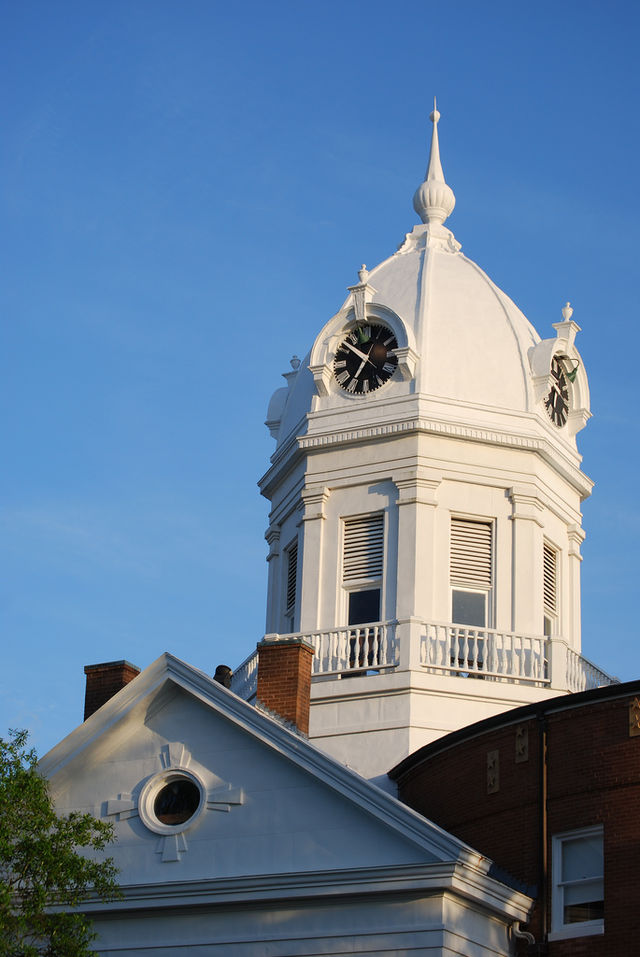
Dome of the Old Monroe County Courthouse, 2008, by Melinda Shelton. Courtesy of Wikipedia.

The upper floors of this building still seem to retain some of the energy from the building’s judicial use. Blogger Lee Peacock quotes one man as saying, “Things blow in the breeze but there is no breeze. You hear sounds that don’t belong, and I have smelled pipe tobacco smoke when no one was smoking or there to be smoking.” Staff members working late here often get the feeling of not being alone and have heard mysterious sounds within this storied building.

Sources

  • Higdon, David & Brett Talley. Haunted Alabama Black Belt. Charleston, SC: History Press, 2013
  • Peacock, Lee. “Ten new locations make list of “Spookiest Places in Monroe County.” Dispatches from the LP-OP. 31 October 2014.
  • W. Warner Floyd. National Register of Historic Places nomination  form for Old Monroe County Courthouse. 29 March 1973.

Moundville Archaeological Park
634 Mound State Parkway
Moundville

Between approximately 1120 C.E. and 1450 C.E., Moundville was the site of a large city inhabited by the Mississippian people, predecessors to the tribes that the Europeans would encounter when they began exploring the South about a century later. At its height, this town was probably home to nearly 1,000 inhabitants. Stretching to 185 acres, the town had 29 mounds of various sizes and uses: some were ceremonial while others were topped with the homes of the elite.

haunted Moundville Archaeological Park Moundville Alabama ghosts
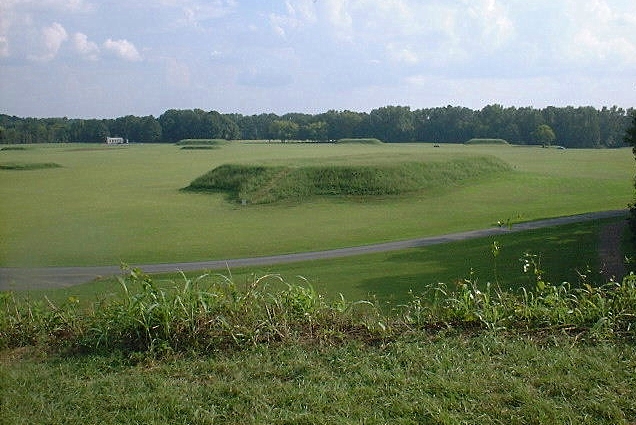
One of the mounds at Moundville, 1998, by Altairisfar. Courtesy of Wikipedia.

Visitors and staff have often mentioned a certain energy emanating from this site. A Cherokee friend of mine visited and while atop one of the mounds let out a traditional Cherokee war cry. Afterward, he noted that there was a palpable change in the energy. Dennis William Hauck speaks of the “powerful spirit of an ancient race” that “permeates this 317-acre site” in his Haunted Places: The National Directory. Southern Paranormal Researchers notes that park staff has witnessed shadow figures, odd noises, and doors opening and closing by themselves in the buildings on the site. Higdon and Talley add orbs and cold spots found throughout the location to the list of paranormal activity here.

Sources

  • Hauck, Dennis William. Haunted Places: The National Directory. NYC: Penguin, 2002.
  • Southern Paranormal Researchers. Investigation Report for Moundville Archaeological Park. Investigated 10 February 2007.
  • Higdon, David & Brett Talley. Haunted Alabama Black Belt. Charleston, SC: History Press, 2013.
  • Blitz, John H. “Moundville Archaeological Park.” Encyclopedia of Alabama. 26 February 2007.

Old Depot Museum
4 Martin Luther King, Jr. Street
Selma

haunted Old Depot Museum Selma Alabama ghosts
Old Depot, 2010, by Carol M. Highsmith. Courtesy of Library of Congress, Prints and Photographs Division.

A part of the Alabama Ghost Trail, a series of haunted places linked by the Southwest Alabama Regional Tourism and Film Office, the Old Depot Museum features a ghost that reportedly has an affinity for the museum’s elevator. The museum occupies the Romanesque Revival circa 1890 Louisville & Nashville Railroad Depot.

Sources

  • Besser, Susan A. National Register of Historic Places nomination form for the Water Street Historic District. March 2002.
  • Old Depot Museum. Alabama Ghost Trail. YouTube. Posted 19 July 2009.

Timmons Cemetery
Buxton Road
Redstone Arsenal

When the Army took over some 40,000 acres in Huntsville in 1941, it swallowed up many old farms and plantations including some 46 cemeteries. Located in the woods off of Buxton Road, the Timmons Cemetery is considered, by some, the spookiest place on the Arsenal. Guards patrolling Buxton Road at night have seen a little girl running across the road near the cemetery.

To explain the little girl’s spirit, a legend has surfaced, though apparently not backed up by historical documentation. Margaret Ann Timmons was an energetic child and sometimes difficult to control. When work required the family to be in the fields, Margaret would be tied to a chair inside the house. The energetic child wiggled out of her restraints, and kicked over an oil lamp that destroyed the house and killed the child. Now, not even death and the stone wall that surrounds the family’s cemetery can restrain her.

Sources

  • “Does a little girl really haunt Redstone Arsenal.” WAAY. 31 Oct 2014.
  • “Redstone Report: Ghost story still haunts Redstone Arsenal.” WAFF. 31 Oct 2011.

Doing the Charleston: A Ghostly Tour—South of Broad

N.B. This article was originally published 13 May 2015 as a single, massive article. It’s now broken up into three sections, South of Broad, North of Broad, and Charleston Environs, which have all been rearranged and revised for ease of use.

Known as the “Holy City” for the number of churches that raise their steeples above the city, Charleston, South Carolina is also known for its architecture, colonial and antebellum opulence, as well as its haunted places. This tour looks at the highlights among Charleston’s legends and ghostlore.

Broad Street cuts across the Charleston peninsula creating a dividing line between the most historic, moneyed, aristocratic portion of the city—located south of Broad—and everything else. For convenience, this tour is now divided into separate articles covering the area South of Broad, North of Broad, and the Environs. Locales in this article include places open to the public as well as private homes. For these private homes, please respect the privacy of the occupants, and simply view them from the street.

The tour is arranged alphabetically by street, with the sites in order by street address south to north and east to west.

As an introduction to the more mysterious, shadowy side of Charleston, the opening lines of Pat Conroy’s 1980 novel, The Lords of Discipline, provide a lush and succinct preface. The novel examines the triumph and cruelty of Charleston, and The Citadel (disguised as the “Carolina Military Institute”), Conroy’s alma mater.

The city of Charleston, in the green feathery modesty of its palms, in the certitude of its style, in the economy and stringency of its lines, and the serenity of its mansions South of Broad Street, is a feast for the human eye. But to me, Charleston is a dark city, a melancholy city, whose severe covenants and secrets are as powerful and beguiling as its elegance, who demons dance their alley dances and compose their malign hymns to the dark side of the moon I cannot see…

Though I will always be a visitor to Charleston, I will always remain one with a passionate belief that it is the most beautiful city in America and that to walk the old section of the city at night is to step into the bloodstream of a history extravagantly lived by a people born to a fierce and unshakable advocacy of their past. To walk in the spire-proud shade of Church Street is to experience the chronicle of a mythology that is particular to this city and this city alone, a trinitarian mythology with equal parts of the sublime, the mysterious, and the grotesque. But there is nothing to warn you of Charleston’s refined cruelty…

Entering Charleston is like walking through the brilliant carbon forest of a diamond with the light dazzling you in a thousand ways, an assault of light and shadow caused by light. The sun and the city have struck up an irreversible alliance.

Charleston Battery

Charleston Battery

On the Battery near the Edmondston-Alston House at 21 East Battery, a young woman encountered the apparition of a woman dressed in period clothing. James Caskey posits that the sad-faced apparition may very well have been the spirit of Theodosia Burr Alston, the daughter of Vice President Aaron Burr and wife of South Carolina Governor Joseph Alston. In 1812, Theodosia Burr Alston boarded the Patriot in Georgetown, SC as she headed north. The ship was never heard from again. Her spirit has been reported up and down the South Carolina coast.

Sources

  • Caskey, James. Charleston’s Ghosts: Hauntings in the Holy City. Savannah, GA: Manta Ray Books, 2014.
  • Theodosia Burr Alston.” Wikipedia, the Free Encyclopedia. Accessed 12 May 2015.

20 South Battery (formerly Battery Carriage House Inn)
20 South Battery

The inn formerly known as the Battery Carriage House Inn is possibly one of the more spiritually active locations in the city. A few of the inn’s eleven sumptuous guest rooms are apparently haunted. A couple staying in room 3 were awakened by noise from a cellphone; while this may be quite common, phones are not supposed to make noise when powered off as this phone was.

Battery Carriage House Inn Charleston SC ghosts haunted
Sign for the Battery Carriage House
Inn, 2011, by Lewis Powell, IV. All rights reserved.

This activity seems minor compared to the reports from rooms 8 and 10. Guests staying in Room 8 have encountered the apparition of a man’s torso. There is no head or limbs, just a torso dressed in a few layers of clothing. One guest sensed that this figure was quite negative. The spirit in Room 10 is much more pleasant and even described as a gentleman. The innkeepers believe this may be the spirit of the son of a former owner who committed suicide.

Sources

  • Ghost Sightings.” Battery Carriage House Inn. Accessed 31 October 2010.
  • Kermeen, Francis. Ghostly Encounters: True Stories of America’s Haunted Hotels and Inns. NYC: Warner Books, 2002.
  • Spar, Mindy. “Local haunts among treats for Halloween.” The Post and Courier. 26 October 2002
  • Ward, Kevin Thomas. South Carolina Haunts. Atglen, PA: Schiffer, 2014.

White Point Gardens
Charleston Battery

If you stand at the corner of East Battery and South Battery, look down South Battery for the large stone monument. This monument marks the spot where Pirate Stede Bonnet and his men were executed. These pirates may be among the multitude of spirits here. See my article for further information and sources. Another article contains photos from this lovely park.

East Bay Street

The Tavern
120 East Bay Street

There are questions as to just how old this little building is. Some sources argue that it may well be one of the oldest buildings in the city, while others argue that it only dates to the early 19th century. Regardless, this building can claim an inordinate amount of history, mostly as a tavern and coffeehouse, as well as ghosts.

One owner spotted the specter of an 18th century gentleman walking through the back door of the building. Later, his vision was confirmed by a psychic visitor who saw the same gentleman and several other spirits lingering here.

Sources

  • Caskey, James. Charleston’s Ghosts: Hauntings in the Holy City. Savannah, GA: Manta Ray Books, 2014.
  • Poston, Jonathan H. The Buildings of Charleston: A Guide to the City’s Architecture. Columbia, SC: University of South Carolina Press, 1997.

Exchange Building and Provost Dungeon
122 East Bay Street

One of the most important and historic buildings in the city, the Exchange Building, was constructed in the late 1760s to support the trade occurring in this, the wealthiest of colonial cities. The building was built on top of the old Half Moon Battery, a section of the original city wall. During the American Revolution, the dungeon held many of Charleston’s most prominent Patriot citizens. In 1791, this building hosted a ball for President George Washington.

It seems that the souls of some of the people imprisoned in the dungeon still stir. Ghost tours passing through the dungeon at night report that the chains used to guard exhibits swing on their own, while visitors take photographs with anomalies quite regularly. Cries and moans have been heard here and Alan Brown reports that some woman have been attacked here. One hapless female visitor was pushed up against a wall while another felt hands around her neck.

Sources

  • Brown, Alan. Haunted South Carolina. Mechanicsburg, PA: Stackpole Books, 2010.
  • Pickens, Cathy. Charleston Mysteries: Ghostly Haunts in the Holy City. Charleston, SC: History Press, 2007.
  • Poston, Jonathan H. The Buildings of Charleston: A Guide to the City’s Architecture. Columbia, SC: University of South Carolina Press, 1997.

Church Street

Thomas Rose House
59 Church Street, private

This circa 1735 home may have never been occupied by Thomas Rose, who built the house. However, this house did serve as the residence of Dr. Joseph Ladd, a poet and physician, who was killed in a duel in Philadelphia Alley (see that listing in the North of Broad section) with his friend, Ralph Isaacs. The argument grew out of a misunderstanding; but after playing out in the local newspapers, it ended in a duel in October of 1786. Ladd, who had the habit of whistling, continues to be heard in the house as well as in the alley where he met the grim specter of death.

Sources

  • Brown, Alan. Haunted South Carolina. Mechanicsburg, PA: Stackpole Books, 2010.
  • Pickens, Cathy. Charleston Mysteries: Ghostly Haunts in the Holy City. Charleston, SC: History Press, 2007.
  • Poston, Jonathan H. The Buildings of Charleston: A Guide to the City’s Architecture. Columbia, SC: University of South Carolina Press, 1997.

Legare Street

Simmons-Edwards House
14 Legare Street, private

Simmons-Edwards House Charleston SC ghosts haunted
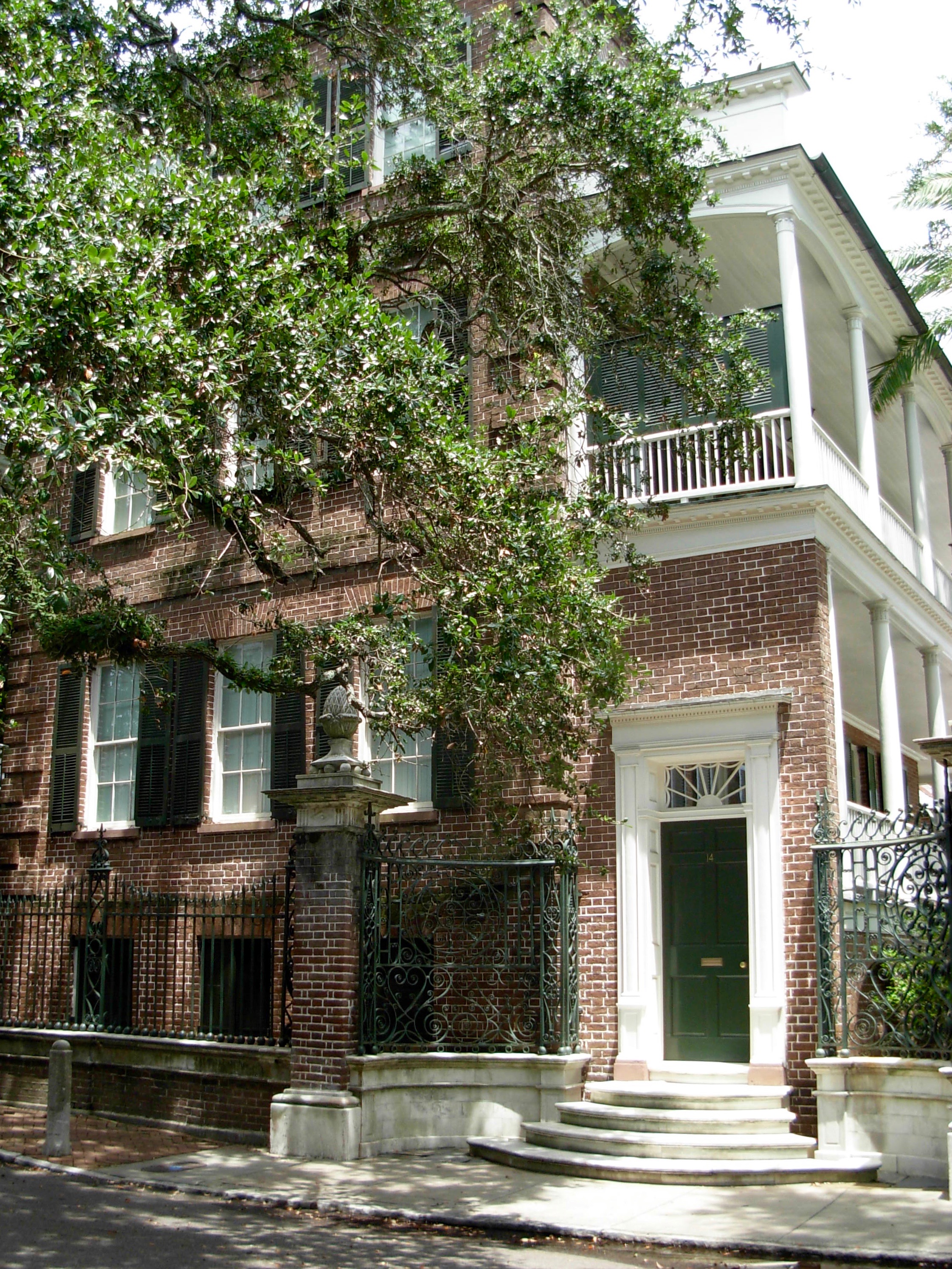
Simmons-Edwards House, 2011. Photo by Lewis O. Powell IV, all rights reserved.

Just outside of Francis Simmons’ old home (see the Simmons Gateposts, 131 Tradd Street for more information on this gentleman) a shadowy couple has been reported walking hand in hand on the street. Their identity is unknown.

Sources

  • Graydon, Nell S. South Carolina Ghosts. Beaufort, SC: Beaufort Book Shop. 1969.
  • Pickens, Cathy. Charleston Mysteries: Ghostly Haunts in the Holy City. Charleston, SC: History Press, 2007.

Hannah Heyward House
31 Legare Street, private

Hannah Heyward House Charleston SC ghosts haunted
Hannah Heyward House, 2011. Photo by Lewis O. Powell, IV. All rights reserved.

This simple, but elegant villa-styled house was built in 1789. After Mrs. Heyward’s son, James, left one morning for a hunting trip, she encountered him sitting quietly in the library later that afternoon. When she inquired among the servants when her son had arrived, no one seemed to have seen him. Later that evening some of James’ friends arrived with his lifeless body. Ever since, residents of the home have occasionally seen James sitting in the library.

Sources

  • Graydon, Nell S. South Carolina Ghosts. Beaufort, SC: Beaufort Book Shop. 1969.
  • Martin, Margaret Rhett. Charleston Ghosts. Columbia, SC University of South Carolina Press, 1963.
  • Poston, Jonathan H. The Buildings of Charleston: A Guide to the City’s Architecture. Columbia, SC: University of South Carolina Press, 1997.

Sword Gate House
32 Legare Street, private

Gates of the Sword Gates House Charleston SC ghosts haunted
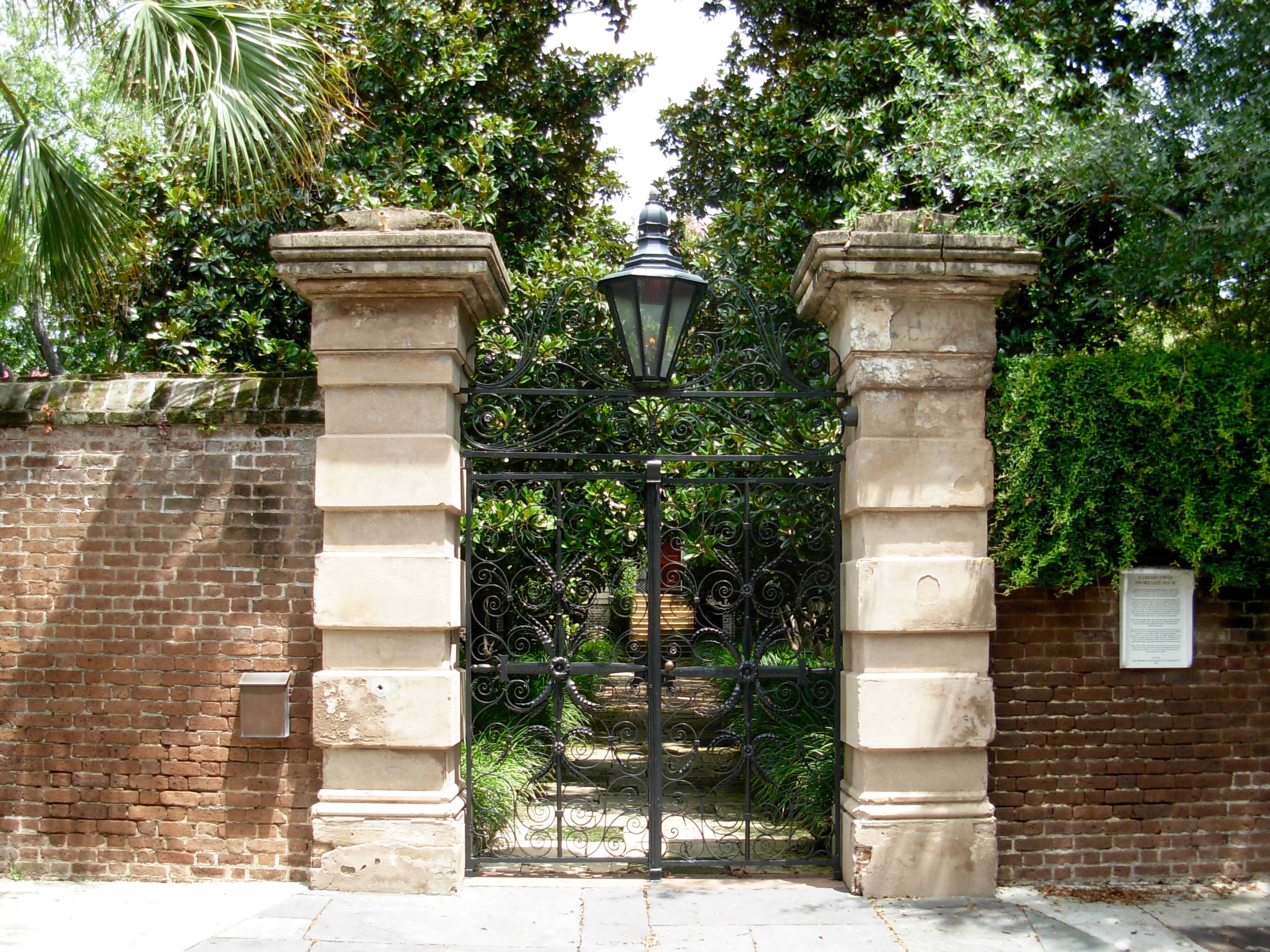
The titular gates of the Sword Gate House, 2011. Photo by Lewis O. Powell IV, all rights reserved.

In the dark of night, a spirit still prowls the halls of the magnificent house that stands beyond these iron gates wrought with swords. The gates were originally created to be used outside the city’s guardhouse; but were purchased by Madame Talvande to guard her students after the city rejected the gates as too expensive. Even after the closure of the elite boarding school, legend speaks of Madame Talvande remaining here in spirit to see that her students remain moral and chaste.

Sources

  • Brown, Alan. Haunted South Carolina. Mechanicsburg, PA: Stackpole Books, 2010.
  • Martin, Margaret Rhett. Charleston Ghosts. Columbia, SC University of South Carolina Press, 1963.
  • Poston, Jonathan H. The Buildings of Charleston: A Guide to the City’s Architecture. Columbia, SC: University of South Carolina Press, 1997.

Meeting Street

Daniel Huger House
34 Meeting Street, private

While this mid-18th century home sustained little damage during the Great Charleston Earthquake of 1886, a young, English visitor to the home was killed on the front steps. This area is prone to earthquakes and the quake that struck the city in 1886 caused massive damage throughout the city. The young man visiting the Huger (pronounced HEW-jee) family here fled the house when the shaking began. As he stood on the front steps a piece of molding from the roof struck him on the head, killing him. He may be the cause of mysterious rapping on the front door prior to earthquakes.

Sources

  • Buxton, Geordie & Ed Macy. Haunted Harbor: Charleston’s Maritime Ghosts and the Unexplained. Charleston, SC: History Press, 2005.
  • Poston, Jonathan H. The Buildings of Charleston: A Guide to the City’s Architecture. Columbia, SC: University of South Carolina Press, 1997.

James Simmons House
37 Meeting Street, private

This house has been named “The Bosoms” because of its bowed front and you may giggle at the silliness of that. The house was built, without bosoms, in the mid-18th century and alterations in the 1840s added the namesake bays. Legend holds that a pirate buried treasure near this house and shot one of his men at the site. The “white, blurry silhouette” of that man has been seen near the house.

Sources

  • Buxton, Geordie & Ed Macy. Haunted Harbor: Charleston’s Maritime Ghosts and the Unexplained. Charleston, SC: History Press, 2005.
  • Caskey, James. Charleston’s Ghosts: Hauntings in the Holy City. Savannah, GA: Manta Ray Books, 2014.
  • Pickens, Cathy. Charleston Mysteries: Ghostly Haunts in the Holy City. Charleston, SC: History Press, 2007.
  • Poston, Jonathan H. The Buildings of Charleston: A Guide to the City’s Architecture. Columbia, SC: University of South Carolina Press, 1997.

St. Michael’s Rectory
76 Meeting Street, private

St. Michael’s Alley, running alongside St. Michael’s Church’s churchyard to Church Street, was the scene of a duel in 1786 that left one young man with mortal wounds. Aroused by the commotion outside his house, Judge Elihu Hall Bay, a noted Charleston jurist, ordered the man’s companions to bring him into the house. Fearing that they could face consequences for their involvement with the dual, the young men fled after seeing their wounded friend into the house. The young man passed away in the house.

It was reported that the commotion of the men bringing their wounded friend inside and then hurriedly fleeing was heard in the house on a regular basis. It has been noted, however, that since the home was converted to use as a church rectory in 1942, the sounds have ceased.

Sources

  • Caskey, James. Charleston’s Ghosts: Hauntings in the Holy City. Savannah, GA: Manta Ray Books, 2014.
  • Pickens, Cathy. Charleston Mysteries: Ghostly Haunts in the Holy City. Charleston, SC: History Press, 2007.
  • Poston, Jonathan H. The Buildings of Charleston: A Guide to the City’s Architecture. Columbia, SC: University of South Carolina Press, 1997.

St. Michael’s Episcopal Church
80 Meeting Street

St Michael's Episcopal Church Charleston SC ghosts haunted
St. Michael’s, 2011. Photo by Lewis O. Powell, IV. All rights reserved.

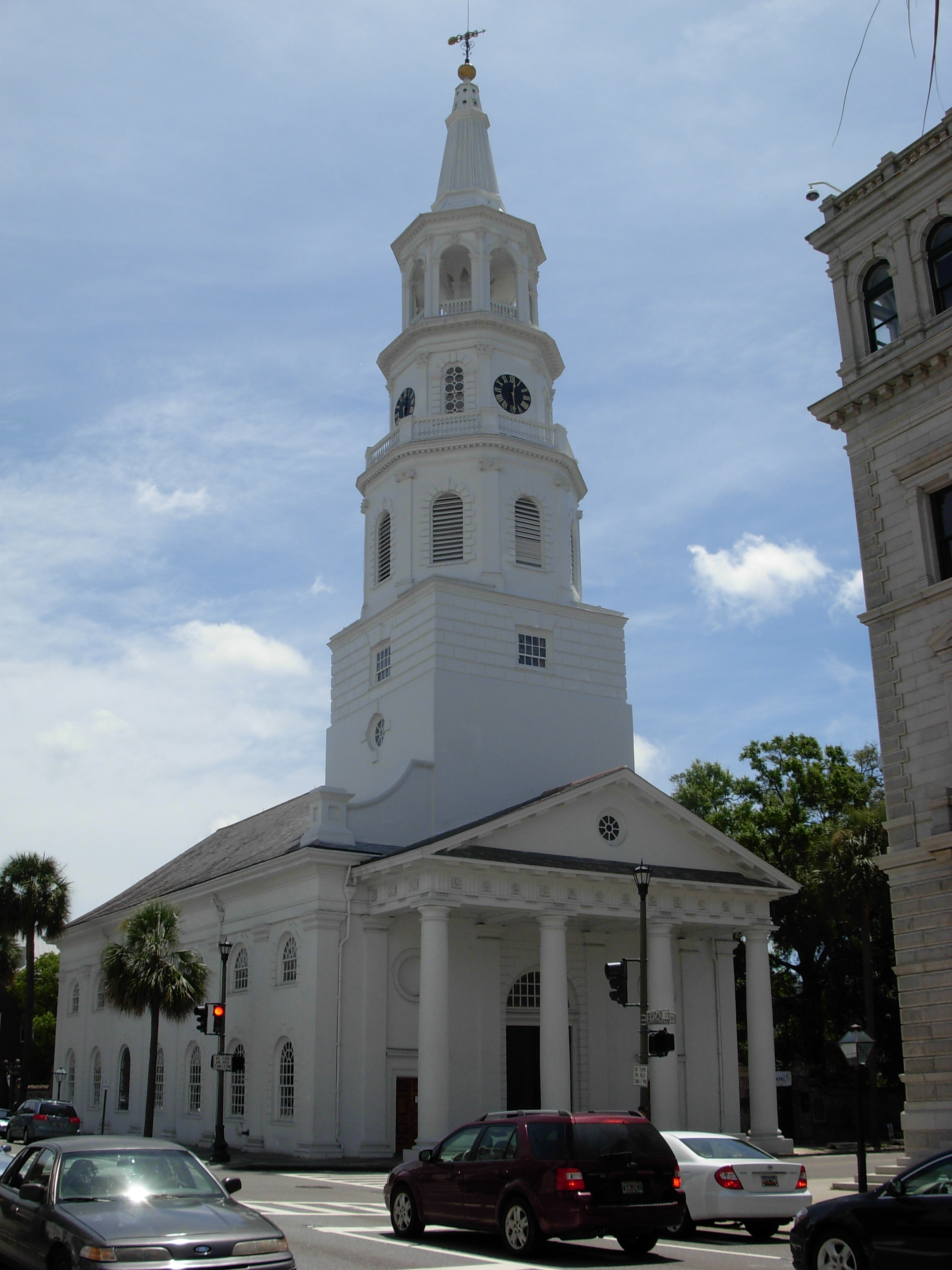
Step inside the cool sanctuary of this mid-18th century church and be on the lookout for a spectral bride. Legend speaks of Harriet Mackie who was supposedly poisoned on her wedding day and remains here in her wedding dress. For more information see my article, “The Ghastly Bell-Ringer and Bride.”

Sources

  • Pickens, Cathy. Charleston Mysteries: Ghostly Haunts in the Holy City. Charleston, SC: History Press, 2007.
  • Poston, Jonathan H. The Buildings of Charleston: A Guide to the City’s Architecture. Columbia, SC: University of South Carolina Press, 1997.

Tradd Street

Simmons Gateposts
131 Tradd Street

Simmons Gateposts Tradd Street Charleston SC ghosts haunted
Simmons Gateposts, 2011. Photo by Lewis O. Powell, IV. All rights reserved.

These gateposts, marking where Ruth Lowndes Simmons’ home once stood, serve as sentinels to remind us of a tragic love story. While Ruth Lowndes was from a noble Charleston family, she was almost a spinster when she married Francis Simmons, a wealthy planter. Simmons provided his wife with a fine house here, though he had his own home on nearby Legare Street. When their separate carriages would pass, the couple would rise and bow to the other. An old Charleston legend says that the sounds of a horse and carriage are heard here. James Caskey reports that he felt the rush of air and smelled the odor of sweaty horses as he visited these gateposts at night.

Sources

  • Caskey, James. Charleston’s Ghosts: Hauntings in the Holy City. Savannah, GA: Manta Ray Books, 2014.
  • Graydon, Nell S. South Carolina Ghosts. Beaufort, SC: Beaufort Book Shop. 1969.
  • Pickens, Cathy. Charleston Mysteries: Ghostly Haunts in the Holy City. Charleston, SC: History Press, 2007.

Spirits of the Camp Creek Disaster—Georgia

Once, McDonough, Georgia was a quiet hamlet. It has now been enveloped by Atlanta’s sprawl and is not so quiet any longer. About thirty miles from downtown Atlanta, McDonough was the scene of the infamous Camp Creek Railroad disaster which is sometimes noted as “Georgia’s Titanic.”

Camp Creek shortly after the train crash, 1900. Courtesy of Wikipedia.

Rain had been falling for most of the month of June 1900 and it was beginning to affect the railroads. On the evening of June 23rd, Old Number 7, carrying 48 souls, was bound for Atlanta, but waited at the station in McDonough for another train to arrive from Columbus. When word reached the station that that train was stalled by a washed out bridge, the Old Number 7 was told to book it towards Atlanta. Before pulling out, the train’s engineer remarked, “We’ll either be having breakfast in Atlanta or in Hell.”

Henry County Courthouse and the McDonough Square. It was here that the bodies of the victims were laid out. Photo 2007, by John Trainor, courtesy of Wikipedia.

The Red Ball Freight sped ahead of the Old Number 7 and cleared the trestle over Camp Creek, a creek that’s usually mild-mannered, though it was swollen this night. The engineer of the No. 7 never could have seen the portion of the trestle that was now missing, having just been washed away and the train plunged into the raging waters of the creek. While some of those aboard died in the initial impact, some drowned and others died in the ensuing fire. Of the 48 souls aboard, only 9 survived. Rescuers pulled the bodies from the wreckage and were laid out in the McDonough town square until they could be taken to one of the two funeral homes, B. B. Carmichael’s or A. F. Bunn & Company. The nine survivors were put up in The Globe Hotel on the square.

As the citizens of McDonough recovered, the spirits from this horrendous disaster have remained. Spirit activity has been reported on the McDONOUGH SQUARE, possibly related to the bodies laid out there. The DUNN HOUSE/GLOBE HOTEL(20 Jonesboro Street), where the survivors recovered was moved just off the square, and now houses businesses. A weeping woman has been seen and heard in the building; someone possibly related to this accident. The building that once housed B. B. Carmichael’s Funeral Home, which handled many of the bodies, is now THE SEASONS BISTRO (41 Griffin Street). While it is regularly home to diners, there are also spirits in this building. A pair of diners in the restaurant saw a man preparing the body of a female in the area that now serves as the women’s restroom. When one of the diners described the man, the restaurant’s owner was shocked to realize that the man was B. B. Carmichael.

Sources

  • Beck, Carolyn F. “McDonough.” New Georgia Encyclopedia. 20 June 2013.
  • Walker, Caprice and Dan Brooks. Haunted Memories of McDonough, Georgia. McDonough, GA: Bell, Book and Candle Used Book Store, 2006.
  • Wells, Jeffrey C. In Atlanta or in Hell: The Camp Creek Train Crash of 1900. Charleston, SC: History Press, 2009.

At Play in the Field of the Dead—Huntsville, Alabama

Maple Hill Park
1351 McClung Avenue, Southeast
Huntsville, Alabama

What could be creepier than the spirits of children perhaps wistfully singing “Ring Around the Rosie” in a minor key and asking, “will you come play with me?” in a sing-song voice? Why, a playground next to a cemetery that’s crawling with these youthful spirits. It’s from these terrifying images that the legend of the “Dead Children’s Playground” was born.

Within view of the resting dead of adjacent MAPLE HILL CEMETERY (202 Maple Hill Street), children happily play on the playground equipment at Maple Hill Park. Lore says that only some of those children are alive. According to Jessica Penot in her 2010 Haunted North Alabama, the playground has gained notoriety among teens out for a scare. They will sometimes sneak into the park at night to witness the paranormal phenomena that supposedly plagues the park.

Maple Hill Cemetery Huntsville Alabama
A view of Maple Hill Cemetery, 2006. Photo by LonelyPilgrim, courtesy of Wikipedia.

The internet is rife with stories involving a murderer killing children here in the 1960s and the playground being constructed as a place of solace for parents whose own children rest just yards away in the cemetery. Even Wikipedia had an article (which now appears to have been deleted) though it is riddled with inaccuracies. These stories are mostly just common internet lore, the actual history of the park is a bit more pedestrian.

Other than its close proximity, Maple Hill Park is not a part of Maple Hill Cemetery. Local ghost authority, Jacquelyn Proctor Reeves, is quoted in a 2012 article as saying there is no evidence that anyone has ever been buried in the area of the park. The property, according to Penot, was originally a stone quarry from 1945 to 1955. After the quarry’s closure, the land was donated to the City of Huntsville and the property became a park in 1985.

Some sources provide the park’s founding as 1822, which is the date for the founding of the cemetery. The cemetery was founded by planter Leroy Pope, the founder of Huntsville, only a decade after the city’s incorporation in 1811. Pope would find his final rest here in 1844. Now spanning some 100 acres, the cemetery has some 80,000 interments and within its fences lie five state governors and a number of congressmen with a host of the local citizenry.

The history of the park, however, does not provide any indication that it might be haunted. Penot questioned a number of park visitors for her book and discovered that many of them had stories to tell about odd occurrences in the park. The most common activity recorded seems to be that the swings will often move by themselves. During her investigation, Penot witnessed this activity herself. In fact, there are a number of YouTube videos showing this phenomenon. Others report to Penot that voices of children have been heard. Of course, one must consider that the park is in a residential area and these voices may be from living neighbors.

A local paranormal organization, the Alabama Paranormal Society (APS), has investigated the location in the past few years and did experience some activity. A psychic with the group was able to determine that there were a number of spirits in the park. They believe that the spirits are wanderers who travel to the park from the cemetery. So far, I have not been able to find any documentation that there is activity in the cemetery.

Sources