It’s one of the few memories from my family’s visit to St. Augustine in 1987. My parents had taken the whole family to Jacksonville, Florida for the Ramses II exhibit and we decided to spend a day in St. Augustine as well. The mix of ancient buildings and gardens along with the mysterious tourist attractions was intoxicating to my ten-year-old self.
After exploring the battlements of the Castillo de San Marco, I was drawn to the castle a short walk down the street. The brochure—that I had undoubtedly picked up at the visitor’s center—promised dazzling things inside the RIPLEY’S BELIEVE IT OR NOT MUSEUM (19 San Marcos Avenue) and I begged to go inside. My parents allowed me to go into the lobby and I was greeted by a water spout seemingly suspended in mid-air with water pouring out of it. Running out the door again, I whined even more, though my parents held firm and wouldn’t let me explore the museum.
I was drawn to this mysterious, castle-like building that houses the Ripley’s Believe It or Not Museum. Photo Michael Rivera, 2016, courtesy of Wikipedia.
Instead, we went to see the Fountain of Youth where I distinctly remember being disappointed that the water—which Ponce de Leon had supposedly searched for—was poured from a Tupperware container into paper Dixie cups. And even worse, it didn’t even taste special. Perhaps my disenchantment stems from not being allowed to view the mysteries of the Ripley’s Museum? Regardless, I fell in love with St. Augustine that day.
Had I known about the ghosts that reside inside the museum, I would have begged even more. My interest in ghosts was burgeoning at the time, and I would have been thrilled to meet the spectral resident of the museum.
Florida has four Ripley’s Believe It or Not Museums and thanks to a recent article in the Northwest Florida Daily News regarding the Panama City Beach location; I now know that three of the four—the third location is Key West—have paranormal activity.
Of the three haunted locations, the St. Augustine museum is the oldest and the most historically significant. The museum occupies an enormous Moorish-style castle built as a private winter escape in 1887 by businessman William G. Warden. A business partner to John D. Rockefeller and Henry Flagler, two of the most influential businessmen of the day, Warden served as a senior executive for Standard Oil. Notably, Henry Flagler is credited with establishing Florida as a vacation destination. Warden contracted the noted New York City architectural firm of Carrère and Hastings to realize his Moorish fantasy.
Warden Castle, as it was called, was occupied by the Warden family until the late 1930s. Pulitzer Prize-winning Florida novelist Marjorie Kinnan Rawlings and her husband purchased the property in 1941 and remodeled it into a hotel. Tragedy visited the concrete castle early on the morning of April 23, 1944. What is believed to have been a carelessly dropped cigarette ignited a fire on the third and fourth floors. Two female guests died in the fire and the St. Augustine Record notes that both were seen standing and screaming for help from the windows of their rooms before they succumbed to smoke inhalation.
During the decade that the castle welcomed guests, cartoonist and traveler Robert Ripley visited and was intrigued by the castle. He realized that the dazzling Moorish castle would provide an apropos backdrop for his collection of wonders.
Ripley inquired of the Rawlings and her husband if the castle might be for sale, but they turned down his offer. Seeking an appropriate monument to Ripley after his death, his estate purchased the building after his death in 1949. In 1950, the first Ripley’s Believe It or Not Museum (or Odditoriums, as they are often billed) opened its doors to the curious public. According to Wikipedia, there are 32 museums worldwide since 2010.
Certainly, it can be expected that Ripley’s collection—which includes shrunken heads, objects of religious devotion, and shamanistic items—is replete with spirit energy and attachments, but it seems that the spirit of one of the women who died in the fire is quite active. A St. Augustine Record article from 1998 provides several reports of museum staff seeing a woman standing in one of the windows. One employee stated, “She was just standing in the window on the third floor, looking out. I thought it was a maintenance man, but then I realized there was no one in the building.” Another chimed in with her own encounter, “I was driving to work early in the morning. I was at the stop light (at Castillo and San Marco) and saw her at the penthouse window.” The penthouse window is on the fourth floor and once looked out of the room where one of the women died.
Two weeks previous to the article, yet another staff member saw a figure at the fourth floor window, this time, though he was able to make out some detail. “She had medium length hair and was wearing a robe or gown, but it was too dark to see her clearly. It was definitely feminine, though.”
More recently, author Dave Lapham explored the paranormal side of the museum in several of his book. He writes in his 2010 book, Ghosthunting Florida, that he had investigated the museum previously with a sensitive friend who picked up on the spirit of a female who had suffocated and died of smoke inhalation. According to many staff members that Lapham spoke with, the activity at the museum has continued unabated with some of them having a wide variety of sometimes frightening experiences. A few have felt someone pulling or playing with their hair while one tour guide had the feeling of someone clutching her by the throat rendering her unable to speak. When she was finally able to talk, she could only utter a few phrases in French. She retired the very next day.
Since uncovering the haunted nature of the building, the museum has begun haunted tours that lead visitors through the museum to point out spots associated with paranormal activity. The Key West RIPLEY’S BELIEVE IT OR NOT ODDITORIUM (108 Duval Street) also has a resident spirit that can get physical. In a 2014 Key West Citizen article, the general manager reported that he had been shoved by the unseen entity. This location is not the first haunted location on Key West that the museum has occupied. For a few years in the 1990s, the museum occupied the old Strand Theatre at 527 Duval Street. The theatre still stands, though it has now been ignominiously converted into a Walgreen’s Pharmacy.
According to author Leslie Rule, the Strand Theatre was the residence of a young boy’s spirit. The child was the son the theatre’s projectionist who had gone to work with his father on a July day in 1934. When the projector caught fire, the child was trapped behind a wall of flame and perished. Still mourning his son’s death, the father is believed to have returned to the building after his own death.
The Odditorium’s current location has a little girl’s spirit that is joined by spirits related to some of the objects in the museum’s collection and the museum offers overnight paranormal lockdowns to allow the public to meet these spirits. Perhaps the recently opened Panama City Beach location (9907 Front Beach Road) might also begin offering similar public tours now that a recent investigation has provided evidence of paranormal activity in this museum.
The Ripley’s Believe It or Not Odditorium, Panama City Beach, 2008. Photo by Joseph Kiernan, courtesy of Wikipedia.
The museum opened in 2006 in a building that is built to resemble the foundered stern of an ocean liner. In March, Two Crows Paranormal was called to the museum to investigate paranormal activity that had been witnessed by guests and staff. A host of odd sounds, disembodied footsteps, and even full apparitions had been witnessed in the building. The most striking piece of evidence involved a tribal African executioner’s table. Investigators using a Structured Light Sensor (SLS) camera detected a figure near the table. The figure appeared to kneel next to the table and its head disappeared.
The SLS camera is one of the newest tools in the paranormal investigator’s toolbox. The technology was initially in the Xbox Kinect gaming system to allow players to interact with the console through physical gestures. Recently, it was discovered that the system sometimes picks up beings that are not visible and the technology has been used in ghost-hunting to detect spirits. While I cannot vouch for the validity of using the camera, the results are still quite fascinating.
One of the other interesting bits of evidence captured came when the team was using a voice box near the figure of an African god. When one of the investigators set the voice box down near the figure, a voice came through the box saying, “get ready, Spinks” (one of the investigators was Dave Spinks) and “behold.” Moments later, the voice box stopped working and did not work for a few weeks after the investigation. If the figure was able to render the voice box inoperable, I wonder what effect it might have on living humans. Visit these museums to see if you believe they are haunted or not.
During the first few minutes of the first annual Haunted History Tour in the small town of Wetumpka, Alabama, my tour group was shuffled into a room in the unrestored portion of the town’s CHAMBER OF COMMERCE BUILDING (110 East Bridge Street). The dingy room was in rough shape and a collection of folding chairs was set out for tour participants. I glanced through a doorway into an adjoining room and was greeted by a scarecrow with a mischievous grin painted on its burlap face.
The Wetumpka Chamber of Commerce just before Wetumpka Haunted History Tour, 2016. Photo by Lewis O. Powell, IV, all rights reserved.
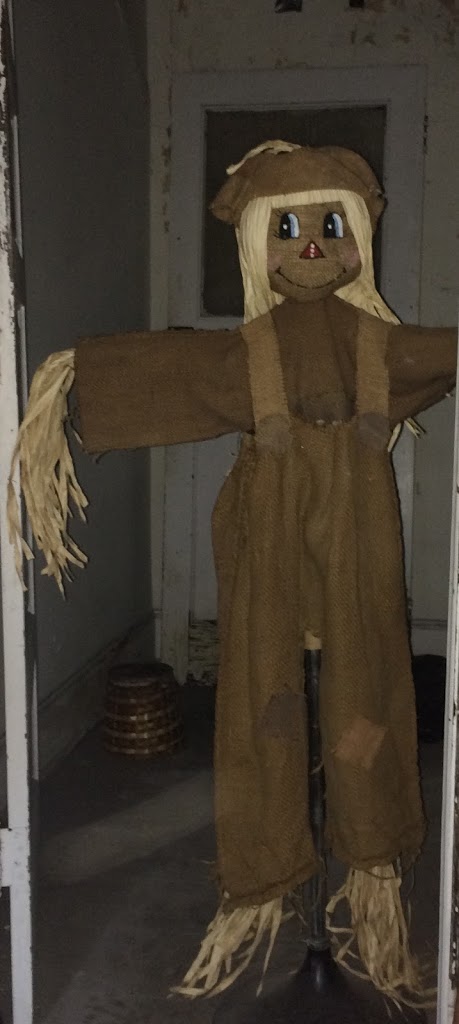
The thought ran through my head, “Someone has put out some tacky Halloween decorations out for this tour. Oh my God, I hope the rest of the tour isn’t like this!” My fears were allayed however when the guide began talking about how this scarecrow moved on its own around the third floor. Passersby on the streets outside have noted the scarecrow peering down on them from one of the third floor windows. When they look again the scarecrow is often looking down from a different window. Employees of the chamber of commerce have also noted the scarecrow’s erratic movement, even once finding it torn apart on the floor of the bathroom. Even more shocking was when the scarecrow reappeared “in pristine condition”—to use our guide’s words—the following day in its usual position overlooking downtown.
The chamber’s scarecrow that moves on its own accord. Photo by Lewis O. Powell, IV, all rights reserved.
The scarecrow, along with the other spirited compatriots, is overseeing a revival that’s taking place in downtown Wetumpka and throughout the state of Alabama. The state is beginning to awaken from its long, sad economic dream state and confidently stride back towards a fully awakened existence. Utilizing its own history, hominess, natural hospitality, stories, and even its ghosts, Alabama is brushing off the dust of its past and creating a more hopeful future.
Some of you may have noticed my absence during October. Please forgive me, I have been traveling throughout Alabama taking part in investigations and ghost tours. The life of a blogger can be rather dull when you’re only writing about these places rather than experiencing them. Last Halloween I promised myself that I would leave my schedule open this year so I could take advantage of the various investigations and ghost tours that crop up during the Halloween season. With one exception, all my investigations and tours were in Alabama, a state that I have discovered really wants its stories told.
My first jaunt, the first weekend of October, took me to Sylacauga, the Marble City. Located in central Alabama, Sylacauga (pronounced sil-uh-CAW-guh), is about 45 miles south east of Birmingham. The town was built primarily on marble quarrying: carving up the fine marble vein that spans thirty miles under this section of Talladega County. Near the downtown, the COMER MUSEUM (711 North Broadway Avenue) is situated in an Art Deco-styled marble-clad building built in the 1930s as the town’s library. Sculptures and carvings from the local marble grace the entrance of the elegant building that serves as a virtual attic for the area squirrelling away and displaying an array of historic artifacts.
I was in town for an investigation at the museum with S.C.A.R.E. of Alabama, a group founded by authors Kim Johnston and Shane Busby (who wrote Haunted Talladega County together, Johnston is also the author of Haunted Shelby County, Alabama and Haint Blue: The Rockford Haunting). Members of the group include haunted collector and author Kevin Cain whose book, My Haunted Collection, is now a part of my Southern Spirit Library, he’s also written a number of supernatural fiction works; and Kat Hobson who hosts the radio show “Paranormal Experienced with Kat Hobson” on which I appeared a few months ago and will be appearing at the end of this month. The group hosted this investigation as part of a series of public investigations that they host as fundraisers for the places investigated.
The fascinating investigation concentrated on a number of objects throughout the building that may have spirit attachments. See my rundown of the investigation here, “The Haunted Collection in the Marble City—Alabama.”
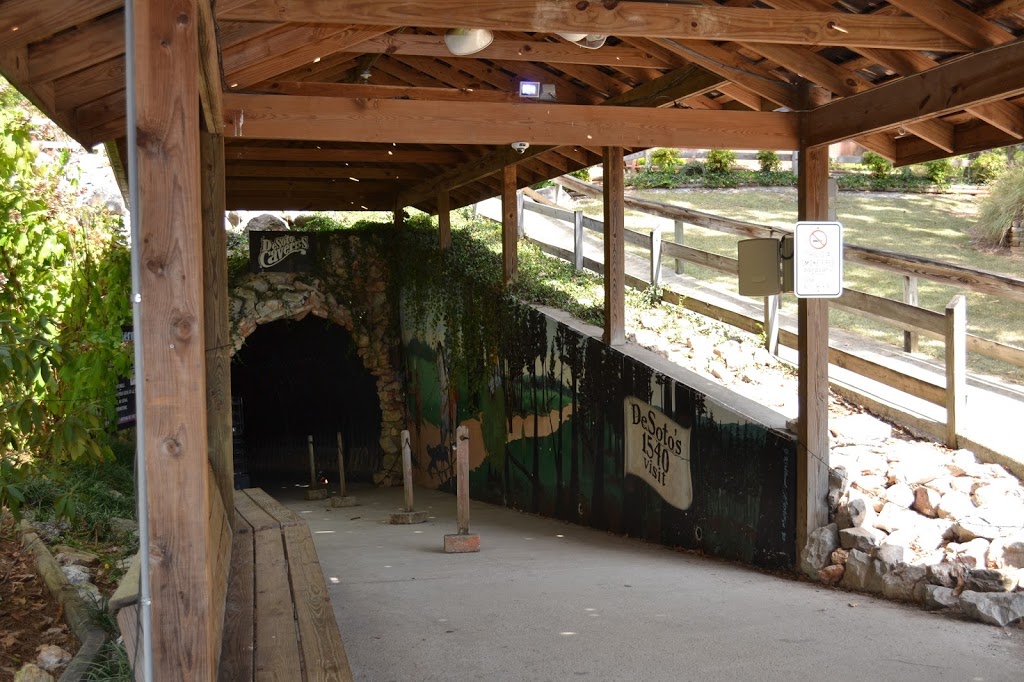
Entrance to De Soto Caverns, 2016. Photo by Lewis O. Powell IV, all rights reserved.
On the route I decided to stop outside of Childersburg to check out DeSOTO CAVERNS & FAMILY FUN PARK (5181 Desoto Caverns Parkway). As I waited for the cave tour I watched a young father carry his child off the porch of the gift shop heading towards the family’s car. In his arms the child squirmed and cried in the depths of a temper tantrum. As they passed the statue of Hernando de Soto the father said, “Hey look, it’s Hernando de Soto!” The child only screamed louder. Goodness knows that de Soto inspired similar reactions from the natives when he marched through this area in 1540.
Interior of the caverns with a replica of a native burial in place. Photo by Lewis O. Powell, IV, all rights reserved.
Scholars suggest that Spanish explorer and conquistador Hernando de Soto may have stopped in the area as he hacked his way through the forests and natives of the region. While there is no proof that he visited the cave, there is evidence that it was known to the local natives. Several native burials were located in the main room of the cave as well as the remains of a white trader who was killed after he carved his name in the cave which was considered sacred to the natives. Being a cave fan, I was happy when Johnston and Busby included the cave in their book on haunted Talladega County.
While I have had some creepy experiences in caves (see my experiences at Lost Sea Cave in Sweetwater, TN), I didn’t have anything odd happen. Johnston and Busby note that a young daughter of the cave’s owners had experiences with Native American spirits during her childhood on the property. Worried that these spirits may have been upset by the family’s use of the cave as a tourist attraction, the owners brought in members of the native tribes that once owned the land to cleanse the property and rebury the bones of their ancestors that had originally lain quietly in the cave. Apparently, the spirits have been appeased, though I do wonder if there is any residual energy that may cause some activity on occasion.
Sylacauga itself seems to be waking up however: a number of buildings in its downtown were occupied and open for business including what appeared to be several new restaurants. For dinner I considered BUTTERMILK HILL RESTAURANT(300 East 3rd Street) which occupies an early 20th century house just outside of downtown. Listed in Johnston and Busby’s book, the restaurant shares the house with an assortment of spirits and a dark history that includes a murder within the past decade. While the menu looks delectable, it was a bit pricey for my current budget, though I did take some pictures.
Buttermilk Hill Restaurant, 2016. Photo by Lewis O. Powell, IV, all rights reserved.
My second sojourn to Alabama took place over the penultimate weekend of October. Due to work on Friday, the trip turned out to be rather rushed and I didn’t have much time to really enjoy it the trip up. S.C.A.R.E. of Alabama sponsored an investigation of JEMISON-CARNEGIE HERITAGE HALL MUSEUM (200 South Street East) and the adjoining ARMSTRONG-OSBORNE PUBLIC LIBRARY (202 South Street East) in Talladega. Despite NASCAR races taking place the same weekend at the nearby (and cursed, supposedly) Talladega Superspeedway in Lincoln, the leafy streets of Talladega were quiet and still. South Street boasts some fine institutions and a handful of ghosts. On this peaceful night, antebellum MANNING HALL (205 South Street East), the huge, main edifice of the Alabama Institute for the Blind and Deaf, across the street from Heritage Hall was lit up like a beacon. Heritage Hall’s smaller, more feminine, Beaux-Arts façade was lit up as if in graceful answer to Manning Hall’s heavy, masculine Greek Revival colonnade. According to Johnston and Busby, Manning Hall does have some spirits of its own, quite possibly including the shade of the Institute’s founder, Dr. Joseph Johnson.
Manning Hall at the Alabama Institute for the Deaf and Blind. Photo by Lewis O. Powell, IV, all rights reserved.
The Jemison-Carnegie Public Library was the dream of Louisa Jemison, a member of the prominent Jemison family who now have a handful of haunted places associated with them. Designed by noted Alabama architect Frank Lockwood, the library was built with a donation of land from Louisa Jemison and the Carnegie Foundation. When the library opened in 1908 local lore tells of a little 8-year-old girl sitting on the top step the first day and her being the first person to check out a book. The little girl, Gentry Parsons, would eventually pen her own books and donated many books to this library.
The facade of Heritage Hall on the night of the investigation. Photo by Lewis O. Powell, IV, all rights reserved.
Good architecture has power. In creating beautiful spaces, the architect can physically manipulate those entering the space; the eyes and chin are raised and the dignity of the space encourages those entering to straighten their back out of respect. With better posture, those entering have their senses heightened and the feeling of awe can mellow into a sense of inspiration, lightness, refinement, and freedom. Like the great cathedrals of Europe, the architecture of Heritage Hall does exactly that. The high ceilings, airiness, and grace raises the senses of those walking up the front staircase and entering the front door. The main bay of the building is a large open space with a dramatic staircase directly ahead leading down to the main librarian’s desk.
Interior of Heritage Hall just inside the front door. Photo by Lewis O. Powell, IV, all rights reserved.The interior of Heritage Hall looking down the stairs just inside the front door towards the old librarian’s desk. Photo by Lewis O. Powell, IV, all rights reserved.
After entering for the investigation I was greeted by the museum’s director and given an excellent tour of the building. The open space inside with the walls lined with art from local artists gives the place a sense of veneration and the art displays the tremendous talent throughout the region. I was also introduced to some of the paranormal activity that has been experienced here. With this building being a community center for such a long period of time, the energy that has passed and continues to pass through it has likely left a psychic imprint. That can be one explanation for the disembodied footsteps and doors opening and closing on their own accord. As a library, this building has also inspired passion for many people, people who return to this beloved spot in spirit. Some of the spirits believed to still oversee business here are Miss Willie, a former librarian; Tom Woodson, a long-time director of the museum who died a few years ago; and Louisa Jemison who may return to check on her beloved library.
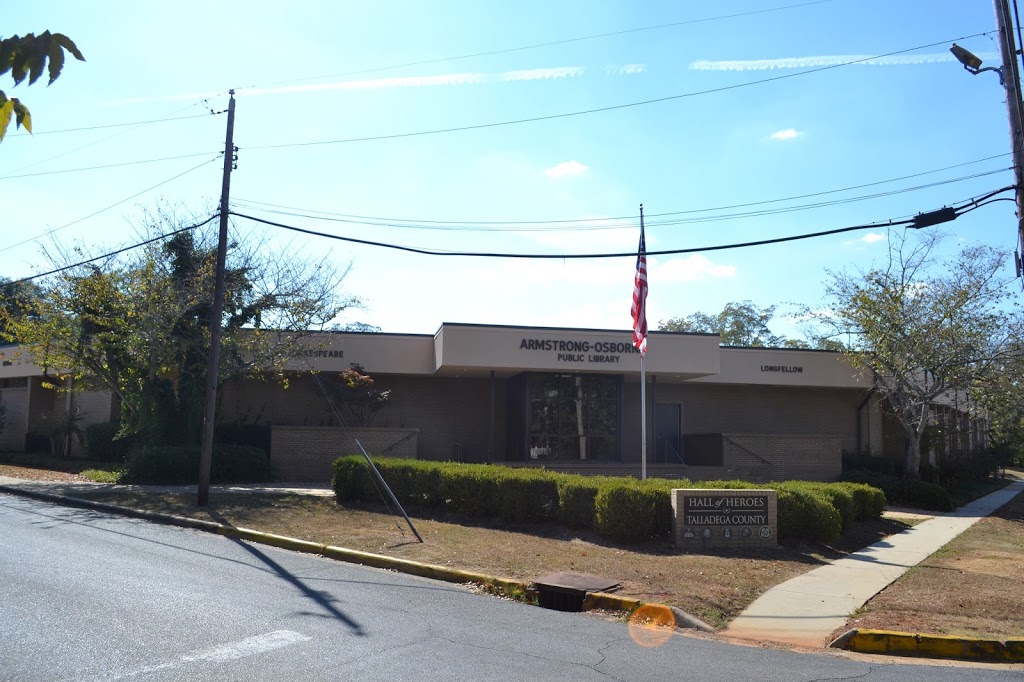
Main entrance of Armstrong-Osborne Public Library, 2016. Photo by Lewis O. Powell, IV, all rights reserved.
Spooning Heritage Hall like a protective older sibling is the Armstrong-Osborne Public Library which opened in 1979. Sadly, the architects of the newer building did not take their cues from Lockwood’s design. The building is minimalist and angular with no ornamentation; utilitarian modernist at its worst. The interior is very typical late 20th century library design which emphasizes function over design. While the architecture is nothing to write home about, the institution itself seems to be very well stocked and the librarians and staff present were delightful and very interested in the investigation.
Hall of Heroes entrance. Photo by Lewis O. Powell, IV, all rights reserved.
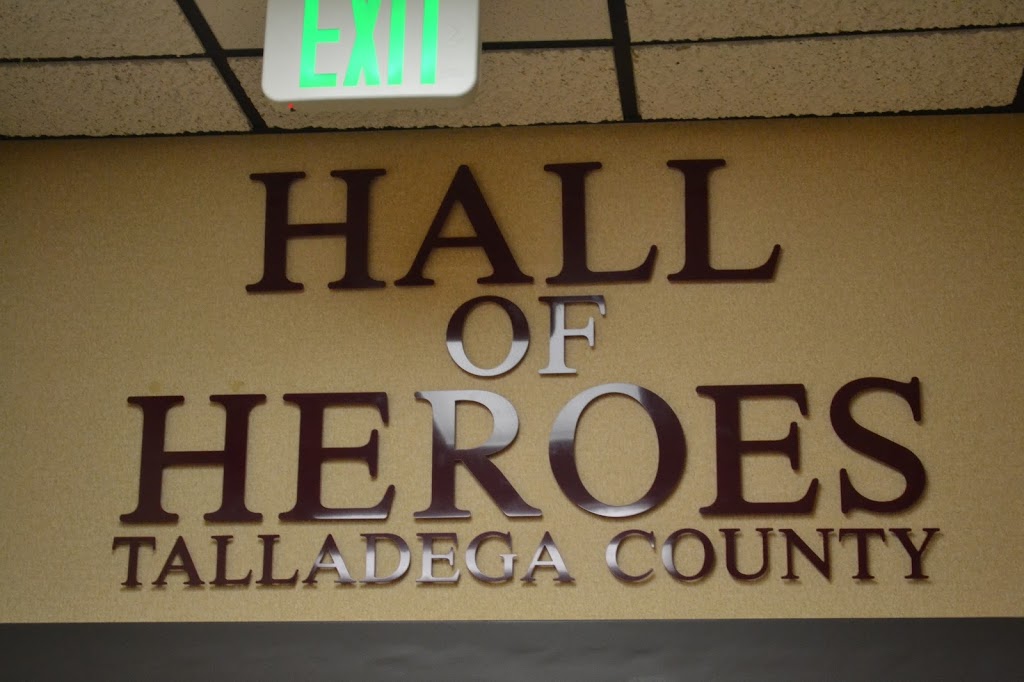
The library itself has experienced a modicum of strange activity particularly around the genealogy room and its adjacent hallway which are actually part of a 2006 addition to the building. That hallway is now the Hall of Heroes, honoring the many men and women of Talladega County who have served in the armed forces. The hall is lined with photographs ranging from World War I to the most recent conflicts in Afghanistan and Iraq. In this hallway the spirit of a woman has been seen while the sounds of a party sometimes emanate from the genealogy room itself when it’s empty. The investigation of the library and Heritage Hall didn’t really uncover much evidence-wise. After sitting with Ghost Boxes in the main reading room of the library we adjourned to the genealogy room and the Hall of Heroes. Fitted out with computers, microfilm readers, and shelves of books old and new, the genealogy room isn’t particularly creepy, even in the dark. We did an EVP session and at one point seemingly heard a “no,” though I was one of the few people to hear it. It may have also been gastric noises from one of the participants. After relocating to Heritage Hall we didn’t pick up much activity, though we had some K2 spikes when some of men began lounging on Miss Willie’s library desk.
The Hall of Heroes is lined with the photos of men and women who served in the armed forces from Talladega County. Photo by Lewis O. Powell, IV, all rights reserved.
Sources
Johnston, Kim and Shane Busby. Haunted Talladega County. Charleston, SC: History Press, 2015.
“History.”Talladega Armstrong-Osborne Public Library. Accessed 12 November 2016.
“Our History.” Jemison-Carnegie Heritage Hall Museum. Accessed 12 November 2016.
Wetumpka Area Chamber of Commerce. Wetumpka Haunted Heritage Tour. 28 October 2016.
Comer Museum & Arts Center 711 North Broadway Avenue Sylacauga, Alabama
The graves stood tenantless and the sheeted dead
Did squeak and gibber in the Roman streets. –William Shakespeare’s Hamlet, Act I, Scene 1
The Comer Museum, 2016, by Lewis O. Powell IV. All rights reserved.
Standing in the dark, listening to the multitude of odd, disconnected syllables pouring forth from the voice box at the Comer Museum last Saturday evening, this quote popped into my head. While most of the noise from the voice box was unintelligible “squeaking and gibbering” the occasional word would miraculously pop out. Occasionally these odd words would begin to make sense. A question may be asked only to receive an intelligent answer. Someone asked a question of Harriet, the Comer Museum’s own haunted doll, inquiring how old she was only for the assembled group to be treated to a cheeky reply: “nine” said a little girl’s voice a moment later. After one of the group members reminded the doll that she was much older, a spooky girl’s giggle issued from the ghost box. Those present were aghast.
It’s very appropriate that the Comer Museum–which could be called Sylacauga’s attic—is within a marble clad building. Sylacauga sits atop a huge vein of marble, often considered comparable to Italian marble, and the city if often referred to as “The Marble City.” Originally constructed as the city’s first public library building by the WPA in 1939, the museum’s exquisite marble façade beckoned members of the community for decades before the library moved to a new building in 1979. The old library building was rededicated in 1982 as a local history and art museum. The rooms that were once filled with books are now filled with the detritus of local history. Old signs, photographs, works of art, Native American artifacts, antique clothing, glorious marble sculptures and one creepy-ass (pardon my French) haunted doll, fill the museum from top to bottom.
When I arrived for I was greeted warmly by the members of Spirit Communications and Research of Alabama (S.C.A.Re) who were leading this public investigation. Kat Hobson, who recently interviewed me as a guest on her radio show whisked me off for a tour of the building. The museum is not large, though it seems that every room is packed with historic bits and pieces. Along the way Kat pointed out various things that oddly gave off high EMF readings including an Edwardian gown and a typewriter. On the first floor I was introduced to Harriet, the haunted doll. The doll gave off a weird energy that gave the air around it a tingly sensation. My first reaction was to say, “I don’t like it.” Kat responded, “I don’t really like it either.”
Harriet, the museum’s haunted doll sits forlornly amidst flashlights and other investigative devices. Photo 2016, by Lewis O. Powell IV. All rights reserved.
We headed down to the basement where we peeked into a recreation of a pioneer log cabin. Again, the air seemed to tingle with the same odd energy that Harriet had given off. It was uncomfortable, but rather intriguing. I noted that I’m not sensitive, so the energy must be strong if I’m feeling it. Kat is a bit sensitive and pointed out that the group had had some activity in the cabin, particularly some shadow play around the cradle in the center of the room. Much of the rest of the basement is used for art classes and the spirits continue their antics including a little boy who is known to kick people in the shins.
Recreated pioneer cabin in the museum’s basement. Photo 2016, Lewis O. Powell IV, all rights reserved.
Upstairs, the investigation began with the group observing three haunted dolls from the haunted collection of Kevin Cain. With these three far less creepy dolls set up on a glass case, Cain provided the tragic histories behind each doll. With a temperature gauge sitting in front of her, the doll named Tammy may have affected the temperature as Cain related her sad tale. Throughout his story the gauge whined almost with sympathy for Tammy’s calamitous plight.
Kevin Cain’s haunted dolls. Note the temperature gauge in front of Tammy on the left. Robin sits in the middle with Maci on the right. Photo 2016 by Lewis O. Powell IV, all rights reserved.
The team and guests for the investigation then headed to basement for a voice box session. Here we were treated to our first taste of the dead’s squeaking and gibbering. During the session, proper names popped through and a few questions were answered directly. Some of the guests had some uneasy sensations there.
Perhaps the most interesting moment of the evening came as the group communed with Harriet. One of the guests holding a thermal imaging camera spotted at odd ball of light in the upstairs balcony. The light was not visible to the naked eye but was present on the thermal camera. Two investigators headed upstairs and looked for a source. After a good deal of waving from the investigators, the light remained on the camera, though no source or reason could be found. The pair of investigators remained upstairs where they began to get the sensation of being touched. Even the admitted skeptic of the group, Shane Busby felt the caress of a hand on his cheek and shoulder. Tristen Cox, the other investigator felt a hand on her upper arm. After she reported being touched Busby pointed his thermal imaging camera at her to reveal a handprint on her arm.
According to Kat Hobson, the haunting of the Comer Museum seems more connected with the various personal artifacts owned by the museum and less with the building itself. I would suggest that the makeup of the building itself and the tremendous marble deposits below may provide a platform for the psychic energy here. Marble is a type of limestone, which some paranormal investigators and researchers consider to be an excellent conductor for psychic energy. Consulting Timothy Yohe’s 2015 work, Limestone and its Paranormal Properties, the author asserts that buildings constructed of limestone can cause powerful EMFs to be emitted which may lend energy to spirits and other entities. The Comer Museum’s large marble façade, the use of marble throughout the building, marble sculptures and architectural elements in the collection may perhaps spur the activity that has been experienced here for years.
The S.C.A.Re of Alabama team with the Southern Spirit Guide. Back left: Lewis O. Powell IV, Shane Busby, Tristen Cox, Kevin Cain. Front left: Harriet the Haunted Doll, Kat Hobson, Kim Johnston.
After the investigation S.C.A.Re’s founder and author Kim Johnston graciously autographed my copies of her books, even inscribing “To Lewis—My favorite blogger” in my copy of Haunted Shelby County, Alabama. She then requested that the investigators take a group photo with me. It seems like many of us were touched physically and emotionally by the people of Sylacauga, both living and dead, I know I was also touched by S.C.A.Re’s graciousness and generosity. Thank you, guys!
Sources
Ford, Gene A., Linda Ford, and Christy Anderson. National Register of Historic Places Nomination form for B.B. Comer Memorial Library. August 2001.
C.A.R.E. of AL. Comer Museum Investigation. 1 October 2016.
Yohe, Timothy. Limestone and its Paranormal Properties: A Comprehensive Approach to the Possibilities. Timothy Yohe. 2015.
N.B. This article was edited and revised 30 April 2020.
This article is part of my series, Street Guide to the Phantoms of the French Quarter, which looks at the haunted places of this neighborhood in a street by street basis. Please see the series main page for an introduction to the French Quarter and links to other streets.
Chartres Street
Chartres Street, which is often pronounced CHAR-terz or CHAR-trez, was named for the Duc de Chartres in 1724 and is among several of the earliest streets in town. Initially, Chartres only ran from Canal Street to Jackson Square. From Jackson Square to Esplanade, the street was called Condé.
Mahogany Jazz Hall Burlesque and Absinthe House 125 Chartres Street
The building that now contains the Mahogany Jazz Hall is on the right of this photo under the sign of Don Juan’s (which formerly occupied this space). Photo 2007, Infrogmation, courtesy of Wikipedia.
This 19th century building served as a boarding house for many years during which two tenants committed suicide. In 1892, a laborer was shot to death in front of the building with his murderer escaping into the dark of night. These deaths may contribute to the building’s haunted reputation with patrons and staff witnessing shadowy figures, hearing disembodied whispers, and feeling the cold touch of hands from the other side.
Sources
“Murder in New Orleans.” The Daily Commercial Herald. 22 November 1892.
Pinheiro, Maria. “Four little-known paranormal hotspots in New Orleans.” Malay Mail Online. 11 October 2016.
204 Chartres Street
204 Chartres in 2007. The building on the left was still Crescent City Books at this time. Photo by Infrogmation, courtesy of Wikipedia.
Formerly the home to Crescent City Books, one of the more prominent second-hand bookstores in the city, this late 19th century commercial building is apparently haunted by ghosts on every floor, including the specter of a young boy on the first floor. An investigation by the New Orleans based International Society for Paranormal Research (ISPR) identified a number of children’s spirits on the first and second floor as spirits that may also haunt Le Petite Theatre de Vieux Carré on St. Peter Street. Other spirits were discovered on the third floor and attic.
Sources
Dwyer, Jeff. Ghost Hunter’s Guide to New Orleans, Revised Edition. Gretna, LA: Pelican, 2016.
Montz, Larry and Daena Smoller. ISPR Investigates the Ghosts of New Orleans. Atglen, PA: Schiffer, 2000.
W New Orleans – French Quarter 316 Chartres Street
Formerly the Hotel de la Poste, the W Hotel is made up of a collection of old buildings many of which are occupied by their own collections of spirits. ISPR investigated the hotel in July of 1996. On the second floor of the hotel, investigators encountered the spirit of a white woman in her 30s who may be causing some activity there. In another section of the building which may have once held slave quarters, the spirits of three enslaved children were discovered. A middle-aged enslaved man, Gerald, was found by the group near the hotel’s parking garage, which may have been the site of stables were this man labored.
Montz, Larry and Daena Smoller. ISPR Investigates the Ghosts of New Orleans. Atglen, PA: Schiffer, 2000.
The Bottom of the Cup Tearoom
327 Chartres Street
Since 1929, The Bottom of the Cup Tearoom has served as one of New Orleans’ psychical landmarks. The tearoom popularly featured psychics who would read the tea leaves left at the bottoms of customers’ teacups. Over time, the shop has added other forms of divination and psychic readings including tarot cards to its menu. While the shop’s second location (open from 1972-2003) at 734 Royal Street possessed the well-known spirit of Julia, there are no documented ghost stories associated with this building, though Jeff Dwyer has noted that the spirit may have moved to the shop after the closure of the Royal Street location. A quote from the shop’s manager indicates there may be some activity there, telling Country Roads Magazine, “There’s a lot of history ground into this neighborhood. Each decade leaves its traces and emotional resin, which helps us tune into the intuitive mind.”
Sources
Dwyer, Jeff. Ghost Hunter’s Guide to New Orleans, Revised Edition. Gretna, LA: Pelican, 2016.
McGunnigle, Nora. “The Bottom of the Cup.” Country Roads Magazine. 21 September 2018.
Williams Research Center 410 Chartres Street
The Williams Research Center occupies one of three campuses that houses parts of The Historic New Orleans Collection, which preserves and collects historic items and archives covering the history of the city and the region. The largest items in this collection are a number of historic properties including the building that houses the research collection. Built in 1915, this Beaux-Arts structure originally housed the Second City Criminal Court and the Third District Police Station. The Historic New Orleans Collection purchased the building in 1993 after it had been vacant for many years.
The renovation of this structure required gutting the interior at which time construction workers began to have odd experiences. These included hearing the slamming of cell doors, despite the doors having been removed, and seeing apparitions of police officers in old-fashioned uniforms.
Montz, Larry and Daena Smoller. ISPR Investigates the Ghosts of New Orleans. Atglen, PA: Schiffer, 2000.
Napoleon House
500 Chartres Street
An early 20th century postcard showing the Napoleon House. Postcard published by A. Hirschwitz.
Built in 1797, this home was significantly expanded for early mayor, Nicholas Girod, who served from 1812-15. According to local lore, offered it as a refuge for Napoleon after he was exiled from France. While he died before he could travel, the house still bears his name. In 1834, some thirteen years after Napoleon’s death, his former physician, Dr. Antommarchi, opened a free clinic in the building, thus continuing its association with the deposed emperor. During the Civil War, wounded soldiers were treated in a hospital that operated on the second floor. In 1914, the Impastato family acquired the property and opened the restaurant and bar that remains in operation.
The over 200-year old history of the building has left spiritual activity. Some stories speak of a Confederate soldier who is seen to stroll the Chartres Street balcony before vanishing or hiding. Another story tells of an old lady who is spotted sweeping on the second floor. While yet others have witnessed the apparition of an enslaved woman in the courtyard.
Over the years, guests and staff have been surprised by lights turning off and on, sometimes on request. During a renovation of the building in the mid-1990’s the spirits expressed their displeasure with a heavy and oppressive feeling throughout. Bartenders also reported that bottles would occasionally fall from their perch behind the bar during this time. A paranormal group that investigated the building recently noted several entities on the property including a young lady in the courtyard who may have died in an accident and an old sailor who drinks at the bar late at night.
Sources
Bailey, Shan. “Strange ghosts: Drinking sailor, sweeping lady haunt the Napoleon House.” NOLA Weekend. No Date.
Brown, Alan. The Haunted South. Charleston, SC: History Press, 2014.
New Orleans Pharmacy Museum (La Pharmacie Francais)
514 Chartres Street
When Louis Dufilho opened his pharmacy here in 1823, this was the first licensed pharmacy established in the country. Dr. Dufilho operated his business here for some 35 years before retiring and selling his business to Dr. Joseph Dupas. Many sources suggest that Dupas performed medical experiments on slaves, especially pregnant slave women.
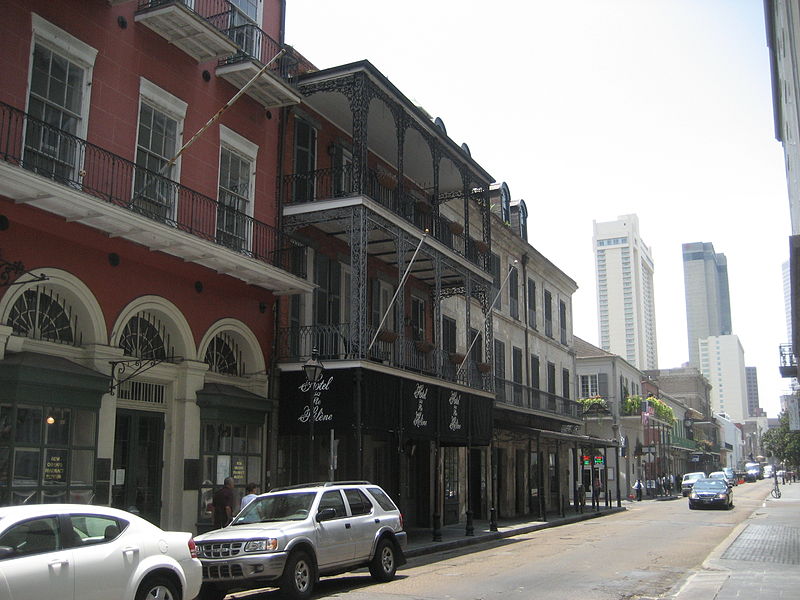
The view looking down Chartres Street. From the left, the buildings are the New Orleans Pharmacy Museum, Hotel Ste. Helene, and the Napoleon House. Photo 2008, by Infrogmation, courtesy of Wikipedia.
Tour guide Katherine Smith suggested in her book, Journey Into Darkness: Ghosts and Vampires of New Orleans, that Dupas also treated wounded soldiers here during the Civil War. Perhaps the pain and death from the medical experiments and the soldiers being treated have left a mark on the energy of this building. Some visitors have reported being suddenly overcome with nausea while others have encountered a figure in a brown suit and white lab coat that may be the spirit of Dr. Dupas.
Sources
Dwyer, Jeff. Ghost Hunter’s Guide to New Orleans. Gretna, LA: Pelican Publishing, 2007.
Oldfield, Eileen. “Things that go bump in the haunted pharmacy.” Pharmacy Times. 30 October 2014.
Smith, Katherine. Journey Into Darkness: Ghosts & Vampires of New Orleans. New Orleans, LA: De Simonin Publications, 1998.
Chartres House (Gally House)
540 Chartres Street
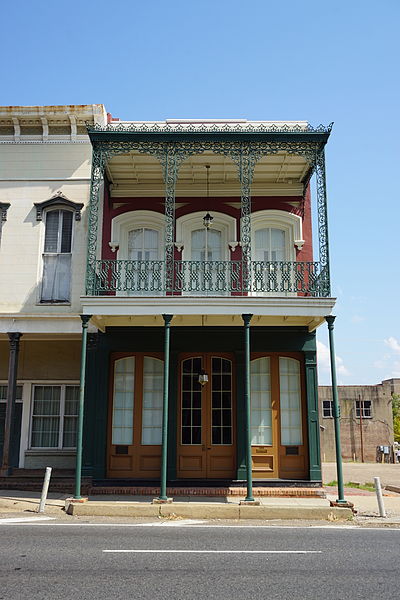
The large building occupying this corner of Chartres and Toulouse Streets is sometimes known as Keuffers Building. Built sometime after 1830, the building was intended to house businesses on the first floor with apartments on the second and third floors. If you walk alongside the building on Toulouse Street, you can see the separate slave quarters at the back of the building. Some passersby have noticed a young lady peering from the upper windows on this side of the building, despite the fact that these rooms were vacant at the time. Venture into the parking lot off Toulouse Street and look at the first small window. Tour guides will point out this window and encourage visitors to plunge their hand in. Some visitors have felt the feeling of their hands being grasped by small hands. Jeff Dwyer notes that these hands may belong to slave children who were housed in this room.
The Gally House in the 1930s as photographed by Frances Johnston for the Historic American Buildings Survey (HABS). Courtesy of the Library of Congress, Prints and Photographs Division.
Recently, the Chartres House restaurant, which opened originally in the former Reynes Mansion (see below) across the street, relocated into the majestic Gally House.
Sources
Dwyer, Jeff. Ghost Hunter’s Guide to New Orleans. Gretna, LA: Pelican Publishing, 2007.
Reynes Mansion (formerly the Chartres House)
601 Chartres Street
Originally built as a residence for the Reynes family following the Great Fire of 1788, this home was eventually occupied by the popular Victor’s Café in the late 19th century. Known as a hangout for artists and bohemians, Victor’s was a favorite of the writer William Faulkner.
An apartment located on the second-floor was the scene of a shooting death in the 1970s. The young man who lived there is supposed to have been involved in drugs. Following his death, the building’s owners had trouble renting the apartment as prospective tenants often detected bad energy and some became physically ill while touring the apartment.
The Reynes Mansion in 2008, when it was still the Chartres House. Photo by Infrogmation, courtesy of Wikipedia.
This building was occupied by the Chartres House restaurant until it relocated across the street to the Gally House (see above).
Muro, Maria. “Haunted Eats.” New Orleans Living. 9 October 2012.
Bosque House
617 Chartres Street, private
The Bosque House in 2011. Photo by Elisa.rolle, courtesy of Wikipedia.
This classic late 18th century Creole townhouse was built to replace a home destroyed in the Great Fire of 1788. Legend holds that this fire started on this site. Don Vicente Jose Nuñez, the army treasurer, owned the house at this site where curtains caught fire from a candle on the family’s personal altar on Good Friday. Tradition prohibited the ringing of bells on this most holy day and the priests of St. Louis Church would not allow the church’s bells to be rung to alarm the citizens. The fire eventually destroyed the church and nearly 900 other buildings in the city. Residents of this private home have heard the sounds of muffled bells. Perhaps better late than never?
Sources
Klein, Victor C. New Orleans Ghosts III. Metarie, LA: Lycanthrope Press, 2004.
Smith, Katherine. Journey Into Darkness: Ghosts & Vampires of New Orleans. New Orleans, LA: De Simonin Publications, 1998.
The Cabildo
701 Chartres Street
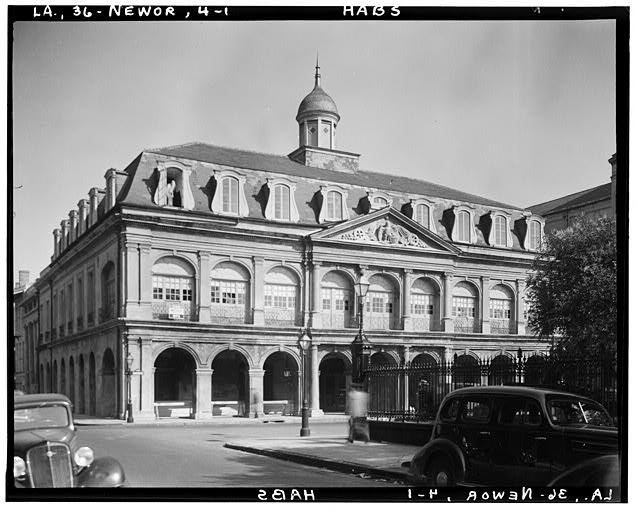
The younger twin of The Presbytère, The Cabildo was constructed to replace the city hall that was destroyed in the Great Fire of 1788. Of all the buildings in this city, this building has witnessed more important historic events than any other. Within the walls of the Cabildo the Louisiana Purchase was finalized in 1803. During the building’s time housing the Louisiana Supreme Court, the case of Plessy v. Ferguson was heard before it headed to the U.S. Supreme Court where it enshrined the concept of “separate but equal” into American racial law. The building became a part of the Louisiana State Museum in 1908.
The Cabildo, 1936, by Richard Koch for the Historic American Buildings Survey (HABS). Courtesy of the Library of Congress, Prints and Photographs Division.
While this building served as a seat of government for many years, a prison once stood behind it (see my entry on Pirate Alley for more information on this structure) which may explain the presence of a young soldier. Legend holds that the young man was imprisoned in the prison and, after a trial before a military tribunal, was summarily executed in the courtyard. Some of the museum’s staff and visitors have felt the sensation of someone rushing past them. Others have seen the pathetic form of a soldier in a ragged uniform.
Sources
The Cabildo. Louisiana State Museums. Accessed 2 June 2016.
Dwyer, Jeff. Ghost Hunter’s Guide to New Orleans. Gretna, LA: Pelican Publishing, 2007.
St. Louis Cathedral
Jackson Square
Interior of St. Louis Cathedral by Carol M. Highsmith. Courtesy of the Carol M. Highsmith Archive, Library of Congress, Prints and Photographs Division.
The Grande Dame of New Orleans, St. Louis Cathedral has stood at the sacred heart of this city since the construction of the first church on this site in 1718. The current building was originally constructed between 1789 and 1794 and heavily reconstructed in the mid-19th century. Legend holds that the black-robed form of Father Antonio de Sedella, often known by his French moniker, Père Antoine, appears during the Christmas Midnight Mass. The specter of this most beloved of curates appears to the left of the altar holding a candle.
Sources
Brown, Alan. The Haunted South. Charleston, SC: History Press, 2014.
“Our History.” Cathedral Basilica of Saint Louis. Accessed 2 June 2016.
The Presbytère
751 Chartres Street
The Presbytère, 2007, by Infrogmation. Courtesy of Wikipedia.
The Presbytère is one of the pair of buildings flanking St. Louis Cathedral. Originally constructed in 1791 to match The Cabildo, this structure was known as “Casa Curial” or “Ecclesiastical House,” and provided housing for the Capuchin monks who ran the cathedral. In 1911, the building was taken over to house the Louisiana State Museum. The museum houses two permanent exhibits: one commemorating Hurricane Katrina and the other celebrating the city’s Mardi Gras traditions. While visiting the museum should you see a tall and slim maintenance man in a dark uniform with curly brown hair, be assured that you have just seen a ghost.
Sources
Dwyer, Jeff. Ghost Hunter’s Guide to New Orleans. Gretna, LA: Pelican Publishing, 2007.
The Presbytère. Louisiana State Museums. Accessed 2 June 2016.
Muriel’s Jackson Square
801 Chartres Street
Originally built as a grand residence for the noted Destrehan family (who also owned haunted Destrehan Plantation found along the famed River Road), the building that now houses Muriel’s partially burned in the Great Fire of 1788 that ravaged the city. Supposedly, the burned house was purchased by Pierre Antoine Lepardi Jourdan who restored the home but sadly lost it in a card game. Not willing to simply leave the home, he quietly resigned to the second floor where he committed suicide in what is now known as the Séance Lounge.
Muriel’s in 2008. Photo by Infrogmation, courtesy of Wikipedia.
At least this is the story that is commonly told about this building. It is even included on the restaurant’s website. According to a 2013 blog post entitled, “The ‘Ghost’ of Muriel’s Restaurant,” this story is partially bunk. The blog notes that the current building was constructed sometime around the turn of the 20th century after the house on that site was torn down. While the history may not match up to the legend, there still may be paranormal activity with staff and visitors hearing knocking from inside the brick walls of the Séance Lounge, and disembodied voices, while encountering shadowy figures throughout the building. In order to keep some of the activity at bay, the restaurant maintains a special table for the ghost of Monsieur Jourdan.
Sources
Brown, Alan. The Haunted South. Charleston, SC: History Press. 2014.
Dwyer, Jeff. Ghost Hunter’s Guide to New Orleans. Gretna, LA: Pelican Publishing, 2007.
“Our Ghost.” Muriel’s Jackson Square. Accessed 2 June 2016.
Tipping, Joy. “Ghost trails and Halloween haunts in New Orleans.” Dallas Morning News. 23 October 2008.
Hotel Provincial
1024 Chartres Street
Hotel Provincial in 2019. Photo by Infrogmation, courtesy of Wikipedia.
Like many hotels throughout the quarter, this hotel consists of an amalgam of different buildings, each with different histories. The 500 building seems to be the one with activity. The building was constructed on a site that was originally occupied by an Ursuline Hospital. It was here that the wounded from the 1814 Battle of New Orleans were treated. During the Civil War the buildings on the site were commandeered for use as a military hospital. That building burned and was replaced by the current structure. Guests and staff have, according to tradition, encountered bloodstains that disappear before their eyes, wounded soldiers in the rooms and corridors, doctors and nurses in bloodstained clothing, and one unlucky security guard using an elevator had the doors open to reveal the scene of a Civil War era surgery.
Sources
Brown, Alan. The Haunted South. Charleston, SC: History Press. 2014.
Dwyer, Jeff. Ghost Hunter’s Guide to New Orleans. Gretna, LA: Pelican Publishing, 2007.
One of the oldest buildings in New Orleans, the old Ursuline Convent has survived hurricanes, fires, and the nuns have provided aid during plagues and epidemics. It’s no surprise that their old convent would house spirits. According to Jeff Dwyer, the spirits of Ursuline sisters have been seen gliding throughout the building while the spirit of a Civil War era soldier has been seen in the garden. (For a couple photos of the Old Ursuline Convent see my entry here.)
Sources
Dwyer, Jeff. Ghost Hunter’s Guide to New Orleans. Gretna, LA: Pelican Publishing, 2007.
Beauregard-Keyes House
1113 Chartres Street
See my entry, “Creepiness on Chartres Street,” for an in depth look at the history and hauntings of this famous home.
Le Richelieu Hotel
1234 Chartres Street
Housed in two buildings, one dating from 1845, the other from 1902, the Le Richelieu Hotel occupies the site where five French patriots were executed in the late 18th century. The spirits of these five men may still reside here. For further pictures see, “A Handful of Haunts—Photos from New Orleans.”
Crime and Punishment Museum (Old Turner County Jail) 241 East College Avenue Ashburn, Georgia
The war in Europe had been heating for only a few months when the front page of The Atlanta Constitution noted that a touch of winter was being felt in Georgia. The paper was almost entirely taken up with news from the fighting that the minor note on page 7 might be totally disregarded by the average reader.
12 September 1914 Page 7
HANGED FOR THE MURDER OF HIS MOTHER-IN-LAW
Ashburn, Ga., September 11.—(Special.)—Miles L. Cribb paid the death penalty on the gallows in the county jail here this afternoon at 1 o’clock for the murder of his mother-in-law, Mrs. Mary E. Hancock, near Rebecca, in November, 1913. Only a few close friends of the family were allowed to witness the execution.
After bidding his aged mother, brothers and little 9-year-old son goodbye the condemned man mounted the scaffold with signs of nervousness.
Sheriff King sprang the trap at exactly 1 o’clock. Twelve minutes later Cribb was pronounced dead. The body was turned over to relatives who will leave tonight for Jones county where Cribb will be buried tomorrow.
The murder for which Cribb was hanged was serious enough to make a headline on the front page of The Atlanta Constitution’s front page.
8 November 1913 Page 1
THREE WOMEN ARE VICTIMS OF ENRAGED FARMER’S FURY; ONE DEAD AND TWO DYING
Miles Cribb of Rebecca, Ga., Kills His Mother-in-Law and Seriously Wounds His Wife and Sister-in-Law.
EFFORT MADE BY WIFE TO SECURE ONLY CHILD LEADS TO THE TRAGEDY
Estrangement Between South Georgia Farmer and His Wife Leads to the Death of Aged Woman and Wounding of Her Daughters
Cordele, Ga., November 7.—(Special.) Enraged because his wife would not agree to a reconciliation with him after a brief separation of two weeks, M. L. Cribb, a Turner county farmer, living about two miles from Rebecca, tonight about 6 o’clock shot and instantly killed his mother-in-law, Mrs. J. G. B. Hancock, fired two bullets into the body of his wife, probably fatally wounding her, and then turning the pistol on his sister-in-law, Miss Sallie Hancock, fired the remaining bullets, inflicting a wound from which she will probably die during the night.
Reports are to the effect that Cribb went to the Hancock home about 6 o’clock and, pushing open the dining room door without a word of warning, ripped out a revolver and shot Mrs. Hancock, 70 years of age, dead in her chair at the supper table, fatally wounded his wife and seriously wounded his sister-in-law, Miss Sallie Hancock.
[…]Cribb hastily left the scene before aid from nearby neighbors reached the wounded women and sought a hiding place in the woods nearby.
Miles Cribb made his way to his brother’s home where he attempted suicide by putting his revolver to his head but his brother, Rev. W. J. Cribb, was able to grab the weapon from him and urged him to surrender. The article notes that this horrific incident stemmed from his mother-in-law’s attempt to get custody of the couple’s child, presumably the son mentioned in the article about the hanging. The 1913 article concludes with the gathering of a mob wishing to lynch Mr. Cribb.
[…] Feeling is strong against Cribb in the Rebecca district, and is rapidly growing stronger, and it is believed that Warden Putman is trying to get Cribb to a place of safety early enough prevent mob violence.
[…] Late reports from the little town are that a mob has formed near the scene of the shooting and will make an effort to take Cribb from the officers f they are located. These reports have not been verified.
The streets of Rebecca are practically deserted, nearly all the male citizens having gone to the scene of the tragedy.
The following day Mr. Cribb again was in the front page headlines of The Atlanta Constitution:
9 November 1913 Page 1
I Know I Must Pay Penalty But Save Me From Lynchers, Cries Cribb, Women’s Slayer
Cordele, Ga., November 8.—(Special.) Miles L. Cribb who was the principal actor in one of the dastardly and horrible crimes ever enacted in the section of Georgia…is now safely confined in the Dougherty county jail [in Albany, GA]. While he is now probably safe from mob violence, feeling in the community near the scene of the tragedy continues [to be] very intense, and it is thought that until he is given trial, if then, it will not be advisable to return him to the Turner county jail.
[…]Upon the arrival of Putnam [the warden who arrested Cribb] and Cribb on the outskirts of Ashburn they found a mob had gathered there, intending to do violence to Cribb if he was brought there. [Sheriff John A.] King was notified of the whereabouts of Cribb, and eluding the angry citizens, he took him in an automobile as rapidly as possible to Sylvester and then to Albany.
Once the furor died down, Mr. Cribb was eventually transferred to the Turner County Jail where he faced a jury next door in the Italianate halls of the Turner County Courthouse on January 6, 1914. Both Cribb’s wife and sister-in-law survived their wounds and were present. Word of the trial was not published in The Atlanta Constitution until nearly a month had passed.
7 February 1914 Page 12
CRIBB MUST HANG FOR BLOODY DEED
Wife Smiles as Ashburn Man Is Sentenced for the Killing of His Mother-in-Law.
Ashburn, Ga., January 6.—(Special.) “We, the jury, find the defendant guilty,” was the verdict returned this afternoon by the twelve men who had been chosen to decide the fate of Miles Cribb, who was placed on trial in Turner superior court this morning at 8:30 o’clock charged with the murder of Mrs. Mary E. Hancock, hos mother-in-law, in the Rebecca district last November.
Silence pervaded the crowded courtroom from the time the bailiff in charge of the jury announced to the court that they were ready to enter until the last word of the sentence of death was uttered by Judge Cox, fixing Tuesday, March 3, 1914, as the date of execution.
Between his aged mother on the right and the Rev. W. J. Cribb, his brother, on the left, the unfortunate man sat with bowed head for the most part throughout the trial which lasted from 10 a. m. to 1:30 p.m. The mother of the defendant sobbed constantly, as did the defendant, himself, as his counsel feelingly pleaded for mercy from the jury.
[…]The wife of the defendant, together with her relatives, who occupied the front seat, smiled her approval of the verdict and sentence as the condemned man was turned over to the sheriff.
[…]It is very likely that Cribb will remain in the jail here until his execution as the bitter feeling toward him immediately after the crime has almost subsided.
Cribb languished in the Turner County Jail for a number of months before he was executed there in September, less than a year after his heinous deed. The Turner County Jail is not atypical of turn of the century jails that remain in small towns throughout the South. It’s a heavy brick building in the reigning vernacular style of the period with some Romanesque-revival elements. The building takes on a very solemn air, especially when compared to the righteous flamboyancy of the courthouse next door. The jail features a tower-like element on its west corner that echoes the clock tower on the courthouse and the steeple of the Baptist church that can be seen between the two when viewed from College Street. This solemnity gives the building the air of strength, order, and as a place to avoided.
Old Turner County Jail, 2015, by Jud McCranie. Courtesy of Wikipedia.
According to a 2003 article, the jail’s strict architectural lines led it to be referred to as the “Turner Castle” by locals. It was constructed in 1906 for Turner County which had been established the previous year. The jail opened in 1907 for inmates. As was common in small town jails, the building provided a home for the sheriff and his family as well as room for inmates. The sheriff’s wife was tasked with providing meals for the inmates as well as her husband and family.
At the back of the building a metal staircase leads to the second floor where male inmates were confined in small 7’X 7’ cells. Two bunks on either side provided sleeping accommodations for the inmates, four of which could be confined in a single cell. The second floor also held a “death cage” where Cribb would have been confined in the hours leading up to his meeting with state-sanctioned fate. This cell is just a few steps from the steel trap door that would drop Cribb to his death at the end of a strong rope. This harsh conditions persisted until the county opened a new jail in 1994.
According to the jail’s documentation in the Georgia Architectural and Historic Properties Survey, the solemn mood of the jail sounded like something akin to a revival service for Cribb’s hanging, the last hanging conducted in Turner County and the second hanging in the jail (the other was in 1907). Mrs. Netta Shingler, who sang a hymn before the execution, described the event as a “once in a lifetime” event attended by the sheriff, deputy sheriff, school superintendent, and a prominent local Methodist minister. A service was held where Mrs. Shingler notes that “if the prisoner heard us he made no signs but those conducting the service were overcome.”
The jail has been preserved as a museum examining the harsh jail conditions that once existed throughout the South. Among the artifacts displayed here is a bloody shirt collar of Miles Cribb’s shirt from his execution. While the museum explores the spirit of crime and punishment in the South, spirits persist here as well, trying to tell their own stories. The spirits slam doors, shake beds, and have been noted to leave indentions in the old mattresses in the cells. Museum staff have allowed a number of paranormal investigation groups investigate the jail with one of the groups, Southeastern Paranormal Investigative and Information Team (S.P.I.R.I.T. Paranormal), having a piece of tile thrown at investigators in the basement during their 2012 investigation. Reportedly, the tile shattered on an opposite wall.
During this investigation members of the team had a variety of personal experiences seeing, hearing, and feeling things. A member of the Ghosts of Georgia Paranormal reported that during their investigation in 2013 that he heard voices throughout the building. The Albany Herald has just recently reported on ghost tours of the jail that are now being conducted on Friday and Saturday nights by the Paranormal Society of Middle Georgia. Perhaps Miles Cribb is still pitifully pleading forgiveness for his heinous deeds.
Sources
“Ashburn, GA. Museum puts a lock on history.” com. 15 July 2003.
“Ashburn man spends the night in haunted jail.” 12 June 2015.
Big Bend Ghost Trackers. “Investigation Report for the Crime and Punishment Museum.” 6 October 2007.
Blanchard, Haley. Georgia Architectural and Historic Properties Survey: Turner County Jail. No date.
“Cribb must hang for bloody deed.” Atlanta Constitution. 7 February 1914.
Sloss Furnaces 20 32nd Street, North Birmingham, Alabama
Perhaps one of the most iconic haunted places in the state of Alabama, this National Historic Landmark site is reminiscent of Birmingham’s history. Birmingham was built on industrial facilities like this producing iron during the latter half of the 19th and into the 20th centuries. While the facility opened in 1882, nothing remains of the original furnaces. The oldest building on this site dates to 1902 with much of the equipment installed and added in later years. This facility closed in 1971, and local preservationists began work to save the facility soon after. Their efforts paid off, and the facility is open as a museum and events facility.
Sloss Furnaces, 2011, by Matthew Gordon. Courtesy of Wikipedia.
There is always a chance for death in industrial sites, even more so around molten metal in a furnace. In 1887 Theophilus Jowers assistant foundryman at the Alice furnace (one of the first furnaces on this site), fell to his death into the molten iron in the furnace. Some of his remains—his head, bowels, two hip bones and some ashes—were fished out of the molten iron. Jowers’ death remains one of the most spectacular and grisly, though many more men died throughout the time that the furnaces were in operation.
After Jowers’ death, his spirit was observed by co-workers. Kathryn Tucker Windham quotes one former employee, “We’d be getting ready to charge the furnace, and we’d see something, something like a natural man walking around on the hearth. Just walking slow and looking around like he was checking to make sure everything was all right.” Windham describes the first time that Jowers’ son saw his father’s spirit in 1927. The grown son took his own son for a drive over the First Avenue Viaduct and there, while watching the action at the furnace, they observed a man walking through the showers of sparks and flames.
Two more spirits are believed to be in residence at this site, but their stories are less historically based. A white deer that has been seen on the grounds is believed to be the spirit of a pregnant girl who committed suicide by throwing herself into the furnace. The other “apocryphal”—as Alan Brown describes him—spirit is that of a fiendish foreman named James “Slag” Wormwood. Like Jowers and the pregnant girl, Wormwood supposedly fell to his death into one of the furnaces, though it is suspected that he was really pushed by an angry employee. It is Wormwood’s angry spirit that is responsible for pushing employees and visitors even today.
The furnaces are known as a hotbed of paranormal activity and were investigated for the first time in 2005 by Ghost Chasers International out of Kentucky. They were joined by psychic Chip Coffey who would soon make his name working on the A&E show, Paranormal State. During the investigation, Coffey made contact with the spirit of a man who had lost a limb in an accident there. Moments after losing contact with the spirit, team members noticed blood on Coffey’s hands. After investigating him for scratches or another injury that could have produced blood, nothing was found. Over the past 10 years of paranormal investigations at the site, a slag heap of evidence has been captured here.
Sources
Brown, Alan. Haunted Birmingham. Charleston, SC: History Press, 2009.
“History.” Sloss Furnaces National Historic Landmark. Accessed 12 June 2015.
Parks, Megan. “Sloss Fright Furnace: The haunts heat up in Alabama.” USA Today. 14 October 2014.
Windham, Kathryn Tucker. The Ghost in the Sloss Furnaces. Birmingham, AL: Birmingham Historical Society, 2005.
Oconaluftee Indian Village 778 Drama Road Cherokee, North Carolina
Back in 2012, I was working as a historic interpreter at the Oconaluftee Indian Village in Cherokee, NC. The village, a recreation of a mid-18th century Cherokee village on an idyllic mountainside, was populated by craftsmen, warriors and a group of British emissaries who were seeking a peaceful end to the Anglo-Cherokee War. As Sergeant Thomas Sumter—who would later be known as “The Gamecock”—I was in this village serving as a military escort to Lieutenant Henry Timberlake who was leading the expedition.
Sign for the village, 2012. Photo by Lewis Powell IV, all rights reserved.
Sumter was being hosted by the family of Tsiyu-gan-si-ni, whose name was translated as “Dragging Canoe,” who would later be a very important Cherokee chief. Dragging Canoe’s little cabin was located in an area containing two cabins and an underground sweat house. Usually, I was the only one in the cabin and I worked hard to keep the place clean and tidy. Cherokee tradition called for a fire in the fireplace at all times even on the hottest days so I maintained the fire which did help to keep the insects away.
The author as Sgt. Thomas Sumter, 2012. Photo by Mia Shirley, all rights reserved.
The region has been part of traditional Cherokee lands for centuries, though this particular patch of land would not have likely been inhabited. Cherokee villages were always built next to a major water source and mountainsides did not provide enough flat space. Historically, there was a village at the bottom of the mountain (where Drama Drive and US 441 intersect). This recreated village was constructed in 1952 under the purview of the Cherokee Historical Association, which also operates the outdoor historical drama, Unto These Hills, in the Mountainside Theatre located across the parking lot.
The village also has a haunted reputation. Having been in operation for over 60 years, many locals have worked here and eventually returned in spirit. Employees would regularly hear voices and laughter emanating from the village in the morning before the gates have been unlocked. One employee heading to her station one morning passed another employee in costume and ready for the day. She wished the woman a good morning and continued walking past her when she realized that the woman she had just seen had been dead for some years. Another employee who led tours past “my” cabin would occasionally glance inside to see another former employee sitting on the bed. That former employee had also passed on some years before.
The entrance to the village, 2012. Photo by Lewis Powell IV, all rights reserved.
When I had one of my first experiences in the cabin, it really came as no shock. As usual, this particular day I had a fire going and was in need of firewood early that afternoon. During a lull in visitors, I stepped out and gathered some firewood and headed back to my cabin. As I rounded the sweat house that my cabin looked onto, I looked towards the cabin door. A woman dressed in the traditional clothing female interpreters wear was stepping inside my cabin. Thinking it was the interpreter who worked in the cabin next door, I quickened my pace towards the door. Looking inside, there was no one.
After putting my wood down inside the cabin, I looked out the door and the other interpreter was standing in her doorway. “Did you see a woman enter the cabin while I was gone.” I asked.
“Nope, but I haven’t been standing here long.” She answered.
“My cabin” in the village, 2012. This is taken from the same vantage point where I was when I saw the figure enter. Photo by Lewis Powell IV, all rights reserved.
I’m not sure who the woman was or if I was simply seeing things. I don’t have a history of hallucinations nor do I indulge in mind-altering drugs. Perhaps I encountered one of the former employees.
In front of the cabin with a female interpreter. The figure that I saw was dressed just like my friend. Photo 2014, all rights reserved.
Since I started this blog in 2010, I have been collecting the experiences of people throughout the South who have had spirited encounters. Have you had an encounter in the South (I define the South as including the states of Alabama, the District of Columbia, Florida, Georgia, Kentucky, Louisiana, Maryland, Mississippi, North Carolina, South Carolina, Tennessee, Virginia and West Virginia)? I’m primarily interested in encounters in places that are public or semi-public in nature. These include places ranging from historic sites to cemeteries, schools to businesses and public spaces in between like roads, parks and natural areas.
I would like to hear about your experiences for possible inclusion in this blog and future publications. You may contact me in the comments here or on my Facebook page. Thank you for reading!
This article touches on Shepherd University. For a further examination of the hauntings on that campus, please see my guide to higher education haunts in WV.
I must sheepishly admit (pun intended) that I was not familiar with Shepherdstown, West Virginia until I stumbled across the website for Shepherd University with a recounting of its campus ghosts. Upon googling local ghosts, a marvelous article from the Shepherdstown Chronicle popped up with the above quote from a local historian. Of course, that got me excited.
Shepherdstown is located in the eastern panhandle of West Virginia in Jefferson County. Of the counties in West Virginia, Jefferson County seems to be one of the most paranormally active, most certainly in the area of Harpers Ferry. Standing in the large shadow of Harpers Ferry ghosts, I imagine that is why there really isn’t much written about Shepherdstown’s ghosts.
Settlement of the area began in the early 18th century with Thomas Shepherd being granted over 200 acres in the area. He set aside a portion of that acreage for a town which was chartered in 1762 and is—“arguably” as Wikipedia says—the oldest chartered town in West Virginia. The town was named Mecklenburg and would remain under that name until after the Civil War.
One of the city’s oldest remaining structures is the ENTLER-WELTZHEIMER HOUSE, also known as the “YELLOW HOUSE” (East High Street, Shepherd University Campus) which is now owned by Shepherd University. Not only is the yellow house one of oldest in the city, but the ghost story told about it may be one of the oldest documented ghost stories in the city as well. The story was mentioned in a Shepherd College (as it was called at that point) yearbook in 1928. An article in the student newspaper, the Shepherd College Picket, in 1954 also covers the tale.
In 1910, the Yellow House was the home of a local cobbler, George Yontz and his furry companion, a cat named Ham. When Mr. Yontz’s body was found not far from the cabin, locals assumed he had been killed for his money (many thought him to be very wealthy), though none was found when the house was searched. Since his death, the cobbler’s taps of his cobbler’s tools have been heard in and around the house.
The student newspaper mentions that a family moved into the house not long after Yontz’s death and their cat heard the tapping in the attic. The cat headed up the stairs and not long after came streaking back down and out the door. The cat was not seen again.
The house is built on the site of what was a fort built in the area during the French and Indian War. The house was purchased by the university in 1926 and has been used for a variety of educational uses—including as a Home Economics Cottage—until recently. The university was recently granted money to preserve the house.
McMurran Hall, Shepherd University. Photo by Acroterion, 2012, courtesy of Wikipedia.
Just down the street and around the corner from the Yellow House is McMURRAN HALL (NE corner German and King Streets), one of the grandest buildings on the university campus. McMurran is where Shepherd College was founded in 1871 and its clock tower is featured in the university logo. This grand, Greek Revival building was constructed as the town hall by Rezin Shepherd, the great-grandson of Thomas Shepherd, the town’s founder. Construction began on the eve of the Civil War and building stood incomplete when the wounded from the Battle of Antietam (17 September 1862)—considered one of the bloodiest battles fought on American soil—began arriving in Shepherdstown. Public and private buildings were commandeered for use as hospitals including the unfinished town hall. Perhaps it is the spirit of one of these men who passed in this building that’s seen peering from the clock tower at night.
At the other end of the block, where German Street intersects Princess Street, the corner is graced with the lovely, old ENTLER HOTEL (129 East German Street), also called Rumsey Hall and now home to the Historic Shepherdstown Museum. The first building on this property was a home for the Entler family which was destroyed by fire in 1912. The subsequent buildings constructed here remain and these housed the Entler Hotel.
Entler Hotel, 2008, by Acroterion, courtesy of Wikipedia.
Shepherdstown’s location along a main road from Baltimore to the interior of the southeast, brought a great deal of traffic through the area in the early 19th century. This hotel was opened primarily to serve the wealthier travelers, though the nomination form for the National Register of Historic Places notes that there was gambling and other gaming taking place in the inn’s yard. Continuing, it notes that one businessman, having lost his money in a card game, shot himself at the back of the hotel.
This was not the only tragedy here, in 1809 after a duel just across the Potomac River, Peyton Smith was brought here. The duel was held following a card game between Smith and Joseph Holmes, both members of noted Virginia families. The wounded Smith was placed in Room 1 and cried out for his mother before he passed. His mother arrived from Winchester after her son’s passing. People in the building continue to hear Smith’s pathetic cries.
Walking south down Princess Street, visitors will find an old carriage repair shop that formerly housed the CARRIAGE HOUSE CAFE (107 South Princess Street). This building has housed a variety of businesses and the spirit of a former owner is said to remain on the property.
A bit further down East German Street, another corner is graced by a grand building in this case it is the Beaux-Arts style, the old 1906 Jefferson Security Bank. The bank was converted to a restaurant some years ago and now houses the YELLOW BRICK BANK RESTAURANT (201 East German Street). Table 25 was the scene of some activity in the 1990s when a patron reported to the restaurant’s manager that she couldn’t sit at the table because of the ghost. The bartender also reported that he had glasses fall from the glass rack and break.
Of course, for Shepherdstown, I think these hauntings are just the tip of the iceberg. I’ll be keeping my eyes open for more reports from this lovely little town.
Sources
Engle, Georgia Lee. “Restless spirit roams campus, haunts High Street Cottage.” Shepherd College Picket. 28 October 1954.
Lehman, Mary Corcoran. “Entler Hotel.” Historic Shepherdstown and Museum. Accessed 2 October 2014.
McGee, Ted. National Register of Historic Places nomination form for Rumsey Hall (Entler Hotel). 6 October 1972.
Molenda, Rachel. “Town serves as home to ghosts from past.” The Shepherdstown Chronicle. 28 October 2011.
Museum of Seminole County History 300 Bush Boulevard Sanford, Florida
That’s where the old folks stay. –“Old Folks at Home,” Stephen Foster, 1851
It’s rather fitting that a former old folks home is now the home to a county historical museum. Of course, it’s no surprise that the same location remains home to old folks who have passed on. Such is the case of the Seminole County Old Folks’ Home which now houses the county’s historical museum.
Seminole County Old Folks’ Home, now home to the county’s historical museum. Photo by Ebyabe, 2006, courtesy of Wikipedia.
In the era before the advent of government assistance, many local governments provided poor houses and poor farms where the poor and indigent could seek shelter and attempt to support themselves. Seminole County constructed this building in 1926 as part of an 82 acre county farm. This site was operated as the county’s “Old Folks’ Home” until 1964 when the structure was converted for use as the county’s Agricultural Center. It served in that capacity until a new center was built in the early 1980s. The structure became the county’s museum in 1982.
However, it seems like some of its residents may have not left. A recent article in Florida Today notes that the museum is now providing paranormal activity tours of the building. With a tablet computer as a guide, guests can see evidence from the two paranormal investigations of the building and discover the varied types of paranormal activity witnessed in each room.
While the spirits have not been identified, many of their activities have been noted. One guest had their sunglasses knocked from their head while a museum employee has discovered lights on that she specifically turned off. In one case, the employee experienced what she described as a feeling of being lightly tased. Investigations of the museum have uncovered photographs of orbs and EVPs.
Eunice Public Library 222 South Second Street Eunice, Louisiana
If there is a spirit haunting the public library in the small town of Eunice, then it may really like children’s literature. According to the librarian, a book by Mary Alice Fontenot, a local children’s author, “has gone missing from our shelves, and after replacing this book, the replacement went missing as well.” But this is only one of a number of incidents that remain unexplained including the staff opening the library in the morning and discovering that the restroom door is locked with the light on inside.
After discovering that a local psychic and paranormal investigator had had odd experiences at the library as a child, the library asked the investigator’s group, On the Edge Soul Seekers, to conduct an investigation. The results were presented to the public on May 29th, with nothing published yet on what those findings were.
Sources
Johnson, William. “Is the Eunice Public Library haunted?” Daily World 29 May 2014.
Spring Street Historical Museum 525 Spring Street Shreveport, Louisiana
At the Spring Street Historical Museum in the old Tally’s Bank Building in Shreveport, the ghost is more interested in the welfare of the employees there than children’s literature. A 2013 article mentions that a museum employee was about to get up on a ladder when he saw the museum’s front door open by itself. The sturdy door was not prone to open easily and the employee was a bit frightened. When he returned to the ladder, he discovered he had not set it up properly and may have fallen should he have climbed upon it.
Spring Street Historical Museum, 2015, by Michael Barera. Courtesy of Wikimedia Commons.
The museum occupies the Tally’s Bank Building, considered one of the oldest in Shreveport. It was constructed as a bank just after the close of the Civil War. With the South’s economy still rather unstable, the building housed three different banks. The first two failed, but the third—B. Jacob’s Bank—became First National Bank of Shreveport in 1885. That bank occupied this Italianate-style building until the 1950s when the bank needed more space. The structure served as a bar for a number of years until it was donated to the local Colonial Dames organization for use as a museum.
The stories of paranormal activity from the building have led to its being investigated three times. According to a recent article in the Shreveport Times, the primary spirit is of a former bank manager named Edward.
Sources
Louisiana State Historic Preservation Office. Document on Tally’s Bank. Accessed 1 June 2014.
Spradlin, Courtney. “City Explorer: Step inside downtown’s Spring Street Historical Museum.” Shreveport Times. 28 May 2014.
Thomas, Angela. “Before ‘Ghost Hunters,’ Louisiana Spirits Explored Shreveport’s Haunted Past.” KEEL News Radio 710. 13 June 2013.