The Unhappy-Go-Lucky Ghost–Georgia

Historic Baker County Courthouse
Courthouse Square
Newton, Georgia

 Georgia’s Southwest corner seems to have been mostly forgotten. The sparsely populated counties (mostly) that comprise the Plantation Trace region are some of the poorest in the state. Once served by the railroads, this area now lacks connection to any interstate highway which has led to much of the isolation from which the region suffers. Even one of the few major urban areas that anchors the region, Albany, is about 45 miles from I-75. Newton, the county seat of Baker County, has a long, quiet history marked by the flooding of the Flint River. Courthouse Square, once the beating heart of this rural county, is now a collection of weedy lots surrounding the still grand turn of the century courthouse, thanks to the severe 1994 flood that submerged the whole area.

Old Newton County Courthouse, 2017, by Michael Rivera. Courtesy of Wikipedia.

While many of the living residents have fled this dried-up region, they have left behind history and ghosts. Sometimes the most fascinating history and the occasional ghost story can be found in the merest of footnotes. Thus, is the case of the Historic Baker County Courthouse and its happy-go-lucky architect, J. W. Golucke. Here, in burgeoning Newton, Mr. Golucke’s luck ran out and he met his sad fate. Many sources now refer to Golucke’s magnificent courthouses that still adorn many of Georgia’s county seats, but few make much of his death. A brief webpage from the Union County, Georgia Historical Society mentions his death and the possibility that he is still in residence in Newton.

The son of a German cabinetmaker, James Wingfield Golucke was born in either Taliaferro or Wilkes counties in east central Georgia in 1857. He was self-taught and began working as an architect in 1891. He quickly rose to prominence with his ambitious designs that transformed the overused classical architectural vocabulary to create graceful structures that seemed to evoke the power of law and justice with stone, bricks, and mortar. In 1904 in Newnan, Golucke ambitiously designed the Coweta County Courthouse which “displays a colossal pride and verticality with which, portico, building mass, and clock dome virtually stand ‘at attention,’” and at the whopping cost of $56,998. Courthouse squares from Blairsville to Sylvester, and Crawfordville to Zebulon, were graced with Golucke designs. He also created a number of other public buildings including schools and hotels.

An advertisement from The Atlanta Constitution, 18 September 1904.

The one remaining photograph of Mr. Golucke gives the impression that the young architect was perhaps a dandy. He stares out of the black and white with a haughty expression belying his brashness. His long face is accented with artistically tousled hair and a stylish mustache. He could easily be one of the Bohemians inhabiting attics and studios in Paris at the time, but he was a self-made architect in Atlanta. It’s not hard to imagine that he was most probably a member of the local “smarter set.”

He was engaged to design the courthouse for Baker County in Newton, but then during the construction Golucke and R. F. Hemphill, president of the Atlanta Fireproofing Company, were arrested for forgery. The Atlanta Constitution explains: “The whole trouble grows out the fact that it is alleged these two men altered a bond for $50,000, bearing the date of May 3, 1906, and changed it to make it read May 1, 1906. This is claimed to have been done with the intention of defrauding not only the Aetna Indemnity company, who went the surety, but also the county of Baker.” The paper continues, “Both Golucke and Hemphill, it is further claimed, contracted to construct a court house for the county in Newton some two years ago, but it was not finished by the time named.”

I’m no legal expert, but it seems that the county was upset that the courthouse wasn’t completed on time and trumped up the forgery charges in order to hold someone accountable. The 1991 county history sympathically remarks that Golucke proclaimed his innocence and suggested that he had not followed the building of the courthouse very closely. The county history continues, “Some local residents of that era have indicated suspicion that Golucke may have been wrongfully blamed for the misappropriation of funds and that someone locally may have been involved and used the self-made designer as a scapegoat.”

Both Golucke and Hemphill were arrested September 20, 1907 and held in Newton under a $20,000 bond. The paper takes pains to note that Golucke was held in town under the bond, though not held in the jail. Perhaps he was getting celebrity treatment? The 1991 county history states that Golucke wrote that he “could not stand being confined in jail and the disgrace it had brought upon him and his family.”

A little more than two weeks later the paper reports that Golucke attempted suicide during his confinement in the county jail in Newton. The brash young architect used a piece of glass to cut his wrists and throat but was spied by an African-American prisoner who raised an alarm. Doctors suspected that he was under the influence of some type of drug as well as he “lingered in a comatose state last night and was believed to be in a desperate condition.” He had left a suicide note.

The paper was silent on the subject until a death announcement appeared a few days before Halloween. Evidently, Mr. Golucke had recovered from his injuries but his life was ended by an attack of gastritis. An obituary suggests that he died from a brain fever. Regardless, this brash, likely innocent wraith is still identified as the spirit that roams the courthouse that brought on his sad fate. The courthouse itself, still standing as a startling sentinel among the barren town square, no longer serves as a courthouse after the disastrous 1994 flooding of the Flint River. Instead, it has been resigned to serve, no less nobly I might add, as the local library.

Sources

  • “Atlanta Man Tries Suicide.” Atlanta Constitution. 8 October 1907.
  • Baker County Historical Society. The History of Baker County. Roswell, GA: WH Wolfe Associates, 1991.
  • “Death takes J. W. Golucke.” Atlanta Constitution. 28 October 1907.
  • “Two Atlantans Are Indicted.” Atlanta Constitution. 22 September 1907.
  • Union County Historical Society. “The Ghost of J. W. Golucke.” Accessed 26 March 2017.

A Big Fish of a Ghost Tale–Albany, Georgia

From the banks of the Flint River in Albany, Georgia, this ghost tale made the rounds of newspapers throughout the country in 1888. According to Dale Cox at the ExploreSouthernHistory blog, this story first appeared on July 9th of that year. Cox mentions that the tale of the headless equine is a holdover from Medieval culture and the spirit in the story is usually that of a woman cursed by God for her great sins. Whatever the origin of this spirit, ghosts do remain along the Flint as it passes through Albany especially in Bridge House, the home to the city’s welcome center.

Broad Avenue Bridge over the Flint River in Albany. Photo 2015, by Michael Rivera, courtesy of Wikipedia.

The Wilson Mirror
Wilson, North Carolina
22 August 1888

 A FISHING STORY.

 How Dink Melvin was Haunted by a Headless Horse.

 Everybody in Albany knows Dink Melvin, the fisherman and boatman, and doubtless every one who has ever been on a fishing expedition with him up the Muckalee or Kinchafoonee has heard the story he tells about a ghost that haunts the banks of the river in the vicinity of the Fair Grounds, says the Albany News and Advertiser.

The ghost that Dink describes most eloquently is in the shape of big white horse without a head. The horse is perfect in shape except he has no head, and Dink says that he has been seeing it for the five or six years. Its trysting place is along the river banks in the vicinity of the Fair Grounds, and Dink says that he can show it to any man that will go with him after nightfall. If he gets in his boat and rows across the river the big white horse follows him to a certain place, and then disappears. It has given him several bad frights, and one Sunday evening as he was returning from the creeks above, the thing came right up to his boat and seemed to be trying to put its fore feet in. Dink says that he has been scared a good many times, but this was the worse fright he had ever had in his life.

The reporter was one of a fishing party that camped on the Muckalee one night last week, and heard Dink tell this wonderful story.

“I’d just like to see some man that had the grit to shoot at the thing, but I wouldn’t care to close to be him when he done it,” said Dink.

“Well, sir, you take me there and show it to me, and I’ll shoot at it,” said the scribe.

“No, sir; boys don’t you do it,” interrupted Harrison Pettis, the scribe’s faithful boatman, from the outer edge of the tent, “Kase I tell you why—I knowed a man what shot at a ghos’, an’ he died in erbout three weeks. No, sir; don’t you shoot dat thing, for I don’t want you to die.”

An engagement was made with Dink to visit the haunted spot, but at the appointed time Dink begged to be excused saying that he was sick and did not feel well enough to take the walk and face the ghost. He then promised to call for the scribe between sundown and dark on the following evening, but he failed to show up.

Sources

Midnight at the Castle of Good and Evil—Book Review

The Corpsewood Manor Murders in North Georgia
Amy Petulla
History Press, 2016

 Even the name Corpsewood Manor is reminiscent of a haunted house attraction. When I first encountered a description of this remote, northwest Georgia site I discounted the description as a typical internet fiction, one of those countless urban legends that are found in the weedier portions of the web. None of the better sources I followed made mention of this until Theresa Racer, the creator of Theresa’s Haunted History of the Tri-State Blog covered this site. I did some perfunctory research on the site and determined that most of the wild facts about the site were not mere inventions and have always meant to include this story in my blog. I was excited to see Amy Petulla, the owner of Chattanooga Ghost Tours and the co-author of Haunted Chattanooga with Jessica Penot, wrote a book about this fascinating case and haunting.

The facts of this story seem like a swirl of bad tabloid journalism. Two gay men, Charles Scudder and Joey Odom, lived in a hand-built castle on a remote mountain ridge in northwest Georgia. The remote location allowed them to escape the pressures of urban living and live in a simple manner without electricity, phones, and the rude interruptions of modern “connected” life. The remote castle acted as a fortress keeping the outside world at bay while allowing them to indulge in decadent pleasures that were viewed with contempt by much of the outside world. Scudder, a former professor of pharmacology at Chicago’s Loyola University, engaged in reading and study in his mountain hideaway where he also dabbled in the occult and the hedonistic tenets of Satanism.

Two local men, Tony West and Avery Brock, had visited the pair a handful of times and even partaken of some of the verboten pleasures that were offered to some of the guests of the castle, when they were struck with the idea of robbing the pair. West and Brock visited Corpsewood on the evening of December 12, 1982 and shot both men to death when they did not reveal where their money was hidden (both Scudder and Odom had a decent sum of money but it was entirely in bank accounts, the pair had no cash on them). The criminals took some valuables from the castle and fled in Scudder’s Jeep. On the road, the two criminals robbed and killed a naval officer they encountered in Vicksburg, Mississippi. Both men were quickly arrested and tried for the murders. They were both found guilty. Both men remain in prison for this horrible crime.

After the discovery of the bodies of Scudder and Odom (as well as their two beloved mastiffs), curious locals flocked to the scene to gawk at the remote castle. The crowds stripped the home clean of souvenirs, even digging up the rose bushes while some of the more valuable items were safely removed by friends and acquaintances of the couple. Many of these items were later believed to have brought bad luck to the owners. The remote castle was soon torched by arsonists and the surrounding forest quickly began to reclaim the site.

As a lover of the paranormal Petulla includes an entire chapter on the paranormal activity that still persists at the site. One of the more fascinating tales she notes came from her masseuse who visited the site one afternoon with friends. At the site of the house they met two middle aged men sitting among the ruins in lawnchairs. After an amicable conversation about the tragedy that had occurred there many years earlier, the masseuse and friends walked away to explore the rest of the site. Returning to the ruins of the house they discovered that the odd men had left. After describing the two men to Petulla she produced a photograph of Dr. Scudder and the masseuse was shocked to say that he had been one of the odd pair.

Petulla revels in the details and personalities involved in this case. The picture she presents is not unlike John Berendt’s Midnight in the Garden of Good and Evil, which explores the events surrounding a murder that occurred in Savannah a year before the Corpsewood murders. Like Berendt who had reported on Jim Williams for Esquire and was personally embedded in Savannah society, Petulla worked as an assistant district attorney under David “Red” Lomenick, who had prosecuted West and Brock a few years earlier. This intimate knowledge of the case is born out in exquisite detail in this book.

In all its tabloid-esque elements, Petulla handles the story sympathetically and mostly without casting aspersions on the victims. She also utilizes interviews with locals who were friends of Scudder and Odom and presents them as fascinating eccentrics who simply wished to live their own lives before that was upended by this murderous plot. By incorporating details of the eccentric personalities involved in this case, Petulla presents a scary, bizarre, and thoroughly enjoyable adventure through remote northwest Georgia in the early 1980s.

Crime and Punishment in South Georgia

Crime and Punishment Museum
(Old Turner County Jail)
241 East College Avenue
Ashburn, Georgia

The war in Europe had been heating for only a few months when the front page of The Atlanta Constitution noted that a touch of winter was being felt in Georgia. The paper was almost entirely taken up with news from the fighting that the minor note on page 7 might be totally disregarded by the average reader.

12 September 1914
Page 7

 HANGED FOR THE MURDER OF HIS MOTHER-IN-LAW

Ashburn, Ga., September 11.—(Special.)—Miles L. Cribb paid the death penalty on the gallows in the county jail here this afternoon at 1 o’clock for the murder of his mother-in-law, Mrs. Mary E. Hancock, near Rebecca, in November, 1913. Only a few close friends of the family were allowed to witness the execution.

After bidding his aged mother, brothers and little 9-year-old son goodbye the condemned man mounted the scaffold with signs of nervousness.

Sheriff King sprang the trap at exactly 1 o’clock. Twelve minutes later Cribb was pronounced dead. The body was turned over to relatives who will leave tonight for Jones county where Cribb will be buried tomorrow.

The murder for which Cribb was hanged was serious enough to make a headline on the front page of The Atlanta Constitution’s front page.

8 November 1913
Page 1

THREE WOMEN ARE VICTIMS OF ENRAGED FARMER’S FURY; ONE DEAD AND TWO DYING

Miles Cribb of Rebecca, Ga., Kills His Mother-in-Law and Seriously Wounds His Wife and Sister-in-Law.

EFFORT MADE BY WIFE TO SECURE ONLY CHILD LEADS TO THE TRAGEDY

Estrangement Between South Georgia Farmer and His Wife Leads to the Death of Aged Woman and Wounding of Her Daughters

Cordele, Ga., November 7.—(Special.) Enraged because his wife would not agree to a reconciliation with him after a brief separation of two weeks, M. L. Cribb, a Turner county farmer, living about two miles from Rebecca, tonight about 6 o’clock shot and instantly killed his mother-in-law, Mrs. J. G. B. Hancock, fired two bullets into the body of his wife, probably fatally wounding her, and then turning the pistol on his sister-in-law, Miss Sallie Hancock, fired the remaining bullets, inflicting a wound from which she will probably die during the night.

 Reports are to the effect that Cribb went to the Hancock home about 6 o’clock and, pushing open the dining room door without a word of warning, ripped out a revolver and shot Mrs. Hancock, 70 years of age, dead in her chair at the supper table, fatally wounded his wife and seriously wounded his sister-in-law, Miss Sallie Hancock.

[…]Cribb hastily left the scene before aid from nearby neighbors reached the wounded women and sought a hiding place in the woods nearby.

Miles Cribb made his way to his brother’s home where he attempted suicide by putting his revolver to his head but his brother, Rev. W. J. Cribb, was able to grab the weapon from him and urged him to surrender. The article notes that this horrific incident stemmed from his mother-in-law’s attempt to get custody of the couple’s child, presumably the son mentioned in the article about the hanging. The 1913 article concludes with the gathering of a mob wishing to lynch Mr. Cribb.

[…] Feeling is strong against Cribb in the Rebecca district, and is rapidly growing stronger, and it is believed that Warden Putman is trying to get Cribb to a place of safety early enough prevent mob violence.

[…] Late reports from the little town are that a mob has formed near the scene of the shooting and will make an effort to take Cribb from the officers f they are located. These reports have not been verified.

The streets of Rebecca are practically deserted, nearly all the male citizens having gone to the scene of the tragedy.

The following day Mr. Cribb again was in the front page headlines of The Atlanta Constitution:

9 November 1913
Page 1

 I Know I Must Pay Penalty But Save Me From Lynchers, Cries Cribb, Women’s Slayer

 Cordele, Ga., November 8.—(Special.) Miles L. Cribb who was the principal actor in one of the dastardly and horrible crimes ever enacted in the section of Georgia…is now safely confined in the Dougherty county jail [in Albany, GA]. While he is now probably safe from mob violence, feeling in the community near the scene of the tragedy continues [to be] very intense, and it is thought that until he is given trial, if then, it will not be advisable to return him to the Turner county jail.

[…]Upon the arrival of Putnam [the warden who arrested Cribb] and Cribb on the outskirts of Ashburn they found a mob had gathered there, intending to do violence to Cribb if he was brought there. [Sheriff John A.] King was notified of the whereabouts of Cribb, and eluding the angry citizens, he took him in an automobile as rapidly as possible to Sylvester and then to Albany.

Once the furor died down, Mr. Cribb was eventually transferred to the Turner County Jail where he faced a jury next door in the Italianate halls of the Turner County Courthouse on January 6, 1914. Both Cribb’s wife and sister-in-law survived their wounds and were present. Word of the trial was not published in The Atlanta Constitution until nearly a month had passed.

7 February 1914
Page 12

 CRIBB MUST HANG FOR BLOODY DEED

Wife Smiles as Ashburn Man Is Sentenced for the Killing of His Mother-in-Law.

 Ashburn, Ga., January 6.—(Special.) “We, the jury, find the defendant guilty,” was the verdict returned this afternoon by the twelve men who had been chosen to decide the fate of Miles Cribb, who was placed on trial in Turner superior court this morning at 8:30 o’clock charged with the murder of Mrs. Mary E. Hancock, hos mother-in-law, in the Rebecca district last November.

Silence pervaded the crowded courtroom from the time the bailiff in charge of the jury announced to the court that they were ready to enter until the last word of the sentence of death was uttered by Judge Cox, fixing Tuesday, March 3, 1914, as the date of execution.

Between his aged mother on the right and the Rev. W. J. Cribb, his brother, on the left, the unfortunate man sat with bowed head for the most part throughout the trial which lasted from 10 a. m. to 1:30 p.m. The mother of the defendant sobbed constantly, as did the defendant, himself, as his counsel feelingly pleaded for mercy from the jury.

[…]The wife of the defendant, together with her relatives, who occupied the front seat, smiled her approval of the verdict and sentence as the condemned man was turned over to the sheriff.

[…]It is very likely that Cribb will remain in the jail here until his execution as the bitter feeling toward him immediately after the crime has almost subsided.

Cribb languished in the Turner County Jail for a number of months before he was executed there in September, less than a year after his heinous deed. The Turner County Jail is not atypical of turn of the century jails that remain in small towns throughout the South. It’s a heavy brick building in the reigning vernacular style of the period with some Romanesque-revival elements. The building takes on a very solemn air, especially when compared to the righteous flamboyancy of the courthouse next door. The jail features a tower-like element on its west corner that echoes the clock tower on the courthouse and the steeple of the Baptist church that can be seen between the two when viewed from College Street. This solemnity gives the building the air of strength, order, and as a place to avoided.

Old Turner County Jail, 2015, by Jud McCranie. Courtesy of Wikipedia.

According to a 2003 article, the jail’s strict architectural lines led it to be referred to as the “Turner Castle” by locals. It was constructed in 1906 for Turner County which had been established the previous year. The jail opened in 1907 for inmates. As was common in small town jails, the building provided a home for the sheriff and his family as well as room for inmates. The sheriff’s wife was tasked with providing meals for the inmates as well as her husband and family.

At the back of the building a metal staircase leads to the second floor where male inmates were confined in small 7’X 7’ cells. Two bunks on either side provided sleeping accommodations for the inmates, four of which could be confined in a single cell. The second floor also held a “death cage” where Cribb would have been confined in the hours leading up to his meeting with state-sanctioned fate. This cell is just a few steps from the steel trap door that would drop Cribb to his death at the end of a strong rope. This harsh conditions persisted until the county opened a new jail in 1994.

According to the jail’s documentation in the Georgia Architectural and Historic Properties Survey, the solemn mood of the jail sounded like something akin to a revival service for Cribb’s hanging, the last hanging conducted in Turner County and the second hanging in the jail (the other was in 1907). Mrs. Netta Shingler, who sang a hymn before the execution, described the event as a “once in a lifetime” event attended by the sheriff, deputy sheriff, school superintendent, and a prominent local Methodist minister. A service was held where Mrs. Shingler notes that “if the prisoner heard us he made no signs but those conducting the service were overcome.”

The jail has been preserved as a museum examining the harsh jail conditions that once existed throughout the South. Among the artifacts displayed here is a bloody shirt collar of Miles Cribb’s shirt from his execution. While the museum explores the spirit of crime and punishment in the South, spirits persist here as well, trying to tell their own stories. The spirits slam doors, shake beds, and have been noted to leave indentions in the old mattresses in the cells. Museum staff have allowed a number of paranormal investigation groups investigate the jail with one of the groups, Southeastern Paranormal Investigative and Information Team (S.P.I.R.I.T. Paranormal), having a piece of tile thrown at investigators in the basement during their 2012 investigation. Reportedly, the tile shattered on an opposite wall.

During this investigation members of the team had a variety of personal experiences seeing, hearing, and feeling things. A member of the Ghosts of Georgia Paranormal reported that during their investigation in 2013 that he heard voices throughout the building. The Albany Herald has just recently reported on ghost tours of the jail that are now being conducted on Friday and Saturday nights by the Paranormal Society of Middle Georgia. Perhaps Miles Cribb is still pitifully pleading forgiveness for his heinous deeds.

Sources

  • “Ashburn, GA. Museum puts a lock on history.” com. 15 July 2003.
  • “Ashburn man spends the night in haunted jail.” 12 June 2015.
  • Big Bend Ghost Trackers. “Investigation Report for the Crime and Punishment Museum.” 6 October 2007.
  • Blanchard, Haley. Georgia Architectural and Historic Properties Survey: Turner County Jail. No date.
  • “Cribb must hang for bloody deed.” Atlanta Constitution. 7 February 1914.
  • Ghosts of Georgia Paranormal Investigations. “Investigation Report for Old Jail Museum, Ashburn, Ga.” 13 April 2013.
  • “Hanged for the murder of his mother-in-law.” Atlanta Constitutition. 12 September 1914.
  • “Historic jail in Ashburn offering ghost tours.” Albany Herald. 27 March 2016.
  • “I know I must pay penalty but save me from lynchers. Atlanta Constitution. 9 November 1913.
  • P.I.R.I.T. Paranormal. “Investigation Report for Crime & Punishment Museum.” 23 June 2012.
  • “Three women are victims of enraged farmer’s fury.” Atlanta Constitution. 8 November 1913.

Apparitions at Allatoona—Cartersville, Georgia

Allatoona Pass Battlefield
Old Allatoona Road
Cartersville, Georgia

Despite Atlanta’s sprawl and the construction of the nearby I-75 corridor, Allatoona Pass Battlefield remains as one of the most pristine battlefields in the country. Located about a mile and a half from bustling I-75, the battlefield seems remote and almost lost in time. The village of Allatoona that existed in 1864 is mostly gone, replaced instead by the Lake Allatoona reservoir and a few buildings of more recent vintage. Even the railroad has abandoned the area, having been rerouted with the building of the reservoir.

Allatoona Pass by George Bernard, 1864. The house on the far left is still standing.
The same house from the photograph above, 2011. Photo by Lewis Powell IV, all rights reserved.
The railroad cut, 2011. Photo by Lewis Powell IV, all rights reserved.

At the time of the Civil War, the Western & Atlantic Railroad provided the vital link between Atlanta and Chattanooga, Tennessee which found itself very close to Union territory following the Confederate defeat at Shiloh. This somewhat mountainous region provided one of the first obstacles as the railroad made its way north. Just north of the tiny village of Allatoona slave labor was used to dig a cut through the Allatoona Mountains allowing trains to move easily towards Chattanooga. The village at the south end of the cut mostly consisted of a depot, some warehouses and an odd assortment of houses and shops. After the pass was captured by Federal forces in June of 1864, Sherman ordered that the pass be heavily fortified and three star-shaped earthen forts were constructed to stand guard.

The railroad cut looking south, 2012. Photo by Lewis Powell IV, all rights reserved.
Panoramic view of one of the star forts built to guard the cut with the author standing by. Photo 2011, by Lewis Powell IV, all rights reserved.

In a last-ditch attempt by the Confederates to capture and destroy Sherman’s supply line to federally held Atlanta, they attacked these forts on October 5th. Under the command of Major General Samuel G. French, the Point Coupee Artillery from Louisiana poured shells onto the well-entrenched units from Illinois, Wisconsin and Minnesota under the command of Brigadier General John M. Corse. After two hours, French sent an order for Corse to surrender, which was refused.

Grave of the Unknown Soldier, who may be one of the spirits haunting this battlefield. Photo 2012, by Lewis Powell IV, all rights reserved.

Legends at this site date to not long after the war when a Confederate soldier (believed to be the spirit of an unknown soldier buried next to the tracks) was seen. More recently, the sounds of battle, cries of the wounded, spectral soldiers and an overpowering sense of dread have been reported here.

Sources

  • Battle of Allatoona. Wikipedia, the Free Encyclopedia. Accessed 15 April 2011.
  • Lake Allatoona. Wikipedia, the Free Encyclopedia. Accessed 8 April 2011.
  • Scaife, William R. Allatoona Pass Battlefield: The Official Website. 2000.
  • Underwood, Corinna. Haunted History: Atlanta and North Georgia. Atglen, PA: Schiffer, 2008.

A Living Cemetery—Colonial Park Cemetery, Savannah

Colonial Park Cemetery
Corner of Abercorn and Oglethorpe Streets
Savannah, Georgia

N.B. This entry is comprised of information from two previous blog entries: “Colonial Park Cemetery (Newsbyte)” from 26 November 2010 and “A Figure in Colonial Park Cemetery” from 8 February 2013. The article was edited and revised 15 September 2019.

 It’s an odd thing to think of a cemetery as a living thing, but in Savannah, a city that luxuriates in its historic spaces, Colonial Park Cemetery is very much alive. Locals and visitors alike still crowd the paths and open expanses of green grass between the crumbling monuments, markers, and vaults. The cemetery itself is verdant and spreads out under many old trees. Even spiritual activity shows that the dead residents are, in a way, still residing among us at their burial ground.

The city’s oldest extant cemetery, this space has served as a park since 1895 when the city took over control from Christ Church. In her 1999 history of the cemetery, Elizabeth Carpenter Piechocinski alludes to children once playing within some of the old family vaults that still contained the dusty bones of former Savannahians. The image of children happily playing among bones certainly supports the idea of this cemetery being alive and a place where life and death joyfully intermingle with the ghost stories and occasional evidence also providing tangible support. With the addition of a playground on the East Perry Street side of the cemetery, this becomes even more evident.


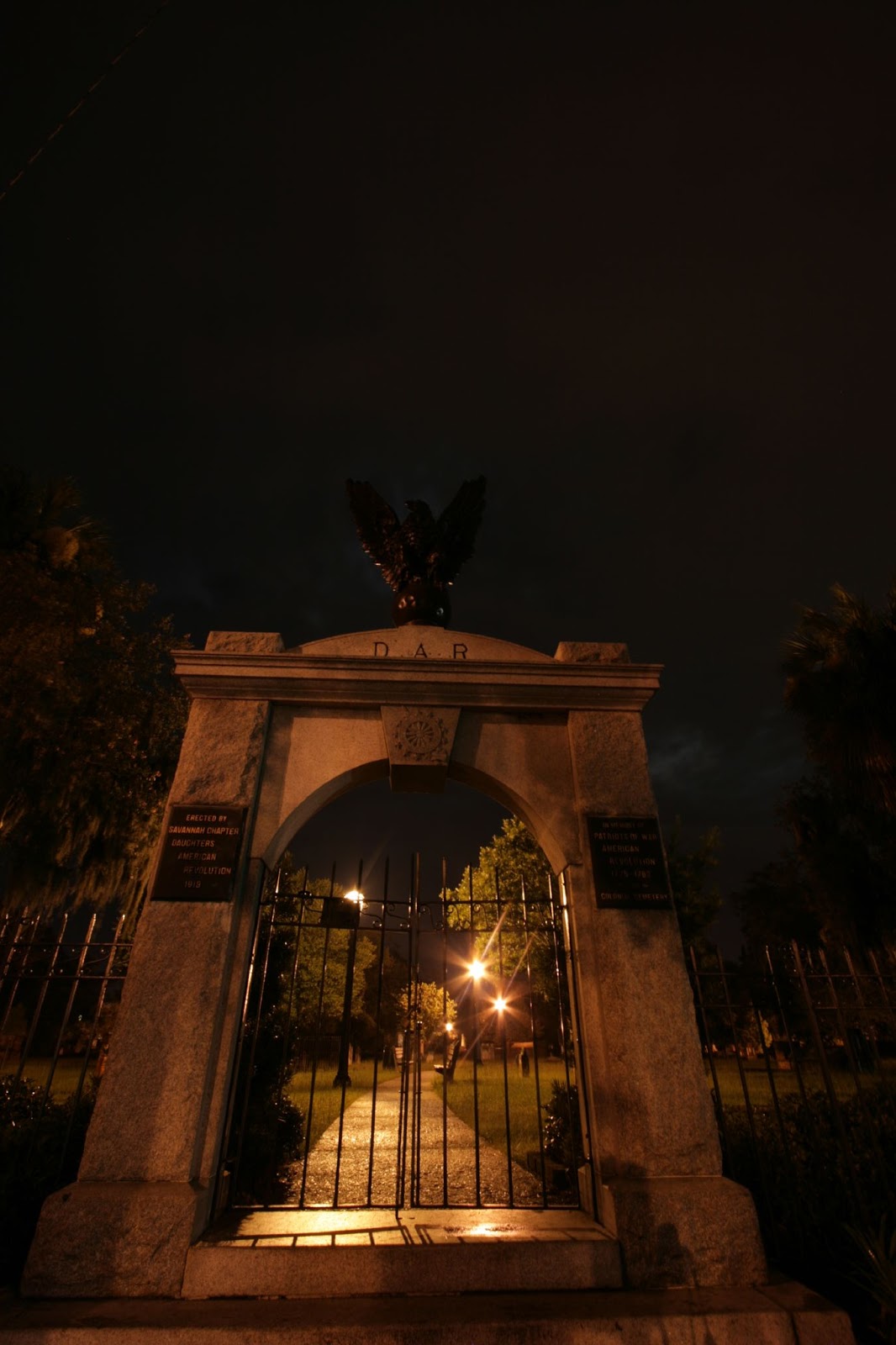
gates of Colonial Park Cemetery Savannah Georgia ghosts haunted
The entrance to Colonial Park Cemetery by Eric Fleming, 2007. Released under a Creative Commons License on Flickr.

Piechocinski’s history, The Old Burying Ground: Colonial Park Cemetery, Savannah, Georgia, 1750-1853, does make a statement about ghosts within Colonial Park: “There are no documented ghosts associated with Colonial Cemetery. Perhaps all the moving and removing of bodies thoroughly disoriented them, and they remain safely interred.” In 2000, a year after her book was released, Piechocinski made a disturbing discovery in the cemetery. She discovered the remains of a bound goat with its throat slashed. Not far away the goat’s heart was found on a piece of aluminum foil with a coconut and burned candle. It’s unknown if this was the remains of a religious ceremony or a gruesome prank. Nonetheless, perhaps the souls of the dead are not as safely interred as Piechocinski believes. Since the writing of her book, quite a bit has been written about the spirits that still walk here.

In 2010, I wrote about a video that was taken by a tourist in the cemetery. The video, taken on 1 December 2008, shows what appears to be a small child and another figure. The child is seen running in the background and then the figures appear to possibly fly up into a tree then come down a moment later. Investigation by a film special effects crew hired by Cleveland, Ohio news station, WJW Fox News 8 (see their story here), determined that the video is not a hoax and the ghostly figures are inconclusive.

Personally, I would have to side with the special effects crew. Yes, the figures are strange, but the young man with the video camera did not investigate the figures any more closely, especially after something fell out of the tree. The video shows the cemetery is also full of people, so a small child running along is not that unusual. I’ve visited the park myself a few times and have noted the many palm trees. To me, the falling object at the end of the video appears to be a palm branch. However fake or real, this video does provide a good reason to discuss the ghosts of Colonial Park Cemetery.

If anything, this cemetery most certainly should be haunted. While it is not the first cemetery established in Savannah, it is the oldest extant cemetery. When the city was laid out in 1733 by General James Oglethorpe, the founder of the city and colony of Georgia, a burial ground was established in 1750 at a site between York, Bull, Oglethorpe, and Whitaker Streets, a location that is a few blocks west of Colonial Park. That cemetery was closed after only seventeen years of use and a cemetery was established at the site of Colonial Park. At the time, this location was outside the city’s walls. Eight years later, the cemetery ownership was given to Christ Church. The cemetery was expanded and opened for the burial of all Christians regardless of denomination. A wall was constructed to surround the cemetery in 1791.

Nearly a hundred years after the cemetery was first established in 1750, the city dedicated space on the newly acquired Springfield Plantation as Laurel Grove Cemetery and closed the South Broad Street Cemetery (as it was known) to burials. Families with members buried in the old cemetery were encouraged to re-inter their loved ones in Laurel Grove. According to records, some 600 burials were transferred to the new cemetery. Others were removed to the newly opened Evergreen-Bonaventure and the Catholic cemeteries as well. For many year, the old cemetery sat lifeless.

On Christmas Day 1864, General William Tecumseh Sherman sent a telegraph to President Abraham Lincoln stating, “I beg to present you as a Christmas gift the City of Savannah, with one hundred and fifty guns and plenty of ammunition, also about twenty-five thousand bales of cotton.” Union soldiers, weary from their destructive march across the state from Atlanta, needed a place for quarters within Savannah. The old cemetery grounds proved useful and horses were quartered here. Soldiers also took up residence in some of the old vaults and mausolea. Bored soldiers are noted to have altered some of the tombstones while other stones were moved from their original locations. After the soldiers left, the old cemetery lay neglected for almost 30 years when the city attempted to acquire the space from Christ Church.

Worried that the cemetery would be destroyed, Christ Church sued the city to prevent the sale, but acquiesced when the city assured the church that the cemetery would not be harmed. After some work to restore the cemetery, the site was opened as Colonial Park. In 1998, an archaeological team located some 10,000 grave sites within the cemetery using ground penetrating radar. Only about 600 of these graves are marked with monuments or tombstones.

Edward Malbone marker Colonial Park Cemetery Savannah Georgia ghosts haunted
The historic marker at the grave of artist Edward Malbone. Photo 2011, by Ebyabe, courtesy of Wikipedia.

In addition to the somewhat questionable 2008 ghost video, there are other reports of paranormal phenomena here. James Caskey of the Savannah Haunted History Tour in his book, Haunted Savannah, does provide one personal story. While conducting a tour in November of 2001, Caskey noticed that some of the people in his group had odd expressions on their faces while he talked just outside the cemetery. Turning around, he saw an odd mist near the grave of Edward Malbone which is located just off the main entry path into the cemetery and is perhaps 50-60 feet inside, if I remember correctly. This grave is particularly identifiable as it has a historical marker (one of many in the cemetery) next to it. This mist rose about five and a half feet off the ground and then dissipated.

Another tour guide and paranormal investigator, Tobias McGriff, writes in his 2012 Savannah Shadows: Tales from the Midnight Zombie Tour of the “Red Girl,” a red-hued young girl’s image that has been captured in photographs taken by ghost tour participants. She is often captured as she kneels at a grave though one intrepid boy saw and communicated with the red waif. As the tour group began to leave, the child inquired why the little girl was in the cemetery and said that the girl had asked him to remain moving the guide and others in the group to tears.

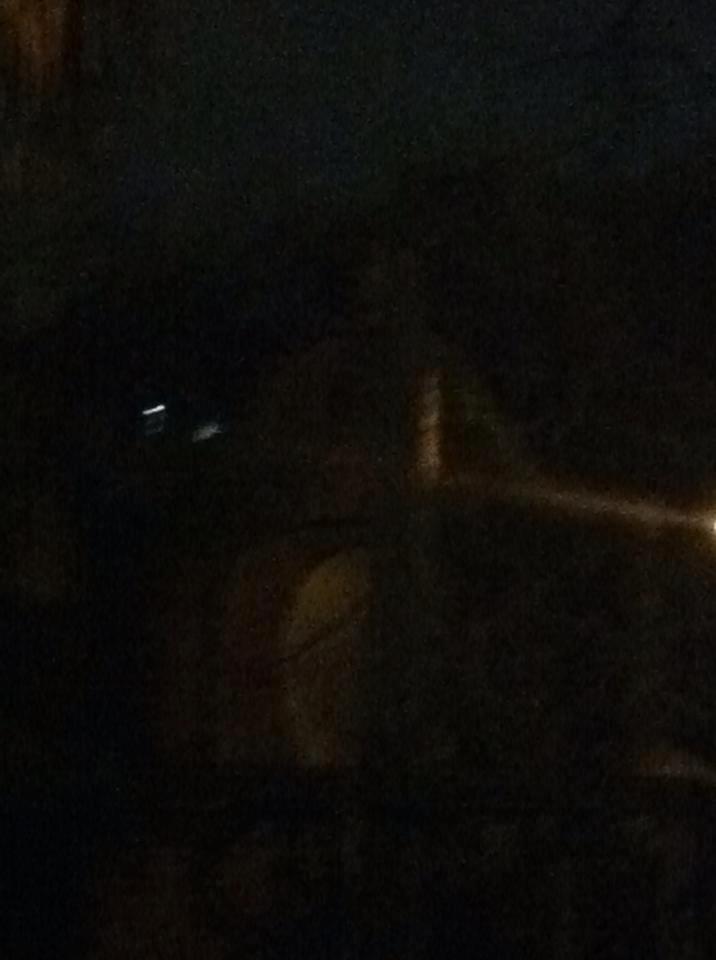
ghost photo Colonial Park Cemetery Savannah Georgia unedited
Kady Heard’s unedited photo, 2013. All rights reserved.
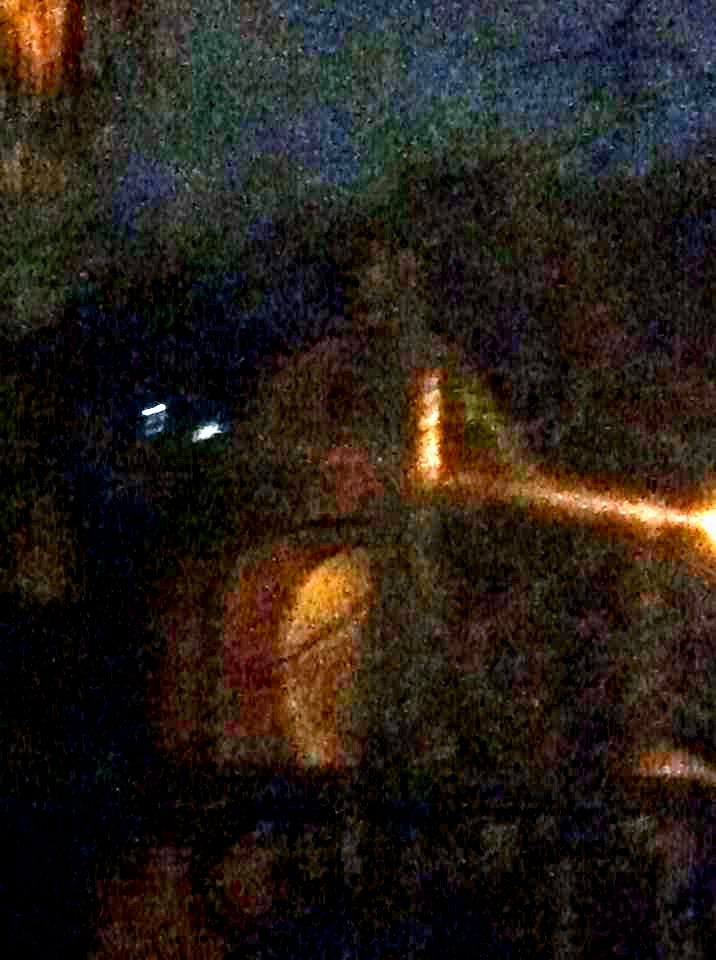
ghost photo Colonial Park Cemetery Savannah Georgia lightened
Kady Heard’s photo after I lightened it. All rights reserved.

Three close friends of mine have captured some intriguing images in and around the cemetery. In 2013, my friends Troy and Kady Heard were visiting Savannah on their honeymoon. An alumni of the Savannah College of Art and Design, Troy had worked as a ghost tour guide and was giving his wife an impromptu tour. Passing Colonial Park, Kady spotted an owl perched on one of the crypts. She snapped a picture on her smartphone and posted it on Facebook. When I saw the picture I immediately wondered if she had taken a creepy picture of her husband lost in the shadows, though after talking to Troy, I discovered the picture was looking into the locked cemetery. Apparently, the owl is the roundish figure in the lower center of the photo, but what is particularly odd is the human shaped figure above that. I figure that the very bright lines are reflections from the iron fence. I can’t say that this photograph is conclusive evidence of anything, though it is intriguing that it may show something.

ghost photo Colonial Park Cemetery Savannah Georgia
Celeste Warlick’s photograph of the playground, 2012. All rights reserved.

Another friend of mine snapped another intriguing photo at Colonial Park. While passing the playground located at the back of the cemetery on East Perry Lane, Celeste Warlick snapped this photograph in 2012. You can see the playground equipment blurred behind a flurry of orbs. While the orbs themselves are often debated as they can be caused by dust, water vapor, or insects, there are three brightly colored orbs in this photograph. According to an internet meme, orange orbs indicate a healing, protective energy. Perhaps that is what appears here. Perhaps the air is full of water vapor or dust or perhaps Celeste captured another piece of evidence of the living energy that still surrounds Colonial Park Cemetery.

Sources

  • Caskey, James. Haunted Savannah: The Official Guidebook to the Savannah Haunted History Tour, 2008. Savannah, GA: Bonaventure Books, 2008.
  • “Fox 8 Exclusive: Video Proof of Afterlife?” WJW Fox 8 News. 15 November 2010.
  • McGriff, Tobias. Savannah Shadows: Tales from the Midnight Zombie Tour. Savannah, GA: Blue Orb Publishing, 2012.
  • Piechocinski, Elizabeth Carpenter. The Old Burying Ground: Colonial Park Cemetery, Savannah, Georgia, 1750-1853. Savannah, GA: Oglethorpe Press, 1999.
  • Stratford, Suzanne. “Do you believe? Experts analyze teen’s ghost video.” WJW Fox 8 News. 23 February 2011.

” As the Georgia moon sends ghastly shafts”—Albany, Georgia

N.B. This article was edited and revised 20 May 2020.

In searching through some old Alabama newspapers, I stumbled across this fascinating article from Albany, Georgia. Located in southwest Georgia, Albany ranks as the 8th largest city in the state, though its distance from major interstates has limited its growth. It should also be noted that a non-Georgian can easily be  identified by how they pronounce the name Albany. Most Georgian’s know that the town’s name is pronounced as AWL-benny rather than ALL-bany.

In addition to being a damn good ghost story, this article provides fascinating historical details. The article begins by calling on Sir Arthur Conan Doyle, the great Scottish writer and physician who created the great Sherlock Holmes. Sir Conan Doyle had a fascination with spiritualism and was active in the British spiritualism movement. This article does comment somewhat on the spiritual movement that was sweeping America at this time, particularly with its description of locals gathering to hear these spirit voices.

birds eye view of Albany Georgia 1885
A birds-eye view of Albany, Georgia, 1885.

It should be noted that this article is a product of the Jim Crow South. I do not personally condone this racist ideals or language that permeate this article.

For a glimpse at the lives of African-Americans in Albany at this time, Wikipedia provides a summary of African-American writer W.E.B. Du Bois’s  1903 description of the city is his book, The Souls of Black Folk:

He described it as a typical African-American majority-populated rural town in the Deep South. Du Bois discussed the culture, agribusiness, and economy of the region. Du Bois described Albany as a small town where local sharecroppers lived. Much of the soil had been depleted of nutrients because of intensive cotton cultivation, and people found it hard to make a living. Once a bustling small city with an economy dependent on cotton, it had numerous cotton gins. The planters were dependent on slave labor and Albany had declined steadily in the late 19th century. After the disruption of the Civil War and poor economy of the late nineteenth century, the local agricultural economy suffered. Du Bois wrote that Dougherty County had many decaying one-room slave cabins and unfenced fields. Despite the problems, local folklore, customs, and culture made Albany a notable small city in the South.

The Anniston Star
Anniston, Alabama

Page 1
9 June 1922

Page Sir Conan, Georgia City is Haunt of Ghost

Spirit of a Hanged Negro is Making Folk Uncomfortable in Albany, Ga.

ALBANY, Ga., June 9.—(United Press)—Call for Sir Conan Doyle! Call for Mr. Doyle!

Albany has a “spirit” he may commune with to his heart’s content, if he isn’t too high toned a spiritualist to attend the same séance with the ghost of a hanged negro.

Z. T. Pate and his family live in what used to be the Warden’s quarters of an old abandoned jail here. The rear of the building, where years ago, prisoners waited their fate, is now but a shell, but the ancient warden’s quarter’s [sic] make a comfortable home for the Pates.

Recently while in the rear of his house, Pate said he heard a voice—a negro’s voice—speak clear and distinctly out of nowhere—“Boss, dis rope aroun’ mah neck shore do hurt.”

Pate was startled, but interested. He told others about it but got the usual answer—a skeptical laugh.

Then he invited in a few of his neighbors. They sat in the back room and listened. Nothing happened until they became quiet, the [sic] again the voice from nowhere saluted them.

Now it’s one of Albany’s chief places of interest.

Each night as the Georgia moon sends ghastly shafts throughout the broken windows of the old jail a party of Albanites gather in the Pate’s home and listen. They have not been disappointed yet, Pate says.

The voices will not answer a question. It will ask them and comment upon things said in the room. A person, in a whisper, will say something as a test to one sitting by him. Although no other person in the room can hear what has been said, the strange voice comments intelligently upon what the whisperer has told or asked his neighbor.

The building has been examined throughout for wires and none have been found. Nothing that could be used for a radio receiving set is in the building. Tests have been made to see if a ventriloquist is responsible and the theory abandoned.

Recently two gentlemen of color were taken in the ghost chamber.

“Who is them niggers, Mr. Pate?” the voice demanded.

With terror gripping the negroes, [sic] Pate answered giving their names. The building seemed about to collapse according to those present. Sounds of breaking woodwork of falling furniture and breaking glass were heard. The negro visitors lost only a few seconds in decamping.

There are many here who laugh at Pate’s ghost as it is called but none have solved the mystery of the strange voice yet, and they still come nightly to “listen in.”

A search for other newspaper accounts and the exact location of this jail has been fruitless.

Sources

  • Albany, Georgia. Wikipedia, the Free Encyclopedia. Accessed 6 December 2015.
  • “Page Sir Conan, Georgia City is Haunt of Ghost.” Anniston Star. 9 June 1922. Page 1.

A Southern Feast of All Souls—Feast Wrap Up

The feast is done, the table has been cleared, the guests have left, the spirits have quietly returned to their rest, and the veil between our world and the next has been restored. This season has been great for articles about the haunted South so, I’m wrapping up this Southern Feast of All Souls with a look at some of the new (to me) haunted places that were covered in the news media.

Colby Building
191 North Foster Street
Dothan, Alabama

An investigator from Circle City Ghost Hunters said of the Colby Building in downtown Dothan, “Somebody once upon a time put their heart and soul in the building.” Perhaps that soul is still here. According to an October 29th article in the Dothan Eagle, this group investigated the building after numerous reports of paranormal activity in the building surfaced.

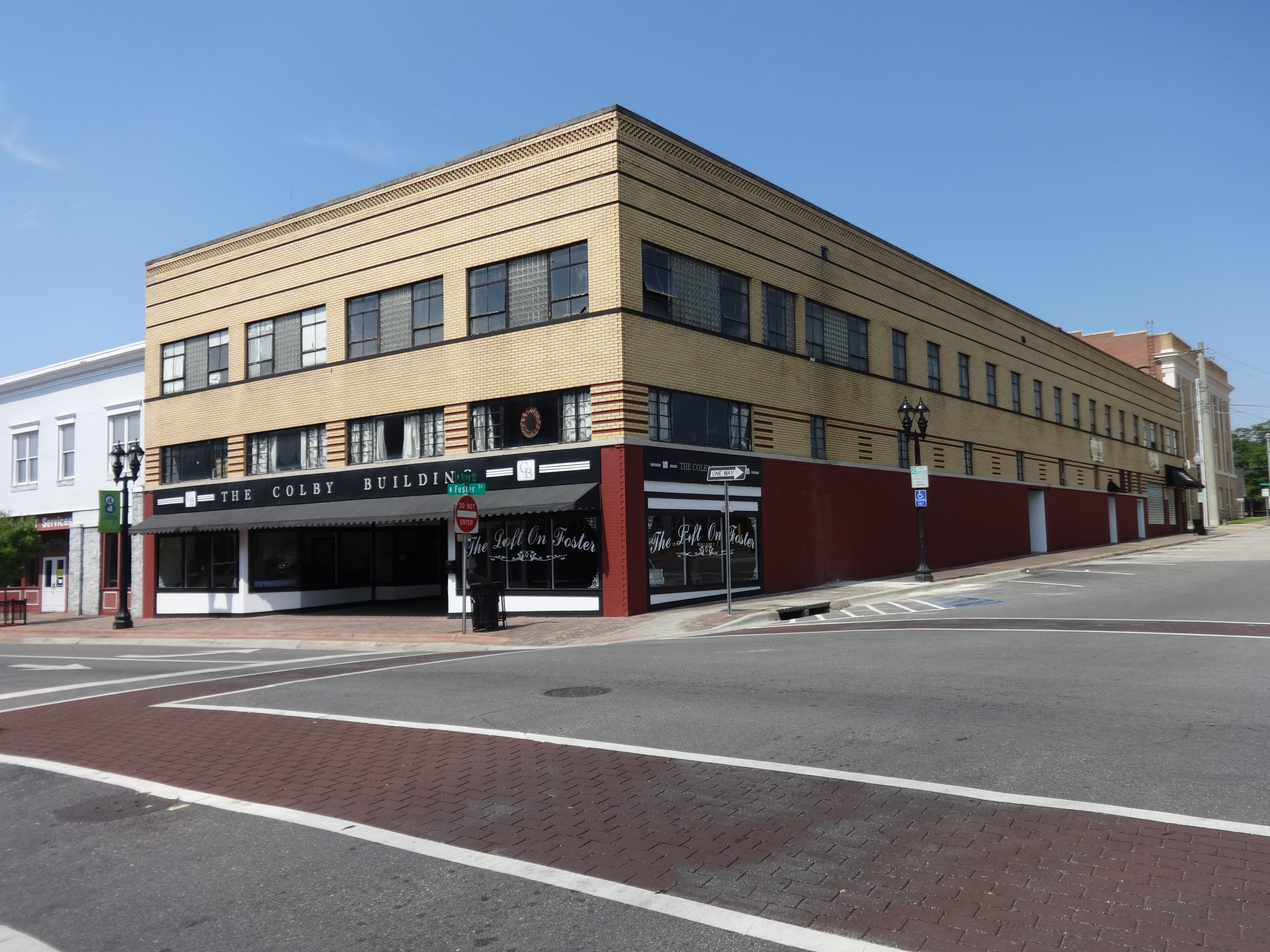
Colby Building Dothan Alabama ghosts haunted
The Colby Building, 2015, by Michael Rivera. Courtesy of Wikipedia.

While working on my recent book about haunted Alabama, I had a heck of a time trying to find anything on the Dothan area. As the seventh largest city in the state by population, there should be more information on hauntings in the area, sadly there was nothing reliable. Therefore, I was rather excited to see this article appear. The Colby Building was built in 1938 as a J.C. Penney’s Department Store and has since hosted a number of businesses. The building was redeveloped by a private/public partnership in 2008 and currently houses two restaurants, Colby’s on North Foster Street and Bella’s in the back of the building on West Troy Street.

Employees and guests have had experiences in the building including things moving on their own and seeing figures. Others have had their names called and the employees have nicknamed the spirit “’Rachel’ because all kinds of crazy stuff happened.” (I’m presuming this a reference to the television show Friends.) The owner of the restaurants was delighted to host an investigation when Circle City Ghost Hunters inquired about investigating there. The article notes that the activity is explained by a story involving the death of a young woman on the building’s third floor in the 1950s.

N.B. As of 2019, it appears that Colby’s has closed, though Bella’s remains open. 

Sources

Suntan Arts Center (Don Vicente Building)
3300 Gulf Boulevard
St. Pete Beach, Florida

Adjoining the Don CeSar Beach Resort, a palatial pink Jazz Age dream, is the Don Vicente Building which was built just prior to the grand hotel to serve as offices during the construction. Over the years, the building has seen many incarnations serving as offices for the hotel, a bank, and even a firehouse. The building has housed the 50 year old Suntan Arts Center for many years. The center provides classes and support for the local arts community.

The center hosted a ghost tour this year highlighting the paranormal activity that has been experienced in the building. For many years people here have encountered the spirit of a man in a white suit. As this building did serve as an office for Thomas Rowe, the hotel’s founder, this spirit has been identified as him. During an investigation of the building in 2013 by SPIRITS of St. Petersburg, the group got a response when Rowe’s name was mentioned. Besides Mr. Rowe’s white-suited spirit there may be other spirits here as well.

Sources

  • “Self-guided ghost tour departs from Suntan Arts Center.” TBN Weekly. 28 September 2015.
  • SPIRITS of St. Petersburg Paranormal Investigation Group. “Report for Suntan Arts Center.” Accessed 8 November 2015.

Porter Hall
Mercer University
Macon, Georgia

Porter Hall, a residence hall on the campus of Mercer University, one of the oldest private universities in Georgia, possibly has something mysterious residing on its fourth floor. One student reported that she “heard things like chairs being dragged across the pine, like a hard pine floor.” The fourth floor is not accessible to students and used for storage. Reportedly, only the dorm’s resident advisor has access. When students complain of noise from that floor, the resident advisor will check it out and find the floor empty of living beings.

Sources

Westover Terrace (private)
905 West Main Street
Richmond, Kentucky

When the current owners of Westover Terrace began restoration on the house after they acquired it in 1995, the house was severely dilapidated and vandals had defaced parts of the interior. A pentagram had been painted upstairs, walls and windows had been smashed, and the mantelpieces and radiators had been stolen. Local kids occasionally prowled the creepy house in search of ghosts in this former funeral home. The new owners did not realize they acquired ghosts with this magnificent 1881 home.

As work progressed, the owners and contractors began to have odd experiences including loud crashes and bangs that sounded like sledge hammers being used and heavy furniture being moved. The voice of a little girl was heard asking workers what they were doing and warning them on occasion. While doing repair work on a staircase, one particular board was removed several times. After the owner used a hydraulic nail gun to attach the it, the board disappeared entirely. When the owners finally moved into the home in 2005, the activity seemed to quiet down. Evidently, the ghosts are pleased with the renovations. This is a private home, please respect the owners’ privacy and observe the house from the street.

Sources

Green Light Bridge
Green Light Road
Winnsboro, Louisiana

An article about Louisiana hauntings from the Shreveport Times highlighted this very interesting location near Winnsboro in Franklin Parish in the northeast portion of the state. The origin of the road’s odd name has been lost to history, but is possibly related to the paranormal green light that is supposed to emanate from underneath the bridge and along the banks of the stream here. The article does not name the creek, but after looking at Google maps, it seems that the road only crosses one stream, Turkey Creek, in its course from LA-15 to its termination at Dummy Line Road.

The possible reasons for the odd green light are varied. A church once existed on one side of the creek and sometime in the mid-20th century a man was hung from a tree in front of the church. A fatal car accident that occurred here may be related to the activity as well. A woman lost her life when her car crashed into a tree. There is also speculation that the woman was frightened by the mysterious green light.

Sources

  • “’Haunted’ Louisiana: Tales of Terror from Shreveport and beyond.” Shreveport Times. 30 September 2015.

Glen Burnie Regional Library
1010 Eastway
Glen Burnie, Maryland

Librarians at the Glen Burnie Regional Library have been spooked by something within this 1969 library for many years. Odd sounds have been heard by staff when they have closed the building at night while books have been pushed to the floor by unseen hands. Staff called in the Maryland Ghost Trackers to investigate. During the investigation, the investigators made contact with a number of male spirits who are apparently hanging around and enjoy making a bit of trouble now and then.

Sources

Ole Tavern on George Street
416 George Street
Jackson, Mississippi

There are several ghosts still patronizing the Ole Tavern on George Street according to a Halloween article from Jackson, Mississippi news station, WAPT. The article highlights a recent investigation of this establishment by the Mississippi Paranormal Research Institute. Employees of the popular eatery have had several eerie encounters with a few possible spirits here.

One employee saw a woman sitting at the bar one morning as he opened up. He had just removed the padlock from the door when he saw the woman. Realizing that no one was in the building, the employee returned to his car until someone else arrived. This spirit is believed to be the spirit of a prostitute who once worked in the building and committed suicide here in the 1970s. The investigation produced evidence that this woman may remain in the building with some other spirits.

Sources

  • “Ghost hunters seek answers from ‘Bitter Hooker.’” 31 October 2015.

A Southern Feast of All Souls—Newsworthy Souls

A collection of hauntings from recent news.

Marty’s Blues Café
(formerly Brandi’s Blues Cafe)
424 West Beacon Street
Philadelphia, Mississippi

N.B. This location has been covered in more detail in “Death on the move–Philadelphia, Mississippi.

The chef at Brandi’s Blues Café was working in the kitchen early one recent morning. Startled by a loud bang he continued working until he heard water running in the sink. He walked over, turned the sink off and returned to his work. Glancing up he saw a figure standing near the kitchen door. It was “about 6 ft. It had a little pot belly. I saw it for three or four seconds.” Thinking it was a co-worker, the chef returned to work. After discovering he was alone in the building he began to hear footsteps and he left the building until his coworkers showed up.

After researching the history of the building and the area, it was discovered that a man was executed nearby in the 1940s. Paranormal investigators brought in to investigate did pick up an EVP response when they spoke the name of the man executed.

Sources

  • Gater, Harold. “Is this Mississippi blues café haunted?” The Clarion-Ledger. 24 September 2015.
  • Jennings, Lindsey. “Haunted Philadelphia Café Investigated.” 24 September 2015.

McRaven House
1445 Harrison Avenue
Vicksburg, Mississippi

The new owners of the McRaven House, often described as the most haunted house in the state, have been very busy restoring the historic house and mingling with the home’s famous ghosts. In one interaction, the new owners captured an EVP of a female’s voice saying, “That’s a funny old clock.” The house has a number ghosts covering nearly all periods of the home’s history from the late 18th century to the present day. McRaven is now open to visitors for history and haunted history tours.

McRaven House, 2016, by Zamburak. Courtesy of Wikipedia.

Sources

  • Norris, Alana. “McRaven House opens its doors Friday.” Vicksburg Post. 28 September 2015.

Old Chatham County Jail
145 Montgomery Street
Savannah, Georgia

The Savannah Ghost Research Society has recently deemed the Old Chatham County Jail to be “the most haunted place” in this paranormally active city. Ryan Dunn, founder and head of the society told the Savannah Morning News, “We came in with a lot of equipment and pretty much investigated the place. We caught a lot with audio. We did capture a couple with thermal imaging and thermal cameras.” Dunn notes that the group captured more audio evidence here than they have captured at any other investigation.

The old jail is a formidable modern building that stands out from the historic buildings which surround it within the venerable Savannah Historic District. In use as a detention facility until 1989, the building has since been used for storage of archival records and, for Halloween, the building is being used for a haunted house called “Panic in the Pen,” and hosting paranormal tours as a fundraiser by the Chatham County Sheriff’s Office. The sheriff called in paranormal investigators to help add some real life terror to this already terrifying building.

Employees in the old facility have noted paranormal activity here since the building’s retirement as a correctional facility. One of the sheriff’s deputies remarked that he remembers hearing doors slam and footsteps in the building at night.

Sources

  • Hoagland, Karen. “Old Chatham County Jail investigated for paranormal activity.” Savannah Morning News. 13 September 2015.
  • Ray, Brittini. “Investigators: Old Chatham County jail ‘’most haunted place in Savannah.” Savannah Morning News. 1 October 2015.

Spirits of the Camp Creek Disaster—Georgia

Once, McDonough, Georgia was a quiet hamlet. It has now been enveloped by Atlanta’s sprawl and is not so quiet any longer. About thirty miles from downtown Atlanta, McDonough was the scene of the infamous Camp Creek Railroad disaster which is sometimes noted as “Georgia’s Titanic.”

Camp Creek shortly after the train crash, 1900. Courtesy of Wikipedia.

Rain had been falling for most of the month of June 1900 and it was beginning to affect the railroads. On the evening of June 23rd, Old Number 7, carrying 48 souls, was bound for Atlanta, but waited at the station in McDonough for another train to arrive from Columbus. When word reached the station that that train was stalled by a washed out bridge, the Old Number 7 was told to book it towards Atlanta. Before pulling out, the train’s engineer remarked, “We’ll either be having breakfast in Atlanta or in Hell.”

Henry County Courthouse and the McDonough Square. It was here that the bodies of the victims were laid out. Photo 2007, by John Trainor, courtesy of Wikipedia.

The Red Ball Freight sped ahead of the Old Number 7 and cleared the trestle over Camp Creek, a creek that’s usually mild-mannered, though it was swollen this night. The engineer of the No. 7 never could have seen the portion of the trestle that was now missing, having just been washed away and the train plunged into the raging waters of the creek. While some of those aboard died in the initial impact, some drowned and others died in the ensuing fire. Of the 48 souls aboard, only 9 survived. Rescuers pulled the bodies from the wreckage and were laid out in the McDonough town square until they could be taken to one of the two funeral homes, B. B. Carmichael’s or A. F. Bunn & Company. The nine survivors were put up in The Globe Hotel on the square.

As the citizens of McDonough recovered, the spirits from this horrendous disaster have remained. Spirit activity has been reported on the McDONOUGH SQUARE, possibly related to the bodies laid out there. The DUNN HOUSE/GLOBE HOTEL(20 Jonesboro Street), where the survivors recovered was moved just off the square, and now houses businesses. A weeping woman has been seen and heard in the building; someone possibly related to this accident. The building that once housed B. B. Carmichael’s Funeral Home, which handled many of the bodies, is now THE SEASONS BISTRO (41 Griffin Street). While it is regularly home to diners, there are also spirits in this building. A pair of diners in the restaurant saw a man preparing the body of a female in the area that now serves as the women’s restroom. When one of the diners described the man, the restaurant’s owner was shocked to realize that the man was B. B. Carmichael.

Sources

  • Beck, Carolyn F. “McDonough.” New Georgia Encyclopedia. 20 June 2013.
  • Walker, Caprice and Dan Brooks. Haunted Memories of McDonough, Georgia. McDonough, GA: Bell, Book and Candle Used Book Store, 2006.
  • Wells, Jeffrey C. In Atlanta or in Hell: The Camp Creek Train Crash of 1900. Charleston, SC: History Press, 2009.