Alabama’s Haunted Thirteen

Thirteen years ago, I started this blog and early on, I did a series of articles highlighting places in each of the thirteen states I cover. Those early articles have mostly been updated and separated into their own articles. Please enjoy this updated version of those early articles.

Bladon Springs Cemetery
Bladon Springs Road
Bladon Springs


A Haunted Southern Book of Days–9 January

This article is a part of an occasional blog series highlighting Southern hauntings or high strangeness associated with specific days. For a complete listing, see “A Haunted Southern Book of Days.”


Located near the Tombigbee River, this cemetery and its well-known ghost story recall another disaster that occurred here. In 1913 as the steamboat James T. Staples neared the bend in the river near here, it was rocked by an explosion sending twenty-six souls and the ship to the bottom of the river. Shrouded in mystery, however, are the events leading up to the sinking.

Bladon Springs Cemetery Alabama
Gates of Bladon Springs Cemetery, by Judyanne Waters, 2015. Courtesy of Find-A-Grave.

The ship’s captain, Norman Staples—the ship was named after his father—had lost the ship to creditors after experiencing a financial reversal in December 1912. Depressed with the loss of his ship, Norman Staples committed suicide just after the New Year. A few days later, the crew of the ship began to see the shadowy form of the ship’s former owner in the boiler room. Legend says that that crew quit and had to be replaced before the ship steamed north. Just prior to the ship’s explosion, the rats aboard reportedly began to flee the doomed ship.

Norman Staples was laid to rest in this cemetery along with his wife and three of their children, none of whom reached the age of six. Norman’s sad spirit is said to patrol the grounds of this cemetery, his eyes never averting from the river where his beloved ship went down.

Sources

  • Ward, Rufus. “Ask Rufus: Ghosts of the Tombigbee.” The Dispatch (Columbus, MS). 25 October 2014.
  • Hauck, Dennis William. Haunted Places: The National Directory. NYC: Penguin, 2002.
  • Higdon, David and Brett J. Talley. Haunted Alabama Black Belt. Charleston, SC: History Press, 2013.


D. E. Jackson Memorial Hospital
30338 Lester Road
Lester

If you hear screams emanating from this old, defunct Limestone County medical facility, they may not be ghosts. Over the past few years, this hospital has been transformed into a charity haunted house attraction at Halloween. According to local newspapers, this facility opened in the 1940s and served the Lester area until the 1990s. It was used as a drug rehab facility until it closed for good sometime thereafter. Prior to its closure, former staff whispered about paranormal activity. Volunteers working in the haunted house have reported hearing voices and seeing a locked door open on its own accord. Additionally, a lady in white has been spotted in and around the building.

Sources

  • Hollman, Holly. “Haunted hospital a prescription for frightening fun.” Decatur Daily. 1 October 2010.
  • Nicole, Ashleigh. “Northern Alabama’s Haunted Attraction: Lester Haunted Hospital.” Newsbreak. 24 September 2023.
  • Scripps, Lora. “Haunted hospital ready to scare you out of your wits.” News-Courier (Athens, AL). 22 September 2011.


George O. Baker House (private)
600 Dallas Avenue
Selma

As the Battle of Selma raged outside the George O. Baker House in April of 1865, seventeen women and children huddled within this 1854 Italianate home. Two gravely wounded soldiers took shelter here, and both were cared for despite being from opposite sides. The Confederate soldier was taken to the nearby hospital while the Union soldier languished in the hall. According to the home’s owner, “he was reported to be a kind one as some of the children here received peanuts from him just before he expired.” The blue-clad soldier died on the floor of the hall just under the staircase. His blood stains are still visible.

Over the years, many types of paranormal activity have been reported ranging from shadow figures to orbs to footsteps. One young man visiting the house some years ago, later told his mother he didn’t want to return because the “real old gentleman in the funny suit” had frightened him. Authors Higdon and Talley note that the house seems overwhelmed by a sense of sadness. The house has been investigated twice by two different paranormal teams and is featured on the Alabama Ghost Trail series on YouTube with a video of the owner speaking about the home’s ghost. Please respect the owners and residents of this private home.

Sources

  • Alabama Ghost Trail. “Baker Home.” YouTube. 19 July 2009.
  • Higdon, David and Brett J. Talley. Haunted Alabama Black Belt. Charleston, SC: History Press, 2013.


Kenan’s Mill
188 Dallas County Road 236
Selma

While investigating Kenan’s Mill with the Alabama Paranormal Association, author and investigator Dale Langella felt something touch her in the charcoal kiln. “That never happens to me. I never get so freaked out like that and scream. I’ve been grabbed by spirits before, but I guess I just wasn’t expecting that,” she told a reporter from the Selma Times-Journal. The spirits here seem to enjoy physically touching visitors. In her book, Haunted Alabama Battlefields, Langella describes the myriad ways that visitors have been touched.

One young lady visiting the mill one evening felt something grab her leg and heard a male voice saying, “Help me.” Looking down, the young lady was shocked to see a wounded Confederate soldier clutching her leg. Other visitors have felt a burning sensation on their buttocks or felt something tug at their clothing; all this in addition to apparitions and odd flashes of light that sometimes appear throughout the site. The Selma Times-Journal quotes Langella as remarking that the site is “highly active.”

Built in the 1860s, the mill remained in the Kenan family until it was donated to the Selma-Dallas County Historic Preservation Society in 1997. This site was quite active during the Civil War, serving as a collection point for Confederate forces throughout central Alabama; as a result, the grounds were used as a field hospital. After the war, the mill served many farmers in the local area. The mill is now operated as a museum.

Sources

  • Johnson, Ashley. “Paranormal society finds activity in Selma.” Selma Times-Journal. 29 August 2012.
  • Langella, Dale. Haunted Alabama Battlefields. Charleston, SC: History Press, 2013.


Kenworthy Hall (Carlisle-Martin House) (private)
AL 14
Marion

Among the most unique Southern plantation homes, Kenworthy Hall was built for cotton planter and factor Edward Kenworthy Carlisle. The home was once the seat of a 440-acre estate and plays host to a classic Alabama ghost tale. Designed by noted British-American architect Richard Upjohn, the house is modeled on an Italian villa and features a unique square tower that figures into the home’s ghost story. As one of Upjohn’s masterpieces, the house was named a National Historic Landmark in 2004.

Kenworthy Hall Marion Alabama
Kenworthy Hall with its campanile-like tower. Undated photo taken for the Historic American Building Survey (HABS). Courtesy of the Library of Congress, Prints and Photographs Division.

Kathryn Tucker Windham’s story of Kenworthy Hall centers on Edward Carlisle’s daughter, Anne. The young woman enjoyed spending time in the room at the top of the home’s tower. As young men across the South were signed up or called for military duty in the days leading to the Civil War, Anne’s beau was one of the first young men in the area to sign up.

He promised his lady that his slave would carry news to her and would carry a red flag if he had been killed. Keeping vigil in the tower room, Anne spotted the slave returning one afternoon bearing a red flag. She uttered a cry and threw herself over the railing of the staircase. Tradition speaks of that anguished cry still being heard on moonlit nights. Please respect the owners and residents of this private home.

Sources

  • Higdon, David and Brett J. Talley. Haunted Alabama Black Belt. Charleston, SC: History Press, 2013.
  • Mellown, Robert & Robert Gamble. National Register of Historic Places nomination form for Kenworthy Hall. January 2003.
  • Windham, Kathryn Tucker and Margaret Gillis Figh. 13 Alabama Ghosts and Jeffrey. Tuscaloosa, AL: University of Alabama, 1969.


McIntire-Bennett House (private)
1105 Sycamore Street
Decatur

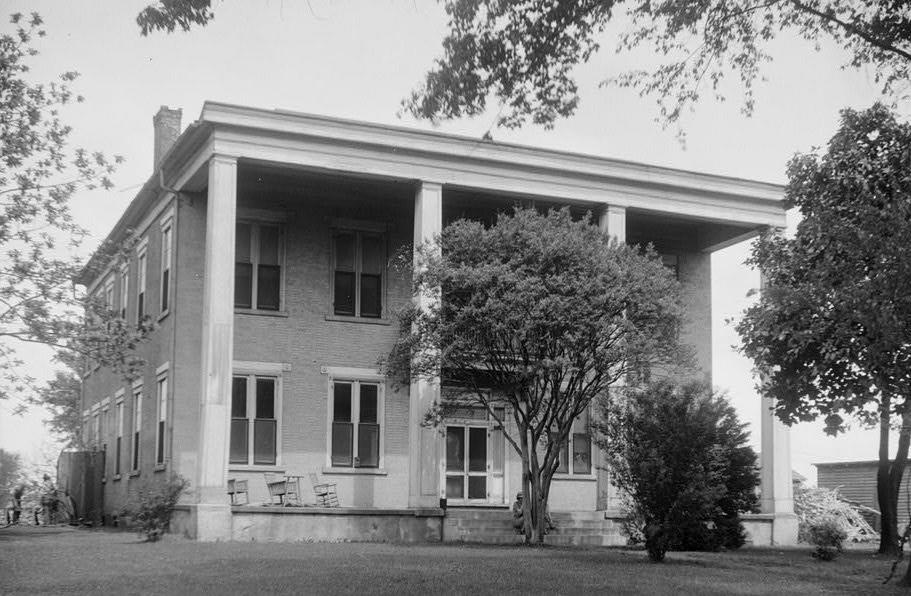
One of the most storied houses in Alabama, the McIntire-Bennett House played a prominent part in state history throughout the 19th century. Completed around 1836 on a bluff overlooking the Tennessee River, the house’s strategic location brought it to prominence during the Civil War. As control of the city passed between Confederate and Union forces, the house served as headquarters for various generals, which is perhaps the reason why it was one of a handful of buildings left standing in town after the war. Following the war, the house was purchased by Joseph Hinds who served as U.S. Consul General to Brazil. Here, Hinds’ daughter Grace was born in 1879. She would marry British Lord Curzon and become a well-known socialite in the Gilded Age.
McIntire-Bennett House Decatur Alabama
McIntire-Bennett House, 1976. Photo by Alex Bush for the Historic American Building Survey (HABS). Courtesy of the Library of Congress, Prints and Photographs Division.

Legend holds that while the house was under Union control, it was receiving considerable fire from snipers located in the Old State Bank (see my entry on the bank here) building downtown. When one of the soldiers was shot and killed, his comrades had no way of disposing of the body. The soldiers cut a hole in the floor of the parlor and buried their friend under the house. The home’s current owner has been under the house, and his wife told the local paper, “There is dirt under there, and a hole cut out.”

The bedroom directly above that parlor is known as the “Ghost Room,” and it is here that a female wraith is said to appear to those in the room alone. She is supposed to lead people to the parlor and stand over the grave of the unfortunate soldier. While the home’s current owners have not encountered the female entity, they note that the room is apparently always much cooler than the rest of the house. The house remains a private residence, please respect the privacy of the owners and residents.

Sources

  • Gamble, Robert. National Register of Historic Places nomination form for Rhea-McIntire House. 11 June 1984.
  • Godbey, Catherine. “Pre-Civil War era home features ghost room, tales of Union soldier buried there.” Decatur Daily. 4 December 2011.
  • Norman, Michael and Beth Scott. Historic Haunted America. NYC: TOR, 1995.


Old Morgan County Courthouse
24 Courthouse Square
Somerville

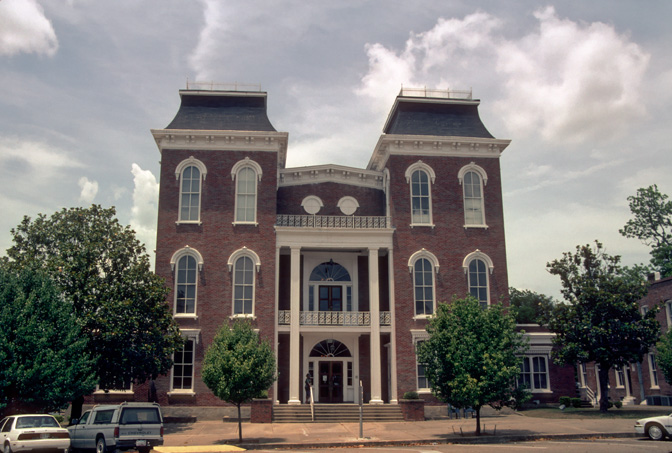
The oldest courthouse remaining in the state, this courthouse was built in 1837 to serve Morgan County. When the county seat moved to the bustling town of Decatur in 1891, the records were removed by an armed guard under cover of night to prevent locals from sabotaging the move.

Old Morgan County Courthouse Somerville Alabama
Old Morgan County Courthouse, by Chris Pruitt, 2012. Courtesy of Wikipedia.

In 2007 this historic courthouse, now a museum and community center, was investigated by the local Somerville Paranormal Apparition Team (SPAT). Among the evidence discovered in this Federal-style building were a handful of EVPs.

Sources

  • Floyd, W. Warner. National Register of Historic Places nomination form for Somerville Courthouse. No Date.
  • Huggins, Paul. “Somerville’s ghost hunters.” Decatur Daily. 20 August 2007.


Phenix City Riverwalk
By the Chattahoochee River
Phenix City

The banks of the Chattahoochee River here have seen human activity for centuries. Evidence discovered in this area indicates that Native American villages had thrived along this river for centuries before white occupation. In the early 19th century, the eastern bank here saw the development of Columbus, Georgia, which would be incorporated in 1828, while this side of the river remained Indian territory inhabited mostly by Muscogee Creek and Yuchi people with a smattering of white pioneers.

Historic Marker Phenix City Riverwalk Phenix City Alabama
Historic Marker on the Phenix City Riverwalk, by Mark Hilton, 2013. Courtesy of the Historic Marker Database.

A historical marker along the Riverwalk commemorates the execution of six Muscogee and Yuchi men who were accused of attacking the village of Roanoke in Stewart County, Georgia. Roanoke was mostly destroyed, several white settlers were killed, and the six accused men were hung here for the attack in November of 1836.

This section of the river saw much development as the end of the navigable portion of the Chattahoochee River. Cotton and other goods from nearby plantations were loaded here on ships bound for the Gulf of Mexico, and Wilson’s Raiders swept this area in April of 1865, towards the end of the Civil War.

The Chattahoochee Riverwalk on both sides of the river apparently has a variety of activity. On this side of the river, walkers and bikers have been followed by shadowy spirits that have caused some bikers to have accidents. As this section of the river has seen so much historical activity, it is difficult to determine the identity of the spirits.

Sources

  • Serafin, Faith. Haunted Columbus, Georgia: Phantoms of the Fountain City. Charleston, SC: History Press, 2012.


Rowand-Johnson Hall
Campus of the University of Alabama
Tuscaloosa

Hurrying towards a class in Rowand-Johnson Hall some years ago, a student passed an elegant older woman on the sidewalk. Being a proper Southerner, he smiled and wished her a good morning. The woman smiled in acknowledgment and said nothing. Entering the lobby of the building he noted that the woman he saw was the same as the woman whose portrait graced the room: Marian Gallaway. He stopped into the office of the head of the theatre department saying, “I just saw Marian Gallaway.”

The department head replied, “Unlikely, she’s been dead for eleven years.”

Rowand-Johnson Hall, built in 1955, houses the university’s Department of Theatre and Dance and two theatres: the Marian Gallaway and the Allen Bales Theatres. The theatre names pay homage to two beloved professors: Dr. Bales, a speech professor and noted actor and director, and Mrs. Gallaway, longtime director of the University Theatre. While Dr. Bales is not believed to be among the numerous spirits on this most haunted of campuses, Mrs. Gallaway’s spirit has become a part of the campus’ ghostlore tradition.

When in doubt, young student actors will implore Mrs. Gallaway for guidance. “How’s my blocking, Mrs. Gallaway?” they will ask and glance towards the projection booth where her spirit is supposed to appear. Though, sources do not provide if her appearance answers their question. Mrs. Gallaway also still attends performances and is sometimes seen sitting in the second row by theatre patrons who recognize her from her portrait in the lobby. Other legends note that when theatre students are lollygagging and avoiding learning lines or studying that Mrs. Gallaway will slam doors and make loud noises in the building to correct these wayward students. Great theatre directors will even direct from the grave, it seems.

Sources

  • Cobb, Mark Hughes. “Who haunts the halls of Tuscaloosa?” Tuscaloosa News. 25 October 2009.
  • Higdon, David and Brett J. Talley. Haunted Tuscaloosa. Charleston, SC: History Press, 2012.
  • “UA Campus Tour: Rowand-Johnson Hall.” University of Alabama. Accessed 21 March 2013.


Samford Hall
Campus of Auburn University
Auburn


A Haunted Southern Book of Days–7 February

This article is a part of an occasional blog series highlighting Southern hauntings or high strangeness associated with specific days. For a complete listing, see “A Haunted Southern Book of Days.”


Standing at the heart of Auburn University and the university’s history is Samford Hall with its spectral guard still watching over things from the building’s bell tower. It was on this site that East Alabama Male College was founded in 1859 in a building that would be fondly dubbed “Old Main.”

Samford Hall Auburn University Alabama
Samford Hall, Auburn University, 2017. Photo by Lewis O. Powell, IV, all rights reserved.

With the coming Civil War, Old Main–along with the Presbyterian Church, now the university chapel (see my article on the chapel here)—was utilized as a Confederate hospital. Legend holds that the front lawn was stacked with the bodies of the dead some twenty-five feet across and about six feet high while awaiting interment in nearby Pine Hill Cemetery.

During this harrowing time, a Confederate guard watched over the living and dead below, from the pair of bell towers of Old Main. When Old Main was destroyed by fire in 1887, it was replaced by a larger, more elaborate building featuring two towers of different size. Though the original building is gone, the guard has been spotted upon his perch many times. One student hurrying past the tower one evening looked up to see a man with a rifle on his shoulder in the bell tower. A local mother who allowed her young son to play on the lawn in front was shocked when her son reported seeing a man in the tower who said that he had helped burn the building.

Sources

  • Kazek, Kelly. “Who wins the Ghost Bowl? An Alabama vs. Auburn challenge for Halloween.” com. 23 October 2013.
  • Ollif, Martin T. “Auburn University.” Encyclopedia of Alabama. 18 August 2008.
  • Sheehan, Becky. “Paranormal research team resurrects regional history.” Auburn Plainsman (Auburn University). 28 October 2013.
  • Serafin, Faith, Michelle Smith and John Mark Poe. Haunted Auburn and Opelika. Charleston, SC: History Press, 2011.


Shelby Springs Confederate Cemetery
Shelby County Road 42
Calera

Visitors among the quiet ranks of grave markers here have had a variety of experiences including full apparitions, unexplained lights after dark, and physical contact from unseen forces. This cemetery was established in 1863 not far from the Confederate hospital relocated here from Vicksburg, Mississippi after the city’s fall. While most of the graves here belong to Confederate soldiers, tradition holds that a few unmarked graves beyond the fence at the back of the cemetery are those of Union soldiers.

Sources

  • Johnston, Kim. Haunted Shelby County, Alabama. Charleston, SC: History Press, 2013.
  • Shelby County Heritage Book Committee. Heritage of Shelby County, Alabama. Clanton, AL: Heritage Publishing Consultants, 1999.


Smith Hall
Campus of University of Alabama
Tuscaloosa

Within the hallowed halls of Smith Hall, much weirdness has been reported. From disembodied footsteps to the sounds of horses and carriage moving through the building, students and staff have had countless experiences in this building. Others have heard the droning of a lecturing professor and noisy students while a laboratory assistant working in the building’s basement was once pushed into and then locked in a closet by an unseen force.
Smith Hall University of Alabama Tuscaloosa
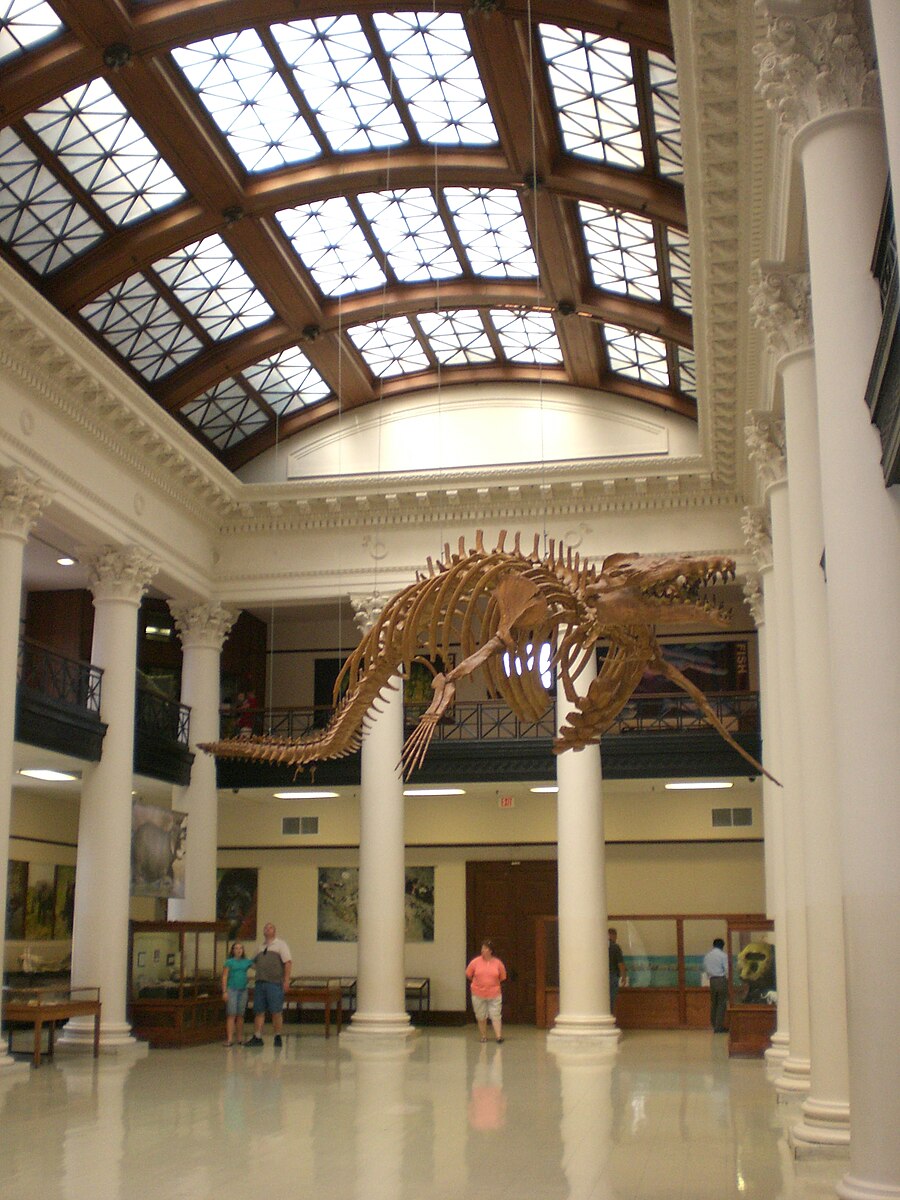
Alabama Museum of Natural History in Smith Hall, University of Alabama. Photo by AlabamaGuy2007, 2008, courtesy of Wikipedia.

Built in 1910, this magnificent Beaux-Arts structure was constructed to house Alabama Museum of Natural History as well as laboratories and classrooms. Named for Eugene Allen Smith, a university professor and Alabama State Geologist, the museum houses some of his personal effects, including his personal carriage, and perhaps his spirit may be one of those remaining here.

Sources

  • Crider, Beverly. “Crimson Hauntings: The Ghosts of UA.” com. 10 May 2012.
  • Higdon, David and Brett J. Talley. Haunted Tuscaloosa. Charleston, SC: History Press, 2012.
  • Windham, Kathryn Tucker. Jeffrey’s Latest 13: More Alabama Ghosts. Tuscaloosa, AL: University of Alabama Press, 1982.


Weaver Castle (private)
625 Lauderdale Street
Selma

A handy man installing a ceiling fan in this historic home was asked, “What are you doing?” When he looked to see who was asking, he discovered an empty room. A resident some years ago had her dog reprimanded by an unseen presence. Her dog began barking, and a voice demanded, “Dog, shut up!” Her children were upstairs when that happened and had not been downstairs.
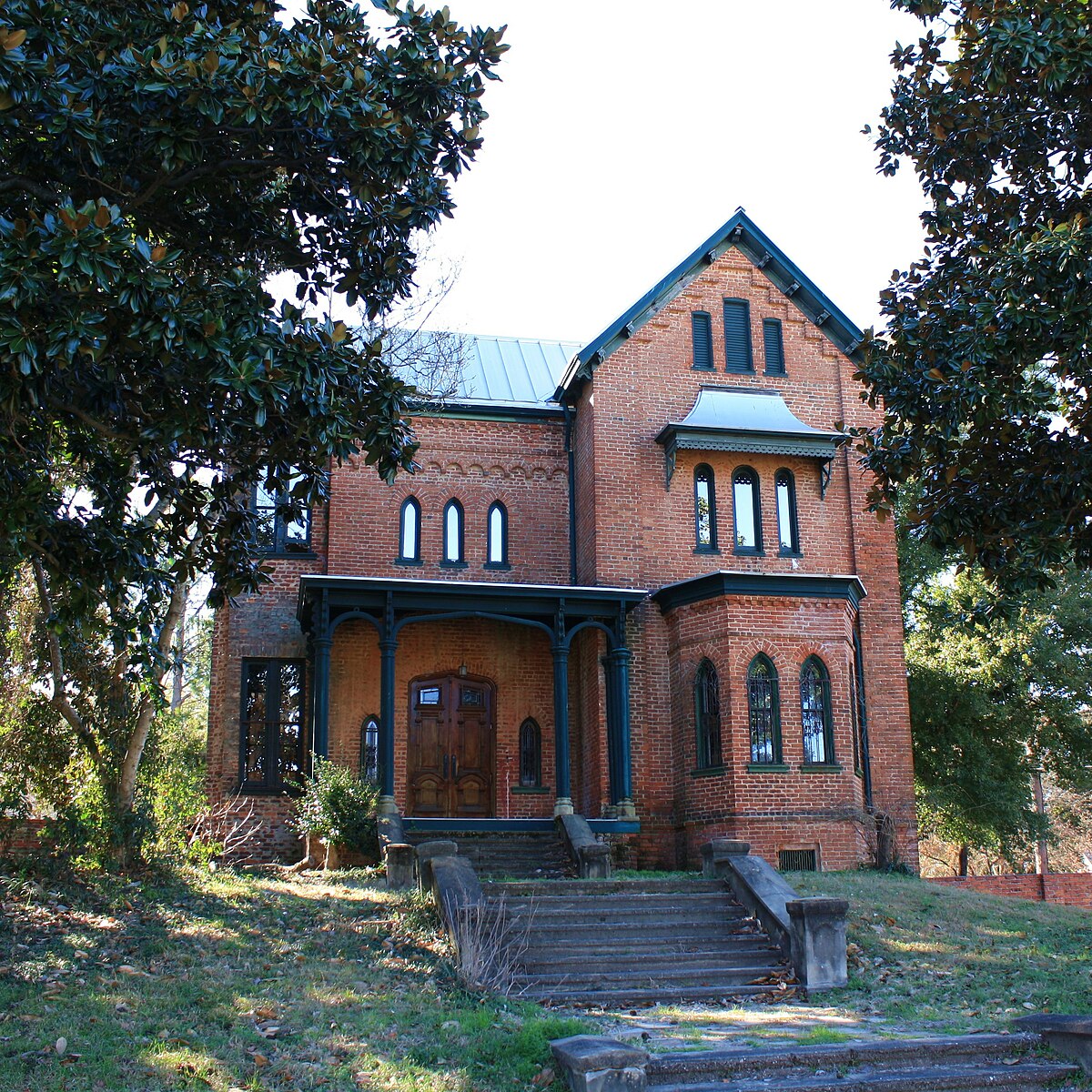
Weaver Castle Selma Alabama
Weaver Castle, by Altairisfar, 2011. Courtesy of Wikipedia.

William M. Weaver constructed this German Gothic style home in 1868 on property that had seen fighting during the Battle of Selma. Weaver passed away here in 1898 of, as the Alabama Ghost Trail asserts, a broken heart following the death of his son from kidney disease. Please respect the owners and residents of this private home.

Sources

  • Alabama Ghost Trail. “Weaver Castle.” YouTube. 19 July 2009.
  • Higdon, David and Brett J. Talley. Haunted Alabama Black Belt. Charleston, SC: History Press, 2013.

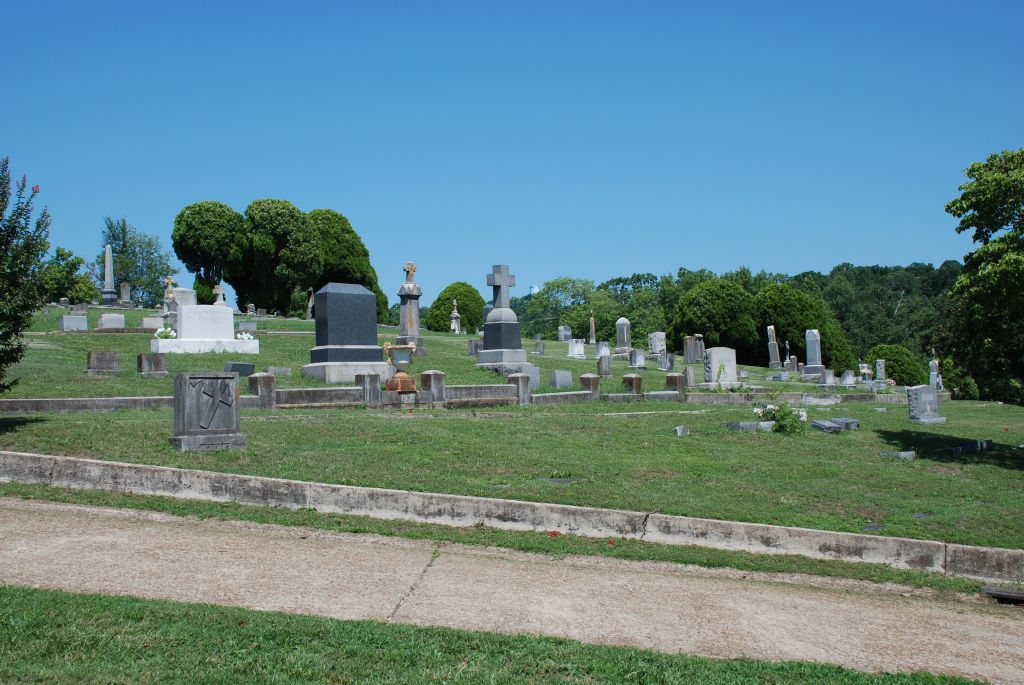
The Trail of the Bell Witch—US 41 in Tennessee, Part I

The Georgia state line to Smyrna

Tennessee’s most celebrated haunting is the tale of the Bell Witch. For a period of about four years—from 1817 to 1821—the family of John Bell living on the Red River in Robertson County was plagued by a mysterious and mischievous entity. While the hauntings are supposed to have died down in 1821, paranormal activity has persisted in the area that is still ascribed to the famous “witch.” It is through this area, now the town of Adams, where US 41 passes a short distance from the Bell family’s former property.

US 41 Tennessee sign

US Route 41 cuts diagonally through Middle Tennessee from Chattanooga across the Cumberland Plateau through Murfreesboro and Nashville to cross over the state line into Guthrie, Kentucky. Part of this route was established around 1915 with the creation of the Dixie Highway which ran from Sault Ste. Marie, Michigan south to Miami, Florida. This portion of the Dixie Highway was designated as US 41 in 1926, with the announcement of the original numbered highway system. While the road has been supplanted by I-24 throughout Tennessee, this highway provides a much more scenic, and haunted, route through the state.

This article explores US 41 from where the road crosses the Georgia state line into East Ridge and Chattanooga, to Smyrna in Rutherford County just before the road passes into Davidson County and Nashville. Part II of this article will cover the remaining portion of the route from Nashville to the Kentucky state line.

East Ridge

Southeast of downtown Chattanooga, US 41 crosses into Tennessee from Georgia into the city of East Ridge.

Mount Olivet Cemetery
Mount Olivet Drive

Located on a hill above the busy rush of US 41, Mount Olivet Cemetery provides an attractive and peaceful oasis from the hustle below. With graves dating to the mid-19th century, this Catholic cemetery also possesses some spectral residents. According to investigator and author Mark E. Fults, he and a friend saw several specters during a late-night walk of this burial ground some 30 years ago. At one mausoleum, the pair saw “a petite, waif-like woman peering sadly through the barred windows.”

At another mausoleum, the investigators witnessed what Fults describes as “ectoplasm.” “There was a faint phosphorescent green mist directly up against the barred windows with images forming within it. As we watched, a hand appeared and then dissolved into the mass of energy. When a watchful eye materialized, we both were gripped with a sickening ache to the solar plexus…we backed away thoroughly nauseated and eager for fresh air.” Fults reports that his friend “was sick for days afterwards, as the energy tried to possess him.”

Mount Olivet Cemetery East Ridge Tennessee
Mount Olivet Cemetery, 2011, by MyrticeJane. Courtesy of Find-A-Grave.

After viewing this ghostly light show, the friends saw a large, black dog observing them from the edge of the woods. As they toured the cemetery, this dog was hiding behind monuments and trees and scurrying between them on two legs. Fults believes this was a watcher spirit keeping vigil over the dead who rest here.

Please note, this cemetery is active and well-maintained. Late night investigations are discouraged, and such a visit would likely be considered trespassing by the local authorities.

Sources

    • Fults, Mark E. Chattanooga Chills, Second Edition. Mark E. Fults, 2012.
Bachman Tunnels Chattanooga Tennessee postcard
A postcard view of the Bachman Tunnels published between 1930-1945 by W. M. Cline & Co. Courtesy of the Tichnor Brothers Collection, Boston Public Library.

The passage into Chattanooga is made through the Bachman Tunnels, which were bored through Missionary Ridge in the late 1920s, opening officially in 1929. While there are no published ghost stories regarding these nearly one-hundred-year-old tunnels, I suspect that there is probably some mysterious activity associated with them.

Chattanooga

Tennessee’s fourth largest city, Chattanooga is situated on the banks of the Tennessee River at Moccasin Bend. Archaeological excavations have revealed that humans have lived in this spot for millennia. Prior to the arrival of Spanish conquistador Hernando de Soto in 1540, the area was a major center for Mississippian culture. In the historic era, the area came under control of the Cherokee People.

White settlers began to filter into the area in the 1830s displacing the native people and creating Ross’ Landing on the river near present day downtown. As they were removed in 1838 on the Trail of Tears, many Cherokee People stopped here before continuing towards the west. As the settlement grew, the town became an important center of river commerce. The introduction of the railroad brought more settlers and strategic importance to the city. The outbreak of the Civil War brought military activity here and the city was captured by Union troops in 1863 after several major battles were fought in the area, including the Battle of Chattanooga, the battle of Lookout Mountain, and the Battle of Chickamauga.

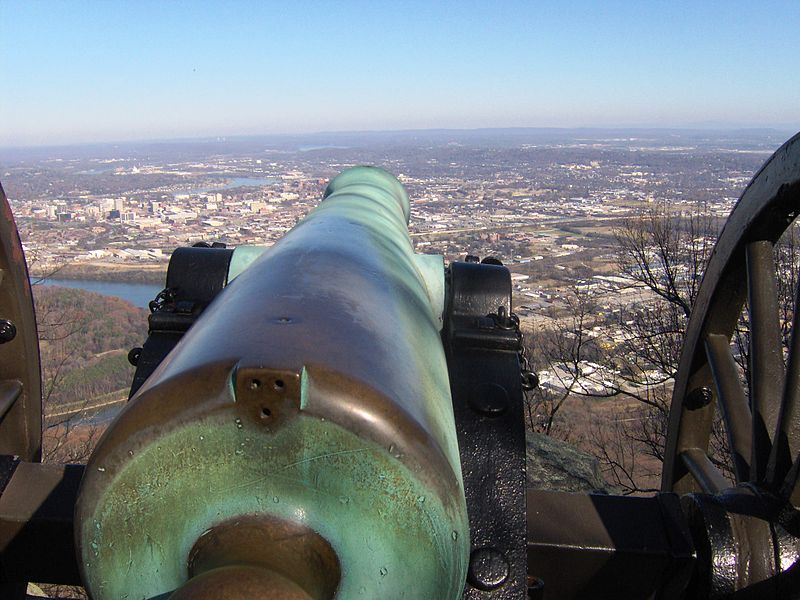
Chattanooga Tennessee from Lookout Mountain
Chattanooga sits under the aim of a cannon atop Lookout Mountain. Photo 2009 by Brian Stansberry. Courtesy of Wikipedia.

As a result of Union attention during the war, the city became quite industrialized during the latter part of the 19th century. As many of the industries began to move elsewhere towards the middle of the 20th century, the city began to clean up its pollution and remake itself as a tourist town. Today, all of these layers of history have left spiritual marks in terms of ghosts and hauntings.

Sources

  • Ezzell, Timothy P. “Chattanooga.” Tennessee Encyclopedia. 8 October 2017.

Passing into Chattanooga, US 41 runs along West Main Street before turning south onto Broad Street. Downtown, there are a number of hauntings, many of which are featured on the Chattanooga Ghost Tour (see my review here). Among the sites where one might find paranormal activity are the Chattanooga Public Library, Engel Stadium, the Hamilton County Jail, and the Southside Saloon and Bistro.

After turning onto Broad Street, US 41 runs concurrent with US 11 (the Lee Highway), US 64, and US 72 along the Tennessee River at the base of Lookout Mountain. The site of heavy fighting during the Civil War Battle of Lookout Mountain, the flanks of the mountain are dotted with haunted places including Ruby Falls Caverns.

Still running parallel to the Tennessee River, US 41 passes near Raccoon Mountain Caverns, a short distance outside of Chattanooga.

Raccoon Mountain Caverns
319 West Hills Drive

Tradition holds that locals were first drawn here by a cool breeze blowing up through rocks on the grounds of the Grand Hotel Farm in the 1920s. Local caver and entrepreneur Leo Lambert, who incidentally discovered and developed Ruby Falls Caverns, was tipped off about the possible existence of a cave and began exploring it in 1929. After finding the cave’s famous Crystal Palace Room with its dramatic and impressive formations, he immediately set about opening the cave to tourists. In 1931, Tennessee Caverns opened to serve the tourist traffic from US 41. Later, the cave was renamed Crystal City Caves later and other attractions were added at the cave’s entrance including a sky bucket ride called the Mount Aetna Skyride.

Raccoon Mountain Caverns Chattanooga Tennessee
Raccoon Mountain Caverns, 2017, by Lewis O. Powell, IV, all rights reserved.

On the night of November 30, 1966, 39-year-old Willie Cowan, the attraction’s night watchman was killed in a fire that destroyed the skyride, as well as the cave’s ticket office and gift shop. In the years since his death, his spirit has been sensed within the cave and the rebuilt gift shop and ticket office. Many guides passing through the cave have smelled Cowan’s cigar smoke, heard his whistling, and several have glimpsed his figure on the route of the cave tours. While touring the cave, author Amy Petulla saw a light during a moment where the lights were turned off to provide visitors with the experience of pitch darkness. The spirit appears to be fairly active around the anniversary of Cowan’s death.

Sources

    • Matthews, Larry E. Caves of Chattanooga. Huntsville, AL: The National Speleological Society, 2007.
    • Penot, Jessica and Amy Petulla. Haunted Chattanooga. Charleston, SC: History Press, 2011.

Haletown

Just before the road dips south to cross the Tennessee River in Haletown, it passes the now infamous Hales Bar Dam.

Hales Bar Dam
1265 Hales Bar Road

Located on a sand bar extending into the Tennessee River, Hales Bar Dam was constructed to provide hydroelectric power to the area. This sand bar is part of a 33 mile stretch of river made dangerous by a number of whirlpools, so the dam’s construction also included a lock on the river to improve navigation. Work commenced in 1905 and was initially expected to last up to two years. When the dam remained incomplete after two years of work, the first contractors withdrew from the project. Another contractor was selected the following year and construction of the power house, the main surviving element of the dam, was begun. Difficulty with the foundation of the structure led to numerous budget overruns and problems for work crews. Despite the issues, however, the dam was completed and began operation in 1913.

Fissures in the structure’s limestone bedrock and innumerable leaks led to a host of issues plagued the dam as it continued to operate over the proceeding decades. In the early 1960s, the Tennessee Valley Authority (TVA) made the decision to abandon it once construction of the Nickajack Dam was completed to the south. Parts of the dam’s facilities were demolished in the years following, though the power house has remained as a main feature of the Hales Bar Marina.

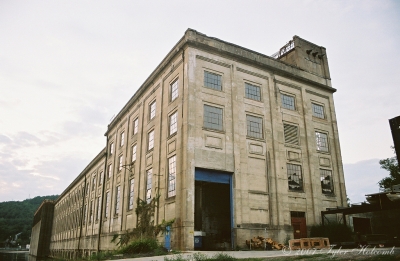
Hales Bar Dam powerhouse Haletown Tennessee
The Hale’s Bar Dam powerhouse, 2007. By Tyler Holcomb, courtesy of Wikipedia.

Over the past couple decades, the abandoned dam has attracted the attention of paranormal investigators who have discovered that it is now the residence of spirits. That attention has led to investigations by television paranormal teams from the shows Ghost Hunters and Ghost Adventures who have all walked away with tremendous evidence. During filming for an episode of Zak Bagans’ Ghost Adventures in 2011, a sudden storm erupted damaging part of the marina and several boats and vehicles. Bagans presumed that the sudden storm was another manifestation of the curse of Chief Dragging Canoe, which is sometimes blamed for local paranormal activity, though there seems to be little evidence to support this correlation.

The dam is haunted by a variety of spirits ranging from children to shadow people to a former dam foreman. Investigators have reported hearing footsteps, voices, and many EVPs have been captured within the structure and throughout the surrounding marina.

Sources

    • Archambault, Paul. National Register of Historic Places nomination form for Hales Bar Dam. 30 May 2008.
    • Glover, Greg. “Weather provides new twist for Ghost Adventures.” 28 February 2011.
    • Phipps, Sean. “An overnight paranormal investigation of Hales Bar Dam.” com. 12 March 2017.

After crossing the Tennessee River in Haletown, US 41 continues through Jasper and heads towards Monteagle.

Monteagle

Located at the meeting point of three counties—Grundy, Marion, and Franklin–the town of Monteagle is situated on the Cumberland Plateau. It was on the edge of this plateau that John Moffat, an organizer in the temperance movement, bought a huge tract of land in 1870. In 1882, the Monteagle Sunday School Assembly was created here. This organization, built on the ideas of the Chautauqua Movement, was founded to promote the “advancement of science, literary attainment, Sunday school interest and promotion of the broadest popular culture in the interest of Christianity without regard to sect or denomination.” The assembly constructed buildings throughout town to support and house the masses of people attending and who continue to be drawn to this city on the edge of the Cumberland Plateau.

Sources

“Monteagle Mountain” Stretch of I-24

Goin’ down Monteagle Mountain on I-24
It’s hell for a trucker when the Devil’s at your door
He’ll tempt you and tell you, “Come on, let her roll,
‘Cause the mountain wants your rig, and trucker, I want your soul.”

–Thomas Richard McGibony, “Monteagle Mountain,” released by Johnny Cash on his 1990 album, “Boom Chicka Boom.”

The notoriety of this stretch of interstate highway has garnered the attention of a Johnny Cash song. The song tells the story of a long-haul trucker carrying a load from Nashville to Florida dreading traversing the infamous road around Monteagle. As he starts down the steep grade, his brakes fail, and he is forced to steer the big rig into one of the runaway truck ramps. After stopping on the ramp, and realizes he is alive, and  grateful to God “’cause when there’s a runaway on Monteagle, some truckers don’t survive.”

For decades, truckers and other drivers dreaded this scenic, but treacherous section of I-24 just before and after the town of Monteagle. Truckers traversing the steep grade sometimes had their brakes go out and more than a few went hurtling off the mountain highway. Despite improvements by the state’s Department of Transportation, drivers still fear the road.

Historically, the path of the interstate was deemed US 41 dating back to the road’s incorporation as the US numbered highway system, with this stretch dating to the earlier Dixie Highway.

In his 2009 book, Ghosts of Lookout Mountain, Larry Hillhouse includes an oft-told tale from this infamous stretch. As young drivers sometimes eased their trucks down the mountain, some encountered a strange sight. Hillhouse explains that “suddenly a figure appeared in the middle of road. The figure was a man, dressed in light blue overalls and wearing a black cowboy hat, and he was always waving his arms furiously, as if to flag them down.” The drivers downshifted to another gear before realizing there was yet one more hairpin turn that they had to navigate. Having already downshifted, the driver avoided certain danger. Of course, the figure that warned them by darting into the road was nowhere to be seen.

These young drivers would tell an assembled group of older truckers who might nod knowingly and tell them that they had seen the spirit of old Cowboy Lewis. They would explain that he was an unlucky trucker who had lost his life at that curve many years ago and had been buried at that spot. If you happen to decide to test out your vehicle’s brakes on this treacherous terrain and you see the cowboy hat wearing figure dart in front of you, heed his warning, there is a dangerous curve ahead.

Sources

    • Hillhouse, Larry. Ghosts of Lookout Mountain. Weaver, IA: Quixote Press, 2009.
    • Monteagle Mountain. Wikipedia, the Free Encyclopedia. Accessed 31 July 2022.
    • “New I-24 lanes opened at Monteagle.” The Tennessean. 12 July 1989.

US 41 enters the town of Monteagle from the east and becomes Main Street for a short distance before heading north. Just before it becomes Main Street, the highway passes the massive DuBose Conference Center.

DuBose Conference Center
635 College Street

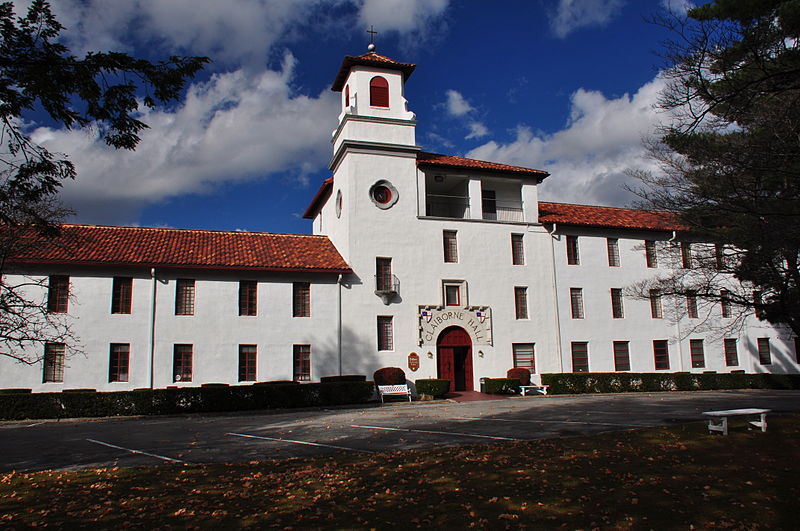
Constructed for the DuBose Memorial Church Training School, an Episcopalian seminary, this Mission style structure has provided lodging and facilities for theological students and later visitors visiting the retreat center for almost a hundred years. Over those years, this building may have acquired several spirits as well.

DuBose Conference Center Monteagle Tennessee
DuBose Conference Center, 2014, by Skye Marthaler. Courtesy of Wikipedia.

Author Annie Armour documents the experiences of a few visitors here in her book, Haunted Sewanee. One guest witnessed a fog creep into her room in the middle of the night. Slowly, the fog began to form the shape of a young woman who eventually took a seat in a rocking chair and started rocking. The guest watched until the fog faded, though the chair continued rocking for some time. Armour interviewed the daughter of the center’s executive director who would sometimes find herself in the building alone. In those moments, she heard the sounds of footsteps and doors opening and closing, despite the fact that she was entirely alone within the huge facility.

Sources

    • Armour, Annie. Haunted Sewanee. CreateSpace Publishing, 2017.
    • Casteel, Britt. National Register of Historic Places nomination form for the DuBose Conference Center. 15 August 1990.

Edgeworth Inn
19 Wilkins Avenue

According to authors Robert and Anne Wlodarski, the spirit haunting this 1896 home turned bed and breakfast is called “Uncle Harry.” The home was one of the many “cottages” constructed for the Monteagle Sunday School Assembly. This entity is reported to have been active as far back as the 1930s, when he once flipped a punch bowl during a reception. Decades later, as a team from the Travel Channel was filming in the inn, Uncle Harry levitated a plastic punch bowl and set it down on the head of a producer. This mischievous spirit has been accused of showing his displeasure whenever changes are made within the building.

Sources

    • Wlodarski, Robert James and Anne Powell Wlodarski. Dinner and Spirits: A Guide to America’s Most Haunted Restaurant, Taverns, and Inns. Lincoln, NE: iUniverse Publishing, 2000.

Passing out of Monteagle, the road continues northwest into the town of Manchester, the seat of Coffee County.

Manchester

Manchester City Cemetery
West High Street

Manchester City Cemetery Tennessee
Manchester City Cemetery, 2009, by Susan Clemons. Courtesy of Find-A-Grave.

Some years ago, a reporter from the local Manchester Times had an eerie experience in the city cemetery following an evening candlelight tour. He wrote in the paper a few years later, “As we neared the end of the presentation and moved to the newer part of the cemetery, I was stopped by what seemed like the voices coming from a nearby group. There was, however, no group near us. The sounds were faint and at the same time seemed right behind me. Still, I couldn’t pin down any particular direction they were coming from. Later I asked my wife and she too had heard something strange but hadn’t wanted to mention it.”

Sources

    • Coffelt, John. “Haunted Manchester: Times readers details some of the spookiest sites in the area.” Manchester Times. 31 October 2018.

Old Stone Fort State Archaeological Park
732 Stone Fort Drive

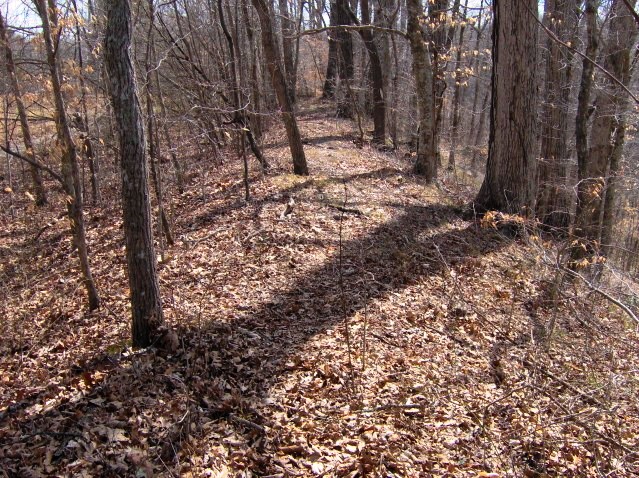
Old Stone Fort State Archaeological Park Manchester Tennessee
View from atop one of the earthworks at Old Stone Fort State Archaeological Park, 2006. Photo by Brian Stansberry, courtesy of Wikipedia.

As US 41 leaves Manchester, it passes by Old Stone Fort State Archaeological Park. This state park preserves an ancient Native American site with stone structures and earthworks built at the confluence of the Duck and Little Duck Rivers. The Manchester Times reports that a visitor to the park after hours under a full moon heard the sound of a person running through an open field. The visitor stood there listening to the strange sound, though they did not see anyone around. As the sound passed them they felt a slight breeze.

Sources

    • Coffelt, John. “Haunted Manchester: Times readers details some of the spookiest sites in the area.” Manchester Times. 31 October 2018.
    • Old Stone Fort (Tennessee). Wikipedia, the Free Encyclopedia. Accessed 17 July 2022.

In Rutherford County, the road enters the Nashville Metropolitan area of which Murfreesboro is now the largest suburb.

Murfreesboro

Now the sixth-largest city in the state, Murfreesboro dates its beginnings to the late 18th century when Colonel William Lytle provided land to build a public square, cemetery, and a Presbyterian church. The town was chartered by the state legislature in 1811 and was deemed the county seat of Rutherford County. A few years later, the first courthouse was built in the center of the public square. This building served as the state capitol for nearly a decade until the capitol was moved to nearby Nashville.

Three battles fought here during the Civil War brought national notoriety to the small town. The second of those battles, the Battle of Stones River fought on New Year’s Eve 1862 until January 2, 1863, brought death and devastation to a huge area north of town. In the 1920s, a small percentage of this battlefield was designated by the National Park Service as a military park. The park is in two portions on both sides of US 41, just north of downtown.

Murfreesboro remained a busy center of trade into the mid-20th century. As Nashville has sprawled beyond its limits, the city has developed as a suburb. In the 1990s, much of that development was centered on land around the battlefield park, making this battlefield one of the most endangered in the country. As this dark and bloody ground has been developed, residents and the employees of businesses built here have reported paranormal activity.

Sources

  • Huhta, James K. “Murfreesboro.” Tennessee Encyclopedia. 8 October 2017.

Historic Rutherford County Courthouse
Public Square

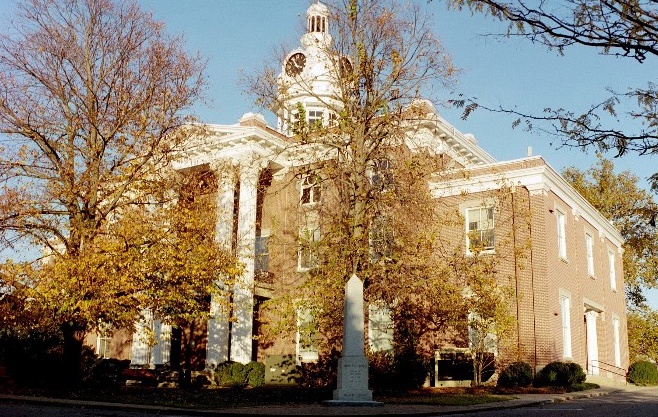
The first courthouse in the center of Murfreesboro’s Public Square was constructed in 1813. It was in this building that the state legislature met for nearly a decade after the town was deemed the state capital. That first building was replaced after fire destroyed it in 1822. The current building replaced the second courthouse and dates to 1859. During its lifetime it has witnessed a tremendous panoply of history play out within its walls and on the square surrounding it.

During the Civil War, hostilities found their way to the halls of the building as Confederate forces under General Nathan Bedford Forrest raided the Union-occupied town. On July 13, 1862, the Union-occupied courthouse was quickly surrounded by rebel troops who eventually broke their way through the doors. With soldiers from Company B of the 9th Michigan trapped on the upper floors, soldiers from the 1st Georgia Cavalry started a fire to smoke out the Yankees. Trapped, the Michigan soldiers surrendered, and Forrest’s successful raid became a feather in the general’s cap.

Historic Rutherford County Courthouse Murfreesboro Tennessee
Historic Rutherford County Courthouse, 2007, by MArcin K. Courtesy of Wikipedia.

During the Union occupation of the city, the courthouse lawn saw several executions as military leaders tried to contain the rebellious local population and deal with Confederate spies and informants. Later, locals lynched a 19-year-old African-American man here in 1881. Houston Turner was arrested for an attack on a white woman and was being transported to Nashville by the county sheriff when the entourage was surrounded by a mob demanding the prisoner be turned over to them for justice. The sheriff, seeing no alternative, turned him over to the mob who immediately exacted “justice” by hanging him on the courthouse lawn.

Another death occurred here in 1923 when a vaudeville actor billing himself as “The Human Fly” attempted to free-climb the building. After reaching the top of the cupola to the delight of the assembled crowd, the man fell as he began his descent, landing on the roof and breaking his neck.

With so many contentious deaths and an accidental one, plus serving as the focus of more than a century of county history, it’s no surprise that specters continue to rove the antebellum halls and grounds of the courthouse. Over the years, county employees in the building have described physical interactions with spirits that sometimes throw books from shelves, upend furniture, open and close doors, push the living, or play with the elevator. One sensitive investigator reported that the spirit of a lonely young Confederate soldier held her hand. The young man had died within the courthouse during a time when it served as a makeshift hospital and sought comfort from the living investigator. Outside the building, people visiting and working in the businesses surrounding the square also deal with spirited activity that may possibly stem from their proximity to the courthouse.

Sources

    • La Paglia, Peter S. National Register of Historic Places nomination form for the Rutherford County Courthouse. 10 May 1973.
    • Rennick, Lee. “4 haunted places in Murfreesboro.” Rutherford County Source. 28 October 2021.
    • Sircy, Allen. Southern Ghost Stories: Murfreesboro: Spirits of Stones River. Amazon Kindle, 2020. eBook.

Big B Cleaners
7 South Public Square

When it comes to places that are likely to be haunted, I’m certain that a dry cleaners would be last on most people’s list. Though, in Murfreesboro, a city rife with history and hauntings, even the cleaners has paranormal activity. Situated on the Public Square facing the haunted Historic Rutherford County Courthouse, the business occupies a pair of old commercial buildings that were home to a furniture store, a saloon, a shoe store, and a theater at varying points in the past. A dry cleaners opened in number 7 in the late 1950s and expanded into number 9 sometime later.

It has been rumored for many years that Big B Cleaners is haunted. In fact, employees called in a paranormal investigative team some years ago to pinpoint the reason why they were dealing with activity. During the investigation by the Shadow Chasers of Middle Tennessee, the group captured EVPs and a pair of investigators saw a shadowy figure on the second floor. “All of a sudden, hair started rising up, and I saw a black figure. He was dark. As a matter of fact, he was darker than the dark. He was going back and forth looking at me. I asked my friend if she saw him, and she said she did.” The pair surmised that the figure tended to stay in a corner of the building and that it may be the spirit of a former owner.

Sources

    • Sircy, Allen. Southern Ghost Stories: Murfreesboro: Spirits of Stones River. Amazon Kindle, 2020. eBook.
    • Willard, Michelle. “Haunting history in Murfreesboro.” The Murfreesboro Post. 30 September 2012.

Oaklands Historic House Museum
900 North Maney Avenue

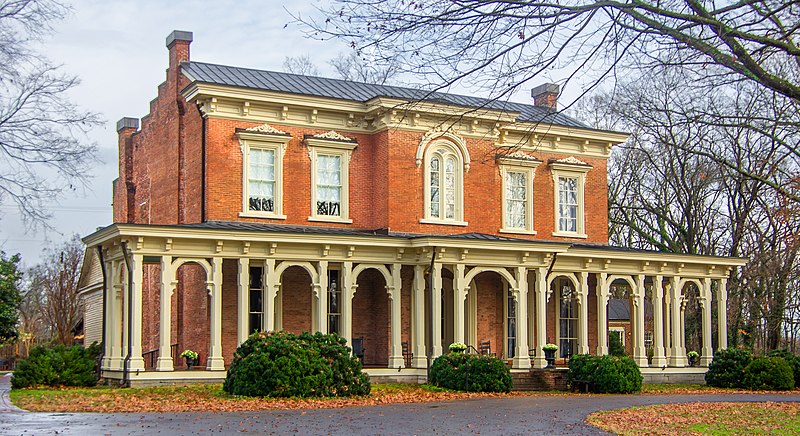
Oaklands Murfreesboro Tennessee
Oaklands, 2021, by rossograph. Courtesy of Wikipedia.

Occupied by the prominent Maney family for almost a century, Oaklands began as a simple two-room structure in the early 19th century. Over time, family members added rooms and renovated older sections to create the large home that stands today. During General Forrest’s raid on the town in July of 1862, a skirmish was fought on the front lawn. The family later opened their home to care for the wounded from the Battle of Stones River. When the home faced demolition in the late 1950s, a group of local women saved it and it now serves as a house museum and event space. Visitors and staff in the house have experienced paranormal activity here since the home’s restoration. Disembodied footsteps, voices, and apparitions of the home’s spectral occupants have been reported.

Sources

    • Coop, May Dean. National Register of Historic Places nomination form for Oaklands. 9 June 1969.
    • Morris, Jeff; Donna Marsh and Garrett Merk. Nashville Haunted Handbook. Cincinnati, OH: Clerisy Press, 2011.
    • Sircy, Allen. Southern Ghost Stories: Murfreesboro: Spirits of Stones River. Amazon Kindle, 2020. eBook.

Stones River Country Club
1830 Northwest Broad Street (US 41)

According to author Allen Sircy, who has exhaustively catalogued haunted places throughout the Nashville area in a number of recent books, the clubhouse of the Stones River County Club has paranormal activity. Founded in 1946, as the Town and Country Club and later renamed Stones River Country Club, the club occupies property where fighting occurred during the Battle of Stones River. A local legend speaks of the spirit of a nurse that has been seen in the area who may allegedly  haunt the clubhouse. Sircy reports that an employee told him that a woman working with the banquet staff saw “a woman in an old-timey dress…multiple times in the ballroom.”

Sources

    • Sircy, Allen. Southern Ghost Stories: Murfreesboro: Spirits of Stones River. Amazon Kindle, 2020. eBook.

Bombshells Hair Studio
803 North Thompson Lane #105A

The Gateway Village development hosts a variety of commercial enterprises and businesses, including Bombshells Hair Studio, and occupies a section of the old battlefield. According to Allen Sircy, this hair salon and parts of the development are haunted.

In the twelve years the salon has been open, the owner, her stylists, and employees have experienced a plethora strange activity. The shop’s security system detected much of that activity in the first few months the business was open. The owner was frequently summoned to the shop very early in the morning after the system registered that doors were open or that there was motion inside the building. Staff and patrons have seen the image of a dark-haired women who is known to sometimes grab people.

The spirit is blamed for opening and closing doors, odd sounds, and breaking electrical equipment here. One night, the usually mischievous spirit was helpful when a stylist left a candle burning at her station. When the owner tried to set the alarm before she left, the panel noted that there was an issue with an unused back door. When she went to look at the door, she discovered the candle and extinguished it. After that, there were no further problems setting the alarm. The owner told Allen Sircy, “I think they were trying to warn me.” While the identity of this spirit has not been established, perhaps she is the nurse that is thought to haunt the Stones River County Club.

Sources

    • Sircy, Allen. Southern Ghost Stories: Murfreesboro: Spirits of Stones River. Amazon Kindle, 2020. eBook.

Stones River National Battlefield
3501 Old Nashville Highway

A Haunted Southern Book of Days–2 January

This article is a part of an occasional blog series highlighting Southern hauntings or high strangeness associated with specific days. For a complete listing, see “A Haunted Southern Book of Days.”

In his memoirs of the Civil War, Private Sam Watkins of the First Tennessee Infantry wrote of the Union’s pyrrhic victory at Stones River, “I cannot remember now or ever seeing more dead men and horses and captured cannon all jumbled together than that scene of blood and carnage…the ground was literally covered with blue coats dead.”

On New Year’s Eve 1862, forces met along the West Fork of Stones River where they fought for control of the town of Murfreesboro. Union forces under General William Rosecrans and Confederate forces under General Braxton Bragg battled for three days with casualties of more than 10,000 men killed, wounded, captured or missing on each side.

Today, about 15% of the battlefield has been preserved by the National Park Service, though much of the remaining battle-scarred land has been developed leaving paranormal activity in homes, businesses, neighborhoods, and commercial developments throughout the area. See above entries.

Stones River Battlefield Murfreesboro Tennessee
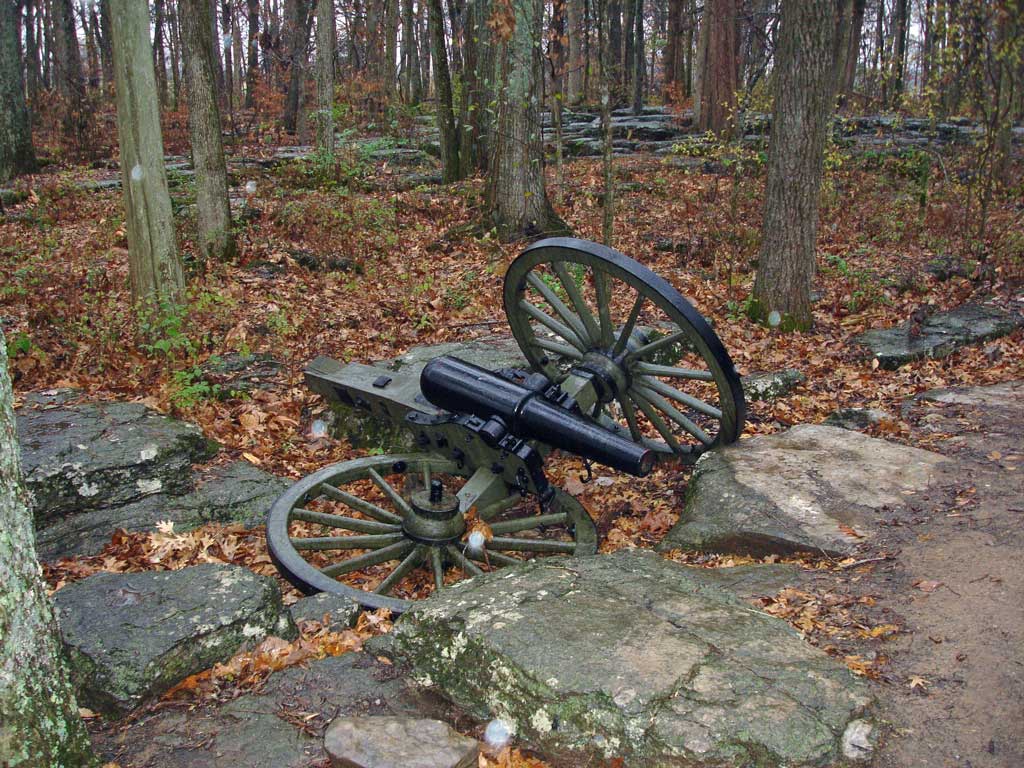
A broken cannon lies amid the karst formations at the Slaughter Pen, 2005, by Hal Jesperson. Courtesy of Wikipedia.

On the preserved portion of the battlefield, there are two primary morbidly-named paranormal hotspots: the Slaughter Pen and Hell’s Half Acre. Battlefield tour stop #2 is the Slaughter Pen where Union soldiers under the command of General Philip Sheridan held out on the first morning of the battle despite suffering tremendous losses. The terrain consists of limestone rocks that form natural knee- and waist-high trenches. Throughout the area visitors have encountered shadow figures, apparitions, strange feelings, and spectral sounds that have been heard amongst the wooded stone outcroppings.

Stones River Battlefield Murfreesboro Tennessee
The Hazen Brigade Monument on Hell’s Half Acre, 2009, by Own work. Courtesy of Wikipedia.

Fighting near what is now tour stop #5, led this section of battlefield to be deemed Hell’s Half Acre. Just six months after the battle, the Hazen Brigade Monument was constructed here, and it remains the oldest Civil War monument in existence. Like the rest of the battlefield, this area is paranormally active and haunted by a headless horseman. During the battle, Union General Rosecrans’ chief of staff, Lt.Col, Julius Peter Garesché was decapitated by a Confederate cannonball while riding his horse near the Round Forest. His spirit continues to ride the battlefield with his head missing. (see my article “‘The most gallant gentleman’–The Headless Horseman of Stones River.”

Sources

    • Blue & Grey Magazine. Guide to Haunted Places of the Civil War. Columbus, OH: Blue & Grey Magazine, 1996.
    • Bush, Bryan and Thomas Freese. Haunted Battlefields of the South. Atglen, PA: Schiffer, 2010.
    • McWhiney, Grady. “Stones River, Tennessee.” in The Civil War Battlefield Guide, 2nd Kennedy, Frances H. editor. Boston: Houghton Mifflin, 1998.
    • O’Rear, Jim. Tennessee Ghosts. Atglen, PA: Schiffer, 2009.
    • Sircy, Allen. Southern Ghost Stories: Murfreesboro: Spirits of Stones River. Amazon Kindle, 2020. eBook.

North of Murfreesboro, US 41 passes through Smyrna and La Vergne before crossing the county line into Davidson County and Nashville proper.

Smyrna

Sam Davis House
1399 Sam Davis Road

On November 27, 1863, Union authorities marched 21-year-old Sam Davis to gallows they had erected in Pulaski, Tennessee. On his birthday, this young man bravely faced death as a Confederate spy. In the intervening years, the young man has been deemed a Confederate hero and martyr while his home has been designated as a shrine and preserved as it was when the young man willingly marched off to certain death.

Sam Davis Home Smyrna Tennessee
The Sam Davis Home, 2012, by Robert Claypool. Courtesy of Wikipedia.

Within the home, visitors and staff have heard the sounds of weeping. Others have encountered the apparitions of Davis’ mother and grandmother. These active spirits have become known for causing mischief within the home. Staff members and visitors alike have noted that the property is permeated with the spirits of Davis, his family, and their enslaved people.

Sources

    • Morris, Jeff; Donna Marsh and Garrett Merk. Nashville Haunted Handbook. Cincinnati, OH: Clerisy Press, 2011.
    • Ong, Linda. “Spirits still linger at Smyrna’s Sam Davis Home.” 31 October 2019.
    • Whittle, Dan. “Spirits make presence known at Sam Davis Home.” Murfreesboro Post. 13 October 2014.

Join me for the rest of this haunted journey along US 41 in Part II as I explore Nashville to the Kentucky state line.

Death on Wheels–Jackson, Mississippi

Hinds County Courthouse
407 East Pascagoula Street

For about fifteen years, death traveled on wheels throughout the state of Mississippi. During that time, a portable electric chair crisscrossed the state as counties needed to execute inmates. The chair along with portable generators and an executioner would set up in county courthouses or jails in order to do their gloomy work and then move on to the next date with death.

There’s something cruel and disturbing in how Mississippi seemed to delight in their use of “Old Sparky.” Even how the deaths are reported in the local papers is tinged with a sense of pride. Between 1940 and 1954, 73 people met their fates while embraced in the chair’s wooden arms.

Mississippi's portable electric chair
The state’s executioner, Jimmy Thompson, poses with “Old Sparky” with an assembly of young boys. Courtesy of the Mississippi Department of Archives and History.

When the instrument was first used in 1940, photographs were proudly published in Jackson’s Clarion-Ledger showing the inmate being strapped in and then a second photograph as the first surge of electricity surged through his body. One blogger noted that photography during executions has been banned throughout the country and that they are exceedingly rare with this being one of only two such photos, the other being the infamous photograph of Ruth Snyder being put to death in New York’s infamous Sing Sing.

Despite being stored in the state capitol building in Jackson, death did not claim a victim there until the 9th of February 1944. Just after midnight 23-year-old Elijah Parker was led into the basement of the Hinds County Courthouse to meet his fate.

Clarion-Ledger
9 February 1944
Page 1

PARKER DIES HERE
IN ELECTRIC CHAIR

The Wages of Sin Is Death

With the final words, “Yes, Father,” plainly visible on his lips, Elijah Parker, 23-year-old Madison county negro, died in the state’s portable electric chair at 12:27 this morning for his part in the slaying of T. Henry Gober over a year and half ago.

The negro was led to the chair by Deputy Sheriffs J. T. Naugher and Bob Stone, and as he entered the basement where the electrocution took place he clasped a Catholic prayer book tightly between his hand-cuffed hands.

His pearly white teeth shone brilliantly behind a faint grin as he sat down in the chair, and he watched intently as officials strapped him securely in the chair. Just before his left arm was strapped to the chair, he handed the prayer book to Father Mathis.

Father Mathis uttered a short prayer and then leaned over close to the negro and said, “be sorry for your sins,” to which the negro replied, “Yes, Father.” These were his last words.

Switch Thrown

Seconds later the state’s official electrocutioner, C. W. Watson threw the switch that shot 2,300 volts of electricity through the negro’s body. The chair gave a quick lurch and the strap holding Parker’s left leg to the chair broke loose, and his fists clenched tight.

Fifty-five seconds later, Dr. S. J. Hooper stepped forward, held a stethoscope to the negro’s heart and shook his head indicating that the negro was not dead. Seconds later more voltage was sent through the negro’s body and then Dr. Cecil Walley stepped up and examined the negro and indicated that he was still not dead. Dr. Hooper then examined him and pronounced him dead.

Sheriff L. M. (John) Gordon read the death warrant to the negro in the jail before he was brought down to the basement. Officials said that the negro remained calm until the last and offered no struggle as he was led to his death.

Spectators Look-on

Some several dozen spectators watched what was the first electrocution to be held in Hinds county.

Elijah Parker became the twentieth person to die (the first in Jackson) in the state’s portable electric chair since that method of electrocution was first installed in Mississippi several years ago.

Fifteen persons died in the chair while Jimmy Thompson served as the official electrocutioner and five have met death since C. W. Watson has been electrocutioner.

Although the sheriff of Hinds county is the official custodian of the chair, Parker became the first person to die in it in Hinds county.

Parker was convicted in November 1942 by a Hinds county jury for his part in the bludgeon-slaying of T. Henry Gober, well-known Madison county farmer, in the early morning hours of July 23, 1942, and was subsequently sentenced to death in the state’s portable electric chair by Judge Jeptha F. Barbour, then circuit judge.

Two teen-age accomplices of Parker were tried at the same time and sentenced to life imprisonment in the state penitentiary. Since that time one died at Parchman.

The Hinds county judgement was affirmed by the State Supreme Court when an appeal was taken to that body, and later when the case was carried to the U. S. Supreme Court that body declined to hear it.

The case was returned to the State Supreme Court and the date of execution was reset for February 9, today.

_____

Elijah Parker’s last request was to have the following song words published:

LET MY LAST DAY BE MY BEST
CHORUS

Lord let my last day be my best.
Lord let my last day be my best
And I know good Lord,
You will do the rest.

If I was dying without Jesus,
On my side it would be miserable,
To think about the death I died.

But I have found Jesus,
And now I am satisfied,
Going to work right on;
Until the day I die.

When I am dying friends and relatives
Standing at my bedside crying then
Lord let my last day be my best.

The appearance of the Hinds County Courthouse is foreboding. It is faced with limestone giving the impression that it is a single carved piece of stone rendered in the Art Deco style. Construction commenced in January 1930 and ended in December of that year. The building contained not only courtrooms, and county offices, but a jail and an apartment for the jailer.

Hinds County Courthouse Jackson Mississippi
The Hinds County Courthouse, 2018, by Michael Barera. Courtesy of Wikipedia.

With such a history, the building is no doubt haunted, though there are no modern published reports of paranormal activity within this building. However, an article appeared in a 1947 Clarion-Ledger noting that several custodians had encounters here.

Clarion-Ledger
20 February 1947
Page 1

Do State’s ‘Chair’ Victims Return?

GHOST HAUNTS HINDS
COUNTY COURT HOUSE

Laugh if you will and scoff if you must, but a ghost last night made its grim appearance in the basement of the Hinds County Court House.

The eerie apparition was seen at about 8 p.m. by P. E. Brent, custodian of the building. The ghost has been reported by several negroes during recent weeks as roaming the basement in the vicinity of the spot where the state’s portable electric chair claims its doomed. But last night was the first time a white man actually saw the melancholy, shadowy figure.

Brent had just left the boiler room where he makes an hourly check. He walked toward the stairway and suddenly halted, sweat forming on his forehead, his muscles tense. Standing a few yards away, facing him, was the transparent outline of a man, about 5 feet 9 inches in height. A black hood covered the figure’s head and shoulders. There were no slits for the eyes or nose.

Brent gathered courage and walked slowly toward the immobile figure, amazed at what he saw and determined to solve the mystery. But as he approached, the figure slowly disintegrated before his eyes, leaving nothing but a vivid memory in the custodian’s mind.

“I don’t believe in ghosts,” Brent said after the strange experience. “But I’m convinced that some sort of apparition in the form of a man with a black hood was standing near the stairway when I emerged from the boiler room.”

Several colored janitors have quit their jobs at the court house during recent months because of their belief that the basement is haunted.

The three present employees, however have taken rather philosophical views of their shadowy colleague. All of them claim they have seen the ghost several times.

On one recent occasion, Ben Britton, one of the negro janitors saw a man walking toward the door. He followed him, since it was late at night and no one was supposed to be in the building. The figure neared the door, opened it and walked out. When Ben got to the door he said he found it locked.

On another occasion, Alec Pools, his co-worker, saw a figure which he said looked like a boy. He told him not to play in the basement. The “boy” turned around and started walking toward him. As Alec started to run, the “boy” disappeared.

Pleas Britton, the third janitor said he saw the ghost practically every week, but added that he “knew he won’t hurt me.”

“He’s one of us,” the negro said. “He couldn’t make heaven or hell and he’s just wandering around. He never does anything. He just wanders around sort of mournful-like. I know he won’t hurt me.”

I pray that if the spirits of any of those who died by way of Mississippi’s death on wheels remain in the Hinds County Courthouse, I sincerely hope they are at peace.

This is not the only spirit from a victim of “Old Sparky” that may continue to haunt the location of their execution. Please see my coverage of Marty’s Blues Cafe in downtown Philadelphia, Mississippi.

Sources

The Wraiths of Winchester, Virginia

N.B. This article was originally posted as part of “A Spectral Tour of the Shenandoah Valley,” which I published in 2014. Seeing that the article needed some serious work, I have decided to shift some things around and post each city as a separate article.

Winchester, Virginia’s twisting history certainly makes it fertile ground for hauntings.

Chartered in 1752, the city was one of the most important cities in the region during the 19th century. Nine major roads converged along with the Winchester and Potomac Railroad, making this a crucial market town.

With the coming of the Civil War, the city’s location made it a prize coveted by both armies. It would famously change hands many times during the war. Three major battles took place here with a host of smaller battles and skirmishes taking place throughout the region. This bloody history has most certainly left a spiritual mark on the Shenandoah and especially on Winchester.

Winchester’s ghosts have been documented primarily in Mac Rutherford’s 2007 book, Historic Haunts of Winchester: A Ghostly Trip Through the Past. There is a ghost tour, Ghost Tours Old Town Winchester, Virginia, which is hosted occasionally.

The tour is arranged alphabetically by street, with the sites in order by street address south to north and east to west.

East Boscawen Street

Mount Hebron Cemetery
305 East Boscawen Street

Encompassing four different cemeteries, Mount Hebron holds some of the oldest burials in the city. Two of the cemeteries within its precincts date to the mid-18th century, while the large Stonewall Confederate Cemetery was created just following the Civil War. This may also be the most haunted section of this cemetery. The marker for the Patton Brothers, George and Tazewell (Col. George S. Patton was the grandfather of General George S. Patton who lead American forces during World War II), has some reported activity with it involving a lone figure seen near it. Wearing a military greatcoat and peaked hat, the figure walks towards the marker and disappears. Legend holds that the figure may be none other than Nazi Field Marshal Erwin Rommel. During the 1930s, Rommel was one of a number of German military leaders who spent time in the area studying the military tactics of Confederate General Stonewall Jackson.

Mount Hebron Cemetery Winchester Virginia
Entrance and Gate House for Mount Hebron Cemetery. Photo 2010,
by Karen Nutini, courtesy of Wikipedia.

While the Confederate dead—some of whom were unknown—were buried in the cemetery here, the Union dead were buried across Woodstock Lane in the National Cemetery. Mac Rutherford notes that people living in the area and passersby just after sundown have seen gray figures rising from the Confederate section of Mount Hebron and making their way across the street towards the National Cemetery.

Sources

  • History. Mount Hebron Cemetery. Accessed 21 September 2014.
  • Klemm, Anna and DHR Staff. National Register of Historic Places Nomination form for Mount Hebron Cemetery. 25 July 2008.
  • Rutherford, Mac. Historic Haunts of Winchester: A Ghostly Trip Through the Past. Charleston, SC: History Press, 2007.
  • Toney, B. Keith. Battlefield Ghosts. Berryville, VA: Rockbridge Publishing, 1997.

West Boscawen Street

38 West Boscawen Street, private

One of Winchester’s most accomplished daughters, the singer Patsy Cline, is associated with this building. It was here, at the G&M Music Store, where Cline bought her first guitar and made some of her first recordings. Visitors to the room that once housed the recording studio have experienced a coldness and claim to have felt the spirit of the famed singer.

Sources

  • Rutherford, Mac. Historic Haunts of Winchester: A Ghostly Trip Through the Past. Charleston, SC: History Press, 2007.

125 West Boscawen Street, private

This circa 1790 home is now occupied by a law firm. Like many buildings throughout the city, this structure served as a hospital for the wounded during the Civil War. Employees of the businesses that have occupied this space over the past few decades have reported hearing footsteps regularly and feeling a cold chill in certain rooms.

Sources

  • Rutherford, Mac. Historic Haunts of Winchester: A Ghostly Trip Through the Past. Charleston, SC: History Press, 2007.

Fuller House Inn
220 West Boscawen Street

This magnificent home was constructed in 1854 incorporating the late 18th century servants’ quarters from the Ambler Hill Estate. On the eve of the Civil War, the house was purchased by prominent local dentist, Dr. William McPherson Fuller. This building was also commandeered for use as a hospital during the Civil War and that may explain the presence of a soldier who has been seen in the house. The house serves as an intimate event space and lodging.

Sources

  • Varhola, Michael J. Ghosthunting Virginia. Cincinnati, OH: Clerisy Press, 2008.

South Braddock Street

South Braddock Street
Between Cork and Boscawen Streets

Soldiers from the Civil War have been seen along this street. After the First Battle of Winchester on May 25, 1862, which was a Confederate victory, Union forces retreated along this street. According to Mac Rutherford, they held their formations along this street until they reached the center of town where they broke rank and ran for their lives. The reports of soldiers seen here usually include large formations of many soldiers.

Sources

  • Rutherford, Mac. Historic Haunts of Winchester: A Ghostly Trip Through the Past. Charleston, SC: History Press, 2007.

Braddock Street United Methodist Church Parking Lot
Intersection of South Braddock and Wolfe Streets, Southeast Corner

This block has spiritual activity from two different wars. The Braddock Street United Methodist Church Parking Lot has possible activity dating to the French and Indian War (1755-1762). During that war, Fort George, one of two forts built in the area under the purview of Colonel George Washington, stood near here. This piece of property was used for drilling recruits and Colonial soldiers have been seen in the area and in the building that once occupied this site.

Sources

  • Rutherford, Mac. Historic Haunts of Winchester: A Ghostly Trip Through the Past. Charleston, SC: History Press, 2007.

North Braddock Street

Kimberly’s (Lloyd Logan House)
135 North Braddock Street

Lloyd Logan, a local tobacco merchant, built this home around 1850 and it was considered one of the finest homes in town. When war came, the house was taken over by Union generals Franz Sigel and later by Philip Sheridan. Under orders from General Sigel, Lloyd Logan was thrown in jail and the house and most of its contents were confiscated for army use. Logan’s wife and daughters were later removed from the house and unceremoniously dumped along the Valley Pike. This incident may contribute to the spiritual activity within the home.

From Braddock Street, look up at the two windows on the south side of the second floor. Passersby have seen the figure of a man pacing and throwing his hands into the air. One witness described him as not “really clear, sort of gray and fuzzy. I think he was even pulling at his hair.” Employees of Kimberly’s have also seen the man in that room and state that he is accompanied by a woman crying in the corner.

Sources

  • Rutherford, Mac. Historic Haunts of Winchester: A Ghostly Trip Through the Past. Charleston, SC: History Press, 2007.

West Cork Street

Cork Street Tavern
8 West Cork Street

Occupying a pair of early 19th century residences, the Cork Street Tavern has a pair of ghosts, though there seems to be some uncertainty as to why they’re there. Much of the structure’s history is well-known except for the period during Prohibition when the building may have been used as a speakeasy and brothel. The pair, nicknamed John and Emily by the restaurant staff, have both made their presence known with a variety of activity. Apparitions of both have been seen in the building while Emily’s voice has been heard calling, “John,” a number of times. A spirit has also been known to trip female patrons walking into the non-smoking section. The level of activity here is high enough that it led an investigator to remark during a 2009 investigation that “nothing holds a candle to Cork Street.”

Sources

  • History. Cork Street Tavern. Accessed 17 September 2014.
  • Rutherford, Mac. Historic Haunts of Winchester: A Ghostly Trip Through the Past. Charleston, SC: History Press, 2007.
  • Varhola, Michael J. Ghosthunting Virginia. Cincinnati, OH: Clerisy Press, 2008.
  • Williams, J.R. “Paranormal investigators examine Cork Street Tavern for ghost activity.” The Northern Virginia Daily. 3 August 2009.

South Loudoun Street

Water Street Kitchen
(formerly Old Town Café)
2 South Loudoun Street

This large, brick building was originally the family home of the prominent Holliday family and this was the home of Frederick Holliday who served as governor during the 19th century. The building has seen a variety of uses including post office, a dry goods store and drug store. Since its use as a restaurant, the owners have discovered that the building is also the residence of two ghosts. A male spirit has been seen ascending the stairs from the basement, though he always just stops and stares upon reaching the top. A woman’s spirit has been seen entering the building’s front door and rearranging items on the shelves inside the restaurant.

Sources

  • Rutherford, Mac. Historic Haunts of Winchester: A Ghostly Trip Through the Past. Charleston, SC: History Press, 2007.

Red Lion Tavern Building
204-208 South Loudoun Street

This historic tavern building was constructed in 1784 by a German-born Revolutionary War veteran named Peter Lauck. He is known to have had seven daughters, one of whom may still be seen and heard in the building. People recently working in the building have been thanked by a soft, feminine voice saying, “danke.” The shadowy figure of a woman in colonial dress is sometimes seen when the voice is heard.

Sources

  • Rutherford, Mac. Historic Haunts of Winchester: A Ghostly Trip Through the Past. Charleston, SC: History Press, 2007. 

North Loudoun Street

Old Court House Civil War Museum
20 North Loudoun Street

Of all the buildings throughout Winchester that were impacted by the Civil War, the biggest impact was possibly on this building which was constructed in 1840 as the Frederick County Court House. The building served as a hospital and, after the Third Battle of Winchester, a prison for captured Confederates. Many of the scars left on this building including the graffiti left on the walls by soldiers from both sides have been preserved. The building has also been the scene of some rather intense spiritual activity.

old frederick county courthouse winchester virginia
Old Frederick County Court House, 2011, by Saran Stierch. Courtesy of Wikipedia.

Some spiritually sensitive passersby have witnessed gray forms huddled in the building’s courtyard where Confederate prisoners were kept. In the old courtroom, voices have been heard ranging from faint whispers to obnoxious shouting and the cries of the wounded that once crowded this space. During the building’s renovation, workers had tools and equipment moved. Three workers walked off the job when scaffolding was moved from one side of the room to another during a lunch break.

Sources

  • Austin, Natalie. “Local ghost expert shares stories of the supernatural.” The Northern Virginia Daily. 30 October 2004.
  • Rutherford, Mac. Historic Haunts of Winchester: A Ghostly Trip Through the Past. Charleston, SC: History Press, 2007.

33 North Loudon Street 

Near this address be on the lookout for a young woman in Civil War era clothing hurrying along the street with a shawl wrapped around her shoulders. This is believed to be the spirit of Tillie Russell, a local woman who legend calls, “The Angel of the Battlefield.”

A small engagement occurred at Rutherford’s Farm outside of Winchester on July 20, 1864. Union forces attacked a Confederate division on General Stephen Ramseur throwing that division into confusion. Capt. Randolph Ridgeley of the 2nd Virginia Volunteer Infantry was seriously wounded when Tillie Russell found him and nursed him through the night. Ridgeley was found the next morning being cradled by Miss Russell and survived his wounds.

For years, people have seen the spirit of Miss Russell leaving the building at 33 North Loudoun pulling her shawl about her shoulders as she heads off towards the battlefield at Rutherford’s Farm.

Sources

  • Rutherford, Mac. Historic Haunts of Winchester: A Ghostly Trip Through the Past. Charleston, SC: History Press, 2007.

Village Square Restaurant and V2 Piano Bar and Lounge
103 North Loudoun Street

These two establishments occupy a series of haunted structures all built in the early 19th century. Spirits flit and float throughout the restaurant, but the V2 Piano Bar and Lounge has the real story to tell. This building formerly housed Miller’s Apothecary which opened on this site in the mid-18th century. The apothecary was operated by the Miller family until 1992 when they decided to shutter the business. Subsequent owners of the building have all had run-ins with the resident spirits including Jeanette, a young woman who lived with the Miller family in the 18th century.

Perhaps one of the saddest stories of this location comes from the Civil War. Union soldiers from the 29th Pennsylvania Infantry were quartered in the upstairs rooms. A young African-American male was lynched by the group in a tree just outside the building. The pacing of boots and the shouts of arguing soldiers are still heard here.

Sources

  • Varhola, Michael J. Ghosthunting Virginia. Cincinnati, OH: Clerisy Press, 2008.

Taylor Pavilion
125 North Loudoun Street

In its heyday, the Taylor Hotel offered the grandest accommodations in the city. Opening about a decade before the Civil War, the hotel provided accommodations to many of the generals leading troops through the area during the war. Sadly, one of the red-headed call girls who served at the hotel still lingers in this building.

In 2011, the old hotel was purchased by the city and renovated to hold five apartments and restaurant space as well as an outdoor events venue. Apparently, something doesn’t like the restaurant space, though. Kitchen staff have reported that grease burners, often turned off at night, will be found to be on in the morning. One cook installed surveillance cameras to put an end to this. However, he saw that the burners were turned off by the night staff, though they were found on again that morning.

Sources

  • Brehm, Brian. “Spirits frequent several Winchester haunts.” Winchester Star. 24 October 2017.
  • Rutherford, Mac. Historic Haunts of Winchester: A Ghostly Trip Through the Past. Charleston, SC: History Press, 2007.

151 North Loudon Street
(formerly Olde Town Armory and Heirlooms)

Originally constructed as the Arlington Hotel, this building houses a ghost that is known to make a bathroom run every morning. Past operators of a shop here reported that the front door would frequently open by itself followed by the sound of footsteps racing into the store and up the stairs. The water in the bathroom would be turned on in the upstairs bathroom. After some time, the spirit began leaving a penny outside the bathroom door. In one case, the spirit left a penny on the floor and placed a penny on the breasts of a female mannequin being stored just outside the bathroom.

Sources

  • Rutherford, Mac. Historic Haunts of Winchester: A Ghostly Trip Through the Past. Charleston, SC: History Press, 2007.

Brewbaker’s Restaurant
168 North Loudoun Street

With a core dating the late 18th century, this old commercial building has been home to a continuous line of restaurants since 1910. However, the history does not explain the apparition of a young woman who appears near the fireplace. A photograph taken here some years ago seemed to show the shadowy figure of a man wearing boots; a figure some have interpreted as a Confederate soldier.

Sources

  • Brehm, Brian. “Spirits frequent several Winchester haunts.” Winchester Star. 24 October 2017.
  • History of Our Building. Brewbaker’s Restaurant. Accessed 24 September 2014.
  • Rutherford, Mac. Historic Haunts of Winchester: A Ghostly Trip Through the Past. Charleston, SC: History Press, 2007.

West Piccadilly Street

Phillip Williams House
(formerly Joe’s Steakhouse)
25 West Piccadilly Street

A Confederate officer is frequently seen staring out the windows of this circa 1845 mansion. Legend holds that this is the spirit of Colonel George S. Patton (the same one buried in Mount Hebron Cemetery above) who died here September 19, 1864 from injuries sustained during the Third Battle of Winchester. He is believed to have passed away on the second floor.

Sources

  • Austin, Natalie. “Local ghost expert shares stories of the supernatural.” The Northern Virginia Daily. 30 October 2004.
  • Rutherford, Mac. Historic Haunts of Winchester: A Ghostly Trip Through the Past. Charleston, SC: History Press, 2007.

Handley Regional Library
100 West Piccadilly Street

Handley Library Winchester Virginia
The glorious Beaux-Arts facade of the Handley Library.
Photo 2011, by Missvain, courtesy of Wikipedia.

Opened in 1913, this glorious Beaux-Arts library was constructed as a gift to the city of Winchester from coal baron, Judge John Handley. The face of a man with a “drooping mustache” has been seen peering from the windows of the building’s rotunda. A full apparition of a man with a mustache and wearing a frock coat has been seen by library staff inside the building. Perhaps Judge Handley is checking up on his gift?

Sources

  • Rutherford, Mac. Historic Haunts of Winchester: A Ghostly Trip Through the Past. Charleston, SC: History Press, 2007.

Indian Alley

Figures of very tall Indians have been witnessed along this street. There are a number of legends dating to the 18th century regarding very tall Native Americans who once lived in the area. Perhaps the spirits of these original inhabitants return? The Indians are generally seen during the first and last light of the day.

Sources

  • Austin, Natalie. “Local ghost expert shares stories of the supernatural.” The Northern Virginia Daily. 30 October 2004.
  • Rutherford, Mac. Historic Haunts of Winchester: A Ghostly Trip Through the Past. Charleston, SC: History Press, 2007.

Located southeast of downtown is this site:

Abram’s Delight
1340 South Pleasant Valley Road

One of the best places to understand the early history of Winchester is in the restored home of the Hollingsworth family, one of the first white families to settle in the area. Built by Abraham Hollingsworth in the mid-18th century, the house remained in the family until the City of Winchester purchased it in 1943. The house is apparently haunted by spirits of family members who once lived there. The family’s mill, which is now home to offices for the Winchester-Frederick County Historical Society, is also the scene of some paranormal activity. Please see my blog entry (An independent spirit—Winchester, Virginia) for further information.

The Terrors of US 29—A Ghost Tour

US 29 from Florida to Maryland

US 29 LaGrange Georgia
A sign for US 29 in downtown LaGrange, GA. Photo by Lewis O. Powell IV, all rights reserved.

In the early 20th century, American roads were a mess. In the late 19th century, the railroad was really the only means to travel throughout the country as roads weren’t well-maintained or even necessary except for local transportation. With the advent of the automobile however, “good roads” (as the movement was called) became increasingly crucial. Car owners began to band together to form auto clubs to create roads for themselves.

In the 1910s, these auto trail organizations and automobile clubs reached even further to create the Lincoln Highway, one of the earliest transcontinental highways stretching from New York’s Times Square to San Francisco’s Lincoln Park. With its popularity among travelers and local governments alike, the idea was expanded to the South with the creation of the Dixie Highway, which originally connected Chicago to Miami. Not only did this open up the South to tourism, but it brought industry as well.

While this new network of roads was increasingly useful, the Federal Government began investigating ways to expand and organize this network. State roadway standards were introduced in 1914 with the creation of the American Association of State Highway Officials (AASHO). Their standards eventually evolved into a U.S. Highway system over the next decade. This system, now nearing a hundred years old, continues to expand to this day.

U.S. Route 29, a north-south highway, connects Pensacola, Florida to Ellicott City, Maryland. Along its route it passes through a number of major cities including Auburn, Alabama; Atlanta, Georgia; Greenville and Spartanburg, South Carolina; Charlotte and Greensboro, North Carolina; Danville, Lynchburg, Charlottesville, and Fairfax, Virginia; Washington, D.C.; and some of DC’s Maryland suburbs before its termination in Ellicott City, a suburb of Baltimore.

For me, US 29 has a very personal connection. On its route through my hometown of LaGrange, Georgia, it passes many landmarks from my youth and is the road on which I currently live. It also figures into several stories that I now tell on my Strange LaGrange Tour. For a few years I have wanted to take a big road trip to visit many of the haunted places I have written about and considered that driving the length of US 29 would make an excellent trip. This article covers many of the haunted locales I plan to visit should the trip come to fruition.

This article is intended to provide links to places I have written about elsewhere on my blog along with several brief entries and other suggested locations that I may cover in the future. This article is not intended as a static article, but will change as I cover more locations along the route of US 29.

Sources

Pensacola, Florida

US 29 begins at the intersection of North Palafox Street and Cervantes Street (US 90 and 98), just north of downtown Pensacola. While there are no haunted places (that I know of) at that immediate intersection, less than a mile south is a cluster of locations. The Saenger Theatre (118 South Palafox) is located at the intersection of South Palafox and Intendencia Street. A block south of the theatre is a cluster of hauntings around Plaza Ferdinand VII (which is haunted) that includes the T.T. Wentworth Museum, the portion of Zaragoza Street between S. Palafox and S. Baylen Streets, the Quayside Art Gallery, Pensacola Children’s Museum, and Seville Quarter. Just east of the Plaza is Old Pensacola Village including Old Christ Church (405 South Adams Street).

Saenger Theatre Pensacola FL
Saenger Theatre, 2010, by Ebyabe. Courtesy of Wikipedia.

The entirety of US 29 in Florida in within Escambia County. After passing through the town of Century, the highway continues north into Escambia County, Alabama.

East Brewton, Alabama

After crossing over the creepily named Murder Creek in Brewton, US 29 runs through East Brewton which features a haunting at the old Fort Crawford Cemetery (Snowden Street).

Andalusia, Alabama

US 29 bypasses downtown Andalusia which features a haunted jail. The Old Covington County Jail can be viewed from North Cotton Street behind the courthouse.

Troy, Alabama

As the highway makes its way through downtown Troy, Alabama, it passes near the first of many major institutions of higher learning, Troy University. Two dormitories on the campus, Pace and Shackleford Halls, feature ghost stories.

Pace Hall Troy University Alabama
Pace Hall, 2017, by Kreeder13. Courtesy of Wikipedia.

Union Springs, Alabama

Some years ago, I took a trip to Enterprise and drove US 29 past downtown Union Springs. I wasn’t expecting to pass through this small town, but the historic downtown intrigued me. Once I got to my destination, I looked up the town and wrote an article about my trip including the three major haunted places here: the Bullock County Courthouse and Pauly Jail (217 North Prairie Street) and the Josephine Arts Center (130 North Prairie Street).

Bullock County Courthouse Union Springs Alabama
Bullock County Courthouse, 2000. Photo by Calvin Beale for the US Department of Agriculture.

Tuskegee National Forest

North of the city of Tuskegee, US 29 heads through the Tuskegee National Forest, a site of high strangeness that includes tales of ghosts and Sasquatch sightings.

Auburn, Alabama

As US 29 approaches Auburn, it joins with I-85 to bypass the city, though there is a concentration of haunted places in and around downtown and Auburn University. Two locations at the university have been covered in this blog including the University Chapel and the Ralph Brown Draughon Library, both of which are located on College Street.

Draughon Library, Auburn University,
South College Street facade of the Draughon Library at Auburn University, 2017. Photo by Lewis O. Powell IV, all rights reserved.

Auburn Train Depot
120 Mitcham Avenue

Railroad passengers entering and leaving Auburn have passed through one of the three buildings that have occupied this site since 1847. The first building was destroyed during the Civil War while its replacement was destroyed by fire after a lightning strike. The current building was erected in 1904 and served as a rail depot until 1970. The building was left empty in 2003 after being used as a real estate office for some 20 years. The building has served as a restaurant for a number of years and rumor has it that staff has experienced a number of strange doings.

There is a legend about the building recounted in Haunted Auburn and Opelika regarding a young woman who met a young man here. The couple began to meet regularly despite the insistence of the young woman’s father that she would marry another man. The young couple planned to elope, but the young woman’s brother thwarted the plans and killed his sister’s lover. She then threw herself in front of an arriving train. Her wail intertwined with the train’s whistle are supposedly still heard.

Sources

  • Cole, Ashtyne. “City plans to renovate historic train depot.” Auburn Plainsman. 12 June 2014.
  • Serafin, Faith, Michelle Smith and John Mark Poe. Haunted Auburn and Opelika. Charleston, SC: History Press, 2011.
  • Woodham, Brian. “Restaurant coming to Auburn Train Depot.” Auburn Villager. 3 December 2014.

Opelika, Alabama

As US 29 (still concurrent with I-85) passes into Opelika, it crosses AL 169, which has had some activity.

Opelika Chamber of Commerce Alabama
Opelika Chamber of Commerce, 2016. Photo by Lewis O. Powell IV, all rights reserved.

Downtown Opelika also features several haunted locales including the Chamber of Commerce (601 Avenue A) and the Salem-Shotwell Covered Bridge in Opelika Municipal Park.

Spring Villa Opelika Alabama
Spring Villa, 2010, by Lewis O. Powell IV, all rights reserved.

The exit with US 280 provides access to Spring Villa (1474 Spring Villa Road), a most unusual plantation home with ghosts and other strangeness. At the next exit, US 29 becomes independent and heads north through Chambers County.

Valley, Alabama

Within the city of Valley, there are several villages clustered around mills including the community of Langdale. US 29 passes between the old Langdale Mill (rumored to be haunted) and Lafayette Lanier Elementary School and the adjoining Langdale Auditorium (6001 20th Avenue) which are known to be haunted.

Langdale Auditorium Valley Alabama
Langdale Auditorium stands next to Lafayette Lanier Elementary. Photo 2016, by Lewis O. Powell IV, all rights reserved.

The city of Valley extends up to the state line with West Point, Georgia. Just before 29 crosses that line it passes through the community of Lanett with its Oakwood Cemetery (1st Street) which is home to the dollhouse grave of Nadine Earles.

West Point, Georgia

West Point Post Office Georgia
West Point Post Office, 2012, by Rivers Langley. Courtesy of Wikipedia.

In downtown West Point, the Depression era U. S. Post Office (729 4th Avenue) may feature a few spirits. The area also has a small Civil War-era fortification, Fort Tyler, which was constructed to protect an important railway bridge over the Chattahoochee. The four-hour siege that was fought here in April of 1865 left many dead, including the commanders of the fort. These men were buried in Pine Wood Cemetery which is passed by US 29 as it leads north to LaGrange. Both of these locations may be home to paranormal activity.

LaGrange, Georgia

I have been a resident of LaGrange since early childhood and this town instilled in me a love of ghost stories. For the past couple years, I have been providing a ghost tour of downtown, the Strange LaGrange Tour, on which I feature the LaGrange Art Museum (112 Lafayette Parkway). Along its route through town, 29 passes LaGrange College with its antique centerpiece, Smith Hall. My tour discusses Smith Hall, Hawkes Hall, and the College Chapel, which are all spirited places. The college’s theatre, Price Theatre, off Panther Way, has an assortment of theatre ghosts.

Smith Hall LaGrange College ghost haunted
Smith Hall ,LaGrange College, 2010, by Lewis Powell IV, all rights reserved.

Atlanta, Georgia

In its journey between LaGrange and Atlanta, the road passes a number of haunted locations, though I have yet to cover any of them in this blog.

Fox Theatre Atlanta Georgia
Fox Theatre, 2005. Photo by Scott Ehardt, courtesy of Wikipedia.

Downtown Atlanta has a number of haunted places on its famous Peachtree Street including the Ellis Hotel (176 Peachtree Street), the Fox Theatre (660 Peachtree Street), and Rhodes Memorial Hall (1516 Peachtree Street) all of these are covered in my “Apparitions of Atlanta” article.

Moving out of downtown towards Decatur, US 29 runs along Ponce de Leon Avenue. On this route, it comes near Oakland Cemetery (248 Oakland Avenue, Southeast).

Oakland Cemetery Atlanta Georgia
Oakland, 2011. Photo by Lewis O. Powell IV,
all rights reserved.

Stone Mountain, Georgia

Leaving DeKalb County, the road enters Gwinnett County near Stone Mountain, home of Stone Mountain Park (1000 Robert E. Lee Boulevard). Not only have there been spiritual encounters on the slopes of the titular monadnock, but the park’s Southern Plantation has a number of spiritual residents inside the historic structures.

Stone Mountain Georgia
Stone Mountain, circa 1910, from “Granites of the Southeastern Atlantic States,” by Thomas Watson.

Duluth, Georgia

US 29 runs south of Duluth where the Southeastern Railway Museum (3595 Buford Highway) is located. With a large collection of historic train cars and related things, a number of encounters have been reported within these cars.

The Superb Southeastern Railways Museum Duluth Georgia
President Warren G. Harding’s personal Pullman Car, The Superb,
now housed in the Southeastern Railway Museum in Duluth.
Photo 2007, by John Hallett. Courtesy of Wikipedia.

Watkinsville, Georgia

As the highway leaves Gwinnett County, it passes through Barrow and into Oconee County. South of US 29 is the small town of Watkinsville, where the creepy Eagle Tavern (26 North Main Street) has served customers, and now museum patrons, for more than 200 years.

Eagle Tavern Watkinsville Georgia
The Eagle Tavern. Photo by Lewis Powell, IV, 2010, all
rights reserved.

Athens, Georgia

Concurrent with US 78, US 29 intersects US 441 right at the city limits of Georgia’s historic university town, Athens. Besides many hauntings on campus, the city features many historic structures with ghosts which I have covered in my article, “Town and Gown—Ghosts of Athens and the University of Georgia.” I have written separate articles on three other locations here: the Classic Center (300 North Thomas Street), the T.R.R. Cobb House (175 Hill Street), and the Tree That Owns Itself (277 South Finley Street).

Postcard of the Tree That Owns Itself Athens Georgia
The original Tree That Owns Itself shortly before it fell in 1942. Postcard from the Boston Public Library.

US 29 passes through three more Georgia counties: Madison, Franklin, and Hart before crossing into South Carolina. Unfortunately, I have little information on these counties’ haunted places.

Anderson, South Carolina

The city of Anderson’s Municipal Business Center (601 South Main Street) was the scene of odd, possibly paranormal activity in 2009.

Greenville, South Carolina

One of the more prominent Upstate South Carolina hauntings is Greenville’s Westin Poinsett Hotel (120 South Main Street). The city’s downtown features a number of haunted locales including Connolly’s Irish Pub (24 North Court Square). The city’s Herdklotz Park (126 Beverly Road), north of downtown was formerly the home of a tuberculosis hospital.

West Poinsett Hotel Greenville South Carolina
The Westin Poinsett Hotel, 2012, by Bill Fitzpatrick. Courtesy of Wikipedia.

Spartanburg, South Carolina

Wofford College is one of several institutions of higher learning located in Spartanburg, nearly all of which have spirits. Wofford’s Old Main Building is the haunt of several spirits.

Old Main Wofford College Spartanburg South Carolina
Old Main Building, 2010, by PegasusRacer28, courtesy of
Wikipedia.

Gaffney, South Carolina

On the way into Gaffney, US 29 passes the small town of Cowpens. A major battle of the American Revolution took place about nine miles north of town and the battlefield is known to be haunted.

In 1968, a serial killer operated in Gaffney and some of the sites where he dumped his victims’ bodies are known to be haunted. These sites include the Ford Road Bridge over Peoples Creek.

Blacksburg, South Carolina

After passing through Blacksburg, US 29 approaches another battlefield from the American Revolution with paranormal activity, Kings Mountain National Military Park (2625 Park Road).

Charlotte, North Carolina

From Blacksburg, South Carolina, US 29 continues across the state line into North Carolina. I have not covered any locations in Cleveland or Gaston Counties. In Charlotte, I have covered one location, the Carolina Theatre (224-232 North Tryon), though I intend to rectify this in the near future.

Carolina Theatre Charlotte North Carolina
The hulking remains of the Carolina Theatre in 2015. Renovations have since started. Photo by Fortibus, courtesy of Wikipedia.

Salisbury, North Carolina

Some years ago, I discovered an 1898 article from the Salisbury Sun describing the appearance of a ghost on Fisher Street. In addition, I discovered that the building at 122 Fisher Street has been reported as haunted. These locations were written up in my article, “’His ghostship’—Salisbury, NC.”

Salisbury National Cemetery
202 Government Road

The treatment of prisoners by both the Union and the Confederacy during the Civil War was atrocious and certainly has led to very active haunted locations where the prisons operated. This is certainly evident in Salisbury where an old textile mill was turned into a prison to house 2,000, but eventually held some 11,000. With a number of deaths occurring on a daily basis, a small cemetery was established a short distance from the prison which in 1874 became the Salisbury National Cemetery. According to Karen Lilly-Bowyer, a retired educator and the operator of the Downtown Ghost Walk, the area around the old prison site and the cemetery are quite active and a Union sentry has been spotted around the trenches where the prisoners were interred.

Salisbury National Cemetery North Carolina
Salisbury National Cemetery. Photo by David Haas for the Historic American Buildings Survey (HABS), courtesy of the Library of Congress, Prints and Photographs Division.

Sources

  • Lilly-Bowyer, Karen. “A war-haunted landscape.” Salisbury Post. 22 January 2011.

Greensboro, North Carolina

Greensboro is home to a number of haunted places including the Biltmore Greensboro Hotel (111 West Washington Street), the Carolina Theatre (310 South Greene Street), and the Guilford County Sheriff’s Office (400 West Washington Street).

Carolina Theatre Greensboro North Carolina
Greensboro’s Carolina Theatre in 2008. Photo by Charles Brummitt, courtesy of Wikipedia.

Yanceyville, North Carolina

As it heads north out of North Carolina and into Virginia, US 29 passes through Caswell County. East of its route is the county seat of Yanceyville with its lovely and haunted Caswell County Courthouse (Courthouse Square).

haunted Caswell County Courthouse Yanceyville North Carolina ghosts spirits
The Caswell County Courthouse, 2009, by NatalieMaynor, courtesy of Wikipedia.

Danville, Virginia

After crossing into Virginia, US 29 briefly runs concurrent with US 58 as both skirt around the edge of the city. Both highways have business routes extending into Danville proper. There is a historic marker on Riverside Drive (US 58 BUS) near the ravine where the deadly crash of the Old 97 train took place in 1903. Over the years since the accident, locals have reported seeing strange lights moving within the ravine and they have heard the scream of the doomed train’s whistle on the anniversary of the tragic event.

Wreck of the Old 97 Danville Virginia
The wreck of the Old 97 in 1903. This photo was taken shortly after the engine was pulled into an upright position.

Lynchburg, Virginia

While I have yet to cover Lynchburg in my blog, there are a number of haunted locales here, especially on the campus of Randolph College.

Sweet Briar, Virginia

US 29 passes through the small college town of Sweet Briar, home to the private women’s college Sweet Briar. From the tales that have been told on campus, it seems the founders of the college have remained here.

Charlottesville, Virginia 

The highway bypasses Charlottesville on its west side passing near the haunted University of Virginia, home to several haunted places including the Alderman Library. Southeast of downtown is one of this city’s most well-known monuments, Thomas Jefferson’s home, Monticello (931 Thomas Jefferson Parkway), where the former president may continue to reside. Nearby is also the old Michie Tavern (683 Thomas Jefferson Parkway), where Jefferson and his friends often dined.

Monticello Charlottesville Virginia
Monticello, 2013, by Martin Falbisoner, courtesy of Wikipedia.

As US 29 passes out of the city, it comes near a haunted former bed and breakfast, the Silver Thatch Inn (3001 Hollymead Drive).

Brandy Station, Virginia

This small community in Culpeper County was the scene of one of the largest cavalry engagements of the Civil War in 1863. A small home near the Brandy Station depot was commandeered as a hospital after the battle. The patients left graffiti covering the walls and perhaps spirits as well, giving this home the nickname Graffiti House (19484 Brandy Road). A small, historic church, Fleetwood Church, nearby and the Brandy Station Battlefield are also known to be paranormally active.

Graffiti House Brandy Station Virginia
Graffiti House, 2013. Photo by Cecouchman, courtesy of
Wikipedia.

Warrenton, Virginia

This small, Fauquier County town is home to several haunted places, including the Black Horse Inn, the Hutton House, and a home called “Loretta.”

Manassas National Battlefield Park

US 29 cuts directly across the Manassas Battlefield in Prince William County. Among these farm fields, hills and wooded copses, two major Civil War battles–the First and Second Battle of Bull Run or Manassas–were fought. The first battle was fought on July 21, 1861, and the second battle was fought on August 29-30, 1862. As a result, this battlefield is known to be quite haunted. New York Avenue, so named for the New York regiments that were decimated here during the second battle, is known to be haunted by the apparition of a Zouave soldier.

Old Stone House Manassas Battlefield Virginia
The Old Stone House on the Manassas Battlefield is one of the most recognizable haunted places here. Photo by William J. Hamblin, courtesy of Wikipedia.
Memorial to the 5th NY regiment Manassas battlefield
Memorial to the 5th New York Regiment near the New York Avenue section of the battlefield. Photo 2006, by AndyZ, courtesy of Wikipedia.

Arlington, Virginia

Occupying the grounds of Robert E. Lee’s former estate, Arlington National Cemetery provides a resting place for some 400,000 soldiers from every conflict since the Civil War. With so many dead, there are ghost stories regarding the cemetery, Arlington Mansion, and the surrounding area.

Arlington Mansion Virginia
An 1864 photograph of the Custis-Lee Mansion or the Arlington Mansion, which is now a centerpiece of Arlington National Cemetery.

Washington, D.C.

US 29 enters the nation’s capital on the Francis Scott Key Memorial Bridge over the Potomac River. It continues onto Whitehurst Freeway in Georgetown before crossing Rock Creek and becoming an elevated freeway. This point over Rock Creek is significant for two reasons, the bridge itself is haunted and this crossing is at the beginning of the Chesapeake and Ohio Canal.

C & O Canal Georgetown
The C&O Canal as it moves through Georgetown. This photograph is looking east from the Wisconsin Street Bridge. Photo by AgnosticPreachersKid, 2008. Courtesy of Wikipedia.

The canal, which was begun in 1828, was meant to provide transportation of cargo from the end of the navigable portion of the Potomac to Pittsburgh, Pennsylvania. In the end, cost overruns ended the construction in Cumberland, Maryland, 184.5 miles from it’s beginning. From the end of construction in 1831 to 1928, the canal was used primarily to ship coal from the Alleghany Mountains to Georgetown. The “Grand Old Ditch,” as it was called, lay abandoned for many years until ownership was overtaken by the National Park Service. The canal is open as a National Historic Park with a trail alongside it. From end to end, the canal is lined with legends and ghost stories.

Along its route through Washington, US 29 comes near many haunted places. For a list of places covered in this blog, please see my District of Columbia Directory.

Montgomery County, Maryland

Montgomery County is a suburban county providing suburbs for Washington. While I don’t have any haunted places listed along US 29, there are several places close by. See my article, “Montgomery County Mysteries.”

Elkridge, Maryland

As it wends its way towards its termination in Ellicott City, US 29 passes the town of Elkridge where Belmont Manor and Historic Park (6555 Belmont Woods Road) is located.

Belmont Mansion Elkridge Maryland
Belmont Manor, 2015, by Scott218. Courtesy of Wikipedia.

Ellicott City, Maryland

On its way towards its terminus, US 29 passes the haunted and quaint Wayside Inn (4344 Columbia Road).

This city’s historic district lies in the valley of the Patapsco River, with Main Street running downhill to a bridge over the river. A tributary, the Tiber River, meets the Patapsco near here and problems with severe flooding have been experienced at points along Main Street. One of these recent floods is discussed in my article on the Judge’s Bench (8385 Main Street). Housing shops, boutiques, and homes, many of the buildings along Main Street also house spirits.

Patapsco Female Institute Ellicott City Maryland
An illustration of the Patapsco Female Institute in 1857, from The Book of Great Railway Celebrations of 1857.

North of downtown are the ruins of the Patapsco Female Institute (3655 Church Road).

Northwest of Ellicott City’s historic downtown, US 29 passes over I-70 before quietly ending at Rogers Avenue and Old Frederick Road.

Courthouse Creepiness—Caswell County, North Carolina

N.B. This article was originally published 6 April 2011, but not reposted when this blog moved. This article has since be edited and revised.

A Haunted Southern Book of Days–21 May 

This article is a part of an occasional blog series highlighting Southern hauntings or high strangeness associated with specific days. For a complete listing, see “A Haunted Southern Book of Days.”

Caswell County Courthouse
Courthouse Square
Yanceyville, North Carolina

There is a room in the Caswell County Courthouse with a door that opens and shuts on its own accord. According to two different sources–though I think one source is likely referencing the other–that is the only unknown phenomena reported in this magnificent edifice. But then again, the story behind it is just as fascinating.

The Caswell County Courthouse is the fourth courthouse and was constructed between 1857 and 1861. The architecture is unusual for a government building of the period in that it employs the Italianate style; a style quite different from the other period, Greek Revival buildings in the area. The courtroom located on the second floor is noted in one description as one of the most beautiful in the state with carved benches and partitions and an ornate plaster ceiling.

haunted Caswell County Courthouse Yanceyville North Carolina ghosts spirits
The Caswell County Courthouse, 2009, by NatalieMaynor, courtesy of Wikipedia.

Within this marvelous structure a heinous act occurred; an act indicative of the area’s rough transition following the Civil War. Reconstruction was a difficult process for much of the South. Nearly everything was in upheaval: the economy, cities and plantations lay in ruins, the social order, and African-Americans suddenly thrust into a new social standing. Add opportunists into this mix, especially Yankees with a carpet bag in hand and a glint in their eye, and you have an explosive combination.

It is against this turbulent backdrop that 34-year-old John Walter Stephens made his arrival in Caswell County. He is described as a difficult fellow, but of course, that all depends on who you talk to. Stephens was born in North Carolina and had worked as a tobacco trader as well as being active in the Methodist Church. Apparently, shortly before his move to Yanceyville, he had been involved in a scuffle with a neighbor whose chickens had wandered onto his property. Stephens killed the chickens and the neighbor had him sent to jail. After getting out, Stephens confronted the neighbor with a gun and in the fight that broke out, two bystanders were wounded. This incident provided Stephens with the nickname, “Chicken.” It was something that he would never live down.

While continuing to work as a tobacco trader, Stephens also worked as an agent for the Freedman’s Bureau and was a member of the Republican affiliated Union League, which helped to control the African-American vote in the South. Needless to say, these things were politically unpopular with the white citizens of Caswell County. Through the efforts of the Union League and the African-American citizens of the county, Stephens was elected to the North Carolina State Senate in 1868. Slanderous gossip was spread through town and Stephens received death threats, but he staunchly remained in his position.

Per the affidavit of John G. Lea, Stephens was tried in absentia by a Ku Klux Klan jury, found guilty, and sentenced to death. This death sentence was carried out on May 21, 1870 in a storage room on the ground floor of the courthouse. Stephens, who was attending a session to nominate county officers and members of the legislature, was lured downstairs and taken into the storage room where a group of KKK members awaited. After Stephens was disarmed of his three pistols John Lea rushed in. Lea, the last of the conspirators to die when he passed in 1919, described the scene in an affidavit sealed until after his death:

He arose and approached me and we went and sat down where the wood had been taken away, in an opening in the wood on the wood-pile, and he asked me not to let them kill him. Captain Mitchell rushed at him with a rope, drew it around his neck, put his feet against his chest and by that time about a half dozen men rushed up: Tom Oliver, Pink Morgan, Dr. Richmond and Joe Fowler. Stevens was then stabbed in the breast and also in the neck by Tom Oliver, and the knife was thrown at his feet and the rope left around his neck. We all came out, closed the door and locked it on the outside and took the key and threw it into County Line Creek.

The turbulence, already boiling in the area, rose to a fever pitch after Stephens’ murder. The Ku Klux Klan stepped up its terror of African-Americans and their white allies throughout the region. In the town of Graham in Alamance County to the south, an African-American town commissioner was lynched in a tree on the courthouse lawn. Republican Governor William W. Holden, upset over the uproar in the area and the political threat to his seat from the mostly white Democrats, declared Caswell County to be in a state of rebellion and sent some 300 troops under the leadership of George W. Kirk to march on Yanceyville. Under the governor’s orders, some 100 local men were rounded up and jailed. With the suspension of habeus corpus, these men were held for some time and quite possibly mistreated during their incarceration. The event, which ended later in 1870, became known as the Kirk-Holden War, despite the distinct lack of fighting.

With the August 1870 election, the Democrats swept the legislature. The governor was tried on charges of corruption for his participation in the Kirk-Holden War and removed from office. The New York Times reported in 1873 on a bill in the state legislature to give amnesty to the murderers. It describes a Republican representative giving an explicit account of the murder on the House floor. The bill passed, but I have not discovered if it was ever signed into law.

Things quieted down in Yanceyville, but there is still discussion of this turbulent bit of local history. And still, the door to the storage room on the courthouse’s ground floor opens and closes by itself. Is John Walter Stephens still seeking justice?

Sources

  • Barefoot, Daniel W. North Carolina’s Haunted Hundred, Vol. 2, Piedmont Phantoms. Winston-Salem, NC: John F. Blair, 2002.
  • Caswell County Courthouse.” Caswell County Historical Association. Accessed 5 April 2011.
  • Kirk-Holden War (1870).” Caswell County Historical Association. Accessed 5 April 2011.
  • Senator John Walter Stephens.” Caswell County Historical Association. Accessed 5 April 2011.
  • Lea, John G. The Ku Klux Klan Murder of John G. Stephens. 2 July 1919.
  • “Life in North Carolina: The Murder of Senator John W. Stephens—A Terrible Scene—Shall His Assassins be Amnestied?” New York Times. 26 February 1873.
  • Stone, Jason. “The Ghost of Chicken Stephens.” CreepyNC.com. Accessed 5 April 2011.