Alabama Hauntings—County by County Part VI

Alabama Hauntings–County by County landing page.

One of my goals with this blog is to provide coverage of ghost stories and haunted places in a comprehensive manner. Perhaps one of the best ways to accomplish this is to examine ghost stories county by county, though so far, researching in this manner has been difficult. In my 2015 book, Southern Spirit Guide’s Haunted Alabama, I wanted to include at least one location for every county, though a lack of adequate information and valid sources prevented me from reaching that goal. In the end, my book was published covering only 58 out of 67 counties.

Further research has uncovered information for a few more counties and on Halloween of 2017, Kelly Kazek published an article on AL.com covering the best-known ghost story for every county. Thanks to her excellent research, I’ve almost been able to achieve my goal for the state.

Montgomery County

Pratt Hall
Campus of Huntingdon College
Montgomery

Huntingdon College’s most famous spirit may have followed the college as it moved to Montgomery from Tuskegee. In the school’s original dormitories, the upper floors, known as “Sky Alley,” were supposed to have been haunted by a Red Lady. After the school’s move to its new campus and the construction of Julia A. Pratt Residence Hall in 1912, the Red Lady may have taken up residence on the third floor.

Students still tell the legend of the Red Lady. A young woman arrived at the school from New York. Very much out of place in this Southern school, the woman remained aloof and was shunned by the other students. Depressed, she committed suicide in her room. In life, this young woman had always favored red, and her lonely spirit is still seen drifting the corridors of Pratt Hall in her favorite color.

Sources

  • Enzwiler, Susan & Trina Brinkley. National Register of Historic Places Nomination form for Huntingdon College. August 1999.
  • Sellers, Shawn. Montgomery: A City Haunted by History. Shawn Sellers 2013.
  • Serafin, Faith. Haunted Montgomery, Alabama. Charleston, SC: History Press, 2013.
  • Windham, Kathryn Tucker and Margaret Gillis Figh. 13 Alabama Ghosts and Jeffrey. Tuscaloosa, AL: University of Alabama, 1969.

Morgan County

Old State Bank
925 Bank Street
Decatur

In 2015 a friend of author Jessica Penot was driving through downtown Decatur with her young daughter. As they passed the Old State Bank, the child asked, “Mommy, why was that lady in the black dress murdered?” The mother immediately asked her daughter what she meant, to which the child replied, “Can we quit talking about this now?” The mother did a bit of research and discovered that there are two female spirits associated with the old bank, one who is weeping and one in a black dress.

Old State Bank, 2010, by Chris Pruitt. Courtesy of Wikipedia.

Literally in “high cotton,” the Bank of the State of Alabama built this structure as a branch in 1833. Nearly a decade later, when the state legislature discovered corruption they refused to renew the bank’s charter, and the bank was shuttered. The building was requisitioned as a hospital during the Civil War as the city passed between control of Confederate and Union forces. At the end of the war, Decatur lay in ruins except for a few buildings including this one.

The identity of the two mysterious female entities is unknown, however. Perhaps they are the lady loves of soldiers who breathed their last here or maybe they are nurses who tended to the wounded. These spirits have been seen by visitors and staff alike, and investigations have uncovered evidence of their presence.

Sources

  • Floyd, W. Warner. National Register of Historic Places Nomination form for State Bank Building, Decatur Branch. 15 June 1971.
  • Langella, Dale. Haunted Alabama Battlefields. Charleston, SC: History Press, 2013.
  • Penot, Jessica. “The little girl who saw a ghost.” Ghost Stories and Haunted Places Blog. 28 April 2015.

Perry County

Marion Military Institute
1101 Washington Street
Marion

As the oldest military junior college in the country, Marion Military Institute traces its roots to the opening of Howard College in 1842. A Baptist institution, Howard College opened its doors as a school for boys. During the Civil War, when military training became necessary, the school added a military department. In 1863, the college’s chapel and Lovelace Hall were commandeered for use as a Confederate hospital. Operating as the Breckinridge Military Hospital, the military’s sick and wounded filled these school buildings for two years. The dead were buried behind the school’s chapel.

Howard College moved to Birmingham in 1887 and evolved into Samford University, and the Marion Military Institute was established on the legends-filled campus. Students have reported supernatural activity throughout the campus, though sources provide little detail.

Sources

  • Higdon, David and Brett J. Talley. Haunted Alabama Black Belt. Charleston, SC: History Press, 2013.
  • History.” Marion Military Institute. Accessed 5 July 2015.
  • Perry County Heritage Book Committee. The Heritage of Perry County, Alabama. Clanton, AL: Heritage Publishing Consultants, 1999.

Pickens County

Pickens County Courthouse
1 Courthouse Square
Carrollton

The north side of the late 19th century courthouse bears an arrow pointing towards the garret window at the top of the structure. This arrow points towards the ghostly window pane that is literally at the heart of Pickens County history and legend.

Twelve years after the first courthouse was burned during the Civil War, the second courthouse erupted in flames in 1877. Rumors spread that the courthouse was set alight by a freed slave, Henry Wells, who lived nearby. He was arrested, and a mob gathered on the courthouse lawn to mete out “justice.” Incarcerated in the attic of the building, Wells peered down on the mob screaming his innocence.
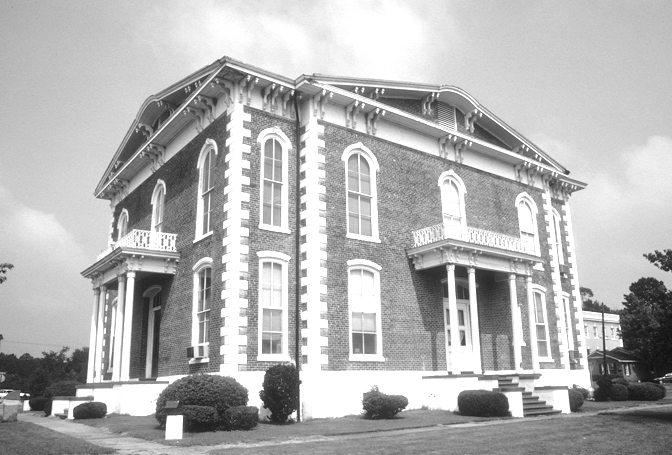
Pickens County Courthouse, 1998, by Calvin Beale for the U.S. Department of Agriculture.

A storm erupted, and a bolt of lightning struck nearby as Henry Wells was hung for his supposed crime, though proclaiming his innocence until the very end. Citizens passing the courthouse the next morning were shocked to see Wells’ visage etched into the pane of the window from which he had peered down on the mob. Frequent washing of the window has not been able to scrub the mysterious image.

As with many legends, there is a mix of fact and fiction at work here. While the image in the window pane is undeniable, the history is confused. Apparently, a lynch mob did gather on the courthouse lawn once, but for a murderer named Nathaniel Pierce. The mob succeeded in lynching Mr. Pierce. Henry Wells was arrested for the arson of the second courthouse, though he was not put to death by a mob. There are also questions as to the actual existence of the windows, which may have been added to the façade sometime after the deaths of both Pierce and Wells.

Sources

  • Higdon, David and Brett J. Talley. Haunted Alabama Black Belt. Charleston, SC: History Press, 2013.
  • Pearce, Jamie Roush. Historic Haunts of the South. Jamie Roush Pearce, 2013.
  • Windham, Kathryn Tucker and Margaret Gillis Figh. 13 Alabama Ghosts and Jeffrey. Tuscaloosa, AL: University of Alabama, 1969.

Pike County

Pace and Shackelford Halls
Campus of Troy University
Troy

Built in 1947 and 1930, respectively, these two residence halls have both been the scene of poltergeist activity. The activity in Shackelford Hall is explained as the product of a young female student’s suicide. Depressed over her fiancée’s death in a war, “Sally Shack,” as tradition identifies her, hanged herself in this building. Rumors state that two female students living here entered their dorm room to find two pens levitating. The incident led the young ladies to vacate their room the following day.

Pace Hall, 2017, by Kreeder13. Courtesy of Wikipedia.

In the 1990s, a few students in one of these dorms decided to play with a Ouija board in an attempt to contact the spirit in Pace Hall. The group succeeded in contacting something after which the terrified girls witnessed “a paper clip tapping on their window from the outside, and things moving around the room.” As a result, the university had the room cleansed to settle the activity, though students continue to encounter activity throughout the buildings.

Sources

  • Brown, Alan. The Haunting of Alabama. Gretna, LA: Pelican Publishing, 2017.
  • Ferrell, Mary. “Ghost stories on campus.” Tropolitan (Troy University). 30 October 2014.

Randolph County

McCosh Mill
McCosh Mill Road
Rock Mills

Though the location is a bit remote, the ruins of this mill have become a popular place for picnicking families and teenagers searching for a thrill. Located on the banks of Wehadkee Creek, this mill possibly dates to the early 1870s when it was constructed by James Eichelburger McCosh, grandson of local industrialist Jacob Eichelburger who built the cotton mills in Rock Mills. The mill, which ground corn into meal and wheat into our, operated until 1958. It was purchased by the U.S. Army Corps of Engineers in 1970 as part of the building of West Point Lake. According to the National Register of Historic Places nomination form, the mill remained standing until vandals set it ablaze. The stone foundation and the mill race are the only remaining features at this site.

The ruins of McCosh Mill, 2015. Photo by Lewis O. Powell, IV, all rights reserved.

This mill figures into lore on both sides of the state line, and there are many stories and much misinformation. A friend of mine, Celeste, and her husband Randy lived near the ruins until recently. The couple would often venture down to the site after dark to enjoy the quiet, and it is here that they have had a few experiences. Randy rode his four-wheeler down to the ru- ins one evening alone, and while he was there felt that something climbed onto the back of the vehicle with him. Fearing what was behind him, he started back home and never looked back. The unsettling feeling did not leave him until the next day.

A photographer and friend of Celeste’s took her children down to Wehadkee Creek to enjoy the water. As they played, the woman took video and photographs. At one point in the video, a woman appears near the children for a split second. After seeing the vid- eo, the startled mother looked over the photographs and saw the same woman in a few of the photographs seemingly watching from the treeline.

The ruins of the mill are located at the end of McCosh Mill Road which begins in Troup County, Georgia and eventually turns into a dirt road. Continue down this road to reach the mill; though proceed with caution as the road is heavily rutted and damaged from recent logging in the area. The site cannot be reached from Alabama.

Sources

  • Floyd, W. Warner & Ellen Mertins. National Register of Historic Places Nomination form for the McCosh Grist Mill. 27 May 1976.
  • Interview with Celeste P., LaGrange, GA. 23 July 2015.
  • Randolph County Heritage Book Committee. Heritage of Randolph County, Alabama. Clanton, AL: Heritage Publishing Consultants, 2000.

Russell County

Elite Café
1501 Fifth Avenue
Phenix City

The Elite Cafe with its infamous parking lot where Albert Patterson was shot. He died near where the historic marker now stands. By Lewis O. Powell IV, all rights reserved.

On the evening of June 18, 1954, as state attorney general nominee Albert Patterson walked to his car parked in the parking lot between the Coulter Building and the Elite Café (pronounced ee-light), he was shot three times. He was able to crawl towards the Coulter Building where he died on the sidewalk. The assailant was never apprehended, though he was most likely associated with the organized crime and the rampant corruption in Phenix City that Patterson had been fighting to destroy.

In the early 20th century, Phenix City had a reputation as the wickedest city in America. Fueled by the influx of soldiers to Columbus, Georgia’s Fort Benning, across the Chattahoochee River from Phenix City, the city had become a haven for prostitution, gambling, alcohol, and other forms of vice. Patterson, a successful lawyer and politician, campaigned on cleaning up the city. Sadly, it took Patterson’s death to spur these changes.

Higdon & Talley report that a gentleman in an old-fashioned suit has been seen in the parking lot and on the sidewalk around the Elite Café and the Coulter Building. Perhaps Patterson is still minding Phenix City hoping it will not return to its sinful ways.

Sources

  • Grady, Alan. “Albert L. Patterson.” Encyclopedia of Alabama. 24 July 2007.
  • Higdon, David and Brett J. Talley. Haunted Alabama Black Belt. Charleston, SC: History Press, 2013.
 

St. Clair County

St. Clair County remains the bane in my side. Despite all the searching, both online and in published sources, I cannot find an adequately sourced haunting within the county. Kelly Kazek describes the Flatwoods Community as “a settlement of freed slaves during Reconstruction” that “was later burned.” Nothing online or in the county heritage book provides information on this community. I have finally come across a haunting from this county! Please see my article on the roadside grave of William Gibson outside Springville.

Shelby County

Old Shelby County Courthouse
1854 Old Courthouse Circle
Columbiana

The oldest remaining courthouse in the state, the Old Shelby County Courthouse has seen a myriad of uses in its long existence. Constructed as a courthouse in 1854, miraculously, this building escaped being burned by Union raiders during the Civil War. The building was used by the county until 1908 when a new courthouse was built nearby. The building was put to use as a hotel and later a boarding house until around 1934 when the public library opened on the second floor. It now serves as a county museum.

Old Shelby County Courthouse, 2016. By Lewis O. Powell IV, all rights reserved.

A spirit reportedly dwells among the artifacts displayed within the old building. In a room on the second floor, the blinds are regularly adjusted by unseen hands. The same room often gives staff members a creepy feeling, and author Alan Brown reports that some workers in the building at night did see a spectral figure in this room. An investigation conducted in 2002 did not turn up any evidence of spiritual activity, though the investigators did have some strange personal experiences.

Sources

  • Brown, Alan. Haunted Birmingham. Charleston, SC: History Press, 2009.
  • Floyd, W. Warner. Nation Register of Historic Places Nomination Form for Columbiana City Hall. 19 July 1974.
  • Reed, Martin J. “Shelby County’s 1854 Old Courthouse in Columbiana gets new address, improvements.” com. 31 January 2013.
  • “Shelby County ghosts busted.” Shelby County Reporter. 24 July 2002.
 

Sumter County

Alamuchee-Bellamy Covered Bridge
Campus of the University of West Alabama
Livingston

The oldest remaining of Alabama’s covered bridges; the Alamuchee-Bellamy Covered Bridge may harbor the spirit of an outlaw. The bridge was originally constructed to span the Sucarnoochee River but was moved to the nearby Alamuchee Creek after its replacement by a concrete bridge. It served automobile traffic there until 1958. The Sumter County Historical Society acquired the bridge in 1971, restored it, and moved the bridge to the campus of the University of West Alabama.

Alamuchee-Bellamy Covered Bridge, 2007, by Mld74. Courtesy of Wikipedia.

The bridge figures into the story of notorious Sumter County Sheri Stephen S. Renfroe. Sometimes known as the “Outlaw Sheriff Renfroe’s notoriety comes from his involvement in murders, leadership in the local Ku Klux Klan, excessive drinking, and embezzlement while in office. Renfroe eventually fled the county, but when he returned he was apprehended by a mob of locals and was lynched either near or on this bridge. A dark shade seen pacing the length of the bridge is believed to be the Outlaw Sheriff Author Alan Brown, a professor at the university who has penned many books on Southern ghosts, stated in a 1994 article that he doesn’t believe the bridge to be haunted.

Sources

  • Alamuchee-Bellamy Covered Bridge. Wikipedia, the Free Encyclopedia. Accessed 16 May 2015.
  • “Bridge harbors legend: Serenity of covered bridge belies dark legend.” Mobile Register. 1 November 2004.
Alabama Hauntings—County by County Part V

Alabama Hauntings–County by County landing page.

One of my goals with this blog is to provide coverage of ghost stories and haunted places in a comprehensive manner. Perhaps one of the best ways to accomplish this is to examine ghost stories county by county, though so far, researching in this manner has been difficult. In my 2015 book, Southern Spirit Guide’s Haunted Alabama, I wanted to include at least one location for every county, though a lack of adequate information and valid sources prevented me from reaching that goal. In the end, my book was published covering only 58 out of 67 counties.

Further research has uncovered information for a few more counties and on Halloween of 2017, Kelly Kazek published an article on AL.com covering the best-known ghost story for every county. Thanks to her excellent research, I’ve almost been able to achieve my goal for the state.

Lee County

Opelika Chamber of Commerce
601 Avenue A
Opelika

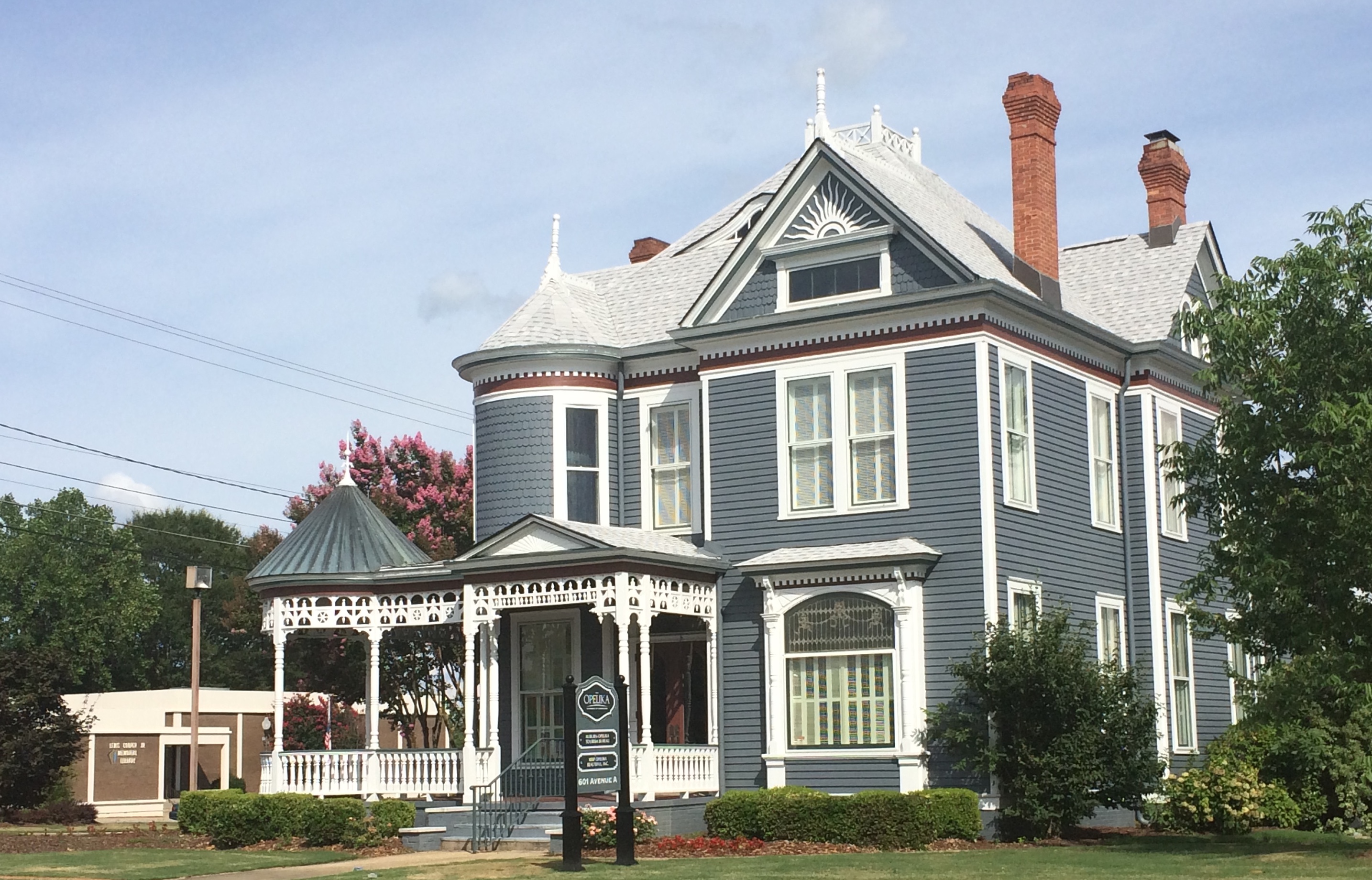
Known also as the Whitfield-Duke-Searcy House for the three families that called this place home, the Opelika Chamber of Commerce may remain the residence of a child’s spirit. Stories from family members reveal that a child may have died in the house in the early 20th century. Chamber staff believes the child may still be in this 1895 home.

Opelika Chamber of Commerce, 2016. Photo by Lewis O. Powell IV, all rights reserved.

Some years ago, three employees witnessed a “bright flash of light” descend the home’s front staircase. Another staff member noticed child-sized footprints in the carpet on the back staircase when no children had been in the house. Chairs and other objects here sometimes playfully move on their own accord.

Sources

  • Hines, Nikolaus. “A young ghost toyingly haunts an old house.” Auburn Plainsman. 17 October 2014.
  • Lee County Heritage Book Committee. Heritage of Lee County, Alabama. Clanton, AL: Heritage Publishing Consultants, 2000.
  • Mission and History.” Opelika Chamber of Commerce. Accessed 29 June 2015.

Limestone County

Houston Memorial Library
101 North Houston Street
Athens

On the morning of New Year’s Eve 1879, former governor George S. Houston awoke from sleep. At that time a senator representing Alabama in Congress, Houston called out, “John, bring me my shoes. I must return to Washington!” He then closed his eyes and passed away.

While Houston did not make it back to Washington, he is believed to remain in his former home. After Houston’s death, his wife lived here until her death in 1909. The house was turned over to the city for use as a library in 1936. One of the reminders that the library was once a former residence is the chiming of the grandfather clock. This chiming occurs on occasion though no grandfather clock exists in the building.

Governor Houston House, 1934, by W.N. Manning for the Historic American Buildings Survey (HABS). Courtesy of the Library of Congress, Prints and Photographs Division.

Two gentlemen within this building installing central air were bothered by something in the attic some years ago. As they worked, they continued to hear a rustling behind them. At one point both men saw something standing near them out of their peripheral vision. When they turned to look directly at the figure it vanished. Exasperated, the pair told the former governor firmly that they were doing no harm. The kindly spirit allowed them to continue unimpeded.

Sources

  • Black, Shane. Spirits of Athens: Haunting Tales of an Alabama Town. NYC: iUniverse. 2009.
  • Rogers, William Warren. “George S. Houston (1874- 78).” Encyclopedia of Alabama. 21 April 2008.

Lowndes County

Marengo
100 North Broad Street
Lowndesboro

Lowndesboro remains a sleepy town, lost in the haze of its past. North Broad Street, lined with historic structures, many of which date to before the Civil War, is, despite its name merely a country road passing through the community. Among those grand 19th century homes is a transplant, Marengo, which was originally built around 1835 in Autauga County but moved here sometime between 1843 and 1847. If local tradition is to be believed, Marengo’s second owner, Dr. Charles Edwin Reese, is responsible for this remarkable collection of antebellum structures surviving the Civil War.

As General Wilson and his Union troops swept through this part of Alabama destroying anything of military importance as well as other property, Dr. Reese met with the general urging him to spare the town as it was suffering an epidemic of smallpox. To provide proof, Dr. Reese brought a patient with a serious rash. Though it was all a ruse, the general was convinced and spared the town.

It seems, however, that despite the good doctor’s work in the community, his wife Sarah was fearful whenever her husband was called out to visit a patient. She never felt safe in her home, regardless of the large, brass lock that her husband had installed on the front door. Like Sarah Reese, the wife of Lindsay James Powell, Jr., a subsequent owner of the home, also felt unsafe in the house. Powell bought a gun for his wheelchair-bound wife Kathleen’s protection and peace of mind. When, in 1961, Powell discovered his wife shot to death in her bed with the same gun at her side. Kathleen Powell’s death was ruled a suicide while evidence pointed to a possible murder.

Marengo, 2012, by Rivers Langley. Courtesy of Wikipedia.

Owners of the home since that time have heard the sound of a woman laughing. A psychic visiting the home confirmed that one of the spirits is that of Kathleen. Another psychic flatly stated that no one that had lived in the home had been happy adding that an additional female spirit haunts the home. The house was donated to the Lowndesboro Landmarks Foundation in 1975 and has been used as an events space for many years.

Sources

  • Brown, Alan. Haunted Places in the American South. Jackson, MS: University Press of Mississippi, 2002.
  • Floyd, W. Warner. National Register of Historic Places Nomination form for Lowndesboro. 1 November 1973.
  • Higdon, David and Brett J. Talley. Haunted Alabama Black Belt. Charleston, SC: History Press, 2013.
  • Windham, Kathryn Tucker. Jeffrey’s Latest 13: More Alabama Ghosts. Tuscaloosa, AL: University of Alabama Press, 1982.

Macon County

Tuskegee National Forest

The smallest national forest in the country, Tuskegee National Forest was created from abused and eroded farmland purchased by the federal government at the height of the Great Depression. Consisting of nearly 11,000 acres, the forest provides recreational opportunities and conservation of natural habitat for the region.

During the Satanic worship scare of the 1980s, rumors spread that teens and young people were engaging in occult rituals deep in the forest here. Higdon and Talley note that some of the spirits raised by these rituals may remain in the more remote woods. Indeed, the forest may also be home to Sasquatch or Bigfoot, as well.

Sources

  • Higdon, David and Brett J. Talley. Haunted Alabama Black Belt. Charleston, SC: History Press, 2013.
  • Tuskegee National Forest.” USDA Forest Service. Accessed 14 June 2015.

Madison County

Huntsville Depot
320 Church Street, Northwest
Huntsville

Huntsville Depot, 2010. by Chris Pruitt. Courtesy of Wikipedia.

The Huntsville Depot has witnessed much of the panoply of railroad history in the area since its construction in 1860. The building has seen the tumult of the Civil War, and a changing transportation picture until its closure as a railroad depot in 1968. It now stands as a museum preserving one of the oldest rail depots in the nation.

As Union troops under Brigadier General Ormsby M. Mitchell swept through North Alabama in 1862, one of his primary objectives was Huntsville and its depot. With the city, Ormsby also captured some 200 ill and wounded Confederate troops. The soldiers were held on the depot’s third floor before being shipped to prisoner of war camps in the North. Graffiti covering the walls preserves some of the experiences of soldiers here.

Visitors and staff within the building have had a variety of experiences. A frequent visitor reported to Alan Brown that she felt a cold spot on the second-floor landing of the staircase. She also described how she and a group of reenactors watched an apparent Confederate soldier peer down at them from a third-floor window. Also on the third-floor, the bust of a Civil War soldier tends to turn on its own accord. A psychic passing through the building described a “cluster of ghosts” within the historic structure.

Sources

  • Brown, Alan. Stories from the Haunted South. Jackson, MS: University Press of Mississippi, 2004.
  • Gray, Jacquelyn Proctor. When Spirits Walk. Bloomington, IN: AuthorHouse, 2006.
  • Madison County Heritage Book Committee. Heritage of Madison County, Alabama. Clanton, AL: Heritage Publishing Consultants, 1998.
  • Penot, Jessica. Haunted North Alabama. Charleston, SC: History Press, 2010.

Marengo County

Gaineswood
805 South Cedar Avenue
Demopolis

Gaineswood can be considered a historical, architectural, and paranormal treasure. According to the home’s National Register of Historic Places nomination form, Gaineswood is considered by many authorities to be one of the grandest and most important American houses built in the antebellum era. Part of the home’s uniqueness is found in its innovative and extraordinary design, which was conceived and realized by the home’s owner and builder, Nathan Bryan Whitfield. A self-taught architect, Whitfield spent much of his time and energy constructing his magnificent Neo-Classical home starting in 1842 and finishing on the eve of the Civil War in 1861.

After having his fortunes nearly wiped out by war, Whitfield sold the home to his son who allowed it to deteriorate. During this time a tree took root in the floor of the dining room, and goats roamed the halls. The house was restored in the 1890s and passed through a few hands before being bought by the State of Alabama in 1966 and opened as a house museum in 1971. Gaineswood was designated as a National Historic Landmark in 1973.

Gaineswood, 1939, by Frances Benjamin Johnston for the Carnegie Survey of the Architecture of the South. Courtesy of the Library of Congress, Prints and Photographs Division.

Besides the architectural importance of Gaineswood, the house is home to a classic Alabama ghost story originally told by Kathryn Tucker Windham. Mrs. Windham contends that after Nathan Whitfield’s wife died, he engaged Evelyn Carter, the daughter of a U.S. Consul to Greece, to care for his children. The delightful young woman was educated, musically inclined, and added a cultural touch to the home and the children’s lives. Unfortunately, she was taken ill and died during a particularly harsh winter. Miss Carter had requested that her body be returned to Virginia where she could be buried in the family cemetery, yet the harsh winter weather would not allow that. Instead, her body was sealed in a wooden casket and placed underneath the stairs until it could be shipped home.

Soon after, Miss Carter’s unhappy spirit began to roam the house noisily expressing her displeasure. Eerie melodies were heard playing on the piano accompanied by the swish of rustling skirts and disembodied voices. Even after Miss Carter’s remains were returned to her home, the spirit has remained in residence, though sources argue if she may have finally left the house.

Sources

  • Hand, Janice P. National Register of Historic Places Nomination form for Gaineswood. 13 September 1971.
  • “The Haunts of Gaineswood Plantation.” Ghost Eyes Most Haunted Places in America <www.GhostEyes.com>. 4 August 2009.
  • Higdon, David and Brett J. Talley. Haunted Alabama Black Belt. Charleston, SC: History Press, 2013.
  • Norman, Michael and Beth Scott. Historic Haunted America. NYC: TOR, 1995.
  • Windham, Kathryn Tucker and Margaret Gillis Figh. 13 Alabama Ghosts and Jeffrey. Tuscaloosa, AL: University of Alabama, 1969.

Marion County

Pikeville
Intersection of CR-21, CR-31, and CR-470

Little remains of the town of Pikeville, a small town built alongside the Jackson Military Road. The town served as the county seat of Marion County from 1820 until 1882, when the seat was moved to nearby Hamilton. The old county courthouse still stands, though it is now a private residence, and the town’s cemetery continues to memorialize the dead of Pikeville. This ghost town may also be populated with ghosts.

Sources

Marshall County

Main Street
Albertville

On April 24, 1908, a tornado roared through northeast Alabama killing some 35 residents and destroying a portion of Albertville including much of Main Street. According to Faith Serafin, there has been quite a bit of paranormal activity reported along Main Street including the spirit of a young boy in khaki knee-pants, a white shirt, and suspenders who has been observed running down the street at night. Residents have seen children wearing period clothing playing on the street in the evenings while business owners have reported the front doors of their businesses opening and closing on their own accord.

Main Street, Albertville, 2012, by Rivers Langley. Courtesy of Wikipedia.

Sources

Mobile County

Phoenix Fire Museum
203 South Claiborne Street
Mobile

Originally located on Conti Street, the old Phoenix Volunteer Fire Company No. 6 building was a state of the art rehouse when it was constructed in 1858. Slightly more than a hundred years later, the neglected building faced demolition for the construction of the Mobile Civic Center. The building was saved by the Mobile Historic Preservation Society, dismantled, and moved to its current location where it now serves as a part of the Mobile Museum of History. Artifacts relating to the history of firefighting within the city are displayed here including antique firefighting vehicles. Not on display, but present within the old building, is a spirit that has been heard stomping around the second-floor and occasionally rifling through an antique secretary located there.

Sources

  • Parker, Elizabeth. Mobile Ghosts: Alabama’s Haunted Port City. Apparition Publishing, 2001.

Monroe County

Rikard’s Mill Historic Park
4116 AL-265
Beatrice

Fleeting shadow figures have been spotted at this mill established in 1845. While the original structure is gone, the current mill, built in the 1860s, has been preserved by the Monroe County Museum. The mill has been probed by paranormal investigators, though little evidence of paranormal activity was uncovered.

Sources

Alabama Hauntings—County by County Part IV

Alabama Hauntings–County by County landing page.

One of my goals with this blog is to provide coverage of ghost stories and haunted places in a comprehensive manner. Perhaps one of the best ways to accomplish this is to examine ghost stories county by county, though so far, researching in this manner has been difficult. In my 2015 book, Southern Spirit Guide’s Haunted Alabama, I wanted to include at least one location for every county, though a lack of adequate information and valid sources prevented me from reaching that goal. In the end, my book was published covering only 58 out of 67 counties.

Further research has uncovered information for a few more counties and on Halloween of 2017, Kelly Kazek published an article on AL.com covering the best-known ghost story for every county. Thanks to her excellent research, I’ve almost been able to achieve my goal for the state.

Geneva County

“Big Oak”
Robert Fowler Memorial Park
South River Street
Geneva

Big Oak, 2006, by AlabamaGuy2007. Courtesy of Wikipedia.

Before the establishment of Geneva County, early settlers gathered under the massive, leafy branches of what is now known as the Big Oak or Constitution Oak. This live oak’s age and size have led to its inclusion in the list of Alabama Famous and Historic Trees. Supposedly the huge branches of the tree have been used for hangings and the spirits of those who died here may continue to haunt this location.

Sources

Greene County

Oakmont Bed & Breakfast
107 Pickens Street
Eutaw

As workers were working on the restoration of Oakmont, a spirit in the house wanted more heat. After continuing to find a heater on in the home, construction workers taped the control knob so that the heat could not be turned on. However, the spirit thought otherwise and turned the heat on again.

Built in 1908 as a wedding gift for Mary Elizabeth and Charles Alexander Webb, it was not until Oakmont began the transformation into a bed & breakfast that the owners discovered that they might have to share the house with spirits. After the restoration, numerous spectral sounds began to be heard including tremendous crashes and disembodied footsteps. It doesn’t appear that this bed and breakfast is open any longer.

Sources

  • Smith, Terry L. and Mark Jean. Haunted Inns of America. Crane Hill Publishers, 2003.

Hale County

Moundville Archaeological Park
634 Mound State Parkway
Moundville

Between approximately 1120 C.E. and 1450 C.E., Moundville was the site of a large city inhabited by the Mississippian people, predecessors to the tribes that the Europeans would encounter when they began exploring the South about a century later. At its height, this town was probably home to nearly 1,000 inhabitants. Stretching to 185 acres, the town had 29 mounds of various sizes and uses: some were ceremonial while others were topped with the homes of the elite.

Visitors and staff have often mentioned a certain energy emanating from this site. A Cherokee friend of mine visited and while atop one of the mounds let out a traditional Cherokee war cry. Afterward, he noted that there was a palpable change in the energy. Dennis William Hauck speaks of the “powerful spirit of an ancient race” that “permeates this 317-acre site.” Southern Paranormal Researchers notes that park staff has witnessed shadow figures, odd noises, and doors opening and closing by themselves in the buildings on the site. Higdon and Talley add orbs and cold spots found throughout the location to the list of paranormal activity here.

Sources

  • Blitz, John H. “Moundville Archaeological Park.” Encyclopedia of Alabama. 26 February 2007.
  • Hauck, Dennis William. Haunted Places: The National Directory. NYC: Penguin, 2002.
  • Higdon, David and Brett J. Talley. Haunted Alabama Black Belt. Charleston, SC: History Press, 2013.
  • Southern Paranormal Researchers. Paranormal Investigation Report for Moundville Archaeological Park. 10 February 2007.

Henry County

Legend of Huggin’ Molly
Abbeville

For over a century, a legend has dwelled in the dark streets of Abbeville: the legend of Huggin’ Molly. This specter is thought to target children on the streets after dark. Most versions describe Molly as a large woman who prowls the dark streets in search of children walking alone. After pursuing a child, she would embrace them and scream in their ear. Most sources agree that this tale was perhaps created to frighten small children and keep them from staying out too late, though the story has remained. In fact, a restaurant named after the legendary figure has recently opened.

Sources

  • Legend of Huggin’ Molly.” Huggin’ Molly’s Restaurant. Accessed 13 July 2015.
  • Smith, Michelle. Legends, Lore and True Tales of the Chattahoochee. Charleston, SC: History Press, 2013.

Houston County

Columbia Manor
306 South Main Street
Columbia

During the Halloween season, this unassuming white frame house is home to nightmares of the fictional kind. However, this house is home to real nightmares as well. Built in 1864, this home has served several uses including serving as a hospital and later a sanitarium for those suffering from pellagra, a severe vitamin deficiency.

Following renovations to transform the house into a haunted attraction, the spirits have begun to act out. The owner of the house told the producers of the BIO Channel show, My Ghost Story, about tools that would go missing only to be found in their original location a short time later, mysterious footsteps, and the shade of an older gentleman that the owner and another volunteer saw standing in the house. He also mentioned the swinging of a chandelier in the foyer which a paranormal investigator has linked to the suicide by hanging of a nurse there.

Sources

  • “Enter at your own risk; they dare you.” Dothan Eagle. 18 August 2014.
  • “Haunting Columbia Manor.” Dothan Eagle. 19 October 2013.
  • My Ghost Story, Episode 3.3. Biography Channel. 29 October 2011. 

Jackson County

Russell Cave National Monument
3728 CR-98
Bridgeport

One of the most significant archaeological sites in the state, Russell Cave has revealed evidence that this site has been in use by humans for at least 8,000 years. That evidence includes human remains, pottery shards, spear points, arrowheads, and charcoal from ancient fires. The remains of various animals, including some prehistoric species, have also been unearthed here.

Entrance to Russell Cave, 2014, by Fredlyfish4. Courtesy of Wikipedia.

Within the cave, some visitors have experienced an uneasy feeling, sometimes even sensing ghostly presences while others have heard spectral sounds and seen apparitions. With thousands of years of human occupation, it’s no surprise that spirits remain here.

Sources

  • Kidd, Jessica Fordham. “Russell Cave.” Encyclopedia of Alabama. 22 September 2010.
  • Penot, Jessica. Haunted North Alabama. Charleston, SC: History Press, 2010.

Jefferson County

Bessemer Hall of History Museum
1905 Alabama Avenue
Bessemer

While the Bessemer Hall of History Museum displays an eclectic mix of items from Bessemer’s past, including a cell door from the local jail where Martin Luther King, Jr. was briefly incarcerated, it appears that a former exhibit may still be haunting this building. For many years, the museum displayed the mummy of a local woman who had taken her life in 1906. Hazel Farris shot and killed her husband during a domestic incident at their home in Louisville, Kentucky. After neighbors summoned the police, Farris shot and killed three of them and fled the state.

Beautiful Hazel settled in Bessemer and confessed her crimes to a man with whom she had fallen in love. He betrayed her to the police, and Hazel ingested arsenic, ending her life. Her corpse was sent to a local funeral home which only put the unclaimed body in storage where it mummified. The funeral home began to charge admission to view the grisly final remains of Miss Farris, and over the course of many years, the mummy was loaned to various exhibitors. In 1974, the museum borrowed the mummy as part of a fundraiser, and the museum displayed it for quite some time.

Southern Railway Depot (now home to the Bessemer Hall of History Museum), 1992, by Jet Lowe. Photo taken for the Historic American Buildings Survey (HABS), courtesy of the Library of Congress, Prints and Photographs Division.

After the mummy’s exhibition in 1981, the museum placed it in permanent storage. National Geographic produced a documentary about Hazel’s corpse in 2002 with various scientists examining it before it was eventually cremated. The old train depot that has housed the museum since 1994 has had some paranormal activity through the years, some of which has been attributed to Hazel. Lights turn off and on within the old building, and other odd sounds have been heard.

Sources

Lamar County

Old Stage Coach Inn
Jackson Military Road
Moscow

Also known as the Moore-Hill House, this circa 1834 stagecoach stop was the scene of a murder in 1881. A Mrs. Armstrong was killed by an African-American man with a grappling hook on a chain. After the gruesome killing, the cook ran out the back door and alerted the men working in the nearby fields. The supposed murderer was hunted down and lynched in the front yard. This event is believed to be the cause of paranormal activity in and around the house. Tradition speaks of a glowing orb that is seen in the front yard and the spirit of Mrs. Armstrong clanking down the stairs with the hook and chain that killed her.

When I initially wrote the above entry for my book way back in 2015, I struggled with how little information existed about this house and the grim murder that took place here. As I was visiting the library yesterday, I decided to take a second look at the research for this particular location. Evidently, I didn’t look hard enough the first time.

Situated on Andrew Jackson’s Military Road, a route constructed after the War of 1812 connecting Nashville, Tennessee with New Orleans, the Moore-Hill House was built for James Moore, an early politician in the state. For many years the house served as a stagecoach inn, but it was an incident in 1881 that gave the house a notorious reputation. According to family legend, a Mrs. Armstrong was killed by an African-American man with a grappling hook on a chain. After the gruesome killing, the cook ran out the back door and alerted the men working in the nearby fields. The supposed murderer was hunted down and lynched in the front yard. After consulting newspapers of the period, the events did not take place exactly as family memory recalls.

Two brief reports appearing in area newspapers in December of 1881 attest that the murder was bloodier that family legend recounts. An African-American man (described in one newspaper as a “crazy negro”) attempted to seize one of the Armstrong children. The child’s mother, Mrs. Winchester Armstrong, and her mother tried to wrestle the child away and both were killed. The newspaper reports that the child’s mother was struck in the head with an ax. Moments later, Mr. Armstrong approached and shot and killed the assailant.

Sources

  • “A heart-rending murder…” Pickens County Herald and West Alabamian (Carrollton, AL). 7 December 1881.
  • Hill, Beulah and Pat Buckley. “History.” Accessed 6 June 2015.
  • “Horrible murder of two women by a crazy negro.” The Marion Times-Standard. 14 December 1881.
  • Kazek, Kelly. “Few historic stagecoach inns and taverns survive across Alabama, take a tour.” com. 14 August 2014.
  • Lamar County Heritage Book Committee. Heritage of Lamar County, Alabama. Clanton, AL: Heritage Publishing Consultants, 2000.

Lauderdale County

Forks of Cypress
Jackson Road
Florence

Crowning a hill above Jackson Road are the skeletal remains of the graceful Forks of Cypress, built in the latter half of the 1820s. Until it burned in June 1966, the house was known as one of the grandest homes in the area. James Jackson, an Irish-born venture capitalist who moved to the area in 1818 and is considered the founder of the city of Florence, constructed the home.

Ruins of Forks of Cypress, 2010, by Carol M. Highsmith. Courtesy of the George S, Landreggar Collection of Alabama Photographs in Carol M. Highsmith’s America, Library of Congress, Prints and Photographs Division.

Even before a conflagration destroyed the house, it was known to be haunted, and spirits may continue to roam the picturesque ruins. The Jackson family cemetery not far from the house has also seen some paranormal activity. Debra Johnston records an incident whereby a visitor to the cemetery one afternoon encountered a young man on horseback. As he talked with the strange young man, he realized the young man was one of the sons of James Jackson. The visitor was astonished when he shook hands with the man and watched him vanish before his eyes.

Southwest of the ruins, a bridge spanned Cypress Creek until its recent demolition. Known as “Ghost Bridge,” the bridge was associated with a typical crybaby bridge story. The woods near the bridge, tradition holds, are supposed to be haunted by a spirit carrying a lantern, a possible holdover from a skirmish fought here during the Civil War.

Sources

  • Farris, Johnathan A. & Trina Brinkley. National Register of Historic Places Nomination Form for Forks of Cypress. 2 May 1997.
  • Johnston, Debra. Skeletons in the Closet: True Ghost Stories of the Shoals Area. Debra Johnston, 2002.

Lawrence County

Henry Hill
CR-25
Mount Hope

Almost as common as Cry Baby Bridges throughout the South are “Gravity Hills;” roads or hills where a car put in neutral will seemingly be pushed up an incline. Along County Road 25, just outside of the community of Mount Hope, is a dip in the road where legend has it a man named Henry was killed. Most legends have Henry’s car breaking down along this road and him trying to push it out of the way when he was struck and killed by another vehicle. When a car is stopped here, Henry still dutifully pushes the car to safety to prevent another driver from having to endure a similar end.

Sources

Alabama Hauntings—County by County, Part III

Alabama Hauntings–County by County landing page.

One of my goals with this blog is to provide coverage of ghost stories and haunted places in a comprehensive manner. Perhaps one of the best ways to accomplish this is to examine ghost stories county by county, though so far, researching in this manner has been difficult. In my 2015 book, Southern Spirit Guide’s Haunted Alabama, I wanted to include at least one location for every county, though a lack of adequate information and valid sources prevented me from reaching that goal. In the end, my book was published covering only 58 out of 67 counties.

Further research has uncovered information for a few more counties and on Halloween of 2017, Kelly Kazek published an article on AL.com covering the best-known ghost story for every county. Thanks to her excellent research, I’ve almost been able to achieve my goal for the state.

Crenshaw County

Patsburg Bridge
AL-59 over Patsaliga Creek
Patsburg

An article from the Greenville Advocate notes that some possible paranormal activity has been experienced at this bridge. A few people have captured odd images, including orbs, in photographs taken here. One witness interviewed for the paper reported that a couple of people had died here as well as a body being discovered by a fisherman in the water below the bridge.

Sources

  • “Ghosts in Patsburg.” Greenville Advocate. 9 July 2009.

Cullman County

Crooked Creek Civil War Museum and Park
516 CR 1127
Vinemont

When he purchased this land, Fred Wise, the creator of the Crooked Creek Civil War Museum and Park, didn’t know its significance. Over time, Mr. Wise, who has a massive collection of Civil War relics and memorabilia, has uncovered the site’s story as the scene of the Battle of Crooked Creek.

Union Colonel Abel Streight conducted a campaign in Northern Alabama to cut o the Western & Atlantic Railroad in late April and May of 1863. As he and his men moved steadily towards Rome, Georgia via Gadsden, Streight and his men were dogged by Confederate forces under General Nathan Bedford Forrest. On April 30, after an engagement at Day’s Gap, forces skirmished here at Crooked Creek. The Union forces would push through, and on May 3 near Cedar Bluff in Cherokee County, they surrendered to Forrest’s Confederate forces. Afterward, Streight and many of his men faced imprisonment at Richmond, Virginia’s notorious Libby Prison.

Fred Wise has preserved much of the battlefield, making it accessible with walking trails and informational signage. Visitors trooping through the area have encountered several apparitions from both sides including a bleeding Confederate who begs for help. On the front lawn in front of the museum, a Union soldier has been spotted strolling with his rifle. Paranormal investigators took an infrared photograph of the ridge where part of the battle occurred which seems to show a line of soldiers near where Union soldiers held their ground.

Sources

  • Herbert, Keith S. “Streight’s Raid.” Encyclopedia of Alabama. 30 October 2007.
  • Langella, Dale. Haunted Alabama Battlefields. Charleston, SC: History Press, 2013.

Dale County

Claybank Log Church
East Andrews Avenue
Ozark

The log Claybank Church was once like many other churches throughout the state of Alabama, though today, it is a rarity. So many log churches have been destroyed by fire or by neglect, that the Claybank Church is now unique, having been restored and maintained, despite not being regularly used. Here the early settlers at Claybank Creek built their church around 1830 and buried their dead in the field surrounding the building. The original structure was replaced in 1852 and that building has survived the turmoil of the Civil War, as well as the neglect that followed the church’s move to more populous Ozark. The church was acquired by the Claybank Memorial Association in the 1960s and was thoroughly restored in 1980.

A baby crawls on the floor of the old Claybank Church, 2016. Photo by Katie Pollack, courtesy of Wikipedia.

In 2005, Carol Gilmer, owner and operator of the International Institute of Clinical Research (IIRC), a company that conducts research trials for drug manufacturers, began leasing space in Claybank Plaza, a property that backs up to the Claybank Church cemetery. Gilmer and her employees began to have strange experiences in the building. Voices and tinkling bells were heard when the building was empty; a heavy lab manual casually threw itself off a shelf in an empty room; and staff members saw shadow-like figures moving through the office. Gilmer’s interest in these odd incidents led her to write a book, The Ghosts of Claybank, where she connects the activity squarely to this historic church and cemetery.

Sources

  • “Claybank Log Church at Ozark added to the prestigious register.” Columbus Ledger-Enquirer. 16 December 1976. In Dale County–Claybank Church file, Alabama Department of Archives and History, Montgomery, Alabama.
  • Gilmer, Carol. The Ghosts of Claybank. Createspace, 2013.

Dallas County

Vaughan-Smitherman Museum
109 Union Street
Selma

The Vaughan-Smitherman Museum has witnessed the panoply of Selma history with much of that history occurring within its halls. Built in 1847 as a school by the local Masonic lodge, this building served as a hospital during the Civil War and later as a public hospital between 1911 and 1960. Just after the Civil War, the building became the Dallas County Courthouse and then served as a military academy around the turn of the 20th century. After the building sat vacant for a few years, it was converted into a local history museum.

Vaughan-Smitherman Museum, 2008. Photo by Altairisfar, courtesy of Wikipedia.

As a new museum employee was being given a guided tour some years ago, she made a somewhat disparaging remark near a portrait of William Rufus King, a Vice President of the United States from Selma. A moment later, a glass globe on a lamp nearby slammed down in its setting. After that, whenever the new employee entered, she made sure to greet the former vice president. Throughout the historic structure, footsteps are heard, toilets flush by themselves, the elevator seems to run when it’s not called, and the lights flicker mysteriously.

Sources

  • Alabama Ghost Trail. “Vaughan-Smitherman Museum.” YouTube. 20 July 2009.
  • Floyd, W. Warner. National Register of Historic Places for the Dallas County Courthouse. 13 May 1975.
  • Higdon, David and Brett J. Talley. Haunted Alabama Black Belt. Charleston, SC: History Press, 2013.
  • “Paranormal weekend at landmark.” Selma Times-Journal. 24 June 2009.

DeKalb County

Hitching Post
6081 AL-117
Mentone

The Hitching Post, 2010, by Carol M. Highsmith. Courtesy of the George S, Landreggar Collection of Alabama Photographs in Carol M. Highsmith’s America, Library of Congress, Prints and Photographs Division.

One of the centerpieces of the scenic, mountain town of Mentone is the Hitching Post. Now housing a collection of businesses including a realty company and Crow’s Nest Antiques, this building was originally constructed in 1898 as a general store. Over the years the building has housed many businesses, including a popular dance hall on the second floor. Perhaps the female wraith spotted on the second floor here dates from that period.

Sources

  • Collard, Deborah. Haunted Southern Nights, Vol. 3: History and Hauntings of the Mentone Area. Deborah Collard, 2008.
  • Jones, Brian S. “Mentone: A Mountaintop Treasure.” The Official Travel Site of Alabama. Accessed 29 May 2015. 

Elmore County

Robinson Springs United Methodist Church
5980 Main Street
Millbrook

This community of Robinson Springs has mostly been swallowed by the bustling town of Millbrook. The community’s Methodist church gracefully faces the bare wall of a CVS Pharmacy, but the church still greets members. In fact, some of the church’s members may have never left the building.

Robinson Springs United Methodist Church, 2010, by Chris Pruitt. Courtesy of Wikipedia.

Methodists from the local area first organized around 1828, within the first decade of the state’s existence, and constructed a rude log church for services near here. With the growth of the area and a donation of land, the current church was constructed in the latter half of the 1840s. Amazingly, the church has seen few alterations from its original form. Perhaps the few changes may be a contributing factor in the church being haunted.

While churches often have paranormal activity, it is rare for pastors to call in paranormal investigators seeking answers. After hearing reports from a number of church members of the many strange goings on here, the pastor invited Southern Paranormal Researchers to investigate. According to a 2007 article in the Montgomery Advertiser, the group began experiencing odd activity within five minutes if their arrival.

Activity at the historic church runs the gamut from distracting things like the sanctuary’s sound system turning off and on during services to doors opening and closing on their own. Often, sounds will be heard from empty rooms including what sounded like a television during an investigation. When investigators searched for the source of the sounds, no television was found.

Sources

  • Mertins, Ellen and Barry Loveland. National Register of Historic Places Nomination Form for Robinson Springs United Methodist Church. September 1981.
  • Mullinax, Kenneth. “Spooked: Area’s scary sites have chilling tales.” Montgomery Advertiser. 31 October 2007.
  • Pritchard, Griffin. “Southern Paranormal Researchers chase ghosts and bust stereotypes.” Montgomery Advertiser. 14 July 2007.

Escambia County

Fort Crawford Cemetery
Snowden Street
East Brewton

In 2009 while searching for the exact location of Fort Crawford, archaeologists found nothing near East Brewton Baptist Church, where the fort was thought to have stood. A trench dug near the church produced nothing that indicated the presence of the log fort that once commanded the area a few years before the creation of the state in 1819. Finding information regarding the resident specters of the Fort Crawford Cemetery, and even just information on the fort itself, has been just as fruitless.

Surprisingly, the Escambia County heritage book provides nothing on Fort Crawford, though an article on Dale Cox’s excellent website, Exploring Southern History, provides a sketch of the fort’s history. A fort was constructed on a bluff over Murder Creek after the Creek War of 1813-1814 to monitor the activities of local Muscogee/Creek people and the Spanish in Florida to the south. Fort Crawford Cemetery, located near the believed site of the fort, may date to that period.

Reports of paranormal activity from the cemetery include the shade of a Confederate soldier who may prowl the grounds. Another encounter involved a pedestrian passing through the cemetery who was seized by a shadow figure. A 2011 video posted on YouTube from Paranormal Productions notes that the soldier is known to approach people asking, “Where is my bayonet?” The video also mentions the apparition of a young girl in a white dress seen here as well.

Sources

Etowah County

CSX Railroad—Coosa River Bridge
CSX Railroad over the Coosa River
Between the Memorial and the Meighan Bridges
Gadsden

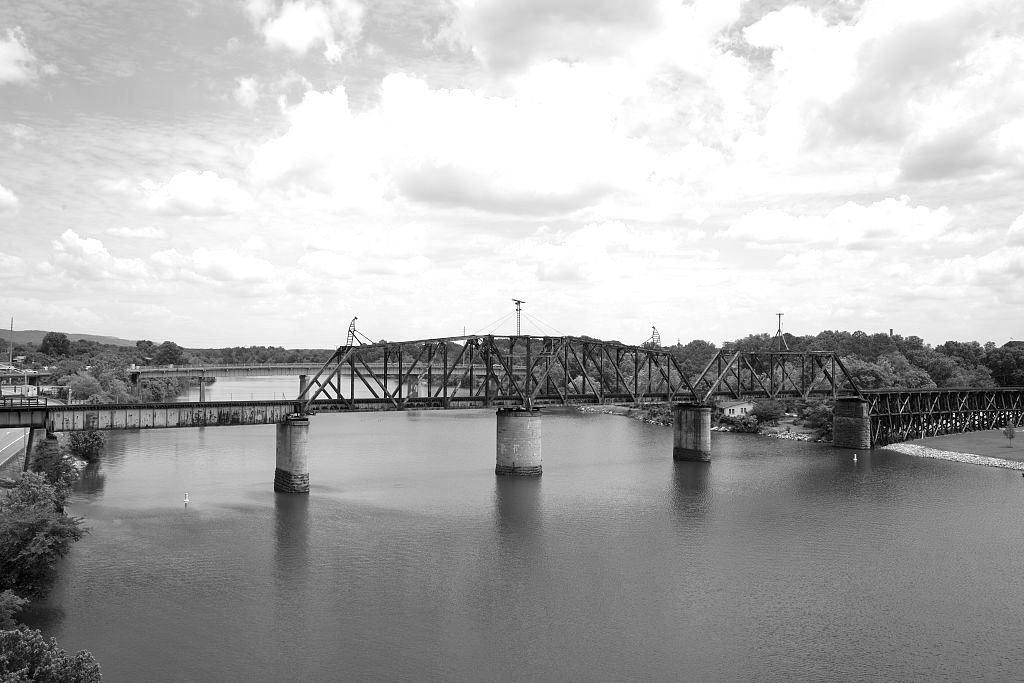
This current bridge was constructed in 1909 to replace the original railroad trestle that was built here in the 1880s. Initially, both bridges provided passage for trains as well as pedestrians and private vehicles. With the construction of the nearby Memorial Bridge in 1927, the trestle has been used solely for railroad traffic. CSX owns the bridge; please do not risk a trespassing charge.

Mike Goodson notes that in 1909 after the bridge’s construction, it was the scene of paranormal activity. An “unusual ghostly light” was observed near the middle of the bridge while passersby on the bridge at night heard disembodied sobbing. Apparently, one death occurred during the bridge’s construction, but Goodson fails to mention an even more tragic event that took place on the original trestle in 1906.

Coosa River and the CSX Bridge at Gadsden, 2010, by Carol M. Highsmith. Courtesy of the George S, Landreggar Collection of Alabama Photographs in Carol M. Highsmith’s America, Library of Congress, Prints and Photographs Division.

After the rape and murder of a white woman outraged locals gathered outside the city jail. The mob eventually demanded that the African-American suspects be handed over to them so that “justice” could be enacted. The mob seized Bunk Richardson, one of the suspects. He was dragged to the railroad trestle where the mob’s perverted justice was achieved at the end of a rope. Photographers captured two images of Richardson after the lynching that remain as reminders of this tragic event. Perhaps it is Richardson’s innocent spirit that returns as the light and disembodied sobbing.

Sources

  • Goodson, Mike. “Bridge on the river Coosa helped ease traffic flow.” Gadsden Times. 7 March 2006.
  • Goodson, Mike. Haunted Etowah County. Charleston, SC: History Press, 2011.
  • Thornton, William. “Lynching a dark chapter in city his- tory.” Gadsden Times. 10 February 2000.
  • Thornton, William. “Lynching only a vague memory.” Gadsden Times. 14 February 2000.

Fayette County

Musgrove Chapel Methodist Church
CR 21, North
Winfield

Within this rural church cemetery, the grave of Robert Lee Musgrove, a descendant of the family that founded this church, is said to bear the image of Musgrove’s wife-to-be. Musgrove, a train engineer for the St. Louis and San Francisco Railroad running the line between Memphis, Tennessee, and Amory, Mississippi, was killed in an accident between Holly Springs and Potts Camp, Mississippi in 1904. There two trains collided killing five railroad employees after an operator in Holly Springs made a mistake and sent a second train onto the occupied line. Tradition says that at the time of his death, Musgrove was engaged to be married, and his funeral took the place of his wedding. Sometime after that, parishioners noticed that the image of a kneeling woman appeared on his stone, perhaps bearing the countenance of his fiancée.

Sources

  • Robert Lee Musgrove, Musgrove Cemetery, Fayette County, Alabama.” Find-A-Grave. Accessed 12 July 2015.
  • Taylor, Troy. Beyond the Grave: The History of America’s Most Haunted Graveyards. Alton, IL: Whitechapel Press, 2001.
  • Windham, Kathryn Tucker. Jeffrey’s Latest 13: More Alabama Ghosts. Tuscaloosa, AL: University of Alabama Press, 1982.

Franklin County

Dismals Canyon
901 CR 8
Phil Campbell

Legends abound throughout the beguilingly beautiful and remote Dismals Canyon. Despite its name—which is believed to have been granted by Scots-Irish settlers after a ruggedly beautiful spot in Scotland called “Dismals”—this sandstone gorge is a paradise with rock formations, waterfalls, champion trees, an amazing array of biological diversity, and gnat larvae that give off a luminescence at night called “dismalites.” Historically, this place was known to local Native Americans who may have hunted and conducted ceremonies in this mystical place.

Rainbow Falls in Dismals Canyon, 2007, by RBharris. Courtesy of Wikipedia.

In 1838, as the Native Americans of the southeast were being rounded up to be marched westward on what would become known as the Trail of Tears, Chickasaw and Cherokee may have been herded into the canyon here under guard from Federal troops. It is possible that one of the legends may relate to this time. After the death of her lover, an Indian maiden threw herself from the top of a bluff known as Weeping Bluff. Supposedly her image was etched upon the bluff following her death and it continues to weep for her and the Chickasaw who were removed from their homeland.

Attracted by the remoteness of this spot, outlaws may have hidden here. Local legends insist that the gorge may have hidden Vice President Aaron Burr on the lam after his infamous duel with Alexander Hamilton as well as bank robber Jesse James. Among the dusky paths and rocks of Dismals Canyon the spirits of these outlaws and Native Americans may still roam.

Sources

  • Franklin County Heritage Book Committee. The Heritage of Franklin County, Alabama. Clanton, AL: Heritage Publishing Consultants, 1999.
  • Kazek, Kelly. “The best-known ghost tale from each Alabama county.” AL.com. 25 October 2017.
  • Morris, M. Scott. “’Fairytale Land’: Alabama’s Dismals Canyon a place out of time.” Daily Journal (Tupelo, MS). 30 July 2017.
  • Ress, Thomas V. “Dismals Canyon.” Encyclopedia of Alabama. 7 November 2011.

Alabama Hauntings—County by County, Part II

Alabama Hauntings–County by County landing page.

One of my goals with this blog is to provide coverage of ghost stories and haunted places in a comprehensive manner. Perhaps one of the best ways to accomplish this is to examine ghost stories county by county, though so far, researching in this manner has been difficult. In my 2015 book, Southern Spirit Guide’s Haunted Alabama, I wanted to include at least one location for every county, though a lack of adequate information and valid sources prevented me from reaching that goal. In the end, my book was published covering only 58 out of 67 counties.

Further research has uncovered information for a few more counties and on Halloween of 2017, Kelly Kazek published an article on AL.com covering the best-known ghost story for every county. Thanks to her excellent research, I’ve almost been able to achieve my goal for the state.

Chilton County

Refuge Bridge
County Road 32 over Walnut Creek
Clanton

Stories of this rural, one lane bridge being haunted have spread across the internet for years. The only published source on this bridge, Rich Newman’s 2016 Haunted Bridges, appears to draw from these unverified reports. Visitors to the bridge at night are supposed to encounter ghost lights and a malevolent spirit that has been known to pursue those who dare to step out of their cars.

Sources

  • Newman, Rich. Haunted Bridges. Woodbury, MN: Llewellyn, 2016.

Choctaw County

Tombigbee River
Near Pennington

Year after year in the early spring, law enforcement near Pennington receives calls about a boat burning on the river. There was a boat that burned on the river near here in a spectacular fire in 1858, the famous Eliza Battle. The river had begun its annual journey outside its banks when the Eliza Battle set its course from Columbus, Mississippi to Mobile loaded with cotton and many passengers. Mrs. Windham describes the journey as starting on a gay note with a band playing as the ship steamed out of Columbus. As evening descended, fireworks were launched, but the weather soon deteriorated.

Tombigbee River below Moscow Landing in 1888, near the site of the Eliza Battle’s demise. Photo by Eugene Allen Smith.

The New York Times notes that a fire broke out around 2 AM on March 1st among the bales of cotton in the ship’s cargo hold. Spreading quickly, the fire severed the ship’s tiller rope rendering the vessel rudderless. As it burned, the boat drifted into the submerged forest along the banks of the river. Some of the passengers were able to grab onto the branches of the submerged trees while many others jumped into the frigid waters. Locals near the river were roused by the screams of the passengers and quickly organized to offer aid. The exact number of lives lost is still not known, but it estimated to be between 25 and 50. However, the burning Eliza Battle still reappears accompanied by the panicked screams of its passengers to remind us of the tragedy.

Sources

  • “Area rich in ghost stories, folk lore.” Demopolis Times. 30 October 2008.
  • “Burning of the Steamer Eliza Battle.” New York Times. 12 March 1858.
  • Higdon, David and Brett J. Talley. Haunted Alabama Black Belt. Charleston, SC: History Press, 2013.
  • Ward, Rufus. “Ask Rufus: Ghosts of the Tombigbee.” The Dispatch (Columbus, MS). 25 October 2014.
  • Windham, Kathryn Tucker and Margaret Gillis Figh. 13 Alabama Ghosts and Jeffrey. Tuscaloosa, AL: University of Alabama, 1969.

Clarke County

Mount Nebo Cemetery
Mount Nebo Road

The Alabama Ghost Trail website lists this rural cemetery as being haunted, though it seems that it may just be especially creepy. This cemetery features four unique gravestones created by local African-American inventor and “brilliant recluse” Isaac Nettles. In these gravestones for family members, Settles includes a “death mask” of the deceased and, in the case of his wife’s grave, the visages of their daughters. These faces, made from impressions done while the subjects were alive, appear to press through from inside the concrete markers. These markers are listed on the National Register of Historic Places and are at the heart of the folk art tradition in this state.

Sources

  • Ghost Trail.” SW Alabama Regional Office of Tourism and Film. Accessed 25 May 2015.
  • Semmer, Blythe and Trina Brinkley. National Register of Historic Places Nomination form for the Isaac Nettles Gravestone. 24 August 1999.

Clay County

Hudson House (private)
Ashland

This abandoned farmhouse is not unlike the quietly decaying abandoned homes and buildings that line Southern byways, except that it is the only well-known haunting in this rural county. Constructed in 1905, this home was built by Charles and William Hudson for their brother, John. Visitors to the home have encountered the sounds of a baby crying, growling, and odd sounds emanating from within the empty house. While the address of this home has been widely publicized, please note that visiting this house without permission of the landowners does constitute trespassing.

Sources

Cleburne County

Bald Rock Group Lodge
Cheaha State Park
19644 AL-281
Delta

Nestled within the state’s oldest continuously operating state park, the Bald Rock Group Lodge was constructed as part of several park features built by workers of the New Deal-sponsored Civilian Conservation Corps in 1939. This historic structure was probed for paranormal activity by the Oxford Paranormal Society in 2007. The group captured some audio and video evidence including a replace lighting up mysteriously. Members of the investigative team also witnessed a door opening and then slamming shut by itself. This door was found to be dead bolted when the team examined it moments later.

Sources

  • Oxford Paranormal Society. Paranormal Investigation Report for Bald Rock Lodge—Mt. Cheaha. Accessed 21 May 2015.
  • Ress, Thomas V. “Cheaha State Park.” Encyclopedia of Alabama. 6 April 2010.
 

Coffee County

Old Coffee County Jail
329 Putnam Street
Elba

By their natures, jails and prisons often hold negative energy. As places of confinement, these places absorb the negative energy and attitudes from the criminals held here. The suicides and murders that sometimes take place within the walls of these facilities add to the negativity that accumulates. The Old Coffee County Jail has been the scene of several tragedies including suicides and the murder of the county sheriff here in 1979.

Built in 1912, this building served Coffee County for many decades until a flood in 1990 led to its closure. On the morning of March 1, 1979, as Sheriff C. F. “Neil” Grantham arrived for work, a young man approached and shot him three times, killing him just outside the building. The shooter was later apprehended and originally sentenced to death, though he was able to get his sentence commuted to life imprisonment.

Tragedy still haunts the halls of the jail which have been investigated by R.I.P. Investigations. Investigators have caught EVPs within the building as well as communicated with spirits through the use of a Spirit Box. One investigator encountered a malevolent entity which left three long scratches on his back.

Sources

Colbert County

Colbert Ferry Park
Natchez Trace Parkway Milepost 327.3
At the Tennessee River
Cherokee

As the Natchez Trace passed through the territory of the Chickasaw, a pair of native brothers and chiefs, George and Levi Colbert, set up “stands” or inns and a ferry across the river to provide for travelers. Later, the brothers’ surname would be used to name this county. The site of George Colbert’s stand and ferry is now Colbert Ferry Park.

Fire destroyed the stand many years ago, and nothing remains but spiritual activity. Here visitors have had their hair and clothing tugged, and they have heard disembodied voices. Author Bud Steed and his wife experienced some of this activity when they visited in 2011. Around the site, the woods continue to stalked by native spirits, and spectral canoes have been observed on the river.

Sources

  • Crutchfield, James A. The Natchez Trace: A Pictorial History. Nashville, TN: Rutledge Hill Press, 1985.
  • Steed, Bud. Haunted Natchez Trace. Charleston, SC: History Press, 2012.

Conecuh County

Castleberry Bank Building
Corner of Cleveland Avenue and West Railroad Street
Castleberry

Those who have been inside this building in the small town of Castleberry remark that there is a heaviness in the air. Lee Peacock, a local reporter and blogger, noted that the building gave him and the investigative team with him a sense of “claustrophobia.” Perhaps the feeling of dread and terror felt by a bank president during the Great Depression still pervades this place where he took his life.

The scent of cigar smoke and the low, muffled voices of men talking still cling to the air here. Originally constructed as a bank and serving later as a post office and town museum, the building is currently closed.

Sources

Coosa County

Oakachoy Covered Bridge site
Covered Bridge Road
Equality

Travelers on the road from Rockford, the seat of Coosa County, to Dadeville forded Oakachoy Creek here for decades. To aid travelers in crossing the creek, a small covered bridge was built here in 1916 and carried traffic across the creek until vandals burned the picturesque bridge in 2001.

While the bridge still stood, legend spoke of an African-American man being hung on this bridge. As a result of this heinous act, odd things would happen to vehicles parked on the bridge including door handles being shaken and engines dying inexplicably. With the loss of the bridge, this activity has expanded to the land around the bridge site and may include a shadow figure making its way through the forest.

Sources

  • Newman, Rich. Haunted Bridges. Woodbury, MN: Llewellyn, 2016.

Covington County

Old Covington County Jail
Behind the Covington County Courthouse
101 North Court Square
Andalusia

In contrast to the grace of the grand, Beaux Arts-style Covington County Courthouse, the building that once housed the jail is severe and linear, perhaps belying its residents’ fall from grace. The building is angular with a few Italianate touches to soften its harsh lines. The jail’s construction followed the completion of the courthouse in 1916. Among the many people whose shadows darkened the threshold, is country singer Hank Williams, who spent a few nights.

The old jail is now primarily the haunt of spirits. The Alabama Paranormal Research Team, led by Faith Serafin, probed the building twice in 2009 obtaining some interesting evidence. The group captured the distinct sound of cell doors closing and disembodied voices as well as observing a shadowy figure in an upper cell. When asked if she thought the building was haunted, Serafin told a local reporter, “That place is haunted beyond a shadow of a doubt. There’s too much evidence, and it’s haunted by more than a few ghosts.”

Sources

  • Conner, Martha A. & Steven M. Kay. National Register of Historic Places Nomination form for Covington County Courthouse and Jail District. 28 January 1988.
  • Nelson, Stephanie. ”Ghostbusters.” Andalusia Star- News. 10 July 2009.
  • Serafin, Faith. Haunted Montgomery, Alabama. Charleston, SC: History Press, 2013.

Alabama Hauntings—County by County, Part I

Alabama Hauntings–County by County landing page.

One of my goals with this blog is to provide coverage of ghost stories and haunted places in a comprehensive manner. Perhaps one of the best ways to accomplish this is to examine ghost stories county by county, though so far, researching in this manner has been difficult. In my 2015 book, Southern Spirit Guide’s Haunted Alabama, I wanted to include at least one location for every county, though a lack of adequate information and valid sources prevented me from reaching that goal. In the end, my book was published covering only 58 out of 67 counties.

Further research has uncovered information for a few more counties and on Halloween of 2017, Kelly Kazek published an article on AL.com covering the best-known ghost story for every county. Thanks to her excellent research, I’ve almost been able to achieve my goal for the state.

Autauga County

Cross Garden
Autauga County Road – 86
Prattville

An odd collection of signs, crosses, and rusting appliances dots two hills along Autauga County Road 86; this is W. C. Rice’s Cross Garden, a testament to the South’s enduring religious fervor and one man’s personal religious devotion. After he was saved and healed of painful stomach issues in 1960, Rice began a journey to save those around him from eternal damnation. Created in 1976, the Cross Garden was maintained by Rice until his death in 2004.

Cross Garden, 2010, by Carol M. Highsmith. Courtesy The George F. Landegger Collection of Alabama Photographs in Carol M. Highsmith’s America, Library of Congress, Prints and Photographs Division.

Listed among Time Magazine’s “Top 50 American Roadside Attractions” in 2010, the Cross Garden has attracted a following fascinated with this place’s spiritual ambiance and the paranormal activity that supposedly permeates the area. There is a pair of visitors who claimed to have had their car held in place by an odd force. Others have heard strange sounds coming from some of the old appliances used in the display. Faith Serafin notes that in 2008 a man in a white robe seen stalking through the woods here.

Sources

  • Crider, Beverly. Legends and Lore of Birmingham and Central Alabama. Charleston, SC: History Press, 2014.
  • Cruz, Gilbert. “Miracle Cross Garden, Prattville, AL: Top 50 American Roadside Attractions.” Time Magazine. 28 July 2010.
  • Serafin, Faith. Haunted Montgomery, Alabama. Charleston, SC: History Press, 2013.

Baldwin County

Bay Minette Public Library
205 West 2nd Street
Bay Minette

Bay Minette Public Library, 2013, by Chris Pruitt. Courtesy of Wikipedia.

It is believed that the spirit of Bay Minette Public Library’s first librarian, Mrs. Anne Gilmer, is still on duty. A librarian recently encountered Mrs. Gilmer’s spirit while shelving books when she observed a book slowly pulling itself off a shelf and tumbling to the floor. This book was joined by others falling by themselves off the shelves. The librarian realizing these books had been mis-shelved returned the books to their proper places.

After her long tenure at the library, Mrs. Gilmer’s portrait was removed from its position above the library’s main desk. After some time, the portrait was returned to its original spot and employees began to notice the smell of roses. This same odor returns whenever something good happens in the library; perhaps as a sign of Mrs. Gilmer’s happiness. When the library was moved to the old Baptist church across the street, the librarian issued a verbal invitation for the ghost to join them in the new building just before workers moved Mrs. Gilmer’s portrait. When the elevator began to act strangely, librarians knew that Mrs. Gilmer was continuing her spectral duties in the new library.

Sources

  • Brown, Alan. The Haunted South. Charleston, SC: History Press, 2014.

Barbour County

Kendall Manor
534 West Broad Street
Eufaula

Crowning the hill of West Broad Street, Kendall Manor, with its white Italianate architecture and cupola resembles the front of a grand steamboat. It is certainly an architectural masterpiece among the hundreds of stately homes in Eufaula. The house, completed just after the Civil War, was constructed for James Turner Kendall, one of the few merchants and planters in the area whose fortune survived the war. A story circulated among the servants about a spirit that appeared near the house as a harbinger of bad luck. The Kendall family thought nothing of it until James Kendall’s manservant saw the spirit of a man in a gray uniform astride a white horse. Reportedly, James Kendall passed away the following day.

Kendall Manor, 2014, by Lewis O. Powell IV. All rights reserved.

For many years, this grand house served as a bed and breakfast with a unique staff member. A spectral nursemaid, known as Annie, is apparently on duty and has often been spotted by the children in the house. One family member told of seeing the specter wearing a black dress and starched white apron scowling at him as he and his siblings raced their tricycles on the home’s veranda. It seems Kendall Manor has returned to being a quiet, private residence in recent years, so please respect the home’s occupants.

Sources

  • Floyd, W. Warner. National Register of Historic Place Nomination form for Kendall Hall. 24 August 1971.
  • Mead, Robin. Haunted Hotels: A Guide to American and Canadian Inns and Their Ghosts. Nashville, TN: Rutledge Hill Press, 1995.

Bibb County

Brierfield Ironworks Historic State Park
240 Furnace Parkway
Brierfield

Founded by a group of local businessmen in 1862—as the Civil War was ramping up—the Brierfield Ironworks quickly attracted the attention of the Confederate Government which was interested in the high-quality pig iron produced here. During the war, the ironworks saw the production of about 1,000 tons of pig iron per year. Later in the war was Union General James H. Wilson swept through central Alabama, destroying targets of military importance, Brierfield was targeted and destroyed. Production resumed here after the war and continued until the ironworks was closed in 1894.

The ruins of the Brierfield Furnace by Jet Lowe. Photo taken for the Historic American Buildings Survey, 1993.

In 1976, the county heritage association turned the ruins into a heritage park. Two years later, the state took over the park, moving several historic structures here including Mulberry Church, which arrived here from its original site near Centreville. Built in 1897, this church is where tradition holds that the daughter of a moonshiner eloped despite her father’s disapproval of her fiancé. At the completion of the couple’s vows, the bride’s father appeared, firing his gun into the church door. The bullet struck both the bride and her new husband who was standing behind her. As a reminder of this tragic incident, the bullet hole remains in the door while the living have encountered the specter of the young bride at the site of her death.

Sources

Blount County

Old Garner Hotel
111 1st Avenue East
Oneonta

Built in 1915, the John Garner Hotel was built to accommodate guests arriving in town via the train depot located nearby. The building now serves as home to several businesses that occupy the first floor of this three-story building. Southern Paranormal Investigators spent an evening in the building in 2007 and were awed by the “findings and activity detected” within. Occupants had reported the smell of brewing coffee and tobacco smoke while the sounds of furniture moving and papers shuffling have also been heard here when the building was empty. The paranormal investigation team captured a few EVPs and photographic anomalies leading them to conclude that possibly three different spirits are present in this old hotel.

Sources

  • Blount County Heritage Book Committee. Heritage of Blount County, Alabama. Clanton, AL: Heritage Publishing Consultants, 1999.
  • Southern Paranormal Researchers. Paranormal Investigation Report on The Lobby. Accessed 29 November 2012.

Bullock County

Josephine Arts Center
130 North Prairie Street
Union Springs

The old Josephine Hotel is now home to the Josephine Arts Center. Built in 1880, the Josephine Hotel was a social center here in rural Southeast Alabama. Phantom odors of cigar and cigarette smoke are often encountered in this building along with the sounds of revelry from former patrons.

A 2012 investigation revealed some paranormal activity. At one point during the probe, members of the paranormal team witnessed an orb of light moving through a hallway which they captured on video.

Sources

  • Alabama Paranormal Research Team. Paranormal Investigation Report for the Bullock County Courthouse. Accessed 29 November 2012.
  • Higdon, David and Brett J. Talley. Haunted Alabama Black Belt. Charleston, SC: History Press, 2013.
  • Tour of Union Springs.” Union Springs, Alabama. Accessed 25 January 2013.

Butler County

Consolation Primitive Baptist Church and Cemetery
Oakey Streak Road
Red Level

On the morning of February 16, 2015, this historic church was lost to a fire. Local officials suspect that the church’s status as a haunted place led vandals to torch the small, rural building. Legend speaks of this place being the scene of a panoply of paranormal activity including demon dogs, or hellhounds; a banshee; and apparitions.

Organized in the 19th century, the church has not had an active congregation for many years, though a few locals maintained the building and cemetery and defended them against the rising tide of vandalism that had begun to overtake it. Teens and amateur “ghost hunters” had damaged the building by burning candles inside, carving their names on the structure, breaking windows, and even painting a pentagram on the floor of the lonely church. The Andalusia Star-News reports that 13 people were arrested in 2007 for burglary and criminal mischief after the police investigated reported illegal activity here.

Local investigator and author Shawn Sellers visited the church with his team in 2013. Upon arriving, two carloads of teens also appeared at the site. The group found the church standing open and showing signs of vandalism. One group of teens brought a Ouija board and attempted to make contact with spirits (something I cannot condone or recommend). A short time later, a man with a flashlight accosted the investigators and mysteriously disappeared after they attempted to speak with him.

Legends surrounding the church include the appearance of a banshee who wails as an omen that someone in the church will die. The grounds of the church are supposedly the domain of red-eyed “hellhounds,” as well as Confederate soldiers, two ghostly children, and a haunted outhouse where those who enter may be locked in. In 2012 reporters from The Greenville Advocate investigated the grounds and encountered nothing. In an article about the investigation, reporter Andy Brown suggested that the stories about this location are merely urban legend. Perhaps if there is paranormal activity here, it may have been drawn by irresponsible use of Ouija boards and rituals being performed here by amateurs attempting to summon spirits.

It is unknown if the loss of the church building has affected the spiritual activity here. Visitors should be warned to use extreme caution when visiting this location and to respect the site and the cemetery.

Sources

  • Bell, Jake. “The Church.” Shawn Sellers Blog. 18 January 2013.
  • Brown, Andy. “Butler County church haunted by tall tales.” Greenville Advocate. 5 October 2012.
  • Edgemon, Erin. “Church said to be haunted burns in Alabama.” com. 17 February 2015.
  • “Fire wasn’t first brush with vandalism for historic church.” Andalusia Star-News. 17 February 2015.
  • Higdon, David and Brett J. Talley. Haunted Alabama Black Belt. Charleston, SC: History Press, 2013.
  • Peacock, Lee. “Bucket List Update No. 165: Visit Consolation Church in Butler County.” Dispatches from the LP-OP. 28 July 2014.
  • Rogers, Lindsey. “Haunted Butler County church destroyed by fire.” WSFA. 16 February 2015.

Calhoun County

Boiling Springs Road Bridge
Boiling Springs Road over Choccolocco Creek
(This bridge is permanently closed to traffic)
Oxford

Known locally as “Hell’s Gate Bridge,” local lore related that visitors to this bridge at night could stop in the middle of the bridge, look back over their shoulders and see the fiery gates of Hell. Other lore tells of a young couple who drowned in the creek here. A traditional ritual said that stopping your car in the middle of the bridge and turning o the lights could summon one of the two people who drowned here. A sign of their presence would appear in the form of a wet spot left on the back seat of the car.

This wooden-decked, steel truss bridge was constructed between 1890 and 1930 and closed permanently in 2005. The Oxford Paranormal Society investigated the bridge in January 2007 and encountered an armadillo that was very much alive; no paranormal evidence was captured. When visiting this site, use extreme caution as the bridge is no longer maintained.

Sources

Chambers County

Oakwood Cemetery
1st Street
Lanett

Within this relatively modern cemetery stands a child-sized brick house complete with a front porch and chimney. The grave of Nadine Earles is among the most unique grave sites in the region. When four-year-old Nadine became ill with diphtheria just before Christmas in 1933, the child’s father had been building a playhouse as a gift for his daughter. After the child passed away on December 18th, the decision was made to erect the playhouse on the little girl’s grave. The playhouse has been well maintained ever since and remains filled with toys.

While not officially haunted, a recent interview with a friend revealed that she had a hard time photographing the grave when she visited. Using a smartphone camera, my friend’s attempts to photograph the grave resulted in black photographs. However, once she stepped away from the grave, the camera functioned properly.

Sources

  • Interview with Celeste Powell, LaGrange, GA. 23 July 2015.
  • Kazek, Kelly. “Alabama child’s playhouse mausoleum one of nation’s rare ‘dollhouse’ graves.” com. 5 June 2014.
  • Rouse, Kelley. “Little Nadine’s Grave.” Chattahoochee Heritage Project. 16 December 2011.
 

Cherokee County

Lost Regiment Legend
Lookout Mountain
Near the Blanche community

Extending from Chattanooga, Tennessee, through the northwest corner of Georgia, and into Alabama, the ridge of Lookout Mountain has played a prominent role in the history of the region. During the Civil War when its flanks were crawling with military activity, the mountain bore witness to several major battles and many skirmishes as the Union army attempted to extend its reach into the Deep South.

During this dark time, legend speaks of a group of Union soldiers getting lost in the mountain wilderness after a skirmish near Adamsburg, in DeKalb County. After retreating, the soldiers attempted to survive in the dangerous terrain. Fearful locals and enemy soldiers picked off a few of the men while others did not survive the harsh mountainous conditions. The last of these survivors was seen near the Blanche community in Cherokee County. Even decades after the disappearance of these soldiers, tales still circulate of sightings of the “Lost Regiment.” Others have discovered bootprints in the snow that suddenly stop, as if the men have vanished into thin air.

Sources

  • Hillhouse, Larry. Ghosts of Lookout Mountain. Wever, IA: Quixote Press, 2009.
  • Youngblood, Beth. Haunted Northwest Georgia. Atglen, PA: Schiffer, 2016.

Sawmill Specter–Alabama

Newspapers in the 19th and early 20th centuries often printed ghost stories. This comes from an 1896 edition of the Atlanta Constitution. David Lake is located east of Mount Vernon, Alabama, in northern Mobile County, and feeds into the Mobile River. I haven’t been able to determine exactly where the sawmill in this article was located.

Please note that this article is typical for its period in its regard for African-Americans and uses language that would be considered racist today.

Atlanta Constitution
20 September 1896

GHOST OF DAVID’S LAKE

An Alabama Sawmill Made Worthless by a Spook

From The St. Louis Globe Democrat.

In the bottoms of the Tombigbee river, a few miles above its confluence with the Alabama, is a deep, lagoon-like lake, locally known as David’s lake. On the western shore of the lake are a shingle mill and a row of a half dozen shanties, intended as houses for the mill hands, all the property of the Seaboard Lumber Company, at Fairford, a few miles away.

The mill has been idle for some time and the shanties untenanted, owing to a depression in the market for cypress shingles. It has been necessary, however, in order to preserve the validity of certain insurance policies to keep a watchman constantly in charge there. Up to a short time ago the watchman was a certain crippled negro named John James.

A sawmill in Covington County, Alabama, circa 1911. Courtesy of the Hoole Special Collections Library, University of Alabama.

John James’s job was a negro’s ideal of a soft job. All the work he had to do was to light a lantern in the mill at dark, blow it out in the morning, and never under any circumstances to leave the mill unguarded. The company paid him $10 a month, furnished a dwelling, a mule and a plow, together with just as much land as he might want to cultivate. The lake was full of fish, toothsome and easy to catch.

Therefore, John James was much envied by his fellows. But on an unlucky evening about sundown he paddled his boat out in the lake to set some lines for big catfish. His wife saw him start, and when she looked again a little later there was the upturned boat, but no John James. The neighbors were hurriedly called and in the gathering gloom they dragged the bottom with grappling irons and brought to the surface the downed body of the watchman. How he happened to lose his balance or why he made no outcry will in all probability never be known.

Of course, the company over at Fairford regretted the affair, paid the widow John’s back salary, at once sent another negro as watchman and things seemed to move along about as before.

In a few days a company official chanced to go to David’s lake, and was surprised to find the new watchman gone, and also the company’s mule. The animal was found later at a station over on the railroad, where the operator stated it had been ridden early morning by a greatly agitated negro, who had left on the first train.

This thing mystified the company and was vexatious, because if the mill should burn in the absence of a watchman no insurance could be collected, and unguarded buildings have an unfortunate way of catching afire in that country. Another negro was at once sent down to the lake as watchman, and informed that if he wanted at any time to quit his job to give notice, so there would be interregnum. No. 2 went to David’s lake, and next the news came that he, too, was missing. Neither he nor his predecessor ever called for salary due them, nor has any trace of either been found.

At this the power that ruled the company held a serious conference. Something was scaring the negroes away, and it must be put an end to. So William Potlatch, one of the company’s most reliable negroes, was sent to the shingle mill with a six-shooter, which he was instructed to use should anything bother him.

William returned the very next morning. He was the worst scared negro in the state of Alabama. He told a confused story that no one could make heads or tails of about ghosts and John James. There was no confusion in his statement that no money could ever induce him to go back again.

Meanwhile stories began to float around to the effect that John James’s ghost was haunting the mill and lake. Of course, the company officials scorned such an idea, but for all its absurdity there was a serious side to the matter. If the place ever gained the reputation of being haunted no negro would work there and the mill would have to be torn down, as negro labor is the only available or possible to be procured. The company determined to lay the ghost at once and forever, and to that end sent down a party well equipped with all proper material for exorcism. The party was composed of Tom Smith and Henry McIntosh, white men of known bravery and coolness, also two negroes, whom the presence of the whites might induce to stand firm in the presence of danger. All were armed and carried a supply of food and whisky [sic].

They reached the mill at David’s lake in the afternoon, taking possession of the shanty next to and almost adjoining the one formerly occupied by John James. After supper, when the dark came, they lit a lantern and all sat out on the little gallery of their quarters. There they gossiped, told tales and drank whisky [sic] until they were in a proper mood to defy the natural or the supernatural. After the supply of tales had run out they took to shooting craps down on the floor.

It must have been near midnight.

One of the negroes was praying energetically to all the powers controlling fortune that he might throw a nine-spot, and thereby win the mean to buy his gal new shoes, when suddenly the door of John James’s shanty opened and shut violently. The players looks up at once. A piece of a moon over in the far west gave dim light. One of the negroes exclaimed:

“Lamb o’ God, looky yondah.”

From out of the shadow in front of the James shanty came the form of a man, walking as though lame and carrying a long pole. Both the negroes at once broke for the woods. Smith and McIntosh stood their ground like the nervy men they were. The shade neither looked to right nor left, but hobbled straight on across an open space and toward the lake, where several skiffs were moored. As through with one impulse and movement, Smith and McIntosh fired at the thing, but with no more apparent result than if they had shot at the stars. There was only the plunge of their bullets heard out in the lake.

“Spook or no spook, I’m going to run that feller down,” said Smith, and as he started McIntosh followed him.

They saw the ghost loosen one of the skiffs and paddle out into the lake. Its motion had seemed to be a slow walk, and yet, running hard as they could, they did not catch up with it. They, in their turn, jumped into a skiff and paddled fiercely after. About where John James’s body was found the first boat stopped, and its mysterious occupant began to shove the long pole down into the water. The pursuers drew nearer and nearer, until there was barely a boat length between them and their object. All at once they heard a terrible, awesome cry, shrilled and piercing. Simultaneously each man felt a shock as though from an electric battery—a shock so severe and overpowering that they collapsed and fell unconscious in the bottom of the skiff.

It was daylight when they revived. They had floated at least two miles below the mill. They were so weak and nervous, so numbed and dazed, they had barely strength to paddle to shore, nor has either one fully recovered to this day.

Now, for one who doubts these things, or who is curious about them, here are the lake and the mill, and the Seaboard company anxious to assist investigation. Also, the position of watchman is open. Who wants it?

LONG LEAF.

The Redmont Revenants and Friends—Birmingham Haunted Tour

It was the last full night of the year and the weather In Birmingham was rainy and cold. Further up the eastern side of the country—where this duo of gentlemen was headed—the weather was getting nastier and causing travel delays. Despite the many miles the two had to go before they could properly sleep in Charleston, West Virginia, they decided to stop for the night at a hotel.

The car pulled into Birmingham and the driver carelessly made a U-turn in the middle of the street in order to pull up to the front of the city’s famed Tutwiler Hotel. The U-turn attracted the attention of a police officer who spoke to the college age driver. The passenger sitting in the back seat wearing a blue serge suit, white shoes, and a white felt hat, spoke up and ordered the young driver to mention to the officer that he was driving Hank Williams, the famed country music star. At the mention of Williams’ name, the officer was not impressed and he told the pair to move along.

Hank Williams, 1951 publicity photo.

Hank Williams slumped back into the car’s back seat as they headed towards Birmingham’s hotel row on 5th Avenue. At the REDMONT HOTEL (2102 5th Avenue, North), Williams and his driver, Charles Carr, a college student, procured two rooms for the night before making a 500-mile trek to West Virginia the following day. Before they could properly settle in, however, three women appeared. Williams asked where they were from and one breezily replied, “Heaven.” Looking over the trio with a sly grin, the music legend said, “Well, in that case, you’re the very reason I’m going to hell!”

The journey the next morning did not exactly lead to hell, but it took Hank Williams to the end of the line. After a stop the next night at Knoxville, Tennessee’s Andrew Johnson Hotel, the gentlemen drove through to West Virginia where they stopped in the small town of Oak Hill. When Carr opened the back door he discovered Hank Williams was dead.

Though he’s passed beyond the veil, it seems that Hank Williams spirit is almost as busy in the afterlife as he was alive. A specter wearing dark pants and a white shirt has been seen prowling the halls by staff, some of whom believe this is Williams’ shadow. He has also been reported at his mother’s home in Andalusia, Alabama where he spent part of his childhood, in the Andrew Johnson Hotel where he also stopped on this trip in Knoxville, the Elite Café in where he played his final performance, and near his grave in Oakwood Cemetery, both in Montgomery.

Hank Williams’ spirit may not be the only spirit in residence at the Redmont. A more sophisticated, gentlemanly spirit has been spotted checking up on the hotel staff. This may be Clifford Stiles, one of the hotel’s former owners. After he bought the hotel, he reserved the elegant penthouse for himself and his family. There he hosted glittering parties that drew luminaries and the city’s elite.

The Redmont Hotel, 1939. Photo by the Birmingham News, courtesy of the Birmingham Public Library.

In his introduction to Haunted Birmingham in 2009, author Alan Brown notes that the city’s ghostlore “is not nearly as rich as that found in much older cities, such as New Orleans, Charleston, and Savannah.” Indeed, Birmingham is not as old—it was incorporated after the Civil War in 1871—but it seems that it’s paranormal history has only recently seen much exploration. The city certainly possesses a magnificent handful of oft-explored major hauntings such as Sloss Furnaces, the Tutwiler Hotel, and the Linn-Henley Research Library, and there are numerous hauntings that have been brought to light in recent years.

The Birmingham Haunted Tour aims to introduce you to these spectral residents of Birmingham. From country to vaudeville stars, executed criminals, dedicated librarians, and the restless dead at points throughout the city. The tour is organized by author and investigator Kim Johnston (Haunted Shelby County, Alabama; Haunted Talladega County; and Haint Blue) with help from author, investigator, and haunted collector Kevin Cain (My Haunted Collection, The Legends of Indian Narrows, Tammy Baby, Patty Doll), and myself. The three of us will be taking over tour guiding duties. Please join us on this two-hour ride through Birmingham’s haunted past!

Click here for tickets!

Sources

  • Brown, Alan. Haunted Birmingham. Charleston, SC: History Press, 2009.
  • Escott, Colin, George Merritt, and William McEwen. Hank Williams: The Biography. NYC: Back Bay Books, 2004.
  • Powell, Lewis O. Southern Spirit Guide’s Haunted Alabama. LaGrange, GA: Southern Spirit Press, 2015.

Ramblings from a Spirited Alabama Sojourn

During the first few minutes of the first annual Haunted History Tour in the small town of Wetumpka, Alabama, my tour group was shuffled into a room in the unrestored portion of the town’s CHAMBER OF COMMERCE BUILDING (110 East Bridge Street). The dingy room was in rough shape and a collection of folding chairs was set out for tour participants. I glanced through a doorway into an adjoining room and was greeted by a scarecrow with a mischievous grin painted on its burlap face.

The Wetumpka Chamber of Commerce just before Wetumpka Haunted History Tour, 2016. Photo by Lewis O. Powell, IV, all rights reserved.

The thought ran through my head, “Someone has put out some tacky Halloween decorations out for this tour. Oh my God, I hope the rest of the tour isn’t like this!” My fears were allayed however when the guide began talking about how this scarecrow moved on its own around the third floor. Passersby on the streets outside have noted the scarecrow peering down on them from one of the third floor windows. When they look again the scarecrow is often looking down from a different window. Employees of the chamber of commerce have also noted the scarecrow’s erratic movement, even once finding it torn apart on the floor of the bathroom. Even more shocking was when the scarecrow reappeared “in pristine condition”—to use our guide’s words—the following day in its usual position overlooking downtown.

The chamber’s scarecrow that moves on its own accord. Photo by Lewis O. Powell, IV, all rights reserved.

The scarecrow, along with the other spirited compatriots, is overseeing a revival that’s taking place in downtown Wetumpka and throughout the state of Alabama. The state is beginning to awaken from its long, sad economic dream state and confidently stride back towards a fully awakened existence. Utilizing its own history, hominess, natural hospitality, stories, and even its ghosts, Alabama is brushing off the dust of its past and creating a more hopeful future.

Some of you may have noticed my absence during October. Please forgive me, I have been traveling throughout Alabama taking part in investigations and ghost tours. The life of a blogger can be rather dull when you’re only writing about these places rather than experiencing them. Last Halloween I promised myself that I would leave my schedule open this year so I could take advantage of the various investigations and ghost tours that crop up during the Halloween season. With one exception, all my investigations and tours were in Alabama, a state that I have discovered really wants its stories told.

My first jaunt, the first weekend of October, took me to Sylacauga, the Marble City. Located in central Alabama, Sylacauga (pronounced sil-uh-CAW-guh), is about 45 miles south east of Birmingham. The town was built primarily on marble quarrying: carving up the fine marble vein that spans thirty miles under this section of Talladega County. Near the downtown, the COMER MUSEUM (711 North Broadway Avenue) is situated in an Art Deco-styled marble-clad building built in the 1930s as the town’s library. Sculptures and carvings from the local marble grace the entrance of the elegant building that serves as a virtual attic for the area squirrelling away and displaying an array of historic artifacts.

I was in town for an investigation at the museum with S.C.A.R.E. of Alabama, a group founded by authors Kim Johnston and Shane Busby (who wrote Haunted Talladega County together, Johnston is also the author of Haunted Shelby County, Alabama and Haint Blue: The Rockford Haunting). Members of the group include haunted collector and author Kevin Cain whose book, My Haunted Collection, is now a part of my Southern Spirit Library, he’s also written a number of supernatural fiction works; and Kat Hobson who hosts the radio show “Paranormal Experienced with Kat Hobson” on which I appeared a few months ago and will be appearing at the end of this month. The group hosted this investigation as part of a series of public investigations that they host as fundraisers for the places investigated.

The fascinating investigation concentrated on a number of objects throughout the building that may have spirit attachments. See my rundown of the investigation here, “The Haunted Collection in the Marble City—Alabama.”

Entrance to De Soto Caverns, 2016. Photo by Lewis O. Powell IV, all rights reserved.

On the route I decided to stop outside of Childersburg to check out DeSOTO CAVERNS & FAMILY FUN PARK (5181 Desoto Caverns Parkway). As I waited for the cave tour I watched a young father carry his child off the porch of the gift shop heading towards the family’s car. In his arms the child squirmed and cried in the depths of a temper tantrum. As they passed the statue of Hernando de Soto the father said, “Hey look, it’s Hernando de Soto!” The child only screamed louder. Goodness knows that de Soto inspired similar reactions from the natives when he marched through this area in 1540.

Interior of the caverns with a replica of a native burial in place. Photo by Lewis O. Powell, IV, all rights reserved.

Scholars suggest that Spanish explorer and conquistador Hernando de Soto may have stopped in the area as he hacked his way through the forests and natives of the region. While there is no proof that he visited the cave, there is evidence that it was known to the local natives. Several native burials were located in the main room of the cave as well as the remains of a white trader who was killed after he carved his name in the cave which was considered sacred to the natives. Being a cave fan, I was happy when Johnston and Busby included the cave in their book on haunted Talladega County.

While I have had some creepy experiences in caves (see my experiences at Lost Sea Cave in Sweetwater, TN), I didn’t have anything odd happen. Johnston and Busby note that a young daughter of the cave’s owners had experiences with Native American spirits during her childhood on the property. Worried that these spirits may have been upset by the family’s use of the cave as a tourist attraction, the owners brought in members of the native tribes that once owned the land to cleanse the property and rebury the bones of their ancestors that had originally lain quietly in the cave. Apparently, the spirits have been appeased, though I do wonder if there is any residual energy that may cause some activity on occasion.

Sylacauga itself seems to be waking up however: a number of buildings in its downtown were occupied and open for business including what appeared to be several new restaurants. For dinner I considered BUTTERMILK HILL RESTAURANT (300 East 3rd Street) which occupies an early 20th century house just outside of downtown. Listed in Johnston and Busby’s book, the restaurant shares the house with an assortment of spirits and a dark history that includes a murder within the past decade. While the menu looks delectable, it was a bit pricey for my current budget, though I did take some pictures.

Buttermilk Hill Restaurant, 2016. Photo by Lewis O. Powell, IV, all rights reserved.

My second sojourn to Alabama took place over the penultimate weekend of October. Due to work on Friday, the trip turned out to be rather rushed and I didn’t have much time to really enjoy it the trip up. S.C.A.R.E. of Alabama sponsored an investigation of JEMISON-CARNEGIE HERITAGE HALL MUSEUM (200 South Street East) and the adjoining ARMSTRONG-OSBORNE PUBLIC LIBRARY (202 South Street East) in Talladega. Despite  NASCAR races taking place the same weekend at the nearby (and cursed, supposedly) Talladega Superspeedway in Lincoln, the leafy streets of Talladega were quiet and still. South Street boasts some fine institutions and a handful of ghosts. On this peaceful night, antebellum MANNING HALL (205 South Street East), the huge, main edifice of the Alabama Institute for the Blind and Deaf, across the street from Heritage Hall was lit up like a beacon. Heritage Hall’s smaller, more feminine, Beaux-Arts façade was lit up as if in graceful answer to Manning Hall’s heavy, masculine Greek Revival colonnade. According to Johnston and Busby, Manning Hall does have some spirits of its own, quite possibly including the shade of the Institute’s founder, Dr. Joseph Johnson.

Manning Hall at the Alabama Institute for the Deaf and Blind. Photo by Lewis O. Powell, IV, all rights reserved.

The Jemison-Carnegie Public Library was the dream of Louisa Jemison, a member of the prominent Jemison family who now have a handful of haunted places associated with them. Designed by noted Alabama architect Frank Lockwood, the library was built with a donation of land from Louisa Jemison and the Carnegie Foundation. When the library opened in 1908 local lore tells of a little 8-year-old girl sitting on the top step the first day and her being the first person to check out a book. The little girl, Gentry Parsons, would eventually pen her own books and donated many books to this library.

The facade of Heritage Hall on the night of the investigation.
Photo by Lewis O. Powell, IV, all rights reserved.

Good architecture has power. In creating beautiful spaces, the architect can physically manipulate those entering the space; the eyes and chin are raised and the dignity of the space encourages those entering to straighten their back out of respect. With better posture, those entering have their senses heightened and the feeling of awe can mellow into a sense of inspiration, lightness, refinement, and freedom. Like the great cathedrals of Europe, the architecture of Heritage Hall does exactly that. The high ceilings, airiness, and grace raises the senses of those walking up the front staircase and entering the front door. The main bay of the building is a large open space with a dramatic staircase directly ahead leading down to the main librarian’s desk.

Interior of Heritage Hall just inside the front door. Photo by Lewis O. Powell, IV, all rights reserved. 
The interior of Heritage Hall looking down the stairs just inside the front door towards the old librarian’s desk. Photo by Lewis O. Powell, IV, all rights reserved.

After entering for the investigation I was greeted by the museum’s director and given an excellent tour of the building. The open space inside with the walls lined with art from local artists gives the place a sense of veneration and the art displays the tremendous talent throughout the region. I was also introduced to some of the paranormal activity that has been experienced here. With this building being a community center for such a long period of time, the energy that has passed and continues to pass through it has likely left a psychic imprint. That can be one explanation for the disembodied footsteps and doors opening and closing on their own accord. As a library, this building has also inspired passion for many people, people who return to this beloved spot in spirit. Some of the spirits believed to still oversee business here are Miss Willie, a former librarian; Tom Woodson, a long-time director of the museum who died a few years ago; and Louisa Jemison who may return to check on her beloved library.

Main entrance of Armstrong-Osborne Public Library, 2016. Photo by Lewis O. Powell, IV, all rights reserved.

Spooning Heritage Hall like a protective older sibling is the Armstrong-Osborne Public Library which opened in 1979. Sadly, the architects of the newer building did not take their cues from Lockwood’s design. The building is minimalist and angular with no ornamentation; utilitarian modernist at its worst. The interior is very typical late 20th century library design which emphasizes function over design. While the architecture is nothing to write home about, the institution itself seems to be very well stocked and the librarians and staff present were delightful and very interested in the investigation.

Hall of Heroes entrance. Photo by Lewis O. Powell, IV, all rights reserved.

The library itself has experienced a modicum of strange activity particularly around the genealogy room and its adjacent hallway which are actually part of a 2006 addition to the building. That hallway is now the Hall of Heroes, honoring the many men and women of Talladega County who have served in the armed forces. The hall is lined with photographs ranging from World War I to the most recent conflicts in Afghanistan and Iraq. In this hallway the spirit of a woman has been seen while the sounds of a party sometimes emanate from the genealogy room itself when it’s empty. The investigation of the library and Heritage Hall didn’t really uncover much evidence-wise. After sitting with Ghost Boxes in the main reading room of the library we adjourned to the genealogy room and the Hall of Heroes. Fitted out with computers, microfilm readers, and shelves of books old and new, the genealogy room isn’t particularly creepy, even in the dark. We did an EVP session and at one point seemingly heard a “no,” though I was one of the few people to hear it. It may have also been gastric noises from one of the participants. After relocating to Heritage Hall we didn’t pick up much activity, though we had some K2 spikes when some of men began lounging on Miss Willie’s library desk.

The Hall of Heroes is lined with the photos of men and women who served in the armed forces from Talladega County. Photo by Lewis O. Powell, IV, all rights reserved.

Sources

  • Johnston, Kim and Shane Busby. Haunted Talladega County. Charleston, SC: History Press, 2015.
  • History.”Talladega Armstrong-Osborne Public Library. Accessed 12 November 2016.
  • Our History.” Jemison-Carnegie Heritage Hall Museum. Accessed 12 November 2016.
  • Wetumpka Area Chamber of Commerce. Wetumpka Haunted Heritage Tour. 28 October 2016.

The Haunted Collection in the Marble City—Alabama

Comer Museum & Arts Center
711 North Broadway Avenue
Sylacauga, Alabama

 The graves stood tenantless and the sheeted dead
Did squeak and gibber in the Roman streets.
–William Shakespeare’s Hamlet, Act I, Scene 1

The Comer Museum, 2016, by Lewis O. Powell IV. All
rights reserved.

Standing in the dark, listening to the multitude of odd, disconnected syllables pouring forth from the voice box at the Comer Museum last Saturday evening, this quote popped into my head. While most of the noise from the voice box was unintelligible “squeaking and gibbering” the occasional word would miraculously pop out. Occasionally these odd words would begin to make sense. A question may be asked only to receive an intelligent answer. Someone asked a question of Harriet, the Comer Museum’s own haunted doll, inquiring how old she was only for the assembled group to be treated to a cheeky reply: “nine” said a little girl’s voice a moment later. After one of the group members reminded the doll that she was much older, a spooky girl’s giggle issued from the ghost box. Those present were aghast.

 It’s very appropriate that the Comer Museum–which could be called Sylacauga’s attic—is within a marble clad building. Sylacauga sits atop a huge vein of marble, often considered comparable to Italian marble, and the city if often referred to as “The Marble City.” Originally constructed as the city’s first public library building by the WPA in 1939, the museum’s exquisite marble façade beckoned members of the community for decades before the library moved to a new building in 1979. The old library building was rededicated in 1982 as a local history and art museum. The rooms that were once filled with books are now filled with the detritus of local history. Old signs, photographs, works of art, Native American artifacts, antique clothing, glorious marble sculptures and one creepy-ass (pardon my French) haunted doll, fill the museum from top to bottom.

When I arrived for I was greeted warmly by the members of Spirit Communications and Research of Alabama (S.C.A.Re) who were leading this public investigation. Kat Hobson, who recently interviewed me as a guest on her radio show whisked me off for a tour of the building. The museum is not large, though it seems that every room is packed with historic bits and pieces. Along the way Kat pointed out various things that oddly gave off high EMF readings including an Edwardian gown and a typewriter. On the first floor I was introduced to Harriet, the haunted doll. The doll gave off a weird energy that gave the air around it a tingly sensation. My first reaction was to say, “I don’t like it.” Kat responded, “I don’t really like it either.” 

Harriet, the museum’s haunted doll sits forlornly amidst flashlights and other investigative devices. Photo 2016, by Lewis O. Powell IV. All rights reserved.

We headed down to the basement where we peeked into a recreation of a pioneer log cabin. Again, the air seemed to tingle with the same odd energy that Harriet had given off. It was uncomfortable, but rather intriguing. I noted that I’m not sensitive, so the energy must be strong if I’m feeling it. Kat is a bit sensitive and pointed out that the group had had some activity in the cabin, particularly some shadow play around the cradle in the center of the room. Much of the rest of the basement is used for art classes and the spirits continue their antics including a little boy who is known to kick people in the shins.

Recreated pioneer cabin in the museum’s basement. Photo 2016, Lewis O. Powell IV, all rights reserved.

Upstairs, the investigation began with the group observing three haunted dolls from the haunted collection of Kevin Cain. With these three far less creepy dolls set up on a glass case, Cain provided the tragic histories behind each doll. With a temperature gauge sitting in front of her, the doll named Tammy may have affected the temperature as Cain related her sad tale. Throughout his story the gauge whined almost with sympathy for Tammy’s calamitous plight. 

Kevin Cain’s haunted dolls. Note the temperature gauge in front of Tammy on the left. Robin sits in the middle with Maci on the right. Photo 2016 by Lewis O. Powell IV, all rights reserved.

The team and guests for the investigation then headed to basement for a voice box session. Here we were treated to our first taste of the dead’s squeaking and gibbering. During the session, proper names popped through and a few questions were answered directly. Some of the guests had some uneasy sensations there.

Perhaps the most interesting moment of the evening came as the group communed with Harriet. One of the guests holding a thermal imaging camera spotted at odd ball of light in the upstairs balcony. The light was not visible to the naked eye but was present on the thermal camera. Two investigators headed upstairs and looked for a source. After a good deal of waving from the investigators, the light remained on the camera, though no source or reason could be found. The pair of investigators remained upstairs where they began to get the sensation of being touched. Even the admitted skeptic of the group, Shane Busby felt the caress of a hand on his cheek and shoulder. Tristen Cox, the other investigator felt a hand on her upper arm. After she reported being touched Busby pointed his thermal imaging camera at her to reveal a handprint on her arm.

According to Kat Hobson, the haunting of the Comer Museum seems more connected with the various personal artifacts owned by the museum and less with the building itself. I would suggest that the makeup of the building itself and the tremendous marble deposits below may provide a platform for the psychic energy here. Marble is a type of limestone, which some paranormal investigators and researchers consider to be an excellent conductor for psychic energy. Consulting Timothy Yohe’s 2015 work, Limestone and its Paranormal Properties, the author asserts that buildings constructed of limestone can cause powerful EMFs to be emitted which may lend energy to spirits and other entities. The Comer Museum’s large marble façade, the use of marble throughout the building, marble sculptures and architectural elements in the collection may perhaps spur the activity that has been experienced here for years.

The S.C.A.Re of Alabama team with the Southern Spirit Guide. Back left: Lewis O. Powell IV, Shane Busby, Tristen Cox, Kevin Cain. Front left: Harriet the Haunted Doll, Kat Hobson, Kim Johnston.

After the investigation S.C.A.Re’s founder and author Kim Johnston graciously autographed my copies of her books, even inscribing “To Lewis—My favorite blogger” in my copy of Haunted Shelby County, Alabama. She then requested that the investigators take a group photo with me. It seems like many of us were touched physically and emotionally by the people of Sylacauga, both living and dead, I know I was also touched by S.C.A.Re’s graciousness and generosity. Thank you, guys!

Sources

  • Ford, Gene A., Linda Ford, and Christy Anderson. National Register of Historic Places Nomination form for B.B. Comer Memorial Library. August 2001.
  • C.A.R.E. of AL. Comer Museum Investigation. 1 October 2016.
  • Yohe, Timothy. Limestone and its Paranormal Properties: A Comprehensive Approach to the Possibilities. Timothy Yohe. 2015.