Sawmill Specter–Alabama

Newspapers in the 19th and early 20th centuries often printed ghost stories. This comes from an 1896 edition of the Atlanta Constitution. David Lake is located east of Mount Vernon, Alabama, in northern Mobile County, and feeds into the Mobile River. I haven’t been able to determine exactly where the sawmill in this article was located.

Please note that this article is typical for its period in its regard for African-Americans and uses language that would be considered racist today.

Atlanta Constitution
20 September 1896

GHOST OF DAVID’S LAKE

An Alabama Sawmill Made Worthless by a Spook

From The St. Louis Globe Democrat.

In the bottoms of the Tombigbee river, a few miles above its confluence with the Alabama, is a deep, lagoon-like lake, locally known as David’s lake. On the western shore of the lake are a shingle mill and a row of a half dozen shanties, intended as houses for the mill hands, all the property of the Seaboard Lumber Company, at Fairford, a few miles away.

The mill has been idle for some time and the shanties untenanted, owing to a depression in the market for cypress shingles. It has been necessary, however, in order to preserve the validity of certain insurance policies to keep a watchman constantly in charge there. Up to a short time ago the watchman was a certain crippled negro named John James.

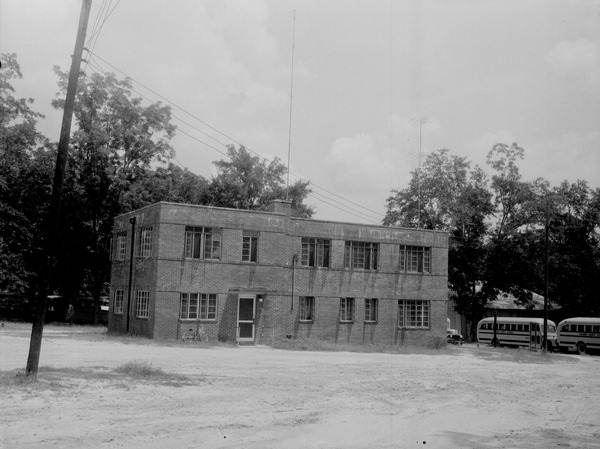
A sawmill in Covington County, Alabama, circa 1911. Courtesy of the Hoole Special Collections Library, University of Alabama.

John James’s job was a negro’s ideal of a soft job. All the work he had to do was to light a lantern in the mill at dark, blow it out in the morning, and never under any circumstances to leave the mill unguarded. The company paid him $10 a month, furnished a dwelling, a mule and a plow, together with just as much land as he might want to cultivate. The lake was full of fish, toothsome and easy to catch.

Therefore, John James was much envied by his fellows. But on an unlucky evening about sundown he paddled his boat out in the lake to set some lines for big catfish. His wife saw him start, and when she looked again a little later there was the upturned boat, but no John James. The neighbors were hurriedly called and in the gathering gloom they dragged the bottom with grappling irons and brought to the surface the downed body of the watchman. How he happened to lose his balance or why he made no outcry will in all probability never be known.

Of course, the company over at Fairford regretted the affair, paid the widow John’s back salary, at once sent another negro as watchman and things seemed to move along about as before.

In a few days a company official chanced to go to David’s lake, and was surprised to find the new watchman gone, and also the company’s mule. The animal was found later at a station over on the railroad, where the operator stated it had been ridden early morning by a greatly agitated negro, who had left on the first train.

This thing mystified the company and was vexatious, because if the mill should burn in the absence of a watchman no insurance could be collected, and unguarded buildings have an unfortunate way of catching afire in that country. Another negro was at once sent down to the lake as watchman, and informed that if he wanted at any time to quit his job to give notice, so there would be interregnum. No. 2 went to David’s lake, and next the news came that he, too, was missing. Neither he nor his predecessor ever called for salary due them, nor has any trace of either been found.

At this the power that ruled the company held a serious conference. Something was scaring the negroes away, and it must be put an end to. So William Potlatch, one of the company’s most reliable negroes, was sent to the shingle mill with a six-shooter, which he was instructed to use should anything bother him.

William returned the very next morning. He was the worst scared negro in the state of Alabama. He told a confused story that no one could make heads or tails of about ghosts and John James. There was no confusion in his statement that no money could ever induce him to go back again.

Meanwhile stories began to float around to the effect that John James’s ghost was haunting the mill and lake. Of course, the company officials scorned such an idea, but for all its absurdity there was a serious side to the matter. If the place ever gained the reputation of being haunted no negro would work there and the mill would have to be torn down, as negro labor is the only available or possible to be procured. The company determined to lay the ghost at once and forever, and to that end sent down a party well equipped with all proper material for exorcism. The party was composed of Tom Smith and Henry McIntosh, white men of known bravery and coolness, also two negroes, whom the presence of the whites might induce to stand firm in the presence of danger. All were armed and carried a supply of food and whisky [sic].

They reached the mill at David’s lake in the afternoon, taking possession of the shanty next to and almost adjoining the one formerly occupied by John James. After supper, when the dark came, they lit a lantern and all sat out on the little gallery of their quarters. There they gossiped, told tales and drank whisky [sic] until they were in a proper mood to defy the natural or the supernatural. After the supply of tales had run out they took to shooting craps down on the floor.

It must have been near midnight.

One of the negroes was praying energetically to all the powers controlling fortune that he might throw a nine-spot, and thereby win the mean to buy his gal new shoes, when suddenly the door of John James’s shanty opened and shut violently. The players looks up at once. A piece of a moon over in the far west gave dim light. One of the negroes exclaimed:

“Lamb o’ God, looky yondah.”

From out of the shadow in front of the James shanty came the form of a man, walking as though lame and carrying a long pole. Both the negroes at once broke for the woods. Smith and McIntosh stood their ground like the nervy men they were. The shade neither looked to right nor left, but hobbled straight on across an open space and toward the lake, where several skiffs were moored. As through with one impulse and movement, Smith and McIntosh fired at the thing, but with no more apparent result than if they had shot at the stars. There was only the plunge of their bullets heard out in the lake.

“Spook or no spook, I’m going to run that feller down,” said Smith, and as he started McIntosh followed him.

They saw the ghost loosen one of the skiffs and paddle out into the lake. Its motion had seemed to be a slow walk, and yet, running hard as they could, they did not catch up with it. They, in their turn, jumped into a skiff and paddled fiercely after. About where John James’s body was found the first boat stopped, and its mysterious occupant began to shove the long pole down into the water. The pursuers drew nearer and nearer, until there was barely a boat length between them and their object. All at once they heard a terrible, awesome cry, shrilled and piercing. Simultaneously each man felt a shock as though from an electric battery—a shock so severe and overpowering that they collapsed and fell unconscious in the bottom of the skiff.

It was daylight when they revived. They had floated at least two miles below the mill. They were so weak and nervous, so numbed and dazed, they had barely strength to paddle to shore, nor has either one fully recovered to this day.

Now, for one who doubts these things, or who is curious about them, here are the lake and the mill, and the Seaboard company anxious to assist investigation. Also, the position of watchman is open. Who wants it?

LONG LEAF.

Haunted Tennessee, Briefly Noted

Cherry Mansion
265 West Main Street
Savannah

The great Alabama storyteller, Kathryn Tucker Windham, provides the account of three people who witnessed an odd event while sitting on the porch of the Cherry Mansion one evening in 1976. Around 11 PM, the trio watched as a man in a white suit and wide-brimmed hat approached the historical marker in front of the house. The man read the marker and then, in full view of the spectators on the porch, vanished.

haunted Tennessee Cherry Mansion Savannah Civil War
Cherry Mansion, 1974, by Jack Boucher for the Historic American Buildings Survey (HABS). Courtesy of the Library of Congress, Prints and Photographs Division.

The house is magnificently sited on an ancient bluff overlooking the Tennessee River. This home was constructed around 1830 by David Robinson, possibly as a gift to his daughter who was the wife of businessman William Cherry. An ardent Unionist during the Civil War, Cherry offered the use of his home to several Union generals in 1862 who used it in the days leading up to the Battle of Shiloh, which took place about 9 miles south of Savannah. General Charles Ferguson Smith, suffering from a recent leg injury passed away in the house during that time.

On the morning of April 6th, legend holds that General Ulysses Grant’s breakfast was interrupted by an overture of cannon-fire announcing the Confederates’ surprise attack on Union forces camped at Pittsburg Landing on the Tennessee River. Furious fighting over a sunken road where Union Generals Benjamin Prentiss and W. H. L. Wallace defended their position against heavy artillery fire from Confederate batteries gave a head wound to Wallace and the area to be nicknamed, “The Hornet’s Nest.” Wallace was taken to Cherry Mansion to receive medical attention.

Legend holds that Wallace’s devoted wife, Martha Ann, had received a premonition of her husband’s death and traveled to Tennessee in hopes that he was unharmed. Arriving in the midst of the battle, she was stunned to find that her husband had been wounded and took up residence at his side in Cherry Mansion. When her husband died a few days later, she was still at his side. People passing the mansion have reported seeing the form of a gentleman in a uniform looking out one of the upstairs windows. This form is widely believed to be that of General Wallace.

This home is a private residence.

Sources

  • Brown, Alan. Haunted Tennessee: Ghosts and Strange Phenomena of the Volunteer State. Mechanicsburg, PA: Stackpole, 2009.
  • Charles Ferguson Smith. Wikipedia, the Free Encyclopedia. Accessed 30 December 2017.
  • Cherry Mansion. Wikipedia, the Free Encyclopedia. Accessed 30 December 2017.
  • Coleman, Christopher K. Ghosts and Haunts of Tennessee. Winston-Salem, NC: John F. Blair, 2010.
  • Hammerquist, Gail. National Register of Historic Places Nomination form for the Cherry Mansion. February 1976.
  • West, Mike. “Tennessee home to tragic Civil War ghost story.” Murfreesboro Post. 26 October 2008.
  • Windham, Kathryn Tucker. 13 Tennessee Ghosts and Jeffrey. Tuscaloosa, AL: U. of AL Press, 1977.

Cocke County Memorial Building
103 North Cosby Highway
Newport

This unassuming building in the small town of Newport in Eastern Tennessee bears the weight of a tragedy. The sadness of this tragic moment in the mid 1960s still echoes now, more than fifty years later.

haunted Tennessee Cocke County Memorial Building Newport ghosts
Cocke County Memorial Building, 2011, by Dwight Burdette. Courtesy of Wikipedia.

Opened in 1931 as an American Legion post, the Cocke County Memorial Building was constructed to memorialize locals who had given their lives in the First World War. The building includes a gym with a stage, as well as office and meeting space for the post and the community at large.

On July 9, 1964, near the Cocke County community of Parrottville, a witness observed a plane with a “violet red light burning on the fuselage.” A short time later other witnesses saw the plane flying low with smoke trailing from it. The plane veered off course and crashed on a wooded mountain slope. Moments before the impact, witnesses observed something falling from the aircraft. A search revealed that one of the plane’s emergency exits had been opened and a passenger had fallen. That passenger, as well as the plane’s remaining passengers and crew, a total of 39 souls, perished in the accident.

As Newport had no large facilities to accommodate the remains of the 39 who had died in the accident, investigators and rescue personnel commandeered the Cocke County Memorial Building for use during the operation. Since most of the bodies were in pieces, remains were spread out on the gym floor to aid in identification. After studying the wreckage of the plane and the remains, authorities ascertained that a fire had broken out in the passenger compartment in mid-air. After two weeks, the investigators and the human remains left the Memorial Building, but spirits have lingered.

Author John Norris Brown, who once maintained the excellent blog, Ghosts and Spirits of Tennessee (the website is no longer extant, though it can still be found on the Web Archive), was one of the first people to document this haunting in Newport. Though some of his facts about the plane crash were incorrect, he described some of the experiences visitors to the building have experienced: “[they have] felt presences, heard voices, as well as the screams of a woman, and the cries of babies. Feelings of being watched are said to be almost unbearable in the building.”

In an article in Supernatural Magazine, paranormal investigator Anthony Justus describes the experiences of him and his paranormal team during a 2008 investigation. While investigating the building’s sub-basement, Justus encountered an entity that he described as “an intelligence without form.” He eloquently continued: “I saw nothing, heard little but I felt it. A deep resonant cold that chilled me to the bone. I felt threatened and oppressed. As I left the area, I felt its heavy presence behind me, following up those rickety stairs, so close I could feel it on my neck. It was death, it was sadness and it was hate, a predatory thing that lurked in the darkness.”

Later, the team members found balls from a Bingo game being thrown from the bleachers in the gym, bouncing and rolling across the wooden floor. During this time, Justus caught a glimpse of a young boy standing in the corner of the room who disappeared as he approached. The most spectacular event of the evening was noted as being a moment when a set of doors that were locked violently threw themselves open gouging the plaster walls and cracking one of the wooden doors. It seems that the spirits from the plane crash are unhappy at being stuck in this plane of existence.

Sources

Cragfont
300 Cragfont Road
Castalian Springs

Cragfont was built to impress. Constructed of stone on a bluff over a spring that feeds into nearby Bledsoe’s Creek, this was the first stone house constructed on the Tennessee frontier. With craftsmen and artisans brought from Maryland, James Winchester began work on his home in 1798, finishing around 1802. Besides providing a fine home for his family, Cragfont served as a gathering spot for locals and as a stop for travelers.

haunted Tennessee Cragfont Castalian Springs ghosts
Cragfont, 2008, by Brian Stansberry. Courtesy of Wikipedia.

James Winchester was already an accomplished individual when he built his home, having served as a Patriot officer during the American Revolution. In the latter years of the 18th century, Winchester had served in the North Carolina Constitutional Convention and worked towards the establishment of the state of Tennessee, after which he served in the newly created legislature. During the War of 1812, Winchester left Cragfont to serve his country. He died here in 1826.

A home that has witnessed the whirlwind of history that Cragfont has witnessed must surely be haunted. Caretakers of the home have noted that furniture and objects apparently move during the night when the house is locked up, while beds will appear to have been slept in. Both visitors and staff have reported seeing apparitions and hearing disembodied footsteps and voices within the house.

Sources

  • Brown, John Norris. “Cragfont Mansion Hauntings.” Ghosts & Spirits of Tennessee. Accessed 31 January 2011.
  • Coop, May Dean. National Register of Historic Places Nomination form for Cragfont. 16 June 1969.
  • James Winchester. Wikipedia, the Free Encyclopedia. Accessed 31 December 2017.
  • Morris, Jeff; Donna Marsh; & Garett Merk. Nashville Haunted Handbook. Cincinnati, OH: Clerisy Press, 2011.
  • MTSU Center for Historic Preservation. Cragfont, Sumner County, Tennessee, Historic Structure Report. July 2012.

Hunt-Phelan House
533 Beale Street
Memphis

Legend holds that at the height of a yellow fever epidemic in 1873, the Hunt family fled their Memphis home after entrusting a chest of gold to a manservant, Nathan Wilson. Upon their return, Wilson was found dead in his room and the chest missing. The only clue to the whereabouts of the chest being mud on the servant’s boots indicating that he may have buried the chest. Stories have emerged that Wilson’s specter is sometimes seen around the house and will guide fortunate witnesses to the buried fortune.

haunted Tennessee Hunt-Phelan House Memphis ghosts
Hunt-Phelan House, 2010, by Thomas R. Machnitzki. Courtesy of Wikipedia.

Marking the Lauderdale Street end of the “infamous section” of Beale Street where Blues music first developed, the Hunt-Phelan House has just as infamous a history. Built in 1832 by George Wyatt, during the Civil War the house was used a headquarters for Confederate General Leonidas Polk while planning the Siege of Corinth, Mississippi and a few months later after the fall of Memphis, the house was headquarters for Union General Ulysses S. Grant while he planned the Vicksburg Campaign. The house then served as a Freedmen’s Bureau and was finally returned to the family by President Andrew Johnson in 1865. More recently, the house was operated as The Inn at Hunt-Phelan featuring four-star accommodations and restaurants.

Sources

  • Brown, Alan. Haunted Tennessee: Ghosts and Strange Phenomena of the Volunteer State. Mechanicsburg, PA: Stackpole, 2009.
  • Coleman, Christopher K. Ghosts and Haunts of Tennessee. Winston-Salem, NC: John F. Blair, 2010.
  • Lester, Dee Gee. “Hunt-Phelan House.” Tennessee Encyclopedia of History and Culture. 25 December 2009.
  • Lovett, Bobby L. “Beale Street.” Tennessee Encyclopedia of History and Culture. 25 December 2009.

Orpheum Theatre
203 South Main Street
Memphis

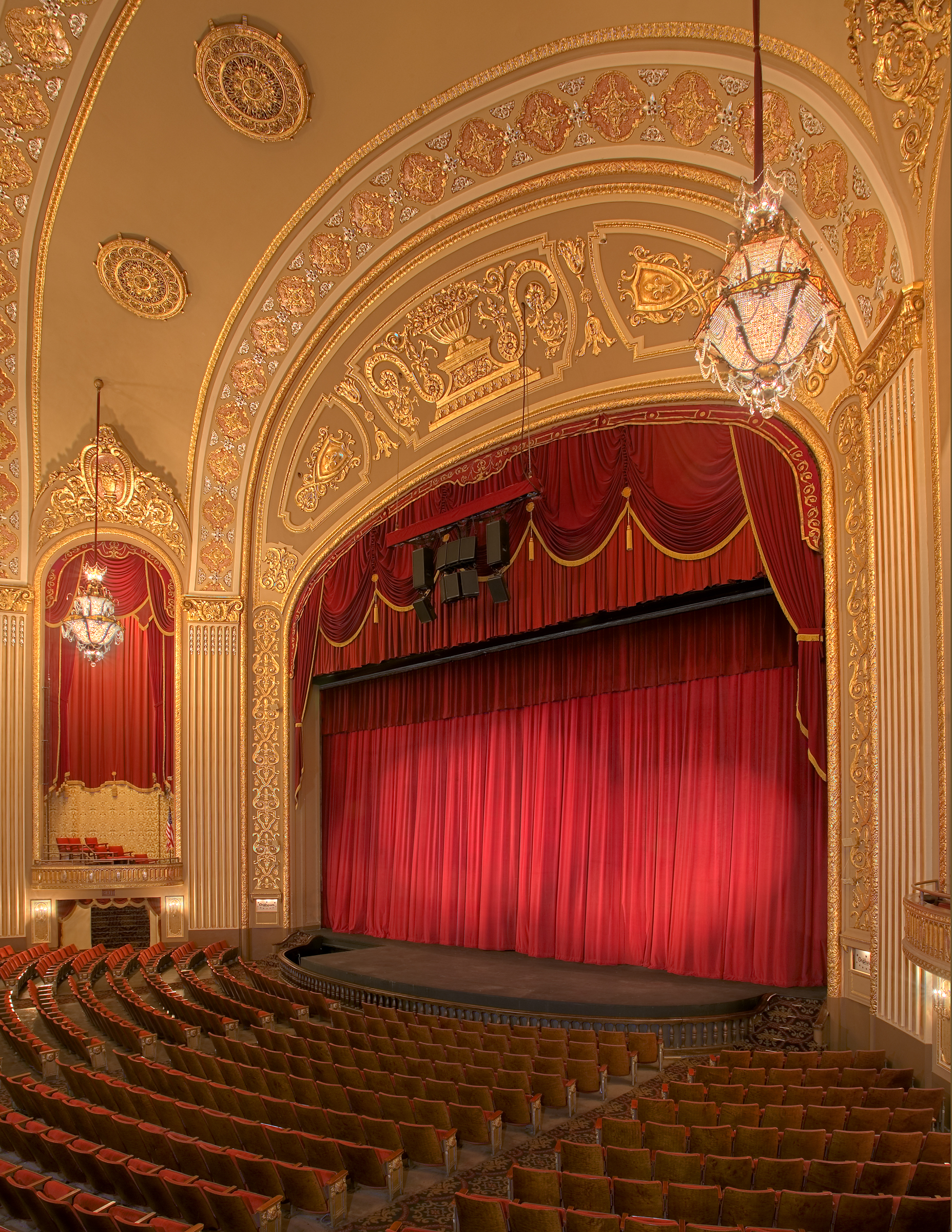
At the other end of the “infamous section” of Beale Street from the Hunt-Phelan House is the dazzling Orpheum Theatre. Opened in 1928, the “New” Orpheum replaced the opera house that originally occupied this site from 1890 until its destruction by a fire in 1923. The Orpheum is among the ranks of hundreds of theatres throughout the country designed by the Chicago architectural firm of Rapp and Rapp, which designed hundreds of theatres throughout the country some of which, like the Paramount in Ashland, Kentucky; and the Tivoli in Chattanooga, are known to be haunted.

haunted Tennessee Orpheum Theatre Memphis ghosts
The proscenium arch of the Orpheum Theatre, 2010, by Orpheummemphis. Courtesy of Wikipedia.

The Grand Opera House was added to the Orpheum circuit in 1907. Made up of the finest theatres from coast to coast, the Orpheum circuit featured the top vaudeville headliners, bringing them to Memphis audiences for almost two decades. Following a performance by singer Blossom Seeley on October 17, 1923, the theatre was gutted by a fire causing approximately $250,000 (about $3.5 million in today’s dollars) in damage. A new, state-of-the-art theatre was constructed on the site opening on November 19, 1928. This new theatre continued to bring cream of the crop stars to Memphis as well as films, which were accompanied by a huge Wurlitzer organ.

As any good theatre has a ghost, it’s no surprise that the Orpheum features some very well-known ghost stories. Around the time that the theatre was sold to the Memphis Development Foundation in 1976, Vincent Astor, a local historian, took some friends to the theatre to show them the Wurlitzer organ. While the group was watching him play, someone asked about the little girl they observed playing in the lobby. Wearing a white dress, black stockings, and with long braids, but no shoes, this girl was repeatedly seen in the theatre sometimes sitting in a specific seat in the balcony.

During an investigation by a class from the University of Memphis, a Ouija board was used to contact the playful spirit. At that time, the spirit was identified as “Mary,” a little girl who died in 1921. In a video posted by the theatre, Astor relates that, including Mary, there may be as many as seven spirits within the theatre.

Sources

  • Brown, Alan. Haunted Tennessee: Ghosts and Strange Phenomena of the Volunteer State. Mechanicsburg, PA: Stackpole, 2009.
  • Coleman, Christopher K. Ghosts and Haunts of Tennessee. Winston-Salem, NC: John F. Blair, 2010.
  • Orpheum Memphis. “Orpheum Ghost Stories with Vincent Astor.” YouTube. 29 October 2012.
  • Orpheum Theatre (Memphis). Wikipedia, the Free Encyclopedia. Accessed 2 January 2018.
  • Williamson, James Floyd, Jr. National Register of Historic Places nomination form for the Orpheum Theatre. January 1977.

Railyard Revenant—West Virginia

Norfolk Southern Railyard
Williamson, West Virginia

Facebook can be a marvelous resource for ghost stories, but only if you can stand wading through unsourced posts, over-eager amateur ghost hunters with blurry ghost photos, and memes asking if you believe in ghosts. The information on this haunting came from a post on the Haunted West Virginia page that included the original article along with the name of the paper and the date, hallelujah!

The Norfolk and Western Railroad got into the coal business in the late 19th century. After the purchase of the Flat-Top Coal Land Association and the massive coal fields under its control, the railroad reorganized the organization into the Pocahontas Coal and Coke Company and began to expand its railroads into the coal fields of southern West Virginia. As the company began cutting into this remote region, towns were established including the small town of Williamson.

Aerial view of Williamson in 1990. Taken by the U. S. Army Corps of Engineers. Notice the railroad cutting through the middle of town.

At a point along the Tug Fork River, at this point the border between West Virginia and Kentucky, a marge railyard was established with a town being established around it. The railroad still cuts through the heart of this small town with the large railyard still in operation, though the railroad’s name has changed from the Norfolk and Western to Norfolk Southern. The town is now the county seat for Mingo County.

On September 1, 1935, the paper in Bluefield, West Virginia, the Bluefield Daily Telegraph, reported on paranormal activity experienced in the railyard.

But today comes the strangest ghost tale every published. The wonder of it is some of the big newspapers have not grabbed it, for it sure is a knockout. Many Norfolk and Western railroad men vouch for the truth of the story, men whose word is as good as their bond.

This amazing happening has its setting on Williamson yard, and has been told and retold until around the Mingo county seat the kiddies are sometimes put to sleep thinking of the yarn.

But we will not [sic] longer keep the reader in suspense.

From the inferno of the boiler of a Norfolk and Western yard engine in use in Williamson yard may be heard the pitiful cries of baby. Of course, there is no baby in that firebox. Even a child need not be told that.

But often during the dead hours of night from the firebox the engineer and fireman almost stand speechless as the faint cry of an infant is emitted from the seething furnace of their locomotive.

Billy Dotson, veteran engineer, is said to have been the first to hear the baby cry, but since, others claim to have heard the voice distinctly.

One theory advanced is that a long time ago a young baby in some maner [sic] was tossed into the firebox of this particular engine, and that its tiny spirit remains.

Anyway, you have the story. It is not for us to offer a solution of this amazing phenomena.

Panoramic view of the Williamson Railyard, 2013. Photo by Magnolia677, courtesy of Wikipedia.

As far as I can find, this is the only reporting on this incident. It is unknown as to if the activity in the Williamson Railyard has ceased.

Sources

  • Norfolk and Western Railway. Wikipedia, the Free Encyclopedia. Accessed 16 January 2018.
  • Williamson, West Virginia. Wikipedia, the Free Encyclopedia. Accessed 16 January 2018.
  • “Writer unfolds a new ghost story.” Bluefield Daily Telegraph. 1 September 1935.

From a dumpster fire to a Husk—Savannah

12 West Oglethorpe Avenue
Savannah, Georgia

In 2006, a ghost tour guide told a reporter from the Houston Chronicle that this one address in Savannah has seen “more conversions than Billy Graham,” a reference to the nationally known evangelist. Of course, these were conversions to one of Savannah’s true religions: belief in the paranormal. According to this tour guide, this site has played host to a panoply of tragedies and, as a result, now hosts paranormal activity.

During this particular tour, guests were allowed to step up to the front door of this forlorn house and take photographs in hopes of capturing evidence of the home’s ghosts. Reportedly, some guests experienced battery drain with their cameras and even motorized wheelchairs. Others were shocked at what appeared in their photos.

This particular site—within Savannah’s massive historic district—has seen a tremendous evolution since the city’s founding in 1733. As noted by a monument in the median of West Oglethorpe within sight of the house, this property was initially the city’s first Jewish cemetery. A burial spot for the local Jewish community was later established some distance away, though, the graves were left at this site, which evolved into a residential area.

12 West Oglethorpe Savannah Husk Restaurant
Husk in October of 2019. Photo by Lewis O. Powell IV, all rights reserved.

The house at 12 West Oglethorpe is an unassuming Georgian home with an elegant circular porch. Among the numerous homes in Georgia’s oldest city, the house is not as old as some of its neighbors, dating only to around 1898. Built as a home, the structure’s modest history includes the building’s use as an Elks Lodge and later, a performing arts school, until the building was abandoned in 1985.

During the time that the house sat boarded up, ghost stories began to circulate and the home became a fixture on many ghost tours. Here, guides would relate the sad tale of Dr. Brown, a physician who occupied the house in 1876, during the last of the yellow fever epidemics to strike the city. Patients visiting the house brought the illness into the home and one by one, the doctor’s family died after succumbing. Grief stricken, the good doctor sealed himself in one of the upstairs rooms and starved to death.

This is a great story, but total bunk. Yellow fever, which does feature in some local ghost stories, is not spread from human to human contact, but spread by mosquitos. Local tour guide and author, James Caskey was not able to locate any reference to a doctor living on this site (this house didn’t exist in 1876) or anywhere in this area named Brown. While this story isn’t true, that doesn’t discount the paranormal activity here. Some of the activity described by Caskey in his authoritative 2008 book, Haunted Savannah,  includes the apparition of an elderly man seen peering from an upstairs window—despite the fact that there was no floor underneath that particular window—odd sounds being heard by the neighbors, and several strange anomalies appearing in photographs.

A year after Caskey’s book was published, a dumpster fire set by teenage pranksters ignited the modern addition at the back of the house. Photos of the damage show the addition with broken, charred windows and a missing roof. Neighbors, worried about the building’s safety pressed the city for action, though they were thwarted by the slow-turning wheels of government and absentee owners.

Caskey makes an appearance in a recent episode of Haunted Towns on Destination America. The show follows the Tennessee Wraith Chasers as they visit cities and towns throughout the country with haunted reputations attempting to suss out why these places have earned such reputations. Their episode on Savannah concentrates on the legends surrounding Wright Square, located just around the corner from 12 West Oglethorpe. Caskey is interviewed early in the episode where he notes that legend of the square and the house may be connected.

Wright Square, just around the corner from 12 West Oglethorpe. Photo by XEON, 2013, courtesy of Wikipedia.

He also remarks that the house has never been investigated, spurring the show’s investigators to investigate themselves. In fact, another local guide and investigator, Ryan Dunn, explored the house in 2010 and had a frightening encounter. On the second floor Dunn’s camera “powered down for no apparent reason.” He continues, “As I looked up, I saw a black shadow person cross the hallway in front of me from one bedroom to the other.” He describes the shadow figure as being three dimensional and roughly shaped like a person, but with no discernable features.

Dunn also includes a fascinating tale from the 2009 fire. After extinguishing the fire, local firefighters held a fire watch in order to ensure that the fire did not reignite. Staying in the house overnight, the firefighters began to tell ghost stories and daring each other to creep up the stairs to the “haunted room” where Dr. Brown supposedly died. One firefighter bravely entered the room and let out a scream. Dashing down the stairs, the firefighter remained in his vehicle out front for the rest of the evening, refusing to reveal what he encountered in the room.

During the Tennessee Wraith Chasers’ investigation, they meet a property manager working on the renovation of 12 West Oglethorpe who told them the story of Dr. Brown. While the story is being told, the crew’s camera unexpectedly cuts out. After getting their camera up and running, the property manager tells the investigators that he had had one peculiar incident while working in the house where his name had been called by a disembodied voice. The paranormal team did a sweep of the house including the basement where a temperature gauge registered a temperature of 66.6 degrees. During the evening investigation, the group experienced battery drain, captured a few EVPs, and heard a disembodied voice.

The building opened its doors on January 5th as the Savannah outpost of the Charleston restaurant Husk. In the award-winning hands of chefs Sean Brock and Tyler Williams, Husk opened in Charleston, South Carolina in 2010 in a historic haunted home next door to haunted landmark, Poogan’s Porch. Serving Nouveau Southern cuisine, the chefs playfully rework classic Southern dishes and ingredients bolstered by research into the gastronomic history of the region. The restaurant has also made a point to occupy historic structures in order to preserve the historic built environments in addition to food ways and incidentally, the spirits, of each city where it operates.

Sources

  • Caskey, James. Haunted Savannah: The Official Guidebook to Savannah Haunted History Tour, 2008. Savannah, GA: Bonaventure Books, 2007.
  • Cowen, Diane. “Spirited Savannah.” Houston Chronicle. 19 March 2006.
  • Curl, Eric. “Three downtown Savannah historic commercial buildings closed to public and awaiting restoration.” Savannah Morning News. 16 November 2013.
  • Dunn, Ryan. Savannah’s Afterlife: True Tales of a Paranormal Investigator. Atglen, PA: Schiffer, 2014.
  • “Savannah.” Haunted Towns. Season 1, Episode 3. Originally aired 9 August 2017.
  • Whiteway, Maria. “Husk is here!” Connect Savannah. 10 January 2018.

Spectral Selfies in the News

In the past few weeks, several people visiting haunted places here in the South have been photobombed in a spectral fashion. Visitors to St. Francisville, Louisiana’s The Myrtles Plantation and Homestead, Florida’s Hotel Redland have captured images of someone in their photographs, someone who wasn’t physically present when the photos were taken.

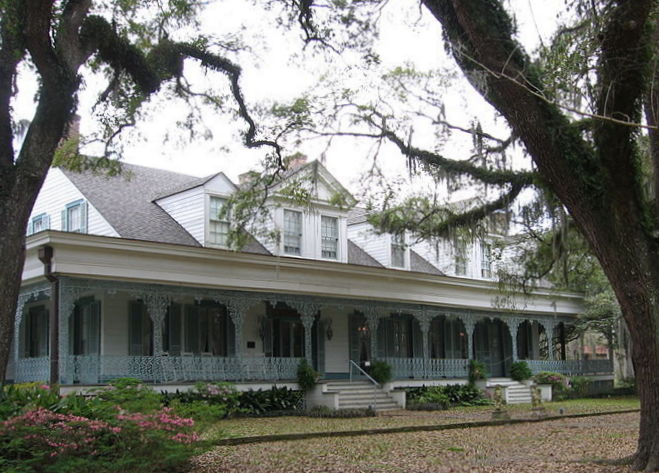
Six friends visiting The Myrtles decided to take a group selfie just outside of the house. Upon closer inspection, the photographer noticed the face of a seventh woman peering from behind a window pane behind the group. While all the women in the group are smiling, the women in the window pane appears to be scowling. Photographs of the this nature are easy to fake, so I cannot say this photograph is authentic. Surely, this is not the first photograph taken at The Myrtles to possibly show something spectral. In 2015, I published a photograph taken by an acquaintance that appears to show someone sitting on the staircase.

The Myrtles, 2005, by Bnet504. Courtesy of Wikipedia.

Perhaps the most famous haunted places in the country, The Myrtles (7747 US-61, St. Francisville, Louisiana) is a late 18th-century plantation with a tragic history. Of course, much of that tragic history has literally come back to haunt the home. The house is preserved as a museum, bed & breakfast, and haunted attraction. In my opinion, at least some of that tragic history has been created to make the haunting more interesting. I looked into these stories in a blog entry several years ago.

It’s interesting that the other selfie that has been published in the news is from a place that also has a doubtful history. The history of the Hotel Redland (5 South Flagler Avenue, Homestead, Florida) is not as long or as varied as The Myrtles, though it has also left spectral impressions. Those spectral impressions led a friend of a hotel staff member to investigate the hotel recently. During the investigation, the visitor snapped a selfie standing in the lobby. In the selfie, a face appears which the British tabloid, the Daily Mirror, described as resembling the horror movie villain, Michael Myers, from John Carpernter’s movie franchise, Halloween.

My opinion on the photograph is that this is a case of pareidolia, when the brain tries to make sense of something chaotic by finding patterns in it. In this case, light reflected in the window pane creates a “face,” within the reflection.

The first building on this site was constructed in 1904 as a boarding house for railroad employees called the Homestead Inn. This building’s history was rather quiet until the fateful day of November 10, 1913. I’ll allow the Miami Metropolis to take over the story from here:

A few minutes before 2 o’clock in the afternoon the large steam roller, being used in rolling the streets, puffed down in front of the Homestead Inn, and it was only a few seconds later that the roof of the hotel was discovered on fire, having caught from a flying spark from the engine. Soon the entire fire-fighting population of the town was on the scene, and all efforts were brought to bear to save the burning building, but to no avail. However, the furnishings were carried to safety and the loss of the building is just about covered by insurance.

Flames spread to five adjoining buildings destroying several other businesses. The paper ends the article by mentioning that a fire caused by sparks from the same steamroller had damaged the city’s other hotel across the street that morning. “It is likely that some action will be taken to curb the chances of another such conflagration starting from the same cause.”

Hotel Redland, 2011, by Ebyabe. Courtesy of Wikipedia.

While the damage to the structure led to much of it being rebuilt, the story of this dramatic fire continued to be told and expanded. The story of the fire as told now sets the scene late at night where the fire takes the lives of a number of guests soundly asleep in their rooms. These same guests now haunt the hotel.

An article in the August 16th Miami New Times detailed a paranormal investigation of the hotel by the South Florida team of PRISM Miami, lead by investigator David Rodriguez. That article hints at the hotel actually being haunted, though the details are somewhat vague.

Sources

A haunt in Hamilton County, Florida

Old Hamilton County Jail
501 Northeast 1st Avenue
Jasper, Florida

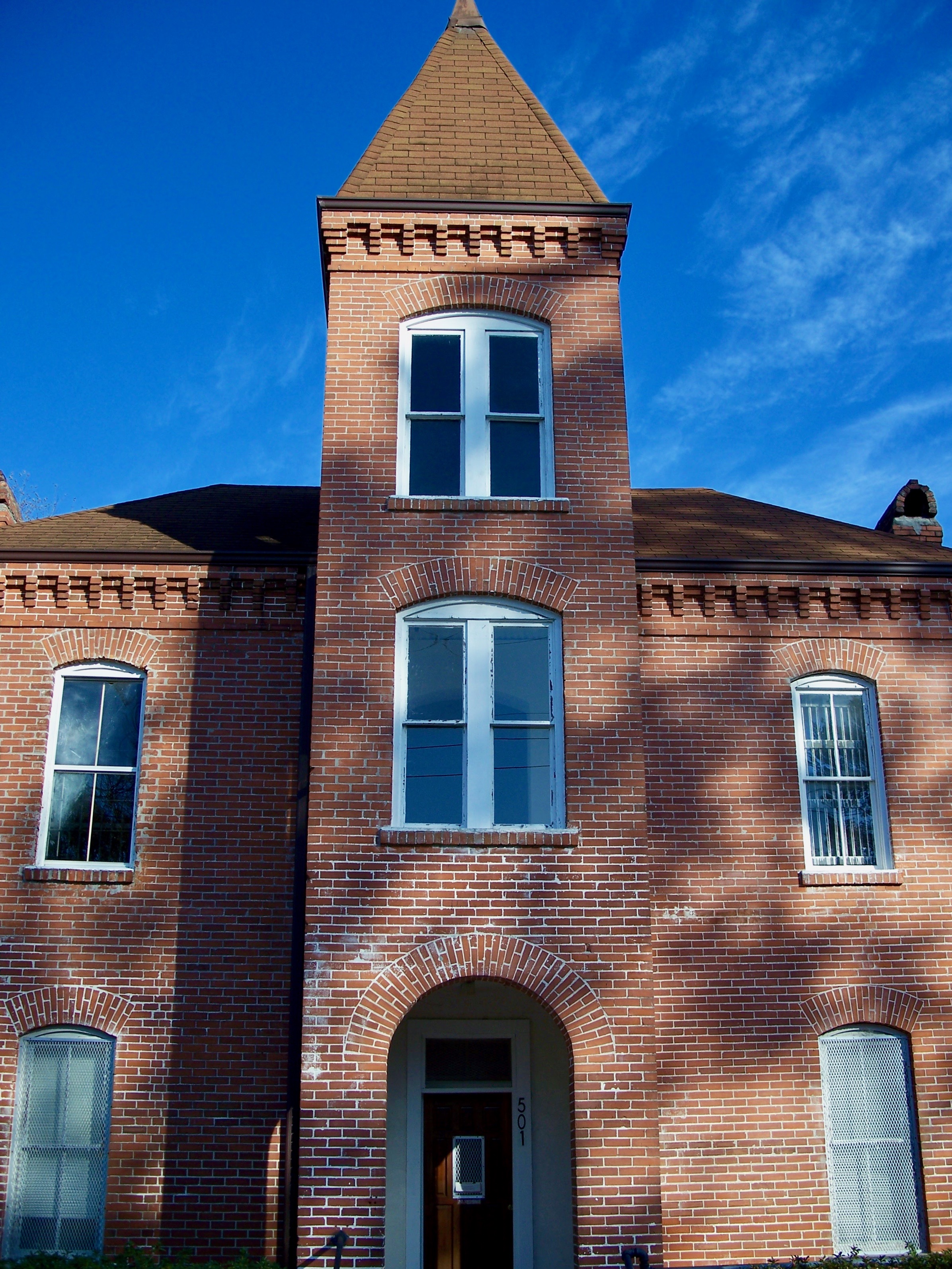
When it closed in 1984, Jasper, Florida’s Hamilton County Jail was the oldest operating jail in the state. In the 91 years it was operational, this building witnessed tremendous tragedy and sadness, such emotion that imprinted itself on the walls of the structure. Even before its closure, ghost stories about the jail circulated throughout Hamilton County, in fact, the National Register for Historic Places nomination form mentions that the building has a haunted reputation within the local folklore

Old Hamilton County Jail, 2007, by Ebyabe. Courtesy of Wikipedia.

Built by the Pauly Jail Company, a St. Louis-based company that constructed jails throughout the country, the jail in Jasper includes a tower suitable for carrying out justice. The historians who wrote the National Register nomination weren’t sure if executions had actually been conducted within the building, though local rumors insist to that fact. Local historian Johnny Bullard stated in a 2014 article that three people met their fates here. He further notes that one or two of these executions were among the last hangings east of the Mississippi.

A 2016 article quotes the president of the Hamilton County Historical Society as saying that no executions took place within the walls of the buildings, but that gallows were constructed for that purpose outside the building. Notice of a 1916 execution at the jail appeared in the Tallahassee Democrat. Interestingly, the paper did not use the name of the criminal, only addressing him as “the murderer of Deputy Raiford Royals,” “the condemned,” and “black man.” While noting that the execution took place on a specially constructed scaffold outside the jail, the article remarks that there was some joy during this most somber of occasions: “As the fatal moment drew near he [Walter Durham, the condemned] laughed and joked with his executioners—smiling even in the very face of death. He claimed he was ‘right with God,’ and was ‘going yonder’—pointing upward. He then asked the negroes present to sing a hymn, himself joining in, and the large crowd was curiously quiet while the mournful dirge floated on the passing breeze.”

After being allowed to pen a brief letter to his parents in Hahira, Georgia, the noose was adjusted around his neck and Mr. Durham called for one of his ministers to pray with him. That minister had departed, but a white minister, the Reverend W. B. Tresca of the local Methodist church stepped forward to offer a prayer. The sheriff stepped forward and “launched the soul of the murderer into eternity.” The National Register form offers that Durham’s execution may have been swift and public because of the local outcry over Deputy Royals’ death.

In addition to executions, it is also noted that several other deaths occurred here including a suicide. However, the wife of a deputy sheriff who lived here gave birth to both of her sons in the building, adding some moments of levity to the building’s dark history.

Old Hamilton County Jail, 2007, by Ebyabe. Courtesy of Wikipedia.

Investigators have been combing the jail for years looking for evidence of paranormal activity. Newspapers have documented some of the encounters that have occurred here. In 2010, a female investigator entered a bedroom that had once housed members of the warden’s family and sensed a spirit. She told the Gainesville Sun that she felt “a strong pressure on my shoulders and chest. And then my stomach starts to turn and I get this tingling feeling in my legs.”

Historian Johnny Bullard demurred when asked if he had personally had any experiences within the jail. He visited the old jail once with a friend late at night. He told the Suwannee Democrat, “I heard something. I saw something that moved…like a shadow, and I didn’t stick around. It was frightening enough to me that I did not stay around.” He continued, saying that others have heard some frightening sounds including voices and footsteps in the empty building.

Sources

  • Arteaga, Allison. “Paranormal investigators help North Florida.” Gainesville Sun. 16 October 2010.
  • Bulger, Peggy & Larry Paarlberg. National Register of Historic Places Nomination Form for the Old Hamilton County Jail. 16 May 1983.
  • Northeastern Florida Paranormal Investigators. Investigation Report for Old Hamilton County Jail. September 2010.
  • “Public execution of a negro at Jasper.” Tallahassee Democrat. 17 September 1916.
  • Taylor, Joyce Marie. “A spooky time at the haunted old jail in Jasper.” Suwannee Democrat. 23 October 2014.

A Calhoun County haunt, finally!

Old Calhoun County Jail
20830 Northeast W.C. Reeder Drive
Blountstown, Florida

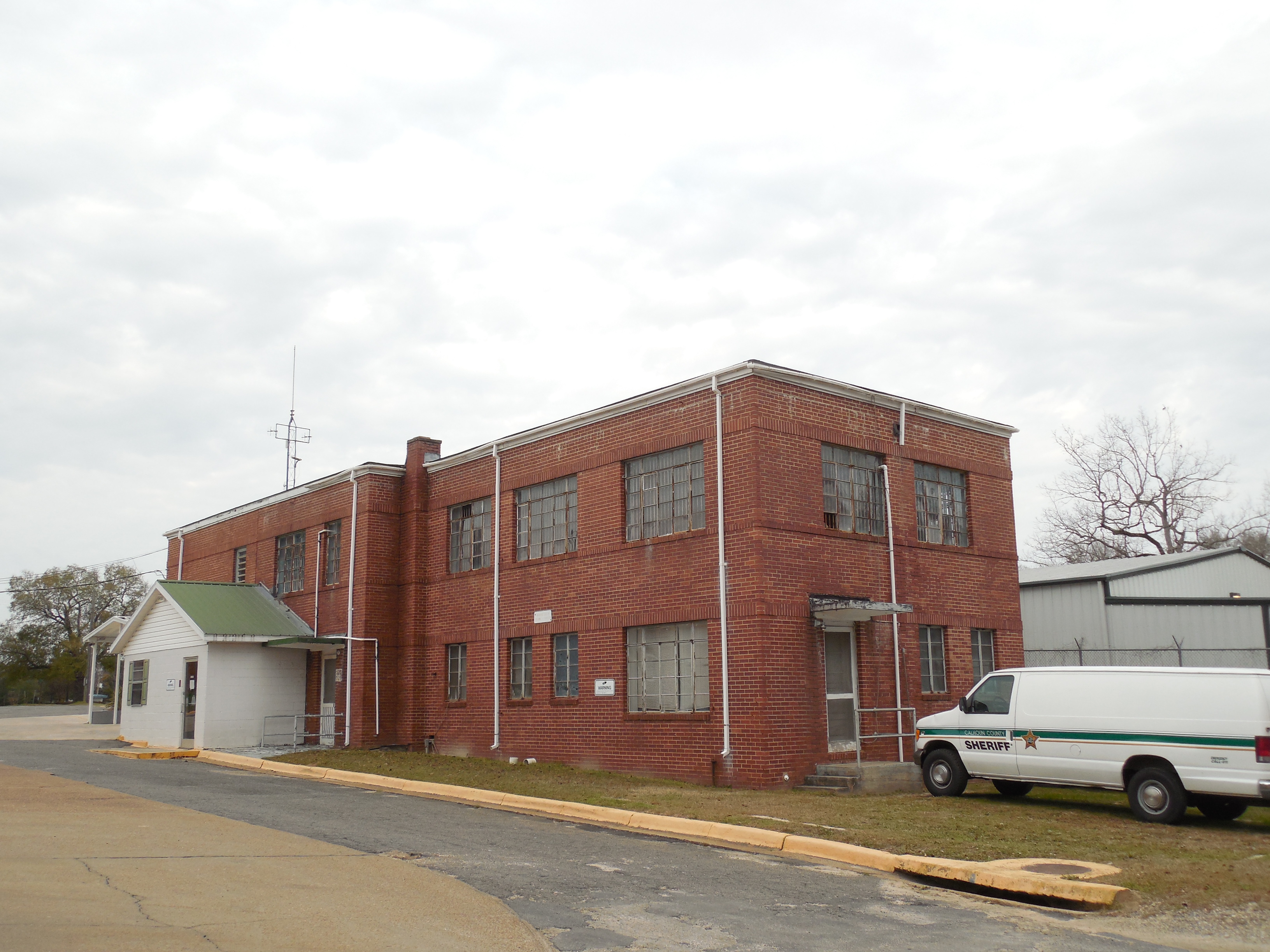
When I was working on part two of my series on Florida Hauntings, County by County—Part II, I ran into a problem that has persistently plagued me: I had information on a haunting, but it was far too little. For several years, the sheriff of Calhoun County, Florida has opened the old jail in Blountstown as a haunted attraction to raise money for charity. Articles covering the event have hinted at actual paranormal activity in the jail, but none have specifically discussed the activity, until this Halloween.

Old Calhoun County Jail, by Forrest Granger, circa 1940. From the Forrest Granger Collection, www.floridamemory.com.

In a November 1st article for the Panama City ABC affiliate, WMBB, a former jail chief reported that the jail is “haunted by trouble.” The jail chief began working at the facility in 1984 and during her tenure the sheriff shot and killed an inmate in the building. “The sheriff shot him, and the place [the bullet hole, presumably] is still in the wall. He got to the top of the steps and he died,” the retired jailer noted.

After that incident, the jailer began to see “mysterious movements” while on her rounds through the building. One evening, she reached the top of the steps and heard the sound of a door slamming. Calling another officer, he investigated but was not able to locate the source of the sound.

Old Calhoun County Jail, 2015, by Jimmy Emerson. Courtesy of Flickr.

The old jail was constructed in 1920 and served the local sheriff until 2007. A few years ago, the sheriff came up with the idea of taking people through the building for a few scares as the “old jail is scary on a regular day.” According to the sheriff, this haunted jail event will open the building to visitors for future Halloween.

Sources


‘Empty, save the memories’–Louisiana

Beauregard Parish Jail
205 West First Street
DeRidder, Louisiana

Joe Genna’s last hours were full of pain and misery just as the last moments of J. J. Brevelle’s life had been. On the fateful evening of August 28, 1926, Genna and Molton Brasseaux robbed and beat Brevelle, a 43-year-old cab driver, on the outskirts of DeRidder and dumped his body in a mill pond. As he awaited hanging within the Gothic confines of the Beauregard Parish Jail, Genna tried to take his own life by swallowing several poison pills. The Shreveport Times takes up the story:

Genna, pale and haggard and apparently deathly ill from the effects of the several poison tablets he swallowed in his cell Thursday night, required the assistance of deputy sheriffs to walk from his cell to the death chamber. The deputies supported him while he stood to make his statement of repentance and express willingness to die. Friday he repented of his act for having attempted to take his life.

The paper notes that at 12:54 on Friday afternoon, March 9, 1928, Genna “mounted the scaffold at the Beauregard parish jail and was dead five minutes later of a broken neck. Molton Brasseaux walked to the same scaffold to meet his death about twenty minutes later.”

The hangings of Genna and Brasseaux took place under the auspices of the stumpy Gothic central tower of the Beauregard Parish Jail. While the “Collegiate Gothic” architecture of the building has been deemed the most fanciful of all the jails in the state, it still lends a cruel sense of ominousness to the building squatting on its haunches next to the proudly standing Beaux-Arts courthouse. Under the jail’s foreboding tower, a circular staircase rises with cells off each round. Hangings could be conducted here allowing for the whole of the jail’s population to witness the death-drop of the convicted. This horrifying feature was used this one time, though it did lend a nickname to the building, the “Hanging Jail.”

Beauregard Parish Jail, 2005. Courtesy of Wikipedia.

For a little over a hundred years these two siblings, the beautiful courthouse and the ugly jail, have existed side by side. Constructed for the newly established Beauregard Parish in 1914, the courthouse continues to operate while the jail is vacant, save for tourists, spirits, spirit-hunters, and memories, having been replaced by a new facility in 1984.

The day of the hanging in 1928, schoolchildren were witness to a pair of black wicker coffins being carried from the jail, though the pair of convicts may not have left spiritually. In 2006, the state’s most notable paranormal investigative organization, Louisiana Spirits Paranormal Investigations, explored the jail. The group did detect some activity that was unexplained as well as having some personal experiences hearing footsteps and flowing water. During their second investigation, the group’s report notes that many of the windows are open thus allowing ambient noise from the street to filter in, which may be mistaken for paranormal activity.

More recent investigations have captured even more compelling evidence. During one investigation, an investigator asked “Do you know that you’re dead?” and recorded the response, “I’m alive. I’m alive.” A photographer taking photos of the jail a few years ago may have captured the image of a jailer sitting on the porch. Starting last year, the jail has been opened at night during the Halloween season allowing visitors to explore the building in the dark.

Scribbled on the wall of a cell, graffiti reveals that at least one inmate expected to remain in this dark place forever: “Here inside these chambers of death I will dwell forever more. I lost my heart, my mind and my soul just because of a bolted door.”

Sources

Haunts from the Halloween season

After spending much of the Halloween season engrossed in the blog move, I’m just starting to catch up on newsworthy haunts from this season’s news.

Tivoli Theatre
Home to the GALA Hispanic Theatre
3333 14th Street NW
Washington, DC

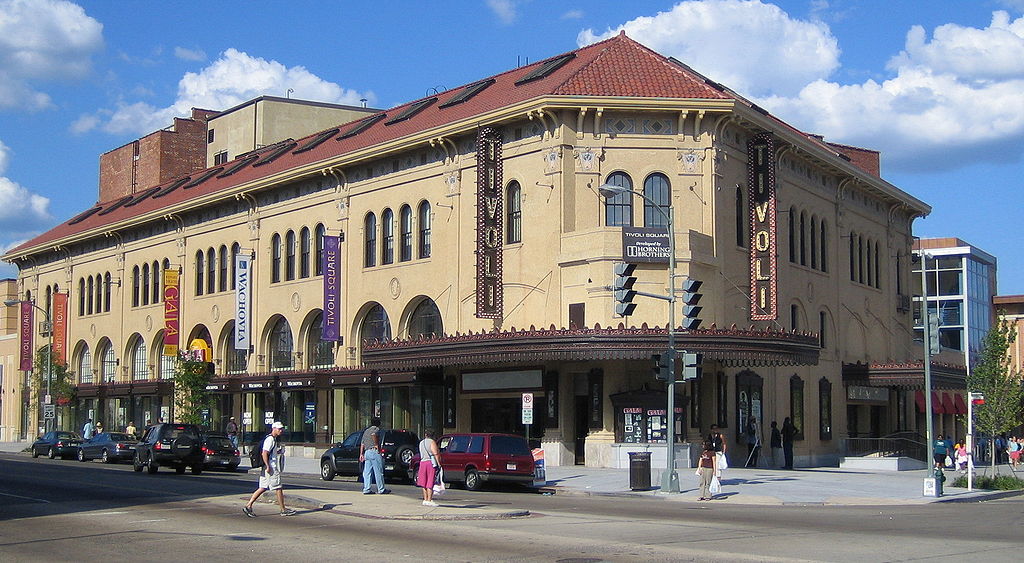
Alone in a one-room apartment, Harry Crandall wrote a note ending with “To whom it may concern: it is now 2:45 a. m., and I am turning on the gas.” He signed the note with his initials and soon slipped out of the bonds of this plane. Crandall had been on top of the world just 15 years previous, but a snowstorm brought difficulties to his theatre empire and fortune in 1922. As a blizzard dumped snow onto Washington on January 28th of that year, patrons of Crandall’s Knickerbocker Theatre were cozily watching Get-Rich-Quick Wallingford when snow piled on the building’s roof caused a collapse leading to the deaths of 98. The city immediately closed all theatres until snow could be removed from their roofs.

The jewel in Crandall’s crown was the Tivoli. When the Knickerbocker disaster took place, the Tivoli was still in the planning stages. After government officials began to question the architectural integrity of Crandall’s architect, Reginal Geare, Crandall asked the eminent theatre architect, Thomas Lamb, to step in as architect. The Tivoli is considered a masterpiece of Lamb’s art. Geare’s replacement and the questions around his design led him to commit suicide in 1927.

Tivoli Theatre, 2005, by D Monack. Courtesy of Wikipedia.

The same year of Geare’s suicide, Crandall sold his theatre chain to Warner Brothers, but continued several businesses related to the film industry. From the day the Tivoli opened its doors in 1924, the Tivoli’s marquee glittered for many decades. Following the assassination of Dr. Martin Luther King, Jr. in 1968, riots rocked many cities including large parts of Washington. Much of the neighborhood around the Tivoli was devastated, though the theatre survived unscathed. The Tivoli limped into the 1970s when a precipitous drop in business led to the theatre’s closure.

While the theatre sat unoccupied, locals recognized the building’s historical importance and had it listed on the National Register of Historic Places in 1985. In the early 2000s the theatre underwent restoration, with the GALA (Grupo de Artistas Latino Americanos) Hispanic Theatre set to occupy the theatre space. In January of 2005, the theatre reopened its doors to the theatre-going public. From opening day, GALA Hispanic Theatre has continued to present the best of Hispanic and Latino theatre in a space where spirits of the past still may wander.

A Halloween article in American Theatre magazine notes that staff and crew members of the GALA Hispanic Theatre have had paranormal encounters which they believe may be the spirit of Harry Crandall. While Crandall did not die in the theatre, it would not be surprising that his spirit would return to this theatre that he was very closely associated with. In the theatre, staff has dealt with light turning off and on and making a general spectral ruckus while a painter saw a figure while painting a set late one night. Perhaps Crandall still wants to be a part of showbiz.

Sources

  • Darris, Cranston. National Register nomination form for the Tivoli Theatre. March 1985.
  • Dembin, Russell. “Keep that ghost light on!” American Theatre. 31 October 2017.
  • “Once wealthy theater head is a suicide.” Daily Mail (Hagerstown, MD). 27 February 1937.
  • Tivoli Theatre (Washington, D.C.). Wikipedia, the Free Encyclopedia. Accessed 14 November 2017.
  • The Venue – History of the Tivoli Theatre.” GALA Hispanic Theatre. Accessed 14 November 2017.

Philippe Park
2525 Philippe Parkway
Safety Harbor, Florida

Grave of Odet Philippe, 2010 by TimT1006. Courtesy of Wikipedia.

Overlooking the western shore of Tampa Bay, Philippe Park encapsulates some of the early history of the area. Among the moss-draped oaks and palmy vistas is a mound constructed by the Tocobaga people who occupied this area until the Spanish invasion in the 16th century. A marker within the park also notes the burial of Odet Philippe, a free black man who settled here in the early 19th century. Philippe is credited as planting the first grapefruit tree here, thus aiding in the establishment of a multi-billion-dollar industry.

An article from the Tampa Bay Times, notes that “supernatural stories abound in the park,” and that the article’s author heard “lots of weird rustling,” which she did not stick around to investigate. The park has been the scene of a serious paranormal investigation conducted by Tampa Bay Spirits. A report on their website includes the experiences of three sensitives who walked the park. Each encountered energy around the mound.

Sources

  • Guerra, Melissa, & Eric Smithers. “Odet Philippe: The story behind the namesake of Philippe Park in Safety Harbor.” South Tampa Magazine. 15 July 2014.
  • Hayes, Stephanie. “5 spooky sites around Tampa Bay that aren’t theme parks.” Tampa Bay Times. 27 September 2017.
  • Tampa Bay Spirits, LLC. “Philippe Park, Safety Harbor.” Tampa Bay Spirits. Accessed 4 October 2017.

Lapham-Patterson House
626 North Dawson Street
Thomasville, Georgia

Lapham-Patterson House, 2010, by Ebyabe. Courtesy of Wikipedia.

Shoe manufacturer Charles Lapham had good reason to fear a house fire. After all, he was from Chicago, a city that had nearly been destroyed during the Great Chicago Fire in 1871. He was also interested in the Spiritualism movement, which was in vogue at that time. Perhaps these things informed the design of this strange and exuberant South Georgia vacation home?

While the house contains an overabundance of exits, which would be ideal in the event of a fire, an odd stained glass window in the gentleman’s parlor projects the image of a cow’s head onto the floor during the spring and fall equinoxes. Some believe this may be a strange homage to Mrs. O’Leary’s cow, the scapegoat of the Chicago fire.

Staff and visitors to the house, which is now operated as a historic site by the state of Georgia, have had some chilling experiences. A performer sitting on the staircase during a reading of Edgar Allan Poe was tapped on the shoulder by the form of a little girl. The curator of the house noted that, “she firmly believed it was Lapham’s daughter, who died in the house of pneumonia.”

Sources

  • Lapham-Patterson House. Wikipedia, the Free Encyclopedia. Accessed 15 November 2017.
  • Warrender, Sarah. “’Supposedly, she roams around’: Haunting tales of the paranormal from South Georgia, North Florida.” Daily Citizen (Dalton, GA). 28 October 2017.
  • Wright, Russell. National Register nomination form for the Lapham-Patterson House. 5 December 1969.

Eight-sided Spirits–Kentucky

N. B. This article has been expanded and revised 16 December 2019.

Octagon Hall
6040 Bowling Green Road
Franklin, Kentucky

As the birthplace of both Abraham Lincoln and his Confederate counterpart Jefferson Davis, Kentucky could be considered the birthplace of the American Civil War. Though, when its Southern neighbors began to secede from the Union, the state attempted to remain neutral. When the Confederate army invaded the state and occupied Columbus, Kentucky on the Mississippi River, all hell began to break loose. A Confederate shadow government was created to oppose the Unionist state government already in place and the state joined the Confederacy in December of 1861. The provisional capital at Bowling Green had to be evacuated the following year and some eight to ten thousand fleeing soldiers camped on the grounds of Andrew Caldwell’s estate with its unique eight-sided home outside of Franklin. The soldiers only camped on the estate overnight before heading into Tennessee.

Two days later, pursuing Union troops swept through the plantation and continued to frequently search the grounds for hidden Confederates while they held the area. Wounded soldiers, knowing of the Caldwell’s pro-Confederate leanings, sought out the house as a hiding place. A story told by the Caldwell family involves soldiers being hidden in the cupola that once topped the house. Mr. Caldwell kept bees in the cupola and Confederates would be dressed in bee suits and hidden there. When Union troops would search the house, the bees prevented them from searching the cupola

haunted Octagon Hall Franklin Kentucky ghosts
Octagon Hall, 2008, by Kentondickerson. Courtesy of Wikipedia.


Andrew Jackson Caldwell began construction on this unique plantation home in 1847 completing it in 1859. The home’s location: on the Nashville & Louisville Turnpike (now U. S. Route 31W) and the Louisville & Nashville Railroad (about a mile east of the road) made this home a landmark for travelers and locals alike. Throughout the home’s history it remained a private residence until 2001, when the Octagon Hall Foundation took over the house transforming it into a house museum.

A host of spirits remain at Octagon Hall. Some investigators have suggested that the building’s unusual shape and limestone bricks may exacerbate the hauntings. Keith Fournier, a paranormal investigator who investigated the house many times, told the Bowling Green Daily Times that the house is “probably one of the most haunted sites in the country. For its size…there’s more evidence caught in that location than for any other location oi its size in the country.”

haunted Octagon Hall Franklin Kentucky ghosts
Rear view of Octagon Hall, 2008, by Kentondickerson. Courtesy of Wikipedia.

One of the primary spectral residents is the spirit of Mary Elizabeth Caldwell, daughter of Octagon Hall’s builder. Young Mary was around seven years of age when she died in 1854. Legend purports that the child was playing in the kitchen when her dress caught fire. During some of his investigations, Fournier has heard the child weeping in the house accompanied by the deep male voice speaking in a Southern drawl.

The museum’s executive director had an experience with the child’s spirit only three or four weeks after his arrival. “We were doing renovations in the basement and I saw a little girl. I thought she was a tourist and I said, ‘can I help you?’’ When the child vanished, he stood there with his mouth agape. Many others have seen other spirits roaming the grounds including Confederate soldiers and shadow figures.

Sources

  • Episode 2. “Octagon Hall.” Most Terrifying Places in America, Season 7. Travel Channel. Originally aired 22 October 2010.
  • French, Jackson. “SyFy’s ‘Ghost Hunters’ to lead ghost hunt at Octagon Hall.” Bowling Green Daily News. 13 April 2018.
  • History.” Octagon Hall Museum. Accessed 16 December 2019.
  • Kentucky in the American Civil War. Wikipedia, the Free Encyclopedia. Accessed 13 December 2010.
  • Swietek, Wes. “Sites throughout the region full of ghostly lore.” Bowling Green Daily News. 10 October 2015.
  • Westmoreland-Doherty, Lisa. Kentucky Spirits Undistilled. Atglen, PA: Schiffer, 2009.