I went and bought myself a ticket and I sit down in the very first row-wo-wo.
They pulled the curtain up and when they turned the spotlight way down low-wo-wo.
Little Egypt came out strutting wearing nothing but a button and a bow-wo-wo. –“Little Egypt (Ying-Yang),” 1961, Jerry Lieber and Mike Stoller
In Richmond, Kentucky, one does not need to buy a ticket to see, or rather experience, “Little Egypt.” You simply need to follow a brief ritual. After driving out to one of the more rural areas of Four Mile Road, perhaps to the bridge that crosses Otter Creek, one opens their windows and calls either, “Little Egypt, Little Egypt, come ride with me,” or repeats her name three times.
Supposedly the spirit of Little Egypt will enter the car and make her presence felt while you drive for a bit. After a breezy drive—your windows should remain down—you return to drop the spirit off where you picked her up. If you don’t open your windows, there is a chance that the spirit may cause an accident.
So much of this sounds like the plentiful urban legends that reside on roadsides throughout the country, but there may be something to this forlorn Kentucky spirit.
The Madison County Courthouse in downtown Richmond, near where Four Mile Road begins. Photo by Russell and Sydney Poore, 2007. Courtesy of Wikipedia.
Four Mile Road branches off from East Irvine Street in downtown Richmond before it winds through the Kentucky countryside, ending as a mundane dirt road. The story of Little Egypt is anything but mundane, it is as colorful as a field of goldenrod in the spring.
Like so much urban legend, the story takes many forms. Author Rebecca Patrick-Howard presents three versions of the legend in her book on haunted Madison County. In one, Little Egypt was a 16-year-old local girl who was raped and murdered, and her spirit continues to look for the men who murdered her by riding in the cars of passersby. Another version recalls that the girl lived on a local farm and when she announced she was pregnant by one of her cousins, she ran out of the house and into the road where she was killed.
The third version of the story had the girl being abducted, killed, and her dismembered remains being scattered on nearby farm fields. Those travelling along the road are supposed to call her name at the farm and drop her spirit off at the bridge.
Patrick-Howard includes the accounts of several people who have experienced odd things around Four Mile Road, things that could be attributed to the spirit of Little Egypt. One story involved two college girls who performed the ritual at the bridge and didn’t experience anything at first. Then, suddenly, their radio began flipping through channels. Frightened, the girls sped back to their dorm room.
A local amateur paranormal investigator decided to go legend tripping with his friend, though they took a decidedly different route. They visited a cemetery on the road, opened their windows and then closed them. As they drove away, both young men experienced intense pressure on their heads. The pressure was relieved as they got further down the road.
For a Halloween story last year, one of the local news stations, WBON, sent a reporter out to perform the ritual and film the results. The reporter only got some creepy feelings on the lonely bridge, though a passerby did share an odd story. This woman mentioned that people having breakdowns in the area have been aided by a strange man in coveralls who seems to appear and disappear into thin air. The woman noted that he had helped her own daughter, who was not from the area and unfamiliar with the legends.
Perhaps Little Egypt now has a friend along lonely Four Mile Road?
This is the seventh entry in my Twelve Days of Southern Spirits Series celebrating traditional ghost story telling over Christmas. May you have a blessed New Year!
Braley Pond Campground
Forest Development Road 96
West Augusta, Virginia
Regrets collect like old friends
Here to relive your darkest moments
I can see no way, I can see no way
And all of the ghouls come out to play And every demon wants his pound of flesh… –“Shake it out,” (2011) Florence + the Machine
Deep within George Washington and Jefferson National Forests in Virginia, a paranormal investigator had a frightening experience at a popular campground some miles from civilization.
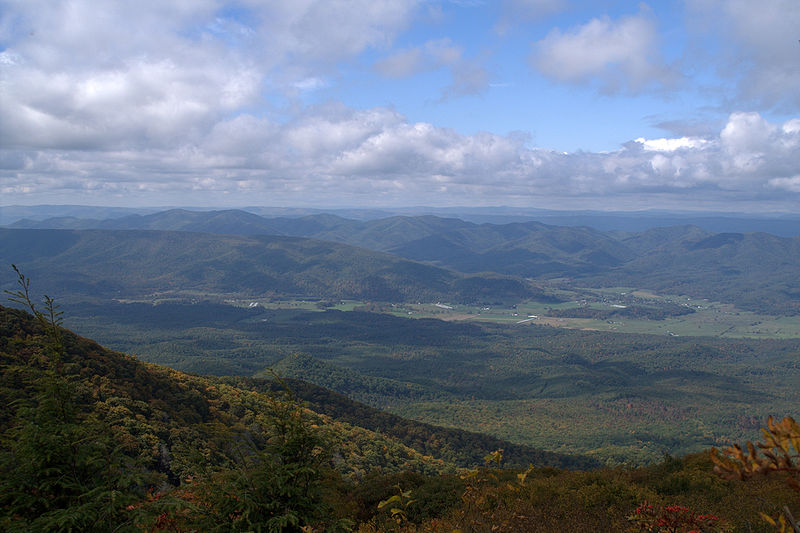
A view of Elliott’s Knob, the highest point in Augusta County, in the George Washington and Jefferson National Forest a few miles south of Braley Pond. Photo by Aneta Kaluza, 2006. Courtesy of Wikipedia.
The group of investigators had arrived around 4:30 in the afternoon of October 25, 2003 to investigate Braley Pond Campground. Stepping out of their vehicles, the lead investigator noted that the atmosphere was “so heavy as to be almost palatable, and I knew immediately that [this feeling] was not my own. I was feeling something that belonged to someone else.”
As the group neared the dam, a couple of group members became physically ill and the entire group retreated. Two of the investigators decided to return to the campground after nightfall to investigate further.
Arriving around 11:30 PM, the pair sensed the same heaviness in the atmosphere that they had experienced on the first visit. Moving on, they felt as if whatever had been there before was lying in wait for their return. As they tenuously made their way towards the dam, one of them saw an orb of light in a nearby pine tree. “Roughly thirty or forty feet in the air, looking as though it were nestled in the branches of one of the big pines that flank the opening to the path, was a brightly glowing fluorescent green light.”
After the light mysteriously blinked out, the pair began to hear violent splashing in the water below. Sensing that something was coming after them, the pair took off for the safety of their vehicle. As they ran, one of the investigators was knocked off the bridge into the water. “I don’t know how to explain it except for he literally flew upwards and to the left, as if something had hit him right in the middle of his back, like using his forward momentum, and he went off the side of the bridge into the water.” The pair would later discover that their audio equipment picked up a mysterious screech just before the man was thrown into the water.
When the lead investigator stopped to check on her companion, he was fine but encouraged her to continue running back to the truck. As she stood up on the side of the pond, she began to feel something crawling on her back. She recalled that it moved like an inchworm and felt as if it had tentacles.
Continuing back to the truck, she screamed that something was on her. Both investigators piled back into the vehicle and nothing was found on the investigator, though she continued to feel the thing creeping along her body.
Over the next few months, the lead investigator was plagued by nightmares and dark feelings and images that would surface in her mind periodically. The pair returned to the campground several more times and witnessed odd events, but none as dramatic as the events of that first night. When the lead investigator felt oddly drawn to visit alone, she found herself walking trancelike around the parking lot and suddenly found herself in the restroom without any memory of getting there.
Several weeks later, she and her husband heard a terrifying scream from her eight-year-old son in another room. The boy had witnessed the image of a man standing in the corner “with multiple holes in his chest; wet and covered in blood.”
Following this frightening vision, the dark feelings began to retreat. Revisiting the campground a few years later, the investigator did not sense anything there.
According to the Mysterious Universe website, campers and hikers in the area have encountered sudden feelings of nausea and dread, orbs of light, shadow figures, the sounds of splashing water, and a feeling of being drawn into the water.
What could be the cause of the darkness here? The answer may lie in tragedies that have occurred here. Mysterious Universe notes that the quiet pond has been the scene of suicides, which I have not been able to confirm, but it was here that a vicious gang-related murder took place in May of 2003, some months before the terrifying investigation took place.
On the evening of May 21, 2003, two young men picked up 19-year-old Christopher Kennedy in nearby Staunton. Kennedy had reportedly become a member of the Los Angeles-based street gang, the Crips. After being picked up by two other members, the group drove to the Braley Pond Campground. A short time previous, Kennedy admitted to his grandfather that he had joined the gang and expressed his anxiety that he was “too young to die.” An account of the murder in the Staunton, Virginia News Leader says, “Kennedy first left with Noa and Tinsley voluntarily and might have realized he was going to be killed on the way out to Braley Pond.”
Once they arrived at the pond, Kennedy was stabbed 12 times in the chest and back at the water’s edge. It was there that his partially submerged body was found. In the initial reports of the murder, police speculated that Kennedy had tried to leave the gang.
Details of the murder would line up with some of paranormal activity reported here: feelings of nausea and dread, splashing of water, and the investigator’s son’s vision of a wet man with holes in his chest and covered in blood.
Allow me to speculate a bit on this haunting. I sincerely hope that Kennedy’s spirit is at rest, and it seems that his residual energy may be felt at the campground. The lead investigator, who is sensitive, noted in her journal that she felt “another presence ‘behind’ the original one. This one didn’t feel like the others. In fact, it didn’t feel human.” This leads me to believe that perhaps this inhuman spirit may be an elemental, or nature, spirit angered by the intense violence that took place in its domain. In fact, it was this spirit’s ire that attached itself to the investigator and haunted her.
If you visit the Braley Pond Campground, enjoy the scenery, but beware that this beauty has a darker side.
Sources
Harrington, Tim. “Family worried about troubled boy.” News Leader. 24 May 2003.
In searching through back issues of the Atlanta Constitution that have recently been posted on Newspapers.com, I stumbled across two brief articles detailing a haunting in the small town of Toccoa.
Located in Stephens County, in the far northeast corner of the state, abutting the state line with South Carolina, Toccoa is a small mountain town established in the late 19th century along the Georgia Air Line Railroad. A few miles outside town, Currahee Mountain rises from the landscape which provided military training during World War II.
The 1907 Stephens County Courthouse in downtown Toccoa. Photo 2015, by Carol M. Highsmith. Courtesy of the Prints and Photographs Division, Library of Congress.
In the early days of the town’s creation after the Civil War and before the town’s incorporation, the town constructed a calaboose, or jail. In small towns, these buildings were generally one room shacks with bars to hold a prisoner or two. Judging from the newspaper’s vague description, I would conclude that the calaboose was this type of building.
A similar calaboose remains standing in Wingate, Arkansas. This one was built in 1898.
Please note that these articles use racist language typical to the period.
Atlanta Constitution 27 December 1887
CAGED AND BURNED
A Heartrending Scene at Toccoa, Georgia.
A PRISONER SHRIEKING FOR HELP
While the Guard House is on Fire—Unavailing Efforts to Free the Unfortunate Man.
TOCCOA, Ga., December 26.—[Special.]—Roland Taylor, a negro man, who has been working for Mr. W. J. Hayes for a long time, met a horrible death this morning at twenty minutes past 3 o’clock. He was taken by the marshal some time ago for some violation and locked up. He was released on bond, however, and given time to pay the fine which was imposed on him by the mayor. He failed to come up at the proper time, and last night was arrested again and confined in the calaboose. At the time mentioned, night watchmen Carter and Purcell heard someone screaming at a terrible rate, and upon investigation, found the calaboose on fire. They did all they could to save him, but failed, as the heavy doors were swelled so and the man too far gone. Mr. Carter says he is satisfied the darky set it on fire to make his escape.
This morning there is nothing left to tell the tale but some ashes and a small stack of bones. The coroner has been notified and will hold an inquest.
Atlanta Constitution 27 February 1888
THE DEAD MAN’S GHOST
Returns to Haunt the Prisoners Who Succeed Him.
TOCCOA, Ga., February 26.—[Special.]—The town council have had erected a new calaboose exactly on the same spot where the old one was burned Christmas eve, when Roland Taylor was cremated.
The negroes here look upon the new guardhouse with a superstitious awe, and to threaten to put one in strikes terror to his heart. They say the dead negro will surely come back at night, and one darky who was so unfortunate as to remain in custody over night, declares that about 10 o’clock something took him by the legs and pulled most vigorously for some time, all his efforts to release himself from the ghost grasp being in vain. It is needless to say he slept but little remainder of the night.
I have yet to determine the location of this building or if Roland Taylor’s spirit still haunts the area.
Sources
“Caged and Burned.” Atlanta Constitution. 27 December 1887.
“The Dead Man’s Ghost.” Atlanta Constitution. 27 February 1888.
Concord Point Lighthouse
700 Concord Street
Havre de Grace, Maryland
Searching for ghosts among Victorian newspaper sometimes leads to serendipitous discoveries. While hunting ghosts in Georgia newspapers, I ran across this brief news item from Maryland.
A ghost haunts the light-house at Havre de Grace, Md. The keeper of the light-house said, recently: “The head of the man, devil, woman, or whatever it was, appeared to rest against the wire frame around the lantern. The top of the head was covered in black, and the eyes and yellowish-looking inch or so of the forehead above them appeared set in a frame of black. Its eyes were as big as those of a cow, and sparkled just like two big diamonds. There was no expression about them as they moved and quivered in the lantern light.” He couldn’t look long at them, as they affected his eyes more than the bright steady flame of the lantern. Where the figure appeared, it left a strong odor of cologne. The place which generally smells of oil, was then filled with a perfume like a flower garden.
The Havre de Grace Lighthouse, as it was officially known, was constructed in 1827 by John Donohoo, who constructed a number of Chesapeake Bay lighthouses in the early 19th century. The light is situated at the point where the Susquehanna River enters the bay and was authorized by the Maryland General Assembly after numerous wrecks occurred at this point. For much of its history, the light was operated by members of the O’Neill family starting with the very first keeper, John O’Neill. The light was discontinued by the coast guard in 1975. The light has been restored and is currently operated as a museum.
The Concord Point Lighthouse, 2005, by Derek Ramsey, courtesy of Wikipedia.
This story from 1889 could be considered the first documented story of paranormal activity at the lighthouse. Several recent sources contend that activity remains at the site. Ed Okonowicz, who has venerably collected ghostlore from the Chesapeake region, notes that a number of locals walking near the lighthouse at night have seen a “slow-moving shadow in the upper windows of the light tower,” while a dark figure has been encountered near the memorial cannon at the tower’s base. Author Amelia Cotter includes the lighthouse in her book, Maryland Ghosts. Her account mentions that the body of a murder victim was discovered on lighthouse grounds in 1994. She believes that his spirit may remain here as well.
Sources
Cotter, Amelia. Maryland Ghosts: Paranormal Encounters in the Free State, 2nd Haunted Road Media, 2015.
Okonowicz, Ed. The Big Book of Maryland Ghost Stories. Mechanicsburg, PA: Stackpole Books, 2010.
“A Perfumed Ghost.” Fayetteville News. 15 February 1889.
Whittington, W.M. National Register of Historic Places nomination form for the Havre de Grace Light. 25 November 1975.
Cherry Research Farm (formerly Cherry Hospital)
604 Farm Road
Goldsboro, North Carolina
Ghost stories pop up in unusual places. These stories are often so entwined with history that these tales and stories pop up in places that are often unexpected. Today’s example is a story that appears in Modern Farmer magazine. While its pages usually discuss practical subjects such as antibiotic use in chickens or soy production, an article about sustainable agriculture research in North Carolina piqued my interest. It seems that the haunted grounds of Cherry Hospital in North Carolina have become an agricultural research station since the hospital’s move to its new, urban facility.
An undated postcard of Cherry Hospital.
“You must have heard,” the agricultural scientist remarks in the article, “Cherry Hospital has a strange history.” The history of the hospital recalls the brutal treatment of the mentally ill, and even worse, the archaic views of race that persisted in the South in the late 19th and early 20th centuries. Throughout the 19th century, states established facilities to deal with the mentally ill and those who stood apart from society. Mental illness encompassed people who thought beyond their social station, independent women, those with “unnatural sexual desires,” and masturbators; as well as the depressed, anxious, and those with more serious mental illnesses. During Reconstruction, many of these facilities were actively segregated and new facilities created for African-Americans. This is where Cherry Hospital was established.
The North Carolina Asylum for Colored Insane opened its doors in 1880. The facility operated specifically for African-Americans until the passage of the Civil Rights Act in 1964 when the Cherry Hospital—as it was renamed in 1959 for former governor R. Gregg Cherry—was forced to open its doors to all North Carolinians. Thousands of acres surrounding the hospital were cultivated by patients in what is now deemed “horticultural therapy.” These vast acres have been overseen by the state’s Department of Agriculture since 1974.
An undated postcard of Cherry Hospital.
However, Cherry Hospital’s treatment of its patients has not always just included the genial sounding horticultural therapy. Patients have endured a cavalcade of therapeutic abuses including electroshock therapy and being placed in cages as well as simple neglect. An entire ward of the hospital was closed in 2008 after a patient was neglected for almost an entire day. That patient died after being found unresponsive. In 2016, the original hospital closed and moved into a new facility within the city limits of Goldsboro. Since much of the land surrounding the original hospital was owned by the state department of agriculture, the whole facility has been transformed into the Cherry Research Farm.
Perhaps the saddest story from this facility became the subject of a 2007 book, Unspeakable: The Story of Junius Wilson. A 17-year-old African-American man, Junius Wilson, was incarcerated here in 1925 on charges of rape. The young man could not communicate verbally, except through grunts and hand gestures, which were interpreted as being signs of mental illness. Mr. Wilson spent most of his life at Cherry Hospital before a social worker identified him as simply being deaf. Wilson’s grunting and wild gesticulation was simply a form of sign language used by African-Americans in the South. He was released and allowed to live his remaining days in a small cottage on the hospital grounds where he passed away in 2001.
Of course, the environment in places of such mental and physical travail, is often imprinted with profound human emotions: the despair of depression, the anguish of anxiety, or perhaps the confusion that marks disorders like schizophrenia. Rumors of hauntings have been passed among locals for years. In fact, the Modern Farmer mentions that some of these rumors and stories have been documented in a book. I suppose this is Margaret Langley’s series of books on Cherry’s sister facility, Broughton Hospital in Morganton. The third volume of her series includes stories from other mental facilities and hospitals in the state.
Langley, an R.N. who worked at Broughton, began collecting ghost stories during her time at the hospital. These stories eventually included stories from a number of other hospitals including Cherry from which she published several. Most of these stories involved elevators. One particular story involved a staff member who boarded an elevator only to notice someone else walking up to the doors as they were closing. Hitting the open doors button, the staff member was surprised when the doors opened to reveal no one else on the other side. Another staff member reported hearing the elevators operating in a portion of a building under renovation. These buildings were not occupied at the time and the elevators required keys to function.
Other than this source, there are few other texts that specifically speak to the haunting of this facility except for storyteller Randy Russell’s 2014 book, The Ghost Will See You Now: Haunted Hospitals of the South. In it, Russell explores stories of band music being heard within the facility. The hospital did have a band for patients and Russell reports that this band may still play on accompanied by the shuffling of feet as patients danced and whirled.
Columbus Stockade 700 East 10th Street Columbus, Georgia
Way down in Columbus, Georgia,
Wanted back in Tennessee,
Way down in Columbus Stockade,
Friends have turned their backs on me. –Jimmie Tarlton & Tom Darby, “Columbus Stockade Blues,” (1927)
In her 2012 book, Haunted Columbus, Georgia, Faith Serafin relates a story that happened to a trio of sheriff’s deputies in 1990. A deputy noticed a light inside the old Columbus Stockade building adjacent to the modern Muscogee County Jail. Knowing that the building should have been empty at that hour, the deputy asked two of his colleagues to walk over to the building with him to check it out.
Entering the building, the deputies encountered the stench of rotting flesh. Assuming that an animal had died inside, the men split up to find the decaying remains. One of the deputies backed up against a cell and had something pull him against the bars. As he screamed out of shock and fear, the other deputies came running.
It took the strength of two deputies to free their frightened colleague. The three men searched for the culprit, but were surprised to find the cell and the whole building empty.
Like so many other jails and prisons I have covered, see the Kentucky State Penitentiary; LaGrange, Georgia’s LaGrange Art Museum; West Virginia’s Moundsville Penitentiary; and Charleston, South Carolina’s Old City Jail, the architecture chosen for the structure was meant to evoke a sense of foreboding and oppression. The Columbus Stockade employs heavy architecture with Italianate elements that add a sense of lightness and also help it to blend with the other buildings of that period.
An undated photo of the old Columbus Stockade.
There is a question of when the building was built. In her recent history of the city, Virginia Causey notes that building may date to as early as 1858, though she believes it was likely built around 1870. The preparers of the Georgia Historic Resources form which was used when listing the building on the National Register of Historic Places, state that the building is made up of two structures that were likely connected in the early 1900s. Originally, these buildings housed both the police department offices and the jail, and the building was used to incarcerate inmates until 1972.
After closing, the suggestion was made to demolish the building, but history-minded locals saved the structure based on, of all things, an old country song.
In 1927, a pair of local musicians, Tom Darby and Jimmie Tarleton wrote and recorded a song, the Columbus Stockade Blues.” After recording the song, the pair made the regrettable choice of accepting a flat payment of $75 rather than signing a contract for royalties. The song was a hit and sold two hundred thousand records in the first year alone. While the song put Columbus and its stockade on the map, the song’s writers lived out the remainder of their lives in obscurity.
It turns out that neither Darby nor Tarleton spent any time in the place they made famous, but it seems that a number of spirits remain incarcerated in the old stockade.
Sources
Alexander, Nancy, Roger Harris & Janice P. Biggers. National Register of Historic Places Nomination Form. 2 December 1980.
Causey, Virginia E. Red Clay White Water & Blues: A History of Columbus, Georgia. Athens, GA: U. of GA Press, 2019.
Kyle, Clason F. “Fate Unsure: Stockade ‘Way Down’.” Columbus Ledger-Enquirer. 23 April 1978.
Serafin, Faith. Haunted Columbus, Georgia. Charleston, SC: History Press, 2012.
A 2012 article from the Tampa CBS affiliate describes the city as “the damnedest city this side of Hell,” and with that perhaps the Britton Cinema 8 could be called “the damnedest multiplex this side of Hell.” This article goes on to note that there’s no rhyme or reason for the theatre to be haunted, but it is, apparently.
When the Britton Theater opened in 1956, it was hailed as the “first modern indoor theater in 32 years.” Situated in the Britton Plaza Shopping Center, the theater was built for $750,000 and seated 2,200 patrons in front of a single, large, seamless screen measuring 60-feet across. Seven years later, the large auditorium was split into three separate theaters. In 1992, the building was divided into eight screens. This multiplex remains in operation.
Advertisement for the opening of the Britton Theater, 1956, from the Tampa Times.
An anonymous report from the Ghosts of America website describes an encounter a patron had in the building around 2009 or 2010. This patron took advantage of a $1 movie ticket deal the theater offered on Tuesday nights. As the movie started, the patron looked around and realized that they were the only person in the theatre. About a third of the way through the movie, the patron spied an older woman sitting in a seat across the aisle, but she apparently disappeared a short time later.
A little while later, the patron then noticed a man in the theater who was seated in a different place every time they looked, though they never saw that person move. When they left, they perplexingly noted there was no one in the theater.
Speaking to a friend who was employed there, the patron discovered that their friend had numerous experiences while working there. One of the most significant things to occur happened in the employee corridor that links all of the projection rooms. A large piece of equipment used to transfer heavy reels of film was moved one evening to block the entrance door to the corridor. Curious as to why the door could not be opened, the employees had to enter the corridor via the fire escape.
Perhaps the spirits are just attracted to the films?
There’ll be parties for hosting,
Marshmallows for toasting,
And caroling out in the snow.
There’ll be scary ghost stories,
And tales of the glories of
Christmases long, long ago. –“It’s the Most Wonderful Time of the Year,” (1963) Edward Pola and George Wyle.
There has been much effort lately, mostly among the writers and bloggers in the paranormal community, to revive the ancient tradition of telling ghost stories at Christmas. To do my part, I’m attempting to post a story every day of the Twelve Days of Christmas.
The tradition of telling ghost stories around a fire on cold winter nights stretches back hundreds of years to the celebration of the winter solstice in Pagan Europe. As these ancient peoples were very much in tune to the rhythms of nature and the seasons, the moment when the northern pole of the earth was tilted at the furthest point away from the sun, sometimes described as the “shortest day.” Marking the mid-point of winter was a time of celebration and feasting, which also included storytelling.
Among the stories were oral sagas, especially among the Norse peoples, that would tell of ghosts, monsters, and other scary creatures. Their mid-winter celebration, called the Yule, has been celebrated for centuries and is the origin of many Christmas traditions including the Twelve Days, which last from December 25th to January 6th.
Not only has this storytelling tradition produced an abundant array of literature, but also a myriad of references. Shakespeare’s romantic comedy The Winter’s Tale references this tradition when Hermione begs Mamillius to tell a tale in the first scene of the second act.
Hermione: Come, sir, now
I am for you again: pray you, sit by us,
And tell us a tale.
Mamillius: Merry or sad shall’t be?
Hermione: As merry as you will.
Mamillius: A sad tale’s best for winter: I have one
Of sprites and goblins.
Hermione: Let’s have that, good sir.
Come on, sit down: come on, and do your best
To fright me with your sprites; you’re powerful at it.
After Shakespeare’s time, the celebration of Christmas began to decline. Oliver Cromwell, who ruled over England with a tough hand after the execution of King Charles I, considered the holiday to be out of line with Puritan mores and banned it. The Industrial Revolution of the 18th century also took its toll on the working classes’ recognition.
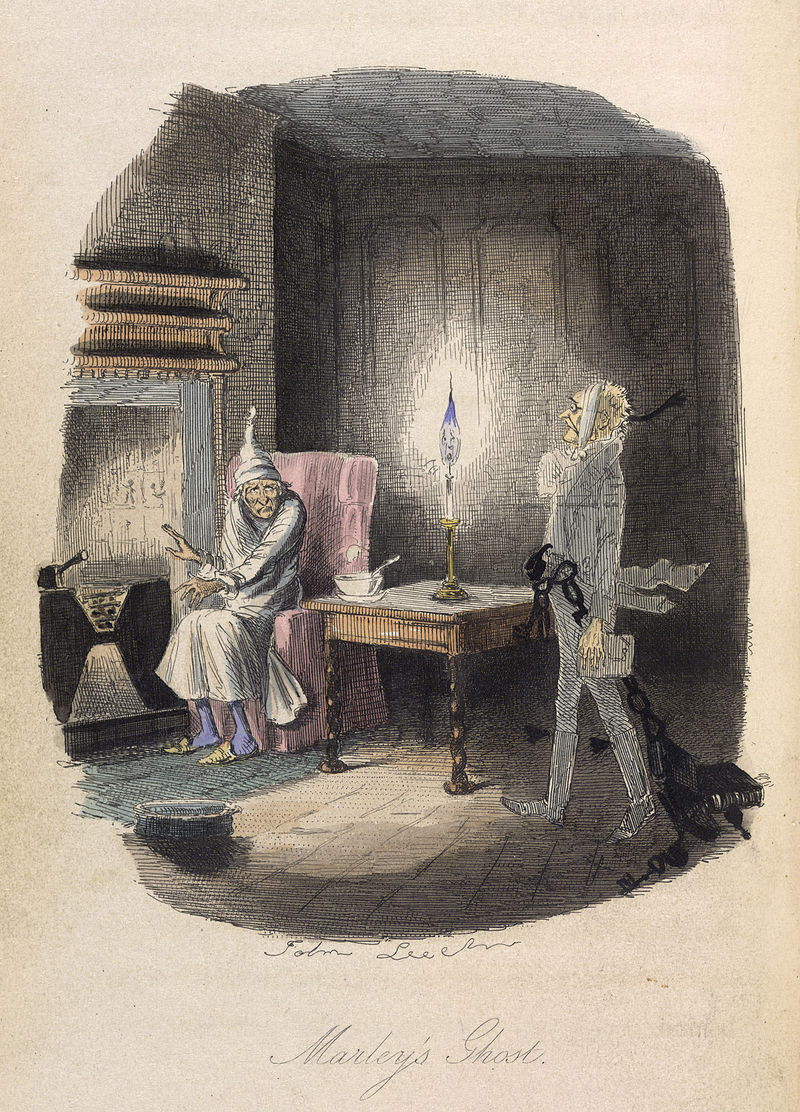
Marley’s Ghost appears to Scrooge in this illustration from the 1843 publication of Charles Dickens’ A Christmas Carol.
Perhaps the greatest reference to the telling of ghost stories at Christmas comes to us from Charles Dickens’ 1843 classic, A Christmas Carol. A tale of holiday redemption, the story includes three spirits who whisk the crotchety Ebenezer Scrooge off to explore three facets of his life. This story, which also serves as a social commentary on the begrudging of Christmas by industrialists and businessmen, helped lead to a revival of holiday celebrations in Britain and throughout the English-speaking world.
For the next twelve days enjoy some Southern chills for Christmas!
N.B. This is a repost of parts of the original “Haunted Kentucky” and “Haunted Old Louisville” articles published in 2011. These entries have been revised.
Conrad-Caldwell House 1402 St. James Court
Louisville
On the south side of Louisville’s Central Park is the St. James-Belgravia Historic District which consists some of the grandest houses in the Old Louisville neighborhood. This area was the site of the Southern Exposition held between 1883 and 1887. Once the exposition ended, the acres that it occupied were auctioned off and laid out in a British style.
Conrad-Caldwell House, 2016, by Kenneth C. Zirkel, courtesy of Wikipedia.
The Conrad-Caldwell House, now a house museum, was perhaps the grandest house in this most grand of settings when it was constructed in 1893. Built of limestone, a stone associated with paranormal activity, the interior utilizes seven different types of hardwood to great effect. The house was constructed for Theophile Conrad, a French immigrant who built a number of successful businesses and who wished to build a home similar to the opulent house of his childhood. Conrad passed away in the home in 1905 and his wife later sold the house to another successful businessman, William Caldwell.
After the Caldwell’s residence, the home was used as a boarding house and later sold to the Presbyterian Church as a retirement home.
Employees in the home are accustomed to greeting the spectral residents when they come in the morning. “I think all of us have gotten into the habit of saying hello when we come in morning because we know we’re not alone.” The director told local news station WDRB in 2013. It is also believed that Theophile Conrad continues to run his home in a strict manner, occasionally appearing to visitors, wagging his finger in disapproval. The Caldwells may also be around, as the odors of perfume and cigar smoke have been smelled within the museum as well.
Sources
Dominé, David. Ghosts of Old Louisville. Kuttawa, KY: McClanahan Publishing, 2005.
“History.” The Conrad-Caldwell House Museum. Accessed 10 December 2019.
“Mingling with spirits at the Conrad-Caldwell House.” WDRB. 26 October 2013.
Cumberland Falls State Resort Park 7351 KY-90 Corbin
At 68-feet high, Cumberland Falls is known as the “Niagara of the South,” and it’s also the only place in the Western Hemisphere where one can witness a moonbow, a rainbow caused by moonlight filtering through the falls’ mist. Considered a sacred place by local Native Americans, the site was developed for tourists at the end of the 19th century. The state park was developed in 1930.
The legend surrounding the park involves a bride who either slipped and fell or jumped to her death from one of the overlooking cliffs. One version of the legend holds that this happened in the 1950s, when the bride and her groom were exploring the park on their honeymoon. The couple had not had time to change clothes and the groom had decided to photograph his bride on one of the cliffs. As she posed, she slipped and fell to her death.
Cumberland Falls, 2009, by J654567, courtesy of Wikipedia.
Another version of the legend speaks of a young couple marrying at the park’s lodge. The bride had become worried when the groom did not show up and was crushed when word arrived that he had been killed in a car accident. In despair, she rushed to the precipice in her wedding dress and flung herself off.
A woman in a white gown has been seen throughout the park, both in and around the falls as well as on the main road. Some have seen her form drifting up through the waters on nights that the moonbow appears. A 2008 blog entry reveals that she may also be active at the park’s lodge.
Sources
Cumberland Falls. Wikipedia, the Free Encyclopedia. Accessed 6 January 2010.
Lamkin, Virginia. “Kentucky’s Cumberland Falls.” Seeks Ghosts. 15 December 2015.
Specter, Jason. “The Bride of Cumberland Falls.” The ScaryStates of America Blog. 23 February 2008.
Filson Historical Society (Ferguson Mansion) 1310 South Third Street Louisville
In a city filled with extravagant Gilded Age homes, the Ferguson Mansion is perhaps the finest. Constructed in 1901 for the Walter Hite Ferguson who built a business selling cottonseed oil, the home was initially built to house him, his wife, their daughter, and a retinue to six servants. Little expense was spared on this Beaux-Arts style manse which included light fixtures by Louis Comfort Tiffany and other works by the leading designers and decorators of the day. The Ferguson family occupied the home until 1924, when it was sold to the Pearson family who operated a funeral home here until 1978. The house was renovated as a home for the Filson Historical Society, which concentrates on the history of Kentucky, the upper South and the Ohio River Valley.
The Filson Historical Society by W.marsh, 2007, courtesy of Wikipedia.
The house is believed to be the residence of a spirit named Sally who gleefully tosses books from the shelves in front of shocked visitors and staff members. She is known to produce disembodied footsteps, strange odors, and slam doors, as well as pulling volumes from the shelves which sometimes end up in piles on floors or tables. While there is nothing in the home’s history to attest to Sally’s identity, David Dominé posits that the spirit may stem from the home’s use as a funeral home.
Sources
Dominé, David. Haunts of Old Louisville. Kuttawa, KY: McClanahan Publishing, 2009.
Natural Bridge State Resort Park 2135 Natural Bridge Road
Slade
Adjacent to the Red River Gorge, a place noted for its wild landscape and mysterious encounters, Natural Bridge State Resort Park has its own paranormal activity. According to investigator and writer Patti Starr, the park is home to the Purple Lady, a female apparition wearing a purple evening gown who has been frequently spotted throughout the park. Staff members and visitors alike have seen the spirit in and around the park’s lodge, roads, and campgrounds. Her identity is unknown, though one park employee suggested that she may be the spirit of a woman who was murdered in a cabin on the property many years ago.
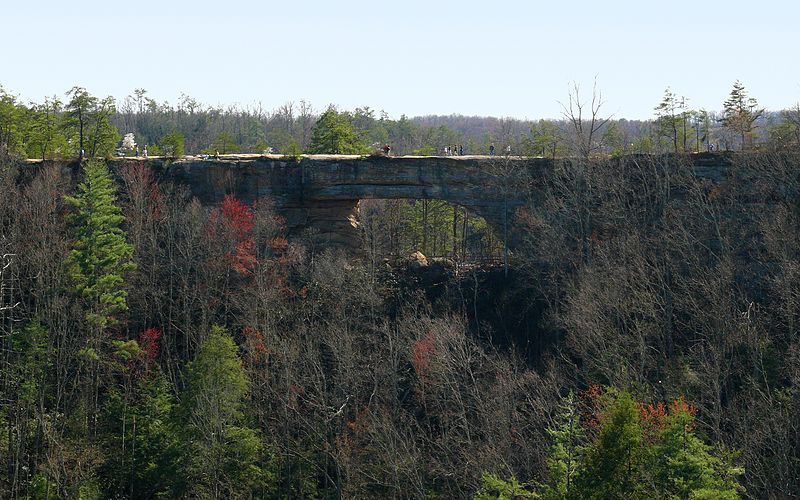
The Natural Bridge in Natural Bridge State Resort Park, 2009, by Ken Thomas. Courtesy of Wikipedia.
Nina Lautner published the experience of a park visitor in her 2014 Ghosts of America: Southern Appalachia. The visitor stayed in the park’s lodge in 2008 and she experienced an overwhelming sense of dread from the moment she stepped into the room. Unable to sleep, she turned on the lights and they flickered a bit, but she wasn’t able to shake the negative feeling. When she reported her experience to the front desk, the clerk asked if she had seen the spirit.
The titular feature of Natural Bridge State Resort Park is a sandstone archway formed by millions of years of weathering. The park opened in 1896 as a private attraction and trains brought visitors from Louisville, Lexington, and other large cities. The park and Hemlock Lodge are now under the auspices of the state of Kentucky as a state park.
Sources
Lautner, Nina, ed. Ghosts of America: Southern Appalachia: True Accounts of Ghosts. Stratus-Pikpuk, 2014.
Pink Palace (private) 1473 St. James Court
Louisville
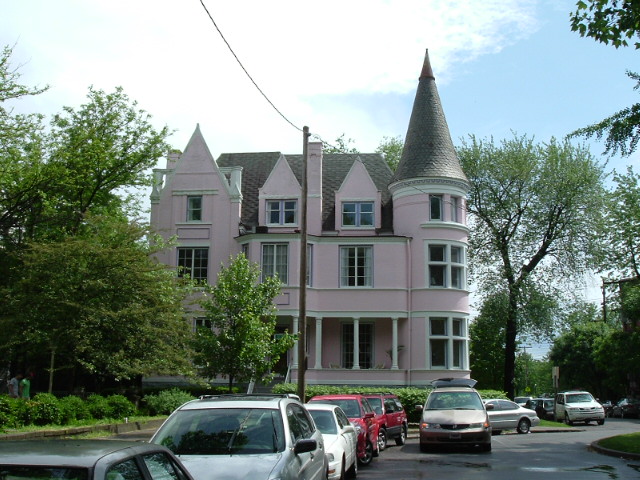
In the late 19th century, St. James Court was developed as one of the most exclusive neighborhoods in Louisville. The dramatic French-styled house at number 1473 was constructed in 1891 originally as a gentlemen’s club for the wealthy homeowners. Rumors allude to the fact that this staid institution may have provided female companionship to club members after dark. Interestingly, after a brief stint as a private family home, the house was acquired by the Women’s Christian Temperance Union (WCTU), a group that crusaded against the consumption of alcohol and other vices. After the WCTU discovered the home’s sordid past, the decision was made to paint the home pink to counteract the negative memories of the building.
The Pink Palace in 2007. Courtesy of Wikipedia.
Over the years, residents of the palatial home have had various encounters with an aristocratic gentleman. David Dominé included the story of one young lady who lived in a basement apartment some decades ago. One particular night, she had two visits from the spectral gentleman. She saw him first standing in her kitchen; then a short time later he appeared in her bathroom doorway while she took a bath. She quickly got out of the bath and left the room. Hearing the crash of breaking glass and splashing water, she returned to the bathroom to find the window broken. She summoned the police who discovered that the window had been broken by a cement block during a robbery attempt. The cement block landed in the bath where she had been lying just moments before.
The apparition, believed to be the image of one of the home’s former owners, has also appeared to other residents of the home as a warning. The house remains a private residence.
Sources
Dominé, David. Phantoms of Old Louisville. Kuttawa, KY: McClanahan Publishing, 2006.
Presentation Academy 861 South Fourth Street
Louisville
The oldest school in continuous operation in the city, the Presentation Academy is a private college-preparatory high school for girls founded by the Sisters of Charity of Nazareth in 1831. The school’s current building was opened in 1893 and designed by D. X. Murphy, one of the city’s leading architects of the time.
Legendary spirits at the school include a nun who died after falling down a staircase and Mary White a student who was killed in a car accident while en route to her coming out party. While documentation does not back up either story, that does not discount the numerous encounters that have occurred here.
Presentation Academy, 2012, by Nyttend. Courtesy of Wikipedia.
David Dominé includes the frightening account of one student’s encounter. As she walked down the hall towards a class, the student noted that another student was walking next to her. After seeing that she was dressed in an old-fashioned uniform, she then noticed that the young lady did not have legs. The student stopped in the middle of the hall to gawk as the spirit continued down the corridor and faded from view.
Sources
Dominé, David. Phantoms of Old Louisville. Kuttawa, KY: McClanahan Publishing, 2006.
Hedgepeth, Mary Poynter. National Register of Historic Places nomination form for Presentation Academy. 15 August 1978.
Presentation Academy. Wikipedia, the Free Encyclopedia. Accessed 18 December 2019.
L. B. Speed Art Museum 2035 South Third Street
Louisville
Founded as a memorial to her husband, the Speed Art Museum opened in 1927. Hattie Speed’s devotion to her husband’s memorial and her own perfectionism may be what is keeping her spirit within the walls of the museum. A rose-type perfume has been smelled, motion sensors set off, elevators operate mysteriously by themselves and misty, white shapes have been seen on security monitors; all believed to be Mrs. Speed checking up on “her” museum. Some particularly notable occurrences have been connected with the portrait of J. B. Speed’s first wife, Cora Coffin, which has had issues with its label mysteriously peeling from the wall. One museum staff member was shocked to discover the portrait removed and left propped with its face turned to the wall.
A view of the galleries inside the Speed Art Museum, 2016, by Sailko. Courtesy of Wikipedia.
Several visitors and staff members have reported odd encounters with a Native American man in the museum’s Native American gallery. While the man’s identity is unknown, he has been seen and his presence felt in the space.
Sources
Dominé, David. Ghosts of Old Louisville. Kuttawa, KY: McClanahan Publishing, 2005
Speed Art Museum. Wikipedia, the Free Encyclopedia. Accessed 18 December 2019.
Walnut Street Baptist Church 1101 South Third Street Louisville
Early 20th Century postcard of Walnut Street Baptist Church.
Erected just at the outset of the 20th century, the grand Gothic Revival Walnut Street Baptist Church has provided spiritual sustenance for over a century to the citizens of Old Louisville and beyond. But it also harbors a legend. Over the century, people have reported a large, winged creature around the church. Reports of this creature, dubbed the “Demon Leaper” even come from as recent as 2005.
Sources
Dominé, David. Haunts of Old Louisville. Kuttawa, KY: McClanahan Publishing, 2009.
Kentucky State Penitentiary
266 Water Street
Eddyville, Kentucky
For he hath looked down from the height of his sanctuary; from heaven did the Lord behold the earth; To hear the groaning of the prisoner; to loose those that are appointed to death. –Book of Psalms, Chapter 102, Verses 19-20 (King James Version)
In his marvelous book, Hauntings of the Kentucky State Penitentiary, Steve Asher recounts a number of experiences he and other staff members had within the walls of this grim institution. A guard working in the late 1980s had a frightening encounter while inspecting cells in Three Cell House. These particular cells had once been part of death row, and despite them not being in use at that point, they still required inspection.
After examining the first few cells, the guard encountered a cell that was occupied. The prisoner stood in the center of the small space reading a Bible. The prisoner greeted the guard and he acknowledged it with a nod and smile before returning to his inspection.
When he returned to his office, he asked his sergeant if the prisoner had gotten a meal. The sergeant replied that there was no one in that cell, in fact no one had been in those cells in nearly a month. Knowing how thorough the guard normally was, the sergeant insisted on looking in the cell himself to ensure that a mistake had not been made.
The guard and the sergeant approached the cell to find that it was indeed empty. A light layer of frost attested to the cell having been unoccupied for some time. The pair stepped inside and noticed that the temperature inside was quite chilly. The cell had been stripped and was empty except for a small Bible that lay open on the floor.
Picking it up, the guard noted that the pages were open to the 102nd Psalm and one single passage had been highlighted, verse 20, “To hear the groaning of the prisoner; to loose those that are appointed to death.” He passed the Bible to the sergeant and shuddered as he read the highlighted verse aloud. Perhaps the spirit was trying to communicate with the guard.
The front facade of the Kentucky State Penitentiary, 2011. Photo by Acdixon, courtesy of Wikipedia.
Eddyville, Kentucky is situated on a sharp bend in the Cumberland River near the border with Tennessee. The bend in the river and the two lakes that were created in the 20th century create a finger of land that is preserved as Land Between the Lakes National Recreation Area, a place that is known for many strange goings-on. Rising above the river at the old site of the town of Eddyville (much of the original town was destroyed with the creation of Lake Barkley) is the famed “Castle on the Cumberland,” the Kentucky State Penitentiary.
For more than a century, this grim edifice has stood reminding the lawful of the consequences of lawlessness and little hope for law-breakers. Several sources note that the front entrance of the prison was once marked with a plaque bearing the words, “Abandon hope all ye who enter here,” the same words marking the gates to Hell in Dante’s Inferno.
Steve Asher posits that the prison itself may act as a kind of paranormal dynamo. Constructed with prison labor, the very building itself is imbued with negativity and that that atmosphere creates the perfect storm for an array of paranormal activity. His book offers a glance behind the prison walls revealing apparitions, phantom sounds, bizarre sensations, and disturbing nightmares experienced by members of the prison staff.
The Kentucky State Penitentiary began life in 1884 as a branch prison to relieve the overcrowding of the main state penitentiary in Frankfort. Opening in 1886, the Medievel-Revival edifice was meant to house 800 prisoners. The prison became the main state prison with the closure of the Frankfort prison in 1937. In 1911, an electric chair was installed and served as the primary method of execution at KSP until 1962. During that time, 163 men were put to death in “Old Sparky.”
View of Kentucky State Penitentiary from the Cumberland River, 1939, from the National Archives and Records Administration.
On July 13, 1928, “Old Sparky” saw its busiest day when seven men were executed back to back. On that Friday the 13th, the headline of the Louisville Courier-Journal shouted, “Red Seymour loses fight for life, is doomed to die with six others.” The Thursday before had dashed the hopes of murderer Orlando “Red” Seymour when a judge overruled a petition for a sanity hearing. The hearing was held in the KSP chapel where the newspaper described the scene.
Seymour was brought into the prison chapel, where the hearing was held, and remained throughout. He appeared to be very weak and was assisted up the steps to the stage where he sat, his hands in his arms. He frowned when the decision was announced and then was led back to his cell.
Just after 7 PM that night, the prison warden visited the cells of the seven condemned men to read the death warrants. The executions were slated to take place just after midnight. The newspaper described the scene at the prison on Thursday afternoon leading up to the mass execution.
Corridor Is Jammed.
Guards at the prison declared today that never had there been so much excitement attending an execution here, the corridor outside the warden’s office throughout the day was filled with relatives, friends and attorneys of the condemned men. Here and there a woman was sobbing. Little groups congregated about the doorways.
[…]
Down in the death house, the heat was oppressive. The four white men sat or stood before their cell doors throughout the afternoon. All were composed and each repeated his assertion of yesterday that he was ready to die.
[…]
Death Cell Furnished Plainly.
The death house has seven rooms, only four of them cells. These cells are situated directly across from the electric chair room, which may easily be seen through a wide door. The death chamber is very plainly furnished. The electric chair is in the center at the far side of the large room. To the right side, facing the chair, is a small room from which the switches are manipulated.
The Owensboro Inquirer picks up the story of the executions.
Four white men, three of them very young, and three negroes made up the seven whose deaths in the electric chair set a record for Kentucky. Sullen, defiant and prayerful by turns during their stay in the death house, the condemned men were reduced by fear to a condition bordering upon collapse as midnight approached.
Shaken by Dread
Although there was no clock going to sound the hours, the prisoners sensed and all talk died away long before the death march started at 12:15. With heads supported in cupped hands, they sat silent, their bodies shaken by chills despite the intense heat in the squat stone house that had been their home in the prison. In plain view was the execution chamber and the chair.
After the seven white coffins were placed outside the prison for the families to take, the newspaper noted:
It was thought however, that one or more might remain to be buried in the tiny prison cemetery that lies just outside the towering walls. Early in the morning a red cart and mule stood hitched near the coffins ready to perform their last duty of the state in hauling those that remained down the hill.
After such a dreadful day in KSP history, it is possible that one or more of these prisoners have remained behind in spirit form. Perhaps it is one of these prisoners who appeared to the guard while going about his rounds.
Eastern view of the Kentucky State Penitentiary, 2014. Photo by Nyttend, courtesy of Wikipedia.
Please note that this prison is still in full operation and not open for the curious or paranormal investigations.
Sources
Asher, Steve E. Hauntings of Kentucky State Penitentiary. NYC: Permuted Press, 2016.