Night creatures call And the dead start to walk their masquerade… –Michael Jackson, “Thriller” (1983)
Charlotte Jane Memorial Park Cemetery 3650 Charles Avenue Miami, Florida
The scene is iconic of the early 1980s and plays a bit part in my own childhood: Michael Jackson donned in classic red leather dancing with a host of zombies outside a cemetery. Jackson’s ‘Thriller’ album was the first pop album I owned and I’m sure my own interpretations of the song and video in my parents’ basement playroom hinted at my future interests in theatre and the supernatural. In 2009, this video was considered important enough to be preserved as part of the National Film Registry by the Library of Congress.
As I was searching out an article on ghost tours being conducted at Miami’s Deering Estate, I happened on a 2012 article on creepy Miami from TheHuffington Post. While I was familiar with most of the locations, Charlotte Jane Memorial Park stood out. The articles notes that neighbors of the cemetery claim that it was where the graveyard scenes in the ‘Thriller’ video were shot here. According to the excellent Wikipedia article on the video as well as later in the Huffington Post article, the video’s director John Landis has stated that the video was shot entirely in Los Angeles.
After looking at the music video, the cemetery does bear some semblance, especially in the fact that both cemeteries appear to be old, crowded cemeteries. A page from a website called Miami for Visitors, claims that Charlotte Jane Memorial Park provided the inspiration for the cemetery. But there is no real evidence behind this tenuous connection between the cemetery and the music video.
A further glance at the history of this cemetery, however, brings one into the mists of the early history of South Florida. Miami was a scrappy collection of settlements at the mouth of the Miami River when the city was incorporated in 1896. Henry Flagler, the railroad magnate who was instrumental in the creation of the modern state of Florida, had begun expanding his Florida East Coast Railway through the area the previous year. Coconut Grove was a well-established town by this time and continued to grow with the influx of immigrants from the Bahamas who enjoyed the South Florida climate that closely resembled that of their island homes. After Miami’s incorporation, wealthy families from the northeast began flooding into Coconut Grove and began erecting mansions such as the Deering Estate. In 1925 Coconut Grove was annexed by the City of Miami, though it remained a Bohemian and Bahamian enclave.
Charlotte Jane Memorial Park was established as the second Bahamian burying ground in the city, the first was located a little ways up Charles Avenue just after the turn of the 20th century. Named for the wife of community leader E.W.F. Stirrup, Charlotte Jane Memorial Park was originally called the Coconut Grove Bahamian Cemetery and founded around 1913. The cemetery features above ground tombs that painted silver and white. According to Alex Plasencia’s thesis examining the history and race relations in Coconut Grove, the graves are traditionally painted during the Goombay Festival, which is held annually to celebrate Bahamian culture.
This historic cemetery has been noted for odd occurrences for many years. A 1990 article in the Miami New Times explores the city’s historic cemeteries and mentions an incident at Charlotte Jane Memorial Park that had taken place in 1983. On a night of a full moon, a brown paper bag with flies swarming around it was discovered just inside the cemetery’s gates. When investigators opened the bag, the decapitated carcass of a chicken was discovered inside. After it appeared that a nearby mausoleum had been broken into, investigators discovered that a casket had been pried open and the corpse inside had been decapitated. A rusty hunting knife lay on the floor of the crypt. An investigator with the medical examiner’s office concluded that the head had possibly been taken as a part of a Santeria ritual. Sadly, a similar incident was reported earlier this year and a local man was arrested on charges of burglary, disturbing the contents of a grave and vandalizing a grave.
According to a variety of sources, there is some spiritual activity here including shadow figures and disembodied voices; activity which has been witnessed in many cemeteries. Those same sources also claim that the Michael Jackson, who may or may not have been inspired by this cemetery, has been seen here following his unexpected death in 2009. If, while exploring this historic cemetery, you encounter spirits, you may want to have some killer dance moves prepared.
Plasencia, Alex. A History of West Coconut Grove from 1925: Slum Clearance, Concrete Monsters, and the Dichotomy of East and West Coconut Grove. Clemson University Thesis. 2011.
Rowe, Sean. “Boneyard Ramble.” Miami New Times. 24 October 1990.
My earlier articles on the haunted plantations of Louisiana’s River Road are among the most visited articles on my blog. Therefore, I’ve decided to revisit and update some of these articles.
The plantation is one of the most iconic images of historical South and Louisiana has preserved many of these cherished places. Some of these grand homes are run as museums while others host guests as bed and breakfasts. Others still have been reduced to ruins.
What is often forgotten, however, is that these plantations were built on the backs of enslaved labor, mostly African. While these grand estates served as paradises for the ruling class—which in Louisiana included people of French and Spanish origin as well as occasionally mixed race people and even freedmen—these same estates were often pure hell for the enslaved. It’s no wonder that these hellish paradises have been imprinted by all the tragedy and triumph they have been witness to. These are some of their stories.
Oak Alley Plantation 3645 Louisiana Highway 18 Vacherie
Of Louisiana’s plantations, Oak Alley is certainly the most iconic with its alley of 14 majestic oaks that frame the view of the house from the river. When viewed from the river, the main house appears tiny, but up close, the home’s 28 peripteral columns seem to translate the trunks of the oaks into classical architectural terms. The oak alley was planted some years prior to the construction of the grand, colonnaded house which was begun in 1837 and was completed two years later. Jacques Telesphore Roman, for whom the house was constructed, owned the house until 1866 when it was sold and passed through the hands of a number of landowners. When Andrew and Josephine Stewart purchased the property in 1925, the house was in a state of serious decay. With the help of architect, Richard Koch, the house was returned to its former glory. It was the restoration of this plantation that started the movement to preserve other plantations in the area.
The house and its majestic grounds have been used in a number of films including 1964’s Bette Davis thriller, Hush…Hush Sweet Charlotte, Interview with a Vampire and Primary Colors. Additionally, the music video for Beyoncé’s 2006 song, “Déjà Vu,” shows the singer dancing under the canopy of the oaks in front of the house.
Oak Alley Plantation. Photo 2012, by Emily Richarson, courtesy of Wikipedia.
Among the shadows of the oaks and the house’s massive colonnade numerous spirits have been reported. At least two female spirits have been seen in and around the house including one that appeared in a photograph in 1987. A couple from Texas was taking pictures in the master bedroom of the house. A dress form that stands in that room appeared in one of the photographs to have a head on it. Oddly, the “head” is not reflected in a nearby mirror. Perhaps, Monsieur Roman’s wife, Celine has returned to have her photograph made.
Jeff Dwyer in his 2007, Ghost Hunter’s Guide to New Orleans, describes the sound of a carriage, complete with the rattle of chains and the neighing of horses, has been heard on the drive leading to the house. The Oak Alley website features a page of ghost stories including a note from a pair of tour guides who recall witnessing billowing dust and sound of horse’s hooves upon the gravel driveway when there was nothing to be seen.
A view of the main house at Oak Alley Plantation. Photo 2011, by Emily Richardson, courtesy of Wikipedia.
One of the home’s staff members related a story to author Jill Pascoe which she included in her 2004 book, Louisiana’s Haunted Plantations. The staff member had begun securing the house for the night and was waiting on the final tour to finish. She took a seat in the parlor to wait. As she was sitting there she saw a woman dressed entirely in black and wearing a black veil approach the bottom of the staircase. The staff member stood to confront this visitor when the figure turned towards her and disappeared.
Investigations by Louisiana Spirit Paranormal Investigators have produced EVPs and many recorded personal experiences. In 2008, Oak Alley was investigated by the The Atlantic Paranormal Society (TAPS) as part of the Syfy Channel series, Ghost Hunters. The investigators came up with some interesting evidence. One piece of thermal imaging video shows something with a heat signature moving outside of a window. When Jason Hawes asked Grant Wilson (the main investigators) to step outside on the veranda outside of the window, nothing can be seen. Other evidence include a flashlight coming on by itself and hits on a K2 meter in response to questions.
Sources
Dwyer, Jeff. Ghost Hunter’s Guide to New Orleans. Gretna, LA: Pelican Publishing, 2007.
Episode 408, “Oak Alley Plantation.” Ghost Hunters. Syfy Channel. Originally aired 8 October 2008.
“Ghost Tales.” Oak Alley Plantation. Accessed 31 January 2015.
Goeldner, Paul. National Register of Historic Places nomination form for Oak Alley Plantation. 3 July 1974.
National Park Service. “Oak Alley Plantation.” Southeastern Louisiana: A National Register of Historic Places Travel Itinerary. Accessed 6 September 2010.
Oak Alley Plantation. Wikipedia, the Free Encyclopedia. Accessed 30 Janurary 2015.
Sillery, Barbara. The Haunting of Louisiana. Gretna, LA: Pelican Press, 2001.
San Francisco Plantation 2646 Louisiana Highway 44 Garyville
It’s not hard to imagine that San Francisco Plantation was designed by a deranged carnival clown. The house is representative of Steamboat Gothic architecture, a style the National Park Service describes as a “potpourri of architectural designs.” A dozen highly skilled slaves were purchased to aid in the construction of this brightly painted home. The immense cost of the house’s construction in 1849, may have led to the name of the house, a bastardization of “saint-frusquin” or “without all that one possesses.” Edmond Marmillion started off in enormous debt after he purchased the land from a free man of color, Elisée Rillieux, for nearly $100,000, a huge sum of money in the early 19th century.
Facade of San Francisco, 2011, by Elisa Rolle. Courtesy of Wikipedia.
Marmillion created an extensive sugar plantation and eventually found financial success in the 1850s. But a pall of sickness hung over this successful period. Marmillion’s wife contracted tuberculosis and died in 1843. The couple’s eight children also contracted the dread disease and six of them died over a period of about 20 years. The marvelous plantation remained in the family until the late 19th century when it passed out of the family. Following the disastrous Great Mississippi Flood of 1927, many riverside plantations, including San Francisco, were threatened with destruction as the Army Corps of Engineers constructed a levee to contain the river. Some plantations were saved and the levee was rerouted to save San Francisco. The house remains, though a massive petroleum plant looms behind the house museum.
Oblique view of San Francisco, 2011, by Elisa Rolle. Courtesy of Wikipedia.
With the dearth of complex and rich history at San Francisco, it is surprising that descriptions of the plantation’s spirits only amount to a few paragraphs. Most sources mention that the spirit of Charles Marmillion, one of Edmond’s sons, has been seen in the house. Psychics with one investigation team noted his sickly form in the office and one of the bedrooms. The apparitions of two young girls have been encountered playing under the trees around the house.
Sources
Brown, Alan. The Haunted South. Charleston, SC: History Press, 2014.
Dwyer, Jeff. Ghost Hunter’s Guide to New Orleans. Gretna, LA: Pelican Publishing, 2007.
Goeldner, Paul. National Register of Historic Places nomination form for San Francisco Plantation. 17 January 1974.
Malone, Paul and Lee. The Majesty of River Road. Gretna, LA:Pelican Publishing, 1991.
National Park Service. “San Francisco Plantation House.” Southeastern Louisiana: A National Register of Historic Places Travel Itinerary. Accessed 6 September 2010.
“Plantation History.” San Francisco Plantation. Accessed 31 January 2015.
Sexton, Richard. Vestiges of Grandeur: The Plantations of Louisiana’s River Road. San Francisco, CA: Chronicle Books, 1999.
The Cottage Plantation River Road at Duncan Point Baton Rouge
On the 18th of February 1960, firefighters battling the lightning-caused blaze that destroyed The Cottage Plantation reported that they saw a man looking out one of the upper windows of the grand home. The firefighters yelled at him trying to encourage the gentleman to jump, but the man didn’t seem to notice the firefighters on the lawn or the flames that were engulfing the house in which he stood. Shortly after the man’s appearance, the roof collapsed. Human remains were not found in the smoldering ruins of The Cottage. Perhaps this may have been the same man whose visage was captured on film just ten years earlier peering out of the moldering house through a broken window.
Only forlorn columns standing in a weedy privately owned field mark the site of The Cottage alongside River Road just south of Baton Rouge. The home was constructed in 1824 as a wedding gift from Colonel Abner Duncan to his daughter, Frances and her husband, Frederick Daniel Conrad. It was under Conrad’s ownership that a certain Ezra Holt was brought to work at the plantation, though stories differ as to what his function was. All stories, however, point to Mr. Holt’s dedication to the Conrad family and The Cottage Plantation.
Legend speaks of Mr. Holt returning to the house after the Civil War to maintain it for the Conrad family. Living alone in the huge house, Holt became a recluse and is said to have grown a long, white beard. After he passed, he was buried in a family cemetery on the site, though stories emerged describing his spirit as continuing to wander the house and grounds. There is some indication that these stories may have been produced to keep vandals and curiosity-seekers away from the decaying house. The house was restored by members of the Conrad family in 1920 and was used as a museum, even appearing in a few films including the 1957 Clark Gable vehicle, Band of Angels.
Even before it was destroyed by fire, visitors and staff reported seeing a man with a long beard wandering the halls of the house. Even now, many years after its destruction, stories of a man seen among the ruins persist. Some, who have trespassed beyond the electric fence that now surrounds the ruins (I cannot recommend anyone breaking the law to see the ruins up close), have reported hearing voices and the sounds of a spectral party among the decrepit columns of the once grand home.
Sources
Duvernay, Adam. “Several Baton Rouge sites said to be haunted.” The Daily Reveille. 27 October 2009.
Dwyer, Jeff. Ghost Hunter’s Guide to New Orleans. Gretna, LA: Pelican Publishing, 2007.
Franklin, Wade. “Ghostly Thought—Haunted House Tour.” Waukesha Daily Freeman (Waukesha, WI). 21 April 1977.
Sloss Furnaces 20 32nd Street, North Birmingham, Alabama
Perhaps one of the most iconic haunted places in the state of Alabama, this National Historic Landmark site is reminiscent of Birmingham’s history. Birmingham was built on industrial facilities like this producing iron during the latter half of the 19th and into the 20th centuries. While the facility opened in 1882, nothing remains of the original furnaces. The oldest building on this site dates to 1902 with much of the equipment installed and added in later years. This facility closed in 1971, and local preservationists began work to save the facility soon after. Their efforts paid off, and the facility is open as a museum and events facility.
Sloss Furnaces, 2011, by Matthew Gordon. Courtesy of Wikipedia.
There is always a chance for death in industrial sites, even more so around molten metal in a furnace. In 1887 Theophilus Jowers assistant foundryman at the Alice furnace (one of the first furnaces on this site), fell to his death into the molten iron in the furnace. Some of his remains—his head, bowels, two hip bones and some ashes—were fished out of the molten iron. Jowers’ death remains one of the most spectacular and grisly, though many more men died throughout the time that the furnaces were in operation.
After Jowers’ death, his spirit was observed by co-workers. Kathryn Tucker Windham quotes one former employee, “We’d be getting ready to charge the furnace, and we’d see something, something like a natural man walking around on the hearth. Just walking slow and looking around like he was checking to make sure everything was all right.” Windham describes the first time that Jowers’ son saw his father’s spirit in 1927. The grown son took his own son for a drive over the First Avenue Viaduct and there, while watching the action at the furnace, they observed a man walking through the showers of sparks and flames.
Two more spirits are believed to be in residence at this site, but their stories are less historically based. A white deer that has been seen on the grounds is believed to be the spirit of a pregnant girl who committed suicide by throwing herself into the furnace. The other “apocryphal”—as Alan Brown describes him—spirit is that of a fiendish foreman named James “Slag” Wormwood. Like Jowers and the pregnant girl, Wormwood supposedly fell to his death into one of the furnaces, though it is suspected that he was really pushed by an angry employee. It is Wormwood’s angry spirit that is responsible for pushing employees and visitors even today.
The furnaces are known as a hotbed of paranormal activity and were investigated for the first time in 2005 by Ghost Chasers International out of Kentucky. They were joined by psychic Chip Coffey who would soon make his name working on the A&E show, Paranormal State. During the investigation, Coffey made contact with the spirit of a man who had lost a limb in an accident there. Moments after losing contact with the spirit, team members noticed blood on Coffey’s hands. After investigating him for scratches or another injury that could have produced blood, nothing was found. Over the past 10 years of paranormal investigations at the site, a slag heap of evidence has been captured here.
Sources
Brown, Alan. Haunted Birmingham. Charleston, SC: History Press, 2009.
“History.” Sloss Furnaces National Historic Landmark. Accessed 12 June 2015.
Parks, Megan. “Sloss Fright Furnace: The haunts heat up in Alabama.” USA Today. 14 October 2014.
Windham, Kathryn Tucker. The Ghost in the Sloss Furnaces. Birmingham, AL: Birmingham Historical Society, 2005.
‘Tis now the Halloween season. As the days shorten and the leaves begin to change, we begin counting down the days until the thinning of the veil between the physical and spiritual planes. Within the Christian Church this time is marked with reflection and celebration for all souls who have passed from the physical realm. The Church officially has named November first as the Feast of All Saints or All Hallows, a time to celebrate those saints of the church. The following day is the Feast of All Souls when all the dead are celebrated. As the celebration of the Feast of All Hallows begins on the previous evening, that day has been named All Hallows Eve, which has become Halloween. To celebrate this season, I’m celebrating some of the Southern souls who remain here among us throughout the days leading up to the Feast of All Souls.
“All Saints’ Day in New Orleans–Decorating the Tombs” by John Durkin. Published in Harper’s Weekly, November 1885.
For centuries these days were celebrated with family gathering in cemeteries and decorating the graves of their loved ones who had passed on. This was especially practiced in Catholic areas of the region. Unfortunately, many of these practices have fallen out of favor since the Victorian era leaving many cemeteries, and graves therein, neglected.
An article from the New Orleans Times-Picayune November 2, 1882, describes the scene in the cemeteries of that city.
IN THE CEMETRIES.
Celebrating the Festival of the Dead.
Tombs of Great Men in Louisiana History—Scenes and Episodes.
The scenes usual on that great Sacred Festival, All Saints’ Day, were enacted yesterday in the cemeteries of the city. While the crowd of visitors was probably as numerous as ever, it was remarked that the floral offering were not so profuse as on some former occasions. A detailed description of the decoration of the tombs would certainly prove monotonous to the general reader, since it would be but a repetition of what has been written year after year from the earliest time at which the custom was adopted. These tributes to the dead, taking the form of harps, lyres, crosses, anchors, crowns, garlands, wreaths—symbols of profoundly tender religious sentiments—were to be seen everywhere upon the resting-place of the rich man and the poor.
The air was redolent of sweet perfumes, and rich huses of vivid blooms were displayed on the white beauty of polished marble, the gray rough granite, or contrasted with the dark green of luxuriant grass and clustering vines. The exquisite taste of women, combined with the art of the florist, to produced the lovliest designs expressive of affectionate remembrance.
Notwithstanding the hot and sultry weather, immense numbers of people visited the cemeteries during the day. Between ten and fifteen thousand persons went to the Canal street cemeteries, the cars being well filled at an early hour, and densely packed in the evening with passengers. But had the entire population of the city thronged the graveyards the dead would have been more numerous than the living. During the period from 1817 to 1878, sixty-two years, 342, 000 persons died in the this city, and reckoning from the date of the foundation of New Orleans, 160 years ago, it may be asserted that more than 400,000 human bodies have been laid within the precincts of her cemeteries. This is an impressive statement of a tremendous fact, which must arouse in thinking minds somber reflections concerning the brevity of human existence.
In the afternoon the Canal street cemeteries presented a singular spectacle. Long lines of vehicles—carriages, buggies, carts laden with flowers—almost blockaded the roadway. Along the banquettes were ranged all manner of refreshment booths, the proprietors of which made great clamor in their efforts to attract patrons.
At the entrance to the cemeteries the orphans from various asylums appealed to the benevolence of the charitable. Within the cemeteries themselves, there was the continual movement of the crowd of promenaders passing to and fro; a hum of voices, and sometimes the unseemly laughter of the frivolous or thoughtless.
Approaching the ancient St. Louis Cemetery, one beheld on high the draped folds of flags—French, Italian, Spanish, Portuguese—over the tombs of the societies of those nationalities. The white sepulchers at a distance seemed like so many tents and over them were the banners. The army of the Dead slept in this marble camp.
This is the site of the Richelieu Apartments in Pass Christian, Mississippi. This is a place where 23 people laughed in the face of death. And where 23 people died.
–Walter Cronkite, CBS Evening News, August 1969
Richelieu Manor Apartments Site Northwest Corner, Intersection of Henderson Avenue and US-90 Pass Christian, Mississippi
Considered among the most trustworthy journalists of his time, Walter Cronkite added substance to fiction as he intoned the above statement. Standing at the former site of the Richelieu Manor Apartments, a three-story apartment building that had been swept off its foundation by the storm surge from Hurricane Camille, he opened the CBS Evening News, with this tale of hubris.
Alongside the screaming headlines tracing Camille’s destructive path through the Gulf Coast was this tragic tale of 23 people partying in the face of death until the storm ripped apart their building, killing everyone. There are reports of people near this site still hearing sounds of a party, though it never really happened.
The Richelieu Manor Apartments prior to Hurricane Camille’s arrival. Courtesy of NOAA.
Today is the 46th anniversary of Hurricane Camille’s dreaded arrival on the Gulf Coast. The category 5 storm swept into Waveland, Mississippi, just west of Pass Christian, in the early morning hours of August 18, 1969. Shrieking winds heralded the arrival of what would be deemed the third most destructive hurricane to hit the country in the 20th century. It would continue its destructive path inland bringing heavy rains and destructive flooding to western and central Virginia that would result in more than 150 deaths there.
In the historic town of Pass Christian, Camille roared ashore accompanied by a massive 24.7 foot storm surge that obliterated many of the buildings facing the Gulf, including the Richelieu Manor Apartments. In the very next block, the beautiful Gothic-Revival Trinity Church sheltered 16 members of the church sexton’s family. As the surge swept in, the 1849 church collapsed under the strain of water and wind. Only three of the family members who had sought shelter there survived.
The surge left just the concrete pad and in-ground swimming pool of the Richelieu apartments covered in debris punctuated by the occasional body of a former resident and seeds of a legend.
On August 20th, the front page of Greenville, Mississippi’s Delta Democrat-Times published this story from the UPI wires:
20 out of 23 revelers died
PASS CHRISTIAN, Miss. (UPI)—A police official said today that there were three known survivors in a group of 23 persons who chose to throw a party during the approach of hurricane Camille.
Assistant Police Chief Tom Ruspoli made the disclosure in telling how he pleaded in vain for everyone to evacuate the Richelieu Apartments before Camille hurled ashore with 190 mile an hour winds.
“Sunday evening three of us went in and told everybody in the Richelieu to get out,” Ruspoli said. “We went to the Richelieu I can’t say how many times, probably three or four.”
“We talked to the manager and told her to have all the people evacuated.”
Ruspoli said the second time he went to the sturdy three-story brick building the people were moving all the furnishings to the top floor.
“There were 23 of them waiting it out on the third floor. They didn’t think they would be harmed. But we explained to them that even if the water got only to the second floor they would be cut off.”
Of the 23, Ruspoli said, 14 were known to have died, six were missing and three were rescued from clinging from the apartment.
“I imagine there was a little bit of drinking that did take place,” the officer said.
Much of this story was pieced together from the account of a young lady who was the lone survivor. According to her story, this young lady tells of partying in a well-stocked apartment on the third floor of the apartment building. Copious amounts of alcohol and drugs fueled the party. The young lady went to sleep with her husband only to be awakened as the walls of the building began to rend and peel away; she survived by clinging to furniture.
The site of the apartments after Hurrican Camille’s destruction. Courtesy of NOAA.
Sadly, this young lady’s life unraveled over the years since her miraculous survival. She was involved with alcohol and drugs and in 1982 she was found guilty of murdering her 11th husband. She was sentenced to life imprisonment, though she was paroled in 1992. Throughout her trial, her lawyers argued that her survival during the hurricane led to her mental unraveling. Of course, the other survivors from the terrible night began to surface and they’re stories were very different.
According to blogger Margie Kieper who has researched the story in depth, there were only 14 people total in the building. Eight died and six survived. Those staying in the apartments had spent the previous day securing the building against the storm. At least one elderly couple was part of that group and many of the younger people stayed in order to watch over them. While the police had told the landlord that everyone in the building should evacuate, those staying believed that the building was strong enough to survive. It had been deemed a fallout shelter and little did they know that the apartment building’s shoddy construction would not withstand the power of Camille. Those remaining were too tired from their preparations to party; they were simply guilty of making the bad decision to remain.
Author Bud Steed notes in his Haunted Mississippi Gulf Coast that stories of paranormal activity at the site began to circulate in the 1970s and 1980s. He spoke with one woman who reported hearing the sounds of a party in the early 1980s. She heard laughter, music and the clinking of glasses which evolved into screams and the sounds of glass breaking. Steed posits that it’s very difficult to know if this is truly paranormal or the product of overactive imaginations. Regardless, the activity and legend still stands as a testament to the many lives that were tragically cut short here.
The site was later developed into a strip mall which was destroyed by the powerful storm surge from Hurricane Katrina in 2005.
Sources
Hurricane Camille. Wikipedia, the Free Encyclopedia. Accessed 18 August 2015.
I know dark clouds will gather round me, I know the pathway is rough and steep, But beauteous fields lie just before me, Where God redeems, his vigil keeps.
–“Poor, Wayfaring Stranger,” Traditional American Folksong
Five years ago this evening I was sitting in my local Starbucks, my favorite place to write, preparing to hit the publish button to launch this blog. I said a little prayer and hit the button that started me on this wonderful journey. Like the folksong’s “poor, wayfaring stranger,” I was setting off towards the horizon with no specific goal in mind but to write about Southern ghosts and hopefully make a better situation for myself. As one who has always had trouble completing things, I wasn’t sure how long I’d keep up with blogging, so reaching this fifth “blogiversary” is quite an achievement. But outside of the blog, my writing has taken me to other places: I’ve written for the local newspaper, interviewed people throughout the South, been interviewed for The Daily Beacon at the University of Tennessee and on Columbia, SC’s “Evolve with Tzima” on The Point Radio. I was published in a Southern horror anthology and I have plans to write some books.
I’m sitting here in Starbucks again and my writing almost caused me to miss this blogiversary. This past weekend I had copies of my first book printed and those have distracted me. These are just for editing, but it’s very exciting to see my book in print for the first time. My book, Southern Spirit Guide’s Haunted Alabama: A Guide to Ghostlore, Legends and Haunted Places in the Heart of Dixie, will be published, God forbid and Creeks don’t rise, as an eBook next month. I’ve been dreaming of writing a “ghost book” since I was a kid collecting books of ghost stories, so, this makes this anniversary ever more poignant.
Along the way, I’ve had help and support from a number of other bloggers: Jessica Penot of Ghost Stories and Haunted Places, Courtney Mroch of Haunt Jaunts, Sharon Day of Ghost Hunting Theories, Pamela Kinney of the Fantastic Dreams of Pamela K. Kinney, the indomitable Theresa Racer of Theresa’s Haunted History of the Tri-State, and recently Faith Serafin, investigator, writer and blogger at Haunted Haven. Countless authors and their wonderful books about the South have been my constant companions on this journey as well, sitting cozily on my bookshelf or nightstand, piled on the floor next to my bed, stacked on my desk, thrown in the back seat of my car and jammed in my computer bag. I owe a deep debt of gratitude to all these people and my readers as well. Thank you!
I don’t know what’s next for my blog, there will be more posted, hopefully, and I have no intention to stop blogging. Please join me as a journey on though the haunted South!
I know dark clouds will gather round me, I know the pathway is rough and steep, But beauteous fields lie just before me, Where God redeems, his vigil keeps.
-–“Poor, Wayfaring Stranger,” Traditional American folksong
N.B. This article was edited and revised 18 May 2019.
Alabama’s state capital, Montgomery, appears to play second fiddle to Birmingham, the largest city in the state. But Montgomery has a complex history that has put it often at the forefront of many historical movements in the South. Starting as a frontier trading post, the city served as the first capital of the young Confederacy until the rebel government moved to Richmond, Virginia.
After the Civil War, the city became known for technological achievements in the form of an electric trolley system, and in 1910, a flying school opened by the Wright brothers. In the mid-20th century, the city’s sad racial history placed it at the forefront of the Civil Rights movement presenting us with a mighty lion in the form of a petite seamstress named Rosa Parks.
1887 Bird’s Eye View of Montgomery by H. C. Davidson.
Paranormally speaking, the city has a fascinating panoply of spirits, many of which have been covered in two recent books: Faith Serafin’s Haunted Montgomery and Shawn Sellers and Jake Bell’s Montgomery: A City Haunted by History, both published in 2013.
Capital Towers Apartments
7 Clayton Street, private
On February 7, 1967, fire ravaged the swanky restaurant on the top floor of this building. Dale’s Penthouse restaurant was one of the most fashionable dining options at the time in Montgomery. As the fire broke out on this frigid February night, rapidly moving flames blocked the elevator and the stairwell, trapping and killing 26 patrons including several well-known politicians and local personalities. While some conspiracy theories exist as to the origin of the fire, the official explanation points to a lit pipe left in a coat pocket.
The headline of the Montgomery Advertiser on 8 February 1967 report the fire at Dale’s Penthouse.Capitol Towers Apartments in October of 2016. Photo by Lewis O. Powell IV, all rights reserved.
The building itself only received slight damage and the penthouse that once housed the restaurant is now a private residence. Former residents of the building have reported hearing screams of “help,” while residents in the penthouse have spotted misty, black forms. Shawn Sellers notes that passersby near the building have smelled smoke and heard screams coming from near the top floor.
Sellers, Shawn & Jake Bell. Montgomery: A City Haunted by History. Shawn Sellers, 2013.
Serafin, Faith. Haunted Montgomery, Alabama. Charleston, SC: History Press, 2013.
Chris’s Hot Dogs 138 Dexter Avenue
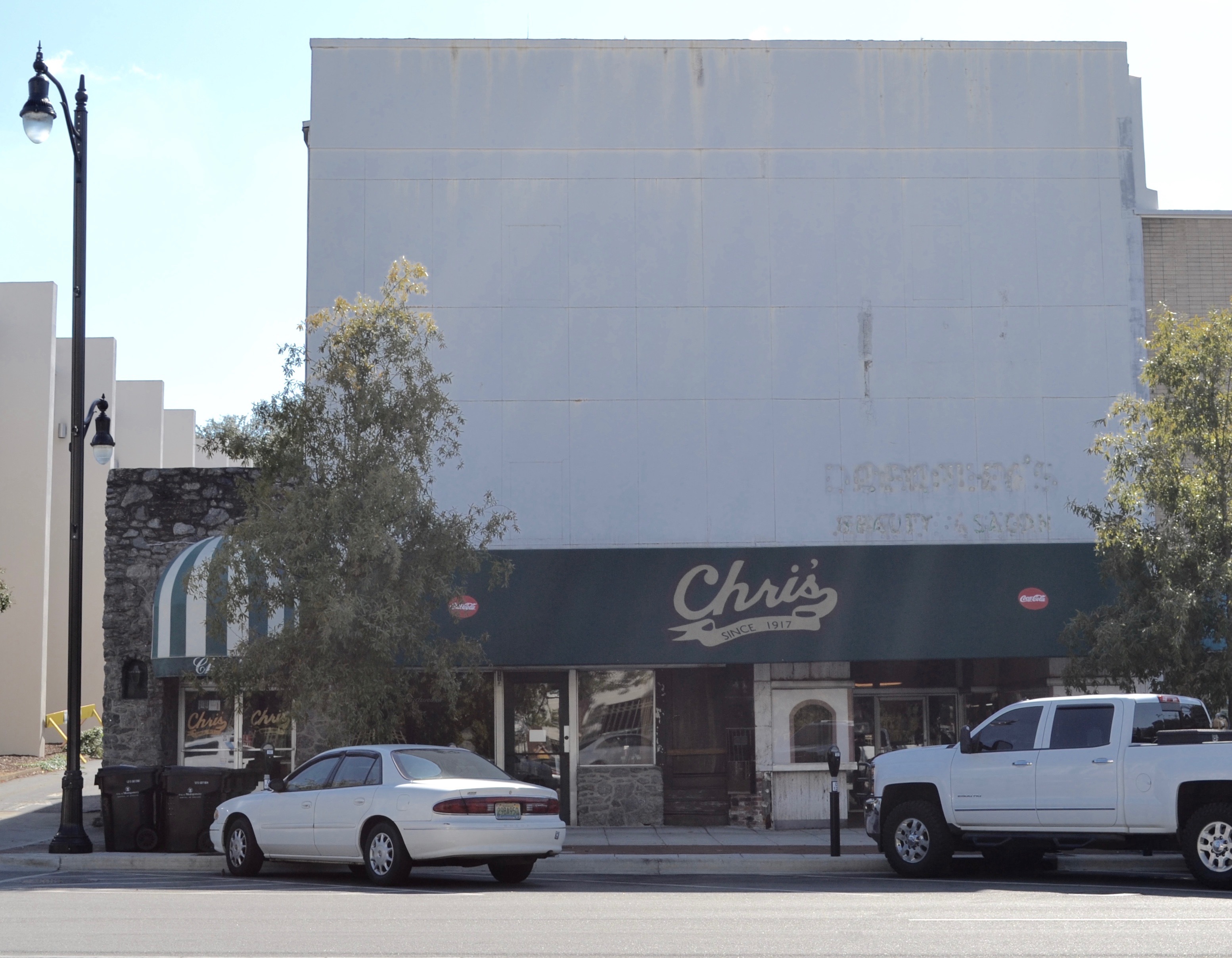
While the hot dogs are legendary around these parts, the good food is not the only reason Montgomery citizens still flock to Chris’ Hot Dogs, it’s the atmosphere; an atmosphere still punctuated by spirits. Founded in 1917 as the Post Office Café, this restaurant has become an institution in its 98 years of business. For three decades, this café was a popular late night hotspot serving hot dogs and liquor and attracting the likes of country singer, Hank Williams.
Chris’ Hot Dogs, 2016, photo by Lewis O. Powell IV, all rights reserved.
Shawn Sellers and his investigation team explored the restaurant and discovered that the staff has countless stories about employees still working their shifts from beyond the grave. Perhaps Hank Williams can be heard still singing under the green and white striped awning?
Sources
Cumuze, Greg. “My Immutable Heaven.” Chris’ Hot Dogs History. Accessed 26 May 2015.
Sellers, Shawn & Jake Bell. Montgomery: A City Haunted by History. Shawn Sellers, 2013.
Downtown Montgomery’s Lady in White
Montgomery’s main street, Dexter Avenue, from the fountain looking up towards the state capitol on Goat Hill, 2016. Photo by Lewis O. Powell IV, all rights reserved.
The identity of this mysterious woman is unknown, but her apparition is quite frightening. Seen throughout downtown Montgomery, the Lady in White is dressed entirely in white with long and dark hair and animal-like, ferocious teeth. In a 2013 article, Shawn Sellers is quoted as saying, “She’s actually the most reported ghost of anywhere in downtown Montgomery. She’s always seen outside. She’s never looking at anybody. She’s just always walking up the street, and people say they feel her before they see her. She’s just a creepy, creepy energy.”
Sources
Sellers, Shawn & Jake Bell. Montgomery: A City Haunted by History. Shawn Sellers, 2013.
Sutton, Amber. “Ghosts, curses and more: Take a walk on the supernatural side with Haunted Montgomery Tours.” AL.com. 2 Oct 2013.
F. Scott and Zelda Fitzgerald Museum
919 Felder Street
In Fitzgerald’s classic novel of the Jazz Age, The Great Gatsby, Daisy Buchanan remarks on the birth of her daughter, “I’m glad it’s a girl. And I hope she’ll be a fool—that’s the best thing a girl can be in this world, a beautiful little fool.” Some suspect that Fitzgerald’s Montgomery-born wife, Zelda, may have made a similar remark on the birth of their daughter. Zelda, whose zest for life strongly influenced her husband as well as legions of young women, lived her life as the epitome of the “foolish” Flapper.
Zelda and her husband lived in this house for a scant five months—October 1931 to February 1932—but during that time F. Scott Fitzgerald completed his novel, Tender is the Night, while Zelda outlined her one and only novel, Save Me the Waltz. The house was saved from demolition in 1986, and later opened as a museum to the literary couple. The upper floor of the house now has several private apartments, and residents there have reported hearing faint jazz music and disembodied footsteps. The museum’s director has reported that Zelda’s “foolish” spirit has remained active in the house and is believed to be the spirit responsible for flinging a painting from the wall while a staff member watched.
Sellers, Shawn & Jake Bell. Montgomery: A City Haunted by History. Shawn Sellers, 2013.
Serafin, Faith. Haunted Montgomery, Alabama. Charleston, SC: History Press, 2013.
Montgomery Riverwalk Stadium
200 Coosa Street
Home to the Montgomery Biscuits, the city’s minor league baseball team, Riverwalk Stadium is located on the site of a former Civil War prisoner of war camp. During the war, this site was occupied by a cotton warehouse. After the Battle of Shiloh in April of 1862, Union prisoners were housed in the warehouse in reportedly deplorable conditions until they were moved to Tuscaloosa in December of that year. Faith Serafin notes that some 200 prisoners died while in captivity at this site.
The field at Riverwalk Stadium, 2008. Photo by markcbrennan, courtesy of Wikipedia.
According to Shawn Sellers, before groundbreaking took place for the ballpark, this site was occupied by a hotel. Maids would sometimes find rooms disturbed after they had cleaned them, while guests observed mysterious figures in their rooms. After the hotel closed, the building was occupied by offices where similar activity was reported. The stadium may host activity including shadow figures, the sounds of weeping and screaming, and the occasional apparition.
Sources
Sellers, Shawn & Jake Bell. Montgomery: A City Haunted by History. Shawn Sellers, 2013.
Serafin, Faith. Haunted Montgomery, Alabama. Charleston, SC: History Press, 2013.
After my recent entry on Alabama, I had a comment on Facebook, “Interesting, but there’s more than the library in Birmingham…” Indeed.
I’ve previously covered two magnificent Birmingham theatres: the Alabama and Lyric; and the Tutwiler Hotel, in addition to the Linn-Henley Library which I covered in the Haunted Alabama entry. So here are a few more locations to add to the Birmingham list.
When Alan Brown wrote his 2009, Haunted Birmingham, he noted that this city’s ghostlore “is not nearly as rich as that found in much older cities.” Certainly, Birmingham is the youngest of Alabama’s large cities, having only been founded in 1871. Still, the city has some very interesting ghostlore including the iconic Sloss Furnaces.
Sloss Furnaces 20 32nd Street, North
Perhaps one of the most iconic haunted places in the whole state, this National Historic Landmark site is iconic of Birmingham’s history. Birmingham was built on industrial facilities like this producing iron during the latter half of the 19th and into the 20th centuries. While the facility opened in 1882, nothing remains of the original furnaces here. The oldest building on this site dates to 1902 with much equipment installed and added in later years. This facility closed in 1971 and local preservationists began work to save the facility. Their efforts paid off and the facility is open as a museum and events facility.
Sloss Furnaces, 2006. Photo by Timjarrett, courtesy of Wikipedia.
There is always a chance for death in industrial sites, even more so around molten metal in a furnace. In 1887, Theophilus Jowers, assistant foundryman at the Alice furnace (one of the first furnaces on this site) fell to his death into the molten iron in the furnace. Some of his remains—his head, bowels, two hip bones and some ashes—were fished out of the molten iron. Jowers’ death remains one of the most spectacular and grisly, though many more men died throughout the time that the furnaces were in operation.
After Jowers’ death, his spirit was observed by co-workers. Kathryn Tucker Windham quotes one former employee, “We’d be getting ready to charge the furnace, and we’d see something, something like a natural man walking around on the hearth. Just walking slow and looking around like he was checking to make sure everything was all right.” Windham describes the first time that Jowers’ son saw his father’s spirit in 1927. The now grown son took his son for a drive over the First Avenue Viaduct and there, while watching the action at the furnace, they observed a man walking through the showers of sparks and flames.
Two more spirits are believed to be in residence at this site, but less historically based. A white deer that has been seen on the grounds is believed to be the spirit of a pregnant girl who committed suicide by throwing herself into the furnace. The other “apocryphal”—as Alan Brown describes him—spirit is that of a fiendish foreman named James “Slag” Wormwood. Like Jowers and the pregnant girl, Wormwood supposedly fell to his death into one of the furnaces, though it is suspected that he was really pushed by an angry employee. It is Wormwood’s angry spirit that is responsible for pushing employees.
The furnaces are known as a hotbed of paranormal activity and were investigated for the first time in 2005 by Ghost Chasers International out of Kentucky. They were joined by psychic Chip Coffey who would soon make his name working on the A&E show, Paranormal State. During the investigation, Coffey made contact with the spirit of a man who had lost a limb in an accident there. Moments after losing contact with the spirit, team members noticed blood on Coffey’s hands. After investigating him for scratches or another injury that could have produced blood, nothing was found. Over the past 10 years of paranormal investigations at the site, a slag heap of evidence has been produced.
Sources
Brown, Alan. Haunted Birmingham. Charleston, SC: History Press, 2009.
“History.” Sloss Furnaces National Historic Landmark. Accessed 12 June 2015.
Parks, Megan. “Sloss Fright Furnace: The haunts heat up in Alabama.” USA Today. 14 October 2014.
Windham, Kathryn Tucker. The Ghost in the Sloss Furnaces. Birmingham, AL: Birmingham Historical Society, 2005.
East Lake Park 400 Graymont Avenue, West
On the 1st December 1888, Richard Hawes accompanied his daughter to the newly built lake here. Sometime later, he left without the seven-year-old. On December 4th, two boys playing on a boat in the lake discovered the child’s half-naked body in the water. The discovery caused a sensation among the citizens who thronged the funeral home where she was taken to view the body. Eventually, she was identified as May Hawes. As his train pulled into Birmingham, Richard Hawes, May’s father, was arrested.
May Hawes’ body as pictured in a local paper, 1888.
Richard Hawes was aboard the train with his new bride and still in his wedding suit. He told investigators that he had divorced his wife and was paying for the support of the children. His new wife, from Columbus, Mississippi, was described as being prostrate with grief after finding that her new husband was suspected of murder. Hawes’ wife Emma and daughter, Irene, age six. As newspapers stirred the city’s emotions, Emma’s body was found in a lake in the Lakeview neighborhood. Outrage overtook countless Birminghamians who gathered outside the city jail demanding Hawes be brought to justice immediately. A militia that had been called out to protect the jail eventually opened fire on the crowd killing ten including the city’s postmaster and wounding many others. A few days later, the pathetic body of Irene Hawes was found in the same lake where her mother had been found.
Postcard of East Lake from the roller coaster that once perched on the shores, 1909.
After a swift trial, Richard Hawes faced the gallows and was hung for the murder of his wife and two daughters. Hawes’ second wife was granted from her depraved husband. The lake in Lakeview where Emma and Irene were drowned is now a golf course while East Lake is the centerpiece of East Lake Park, which became a city park 1917. Little May Hawes is still seen in and around the lake where she is sometimes called the “Mermaid of East Lake.”
Sources
East Lake Park. Accessed 12 June 2015.
Jones, Pam. “The Hawes Murders.” Alabama Heritage. Spring 2006.
Kazek, Kelly. “’Tis the season: Haunting tales from ghost tours in 3 Alabama cities.” com. 2 October 2012.
Arlington Antebellum Home & Gardens 331 Cotton Avenue
Described as the “Birthplace of Birmingham,” Arlington is the oldest remaining home in Jefferson County. The core of this house was constructed in 1822 with additions being made to the house in 1842. As it served as the headquarters for Union General James H. Wilson during the closing months of the Civil War, the house was spared while the orders for the destruction of the University of Alabama, the arsenal at Selma and iron works throughout the region were issued from this home. As can be expected in a house of this age, there is some paranormal activity. Alan Brown notes that docents have heard doors slamming and witnessed rocking chairs rocking on their own accord.
Arlington by Jet Lowe. Photo for the Historic American Buildings Survey, courtesy of the Library of Congress.
Sources
Brown, Alan. Haunted Birmingham. Charleston, SC: History Press, 2009.
Floyd, W. Warner and Mrs. Catherine M. Lackmond. National Register of Historic Places nomination form for Arlington. 9 September 1970.
Carraway Methodist Medical Center 1600 Carraway Boulevard
This defunct hospital was, for many years, one of Birmingham’s leading medical facilities. In the 2000s, the hospital was plagued with financial difficulties that lead to its closure in 2008. The facility has been deteriorating since and it has attracted homeless people, vandals, copper thieves and some ghost hunters. A November 2014 article by Kelly Kazek reports on an investigation conducted by investigator and author, Kim Johnston. After touring the facility with the owner, Johnston reported that the Emergency Room had a “palpable heaviness.” Her group did have the experience of hearing muffled voices in the cardiac surgery area of the third floor. Even after bringing in local police, no one was found to be in that area. This building is closed and tresapssers will be prosecuted, please only observe from a distance.
Sources
Carraway Methodist Medical Center. Acc. 6 Jun 2015.
Kazek, Kelly. “Abandoned Alabama Part 2: The ghost of cities past.” com. 28 Nov 2014.
Hotel Indigo Birmingham Five Points South (formerly The Hotel Highland at Five Points South) 1023 20th Street, South
Originally constructed as the Medical Arts Building in 1931, this building served as offices for surgeons and dentists for many years. In the 1980s, a former cardiac surgeon renovated the Art Deco structure into a hotel, the Pickwick Hotel. During this time, stories emerged of a nurse still making rounds on the eighth floor. Sheila Turnage quotes a former director of sales who said that the elevator would mysteriously be called to the eighth floor unexpectedly. The hotel was transformed into a boutique hotel in 2007.
Sources
Turnage, Sheila. Haunted Inns of the Southeast. Winston-Salem, NC: John F. Blair, 2001.
“History of the Hotel” The Hotel Highland at Five Points South. Accessed 18 May 2015.
N. B. This article was overhauled 8 December 2019.
Shortly after starting this blog, I created a series of articles covering each state. When I moved this blog, I removed those articles and I have slowly, but surely reposted edits of these articles. The only article to remain intact is the one I created for Washington, D.C. Some of the edited articles have been reposted for Florida, North Carolina, South Carolina, Tennessee, and Virginia.
After publishing my Haunted Alabama book as an eBook in 2015, I redid the haunted Alabama article using entries from the original manuscript. When I republished the book in print, the text received a major overhaul, though this article wasn’t updated. Now, in 2019, I’m finally getting around to updating this article.
Alabama State Capitol 600 Dexter Avenue Montgomery
One of the most important sites in the entire state stands on a place called Goat Hill. This building is the second capitol building on this site, the first having been destroyed by fire in 1849. The current building opened in 1851 and has witnessed a panorama of much of Alabama’s history. It was here in 1861 that representatives of six Southern states met to create the Confederate government. Later that year, Jefferson Davis and Alexander Stephens were inaugurated here, respectively, as the President and Vice President of the Confederacy. A little more than a hundred years later, Martin Luther King, Jr. would lead a civil rights march to the steps of this building.
With such history, it’s no surprise that spirits may still wander the capitol’s corridors. One legend concerns a Confederate widow. Desperate to find where her husband had died and the location of his grave, she made inquiries, but no information was forthcoming. She continued haunting the corridors in life and, evidently, in death. Security guards and staff members have seen this desperate woman and continue to hear her footsteps.
Alabama State Capitol, 2006, by Jim Bowen. Courtesy of Wikipedia.
A security guard is quoted in a 1994 Birmingham News article as having seen a female spirit standing near the statue of Governor Lurleen Wallace. The woman was wearing white opera-length gloves which are reminiscent of the gloves Wallace is wearing in her official state portrait.
Faith Serafin notes in her book Haunted Montgomery, Alabama that bathroom sinks near the offices of the state board of convicts are often found with the water running. This activity may be related to a 1912 murder that occurred here. When a property dispute did not turn out in his favor, Will Oakley shot and killed his stepfather, P. A. Woods, in the offices of the president of the convict board. Legend holds that Will Oakley’s spirit may still be trying to wash the blood off his hands.
Sources
Lindley, Tom. “Ghosts or good stories haunt Capitol’s halls: This Confederate widow will never tell.” The Birmingham News. 27 November 1994.
Schroer, Blanche Higgins. National Register of Historic Place nomination form for the Alabama State Capitol. 29 September 1975.
Serafin, Faith. Haunted Montgomery, Alabama. Charleston, SC: History Press, 2013.
Bear Creek Swamp County Road 3 Prattville
On Halloween of 2014, twenty-one dolls tied to bamboo stakes appeared in Bear Creek Swamp. The Autauga County Sheriff’s Office thought they were simply a harmless Halloween prank, but after reports of the dolls began to spread through the media, the sheriff’s office decided to remove them. The reason for the dolls’ placement in the swamp remains mysterious, but then again, Bear Creek Swamp abounds in mystery.
A newspaper article regarding the incident described the swamp as “a massive bog with a bit of a reputation locally.” The article continues, “As a rite of passage, generations of teenagers have entered the area at night looking for the creatures and haints said to roam the mist-covered realm. And it’s not unusual to hear reports of loud booms coming from its depths.”
Before the arrival of white settlers, local Native Americans knew the swamp as a place with pure water and medicinal springs. This area was once the home of the Autauga or Tawasa Indians who were members of the Muscogee Creek Confederacy. The Muscogee Creek were removed by force in the 1830s and forced west on the Trail of Tears.
Some Native spirits may have remained in the swamp. A hunter told author Faith Serafin about seeing a female apparition with- in the swamp while tracking a deer. A couple hiking through the area encountered a wild-looking woman with a gaunt face who screamed and disappeared into the underbrush when they approached. Others, including an investigation team from Southern Paranormal Researchers, have witnessed strange orbs of light in the depths of this mysterious bog.
Sources
Roney, Marty. “21 dolls on bamboo stakes found in Alabama swamp.” Hattiesburg American. 27 November 2014
Serafin, Faith. Haunted Montgomery, Alabama. Charleston, SC: History Press, 2013.
Sutton, Amber. “Officers remove more than a dozen dolls from Autauga County swamp.” AL.com. 25 November 2014.
Southern Paranormal Researchers. “Bear Creek Swamp—September 3, 2006.” Accessed 29 November 2012.
Belle Mont 1569 Cook Lane Tuscumbia
Built between 1828 and 1832 by Dr. Alexander Mitchell, Belle Mont is now a house museum owned by the Alabama Historical Commission. This house represents a rare example of what is sometimes termed “Jeffersonian Classicism,” the distinctive style of Palladian architecture created by Thomas Jefferson. While most likely not directly designed by Jefferson himself, the house may be the work of one of his disciples.
Belle Mont, 2010, by Carol M. Highsmith. Courtesy of the Library of Congress, Prints and Photographs Division.
Around the time the house was completed Dr. Mitchell lost his wife and both daughters to a fever, and he subsequently sold the property. A family renting this house in 1938 had a frightening experience. Just after moving their things into the house, the family began to hear sounds throughout the house including footsteps and voices crying “help me.” Time passed with these events growing more and more frightening until one rainy night when the family watched with horror as a group of apparitions: a man, a woman and one, possibly two, small girls, appeared at the top of the staircase. The woman and children, dressed in night- clothes that were dirty and torn, wore expressions of horror as they descended the staircase and out the front door. After this frightening vision, the family continued to hear odd sounds. The last reported paranormal incident is recorded in 1968 with nothing seen or heard since.
Sources
Gamble, Robert S. National Register of Historic Places nomination form for Belmont. Jan. 1981.
Belle Mont. Alabama Historical Commission. Accessed 16 December 2010.
Johnston, Debra. Skeletons in the Closet: True Ghost Stories of The Shoals Area. Debra Johnston, 2002.
Bragg-Mitchell Mansion 1906 Springhill Avenue Mobile
Bragg-Mitchell Mansion, 2006, by Altairisfar. Courtesy of Wikipedia.
In the years following the Civil War, General Braxton Bragg was considered one of the most inept generals to have served in the Confederate Army. Bragg had earned victories though lost tactically in battle at Perryville, Kentucky; Chickamauga, Georgia, and Stones River (Murfreesboro), Tennessee. He lived here in the home once occupied by his brother Judge John Bragg, from 1869 until he moved to Texas in 1874. He would die in Galveston two years later having found about as much success in civilian life as he found in military life. From time to time, docents and visitors to the Bragg-Mitchell Mansion have seen the gray form of a man, believed to be the form of General Bragg. Once, as a docent was opening the house for wedding photographs, she saw a man striding across the parking lot behind the house. The strange man neared the tool shed and vanished. A thorough search of the property by the docent and the wedding party did not uncover the gentleman.
The Bragg-Mitchell House was built by Judge John Bragg in 1855. After construction, the house was the scene of gatherings by prominent Alabamians of the period and members of the Bragg family including John’s brothers: Braxton, former North Carolina governor Thomas Bragg, Captain William Bragg, and Alexander Bragg, who may have had a hand in designing his brother’s home. During the Civil War, Judge Bragg’s wife anxiously sent the family’s furnishing and many of their possessions to the family’s inland cotton plantation for safe keeping. Unfortunately, the estate was destroyed along with the contents of her city home, something from which Mrs. Bragg never quite recovered. After Judge Bragg’s death in the late 1870s, the house passed through a few different hands before being purchased by the Mitchell family who lovingly restored the home and left it to the City of Mobile.
The house has served as a wedding venue and events facility for many years. Over time, guests and docents have had many encounters with the spectral residents of the house including a ghostly feline that was first noted by Mrs. Mitchell when she owned the house. A spectral woman, possibly Judge Bragg’s wife, has been seen peering from one of the upstairs windows. Others have had more mischievous encounters including an AC installer who was locked in the attic and others who have been irritated by the ghosts turning lights on just after they have been turned off.
Sources
Coleman, Christopher K. Dixie Spirits: True Tales of the Strange and Supernatural, 2nd Edition. Nashville, Cumberland House, 2002.
Parker, Elizabeth. Mobile Ghosts: Alabama’s Haunted Port City. Apparition Publishing, 2001.
Fort Morgan State Historic Site 51 AL 180 Baldwin County
Along with Fort Gaines on Dauphin Island, Fort Morgan guards the entrance to Mobile Bay. Construction of the fort began in 1819, following the British capture of the area in 1815, during the misnamed War of 1812. Using slave labor, this enormous masonry fort was constructed in 1834. With rising tension after Alabama’s secession from the Union, the fort was peacefully turned over to the state’s Confederate militia.
Fort Morgan, 2002, by Edibobb. Courtesy of Wikipedia.
The fort saw action on August 5, 1864, during the Battle of Mobile Bay when it was attacked and besieged by Union warships; the fort surrendered a few days later. It remained in operation until it was abandoned by the military in 1924. It was then re-militarized during World War II and turned over to the State of Alabama in 1946.
Southern Paranormal Researchers investigated the fort in 2006 and witnessed a bevy of activity including disembodied voices, fleeting shadow figures, and having fully charged batteries drained. They also captured a few anomalies in photographs and one EVP. Visitors to the fort have encountered phantom smells of gunsmoke, the sounds of battle, and figures in period clothing.
Sources
Langella, Dale. Haunted Alabama Battlefields. Charleston, SC: History Press, 2013.
Schroer, Blanche Higgins. National Register of Historic Places nomination form for Fort Morgan. 4 Oct 1975.
Southern Paranormal Investigation Team. Fort Morgan Investigation. 16 Dec 2006.
Horseshoe Bend National Military Park 11288 Horseshoe Bend Road Dadeville
A bend on the Tallapoosa River formed an ideal site for the Muscogee Creek village of Tohopeka. During the Creek War of 1813-14—a civil war within the Muscogee Creek Nation that eventually embroiled the American government—a band of Red Stick Creeks under Chief Menawa defended this position against American troops and Native American allies under the command of General Andrew Jackson. Some 800 Red Stick warriors were slaughtered here on March 27, 1814, bringing an end to the Creek War of 1813-14 and leaving the Tallapoosa River at Horseshoe Bend stained red with blood.
With the slaughter that occurred here, it’s no wonder that visitors have reported a plethora of paranormal activity here ranging from smells and odd noises to full apparitions. A paranormal investigation by the Alabama Paranormal Research Team produced some photographic anomalies as well as the sound of someone screaming in the vicinity of the Muscogee Creek village site.
The riverbank at the Horseshoe Bend Battlefield, 2015. Photo by Lewis Powell IV, all rights reserved.
Sources
Langella, Dale. Haunted Alabama Battlefields. Charleston, SC: History Press, 2013.
Alabama Paranormal Research Team. Investigation of Horseshoe Bend National Military Park. Accessed 18 Dec 2010.
Linn-Henley Research Library 2100 Park Place Birmingham
Linn-Henley Library, 2009, by DwayneP. Courtesy of Wikipedia.
This building opened in 1927 as the Birmingham Public Library and now houses archives, government documents, a southern history library, and a ghost. Blogger Jessica Penot visited in 2012 and noted the “uncanny quiet that fills the building like a tangible presence.” The spirit of Fant Thornley, the library’s dedicated director from 1953 until the 1970s, still makes occasional appearances here. The spirit has been seen by an electrician, and library staffers have smelled the smoke from his cigarettes.
Monroe County Heritage Museum (Old Monroe County Courthouse) 31 North Alabama Avenue Monroeville
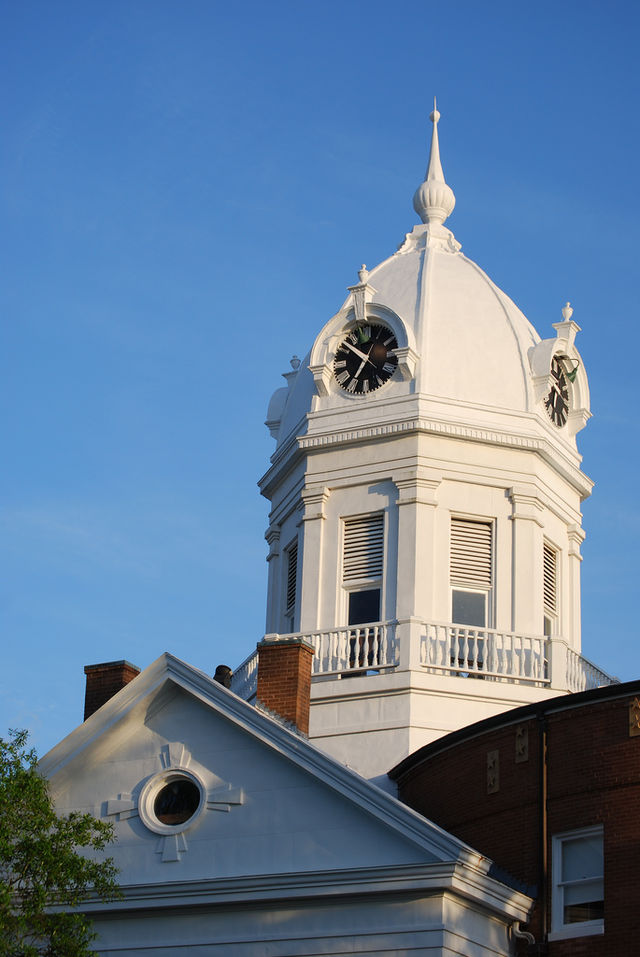
In 1903, this structure was constructed as the Monroe County Courthouse. It was here that a young Harper Lee, Monroeville’s most famous resident and author of the classic novel, To Kill a Mockingbird, would watch her attorney father as he argued cases. When Hollywood put the story on celluloid, the set designers replicated the courtroom on a California sound stage. This building was used by Monroe County as a courthouse until 1967.
Dome of the Old Monroe County Courthouse, 2008, by Melinda Shelton. Courtesy of Wikipedia.
The upper floors of this building still seem to retain some of the energy from the building’s judicial use. Blogger Lee Peacock quotes one man as saying, “Things blow in the breeze but there is no breeze. You hear sounds that don’t belong, and I have smelled pipe tobacco smoke when no one was smoking or there to be smoking.” Staff members working late here often get the feeling of not being alone and have heard mysterious sounds within this storied building.
Sources
Higdon, David & Brett Talley. Haunted Alabama Black Belt. Charleston, SC: History Press, 2013
W. Warner Floyd. National Register of Historic Places nomination form for Old Monroe County Courthouse. 29 March 1973.
Moundville Archaeological Park 634 Mound State Parkway Moundville
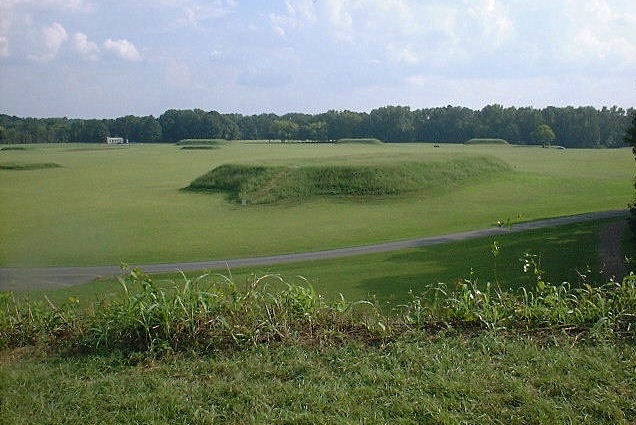
Between approximately 1120 C.E. and 1450 C.E., Moundville was the site of a large city inhabited by the Mississippian people, predecessors to the tribes that the Europeans would encounter when they began exploring the South about a century later. At its height, this town was probably home to nearly 1,000 inhabitants. Stretching to 185 acres, the town had 29 mounds of various sizes and uses: some were ceremonial while others were topped with the homes of the elite.
One of the mounds at Moundville, 1998, by Altairisfar. Courtesy of Wikipedia.
Visitors and staff have often mentioned a certain energy emanating from this site. A Cherokee friend of mine visited and while atop one of the mounds let out a traditional Cherokee war cry. Afterward, he noted that there was a palpable change in the energy. Dennis William Hauck speaks of the “powerful spirit of an ancient race” that “permeates this 317-acre site” in his Haunted Places: The National Directory. Southern Paranormal Researchers notes that park staff has witnessed shadow figures, odd noises, and doors opening and closing by themselves in the buildings on the site. Higdon and Talley add orbs and cold spots found throughout the location to the list of paranormal activity here.
Sources
Hauck, Dennis William. Haunted Places: The National Directory. NYC: Penguin, 2002.
Southern Paranormal Researchers. Investigation Report for Moundville Archaeological Park. Investigated 10 February 2007.
Higdon, David & Brett Talley. Haunted Alabama Black Belt. Charleston, SC: History Press, 2013.
Old Depot Museum 4 Martin Luther King, Jr. Street Selma
Old Depot, 2010, by Carol M. Highsmith. Courtesy of Library of Congress, Prints and Photographs Division.
A part of the Alabama Ghost Trail, a series of haunted places linked by the Southwest Alabama Regional Tourism and Film Office, the Old Depot Museum features a ghost that reportedly has an affinity for the museum’s elevator. The museum occupies the Romanesque Revival circa 1890 Louisville & Nashville Railroad Depot.
Sources
Besser, Susan A. National Register of Historic Places nomination form for the Water Street Historic District. March 2002.
Old Depot Museum. Alabama Ghost Trail. YouTube. Posted 19 July 2009.
Timmons Cemetery Buxton Road Redstone Arsenal
When the Army took over some 40,000 acres in Huntsville in 1941, it swallowed up many old farms and plantations including some 46 cemeteries. Located in the woods off of Buxton Road, the Timmons Cemetery is considered, by some, the spookiest place on the Arsenal. Guards patrolling Buxton Road at night have seen a little girl running across the road near the cemetery.
To explain the little girl’s spirit, a legend has surfaced, though apparently not backed up by historical documentation. Margaret Ann Timmons was an energetic child and sometimes difficult to control. When work required the family to be in the fields, Margaret would be tied to a chair inside the house. The energetic child wiggled out of her restraints, and kicked over an oil lamp that destroyed the house and killed the child. Now, not even death and the stone wall that surrounds the family’s cemetery can restrain her.
Sources
“Does a little girl really haunt Redstone Arsenal.” WAAY. 31 Oct 2014.
“Redstone Report: Ghost story still haunts Redstone Arsenal.” WAFF. 31 Oct 2011.
N.B. This article was originally published 13 May 2015 as a single, massive article. It’s now broken up into three sections, South of Broad, North of Broad, and Charleston Environs, which have all been rearranged and revised for ease of use.
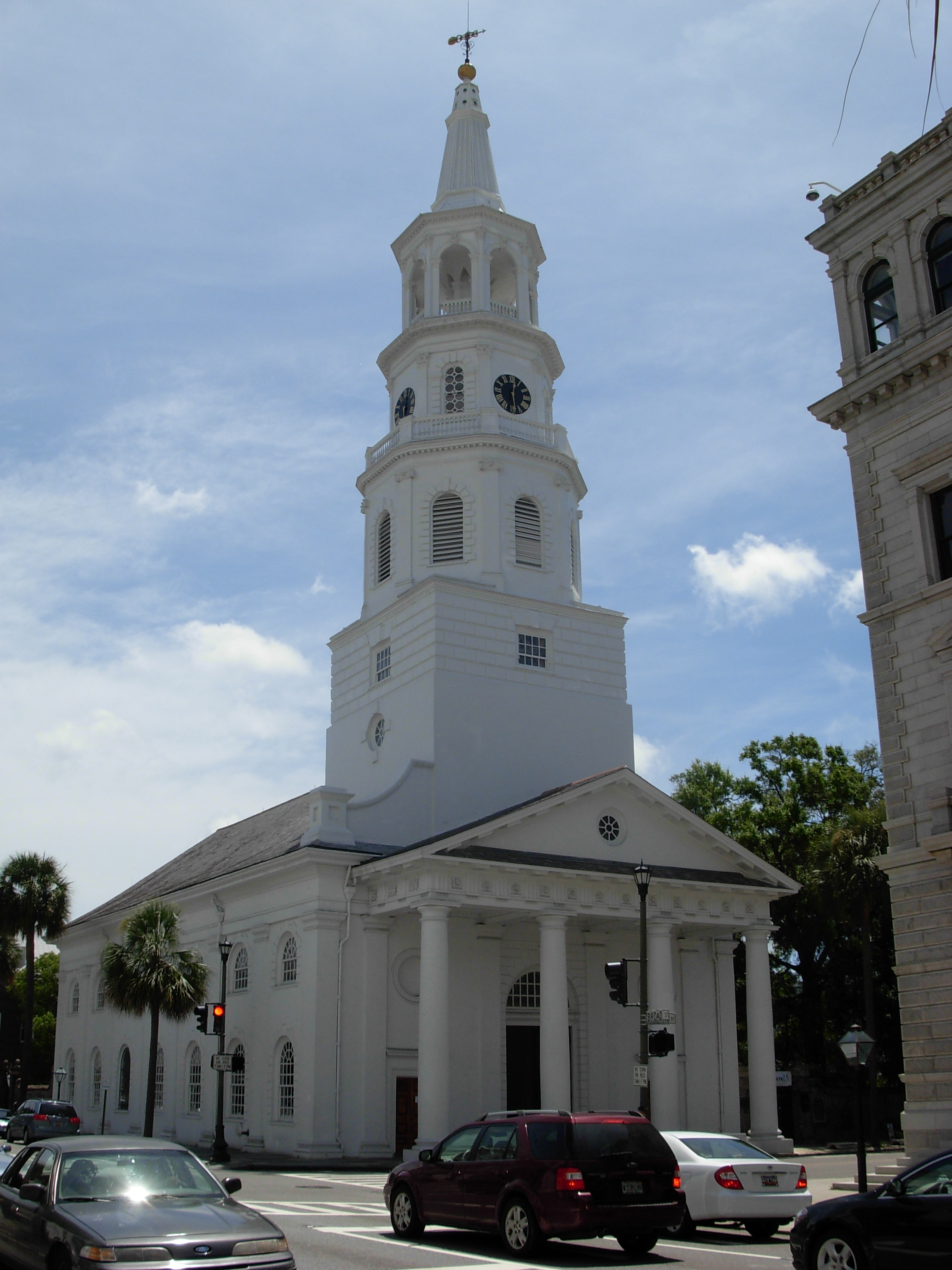
Known as the “Holy City” for the number of churches that raise their steeples above the city, Charleston, South Carolina is also known for its architecture, colonial and antebellum opulence, as well as its haunted places. This tour looks at the highlights among Charleston’s legends and ghostlore.
Broad Street cuts across the Charleston peninsula creating a dividing line between the most historic, moneyed, aristocratic portion of the city—located south of Broad—and everything else. For convenience, this tour is now divided into separate articles covering the area South of Broad, North of Broad, and the Environs. Locales in this article include places open to the public as well as private homes. For these private homes, please respect the privacy of the occupants, and simply view them from the street.
The tour is arranged alphabetically by street, with the sites in order by street address south to north and east to west.
As an introduction to the more mysterious, shadowy side of Charleston, the opening lines of Pat Conroy’s 1980 novel, The Lords of Discipline, provide a lush and succinct preface. The novel examines the triumph and cruelty of Charleston, and The Citadel (disguised as the “Carolina Military Institute”), Conroy’s alma mater.
The city of Charleston, in the green feathery modesty of its palms, in the certitude of its style, in the economy and stringency of its lines, and the serenity of its mansions South of Broad Street, is a feast for the human eye. But to me, Charleston is a dark city, a melancholy city, whose severe covenants and secrets are as powerful and beguiling as its elegance, who demons dance their alley dances and compose their malign hymns to the dark side of the moon I cannot see…
Though I will always be a visitor to Charleston, I will always remain one with a passionate belief that it is the most beautiful city in America and that to walk the old section of the city at night is to step into the bloodstream of a history extravagantly lived by a people born to a fierce and unshakable advocacy of their past. To walk in the spire-proud shade of Church Street is to experience the chronicle of a mythology that is particular to this city and this city alone, a trinitarian mythology with equal parts of the sublime, the mysterious, and the grotesque. But there is nothing to warn you of Charleston’s refined cruelty…
Entering Charleston is like walking through the brilliant carbon forest of a diamond with the light dazzling you in a thousand ways, an assault of light and shadow caused by light. The sun and the city have struck up an irreversible alliance.
Charleston Battery
Charleston Battery
On the Battery near the Edmondston-Alston House at 21 East Battery, a young woman encountered the apparition of a woman dressed in period clothing. James Caskey posits that the sad-faced apparition may very well have been the spirit of Theodosia Burr Alston, the daughter of Vice President Aaron Burr and wife of South Carolina Governor Joseph Alston. In 1812, Theodosia Burr Alston boarded the Patriot in Georgetown, SC as she headed north. The ship was never heard from again. Her spirit has been reported up and down the South Carolina coast.
Sources
Caskey, James. Charleston’s Ghosts: Hauntings in the Holy City. Savannah, GA: Manta Ray Books, 2014.
20 South Battery (formerly Battery Carriage House Inn) 20 South Battery
The inn formerly known as the Battery Carriage House Inn is possibly one of the more spiritually active locations in the city. A few of the inn’s eleven sumptuous guest rooms are apparently haunted. A couple staying in room 3 were awakened by noise from a cellphone; while this may be quite common, phones are not supposed to make noise when powered off as this phone was.
Sign for the Battery Carriage House Inn, 2011, by Lewis Powell, IV. All rights reserved.
This activity seems minor compared to the reports from rooms 8 and 10. Guests staying in Room 8 have encountered the apparition of a man’s torso. There is no head or limbs, just a torso dressed in a few layers of clothing. One guest sensed that this figure was quite negative. The spirit in Room 10 is much more pleasant and even described as a gentleman. The innkeepers believe this may be the spirit of the son of a former owner who committed suicide.
Sources
“Ghost Sightings.” Battery Carriage House Inn. Accessed 31 October 2010.
Kermeen, Francis. Ghostly Encounters: True Stories of America’s Haunted Hotels and Inns. NYC: Warner Books, 2002.
Spar, Mindy. “Local haunts among treats for Halloween.” The Post and Courier. 26 October 2002
Ward, Kevin Thomas. South Carolina Haunts. Atglen, PA: Schiffer, 2014.
There are questions as to just how old this little building is. Some sources argue that it may well be one of the oldest buildings in the city, while others argue that it only dates to the early 19th century. Regardless, this building can claim an inordinate amount of history, mostly as a tavern and coffeehouse, as well as ghosts.
One owner spotted the specter of an 18th century gentleman walking through the back door of the building. Later, his vision was confirmed by a psychic visitor who saw the same gentleman and several other spirits lingering here.
Sources
Caskey, James. Charleston’s Ghosts: Hauntings in the Holy City. Savannah, GA: Manta Ray Books, 2014.
Poston, Jonathan H. The Buildings of Charleston: A Guide to the City’s Architecture. Columbia, SC: University of South Carolina Press, 1997.
Exchange Building and Provost Dungeon 122 East Bay Street
One of the most important and historic buildings in the city, the Exchange Building, was constructed in the late 1760s to support the trade occurring in this, the wealthiest of colonial cities. The building was built on top of the old Half Moon Battery, a section of the original city wall. During the American Revolution, the dungeon held many of Charleston’s most prominent Patriot citizens. In 1791, this building hosted a ball for President George Washington.
It seems that the souls of some of the people imprisoned in the dungeon still stir. Ghost tours passing through the dungeon at night report that the chains used to guard exhibits swing on their own, while visitors take photographs with anomalies quite regularly. Cries and moans have been heard here and Alan Brown reports that some woman have been attacked here. One hapless female visitor was pushed up against a wall while another felt hands around her neck.
Sources
Brown, Alan. Haunted South Carolina. Mechanicsburg, PA: Stackpole Books, 2010.
Pickens, Cathy. Charleston Mysteries: Ghostly Haunts in the Holy City. Charleston, SC: History Press, 2007.
Poston, Jonathan H. The Buildings of Charleston: A Guide to the City’s Architecture. Columbia, SC: University of South Carolina Press, 1997.
Church Street
Thomas Rose House 59 Church Street, private
This circa 1735 home may have never been occupied by Thomas Rose, who built the house. However, this house did serve as the residence of Dr. Joseph Ladd, a poet and physician, who was killed in a duel in Philadelphia Alley (see that listing in the North of Broad section) with his friend, Ralph Isaacs. The argument grew out of a misunderstanding; but after playing out in the local newspapers, it ended in a duel in October of 1786. Ladd, who had the habit of whistling, continues to be heard in the house as well as in the alley where he met the grim specter of death.
Sources
Brown, Alan. Haunted South Carolina. Mechanicsburg, PA: Stackpole Books, 2010.
Pickens, Cathy. Charleston Mysteries: Ghostly Haunts in the Holy City. Charleston, SC: History Press, 2007.
Poston, Jonathan H. The Buildings of Charleston: A Guide to the City’s Architecture. Columbia, SC: University of South Carolina Press, 1997.
Legare Street
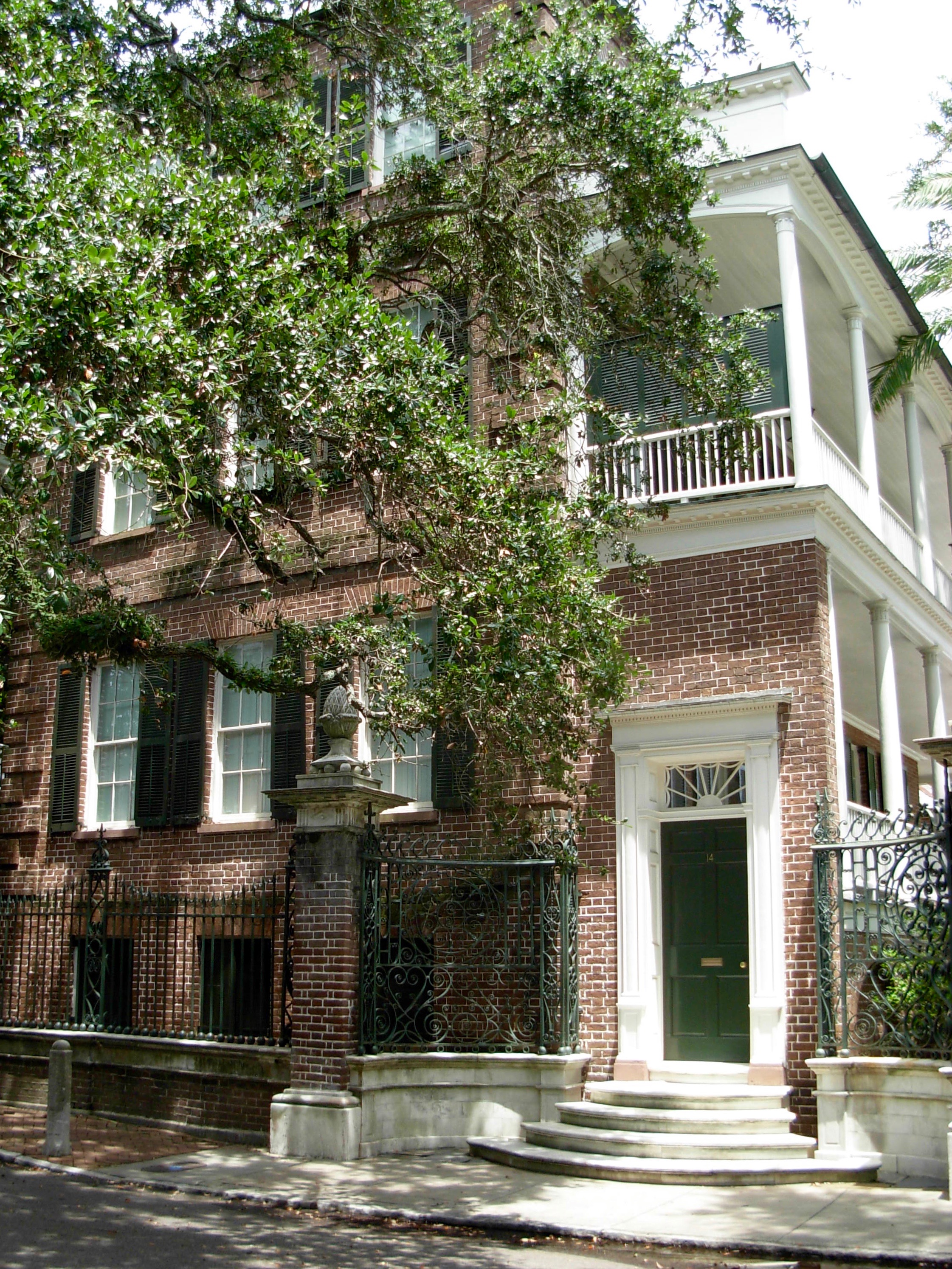
Simmons-Edwards House 14 Legare Street, private
Simmons-Edwards House, 2011. Photo by Lewis O. Powell IV, all rights reserved.
Just outside of Francis Simmons’ old home (see the Simmons Gateposts, 131 Tradd Street for more information on this gentleman) a shadowy couple has been reported walking hand in hand on the street. Their identity is unknown.
Sources
Graydon, Nell S. South Carolina Ghosts. Beaufort, SC: Beaufort Book Shop. 1969.
Pickens, Cathy. Charleston Mysteries: Ghostly Haunts in the Holy City. Charleston, SC: History Press, 2007.
Hannah Heyward House 31 Legare Street, private
Hannah Heyward House, 2011. Photo by Lewis O. Powell, IV. All rights reserved.
This simple, but elegant villa-styled house was built in 1789. After Mrs. Heyward’s son, James, left one morning for a hunting trip, she encountered him sitting quietly in the library later that afternoon. When she inquired among the servants when her son had arrived, no one seemed to have seen him. Later that evening some of James’ friends arrived with his lifeless body. Ever since, residents of the home have occasionally seen James sitting in the library.
Sources
Graydon, Nell S. South Carolina Ghosts. Beaufort, SC: Beaufort Book Shop. 1969.
Martin, Margaret Rhett. Charleston Ghosts. Columbia, SC University of South Carolina Press, 1963.
Poston, Jonathan H. The Buildings of Charleston: A Guide to the City’s Architecture. Columbia, SC: University of South Carolina Press, 1997.
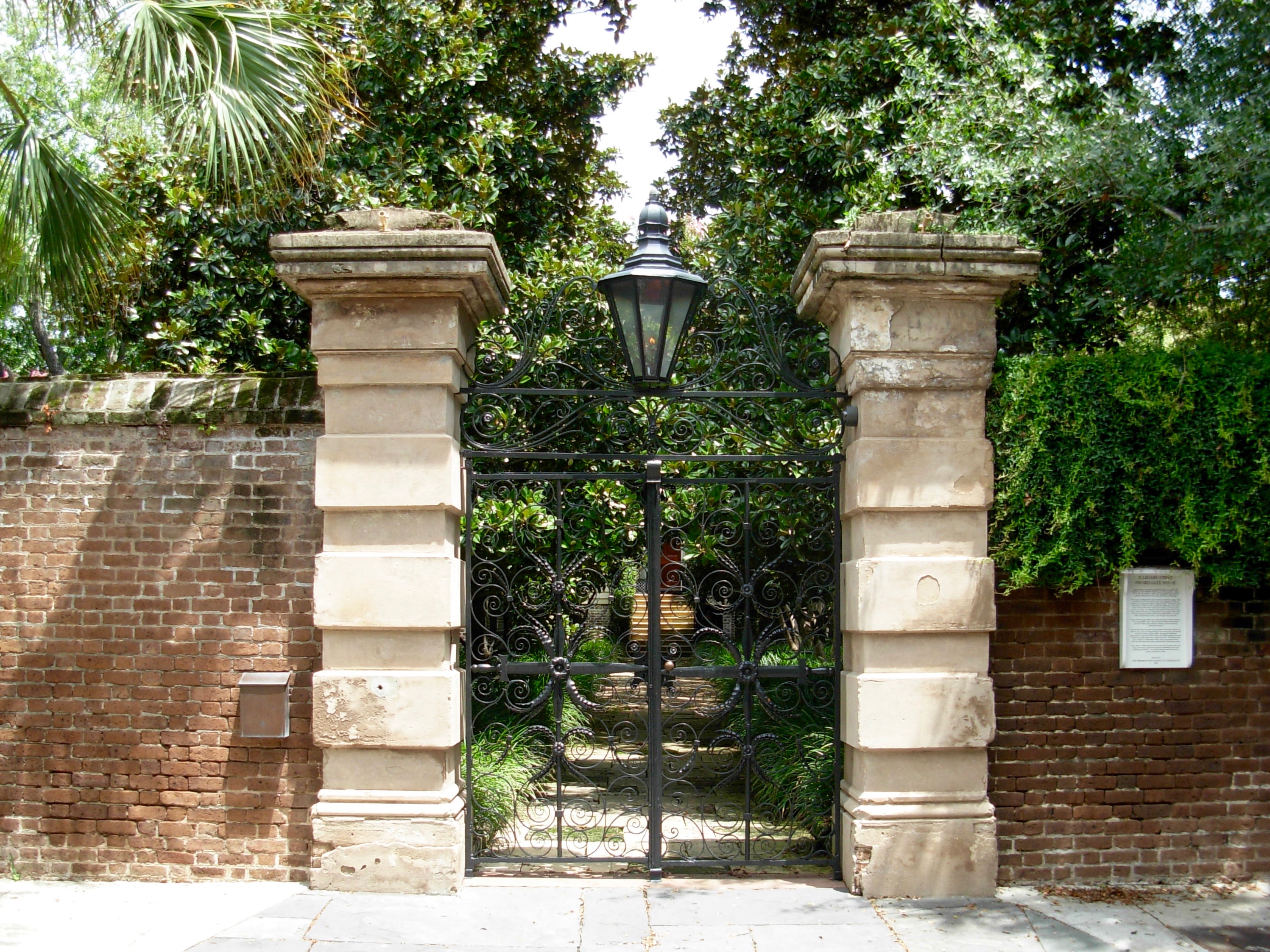
Sword Gate House 32 Legare Street, private
The titular gates of the Sword Gate House, 2011. Photo by Lewis O. Powell IV, all rights reserved.
In the dark of night, a spirit still prowls the halls of the magnificent house that stands beyond these iron gates wrought with swords. The gates were originally created to be used outside the city’s guardhouse; but were purchased by Madame Talvande to guard her students after the city rejected the gates as too expensive. Even after the closure of the elite boarding school, legend speaks of Madame Talvande remaining here in spirit to see that her students remain moral and chaste.
Sources
Brown, Alan. Haunted South Carolina. Mechanicsburg, PA: Stackpole Books, 2010.
Martin, Margaret Rhett. Charleston Ghosts. Columbia, SC University of South Carolina Press, 1963.
Poston, Jonathan H. The Buildings of Charleston: A Guide to the City’s Architecture. Columbia, SC: University of South Carolina Press, 1997.
Meeting Street
Daniel Huger House 34 Meeting Street, private
While this mid-18th century home sustained little damage during the Great Charleston Earthquake of 1886, a young, English visitor to the home was killed on the front steps. This area is prone to earthquakes and the quake that struck the city in 1886 caused massive damage throughout the city. The young man visiting the Huger (pronounced HEW-jee) family here fled the house when the shaking began. As he stood on the front steps a piece of molding from the roof struck him on the head, killing him. He may be the cause of mysterious rapping on the front door prior to earthquakes.
Sources
Buxton, Geordie & Ed Macy. Haunted Harbor: Charleston’s Maritime Ghosts and the Unexplained. Charleston, SC: History Press, 2005.
Poston, Jonathan H. The Buildings of Charleston: A Guide to the City’s Architecture. Columbia, SC: University of South Carolina Press, 1997.
James Simmons House 37 Meeting Street, private
This house has been named “The Bosoms” because of its bowed front and you may giggle at the silliness of that. The house was built, without bosoms, in the mid-18th century and alterations in the 1840s added the namesake bays. Legend holds that a pirate buried treasure near this house and shot one of his men at the site. The “white, blurry silhouette” of that man has been seen near the house.
Sources
Buxton, Geordie & Ed Macy. Haunted Harbor: Charleston’s Maritime Ghosts and the Unexplained. Charleston, SC: History Press, 2005.
Caskey, James. Charleston’s Ghosts: Hauntings in the Holy City. Savannah, GA: Manta Ray Books, 2014.
Pickens, Cathy. Charleston Mysteries: Ghostly Haunts in the Holy City. Charleston, SC: History Press, 2007.
Poston, Jonathan H. The Buildings of Charleston: A Guide to the City’s Architecture. Columbia, SC: University of South Carolina Press, 1997.
St. Michael’s Rectory 76 Meeting Street, private
St. Michael’s Alley, running alongside St. Michael’s Church’s churchyard to Church Street, was the scene of a duel in 1786 that left one young man with mortal wounds. Aroused by the commotion outside his house, Judge Elihu Hall Bay, a noted Charleston jurist, ordered the man’s companions to bring him into the house. Fearing that they could face consequences for their involvement with the dual, the young men fled after seeing their wounded friend into the house. The young man passed away in the house.
It was reported that the commotion of the men bringing their wounded friend inside and then hurriedly fleeing was heard in the house on a regular basis. It has been noted, however, that since the home was converted to use as a church rectory in 1942, the sounds have ceased.
Sources
Caskey, James. Charleston’s Ghosts: Hauntings in the Holy City. Savannah, GA: Manta Ray Books, 2014.
Pickens, Cathy. Charleston Mysteries: Ghostly Haunts in the Holy City. Charleston, SC: History Press, 2007.
Poston, Jonathan H. The Buildings of Charleston: A Guide to the City’s Architecture. Columbia, SC: University of South Carolina Press, 1997.
St. Michael’s Episcopal Church 80 Meeting Street
St. Michael’s, 2011. Photo by Lewis O. Powell, IV. All rights reserved.
Step inside the cool sanctuary of this mid-18th century church and be on the lookout for a spectral bride. Legend speaks of Harriet Mackie who was supposedly poisoned on her wedding day and remains here in her wedding dress. For more information see my article, “The Ghastly Bell-Ringer and Bride.”
Sources
Pickens, Cathy. Charleston Mysteries: Ghostly Haunts in the Holy City. Charleston, SC: History Press, 2007.
Poston, Jonathan H. The Buildings of Charleston: A Guide to the City’s Architecture. Columbia, SC: University of South Carolina Press, 1997.
Tradd Street
Simmons Gateposts 131 Tradd Street
Simmons Gateposts, 2011. Photo by Lewis O. Powell, IV. All rights reserved.
These gateposts, marking where Ruth Lowndes Simmons’ home once stood, serve as sentinels to remind us of a tragic love story. While Ruth Lowndes was from a noble Charleston family, she was almost a spinster when she married Francis Simmons, a wealthy planter. Simmons provided his wife with a fine house here, though he had his own home on nearby Legare Street. When their separate carriages would pass, the couple would rise and bow to the other. An old Charleston legend says that the sounds of a horse and carriage are heard here. James Caskey reports that he felt the rush of air and smelled the odor of sweaty horses as he visited these gateposts at night.
Sources
Caskey, James. Charleston’s Ghosts: Hauntings in the Holy City. Savannah, GA: Manta Ray Books, 2014.
Graydon, Nell S. South Carolina Ghosts. Beaufort, SC: Beaufort Book Shop. 1969.
Pickens, Cathy. Charleston Mysteries: Ghostly Haunts in the Holy City. Charleston, SC: History Press, 2007.