It was the last full night of the year and the weather In Birmingham was rainy and cold. Further up the eastern side of the country—where this duo of gentlemen was headed—the weather was getting nastier and causing travel delays. Despite the many miles the two had to go before they could properly sleep in Charleston, West Virginia, they decided to stop for the night at a hotel.
The car pulled into Birmingham and the driver carelessly made a U-turn in the middle of the street in order to pull up to the front of the city’s famed Tutwiler Hotel. The U-turn attracted the attention of a police officer who spoke to the college age driver. The passenger sitting in the back seat wearing a blue serge suit, white shoes, and a white felt hat, spoke up and ordered the young driver to mention to the officer that he was driving Hank Williams, the famed country music star. At the mention of Williams’ name, the officer was not impressed and he told the pair to move along.
Hank Williams, 1951 publicity photo.
Hank Williams slumped back into the car’s back seat as they headed towards Birmingham’s hotel row on 5th Avenue. At the REDMONT HOTEL (2102 5th Avenue, North), Williams and his driver, Charles Carr, a college student, procured two rooms for the night before making a 500-mile trek to West Virginia the following day. Before they could properly settle in, however, three women appeared. Williams asked where they were from and one breezily replied, “Heaven.” Looking over the trio with a sly grin, the music legend said, “Well, in that case, you’re the very reason I’m going to hell!”
The journey the next morning did not exactly lead to hell, but it took Hank Williams to the end of the line. After a stop the next night at Knoxville, Tennessee’s Andrew Johnson Hotel, the gentlemen drove through to West Virginia where they stopped in the small town of Oak Hill. When Carr opened the back door he discovered Hank Williams was dead.
Though he’s passed beyond the veil, it seems that Hank Williams spirit is almost as busy in the afterlife as he was alive. A specter wearing dark pants and a white shirt has been seen prowling the halls by staff, some of whom believe this is Williams’ shadow. He has also been reported at his mother’s home in Andalusia, Alabama where he spent part of his childhood, in the Andrew Johnson Hotel where he also stopped on this trip in Knoxville, the Elite Café in where he played his final performance, and near his grave in Oakwood Cemetery, both in Montgomery.
Hank Williams’ spirit may not be the only spirit in residence at the Redmont. A more sophisticated, gentlemanly spirit has been spotted checking up on the hotel staff. This may be Clifford Stiles, one of the hotel’s former owners. After he bought the hotel, he reserved the elegant penthouse for himself and his family. There he hosted glittering parties that drew luminaries and the city’s elite.
The Redmont Hotel, 1939. Photo by the Birmingham News, courtesy of the Birmingham Public Library.
In his introduction to Haunted Birmingham in 2009, author Alan Brown notes that the city’s ghostlore “is not nearly as rich as that found in much older cities, such as New Orleans, Charleston, and Savannah.” Indeed, Birmingham is not as old—it was incorporated after the Civil War in 1871—but it seems that it’s paranormal history has only recently seen much exploration. The city certainly possesses a magnificent handful of oft-explored major hauntings such as Sloss Furnaces, the Tutwiler Hotel, and the Linn-Henley Research Library, and there are numerous hauntings that have been brought to light in recent years.
The Birmingham Haunted Tour aims to introduce you to these spectral residents of Birmingham. From country to vaudeville stars, executed criminals, dedicated librarians, and the restless dead at points throughout the city. The tour is organized by author and investigator Kim Johnston (Haunted Shelby County, Alabama; Haunted Talladega County; and Haint Blue) with help from author, investigator, and haunted collector Kevin Cain (My Haunted Collection, The Legends of Indian Narrows, Tammy Baby, Patty Doll), and myself. The three of us will be taking over tour guiding duties. Please join us on this two-hour ride through Birmingham’s haunted past!
The Corpsewood Manor Murders in North Georgia Amy Petulla History Press, 2016
Even the name Corpsewood Manor is reminiscent of a haunted house attraction. When I first encountered a description of this remote, northwest Georgia site I discounted the description as a typical internet fiction, one of those countless urban legends that are found in the weedier portions of the web. None of the better sources I followed made mention of this until Theresa Racer, the creator of Theresa’s Haunted History of the Tri-State Blogcovered this site. I did some perfunctory research on the site and determined that most of the wild facts about the site were not mere inventions and have always meant to include this story in my blog. I was excited to see Amy Petulla, the owner of Chattanooga Ghost Tours and the co-author of Haunted Chattanooga with Jessica Penot, wrote a book about this fascinating case and haunting.
The facts of this story seem like a swirl of bad tabloid journalism. Two gay men, Charles Scudder and Joey Odom, lived in a hand-built castle on a remote mountain ridge in northwest Georgia. The remote location allowed them to escape the pressures of urban living and live in a simple manner without electricity, phones, and the rude interruptions of modern “connected” life. The remote castle acted as a fortress keeping the outside world at bay while allowing them to indulge in decadent pleasures that were viewed with contempt by much of the outside world. Scudder, a former professor of pharmacology at Chicago’s Loyola University, engaged in reading and study in his mountain hideaway where he also dabbled in the occult and the hedonistic tenets of Satanism.
Two local men, Tony West and Avery Brock, had visited the pair a handful of times and even partaken of some of the verboten pleasures that were offered to some of the guests of the castle, when they were struck with the idea of robbing the pair. West and Brock visited Corpsewood on the evening of December 12, 1982 and shot both men to death when they did not reveal where their money was hidden (both Scudder and Odom had a decent sum of money but it was entirely in bank accounts, the pair had no cash on them). The criminals took some valuables from the castle and fled in Scudder’s Jeep. On the road, the two criminals robbed and killed a naval officer they encountered in Vicksburg, Mississippi. Both men were quickly arrested and tried for the murders. They were both found guilty. Both men remain in prison for this horrible crime.
After the discovery of the bodies of Scudder and Odom (as well as their two beloved mastiffs), curious locals flocked to the scene to gawk at the remote castle. The crowds stripped the home clean of souvenirs, even digging up the rose bushes while some of the more valuable items were safely removed by friends and acquaintances of the couple. Many of these items were later believed to have brought bad luck to the owners. The remote castle was soon torched by arsonists and the surrounding forest quickly began to reclaim the site.
As a lover of the paranormal Petulla includes an entire chapter on the paranormal activity that still persists at the site. One of the more fascinating tales she notes came from her masseuse who visited the site one afternoon with friends. At the site of the house they met two middle aged men sitting among the ruins in lawnchairs. After an amicable conversation about the tragedy that had occurred there many years earlier, the masseuse and friends walked away to explore the rest of the site. Returning to the ruins of the house they discovered that the odd men had left. After describing the two men to Petulla she produced a photograph of Dr. Scudder and the masseuse was shocked to say that he had been one of the odd pair.
Petulla revels in the details and personalities involved in this case. The picture she presents is not unlike John Berendt’s Midnight in the Garden of Good and Evil, which explores the events surrounding a murder that occurred in Savannah a year before the Corpsewood murders. Like Berendt who had reported on Jim Williams for Esquire and was personally embedded in Savannah society, Petulla worked as an assistant district attorney under David “Red” Lomenick, who had prosecuted West and Brock a few years earlier. This intimate knowledge of the case is born out in exquisite detail in this book.
In all its tabloid-esque elements, Petulla handles the story sympathetically and mostly without casting aspersions on the victims. She also utilizes interviews with locals who were friends of Scudder and Odom and presents them as fascinating eccentrics who simply wished to live their own lives before that was upended by this murderous plot. By incorporating details of the eccentric personalities involved in this case, Petulla presents a scary, bizarre, and thoroughly enjoyable adventure through remote northwest Georgia in the early 1980s.
The rain had slackened on the night of July 30th in Ellicott City, Maryland when the water flowing down Main Street began to form into cascades and eventually a torrent. The historic cobblestone streets and storefronts funnelled the raging water into a flume as it sought the refuge of the Patapsco River at the foot of Main Street. Cars, pedestrians, mud, merchandise, and eventually pavement and parts of the street joined the river-bound tumult. Within hours much of the street itself had been swept away leaving the foundations of the buildings on either side exposed. In the chaos, two lives were lost, several buildings totally destroyed, and many more sustained severe damage.
Ellicott City is no stranger to flooding and its historic streets and buildings bear scars from floods over the centuries. Some of those scars are spiritual in nature. It has been claimed that Ellicott City is the most haunted city in the country—though I take no stock in any claims of being “the most haunted”—though at least some of that haunted nature may stem from the floods. The father and son ghosthunting team of Michael J. and Michael H. Varhola, authors of Ghosthunting Maryland, posit that granite may also be a cause. The city lies on a large deposit of granite, some of which has been quarried for the city’s building materials. Indeed, many historic structures use granite as well as the city’s cobblestone streets. Regardless of the cause, Ellicott City does have more than its fair share of ghosts.
Flood waters have severely damaged storefronts on the lower end of Main Street. Photo from MDGovPics, 2016, courtesy of Wikipedia.Maryland’s governor tours Main Street after the flooding. The Judge’s Bench is located just up the street on the left. Photo from MDGovPics, 2016, courtesy of Wikipedia.
Situated on the upper reaches of Main Street, The Judge’s Bench escaped the damage visited on its neighbors down Main Street by the floodwaters of July 30, 2016. As part of downtown Ellicott City, however, The Judge’s Bench has not escaped the city’s more haunting aspects. Indeed, this pub has one of the city’s more well-known ghost stories. In fact, the story is noted in the building’s description in the Maryland Inventory of Historic Properties.
The Inventory of Historic Properties notes that the Judges Bench property has been occupied at least as far back as 1860. The stone and wood frame building on this site has been occupied by several businesses over the decades, most notably Berger’s Grocery Store. During this period, the grocery’s proximity to the local courts supposedly brought judges to the store on their lunch. The judges would often sit on a bench outside the store as they ate, thus the name “The Judge’s Bench.” In researching the building, I stumbled across an interesting article in the Baltimore Sun concerning a fire that severely damaged a block of Main Street in 1940. Unfortunately, while the article notes Berger’s Grocery, a laundry, and the Church of God as being in this block, it does not specify addresses and I can’t determine if this was the exact block.
The story of the fire is interesting, however, especially in the treatment of the Chinese immigrant businessman, Der Wong, who owned and operated the laundry that was decimated in the fire. The reporter decided that the fire was much less interesting than Mr. Wong’s personal story and the loss of his life savings (in cash) that he stored in the now-ruined building. While the reporter treats Mr. Wong and his story condescendingly, he also buries the details of the fire, though he notes that much of Berger’s Grocery was lost and that the Bergers, both of whom were 56, escaped to the roof of the building where firemen brought them down by ladders. No one was killed in the fire.
The Judge’s Bench has operated as a bar for several decades and for much of that the story has been told of the resident spirit, Mary. According to locals, the daughter of the Bergers took her own life in 1962 on the third floor by hanging herself from one of the building’s rafters. While she makes her presence known throughout the building, her spirit is most active on the third floor. In 1997, the bar’s manager told a reporter from the Baltimore Sun, “I make people come upstairs with me because I’m scared.”
Staff had already had issues with liquor bottles falling from behind the bar and one of the bar owners opened one morning to discover liquor bottles neatly lined up on the floor behind the bar. Other staff had issues with the restrooms where toilets would unaccountably flush on their own, faucets would turn themselves on, and an entire roll of toilet paper once unrolled itself while no one was in the bar but a single staff person.
Some years ago, one of the owners was working in the building’s third floor, she was shocked to feel a cold breeze, but could not locate a source. A 1997 investigation of the bar documented in a Halloween article in the Baltimore Sun provides the impressions of a psychic who explored this haunted area. “The only thing I’m getting is that someone once used this as a refuge,” the psychic contends, “I think this was a refuge…a place where maybe someone came to hide from everyone.” The psychic noticed the rafter where Mary supposedly hanged herself and the sensitive remarked, “There’s something about it that keeps catching my eye. It looks like there was fire damage or something.”
Since the disastrous July floods, the Judge’s Bench has reopened and life has begun to return to Main Street and presumably, Mary has returned to her antics.
Sources
“Chinese laundryman loses life’s savings as shop burns.” Baltimore Sun. 6 April 1940.
Maryland Investory of Historic Properties. “The Judge’s Bench.” Accessed 2 January 2017.
Nitkin, Karen. “Change is stranger at Judge’s Bench.” Baltimore Sun. 27 July 2000.
Nitkin, Karen. “Ghost tours attract visitors to Ellicott City.” Baltimore Sun. 29 July 2011.
Ollove, Michael. “The spirits move them.” Baltimore Sun. 31 October 1997.
Peterman, Erika D. “Spirited excursion attracts ghost club.” Baltimore Sun. 24 May 1998.
Rector, Kevin. “2 dead, emergency declared after historic Ellicott City ravaged by flash flood.” Baltimore Sun. 1 August 2016.
Sachs, Andrea. “A history spree in Ellicott City, Md.” Washington Post. 16 October 2014.
…for I doubt if there is another building in the while South that has been the theatre of more mental travail. Do you remember Hugo’s ‘Last Days of a Condemned Man?’ That horrible drama has been enacted over and over again inside its walls. And think of the desperate men who have taken their lives in its cells, and the other desperate men who have lain awake at night plotting escape. The old place has held the concentrated essence of every human emotion—hope, fear, rage, grief, remorse.
— “By the By!” The Times-Democrat 23 October 1899
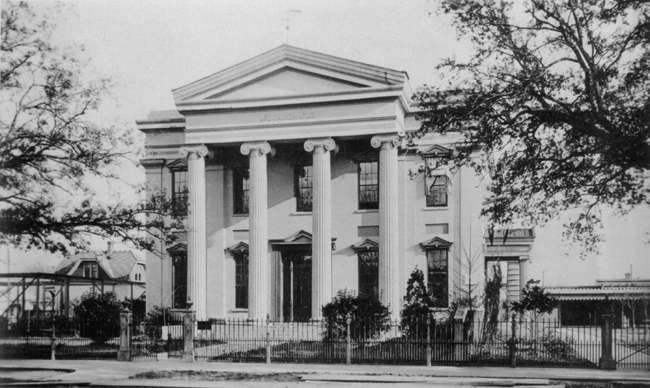
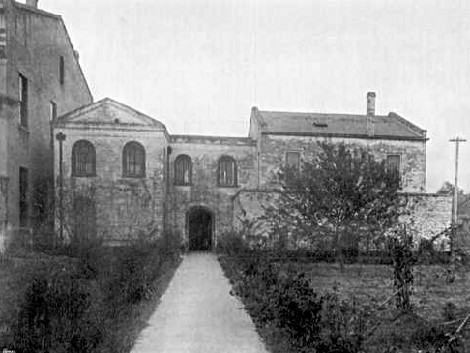
The Ninth Precinct Prison once humbly squatted behind the Greek Revival magnificence of the CARROLLTON COURTHOUSE (719 South Carrollton Avenue). Originally the seat of justice for Carrollton while it was a part of Jefferson Parish, the courthouse and jail were designed by Henry Howard, a noted New Orleans architect, and constructed in 1855. When the burgeoning city of New Orleans absorbed Carrollton in 1874 the courthouse was transformed into a school while the jail remained open just steps from studious children, staffed by officers from the New Orleans Police Department.
After complaints from worried parents, the ancient jail was torn down in 1937 while the courthouse building remained an elementary school until the 1950s when it became Benjamin Franklin Senior High School. The high school had outgrown the old courthouse building by the late 1980s and a new building was constructed for the high school. The courthouse again became an elementary school and was in use until 2013. The courthouse building has been abandoned since that time and was listed by the National Trust for Historic Preservation to its list of 11 Most Endangered Historic Places.
Old Carrollton Courthouse from W.H. Parish’s Art Work of New Orleans, 1895.
At the back of the old courthouse building where the jail once stood is now occupied by school trailers with no sign to indicate the inhumane building that once occupied that space. In this place criminals were locked away in dank cells some spending their last days here before they transcended this plane in the execution yard. It’s no wonder that stories began to pour forth from this building towards the end of the 19th century telling of spectral experiences and uncanny events. The Times-Democrat devoted a little more than two columns of space to the experiences of the “peculiarly level-headed and unimaginative” officers working there:
“I can tell what has happened easily enough,” said Sergeant Clifton, “but explain it, I can’t. I have been on duty here about a year and a half, and we have been bothered off and on, from the start by strange noises, things falling without apparent cause, and other unaccountable disturbances. Lately they have grown worse. Here in my office our attention was first attracted to that old sofa in the corner. Frequently at night one of the men would lie down on it to rest, and invariably something queer would happen. Sometimes the man would be thrown off violently, sometimes he would feel hands touching him, and several times the sofa would be moved bodily several feet from the wall. Strangers here have had the same experience. We have never been able to find any clew [sic] to the cause. Some weeks ago I was sitting one evening at my desk reading, when suddenly my chair was whirled entirely around. I was quite alone and several lights were burning brightly in the room. I was simply dumfounded, and all I can do now is to give you the facts. As I said before, the explanation is beyond me.
“A few nights later, I was talking to Corporal Perez, when a large picture of Gen. Beauregard, hanging on the wall above the washstand, came crashing down, and at the same instant, the stand itself, bowl and pitcher, were apparently hurled forward and struck the floor several feet away. Strange to say, nothing was broken, and oddest of all, the cord of the picture was intact and the nail on which it hung was as firm as ever. We had been talking about Beauregard during the evening and the coincidence startled us greatly. Next night the mirror, below where the picture had been, fell in exactly the same manner. That time the washbowl was broken. I have since placed the picture and looking glass elsewhere, and they have not been molested any further. These things occurred right before our eyes, under the glare of the electric light.
“One evening last week,” he went on, “two gentlemen and a lady dropped in to pay me a visit. While the men were sitting on the sofa talking, the lady arose and leaned against the wall. A moment afterward she staggered forward, crying out that some one had given her a violent push. We were all astonished, and in explaining to us what happened she again leaned against the wall and again bounded away exactly as if she had received a sudden thrust against the shoulders. She was greatly excited and alarmed, and it was some time before we could quiet her. There is the large bare brick wall; you can see for yourself how impossible it was for any trick to have been played. The lady had never heard of the ghosts.”
The most remarkable story of all is told by the head doorman, C.W. Foster. Officer Foster is a man of middle age, quiet, well educated and intelligent. He has been on duty at the jail about eight months.
“I heard all sorts of strange noises frequently,” he said, “and more than once searched the place from top to bottom trying to discover what caused them. But the first time I actually saw anything was one afternoon last July. The sergeant had stepped out, and I was occupied with something in the clerk’s office on the other side of the passage. The doors are on a line, and I could see through in the opposite room. Presently I looked up and was astonished to see two women standing by Sergeant Clifton’s desk. They were holding themselves very erect, looking straight toward me, and their stiff, unnatural attitude struck me as strange. Still I thought they were merely visitors, who had slipped in without my noticing them. They were young and both wore dresses of some sort of spotted stuff. They impressed me as being very light-skinned negresses.
“I got up, never taking my eyes from the pair, and started across the passage. Just as I was entering the other room both figures vanished. It was so sudden, so absolutely inexplicable, that I couldn’t believe my senses, and stood here for a moment literally paralyzed with amazement. The sun was shining brightly, the room was perfectly light and I was never in better health. It was hard for me to believe the appearance was an hallucination, yet there was no way in the world for the women to have left the room, for there was only one door, in which I stood. I never saw the women before or afterward.
Old Carrollton Jail, c. 1900.
“My next experience was even more startling. It was in the evening, and, as before, the sergeant’s room was temporarily vacant, while I was engaged in the clerk’s office. Lights were burning everywhere, and several men were in the building. When I got through my work in the office I stepped into the passage and happening to glace into the other room, I saw Sergeant Shoemaker, who died a year ago last July, standing between the desk and the sofa. I knew Shoemaker intimately for years, and there is absolutely no possibility of my being mistaken. He had charge of this jail up to the time of his death. The figure I saw was perfectly distinct and solid, and was in the full light of an incandescent lamp. His head was slightly bent, as if he was in a brown study, and he was walking slowly toward the sofa. While I stood there staring at him he vanished precisely as the two women had vanished. It was like snuffing out a candle—one instant he was there and the next instant he was gone.
“I admit frankly that I was frightened,” continued Officer Foster. “I never received such a shock in my life, but I forced myself somehow to go into the room. It was perfectly empty. I have seen nothing since, but hardly a day or night passes without noises and other manifestations. We have about ceased to pay attention to them.”
Mr. Joseph Crowley, the night clerk and operator, has had his full share of uncanny experience. When he was assigned to duty at the precinct he made a good deal of sport of the current ghost stories, but he soon witnessed enough to thoroughly puzzle him. One night last month, as he tells the story, he was at his desk writing, when something prompted him to look up, and he saw a tall, dark-bearded stranger standing outside the railed inclosure [sic]. The man look ill and thin, and was dressed in black. Mr. Crowley was about to inquire his business when the stranger glided away toward the door. Remembering the ghost stories, and sure that a trick was being played, he sprang through the gate and rushed towards the figure, which disappeared in the hall. He was only two steps behind, but the hall was empty. There was no egress except past the doorman, who was on duty, and not one of the several officers on the floors had seen a soul. They made an instant and thorough search of the building, but could find no trace of the mysterious visitor. He had vanished like a feat in conjuring.
A few nights afterward Clerk Crowley was again in the office, talking with Patrolman Edward Harrison and George Shafe, when the pale, bearded stranger suddenly appeared in the door. That time he was seen by all three of the men at about the same instant, and they rushed toward him with one accord. Exactly what happened they have some difficulty in explaining. As before, the strange man glided backward into the hall, passed into a little patch of shadow and that was the last of him. They ran over the very spot where he had been, questioned the doorkeeper, ransacked the building and searched the garden with lights from one end to the other, but all in vain.
Officer Harrison is a very practical, common sense type of man. He is perhaps fifty years old, but still active, and is tall and strongly built. He has a stern, aquiline face, and talks briefly and to the point.
“I don’t believe in ghosts,” he said yesterday. “That’s all nonsense, and there must be some explanation for these things. Still I don’t know what it is, and the best I can do is to state exactly what I witnessed. I saw the man with a beard. He simply appeared and disappeared, and where he went to I have no idea. It was the quickest thing I ever looked at. We made a very thorough search, and I’m certain he was not hidden about the house. I never saw the man before, but his face was very peculiar, and I would know it in a thousand. Yes, I have heard noises and footsteps—frequently. What causes them is a mystery. We’ve tried out best to find out, but have so far failed. All the same I don’t believe in ghosts.”
Mr. Crowley not only saw the phantoms, but felt them. He states that he was seated at his desk on another occasion when something that seemed like a cold hand gripped him by the neck. For an instant he was too startled to move, but at the first struggle he was released and whirling around found himself alone. The clock stood exactly at 3 a.m.
The sound of heavy footsteps in the hall and corridor has been heard at different times by nearly all the officers about the building. In conversation yesterday Corporal Harry Hyatt described that particular manifestation.
“I have heard it twice,” he said. “It sounded exactly as if some powerful man had entered the front door and walked as far as the office. On both occasions I ran out immediately and no one was there. The footfalls were as distinct as anything I ever heard in my life.”
Sometimes the sound of walking comes from the courtroom up stairs, where there was formerly a row of four “condemned cells,” used for confining prisoners under sentence of death. One night, when the noises from that quarter were particularly loud, several officers went up to investigate and were amazed to see the heavy docket fly through the air from the judge’s desk. It struck the floor with a crash audible all over the building, but what propelled it they were never able to find out. One of those who had an experience with the sofa, which seems to be the storm centre [sic], so to speak, of the sergeant’s room, was Driver Dell of the patrol wagon. He went in to get a bit of rest, and had no sooner stretched himself out then the sofa moved from the wall fully a yard and then moved back again. The motion was gentle, as if the legs were on well-oiled wheels, but the startled driver did not tarry from another ride. He sprang to his feet and sought his rest in another part of the building.
Many of the manifestations reported about the old building are perfectly meaningless and grotesque, and paradoxical as it may seem, they derive a certain impressiveness from that very fact. The theory of trickery presupposes more or less of a coherent plan, and it is hard to associate it with things that have no apparent purpose. For example, mounted officer Jules Aucoin went to the sergeant’s room at about 11 o’clock last Wednesday night to make a report. Glued to the wall above the fireplace is a large colored lithograph of Admiral Dewey, and as Aucoin entered he was surprised beyond measure to see the picture seemingly turning round and round like a wheel. He called to some of the others, but before they could get there the lithograph was still again. Many kindred stories are told. In one corner of the clerk’s office is a small ledge on which several books are kept. Lying on them were two large weights, such as are used by grocers. A few nights ago the weights described a curve through space and came crashing down on the floor. Several officers witnessed the occurrence, but nobody is able to offer any explanation. Now and then different articles of furniture act as if they are bewitched, tumbling about, shifting their places and echoing to invisible blows. Everybody in the station has been under suspicion as a practical joker, but nowadays that theory has been pretty thoroughly abandoned.
One night last week, a colored man named Charles Marquez was arrested on a capias issued by Judge Duggan on the charge of contempt of court and locked until morning in cell No. 3. When the doorman came to release him, he was a pitiable object. He was shaking with fright and declared that he had been tormented all night long by things he could not see. Viewless hands hauled him about the floor, snatched away his blankets whenever he spread them to lie down, and kept up and incessant rattling at his lock. A score or more of times he felt cold fingers drawn across his face, and from the patter of footfalls in the dark, he could have sworn he had a dozen companions. Such was the man’s story. He was unusually intelligent, and however he may have embroidered the narrative, there was no gainsaying the fact that he was half dead with terror. Something had certainly played havoc with his rest.
Cell 3, by the way, has an evil name. There is no particular legend connected with it, but most of the mysterious noises in that end of the building seem to have their origin there, and many other prisoners have reported experiences more or less resembling that of Marquez.
The author of the article ends by noting that the reports from the jail should be further investigated by the Society of Psychical Research out of London. The author was so insistent of this that in an article published in the same paper two days later, he (I’m assuming this is the same author, though bylines in papers were not common at that time) recounts a conversation about the case and a discussion of the Society’s investigation techniques.
As for the activity at the old jail, a few other sources state that a vague figure was seen as the building was torn down in 1937. The blog Seeks Ghosts notes that a strange figure is still seen in the area of the building.
Roll & Roll Hotel 1353 H Street, NE Washington, D.C.
Not far from the halls of the nation’s power, H Street—lined with handsome commercial buildings from another age—escapes towards Maryland. The Rock & Roll Hotel occupies one of these old commercial building, a building that is evidently still occupied by spirits from its previous incarnation: a funeral home. Some of the spirits may enjoy the loud, hard-driving rock music that has replaced the comforting organ music that is usually played throughout funeral homes, but other spirits apparently are disturbed by it.
According to a Halloween season article in the Washington City Paper, the nightclub’s staff (despite its name, the Rock & Roll Hotel is a live music venue and nightclub) has had numerous odd experiences throughout the building. One employee had his wife wait on him in the lobby while he locked up the building. When he returned, she was standing on the street.
“She’s like, ‘Weird, someone left the radio on.’ And it’s like some old talkie show, and they’re talking about her. And they’re describing her dress, and asking, ‘Who is she? Why is she here?’ So I come down five minutes later, and she’s literally standing in the middle of H street with her arms crossed like, ‘Nope, nope, nope.’”
Other members of the staff have heard the sounds of disembodied footsteps, voices, and have witnessed the occasional spectral figure within the building. Several staff members have been spooked in the building’s restrooms when they’ve heard stall doors slamming while in the restroom while they were alone. Candles that were distinguished by staff before locking up have been found burning the next day, even when they were doused with water.
Sources
Rudig, Stephanie and Justin Weber. “Some believe that the Rock & Roll Hotel nightclub hosts more than just shows.” Washington City Paper. 27 October 2016.
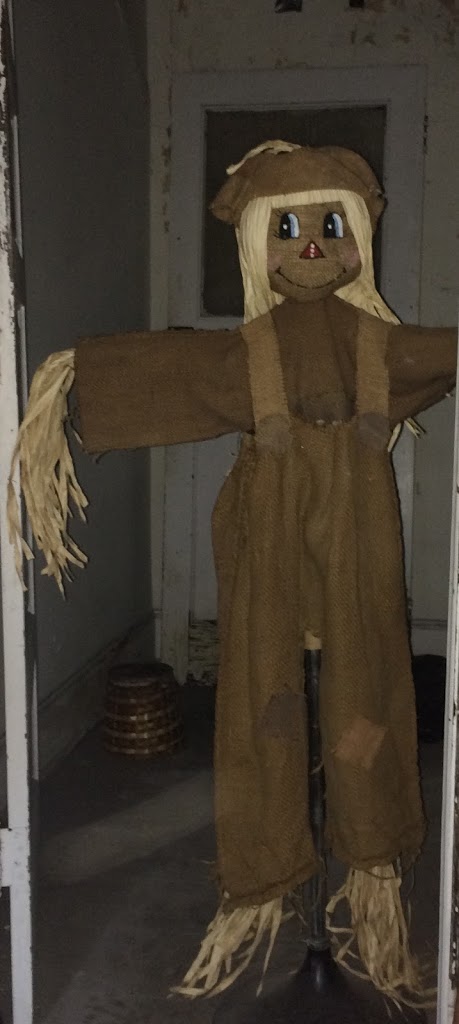
During the first few minutes of the first annual Haunted History Tour in the small town of Wetumpka, Alabama, my tour group was shuffled into a room in the unrestored portion of the town’s CHAMBER OF COMMERCE BUILDING (110 East Bridge Street). The dingy room was in rough shape and a collection of folding chairs was set out for tour participants. I glanced through a doorway into an adjoining room and was greeted by a scarecrow with a mischievous grin painted on its burlap face.
The Wetumpka Chamber of Commerce just before Wetumpka Haunted History Tour, 2016. Photo by Lewis O. Powell, IV, all rights reserved.
The thought ran through my head, “Someone has put out some tacky Halloween decorations out for this tour. Oh my God, I hope the rest of the tour isn’t like this!” My fears were allayed however when the guide began talking about how this scarecrow moved on its own around the third floor. Passersby on the streets outside have noted the scarecrow peering down on them from one of the third floor windows. When they look again the scarecrow is often looking down from a different window. Employees of the chamber of commerce have also noted the scarecrow’s erratic movement, even once finding it torn apart on the floor of the bathroom. Even more shocking was when the scarecrow reappeared “in pristine condition”—to use our guide’s words—the following day in its usual position overlooking downtown.
The chamber’s scarecrow that moves on its own accord. Photo by Lewis O. Powell, IV, all rights reserved.
The scarecrow, along with the other spirited compatriots, is overseeing a revival that’s taking place in downtown Wetumpka and throughout the state of Alabama. The state is beginning to awaken from its long, sad economic dream state and confidently stride back towards a fully awakened existence. Utilizing its own history, hominess, natural hospitality, stories, and even its ghosts, Alabama is brushing off the dust of its past and creating a more hopeful future.
Some of you may have noticed my absence during October. Please forgive me, I have been traveling throughout Alabama taking part in investigations and ghost tours. The life of a blogger can be rather dull when you’re only writing about these places rather than experiencing them. Last Halloween I promised myself that I would leave my schedule open this year so I could take advantage of the various investigations and ghost tours that crop up during the Halloween season. With one exception, all my investigations and tours were in Alabama, a state that I have discovered really wants its stories told.
My first jaunt, the first weekend of October, took me to Sylacauga, the Marble City. Located in central Alabama, Sylacauga (pronounced sil-uh-CAW-guh), is about 45 miles south east of Birmingham. The town was built primarily on marble quarrying: carving up the fine marble vein that spans thirty miles under this section of Talladega County. Near the downtown, the COMER MUSEUM (711 North Broadway Avenue) is situated in an Art Deco-styled marble-clad building built in the 1930s as the town’s library. Sculptures and carvings from the local marble grace the entrance of the elegant building that serves as a virtual attic for the area squirrelling away and displaying an array of historic artifacts.
I was in town for an investigation at the museum with S.C.A.R.E. of Alabama, a group founded by authors Kim Johnston and Shane Busby (who wrote Haunted Talladega County together, Johnston is also the author of Haunted Shelby County, Alabama and Haint Blue: The Rockford Haunting). Members of the group include haunted collector and author Kevin Cain whose book, My Haunted Collection, is now a part of my Southern Spirit Library, he’s also written a number of supernatural fiction works; and Kat Hobson who hosts the radio show “Paranormal Experienced with Kat Hobson” on which I appeared a few months ago and will be appearing at the end of this month. The group hosted this investigation as part of a series of public investigations that they host as fundraisers for the places investigated.
The fascinating investigation concentrated on a number of objects throughout the building that may have spirit attachments. See my rundown of the investigation here, “The Haunted Collection in the Marble City—Alabama.”
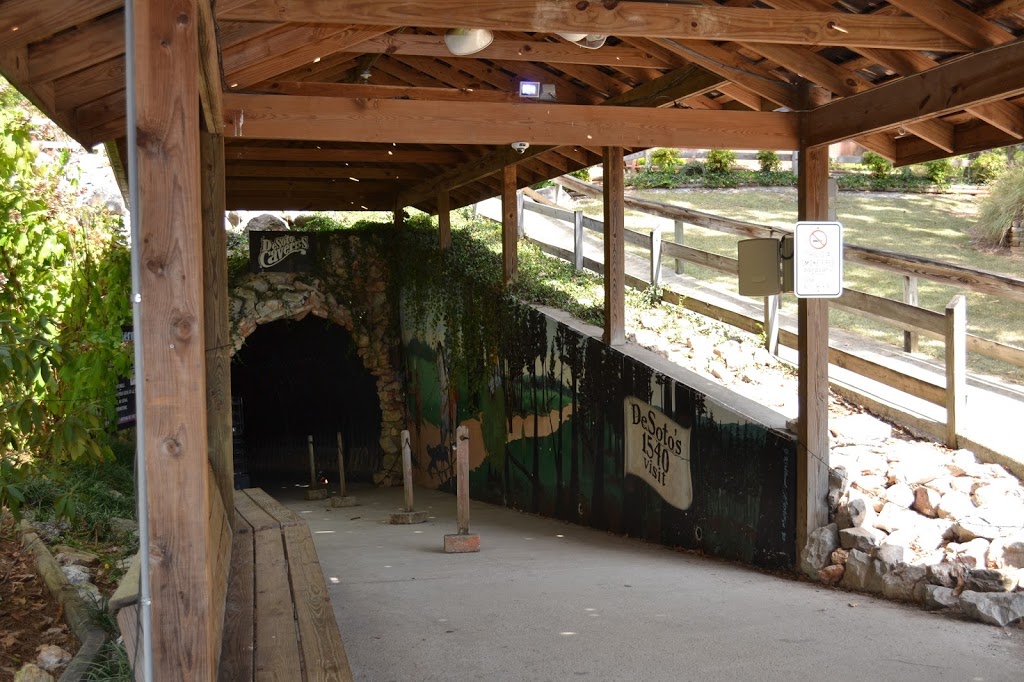
Entrance to De Soto Caverns, 2016. Photo by Lewis O. Powell IV, all rights reserved.
On the route I decided to stop outside of Childersburg to check out DeSOTO CAVERNS & FAMILY FUN PARK (5181 Desoto Caverns Parkway). As I waited for the cave tour I watched a young father carry his child off the porch of the gift shop heading towards the family’s car. In his arms the child squirmed and cried in the depths of a temper tantrum. As they passed the statue of Hernando de Soto the father said, “Hey look, it’s Hernando de Soto!” The child only screamed louder. Goodness knows that de Soto inspired similar reactions from the natives when he marched through this area in 1540.
Interior of the caverns with a replica of a native burial in place. Photo by Lewis O. Powell, IV, all rights reserved.
Scholars suggest that Spanish explorer and conquistador Hernando de Soto may have stopped in the area as he hacked his way through the forests and natives of the region. While there is no proof that he visited the cave, there is evidence that it was known to the local natives. Several native burials were located in the main room of the cave as well as the remains of a white trader who was killed after he carved his name in the cave which was considered sacred to the natives. Being a cave fan, I was happy when Johnston and Busby included the cave in their book on haunted Talladega County.
While I have had some creepy experiences in caves (see my experiences at Lost Sea Cave in Sweetwater, TN), I didn’t have anything odd happen. Johnston and Busby note that a young daughter of the cave’s owners had experiences with Native American spirits during her childhood on the property. Worried that these spirits may have been upset by the family’s use of the cave as a tourist attraction, the owners brought in members of the native tribes that once owned the land to cleanse the property and rebury the bones of their ancestors that had originally lain quietly in the cave. Apparently, the spirits have been appeased, though I do wonder if there is any residual energy that may cause some activity on occasion.
Sylacauga itself seems to be waking up however: a number of buildings in its downtown were occupied and open for business including what appeared to be several new restaurants. For dinner I considered BUTTERMILK HILL RESTAURANT(300 East 3rd Street) which occupies an early 20th century house just outside of downtown. Listed in Johnston and Busby’s book, the restaurant shares the house with an assortment of spirits and a dark history that includes a murder within the past decade. While the menu looks delectable, it was a bit pricey for my current budget, though I did take some pictures.
Buttermilk Hill Restaurant, 2016. Photo by Lewis O. Powell, IV, all rights reserved.
My second sojourn to Alabama took place over the penultimate weekend of October. Due to work on Friday, the trip turned out to be rather rushed and I didn’t have much time to really enjoy it the trip up. S.C.A.R.E. of Alabama sponsored an investigation of JEMISON-CARNEGIE HERITAGE HALL MUSEUM (200 South Street East) and the adjoining ARMSTRONG-OSBORNE PUBLIC LIBRARY (202 South Street East) in Talladega. Despite NASCAR races taking place the same weekend at the nearby (and cursed, supposedly) Talladega Superspeedway in Lincoln, the leafy streets of Talladega were quiet and still. South Street boasts some fine institutions and a handful of ghosts. On this peaceful night, antebellum MANNING HALL (205 South Street East), the huge, main edifice of the Alabama Institute for the Blind and Deaf, across the street from Heritage Hall was lit up like a beacon. Heritage Hall’s smaller, more feminine, Beaux-Arts façade was lit up as if in graceful answer to Manning Hall’s heavy, masculine Greek Revival colonnade. According to Johnston and Busby, Manning Hall does have some spirits of its own, quite possibly including the shade of the Institute’s founder, Dr. Joseph Johnson.
Manning Hall at the Alabama Institute for the Deaf and Blind. Photo by Lewis O. Powell, IV, all rights reserved.
The Jemison-Carnegie Public Library was the dream of Louisa Jemison, a member of the prominent Jemison family who now have a handful of haunted places associated with them. Designed by noted Alabama architect Frank Lockwood, the library was built with a donation of land from Louisa Jemison and the Carnegie Foundation. When the library opened in 1908 local lore tells of a little 8-year-old girl sitting on the top step the first day and her being the first person to check out a book. The little girl, Gentry Parsons, would eventually pen her own books and donated many books to this library.
The facade of Heritage Hall on the night of the investigation. Photo by Lewis O. Powell, IV, all rights reserved.
Good architecture has power. In creating beautiful spaces, the architect can physically manipulate those entering the space; the eyes and chin are raised and the dignity of the space encourages those entering to straighten their back out of respect. With better posture, those entering have their senses heightened and the feeling of awe can mellow into a sense of inspiration, lightness, refinement, and freedom. Like the great cathedrals of Europe, the architecture of Heritage Hall does exactly that. The high ceilings, airiness, and grace raises the senses of those walking up the front staircase and entering the front door. The main bay of the building is a large open space with a dramatic staircase directly ahead leading down to the main librarian’s desk.
Interior of Heritage Hall just inside the front door. Photo by Lewis O. Powell, IV, all rights reserved.The interior of Heritage Hall looking down the stairs just inside the front door towards the old librarian’s desk. Photo by Lewis O. Powell, IV, all rights reserved.
After entering for the investigation I was greeted by the museum’s director and given an excellent tour of the building. The open space inside with the walls lined with art from local artists gives the place a sense of veneration and the art displays the tremendous talent throughout the region. I was also introduced to some of the paranormal activity that has been experienced here. With this building being a community center for such a long period of time, the energy that has passed and continues to pass through it has likely left a psychic imprint. That can be one explanation for the disembodied footsteps and doors opening and closing on their own accord. As a library, this building has also inspired passion for many people, people who return to this beloved spot in spirit. Some of the spirits believed to still oversee business here are Miss Willie, a former librarian; Tom Woodson, a long-time director of the museum who died a few years ago; and Louisa Jemison who may return to check on her beloved library.
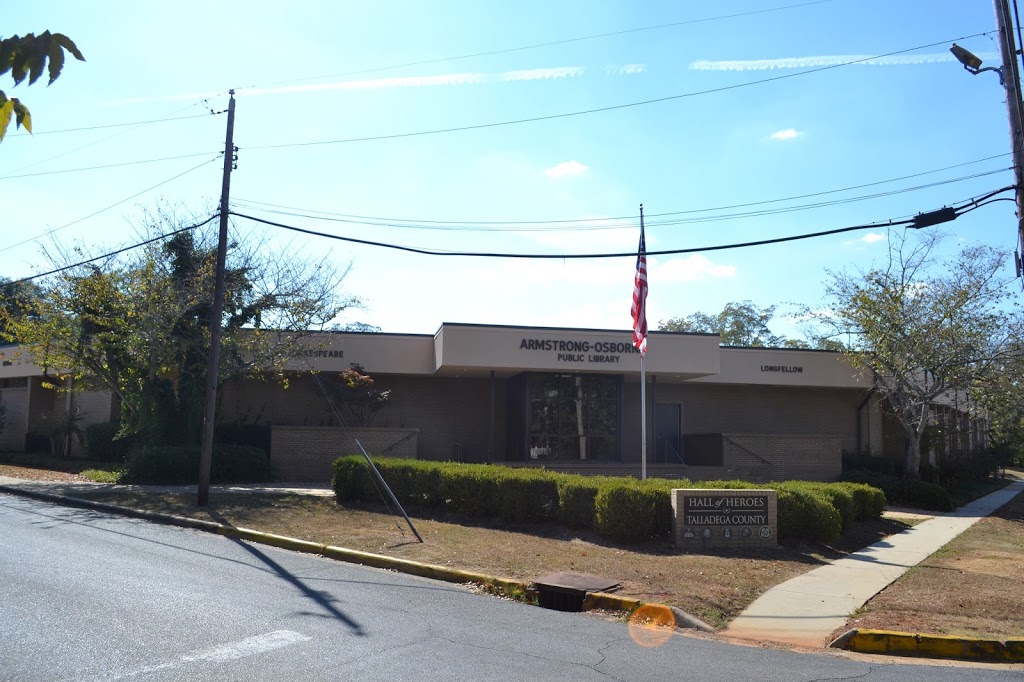
Main entrance of Armstrong-Osborne Public Library, 2016. Photo by Lewis O. Powell, IV, all rights reserved.
Spooning Heritage Hall like a protective older sibling is the Armstrong-Osborne Public Library which opened in 1979. Sadly, the architects of the newer building did not take their cues from Lockwood’s design. The building is minimalist and angular with no ornamentation; utilitarian modernist at its worst. The interior is very typical late 20th century library design which emphasizes function over design. While the architecture is nothing to write home about, the institution itself seems to be very well stocked and the librarians and staff present were delightful and very interested in the investigation.
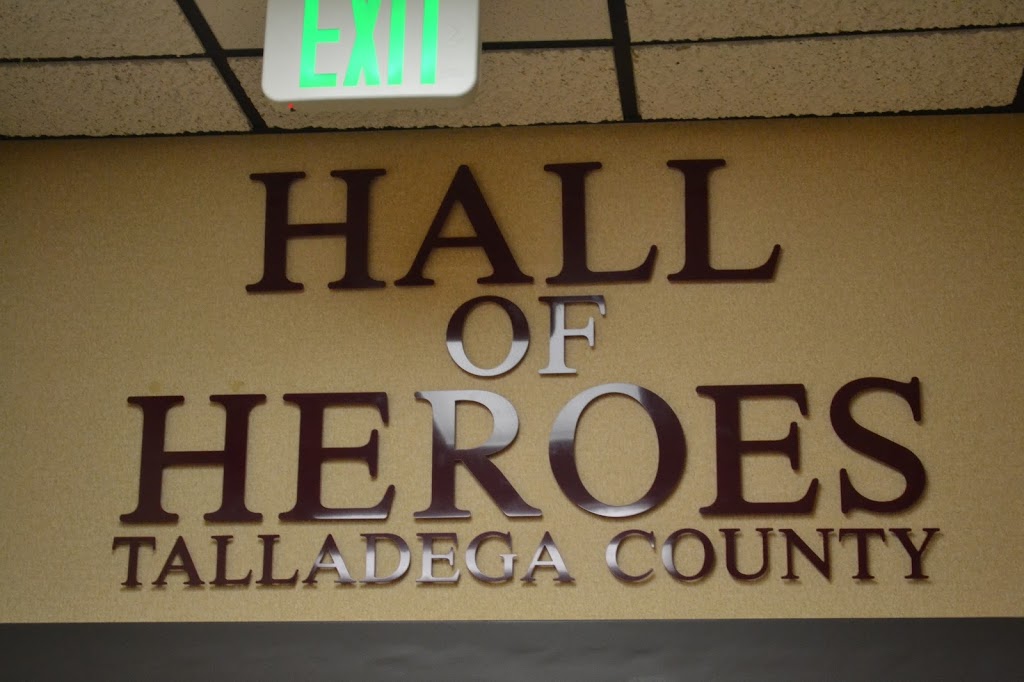
Hall of Heroes entrance. Photo by Lewis O. Powell, IV, all rights reserved.
The library itself has experienced a modicum of strange activity particularly around the genealogy room and its adjacent hallway which are actually part of a 2006 addition to the building. That hallway is now the Hall of Heroes, honoring the many men and women of Talladega County who have served in the armed forces. The hall is lined with photographs ranging from World War I to the most recent conflicts in Afghanistan and Iraq. In this hallway the spirit of a woman has been seen while the sounds of a party sometimes emanate from the genealogy room itself when it’s empty. The investigation of the library and Heritage Hall didn’t really uncover much evidence-wise. After sitting with Ghost Boxes in the main reading room of the library we adjourned to the genealogy room and the Hall of Heroes. Fitted out with computers, microfilm readers, and shelves of books old and new, the genealogy room isn’t particularly creepy, even in the dark. We did an EVP session and at one point seemingly heard a “no,” though I was one of the few people to hear it. It may have also been gastric noises from one of the participants. After relocating to Heritage Hall we didn’t pick up much activity, though we had some K2 spikes when some of men began lounging on Miss Willie’s library desk.
The Hall of Heroes is lined with the photos of men and women who served in the armed forces from Talladega County. Photo by Lewis O. Powell, IV, all rights reserved.
Sources
Johnston, Kim and Shane Busby. Haunted Talladega County. Charleston, SC: History Press, 2015.
“History.”Talladega Armstrong-Osborne Public Library. Accessed 12 November 2016.
“Our History.” Jemison-Carnegie Heritage Hall Museum. Accessed 12 November 2016.
Wetumpka Area Chamber of Commerce. Wetumpka Haunted Heritage Tour. 28 October 2016.
Comer Museum & Arts Center 711 North Broadway Avenue Sylacauga, Alabama
The graves stood tenantless and the sheeted dead
Did squeak and gibber in the Roman streets. –William Shakespeare’s Hamlet, Act I, Scene 1
The Comer Museum, 2016, by Lewis O. Powell IV. All rights reserved.
Standing in the dark, listening to the multitude of odd, disconnected syllables pouring forth from the voice box at the Comer Museum last Saturday evening, this quote popped into my head. While most of the noise from the voice box was unintelligible “squeaking and gibbering” the occasional word would miraculously pop out. Occasionally these odd words would begin to make sense. A question may be asked only to receive an intelligent answer. Someone asked a question of Harriet, the Comer Museum’s own haunted doll, inquiring how old she was only for the assembled group to be treated to a cheeky reply: “nine” said a little girl’s voice a moment later. After one of the group members reminded the doll that she was much older, a spooky girl’s giggle issued from the ghost box. Those present were aghast.
It’s very appropriate that the Comer Museum–which could be called Sylacauga’s attic—is within a marble clad building. Sylacauga sits atop a huge vein of marble, often considered comparable to Italian marble, and the city if often referred to as “The Marble City.” Originally constructed as the city’s first public library building by the WPA in 1939, the museum’s exquisite marble façade beckoned members of the community for decades before the library moved to a new building in 1979. The old library building was rededicated in 1982 as a local history and art museum. The rooms that were once filled with books are now filled with the detritus of local history. Old signs, photographs, works of art, Native American artifacts, antique clothing, glorious marble sculptures and one creepy-ass (pardon my French) haunted doll, fill the museum from top to bottom.
When I arrived for I was greeted warmly by the members of Spirit Communications and Research of Alabama (S.C.A.Re) who were leading this public investigation. Kat Hobson, who recently interviewed me as a guest on her radio show whisked me off for a tour of the building. The museum is not large, though it seems that every room is packed with historic bits and pieces. Along the way Kat pointed out various things that oddly gave off high EMF readings including an Edwardian gown and a typewriter. On the first floor I was introduced to Harriet, the haunted doll. The doll gave off a weird energy that gave the air around it a tingly sensation. My first reaction was to say, “I don’t like it.” Kat responded, “I don’t really like it either.”
Harriet, the museum’s haunted doll sits forlornly amidst flashlights and other investigative devices. Photo 2016, by Lewis O. Powell IV. All rights reserved.
We headed down to the basement where we peeked into a recreation of a pioneer log cabin. Again, the air seemed to tingle with the same odd energy that Harriet had given off. It was uncomfortable, but rather intriguing. I noted that I’m not sensitive, so the energy must be strong if I’m feeling it. Kat is a bit sensitive and pointed out that the group had had some activity in the cabin, particularly some shadow play around the cradle in the center of the room. Much of the rest of the basement is used for art classes and the spirits continue their antics including a little boy who is known to kick people in the shins.
Recreated pioneer cabin in the museum’s basement. Photo 2016, Lewis O. Powell IV, all rights reserved.
Upstairs, the investigation began with the group observing three haunted dolls from the haunted collection of Kevin Cain. With these three far less creepy dolls set up on a glass case, Cain provided the tragic histories behind each doll. With a temperature gauge sitting in front of her, the doll named Tammy may have affected the temperature as Cain related her sad tale. Throughout his story the gauge whined almost with sympathy for Tammy’s calamitous plight.
Kevin Cain’s haunted dolls. Note the temperature gauge in front of Tammy on the left. Robin sits in the middle with Maci on the right. Photo 2016 by Lewis O. Powell IV, all rights reserved.
The team and guests for the investigation then headed to basement for a voice box session. Here we were treated to our first taste of the dead’s squeaking and gibbering. During the session, proper names popped through and a few questions were answered directly. Some of the guests had some uneasy sensations there.
Perhaps the most interesting moment of the evening came as the group communed with Harriet. One of the guests holding a thermal imaging camera spotted at odd ball of light in the upstairs balcony. The light was not visible to the naked eye but was present on the thermal camera. Two investigators headed upstairs and looked for a source. After a good deal of waving from the investigators, the light remained on the camera, though no source or reason could be found. The pair of investigators remained upstairs where they began to get the sensation of being touched. Even the admitted skeptic of the group, Shane Busby felt the caress of a hand on his cheek and shoulder. Tristen Cox, the other investigator felt a hand on her upper arm. After she reported being touched Busby pointed his thermal imaging camera at her to reveal a handprint on her arm.
According to Kat Hobson, the haunting of the Comer Museum seems more connected with the various personal artifacts owned by the museum and less with the building itself. I would suggest that the makeup of the building itself and the tremendous marble deposits below may provide a platform for the psychic energy here. Marble is a type of limestone, which some paranormal investigators and researchers consider to be an excellent conductor for psychic energy. Consulting Timothy Yohe’s 2015 work, Limestone and its Paranormal Properties, the author asserts that buildings constructed of limestone can cause powerful EMFs to be emitted which may lend energy to spirits and other entities. The Comer Museum’s large marble façade, the use of marble throughout the building, marble sculptures and architectural elements in the collection may perhaps spur the activity that has been experienced here for years.
The S.C.A.Re of Alabama team with the Southern Spirit Guide. Back left: Lewis O. Powell IV, Shane Busby, Tristen Cox, Kevin Cain. Front left: Harriet the Haunted Doll, Kat Hobson, Kim Johnston.
After the investigation S.C.A.Re’s founder and author Kim Johnston graciously autographed my copies of her books, even inscribing “To Lewis—My favorite blogger” in my copy of Haunted Shelby County, Alabama. She then requested that the investigators take a group photo with me. It seems like many of us were touched physically and emotionally by the people of Sylacauga, both living and dead, I know I was also touched by S.C.A.Re’s graciousness and generosity. Thank you, guys!
Sources
Ford, Gene A., Linda Ford, and Christy Anderson. National Register of Historic Places Nomination form for B.B. Comer Memorial Library. August 2001.
C.A.R.E. of AL. Comer Museum Investigation. 1 October 2016.
Yohe, Timothy. Limestone and its Paranormal Properties: A Comprehensive Approach to the Possibilities. Timothy Yohe. 2015.
Stretching from Key West, the southernmost point in the country to the Canadian border at the St. John River in Fort Kent, Maine, US-1 connects the East Coast. In the South it links together important cities from Miami to Jacksonville, Florida; Augusta, Georgia; Columbia, South Carolina; Raleigh, North Carolina; Richmond and Arlington, Virginia; Washington, D. C.; to Baltimore, Maryland before entering into Yankee territory. It also links historic and haunted cities like St. Augustine, Florida; Aiken and Camden, South Carolina; Petersburg, Fredericksburg, and Alexandria, Virginia before it solemnly passes The Pentagon, with Arlington National Cemetery beyond it, before crossing the Potomac into Washington.
US-1 in Maryland, 2004 by Doug Kerr. Courtesy of Wikipedia.
US-1 may be considered among the most haunted roads in the country. Not only does it directly pass a number of haunted places, but many more can be found within a short drive of this legendary road. This tour samples just a few of the legendary spots found alongside or near this legendary road.
Pig Woman Legend Cecil County
As US-1 dips south out of Pennsylvania into the countryside of Maryland, it enters Cecil County, the domain of the Pig Woman. According to local folklorist, Ed Okonowicz, the Pig Woman stalks the northern counties of the state as well as the marshes of the Eastern Shore, though the primary setting is usually in Cecil County. Okonowicz’s version of the tale begins near the town of North East where a farmhouse caught fire in the 19th century. The lady of the house was horribly burned in the fire and witnesses watched her flee into the nearby woods. She usually confronts drivers near a certain old bridge and causes cars to stall. The drivers see the specter of the Pig Woman who scratches and beats on the car. Terrified drivers who flee their vehicles are never seen again, though those who stay in their cars are left with horrible memories and odd scratches as well as dents on their vehicles.
This tale has been told around Cecil County for decades with hotspots for Pig Woman encounters being reported around North East, Elkton, and, in the 1960s, near Rising Sun, through which US-1 passes. Matt Lake, author of Weird Maryland, associates this tale with tales from Europe that tell of a woman with a pig-like face, particularly stories that ran rampant in early 19th century London. Despite deep European roots, the Pig Woman Legend remains fairly unique among Southern ghostlore.
Sources
Lake, Matt. Weird Maryland. NYC: Sterling Publishing, 2005.
Okonowicz, Ed. The Big Book of Maryland Ghost Stories. Mechanicsburg, PA: Stackpole, 2010.
Wormuth, Laura. “Decoding the Pig Lady of Elkton legend.” 31 October 2013.
Susquehanna River At the Conowingo Dam Between Cecil and Harford Counties
The Conowingo Dam, built between 1926 and 1928, carries US-1 over the Susquehanna River. Only five miles from the Pennsylvania border, this area was rife with activity when the Underground Railroad was in operation before the Civil War. Slaves seeking freedom in Pennsylvania would ply the river at night looking for red lanterns on the riverbanks that marked the safe houses. Slave catchers also used red lanterns to capture contraband slaves only a scant few miles from freedom in order to return them to their owners. Flimsy rafts were often employed here that led to the drowning deaths of some.
1930s era postcard of the Conowingo Dam. Courtesy of Wikipedia.
Along the river, the red lights are supposed to bob and dance on the riverbanks even today while the moans of slaves and even spectral bodies floating in the water are encountered by hikers, campers, and fishermen in the area.
Ricksecker, Mike. Ghosts of Maryland. Atglen, PA: Schiffer, 2010.
Peddler’s Run Flowing parallel to Glen Cove Road and MD-440 Near Dublin
On the western side of the river, one of the tributaries offering up its waters to the Susquehanna is named for a ghost; it’s called Peddler’s Run. As the legend states, in 1763 a poor peddler on the Dublin-Stafford Road (now MD-440) was found decapitated near John Bryarley’s Mill on Rocky Run. Locals buried the body near the creek where it was discovered. Not long after the peddler’s burial, his specter was seen walking along the creek without his head. In 1843 a skull was found by another local farmer. Presuming it to be that of the now legendary peddler, the skull was buried with the traveler’s remains. The peddler’s spirit was not seen again, though his name still graces the creek.
Sources
Dublin, Maryland. Wikipedia, the Free Encyclopedia. Accessed 17 September 2016.
Hauck, Dennis William. Haunted Places: The National Directory. NYC: Penguin Press, 1995.
Varhola, Michael J. and Michael H. Varhola. Ghosthunting Maryland. Cincinnati, OH: Clerisy Press, 2009.
Tudor Hall 17 Tudor Lane Bel Air
As it hurries towards Baltimore, US-1 passes through the county seat of Harford County, Bel Air. Northeast of downtown is Tudor Hall, the former home of the famous and infamous Booth family. Junius Brutus Booth, one of the greatest American Shakespearian actors of the first half of the 19th century, built this Gothic-style home for his family. In this fine home, Booth’s family were immersed in the family occupation of acting. The halls rang with snippets of Sheridan and Etheredge while family members are supposed to have performed the balcony scene from Shakespeare’s Romeo and Juliet using the balcony on the side of the house. Some of the elder Booth’s children would achieve their own celebrity including his sons Edwin, Junius Brutus Jr., and his daughter, Asia. Booth’s son, John Wilkes, who inherited his father’s fiery personality, would achieve notoriety after he assassinated President Lincoln after the end of the Civil War heaping infamy of Shakespearean proportions on the family name.
As word of Lincoln’s assassination spread, troops began to seek out members of the Booth family. Troops searched Tudor Hall which was still owned by the Booths but being rented to another family. The house passed out of family hands a few years later and has been owned by a host of individuals. Now owned by Harford County, the house is home to the Center for the Arts and is open a few times a month for tours.
Tudor Hall, 1865. Courtesy of Wikipedia.
The Booth’s legacy has extended from the theatrical realm into the spiritual. The spirits of several Booth family members have been reported throughout the South including John Wilkes Booth’s spirit which may still stalk Ford’s Theatre in Washington and Dr. Mudd’s farm in Waldorf, Maryland, where he was treated for a broken leg after his dastardly deed at the theatre. Legend holds (wrongly so) that Edwin’s dramatic spirit still appears on the stage of Columbus, Georgia’s Springer Opera House where he appeared in the early 1870s as well as in the halls of the Players’ Club in New York City where he died. Junius Brutus Booth’s fiery spirit may still roam the halls of Charleston, South Carolina’s Dock Street Theatre, formerly the Planter Hotel, where he stayed in the 1850s. Appropriately the building was transformed into a theatre in the 1930s.
Of course, the family’s seat in Bel Air may also be haunted by members of the spirited family. One couple who owned the house told the Washington Post in 1980 that they once were greeted by small brown and white pony. The curious creature looked into the couple’s car and then peeked into the house through a rear window. Moments later the creature vanished. The couple believed the animal was the spirit of Junius Booth’s favorite pony, Peacock. The same couple had a dinner party interrupted by spectral antics when a guest asked for seconds. The hosts and their guests were astonished as the top of a cake lifted up and landed at the place of that guest. People who have lived and worked in the house continue to tell stories of unexplained footsteps, voices, and things moving on their own accord with this storied house.
Sources
Allen, Bob. “In Maryland, a couple preserves the estate of the ill-starred Booth family.” The Inquirer (Philadelphia, PA). 21 December 1986.
Meyer, Eugene L. “House Booth built is slightly spooky.” Washington Post. 10 January 1980.
Perry Hall Mansion 3930 Perry Hall Road Perry Hall
It is arguable that the namesake of this Baltimore suburb is actually haunted. This grand colonial mansion sat derelict for many years and acquired a reputation of being haunted. The legend that has persisted about this house states that builder of this home and his wife both died on Halloween night in the late 18th century and that in the time since, some 50 other people have died here under mysterious circumstances some of whom still haunt the house. Though, according to the mansion’s website, none of this is true.
Baltimore businessman Harry Dorsey Gough acquired this vast estate in the 1770s and constructed this mansion which he named for his family’s ancestral home in Britain. Gough lived the life of a colonial playboy for a while after Perry Hall was constructed but after a visit to a Methodist meeting in Baltimore, he converted to the new Christian denomination. After distinguishing himself as a planter, businessman and politician, Gough passed away here in May of 1808 (not Halloween as the legend states). The estate remained in the family until 1852 when it began its long journey in the hands of others. Baltimore County acquired the derelict house recently and will be used as a museum and events facility.
In a 2011 article for the Perry Hall Patch Jeffrey Smith, then president of the Friends of Perry Hall Mansion debunked some of the legends around Perry Hall. Using the version of the legend in Matt Lake’s 2006 book, Weird Maryland, Smith breaks down the points of the legend. While there have likely been deaths in the house, the 50 deaths under mysterious circumstances that the legend purports are absurd. Smith notes that the house is hooked up to electricity and lights seen inside may have simply been left on by a previous visitor. Where the legend states that visitors have been unable to capture video of the house is also preposterous. While this house has reasons to be haunted on account of its history, there are no stories to support that assertion.
Sources
Coffin, Nelson. “Perry Hall Mansion shuttered while updates considered.” Baltimore Sun. 1 March 2016.
Lake, Matt. Weird Maryland. NYC: Sterling Publishing, 2004.
Smith, Jeffery. “Perry Hall’s most renowned and mistaken ghost story.” 31 October 2011.
Green Mount Cemetery 1501 Greenmount Avenue Baltimore
As US-1 bypasses downtown Baltimore it forms a northern border for this venerated cemetery. After visiting Boston’s Mount Auburn Cemetery, the first “garden cemetery” in the country, Samuel Walker, a Baltimore merchant, began to draw up plans for a similar cemetery to occupy a former estate called Green Mount. Hiring Benjamin Latrobe, architect for the U.S. Capitol Building, to design this park-like cemetery which opened in 1838. In the decades since, the cemetery has become the resting place for famed statesmen, artists, writers, and military figures, as well as the infamous including John Wilkes Booth who is buried with his family.
Gates of Green Mount Cemetery, 2010, by Pubdog. Courtesy of Wikipedia.
While numerous articles state that Green Mount is haunted, none of them connect specific stories with this august resting place. However, the cemetery has one very interesting connection to the paranormal, the grave of Elijah Bond, the creator of the Ouija Board. It was not until recently that Bond’s grave was marked, appropriately with a stone engraved with his Ouija board design.
Sources
“Baltimore headstones, horrors for a hair-raising, haunted Halloween.” The Towerlight (Towson University). 27 October 2013.
“History.” Green Mount Cemetery. Accessed 23 September 2016.
Hilton Mansion Campus of the Community College of Baltimore County Catonsville
Hilton 2009, by Pubdog. Courtesy of Wikipedia.
As US-1 leaves Baltimore it swings by the suburb of Catonsville. According to a 2004 lecture given on the haunts of Catonsville, community college faculty held contests to select a member to attempt to spend the night in this haunted mansion. Some encountered the sword-wielding Confederate soldier who is supposed to guard the home’s main staircase. Author Tom Ogden notes that the apparition of a woman wearing a nightgown and holding a candle has also been encountered here. The house dates to the early 19th century, though the interior was completely replaced in the early 20th century. The home now serves as the college’s Center for Global Education.
Sources
Hagner-Salava, Melodie. “’Spirited’ talk evokes ghosts of Catonsville’s past.” Catonsville Times. 4 March 2004.
Ogden, Tom. Haunted Colleges and Universities: Creepy Campuses Scary Scholars and Deadly Dorms. Guilford, CT: Globe Pequot Press, 2014.
Historic Savage Mill 8600 Foundry Street Savage
Located between Baltimore and Laurel, Savage, Maryland is a quiet, unincorporated community on the banks of the Little Patuxent River. Downtown Savage lies between busy I-95 and slightly less busy US-1. The community was created as a mill town providing employees for the Savage Manufacturing Company’s textile mill which was constructed in the 1820s. The mill was in operation for more than a hundred years before it closed just after World War II. The old mill complex was used for the manufacture of Christmas ornaments for a few years before it was purchased for use as a warehouse. In 1985, the mill was reopened as a venue for boutiques, restaurants, and antiques dealers.
Aerial view of Savage Mill and the Little Patuxent River, 1970, by William E. Barrett for the Historic American Buildings Survey. Courtesy of the Library of Congress, Prints and Photographs Division.
The mill has since become one of the driving forces for tourism to the area drawing more than a million people in 2010, but not all those people are attracted by shopping and attractions at the mill, some are brought because of the ghosts. The owners of the mill started ghost tours in the mid-2000s to capitalize on the ghost stories surrounding the mill complex.
Throughout the mill complex, spirits of former millworkers still linger. Merchants and patrons of the mill have heard their names called, been tripped by the puckish little girl’s spirit on the steps of the New Weave Building, seen faces at the windows, or perhaps encountered the spirit of Rebecca King who fell down the steps in the mill’s tower.
Sources
Alexander, Sandy. “Using the supernatural to sell Howard County.” Baltimore Sun. 4 October 2004.
“Ghostly history.” Washington Times. 23 October 2004.
Hoo, Winyan Soo. “At Maryland’s Savage Mill, history and commerce converge.” Washington Post. 28 April 2016.
St. John’s Episcopal Church 11040 Baltimore Avenue Beltsville
Like a moralizing parent looking over wild children, St. John’s Episcopal Church presides over the sprawl of US-1 (known as Baltimore Avenue here) as it passes through Beltsville. During the Civil War this commanding site featured a Federal artillery battery. The wife of a rector here in the 1970s recorded a number of experiences with spirits both in the church and in the churchyard. One evening while the wife and her children picked flowers in the churchyard they were startled to hear the sounds of a service coming from the church. After intently listening, the family entered the sanctuary to find it darkened and empty.
Sources
Carter, Dennis. “Hunting for haunts.” The Gazette. 25 October 2007.
Tawes Fine Arts Building Campus of the University of Maryland College Park
Moving south out of Beltsville, US-1 passes through College Park and the University of Maryland Campus. Though no longer home to the Department of Theatre, the Tawes Fine Arts Building retains its theatre and recital hall. The current home to the university’s English department, the building may still also retain its resident spook. Not long after the building’s opening in 1965, students began noticing the sound of footsteps in the empty theatre and would occasionally have mischievous jokes played on them, seemingly from beyond.
With quite a population of resident ghosts on campus, the university archivists have started documenting the stories. According to one of the archivists quoted in Michael J. and Michael H. Varhola’s Ghosthunting Maryland, Mortimer, Tawes’ ghost, may actually be a dog rather than a human spirit. According to campus lore, Mortimer was brought into the theatre during its construction and would frolic on the stage. The theatre’s seats had yet to be completely installed and the house was filled with metal frames the seats would be attached to. The frolicsome canine jumped from the stage into the house and impaled himself on one of the frames. Supposedly, he was buried in the building’s basement.
Sources
Okonowicz, Ed. The Big Book of Maryland Ghost Stories. Mechanicsburg, PA, Stackpole, 2010.
Tawes Theatre. Wikipedia, the Free Encyclopedia. Accessed 5 April 2013.
Varhola, Michael J. and Michael H. Ghosthunting Maryland. Cincinnati, OH: Clerisy Press, 2009.
Bladensburg Dueling Ground Bladensburg Road and 38th Street Colmar Manor
When Washington outlawed dueling within the limits of the district, the hotheaded politicians and gentlemen of the district needed a place to “defend their honor.” They chose a little spot of land just outside the district in what is now Colmar Manor, Maryland. The activities at the dueling ground provided the name for the nearby waterway, Dueling Creek or Blood Run, now blandly called Eastern Branch. When the city of Colmar Manor was established in 1927, the city used dueling imagery on its town crest including a blood red background, a pair of dueling pistols and crossed swords.
Senators, legislators and military heroes are among the hundred or so men who dueled at this place in some fifty duels that are known and countless others that took place at this spot. Commodore Stephen Decatur was killed here in a duel with Commodore James Barron in 1820 and Representative John Cilley of Maine, who knew little of firearms, died here after combat in 1838 with Representative William Graves of Kentucky. The spirit of Stephen Decatur has been seen here along with other dark, shadowlike spirits that still stalk the old dueling grounds. The bloody grounds are now a park that stands silently amid the roaring sprawl of suburbia.
Sources
Hauck, Dennis William. Haunted Places: The National Directory. NYC: Penguin, 2002.
Taylor, Troy. “The Bladensburg Dueling Grounds, Bladensburg, Maryland.” Ghosts of the Prairie. 1998.
Varhola, Michael J. and Michael H. Varhola. Ghosthunting Maryland. Cincinnati, OH: Clerisy Press, 2009.
East Hill Cemetery East State Street Bristol, Tennessee and Virginia
The city of Bristol straddles the border between Virginia and Tennessee with East State Street marking the state line west of East Hill Cemetery. The cemetery itself is divided into nearly equal portions as it passes through the cemetery. The primary entrance, however, is located on the Tennessee side.
The death of a child is always traumatic, though it was especially harrowing when five-year-old Nellie Gaines passed away in 1857 as her family was preparing to leave the area. Worried that the pitiful grave would be neglected and forgotten, the family sought a proper place for their daughter. One of Bristol’s founders, Samuel Goodson, owned a hill east of town and suggested it as a proper burial place.
A wagon bore the child’s casket up the hill prodded by a branch snapped off by the driver. After the service, the branch was stuck into the earth to mark the grave. The branch grew into a tree atop the grave until the early 1970s. Over the years the hill began to collect graves and eventually became an official cemetery.
East Hill Cemetery by Dan Grogan, 2013. Courtesy of Flickr.
This hill had been the scene of strange occurrences for many years prior to its use as a cemetery. During the latter days of the 18th century, this area was a favored hunting ground for General Evan Shelby who lived nearby. As the old general developed dementia in his old age, he took to wandering his old hunting grounds which included East Hill. After his death passersby still spotted the form of the old general still rambling about the hillside.
Even stranger was the image of a burning tree that was spotted on rainy nights. Brave souls who ventured into the cemetery in search of the torch-like tree never found any sign of fire. A local reverend built a home on a nearby hill with a good view of East Hill and he and his family regularly witnessed this phenomenon that they dubbed the “burning tree ghost.”
Sometime after the cemetery was formally established, a man taking a shortcut through the cemetery late on a snowy night heard the sounds of children playing. Thinking the sounds odd, he stopped momentarily to listen and was shocked to see three white figures moving towards him. He fled. Over the years, many others have reported similar sounds on cold, snowy evenings.
Local historian Bud Phillips tells a more recent story involving a woman searching for the grave of her great-grandmother. After tramping through the cemetery and have no luck finding her great-grandmother’s marker the woman decided to give up. As she walked back to her car she saw the strange figure of a woman standing not far away wearing a pink gown and pointing to a shrub. The figure vanished and the intrepid visitor decided to take a closer look at the shrub the woman had been pointing at. Lo and behold, the shrub was covering her great-grandmother’s marker. A short time later, the woman remembered that her great-grandmother had been buried wearing a pink gown.
With the activity here, it seems that East Hill Cemetery may also straddle the line between life and death.
There are several other places that “straddle the line” that I have covered. Two theatres on State Street–the Paramount Center for the Performing Arts on the Tennessee side, and the Cameo Theatre on the Virginia side–have been covered in my article, “Phantoms of the Operas, Y’all–13 Haunted Southern Theatres.” I have also covered the ghosts of the Bristol Train Station in Virginia.
Payne and Edwards Roads Rural Hall, North Carolina
The ritual is thus: drive out at night to the bridge where Edwards Road crosses over Payne Branch, stop your car in the middle of the bridge, and put it into neutral. Open the windows and begin to whistle “Dixie.” Supposedly your engine will die and you will be unable to restart the car until it is pushed from the bridge.
Author Michael Renegar tells of a friend of his who performed this ritual with frightening results. This young man and two female companions ventured out to haunted Payne Road one night looking for a thrill. After performing the ritual their car sputtered and died. After the young man pushed the car off the bridge, he was able to crank the car, though while he was outside of the car he was spooked by a feeling of being watched.
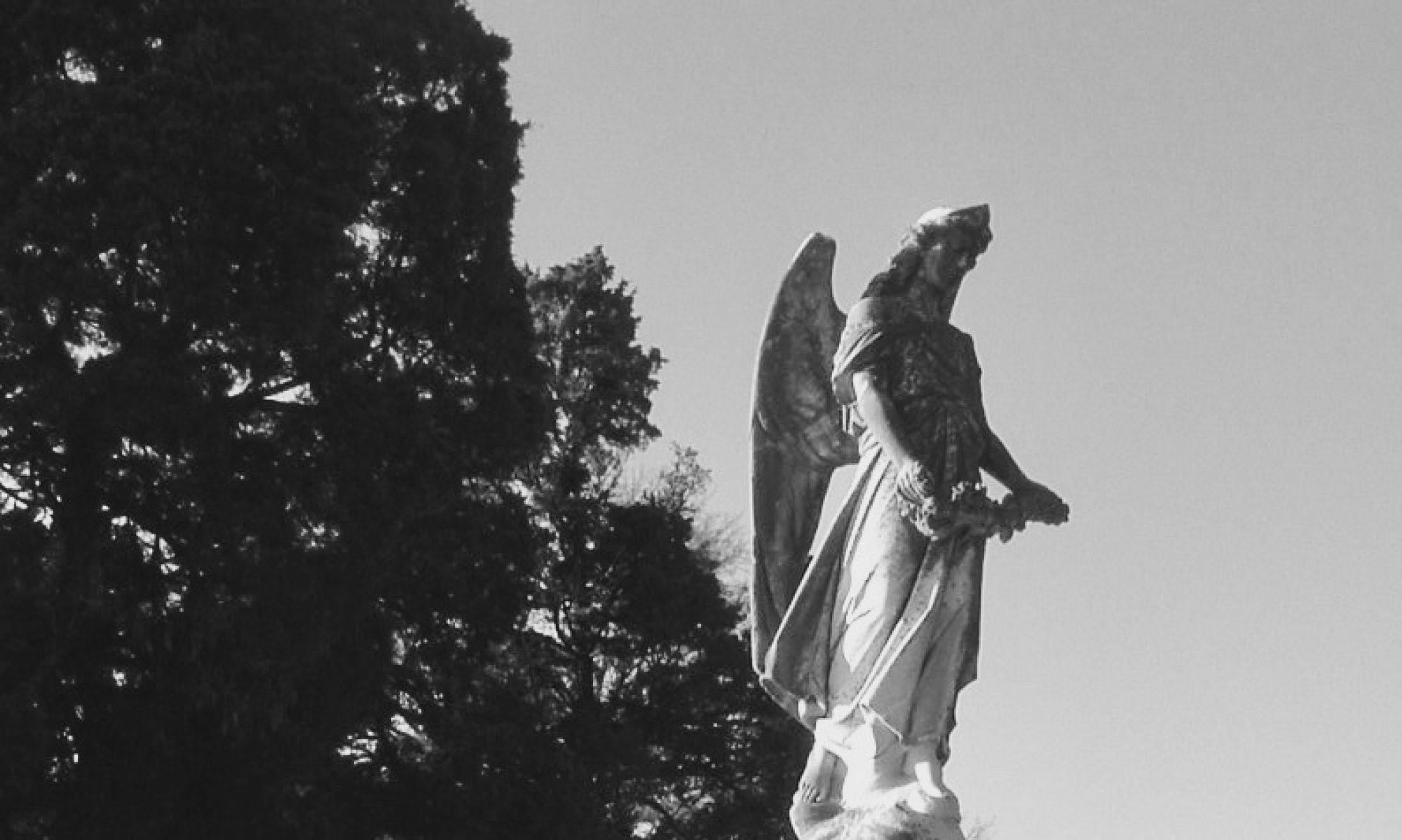
Reportedly, the vehicle never acted the same after that. Besides the scary moments on the bridge, the three also noted that when they drove past one of the old cemeteries an angel on the edge of the cemetery faced away from the road, but was facing them the second time they passed it.
Authors Burt Calloway and Jennifer FitzSimons record an earlier encounter on the bridge where a young man was trying to impress his date. The couple performed the ritual, and the young man left his date sitting in the car as he strutted around the lonely bridge provoking the spirits. As lightning lit up the night’s sky, it revealed something to the young man.
Stumbling back to the car, he attempted to crank it. It refused to start and the young man just sat stunned in the driver’s seat. His date, not too pleased with his sudden fear, cranked the car and drove them away from the bridge. Only after leaving the haunted spot, did the man reveal that he saw a ghost during the lightning’s flash.
The stories of Payne and Edwards Roads have circulated in this rural area of Forsyth and Stokes counties for decades. The legendary history has entered the digital realm where it is discussed and argued among the more than 4000 members of the Legend of Payne Road group on Facebook. To add more fuel to the fiery legends, the viral website Only In Your State recently published an article repeating many of the lurid, and oft disputed legends of these haunted roads.
First off, there is a great deal of confusion regarding the exact location of the hauntings. Edwards Road branches off from Broad Street within the Rural Hall city limits. Google Maps notes that the road is NC 1903 until after it intersects Forsto Road at which point it combines with NC 1961. Apparently, the haunted portion of the road is located south of Payne Branch where the road curves before crossing over Payne Branch. Edwards Road terminates at Payne Road just north of the bridge. Payne Road continues east as NC 1961, while the western section is NC 1962. At some point, part of Payne Road may have been renamed Edwards Road, but that is only speculation, however the roads do appear to have been named for the families that once owned the land: the Paynes and the Edwards.
The Only In Your State article notes three legends associated with this road, though, like all legends, these legends change from storyteller to storyteller and article to article. The first legend involves the story of Payne Edwards, a cruel plantation owner whose daughter was impregnated by a slave. After killing the slave, Edwards began to practice devil worship and eventually killed his entire family. He also burned the plantation killing all the remaining slaves.
A different version of the story casts Payne Edwards as the head of a large household here in the 1930s. After losing his mind he decided to murder his family and tied his wife to a chair in the living room. One by one he took his children to kiss their mother before he took them upstairs and slit their throats. The mother was able to escape, but was beheaded by her husband who dumped their infant child into a well.
While these stories are both grotesquely fascinating, they are utter balderdash. One of the best sites for a well-researched view of this story is the blog of the North Carolina Room of the Forsyth County Public Library. Last Halloween, one of the research librarians presented these two stories from Payne Road and checked their validity against the historic records. She found no record of Payne Edwards, though an early settler in the area, Robert Payne, owned land in the area. According to the Federal Census, Robert Payne was also a slave owner and had several children, though most apparently survived him.
The detail of a man murdering his entire family is also quite interesting. This detail is borrowed from an actual murder that occurred nearby in 1929. On Christmas Day, Charlie Lawson systematically killed his wife and six of his seven children (his oldest son was away from the family farm) and then shot himself a short time later. Lawson’s reasons for the murders went to the grave with him, though family and acquaintances have speculated that domestic issues, including possible incest, may have led to the tragedy. This gruesome mass murder elicited awe and curiosity from locals for many years and the family’s farmhouse was open as a tourist attraction for many years. Interestingly, these murders occurred roughly 5 miles from Payne and Edwards Roads on Brook Cove Road outside of Germanton. Though the family’s ramshackle farmhouse was demolished decades ago, there are still reports of paranormal activity in the area linked to the family’s murder.
While this tragedy did not occur in the Payne/Edwards Road area, there are a number of documented tragedies that have occurred here. In 1955, Milus Frank Edwards—who lived at the curve in Edwards Road just south of the bridge—committed suicide with a stick of dynamite. From the Gastonia Gazette, 7 October 1955:
Man Takes Life with Dynamite
Danbury—(AP)—A 73-year-old Stokes county man committed suicide yesterday with a dynamite explosion.
Sheriff Harvey Johnson said Milus Frank Edwards of Rt. 1, Rural Hall, apparently parked his pickup truck in a shed at his home, climbed into the truck bed and set off a stick of dynamite near his head.
A coroner’s jury ruled that death was self-inflicted.
Aubrey Edwards, son of the dead man, said his father had made several threats to end his life.
Sadly, this was among a handful of suicides to plague this family. According to the North Carolina Room blog, Mr. Edwards had four siblings also take their own lives. The blog poster further speculates that this is the beginning of the urban legends that surround these roads.
A more recent misdeed in the area can only be used to back up the tragic nature of this place. In December 1992 several men picked up a young woman in Winston-Salem. The young woman was driven to an old logging road off Payne Road. She was tied to a tree, raped, possibly tortured, and stabbed to death. More than a decade later one of the men involved was found guilty, though that conviction was later overturned based on DNA evidence.
This photograph appears in the 1990 book, Triad Hauntings, and is identified as the “Payne Road House,” though I cannot positively identify it as the haunted farmhouse.
While many of the legends that have accumulated around this area appear to be mostly fantasy embellished with fact, the experiences of locals and investigators cannot be denied. Writer Edrick Thay includes an interesting post-script to this research in his 2005 book, Ghost Stories of North Carolina. In a chapter entitled “The Haunted Farmhouse,” Thay recounts an investigation of an abandoned farmhouse by Haunted North Carolina Paranormal Investigators and Research that the group first looked into in 2002. Thay attempts to disguise the location saying that the lead investigator “refuses to disclose the farm’s location, except to say that it may or may not be around Winston-Salem.” Later details of the history make it certain that this is the old Edwards farmhouse outside of which Frank Edwards died by his own hands. “With this abandoned farm, the sheer number of the deaths from suicide and foul play over the last 50 years is staggering.” The investigator continues noting “gruesome accounts of people exploding themselves with sticks of dynamite, of the Mafia-style executions of two individuals beneath the awnings of an outbuilding and of the torture and grisly murder of a prostitute.”
During the several investigations the group has conducted here they have encountered high levels of activity in and around the old farmstead. On the first investigation several investigators were touched by unseen hands. One had their backpack grabbed and a nearby video camera proved her experience while another was touched on the hand leaving a red welt. Voice recorders used throughout the investigation recorded a number of EVPs including one with “many plaintive voices calling ‘help us!’” Perhaps the most interesting moment occurred when four investigators simultaneously witnessed a shadowy apparition moving along the banks of the nearby creek.
This investigation was conducted some years ago before the farmhouse and outbuildings were destroyed by vandals and an arsonist. Payne and Edwards Roads have both been paved and the mysterious haunted bridge has been replaced by a culvert. Despite these intrusions of modernity, teens and the curious still drive this road at night legend tripping. Hopefully they’re not just whistling Dixie.