WATE-TV Studios in Greystone Mansion
1306 North Broadway Street, Northeast
Knoxville, Tennessee
N.B. This article was revised and expanded 31 January 2019 and 13 June 2021.
Throughout the South, hauntings can be found in unlikely places: Walmart stores, fast food restaurants (I’ve covered the haunted McDonald’s in Hermitage, Tennessee), and amusement parks among them. Some years ago, WATE-TV 6, the Knoxville ABC affiliate, revealed that their own studios may be haunted.
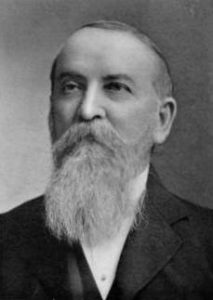
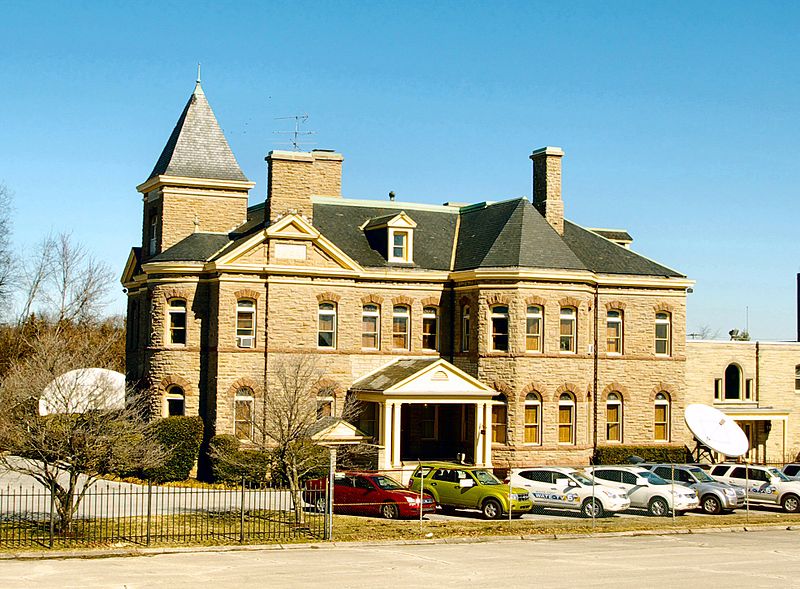
The studios occupy a rambling Victorian mansion that resembles a classic haunted house. The Richardsonian Romanesque mansion was constructed for Major Eldad Cicero Camp, Jr., the wealthiest man in East Tennessee at the time. He initially arrived in the area towards the end of the Civil War while he was serving Ohio Volunteer Infantry. Impressed at the region’s untapped mineral resources, he decided to make Knoxville his permanent home
Major Eldad Cicero Camp, circa 1917. From Knoxville Men of Affairs.
Camp settled here when the city was still reeling from the divisions brought about by the war, and Camp had his own lingering dispute to settle. During the war, a number of men under his command had been held as prisoners of war under Colonel Henry Ashby in atrocious conditions. Camp held Ashby personally responsible for their mistreatment and, after the war, pressed charges of war crimes and treason against him. Ashby fled Knoxville but returned when the charges were eventually dropped.
On the afternoon of July 9, 1868, Ashby ran into Camp on the street. The gentlemen struggled as Ashby struck Camp with his cane while Camp fought back with his umbrella. The following day, Ashby appeared at Camp’s law office near the corner of Walnut and Main Streets. The two took their quarrel outside where Camp drew his revolver and fired. Henry Ashby was struck in the chest and killed. Camp was arrested and charged with murder, but the charges were dropped.
The following year, President Grant appointed him as the United States Attorney for the Eastern District of Tennessee. Taking advantage of the region’s natural resources, he organized the Coal Creek Coal Company and served as president of two other companies, building a name for himself as a businessman.
With his wealth, Camp began building Greystone Mansion in 1885. The home took five years to construct and featured elaborate woodwork, jeweled stained glass windows, and imported marble mantelpieces. He lived in the house for some 30 years until his death in 1920. He was buried in Old Gray Cemetery not far from where Henry Ashby was also laid to rest. The house remained in the family until 1935 when it was sold and divided into apartments. WATE-TV purchased the house in the 1965, restoring it and adding studio space at the back.
Oblique view of Greystone. Photo 2010 by Brian Stansberry. Courtesy of Wikipedia.
Since moving in, station employees have had experiences throughout the old house. Footsteps and other odd noises have been heard, and a door on the second floor closes by itself. Several years ago, a custodian filmed something moving on the second floor with her phone.
The building has been investigated by Appalachian Paranormal Investigations several times with the group capturing video and audio evidence. According to a WATE, that evidence points to the presence of four possible spirits on the premises.
Sources
Booker, Robert J. “Greystone Mansion builder shot, killed man downtown.” Knoxville News-Sentinel. 26 February 2018.
And suddenly there was with the angel a multitude of the heavenly host praising God, and saying, Glory to God in the highest, and on earth peace, good will toward men. – Luke 2: 13-14 (KJV)
Old Gray Cemetery 543 North Broadway Knoxville, Tennessee
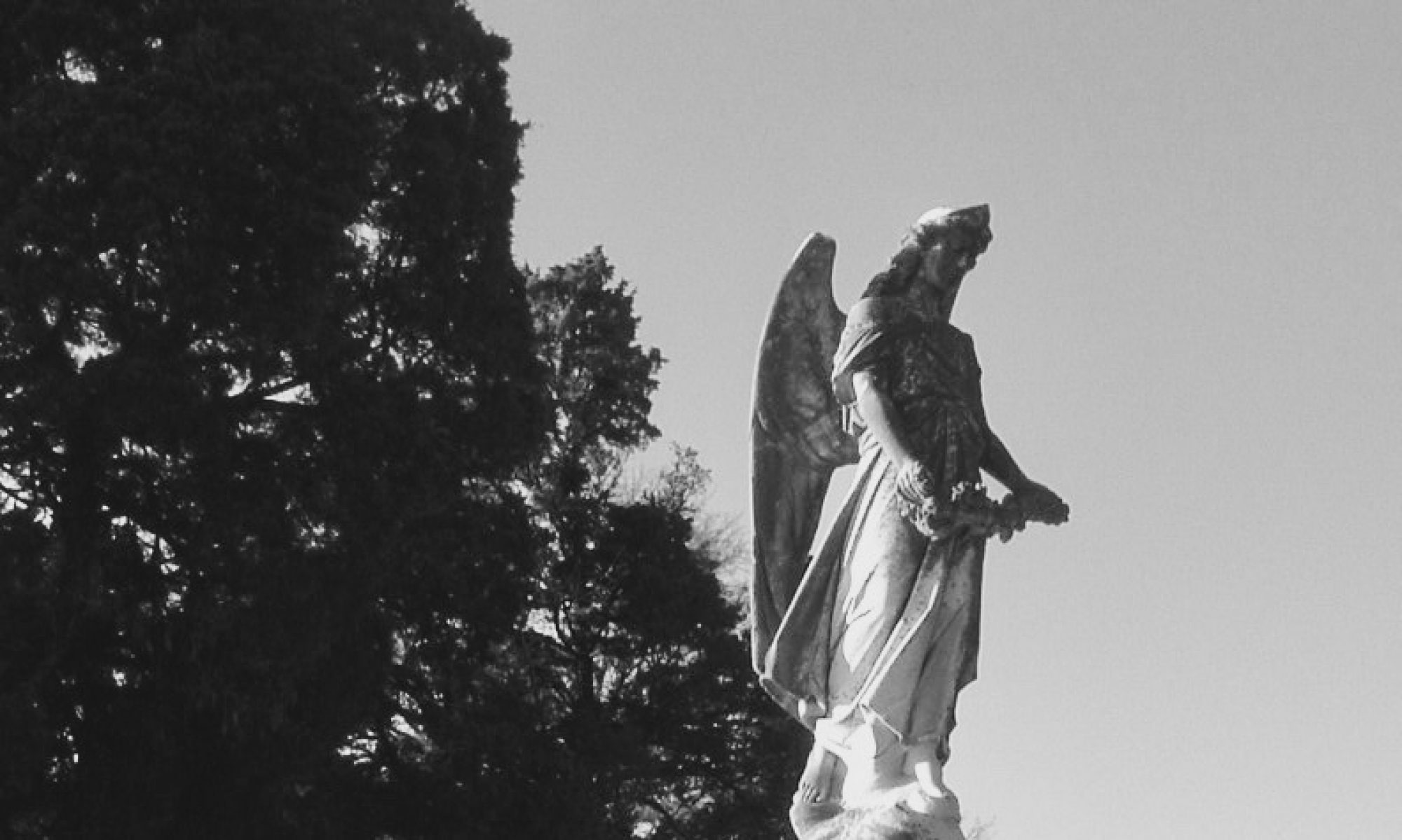
One of the host of angels at Old Gray. This one adorns the monument Ora Brewster. Photo 2010 by Brian Stansberry. Courtesy of Wikipedia.
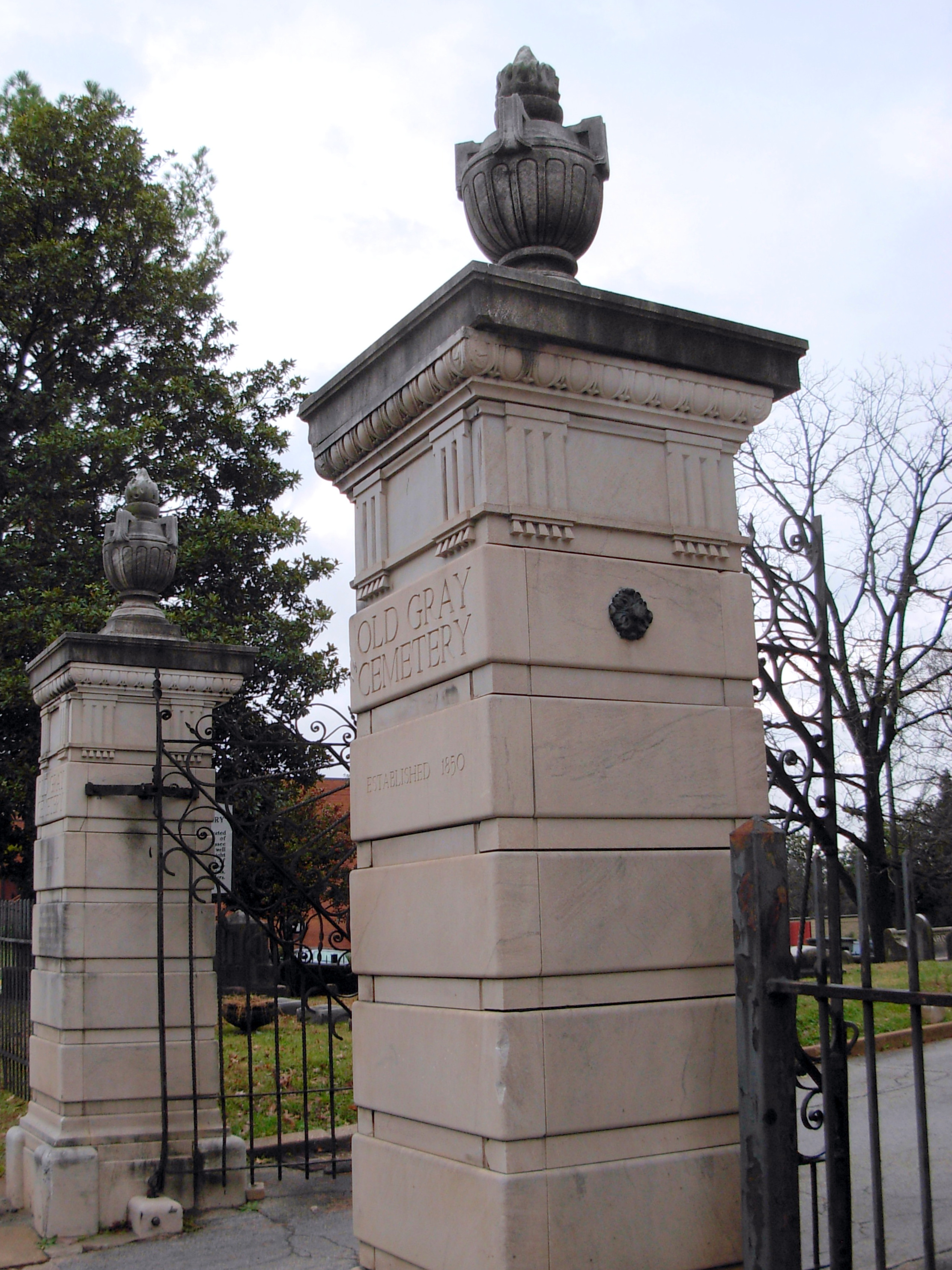
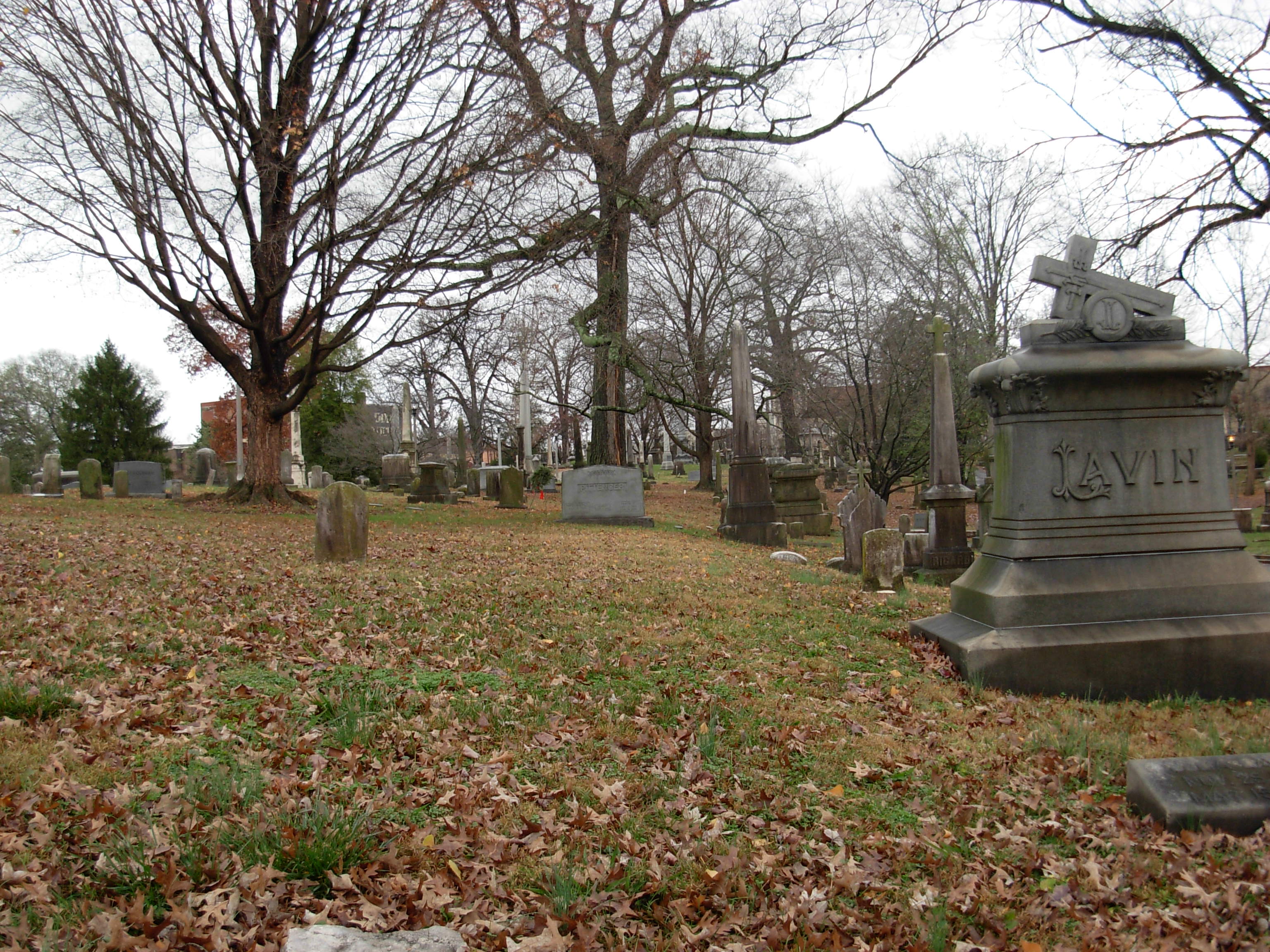
Like so many Victorian cemeteries, Old Gray Cemetery is adorned with a host of angels guiding us towards heaven, mourning the deceased, or standing silent vigil over the dead. The cemetery traces its founding to 1850 and it was joined by the neighboring Knoxville National Cemetery in 1863, when General Ambrose Burnsides needed a location for the burial for Union troops occupying the city. Since its founding, Old Gray–named for English poet Thomas Gray who penned Elegy in a Country Churchyard–has become the resting place of many notable citizens of Knoxville.
Of course, the cemetery is also the home of specters, otherwise, I wouldn’t be writing about it here. Legends have circulated for decades regarding a “Black Aggie” that has been seen on the grounds. The Black Aggie appears as a figure in a dark robe prowling about the grounds. Initially, the legend sprouted from the Adams Memorial in Rock Creek Cemetery, Washington, D. C. The memorial features a statue representing grief by the noted sculptor Augustus Saint-Gaudens. Since its installation, legends have evolved regarding this haunting figure. However, the name for the specter actually stems from a copy of the statue that was sold to General Felix Agnus in Druid Ridge Cemetery, Pikesville, Maryland, just outside of Baltimore. This statue inspired so many legends and endured so much vandalism it was removed and now graces the garden of the Dolley Madison House in Washington. Since this time, Black Aggies have been associated with numerous cemeteries throughout the world.
A pair of angels. Photo 2011 by Lewis Powell IV, all rights reserved.
When I visited the cemetery last year in early December, it was cold and the stones sat huddled on the hills under leaden skies; skies that would later that day produce light snow. While I did not encounter any Black Aggies, I did see a number of apparently homeless people wandering through. In fact, I was greeted at the cemetery gates by a young woman shouting profanities as she strolled down the street. That, coupled with the homeless people, did add a sense of unease to this otherwise peaceful resting place.
Numerous sources say simply that the Black Aggie has been reported by many people, though there are no specific reports provided. Dr. Alan Brown in his 2009 book, Haunted Tennessee, provides one unique report. In the 1990s, two teenage boys emboldened by beer, decided to try to photograph the spirit. They drove out to the cemetery and drank while hurling epithets towards the wraith. After urinating on one of the graves, one of the young men saw something black begin to ooze from the ground and form into a black shape. The boy fled as the shape began to pursue him and he jumped into the car shouting for the driver to go. The fleeing teens did, however, get a photo of the spirit before leaving, though, according to Brown, no one else has seen this picture.
Detail from the Mead Monument. Photo by Lewis Powell IV, all rights reserved.
In searching online, it does seem that some of the local paranormal organizations have investigated the cemetery during the day, though they have yielded little if any, evidence of paranormal activity. If you, dear reader, happen to find yourself in Knoxville, I would encourage a visit to Old Gray, and be sure to watch for the Black Aggie.
The magnificently decorated Mead Monument. Photo 2011 by Lewis Powell IV, all rights reserved.The gates of Old Gray Cemetery, Photo 2011 by Lewis Powell IV, all rights reserved.A circle of important monuments greets visitors to Old Gray. Photo 2011 by Lewis Powell IV, all rights reserved.The cemetery is perched on a series of rolling hills. The gleaming, white stones are apart of neighboring Knoxville National Cemetery. Photo 2011 by Lewis Powell IV, all rights reserved.The lovely monument to Lillian Gaines. Photo 2011 by Lewis Powell IV, all rights reserved.The unique Horne monument pays homage to two Confederate soldiers. Photo 2011 by Lewis Powell IV, all rights reserved.A hillside of monuments. Photo 2011 by Lewis Powell IV, all rights reserved.
Monuments dot a gentle slope. Photo 2011 by Lewis Powell IV, all rights reserved.
It seems that the further I read about hauntings in Memphis, the more I see a city that has been down on its luck for the past few decades. So many of Memphis’ haunted sites are incredible architectural treasures, yet they sit empty and crumbling. Certainly, it reflects the ill fortune of large cities over the second half of the 20th century as they sprawled outwards while their hearts withered. Among Memphis’ haunted locales are a number that have been abandoned (or, in one case, partially abandoned) and legends have sprouted up concerning them.
At least two of these buildings have legends that may have been invented to accompany their lonely states: the SEARS CROSSTOWN BUILDING (495 North Watkins Street) and the STERICK BUILDING (8 North 3rd Street).
Opening in 1927, the Sears Crosstown Building was once the showplace of Memphis. Looming over North Watkins Street, just north of downtown, the enormous Art Deco structure housed retail, catalog, a merchandise warehouse and distribution space for Sears Roebuck and Company, at that time, the largest retailers in the nation. The building’s 11 stories and 17 story tower encompass 1.4 square feet of space. When the building opened on August 8th of that year, many sources say an estimated 47,000 people walked through the doors.
The Sears Crosstown building, 2008. Photo by Anthonyturducken, released under a Creative Commons License.
Until the store closed in 1983 (the building totally closed for good in 1993), it was considered the height of retailing in the city. Since that time a single person patrols the monstrous structure keeping vandals and curiosity seekers out. His only companions may be the occasional ghosts that may or may not exist.
Laura Cunningham’s 2009, Haunted Memphis includes a description of some of the activity supposedly witnessed in the building. This includes apparent residual activity such as the sounds of shoppers and escalators as well as doors opening and closing on their own accord. Cunningham also mentions that the parking garage may be haunted by the spirit of a homeless man who was killed there and buried nearby. Unfortunately, there are no specific reports of any of this activity, nor are the witnesses identified, therefore this has to be chalked up to urban legend.
Perhaps, more evidence will come to light as the building is used. An organization is already formulating plans to create an arts hub within the cavernous building. Late last year an artist installed a lighting installation that lit up various windows in an array of colors. We can hope that as the building sees more activity that more reports of paranormal activity will filter out.
In downtown Memphis, the Sterick Building has dominated the skyline for nearly a century. Opened in 1930, the building’s name is a combination of the surnames of its owners, R. E. Sterling and Wyatt Hedrick. The building was the tallest building in the South for some years and a grand jewel in the crown of Memphis. The building rises 29 grand floors in the Gothic Revival Style.
That grand jewel has been tarnished quite a bit over the years and the massive structure now sits empty. Financial issues have taken their toll over the decades. As development in Memphis expanded outward, the building’s tenants vacated one by one until the last tenants left in 1986. It has been empty since. The valuable land that the building rests upon is only leased and the building reverts to the landlord’s ownership at the end of its 99 year lease in 2025. Therefore, the current owners and anyone who tries to do anything to the building before that point will lose most of their investment. The Downtown Memphis Commission has made recommendations, but these may only join the past recommendations that have been nixed as too expensive.
The Sterick Building rises 29 stories above 3rd Street. Photo 2011, by Reading Tom. Released under a Creative Commons License.
So, for now, this massive white elephant sits on 3rd Street longing for people to fill its corridors and offices again while the occasional spirit may still prowl about. Again, like the reports of activity from Sears Crosstown, the reports from the Sterick Building are somewhat vague. Cunningham points out two specific incidents that may have left a spiritual mark upon the building: both involving people plunging to their deaths. One vague incident involved a young woman committing suicide to “save herself from a loveless marriage.” Another incident occurred in 1981 when a man attacked a woman in the building. As building security pursued the man he broke a window and climbed out onto the ledge from which he plunged to his death. Cunningham notes that employees in the building reported hearing the screams of someone falling outside their windows. Additionally, there are also reports of residual activity including lights on in empty offices and the sounds of people working.
While specific details of the hauntings of the Sears Crosstown and Sterick buildings may be hard to come by, details from the TENNESSEE BREWERY (477 Tennessee Street) are quite prevalent. The massive Romanesque Revival structure looms over Tennessee Street quite close to the muddy Mississippi River. According to Memphis Paranormal Investigations, LLC, this building is quite active and they have captured quite a bit of evidence in their 12 investigations of the structure.
The Tennessee Brewery at the height of its operations in 1909. Courtesy of Wikipedia.
Investigations have uncovered the sounds of footsteps and numerous photographic anomalies. Cunningham mentions that “loud noises, strong enough to rattle windows, can be heard throughout the building.”
Organized in 1877, this massive brewery was constructed in 1890. By the turn of the 20th century the Memphis Brewing Company was the largest brewery in the South and among the largest in the nation. Like most breweries throughout the nation, the brewery closed during Prohibition. With the repeal of the 18th Amendment, the brewery reopened under the auspices of John Schorr, the son of one of the early owners. The brewery’s beer was named “Goldcrest 51” in 1938 and was the most popular brand of beer in the region until the brewery closed in 1954.
The Tennessee Brewery, 2008, by Otto42. Courtesy of Wikipedia.
Following its closure, the building was used as a scrap metal company until 1982. As the scrap metal company, the building was little changed and it has been a virtual time capsule with few changes made except those to keep the building in compliance with building codes. The city almost demolished the building in the 1990s, but a buyer jumped in and purchased the structure and brought it up to code. However, the building still remains vacant, though plans have been considered for its use as an arts space similar to Sears Crosstown. Certainly, such a magnificent edifice deserves to be cared for and maintained.
Sources
Bailey, Tom, Jr. “Towering vision: Project would remake Sears Crosstown into Memphis arts village.” The Commerical Appeal. 13 February 2011.
Cunningham, Laura. Haunted Memphis. Charleston, SC: History Press, 2009.
Lauderdale, Vance. “When the Sterick Building was Supreme.” Ask Vance: The Blog of Vance Lauderdale. 28 November 2008.
McCoy, Chris. “Signs of Life at Sears Crosstown Tower.” Live from Memphis. 21 October 2011.
Patterson, Sara. “Tennessee Brewery has intoxicating beauty, sobering challenges for developers.” The Commercial Appeal. 28 August 2011.
Pickrell, Kayla. “Haunted Memphis: Brewery a piece of history.” The Commercial Appeal. 24 July 2012.
Risher, Wayne. “Memphis officials pushing for plan to redevelop long-vacant Sterick Building.” The Commercial Appeal. 3 May 2012.
Risher, Wayne. “Skyline Orphan: Once the towering jewel of Downtown Memphis, rehabbing of Sterick Building poses tall order.” The Commercial Appeal. 27 December 2011.
Tennessee Brewery. Wikipedia, the Free Encyclopedia. Accessed 24 July 2012.
Wolf, Cindy. “Sears Crosstown, before the doors closed.” The Commercial Appeal. 27 February 2011.
Chattanooga Public Library 1001 Broad Street Chattanooga, Tennessee
N.B. This article was revised 20 February 2019.
Most libraries have ghosts, though usually these are confined to the 133 section of the Dewey Decimal System: the section for ghosts and the paranormal. The Chattanooga Public Library in downtown Chattanooga, Tennessee has a ghost (or possibly more than one) whose range lies far beyond its Dewey Decimal classification. Over the years, patrons and staff have had a variety of experiences ranging from hearing footsteps and voices to seeing apparitions. According to two recent articles from the Times Free Press, books have been thrown off shelves, and chairs have been moved about.
There has been enough activity to warrant the Young Adult Librarian to bring in a paranormal investigation group, the Global Paranormal Society, to investigate. The group spent six hours investigating the library on March 17. The results were publicized recently.
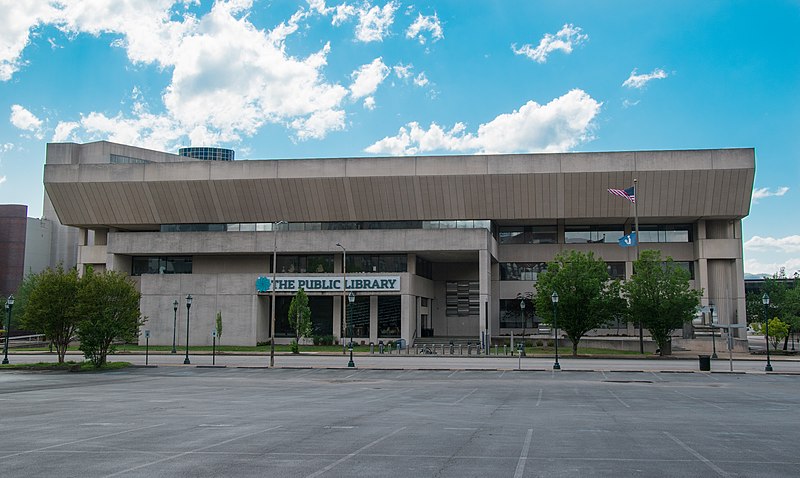
Chattanooga Public Library in 2019, by Ɱ.
The staff has named the resident spirit “Eugene,” though the spirit’s actual identity is unknown. The building itself is only 36 years old, and neither article mentions any deaths associated with the building, though the land upon which it was constructed, does have quite a history. It was on here that the city of Chattanooga was originally settled.
Evidence shows that Native Americans lived in the area for a few thousand years prior to the Historic Era: that period following European expansion into the Americas. It was here that the powerful Cherokee chief, Tsiyu Gansini or Dragging Canoe, settled with his followers in 1777. The chief’s father, Chief Attakullakulla, and other chiefs including Oconostota, made the decision to ally themselves with the Patriot cause following General Griffith Rutherford’s destruction of many Cherokee towns the previous year. Dragging Canoe set up a series of towns around the Tennessee River and Chickamauga Creek, with the settlers uniting under the name Chickamauga.
Later, another influential Cherokee, John Ross, settled in the same area and named this stop on the Tennessee River “Ross’ Landing.” The natives living here were forced on the Trail of Tears during the Removals in the 1830s. The name was changed in 1838 by the US Post Office to Chattanooga.
Where the library now stands, one of Dragging Canoe’s villages as well as being near to the actual site of Ross’ Landing. So, it’s possible that the library spirit may be from this period. Indeed, the investigators did find some evidence of activity, though they did not conclusively pronounce the library as being “haunted.” Still, Eugene continues to roam I can imagine the public library is pretty interesting place to haunt.
Nikwasi Mound Nikwasi Lane Franklin, North Carolina
Throughout the South and across the country, Native Americans have left a legacy, though one that has been obscured. This legacy delves deeply into our geography, language, culture and into the heart of our national identity. Certainly, the geographic legacy is the most evident with places throughout the nation bearing names derived from Native American names or descriptions. While some place names have been translated into English, often the names in their native forms (or a version thereof) have been stripped of their meanings and roots; so to most people it’s just a funny sounding name devoid of meaning.
Besides names, there are some Native American landmarks remaining, though very few. Mostly these are earthworks such as mounds that have survived the elements and the destructive nature of modern man. Franklin, North Carolina has one of these landmarks: the Nikwasi Mound, the former centerpiece for a major town of the same name. The meaning of that name has been lost to history, though the mound remains; now sandwiched between commercial buildings and the business route of busy US 441. When I visited last week, I had to drive past the landmark a few times before even picking it out amongst the urban sprawl.
There is controversy as to who actually constructed the mound. Wikipedia credits the Mississippean culture peoples as having originally constructed the mound around the year 1000 CE. Though, in speaking to local Cherokee, they take credit for it themselves. Members of the Cherokee tribe, who later used the mound up until most of them were removed from the area in the early 19th century, will often describe their origins by saying they have always been here (in the Southern Appalachians). The more academic answer is that their origins are disputed. Some believe that the Cherokee have existed in the area for much of the first millennia, while others believe that the Cherokee arrived as late as the 15th century CE. Despite these arguments, however, the mound is quite ancient.
James Mooney, the late 19th and early 20th century ethnographer who preserved much of the Cherokee’s knowledge, history and legends in his seminal work, History, Myths and Sacred Formulas of the Cherokee states that some believe the mound was built as a townhouse mound to protect the townhouse (which served as a the center of village life) from flooding. According to Mooney, these mounds were constructed by piling earth atop the grave of a prominent chief or priest or possibly the remains of chiefs or priests from each of the seven clans. Along with these burials were included other sacred objects including an eagle feather (the eagle was one of the more sacred creatures to the Cherokee). The earth would be lain over these things and a hollow cedar log placed in the center of the mound to protect the sacred fire that will burn in the townhouse.
The townhouse served as the focal point of village life. Within this seven-sided building (seven being a sacred number to the Cherokee) business was conducted: legal, social, governmental and religious business and it was here that all the members of the village could sit. In the center of the building, under a small hole in the center of the roof acting as a chimney, burned the sacred fire from which all of the fires in the village were kindled. These fires at the hearths of local homes were kept burning throughout the year but were extinguished before the ceremony of the Green Corn. At that time, all the fires were extinguished and hearths swept clean. Embers from the eternal fire in the council house were taken to create new home fires. During this ceremony of renewal all debts and sins were erased and all started anew with a clean slate, so to speak. Mooney states that it is possible that the truly everlasting flames were only found in the larger towns like Nikwasi and nearby Kituhwa (near Bryson City, NC and considered by the Cherokee to be the “center of the earth”).
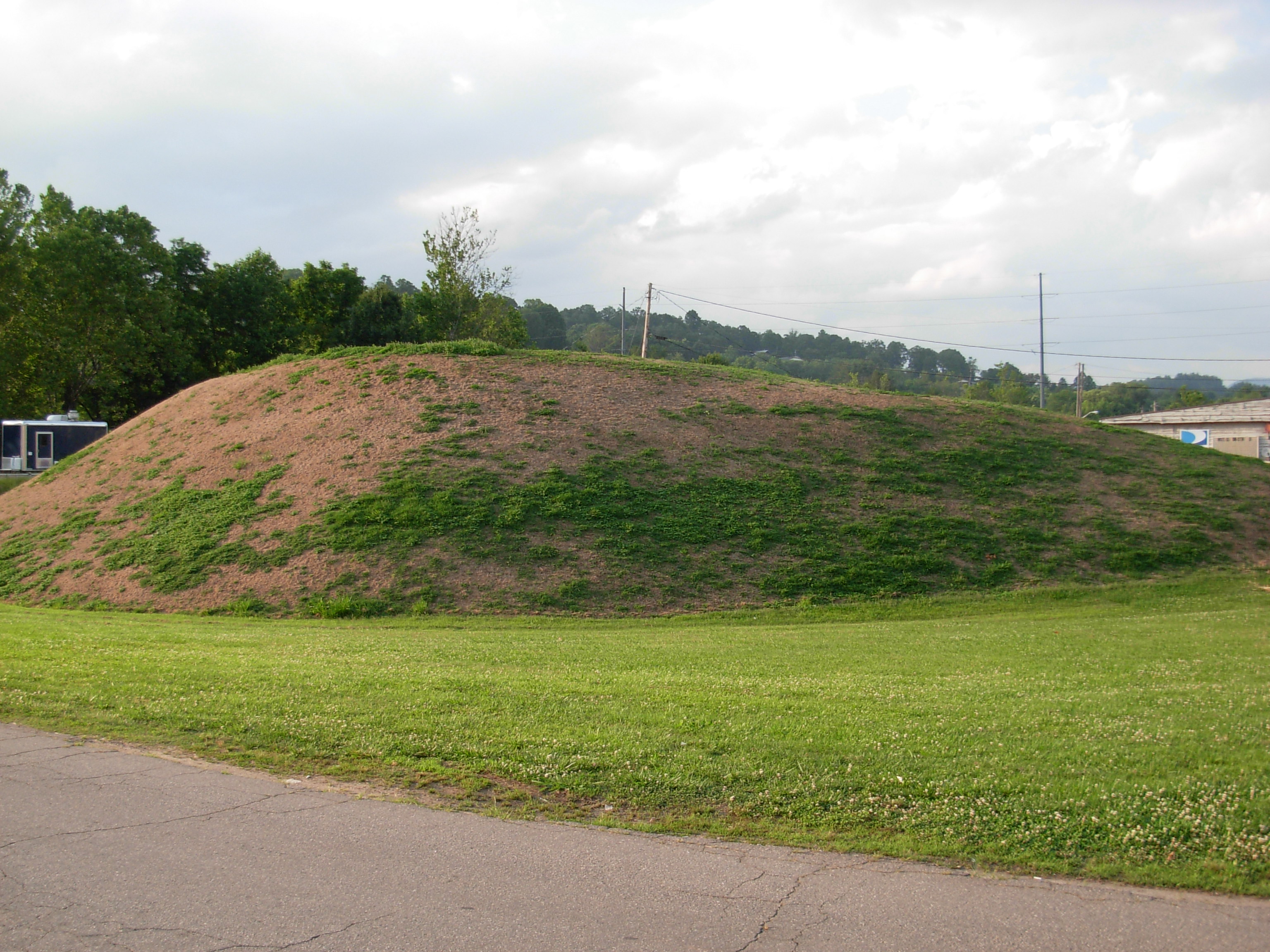
The Nikwasi Mound, 2012, by Lewis Powell IV, all rights reserved.
It was here in 1730 that Sir Alexander Cumming, a Scottish trade envoy, crowned Chief Moytoy of Tellico as “Emperor of the Cherokee.” The town, and likely the townhouse with it, was destroyed in 1761 in hostilities that included the massacre of peace chiefs at Fort Prince George (in the Province of South Carolina) and the siege of Fort Loudon (in what is now Tennessee) all leading up to the expedition of Henry Timberlake (which included Sgt. Thomas Sumter and trader John McCormack) to the Cherokee to sue for peace in 1762. The town was again destroyed during the in 1776 by American General Griffith Rutherford as part of the Chickamauga Wars. Nikwasi was rebuilt but then ceded to the white man in treaties signed in 1817 and 1819. While some Cherokee in the area escaped in the mountains, they were later resettled on the nearby Qualla Boundry.
The city of Franklin was created in 1819, following one of the Cherokee treaties and the Nikwasi Mound remained outside the city as a curiosity. The old mound was part of farmland and in discussion with a local Cherokee historian I was told that a man with a plow and a team of horsemen took a week to plow the mound down in the early 20th century. So much for preserving history!
When the mound was threatened by a developer just after World War II, a prominent local attorney, Gilmer Jones, raised $1500 in pennies from local school children to purchase the mound. The mound was deeded to the Town of Franklin to be preserved for posterity, though the property only consists of the mound and the adjoining properties have been developed commercially. The mound has been sitting quietly under a historical marker until recent years. Or has it?
The mound from a different angle, note the dead grass and the commercial sprawl around it. Photo 2012 by Lewis Powell IV, all rights reserved.
Cherokee legend speaks of the mound as being inhabited by the Nunne’hi, the race of “immortals” whose name translates, according to James Mooney, as “people who live anywhere.” The Nunne’hi (pronounced nun-eh-HEE) are similar to the Yunwi Tsunsdi, or the “Little People,” in that they are also spiritual defenders of the Cherokee, though the Little People are small as their name indicates while the Nunne’hi appear as regular humans when they wish to be seen. The Nikwasi mound is believed to be one of their homes. This became known many moons ago during a pitched battle when the Cherokee found themselves losing against a fierce enemy. This invader had fought their way through many villages and was now moving into the mountains. As their numbers waned in the heat of battle, the Cherokee defending Nikwasi had begun to fall back. I’ll allow Mooney to take it from here:
…suddenly a stranger stood among them and shouted to the chief to call off his men and he himself would drive back the enemy. From the dress and language of the stranger the Nikwasi people thought him a chief who had come with reinforcements from the Overhill settlements in Tennessee. They fell back along the trail, and as they came near the townhouse they saw a great company of warriors coming out from the side of the mound as through as open doorway. Then they knew that their friends were the Nunne’hi, the Immortals, although no one had ever heard before that they lived under Nikwasi mound.
The Nunne’hi poured out by hundreds, armed and painted for the fight, and the most curious thing about it all was that they became invisible as soon as they were fairly outside of the settlements, so that although the enemy saw the glancing arrow or the rushing tomahawk, and felt the stroke, he could not see who sent it.
The invaders were sent fleeing with the Nunne’hi in full pursuit. When the attackers attempted to take cover behind rocks and trees, the arrows followed and found their targets. Only half a dozen were left to return to their villages with the awful news of their comrades’ deaths. These survivors sat down some distance from the battlefield and cried. As they wept, the Nunne’hi chief approached and explained that they deserved this terrible defeat for attacking a peaceful tribe. The attackers fled and the Nunne’hi returned to their mound unscathed.
Legend holds that the Nunne’hi may have also appeared during the Civil War when a contingent of Federal troops were supposed to make a surprise raid against the town of Franklin. The town was supposed to be guarded by only a small force of Confederate troops. When the Federals arrived, they spied a large group of defenders and did not attack. Perhaps the Nunne’hi had taken to wearing butternut grey?
While the Nunne’hi are rarely visible, they are heard quite often. As they are fond of drumming and dancing, their music and merrymaking is sometimes heard near their townhouses. Though when the curious attempt to trace the source of the sounds, the sound travels. At least one source states that these sounds sometimes issue from the mounds, but I can find no specific reports of these sounds. Such sounds, however, are heard throughout Cherokee country. In conversation with a Cherokee friend, I was told that one of the Nunne’hi townhouses may be located on one of the mountains that forms the Oconaluftee River valley in downtown Cherokee, NC. He stated that people often heard the sounds of a party from this mountain which is opposite the mountain where the Mountainside Theatre is located. Incidentally, I have personally heard the sounds of a party coming from that direction while sitting at the Mountainside Theatre late at night. My friend went on to state that the sounds are rarely heard any longer as the sounds of modern life now drown them out.
Just today I spoke with some friends who had been swimming last night along the Oconaluftee River just north of Cherokee. They reported that they had heard the sounds of drumming and laughter nearby, but were unable to trace the source. They presumed that it was the Yunwi Tsunsdi and left them alone. Both spirit races are known for their music and merrymaking, though I wonder if the music they heard was issuing from an unknown Nunne’hi townhouse.
Nikwasi mound still stands, only a fraction of what it once was and now denuded of grass. Recently, the town of Franklin sprayed herbicide on the mound angering the Eastern Band of Cherokee and raising questions as to how to better care for this precious landmark. While the anger lingers, there is renewed hope that a good preservation solution can be put into place that will preserve this sacred place. If you happen by the mound late at night, roll down your windows and perhaps, over the noise of modern life, you’ll hear the ancient ruckus of a Nunne’hi party.
Sources
Cherokee. Wikipedia, the Free Encyclopedia. Accessed 17 June 2012.
Dalrymple, Maria. “Nikwasi Mound deed could be transferred to create park.” Macon County News. 3 September 2009.
McKie, Scott. “Herbicide put on Nikwasi mound.” Cherokee One Feather. 9 May 2012.
Mooney, James. History, Myths and Sacred Formulas of the Cherokees. Asheville, NC: Bright Mountain Books, 1992.
Moytoy of Tellico. Wikipedia, the Free Encyclopedia. Accessed 17 June 2012.
Nikwasi. Wikipedia, the Free Encyclopedia. Accessed 14 June 2012.
Pruett, Kimberly. “Nikwasi Mound debate continues.” Macon County News. 30 June 2011.
Haunted theatres figure into two newsworthy haunts this evening.
Valrico, Florida’s JAMES McCABE THEATRE (506 5th Street) has recently been the scene of a fund-raising investigation by two paranormal groups, Fire and Ice Investigations and Plant City Paranormal. With the recent recession and many arts groups and historic sites hurting for funds many have tried using their ghosts to help raise money. In conjunction with local paranormal organizations, they will put on ghost hunts where participants can pay a fee for ghost tours and helping with a paranormal investigation. This is what this historic theatre has done while raising money to restore and renovate this more than century old building.
Built in 1915 as the Valrico Civic Center, the building served as the home to a woman’s club later. The building was repossessed in the late 1970s and The Village Players, a community theatre group, was allowed to use the structure. The building was deeded to the theatre in 1994. Over the years, local thespians have noticed odd occurrences in the building including many odd noises and the occasional apparition. The June 16th investigation uncovered a few interesting pieces of evidence including some EVPs
Sources
About. James McCabe Theatre. Accessed 24 June 2012.
The second theatre in the headlines is the RICE THEATRE (323 North Parkerson Avenue) in downtown Crowley, Louisiana. This location is one of two being investigated by Louisiana Spirits Paranormal Investigations though, according to the article, neither location has a reputation of being haunted. The theatre was built by The Southern Amusement Company in 1940, but its opening was delayed by damage done by a hurricane. It opened in 1941 with the film This Thing Called Love. Sold to the City of Crowley in 1986, the building now serves as the Rice City Civic Center.
The Rice Theatre in downtown Crowley. Photo 2003 by Falcanary, courtesy of Wikipedia.
Also up for being investigated is CROWLEY CITY HALL (425 North Parkerson Avenue) just down the street. There are, however, a few tales of ghosts from city employees. A freight elevator has been known to function on its own accord, something that, according to a city hall staffer, is impossible. Another employee has seen shadow figures and heard voices. This 1920 structure was not built as a government building but as a car dealership and later served as a recording studio before becoming city hall.
For those regular readers of this blog, my apologies for not having updated sooner. As I revealed in the last post, I’m working in Cherokee, NC and I’m still settling in. Finding time to write has been increasingly difficult, though I’ve uncovered a good deal of material and will be writing about those things soon. Please stay tuned!
The Corners Bed & Breakfast Inn 601 Klein Street Vicksburg, Mississippi
According to Alan Brown’s 2010 Haunted Vicksburg, there doesn’t appear to be much going on at The Corners Bed & Breakfast Inn. His entry on this home includes only a single sighting of a woman in Victorian clothing seen by a couple staying there. Returning from a day of sightseeing, the couple had this oddly dressed woman walking ahead of them. When she reached the back door, she vanished through the closed door.
It is the lack of information on the haunting there that makes this recent article from the Jackson, Mississippi Clarion-Ledger so interesting. It covers a recent investigation by Smoke & Mirrors Paranormal and includes a few of the odd things that occurred during the investigation. Among the evidence captured by the group are EVPs and a video of an odd orb. One of the more interesting, though possibly one of the more easily debunked, pieces of evidence is a clock radio in a room cutting on at exactly midnight and playing Diana Ross and Supremes’ hit, “Ain’t No Mountain High Enough.”
The house has a fascinating history that is compounded by its association with Cedar Grove Mansion which is located just around the corner. The Corners, listed on the National Register of Historic Places as the Isaac Bonham House, was built in 1873 by John Alexander Klein who had built Cedar Grove. The house was built for Klein’s daughter and her husband and the home’s architecture reflects its status as a wedding gift. Hearts, rings, diamonds and shamrocks are woven into the design of the pierced columns that line the front porch. Though, these symbols of marital bliss do not reflect the sad events that took place. Isaac and Susan Klein Bonham had two sons who died of malaria at an early age. Isaac was killed when he tried to break up a bar brawl between friends. Unable to live in a house with so many memories, Susan moved into Cedar Grove following her father’s death.
By all accounts, the house should be haunted and this investigation will add a new layer of evidence. Perhaps, this will help to prove that ain’t no river wide enough will keep the spirits away.
I’m starting a new regular segment where I’ll briefly highlight hauntings or haunted places in the news and in some of the regular blogs I read.
The NIKAWSI MOUND (Nikwasi Lane), an ancient Native American mound in Franklin, North Carolina, is still stirring up controversy a few thousand years after it was built. The City of Franklin, which owns the mound that is still considered sacred to the local Cherokee people, recently sprayed herbicide on the mound. The herbicide was sprayed because mowing of the mound has lead to some deterioration of it. Local Cherokee, however, are not pleased with the actions, have expressed their opinions and demanded an apology from the city.
The mound’s builders are not known, but scholars believe that it was built by one of the early Mississippean peoples. The Cherokee utilized the site and it became part of Cherokee mythology as one of the locations where the Nunne’hi lived. This was a mythical race of beings that lived underground. Nineteenth century anthropologist James Mooney recorded a story that during a battle near the site, the Nunne’hi emerged to defeat the Cherokee’s enemy. Roger Manley records in Weird Carolinas that the Nunne’hi may have also guarded the town during the Civil War when a contingent of Federal troops attempted to the seize the Confederate stronghold. The Federal troops retreated when they saw a huge number of troops when in actuality there were only a few Confederates guarding the town. Manley also notes that some claim to hear drumbeats within the mound.
The mound is listed on the National Register of Historic Places, but there has been controversy about its preservation. Some have considered creating a park, but there is contention as to who will pay for it and control it. Hopefully, the herbicide will not adversely affect this place where the heartbeats and drumbeats of Native America may still be heard.
Sources
Dalrymple, Maria. “Nikwasi Mound deed could be transferred to create park.” Macon County News. 3 September 2009.
McKie, Scott. “Chief: Tribe wants apology on Nikwasi Mound issue.” Cherokee One Feather. 21 May 2012.
Mooney, James. History, Myths, and Sacred Formulas of the Cherokees. Asheville, NC: Bright Mountain Books, 1992.
Nikwasi. Wikipedia, the Free Encyclopedia. Accessed 21 May 2012.
In Chesterfield, Virginia, the Chesterfield Historical Society has announced that they will be hosting ghost tours of MAGNOLIA GRANGE (10020 Ironbridge Road). The magnificent Federal plantation, one among the many famous James River Plantations, was constructed in 1821 and named for the circle of magnolia trees that once, with formal boxwoods, constituted its formal gardens. These gardens were destroyed after the Civil War.
Magnolia Grange, 2012, by James Shelton32. Courtesy of Wikipedia.
The home is now owned by the county and administered by historical society. The ghost tours are being conducted by Spirited History, a local paranormal group that is working to help local historical sites with funding by investigating and educating the public about the sites’ paranormal history. Among the activity that has been reported in the house is the appearance of a beautiful, blond woman seen standing on the steps. A photographer taking wedding pictures in the house some years ago encountered her and mentioned the woman he had seen in period clothing to the staff. The staff informed him that no one was working in period clothing. Investigations of the house have also yielded a number of EVPs.
Sources
Gregory, Donna C. “The past lives on at Magnolia Grange.” The Chesterfield Observer. 26 October 2011.
“Historical Society to host ‘Spirited History’ at Magnolia Grange May 19.” Midlothian Exchange. 17 May 2012.
National Park Service. “Magnolia Grange” James River Plantations. Accessed 21 May 2009.
Virginia Historic Landmarks Commission Staff. National Register of Historic Places nomination form for Magnolia Grange. November 1979.
Over at the “eco-gossip” blog, Ecorazzi, two locations in the South have been featured in a list of the top 10 “naturally haunted” places in the world. While I give little credence to such lists (so many of them are just silly, unsubstantiated fluff), I was excited to see these two places in the list.
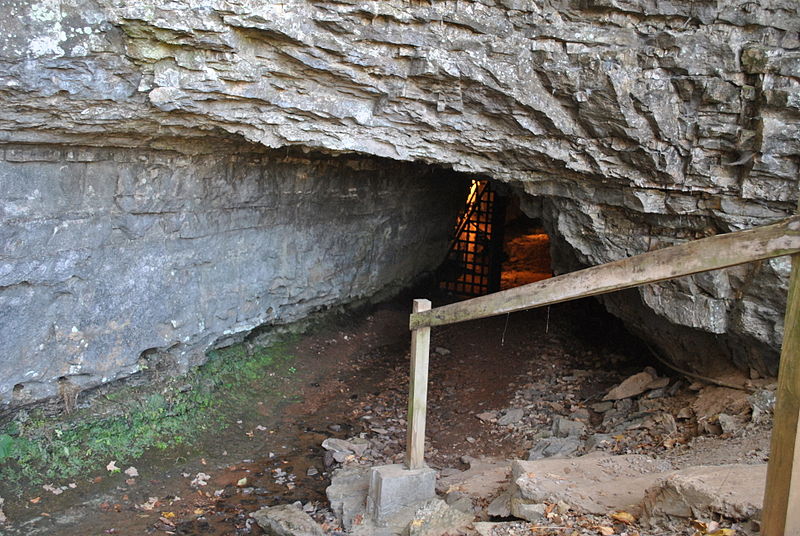
Inside the Bell Witch Cave, 2010, by Www78. Courtesy of Wikipedia.
Adams, Tennessee’s BELL WITCH CAVE (430 Keysburg Road) is probably the most well-known of the two locations. Located on property once owned by the Bell family, the cave is believed to be the current residence of the famous Bell Witch who terrorized the Bell family in the early 19th century. Of the spirits in the American South, this spirits is perhaps the most well-known and certainly one of the most publicized spirits having a number of books written solely on the subject as well as a recent feature film, An American Haunting. Visitors to the cave have had a variety of experiences in and around it. The cave is privately owned and tours are given.
On the western shores of Louisiana’s Lake Pontchartrain, near New Orleans is MANCHAC SWAMP, home to ghosts and the French Creole werewolf, the Loup-Garou. It was here that a number of small towns were wiped off the map in the New Orleans Hurricane of 1915. Tours now travel through this haunted wetland at night by torchlight scaring up alligators and the spirits of the victims of the hurricane.
Patriot’s Point 40 Patriot’s Point Road Mount Pleasant, South Carolina
I never quite felt comfortable aboard the USS Yorktown. I’m not a small guy and my height (6’2”) required that I ducked my head quite a bit as I moved through the passages of the ship and the camera bag hanging around my neck did not facilitate easy movement either. But there was also a feeling of never being alone on this fighting lady as well. There was a constant stream of visitors through the ship, but at moments when I found myself alone, I felt uncomfortable.
This is evidently not an uncommon experience aboard the ship. Last Wednesday evening as I was heading towards Charleston, a new episode of Ghost Hunters was airing revealing their extraordinary investigation of the ship. Having only read about the episode, I’ll refrain from commenting further on it. Before hearing of their investigation, I’d only read a bit about ghosts aboard the ship and had not pursued any other information.
The USS Yorktown in service sometime in the early 1960s. Photo by the US Navy, courtesy of Wikipedia.
According to a Charleston Post & Courier article about the investigation, this show was really used as a platform for revealing the ship’s hauntings to the paranormal world. There seem to have been many staff and visitors to the ship who have had a variety of experiences. Primarily, these experiences tend to be aural: including voices and footsteps. But there are also reports of shadow figures and full bodied apparitions.
The ship was laid down on December 1, 1941, just days before the bombing of Pearl Harbor. She was named for the USS Yorktown which was lost in the Battle of Midway in 1942. She entered service in 1943 and served admirably in the Pacific throughout the remainder of World War II. Following the war she patrolled the West Coast and served in the Vietnam War. She was retired in 1973 before being donated to Patriot’s Point.
Approach to the ship at Patriot’s Point. Photo 2012, by Lewis Powell IV, all rights reserved.
Part of the engine room. One of the docents mentioned that this is where a mechanic was scalded to death by steam. Photo 2012, by Lewis Powell IV, all rights reserved.One of the bunk rooms. Photo 2012, by Lewis Powell IV, all rights reserved.One of the labyrinthine passages running throughout the ship. Photo 2012, by Lewis Powell IV, all rights reserved.
The “island” rises above the deck. Photo 2012, by Lewis Powell IV, all rights reserved.
The ship’s bridge. Photo 2012, by Lewis Powell IV, all rights reserved.
Sources
USS Yorktown(CV-10). Wikipedia, the Free Encyclopedia. Accessed 10 May 2012.
Warren L. “SyFy’s ‘Ghost Hunters’ explore paranormal side of Yorktown.” Charleston Post & Courier. 2 May 2012.
Maco Light Seen near the old Atlantic Coast Line Railroad Tracks Maco, North Carolina
N. B. This entry was revised 6 January 2024.
A Haunted Southern Book of Days–4 January
This article is a part of an occasional blog series highlighting Southern hauntings or high strangeness associated with specific days. For a complete listing, see “A Haunted Southern Book of Days.”
The influence of the Southern folklore extends tremendously beyond the South as evidenced by Bekah Brunstetter’s play Take Her to See the Maco Lights that premiered in Chicago in 2012. According to the notice on Broadwayworld.com, the play “follows a pair of young lovers along a dark railroad track where the past and future converge. [… the story] weaves a ghostly love story with characters who are on a crash course to a certain stretch of overgrown railroad tracks in North Carolina.” Indeed, a special May 17th performance was preceded by a local walking tour hosted by paranormal researcher and writer Ursula Bielski, whose haunted Chicago books I would highly recommend.
The play’s climax occurs on at a legendary spot just outside the small community of Maco in Brunswick County, North Carolina. For more than a century and a half, the railroad tracks attracted the curious to see the famous Maco Light. Legend holds that on the evening of 4 January 1867 a train passing on the then Wilmington and Manchester line near Maco Station had its caboose come uncoupled. The caboose had a lone crewman, Joe Baldwin, asleep inside. When the car slowed down and stopped, he was awakened. Shortly, he was horrified to hear an approaching train and fearing calamity, he grabbed a lantern and stood on the back of the caboose swinging it wildly to alert the oncoming locomotive. That train did not slow down and plowed into the caboose crushing and decapitating the unfortunate crewman. His body was recovered, though his head was not found.
An 1890 engraving of a brakeman at work. Joe Baldwin was likely a brakeman.
According to some sources, strange lights were first seen in the area just days after the accident. They were a popular attraction for locals and gained some fame from a presidential sighting in 1889. Grover Cleveland told his story in Washington after seeing the lights from his presidential Pullman car. Tony Reevy recounts in his Ghost Train! American Railroad Ghost Legends what most viewers witnessed:
Viewers who saw the light always reported the same thing: the light flared up way down the track, crept towards the observer, then speeded up and began swinging side-to-side. Finally, the light stopped abruptly, hovered for a minute, retreated back to where it started from and vanished. The light always appeared three feet above the left rail, facing east. It was sometimes so distinct that you could see the metal guards of a railroad hand lantern. The light didn’t appear every night. It seemed to appear randomly according to old Joe’s whims.
The tracks were a part of the Wilmington and Manchester Railroad which was acquired not long after the accident by the Atlantic Coast Line Railroad. The line later became the Seaboard Coast Line. Later mergers added the line to the thousands of miles of rail owned by CSX which took up these tracks in 1977. Sightings of the light reportedly ceased around that time.
But have they? A North Carolina paranormal investigation group, NC HAGS (North Carolina Haints, Apparitions, Ghosts and Spirits) investigated the area in 2007. Following up on recent reports of people seeing the light, the group investigated and captured an odd image. While most photographs taken that evening turned out quite dark with little to be seen, one photograph taken just after an investigator asked Joe Baldwin to appear shows a series of lights that seem to resemble the silhouette of a man. Is Joe Baldwin still stalking the site of the old Maco tracks? At least for now you may have to either venture out to the bug-ridden coastal piney woods of North Carolina or you may sit in an air-conditioned theatre in Chicago to answer that question.