N.B. This article has been revised and edited 18 May 2019.
It’s not hard to imagine that investigating in pitch black darkness could be both terrifying and exhilarating. Ghost hunters are accustomed to stumbling about in dark spaces, but usually there is some dim light even if just from the moon or street lights outside. Within a cave there is no ambient light, and the inky darkness envelops you.
In an article from WHSV, the ABC affiliate out of Harrisonburg, Virginia in the Shenandoah Valley, the founder of the Twisted Paranormal Society of Virginia talks about the adrenaline rush that he gets from investigating the shadier side of things. In his investigation report he says, “Once the interior lights were turned off, [Grand Caverns] took on a whole new appearance.”
According to the history on its website, Grand Caverns is the oldest continually operating show cave in the nation. Show caves are those caverns that have been opened—exploited some say—for tourists and commercial use.
Like so many caves, Grand Caverns was discovered when someone simply stumbled on it, in this case a hunter retrieving traps. Bernard Weyer discovered the cave in 1804, and within two years tours were being led through it. In the early days, standing in the thick darkness tourists imagined ghosts, demons and all those denizens of the underworld were just at their heels. The weird formations were transformed into manifestations of nightmares and named accordingly: Dante’s Inferno and George Washington’s Ghost among them. At Dante’s Inferno especially—a hole-like formation with rock that seemingly melts towards the mouth of Hell—tourists were warned of evil spirits there that would extinguish candles or torches: the only sources of light here.
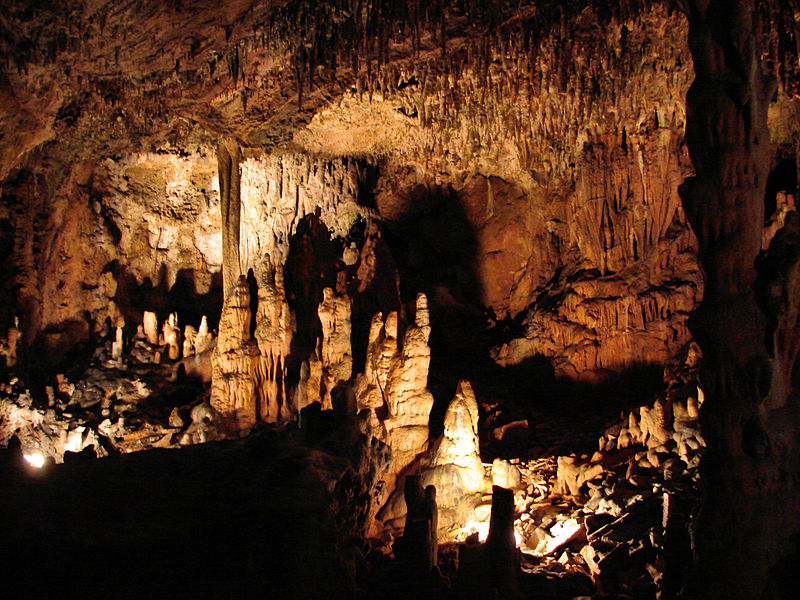
Formations within Grand Caverns. Photo 2010 by P199. Courtesy of Wikipedia.
Other areas inspired awe or whimsy. In one large room, grand balls were held, while the sacred space of The Chapel was actually used on occasion for religious services. These things brought the curious to visit these caverns for just over two centuries. When the Virginia countryside was overrun with battling armies during the Civil War, soldiers visited, easing their minds of the weariness of war.
The identities of the spirits within Grand Caverns are unknown. While the articles relating to the haunting point to the military visitors to the cave during the Civil War, it appears that the soldiers simply visited and none died or were killed within the cave. Twisted Paranormal’s investigation did produce some results that may indicate the presence of spirits here, though their investigation was only 3 hours long. The group presents some of the evidence they captured on their website including some photographs with orbs and video of EMF detectors being set off with no one around. Unexplained flashing lights were also encountered.
Sources
Adams, Cindy. “Strange activity found in Grottoes Grand Caverns by paranormal investigators.” Examiner.com. 26 June 2012.
Old Richardsville Road Bridge Richardsville Road at the Barren River Bowling Green, Kentucky
N.B. This article was edited and revised 3 February 2019.
Bridges are the centerpieces of numerous ghost stories. They can be symbols of the transition between life and death. Perhaps that’s what also attracts ghosts. In a distant memory, I recall something about folklore stating that ghosts cannot cross water; that would certainly cause problems for many bridge-dwelling spirits, though it does nothing to prevent many bridges from being haunted.
The Old Richardsville Road Bridge is certainly something out of a different time. In proper bridge parlance it is a “three span bowstring arch truss bridge.” The span is a segment of the bridge supported on both sides by piers. Bowstring arch truss refers to the graceful curved iron arches–resembling a bow primed to shoot an arrow–that support each span. Located on both sides of the road, these graceful arches are also supported by another, squarish truss on each span. The deck is wooden and a single lane, which does present some issues for modern automobiles. Aesthetically, the bridge is an elegant marriage of form and function.
Old Richardsville Road Bridge, 2014, by Nyttend. Courtesy of Wikipedia.
While the bridge may be somewhat unusual in its architecture, its legend is a version of the far more common Crybaby Bridge Legend. At some point in the bridge’s early history a young, unmarried woman found herself pregnant. Unable to face the shame and scorn that society heaped upon innocents gone astray like herself, she leapt from the bridge to drown in the waters below. Other versions of the story include the woman jumping as she fled an attack, or driving off the bridge either accidentally or purposefully. The legend continues that if one drives onto the bridge, puts the car in neutral and turns it off, the car will be pushed towards the opposite end. I have covered this folkloric archetype in my article on the Kayo Road Bridge in Hartselle, Alabama.
A 2011 article in the Bowling Green Daily News by Jack Montgomery recounts his informal investigation of the bridge legend. Montgomery and his companions tried to get their car pushed across the bridge, but to no avail. He then walked the bridge with a pair of dowsing rods. The rods did respond in three specific areas of the bridge. Other than that, he left with no other evidence of a haunting. Though, Montgomery did note that the wires on the bridge may produce high EMFs which may affect some who are sensitive. In addition, he noticed the creaks and groans of the old bridge which may give the impression of human cries or screams.
A more formal investigation of the bridge was conducted by Kindred Realm Investigations on three days in September of the same year. The first investigation produced no odd results. The second evening produced a single photograph with a possible orb. The third evening produced a few interesting results. The group finally had their vehicle, a large SUV, pulled along the bridge. A short time later, one of the group’s recorders picked up the sounds of singing or humming, as well as conversation and laughter from a female.
The bridge, built in 1889 by the King Bridge Company of Cleveland, Ohio, has held up for more than a century, though in recent decades, the bridge has begun to show its age. While the iron has remained in excellent condition, the stone piers and the stone entrances to the bridge as well as the wooden decking have deteriorated. However, the bridge has found a savior in the form of local resident David Garvin. Having been born and raised nearby, Garvin has “adopted” the bridge and financed repairs and restorative work with his own money. If only every endangered historic site could find such a savior!
Sources
Bernson, Barry. “Bernson’s Corner: The Caretaker of the Old Richardsville Bridge.” Fox41 News. 10 May 2010.
B & D Burgers 209 West Congress Street Savannah, Georgia
N.B. This article was edited and revised 15 September 2019.
In a city like Savannah with so much of the original built environment still intact, it can be expected that much of the spiritual realm will be intact as well. Even in places whose histories are not marked with tragic events, there still may be residual energy left from the many souls using these places over decades and centuries. Apparently, this may be the case of B&D Burgers, a gourmet burger joint.
According to two recent stories from Savannah ABC affiliate, WJCL, the B&D Burgers location on West Congress Street, well inside the large Savannah Historic District, may have some spirits lingering about it premises. The Savannah Historic District is a National Historic Landmark District, a recognition afforded to only around 2,500 sites in the nation, and even fewer historic districts.
B & D Burgers, 2017, by Michael Rivera. Courtesy of Wikipedia.
The plain, mid-19th century commercial building located on Congress Street looks out onto Ellis Square, one of the original squares laid out by General James Oglethorpe—the founder of Savannah and the Colony of Georgia—in 1733. The square and the market building within it were demolished in the mid-20th century and replaced by a not so glorious parking garage.
Spurred by this sad fate, locals began to band together to preserve the history that was being demolished around them. When the lease on the parking garage expired almost 50 years later, the city did not renew it and took over the square again with plans to renew the streetscape. The garage was demolished and replaced with underground parking while the square was recreated and reopened in 2010. All this has been witnessed by the little brick building on Congress Street.
For some time, the employees of the burger joint have thought the building to be haunted. One manager reported having had his name called when no one was present. Others have felt uncomfortable in the building’s basement. All of these things are classic signs of a haunting, but it wasn’t until surveillance video revealed some odd occurrences that a paranormal team was called in to investigate.
One video shows an odd light moving around the busy bar area and then seeming to hover. Another video shows a stack of plastic glass pallets toppling over on their own accord. Granted, these odd videos themselves do not preclude the presence of paranormal activity, though when combined with reports from the restaurant’s staff, paranormal activity becomes quite a bit more evident.
Paranormal investigators from 3D Ghost Hunters, did pick up on some spiritual energy within the building. Accompanied by a local psychic, the preliminary investigation of the building produced some high EMF readings and personal experiences for the investigators. A woman’s perfume was smelled, though none of those present were wearing any. Interestingly, when a brothel was mentioned, the odor of perfume got stronger. All of this evidence, coupled with the video and employee experiences appear to be enough to bring the investigators back for a full investigation.
WJCL included the surveillance videos on their website, but they do not appear to be working.
Sources
Colwell, Josh. “B&D Burgers Ghost Hunt.” WJCL. 1 May 2013.
Colwell, Josh. “Ghost Busters Anyone?” WJCL. 30 April 2013.
U. S. Post Office
729 4th Avenue West Point, Georgia
Neither snow nor rain nor heat nor gloom of night stays these couriers from the swift completion of their appointed rounds. –Inscription on the façade of the James Farley Post Office, New York City, from the Histories of Herodatus.
Apparently, this inscription which is often considered the unofficial motto of the United States Postal Service should also include death. It seems that something is still at work within this old post office; something still carrying on its appointed rounds perhaps?
I was first introduced to the West Point Post Office’s haunted state when I took the local Ghost Walk that’s held around Halloween each year (see my review here). The post office was included on the tour, though I was skeptical of the legend which involved a young girl in a bloody dress being seen outside the building. To me, it just seemed like local tripe. That is, until I received an email a couple of weeks ago.
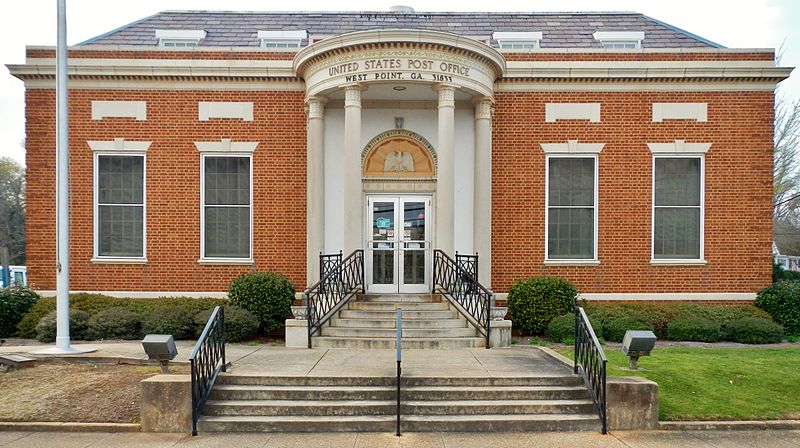
West Point Post Office, 2012, by Rivers Langley. Courtesy of Wikipedia.
Robin Jarrell, who has worked at this post office branch since 1996, wanted me to know about the ghost there; something far more believable than a girl in a bloody dress. They call him Joe, though his exact identity remains a mystery, and he tends to ramble about the building mystifying the employees. Robin invited me to visit, tour the building and hear their stories.
Built in 1932, the old building is quite intriguing. The main floor includes the post office and all of its functions. With the exception of a few modern additions, the lobby appears to be mostly original with banks of old post office boxes, marble flooring and original streamlined Art Deco-styled light fixtures. The post office’s main workspace occupies the remainder of that floor. The old, creaking wooden floor underscores the old techniques still employed to sort the mail here. No robots or complicated sorting mechanisms here, just the tried and true hand sorting that I imagine is still employed in small post offices throughout the nation. Above, a modern acoustical tile drop ceiling hides the catwalk that once existed above the floor from which employees were monitored to keep them honest.
From the lobby, a marble staircase leads to a series of rental offices upstairs. Again—in this now mostly empty series of rooms—the building really shows its age. This is also the domain of the ghost. According to Robin, footsteps are heard issuing from up here sometimes accompanied by the slam of a door. The employees downstairs often hear this but simply return to work with the chill of knowing that no one is up there.
Arthur, a postal contractor, is the one person who probably uses this floor more than anyone. His schedule driving the mail requires downtime and he uses one of the old offices to relax. Commonly, he’ll hear footsteps out in the hall or in other offices and he’ll hear things being shuffled through. The old doors of these offices are fitted with opaque window panes and heavy brass knobs that really provide the weight of age. It was through the window of the restroom that he actually saw something. He’d heard footsteps and looking up from the toilet he saw something pass by the door. The window’s opacity blocked out any details.
It is Arthur’s polite, but no-nonsense demeanor that is in sharp relief to his very odd experiences in his garret room in the post office. In the small, cluttered room with a desk, computer and air mattress, he’s had the computers turn themselves on. At times, he’s heard footsteps on the roof as well, though getting up there appears to be a bit of a challenge. He has also had some moments where he has been awakened to the feeling of being smothered.
The issue of sleep paralysis has been frightening people for millennia. In centuries past, the blame for these has been placed squarely on the spirit world and even more specifically on creatures called incubi and succubae. The male form—the incubus, from the Latin incubo, “to lie upon— was believed to attack females and to sometimes impregnate them. The female form, the succubus—from the Latin succuba, “to lie under”— was believed to attack the male in his sleep. Both entities were supposed, over time, to slowly drain the life from the sleepers. Shakespeare includes a description of an incubus in Act I of Romeo and Juliet with Mercutio chiding Romeo, “This is the hag where maids lie on their backs, That presses them and learns them first to bear, Making them women of good carriage. This is she—“
He is interrupted by Romeo who responds, “Peace, peace, Mercutio, peace! Thou talkest of nothing.” Indeed, Romeo now has the weight of science behind his exclamation.
As science has explored and begun to understand “O gentle sleep!—Nature’s soft nurse,” (Shakespeare’s Henry VI, Part II) it has come to understand that sleep paralysis—a much gentler name than evil entities with Latinate names—is a common occurrence. An experience with such may only indicate an uneasy transition between stages of sleep. Though the experience may be terrifying it is not dangerous.
When people experience sleep paralysis in a paranormally active location, though, the black-and-white of science then meets the grey void of tradition and folklore. Could these instances actually be caused by spirit activity in these cases? Since I have begun interviewing witnesses to paranormal activity over the last few years, this is one of a few cases I’ve been privy to involving sleep paralysis in a possibly haunted location.
The first case happened at Unto These Hills Cast Housing in Cherokee, North Carolina. My friend, Philenia, was napping in the new dormitory building. The building occupies the footprint of the old girls dorm and while it is surrounded by buildings with fairly high amounts of paranormal activity, the new building—as well as the old one—had few occurrences. Philenia had been napping awhile when she awoke to the feeling of something climbing on her chest. She said she felt a hand over her mouth and could not move or breathe. When it finally released her, she jumped up upset and terrified.
While Arthur’s experience was not as dramatic as Philenia’s there’s still the question of cause left hanging. There are other cases of people being awakened by possibly paranormal activity. A cousin of mine grew up in an antebellum home in Newnan, Georgia. During the Civil War, Newnan was, like many Southern towns along the railroad, pressed into hospital service. Churches, government buildings and private homes quickly filled with the wounded and sick, my cousin’s home included. She spoke of being awakened to the feeling of something holding her feet down. She continued,
I could feel the pressure of hands. I assumed it was my mom. But when I looked down at the foot of the bed, I saw a small woman with a bun wearing a long, grayish blue dress that came all the way to the ground. It was a weird sensation because I could see her, but I couldn’t make out details. What remains with me more than the brief image I saw was the feeling she gave me. It was extremely peaceful and sweet and real. It was nothing like I had ever felt before that day or since.
When my cousin married and moved into a home with her husband, she began to experience a far less positive haunting. “I had a lot of experiences where I would wake up in the morning (sometimes at night) and feel paralyzed. I was completely aware but unable to speak or move. That was not pleasant at all.” This was in addition to other activity, some of which centered on her young daughter. While this was going on she took a photograph of her youngest daughter in which a grayish hand appears reaching towards the child. She no longer lives in the house and has experienced nothing in her new home.
As for Arthur, he pointed out a lounge chair on the other side of the room and said he’d slept in that chair several times without incident. The only times he’d been awakened were while sleeping on the air mattress. He noted that he would sometimes leave a radio on upstairs to hopefully placate the spirit or at least keep it at bay. He removed the radio and the activity has returned. “I don’t think I’ve slept since I took the radio out.” He remarked. I made the suggestion that he try sleeping in the lounge again or that perhaps he move the air mattress.
As I toured the building from attic to basement, I didn’t really feel anything energy-wise that was off. I was guided up to the old attic entrance to the catwalks. The narrow, closet-like space felt quite different, though. As attics are wont to be, this one was hot and stuffy, though the atmosphere was charged with energy. It was almost like being surrounded by hot breath. While I’m not really sensitive, I do sometimes pick up on strong energy and what I felt was a feeling I’ve felt in only a few other situations. Needless to say, I didn’t stick around in the attic very long.
While the spirit or spirit may occasionally upset or mystify the employees at the post office, it’s not thought of as dangerous. Robin remarked, “We take it as a good spirit.” She thinks that the spirit is “looking for something or he needs something fulfilled.” Or perhaps he’s just going about his “appointed rounds.”
I’d like to thank Robin Jarrell and Arthur for extending me such hospitality on my visit and for sharing their experiences. I’m also grateful to my cousin and Philenia for sharing their experiences as well.
Sources
Conversation with Bonne B. 23 April 2013.
Interview with Arthur C. at the West Point Post Office, West Point, Georgia. 19 April 2013.
Interview with Philenia W. at the Cherokee Historical Association, Cherokee, North Carolina. 21 September 2012.
Interview with Robin Jarrell at the West Poing Post Office, West Point, Georgia, 19 April 2013.
Johnson, Forrest Clark and Glenda Major. Treasures of Troup County: A Pictorial History. LaGrange, GA: Troup County Historical Society, 1994.
West Point Depot Visitors Center and Museum. Ghost Walk. 15 October 2010.
Actors Theatre of Louisville 316 West Main Street Louisville
The two buildings at this address are at the heart of modern American Theatre. The theatre company here, the Actors Theatre of Louisville, has striven to become one of the premier theatre companies in the nation and they have succeeded. From humble beginnings in a former tea-room, the company moved to an old train station which was renovated to house a 350-seat theatre. At that time, Jon Jory, son of Hollywood actor Victor Jory, joined the company as an artistic director. He expanded the horizons of the company and oversaw their move to this current space after the train station was demolished in 1972.
With the company, Jory envisioned and created the Humana Festival of New American Plays, now considered the “preeminent annual showcase of new theatrical work.” The festival has introduced new American plays such as David Margulies’ Dinner with Friends and Beth Henley’s Crimes of the Heart to the American theatrical consciousness; both of which garnered Pulitzer Prizes for drama.
Western theatre’s deepest roots lie in Ancient Greece, thus it’s appropriate that the entrance and lobby for this venerable theatrical institution is a remarkable Greek Revival structure. Built in the mid-1830s, for the Bank of Louisville, this building’s marvelous architecture and the participation of noted architect Gideon Shryock in its construction have led it to be named a National Historic Landmark. The adjoining late-19th century commercial building also belongs to the theatre.
Bank of Louisville Building, now the lobby of the Actors Theatre. Photograph taken in 1987 by William G. Johnson for the Historic American Buildings Survey. Courtesy of Wikipedia.
Part of the ghost story of this venerable institution begins in a field in the Hamptons in 1970. Rodney Anderson and his wife, Pamela Brown—an actress and scion of Kentucky’s prominent Brown family—were setting off on a journey with pilot Malcolm Brighton to cross the Atlantic in a Roziere balloon (a hybrid between a hot-air balloon and one held aloft by gases like helium or hydrogen). Friends and family gathered to fete the trio and watch as the intrepid voyagers headed into the horizon aboard The Free Life. One of the friends in attendance recalled that the event was “kind of a last hurrah.” She continued, describing the atmosphere as“all that hope and joy of the 60s that seems to have gone so sour, a last little flickering flame before everybody got serious again.” Grasping the euphoric hopes of a libertine decade the balloon ascended heavenwards into a perfect sky. Some thirty hours later, those hopes were dashed when fate caught up with them off the rocky coast of Newfoundland.
In the Brown family’s grief, the Actors Theatre was granted a substantial sum to build a theatre in Pamela’s honor. Built directly behind the antique buildings fronting the street, the 643-seat Pamela Brown Auditorium stands as a memento mori to the idealism of youth. The young, promising actress who was lost so young is still glimpsed in the theatre bearing her name while another specter is seen as well: the shade of an African-American male, possibly from the 19th century. He quietly goes about his business and disappears when he detects he has been spotted by the living.
Sources
Actors Theatre of Louisville. “The History of the Actors Theatre.” Accessed 15 March 2013.
Cummings, Mary. “The Day a Dream From Springs Crashed.” New York Times. 22 January 1995.
Plant Hall—University of Tampa 401 West Kennedy Boulevard Tampa, Florida
A Haunted Southern Book of Days–5 February
This article is a part of an occasional blog series highlighting Southern hauntings or high strangeness associated with specific days. For a complete listing, see “A Haunted Southern Book of Days.”
It’s truly an incredible sight, silver-roofed minarets out of a Moorish fantasy rising above the oaks and palms of downtown Tampa. As I was researching something else, photographs of this fantasy palace called for a further look. I’m glad I did.
It does not, in any way, resemble an academic building, though that is its current use. It was constructed by Henry Plant as the Tampa Bay Hotel between 1888 and 1891. Plant—who had already constructed a rail line to this sleepy hamlet in 1884 and later a steamship line running to Havana—had dreams, like those of Henry Flagler, of turning Florida into a vacation paradise. Their pioneering ideas did succeed—look at Florida now—though it took quite a bit of time. Plant’s investments in this fine hotel were never recouped, though he did succeed in building Tampa into an exciting and cosmopolitan city.
Some of Plant Hall’s minarets. Photo 2012 by WalterPro4755. Released under a Creative Commons License.
Over the more than forty years the hotel operated it barely turned a profit while still attracting some of the best and brightest celebrities. The great French actress, Sarah Bernhardt, lounged in the hotel’s opulence while the Russian ballerina, Anna Pavlova, danced in the corridors. The voice of William Jennings Bryan echoed through its rooms while Babe Ruth signed his first baseball contract here.
The highlight of the hotel’s illustrious, though impecunious, early history came in 1898 when the hotel served as the stateside command post for the American invasion of Cuba. The ladies and gentlemen who usually promenaded through the elegant hallways of the hotel were replaced with generals, troops and newspaper reporters. With Theodore “Teddy” Roosevelt and his Rough Riders stationed nearby, Mrs. Roosevelt was booked into the 511 room hotel alongside the famous nurse, Clara Barton, founder of the American Red Cross, who came to oversee the nursing of soldiers.
After Plant’s death, the grand hotel passed to his heirs who sold it to the city of Tampa in 1905. The hotel saw a series of lease holders until 1933, when the building was leased to the fledgling University of Tampa. Much of the hotel was converted into classrooms and offices while a small portion remained as a museum, preserving the hotel as it was in its heyday. In addition to appearing as part of the university’s logo, the unique building now serves as administrative offices for the school.
A grand staircase inside Plant Hall. Photo 2009 by Gordon Tarpley. Released under a Creative Commons License.
As midnight’s darkness descends on the minarets of Plant Hall—the building’s current designation—the memories from the great building’s heyday are relived. Legend says that students still occasionally encounter servants from the Victorian era still going about their duties. Students have noted that certain parts of the building have an eerie chill and they get the feeling of being watched. A theatre professor in the building’s Fletcher Ballroom encountered an oddly shaped mist. “This cloud of mist…fog, and it was obvious there was some kind of physical shape to it. And as soon as I saw it, it literally sucked into the wall.”
A curving corridor. Photo 2009 by Gordon Tarpley. Released under a Creative Commons License.
A curious student one morning had a frightening experience. As she explored the labyrinthine structure, the student encountered a man in an old-fashioned three piece suit. When she called out to ask if she could help him he did not respond, though he began to walk towards her. At that point she realized his eyes were glowing red and she fled. As she descended a staircase, she encountered the same man calmly drinking tea. There’s no telling what else one might encounter around midnight under the minarets.
Sources
Dickens, Dorothy K. and Ralph Christian. National Register of Historic Places nomination form for the Tampa Bay Hotel. October 1975.
“The Ghosts of Plant Hall.” The Minaret. 1 November 2007.
He appeared first in a Lee County community called Black Zion near the Pontotoc County line. He was a dark, shadowy figure stretching from the leaden clouds to the dusty ground. The winds surrounding him stirred up dust in the still and humid air of a warm spring Palm Sunday. He tore through Black Zion and then slammed into the town of Tupelo with great fury around 8:30 that evening.
April 5, 1936 had been a pleasant Palm Sunday in Tupelo until the twister touched down flattening 48 blocks of the city. Believed to have been a 5 on the Fujita scale—the scale for judging the strength of tornados—this Palm Sunday visitor was part of a line of storms that struck the South with another powerful tornado destroying parts of Gainesville, Georgia the following day. Local officials counted 216 deaths, but in this era of Jim Crow that was only counting whites among the dead. The deaths of African-Americans—and this tornado struck a part of Tupelo that was largely black—went unrecorded.
As the dead and injured were pulled from the twisted wreckage of the city the broken bodies were moved to a temporary hospital and morgue set up in the Lyric Theatre. The sounds of agony from the injured and the dying, as well as the clink of metal medical instruments and trays replaced the laughter that usually echoed through the building. Stories speak of the popcorn machines in the lobby being pressed into service to sterilize the instruments. These bad memories still may linger.
Undated postcard of the Comus Theatre. The facade now features Art Deco elements and marquee. Postcard from the Cooper Postcard Collection, Mississippi Department of Archives and History.
The Lyric opened as the Comus Theatre in 1912. The Comus hosted vaudeville and other live performances until the prevalence of films lead to vaudeville’s untimely demise. The theatre became a part of the M. A. Lightman Company (Malco), a chain of cinemas, acquiring a new name, the Lyric, and it’s Art Deco façade and marquee. It’s appropriate that this theatre, having been built for live theatre would ultimately be saved by it as well. In the mid 1980s when the theatre had outlived its usefulness as a cinema, it was saved from the wrecker’s ball by the Tupelo Community Theatre and has been slowly but surely restored by them.
With TCT’s acquisition of the Lyric Theatre, they also acquired some lingering memories; memories that will mischievously play tricks on actors and theatre staff. One executive director had his keys taken and hidden from him. After searching for about 45 minutes he gave up and decided to call someone to come get him. The phone sat on a Plexiglas stand with a small slot for papers clips. As he lifted the receiver he glanced down to see his keys stuffed into the small slot. Puzzled, he locked up the building and quickly left. He could come up with no explanation except to blame Antoine, the theatre’s lingering spirit.
Exactly who the spirit is or why his name is Antoine is unknown. Perhaps he’s one of the injured, dying or dead brought into the building following the tragic tornado or perhaps a more recent theatre associate who has returned to his beloved theatre? All that is known is that he enjoys playing tricks including playing with the lights, slamming doors when he may be unhappy and possibly making a surprise appearance in a theatergoer’s photograph.
There are other lingering memories that are more obviously connected with the theatre’s tragic past. The clank of metal medical instruments still resounds through the building while the popcorn machines, once pressed into such ghastly service, are said to turn on by themselves. In a place where such happy memories are now made, these negative memories linger to remind us that even the beauty of a warm spring evening can be shattered in an instant by a terrible storm.
Ralph L. Fike High School 500 Harrison Drive Wilson, North Carolina
High school is scary enough. You already have teenage angst compounded by raging hormones and with modern teenage drama; it makes for a volatile situation. It’s even worse, I imagine, with ghosts thrown in.
Schools, ranging from preschools to university buildings, appear frequently on lists of haunted places. In his 2003 book, Haunted Schools, A.S. Mott suggests several reasons why schools may be rife with spiritual activity. Some activity can be linked with the land upon which the school sits, while others have been the scene of deaths, accidental or otherwise, that may contribute to a haunting. Students who pass on away from school, may return to the place where they spent their formative years, or devoted faculty or staff members may continue their duties in the afterlife.
Some of these stories are simply urban legends that flourish within the school community. They bear the hallmarks of oral storytelling as each teller adds their own flourishes compounding the exaggerations and inaccuracies, though there sometimes remains a kernel of truth.
Among haunted schools in the South, there are some very notable haunted schools including C. E. Byrd High School in Shreveport Louisiana; Airport High School in West Columbia, South Carolina; Bristol Tennessee High School in Bristol, Tennessee; and Matthew Whaley Elementary in Williamsburg, Virginia.
North Carolina has a few notable haunted high schools including Erwin High School in Asheville, which was built on the site of a potter’s field cemetery. While most of the graves were moved prior to construction, it’s possible that some were missed which might account for some of the activity.
Asheville, North Carolina’s haunted Erwin High School, 2012. Photo by Lewis Powell IV, all rights reserved.
I always wondered if my alma mater, LaGrange High School in LaGrange, Georgia was haunted. The school’s main building dates to the 1940s with many modern additions. Parts of the building were creepy, though I never heard anything substantial as to activity. Not that I wasn’t interested, in fact, I worked on an independent study my senior year about ghosts. While anxiety and procrastination marred that project, I believe all that work was really ramping up for the debut of this blog.
This is why I’m jealous of the student named in this recent article from the Wilson Daily Times; she’s gathering paranormal evidence about her high school for her senior project.
Certainly it appears that there are some very strange things going on at Fike High School. This project got its impetus when a student watched her classroom door close by itself during class. Moments later, the door opened again about six inches and a nearby projector head flipped downward by itself. The student began asking questions which has culminated in her concentrating on the school haunting as her senior project.
Witnesses to these phenomena include teachers, janitors and the assistant principal. A coach walking along one hallway began to notice the classroom doors closing by themselves as he passed. The assistant principle saw a white figure in the hallway when she was a student, while a current math teacher started hearing odd sounds one night as he was working late. He went to the main office to check the security cameras and noticed the motion detectors were alerting him to movement in the second floor hallway. When he went to look, he saw a white figure at the end of the corridor.
The student has called in a paranormal team, The Paranormal Detectives, to investigate. The results of the investigation will be publicized in the local paper.
Wilson County Courthouse in downtown Wilson, North Carolina. Photo 2014, by Ammodramus. Courtesy of Wikipedia.
The school, built in 1958, occupies the site of a farm, though the student has been unable to find evidence of any particularly traumatic events occurring there. “I need to keep digging to find out if anything traumatic happened.” she said.
Sources
Butcher, Lucy. “Fike High School under investigation for paranormal activity.” The Carolina Mercury. 14 March 2013.
Maryland Theatre 21 South Potomac Street Hagerstown, Maryland
Nota Bene: This is a repost. The original article was posted 31 May 2011.
Sometimes I’ll encounter an article that opens a whole Pandora’s Box of articles and hauntings. This is one of those cases. Initially, I was looking for information on the Westminster Opera House in Westminster, Maryland and decided to Google “haunted theatres Maryland.” An article from the Hagerstown Herald Mail regarding the Maryland Theatre popped up and I dutifully added it to my files and then began searching out whatever else I could find on it. A search for “Maryland Theatre ghost” turned up a few more articles, but most importantly, an article from Hagerstown Magazine detailing a number of haunts in the area. What joy! And a quick jaunt to the website of the Maryland Historic Trust et voila, I now have a copy of the theatre’s National Register of Historic Places nomination form. Thank goodness for the convenience of the internet!
Hagerstown is situated in western Maryland’s Washington County, just south of the Mason-Dixon Line in the Great Appalachian Valley. Its position brought much of the action of the Civil War to the city’s doorstep with armies of both sides tramping through its streets on a number of occasions. The Battle of Antietam—the bloodiest single day in American military history—was fought just south of the city. Hagerstown prospered throughout the 20th century and is now the largest city in Western Maryland.
The Maryland Theatre opened in 1915 as a top tier vaudeville and movie house. The structure was built in the interior of the 20s block of Potomac Street. The entrance and lobby of the theatre, located on the ground floor of an adjoining apartment building, extended towards Potomac Street. The theatre was designed by Harry Yessler, a local architect, in conjunction with Thomas Lamb, one of the preeminent theatre architects of the day. The interior of the theatre is an elegant Neoclassical design complete with decorative plaster work.
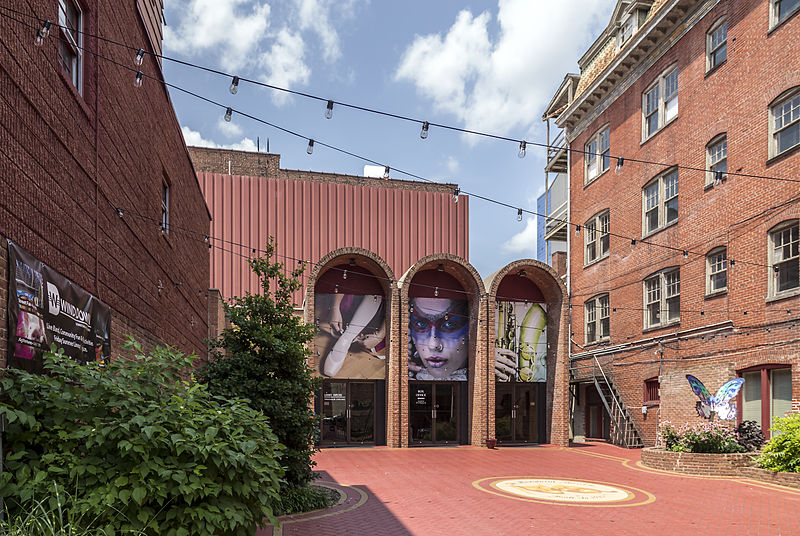
The modern entrance to the Maryland Theatre, 2014. Photo by Acroterion, courtesy of Wikipedia.
Even as live theatre became increasingly scarce, the theatre continued in business until it closed in 1973. The following year, the building lobby and entrance were destroyed when the adjoining apartment building burned. Firefighters valiantly fought to save the theatre itself and were successful, though one life was lost in the apartment building. The remains of the building and the theatre’s lobby were not salvageable and they were razed. When the theatre was reopened, a small lobby was constructed with a passage to Potomac Street. Sadly, from the outside, the lobby’s 1970s modern architecture is at odds with the opulence within the theatre. The modern theatre now plays host to numerous cultural events and is one of the premier cultural venues in the region.
Stories of the theatre’s haunting appeared quite early. The daughter of one of the theatre’s first managers worked in the theatre between the 1930s and the 1960s. Reportedly, she claimed to have encountered her father, who loved the theatre dearly, still going about his daily business. More recently, staff members have had the feeling of not being alone, but have also heard voices. According to two different articles, an investigation by the Mason-Dixon Paranormal Society was able to capture a number of EVPs in the building. It appears this historical theatre has its fair share of spiritual occupants as any good theatre should. As one of the theatre’s former executive directors remarked, “Starting with the Phantom of the Opera, every theatre should have a ghost.”
A commenter under the name “mymixedtapeforher”posted on the original entry that friends had experienced quite a bit in the theatre including the feeling of hands pushing on their backs, being told to “get the f*** out” by a disembodied voice” and finding a sandbag (used as weights on the theatre’s fly system) sliced open. These details, if true, make this quite an interesting haunting.
Sources
Coffey, Claudia. “Hagerstown Theater Believed Haunted.” com. 31 August 2009.
Finglass, Jack L. & Ronald L. Andrews. National Register of Historic Places Nomination Form for the Maryland Theatre. Listed 13 November 1976.
Hagerstown, Maryland. Wikipedia, the Free Encyclopedia. Accessed 31 May 2011.
Julius, Erin. “Is the Maryland Theatre haunted?” Herald-Mail. 30 August 2009.
Pensacola Cultural Center 400 South Jefferson Street
Florida has a glut of haunted theatres; not that that’s a bad thing. A recent project has me researching theatres throughout the South and it seems that Florida has more than any other state. Perhaps it’s geography or something in the air or all the seawater that surrounds the state; it gives one pause.
On the official website for the Pensacola Cultural Center, one statement stands out, “The spaces where judges handed out justice and criminals served their time are now filled with the positive energy of dancers, actors, artists, and students.” The building was initially constructed in 1911 as the Escambia County Building, housing the county Court of Records and the jail. Places where criminals were tried, sentenced, incarcerated and executed now thrum with the rhythm of the arts in this old building.
It seems that some of the criminals are still doing time in this Neo-classical structure. A man has been seen lurking within the building. A staff member working in the building afterhours heard the operating of a nearby elevator. Shortly afterwards the dark shadow of a man walked past the staff member’s open door. She called out but did not get a response. When she looked into the hallway, it was empty.
The Pensacola Cultural Center, 2007. Courtesy of Pensapedia.com.
A couple staff members working late in the auditorium saw a man sitting in one of the seats. They both saw him simultaneously and turned to look at each other. When they turned back, the man was sitting in a different seat, on the opposite side of the house. They described him as wearing a worn suit and having a gaunt face. Some have identified this male spirit as that of Hosea Poole, a small time criminal who murdered his brother. Poole was the last man executed in the jail when he was hung July 31, 1920. However, there is little evidence, other than coincidence, to solidly identify the spirit as Poole’s.
The playful spirit of a young girl, possibly from the 1920s or 30s has also been witnessed. Unlike the male spirit’s almost menacing presence, the young girl has been heard giggling and she has been seen playfully skipping through the hallways. She is known to peer curiously over shoulders and she is occasionally seen peering from shadowed corners.
Saenger Theatre 118 South Palafox Place
Known as the “Grande Dame of Palafox Street,” the Saenger Theatre was literally built from the ruins—the bricks and other fittings—of the Pensacola Opera House which was destroyed in the 1917 Nueva Gerona hurricane (so named for the destruction it caused to the Cuban town of Nueva Gerona). The theatre opened in 1925 as a venue for live performances and film. Broadway shows and vaudevillians on “The Road” played here as well as films like Cecil B. DeMille’s The Ten Commandments which opened the theatre.
Saenger Theatre, 2010, by Ebyabe. Courtesy of Wikipedia.
The Saenger thrived as a cinema for a few decades until competition from multiplex big screens and the small television screens now found in homes began to shrink the audiences to the Grande Dame. The theatre closed in 1975 but was reopened as a cultural center in 1981. The theatre was extensively renovated in 1996.
With the crowds that have passed through the theatre’s doors since its opening and whatever spiritual residue may be left on the old bricks and other fittings from the old opera house, it’s no wonder that the Saenger Theatre has some paranormal activity on hand. Voices have been heard in the balcony of the building and spirits may affect the electrical circuits at times. Author Alan Brown records an incident that happened to the electricians working on a touring show. Just after hanging and adjusting the lighting for a show, the lights began to flash erratically on their own volition. The blame for this activity is laid upon the spirit of a worker who died when the boiler in the basement exploded, though—like Hosea Poole at the Pensacola Cultural Center—there is nothing to specifically identify the culprit.
Sources
Brown, Alan. Haunted Pensacola. Charleston, SC: History Press, 2010.
Jenkins, Greg. Florida’s Ghostly Legends and Haunted Folklore, Vol. 3: The Gulf Coast and Pensacola. Sarasota, FL: Pineapple Press, 2007.