Something in the Shadows–Reed Gold Mine

Reed Gold Mine
9621 Reed Mine Road

Midland, North Carolina

Last March, I posted an article about an odd video someone had taken in the famous Reed Gold Mine. While on a tour, a woman was startled to see a figure ahead of her in a corridor and captured it on video. She claimed the figure was a ghost and released the video on YouTube where it attracted a good deal of attention. The video has since been removed and some remarks, disparaging the video and the woman’s actions, were posted on this blog by someone who was anonymous.

A few days ago, a reader from Lexington, NC who had seen the posting emailed me to let me know he may have captured an odd image in some photographs he had taken in the mine. In an email the reader explained that he, his son and some of his son’s friends visited the mine last Saturday. He wrote, “It was roughly around 11:00 or so that morning, and the place was pretty much dead. We were the only people there on the self guided tour. We had actually wanted to go try our luck at panning for gold, but that part of the exhibit was shut down due to the troughs being reconstructed. Anyway, to make a long story short…we went into the mine shaft that you can tour, and I was taking some pictures with my iPhone, so I could show my wife when we got back home.”

Quickly, let me remind you of the history of this location:

The mine possesses a marvelous history beginning with Johannes Reith, a Hessian mercenary who moved with his family to the area and anglicized his name to John Reed. A different legend involves Reed’s 12-year old son, Conrad, who discovered an odd, yellow rock in Little Meadow Creek in 1799. The story tells that the odd rock served as a doorstop for a few years before Reed sold the rock to a jeweler for the princely sum of $3.50. When he discovered that he was literally sitting on a gold mine he began mining his land. The mine ran until 1912 when it was abandoned. The state of North Carolina acquired the mine later and has opened it as a historic site.

There have apparently been stories told about the Reed Mine for some time. According to Troy Taylor’s Down in the Darkness: The Shadowy History of America’s Haunted Mines, Tunnels and Caverns, there is a legend about the mine. William Mills, a Welsh immigrant, arrived in Cabarrus County with his wife Eleanor to work in the mine. The relationship between William and his wife was quite tenuous and they fought a great deal. One evening, in the midst of a fight, Eleanor tripped on the hem of her dress and pitched head forward into a bench, hitting her head on the corner. William tried to revive his wife, but she was dead. Awakened from sleep and probably hoping that the events had been a bad dream, William checked his wife’s now cold body. He heard her voice begging him to take her back to Wales.

Even though her body was cold, William continued to hear her voice begging him. He wrapped her body up and threw is down one of the unused shafts, the Engine Shaft, at the Reed Mine. The legend continues that he continued to hear Eleanor’s voice and was driven to drink as a result. Meanwhile, others began to hear ghostly screams and cries emanating from the Engine Shaft.

Besides the recent video, I’ve not seen much said of the modern haunting of the Reed Mine.

Our reader, upon pulling the photos up on his computer discovered that one had an odd figure in it. Standing at the end of a corridor is a pair of legs and what, to me, appears to be part of a torso. The rest of the figure is missing. Upon zooming in, the figure does appear to be three dimensional, but it remains strange. One odd detail that emerges is that there is a ray of light that seems to be shining onto the torso. Without having been present when it was taken, I cannot vouch for the photo myself, but it does appear very odd. Both myself and the photographer would like to hear what you think.

The original photo. The figure is the faint and grey in the center. Photo by Bobby Troxler, used with permission.
The original photo after I lightened it. All rights reserved.


Zooming in, the figure becomes more distinct. Is it a figure or just something that resembled one? Photo by Bobby Troxler, used with permission.

I’d like to thank Mr. Bobby Troxler for letting me post his picture.

Sources

  • Knapp, Richard F. “The History of John Reed’s Mine.” Reed Gold Mine. Accessed 29 May 2011.
  • Reed Gold Mine. Wikipedia, the Free Encyclopedia. Accessed 29 May 2011.
  • Rettig, Polly M. National Register of Historic Places Nomination form for Reed Gold Mine. Listed 15 October 1966.
  • Taylor, Troy. Down in the Darkness: The Shadowy History of America’s Haunted Mines, Tunnels and Caverns. Alton, IL: Whitechapel Press, 2003.

Spectral Humor–Fort Clinch, Fernandina Beach, Florida

Fort Clinch State Park
2601 Atlantic Avenue
Fernandina Beach, Florida

N.B. This article was edited 26 June 2019.

For my own photos from Fort Clinch, please see my article, “A historic playhouse–Photos from Fort Clinch.”

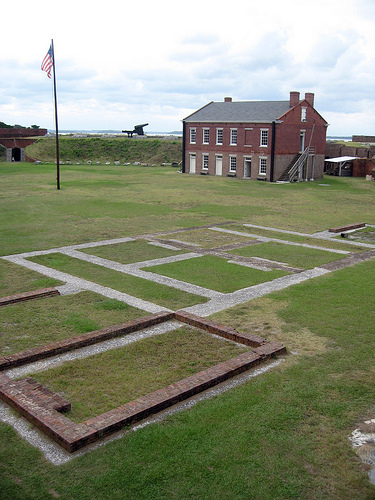
Fort Clinch is a popular place. This state park offers camping, wildlife, fishing and swimming as well as what the park website describes as “one of the most well-preserved 19th century forts in the country.” The fort is also popular with historic re-enactors, those people who enjoy spending time living in a different era.

During a historic encampment one July weekend, two re-enactors sitting on the porch of one of the barracks witnessed four spectral soldiers. The soldiers emerged from one of the bastion tunnels wearing Civil War era uniforms, crossed the parade ground, marched up the ramp, and disappeared. The following year during the same encampment, the re-enactors took their seats again on the barracks porch to see if the specters returned. Sure enough, three uniformed ghosts emerged from the tunnel and began making their way across the parade ground. One of the witnesses called out, “There were four of you last year, where’s the fourth man?” One of the ghosts responded, “He’s sick tonight, couldn’t come.” The spectral trio continued up the ramp and disappeared.

This story amuses me greatly. So often in dealing with ghost stories, we are dealing with sometimes horrible deaths involving war, murder, or pestilence, that we forget that these spirits have a sense of humor. I recall an episode of Ghost Hunters where the TAPS team was investigating the well house of a farm that was known to have a prankster ghost. The ghost turned on the investigator’s flashlight upon request and later analysis revealed an EVP of a man laughing at the time. Ghosts DO have a sense of humor!

This story, however, has become one of the most enduring legends surrounding the fort. I’ve seen this story retold in a few different sources and each includes different details. Maggie Carter-de Vries, a local author, includes the story in her 2008 book, Ghosts of Amelia and Other Tales. She does provide a date for this story, 1952, and includes that the witness was a park ranger.

Aerial view of Fort Clinch Fernandina Beach Florida ghosts haunted
Aerial view of Fort Clinch, 2003, by Fl295. Courtesy of Wikipedia.

Of course, Fort Clinch is hardly a place for much sadness. The fort has never seen military action; only the ennui that accompanies waiting for such action to occur. The site of the fort, at the northern end of Amelia Island on the northern Atlantic coast of Florida, has been occupied by various military installations since 1736, all guarding the St. Marys River from attack.

Construction on the fort commenced in 1847 as part of the federal government’s plan to fortify the American coast. By the outbreak of the Civil War in 1861, the fort was only partially constructed with only two bastions facing the river and two walls connecting them as well as other necessary buildings in different stages of completion. At the time of the bombardment of Fort Sumter by Confederate forces in April of that year, guns had yet to be placed within the fort. It was not until the Confederacy took control that guns were installed. The fort aided blockade runners running supplies into the port of St. Marys, Georgia on the other side of the river.

By 1862, many of the neighboring islands had been captured by Union forces leaving Amelia Island and Georgia’s Cumberland Island (a barrier island to the north) isolated. General Robert E. Lee gave orders for troops to abandon the fort. On March 3rd, as the last of the Confederate troops left the fort, Union gunboats arrived and immediately took control of the fort. The First New York Volunteer Engineers company was brought in to resume construction on the fort. Work continued through the war and was halted in 1867 when the construction was deemed obsolete and the fort was placed under the eye of a caretaker.

guns Fort Clinch Fernandina Beach Florida ghosts haunted
The fort’s guns, 2004, by Sir Mildred Pierce. Released under a Creative Commons License.

The forgotten fort was briefly returned to military usage in 1898 during the Spanish-American War, but in September of that year was again deemed obsolete and closed. The decaying ramparts remained desolate until 1926 when the site was offered for sale. The state of Florida purchased the site in 1935 and the Civilian Conservation Corps began work restoring it. Fort Clinch State Park opened as the first park in Florida’s state park system in 1938. During World War II, with German U-boats patrolling off the coast and sinking vessels within sight of land, the fort was reactivated for surveillance.

parade ground Fort Clinch Fernandina Beach Florida ghosts haunted
View across the parade ground, 2009, by mediafury. Released under a Creative Commons License.

The past is still very much with us at Fort Clinch, not only literally, but spiritually as well. Re-enactors operate at the site regularly, demonstrating the harsh realities of military life during the Civil War. These same re-enactors seem to also witness the spiritual realities as well. Author Jack Powell in his Haunting Sunshine: Ghostly Tales from Florida’s Shadows, notes that there is a surprising amount of interaction between the ghosts of Fort Clinch and the re-enactors, rangers, and the occasional visitor. People staying in the barracks have been awakened by the clomping steps of booted feet and the appearance of a woman with a lantern who may possibly be a nurse still checking on patients.

Another interesting interaction involved this same female spirit. A female volunteer was looking for something in a darkened barracks room. The female spirit passed through with her lantern and the woman, not realizing the lantern-bearing woman was not another volunteer, asked her to hold up the lantern while she continued to search. The woman stopped, held the lantern aloft while the volunteer searched. She found what she needed and the other woman left the room. The volunteer approached a woman outside who she believed to have helped her and thanked her, only to discover that she hadn’t been walking around with a lantern, nor had any other women present.

corridor Fort Clinch Fernandina Beach Florida ghosts haunted
View of one the Fort Clinch’s many corridors.

In their book, Ghost Stories of the Civil War, Dan Asfar and Edrick Thay includes a marvelous story from 1999. A family taking a candlelight tour of the fort at night was greeted by a Union officer standing in a window of the Officer’s Quarters. The man looked at them, doffed his cap in acknowledgement, and vanished. After seeking out the guide, the family learned that they were not the first to see the officer, nor were they the only members of that particular tour group to see him.

Not all of the spirits roaming the fort are martial in nature, staff and visitors have reported the sound of a baby crying in the southwest tunnel. There’s speculation that the baby’s spirit may remain from the time when, while abandoned, the fort was home to a homeless family. The family is said to have had a baby that died. It seems that both military and civilian life continue at Fort Clinch.

Sources

  • Asfar, Dan and Edrick Thay. Ghosts Stories of the Civil War. Auburn, WA: Ghost House Books, 2003.
  • Carter-de Vries, Maggie. Ghosts of Amelia & Other Tales. Bloomington, IN: Author House, 2008.
  • Fort Clinch. Wikipedia, the Free Encyclopedia. Accessed 11 August 2010.
  • Fort Clinch State Park. Wikipedia, the Free Encyclopedia. Accessed 11 August 2010.
  • Moore, Joyce Elson. Haunt Hunter’s Guide to Florida. Sarasota, FL: Pineapple Press, 1998.
  • Powell, Jack. Haunting Sunshine: Ghostly Tales from Florida’s Shadows. Sarasota, FL: Pineapple Press, 2001.

Haunting Huntsville, Alabama

Early in this blog’s history I explored (or tried to) the ghosts of Huntsville, Alabama. The problem was that there was very little available. I found a few poorly written and unsourced articles that basically just repeated each other in terms of information. Besides those articles, there was very little, or so I thought. Just days before I posted the entry, Jessica Penot’s marvelous Haunted North Alabama had been released and in it, there were good, reliable information on a number of Huntsville’s hauntings plus information on locations that were not included in the few articles on the subject. After getting my copy of Ms. Penot’s book, I also began reading her blog which has included more locations in Huntsville. Since, I’ve kept an eye out for articles relating to Huntsville. In my usual search through Google News, I was surprised to find two articles about Huntsville tonight.

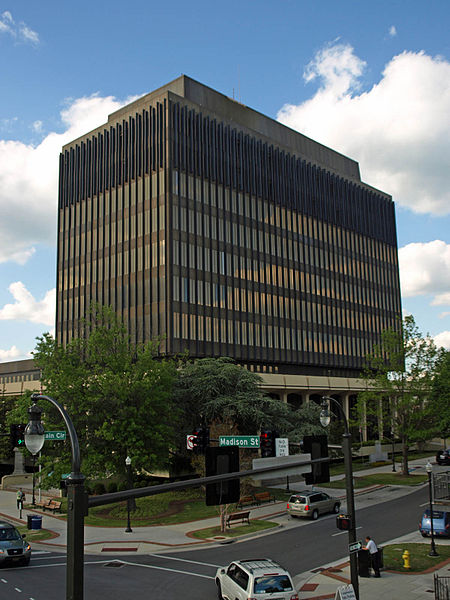
The first article, from the local ABC station, WAAY, concerns a business located on courthouse square, Huntsville’s historic heart. In many towns and cities in the South (and really throughout the nation), the courthouse or main square is also ground zero for hauntings, often due to the historic fabric that may be intact there. Huntsville is no exception, with a starkly modern courthouse sitting amid historic commercial buildings. The business is a pizzeria, SAM & GREG’S PIZZERIA AND GELATERIA (119 North Side Square), which is located in one of those historic commercial buildings.

The pizzeria’s website describes the building as having been built in the early nineteenth century and being one of the original buildings on the square. It continues by saying that the building has served as a general store, a dress shop and a gallery before becoming a pizzeria. The article states that the main floor of the pizzeria is quite normal, but it’s the large, unrestored room upstairs that has activity. The building was recently investigated by the Alabama Paranormal Association who certified the building as haunted.

The pizzeria’s location reminded me of an article from Jessica Penot’s blog, Ghost Stories and Haunted Places, regarding the MADISON COUNTY COURTHOUSE (100 North Side Square). A brief internet search does not reveal the history of the current courthouse building, but I would assume from the architecture that it was built anytime between the 1960s and the 1980s. I did discover, however, that the building sits on the site of the original courthouse that was constructed in 1818. According to the blog’s entry, apparitions have been seen in the building along with orbs and odd sounds and lights. One of the spirits may be that of Horace Maples, an African-American who was lynched by a mob on the courthouse lawn.

Madison County Courthouse, 2011, by Spyder_Monkey. Courtesy of Wikipedia.

The second article I stumbled across concerns an upcoming investigation at the VETERANS MEMORIAL MUSEUM (2060 Airport Road, SW) a museum displaying memorabilia from wars dating back to the American Revolution. Interestingly, the article points out that the investigation will not be in search of spirits that haunt the museum, but those attached to the artifacts within, specifically those from World Wars I and II. While it has been known that spirits may attach themselves to objects, interest in this has increased in the paranormal community, especially with the recent television show, Haunted Collector. The show features investigator John Zaffis who investigates a variety of hauntings usually centered on a specific object.

Tucked away in my files on the paranormal South is another article on an investigation at another Huntsville location, MERRIMACK HALL PERFORMING ARTS CENTER (3320 Triana Boulevard). Opened in 2007, the performing arts center is located in an 1898 structure that once served as the company store for the mill village serving Merrimack Mills. This building and some 200 mill houses are all that remain of this important textile hub.

The investigation, conducted by the Alabama Paranormal Society, appears to have uncovered some interesting evidence. Among the evidence mentioned in the article, odd bangs heard in response to questions, a mysterious drop in temperature in the theatre and orbs are seen on video wheeling about the building. According to the article, the building may be inhabited by multiple spirits.

I imagine this is just the tip of the iceberg of haunted Huntsville.

Sources

Oldest Spirits–González-Alvarez House

González-Alvarez House
14 St. Francis Street
St. Augustine, Florida

N.B. This entry was originally posted October 13, 2010. Since I now have many more sources at my disposal, I tried to add to the research I’ve presented here, but no further sources could be immediately found, so I’m reposting this with only minor changes. It’s interesting to note that this location is not found in most books on the ghosts of St. Augustine. I still find the video that inspired this post absolutely fascinating. Regular readers may also recognize my “most haunted” rant here, as well.

It is said that St. Augustine, Florida is the most haunted city in America, at least according to a number of authors. As I mentioned in this blog’s very first entry, I find this description to be somewhat distasteful. On one count, the term “haunted” really can’t be any further qualified. Something is either haunted or it isn’t; it’s like death: one is either dead or alive not “more dead” or “more alive.” Therefore, a location either has spiritual activity or not. Certainly, what authors mean is that St. Augustine has more spiritual activity and that may be the case.

Taking this further, though, the phrase “most haunted” is tossed around easily. When cities or locations are rated or ranked as “most haunted,” the basis for this conclusion is often not presented. What makes New Orleans more haunted than Savannah? Why is St. Francisville, Louisiana’s The Myrtles the most haunted place in the nation? Based on what? Granted, a good deal has been published on all three locations, but what criteria make them “more haunted?” Certainly, these locations may have a number of spirits and be very spiritually active, but they are no more haunted than any other location.

González-Alvarez House, 2008, by Ebyabe. Courtesy of Wikipedia.

Additionally, there’s also the issue of research and documentation. Of the three previously mentioned locations, all of them have been well researched and documented, but does that make them any “more haunted” than a location that is not well documented. That’s one of the goals of this blog: to document Southern locations that may be quite active, though perhaps not as well documented. In addition, I’m also adding to the scholarship on locations that are well documented by synthesizing the available information.

The González-Alvarez House is called “The Oldest House” in America and is located in America’s “Oldest City.” The only part of that statement that bears even partial truth is the fact that St. Augustine is the oldest continuously inhabited European settlement in the continental United States. There are Native American cities, notably the Acoma and Taos Pueblos in New Mexico that are far older, but St. Augustine is the oldest European settlement. The González-Alvarez House is not the oldest house in America by any stretch of the imagination. There are far older houses in New England and even as far south as Virginia, but the house sits on a site with far more history than its early 18th century walls can attest to. In fact, this house may not even be the oldest house in St. Augustine. The moniker dates to a time when the house was believed to date to the 16th century.

While the location of the González-Alvarez House may have been inhabited as far back as the initial founding of the city in 1565, archaeologists can only prove inhabitants at the site as far back as the early 17th century. Regardless, the centuries of hope, despair, madness, birth, death, pain and joy have left both physical and spiritual scars on the house.

I was first acquainted with “The Oldest House” on a visit to St. Augustine as a child. An avid collector of travel brochures, seeing racks of brochures in a hotel lobby would give me heart palpitations and soon my little fist would be clutching a stack to take home. Among the brochures I gathered on this trip was one from “The Oldest House.” We didn’t visit, but I was certainly fascinated by the numerous “oldest” places throughout the city.

That memory wasn’t jarred until I came across this video on YouTube one evening. The video’s creator doesn’t provide much information on the video itself, but I found it to be quite intriguing. The first part of the video shows a series of haunted locations in the city including “The Oldest House.” The second part of the video (starting around 3:35) is from a camera placed in a room of one of the houses on the site (there is a handful of buildings located on the site) where supposedly some 50 people were slaughtered by the Spanish, though I can find no reference to this event in any materials I have found). The piece of video, taken during the day, shows what appears to be the shadowy figure of a man, with his hands behind his back, walking through doorway on the right and disappearing into the other room. What I find remarkable is the fact that the figure, unlike an actual shadow, does not fade when it walks into the sunlight in the next room. Perhaps this video is faked, I don’t think so and it’s an excellent fake if it is.

Postcard, c. 1914.

In his marvelous guide to haunted America, Haunted Places: The National Directory, Dennis William Hauck presents some of the activity that has been witnessed in the house. According to him, objects move about the house on their own accord specifically in Maria’s Room. This report is backed up by Dave Lapham in his Ancient City Hauntings. Lapham reports that objects throughout the house move according to one long-time staff member. Hauck also includes strange lights seen in various rooms and the experience of a tourist whose poodle was upset inside the house. Apparently, once the dog was taken outside it was fine. It is believed that animals can sense spirits and may sometimes be upset by them. Interestingly, none of the accounts of spiritual activity include figures such as the one in the video, though there are relatively few accounts of activity that I could find.

As stated earlier, the site of the house had been inhabited for some time when the existing house was constructed. The date of construction, however, is in question and could be anytime between 1703 and 1727. Documentary evidence indicates that this house was home to Tomàs Gonzàlez y Hernàndez and his wife, Maria Francisca Guevara y Domínguez. Gonzàlez was a Canary Island-born sailor who served as a soldier. When Spain ceded Florida to the English in 1763, the Gonzàlez family fled the city and the house stood vacant until 1775 when Englishman Major Joseph Peavett purchased the house. Peavett enlarged the house and following his death in 1786, the house was acquired by a Spaniard, Gerònimo Àlvarez. The Àlvarez family owned the house for nearly a century and in 1884, the house was purchased by dentist, Dr. C. P. Carver who began opening the house for tours and who also began calling the house, “The Oldest House.” The house came under the ownership and operation of the St. Augustine Historical Society in 1918 and has been operated as a museum ever since.

The Gonzàlez-Alvarez House was named a National Historic Landmark, 15 April 1970.

Sources

  •  Gonzàlez-Alvarez House. Wikipedia, the Free Encyclopedia. Accessed 12 October 2010.
  • Hauck, Dennis William. Haunted Places: The National Directory: Ghostly Abodes, Sacred Sites, UFO Landings, and Other Supernatural Locations, 2nd Edition. NYC: Penguin, 2002.
  • Lapham, Dave. Ancient City Hauntings: More Ghosts of St. Augustine. Sarasota, FL: Pineapple Press, 2004.
  • Oldest buildings in the United States. Wikipedia, the Free Encyclopedia. Accessed 12 October 2010.
  • Snell, Charles. National Register of Historic Places Nomination Form for The Gonzàlez-Alvarez House. Listed 15 April 1970.

Preserving Haunted History–Tennessee

N.B. This article originally included a section on the Tennessee State Prison in Nashville. That has since been moved into a new article.

Temperance Building
Walden and Roane Avenues
Harriman, Tennessee

Historic preservation and hauntings go hand in hand. Most often, those places known for their paranormal activity are also places that have preserved a great deal of their history: Savannah, Georgia; Charleston, South Carolina; St. Augustine, Florida and Natchez, Mississippi would most certainly qualify. This notion has made strange bedfellows at times with historians, scholars and preservationists teaming up with ghost hunters and paranormal investigators to help preserve historic locations. This was recently seen in an article from Britain’s Daily Mail, though the author takes it in more of a tongue in cheek fashion.

Temperance Building, 2010. Photo by Brian Stansberry, courtesy of Wikipedia.

I’d be interested to know how the citizens of Harriman, Tennessee and their efforts to restore their city hall reached the ears of the British Press. One wonders if they hacked the cellphones of the local city government in order to extract some of the details. Really, a story made the rounds via the Reuters News agency in a more respectful article by Tim Ghianni.

Harriman, Tennessee is a quiet town in East Tennessee, just off of Interstate 40 near Knoxville. The town was founded in 1889 by leaders in the Temperance Movement, the Victorian movement to free the country from the vise-grip of the vice of alcohol. Hopefully this utopia would provide a cleansing presence among the moonshiners of Appalachian Tennessee. In the Panic of 1893, the East Tennessee Land Company, which had been established to create the city, was forced into bankruptcy, though the Temperance leaders involved in the town marched forward. The large Romanesque revival structure on Roane Avenue was constructed to house the land company and with its closure, the building became the main hall for American Temperance University.

In the second year of the university’s existence (1894), it boasted some 345 students but that number dwindled by 1908 and the university shut its doors. The large building then served as a jail and went through a number of other uses before being occupied by the City of Harriman as a City Hall. Recently, the over 120-year-old building has required more and more maintenance; work that a city in the grips of the economic recession that has plagued the US can ill afford.

Locals have described the antique edifice as haunted for quite some time. The building is listed in John Norris Brown’s encyclopedic Ghosts and Spirits of Tennessee website. Brown mentions that shadowy apparitions have been reported in the structure which have been identified as some of the early city leaders. These reports brought out the investigative team from G.H.O.S.T., the Ghost Hunters Of Southern Tennessee to investigate the building recently.

During their investigation, the team captured possible video evidence of spiritual activity as well as EVPs which they presented to the city council. In displaying this evidence, they have suggested that the city consider hosting tours and paranormal investigators with the city taking half of that revenue for use in restoring the building. This is a concept which has been employed successfully elsewhere including the Old Jail in Charleston, South Carolina.

Sources

  • American Temperance University. Wikipedia, the Free Encyclopedia. Accessed 18 January 2012.
  • Brown, John Norris. “Temperance Building.” Ghost & Spirits of Tennessee. Accessed 18 January 2012.
  • Ghianni, Tim. “Ghost Hunters to raise money for ‘haunted’ Temperance Building in Harriman, Tenn.” The Huffington Post. 15 January 2012.
  • Harriman, Tennessee. Wikipedia, the Free Encyclopedia. Accessed 18 January 2012.
  • Keneally, Meghan. “Modern-day ghostbusters hoping to save their haunted house with guided tours may have a problem: lack of scary ghosts.” Daily Mail. 17 January 2012.

“Just Visiting”—Old Jail Tour, Charleston, South Carolina

Old City Jail
21 Magazine Street
Charleston, South Carolina

N.B. This article was edited and revised 30 June 2019.

ghosts Old City Jail Charleston South Carolina haunted
A set of old jail keys. Photo 2011, by Lewis Powell IV, all rights reserved.
ghosts Old City Jail Charleston South Carolina haunted
A barred window. Photo 2011, by Lewis Powell IV, all rights reserved.
ghosts Old City Jail Charleston South Carolina haunted
One of the jail corridors. Photo 2011, by Lewis Powell IV, all rights reserved.

Standing in front of the Old Jail in Charleston, South Carolina, even in the midst of summer heat and humidity, is chilling. The building is imposing and threatening akin to a bully rising to ask, “Do you have a problem with that?”

On a chilly evening in early December with a chill wind blowing, the building grows more threatening. While waiting for my 10 PM ghost tour of the building, I stood in the cold with a few couples and spoke with a couple visiting from Rhode Island specifically for Charleston’s ghosts. They were staying in the Battery Carriage House Inn and had rented one of the haunted rooms for the evening. Definitely, they are proof that much can be said of “paranormal tourism.”

Our guide, Susan, was very efficient and no-nonsense; precisely the type that I like as a guide, someone who was down to earth yet open minded. In fact, she reminded me of the actress Ellen Page, someone I would love to just hang out with. She remarked that while the jail looks quite large and imposing from the outside, it is actually much smaller inside.

We walked around back and she discussed the gallows that stood behind the jail for many years. The design, apparently, was somewhat unique and would, at times, decapitate the victim instead of merely breaking their neck. She described one of the final executions, that of a young man who may have been in the wrong place at the wrong time. She ended with the statement “his ghost is said to be one of the many here.”

ghosts Old City Jail Charleston South Carolina haunted
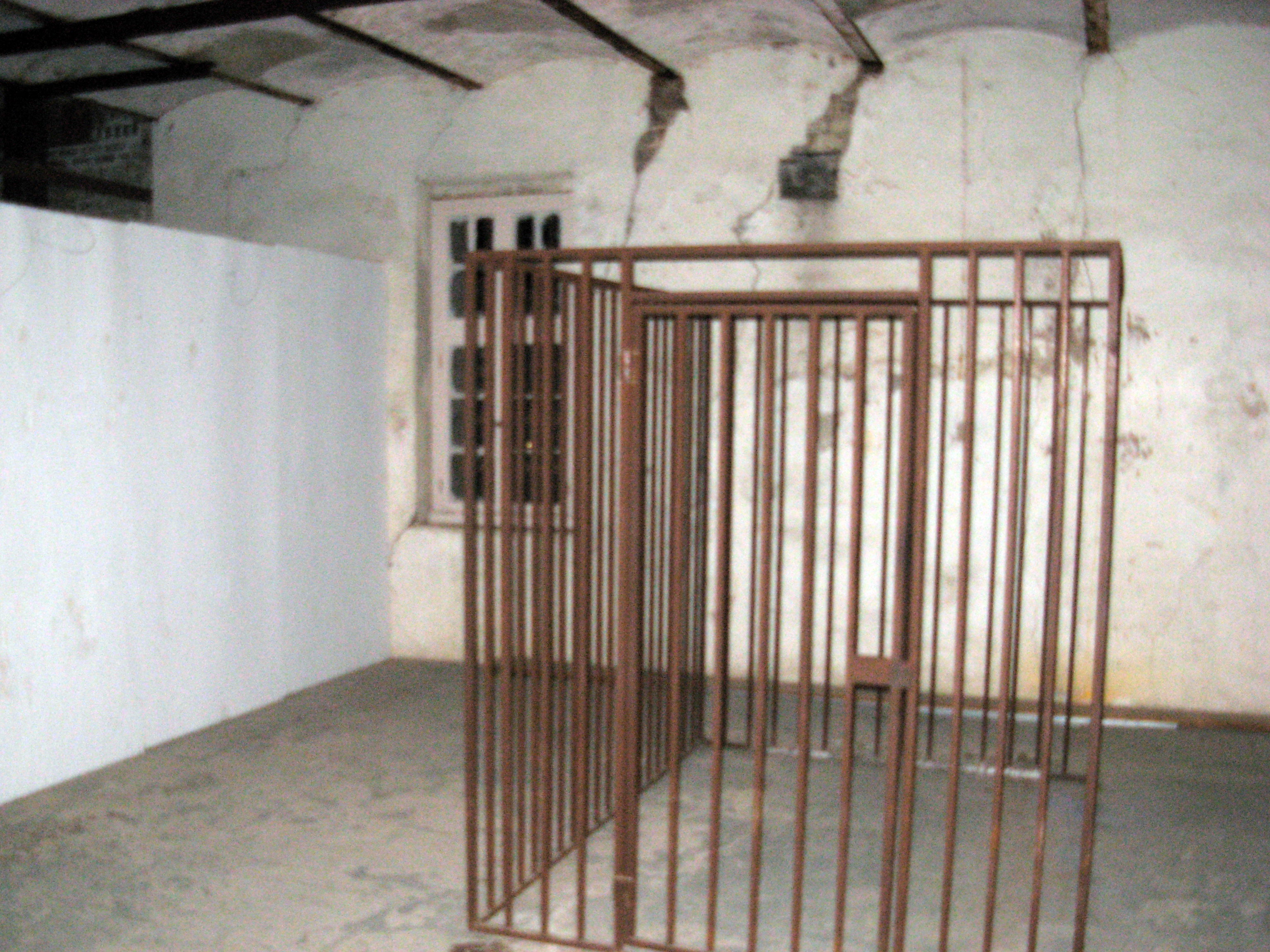
A cage for the more dangerous criminals. These cages would hold multiple inmates at the same time. Photo 2011, by Lewis Powell, IV, all rights reserved.
ghosts Old City Jail Charleston South Carolina haunted
The building is being stabilized and restored by the American College of Building Arts. Photo 2011, by Lewis Powell IV, all rights reserved.

We moved inside and found ourselves in a cell where torture was described then moved on to a large room with a replica of the cage that was used for the more violent offenders. There was a discussion of criminals and their treatment and we moved again downstairs to see solitary confinement, the kitchen, and some other rooms off a small corridor on the lowest level. The guide pointed out a large room that had served as a surgery during the Civil War. She suggested that if any room had spiritual activity, it was that room.

ghosts Old City Jail Charleston South Carolina haunted
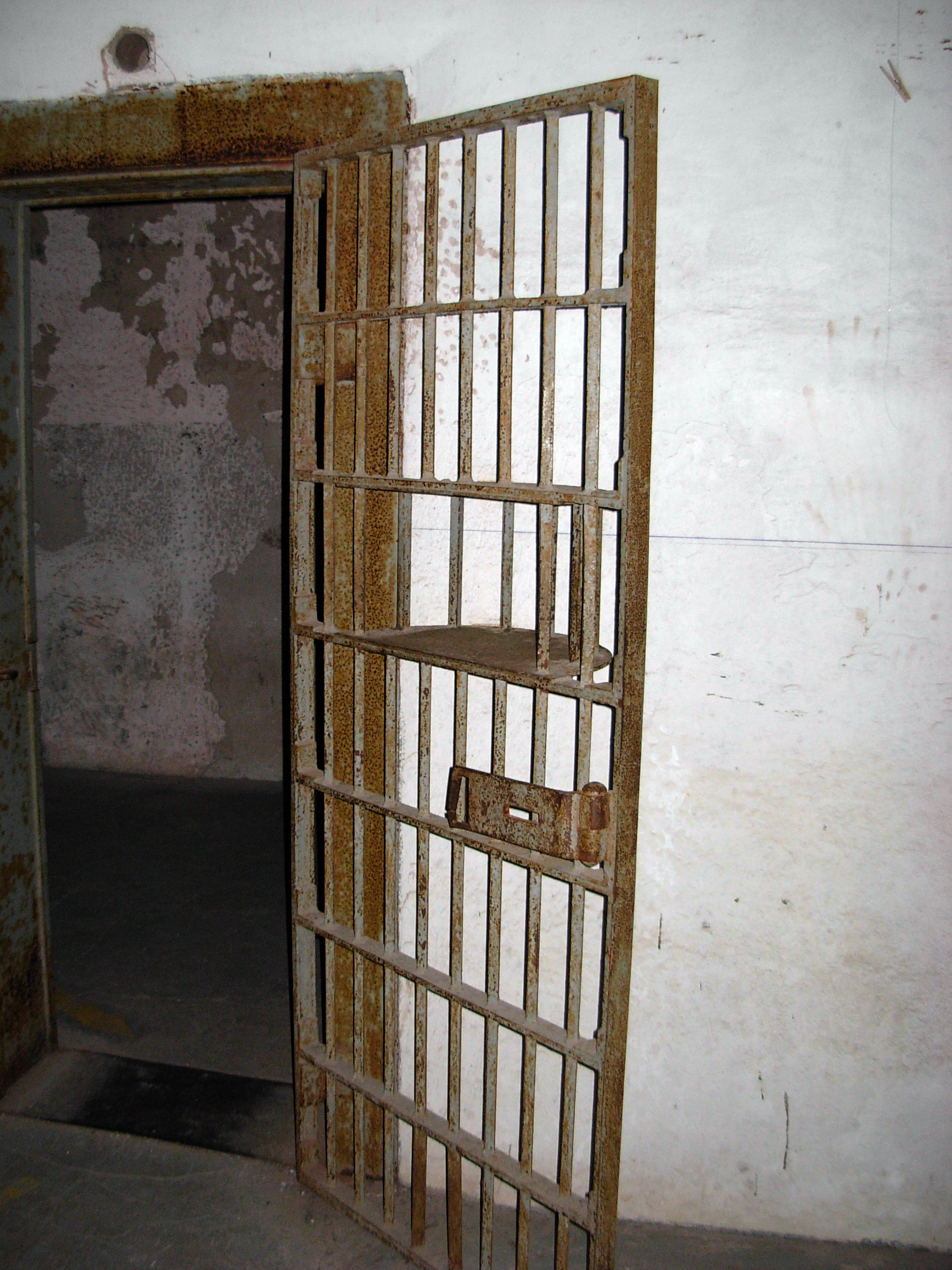
An original cell door. Photo 2011, by Lewis Powell IV, all rights reserved.
ghosts Old City Jail Charleston South Carolina haunted
Another cell door. Photo 2011, by Lewis Powell IV, all rights reserved.
ghosts Old City Jail Charleston South Carolina haunted
Yet another cell door. Note the “peep holes.” Photo 2011, by Lewis Powell IV, all rights reserved.

We finally entered a dark room next to the exit and were told a bit about paranormal activity involving the possible spirit of a former warden, one who had served at the jail for quite a long time. After this, we walked out a back entrance and the tour was over. I was surprised by the emphasis placed on the history and so little mentioned of the paranormal, this is a haunted jail tour, isn’t it? I cannot blame the guide, she was following a script which she later admitted was very dry and dull, she went so far as to say that all the guides spiced up each tour with additional stories and information.

Being disappointed at the lack of ghosts on the ghost tour, I stuck around to ask the guide what she’d experienced. She was more than happy to fill me in on the details. She mentioned that she had lasted longer as a guide on this tour than anyone else, as many others had been scared away, especially while having to lock up the building alone after tours. Personally, she’s heard voices in the empty building, specifically the sound of men in conversation as well as hearing her name called. She’s also been touched. She mentioned other guides who have felt nausea in certain areas and who’ve had much stranger experiences in the monstrous edifice.

I was happy to finally hear of some specific activity as most sources on the haunting fail to be very specific about the details of the haunting. While the conversation with the guide was quite interesting, it bothers me that few of those details were revealed on the tour. The tour is offered through Bulldog Tours which offers the Ghosts and Dungeon tour which I took a few months ago and which I would highly recommend. Unfortunately, the jail tour is the only real chance the public has of actually touring the interior as well. I’d like to encourage Bulldog Tours to review the script for this tour and add in some more ghosts.

At the outset of the tour, the guide encouraged the group to take pictures. She went on to say that balls of energy, known as orbs, were often captured in and around the building and that this was known as “paranormal activity.” Actually people quite often capture these “orbs” in all types of photographs and, more often than not, these are reflections of light off of water vapor, dust or insects.  Earlier that week, while visiting the Lost Sea in Tennessee, I took a series of photos while in the boat on the underground lake there and these photos, taken in a very humid environment, are filled with “orbs.” In my photos, I did capture one prominent orb. It may be dust or it may be paranormal.

ghosts Old City Jail Charleston South Carolina haunted
Looking down a flight of stairs. The orb is just below the center of the pic. Photo 2011, by Lewis Powell IV, all rights reserved.
ghosts Old City Jail Charleston South Carolina haunted
Closeup of the orb. Photo 2011, by Lewis Powell, IV, all rights reserved.

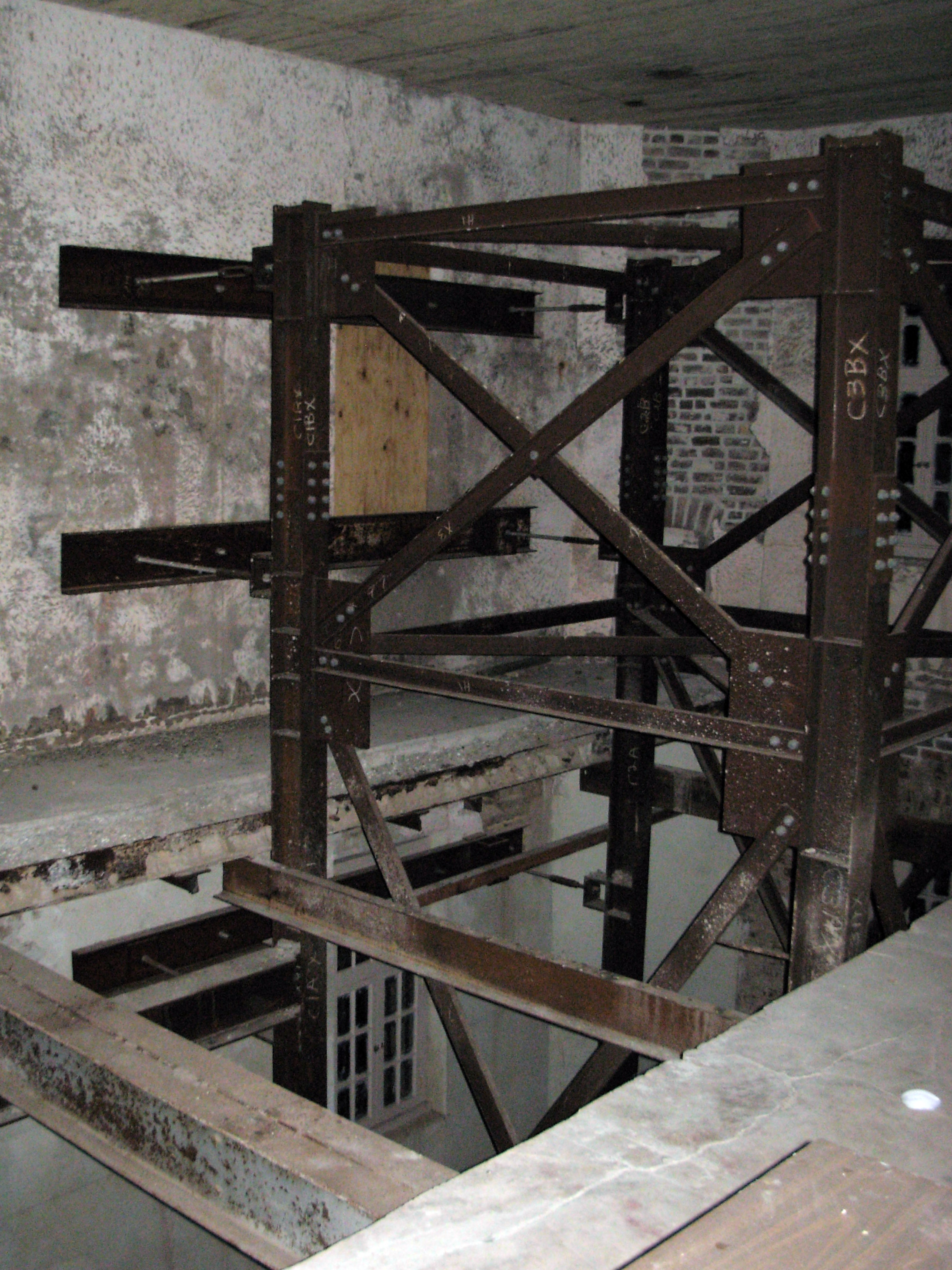
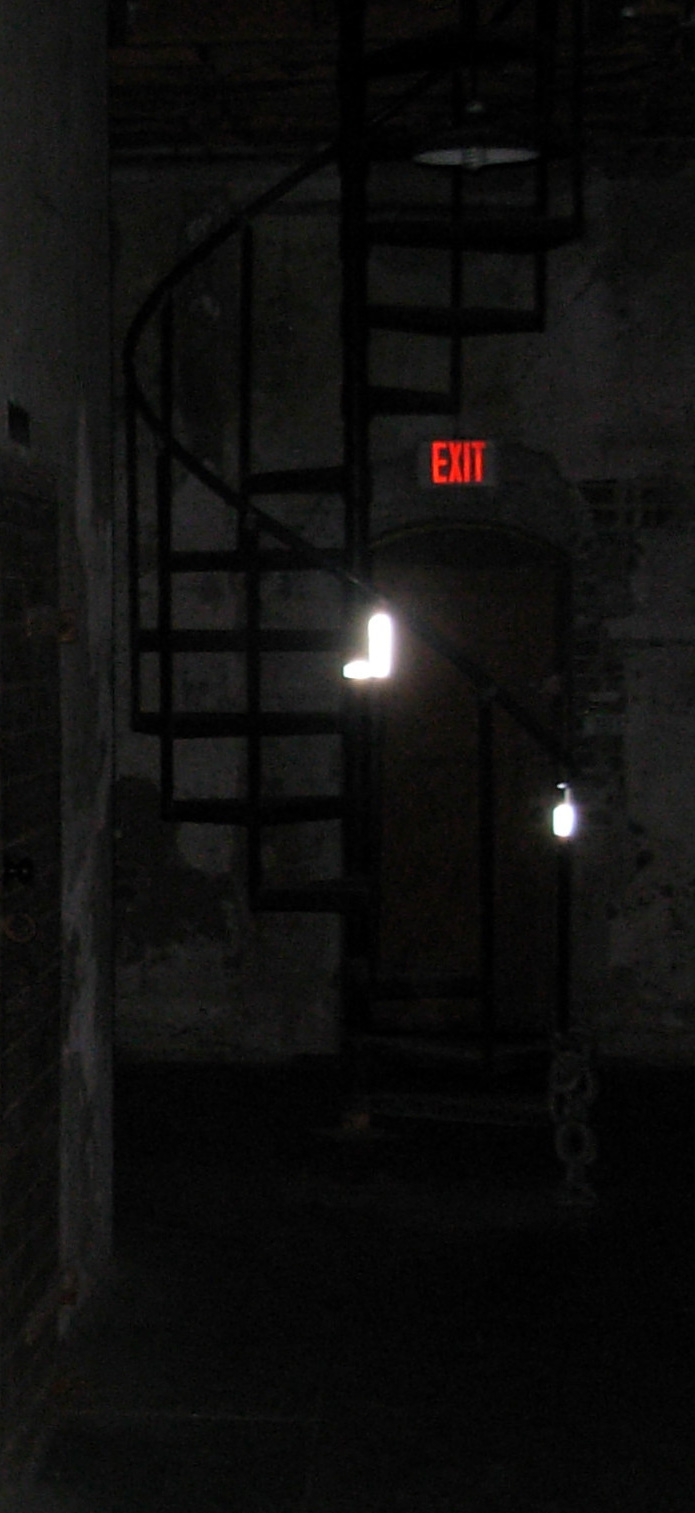
I did capture one other anomaly, though this is much stranger. The photo shows one of the upper hallways and is looking towards a set of metal stairs. There are two very bright lights around the stairs. This was taken with a flash and it appears to be very brightly reflected off of something, though I can’t figure out what. There’s a little bit of light reflected on the glossy paint of the stairs, but it’s not so reflective as to reflect back the amount of light in the photo. Again, I can’t say it’s paranormal, but it is odd.

ghosts Old City Jail Charleston South Carolina haunted
The odd light anomaly. Photo 2011, by Lewis Powell IV, all rights reserved.
ghosts Old City Jail Charleston South Carolina haunted
Closeup of the light anomalies. Photo 2011, by Lewis Powell IV, all rights reserved.

A Spiritual Treasure—Angel Oak

Angel Oak Park
3699 Angel Oak Road
John’s Island, South Carolina

N.B. This article was revised and updated 13 January 2019. I revisited the oak in 2019, read about my experiences

Angel Oak John's Island South Carolina ghosts haunted
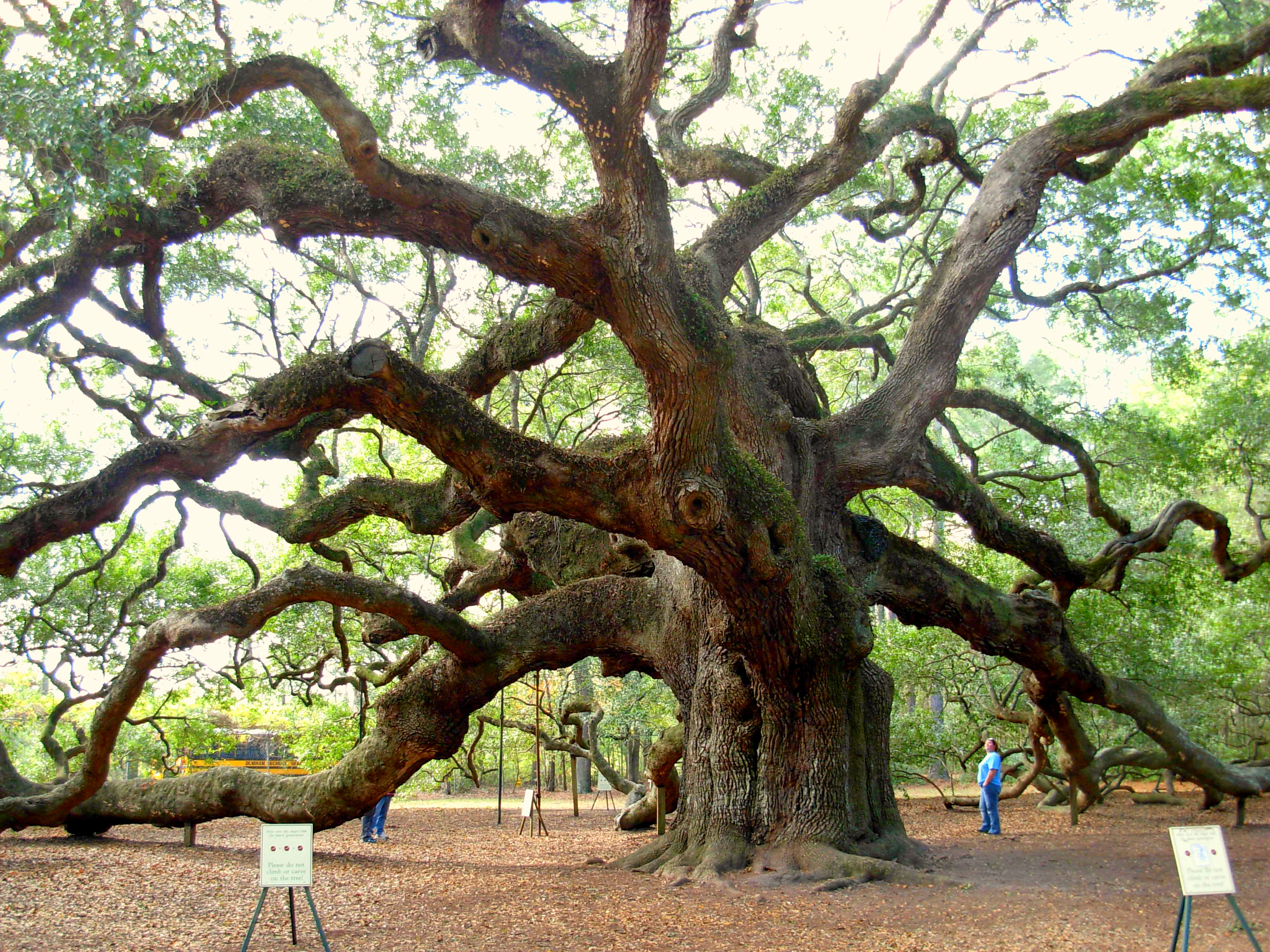
The massive Angel Oak. Photo 2011, by Lewis Powell IV, all rights reserved.

The city of Charleston incorporates not only the bustling peninsula where the city was originally built, but it now encompasses parts of some of the surrounding barrier islands like James and John’s Islands. Until fairly recently, John’s Island has been somewhat rural. Following the Civil War it was home to communities of freed slaves and their descendants, but developers have begun turning the island into a bedroom community for the city of Charleston. This has caused quite a stir among locals as the quiet nature of the island has rapidly changed with sprawling commercial and residential developments. The magnificent Angel Oak, whose leafy branches have provided shade and solace for centuries, is now at the center of one of the controversies over the island’s development.

Angel Oak John's Island South Carolina ghosts haunted
The massive limbs seem to reach out towards visitors. Photo 2011, by Lewis Powell IV, all rights reserved.
Angel Oak John's Island South Carolina ghosts haunted
Photo 2011, by Lewis Powell IV, all rights reserved.

Angel Oak is considered to be the oldest living thing east of the Mississippi. However, dating a living tree can be difficult. Signs posted around the tree give the age at between 300-400 years old, though many other sources estimate it to be in excess of 1500 years old. This tree has withstood hurricanes, war, pestilence and small, screaming children climbing its branches and yet continues to provide a gentle, loving embrace to thousands of visitors year after year.

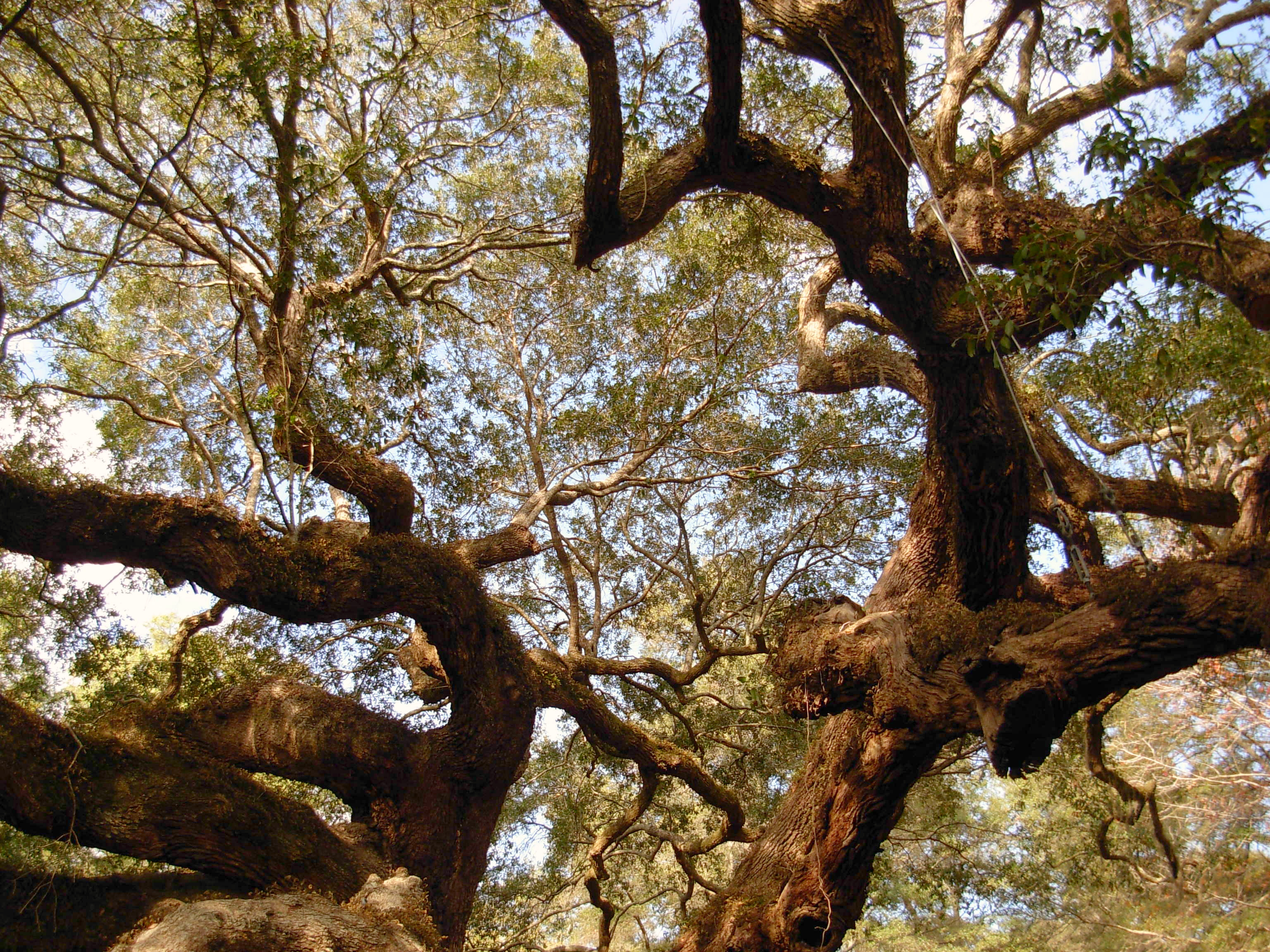
The tree is a remarkable sight. Southern Live Oaks (Quercus virginiana) are not known for their height–this tree is only 65 feet high–but for their sprawling branches, which, in this case, loll over an area of some 17,000 square feet. The massive trunk is over 25 feet in circumference with the largest branch being 11 feet in circumference. During a performance under the oak, the Charleston Ballet Company was able to fit its entire company, 19 dancers, behind the trunk. To prevent the massive limbs from breaking off, wooden and metal posts have been erected along with steel wires to help support some of the larger, more unstable branches. Walking near the tree and under its massive branches is a memorable experience. 

Angel Oak John's Island South Carolina ghosts haunted
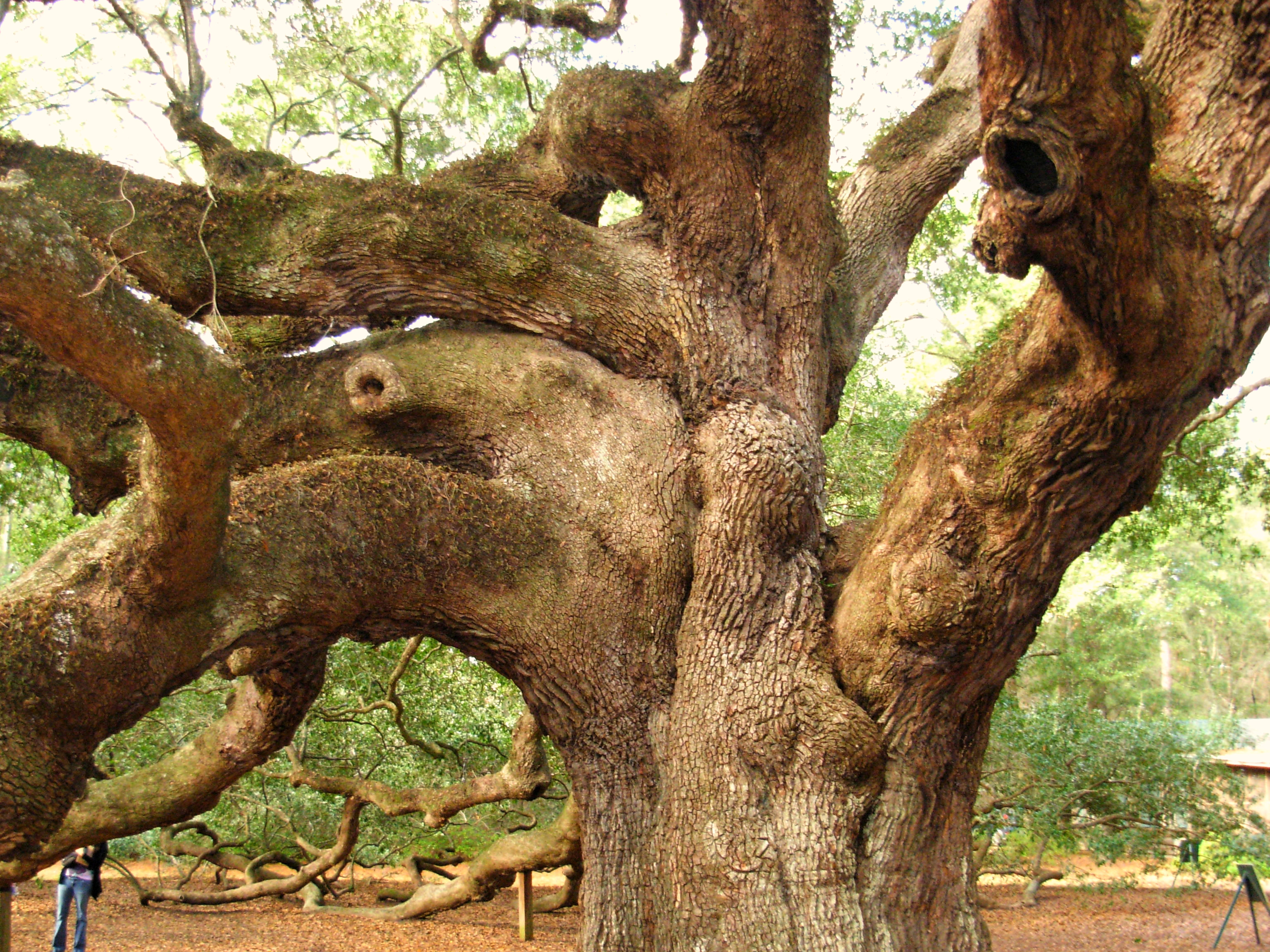
Centuries of branches rise out of the massive trunk. Photo 2011, by Lewis Powell IV, all rights reserved.
Angel Oak John's Island South Carolina ghosts haunted
Looking into the tree’s canopy. Note the steel wires supporting limbs on the right of the pic. Photo 2011, by Lewis Powell IV, all rights reserved.

There is a marvelous energy here. The atmosphere is calming and moving, like being in the presence of an enlightened being, I felt protected and supported by this massive thing, it’s almost god-like; it’s divine. The spiritual energy is just as strong. This spot naturally offers a plethora of legends and stories. The most common stories involve the spirits of slaves appearing among the leafy branches. It should be noted that the tree’s name is a reference to the Angel family who once owned the plantation that surrounded this massive treasure.

Author Denise Roffe in her Ghosts and Legends of Charleston, South Carolina, interviewed an elderly African-American woman who was descended from the slaves who once toiled on the island’s plantations before the Civil War. She recounted the legends of the tree including that the tree was once home to huge birds (probably vultures) who would feast on the bodies of slaves hung in there. The old woman continued saying that many people were buried under the tree including Native Americans who met under its shady branches before the area was settled by the white man. She stated that these spirits are still experienced around the oak and that they also work to protect the tree. Certainly if there are bodies under the soft ground around the tree, it’s not hard to imagine that the tree has fed off of the remains, adding to the tree’s allure.

Angel Oak John's Island South Carolina ghosts haunted
Branches, like fingers, intertwine. Photo 2011, by Lewis Powell IV, all rights reserved.

Besides the spirits there, the mission of protecting the tree has become part of the lives of many living beings who have organized to fight development of the area. The development threat does not directly affect the Angel Oak itself but the land surrounding Angel Oak Park. The park is owned by the City of Charleston, but outside of the few acres that comprise the park, the now wooded property is privately owned. Recently, a developer proposed constructing a residential development that would contain around 600 housing units, thus destroying the peaceful sylvan atmosphere of the area. The fear of many of those working to prevent this development is that while the oak is untouched, the destruction of the surrounding forest would eventually lead to the demise of the tree itself. The woods surrounding the tree are believed to be one of the reasons for the tree’s survival as it provides protection from high winds and destructive flooding. The fight is still being waged for this peaceful place with the spirits standing behind those of us who would see the tree protected for generations to come.

UPDATE: Preservationists with Save Angel Oak and the Lowcountry Open Land Trust purchased the surrounding 18 acres in 2014 sparing the tree from development.

 Angel Oak John's Island South Carolina ghosts haunted
The intrepid Southern Spirit Guide poses with the mighty trunk. Photo 2011, all rights reserved.
Angel Oak John's Island South Carolina ghosts haunted
All around the tree are posted signs in hopes of protecting the tree. Photo 2011, by Lewis Powell IV, all rights reserved.

Sources

  • Angel Oak. Wikipedia, the Free Encyclopedia. Accessed 14 December 2011.
  • Angel oak saved from development.” ABC News 4. 14 March 2014.
  • Jones, Jessica. “Exposing the Angel Oak in Charleston, South Carolina.” com. 29 May 2011.
  • Moore, Andrew. “Battle swirls around fate of the East Coast’s oldest tree.” Pittsburgh Post-Gazette. 17 April 2011.
  • Roffe, Denise. Ghosts and Legends of Charleston, South Carolina. Atglen, PA: Schiffer, 2010.
  • Save The Angel Oak. Savetheangeloak.com. Accessed 14 December 2011.

Photos of White Point Gardens, Charleston, South Carolina

My two-part trip this week has brought me back to Charleston. I spent some time at White Point Gardens since I wrote an entry about it a few months ago. It was quite lovely even on a day in early December.

haunted White Point Gardens Battery Charleston South Carolina pirate executions Stede Bonnet 1718 Southern ghosts
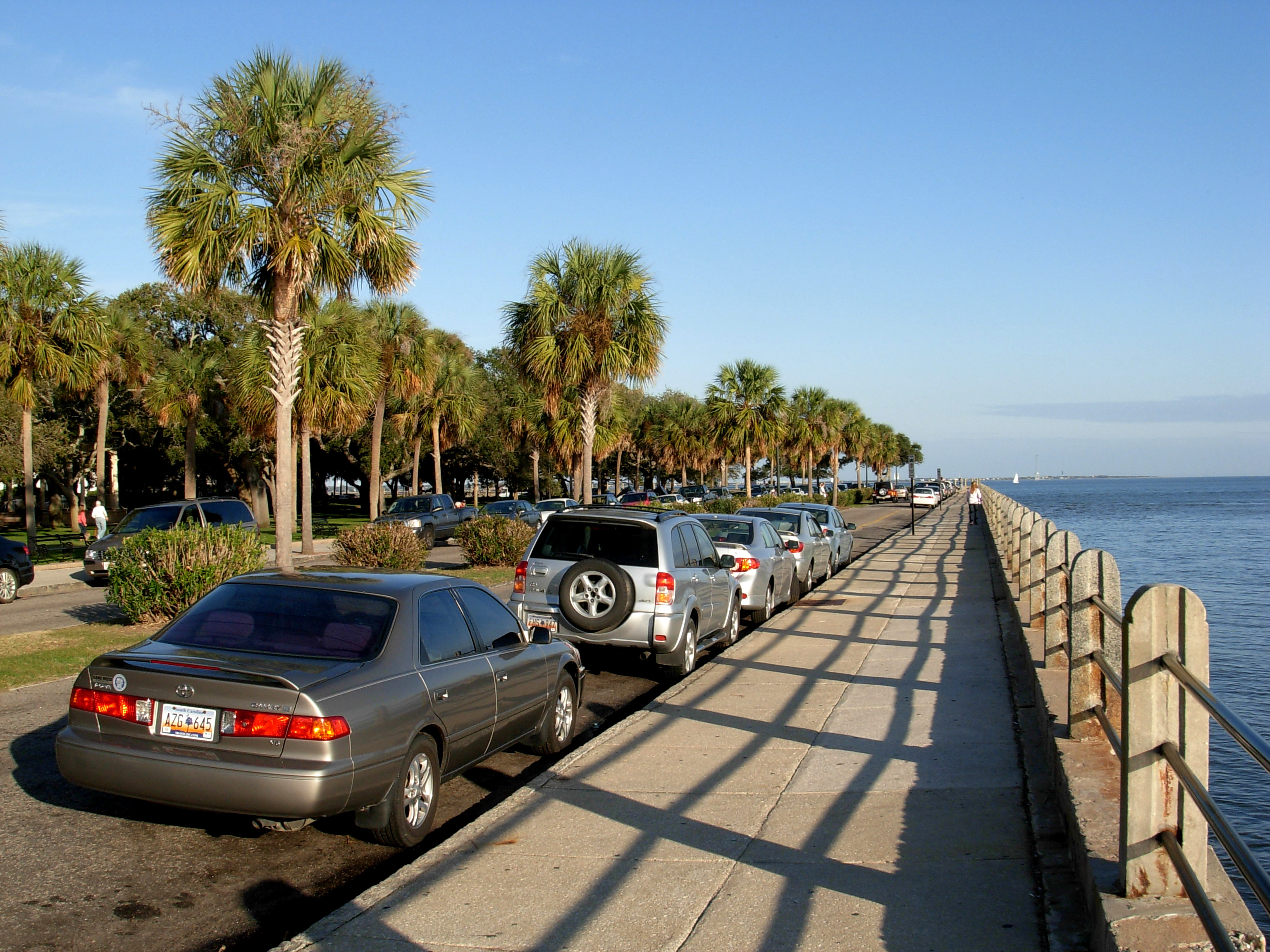
View of the walk along the Battery. Photo 2011, by Lewis Powell IV, all rights reserved.
haunted White Point Gardens Battery Charleston South Carolina pirate executions Stede Bonnet 1718 Southern ghosts
A barge passes by the Battery. Photo 2011, by Lewis Powell IV, all rights reserved.
haunted White Point Gardens Battery Charleston South Carolina pirate executions Stede Bonnet 1718 Southern ghosts
Houses overlooking the gardens. Photo 2011, by Lewis Powell IV, all rights reserved.
haunted White Point Gardens Battery Charleston South Carolina pirate executions Stede Bonnet 1718 Southern ghosts
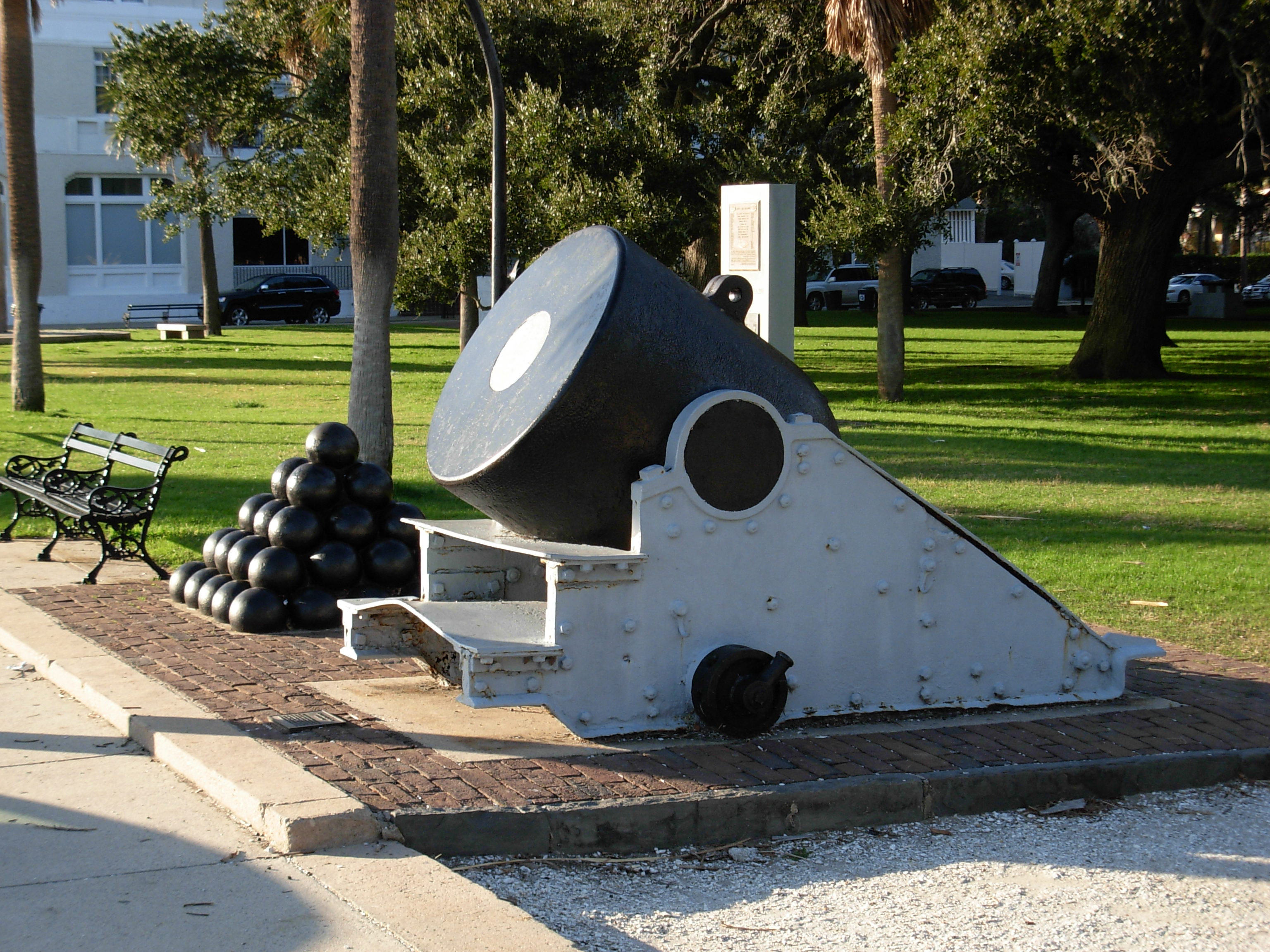
Artillery pieces like this mortar, line White Point Gardens as a reminder of the Battery’s martial function. Photo 2011, by Lewis Powell IV, all rights reserved.
haunted White Point Gardens Battery Charleston South Carolina pirate executions Stede Bonnet 1718 Southern ghosts
More of the heavy guns lining the gardens. Photo 2011, by Lewis Powell IV, all rights reserved.
haunted White Point Gardens Battery Charleston South Carolina pirate executions Stede Bonnet 1718 Southern ghosts
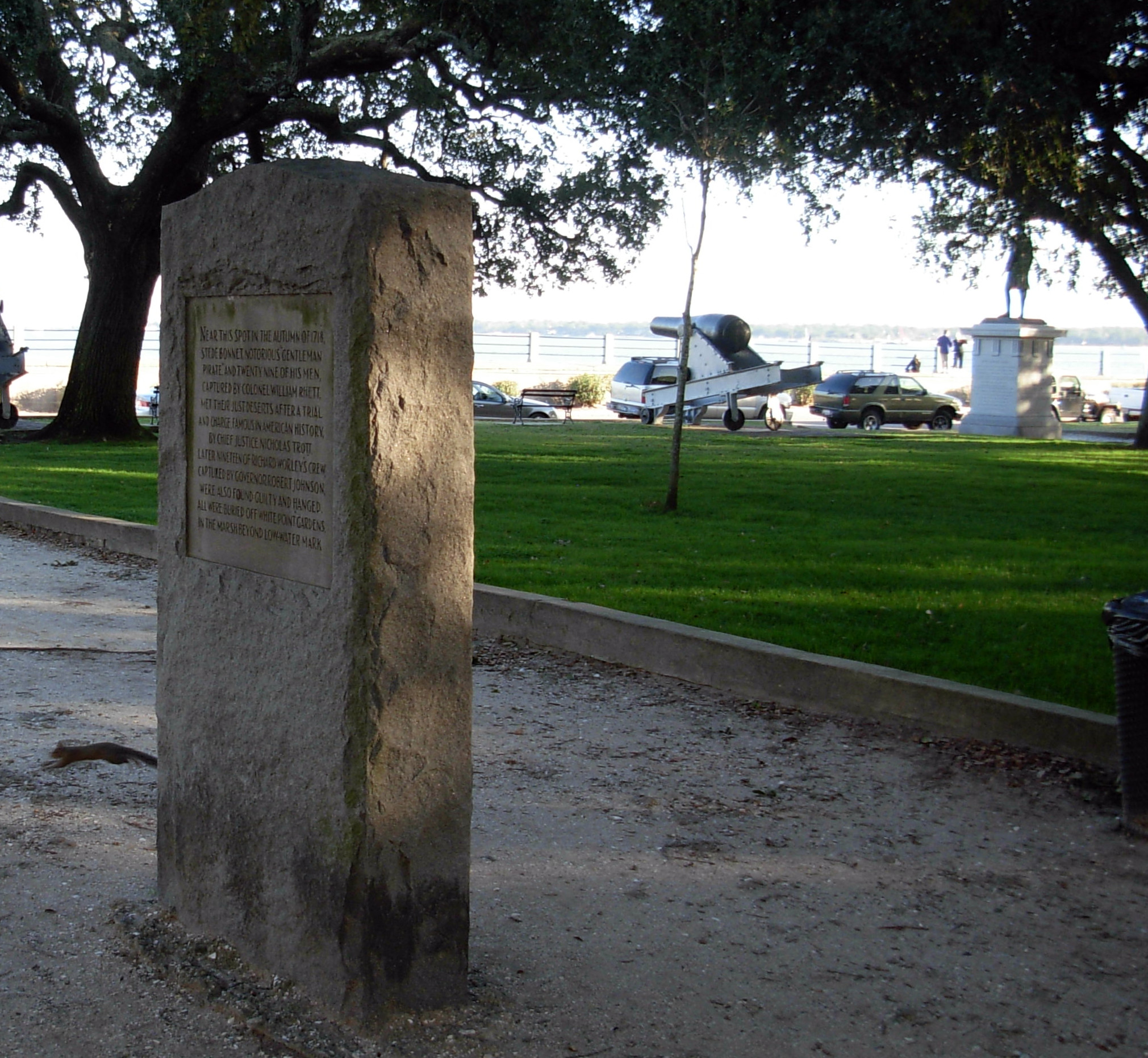
The stone marking the spot of Stede Bonnet’s execution. Photo 2011, by Lewis Powell IV, all rights reserved.
haunted White Point Gardens Battery Charleston South Carolina pirate executions Stede Bonnet 1718 Southern ghosts
The inscription on the Stede Bonnet marker. Photo 2011, by Lewis Powell IV, all rights reserved.
haunted White Point Gardens Battery Charleston South Carolina pirate executions Stede Bonnet 1718 Southern ghosts
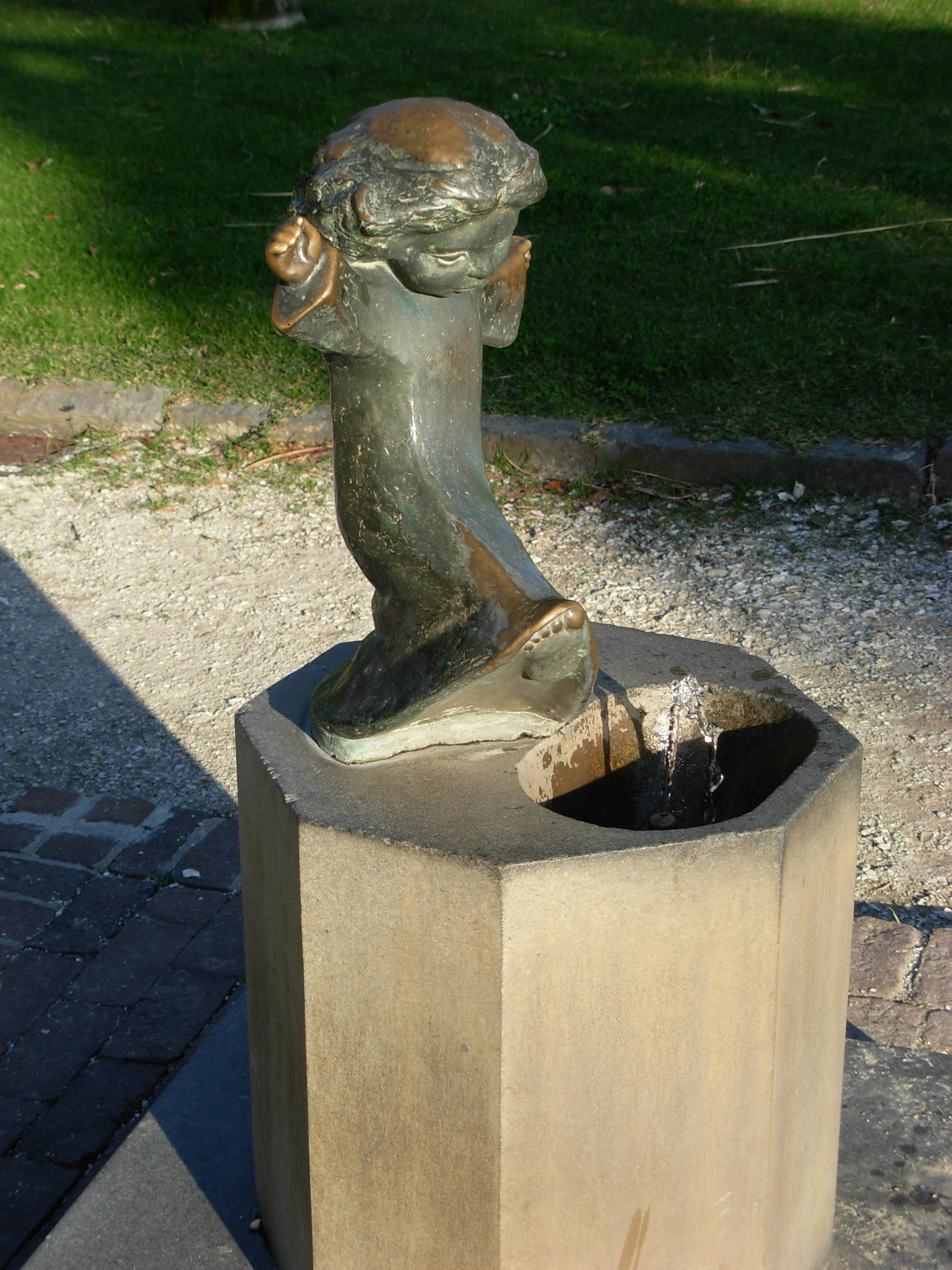
A whimsical sculpture greets visitors entering the gardens. Photo 2011, by Lewis Powell IV, all rights reserved.
haunted White Point Gardens Battery Charleston South Carolina pirate executions Stede Bonnet 1718 Southern ghosts
Looking towards the bandstand under the mighty oaks. Photo 2011, by Lewis Powell IV, all rights reserved.
haunted White Point Gardens Battery Charleston South Carolina pirate executions Stede Bonnet 1718 Southern ghosts
The sun filters through the trees. Photo 2011, by Lewis Powell IV, all rights reserved.
haunted White Point Gardens Battery Charleston South Carolina pirate executions Stede Bonnet 1718 Southern ghosts
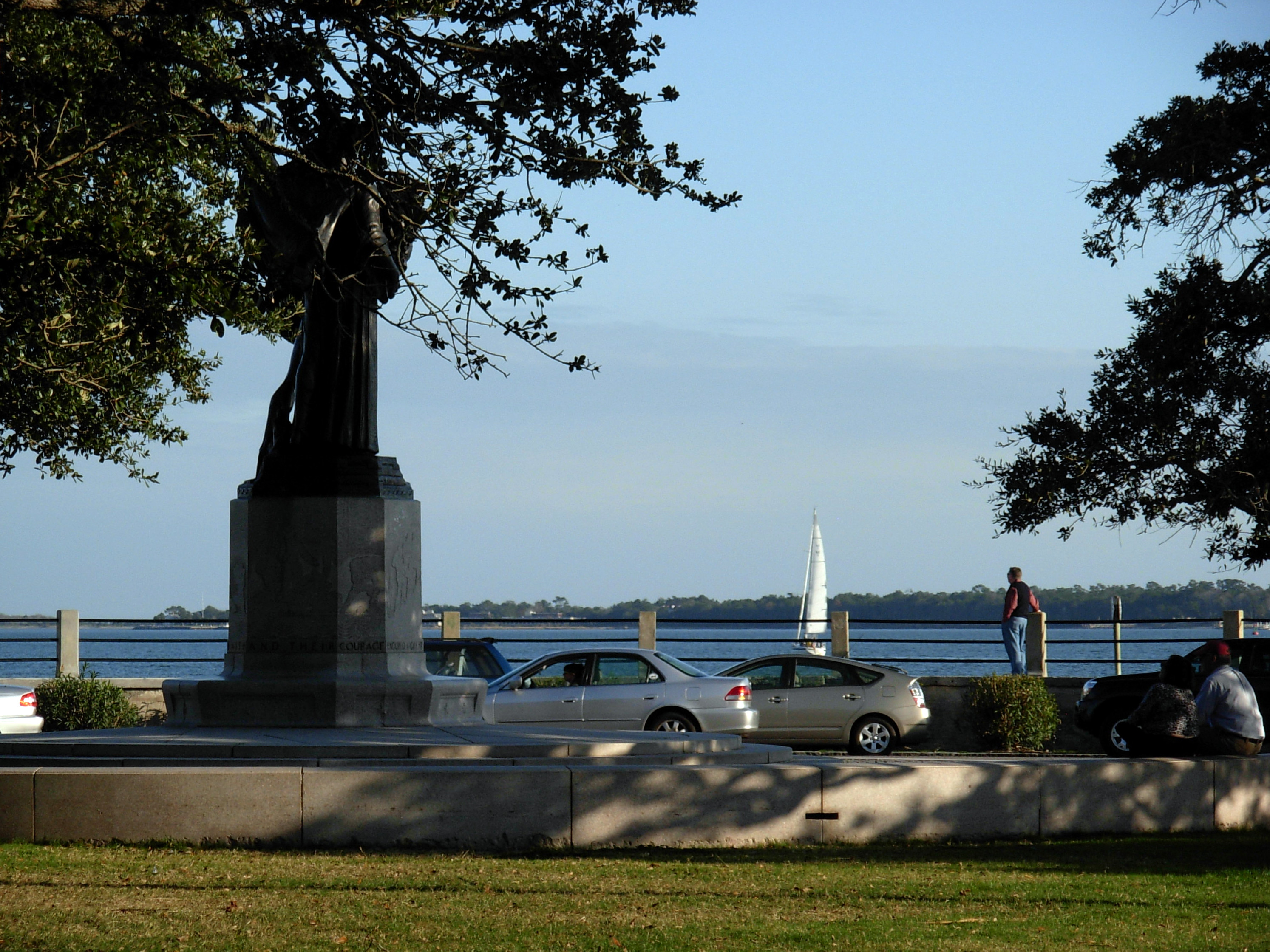
The Charleston defenders monument with a sailboat passing by. Photo 2011, by Lewis Powell IV, all rights reserved.
Confesderate monument haunted White Point Gardens Battery Charleston South Carolina pirate executions Stede Bonnet 1718 Southern ghosts
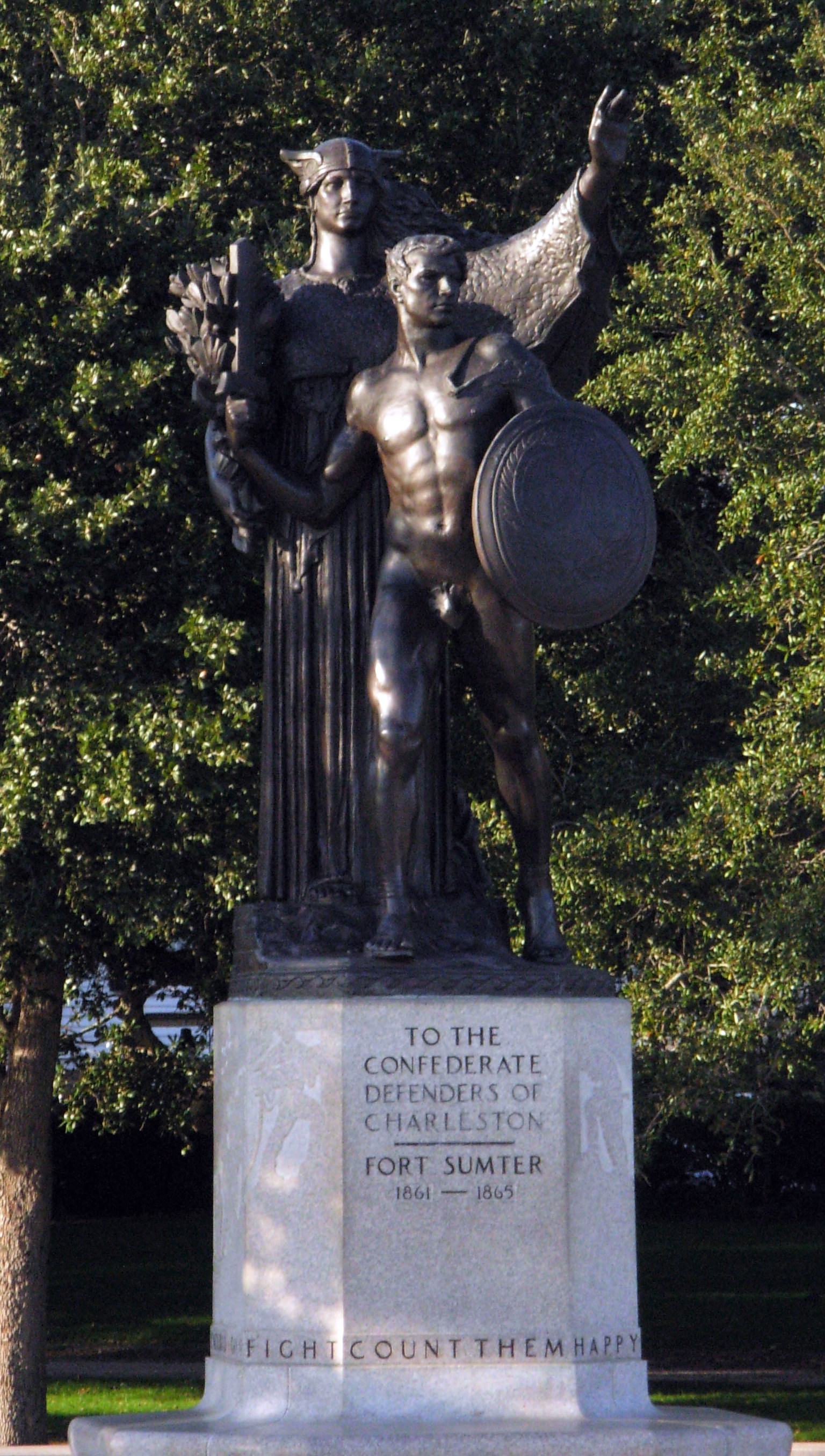
Monument to the Confederate defenders of Charleston. Photo 2011, by Lewis Powell IV, all rights reserved.

A Sunless Sea—Craighead Caverns and the Lost Sea

In Xanadu did Kublai Khan
A stately pleasure-dome decree:
Where Alph, the sacred river, ran
Through caverns measureless to man
Down to a sunless sea.
–Samuel Taylor Coleridge, “Kublai Khan” (1797)

The Lost Sea
140 Lost Sea Road
Sweetwater, Tennessee

Many moons ago a large, prehistoric jaguar stumbled into this cave in eastern Tennessee between the modern metropolises of Chattanooga and Knoxville. The large cat may have wandered in but it never saw the light again. Lost in the inky darkness of the cave, the cat stumbled, fell and died. Its remains and a couple paw prints remained undisturbed until two curious cavers discovered them in Craighead Caverns in 1939. Since then, according to Christopher Coleman’s Ghosts and Haunts of Tennessee, “visitors have felt something akin to the tail of a large animal brush against them. Locals swear that a phantom jaguar haunts the cave.” 

Visitor’s center. Photo, 2011, by Lewis Powell, IV, all rights reserved.

On a weekday morning in early December, I was visiting the cave long past the usual tourist season. The visitor’s center was quiet with a few employees putting up Christmas decorations. As a child, I always collected travel brochures when I went on family vacations and brochures for The Lost Sea were always available. I was thrilled to be finally visiting and even more thrilled to see that I was getting a private tour as one of the few visitors that morning.

The modern entrance to the caverns. Photo 2011, by Lewis Powell, IV. All rights reserved.

I descended the futuristic tunnel with my guide to the caverns and he began his spiel: explaining the stalagmites and stalactites and how they were formed. We entered a round room called the “Council Room” where the Cherokee who once owned the cave may have gathered. The ceiling of this room bears beautiful and rare ornamentations known as “anthodites,” a fragile, flower-like formation. The Cherokee were among the earliest explorers of the cave and they left behind some artifacts. In the 1820s, the property was owned by a Chief Craighead for whom the cave was named. At some point after this time the cave was “discovered” by the white pioneers moving into the old Cherokee lands. Initially, families living in the area used the large, cold and dark cave rooms for food storage, but eventually an operation was set up to extract saltpeter for gunpowder.

A cave formation. Photo 2011, by Lewis Powell IV, all rights reserved.

As with so many caves throughout the South, during the Civil War the cave’s saltpeter works became strategically important. In fact, the ceilings still bear signatures that were left there by soldiers and visitors. According to an old diary from the period, the cave’s guard was infiltrated by a Union spy who intended on blowing up the whole operation. Once discovered, the spy was dragged out of the cave, tied to a large gum tree and shot. Of course, some have tied this story with the spirits that may haunt the cave, though, as of yet, there’s no real evidence to make that connection.

Replica of a saltpeter leeching vat. Photo 2011, by Lewis Powell, IV, all rights reserved.
A date smoked into the ceiling. Photo 2011, by Lewis Powell, IV, all rights reserved.
A soldier’s name smoked into the ceiling. Photo 2011, by Lewis Powell, IV, all rights reserved.

Following the tumult of the Civil War, the cave saw a variety of uses including mushroom farm, a setting for moonshine operations and as a fallout shelter during the Cold War. In 1947, the cave opened as the Cavern Tavern, a nightclub in the Big Room just inside the historical entrance of the cave. The tavern owners installed a bar and a dance floor with a band in an adjacent room which aided the acoustics. Patrons entering the tavern would traverse a steep staircase to descend into the club and once they’d had a few drinks and danced the night away, would again have to traverse the staircase again. According to the guide, resulting injuries from drunk patrons forced the closer of the club after a few months.

A cave formation. Photo 2011, by Lewis Powell IV, all rights reserved.

We were standing in the Hanging Rock Chamber (a round room created by a whirlpool with a ceiling of jagged rock) as the guide told me about the club in the adjacent Big Room. The room is not usually open during regular tours, though it is used as part of the Wild Cave Tours and groups spending the night within the cave stay here. No mention of legends had come up at this point, so I decided to ask about ghosts.

“I’ve read that there are a few legends of ghosts associated with this cave.”

The guide looked rather uneasy so I added a postscript, “I’d be interested in hearing anything you may know if you’re not forbidden to talk about it.” The guide relaxed a bit.

“I’ve had some experiences here.” He went on to explain that he had had an experience in the Big Room. He was in the cave with a group spending the night and was seated on the infamous staircase reading. He was startled by a sudden drop in temperature at which point he said he heard voices around him whispering. He jumped up and went outside for a little while.

“The Hell Hole” within the upper portion of the cave. Photo 2011, by Lewis Powell IV, all rights reserved.

He went on to relate the experience of a maintenance man who was gathering bags of trash in the same room. The maintenance man heard the sound of footsteps following him as he moved through the room. As he began to leave, a voice uttered his name from just behind him. He fled.

The guide and I began to leave the Hanging Rock Chamber, but I wanted to get a photograph of the entrance to the Big Room. Since we were on a private tour, I was allowed to venture into the room to see the dance floor and the staircase. The way into the room was steep and I was out of breath by the time we were inside. The room felt colder and there was an odd, possibly chaotic energy there. My instincts said, “You shouldn’t be here.” I ignored them and took a few pictures, though I could tell the guide wanted to go as well. As we hurried out, I remarked on the energy. He felt it too.

The best picture I could get of the old dance floor in the Big Room. Photo 2011, by Lewis Powell IV, all rights reserved.

I recalled something a guide said when I was visiting Kentucky’s monstrous Mammoth Cave last year. After turning out the lights we were treated to the pitch black darkness that can only be found in caves and at the deepest reaches of the ocean. The guide spoke of how caves can wreck havoc on the senses, especially where there is the sound of water: the ears can be tricked into hearing voices. In the case of Craighead Caverns, the cave is quite humid and there are large amounts of water, though mostly in the lower reaches. In the upper reaches, I occasionally heard water dripping, but it was fairly sporadic and not noisy enough to be mistaken for voices.

Anthodite “flowers.” Photo 2011, by Lewis Powell IV, all rights reserved.

We discussed spirits as we moved through the caverns towards the Lost Sea. My guide mentioned that he occasionally saw shadowy figures dart through the caverns. I inquired about the spirits of the ancient jaguar and the Union spy. He had heard the stories but didn’t elaborate any further.

The guide returned to his spiel about the discovery of the Lost Sea. As it turns out, the sea really was lost for quite a time. A young man playing in the cave in 1905 was the first to discover the large, flooded chamber. When he told others about it, they tried to find the room, but were met only with passages that were flooded. As Ben Sands grew older he continued to tell about the lost sea that only he had seen. It wasn’t until many years later that the sea was found and the entire cave developed as a commercial “show cave.” It opened as The Lost Sea in 1965.

The sea itself is immense. The only words I could utter when it was first revealed were, “Oh my!” As we got out on the second largest underground lake (as they call it) in the world, I did feel a bit of a chill peering into the darkness beyond the boat. The lake is lit with occasional lights along the edge and this allows visitors to see the large Rainbow Trout that have been stocked within the lake, but it is still fairly dark. Seeing the large, dark shape in the water of the first trout approaching the boat was a bit disconcerting and soon the water around the boat was swarming with them. They’re fed on every tour and that has contributed to their large size.

The Rainbow Trout in the sea. Photo 2011, by Lewis Powell IV, all rights reserved.

After exiting the boat the guide and I began our ascent back to the entrance. We paused for a moment near a dark, narrow passage that was another part of the Wild Cave Tour. The guide mentioned that he didn’t like to walk that area alone and he offered to let me take a quick look. We walked a few yards into the passage and something in the back of my mind kept repeating, “You don’t need to be here.” My guide remarked that he felt another energy change and felt a heaviness in his chest. I didn’t sense any of that, but it felt warmer in the space, a feeling that I somehow equated in my mind with hot breath. I knew I did not want to go any further so I took a quick picture and we returned to the trail.

Overall, the cave tour is quite pleasant. Where some cave experiences can be overdone (using music, colored lights and other nonsense), this cave is perfectly lovely and it has been left in its mostly natural state. The wonder of nature’s creation and the cave’s unique history shows through. My guide (and he knows who he is) was friendly and very interesting. I’m grateful he shared his experiences with me. If you’re looking for an interesting tour in East Tennessee, be sure to stop at Exit 60 for The Lost Sea!

A reader of this blog provided me with a fascinating encounter she had at the Lost Sea.

Sources

  • Coleman, Christopher K. Ghosts and Haunts of Tennessee. Winston-Salem, NC: John F. Blair, 2010.
  • The Lost Sea Adventure. The History of The Lost Sea Adventure: America’s Largest Underground Lake. Sweetwater, TN, No date.
  • Matthews, Larry F. Caves of Knoxville and the Great Smokey Mountains. Huntsville, AL: National Speleological Society, 2008.

“…the Heav’n rescued land…”—Fort McHenry, Baltimore, Maryland

Blest with vict’ry and peace, may the Heav’n rescued land
Praise the Power that hath made and preserved us a nation!
–Francis Scott Key, “The Defense of Fort McHenry”

One can hardly fathom the sheer terror that Francis Scott Key must have experienced as he watched the bombardment of Fort McHenry on the night of September 13 and into the early morning hours of the 14th, 1814. That evening, Key, a thirty five year-old Maryland-born lawyer from Georgetown in the district of Columbia, had dined with enemy officers aboard an enemy ship in order to negotiate the release of American prisoners. Because he was now privy to British plans for the bombardment and invasion of Baltimore, Key and American Prisoner Exchange Agent Colonel John Stuart Skinner were detained aboard the HMS Tonnant.

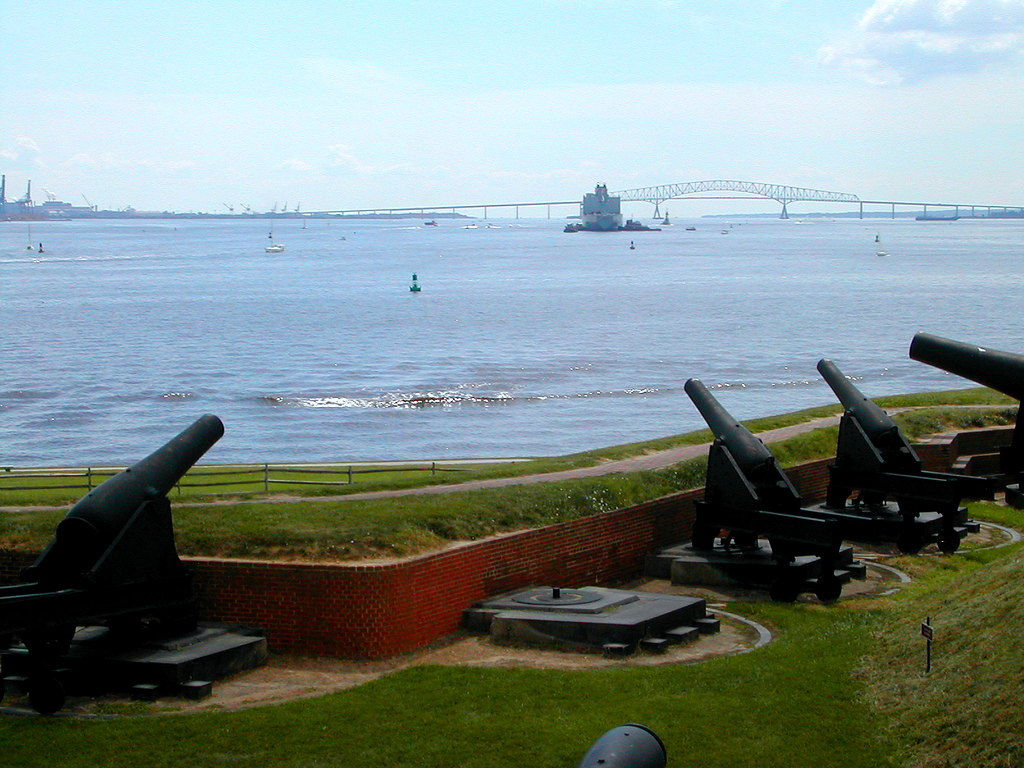
The guns of Fort McHenry now overlook the Francis Scott Key Bridge which carries I-695. Photo by renpytom, released under Creative Commons licensing.

Key likely knew of the systematic destruction of Washington, D.C. by the British and quite possibly worried about destruction of his own home on the opposite bank of the Potomac River. Now detained aboard an enemy ship in Baltimore harbor, it’s imaginable that he worried about the probable destruction of another American city. Below decks, American prisoners lay shackled and there was fear that the British would mercilessly hang these citizens including a respected doctor, William Beanes, from Upper Marlboro, Maryland. Key and Skinner watched with horror the bombardment of Fort McHenry with its huge flag.

A reproduction of the fort’s huge flag still flies. Photo by renpytom, released under Creative Commons licensing.

The bombardment by the British fleet in Baltimore harbor began on the morning of the thirteenth with an initial exchange. The Americans had sunk a series of merchant ships in the harbor to prevent the British from getting close enough to the fort. After the initial bombardment, the British withdrew to just outside of the range of Fort McHenry’s cannon. At 1 AM the next morning, the British began their heaviest and most long-lasting bombardment that would last most of the next day. They poured some 1500 to 1800 Congreve rockets and mortars onto the fort from a series of ships. Firing mortars onto the fort were ships bearing names like Devastation, Terror, Meteor, Volcano and Aetna. Fortunately, the mortars were poorly designed and few of them actually reached their targets while many of the Congreve rockets exploded mid-air. “…And the rocket’s red glare, the bombs bursting in air…”

With dawn’s early light, Fort McHenry’s huge flag which had been sewn by Mary Pickersgill and her 13 year-old daughter was revealed to still be flying, an indication that the city and fort had repelled the invasion. Relieved, Key wrote an ode to the flag that was set to an English tune, “To Anacreon in Heaven.” The song gained popularity and was eventually deemed the national anthem in 1931. The grand flag has been cherished and preserved in the Museum of American History while Fort McHenry has been deemed a National Historic Shrine: a shrine to liberty, American defiance, hope, history and spirits.

A view of one of the bastions. Photo by Ad Meskens, courtesy of Wikipedia.

Whetstone Point juts into an arm of the Patapsco River as it meets the Chesapeake Bay. This peninsula provides the perfect perch from which to oversee ships sailing into Baltimore Harbor and it was here that a fort was first constructed during the American Revolution in 1776. Baltimore was never under British threat during that war, but the local citizens thought it necessary to expand the fort following the war using a five-pointed star design by Jean Foncin. Among the fort’s biggest cheerleaders during this time was Secretary of War James McHenry, for whom the fort was later named.

In the midst of the tumult of the early nineteenth century, American decided to finally stand up against British bullying and declared war. It was this action that brought intense military scrutiny to the region and then action in 1814. Brevet Lt. Col. George Armistead commanded the fort during the day-long bombardment and saw only four casualties among his men. Following the war, the fort resumed its duties standing guard over the harbor until the nation it kept intact was torn apart by Civil War. As Maryland remained neutral there was fear that those with Southern sympathies would try to secede, thus leaving Washington, D.C. surrounded by enemy territory. Politicians suspected of having rebel sympathies were imprisoned in the fort including Baltimore’s mayor, city council and police commissioner. Legend states that the fort’s guns were even trained on the city it had so dutifully protected.

After the Civil War the fort resumed its regular duty and when war once again tore Europe apart during World War I, the fort became a 3000 bed hospital for American troops. After medical duty, much of the fort was restored and it was named a National Park in 1925. On the eve of the Second World War, the fort was named both a National Monument and Historic Shrine, a unique designation from a grateful nation. Once again, the fort resumed duty, like many historic coastal forts. The fort was used by the Coast Guard who worked to protect American shores and shipping from German U-boats.

Under the purview of the National Park Service, the typical line is taken: there are no ghosts at Fort McHenry, though many experiences have been documented. Ed Okonowicz in his masterful Baltimore Ghosts catalogs the numerous spirits that have been witnessed through the old fort. Among them are one, possibly two spirits from the British bombardment in 1814. During one of the engagements, the British scored a direct hit on a gun emplacement on Bastion 3. The explosion killed two Baltimore merchants serving in the Maryland Militia, Lt. Levi Clagett and Sgt. John Clemm. Visitors and staff near “Clagett’s Battery” as it is now called, have spotted the visage of a soldier in period uniform. Visitors sometimes inquire at the visitor’s center as to the identity of the reenactor in that area when none are present. During preparations for a visit by President Gerald Ford, the Secret Service spotted a uniformed soldier walking the same bastion where Clagett and Clemm died.
One of the fort’s gun emplacements. Photo by sneakerdog, released under Creative Commons licensing.

The barracks hosts a female spirit who has been spotted looking out the window and who may be responsible for two “attacks” that have taken place there. An artist who was exploring the building walked through a doorway and was knocked out cold by an invisible something. He stated that it felt like he was hit in the face with a frying pan. He was discovered a short time later by a park ranger who escorted him from the building and who did not seem surprised by the artist’s experiences, replying that he had had a woman in nineteenth century clothing try to push him down the stairs. According to Okonowicz, the identity of the woman may be that of a military officer’s wife who lost both her husband and children to an epidemic sometime after the War of 1812.

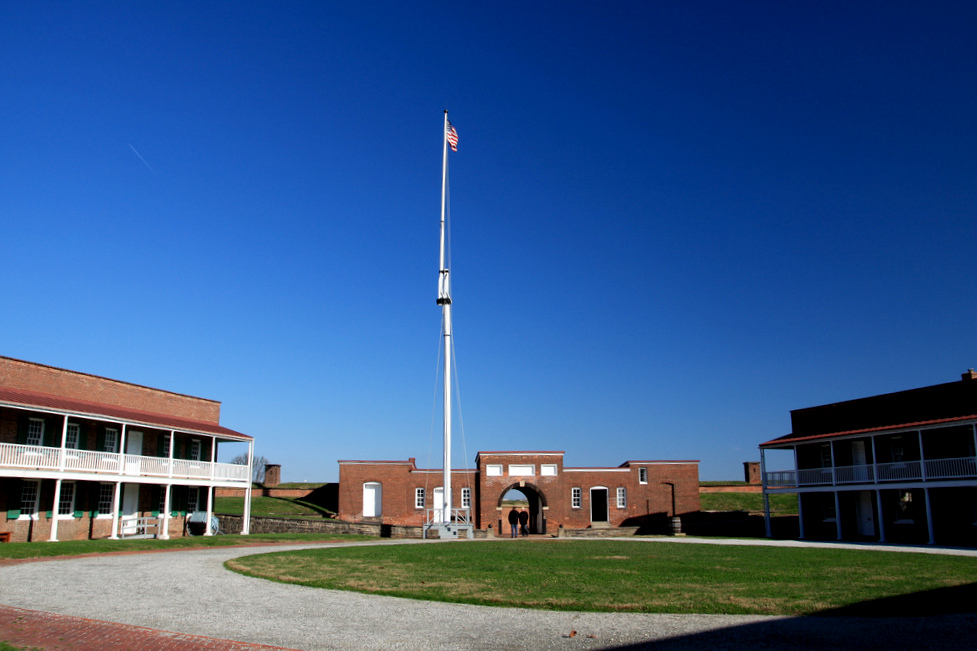
The parade ground with barracks and the sally port. Photo by David Smith, released under Creative Commons licensing.

Perhaps one of the saddest spirits of the fort is the pathetic form of Private John Drew. Drew was on guard duty one evening in 1880. He was arrested the following morning when he was found to have fallen asleep on the job. Unable to deal with this horribly embarrassing episode, Drew shot himself in his cell. Drew’s form has been seen near where he was supposed to be standing guard on that fateful evening. Others have felt a chill within the cell where Drew took his life.

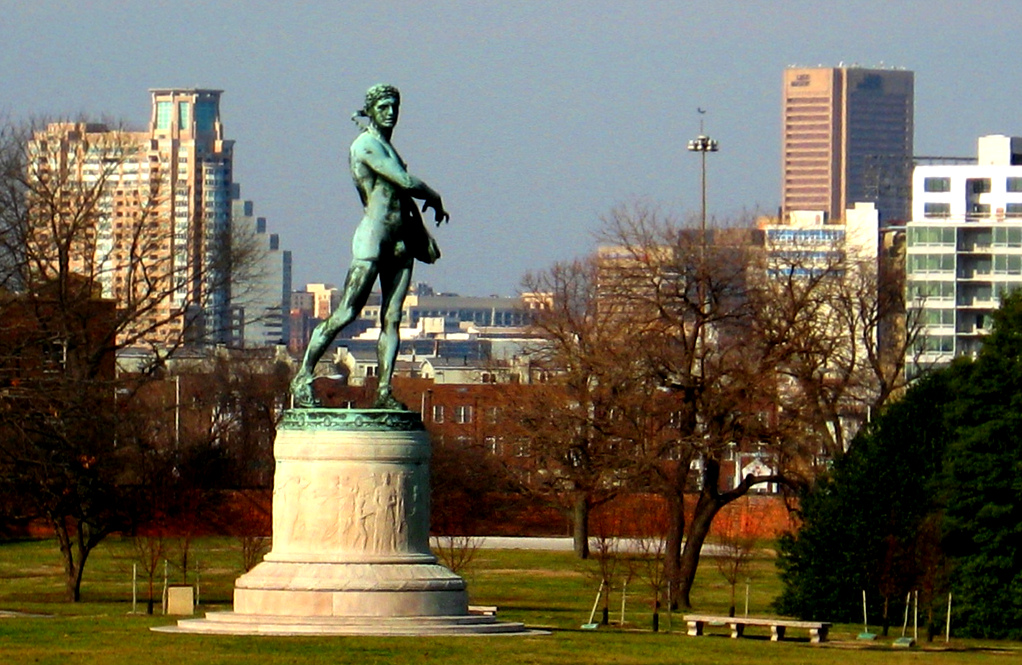
The statue of Orpheus with the Baltimore skyline in the background. Photo by pwbaker, released under Creative Commons licensing.

One of the more interesting experiences reported on the grounds of the fort comes from near a large statue of Orpheus honoring Francis Scott Key. The large statue stands on the grounds outside the fort and it was here that one visitor saw the figure of man in uniform seemingly floating in mid-air. It was discovered later that that particular area had been the scene of an execution in 1862. A young private had been found guilty of murdering another soldier and it was here that he made his “air-dance,” in other words, he was hanged. Most likely, this is just a sample of the spirits that roam the historic battlements of Fort McHenry; battlements that still witness “the rocket’s red glare, the bombs bursting in air,” every Fourth of July when fireworks celebrate the freedom this place helped maintain.

Sources

  • Fort McHenry. Wikipedia, the Free Encyclopedia. Accessed 22 November 2011.
  • Francis Scott Key. Wikipedia, the Free Encyclopedia. Accessed 22 November 2011.
  • Okonowicz, Ed. Baltimore Ghosts: History, Mystery, Legends and Lore. Elkton, MD: Myst and Lace Publishing, 2006.
  • The Star-Spangled Banner. Wikipedia, the Free Encyclopedia. Accessed 22 November 2011.
  • Varhola, Michael J. and Michael H. Varhola. Ghosthunting Maryland. Cincinnati, OH: Clerisy Press, 2009.