Ralph L. Fike High School 500 Harrison Drive Wilson, North Carolina
High school is scary enough. You already have teenage angst compounded by raging hormones and with modern teenage drama; it makes for a volatile situation. It’s even worse, I imagine, with ghosts thrown in.
Schools, ranging from preschools to university buildings, appear frequently on lists of haunted places. In his 2003 book, Haunted Schools, A.S. Mott suggests several reasons why schools may be rife with spiritual activity. Some activity can be linked with the land upon which the school sits, while others have been the scene of deaths, accidental or otherwise, that may contribute to a haunting. Students who pass on away from school, may return to the place where they spent their formative years, or devoted faculty or staff members may continue their duties in the afterlife.
Some of these stories are simply urban legends that flourish within the school community. They bear the hallmarks of oral storytelling as each teller adds their own flourishes compounding the exaggerations and inaccuracies, though there sometimes remains a kernel of truth.
Among haunted schools in the South, there are some very notable haunted schools including C. E. Byrd High School in Shreveport Louisiana; Airport High School in West Columbia, South Carolina; Bristol Tennessee High School in Bristol, Tennessee; and Matthew Whaley Elementary in Williamsburg, Virginia.
North Carolina has a few notable haunted high schools including Erwin High School in Asheville, which was built on the site of a potter’s field cemetery. While most of the graves were moved prior to construction, it’s possible that some were missed which might account for some of the activity.
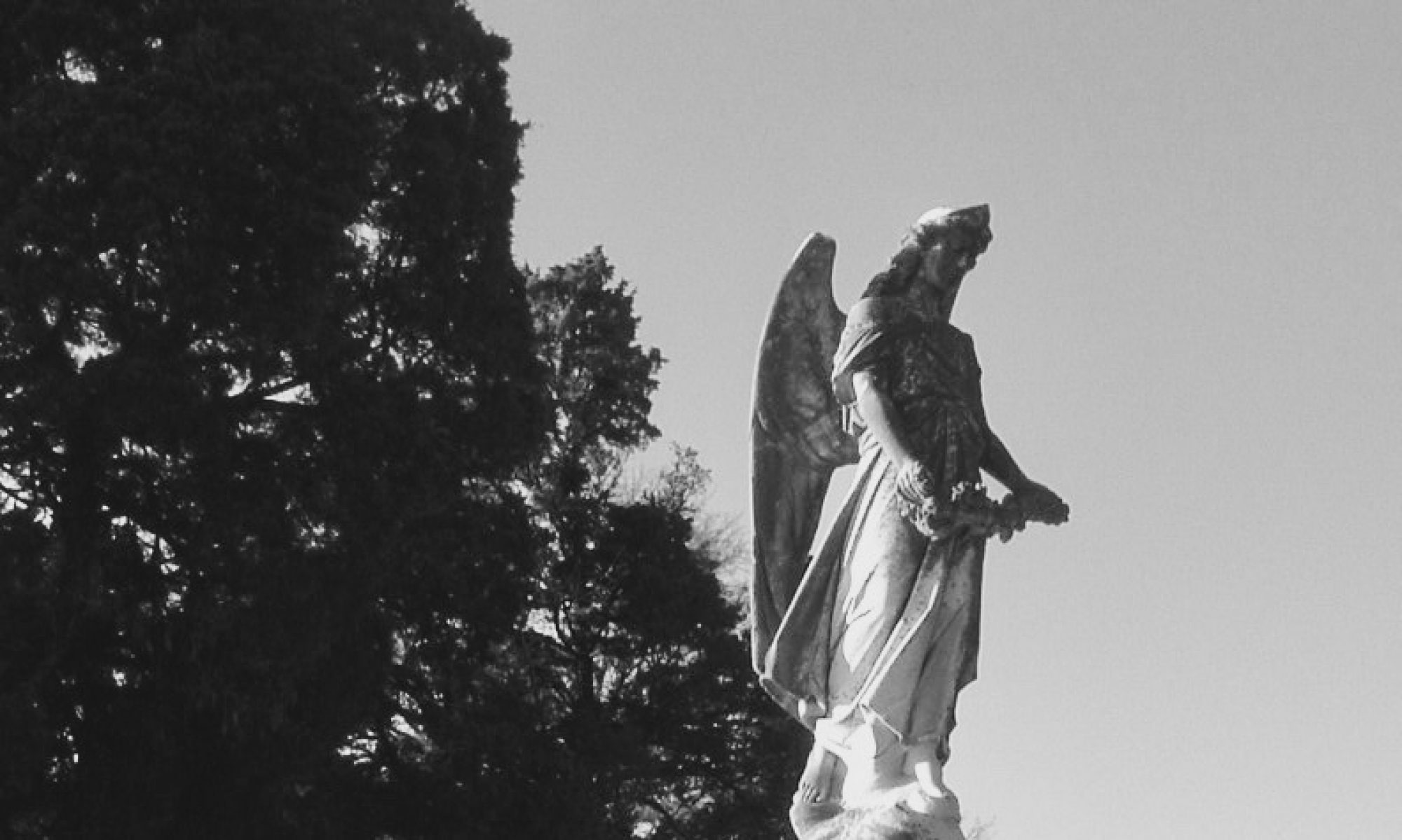
Asheville, North Carolina’s haunted Erwin High School, 2012. Photo by Lewis Powell IV, all rights reserved.
I always wondered if my alma mater, LaGrange High School in LaGrange, Georgia was haunted. The school’s main building dates to the 1940s with many modern additions. Parts of the building were creepy, though I never heard anything substantial as to activity. Not that I wasn’t interested, in fact, I worked on an independent study my senior year about ghosts. While anxiety and procrastination marred that project, I believe all that work was really ramping up for the debut of this blog.
This is why I’m jealous of the student named in this recent article from the Wilson Daily Times; she’s gathering paranormal evidence about her high school for her senior project.
Certainly it appears that there are some very strange things going on at Fike High School. This project got its impetus when a student watched her classroom door close by itself during class. Moments later, the door opened again about six inches and a nearby projector head flipped downward by itself. The student began asking questions which has culminated in her concentrating on the school haunting as her senior project.
Witnesses to these phenomena include teachers, janitors and the assistant principal. A coach walking along one hallway began to notice the classroom doors closing by themselves as he passed. The assistant principle saw a white figure in the hallway when she was a student, while a current math teacher started hearing odd sounds one night as he was working late. He went to the main office to check the security cameras and noticed the motion detectors were alerting him to movement in the second floor hallway. When he went to look, he saw a white figure at the end of the corridor.
The student has called in a paranormal team, The Paranormal Detectives, to investigate. The results of the investigation will be publicized in the local paper.
Wilson County Courthouse in downtown Wilson, North Carolina. Photo 2014, by Ammodramus. Courtesy of Wikipedia.
The school, built in 1958, occupies the site of a farm, though the student has been unable to find evidence of any particularly traumatic events occurring there. “I need to keep digging to find out if anything traumatic happened.” she said.
Sources
Butcher, Lucy. “Fike High School under investigation for paranormal activity.” The Carolina Mercury. 14 March 2013.
Maryland Theatre 21 South Potomac Street Hagerstown, Maryland
Nota Bene: This is a repost. The original article was posted 31 May 2011.
Sometimes I’ll encounter an article that opens a whole Pandora’s Box of articles and hauntings. This is one of those cases. Initially, I was looking for information on the Westminster Opera House in Westminster, Maryland and decided to Google “haunted theatres Maryland.” An article from the Hagerstown Herald Mail regarding the Maryland Theatre popped up and I dutifully added it to my files and then began searching out whatever else I could find on it. A search for “Maryland Theatre ghost” turned up a few more articles, but most importantly, an article from Hagerstown Magazine detailing a number of haunts in the area. What joy! And a quick jaunt to the website of the Maryland Historic Trust et voila, I now have a copy of the theatre’s National Register of Historic Places nomination form. Thank goodness for the convenience of the internet!
Hagerstown is situated in western Maryland’s Washington County, just south of the Mason-Dixon Line in the Great Appalachian Valley. Its position brought much of the action of the Civil War to the city’s doorstep with armies of both sides tramping through its streets on a number of occasions. The Battle of Antietam—the bloodiest single day in American military history—was fought just south of the city. Hagerstown prospered throughout the 20th century and is now the largest city in Western Maryland.
The Maryland Theatre opened in 1915 as a top tier vaudeville and movie house. The structure was built in the interior of the 20s block of Potomac Street. The entrance and lobby of the theatre, located on the ground floor of an adjoining apartment building, extended towards Potomac Street. The theatre was designed by Harry Yessler, a local architect, in conjunction with Thomas Lamb, one of the preeminent theatre architects of the day. The interior of the theatre is an elegant Neoclassical design complete with decorative plaster work.
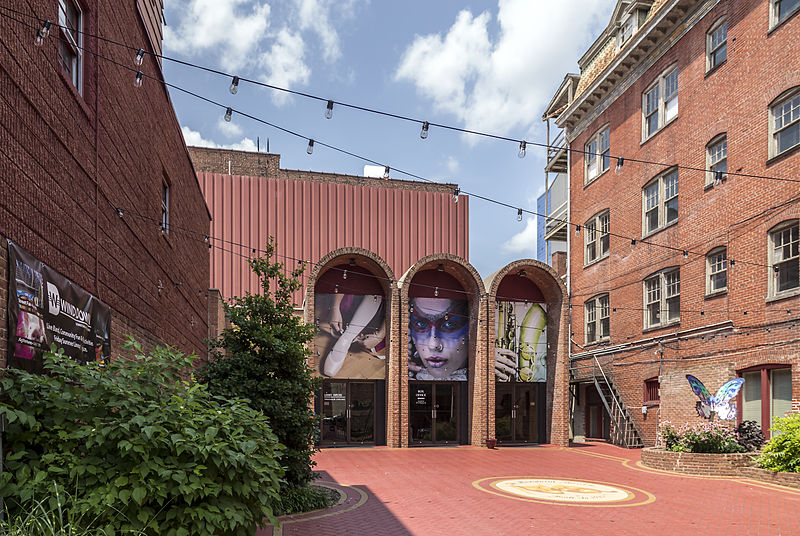
The modern entrance to the Maryland Theatre, 2014. Photo by Acroterion, courtesy of Wikipedia.
Even as live theatre became increasingly scarce, the theatre continued in business until it closed in 1973. The following year, the building lobby and entrance were destroyed when the adjoining apartment building burned. Firefighters valiantly fought to save the theatre itself and were successful, though one life was lost in the apartment building. The remains of the building and the theatre’s lobby were not salvageable and they were razed. When the theatre was reopened, a small lobby was constructed with a passage to Potomac Street. Sadly, from the outside, the lobby’s 1970s modern architecture is at odds with the opulence within the theatre. The modern theatre now plays host to numerous cultural events and is one of the premier cultural venues in the region.
Stories of the theatre’s haunting appeared quite early. The daughter of one of the theatre’s first managers worked in the theatre between the 1930s and the 1960s. Reportedly, she claimed to have encountered her father, who loved the theatre dearly, still going about his daily business. More recently, staff members have had the feeling of not being alone, but have also heard voices. According to two different articles, an investigation by the Mason-Dixon Paranormal Society was able to capture a number of EVPs in the building. It appears this historical theatre has its fair share of spiritual occupants as any good theatre should. As one of the theatre’s former executive directors remarked, “Starting with the Phantom of the Opera, every theatre should have a ghost.”
A commenter under the name “mymixedtapeforher”posted on the original entry that friends had experienced quite a bit in the theatre including the feeling of hands pushing on their backs, being told to “get the f*** out” by a disembodied voice” and finding a sandbag (used as weights on the theatre’s fly system) sliced open. These details, if true, make this quite an interesting haunting.
Sources
Coffey, Claudia. “Hagerstown Theater Believed Haunted.” com. 31 August 2009.
Finglass, Jack L. & Ronald L. Andrews. National Register of Historic Places Nomination Form for the Maryland Theatre. Listed 13 November 1976.
Hagerstown, Maryland. Wikipedia, the Free Encyclopedia. Accessed 31 May 2011.
Julius, Erin. “Is the Maryland Theatre haunted?” Herald-Mail. 30 August 2009.
Pensacola Cultural Center 400 South Jefferson Street
Florida has a glut of haunted theatres; not that that’s a bad thing. A recent project has me researching theatres throughout the South and it seems that Florida has more than any other state. Perhaps it’s geography or something in the air or all the seawater that surrounds the state; it gives one pause.
On the official website for the Pensacola Cultural Center, one statement stands out, “The spaces where judges handed out justice and criminals served their time are now filled with the positive energy of dancers, actors, artists, and students.” The building was initially constructed in 1911 as the Escambia County Building, housing the county Court of Records and the jail. Places where criminals were tried, sentenced, incarcerated and executed now thrum with the rhythm of the arts in this old building.
It seems that some of the criminals are still doing time in this Neo-classical structure. A man has been seen lurking within the building. A staff member working in the building afterhours heard the operating of a nearby elevator. Shortly afterwards the dark shadow of a man walked past the staff member’s open door. She called out but did not get a response. When she looked into the hallway, it was empty.
The Pensacola Cultural Center, 2007. Courtesy of Pensapedia.com.
A couple staff members working late in the auditorium saw a man sitting in one of the seats. They both saw him simultaneously and turned to look at each other. When they turned back, the man was sitting in a different seat, on the opposite side of the house. They described him as wearing a worn suit and having a gaunt face. Some have identified this male spirit as that of Hosea Poole, a small time criminal who murdered his brother. Poole was the last man executed in the jail when he was hung July 31, 1920. However, there is little evidence, other than coincidence, to solidly identify the spirit as Poole’s.
The playful spirit of a young girl, possibly from the 1920s or 30s has also been witnessed. Unlike the male spirit’s almost menacing presence, the young girl has been heard giggling and she has been seen playfully skipping through the hallways. She is known to peer curiously over shoulders and she is occasionally seen peering from shadowed corners.
Saenger Theatre 118 South Palafox Place
Known as the “Grande Dame of Palafox Street,” the Saenger Theatre was literally built from the ruins—the bricks and other fittings—of the Pensacola Opera House which was destroyed in the 1917 Nueva Gerona hurricane (so named for the destruction it caused to the Cuban town of Nueva Gerona). The theatre opened in 1925 as a venue for live performances and film. Broadway shows and vaudevillians on “The Road” played here as well as films like Cecil B. DeMille’s The Ten Commandments which opened the theatre.
Saenger Theatre, 2010, by Ebyabe. Courtesy of Wikipedia.
The Saenger thrived as a cinema for a few decades until competition from multiplex big screens and the small television screens now found in homes began to shrink the audiences to the Grande Dame. The theatre closed in 1975 but was reopened as a cultural center in 1981. The theatre was extensively renovated in 1996.
With the crowds that have passed through the theatre’s doors since its opening and whatever spiritual residue may be left on the old bricks and other fittings from the old opera house, it’s no wonder that the Saenger Theatre has some paranormal activity on hand. Voices have been heard in the balcony of the building and spirits may affect the electrical circuits at times. Author Alan Brown records an incident that happened to the electricians working on a touring show. Just after hanging and adjusting the lighting for a show, the lights began to flash erratically on their own volition. The blame for this activity is laid upon the spirit of a worker who died when the boiler in the basement exploded, though—like Hosea Poole at the Pensacola Cultural Center—there is nothing to specifically identify the culprit.
Sources
Brown, Alan. Haunted Pensacola. Charleston, SC: History Press, 2010.
Jenkins, Greg. Florida’s Ghostly Legends and Haunted Folklore, Vol. 3: The Gulf Coast and Pensacola. Sarasota, FL: Pineapple Press, 2007.
Kehoe House 123 Habersham Street Savannah, Georgia
Savannah has worked hard to promote its ghosts. Perhaps it may be one of the more, if not most, active cities in the South. Its huge historic districts are just crawling with spirits, some strolling through its parks, stalking its streets and alleys, lingering in its gardens and cemeteries, residing amongst the living in private homes, floating between the tables of restaurants and bars and staying on past their reservations in the city’s hotels and inns. Savannah has no end of beautiful hotels and inns for guests and ghosts to haunt. From historic hotels like the Marshall House, 17Hundred90 Inn and the East Bay Inn to bed and breakfast inns like the Foley House Inn and the Hamilton-Turner House, ghosts and guests have quite a bit to choose from. Perhaps one of the grandest among these is the Kehoe House on Columbia Square.
Savannah was laid out by James Oglethorpe, the founder of the Colony of Georgia, in a style used initially by the ancient Romans for laying out their military encampments. This style consists of broad avenues punctuated by squares. Over time the strict lines of this plan have been softened by the many live oak trees planted along the streets and in the squares. The oaks provide a verdant canopy over the still vibrant historic streets and squares. Columbia Square is one of more peaceful and less bustling squares while two of its structures anchor its historic character: the Isaiah Davenport House and the Kehoe House. The ghostly reputations of both these houses also anchor them in the annals of the paranormal world
Built in 1820, the Isaiah Davenport House was built almost 70 years before the construction of the grand Kehoe House just across the street. Isaiah Davenport was a master builder from New England who used his family’s home to demonstrate his building skill; while William Kehoe was an Irish immigrant who climbed his way up the ladder in the iron industry and eventually bought the iron foundry where he began as an apprentice. In building his home, Kehoe sought to demonstrate the beauty and flexibility of his iron products which were used in the window and door frames, railings and balustrades. Both the Federal Davenport House and the Queen Anne Kehoe House reflect the progress of the American Dream in the 19th century.
The fates of both homes took similar paths. Both remained residences until the early 19th century when Savannah’s fortunes changed and the neighborhood declined. The homes were both converted to boarding houses, but the newer Kehoe House eventually became home to a funeral home. Its basements where servants had once toiled to support the family saw embalmers draining the blood of the dead to be replaced with formaldehyde. The parlors on the first floor that once buzzed with the excitement of society’s graces were filled with weeping and sorrow as family and friends stole one last glance upon their loved ones in the Viewing Room. The perfumes and colognes of the living throughout the house were replaced with the perfume of flowers for the dead.
The Kehoe House remained as a funeral home for some decades until it was sold to a group of investors including football star Joe Namath. Intending to turn the grand house in a gentleman’s club, the investors were rebuffed by the residents of Columbia Square and the rest of the neighborhood. In 1990, the house was sold again and began a restoration to transform it into a historic inn.
Meanwhile the Davenport House remained a boarding house of the lowest order through the first half of the twentieth century. In 1955, the shabby structure was purchased by the step daughter of the owner of the Goette Funeral Home across the street. It was intended that the eyesore would be demolished and replaced with America’s contribution to historic preservation: a parking lot. History-minded citizens in the city created the Historic Savannah Foundation with an eye towards saving the derelict house. On several occasions they tried to purchased the home but their advances were spurned. With just hours until the home was to meet its fate, the owner relented and sold it to the Foundation. The home underwent years of restoration and once again held her head proudly among the historic ladies of Columbia Square as a house museum.
Davenport House by Carol M. Highsmith. Courtesy of the Library of Congress, Prints and Photographs Division.
While now the Davenport House is devoid of living residents, there are spiritual residents remaining. One of the first stories told of the house dates to its days as a boarding house. Among its diverse residents were a number of Chinese families including Robert Chung Chan whose daughter reported this story to Margaret Wayt DeBolt who included it in her magisterial Savannah Spectres. The simple story tells of Chan encountering a large yellow cat as he entered the house one day. The cat followed him up the stairs and bolted through the front door and disappeared down the hall. A subsequent search of the house did not reveal the yellow feline.
From source to source the description of the cat changes, perhaps from witness’s unfamiliarity with cat breeds. James Caskey describes the cat as an orange and white tabby, though he notes DeBolt’s description of a large yellow cat while Robert Edgerly notes the same description. Dr. Alan Brown goes further afield in describing the cat as a large Persian. Regardless, guests visiting the Davenport house have seen and felt the large cat on the premises. Some may have the same experience as Mr. Chan with the cat scurrying up the front stairs and disappearing in the hallway. Others see the cat following them into the gift shop. Robert Edgerly reports a guest standing on the second floor felt a purring cat rub against his leg, though when he looked down, there was nothing there. It should be noted that the museum does not allow pets on the premises, though they have adopted the spirited feline as part of the museum family and they now sell a plush version in the gift shop.
In addition to the scurrying, four-legged spirit, the Davenport House also plays host to a two-legged spirit as well. Guests have seen a small girl playing with toys on the second floor. She was spotted at one point by two tourists who were touring the house near closing time. Concerned that the girl seemed to be unsupervised, they mentioned her presence on the second floor to the cashier in the gift shop. The concerned cashier thoroughly searched the house to no avail. Tour groups passing the house have also observed the little girl peering from the upper windows of the house. Alan Brown ventures that the child may be the spirit of Laura Davenport who died after falling down the stairs of the home.
With guests staying longer at the Kehoe House, there’s more of a chance for run-ins with the resident spirits there. One of the more prominent spirits is that of a woman in white. She has been known to enter rooms, possibly checking in on the guests. The late Nancy Roberts, the author of numerous books on ghosts of the South, stayed in room 201 and encountered the Lady in White during her stay. Her first night in the inn she stayed up expecting something to happen. Exhausted, she closed her eyes around 1 AM but was awakened around 2 AM by the sound of a key in the lock of the door.
I was still half asleep when I heard the sound in the door. Then I heard a sharp crack as if the door was opening, followed by the sound of the door closing with a resounding crash.
I immediately opened my eyes and sat up in bed. In the far corner of the room, I could see a tall woman with long, dark hair. The woman’s floor-length gown was a luminous white. With trembling fingers, I turned on the bedside light and looked again, only to find that she was gone.
The following night, the nocturnal visitor did not return, though Roberts and her husband did note a cold spot in the room and her husband complained of the strong scent of roses that permeated the room. Oddly, his wife did not notice the odor.
Kehoe House, 2009. Photo by rjones0856. Released under a Creative Commons License.
Robert Edgerly mentions an event that was related to him by hotel guests in 2004. A couple staying in the same room, 201, were awakened at 12:01 AM by a woman scream followed by the sound of someone falling down the stairs just outside their room. Rushing to the door and throwing it open, the couple found no one but the couple from room 203, just across the hall, who had been awakened by the same sounds.
These two rooms on the second floor seem to attract the most spirits. Ghost tour guide James Caskey surmises that at least some of the activity in these rooms may be caused by the spirits of a pair of twins who legend holds may have died in the home. The progeny of the Kehoe family, these curious twins died while exploring a chimney. As a result, their laughter and footsteps have been heard in the hall of the second floor. Additionally, a guest of room 201 was awakened by a young child caressing her face. The child quickly disappeared as the startled sleeper awoke.
However, it seems that the activity is hardly confined to the second floor. Recently, one of my best friends (who has been previously mentioned in this blog), Troy Heard, and his wife, the ever lovely Kady stayed in room 101 of the inn. Troy knows well the stories of the Kehoe House and the rest of Savannah, having conducted ghost tours of the city while studying for his masters at SCAD. Kady, who has an abiding interest in ghosts, was most happy to hear her husband’s stories. While Kady does not consider herself to be sensitive, she stated that her entire stay in Savannah she could never quite get comfortable and relax.
Their stay in the Kehoe House was also not that uneventful. One night around 3 AM, Kady was awakened by an odd scratching at the window. While this may not be odd, she soon heard the sound of footsteps in the hall. The jingle of keys soon followed and she heard the door to the room across the hall being opened. The next morning, the couple was surprised to see the door to the room across the hall still propped open (the rooms are opened when they’re not occupied). They inquired at the desk to find that no one checked into that room late at night.
While the phantom feline at the Davenport House is seen quite regularly, it seems the Kehoe House may be more active. There’s also mention made of a light being seen in the cupola of the house as well as the voice of a small boy inviting passersby to come play. The Kehoe House pays homage to its ghosts on its website and many authors have noted that the front desk takes notes on the experiences of guests. Should you pass by Columbia Square late at night, don’t be startled to see or hear playing children or a large, yellow cat, they’re just very permanent residents.
Sources
Brown, Alan. Haunted Georgia: Ghosts and Strange Phenomena of the Peach State. Mechanicsburg, PA: Stackpole Books, 2008.
Caskey, James. Haunted Savannah: The Official Guidebook to the Savannah Haunted History Tour, 2008. Savannah, GA: Bonaventture Books, 2008.
Conversation with Troy and Kady Heard, 12 February 2013.
DeBolt, Margaret Wayt. Savannah Spectres and Other Strange Tales. Norfolk, VA: The Donning Company, 1984.
Edgerly, Robert. Savannah Hauntings. Savannah, GA: See Savannah Books, 2005.
“History of the Kehoe House.” com. Accessed 15 February 2013.
Isaiah Davenport House. Wikipedia, the Free Encyclopedia. Accessed 15 February 2013.
“Our Institutional History.” Davenport House Museum. Accessed 15 February 2013.
Roberts, Nancy. Georgia Ghosts. Winston-Salem, NC: John F. Blair, 1997.
The Latin phrase “Et in Arcadia ego” (And even I am in Arcadia) is the title of a marvelous painting by the French painter, Nicolas Poussin. It depicts a group of shepherds in an idealized landscape contemplating a stone carved with these words. The words remind us that “I” (death in this case) is present everywhere, even in the most idyllic of places. Arcadia, Virginia, most certainly an idyllic location along the James River in Botetourt County in the central part of the state.
To bring tourists into this semi-rural and historic area, local planners are busy creating the Upper James River Blueway Trail. Unlike a regular trail over land, a blueway trail follows a water path. To capitalize on the family’s waterfront holdings, the Breeden family who have owned this land since the Great Depression, have opened the land and their historic farmhouse, Breeden Manor, to campers and tourists in the area seeking a scenic getaway.
Et in Arcadia ego, and death here lingers as a memento mori. The Breeden family has had many experiences within Breeden Manor causing them to ask if the home may be haunted. Mrs. Breeden was taking a shower one evening when ice cold water was thrown at her followed by a tapping from inside the wall. That event, among many others caused the family to ask the Central Roanoke Association of Paranormal Studies. The organization has investigated and also conducted tours of the home which have yielded very interesting results including a recording of a piano playing in the empty house.
Sources
Adams, Duncan. “Family says paranormal is the norm in old home.” The Roanoke Times. 17 October 2011.
Bowman, Rex. “Botetourt County ranchers re-create property for recreation.” The Roanoke Times. 10 September 2009.
Wiegandt, Jessica. “Haunted House Reviews: Arcadia.” The Roanoke Times Blog. 25 October 2012.
Piedmont Battlefield Battlefield Road New Hope
Honestly, reenactors get all the best activity at old military sites. From Fort Clinch and Olustee in Florida to Antietam in Maryland, reenactors often experience marvelous activity at these sites. Outside of New Hope, near the community of Piedmont, is an open field that was the scene of a battle, the 5th of June 1864.
Around 5 AM, June 5,, 1996, a group of reenactors camping on the southern edge of the battlefield were awakened by an unusual ruckus: the sounds of wagons approaching. In an effort to greet the approaching wagons, a few of the reenactors stepped towards a nearby fence. The sounds, the creak of wagon wheels, the tinkle of chains, the clop of horses hooves and their whinnies, increased for a moment as they apparently neared the awed witnesses then they suddenly ceased. Some of those present later discovered an overgrown trace or wagon road in the woods near the spot where they’d heard the sounds. It is believed that this road may have been in existence at the time of the battle.
Piedmont Battlefield, 1993, by Shenandoah1864. Courtesy of Wikipedia.
Of course, there’s no way to know if the sounds were related to battle or simply spiritual residue from the road’s history. Either way, the reenactors will likely tell this story for years to come.
Sources
Shulman, Terry. “Did ghostly soldiers pay reenactors a courtesy call?” The News Leader (Staunton, VA). 10 July 2004.
Graffiti House 19484 Brandy Road Brandy Station
It’s not hard to imagine that soldiers throughout the Civil War began to quickly feel their own mortality. As they lay wounded in the homes and taverns, churches and barns that had been hastily converted into hospitals throughout the nation, many scratched their names into adjacent plaster walls and floorboards, perhaps in hopes of gaining some type of immortality. With so much of this graffiti obliterated by the building’s caretakers and time, these exercises into immortality have become increasingly rare, despite their importance to historians and the residents of the modern age.
Built near a small railroad stop on the Orange & Alexandria Railroad, Graffiti House was built by James Barbour in 1858 as a residence and possible commercial building. As battles raged around Virginia, Mr. Barbour’s building was converted into a hospital and the patients began to scrawl on the walls of the structure. In June of 1863, the war that had been trickling into the community until then arrived as a deluge when it was the scene of the largest cavalry battle fought on American soil.
The graffiti was only rediscovered in the early 1990s and the building was later purchased by the Brandy Station Foundation, an organization devoted to preserving the local battlefield and associated sites. But it’s not just graffiti that remains in the building, spirits are still active as well. A handful of paranormal investigation organizations have investigated Graffiti House and captured evidence.
A reporter from The Free Lance-Star in nearby Fredericksburg in 2007 observed a paranormal investigation by the Virginia Paranormal Institute. About an hour into the investigation he was apparently touched by something while an investigator had something grab her hand. During a more recent investigation by Transcend Paranormal, video of an anomalous light in an empty room was captured. The video is available on YouTube.
Sources
Graffiti House. Wikipedia, the Free Encyclopedia. Accessed 6 February 2013.
Johnston, Donnie. “What was that touching my back?” The Free Lance-Star. 23 November 2007.
Early on in Growing Up With Ghosts Sharon Day recalls an incident when her family was awakened by a tremendous boom. After digging in the basement, Day’s father Stanley, discovers a cannonball. Revealing to the children the cause of the nighttime blast, the children still don’t quite understand.
“How did it make a boom blast last night if it was shot a hundred years ago?” Kathy finally questioned.
As always, we siblings all turned to stare her down for ruining the fun with her questioning nature.
My father squatted down and brushed the trowel across the mortar in the pan. “I’m thinking the house remembers that hit.”
Kathy frowned and couldn’t seem to come up with a reply to that one.
That particular descriptive really struck me as a poetic way to describe this haunting.
This field of paranormal literature is made up almost entirely of haunted house stories of varying lengths. Among the first book length works in this genre are famous works like Harry Price’s The Most Haunted House in England in 1940 about the infamous Borley Rectory and Jay Anson’s 1977 The Amityville Horror, both books dealing with horrific and frightening hauntings. While both accounts end with the families fleeing in terror, Day’s account ends with her family sadly leaving the haunted plantation and the house seemingly responding in sorrow.
As the youngest of four children, Sharon Day spent her formative years growing up in the family’s historic mansion in Fairfax, Virginia. Located not far outside of Washington, DC, the Fairfax area has been at the heart of American history for centuries. Built in the mid 18th century, Aspen Grove, has born witness to the tide of history as its flowed through the area.
Perhaps it was the Civil War that left the biggest of impressions on the home. As many structures throughout the South, the home served as a hospital and was left with bloodstained floors, artifacts littering the grounds and spirits. But unlike the tortured and possibly demonic spirits of 112 Ocean Boulevard in Amityville, New York, the spirits of Aspen Grove seem to be kindly and protective. Just as the spirits and the house seem to adopt the family, the family adopts the spirits in turn in an almost symbiotic relationship.
Through the years, Sharon Day begins to understand her psychic abilities. She and her family witnesses a remarkable amount of activity from odd sounds, booted footsteps, wisps of smoke arising from the cold top of a marble topped table and the apparitions of soldiers. Regarding the spirits with more of a sense of curiosity and little fear, the family adjusted to their spirit compatriots.
The book is a lively coming of age memoir with a spirited cast, living and dead. Day’s memories of her rather ideal childhood is rendered in lively and lush prose. It’s an engrossing and delightful read that does produce some metaphysical questions. I would also highly recommend it for people beginning to explore the paranormal world for the first time or perhaps dealing with a possible haunting of their own.
The book is available in paperback and Kindle ebook editions.
Growing Up With Ghosts by Sharon Day, CreateSpace Publishing, 228 pages
It’s a gloomy stormy day in the Deep South, a perfect time to check for news of Southern ghosts.
TacoLu Baja Mexicana 1712 Beach Boulevard Jacksonville Beach, Florida
The famous and haunted Homestead Restaurant has gone south, south of the border, that is. Opened in 1947, The Homestead Restaurant was, until a few years ago, a Jacksonville Beach landmark known for its fried chicken and other Southern specialties. Sadly, recent years have not been so kind to the restaurant or fat, sugar and cholesterol laden Southern cuisine in general. The restaurant was closed for a while but then reopened. Evidently, it was not the same and the restaurant closed again. Recently, a local taco joint has taken up residence in this haunted landmark and, according to a recent article in The Florida Times-Union, they’re still being visited by something otherworldly.
After inheriting the 1932 structure, Alpha Paynter opened the building that would become the restaurant as a boarding house. As boarding houses fell out of fashion, Mrs. Paynter opened the place as a restaurant, The Homestead Restaurant. The place became known for its fried chicken as much as its kitschy interior. Mrs. Paynter sold the restaurant in the early 1960s and died that same year, though her indomitable spirit that built the successful restaurant remained.
The tales of ghosts in the building go back many years and have been widely recorded. A spirit, believed to be Alpha Paynter, has been spirits and causes the occasional lighthearted disturbance. But two other spirits in the restaurant may not be so lighthearted. Dave Lapham reports in his Ghosthunting Florida that there may be two other female spirits: the unhappy shades of two former residents who committed suicide in the building 10 years apart.
A glance at the menu shows no sign of a Fried Chicken Taco, perhaps that might be a good idea to pay homage to Mrs. Paynter and her two spiritual companions.
Sources
FitzRoy, Maggie. “Local legend lives on at Beaches restaurant.” The Florida Times-Union. 27 January 2013.
Mills, Gary T. “Dining Notes: TacoLu plans move to former Homestead spot in Jacksonville Beach.” The Florida Times-Union. 31 August 2012.
Ijams Nature Center 2915 Island Home Avenue Knoxville, Tennessee
The Ijams Nature Center is reveling in its haunted side. The famed nature center is hosting a ghost hunt for the public this upcoming Saturday. If I didn’t have a previous engagement, I’d love to attend.
This public park, established by bird expert Henry Ijams and the “First Lady of Knoxville Garden Clubs,” Alice Yoe Ijams, serves to preserve nature within Knoxville and educate the public. Except for information on the ghost hunt, I’ve not been able to locate any details on the ghosts of the park, though I’ll be looking forward to finding out more.
Sources
“History.” Ijams Nature Center. Accessed 30 January 2013.
News Sentinel Staff. “Ijams Nature Center to host ghost hunt. Knoxville News Sentinel. 23 January 2013.
Longwood Village Inn 300 North Ronald Reagan Boulevard Longwood, Florida
I really want to find out how George Clark died. The owner of the then St. George Hotel, Clark died in April 1923 during an ice cream social he was hosting there for the community. So far, none of the sources have revealed the actual circumstances of his death, though most report that he died at the rear of the building.
Longwood Village Inn, 2007. Photo by Ebyabe, courtesy of Wikipedia.
The latest news about the Longwood Village Inn is that the building is for sale. Built during Florida’s first railroad boom in 1885, this historic hotel may get a second chance during Florida’s second railroad boom in the very near future. With support from the Federal government, state and local governments, SunRail is being constructed. This rail system will connect Poinciana to DeLand through the heart of downtown Orlando. The station linking Longwood will be constructed just across the street from the inn.
But it seems that George Clark’s spirit is not the only one in the 30 room hotel. The hotel has most recently been used as office space and workers in the old rooms have reported the sounds of giggling and tapping while others have smelled cigar smoke. Strange lights and apparitions round out the paranormal activity.
Sources
Busdeker, Jon. “Historic Longwood Village Inn for sale in anticipation of SunRail.” Orlando Sentinel. 17 January 2013.
I’m on the road again, this time to southeast Alabama to explore a few hauntings here. As I drove through rural Bullock County, I passed the road to a place called Smuteye. This is a land that wears its history on its sleeve. As I drove towards tonight’s destination, Ozark, I passed through small towns still bearing the scars of Reconstruction. Slavery’s grim face still shown on the streets and in the peeling paint of the grand, white houses lining the main streets. Discounting the modern cars, in some places it could still be 1965 or 1920 or 1885.
Driving through places like Union Springs, Brundidge, Tuskeegee, history is ever present. Tuskeegee, where African-Americans under the watchful eye of Booker T. Washington and George Washington Carver began to raise themselves from oppression to tolerance to the hallowed halls of the White House, is sadly decaying with the main street lined with crumbling old homes and boarded up commercial buildings. Passing through Union Springs on AL-29, architectural gems of past ages lined the street with occasional modern infill housing and run down mobile homes butting up against the Greek-Revival, Italianate, and Victorian manses. Between these towns churches every few miles remind travelers that this is God’s country.
This is also a land rife with ghosts, though most of these spirits are simply not discussed. The purpose of this trip is ultimately to see the Rawls Hotel in Enterprise, though I’m finding a few other hauntings along the way to occupy my interest. Had I done my research before my drive, I would have stopped in Union Springs to photograph the three possibly haunted locations in downtown: the BULLOCK COUNTY COURTHOUSE, the PAULY JAIL and the JOSEPHINE HOTEL.
All three locations have been investigated by the Alabama Paranormal Research Team with the courthouse and the jail investigated in 2009 and the hotel investigated the following year. According to the investigation reports they have published on their site, activity was uncovered in the courthouse and the hotel, but the jail, oddly, seemed quiet.
Bullock County Courthouse, 2000, taken by the US Dept. of Agriculture.
The Second Empire style Bullock County Courthouse was constructed in 1871-2, during Reconstruction. It was here that the paranormal team was told of the frightening photograph of a Confederate soldier hanging inside. Recently, one of the sheriffs reported that the portrait made him feel uneasy, to the point that he had the photograph covered. In addition, there were reports of the elevators operating on their own volition, which is not an uncommon occurrence. The investigation revealed some odd activity in the courtroom including odd static charges coming from the floor and certain seats. Some EVPs were recorded and a few strange photos were taken.
Behind the courthouse, the intimidating Pauly Jail stands. Named for the Pauly Jail Building and Manufacturing Company which constructed it in 1897, the jail is the oldest jail still in existence in the state. Unfortunately, the building produced no results during the investigation.
Just down the street stands the old Josephine Hotel which is now home to the Josephine Arts Center. This 1880 hotel did reveal some paranormal activity. At one point during the investigation, the investigators witnessed an orb of light moving through a hallway. Upon reviewing the video collected at the hotel, this orb was found to have been captured. In addition, an EVP was also collected. This was enough evidence for the organization to indicate that there is some activity within the building.
Down the road in Dale County outside of the town of Newton is the peculiar “CHOCTAWHATCHEE BRIDGE HOLE.” Legend tells us the sad story of Bill Sketoe, who was put to death near the bridge over the Choctawhatchee River which now carries Alabama Highway 123. In 1864, when the Confederate Army was desperate for manpower, poor Bill Sketoe was arrested by a company of soldiers and accused of desertion. Arguing that he had hired a substitute to fight on his behalf, Sketoe was hung from a nearby water oak. The amateur hang man misjudged Sketoe’s height and his feet were still touching the ground after the noose was tightened. One of the men slowly scraped away the dirt from under Sketoe’s feet and he was slowly strangled, most certainly a brutal death.
For years, the hole remained and refused all efforts to fill it. Kathryn Tucker Windham immortalized this story in her 1969 13 Alabama Ghosts and Jeffrey. Sadly, this was not enough to save the actual hole. When a new bridge was built to carry AL-123 over the river, the hole was covered. Though, the hole was recreated in a nearby park. Of course, it isn’t the same.
The point of this trip is to make a pilgrimage to the RAWLS HOTEL that I have previously written about, though I will be stopping past the recreation of Bill Sketoe’s hole as well. This is a fascinating landscape and I hope to find more about the spirits of the region.
Sources
Alabama Paranormal Research Team. Investigation Report for Bullock County Courthouse. Accessed 29 November 2012.
Alabama Paranormal Research Team. Investigation Report for The Josephine Hotel. Accessed 29 November 2012.
Cox, Dale. “The Ghost of Sketoe’s Hole—Newton, Alabama.” Exploring Southern History Blog. Accessed 25 January 2013.
Fox, Jovani. “Paranormal research team investigates Pauly Jail.” Union Springs Herald. September 2009.
Union Springs, Alabama. “A Tour of Union Springs.” Accessed 25 January 2013.
Windham, Kathryn Tucker & Margaret Gillis Figh. 13 Alabama Ghosts and Jeffrey. Tuscaloosa, AL: University of Alabama Press, 1969.
Drish Mansion 2300 17th Street Tuscaloosa, Alabama
The earliest available image of the Drish Mansion from a 1907 postcard.
Last week saw much celebration in Tuscaloosa and across the Deep South as fans of the University of Alabama’s football team, the “Crimson Tide,” celebrated the team’s victory over Notre Dame in the BCS National Championship Game after a nearly perfect season. But this is also a city that has seen the depths of despair after a massive EF4 tornado struck the city in 2011. The tornado cut a huge swath through the city killing some 44 and injuring scores more. After leaving Tuscaloosa the funnel barreled through rural Alabama flattening homes and small communities before striking Birmingham.
As the tornado swept through the eastern portion of Tuscaloosa, the tower of the Drish Mansion would have afforded a nearly front-row seat. The tornado first touched down in neighboring Greene County and then moved towards Tuscaloosa almost following the route of I-20. The mansion sits on a small knoll in a traffic island where 17th and 23rd Streets intersect, close to the intersection of I-359 and 15th Street. The tower of the mansion would have afforded a spectacular view of the 1.5 mile funnel as it began its rampage through the city. Crossing I-359, the tornado slammed into Rosedale Park about a mile south of the Drish Mansion. The funnel cloud continued through the city ripping its way through residential and commercial areas and devastating this mighty university town.
Devastation from the 2011 tornado in Tuscaloosa. Photo from the US Army Corps of Engineers, Savannah District. Released under a Creative Commons License.
This would not be the first nor the last tornado this manse will witness and it only adds to a lengthy list of tragedies it has seen. Seemingly, every time I begin research on this home it seems that another tragedy or tragic period appears. Glancing through the WPA guide to Alabama (originally published in 1941 and revised in 1975), I discovered a statement that the house was used to house Confederate prisoners of war after the battle of Shiloh in 1862. Add this to years of other tragedies and you have a host of ghosts on hand.
The most striking feature of the house is an elegant, Italianate-style tower that rises from the façade. It is somewhat at odds with the obviously Greek revival architecture but the overall effect is quite imposing. According to David Higdon and Brett J. Talley in their recent Haunted Tuscaloosa, the tower was also used to appease one of the vices of the home’s builder, Dr. John Drish. He is described as a jealous man and the tower was used to observe the building of the Jemison house (now known as the Jemison-Van de Graaf Mansion and also haunted), being built by rival planter Robert Jemison, Jr.
It is also this tower upon one of the house’s many ghost stories is centered. Dr. Drish is described by Kathryn Tucker Windham as being a man who “gambled and drank—and did both very poorly.” In an alcoholic rage one night in 1867, Dr. Drish stumbled to the staircase where he uttered a shriek and dropped dead. Before the funeral, Sarah, Dr. Drish’s wife, had the body lay in state in the home with candles surrounding the bier. Following his interment at Greenwood Cemetery, she stored the candles away with strict orders that the same candles be used during her own funeral. When she passed away in 1884, the candles could not be located. Since that time, passersby at night have witnessed flames leaping from the tower, the vengeful acts of an earthbound and unhappy spirit.
The Drish Mansion, 1934. Photo by W. N. Manning for the Historic American Buildings Survey. Courtesy of the Library of Congress, Prints and Photographs Division.
The 20th century saw the degradation of this beautiful house. The 1941 publication of Walker Evans’ Let Us Now Praise Famous Men, attests to it with a photograph of the Drish House serving as the Tuscaloosa Wrecking Company. Photos from the Library of Congress show the delicate architecture marred as the building served as an auto parts store. In the 1950s, the home became part of Southside Baptist Church which was built adjoining the house. The church remained, obtrusively sticking off one side of the house, until its demolition in 2009. The house is now owned by the Tuscaloosa County Preservation Society who is working to return this home to its antebellum splendor.
Rear view of the Drish Mansion, 1934. Note the junked cars. Photo by W. N. Manning for the Historic American Building Survey. Courtesy of the Library of Congress, Prints and Photographs Division.
The porch of the Drish Mansion, 1936. Photo by Alex Bush for the Historic American Building Survey. Courtesy of the Library of Congress, Prints and Photographs Division.
Front Hall of the house, Photo by W. N. Manning for the Historic American Building Survey. Courtesy of the Library of Congress, Prints and Photographs Division.
Shelves of auto parts in one room. Photo by W. N. Manning for the Historic American Building Survey. Courtesy of the Library of Congress, Prints and Photographs Division.
The mansion in 2010 by Carol Highsmith. Courtesy of the George F. Landegger Collection of Alabama Photographs in Carol M. Highsmith’s American Project in the Carol M. Highsmith Archive. Library of Congress, Prints and Photographs Collection.
Sources
Higdon, David & Brett J. Talley. Haunted Tuscaloosa, Charleston, SC: History Press, 2012.
Stevenson, Tommy. “Church demolition restores look of Drish House.” Tuscaloosa News. 12 December 2009.
Walker, Alyce Billings, ed. Alabama: A Guide to the Deep South. NYC: Hastings House, 1975.
Windham, Kathryn Tucker & Margaret Gillis Figh. 13 Alabama Ghosts and Jeffrey. Tuscaloosa, AL: U. of Alabama Press, 1969.
Salem-Shotwell Covered Bridge Opelika Municipal Park Park Road Opelika, Alabama
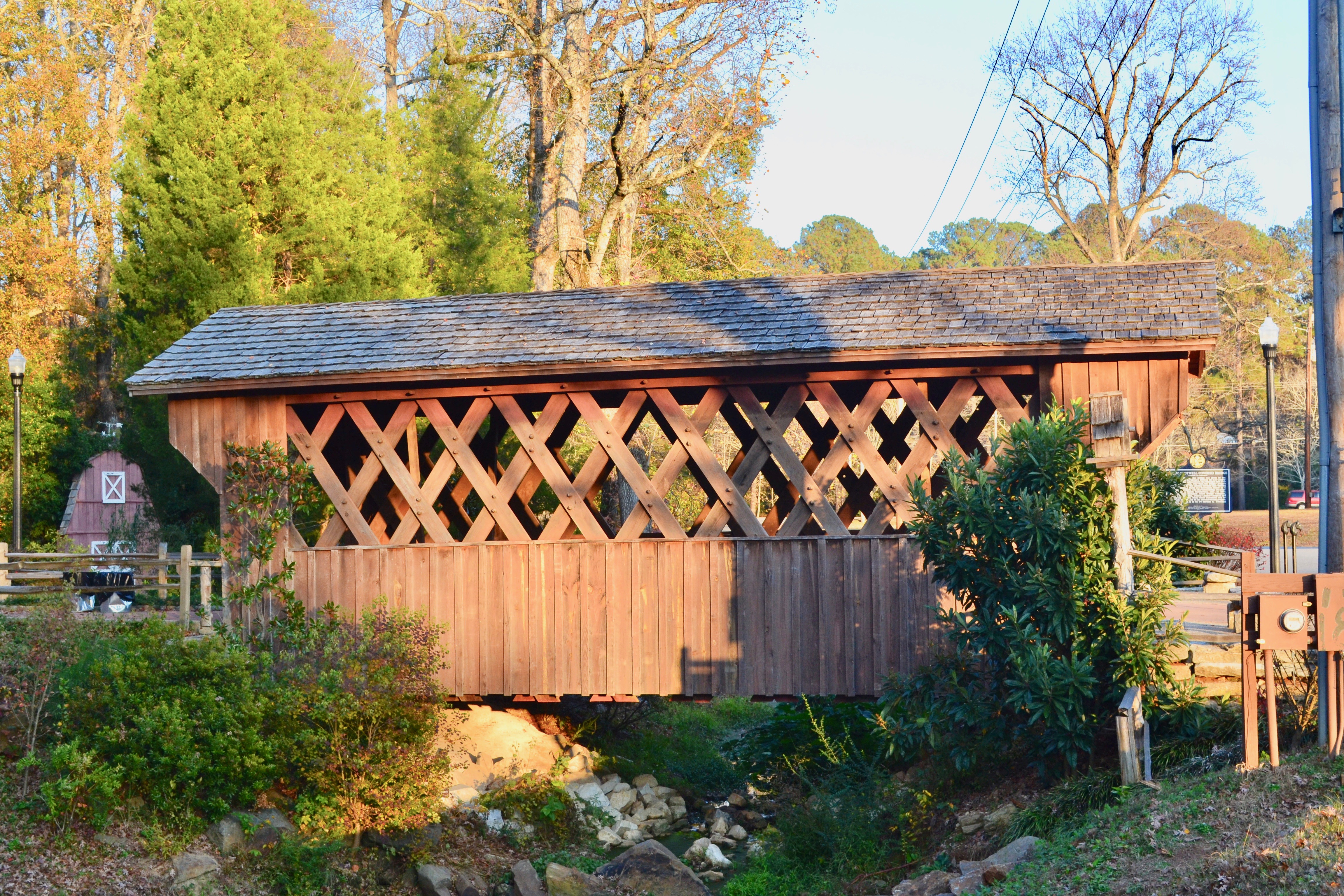
Things looked bleak for the Salem-Shotwell Covered Bridge on June 5, 2005. Early that morning, a tree had fallen on part of this 105-year-old bridge. The damage was so severe that the entire bridge collapsed into Wacoochee Creek. Located in rural Lee County, Alabama, near the community of Salem, it appeared that this was the end for this last remaining covered bridge in the county. It was one of eleven covered bridges remaining in the state.
The Salem-Shotwell Bridge in its new location in Opelika Municipal Park. Photo 2012, by Lewis Powell IV, all rights reserved.
Concerned citizens in the area soon began to salvage the parts of the bridge and placed them in storage. Later on that year, ownership of the remains of the bridge were officially transferred to the City of Opelika who, with the help of the local Kiwanis Club and historical organizations, began a reconstruction of the bridge over Rocky Creek in Opelika Municipal Park. The bridge reopened to fanfare in 2007.
For years before it’s destruction and subsequent reconstruction, stories were told about this lonely bridge. Some of the first stories, according to Faith Serafin, Michelle Smith and Mark Poe in their recent book Haunted Auburn and Opelika, were told of Native American spirits reaching up from the waters of Wacoochee Creek towards unwary travelers crossing the bridge at night. Like so many lonely bridges, this bridge acquired a reputation for other spirits over time. (see my recent entry on Cry Baby Hollow in North Alabama)
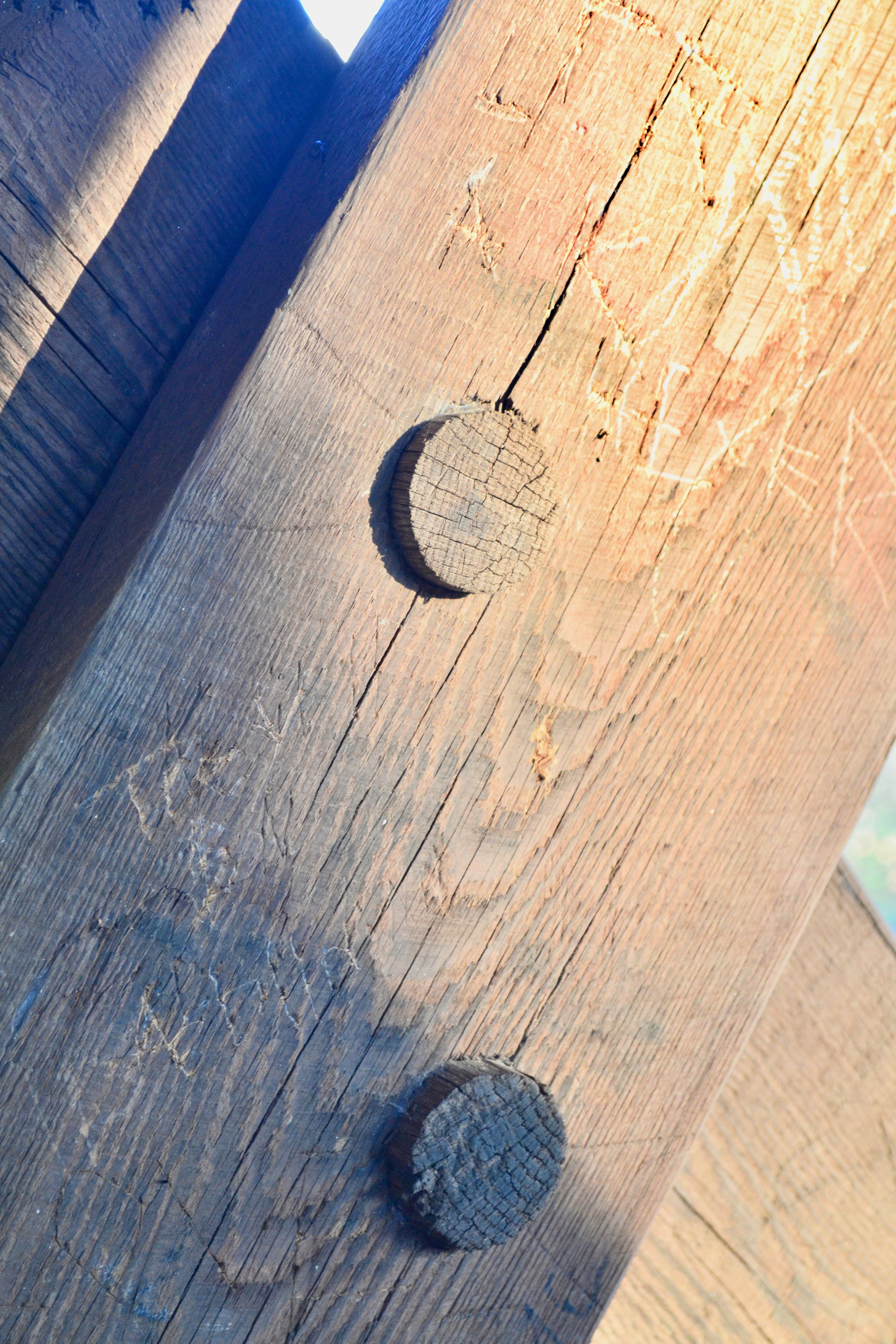
The bridge was constructed using wooden pegs, many of which were reused when the bridge was reconstructed. Photo 2012, by Lewis Powell, IV. All rights reserved.
Supposedly in the 1960s, a young woman was either strangled or hung herself on the bridge. One story involves the young woman asking a young man to meet her at the bridge for a late night tryst. When the young man didn’t show up, the young woman hung herself.
The death of another woman in a fatal car accident added yet another spirit to the bridge. In this tale a young woman is driving along the country road towards the bridge in a rain storm. As she rounded the curve in the road towards the bridge, the car skidded on the slick road and crashed into the turbulent, storm-riled waters below. Her spirit is said to drift along the stream banks accompanied by the smell of burning flesh. I have not yet been able to locate media coverage to corroborate these stories.
The reconstruction only rebuilt 43 feet of the original 76 feet of the bridge’s length. Photo 2012, by Lewis Powell, IV. All rights reserved.
Yet one more accident added a spirit to the bridge: that of a young boy. His pitiful spirit often attracted ghost hunters and curious legend trippers who would leave small toys and gifts behind for the child. It is possibly his spirit who has accompanied the bridge to its new location. The authors of Haunted Auburn and Opelika speak of children playing near the reconstructed bridge playing with a young boy that only they can see.