Ramblings from a Spirited Alabama Sojourn

During the first few minutes of the first annual Haunted History Tour in the small town of Wetumpka, Alabama, my tour group was shuffled into a room in the unrestored portion of the town’s CHAMBER OF COMMERCE BUILDING (110 East Bridge Street). The dingy room was in rough shape and a collection of folding chairs was set out for tour participants. I glanced through a doorway into an adjoining room and was greeted by a scarecrow with a mischievous grin painted on its burlap face.

The Wetumpka Chamber of Commerce just before Wetumpka Haunted History Tour, 2016. Photo by Lewis O. Powell, IV, all rights reserved.

The thought ran through my head, “Someone has put out some tacky Halloween decorations out for this tour. Oh my God, I hope the rest of the tour isn’t like this!” My fears were allayed however when the guide began talking about how this scarecrow moved on its own around the third floor. Passersby on the streets outside have noted the scarecrow peering down on them from one of the third floor windows. When they look again the scarecrow is often looking down from a different window. Employees of the chamber of commerce have also noted the scarecrow’s erratic movement, even once finding it torn apart on the floor of the bathroom. Even more shocking was when the scarecrow reappeared “in pristine condition”—to use our guide’s words—the following day in its usual position overlooking downtown.
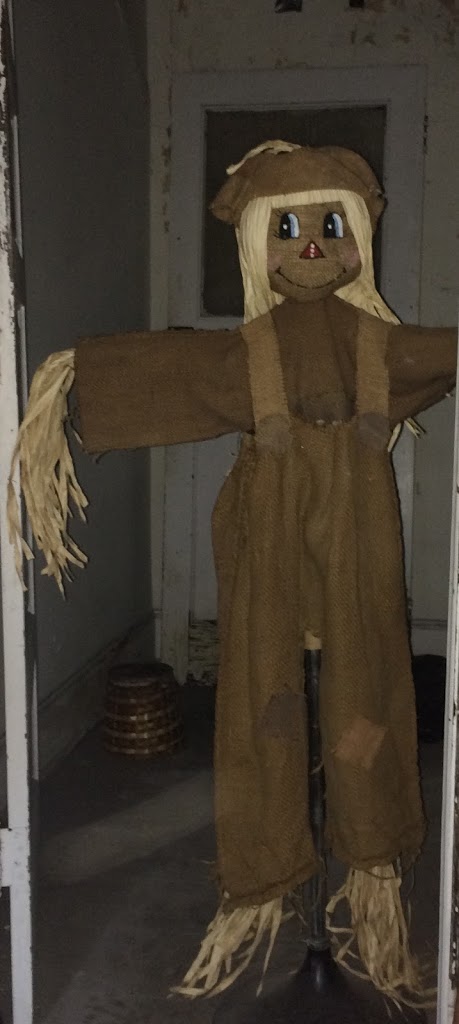
The chamber’s scarecrow that moves on its own accord. Photo by Lewis O. Powell, IV, all rights reserved.

The scarecrow, along with the other spirited compatriots, is overseeing a revival that’s taking place in downtown Wetumpka and throughout the state of Alabama. The state is beginning to awaken from its long, sad economic dream state and confidently stride back towards a fully awakened existence. Utilizing its own history, hominess, natural hospitality, stories, and even its ghosts, Alabama is brushing off the dust of its past and creating a more hopeful future.

Some of you may have noticed my absence during October. Please forgive me, I have been traveling throughout Alabama taking part in investigations and ghost tours. The life of a blogger can be rather dull when you’re only writing about these places rather than experiencing them. Last Halloween I promised myself that I would leave my schedule open this year so I could take advantage of the various investigations and ghost tours that crop up during the Halloween season. With one exception, all my investigations and tours were in Alabama, a state that I have discovered really wants its stories told.

My first jaunt, the first weekend of October, took me to Sylacauga, the Marble City. Located in central Alabama, Sylacauga (pronounced sil-uh-CAW-guh), is about 45 miles south east of Birmingham. The town was built primarily on marble quarrying: carving up the fine marble vein that spans thirty miles under this section of Talladega County. Near the downtown, the COMER MUSEUM (711 North Broadway Avenue) is situated in an Art Deco-styled marble-clad building built in the 1930s as the town’s library. Sculptures and carvings from the local marble grace the entrance of the elegant building that serves as a virtual attic for the area squirrelling away and displaying an array of historic artifacts.

I was in town for an investigation at the museum with S.C.A.R.E. of Alabama, a group founded by authors Kim Johnston and Shane Busby (who wrote Haunted Talladega County together, Johnston is also the author of Haunted Shelby County, Alabama and Haint Blue: The Rockford Haunting). Members of the group include haunted collector and author Kevin Cain whose book, My Haunted Collection, is now a part of my Southern Spirit Library, he’s also written a number of supernatural fiction works; and Kat Hobson who hosts the radio show “Paranormal Experienced with Kat Hobson” on which I appeared a few months ago and will be appearing at the end of this month. The group hosted this investigation as part of a series of public investigations that they host as fundraisers for the places investigated.

The fascinating investigation concentrated on a number of objects throughout the building that may have spirit attachments. See my rundown of the investigation here, “The Haunted Collection in the Marble City—Alabama.”
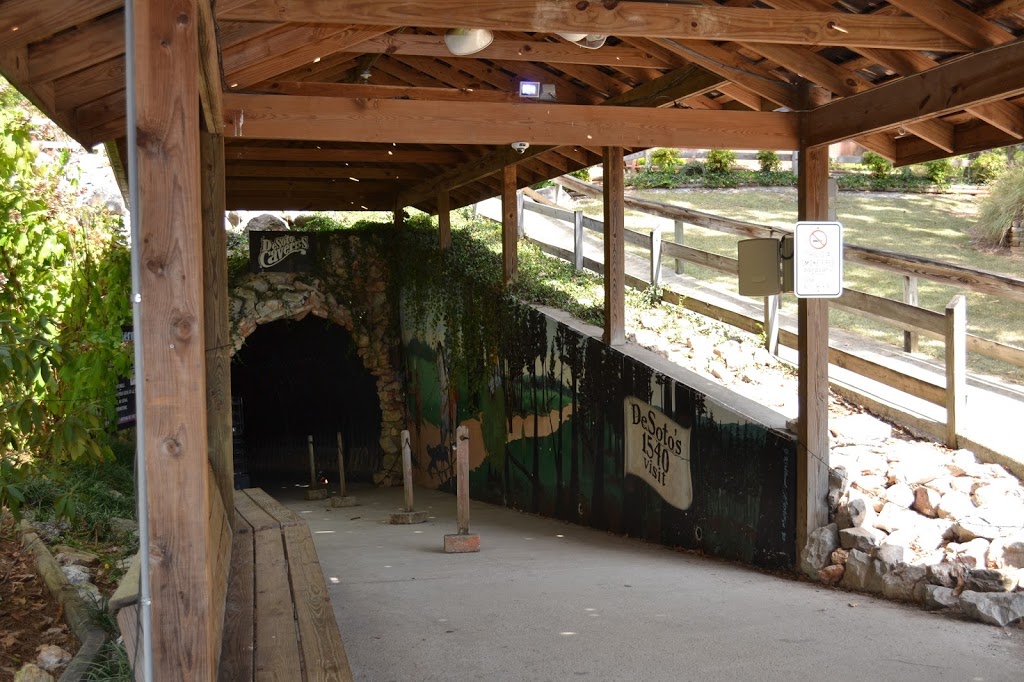
Entrance to De Soto Caverns, 2016. Photo by Lewis O. Powell IV, all rights reserved.

On the route I decided to stop outside of Childersburg to check out DeSOTO CAVERNS & FAMILY FUN PARK (5181 Desoto Caverns Parkway). As I waited for the cave tour I watched a young father carry his child off the porch of the gift shop heading towards the family’s car. In his arms the child squirmed and cried in the depths of a temper tantrum. As they passed the statue of Hernando de Soto the father said, “Hey look, it’s Hernando de Soto!” The child only screamed louder. Goodness knows that de Soto inspired similar reactions from the natives when he marched through this area in 1540.

Interior of the caverns with a replica of a native burial in place. Photo by Lewis O. Powell, IV, all rights reserved.

Scholars suggest that Spanish explorer and conquistador Hernando de Soto may have stopped in the area as he hacked his way through the forests and natives of the region. While there is no proof that he visited the cave, there is evidence that it was known to the local natives. Several native burials were located in the main room of the cave as well as the remains of a white trader who was killed after he carved his name in the cave which was considered sacred to the natives. Being a cave fan, I was happy when Johnston and Busby included the cave in their book on haunted Talladega County.

While I have had some creepy experiences in caves (see my experiences at Lost Sea Cave in Sweetwater, TN), I didn’t have anything odd happen. Johnston and Busby note that a young daughter of the cave’s owners had experiences with Native American spirits during her childhood on the property. Worried that these spirits may have been upset by the family’s use of the cave as a tourist attraction, the owners brought in members of the native tribes that once owned the land to cleanse the property and rebury the bones of their ancestors that had originally lain quietly in the cave. Apparently, the spirits have been appeased, though I do wonder if there is any residual energy that may cause some activity on occasion.

Sylacauga itself seems to be waking up however: a number of buildings in its downtown were occupied and open for business including what appeared to be several new restaurants. For dinner I considered BUTTERMILK HILL RESTAURANT (300 East 3rd Street) which occupies an early 20th century house just outside of downtown. Listed in Johnston and Busby’s book, the restaurant shares the house with an assortment of spirits and a dark history that includes a murder within the past decade. While the menu looks delectable, it was a bit pricey for my current budget, though I did take some pictures.

Buttermilk Hill Restaurant, 2016. Photo by Lewis O. Powell, IV, all rights reserved.

My second sojourn to Alabama took place over the penultimate weekend of October. Due to work on Friday, the trip turned out to be rather rushed and I didn’t have much time to really enjoy it the trip up. S.C.A.R.E. of Alabama sponsored an investigation of JEMISON-CARNEGIE HERITAGE HALL MUSEUM (200 South Street East) and the adjoining ARMSTRONG-OSBORNE PUBLIC LIBRARY (202 South Street East) in Talladega. Despite  NASCAR races taking place the same weekend at the nearby (and cursed, supposedly) Talladega Superspeedway in Lincoln, the leafy streets of Talladega were quiet and still. South Street boasts some fine institutions and a handful of ghosts. On this peaceful night, antebellum MANNING HALL (205 South Street East), the huge, main edifice of the Alabama Institute for the Blind and Deaf, across the street from Heritage Hall was lit up like a beacon. Heritage Hall’s smaller, more feminine, Beaux-Arts façade was lit up as if in graceful answer to Manning Hall’s heavy, masculine Greek Revival colonnade. According to Johnston and Busby, Manning Hall does have some spirits of its own, quite possibly including the shade of the Institute’s founder, Dr. Joseph Johnson.

Manning Hall at the Alabama Institute for the Deaf and Blind. Photo by Lewis O. Powell, IV, all rights reserved.

The Jemison-Carnegie Public Library was the dream of Louisa Jemison, a member of the prominent Jemison family who now have a handful of haunted places associated with them. Designed by noted Alabama architect Frank Lockwood, the library was built with a donation of land from Louisa Jemison and the Carnegie Foundation. When the library opened in 1908 local lore tells of a little 8-year-old girl sitting on the top step the first day and her being the first person to check out a book. The little girl, Gentry Parsons, would eventually pen her own books and donated many books to this library.

The facade of Heritage Hall on the night of the investigation.
Photo by Lewis O. Powell, IV, all rights reserved.

Good architecture has power. In creating beautiful spaces, the architect can physically manipulate those entering the space; the eyes and chin are raised and the dignity of the space encourages those entering to straighten their back out of respect. With better posture, those entering have their senses heightened and the feeling of awe can mellow into a sense of inspiration, lightness, refinement, and freedom. Like the great cathedrals of Europe, the architecture of Heritage Hall does exactly that. The high ceilings, airiness, and grace raises the senses of those walking up the front staircase and entering the front door. The main bay of the building is a large open space with a dramatic staircase directly ahead leading down to the main librarian’s desk.

Interior of Heritage Hall just inside the front door. Photo by Lewis O. Powell, IV, all rights reserved. 
The interior of Heritage Hall looking down the stairs just inside the front door towards the old librarian’s desk. Photo by Lewis O. Powell, IV, all rights reserved.

After entering for the investigation I was greeted by the museum’s director and given an excellent tour of the building. The open space inside with the walls lined with art from local artists gives the place a sense of veneration and the art displays the tremendous talent throughout the region. I was also introduced to some of the paranormal activity that has been experienced here. With this building being a community center for such a long period of time, the energy that has passed and continues to pass through it has likely left a psychic imprint. That can be one explanation for the disembodied footsteps and doors opening and closing on their own accord. As a library, this building has also inspired passion for many people, people who return to this beloved spot in spirit. Some of the spirits believed to still oversee business here are Miss Willie, a former librarian; Tom Woodson, a long-time director of the museum who died a few years ago; and Louisa Jemison who may return to check on her beloved library.
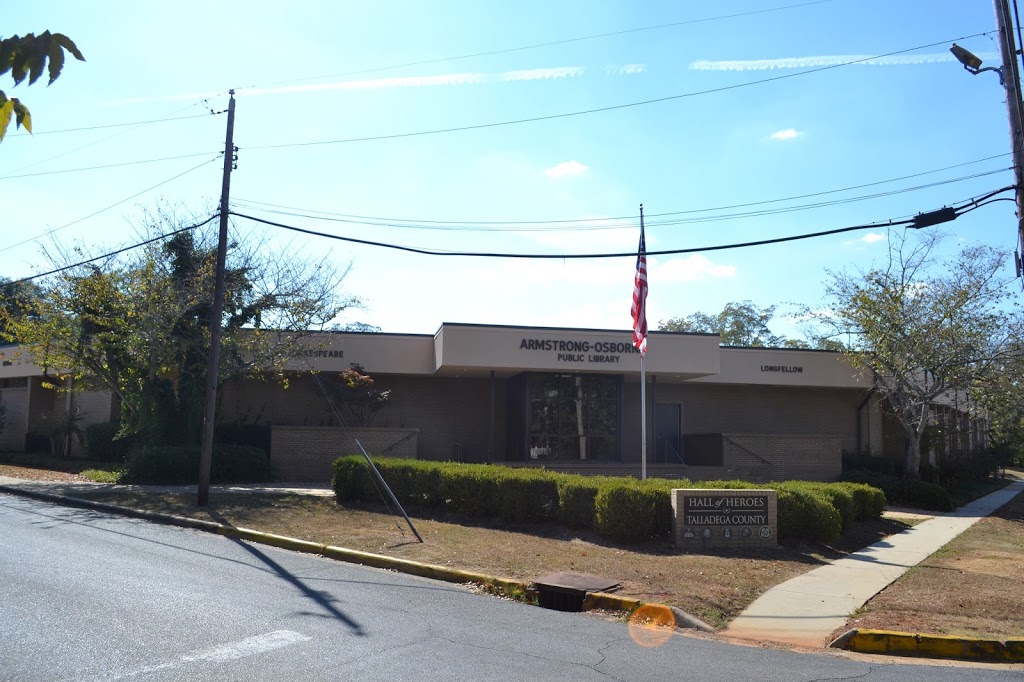
Main entrance of Armstrong-Osborne Public Library, 2016. Photo by Lewis O. Powell, IV, all rights reserved.

Spooning Heritage Hall like a protective older sibling is the Armstrong-Osborne Public Library which opened in 1979. Sadly, the architects of the newer building did not take their cues from Lockwood’s design. The building is minimalist and angular with no ornamentation; utilitarian modernist at its worst. The interior is very typical late 20th century library design which emphasizes function over design. While the architecture is nothing to write home about, the institution itself seems to be very well stocked and the librarians and staff present were delightful and very interested in the investigation.

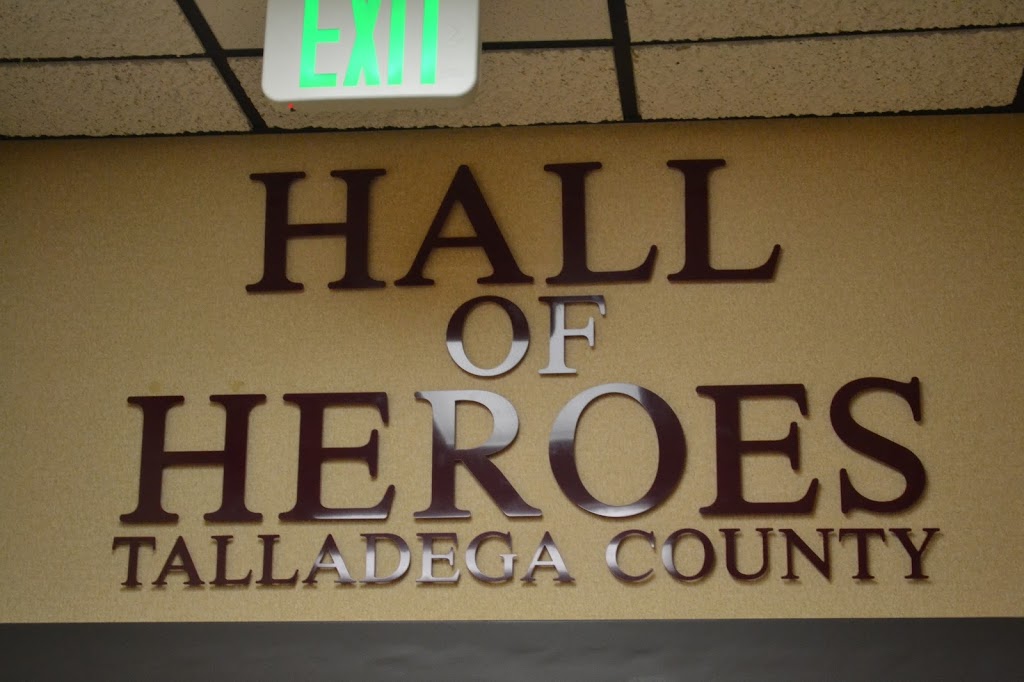
Hall of Heroes entrance. Photo by Lewis O. Powell, IV, all rights reserved.

The library itself has experienced a modicum of strange activity particularly around the genealogy room and its adjacent hallway which are actually part of a 2006 addition to the building. That hallway is now the Hall of Heroes, honoring the many men and women of Talladega County who have served in the armed forces. The hall is lined with photographs ranging from World War I to the most recent conflicts in Afghanistan and Iraq. In this hallway the spirit of a woman has been seen while the sounds of a party sometimes emanate from the genealogy room itself when it’s empty. The investigation of the library and Heritage Hall didn’t really uncover much evidence-wise. After sitting with Ghost Boxes in the main reading room of the library we adjourned to the genealogy room and the Hall of Heroes. Fitted out with computers, microfilm readers, and shelves of books old and new, the genealogy room isn’t particularly creepy, even in the dark. We did an EVP session and at one point seemingly heard a “no,” though I was one of the few people to hear it. It may have also been gastric noises from one of the participants. After relocating to Heritage Hall we didn’t pick up much activity, though we had some K2 spikes when some of men began lounging on Miss Willie’s library desk.

The Hall of Heroes is lined with the photos of men and women who served in the armed forces from Talladega County. Photo by Lewis O. Powell, IV, all rights reserved.

Sources

  • Johnston, Kim and Shane Busby. Haunted Talladega County. Charleston, SC: History Press, 2015.
  • History.”Talladega Armstrong-Osborne Public Library. Accessed 12 November 2016.
  • Our History.” Jemison-Carnegie Heritage Hall Museum. Accessed 12 November 2016.
  • Wetumpka Area Chamber of Commerce. Wetumpka Haunted Heritage Tour. 28 October 2016.

“Blew our schoolhouse away”—Duffield, Virginia

Rye Cove Intermediate School
158 Memorial School Lane
Duffield, Virginia

Oh listen today and a story I tell
With saddened and tear dimmed eyes
Of a dreadful cyclone that came this way
And blew our schoolhouse away.
–“The Cyclone of Rye Cove” by A. P. Carter, originally covered by
The Carter Family

In the news business there’s the old maxim, “if it bleeds, it leads,” thus headlines are often gory. Americans were jarred on the 3rd of May, 1929, by headlines about the huge storm that passed through Virginia and the rural wooden schoolhouse in Rye Cove that didn’t stand a chance against one of the storm’s tornados. The Associated Press story about the tornado was printed in papers from Maine to California.

The story of the storm appeared on the front page of the Alton Evening Telegraph in the Mississippi River town of Alton, Illinois, incidentally noted to be one of most haunted cities in the Midwest.

RYE COVE, Va., May 3, (AP)—Grief stricken parents searched the debris of the Rye Cove Consolidated school today, fearful of finding additional victims of the tornado that yesterday claimed the lives of 13 children and one teacher in the greatest disaster ever known to this western Virginia mountain village.

The tragedy at Rye Cove has been the worst thing to occur in this tight-knit community in the mountains of southwest Virginia. Indeed, the spirit world will not let the community forget this tragedy and, according to folklorist Charles Edwin Price, the ghastly roar of the tornado’s wind and the accompanying cries of children are still heard on the anniversary of the fateful day.

The history of this quiet cove in the Appalachians began with a tragedy in 1773 when a group of settlers were attacked here. Despite treaties forbidding settlers from settling in territory claimed by Native Americans, settlers began to make their ways into that territory. On the evening of October 9, a group of settlers including James Boone—son of the famed frontiersman, Daniel Boone—were set upon by natives attempting to guard their territory. The sleeping settlers were fired upon as they slept with two killed instantly. Two others escaped into the woods while Boone and another settler were tortured before being killed. One African slave hid in the forest and witnessed the ordeal while another slave was taken by the natives.

Rye Cove’s baptism by blood was just the beginning. Other settlers filtering into the area had their lives cut short in similarly bloody ways. Permanent settlement did not begin until after the American Revolution, though Rye Cove—due to its isolation—grew very slowly. Additionally, farming in the area was made difficult by the large outcroppings of limestone that punctuated the land throughout the cove.

The hard-scrabble families in the cove eventually built a school in the mid-19th century which was replaced by a modern schoolhouse in 1907. By 1923, the Rye Cove Consolidated School had grown to eight rooms and an auditorium. This was the building that housed some 150 students around noon on May 2, 1929.

The school’s principal, A. S. Noblin, was at lunch when his landlady noted the storm that was brewing outside. As he left his boarding house to return to the school he saw the black shape that was quickly making its way up the valley. Noblin reached the schoolhouse just in time to watch one of the automobiles parked outside the school rise into the air. Moments later, the wooden building disintegrated into a mass of splintered wood with students, teachers, chalkboards, pot-bellied stoves and other debris careening through the air.

Noblin told a reporter for the Scott County Herald-Virginian, “Trees were swaying. As it neared the school building it became a black cloud…I think I yelled. It struck the building. The next thing I remembered I was standing knee deep in a pond 75 feet from where the building stood before it was demolished.”

The Bee, a newspaper in Danville, Virginia, picks up the story. “The two-story frame schoolhouse was ripped from its foundations, torn asunder and strewn over a distance of 300 to 400 yards, some of the children were blown almost 100 yards while others were buried in the wreckage.”

Anxious parents and neighbors from throughout the valley soon flooded the scene and began digging through the wreckage. Included among the many neighbors who came to help was A. P. Carter who would compose a song mourning that Rye Cove, “where in life’s early morn, I once loved to roam,” was now “so silent and lone.” The search was intensified when overturned pot-bellied stoves began to ignite the wooden debris of the school.

Headlines from The Bee of Danville, Virginia, 3 May 1929.

The Bee of Danville, Virginia, picks up the story: “Great confusion followed the tornado, anxious fathers worked feverishly in the ruins, fearful that they might discover the bodies of their children. The anxiety of parents was intensified because the injured children were hurriedly rushed away for hospital treatment before the parents arrived.” Rye Cove’s remote location lead rescuers to evacuate the most seriously injured to Clinchport, Virginia while some were taken by train to Kingsport, Tennessee.

In the end, the lives of twelve students and one teacher were lost amid the ruins of the schoolhouse. The remainder of the school term was canceled and a new school was constructed on the site with a memorial plaque installed in memory of the thirteen victims whose memory is still stirred by the sound of howling winds and screams every May 2.

Sources

  • Associated Press. “22 Dead and 100 hurt is state’s toll.” The Bee (Danville, Virginia). 3 May 1929.
  • Associated Press. “Death toll from storm reaches 49.” Alton Evening Telegraph (Alton, Illinois). 3 May 1929.
  • McDaid, Jennifer Davis. “Rye Cove Cyclone.” Encyclopedia Virginia 23 November 2010.
  • Mills, Elizabeth. “Rye Cove High School: A Brief History.” Scott County Public Schools. Accessed 5 November 2014.
  • Price, Charles Edwin. “Death in the Afternoon: The Rye Cove Tornado.” Rootsweb FOLKLORE-L Archives. 28 April 2000.
  • Price, Charles Edwin. The Mystery of Ghostly Vera and other Haunting Tales Of Southwest Virginia. Johnson City, TN: Overmountain Press, 1993.

Newsworthy Haunts 3/19—Fike High School

Ralph L. Fike High School
500 Harrison Drive
Wilson, North Carolina

High school is scary enough. You already have teenage angst compounded by raging hormones and with modern teenage drama; it makes for a volatile situation. It’s even worse, I imagine, with ghosts thrown in.

Schools, ranging from preschools to university buildings, appear frequently on lists of haunted places. In his 2003 book, Haunted Schools, A.S. Mott suggests several reasons why schools may be rife with spiritual activity. Some activity can be linked with the land upon which the school sits, while others have been the scene of deaths, accidental or otherwise, that may contribute to a haunting. Students who pass on away from school, may return to the place where they spent their formative years, or devoted faculty or staff members may continue their duties in the afterlife.

Some of these stories are simply urban legends that flourish within the school community. They bear the hallmarks of oral storytelling as each teller adds their own flourishes compounding the exaggerations and inaccuracies, though there sometimes remains a kernel of truth.

Among haunted schools in the South, there are some very notable haunted schools including C. E. Byrd High School in Shreveport Louisiana; Airport High School in West Columbia, South Carolina; Bristol Tennessee High School in Bristol, Tennessee; and Matthew Whaley Elementary in Williamsburg, Virginia.

North Carolina has a few notable haunted high schools including Erwin High School in Asheville, which was built on the site of a potter’s field cemetery. While most of the graves were moved prior to construction, it’s possible that some were missed which might account for some of the activity.

haunted Erwin High School Asheville North Carolina ghosts built on a cemetery
Asheville, North Carolina’s haunted Erwin High School, 2012. Photo by Lewis Powell IV, all rights reserved.

I always wondered if my alma mater, LaGrange High School in LaGrange, Georgia was haunted. The school’s main building dates to the 1940s with many modern additions. Parts of the building were creepy, though I never heard anything substantial as to activity. Not that I wasn’t interested, in fact, I worked on an independent study my senior year about ghosts. While anxiety and procrastination marred that project, I believe all that work was really ramping up for the debut of this blog.

This is why I’m jealous of the student named in this recent article from the Wilson Daily Times; she’s gathering paranormal evidence about her high school for her senior project.

Certainly it appears that there are some very strange things going on at Fike High School. This project got its impetus when a student watched her classroom door close by itself during class. Moments later, the door opened again about six inches and a nearby projector head flipped downward by itself. The student began asking questions which has culminated in her concentrating on the school haunting as her senior project.

Witnesses to these phenomena include teachers, janitors and the assistant principal. A coach walking along one hallway began to notice the classroom doors closing by themselves as he passed. The assistant principle saw a white figure in the hallway when she was a student, while a current math teacher started hearing odd sounds one night as he was working late. He went to the main office to check the security cameras and noticed the motion detectors were alerting him to movement in the second floor hallway. When he went to look, he saw a white figure at the end of the corridor.

The student has called in a paranormal team, The Paranormal Detectives, to investigate. The results of the investigation will be publicized in the local paper.

Wilson County North Carolina Courthouse
Wilson County Courthouse in downtown Wilson, North Carolina. Photo 2014, by Ammodramus. Courtesy of Wikipedia.

The school, built in 1958, occupies the site of a farm, though the student has been unable to find evidence of any particularly traumatic events occurring there. “I need to keep digging to find out if anything traumatic happened.” she said.

Sources

A tornado victim returns–William Winston House

Winston House
Deshler High School Campus
200 Northeast Commons Street
Tuscumbia, Alabama

N.B. Edited 4 March 2019.

1874 Alabama tornado ghost haunt William Winston House Judith Winston victim Tuscumbia haunting Deshler High School
William Winston House, 2010. Photo by Carol M. Highsmith. From the George F. Landegger Collection of Alabama Photographs in Carol Highsmith’s America, Library of Congress, Prints and Photographs Division.

In recent days, tremendous storms and tornados cut their way across the South. The storms affected Mississippi, Georgia, Tennessee and especially hard hit was Alabama. Northern Alabama felt the brunt of the storm in urban areas like Tuscaloosa, Birmingham and Huntsville; but also in small towns like Cullman, Rainsville, and a little town in Franklin County with the unusual name, Phil Campbell. Just north of Franklin County is Colbert County and its seat, Tuscumbia. It was here that a tornado in the late nineteenth century left a spiritual mark.

On November 22, 1874, as a tornado bore down upon her home, Judith Winston, the lady of the house tried to take cover. She failed, and was crushed beneath rubble. Her sons pulled her from the wreckage still alive, but she lived only a little while. According to Debra Johnson, she breathed her last in the front bedroom on the eastern side of the house.

Tuscumbia, Alabama began its rise to prominence as the town of Occocopoosa, along the military road completed in 1820 by General Andrew Jackson linking Tennessee with Louisiana. The town’s name was changed to Big Spring in 1821 and the next year to Tuscumbia. The richness of the area’s land and the abundance of game brought settlers to the area along with business and eventually the railroad. Tuscumbia rose as one of the leading cities in the region.

Among early settlers were members of the prominent Winston family. Descended from Captain Anthony Winston, a cousin of Dolly Madison and Patrick Henry, the Winstons fought at the side of Andrew Jackson and acquired land in Virginia, Tennessee, and finally Alabama. Further descendants would serve as governors of both Alabama and Mississippi as well as a senator from Alabama.

William Winston began construction on this magnificent edifice in 1824, and it was completed nine years later. This Georgian house is the largest remaining antebellum house in the city. It remained in private hands until 1948 when it was purchased by the City of Tuscumbia for the new campus of Deshler High School. Restoration efforts began on the house in the early 1980s and these efforts were boosted by the home being placed on the National Register of Historic Places in 1982. Since that time, the home has served as a house museum and events space.

1874 Alabama tornado ghost haunt William Winston House Judith Winston victim Tuscumbia haunting Deshler High School
The magnificent “flying staircase” in the Winston House, 2010. Photo by Carol M. Highsmith. From the George F. Landegger Collection of Alabama Photographs in Carol Highsmith’s America, Library of Congress, Prints and Photographs Division.

Mrs. Winston may be the source of some rather interesting phenomena that has occurred in the house. One woman setting up chairs for her daughter’s wedding was disturbed by the chairs rattling by themselves. Upset, the woman questioned the home’s curator and was told that Mrs. Winston simply wanted an invitation to the event. Once the mother of the bride issued an oral invitation, the rattling ceased. Debra Johnston also credits Judith Winston’s spirit with the “weeping walls” in the downstairs entry hall when there is the threat of a storm.

Jessica Penot, author of Haunted North Alabama and the Ghost Stories and Haunted Places Blog, identifies one of the spirits in the home as William Winston, the home’s builder. She states that his spirit has been seen standing at the top of the stairs and wandering through the halls. She also speaks of white figures seen through the windows of the house at night after it is closed.

Sources

  • April 25-28, 2011 tornado outbreak. Wikipedia, the Free Encyclopedia. Accessed 1 May 2011.
  • Garfrerick, Beth. “National Register Nomination Boosts Tuscumbia Restoration.” The (Tuscumbia, AL) Times-Daily. 21 January 1982.
  • Johnston, Debra. Skeletons in the Closet: True Ghost Stories of The Shoals Area. Debra Johnston, 2002.
  • Penot, Jessica. Haunted North Alabama. Charleston, SC: History Press, 2010.
  • Thornton, Linda. “Tuscumbia.” Encyclopedia of Alabama. 22 May 2009.