Sometimes aimless searching online produces serendipitous results. Thus, this was the case when I stumbled upon a mention of a place called “Werewolf Springs.” Reporter Josh Arntz of the Dickson Herald wrote a fabulous article about the legend of Werewolf Springs in 2011. He has since done some excellent reporting on several haunted locations within Dickson County. What’s interesting about this legend, is the possible connection with the more well-known story of the White Bluff Screamer located roughly 5 miles away in the same county.
The Dickson County Courthouse in Charlotte, the oldest courthouse still in use in the state of Tennessee. Photo by Brian Stansberry, 2008, courtesy of Wikipedia.
Dickson County retains its rural character despite being within (about 35 miles) listening distance of Nashville’s country music. Several sites within the county are the subject of ghost stories and legends including Montgomery Bell State Park (the location of Werewolf Springs), the small town of White Bluff (where the legend of the White Screamer may be found), and the Clement Railroad Hotel Museum in Dickson (the childhood home of Governor Frank Clement whose parents owned the hotel).
The legend of Werewolf Springs begins with a circus train passing through Dickson County in the late 1860s. The train derailed near the community of Burns, southeast of Dickson, and some of the animals escaped. Among the escapees were a pair of half-human, half-wolf creatures who were exhibited under the moniker, “The Wolfmen of Borneo.” Circus employees caught all the other escaped animals, though the wolfmen were nowhere to be found.
A couple of years later, two locals traveling on a nearby road—where modern State Route 47 now runs from Burns to White Bluff—found themselves being stalked by a large creature. The two men, a local landowner and a hired hand, attempted to outrun the creature, but it caught up with them, and the duo split up and fled into the forest.
The creature pursued the hired hand, and the landowner was shocked to hear the man’s screams and cries as he was presumably torn apart. The hired hand’s body was never located. A mob of locals, I imagine classically armed with pitchforks and torches, formed from nearby farms and towns to bring justice to this dreadful creature. Near the springs where the duo had encountered the beast, the mob led a live goat to a clearing where it was tied to bait the monster. Extinguishing their torches and lanterns, the posse waited with bated breath for the hungry creature to make its appearance.
The prowling creature eventually appeared. The group opened fire then quickly lit their torches and lanterns to see if they had bagged their quarry. The clearing was empty. The creature, goat, and two members of the posse had vanished into the thick night air. With terror, the group dispersed fearing to pursue the mysterious creature any further.
Later, a big game hunter attempted to kill the creature of Wolfman Springs. Setting himself up in a nearby cabin, he slept soundly the first two nights, but on the third night, he heard howling in the distance. A short time later, the frightened hunter began to hear the creature outside his cabin. When it appeared to pass by one of the windows, he aimed and fired. The gunshots only served to rile the creature’s wrath, and it broke down the door. The hunter fired all but two rounds at hairy bipedal, but it only seems to anger more with every shot. With only two rounds left in the chamber, dawn arrived, and the light from the rising sun caused the creature to flee into the shadows of the forest.
Replica of the cabin where the Cumberland Presbyterian Church was founded in Montgomery Bell State Park. Photo 2006, by Leylander, courtesy of Wikipedia.
Just as the sun rose to banish this creature of the night, Arntz sheds some light on the legend and the history of the area. Wolfman Springs is actually Hall Springs which is located in one of the areas of MONTGOMERY BELL STATE PARK (1020 Jackson Hill Road, Burns) that is only accessible by a hike. The springs are named for the Hall family who had a homestead near the springs. The family’s home is long gone, but a small family cemetery remains nearby. A few weeks after the appearance of the Wolfman Springs article, Arntz followed up with an article about a descendant of the Hall family who grew up near the infamous springs. She denied that she ever heard anyone speak of a mysterious creature in the area.
The land that the state park now occupies was purchased by a National Park Service in 1935 to develop the Montgomery Bell National Recreation Demonstration Area. The park’s namesake is local manufacturing entrepreneur, Montgomery Bell, who was instrumental in building the local iron-smelting industry. Interestingly, even he has been pulled into the Wolfman legend. Some tellers of the story feature Mr. Bell as the local landowner, though this wouldn’t be possible as he passed away before the Civil War.
The railroad tracks where the train derailed still run their original course along the southern edge of the park. Evidently, there were several train derailments on this stretch of line, though none that specifically involved a circus train.
What is the origin of this odd story? I can attest that in my research in Southern ghost and folklore, stories involving these type of creatures appear less frequently than ghost stories. Among these stories are the tales of the Pig Woman in Cecil County and a goat-man creature in southern Maryland; the “Bunny Man” who supposedly haunts a bridge in Virginia; the infamous Mothman of Point Pleasant, West Virginia; the Skunk Ape spotted in Florida; the Lizard-Man of South Carolina; Sasquatch activity that may be associated with the haunting of Spring Villa in Opelika, Alabama and throughout the nearby Tuskegee National Forest in Macon County; and the goat-man creature that has led, like a siren, a handful of young people to their deaths at Pope Lick Trestle in Kentucky. Among these stories, I only know of one other wolfman or werewolf-like creature, and that is a story from Talbot County, Georgia that Nancy Roberts documented in her 1997 opus, Georgia Ghosts.
Interestingly, just five miles from Montgomery Bell State Park and within the same county is the small town of White Bluff. For some time, stories have circulated regarding a creature or entity that is known to prowl the community emitting a terrifying scream. Known as the White Bluff Screamer, the explanations appear to fall into two camps: one believing that the screamer is a banshee while the other camp believes the screamer is a cryptid.
Alan Brown, one of the more venerable writers on Southern ghostlore, makes the argument for the banshee camp in his 2009 work, Haunted Tennessee. Relating the “standard version” of the story, he tells of a settler building a cabin in an isolated hollow near town. However, the man and his family were plagued by a high-pitched screaming that woke them every night. Determined to bring peace, the man took his rifle and hunting to pursue the source of the screams. As the man entered the forest, the screams began anew, and the dogs bounded towards them. Though a short time later the dogs returned frightened with their tails between their legs. The settler continued towards the wailing and climbed a hill to get a view of the surrounding landscape. Reaching the summit, the hunter’s ears were besieged with the screaming once again, though this time is seemed to come from the man’s cabin. He sprinted back to his home and discovered his family’s mangled remains.
The story is not really about a banshee as they are rarely known as malevolent spirits, mostly as heralds of death. A banshee would not typically use her wails to distract a man to kill his family. According to West Virginia writer Rosemary Ellen Guiley in her 2007 compendium, Encyclopedia of Ghosts and Spirits, a banshee (or Bean Shide in Gaelic, literally “woman of the fairies”) is “a female death omen spirit of Ireland and Scotland that attaches itself to families…and manifests to herald an approaching death in the family.” She continues, “the banshee most commonly is heard singing or crying, but is not seen.” Speaking with an Irish friend of mine, he noted that banshees are generally considered harbingers and occasionally provide protection to family members when traveling alone or at night. According to him, “the only legends of the banshee killing is if she is disturbed whilst combing her hair. She is reputed to throw her comb, piercing the heart and killing her victim.”
Guiley states that legends of banshees followed the Scots and Irish immigrants who settled throughout the South. One primary legend that appears in Southern folklore is the story of the Tarboro Banshee. Originating in the town of Tarboro, North Carolina on the banks of the Tar River, the story recalls the days during the American Revolution when a patriotic miller operated a grist mill on the banks of the river. Refusing to abandon his operation at the approach of the British, he was captured and drowned in the river, but not before warning his captors of a banshee that would avenge his death.
As the miller sank beneath the brackish water of the river, a wail arose from the watery grave. A feminine form began to take shape in the mist over the river while an agonizing cry was heard on the river banks. The beautiful maiden terrorized the British soldiers responsible for the miller’s death, eventually leading all to grisly deaths. Legend still speaks of the lovely creature appearing over the river waters still mourning the miller’s early departure from this world. I have covered the story of the Tarboro banshee here.
Returning to Middle Tennessee, I need to acknowledge the other camp of thought on the White Bluff Screamer, the camp that believes that the creature may be a cryptid and not a spirit. The authors of the 2011 Nashville Haunted Handbook remark that the creature is commonly heard and sometimes even seen. “Some who see the creature report that it is a white, misty apparition that flits through the woods quickly and ominously in the night…Others report that the source of the screams is an actual creature that resembles an alpaca [a domesticated relative of the llama]: a white furry beast that walks on all fours and stands about six feet tall with a face resembling a camel.” It should also be noted that alpacas can produce a high-pitched whine or scream when frightened.
Screaming is also a purported characteristic of the Sasquatch or Bigfoot. Some witnesses have been able to record the mysterious screaming that may be produced by a sasquatch. This leads me to believe that there may be a connection between this screaming creature and the Sasquatch, though the description that this creature is a quadruped rather than a biped puts that connection into jeopardy.
Returning to the creature that may haunt “Werewolf Springs,” in recent years screaming has been reported in the area. Josh Arntz in his Werewolf Springs article ends with a report from a local teacher who “heard ‘the most blood-curdling scream’ from a wild animal at 1 a.m.” near the park inn on Lake Acorn. The teacher also reported to have heard “plenty of eerie sounds while walking through the park’s woods at night.”
There are several creatures native to the area that can produce human-like screams in the night including fox and bobcat. Regardless of whether these stories contain any truth, they have left a marvelous mythological legacy on the landscape.
Sources
Arntz, Josh. “The half-wolf, half-man of Werewolf Springs.” Dickson Herald. 28 October 2011.
Payne and Edwards Roads Rural Hall, North Carolina
The ritual is thus: drive out at night to the bridge where Edwards Road crosses over Payne Branch, stop your car in the middle of the bridge, and put it into neutral. Open the windows and begin to whistle “Dixie.” Supposedly your engine will die and you will be unable to restart the car until it is pushed from the bridge.
Author Michael Renegar tells of a friend of his who performed this ritual with frightening results. This young man and two female companions ventured out to haunted Payne Road one night looking for a thrill. After performing the ritual their car sputtered and died. After the young man pushed the car off the bridge, he was able to crank the car, though while he was outside of the car he was spooked by a feeling of being watched.
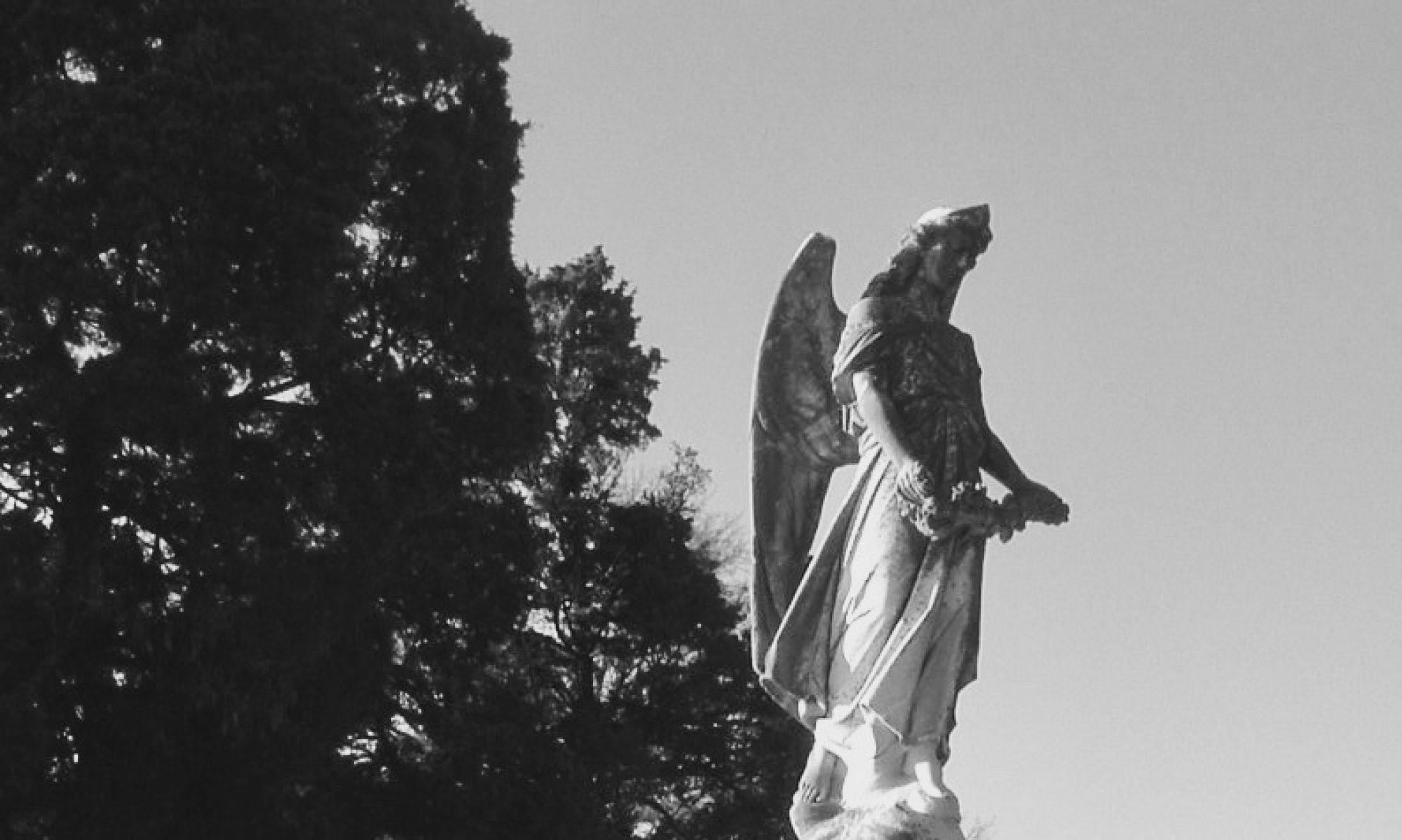
Reportedly, the vehicle never acted the same after that. Besides the scary moments on the bridge, the three also noted that when they drove past one of the old cemeteries an angel on the edge of the cemetery faced away from the road, but was facing them the second time they passed it.
Authors Burt Calloway and Jennifer FitzSimons record an earlier encounter on the bridge where a young man was trying to impress his date. The couple performed the ritual, and the young man left his date sitting in the car as he strutted around the lonely bridge provoking the spirits. As lightning lit up the night’s sky, it revealed something to the young man.
Stumbling back to the car, he attempted to crank it. It refused to start and the young man just sat stunned in the driver’s seat. His date, not too pleased with his sudden fear, cranked the car and drove them away from the bridge. Only after leaving the haunted spot, did the man reveal that he saw a ghost during the lightning’s flash.
The stories of Payne and Edwards Roads have circulated in this rural area of Forsyth and Stokes counties for decades. The legendary history has entered the digital realm where it is discussed and argued among the more than 4000 members of the Legend of Payne Road group on Facebook. To add more fuel to the fiery legends, the viral website Only In Your State recently published an article repeating many of the lurid, and oft disputed legends of these haunted roads.
First off, there is a great deal of confusion regarding the exact location of the hauntings. Edwards Road branches off from Broad Street within the Rural Hall city limits. Google Maps notes that the road is NC 1903 until after it intersects Forsto Road at which point it combines with NC 1961. Apparently, the haunted portion of the road is located south of Payne Branch where the road curves before crossing over Payne Branch. Edwards Road terminates at Payne Road just north of the bridge. Payne Road continues east as NC 1961, while the western section is NC 1962. At some point, part of Payne Road may have been renamed Edwards Road, but that is only speculation, however the roads do appear to have been named for the families that once owned the land: the Paynes and the Edwards.
The Only In Your State article notes three legends associated with this road, though, like all legends, these legends change from storyteller to storyteller and article to article. The first legend involves the story of Payne Edwards, a cruel plantation owner whose daughter was impregnated by a slave. After killing the slave, Edwards began to practice devil worship and eventually killed his entire family. He also burned the plantation killing all the remaining slaves.
A different version of the story casts Payne Edwards as the head of a large household here in the 1930s. After losing his mind he decided to murder his family and tied his wife to a chair in the living room. One by one he took his children to kiss their mother before he took them upstairs and slit their throats. The mother was able to escape, but was beheaded by her husband who dumped their infant child into a well.
While these stories are both grotesquely fascinating, they are utter balderdash. One of the best sites for a well-researched view of this story is the blog of the North Carolina Room of the Forsyth County Public Library. Last Halloween, one of the research librarians presented these two stories from Payne Road and checked their validity against the historic records. She found no record of Payne Edwards, though an early settler in the area, Robert Payne, owned land in the area. According to the Federal Census, Robert Payne was also a slave owner and had several children, though most apparently survived him.
The detail of a man murdering his entire family is also quite interesting. This detail is borrowed from an actual murder that occurred nearby in 1929. On Christmas Day, Charlie Lawson systematically killed his wife and six of his seven children (his oldest son was away from the family farm) and then shot himself a short time later. Lawson’s reasons for the murders went to the grave with him, though family and acquaintances have speculated that domestic issues, including possible incest, may have led to the tragedy. This gruesome mass murder elicited awe and curiosity from locals for many years and the family’s farmhouse was open as a tourist attraction for many years. Interestingly, these murders occurred roughly 5 miles from Payne and Edwards Roads on Brook Cove Road outside of Germanton. Though the family’s ramshackle farmhouse was demolished decades ago, there are still reports of paranormal activity in the area linked to the family’s murder.
While this tragedy did not occur in the Payne/Edwards Road area, there are a number of documented tragedies that have occurred here. In 1955, Milus Frank Edwards—who lived at the curve in Edwards Road just south of the bridge—committed suicide with a stick of dynamite. From the Gastonia Gazette, 7 October 1955:
Man Takes Life with Dynamite
Danbury—(AP)—A 73-year-old Stokes county man committed suicide yesterday with a dynamite explosion.
Sheriff Harvey Johnson said Milus Frank Edwards of Rt. 1, Rural Hall, apparently parked his pickup truck in a shed at his home, climbed into the truck bed and set off a stick of dynamite near his head.
A coroner’s jury ruled that death was self-inflicted.
Aubrey Edwards, son of the dead man, said his father had made several threats to end his life.
Sadly, this was among a handful of suicides to plague this family. According to the North Carolina Room blog, Mr. Edwards had four siblings also take their own lives. The blog poster further speculates that this is the beginning of the urban legends that surround these roads.
A more recent misdeed in the area can only be used to back up the tragic nature of this place. In December 1992 several men picked up a young woman in Winston-Salem. The young woman was driven to an old logging road off Payne Road. She was tied to a tree, raped, possibly tortured, and stabbed to death. More than a decade later one of the men involved was found guilty, though that conviction was later overturned based on DNA evidence.
This photograph appears in the 1990 book, Triad Hauntings, and is identified as the “Payne Road House,” though I cannot positively identify it as the haunted farmhouse.
While many of the legends that have accumulated around this area appear to be mostly fantasy embellished with fact, the experiences of locals and investigators cannot be denied. Writer Edrick Thay includes an interesting post-script to this research in his 2005 book, Ghost Stories of North Carolina. In a chapter entitled “The Haunted Farmhouse,” Thay recounts an investigation of an abandoned farmhouse by Haunted North Carolina Paranormal Investigators and Research that the group first looked into in 2002. Thay attempts to disguise the location saying that the lead investigator “refuses to disclose the farm’s location, except to say that it may or may not be around Winston-Salem.” Later details of the history make it certain that this is the old Edwards farmhouse outside of which Frank Edwards died by his own hands. “With this abandoned farm, the sheer number of the deaths from suicide and foul play over the last 50 years is staggering.” The investigator continues noting “gruesome accounts of people exploding themselves with sticks of dynamite, of the Mafia-style executions of two individuals beneath the awnings of an outbuilding and of the torture and grisly murder of a prostitute.”
During the several investigations the group has conducted here they have encountered high levels of activity in and around the old farmstead. On the first investigation several investigators were touched by unseen hands. One had their backpack grabbed and a nearby video camera proved her experience while another was touched on the hand leaving a red welt. Voice recorders used throughout the investigation recorded a number of EVPs including one with “many plaintive voices calling ‘help us!’” Perhaps the most interesting moment occurred when four investigators simultaneously witnessed a shadowy apparition moving along the banks of the nearby creek.
This investigation was conducted some years ago before the farmhouse and outbuildings were destroyed by vandals and an arsonist. Payne and Edwards Roads have both been paved and the mysterious haunted bridge has been replaced by a culvert. Despite these intrusions of modernity, teens and the curious still drive this road at night legend tripping. Hopefully they’re not just whistling Dixie.
Nota Bene: My thoughts regularly return to my second home, Cherokee, NC and recently these wonderful memories have been jarred again. This is a freshly edited account from 2012 of some of my paranormal experiences in Unto These Hills Cast Housing, a place lovingly referred to as “The Hill,” and at the Oconaluftee Indian Village.
“To the Cherokee, the supernatural is just natural.” a Native friend said in and I think it succinctly sums up the attitude of the Cherokee towards the spirit world. They are simply blasé about it; it is just another facet of the world that exists around them. Overall, this world is very different from the world of Western thought where magic and superstition, in the name of science, are banished to the remote deserts of distasteful fiction. Working here among the Cherokee has been a challenge to how I think about the paranormal.
Since late May I have been working in Cherokee, North Carolina, at the heart of the Qualla Boundary Reservation, as a reenactor at the Oconaluftee Indian Village. The village is a recreation of a mid-18th century Cherokee village and is operated by the Cherokee Historical Association which also operates the outdoor historical drama Unto These Hills where I spent three glorious summers in college. While I’m working in the Village, I’m living in cast housing for the drama (known as “The Hill”). When I worked up here previously, I heard stories from the Mountainside Theatre and a few stories from The Hill, even having an experience of my own (which I discussed here). Returning some nine years later with a paranormal blog, I began asking for stories just after arrival and I’ve been bowled over as the stories have poured forth.
The Cherokee possess a deeply engrained spirituality and connection with nature. Certainly they are so much more open to the interactions between the living world and the spirit world and in inquiring about their experiences, their responses are often related in a mundane tone than those I would find elsewhere. From an early age, children here are warned by parents and elders about sgi-li or boogers and how they should not fear them. Children will be taught about the Yun-wi Tsuns-di or Little People, mischievous and protective beings that live all around. Their world is populated by wonderful, scary and magical creatures like the Nunne-hi, Uktena and the witch, Spearfinger, who steals children’s livers while they slumber. Truly the world of the Cherokee is a marvelous place of signs and omens, spirits and boogers, good and bad medicine. To truly appreciate the Cherokee universe, one must adjust their worldview and see it through very different eyes. These are also eyes that see spirits everywhere and not just in specific, “haunted” locations.
It’s unusual for me to have paranormal experiences. I’ve had a few throughout my life, but they are scattered and fairly rare. But since my arrival here in May, I’ve had a variety of unusual experiences; personal experiences that have, at times, even left me questioning my own sanity. Perhaps I’m too eager to experience things. After all, I’m fascinated by ghosts and I’m surrounded by people who have unusual experiences frequently. However, I do believe these experiences should be documented, thus adding to the plethora of information available on the weird world that we live in.
Only a couple weeks into my stay I had my first experience. Two of my fellow reenactors were hanging out on the lower porch of the Boys Dorm. Joining them, we discussed, joked and laughed about a number of things including ghosts. The hours stretched on and we found ourselves still chatting around three in the morning. Everyone else on The Hill appeared to be in bed. My two friends were sitting and I was standing at the top of the porch stairs with my back to them.
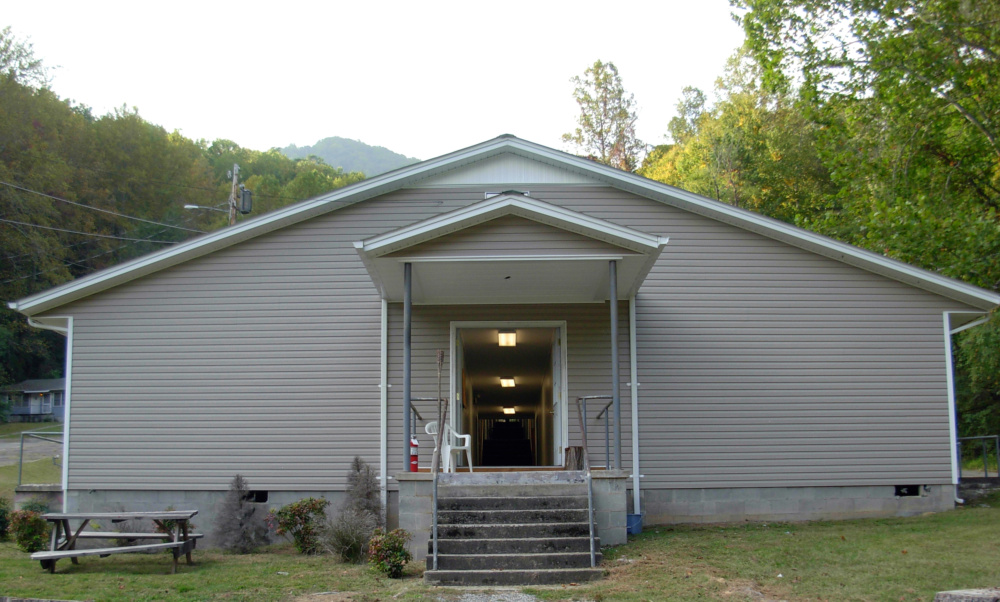
The porch of the Boys Dorm where something poked me. Photo September 2012 by Lewis O. Powell IV, all rights reserved.
I felt a finger poke me in the middle of my back. It had definite pressure and it lasted for a moment just as someone would poke someone to get their attention. I immediately felt with my hand, in the event that it was an insect, but the pressure had been too much to be from that. There was nothing there and I turned to see if someone was standing behind me. The Hill was quiet and empty. Nothing else stirred. I mentioned it to my two companions, both of whom are Native American. Both simply raised their eyebrows and one addressed the spirit, “Thank you for letting us know you’re here. “Please, leave us alone.” he said calmly.
Until just a couple weeks ago that was my only experience on The Hill this summer. The drama had its final performance and most of the cast left fairly quickly to resume their normal lives. I’ll remain, with the other reenactors, until the Village closes. Only a few people were left and I was off to watch a movie with a few people in the day room of the Boys Dorm (on the opposite end of the building from where I was poked). While walking up the hill towards the building I hear the whinny of an Eastern Screech Owl (Megascops asio). Being a birder, usually I would have thought, “Eastern Screech Owl, very cool!” but being in Cherokee, the sound sent a shiver through me. The whinny of the owl is considered to be an omen of death to the Cherokee. In accordance with Cherokee tradition, I tied a knot in my shirt to acknowledge that I’d heard the “laugh of death” and I continued into the building.
The Boys Dorm. The Day Room where I saw something pass the window is at the top of the building at the left side of this picture. Photo September 2012 by Lewis O. Powell IV, all rights reserved.
While watching the movie I turned to one of the young ladies sitting near me. I had intended on saying something when I saw something white and vaguely human-shaped move past the window next to her. For a moment I watched to see if it would happen again and nothing happened. I waited also to see if someone else saw it. Alas, no one else saw anything; they were all intently watching the movie. I turned to the window behind me and looked towards the door expecting someone to enter, but there was nothing but darkness. After mentioning the incident and finding that no one had witnessed the figure but me, I stepped outside to see if anyone else was about on The Hill, nothing else stirred. Perhaps this was the same sgi-li or booger that I’d heard before entering the building.
Just last week I’d headed out with a native friend to see the Thomas Divide Lights, we saw them and spent the time discussing many of the haunted places in Cherokee. When she dropped me off back on The Hill, we spent some time talking in the parking lot, directly in front of the Boys Dorm porch where I’d been poked. As we stood talking, I began seeing a dark shape move back and forth across the porch. This was all in my peripheral vision. When I looked directly towards the porch, there was nothing there. I began to wonder if I was seeing the frames of my glasses but I was not sure. I asked my companion if she was seeing anything. “You mean the thing on the porch?” she replied.
“Yeah.”
“Yep, there’s something up there. I keep seeing it out of the corner of my eye.” And she was not wearing glasses. Nothing else was stirring.
In the Village there seems to be a good deal of activity that’s being witnessed by employees, myself included. Just last week during my lunch break I decided to lie down and close my eyes on the porch just off the costume shop. Twice I heard the definite sounds of footsteps on the porch. Raising my head, the footsteps ceased. These were definite footsteps from a hard soled shoe on the deck. I was alone on the porch.
Within the Village I spend most of my time in one of the cabins. Interestingly, this seems to be the cabin that has been the subject of numerous stories. One afternoon while returning to the cabin with some firewood I glanced up to see a figure enter the cabin. Usually, it’s not uncommon to find tourists or other employees in or around my cabin when I return. I sped up my pace to greet the visitor, but arrived to find the cabin empty.
The beds in the cabin are sometimes too inviting and I may nap when there’s no one around. While napping one afternoon I was awakened by the sound of a man’s voice speaking in Cherokee. Before opening my eyes, I imagined a small Cherokee man standing in the corner, though I could not understand what he was saying. I raised my head and no one was in the cabin. Getting up, I looked outside and even looked behind the cabin and no one was around. Nearby, nothing else stirred.
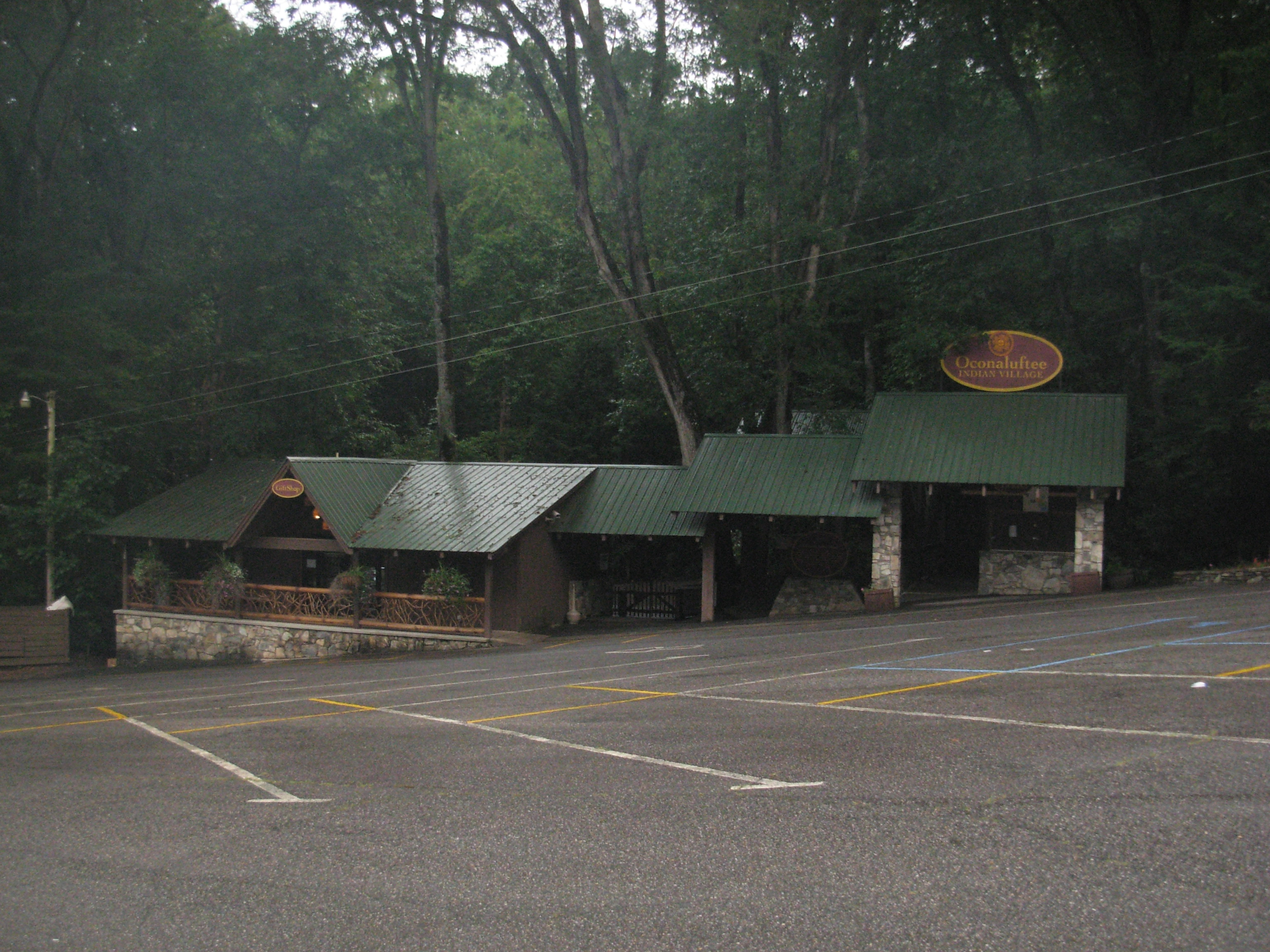
The entrance to the Oconaluftee Indian Village. The box office in under the round sign on the right and the gift shop is located on the left side. I saw a figure walking between these two sections. Photo September 2012 by Lewis O. Powell IV, all rights reserved.
My parents came up for a visit about a week before the drama ended. We saw the show together and I walked them to their car afterwards. They had parked in front of the Village visitor’s center and as we approached I saw a shadowy form move under the breezeway between the gift shop and the box office, an area that is not well lit. The figure passed behind a column and I fully expected to see someone emerge into the light on the opposite side of the column. No one did. My parents saw nothing, but I walked over to see if someone was walking around. Not a soul was there.
A native friend suggested that perhaps I may have become more sensitive as I have spent more time in the mountains. Or perhaps all of this is simply the product of an over-eager imagination. All I can say is that these things happened and I have no immediate explanation for them. Perhaps the spirits really are getting personal.
House in the Horseshoe State Park 288 Alston House Road Sanford, North Carolina
By all accounts, Philip Alston was trouble. A member of the prominent Alston family, some might describe him as a spoiled brat. The house Alston constructed at this horseshoe bend in the Deep River was among the first large plantation homes constructed in this region when it was built in 1772. As revolutionary tensions heated up throughout the colonies, Alston sided with the Patriot cause. Though he was fighting for the same ideals, even the Patriots took umbrage with Philip Alston. Another Patriot, Robert Rowan, even spoke to the governor of his dislike for Alston’s “domineering” and “tyrannical” attitude.
With the outbreak of fighting, squabbles between neighbors took on more deadly overtones throughout the frontier. Planter David Fanning of South Carolina remained loyal to the British crown and steadfastly rooted out Patriots throughout the area. A small militia under Fanning’s command attacked Alston’s home on the morning of August 5, 1781 in retaliation for the death of one of his men at the hands of some of Alston’s comrades. That morning, Alston, his wife Temperance, two children, and a small band of his men were at the large white house. When Fanning’s men attempted to attack the house one of the Tories was quickly felled by a bullet to the heart. Soon gunfire poured from the home’s windows while Alston’s children cowered in a fireplace inside.
A cart of straw was set alight and pushed towards the house which began to burn. Fearful of being burned out of the house, Alston sent his wife with a flag of truce to arrange surrender. Fanning agreed to allow Alston and his men to surrender. The Tories plundered the bullet-riddled house but did not burn it.
House in the Horseshoe, 2007, by Jerrye and Roy Klotz, MD. Courtesy of Wikipedia.
Philip Alston remained on his plantation for some years after the war and served in the state senate, though his roguish attitude lead to his fall from grace and in 1790, he was forced to sell his beloved home. Some believe that the rascal spirit of Alston may remain here in the form of footsteps heard in the home, disembodied whispers in the fireplace where the children were hidden, and orbs of light seen in the yard.
Source
Barefoot, Daniel W. Spirits of ’76: Ghost Stories of the American Revolution. Winston-Salem, NC: John F. Blair. 2009.
Bishir, Catherine W. and Michael T. Southern. A Guide to the Historic Architecture of Piedmont North Carolina. Chapel Hill, NC: University of North Carolina Press, 2003.
Hauck, Dennis William. Haunted Places: The National Directory. NYC: Penguin, 1996.
Guilford County Sheriff’s Office 400 West Washington Street Greensboro, North Carolina
In a recent article about the strange goings-on at the Guilford County Sheriff’s Office, the niece of Otto Zenke reported that his spirit may not approve of the vertical blinds used throughout the building. “He would never have approved of all those vertical blinds,” Ginia Zenke responded. “Not when his workrooms churned out beautiful draperies and furnishings for decades.” The sheriff’s office occupies a building that once served as noted interior designer Otto Zenke’s showroom and residence in his final years.
Brooklyn-born Otto Zenke arrived in Greensboro in 1937 to work for a furniture store. After going into business for himself with his brother in 1946, Zenke made a name for himself as one of the leading interior designers of the day as he worked on projects for wealthy clients in the area. He collected fine antiques and acquired the delicate, Italianate-styled Eugene Morehead House at 215 South Eugene Street which he turned into a local showplace. In the European style, the home’s library featured murals and paneling. The exquisitely executed gardens surrounding the house became a noted feature on the tours of local garden clubs. Sadly, city officials didn’t see this home as a treasure in their city.
In the 1960s as Greensboro began to execute a plan for “urban development” Zenke’s magnificent home and gardens sat smack dab in the middle of a proposed government center. The property was seized under eminent domain in 1968 and replaced with a Brutalist monstrosity by Argentine modernist Eduardo Catalano. The delicate cottage was razed over two days and the unadorned cast concrete walls of the government center rose over the next few years in its place. While the city did well in hiring a noted architect for the design, the bold architectural lines have always stood very harshly against the more classically based traditional architecture of the city; so much so that Preservation Greensboro remarked in its blog that the style, “has never been at ease” in the city.
Zenke, never one to back down from a challenge, moved across the street into the series of buildings that housed his showrooms and workshops. There, he created a fine residence that rivaled any in the city, though his heart still longed for the delicate cottage that he had lost. Otto Zenke died of cancer in 1984. Not long after his death, when the city bought Zenke’s last residence and converted it to the sheriff’s office, locals noted the irony of the situation.
The building behind the trees with the chimney is the sheriff’s office, formerly Otto Zenke’s residence.
Otto Zenke has a good reason to stalk the halls of the sheriff’s office and he seems to be particularly active. Law enforcement officials and staff have reported having items on their desks and in their offices rearranged, perhaps to suit Mr. Zenke’s taste. Some employees have had their names called by a male voice while working in the building after hours. Others have heard distinct footsteps rambling through empty rooms and hallways. While the spirit may not be malevolent, it does seem he may be a bit judgmental. If you work in the Guilford County Sheriff’s Office, you may want to keep your office tidy.
Sources
Associated Press. “Could ‘weird things’ at Guilford County Sheriff’s Office be a ghost?” Burlington Times-News. 13 September 2015.
Bishir, Catherine W. and Michael T. Southern. A Guide to the Historic Architecture of Piedmont North Carolina. Chapel Hill NC: University of North Carolina Press, 2003.
Helen’s Bridge Over College Street between Windswept Drive and Beaucatcher Road Asheville, North Carolina
I know your life on earth was troubled And only you could know the pain. You weren’t afraid to face the Devil You were no stranger to the rain. Go rest high on that mountain… –“Go rest high on that mountain,” Vince Gill (1995)
The city drops away quickly as you drive up Beaucatcher Mountain from downtown Asheville. College Street—a main thoroughfare through the heart of downtown, forming one side of Pack Square—suddenly becomes a mountain road. As it dizzily traverses the side of the mountain, the road enters a gap spanned by a lonely, primeval bridge. Something about the patina of the stone and the flora growing around the bridge, make it appear to be a natural part of the landscape, as if it’s always been there. In truth, it has been here for a little more than a hundred years, enough time for the bridge to settle into the landscape and become ensconced in legend and lore. You have arrived at Helen’s Bridge.
Helen’s Bridge, October 2012, by Lewis O. Powell IV. All rights reserved.
The temperature here seems chillier; perhaps it’s the geography or perhaps it’s the wandering spirit of Helen; it’s hard to tell. While many are drawn to the bridge’s stark beauty it is the legend and lore that draws others. The legend speaks of a woman named Helen who lived near the bridge with her beloved daughter. After losing her daughter in a fire, the distraught Helen hung herself from the bridge. Some versions associate Helen with the nearby estate of Zealandia, where she was supposed to have been a mistress to one of the estate’s owners, and after becoming pregnant, hung herself in anguish. Researchers have found nothing to document the existence of an actual Helen, although author Alan Brown relates that some of the owners of Zealandia encountered the apparition of a woman on the stairs that they identified as Helen.
Teens have taken to trying to summon Helen by visiting the bridge at night and calling her name three times. It is reported that she will sometimes appear as a light or as an apparition. Others have reported that this ritual will sometimes cause car problems, ranging from odd mechanical issues to dead batteries. Florida author, Jamie Roush Pearce experienced problems with her car’s automatic locks after visiting the bridge and attempting to summon the sad spirit. Pearce briefly glimpsed a figure near her car and discovered the problem with the locks after leaving the site. After dealing with the issue for a week, she returned and asked Helen to leave her car alone. The lock problem has not reoccurred.
The bridge is immortalized in Thomas Wolfe’s 1929 novel, Look Homeward, Angel, when the main character, Eugene Gant walks with his girlfriend up Beaucatcher Mountain:
They turned from the railing, with recovered wind, and walked through the gap, under Philip Roseberry’s great arched bridge… As they went under the shadow of the bridge Eugene lifted his head and shouted. His voice bounded against the arch like a stone. They passed under and stood on the other side of the gap, looking from the road’s edge down into the cove.
Though Wolfe attempted to draw a thin veil over his hometown by renaming it Altamont, it was clear to the Ashevillians that he was depicting them in his novel. So much so that he is reported to have received death threats and did not return to the city for several years after the novel’s publication.
This rustic stone bridge was constructed as a carriageway for the Zealandia Estate in 1909. It was designed by R. S. Smith, who worked as an architect on the building of the nearby Biltmore Estate and was obviously fluent in the languages of Gothic, Tudor, and Elizabethan architecture. In 1889, the same year that George Vanderbilt began construction on his magnificent manse that he would call Biltmore, John Evans Brown, who had spent his formative years in Asheville, began to build his estate here on Beaucatcher Mountain. Brown had left the city in 1849 to pursue his dreams of striking gold in the Golden West. When those dreams failed to pan out (pun intended), Brown set out for the green mountains of New Zealand where he found fortune in sheep and politics. He returned to his hometown with fortune in hand in 1888 and began construction on his estate.
Helen’s Bridge, December 2015, by Lewis O. Powell IV. All rights reserved.
Brown enjoyed his stately, mountainside view of Asheville for a few scant years before his death in 1895. The estate was purchased by Australian native Philip S. Henry in 1903 and this intellectual, art collector, and diplomat set about fashioning the estate into a showplace in this aristocratic resort community. Hiring architect R. S. Smith, Henry began to transform the lofty estate into a European-styled castle in the Tudor style. The carriageway with its notable bridge was constructed during this period. In 1924, Henry opened his estate for the public to see his art collection. Upon Henry’s death in 1933, the estate passed to his daughters and remained in the family until 1961.
When construction began on the nearby Interstate 240 corridor, plans originally called for slicing through part of Beaucatcher Mountain. Local preservationists quickly formed the Beaucatcher Mountain Defense Association to argue for the mountain’s preservation and even more specifically for the protection of Zealandia. A tunnel through the mountain was proposed instead. Though the state department of transportation tore down Philip Henry’s museum in 1976, the estate was named to the National Register of Historic Place in 1977 and was left alone. During the tunneling blasting supports were added to protect the bridge. In 1998 with the supports still in place and stones falling from the looming structure, the city considered demolishing the structure. Local history buffs and preservationists won the fight and the supports were carefully removed. The bridge was structurally sound and it has recently been bought by the city to use as part of a proposed greenway.
Helen’s Bridge, December 2015, by Lewis O. Powell IV. All rights reserved.
If you choose to visit Helen, be cautious as the area does have some traffic. There is a dirt turnout off Beaucatcher Road a few yards past the bridge ideal for parking. The top of the bridge is still closed off and Zealandia is private, so please confine your ramblings to the public thoroughfare underneath the bridge. Summoning spirits is never encouraged, especially if you wish to avoid car problems and please be kind to Helen, she’s been through a lot.
Helen’s Bridge, October 2012, by Lewis O. Powell IV. All rights reserved.
Sources
Bishir, Catherine W., Michael T. Southern, & Jennifer F. Martin. A Guide to the Historic Architecture of Western North Carolina. Chapel Hill, NC: University of North Carolina Press, 1999.
Bordsen, John. “Find the most haunted place in these Carolina towns.” Dispatch-Argus. 31 October 2010.
Brendel, Susanne & Bettu Betz. National Register of Historic Places nomination form for Zealandia. 12 January 1977.
Brown, Alan. Stories from the Haunted South. Jackson, MS: University Press of Mississippi, 2004.
“Saving Helen’s Bridge.” Asheville Community News. 1999.
Pearce, Jamie Roush. Historic Haunts of the South. Jamie Roush Pearce, 2013.
Tomlin, Robyn. “Zealandia Bridge Repairs Completed; Fixing historic bridge cost much less than originally forecast.” Asheville Citizen-Times. 1 June 1999.
Warren, Joshua. Haunted Asheville. Johnson City, TN: Overmountain Press, 1996.
In recent years, the sightings of the supernatural have spread by word of mouth among those seeking a genteel visit with those who have crossed over. — Steve Wong
The Oaks Bed & Breakfast 339 Greenville Street Saluda, North Carolina
Steve Wong’s delightful article in the October 5th, 2015 Tryon Daily Bulletin, “Hoping for ghosts in an old Saluda B&B,” is a charming description of one reporter’s search for the supernatural at The Oaks Bed & Breakfast. Admitting that he really wants to believe, Wong spends a night prowling the halls of this late 19th century inn in search of some of the genteel specters that remain here.
The railroad that built the town of Saluda still runs through the center of town, 2012. Photo by Bigskybill, courtesy of Wikipedia.
Saluda was built by the railroad that arrived in 1878. The town is located at the top of the Saluda Grade, the steepest mainline railway grade east of the Rockies. Nearly ten years after the railroad’s construction, almost 3,000 visitors per year were arriving in this tourist town. Many private homes, including this 1895 house, were transformed into inns to host the visitors. This turreted home, originally built for a physician, became an inn in 1906.
Wong’s marvelous article provides some of the first documentation of the inn’s spectral activity that had previously only been spread by word of mouth. While the article doesn’t hint at a possible identity for the spirits, but it seems that it may be a past innkeeper. A woman has been seen ascending the staircase apparently checking to make sure that guests are well taken care of. One of the innkeepers admitted that some guests have been overcome with “a strange feeling about the house that compelled them to tidy up their rooms.” Overall, this inn and its spirits seem to be the epitome of Southern hospitality.
N.B. This page was edited and revised 26 May 2020.
Among theatre folks there’s an old saying, “no good theatre, worth its salt, will be without a ghost.” The South is not immune to this phenomenon and its landscape is dotted with many theatres claiming to be haunted. The variety of theatres is astonishing; from 1920s-era movie palaces, to opera houses to performance spaces that have been created out of old buildings, and even cinemas, so many of these sites have wonderful and creepy stories to tell.
Mary G. Hardin Center for Cultural Arts 501 Broad Street Gadsden, Alabama
This prominent corner of Broad and 5th Streets has witnessed much of Gadsden’s history. A home stood on this corner until 1860 when the First Baptist Church erected a church here with a graveyard surrounding the building. Around the turn of the 20th century, the church was sold and the graves—most of them—were relocated to nearby Forrest Cemetery. A furniture store operated on the site until the building of the Imperial Theatre which opened in 1920. The theatre changed hands a few years later, was extensively remodeled and reopened as the Princess Theatre in 1926. The Princess—a vaudeville and motion picture house—provided the citizens of Gadsden the utmost in comfort and technology until it’s destruction by fire in 1963.
The Mary G. Harden Center for Cultural Arts on a grey day in October 2019. Photo by Lewis O. Powell IV, all rights reserved.
The starkly modern Mary G. Hardin Center for Cultural Arts now occupies the corner. Within its modern corridors, galleries, studios and performance spaces there are spirits. Betty McCoy reports that two visitors encountered the spirit of a child who was apparently quite confused. The spirit of a young girl appeared at the Princess Theatre just after it opened in 1920 and many patrons encountered the young and quite curious entity. The identity of this young entity has always been a mystery. Was she attached to one of the graves formerly on the site? Is she one of the spirits in the modern arts center? As long as spirits linger, the questions will remain.
Sources
Goodson, Mike. Haunted Etowah County, Alabama. Charleston, SC: History Press, 2011.
Hardin Center for Cultural Arts. “About the Center for Cultural Arts.” Accessed 18 March 2013.
McCoy, Betty S. Haints, Haunts and Hullabaloos: Etowah and Surrounding Counties. CreateSpace, 2011.
H Street Playhouse 1365 H Street, Northeast Washington, D.C.
Things have a strange way of disappearing at the H Street Playhouse. Some believe that these odd disappearances may be linked to a spirit within the old theatre, besides, these disappearances are truly strange. Take for instance, the matter of the disappearance of the theatre’s router from the office during a meeting. Members of one of the theatre companies that uses the theatre were meeting in the building when the Wi-Fi suddenly went out. Heading back to the office, which was only accessible through the room where the meeting was being held, the router seems to have completely vanished.
H Street Playhouse, 2012, by Smallbones. Courtesy of Wikipedia.
Costumes pieces and props also have a tendency to disappear right before performances. A t-shirt hanging on a rack disappeared without a trace while prop money seemed to have departed briefly from the bag it was stored in during the show. As money was required during the scene, the actors pulled together what bills they had on them to use, though when the props master opened the bag to dole out money for the upcoming scene, the prop money had reappeared.
If the kleptomaniac of the H Street Playhouse is, in fact, a spirit, then there is the question of identity. Tour guide and author Tim Krepp speculates that the spirit may either be the shade of Bruce Robey, who founded the H Street Playhouse with his wife, or perhaps the spirit of a young boy who was severely burned in a fire across the street in 1905. But, perhaps the spirit lies somewhere in the playhouse’s marvelous history.
The Romanesque Revival-styled building was built in 1928 as an automobile showroom. At the time, this particular stretch of H Street boasted so many dealerships it was called “Autombile Row.” This building served as a showroom until 1942 when the building was renovated for use as a cinema for the African-American community that occupied this area. As the social upheavals of the mid-20th century led to the neighborhood’s decline, the building was used for a variety of purposes until its conversion to a live theatre in 2002.
The H Street Playhouse closed in 2012. A gym currently occupies the building.
Sources
Bell, T. David. National Register of Historic Places nomination form for Plymouth Theatre. December 2003.
Krepp, Tim. Capitol Hill Haunts. Charleston, SC: History Press, 2012.
Coconut Grove Playhouse 3500 Main Highway Miami, Florida
The Coconut Grove Playhouse is like a famous actor in a vegetative state. The doctors are faced with a hard choice: unplug him from life-support to let him die or revive him with an expensive, experimental treatment and hope that he makes a full recovery. As of now, the doctors are still arguing over the best course to take.
This most famous of Florida theatres went suddenly into a vegetative state in 2006 under mounting debt. Since the theatre company’s closure, the theatre has been embroiled in mounting drama between a cast of politicians, preservationists, thespians and developers. Occupying a prominent corner on Main Highway at Charles Avenue, the location has developers salivating over the money that could come from a luxury condominium development on the site. Some government officials, preservationists and thespians would reopen the playhouse as a theatre and hopefully revive its cherished name. Before its closure, the theatre was a major economic driver in the Coconut Grove, one of the oldest neighborhoods in the city.
Coconut Grove Playhouse, 2011, by Ebyabe. Courtesy of Wikipedia.
As the drama fills courtrooms, offices and boardrooms outside of the theatre, faces have been seen peering from the buildings upper windows: spiritual guardians of this 1927 edifice. Ghost tours pass by the site regularly as the Mediterranean Revival structure sits forlornly with its doors locked. The theatre opened gloriously as the Player’s State Theatre on New Year’s Day 1927—a jewel in the Paramount crown. All the amenities of the best theatres were incorporated here including a huge Wurlitzer Concert Grand Organ and air conditioning. Riding high on the great Florida Land Boom of the 20s, the theatre’s fortunes ran out when the real estate bubble burst. The theatre closed in the early 1930s. It was not until 1955 that it would resume use as a theatre, but only after being transformed for use as a live-performance venue.
It struggled even as a legitimate theatre, though it did host a grand assortment of prominent actors and productions on its boards. Samuel Becket’s Waiting for Godot had its American premiere here and the stage has seen the work of such noted thespians as Jose Ferrer, Hume Cronyn, Jessica Tandy, and Ethel Merman. But, until the actors in the current drama come to a resolution, the theatre and the spirits peering from its windows will continue to wait for Godot’s eminent arrival.
Sources
Bandell, Brian. “Coconut Grove Playhouse hit with foreclosure.” South Florida Business Journal. 17 January 2013.
Feldman, Hal. “Do ghosts walk among us?” Pinecrest Tribune. 28 June 2012.
Uguccioni, Ellen and Sarah E. Easton. Designation Report: Coconut Grove Playhouse. City of Miami. 2005.
Viglucci, Andres. “Coconut Grove Playhouse board decides not to fight imminent state takeover.” Miami Herald. 2 October 2012.
Viglucci, Andres. “Plan for larger theatre at coconut Grove Playhouse remains alive.” Miami Herald. 12 March 2015.
Viglucci, Andres. “State says shuttered Coconut Grove Playhouse could be sold to private bidders.” Miami Herald. 14 December 2012.
Viglucci, Andres. and Christine Dolan. “FIU, Miami-Dade in possible deal to save Grove Playhouse.” Miami Herald. 13 March 2013.
Springer Opera House 103 10th Street Columbus, Georgia
As a kid, the Springer Opera House was the first local haunting I was familiar with. I recall the intense jealousy I felt when my sister got invited to a birthday party at the Springer and I wasn’t allowed to tag along to “see the ghost.” As a theatre major at Columbus State University, I visited the Spring a number of times and saw a few performances, though still I was distracted by the fact that there may be ghosts wandering about the antique promenades and still taking their seats in the boxes on either side of the stage.
In school, I also began to hear stories from my friends who had worked in the old theatre. Some of the experiences seemed incredible—like the story of a sound technician being levitated in the booth—while others seemed quite credible—a friend’s encounter with a little girl in a hallway who seemingly wanted to play tag but disappeared. When I got hired to work on a book about this theatre, I was excited to possibly experience the spirits there myself.
Interior of the Springer Opera House, 1979. Courtesy of the Library of Congress, Prints and Photographs Division.
I was asked by F. Clason Kyle to work as an editor on his book, In Order of Appearance, a history of the theatre and the many famous personalities—Edwin Booth and John Philip Sousa to Minnie Maddern Fiske and Burt Reynolds—to have trod its boards. Mr. Kyle and I first began by organizing much of the archival material the theatre had. We had our own little room stuffed with boxes of old programs, promotional materials, business papers and the occasional artifact. Among the artifacts was a beaded purse once owned by famed Polish actress, Helena Modjeska. We weren’t sure where the purse was, so we went looking for it.
Before we left the archives room, Mr. Kyle and I had been sorting through the various boxes. We returned to the room after a search of about an hour and I walked straight back to the box I had been searching through. There, sitting on top of the papers within the box was an antique purse. While it was not the Modjeska purse, almost as a consolation prize, an antique pocket watch had been placed on top of the purse. Obviously, if the purse had been there as we were discussing the Modjeska purse I would have asked about it. But to appear after we returned from the search was very odd. Perhaps the Springer’s ghost is similar to the H Street Playhouse’s kleptomaniac spirit.
During my two years working on the book, I also heard footsteps on the second floor and a door slamming shut by itself during a rehearsal. But many others have had more spectacular experiences. The educational director whose office was located on the second floor regularly saw a man walking past her doorway. She also felt a strong bond, motherly really, towards the spirit of a little girl that had been reported throughout the building as well.
There is apparently a host of spirits within the 1871 building, though it seems that the male spirit and the little girl may be the more active. The theatre’s artistic director, Paul Pierce, wrote a book about many of the experiences in the Victorian theatre including his own experience. Pierce had arrived at the theatre early one morning to open the tool room for technicians who were setting up for an event. As he walked through the scene shop, Pierce realized there was a man walking next to him. “Slight of build, he was a young gentleman with a thin, unruly, Van Dyke beard and wearing an ill-fitting tweed suit.”
Pierce walked through the shop with this figure playfully mirroring his stride through the room. They turned a corner and the figure walked behind a screen leaning against the wall. The figure did not emerge from the other side.
Sources
Kyle, F. Clason and Lewis O. Powell, IV, editor. In Order of Appearance: Chronicling 135 Years on America’s Most Celebrated Stage. Columbus, GA: Communicorp, 2006.
Pierce, Paul. The Springer Ghost Book. Columbus, GA: Communicorp, 2003.
Paramount Arts Center 1300 Winchester Avenue Ashland, Kentucky
The Paramount Arts Center gained its ghost fairly early in the theatre’s history when, as legend holds, a worker somehow became entangled in the rigging above the stage and died. If this act was an accident or suicide is unknown, but strange things began to be reported in the building. Over time, theatre staff members dubbed the entity “Paramount Joe.”
Just seven months after the Ashland Opera House was destroyed by fire in 1931, the Paramount Theatre opened as a movie palace for the citizens of the city. When the Art Moderne style theatre closed its doors in 1971, locals purchased the building as a performing arts center.
Paramount Arts Center, 2007, by YoungAmerican. Courtesy of Wikipedia.
In 1992, local musician Billy Ray Cyrus (father of Miley Cyrus) chose the theatre for the filming of the video of his hit song, “Achy Breaky Heart.” While there, he was told the story of “Paramount Joe,” and Cyrus claimed that he spoke with the spirit during a break and signed a poster for Paramount Joe. Some years later when an executive removed the poster from its place in the box office the staff returned the next day to find all the pictures had fallen from the walls some having their glass and frames broken. After Paramount Joe’s signed poster was restored, all has returned to normal in terms of the pictures.
Sources
Ball, Linda Larimore. National Register of Historic Places Nomination Form for the Paramount Theatre. October 1975.
Abbey Players Theatre 200 South State Street Abbeville, Louisiana
The Abbey Players had its founding in 1976 when a small group of thespians staged a successful production of Neil Simon’s Last of the Red Hot Lovers. The theatre company was incorporated the next year with the intention of presenting quality theatre to the region. After spending a few years staging shows at various venues throughout town, the group began renting an old building on South State Street. Previously housing the Reaux Lumber Company, the building dates to 1908 and was originally opened as a saloon.
After adapting the building for use as an arena stage, the company settled in and now produces 3-4 shows per season as well as children’s productions. Additionally, company members have had experiences in the building that may be paranormal. These include the shade of an elderly woman and the voice of a young girl among other unexplained noises. An investigation by Louisiana Spirits Paranormal Investigations captured a number of personal experiences for the team as well as EVPs.
A couple of these experiences are highlighted in Chere Coen’s Haunted Lafayette, Louisiana. During the investigation, Louisiana Spirits discovered a cold spot that seemed to move around a dressing room. The investigators also heard a disembodied voice greet them with a “hi.”
Patapsco Female Institute 3655 Church Road Ellicott City, Maryland
The immortal words of Shakespeare have been uttered within the walls of the Patapsco Female Institute for almost two centuries. Even with only the exterior stone walls remaining, the ruins now provide a perfect backdrop for productions by the Chesapeake Shakespeare Company. Shakespeare’s numerous ghosts may even provide a camouflage for the ghosts that reside among the romantic ruins.
The Patapsco Female Institute opened in 1837 as an elite finishing school for young women. Among some of the more well known alumnae is Winnie Davis, daughter of Confederate President Jefferson Davis. Sally Randolph, the great granddaughter of Thomas Jefferson, served as a headmistress. It was during this time in the balmy days leading up to the Civil War that a daughter of a Southern planter was enrolled here.
An illustration of the Patapsco Female Institute in 1857, from The Book of Great Railway Celebrations of 1857.
The young girl hated the school, longed for home and her father would not allow her to return home. The student contracted pneumonia and her body left the school in a coffin. The student’s spirit, however, has remained to wander the ruins of her former school.
The school closed its doors in 1891 and throughout the 20th century the building served as variety of uses including a convalescent home after World War I, a private residence and a theatre. After local officials condemned the building in the late 1950s, the owner gutted the building of its woodwork leaving just the yellow-tinted local stone walls standing. The space is now owned and operated by the Howard County Government as a historic site and an events space.
The white-gowned apparition of the former student still wanders the grounds.
Sources
Hannon, Jean O. Maryland Historic Trust Worksheet for Patapsco Female Institute. January 1978.
Hirsch, Rona S. “Ghostly images, spirited debate.” Baltimore Sun. 31 October 2001.
Cinemark Movies 8 Mall at Barnes Crossing 1001 Barnes Crossing Road Tupelo, Mississippi
An entrance to the Mall at Barnes Crossing, 2015. Photo by Mike Kalasnik, courtesy of Wikipedia.
Any location can be haunted. While most people would not expect to encounter a spirit within a fast food restaurant, big-box retailer (like Wal-Mart or Toys R Us) or a recently constructed building, it does happen. In some cases, recent tragic events may spur such a haunting, but other times, there is no obvious reason at all. Such is the case of this haunted multiplex theatre. According to CinemaTreasures.org, this theatre was opened in 1992, seating 1920 people and a couple spirits. A female spirit, nicknamed Lola, quite mischievously moves things and has been seen peering into the break room trashcan. She apparently gets the brunt of the blame when things go wrong or missing. A male spirit seems to be more elusive and sticks to the projection room.
Steed, Bud. The Haunted Natchez Trace. Charleston, SC: History Press, 2012.
Mountainside Theatre 688 Drama Drive Cherokee, North Carolina
Part of my own heart lies in the mountains of Western North Carolina around Cherokee. While I was in college I spent the three greatest summers of my life working on the historical drama, Unto These Hills, which has been performed at the Mountainside Theatre since 1950. It’s a humbling experience to be able to tell the story of the Cherokee people who have existed in this area for millennia. Even more humbling is being able to tell that story surrounded by the spirits of the characters and their living descendants.
The theatre is truly a sacred space where we can commune with the spirits of the past, both figuratively and literally. From my first day here, we were always made aware of the presence of spirits in this enormous amphitheatre. Among the host of spirits are Cherokee, sacred spirits from Cherokee mythology (see my entry on my own experience with the Cherokee little people) and former cast members. Some of these spirits can be truly frightening while others provide comfort.
Entrance to the Mountainside Theatre, 2012, by Lewis O. Powell, IV. All rights reserved.
In recent years, the Cherokee Historical Association—which operates the drama as well as the Oconaluftee Indian Village (it’s also haunted)—has operated a “Haunted Village” attraction around Halloween. This includes a ghost walk through the theatre and cast housing. In 2013, a zombie run was held at the theatre. During this event participants were chased through the theatre complex and cast housing by a variety of zombies. This included an area just behind the theatre called the ready room. This space is a partially enclosed area where actors may wait once they have put on their costumes. On the wall here is an old pay phone.
The ready room phone, 2014, by Lewis O. Powell, IV. All rights reserved.
I was told this story last summer when I was working in Cherokee. One evening in 2013, an hour or so after the zombie run the local police department received a panicked phone call from the Mountainside Theatre. A terror-filled voice begged for help from the theatre. The Cherokee Police Department responded and sent police up the driveway behind the theatre. The theatre complex was quiet and empty without a living soul to be found. The call had been traced to the theatre pay phone. It was discovered, however, that the phone was disconnected.
This is one of countless stories that have been told about the theatre.
Sources
Connor, William P., Jr. History of the Cherokee Historical Association 1946-1982. Cherokee, NC: Cherokee Historical Association, 1983.
Dock Street Theatre 135 Church Street Charleston, South Carolina
St. Philip’s Episcopal Church aggressively pushes itself into Church Street. Its columned porches thrust out so far that the street must curve to accommodate it. Above the street, the tremendous spire rises like an upright, moral finger, a reminder of the moral duties of the citizens of The Holy City. In the next block south of the church and within the shadow of the spire sits the Dock Street Theatre grinning garishly with its whimsical columns at St. Philip’s and the stringent Gothic Revival face of the French Huguenot Church directly across Church Street.
Theatre has always thumbed its nose at the self-righteous morality of good, church-going folk while often lampooning their foibles and failures on its boards, pulling down the saints from their lofty niches. In turn, the righteous have worked to reign in and silence the heckling theatre. This certainly was the case in Colonial America, a place still reeking of the Puritanism and strict morality that afflicted and bound the earliest settlers. Theatre most certainly struggled to gain a foothold on this steep religious mountain. The original Dock Street Theatre opened its doors in 1736 as, quite possibly, the second oldest edifice devoted to theatrical performance in the colonies.
As a part of a city in its early evolution, the original structure lasted a little less than two decades before that spark of a city’s growth, fire, reduced it to a hollowed shell of brick. The theatre was rebuilt and remained a theatre through the remainder of the 18th century. In 1809 the structure became home to the Calder House Hotel (later known as the Planter’s Hotel) run by Alexander Calder—an ancestor of the 20th century American artist of the same name—to serve wealthy visitors to the city. During the Great Depression, the Works Progress Administration cobbled together the collection of old buildings on this site into the current reincarnation of the Dock Street Theatre which incorporates an 18th century styled theatre and possibly a few brick walls dating to the original 1736 theatre.
Dock Street Theatre, 2011. Photo by Lewis O. Powell, IV. All rights reserved.
The building incorporates a certain spiritual fabric within its aged physical fabric. Most sources refer to two spirits who reside within the old theatre, though I venture that with the Dock Street Theatre’s long history, there’s also quite a good bit of residual energy manifesting itself.
One of the spirits has been identified as the great British thespian, Junius Brutus Booth. Renowned for his portrayals of Shakespearean characters, Booth fathered three sons who were also destined for the stage: Junius Brutus Jr., Edwin and John Wilkes, three thespians who left their mark on the theatrical world and one who would leave a mark upon the world stage. Edwin followed in his father’s footsteps to become one of the greatest tragedians of his day whilst Junius Jr. found better success in the managing of theatres. John Wilkes earned his notoriety as Abraham Lincoln’s assassin.
According to numerous—mostly paranormal in nature—sources, Booth the elder did stay in the Planter’s Hotel and that the well-dressed gentleman’s spirit seen in and around the theatre is his shade. Though it does ask the question of why would Booth haunt this hotel of all the numerous hotels where he stayed? According to the managing director of the theatre Booth was an alcoholic and possibly mentally unstable. During a stay in Charleston Booth allegedly beat his manager with a fire iron. Just as modern actors and performers are prone to bouts of bad behavior, so were the actors and performers of old. It seems this may belong to the phenomenon of historic landmarks picking among their most famous patrons or residents in order to identify their spirits.
Nevertheless, the spirit is still seen within the theatre. A man in a tall hat and overcoat is sometimes seen in the balcony and may sit in on rehearsals. In her Ghosts and Legends of Charleston, Denise Roffe reports on a young woman who saw this gentleman standing in the balcony when she visited.
Though, other stories center on a spirit known as “Netty” or “Nettie.” Likely dating to the same time as the gentleman’s spirit, legend has it that Nettie was a “working girl” who provided entertainment to the gentlemen who patronized the hotel. The legend continues with her dying a violent death on the balcony of the hotel, just above the entrance. While she was out on the balcony one evening, the steel beam supporting the balcony was struck by lightning and she was electrocuted. According to author Terrance Zepke, her spirit form has been observed by passersby and also captured on film. Additionally, she lingers in the second floor backstage hall where she apparently appears to be walking on her knees as the floor was raised during the building’s renovations in the 1930s. Netty is still walking on the original floors.
Sources
Bull, Elias B. National Register of Historic Places nomination form for the Dock Street Theatre. 2 January 1972.
Macy, Ed and Geordie Buxton III. Haunted Charleston: Stories from the College of Charleston, the Citadel and the Holy City. Charleston, SC: History Press, 2004.
Poston, Jonathan H. The Buildings of Charleston. Columbia, SC: U. of SC Press, 1997.
Roffe, Denise. Ghosts and Legends of Charleston, South Carolina. Atglen, PA: Schiffer, 2010.
Zepke, Terrance. Best Ghost Tales of South Carolina. Sarasota, FL: Pineapple Press, 2004.
Paramount Center for the Performing Arts 518 State Street Bristol, Tennessee
In 1991 at the age of 60 the Paramount Theatre, run down and virtually abandoned, rose like its “Mighty Wurlitzer” organ once did from the depths to be reborn as the Paramount Center for the Performing Arts. Opened in 1931, the theatre was meant as a cinema and its small stage had to be enlarged to accommodate live performance in the modern day. Sitting proudly on State Street not far from the Tennessee/Virginia state line, which divides this city, the theatre continues to attract people from all over the region.
The Paramount Center for the Performing Arts by Carole M. Highsmith, courtesy of the Carol M. Highsmith Archive, Library of Congress, Prints and Photographs Division.
According to a 2009 article from the Bristol Herald Courier, the site of the Paramount Theatre was previously haunted. On that site, Bristol’s first hospital stood, a building that had previously been a hotel. During its time as a hotel, a man was shot and killed there. After that, the hotel had trouble renting his room after that as patrons reported hearing and feeling odd things in that room. There is a spirit still hanging around the theatre, though no indication it is the same from the old hotel. The Executive Director has reported that footsteps are still heard in the empty building with the sound of doors opening and closing as well.
Sources
Netherland, Tom. “A Timeless Stage: Memories of the Paramount Center.” Originally published in Bristol Herald Courier, 17 February 2009. Republished in A! Magazine for the Arts, March 2013.
State Street divides city of Bristol and marks the state line between Tennessee and Virginia. The Cameo Theatre, on the north side of the street, is in Virginia while the Paramount Center for the Performing Arts, just a few blocks down, sits on the south side of the street in Tennessee. The division between the theatres also marks a gulf of fortunes between them as well. While the Paramount Theatre remains open as a performing arts center the Cameo is currently for sale. Two years older than the Paramount, the 1925 theatre was opened as a vaudeville house and recently served as an arts facility, hosting arts classes for children. Sadly, finances did not allow that to continue and the theatre was put up for sale in 2010.
According to V.N. Phillips’ book, Ghosts of Bristol: Haunting Tales from the Twin Cities, the Cameo replaces The Black Shawl, Bristol’s most infamous brothel. Pocahontas Hale, the establishment’s madam, is said to notoriously patrol the sidewalk in front of the Cameo Theatre. Her shade has been spotted wearing the black clothes and wrapped in the black shawl that she always wore in life.
Sources
McGee, David. “Cameo Theatre annex’s inventory being sold off to make way for new owner.” Bristol Herald Courier. 16 June 2010.
Phillips, V.N. Ghosts of Bristol: Haunting Tales from the Twin Cities. Charleston, SC: History Press, 2010.
Old Main Campus of Marshall University Huntington, West Virginia
With a cornerstone laid in 1869—just 32 years after the founding of Marshall Academy on the same spot—Old Main continues to carry Marshall University towards the horizon of the future. The structure’s nomination form for the National Register of Historic Places contains the sentimental statement that “alumni consider Old Main and school itself to be identical. Old Main is Marshall University and Marshall University is Old Main.” Not only does this monumental Tudor structure carry students and faculty forward as a university centerpiece and administration building, but it carries a spirit or two as well.
Old Main, 2013, by WVFunnyman. Courtesy of Wikipedia.
Old Main embodies the history of the school itself in its walls. It is not actually a single building, but five buildings that have been joined over time. Originally one of these building contained an auditorium, though the space has been unused since 1990. School legend relates that a well-dressed man was sometimes seen back stage during performances. Actors and crew back stage would see the man who would be gone with a second glance. This man was identified as a theatre director from the 1920s. The director supposedly disappeared after it was discovered he had embezzled money from the school.
Sources
Bleau, Edward R. National Register of Historic Places nomination form for Old Main—Marshall University. 28 December 1972.
Bozzoli, Carlos. “Old Main Building.” Marshall University Architectural Guide. Accessed 14 March 2013.
Donahue, Kelly. “Untitled article.” The Parthenon. 29 October 1996.
This is the second half of my two-part article on Haunted Hotels and Inns of the South that I created just after the blog was first posted in 2010. It was my first really big (almost too big) article and I have attempted over the years to revisit it with the hope of updating, revising and completing it (I originally left off Virginia and West Virginia when I got tired of writing). This article with my article, 13 Southern Rooms with a Boo, is the replacement.
This article is just a sampling (2 from each of the 13 states that I cover here) of the vast array of haunted lodgings throughout the South. My article, “Dining with Spirits” is a companion piece to this article. Enjoy!
Tutwiler Hotel 2021 Park Place Birmingham, Alabama
The Tutwiler Hotel, like a ghost, has risen from the dead, almost. When it opened in 1914, the Tutwiler was the finest hotel in the city and was at the heart of its social scene hosting events such as actress Tallulah Bankhead’s wedding reception. The hotel was originally constructed to serve visiting steel company executives in this city that was built on the steel industry. When the industry began to die in the second half of the twentieth century, the hotel fell into disrepair and the 450-room landmark with its 1000-seat ballroom was imploded a year after closing its door in 1972.
Panoramic view of the Tutwiler Hotel, 2011, by Chris Pruitt. Courtesy of Wikipedia.
With the recovery of Birmingham’s economy, the need for a luxury hotel again arose. Investors purchased the Ridgeley Apartments, a large brick building on Park Avenue that had been constructed by Major Tutwiler at the same time his grand hotel had opened. The apartment building was restored and refurbished into the new Tutwiler Hotel. Not only has the hotel returned from oblivion, but some of its former residents have returned as well. A spiritual knocker raps on the doors of the hotel’s sixth floor late at night. Of course, when the door is answered, no one is seen. Jessica Penot in her Haunted North Alabama tells of the spirit of a young girl who is also seen on the sixth floor and may be the cause of the knocking.
According to Alan Brown, the bartender of the hotel had issues with the lights in the dining room. He would turn them off and leave for the night only to find them on in the morning. After coming in one morning to discover a fully cooked feast laid out on the table, the bartender began saying goodnight to Major Tutwiler upon leaving at night. The lights have remained off. “Good night, Major Tutwiler.”
Sources
Brown, Alan. “Knocking at the Tutwiler Hotel.” WierdUS,com. Accessed 28 October 2010.
Lewis, Herbert J. “Birmingham.” Encyclopedia of Alabama. 8 January 2008.
Penot, Jessica. Haunted North Alabama. Charleston, SC: History Press, 2010.
The Hay-Adams 800 16th Street, Northwest Washington, D.C.
Marian Adams, known by her nickname, “Clover,” is at the center of two ghost stories. One tale concerns her tragic spirit haunting the fourth floor of the Hay-Adams Hotel and the other concerns her eerie grave at Rock Creek Cemetery. Clover was the socialite wife of historian and writer Henry Adams whose autobiography, The Education of Henry Adams, won the 1919 Pulitzer Prize but omitted his late wife.
The December 10, 1885 edition of the Washington paper, The Critic, briefly notes Marian Adams’ funeral: “The funeral of Mrs. Marian Adams of 1607 H Street, wife of Mr. Henry Adams, took place from her late residence yesterday. The certificate of Dr. Hagner, filed in the Health office, was to the effect that the deceased died of paralysis of the heart superinduced by an overdose of potassium.” Mrs. Adams was an amateur photographer and used potassium cyanide in developing her photographs. It was believed that she had committed suicide, though rumors swirled throughout the city as to why and even if she had possibly been murdered.
Hay-Adams Hotel, 2008, by AgnosticPreachersKid. Courtesy of Wikipedia.
The H Street home where Adams had met her death was being rented by the Adams from art collector W. W. Cochran. The couple had been renting the house while an H. H. Richardson-designed home was being built for them on 16th Street. The home was being built next door to the home of John and Clara Hay, close friends of the Adams. Following his wife’s death, Henry Adams moved into the new house and stories came out of the couple’s old house on H Street where residents witnessed mysterious knocking and the ghost of a “sad-eyed lady.”
To mark his wife’s grave, Henry Adams commissioned the sculptor Augustus Saint-Gaudens to create a fitting memorial that was not “intelligible to the average mind.” The sculptor created a bronze figure that sat atop the grave shrouded in cloth. The figure’s face is hidden under a hood and is hidden in shadow. Though neither Saint-Gaudens or Adams called it such, the creepy statue became known as “Grief.” Over the years, tales have been spun to explain the statue’s effect on people and some have reported that the figure has supernatural powers.
Adams passed away in 1918 and the graceful pair of Richardsonian mansion that had been home to Adams and his friends the Hays became the victims of “progress” in 1927. A developer demolished the homes and constructed a large Italian Renaissance-styled hotel which he named for the former owners of the property. At some point, the hotel gained a permanent guest in the form of the shade of Marian “Clover” Adams.
Clover has apparently taken over the hotel’s fourth floor. Maids in unoccupied rooms on that floor have reported hearing the sounds of a woman sobbing, asking “what do you want?” and calling their name. The hotel’s Wikipedia page cites a source as saying that the spirit of Clover Adams is accompanied by the faint smell of almonds. Potassium cyanide is extracted from almonds.
Sources
Alexander, John. Ghosts: Washington Revisited. Atglen, PA: Schiffer, 1998.
“Funeral of Mrs. Adams.” The Critic. 10 December 1885.
Hay-Adams Hotel. Wikipedia, the Free Encyclopedia. Accessed 5 March 2015.
Rooney, E. Ashley and Betsy Johnson. Washington, D.C.: Ghosts, Legends and Lore. Atglen, PA: Schiffer, 2008.
Smith, Terry L. and Mark Jean. Haunted Inns of America. Crane Hill Publishers, 2003.
The Don CeSar 3400 Gulf Boulevard St. Pete Beach, Florida
Facing the sapphire waters of the Gulf of Mexico stands Thomas Rowe’s palatial pink dream, The Don CeSar. Opened in 1928, the resort was, for a time, the heart of the Jazz Age social scene in Florida, hosting luminaries ranging from novelist F. Scott Fitzgerald to baseball legend, Lou Gehrig. The resort survived the tumult of the Great Depression but with Thomas Rowe’s death in 1940, the hotel passed into the hands of his ex-wife. When Rowe died, he had been in the process of changing his will to write out his former spouse, but as this new will remained unsigned at the time of death, the old will was executed. The ex-wife, Mary, was not a business woman and the hotel began to fall into disrepair and was taken over by the government for back taxes.
The immense hotel was transformed by the government into a veteran‘s hospital, stripped of its Old World splendor. Following World War II, the building remained in government hands and served as offices for the Veteran’s Administration and later for other agencies. In 1967, the structure was abandoned and left to the elements. Vagrants, vandals and mice roamed the graffiti painted and trash-strewn corridors. During this time, stories began to circulate of Jazz Age phantoms roaming the beach near the resort and the sound of parties echoing from the ruined patios and terraces.
With the looming threat of demolition, a citizens group banded together to save the pink landmark. The hotel was reopened in 1973 and renovation starting in the early 1980s restored and expanded the resort. Renovations and work in old structures often tends to stir up spiritual activity and such was the case at the Don CeSar. The figure of a man in a tan suit and Panama hat began to be seen poking around the building. Sometimes alone and sometimes seen with a beautiful woman, the man has been identified as Thomas Rowe.
The Don Cesar in 2006 by Porkfork6. Courtesy of Wikipedia.
The woman is connected with the legend of the hotel. According to the story, Rowe built this pink palace as a monument to his first love, an opera singer. The couple was not allowed to marry and when Rowe built the hotel, he named it Don CeSar for the male lead in Wallace’s opera, Maritana. Supposedly, Rowe’s lady love was an opera singer whom he spotted first playing the female lead in the opera. Perhaps Rowe and his love have finally found the solace in death that they could ill afford in life.
Sources
1935 Labor Day hurricane. Wikipedia, the Free Encyclopedia. Accessed 29 October 2010.
Don CeSar. Wikipedia, the Free Encyclopedia. Accessed 28 October 2010.
Jenkins, Greg. Florida’s Ghostly Legends and Haunted Folklore, Volume 1, South and Central Florida. Sarasota, FL: Pineapple Press, 2008.
Riverview Hotel 105 Osborne Street St. Marys, Georgia
The verandas of the Riverview Hotel have faced the waters of the St. Marys River for nearly 100 years inviting visitors to stay and “set a spell.” This family-owned hotel has been operated by the Brandon family since the 1920s and has seen the likes of Marjorie Kinnan Rawlings, Admiral Chester Nimitz and Senator Richard Russell. Something, possibly not of this world, seems to occupy Room 8, even when the guest register shows it to be vacant. Innkeeper Jerry Brandon is quoted by Sheila Turnage in her Haunted Inns of the Southeast as saying that a male apparition has been spotted outside of Room 8 and people staying in that room have been touched by an unseen presence. He continues that during a power outage, the lights in the room stayed on. In St. Marys, the spirit world still leaves the light on for you.
Riverview Hotel, 2012, by Lewis Powell IV, all rights reserved.
Sources
Hampton, Liz. “Living history at the Riverview.” The Florida Times-Union. 21 February 2004.
Reddick, Marguerite. Camden’s Challenge: A History of Camden County, Georgia. St. Marys, GA: Camden County Historical Society, 1976.
Turnage, Sheila. Haunted Inns of the Southeast. Winton-Salem, NC: John F. Blair, 2001.
Maple Hill Manor 2941 Perryville Road Springfield, Kentucky
Some paranormal researchers speculate that ghosts may see a location as they once knew it rather than what exists now. Despite this speculation, I can imagine the ghosts looking out of the windows of Maple Hill Manor would be confused by the flocks of alpacas and llamas grazing outside. The current innkeepers, Todd Allen and Tyler Horton, raise the alpacas and llamas for their wool which may be used to make clothing, jewelry, and even teddy bears.
In addition to these exotic animals, the innkeepers appear to have a number of spirits on hand in this historic home built between 1848 and 1851. It was the home of Thomas and Sarah McElroy, their children (a few of whom died in infancy) and the family’s slaves. Some of the spirits that are still encountered may be family members, including a son who plunged to his death when a railing on the stairway gave way and the spirits of the McElroy’s slaves including “Mammy Anne” who has been seen sitting in her former room. These spirits are joined by the apparitions of soldiers who were wounded in the Battle of Perryville, fought nearby. The innkeepers have reported that activity, especially in Harriet Beecher Stowe room where the soldiers were treated, tends to spike around October 8, the anniversary of the battle.
Sources
Brown, Alan. Haunted Kentucky: Ghosts and Strange Phenomena of the Bluegrass State. Mechanicsburg, PA: Stackpole, 2009.
T’Frere’s House Bed and Breakfast 1905 Verot School Road Lafayette, Louisiana
During an investigation of T’Frere’s House Bed & Breakfast, Smoke and Mirrors Paranormal captured an EVP of a male voice whispering very gruffly, “that’s it, I want them out!” The spirits here speak a great deal in both English and French. An exterminator was working in the home’s attic when he encountered a small woman who asked him to “viens voir,” or come see. Not wanting to actually see what the mysterious woman wanted to show him, the exterminator fled.
Oneziphore Comeaux, the youngest of seven children, nicknamed T’Frere, meaning “little brother,” built his home in Lafayette in 1880. When the home’s owner, Peggy Moseley decided to open the home as a bed and breakfast in 1986, the name T’Frere’s was perfectly suited for it. When the Pastor family bought the bed and breakfast in 1994, they also didn’t realize their purchase included a ghost.
As the Pastors were moving in the family took a load of things to the house for the night. Their son had forgotten a paper needed for his math homework. He was worrying about it in his room when the sheet suddenly floated down from the ceiling. An investigation of the room did not reveal any reason that the missing paper could have just appeared.
Legend speaks of a young schoolteacher, Amelie, who died when she went to wash her face and fell in the well. When the Catholic Church judged her death a suicide, she was denied burial in the consecrated ground of the cemetery. Amelie’s spirit has been encountered throughout the house, with her mostly making her presence known by rattling pots and pans, turning lights off and on and other mischievous activity.
Sources
Coen, Chere. “Ghost hunters search for inn’s oldest ‘resident.’”IND Monthly. 18 August 2014.
Coen, Chere. Haunted Lafayette, Louisiana. Charleston, SC: History Press, 2013.
Ponseti, Valerie. “Ghost Hunt at T-Frere’s.”KATC. 17 August 2014.
Rose, Christopher. “Minding her manor.” The New Orleans Times-Picayune. 19 April 1992.
Turnage, Sheila. Haunted Inns of the Southeast. Winton-Salem, NC: John F. Blair, 2001.
The Wayside Inn 4344 Columbia Road Ellicott City, Maryland
The massive three-story granite Wayside Inn on the Columbia Turnpike outside of Ellicott City can claim that “George Washington slept here,” it can also claim a ghost. While the early history of the inn is lost in the shadows, it is known that Washington, as well as other colonial luminaries passed through the area. Most likely, they would have stayed in one of the inns that lined the Old Columbia Turnpike, between Washington, D. C. and Baltimore. Little has been written on the female ghost that haunts the premises, though an article written around the time of the inn’s reopening in 2004, mentions that a friend of the innkeepers heard a door open followed by footsteps to discover that no one was present.
Sources
History. WaysideInnMD.com. Accessed 29 October 2010.
Schissler, Eleanor. “B&B’s renovation doesn’t quiet talk of reputed ghost.” Howard County Times. 3 June 2004.
Cedar Grove Mansion Inn & Restaurant 2200 Oak Street Vicksburg, Mississippi
Cedar Grove is a house built for love. Built by John Klein as a wedding gift to his bride, Elizabeth Bartley Day, Cedar Grove was completed in 1852 following a grand tour of Europe with her. With the start of the Vicksburg Campaign during the Civil War, the house was one of the first houses in Vicksburg hit by the Union shelling of the city, in fact, a cannonball is still lodged in the wall of the parlor. Mrs. Klein, a native of Ohio, was also a relative of Union General William Tecumseh Sherman who had been a guest in the house. Sherman gave personal assurances to the Kleins that their home would be spared and he personally escorted the family to safety. Following the Kleins evacuation, the house was used by Union forces until after the fall of Vicksburg.
Foyer of the Cedar Grove Inn, 2004, by Flowerchild48. Courtesy of Wikipedia.
When the Kleins returned to the city after the war, they were met as traitors with turned backs and averted eyes. When the house was purchased in 1983 and conversion into a bed and breakfast began, the Klein’s proud house had fallen into disrepair. The owners have fully restored the house and included homes across the street as cottages including the cottage that John Klein used while the main house was under construction.
I’ve found two main sources on this inn. While there is no confusion about the history, the sources differ on the spiritual guests. Sheila Turnage mentions two spirits, a male spirit, possibly Mr. Klein, whose pipe smoke appears in the gentlemen’s parlor and a female spirit who has been heard and seen on the stairs. Interestingly, my other source, Sylvia Booth Hubbard’s Ghosts! Personal Accounts of Modern Mississippi Hauntings, provides more spirits. Hubbard mentions the possible spirit of Mr. Klein, but also includes the sounds of children playing and an infant crying. She continues by mentioning that a later owner of the home had a sister who committed suicide in the ballroom and that the sounds of a gunshot and a crash are sometimes heard there. Hubbard also indicates that the spirit of a tour guide who lead tours of the hours during the annual pilgrimage has been seen in the house as well. Nonetheless, it seems Cedar Grove has no shortage of history, charm or ghosts.
Sources
“Cedar Grove History.” CedarGroveInn.com. Accessed 31 October 2010.
Hubbard, Sylvia Booth. Ghosts! Personal Accounts of Modern Mississippi Hauntings. Brandon, MS: Quail Ridge Press, 1992.
Kermeen, Frances. Ghostly Encounters: True Stories of American’s Haunted Inns and Hotels. NYC: Warner Books, 2002.
Turnage, Sheila. Haunted Inns of the Southeast. Winton-Salem, NC: John F. Blair, 2001.
The Omni Grove Park Inn 290 Macon Avenue Asheville, North Carolina
Throughout ghost literature there are tales of female wraiths. Over time many of these female spirits have acquired nicknames, usually relating to the color of their clothing: “White Lady” and “Grey Lady” being the most common. Of course, they do appear in other colors; Huntingdon College in Montgomery, Alabama, for instance, has a “Red Lady, but I know of only one spirit that appears in that most feminine of colors, pink, and Asheville’s Grove Park Inn is her home.
The legend is almost typical in ghostlore: a young flapper in the 1920s plunged to her death from a fourth or fifth floor railing and her spirit has been seen ever since. Time has kept her anonymity, though I’m curious if a close scan of local papers might reveal her identity. Anonymous she may be, though, the details of her activity seem to be well known. People staying in rooms 545, 441, 448 and even 320 have experienced a variety of strange activity including the appearance of a young woman wearing a pink dress. A North Carolina police chief staying in room 448 felt someone sit on the edge of his bed while a female journalist staying in 441 the same night had doors in her room open and close mysteriously.
Postcard view of the Grove Park Inn, circa 1914. Courtesy of the Library of Congress, Prints and Photographs Division.
The Inn brought in writer and investigator Joshua Warren to investigate the legend of the Pink Lady in 1996. His results, published in his book Haunted Asheville, include some photographic anomalies, but also a number of personal experiences. The Pink Lady still walks this 1913 edifice.
Sources
“History.” GroveParkInn.com. Accessed 1 November 2010.
Kermeen, Frances. Ghostly Encounters: True Stories of American’s Haunted Inns and Hotels. NYC: Warner Books, 2002.
Turnage, Sheila. Haunted Inns of the Southeast. Winton-Salem, NC: John F. Blair, 2001.
Warren, Joshua P. Haunted Asheville. Johnson City, TN: Overmountain Press, 1996.
Rice Hope Plantation Inn 206 Rice Hope Drive Moncks Corner, South Carolina
Rice Hope Plantation’s resident spirit, Mistress Chicken, certainly ranks among the more amusing spirit names. She was born Catherine Chicken and her grandfather, James Child had founded the nearby community of Childsbury, which no longer exists. Captain George Chicken, Catherine’s father, had been a member of the Goose Creek militia and had been involved in the Yamassee War which helped to exterminate and exile the Yamassee people from the Low Country of South Carolina.
Catherine Chicken’s tale has been told for centuries in this region. After Catherine’s father’s death, her mother remarried and Catherine was placed in a boarding school in Childsbury under the care of Monsieur and Madame Dutarque. Catherine was a sensitive child who bore the strain of the Dutarque’s strict disciplinary methods and she was often punished for minor infractions. Little Catherine had been given some sewing as punishment, but as children are wont to do, she was distracted. Despite the Dutarque’s decree that no student shall possess pets, Catherine Chicken had brought a small pet turtle with her. While she sewed, the turtle had wandered away and Little Mistress Chicken dropped her sewing to pursue it.
Upon finding that the little girl had disappeared, the Dutarques were enraged and Monsieur began to search feverishly for the child. He found her and her small pet and decided to teach the child a lesson with a rather unusual punishment. The child was tied to a tombstone while the cruel schoolmaster threw the small turtle against a stone, killing it before the child’s eyes.
As darkness descended on the tombstones of Strawberry Chapel where the child had been left, the girl grew weary of struggling to cry out and free herself. A slave, out past curfew found her and alerted the locals who found the child limpid with terror and exhaustion. Her limp form was taken to her home where there was a fear she might not awaken. After discovering the culprits behind this travesty, the townsfolk considered hanging for the cruel schoolmasters. Little Mistress Chicken did awaken and exclaimed that she hoped nothing would happen to Monsieur Dutarque. The Dutarques were exiled from the settlement.
Strawberry Chapel where Catherine Chicken was tied to a tombstone. Photo circa 1940 by Frederick Nichols for the Historic American Buildings Survey.
Catherine never quite recovered from her ordeal, though she lived a long and fruitful life. Luckins Plantation, where young Catherine had spent happy days before her father’s death eventually became Rice Hope Plantation according to some sources. Joseph S. Freylinghausen, a former senator from New Jersey, purchased the plantation in the early 1920s and remodeled the house there in 1929. It is this house where Catherine is supposed to return to the Heron Room where she rocks in the rocking chair there. Her forlorn spirit is also occasionally heard still crying for help at Strawberry Chapel as well.
Sources
Chandler, Andrew W. et al. National Register of Historic Places Nomination Form for the Cooper River Historic District. Listed 5 February 2003.
Orr, Bruce. Ghosts of Berkeley County, South Carolina. Charleston, SC: History Press, 2011.
Turnage, Sheila. Haunted Inns of the Southeast. Winton-Salem, NC: John F. Blair, 2001.
Magnolia Manor Bed & Breakfast 418 North Main Street Bolivar, Tennessee
I am certain that one of the first things the citizens of Bolivar, Tennessee would like you to know is how to pronounce their name. While it is named for the South American revolutionary, Simon Bolivar, the town’s name is pronounced to rhyme with “Oliver,” Though I cannot be completely certain, I’m sure the second thing the citizens would want you to know is that Magnolia Manor has wonderful legends associated with it and quite possibly a few ghosts as well.
Just before the Battle of Shiloh, which took place just two counties over, four Union generals: Logan, Sherman, Grant and McPherson, supposedly planned the battle in the Gentleman’s Parlor. (It should be noted, however, that the battle was the result of a surprise attack by Confederate forces.) But the legend continues with the ill-mannered William Tecumseh Sherman making a very disagreeable and telling remark during a meal in suggesting that all Southerners: men, women and children, should be exterminated.
Magnolia Manor’s hostess, Mrs. Miller, the wife of Judge Austin Miller, the home’s builder, excused herself immediately left the room in tears. Ulysses Grant furiously ordered Sherman to apologize. He did so begrudgingly and stormed up the staircase afterwards slashing the banister with his saber. Mrs. Miller was the first of a long line of strong women to oversee this manse and leave a spiritual mark as well—one of Mrs. Miller’s grand-daughters would become the first woman elected to the Tennessee state legislature.
Activity in the 1849 home is at such a level that paranormal investigators have been at work in the house regularly for a number of years. Therefore, being certified as haunted is really just a formality for Memphis Mid-South Ghost Hunters who have been working in the house for quite some time.
The activity in the house ranges from full apparitions to the movement of objects. Guests in the home have witnessed a woman descend the staircase and others have been touched by a female spirit in their rooms while still others have reported a woman pulling the covers from them as they slept.
Sources
Brown, Alan. Haunted Tennessee: Ghosts and Strange Phenomena of the Volunteer State. Mechanicsburg, PA: Stackpole, 2009.
Ferree, Lyda Kay. “Magnolia Manor Bed & Breakfast to host ghost tours.” The Jackson Sun. 27 September 2014.
Phillips, Bianca. “Bumps in the Night.” Memphis Flyer. 12 July 2007.
Turnage, Sheila. Haunted Inns of the Southeast. Winston-Salem, NC: John F. Blair, 2001.
1797 Wayside Inn 7783 Main Street Middletown, Virginia
This building essentially sits at the center of history for this small town. The motley of old buildings forming the tavern were built over a period ranging from the 18th century through to the late 19th century. The oldest portion of the building, that containing Larrick’s Tavern, is considered the oldest portion and may have been constructed around 1750. The road in front was once part of the Great Wagon Road—the road that helped settle the American “backcountry.” The road here, through the Shenandoah Valley, which enters the valley in Winchester, was originally a Native American trail called the Great Indian Warpath, a trail used by the multitude of Native American tribes—including the Cherokee—throughout this region.
In 1797, this collection of buildings became an inn for the many travelers passing on the road. Leo Bernstein, the garrulous personality who took over the inn the latter half of the 20th century, would always claim that this inn was the oldest continuously operating inn in the nation. There does seem to be a good deal of truth behind his claim. It is known that this inn was in operation as war raged up and down the valley during the Civil War and that the inn served both sides.
The Wayside Inn, 2008, by DwayneP. Courtesy of Wikipedia.
Like most buildings in the area, the inn has a number of Civil War related spirits, though there is the possibility that the inn may have been haunted by the time the war rolled through the region. Lord Fairfax, who had been given much the land in the area, did live nearby and died in Winchester (he’s buried at Christ Episcopal Church) is claimed as the spirit that moans on a nightly basis in the oldest portion of the inn. Bernstein describes the space in Sheila Turnage’s Haunted Inns of the Southeast, “Upstairs is about a three foot space. There was a set of steps going up there. The straw is still there.” Bernstein would like to believe that Lord Fairfax is the source of the moan, who may have been a guest here with his young surveyor, George Washington, in tow. The loft is located just above one of the bars and Turnage mentions that people gather to listen for the moan at 11:30 PM nightly.
Besides odd moans, the inn is home to numerous other spirits and employees and guests have witnessed much activity. Objects have moved on their own accord, a dishwasher had his apron untied repeatedly by unseen hands, and full apparitions have been seen including those of Civil War soldiers. Paranormal investigations have captured much evidence including EVPs of horses whinnying and photographs featuring specters.
Sources
Ash, Linda O’Dell. “Respect the spirits, ‘Ghost Hunters International’ star Dustin Pari tells Wayside Inn paranormal investigators.” The Northern Virginia Daily. 7 November 2011.
Daly, Sean. “In Strasburg, a Medium Well Done.” The Washington Post. 31 July 2002.
Middletown Heritage Society. National Register of Historic Place nomination form for Middletown Historic District. 7 May 2003.
Turnage, Sheila. Haunted Inns of the Southeast. Winston-Salem, NC: John F. Blair, 2001.
Varhola, Michael J. Ghosthunting Virginia. Cincinnati, OH: Clerisy Press, 2008.
General Lewis Inn 301 East Washington Street Lewisburg, West Virginia
Last August the General Lewis Inn was purchased by a young couple who remarked that it felt surreal owning “the iconic center of Lewisburg.” The new owners are quoted in a Charleston Gazette-Mail article as saying, “quirkiness is what makes the Inn the Inn. It’s unique; it’s not like staying in a Days Inn or a Hampton Inn.” Most certainly, that quirkiness involves the spirits of the General Lewis Inn as well. When questioned about the inn’s haunted reputation, one of the innkeepers responded, “I haven’t met the ghost. Having them or not having them is fine with me.”
The inn’s history has many layers which have contributed spirits to the site. The oldest portion of the inn was originally constructed as a residence for James Withow in 1834. It is from sometime after this time that one of the inn’s spirits, a slave, comes. Legend speaks of a slave named Reuben who was sold after showing disrespect to an overseer. As punishment, he was sold to another plantation nearby. His new owner promised to free all his slaves upon his death, so Reuben hatched a plan to murder him and make it look like an accident. He killed his new master, but was caught and returned to his former owners in Lewisburg. They opted to execute him by hanging him in one of the outbuildings.
The old Withow house was remodeled and added to in the 1920s to create the General Lewis Inn. The new addition was constructed with beams from some of the outbuildings that stood behind the Withow house, those beams included the beam from which Reuben was hung. Reuben’s shade is joined by a black-clad woman who occasionally strolls into the restaurant and takes a seat. When she is approached by a server, she vanishes. A gingham-clad little girl who may have died in the 1850s also plays throughout the inn. She enjoys stealing socks from guests among other antics and it is believed she enjoys rocking in the lobby’s rocking chairs.
Strange sounds are sometimes heard emanating from Room 206. Ghastly moans have been heard by guests both in and out of the room while guests in Room 208 have encountered a female entity.
Sources
Gutman, David. “New owners, but same (haunted?) history for the General Lewis Inn.” Sunday Gazette-Mail. 31 August 2014.
Kermeen, Frances. Ghostly Encounters: True Stories of American’s Haunted Inns and Hotels. NYC: Warner Books, 2002.
Richmond, Nancy, Tammy Workman and Misty Murray Walkup. Haunted Lewisburg, West Virginia. Privately Published, 2011.
Oconaluftee Indian Village 778 Drama Road Cherokee, North Carolina
Back in 2012, I was working as a historic interpreter at the Oconaluftee Indian Village in Cherokee, NC. The village, a recreation of a mid-18th century Cherokee village on an idyllic mountainside, was populated by craftsmen, warriors and a group of British emissaries who were seeking a peaceful end to the Anglo-Cherokee War. As Sergeant Thomas Sumter—who would later be known as “The Gamecock”—I was in this village serving as a military escort to Lieutenant Henry Timberlake who was leading the expedition.
Sign for the village, 2012. Photo by Lewis Powell IV, all rights reserved.
Sumter was being hosted by the family of Tsiyu-gan-si-ni, whose name was translated as “Dragging Canoe,” who would later be a very important Cherokee chief. Dragging Canoe’s little cabin was located in an area containing two cabins and an underground sweat house. Usually, I was the only one in the cabin and I worked hard to keep the place clean and tidy. Cherokee tradition called for a fire in the fireplace at all times even on the hottest days so I maintained the fire which did help to keep the insects away.
The author as Sgt. Thomas Sumter, 2012. Photo by Mia Shirley, all rights reserved.
The region has been part of traditional Cherokee lands for centuries, though this particular patch of land would not have likely been inhabited. Cherokee villages were always built next to a major water source and mountainsides did not provide enough flat space. Historically, there was a village at the bottom of the mountain (where Drama Drive and US 441 intersect). This recreated village was constructed in 1952 under the purview of the Cherokee Historical Association, which also operates the outdoor historical drama, Unto These Hills, in the Mountainside Theatre located across the parking lot.
The village also has a haunted reputation. Having been in operation for over 60 years, many locals have worked here and eventually returned in spirit. Employees would regularly hear voices and laughter emanating from the village in the morning before the gates have been unlocked. One employee heading to her station one morning passed another employee in costume and ready for the day. She wished the woman a good morning and continued walking past her when she realized that the woman she had just seen had been dead for some years. Another employee who led tours past “my” cabin would occasionally glance inside to see another former employee sitting on the bed. That former employee had also passed on some years before.
The entrance to the village, 2012. Photo by Lewis Powell IV, all rights reserved.
When I had one of my first experiences in the cabin, it really came as no shock. As usual, this particular day I had a fire going and was in need of firewood early that afternoon. During a lull in visitors, I stepped out and gathered some firewood and headed back to my cabin. As I rounded the sweat house that my cabin looked onto, I looked towards the cabin door. A woman dressed in the traditional clothing female interpreters wear was stepping inside my cabin. Thinking it was the interpreter who worked in the cabin next door, I quickened my pace towards the door. Looking inside, there was no one.
After putting my wood down inside the cabin, I looked out the door and the other interpreter was standing in her doorway. “Did you see a woman enter the cabin while I was gone.” I asked.
“Nope, but I haven’t been standing here long.” She answered.
“My cabin” in the village, 2012. This is taken from the same vantage point where I was when I saw the figure enter. Photo by Lewis Powell IV, all rights reserved.
I’m not sure who the woman was or if I was simply seeing things. I don’t have a history of hallucinations nor do I indulge in mind-altering drugs. Perhaps I encountered one of the former employees.
In front of the cabin with a female interpreter. The figure that I saw was dressed just like my friend. Photo 2014, all rights reserved.
Since I started this blog in 2010, I have been collecting the experiences of people throughout the South who have had spirited encounters. Have you had an encounter in the South (I define the South as including the states of Alabama, the District of Columbia, Florida, Georgia, Kentucky, Louisiana, Maryland, Mississippi, North Carolina, South Carolina, Tennessee, Virginia and West Virginia)? I’m primarily interested in encounters in places that are public or semi-public in nature. These include places ranging from historic sites to cemeteries, schools to businesses and public spaces in between like roads, parks and natural areas.
I would like to hear about your experiences for possible inclusion in this blog and future publications. You may contact me in the comments here or on my Facebook page. Thank you for reading!