After Oglethorpe’s establishment of the first four wards Reynolds and Anson Wards were created to expand the city. The ward was laid out in 1734, just a year following the city’s founding. It did not acquire its current name until the 1750s, when it was named in honor of John Reynolds (c. 1713 – 1788), the fifth Royal Governor of the Province of Georgia.
Until its destruction by fire just prior to 1850, the northeast Trust Lot was occupied by a filature house, once useful in silk making, one of the industries that Oglethorpe hoped would make Georgia unique among colonies. This structure was the first large building built in the colony and the long rooms were needed for unwinding the filament of the cocoons of silkworms to weave into silk cloth. The silk industry did not survive for long in the nascent colony. Eventually, the building was frequently used for meetings, and in 1791, George Washington was fêted here.
Planters Hotel seen from Reynolds Square, by Ken Lund, 2011. Courtesy of Wikipedia.
A large bronze statue of John Wesley memorializes the founder of Methodism, who was asked by Oglethorpe to minister to the local citizenry between 1735 and 1737 and had a home within the ward.
Sources
Fertig, Barbara C. City of Savannah Tour Guide Manual: Manual for the Instruction and Licensing of Tour Guide in the City of Savannah. Savannah, GA: Tourism and Film Services, City of Savannah, 2006.
John Wesley. Wikipedia, the Free Encyclopedia. Accessed 28 September 2025.
Olde Pink House (23 Abercorn Street) – The light pink colonial home fronting Reynolds Square is the former mansion of the Habersham family. A restaurant since 1968, this home has been serving up top-notch food and spirits (both the alcoholic type and the spiritual type) since that date. A number of ghosts are known to be in residence here, including James Habersham, who may be the spirit a bartender followed one night to Colonial Park Cemetery. See my post on this incident here.
Planters Inn (29 Abercorn Street) – According to James Caskey, this hotel is haunted by a female spirit who casually straightens pictures on the wall then disappears.
Sources
Caskey, James. Haunted Savannah: The Official Guidebook to Savannah Haunted History Tour, 2008. Savannah, GA: Bonaventure Books, 2008.
Lucas Theatre for the Arts (32 Abercorn Street) – Opening on the day after Christmas, 1921, the Lucas Theatre was built by Georgia theater impresario, Arthur Lucas, who owned several dozen theaters throughout the state. It was in operation as a theatre until 1976. After it closed, the building was used as a comedy club and a restaurant for a few years. After years of abandonment and decay, it was saved from demolition by local historic preservationists. The building is now a part of the Savannah College of Art and Design.
Lucas Theatre in 2025, by Lewis O. Powell, IV, all rights reserved.
Ghost stories have been told about the theatre since at least the mid-20th century. According to James Caskey, a story has long been told involving a drive-by shooting in front of the theatre in the late 1920s where a ticket seller was killed. However, no documentation has surfaced regarding this incident. People inside the building have heard a projector running in the projection booth, despite the projector having been removed, while others have heard ghostly applause in the empty theatre.
Sources
Caskey, James. Haunted Savannah: The Official Guidebook to Savannah Haunted History Tour, 2008. Savannah, GA: Bonaventure Books, 2008.
Lucas Theatre. Wikipedia, the Free Encyclopedia. Accessed 25 September 2025.
East Bay Inn (225 East Bay Street) – Often businesses shun the haunted spotlight, though in places like Savannah, they may proclaim that they are haunted on their websites. Contained within an Antebellum structure, the East Bay Inn is one of these sorts of places, talking about their ghost “Charlie.” Details on Charlie’s antics are not revealed, however.
Realty Building, 2021, by JeffersonLH, courtesy of Wikipedia.
Realty Building (24 Drayton Street) – Just beyond Reynolds Square is the city’s tallest building, the Realty Building, built in 1921 (or 1924, sources differ). A legend haunts these premises that may just be folklore told to scare maintenance employees. The story begins on the evening of Black Tuesday, October 29, 1929, after the stock market crashed. A businessman working on the top floor and having lost everything in the crash, ended it all by jumping out a window. In 1969, a member of the night cleaning crew working on the top floor was startled to see a man emerge from an empty office, walk to a window and jump. After he called the police, no body or evidence of the jumper was discovered.
Sources
Caskey, James. Haunted Savannah: The Official Guidebook to Savannah Haunted History Tour, 2008. Savannah, GA: Bonaventure Books, 2008.
O’Connell’s Irish Pub (42 Drayton Street) – While so many of Savannah’s haunted sites have been well documented, there are others where the specifics of their ghost stories have not been disclosed. A review of this Irish pub on Tripadvisor notes a ghost tour stopping at the pub to talk about its ghosts, though the particulars are not revealed.
17 Lincoln Street about 1870, showing the proprietors of the saloon standing in the doorway. Courtesy of the Metropolitan Planning Commission Instagram page.
Abe’s on Lincoln (17 Lincoln Street) – Occupying the basement of 226 East Bryan Street, Abe’s on Lincoln’s front door faces Lincoln Street, given it a different address. This basement has hosted bars since shortly after the house was built in 1852. This bar is also a stop on a haunted pub tour, though the details of the haunting are unknown.
Statue of John Wesley in Reynolds Square, 2025, by Lewis O. Powell, IV, all rights reserved.
Reynolds Square – Local folklore states that this square was used to burn bodies used during one of the many epidemics to strike the city in the 19th century. Perhaps this this reason why photographs taken of John Wesley’s statue in the center of the square are distorted or show orbs that may be paranormal in nature.
Like Decker Ward, Derby Ward is one of the first wards laid out when Savannah was created in 1733. It is named for James Stanley, Tenth Earl of Derby, while its central square is named for Robert Johnson, Royal Governor of South Carolina at the time Georgia was settled. The large monument at the center of Johnson Square was erected to the memory of General Nathanael Greene, a hero of the American Revolution. Savannah is frequently described as a city built on top of the dead. This is a fact for this scenic square as the probable remains of General Greene, who died near Savannah, are buried beneath the monument.
The fountain in Johnson Square, 2021, by Seasider53, courtesy of Wikipedia.
Sources
Fertig, Barbara C. City of Savannah Tour Guide Manual: Manual for the Instruction and Licensing of Tour Guide in the City of Savannah. Savannah, GA: Tourism and Film Services, City of Savannah, 2006.
Tondee’s Tavern (7 East Bay Street) – This mid-19th century building once housed a bank and the offices of a slave dealer. Spirits continue to occupy the building once even saving the lives of two servers sleeping in the basement by alerting them to a fire in a planter box affixed to the front façade. This location has been covered in a separate entry.
Churchill’s Pub (13 West Bay Street) – This British-style pub originally opened at 9 Drayton Street (now occupied by The Fitzroy, seer below) that is haunted only to love into another haunted location. Investigator and author Ryan Dunn frequented this bar for many years before asking one of the bartenders if it was haunted. A couple weeks later, he arrived with two other investigators to explore it after hours. Hearing that many patrons had experiences in the ladies’ room in the basement, Dunn focused his investigative efforts there, coming away with a decent amount of evidence that spirits are still lurking.
Sources
Dunn, Ryan. Savannah’s Afterlife II: More True Tales of a Paranormal Investigator. Atglen, PA: Schiffer Publishing, 2018.
The infamous basement of the Moon River Brewing Company, 2019. Photo by Lewis O. Powell, IV, all rights reserved.
Moon River Brewling Company (21 West Bay Street) – Of the many haunted locations in Savannah, perhaps the Moon River Brewing Company has gained the most notoriety. Nearly every book and article on the city’s hauntings written in the last twenty years includes this location, and it has drawn tourists, paranormal investigators, and the just plain curious in hopes that they may experience something unworldly here.
Opening as the City Hotel in 1821, this mostly unremarkable building has seen a little more than two centuries of activity played out in its rooms and corridors. While many have had chilling experiences in the basement and the upper floors of the building, patrons and staff have had encounters throughout the building.
Sadly, the brewery served its last drinks just last year. While the business has closed, I’m certain that the spirits remain.
View of the former site of the Pulaski Hotel at left, with City Hall in the background. Photo 2025, by Lewis O. Powell, IV, all rights reserved.
Regions Bank (formerly Piccadilly Cafeteria on Pulaski Hotel Site) (15 Bull Street) – Built on the former site of the large, antebellum Pulaski House Hotel, this site supposedly remains the playground for six-year-old Gracie Watson. The child, the only daughter of W. J. Watson and Margaret Frances Waterman, was often given the run of the hotel where her father was the resident manager. When little Gracie died of pneumonia at the age of six, her parents buried her in Bonaventure Cemetery, marking her grave with a marble likeness.
Before the hotel’s demolition in 1957, staff continued to hear a child laughing and playing. These sounds have continued to be heard after the construction of this modern structure, while witnesses also report seeing the apparition of a little girl.
Sources
Caskey, James. Haunted Savannah: The Official Guidebook to Savannah Haunted History Tour, 2008. Savannah, GA: Bonaventure Books, 2008.
Gracie Watson. Wikipedia, the Free Encyclopedia. Accessed 16 September 2025.
9 Drayton Street, 2017, by Seasider53, courtesy of Wikipedia.
The Fitzroy (9 Drayton Street) – Built in 1853, this building is believed to have housed saloons and restaurants throughout its 172 years of existence. One legend states that a man died here during a boxing match and instead of alerting authorities to the man’s death, his body was walled up. Churchill’s Pub occupied this space before moving to Bay Street.
Sources
9 Dayton Street. Wikipedia, the Free Encyclopedia. Accessed 16 September 2025.
Cobb, Al. Savannah’s Ghosts II. Atglen, PA: Schiffer Publishing, 2007.
Circa 1875 (48 Whitaker Street) – According to the authors of the blog, Eat It & Like It, the owners of this French restaurant and gastropub began experiencing paranormal activity in the building shortly after it opened. After problems with lights being mysteriously turned off, the owners locked the electrical box. Despite the lock, they continued having issues.
A sensitive visited, informing them that the spirits were of enslaved people who had been held on the premises in the Antebellum era. They wanted confirmation that the new owners would not use the building for enslavement. In an effort to appease the spirits, the owners drew up an agreement and hung it in the wine cellar.
French QuarterCourtyard Hotel & Suites
1101 North Rampart Street
New Orleans, Louisiana
There are ghost stories to be found among the thousands of reviews on sites like TripAdvisor. Back in 2011, a couple staying at the French Quarter Courtyard Hotel & Suites found that the hotel offered everything they wanted, but threw in some ghosts to round out their experience. On one morning, the young woman awoke to see “about 6 or 7 round happy faces just watching us sleep.” After rubbing her eyes, the figures were still in the front room. When she looked again, “there they were, smiling, turning their heads from side to side, just watching us sleep.”
New Orleans Courtyard Hotel & Suites in 2013, by Infrogmation, courtesy of Wikipedia.
She told her partner the next day about her experience and he laughed at her, thinking her to be crazy. The following morning, he awoke to have the same puzzling experience. The guests seemed to have enjoyed the hotel and all it has to offer, including the ghosts.
The hotel occupies a home that was long known as the Dupaquier House. The home was designed by G. A. D’Hemecourt in 1879 for Dr. A. Dupaquier and his family who lived in the home for many years. In 1971, the home was reincarnated as a jazz club where many modern greats including Ellis Marsalis and his son, Wynton performed. The club was renovated and reopened as Menefee’s Restaurant in 1982.
Tile North Rampart Street marker, by Infrogmation, 2007, courtesy of Wikipedia.
The atmosphere of a room on the second floor of the Best Western French Quarter Courtyard Hotel remains on edge. The tensions and negative energies left over from a shooting that happened some years ago still echo in this hotel on the edge of the French Quarter.
According to author Allen Sircy, in the 1970s a wealthy businessman picked up a pair of young hustlers and brought them back to his hotel room to take advantage of their services. When the hustlers attempted to rob their client, he produced a gun shooting and killing both young men. He was arrested in their murder but was let off pleading self-defense.
A longtime hotel employee told Sircy that while the hotel doesn’t advertise itself as being haunted, guests staying in the particular second-floor room have had a variety of experiences. One guest reported that she heard footsteps around her bed before she felt someone climb in with her. Jumping up, she turned on the light to reveal that she was entirely alone.
A search for the details of this murder have so far been fruitless.
This article is part of my series, Street Guide to the Phantoms of the French Quarter, which looks at the haunted places of this neighborhood in a street by street basis. Please see the series main page for an introduction to the French Quarter and links to other streets.
Ursulines Street
When Adrien de Pauger laid out the streets of New Orleans in 1721, he named this street for his personal saint, Rue de Saint-Adrien. The name did not stick for long and the street was renamed Rue de l’Arsenal. Eventually, the name was changed to honor St. Ursula, the patron of the Ursuline Sisters who arrived here in 1727 and founded a convent at the corner of what is now Chartres and Ursulines Streets. That name evolved to honor the sisters themselves.
Sources
Arthur, Stanley Clisby. Walking Tours of Old New Orleans. Gretna, LA: Pelican Publishing, 1936.
Haunted Hotel 623 Ursulines Street
This early 19th century home is the host of modern tourists and supposedly a number of ghosts. I have covered it in a separate article.
715 Ursulines Street (private)
This typical early 19th century home became the scene for two bloody murders in 1927 dubbed the “Trunk Murders, “after making headlines around the country. According to the current owner, the house is not haunted, though the story has influenced another ghost story a few doors down. This strange murder has been covered in my article, “A Block of Death and Dismemberment—New Orleans.”
725 Ursulines Street
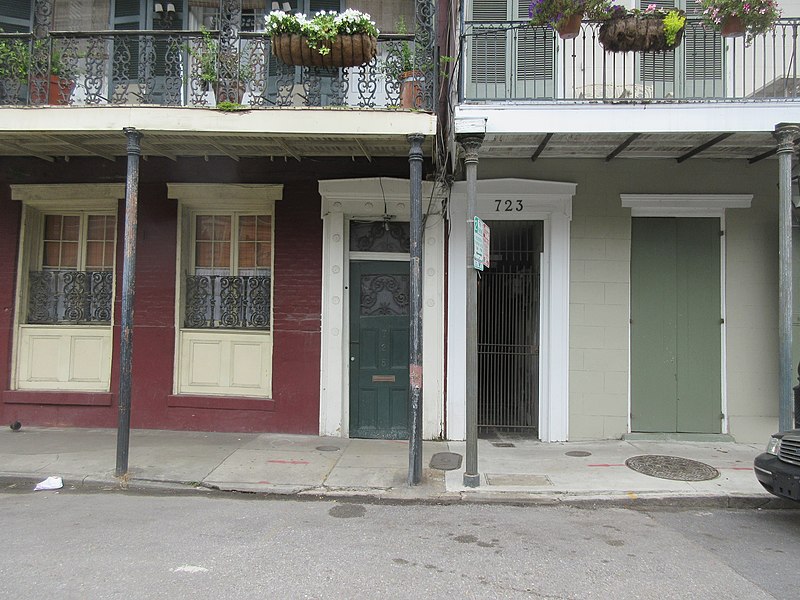
The doorway of 725 Ursulines Street, 2019. Photo by Infrogmation, courtesy of Wikipedia.
For nearly a century, a famous ghost tale has been placed in this home, though the story may be mostly fictional. For more information, see my article, “A Block of Death and Dismemberment—New Orleans.”
735 Ursulines Street
This classic Creole cottage may be haunted by ghosts, but it does provide an eerie postscript and tie-in to two stories in the same block. See my article, “A Block of Death and Dismemberment—New Orleans for more details.
This article is part of my series, Street Guide to the Phantoms of the French Quarter, which looks at the haunted places of this neighborhood in a street by street basis. Please see the series main page for an introduction to the French Quarter and links to other streets.
Conti Street
Conti Street sign, 2019 by Infrogmation, courtesy of Wikipedia.
According to historian Stanley Clisby Arthur, Bourbon Street was initially called Conti Street for the Princess Conti. When Bourbon Street was renamed, this street was renamed Conti.
Sources
Arthur, Stanley Clisby. Walking Tours of Old New Orleans. Gretna, LA: Pelican Publishing, 1990. Originally published in 1936.
700 Block Conti Street
Throughout its history, the French Quarter has been no stranger to violence. In the early morning hours of 21 March 2015, gunshots rang out in this block of Conti Street. In the aftermath, two young men in their 20s lay wounded. One of them died on the scene, while the other died at the hospital a short time later.
A view of the 700-block Conti Street looking towards Bourbon Street. Photo 2019, by Infrogmation, courtesy of Wikipedia.
Part of this spectacle may replay itself. Investigator and author Jeff Dwyer explains that witnesses have seen “the ghostly images of a young man who appears lifelike but quickly becomes transparent as he runs a distance of about 50 feet and then vanishes.” Others have heard “muted gunshots” as they have seen this horrible image.
Sources
Dwyer, Jeff. Ghost Hunter’s Guide to New Orleans: Revised Edition. Gretna, LA: Pelican Publishing, 2016.
Prince Conti Hotel
830 Conti Street
The Prince Conti Hotel’s bar, The Bombay Club, is apparently haunted by the spirit of a madam who once operated on the premises before the hotel was opened. She has been dubbed Sophie by staff members who have encountered her in the kitchen, bar, and at Booth 3.
The bar of The Bombay Club in the Prince Conti Hotel, 2010. Photo by Gary J. Wood, courtesy of Wikipedia.
Sources
Gardner, James. Professor’s Guide to Ghosts of New Orleans. CreateSpace, 2020. Kindle Edition.
917 Conti Street (formerly Musee Conti Wax Museum), private
The idea for the Musee Conti Wax Museum came to Ben Weil after a visit to London’s famous Madame Tussaud’s while on a trip to Europe. He quickly imagined a similar counterpart in New Orleans illustrating scenes from local history. The museum opened in 1964 with figures created by a Parisian mannequin maker. The figures of Napoleon, Andrew Jackson, Madame LaLaurie, Marie Laveau, and Jelly Roll Morton were shipped to the city on a Pan Am jet, where some of the figures were seated in the cabin among actual human passengers. The wax museum quickly became a major tourist attraction in the French Quarter. Legions of school children visited among the silent and still figures to learn the weird and wacky and violent history of the city.
917 Conti Street, the building that once held the Musee Conti Wax Museum, is the grey building on the right of this photo. Photo 2021, by Infrogmation, courtesy of Wikipedia.
Over time, stories began to spread of spirits among the wax figures. Staff and guests have heard disembodied voices within the museum and others have seen shadow figures moving about amongst the stationary figures. Others have felt the eyes of the figures follow them around the space. The museum has undergone investigations by a number of paranormal investigators who have uncovered a great deal of evidence alluding to the presence of spirits here.
Sadly, the Musee Conti Wax Museum closed in 2016 and the building was sold. Developers transformed the building into high-end private condos. Since the building’s redevelopment, it is unknown if the spirits remain here.
In a city chock full of irascible characters, Norma Wallace is amongst the pantheon. For decades, she was one of the most well-known doyennes of the city’s pleasure palaces. She was the last, and perhaps the most upstanding and respectable, of many madams who operated throughout this city’s vice-ridden history. From this innocuous address she operated one of the city’s most famous brothels, a place where the patriarchs of prominent families brought their sons as a rite of coming of age. A place where wanted criminals might rub shoulders with the judges who might one day sentence them. Business leaders, bureaucrats, political leaders, entertainers, law enforcement, and diplomats all came to indulge in Norma Wallace’s court of young women. For a time, couples might visit to observe some of New Orleans’ first sex shows given in Norma Wallace’s parlor.
Born into a poverty-stricken family, Wallace had aunts engaged in prostitution. At a young age, she learned that she could earn a living with her womanly charms, though she quickly grew tired of actually selling herself. Within a short time, she began overseeing other ladies of the evening and quickly learned how to finesse law enforcement and the justice system to protect her business interests. With the election of increasingly conservative crime-fighting district attorneys who vowed to fight corruption, she was forced to close her house and business. In her later years, she was able to transform her infamy into fame and her name was celebrated, though she quickly grew bored. In 1974 she took her life at her home in rural Mississippi.
This infamous address fell into disrepair and decay following Wallace’s ownership. Recently, a developer purchased the home and restored it, dividing the house into condos. It is said that the odor of cigars is still smelled here accompanied by the clinking of glasses and the sound of a woman’s husky laugh. Perhaps Norma Wallace is reliving the best years of her life?
Sources
Gardner, James. Professor’s Guide to Ghosts of New Orleans. CreateSpace, 2020. Kindle Edition.
Wiltz, Christine. The Last Madam: A Life in the New Orleans Underworld. NYC: Open Road Integrated Media, 2000. Kindle Edition.
N.B. This article was originally published 15 June 2016 with Bourbon Street.
This article is part of my series, Street Guide to the Phantoms of the French Quarter, which looks at the haunted places of this neighborhood in a street by street basis. Please see the series main page for an introduction to the French Quarter and links to other streets.
Dauphine Street
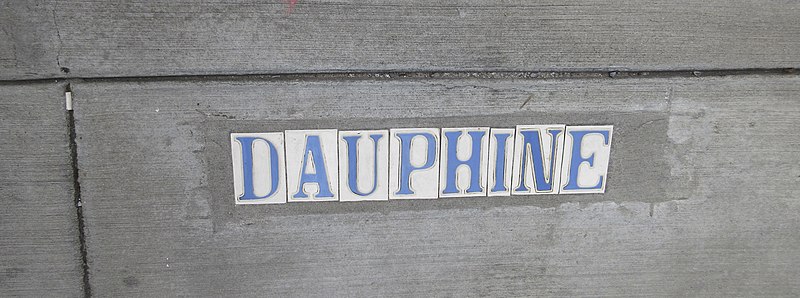
Tile street name set into the sidewalk. Photo by Infrogmation, 2019, courtesy of Wikipedia.
Originally the Rue de Vendome, this street was renamed Dauphine Street not long after. According to John Chase’s Frenchmen, Desire, Good Children…and other Streets of New Orleans, there is no certainty as to who this street is named for, though it was likely named for the Dauphin of France, the heir apparent to the French crown.
Sources
Chase, John. Frenchmen, Desire, Good Children…and other Streets of New Orleans. Gretna, LA: Pelican Publishing, 1949.
Museum of Death 227 Dauphine Street
This plain building houses a remarkable collection of artifacts relating to death in its myriad of ways such as murder, suicide, executions. Several visitors have reported feeling weird energy upon entering the museum. See my article, “Death in a sunny clime–New Orleans,” for further details.
Dauphine Orleans Hotel
415 Dauphine Street
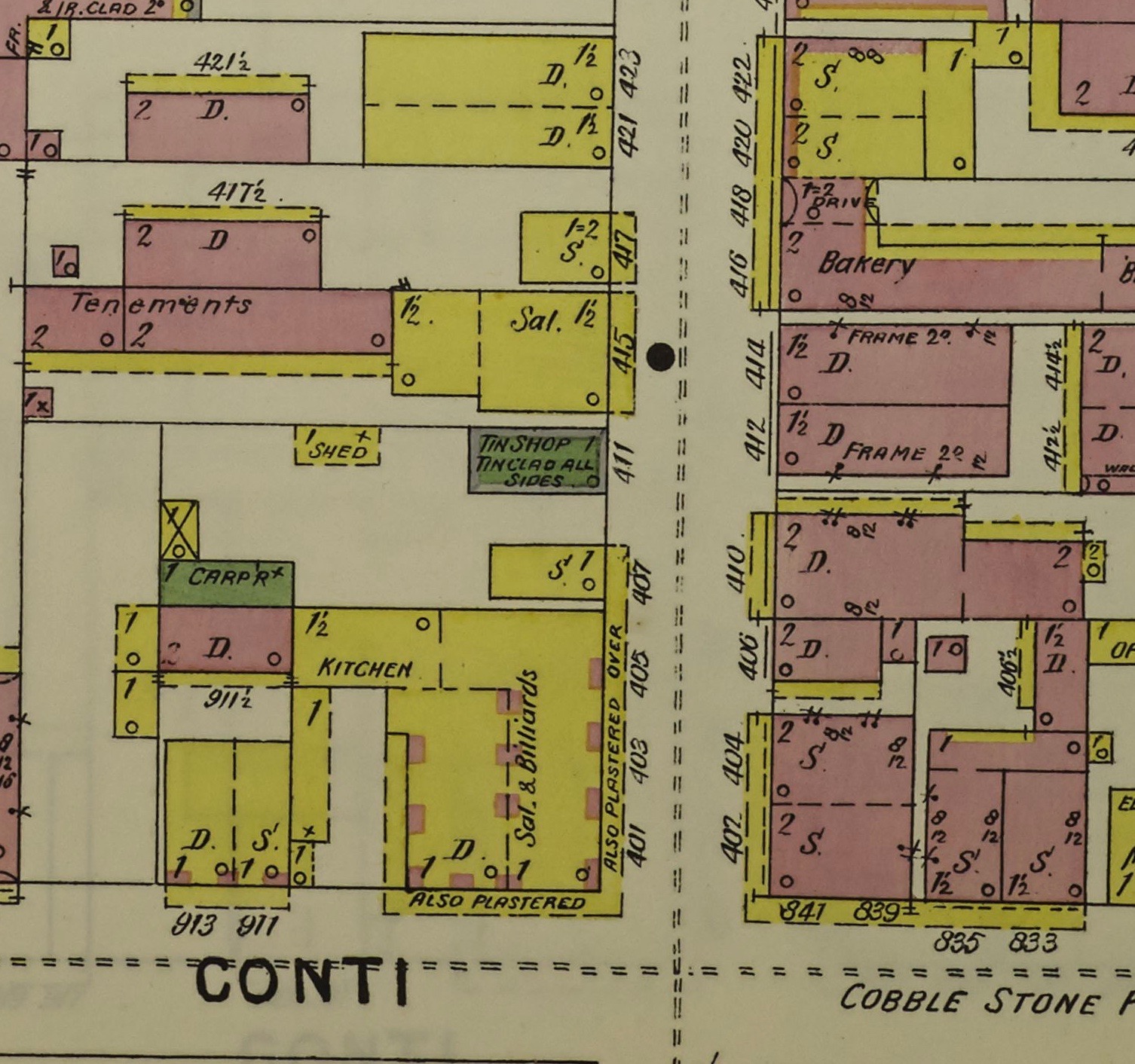
Like so many French Quarter hotels, the Dauphine Orleans comprises a number of buildings with varying histories and spirits. On the west side of Dauphine Street is a small group of old cottages, some dating to at least 1775. Among these buildings is the Audubon Cottage, one of several buildings where artist John James Audubon lived for a time. Another cottage was once occupied by one of the city’s infamous bordellos in the 19th century, a bawdy house under the watchful eye of May Bailey. This building is now the hotel’s bar, May Bailey’s Place.
The 1895 Sanborn Fire Insurance Map of the corner of Dauphine and Conti Streets where the Dauphine Orleans Hotel is now located. Most of the cottages and buildings on this corner now comprise the hotel.
In 1834, merchant Samuel Hermann built a large home just across the street from the cottages. This building now houses the hotel’s offices. After these buildings were renovated, the Dauphine Orleans Hotel opened in 1971.
Investigations conducted in the 1990s by the International Society for Paranormal Research (ISPR) reported the presence of a number of spirits including a soldier’s spirit in the pool area, and several former ladies of the evening, possibly associated with May Bailey.
Sources
Brown, Alan. The Haunted South. Charleston, SC: History Press, 2014.
“The Dauphine Hotel is really haunted.” WGNO. 30 October 2015.
Montz, Larry and Daena Smoller. ISPR Investigates The Ghosts of New Orleans. Atglen, PA: Schiffer, 2000.
Oswell, Paul. New Orleans Historic Hotels. Charleston, SC: History Press, 2014.
Gardette-LePretre House 715 Dauphine Street, private
The Gardette-LePretre House in January 1958. This photo was taken by Richard Koch for the Historic American Buildings Survey (HABS), courtesy of the Library of Congress Prints and Photographs Division.
Sometimes known as the “Sultan’s Retreat” this private residence is home to a popular legend. At some point in the early 19th century, a deposed potentate from the east took up residence here. Accompanied by scimitar-wielding guards, a harem, eunuchs and servants, the potentate rented the home and turned it into an Eastern-styled pleasure garden. One morning passersby noticed that everything had suddenly gone quiet. Ominously, and in testament to the horrors within, a small trickle of blood dripped from underneath the front door. When the police broke in to investigate they discovered all the home’s residents had been massacred in an orgy of blood and violence. Since that time, residents have supposedly dealt with odd sounds, disembodied screams, and mysterious apparitions. Sadly, there’s no evidence that these events actually occurred or that the building may be haunted.
Sources
Ambrose, Kala. Spirits of New Orleans. Cincinnati, OH: Clerisy Press, 2012.
Caskey, James. The Haunted History of New Orleans. Savannah, GA: Manta Ray Books, 2014.
Dauphine House Bed & Breakfast
1830 Dauphine Street
The Dauphine House is located about a block outside of the French Quarter in Faubourg Marigny, but I think it’s close enough to include in this look at French Quarter haunts.
This small inn, built in 1860 as a private residence, hosts several spirits. Not long after the owner purchased the home she encountered a spectral couple on the stairs, “they wore clothes from the end of the 1800s…they were standing there smiling.” She thanked them for their home and explained that she would take care of the house and the couple disappeared. A guest at the inn who was distraught over a breakup reportedly saw the couple a few times during her visit and felt they were attempting to comfort her.
Sources
“Haunts of the Dauphine House.” Ghost Eyes Blog. 15 January 2010.
Smith, Terry L. and Mark Jean. Haunted Inns of America. Crane Hill Publishers, 2003.
Turnage, Sheila. Haunted Inns of the Southeast. Winston-Salem, NC: John F. Blair, 2001.
Seemingly, the pandemic has affected everything, including my own writing and research. While I have continued to research, my motivation and focus when writing has been severely undermined.
In my research for this blog I have amassed a tremendous amount of information in the form of books, as well as in periodical articles and blog entries. Yet, so much of this information hasn’t been utilized. When I write blog entries, I usually pour a great deal of research into my subject or subjects, which of course takes time. These entries, however, have been written in a “fast and furious” style and utilize just one or two sources. I expect that these may be used and expanded in the future. Please enjoy this “fast and furious” tour of North Carolina haunts!
Asheville
1889 WhiteGate Inn & Cottage
173 East Chestnut Street
This Asheville bed & breakfast has been in operation for many years. Over that time, guests have reported quite a bit of paranormal activity. A 2001 article in the Asheville Citizen-Times notes some of that activity including footsteps on the stairs and an old woman sitting on an outside chair.
Sources
Clark, Paul. “Ghosts luring guests to local bed and breakfasts.” Asheville Citizen-Times. 1 September 2001.
Lewis Memorial Park Cemetery
415 Beaverdam Road
Workers in this cemetery have reported a ghostly horse and rider as well as a phantom dog. Some believe the rider may be the spirit of Robert J. Lewis who created the park in 1927.
Sources
Bianchi, Melanie M. “Outdoors: Spooky outdoor spots.” Mountain Xpress. 29 October 2008.
Bath
Devil’s Hoofprints on the Cutler Farm (private)
NC 1334
These mysterious prints on the edge of the woods now on private property are believed to be those of the Devil. Sometime in the early 19th century, a local man by the name of Jesse Elliott was known for his fondness for horses and racing. He was approached by a stranger wearing black astride a black horse. The stranger made a wager with Elliott as to whose horse was faster.
Elliott soon found himself in the lead and he boasted to the stranger “Take me as the winner or take me to hell!” As soon as the words left his mouth, the stranger was next to him and Elliott’s horse stopped running. Jesse was thrown from his horse, his head hitting a pine tree killing him.
The stranger got off his horse and supposedly took ahold of his soul and disappeared. The only sign that the Devil had been there were hoofprints left in the soft earth. Like the Devil’s Tramping Ground in Bear Creek (also included in this article), debris falling into the hoofprints is quickly swept away by an unseen force.
Sources
Bianchi, Melanie M. “Outdoors: Spooky outdoor spots.” Mountain Xpress. 29 October 2008.
Carmichael, Sherman. Mysterious Tales of the North Carolina Coast. Charleston, SC: History Press, 2018.
A view of the Devil’s Tramping Ground in 2007. Photo by Jason Horne, courtesy of Wikipedia.
In a state full of paranormal landmarks, the Devil’s Tramping Ground outside of Siler City is perhaps one of the most famous. This circular clearing in the woods oddly has no plant life or debris within it. Legend states that this is due to the nightly tramping of the Devil, though scientific investigation has not been able to find a reasonable answer. Curious visitors have left things within the mysterious space only to find it swept clean in the morning.
“Spookiest spots in North Carolina.” 24 October 2019.
Burke and Caldwell Counties
Brown Mountain
Brown Mountain in 2016. Photo by Thomson200, courtesy of Wikipedia.
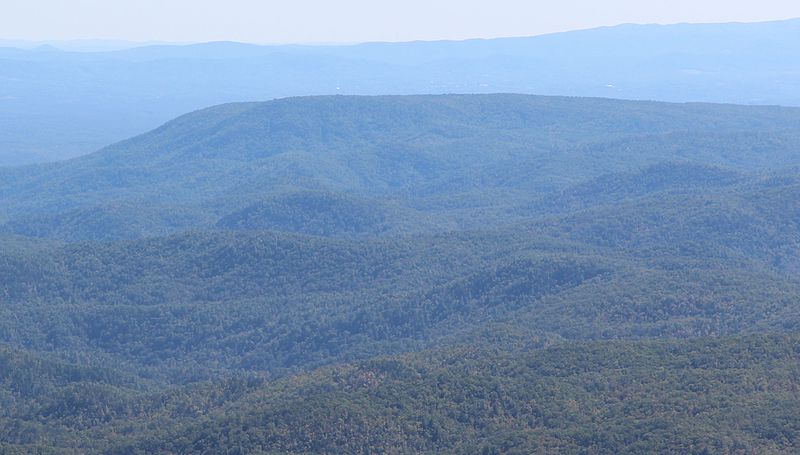
On the border of Burke and Caldwell counties within the Pisgah National Forest is the famed Brown Mountain on whose flanks ghost lights have been seen for quite some time. One of first mentions of the lights in the media occurred in 1913 and an investigator with the U.S. Geological Survey determined that the lights were simply those of a train. Another investigation by the same government entity in 1922 put the blame squarely on trains, automobiles, and stationary lights. However, after a flood in the area cut off electricity and damaged railroads, the lights were still seen. In the years since, scientists have continued to ponder the mysteries and have discovered few answers to the famous Brown Mountain Lights.
As all good theatres have a ghost, Burlington’s Paramount Theatre is no exception. The kindly, yet mischievous, spirit has been dubbed “Herschel.” Some legends point to his identity as that of a customer who passed away in the men’s room, while others say that he is the spirit of a projectionist who was electrocuted in the projection booth. According to a 2011 article in the local paper, no one has died in the men’s room or projection booth. Despite the debunked legends, seat bottoms have been seen to move on their own, and lights sometimes act up, while actors onstage have seen a shadowy figure in the projection booth.
Sources
Boyd, Walter. “Burlington has more than its share of ghosts and goblins.” Times-News. 28 October 2011.
Buxton
Cape Hatteras Lighthouse
46379 Lighthouse Road
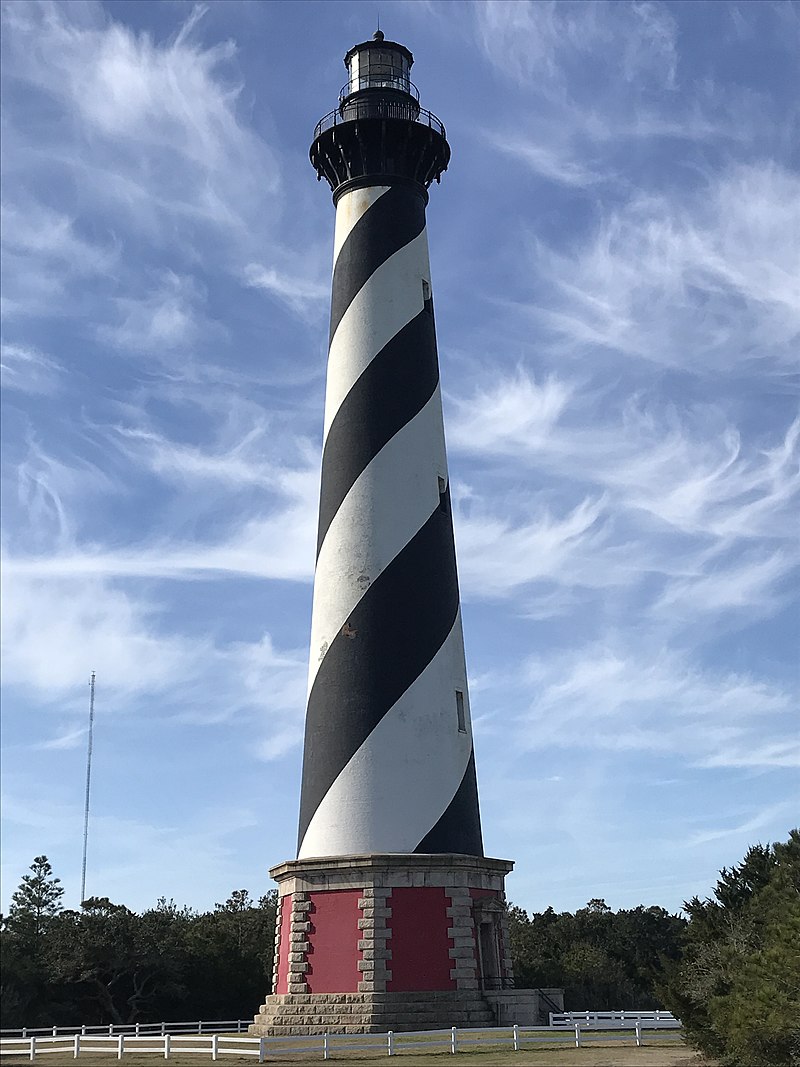
The Cape Hatteras Lighthouse in 2020. Photo by Jschildk, courtesy of Wikipedia.
The Cape Hatteras Lighthouse has stood over the beach and protected ships from ground on the offshore Diamond Shoals since 1870. During that time, it has also attracted ghosts and paranormal activity. Within the lighthouse itself, a spectral cat has been seen by surprised visitors who have also felt the cat rubbing up against their legs. When the visitor reaches to pet it, the cat vanishes. The apparition of a man in a yellow raincoat has also been spotted here.
Sources
Carmichael, Sherman. Mysterious Tales of the North Carolina Coast. Charleston, SC: History Press, 2018.
Candler
Owl’s Nest Inn
2630 Smoky Park Highway
A search of Google reveals that this inn may have closed, though the spirits may remain. A 2001 article in the Asheville Citizen-Times reports that the innkeeper was still scrutinizing an odd photo taken inside the inn. In a room that was supposed to be empty, the photo shows a woman standing in the room with a shroud over her head. But the spirits here did not just make their presence known by appearing in photographs, unseen hands would sometimes turn on gas fireplaces as well as setting alarms on alarm clocks to go off in rooms that had been unoccupied for days.
Sources
Clark, Paul. “Ghosts luring guests to local bed and breakfasts.” Asheville Citizen-Times. 1 September 2001.
Stony Fork Picnic Area
711 Pisgah Highway
Located within Pisgah National Forest on the outskirts of Asheville, this picnic area is reputed to be an old dump site for bodies during the Prohibition era. More recently, bodies of two murder victims have been found in the area. One was identified as a victim of Gary Michael Hilton, while the other remains were those of Judy Smith, who may have also been a victim of Hilton.
Visitors to the area after dark have reportedly been pursued into woods by apparitions, including those of a man and a small boy. A paranormal investigation team heard disembodied footsteps there and one of the investigators described the area as being “very uncomfortable.”
Sources
Bianchi, Melanie M. “Outdoors: Spooky outdoor spots.” Mountain Xpress. 29 October 2008.
Judy Smith homicide. Wikipedia, the Free Encyclopedia. Accessed 9 January 2021.
Built in 1924, the Carolina Inn was meant to house visitors to the University of North Carolina next door. In 1948, William Jacocks, a physics professor and 1904 graduate of the university, made his residence in a suite on the second floor, which he would occupy until 1965. Following his death, visitors staying in Room 256 have experienced activity possibly caused by the mischievous professor’s spirit. One of the most occurrences is that the door will lock by itself and refuse to admit guests.
Sources
Gardner, George. “Haunted N.C. hotels.” Charlotte Observer. 3 October 2014.
Corolla
Currituck Beach Light
1101 Corolla Village Road
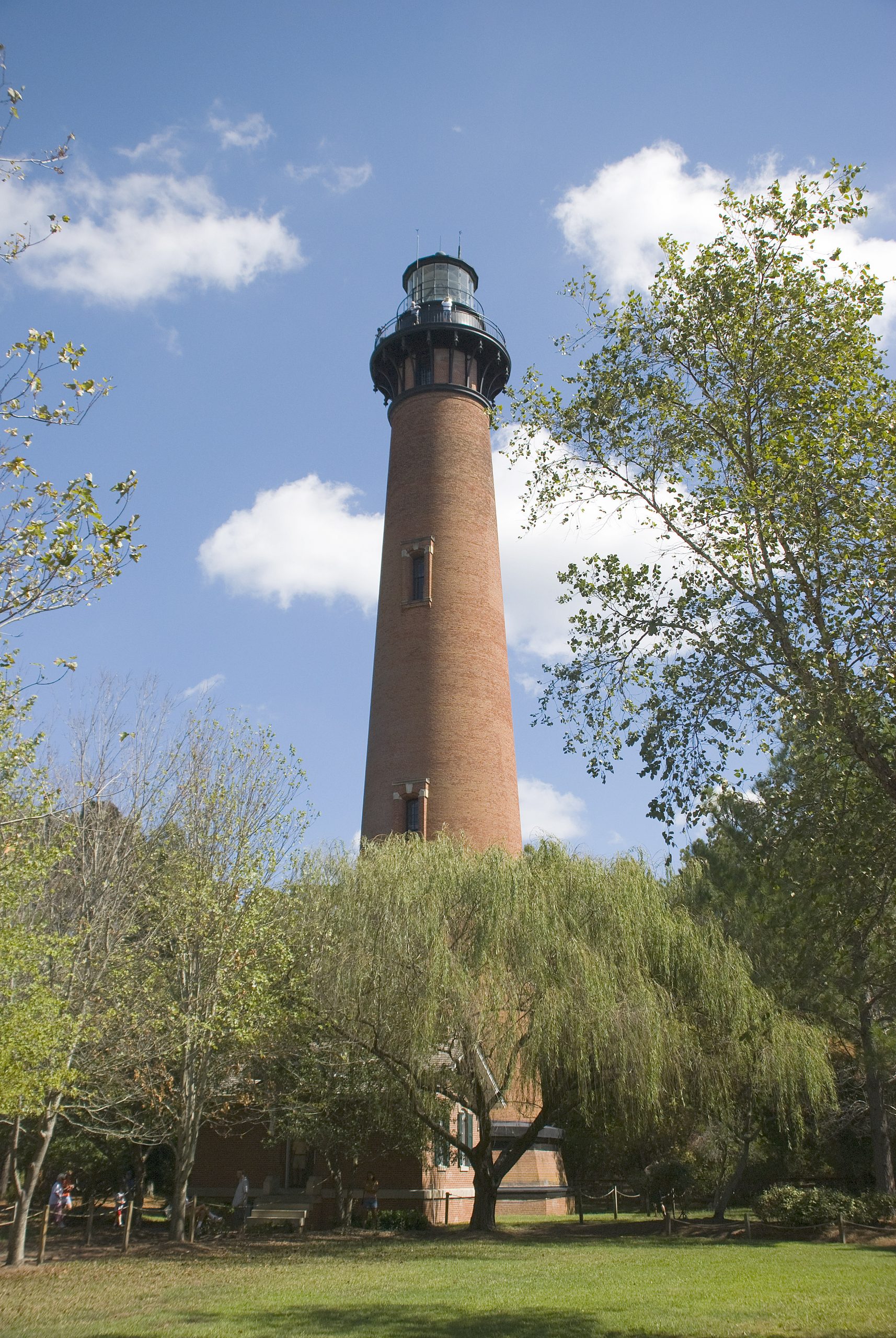
Currituck Beach Light, 2007. Photo by Warfieldian, courtesy of Wikipedia.
Constructed in 1875, this lighthouse was the last to be built in the Outer Banks. The north room in the keeper’s house may be the domain of two spirits, a little girl who once stayed in the room and a woman who may have died there. The little girl is supposed to have been the daughter or ward of the first lighthouse keeper. While playing on the beach, the child drowned. Afterwards, her form has been encountered on the property. The woman may have been the wife of a keeper who died from tuberculosis here.
Sources
Ambrose, Kala. Ghosthunting North Carolina. Cincinnati, OH: Clerisy Press, 2011.
Sledge, Joe. Haunting the Outer Banks: Thirteen Tales of Terror from the North Carolina Coast. Gravity Well Books, 2019.
Greensboro
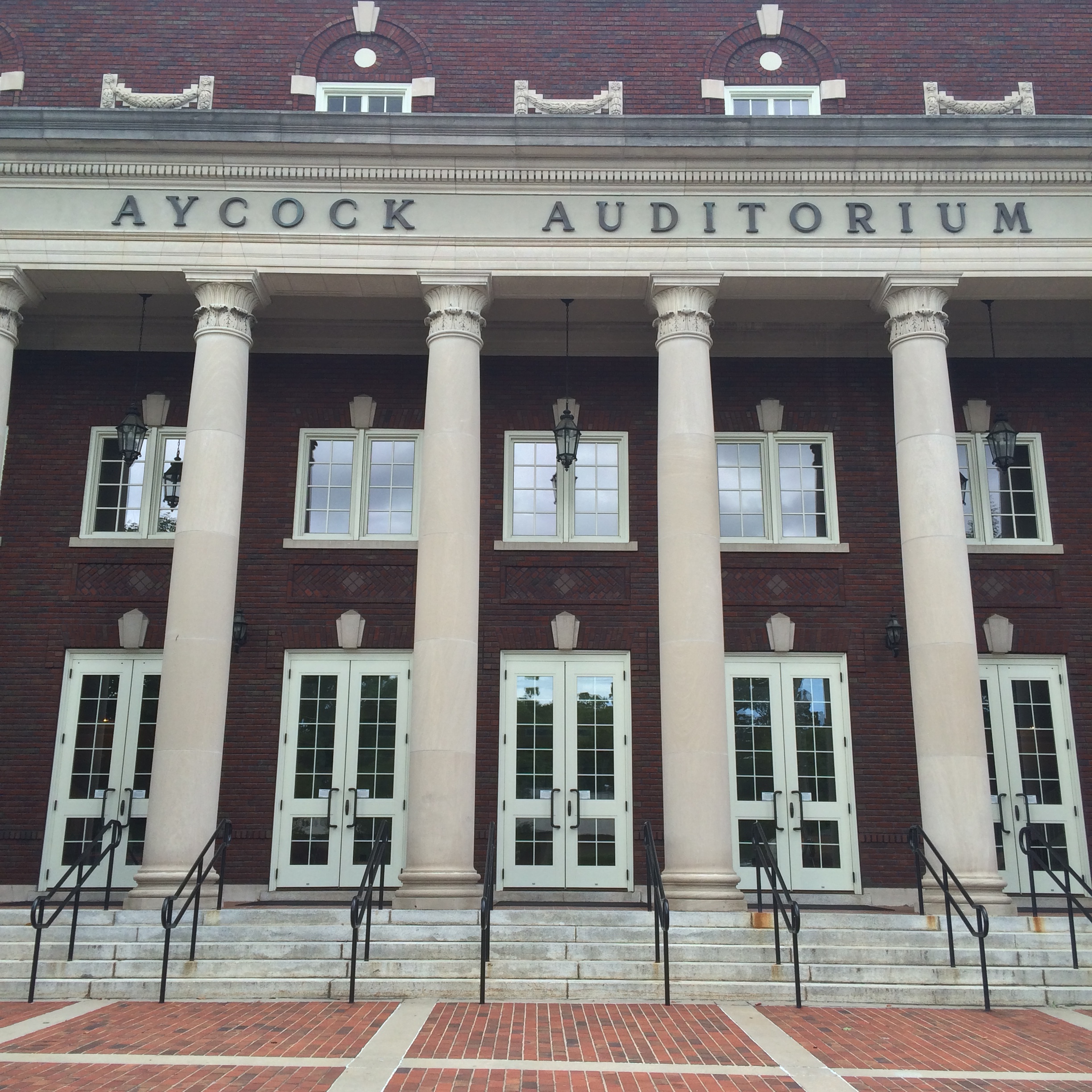
Aycock Auditorium
Campus of University of North Carolina, Greensboro
Facade of Aycock Auditorium at UNCG, 2015. Photo by Willthacheerleader, courtesy of Wikipedia.
Legend holds that the spirit haunting this auditorium is that of Jane Aycock, daughter of Governor Charles Brantley Aycock, for whom the facility is named. Another story lays the blame for the haunting on the woman who lived in a house that once stood on this spot.
Sources
Clodefelter, Tim and Nicole Chenier. “The state of fright: North Carolina history rich in the weird and unexplainable.” Winston-Salem Journal. 29 October 2000.
Kure Beach
Fort Fisher 1610 Fort Fisher Boulevard, South
A Haunted Southern Book of Days–15 January
This article is a part of an occasional blog series highlighting Southern hauntings or high strangeness associated with specific days. For a complete listing, see “A Haunted Southern Book of Days.”
Fort Fisher was one of the linchpins that kept the Confederacy together. Guarding the approach to Wilmington harbor, the fort aided blockade runners thus keeping the Confederacy alive after so many other ports had been blocked. After the fall of Mobile, Alabama, Fort Fisher became a major target of Union forces. After the first battle waged against the fort was a dismal failure, regrouped Union forces launched a second battle against the fort that was successful. Wilmington fell shortly after.
Fort Fisher just after the Second Battle of Fort Fisher.
According to Alan Brown, one of the first incidents of paranormal activity was witnessed in 1868 during a reunion of soldiers was held there. Three former soldiers saw a figure atop one of the gun placements. When they waved, the figure raised its sword into the air, revealing it to be none other than General Whiting who had commanded the fort but had been wounded in the second battle and died in captivity. The figure disappeared before their eyes. Figures such as that of the general have been seen repeatedly since and an investigation of the fort in 2004 captured interesting evidence including a human shaped figure that appeared in a photograph.
Sources
Brown, Alan. Haunted Places in the American South. Jackson, MS: University Press of Mississippi, 2002.
Brown, Alan. Stories from the Haunted South. Jackson, MS: University Press of Mississippi, 2004.
Fort Fisher. Wikipedia, the Free Encyclopedia. Accessed 1 February 2011.
Toney, B. Keith. Battlefield Ghosts. Berryville, VA: Rockbridge Publishing, 1997.
Wardrip, Stanley. “Fort Fisher Civil War Battlefield.” In Jeff Belanger’s Encyclopedia of Haunted Places. Franklin Lakes, NJ: New Page Books, 2005.
Morganton
Broughton Hospital
1000 South Sterling Street
Avery Building at Broughton Hospital, 2019. Photo by Warren LeMay, courtesy of Wikipedia.
With the lobbying of Dorthea Dix, the state of North Carolina set out to build modern hospitals for the treatment of mental illnesses. The Western Carolina Insane Asylum opened in 1883 and continues to serve as a mental health facility, though with fewer patients and under the name Broughton Hospital. Most facilities treating mental illness have spirits and Broughton is no exception. Reports mention apparitions, disembodied screams, and eerie feelings haunting this facility. See my further coverage of this haunting in “Ill Defined and Unknown Cause of Morbidity and Mortality–North Carolina.”
Broughton Hospital. Wikipedia, the Free Encyclopedia. Accessed 3 January 2021.
“Spookiest spots in North Carolina.” 24 October 2019.
New Bern
Attmore-Oliver House 510 Pollock Street
Attmore-Oliver House, 2006. Photo by Self, courtesy of Wikipedia.
During a paranormal investigation of the Attmore-Oliver House a door slammed in the face of an investigator. After checking the door, there was no obvious force that could have slammed it. Along with some EVPs, this is the main evidence of paranormal activity in this circa 1790 house. Legend tells of a father and daughter who possibly died in the attic during a smallpox epidemic, though this cannot be confirmed through historical records. Others look towards the last resident of the house who was known for her eccentricity. Regardless, there appears to be some very interesting activity going on here.
The swamps and lowlands of America were considered bewitched and dangerous places to the Europeans who settled here. During the American Revolution, patriot General Francis “Swamp Fox” Marion used these mysterious places to his advantage by utilizing guerilla warfare throughout the swamps of South Carolina and even extending into North Carolina on occasion. The land along the course of the Lumber River is mostly undeveloped and remains much as it was when Marion traveled along its swampy run. An old local legend tells of one of Marion’s officers who loved a young woman from a Tory family and passed information on to her father. Marion pursued a group of Tories to Tory Island along the Lumber River and destroyed their settlement. He killed the traitorous officer and hung him in the ruins where the officer’s lover found him. The pair is still seen roaming the island.
Sources
Barefoot, Daniel W. North Carolina’s Haunted Hundred, Vol. 2: Piedmont Phantoms. Winston-Salem, NC, John F. Blair, 2002.
North Carolina State Capitol Building 1 East Edenton Street
North Carolina State Capitol, 2007. Photo by Jim Bowen, courtesy of Wikipedia.
It seems that many current and former state capitol buildings throughout the South are haunted. Old state capitols in Georgia, Louisiana, and Virginia have ghosts as well as the current state capitols for Maryland, Alabama, Tennessee, Virginia, West Virginia, and North Carolina. Of these, only the North Carolina Capitol has received any paranormal investigation. The investigation was conducted by none other than the Rhine Research Center, an organization originally established as part of Duke University, which is now independent of the university, devoted to the scientific study of parapsychology. The Rhine Center discovered paranormal activity in the capitol and one investigator who saw a man in nineteenth century clothing sitting in the legislative chamber.
Sources
Barefoot, Daniel W. North Carolina’s Haunted Hundred, Vol. 2: Piedmont Phantoms. Winston-Salem, NC, John F. Blair, 2002.
Brown, Alan. Stories from the Haunted South. Jackson, MS: University Press of Mississippi, 2004.
Rockingham
Hudson Brothers Deli 115 South Lee Street
In 2011, the Sandhills Paranormal Research Society set out to investigate Hudson Brothers Deli, a bar in Rockingham. The building housing the bar originally served as a funeral home. The owner even mentions the existence of crematoriums in the basement.
Among the reports from the bar are the apparition of a girl seen by both a bartender and a manager. One patron reported seeing the apparition of a man in a business suit that told him to, “wait right here.” A former owner reported that an employee sent on an errand to the basement ran screaming from the establishment and never even returned to pick up their paycheck.
The investigation appeared to be successful with the group picking up evidence including the odor of flowers in the basement and EVPs. The group stated that there was definitely spiritual activity here.
Sources
Brown, Philip D. “A haunting in Hudson Brothers.” RichmondCounty Daily Journal. 5 April 2011.
Weaverville
Inn on Main Street
88 South Main Street
New Year’s Eve 1999 offered the owner and guests of the Inn on Main some paranormal activity. As the small group celebrated the new year they “heard two things fall of the wall in the next room.” When the owner walked into the next room, nothing was out of place and the room was empty. A moment later, they heard the sound of a door shutting behind them. The inn occupies a home built around the turn of the 20th century for a surgeon.
Sources
Clark, Paul. “Ghosts luring guests to local bed and breakfasts.” Asheville Citizen-Times. 1 September 2001.
Wilmington
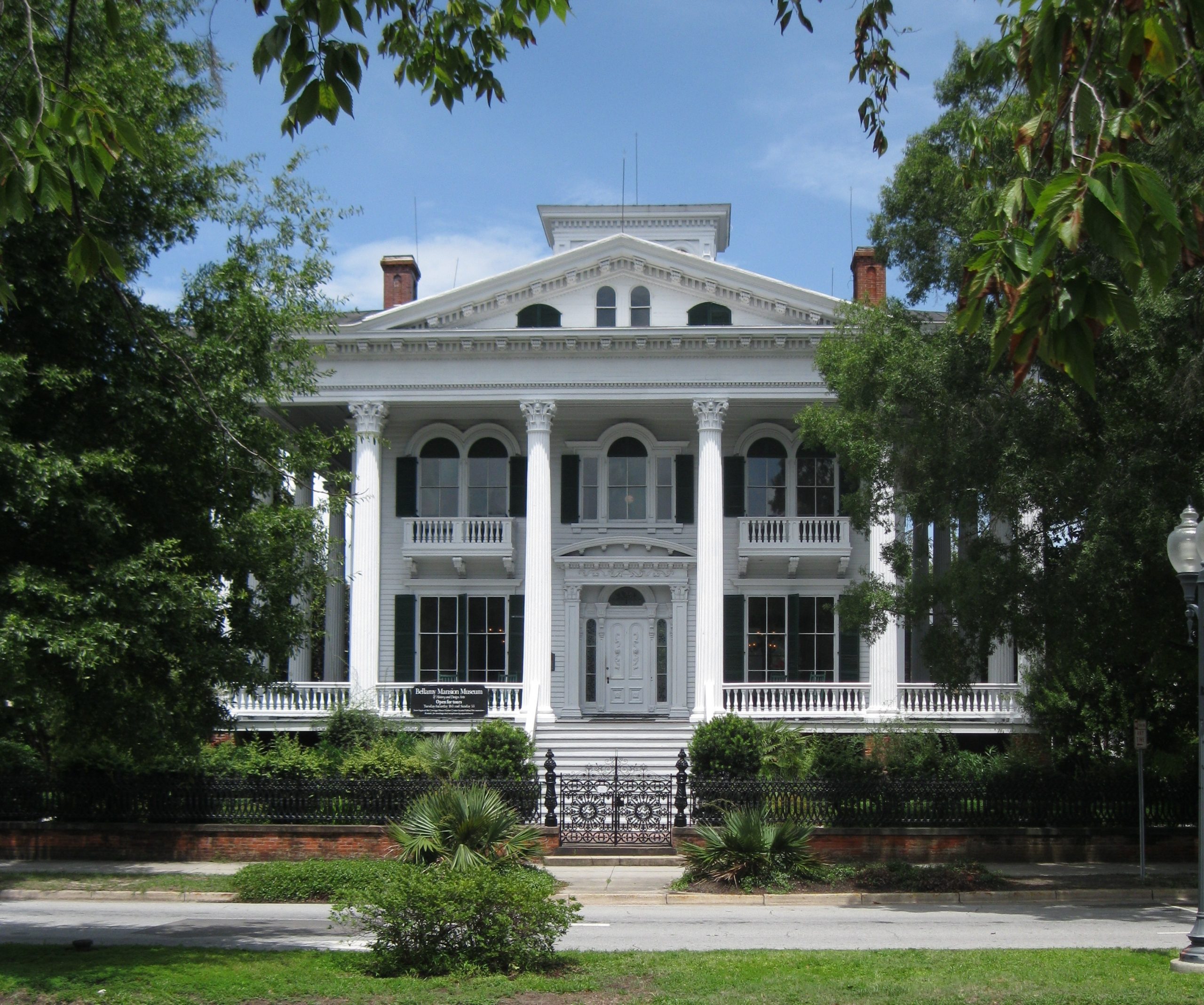
Bellamy Mansion 503 Market Street
A spectacular mix of Greek Revival and Italianate architecture, the Bellamy Mansion has been restored and preserved as a monument to history and design. Dr. John D. Bellamy, a physician, planter, and businessman began construction of the house in 1858 and it was completed in 1861, as civil war was breaking out. When Wilmington was captured by Union troops, the house served as headquarters for the Union general. The house is now under the purview of Preservation North Carolina and open as a museum.
Bellamy Mansion, 2012. Photo by Jameslwoodward, courtesy of Wikipedia.
The museum staff reportedly doesn’t say much about spirits in the house, but according to Alan Brown, night managers have reported quite a bit of activity. One of those night managers called by the police twice in one night because inside doors were opening by themselves. Another night manager reported seeing the figure of a man and seeing a wheelchair that belonged to one of the Bellamy family members move on its own accord.
Sources
Bellamy Mansion. Wikipedia, the Free Encyclopedia. Accessed 1 February 2011.
Brown, Alan. Stories from the Haunted South. Jackson, MS: University Press of Mississippi, 2004.
USS North Carolina (BB-55) 1 Battleship Road
This mighty battleship was laid down in 1937 and it was completed in 1941, more than seven months before the Japanese bombing of Pearl Harbor, one of the events leading the U.S. to enter World War II. The ship was quickly sent to the Pacific Theater where she served valiantly for the Allied cause and then helped ferry American servicemen home following Japan’s surrender. After the ship was struck from the Naval Register, she was preserved as a museum ship.
The USS North Carolina, 2007. Photo by Doc Searls, courtesy of Wikipedia.
During the ship’s service, it is known that ten men lost their lives aboard the ship. It is believed that the spirits of these men remain aboard the ship, along with a great deal of residual energy. During one investigation, a recorder was dropped into a well. After it was retrieved, investigators heard the words “Help! Help!” and “Tommy” clearly spoken in the well. Research showed that a sailor had once fallen into that well and cracked his skull.
Sources
Jordan, Annette. “Ghost hunters: Positively Paranormal is who you’re gonna call.” Courier-Tribune. 16 September 2013.
The Ellis Hotel
176 Peachtree Street
Atlanta, Georgia
In downtown Atlanta, the city’s most famous thoroughfare, Peachtree Street, is lined with many possibly haunted landmarks. On any haunted tour of the city, one of the primary stops should be 176 Peachtree St.—The Ellis Hotel.
A view of the Winecoff Hotel in 1918. Courtesy of the Atlanta History Center.
This boutique hotel may offer ghosts in addition to its usual amenities.
The Ellis opened originally in 1913 as the Winecoff Hotel. It was here in the early morning hours of Saturday, December 7th, 1946, that a fire broke out. The 15-storey hotel, often advertised as ‘absolutely fireproof,’ was booked to capacity with Christmas shoppers, families in town to see the premier of the new Disney film, Song of the South, and some 40 Georgia high school students in town for a mock legislative session.
Starting in a third-floor corridor, the fire spread quickly. As the old hotel lacked modern fire preventive measures and the fire spread wildly up the single escape stairwell trapping everyone above it. The Atlanta Fire Department impressively responded with nearly 400 firefighters, 22 engine companies and 11 ladder trucks, four of them aerial. However, ladders were only able to reach people partway up the burning hotel.
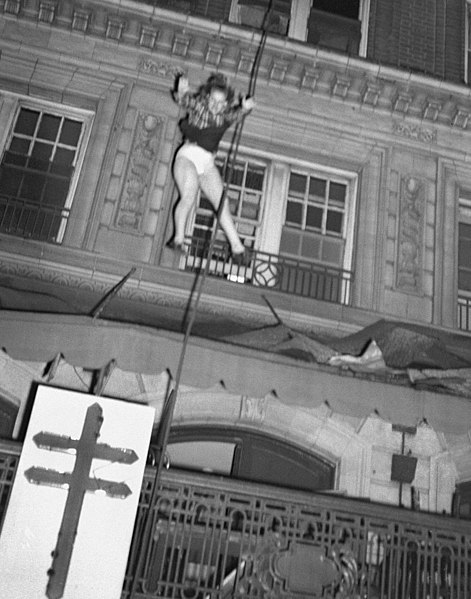
As flames licked at their doors, guests began jumping or trying to lower themselves on improvised ropes of bed sheets. Others tried to propel themselves across to the Mortgage Guarantee Building across the alley off Ellis Street. The alley soon became dangerous as bodies began to fall. The sun rose that day to reveal 119 lives snuffed out among the still smoking carnage.
Photographer Arnold Hardy was able to capture this image of Daisy McCumber as she plummeted towards the sidewalk. This young lady survived her fall and the photographer was granted a Pulitzer Prize for this photograph.
Sadly, the Winecoff itself was absolutely fireproof, just not the combustible interiors. The hotel’s modern incarnation as the Ellis can attest to that. Outside the hotel, a historical marker reminds passersby of “Georgia’s Titanic” while spirits may remain in the hotel as reminders to the tragedy.
Guests and hotel staff have cited a tremendous variety of paranormal activity. The building’s elevators have been known to act strangely and operate on their own accord. During the renovations into the Ellis Hotel, workers reported finding their tools moved or missing as well as hearing footsteps and voices coming from empty rooms. Guests have reported hearing screams and the sound of running within empty corridors while some have awakened to the odor of smoke within their rooms.
Staff members have also reported that calls come to the hotel switchboard from unoccupied rooms while the smoke alarm mysteriously goes off at 2:48 AM, the time the fire started. People outside the hotel have also claimed to have seen faces in the windows, some of them appearing to scream in pain.
The Ellis Hotel in January of 2020, by JJonahJackalope, courtesy of Wikipedia.
After The Winecoff Fire was published in 1993, I bought a copy and passed it to my parents once I finished it. A short time later, we were in Atlanta one evening and decided to drive past the old hotel building. The huge building still stood derelict and we drove slowly down Ellis Street. Peering down the alley between the hotel and the old Guarantee Mortgage Company building where so many had leapt to their deaths, we spied some graffiti scrawled on the wall of the hotel. “The police tape is soaked in blood,” it read as if to remind viewers of the sacred somberness that continues to haunt the scene of the country’s deadliest hotel fire.
Sources
Christian, Reese. Ghosts of Atlanta: Phantoms of the Phoenix City. Charleston, SC: History Press, 2008.
In my research for this blog I have amassed a tremendous amount of information in the form of books, as well as in periodical articles and blog entries. Yet, so much of this information hasn’t been utilized. When I write blog entries, I usually pour a great deal of research into my subject or subjects, which of course takes time. These entries, however, have been written in a “fast and furious” style and utilize just one or two sources. I expect that these may be used and expanded in the future. Please enjoy this “fast and furious” tour of Kentucky haunts!
Shaker Museum at South Union
850 Shaker Museum Road
The main dwelling at the Shaker Museum at South Union, 1969. Photo taken for the Historic American Buildings Survey (HABS) by E. R. Pearson. Courtesy of the Library of Congress, Prints and Photographs Division.
This museum and its supporting organization preserve the historic Shaker village of South Union. The village was established by the Shaker religious sect in 1807 and was occupied until 1922. In the mid-1980s, a husband, wife, and their 6-year-old son visited the village and spent part of their day exploring the many buildings. In one particular structure, the husband and his son ventured upstairs and spied a strange opening in the wall. When they peered through it, they saw evidence of damage from a fire. A moment later, the pair felt something come through the opening and surround them with a strange energy that unnerved them.
Sources
Montell, William Lynnwood. Haunted Houses and Family Ghosts of Kentucky. Lexington, KY: University Press of Kentucky, 2001.
Room 245 in this campus residence hall is home to a legend. In 1963, a student named James Garner attempted to close his dorm room window when he accidentally slipped out and died in the fall. Consequently, students to open the window of this room will have it slammed shut by the spirit.
Sources
Ogden, Tom. Haunted Colleges and Universities: Creepy Campuses, Scary Scholars, and Deadly Dorms. Guilford, CT: Globe Pequot Press, 2014.
Speed Hall
Campus of Union College
This building, built just after the turn of the 20th century, currently houses the college’s Office of Financial Aid. The apparition of a woman has been seen in this building and staff has experienced doors opening and closing by themselves. The identity of the woman is unknown.
Sources
Ogden, Tom. Haunted Colleges and Universities: Creepy Campuses, Scary Scholars, and Deadly Dorms. Guilford, CT: Globe Pequot Press, 2014.
Warfield Cemetery
KY 459
Legend holds that visitors to this cemetery are sometimes plagued by a spirit that follows them around and sometimes even following them home.
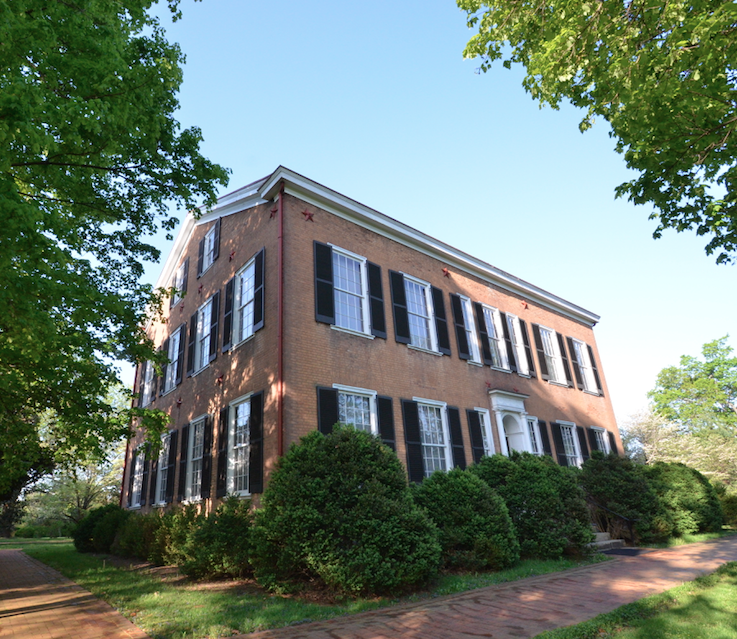
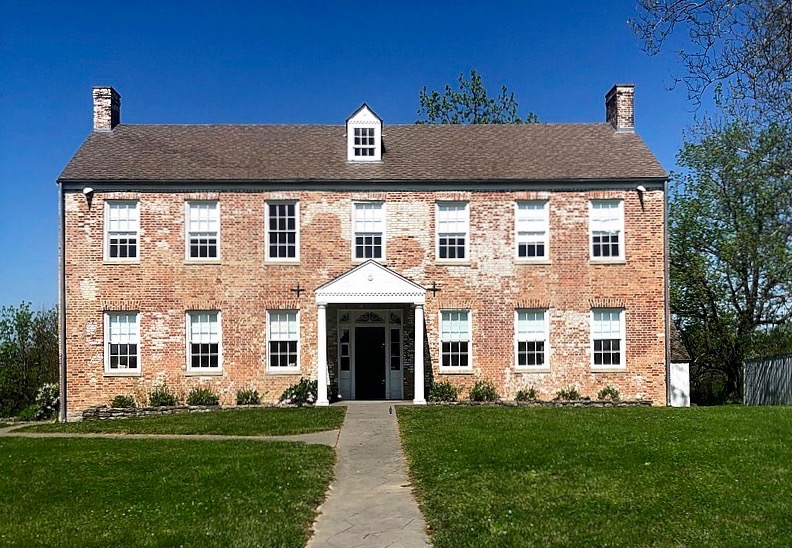
This large brick home was built in 1787 for Dr. Henri Chapeze, a French surgeon who arrived in this country with the Marquis de Lafayette. Local legend tells of Dr. Chapeze arriving home one day to find his wife in the arms of another man. His wife lost face and lived in shame while her cuckolded husband left town to settle in Ohio and start a new life. The house has been known for years to be haunted with the spirits of a young boy, possibly Chapeze’s son Benjamin, to whom he left this home, and a woman. The woman, who has been seen peering from the windows is sometimes seen without a face. Is this the visage of Chapeze’s unfaithful wife who lost face when her philandering was discovered?
Jailer’s Inn Bed & Breakfast
111 West Stephen Foster Avenue
Jailer’s Inn, 2009, by C. Bedford Crenshaw. Courtesy of Wikipedia.
Occupying the old Nelson County Jail, which was in use from 1797 to 1987, the Jailer’s Inn allows guests to sleep in a space where criminals once served their sentences. These paying guests have encountered spirits of these criminals in the form of apparitions, and spectral sounds.
Sources
Newman, Rich. The Ghost Hunter’s Field Guide. Woodbury, MN: Llewellyn Press, 2011.
My Old Kentucky Home State Park
501 East Stephen Foster Avenue
Federal Hill, 2015, by Firthpond1700. Courtesy of Wikipedia.
This state park preserves Federal Hill, the mansion of Senator John Rowan, which inspired the song “My Old Kentucky Home,” by Stephen Foster, a relative of Rowan’s. Spirits may roam both the house and the Rowan Family Cemetery nearby. John Rowan left instructions that following his death no memorial was to be erected over his grave. When family insisted on erecting a monument, his ghost has been blamed for toppling it.
Sources
Floyd, Jacob and Jenny. Kentucky’s Haunted Mansions. Seventh Star Press, 2017.
Landini, Leigh. “Things that go ‘bump’ in the night may be a mischievous may be a ghost in downtown Paducah.” The Paducah Sun. 31 October 1999.
Benham
Benham Schoolhouse Inn
100 Central Avenue
In 1926 the Wisconsin Steel Company, which had founded the small town of Benham as a coal camp, built an all-grades school. That school closed in 1992 and was converted into use as an inn. Guests have since reported run-ins with the spirits of former students.
Boone Tavern, 2009, by Parkerdr. Courtesy of Wikipedia.
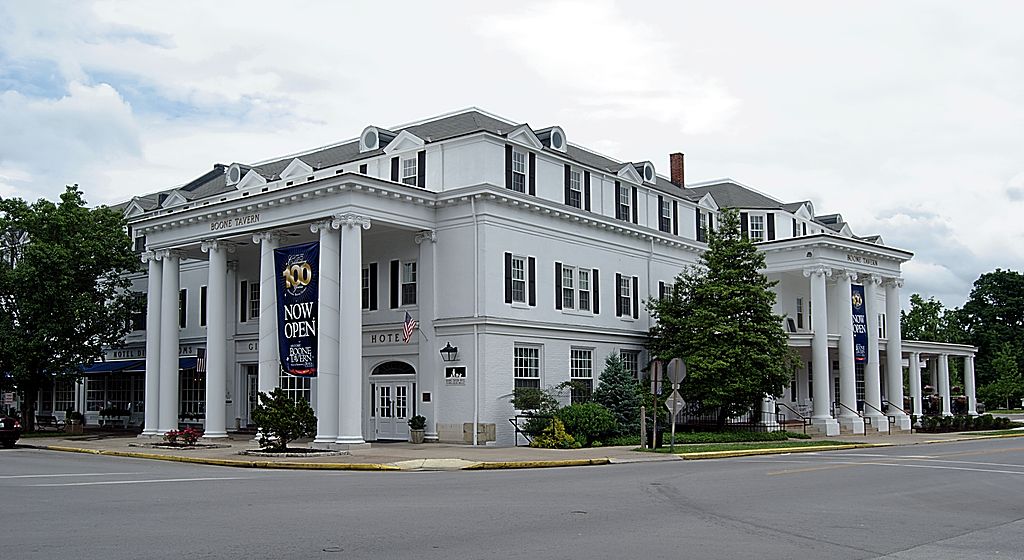
A restaurant, hotel, and guesthouse affiliated with Berea College, Boone Tavern was built in 1909. A paranormal investigation in 2012 produced evidence of “an abundance of spirits.” Investigator Patti Star described the tavern to the Richmond Register as being like a “train station with spirits coming and going.”
Sources
Boone Tavern. Wikipedia, the Free Encyclopedia. Accessed 27 November 2020.
Robinson, Bill. “Ghost hunters detect spirits at Boone Tavern.” Richmond Register. 2 April 2012.
Campbellsville
Hiestand House—Taylor County Museum 1075 Campbellsville Bypass
This small stone house is one of only 12 German stone houses standing in the state. According to Dennis William Hauck’s Haunted Places: The National Directory, residents of the home have experienced paranormal activity for years. The house now houses a county museum.
Sources
Hauck, Dennis William. Haunted Places: The National Directory. NYC: Penguin, 1996.
Jim Beam American Stillhouse
526 Happy Hollow Road
Jim Beam is one of the largest producers of Kentucky bourbon producing more than a half million barrels a year. But is this famous distillery producing spirits beyond bourbon? It seems that the apparition of a woman has been seen in the old T. Jeremiah Beam House and other spirits have been encountered throughout the distillery and its grounds.
Crumbie, Trey. “Ghosts at Jim Beam? Two investigators are determined to find out.” Lexington Herald-Leader. 4 January 2018.
Cynthiana
Rohs Opera House
122 East Pike Street
This 1871 opera house is possibly occupied by a handful of spirits including children and a woman dubbed, “The Lady of the Opera House.” These spirits manifest themselves in a variety of ways including the children playing with people’s hair, strange noises, and apparitions.
Sources
Dailey, Bonnie. “The haunting of Rohs Opera House.” 8 August 2013.
Danville
Breckinridge Hall
Campus of Centre College
A Haunted Southern Book of Days–21 January
This article is a part of an occasional blog series highlighting Southern hauntings or high strangeness associated with specific days. For a complete listing, see “A Haunted Southern Book of Days.”
The spirit of a young man named Peter continues to haunt this dormitory. During a renovation in the 1990s several people saw his face on the wall of a particular dorm room. When they contacted painters to cover up the image, they could not find it.
Sources
Brummet, Jennifer. “Paranormal investigators use own time and money to seek out supernatural.” The Advocate-Messenger. 28 October 2007.
“Ghost hunter hopes to find paranormal activity at Centre.” The Centre College Cento. 27 October 2011.
Sutcliffe Hall
Campus of Centre College
A Haunted Southern Book of Days–21 January
This article is a part of an occasional blog series highlighting Southern hauntings or high strangeness associated with specific days. For a complete listing, see “A Haunted Southern Book of Days.”
A staff member working in this building reported “Sometimes I’d be in the building alone and would hear basketballs bouncing in Bowman Gym. I would go right to the gym door and look in, and there was never anyone in the gym playing basketball. But I could definitely hear the ball bounce.” The staff member also reported that during renovations workers would find their tools moved or missing.
Sources
“Ghost hunter hopes to find paranormal activity at Centre.” The Centre College Cento. 27 October 2011.
Elsmere
Allendale Train Tunnel
Near East Covered Bridge Drive
This mis-named site is not an actual train tunnel, but rather a culvert that carries Bullock Pen Creek underneath a set of railroad tracks. Metal hooks protrude from above both ends of the culvert from which stems the legend that a man once hung himself here and he continues to haunt the site. However, there is no documentary to prove that the suicide ever happened.
There are reports that drivers along this stretch of road a night have been pulled over by a police officer in an old-fashioned police car. As the officer approaches the car he vanishes, much to the surprise of the driver.
Sources
“Residents say Northern Kentucky Road is haunted.” 29 August 2016.
Frankfort
Buffalo Trace Distillery
113 Great Buffalo Trace
Interior of one of storage houses at the Buffalo Trace Distillery, 2018, by Jaimin Trivedi. Courtesy of Wikipedia.
Quite possibly the oldest distillery in the United States, the Buffalo Trace Distillery includes the oldest building in the county, Riverside House. Reports and an investigation by Patti Star reveal strange activity in Stony Point Mansion, formerly the home of Colonel Albert B. Blanton, a former president of the company. Riverside House, which is occupied by the distillery gift shop, is home to several spirits as well. In the storage space above the gift shop, a psychic detected the spirits of four men who continue to work in the hot, confined space.
Formerly the Old Crow Distillery, Glenns Creek Distilling may be the habitation of spirits. The distillery’s owner, David Meier, told Roadtrippers that he frequently hears disembodied footsteps throughout the old buildings.
Liberty Hall, 2018, by Christopher L. Riley. Courtesy of Wikipedia.
After an elderly aunt, Mrs. Margaret Varick, died following an arduous trip to Frankfort to console her niece, her spirit has remained in this National Historic Landmark. This 1796 home was built by James Wilkinson, founder of the city of Frankfort, and the home remained in the family for many years before opening as a house museum. Mrs. Varick’s spirit is said to help out in maintaining the house and her spirit may have been joined in her ethereal romps by a Spanish opera star who also died in the house during a visit in 1805.
On the site of this park once stood the Harrodsburg Spring Hotel, which attracted visitors to take advantage of the spring. Early in the 19th century a young lady checked into the hotel alone. That evening, she appeared in the hotel’s ballroom where she danced all evening with a number of young men. As she danced with one eager suitor later in the evening, she collapsed and died. Since it was discovered that the young woman checked in under an assumed name, her identity remained a mystery. She was buried on the hotel property under a stone bearing the words, “Hallowed and hushed be the place of the dead. Step softly. Bow head.” Though the hotel is long gone, the young woman’s dancing apparition still appears in the park.
Newman, Rich. The Ghost Hunter’s Field Guide. Woodbury, MN: Llewellyn Press, 2011.
Hazard
Crawford Mountain Road
Author R. J. Stacy has had many experiences as he’s lived throughout the southeastern portion of the Commonwealth that he’s included them in his 2013 book, Spirits of Southeast Kentucky: True Personal Paranormal Encounters. In the mid-1990s, Stacy and his wife were driving this twisted mountain road one evening when they watched a bluish-white orb of light float slowly over their car and vanish in the woods on the other side of the road. Stacy reports that this road has seen a fair number of accidents, though he posits that one particular may be correlated with the orb. This accident, which occurred in August of 1975, was a hit and run with the driver at fault fled into the mountain forest. The driver was not found until several months later when he was discovered to have plunged off a cliff after fleeing the scene.
Sources
Stacy, R. J. Spirits of Southeast Kentucky: True Personal Paranormal Encounters. CreateSpace, 2013.
Jackson
Quicksand Road
Running south out of Jackson, the county seat of Breathitt County, this two-lane rural road was the scene of an accident in 2010 when a young man was struck and killed as he walked the thoroughfare in the early morning. Several motorists driving along this road have nearly hit a young man wearing a hoodie with the hood up and covering his face. When the driver stops to check on the pedestrian, they find no one in the road.
Sources
Stacy, R. J. Spirits of Southeast Kentucky: True Personal Paranormal Encounters. CreateSpace, 2013.
Lawrenceburg
Anderson Hotel
116 South Main Street
When a haunted attraction was opened inside the old Anderson Hotel in downtown Lawrenceburg in 2018, 50 of the roughly 400 people who entered took off after being frightened by the very real spooks that inhabit the building. Previously, the hotel had been abandoned for nearly 30 years. A few years ago, the owner of a restaurant that operated on the first floor of the hotel building called in a paranormal investigator to check out the odd sounds she frequently heard coming from the abandoned hotel above. As he investigated, he discovered that a number of tragic deaths, including several suicides, had left a remarkable amount of paranormal activity inside the empty building.
Sources
Carlson, Ben. “Dozens flee during debut of Lawrenceburg haunted house.” Lexington Herald-Leader. 3 October 2018.
“Closed hotel still has ‘guests.’” 26 October 2015.
Lebanon
St. Ivo Cemetery
St. Ivo Road
Named for St. Ivo of Kermartin, a 13th century French saint who is also the patron of abandoned children, this rural cemetery is reported to be the home to many children’s spirits. It is said that visitors often have cameras and other electrical devices malfunction while inside the cemetery.
For much of its route through rural Leslie County, two-lane Cutshin Road parallels Cutshin Creek. As author R. J. Stacy and his stepdaughter drove this road at dusk the pair watched a “transparent black mass floating across the road” in the headlights. This section of road has been the scene of many tragedies over the years, perhaps one of these has contributed to the shadowy apparition?
Sources
Stacy, R. J. Spirits of Southeast Kentucky: True Personal Paranormal Encounters. CreateSpace, 2013.
Lexington
Ashland – The Henry Clay Estate
120 Sycamore Road
Ashland, 2007, by Analogue Kid. Courtesy of Wikipedia.
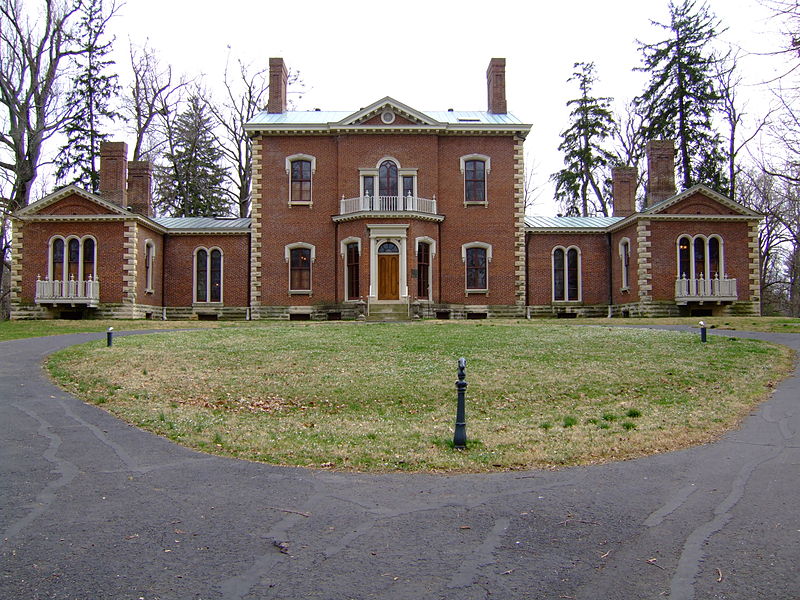
One of the most prominent politicians in the early 19th century, Henry Clay represented the state in both houses of Congress, served as Speaker of the House, and was appointed as Secretary of State under President John Quincy Adams. Clay created this large plantation just outside Lexington starting around 1806. Reports note that Clay’s presence has been noted inside the large home.
Newman, Rich. The Ghost Hunter’s Field Guide. Woodbury, MN: Llewellyn Press, 2011.
Loudoun House
209 Castlewood Drive
Loudoun House, 1940, by Lester Jones for the Historic American Buildings Survey (HABS). Courtesy of the Library of Congress, Prints and Photographs Division.
This large, Gothic-revival private residence was constructed in 1851 and has been home to the Lexington Art League for many years. Stories of its haunting include the apparition of a woman in a Victorian gown and the sounds of merriment that are sometimes heard in the empty house.
Sources
Newman, Rich. The Ghost Hunter’s Field Guide. Woodbury, MN: Llewellyn Press, 2011.
London
Levi Jackson Wilderness Road Park
998 Levi Jackson Mill Road
Formerly a state park, this city park offers history, recreation, and several ghostly children that run around. During an investigation in 2011, several investigators were locked out of a building when they left to get more equipment and a rocking chair was seen to rock on command with no one sitting in it.
Sources
Brummet, Jennifer. “Paranormal investigators use own time and money to seek out supernatural.” The Advocate-Messenger. 28 October 2007.
This brewery occupies a building that was constructed in 1878 as a church in the Jeffersontown neighborhood of Louisville. According to one of the co-owners, the building had served as a Moose Lodge for some 60 previous. When the brewery moved in, a note was found instructing the little girl to behave herself and the new owners soon realized that they shared the old church with the spirits of both a little girl and a man. Co-Owner Ben Shinkle told Louisville Magazine that he once had an encounter with the man while getting ready to open on a Sunday afternoon. “I saw a guy standing there, but I was running downstairs and said, ‘Hang on. I’ll be right with you.’ I popped back up and nobody was there. And all the doors were locked.”
Opening in 1905 after nearly two years of construction, the Seelbach Hotel soon became one of the most sought out hotels in downtown Louisville. For much of the 20th century it remained a glittering landmark, even inspiring F. Scott Fitzgerald as he wrote The Great Gatsby, though financial problems led to its closure in 1975. It was abandoned for only three years before a local actor bought it and began a restoration. Since reopening in 1982, it has continued to offer top notch service.
Postcard of the Seelbach Hotel, 1905, by the Detroit Publishing Company.
An incident in the 1920s has led to the hotel being haunted by a “Lady in Blue” who is thought to be the spirit of Patricia Wilson. She and her husband checked in to the hotel and the couple arrived separately. Mrs. Wilson arrived, but her husband did not show up as he was killed in a car accident on the way. The unfortunate wife was found dead at the bottom of an elevator shaft a short time later and her spirit has continued to haunt the building for decades.
Sources
Seelbach Hotel. Wikipedia, the Free Encyclopedia. Accessed 24 November 2020.
Backside of Waverly Hills Sanatorium, 2018, by Royasfoto73. Courtesy of Wikipedia.
With the rise of paranormal shows on television, Waverly Hills Sanatorium has established itself as one of America’s preeminent ghost-trekking locales. Construction began on this massive facility in 1911 to care for tuberculosis patients in a time before adequate treatments were available. The facility expanded and grew until streptomycin was introduced as a treatment leading to a decline in the number of TB patients. The facility closed in 1962 to reopen as a nursing home later that year. The nursing home closed in 1981 and the building has sat empty. Vandalism and the elements have caused some deterioration of the building since that time. Legends have surfaced that may explain the huge amounts of paranormal activity here.
Tourists explore the interior of Mammoth Cave, 2007, by Daniel Schwen. Courtesy of Wikipedia.
The largest cave system in the world at nearly 400 miles, the name does not refer to its linear size but rather the huge rooms and passages that form the cave’s labyrinth. Since its discovery by Native Americans, the cave has been a source of medicine and saltpeter, shelter for various people including tuberculosis patients, a tourist attraction, and a burial chamber. It’s little surprise that numerous odd experiences have been reported, though, it should be noted that the cave’s unusual environment may alter one’s senses. Nevertheless, reports from the cave include apparitions in old fashioned clothing including the spirit of Stephen Bishop, an enslaved man who was one of the earliest guides and explorers of the cave.
Olson, Colleen O’Connor and Charles Hanion. Scary Stories of Mammoth Cave. Dayton, OH: Cave Books, 2002.
Taylor, Troy. Down in the Darkness: The Shadowy History of America’s Haunted Mines, Tunnels, and Caverns. Alton, IL: Whitechapel Press, 2003.
Marion
Baker Hollow Road Cemetery
Baker Hollow Road
This country road outside Marion in rural Crittenden County along the Ohio River is supposed to be the site of much strangeness, especially at night. This cemetery, next to Baker Church, is actually two separate cemeteries located near the church building. People driving down Baker Hollow Road, running beside the church, have encountered a demonic dog in the road. Others have heard disembodied voices, and even apparitions hanging from the trees.
Phillips’ Folly, 2010, by Greg Hume. Courtesy of Wikipedia.
William B. Sutton built his grand home over the course of six years between 1825 and 1831. Evidence in the home’s basement may attest to its use as a stop on the Underground Railroad. It seems that Mr. Phillips may continue to be in residence here accompanied by his loyal dog. An investigation here in 2011 by the team from the show Ghost Adventures produced evidence that there are spirits here.
Sources
Maynard, Misty. “Ghost Adventures episode filmed in Maysville airs today.” Maysville Ledger-Independent. 12 May 2011.
Phillips’ Folly. Wikipedia, the Free Encyclopedia. Accessed 24 November 2020.
Newport
Monmouth Street Antique Gallery
822 Monmouth Street
This antique store’s former name, Sin City Antique Gallery, pays homage to Newport’s rowdier days when members of the Cleveland Syndicate, operated by a group of gangsters, ran casinos and carried on illegal operations throughout the city. Housed in a building that once held a Kresge’s Five & Dime and possibly may have been used for more illicit activities, the owners of the antique shop have had multiple experiences with spirits within the building. Activity here includes disembodied footsteps and voices, alarms being tripped when no one is around, and items moving on their own accord. A paranormal investigator who has investigated this location described it as “one of the most active and haunted locations I’ve been to.”
Sources
Cooley, Mac, et al. Newport is Haunted. Newport, KY: Newport Walking Tours, 2009.
Campbell Club, 2013, by Nyttend. Courtesy of Wikipedia.
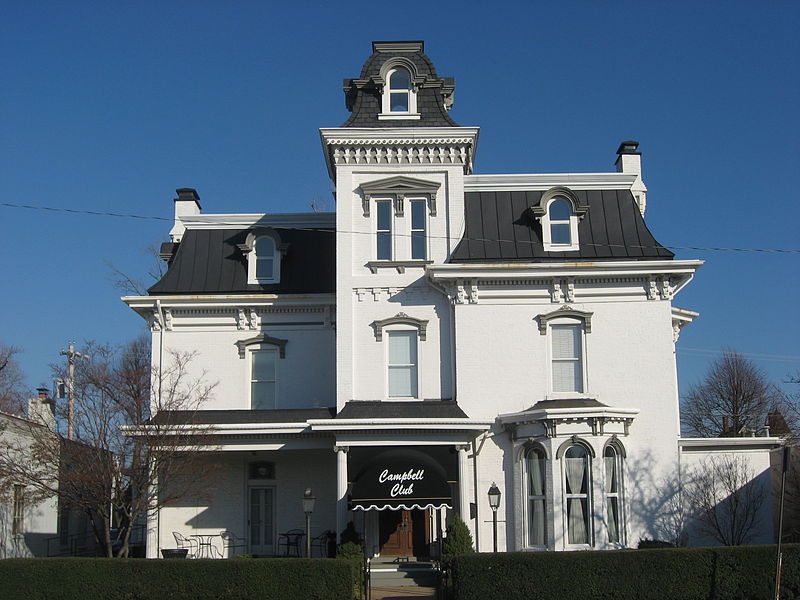
Occupying the 1880 French Empire Gillem House, this private dining club closed in 2017 after operating here since 1959. One of the recent chefs noticed a woman sitting in the restaurant staring out the window. When he asked about her, no one knew anything but when one of the staff members approached her, they found no one there.
May, Danny. “What’s next for the Campbell Club?” Owensboro Living. 30 August 2018.
The Miller House
301 East 5th Street
The Miller House is a 1905 home that has been transformed into a restaurant. The home is also the residence of several spirits including a little girl who plays with a ball.
Theatre Workshop of Owensboro (TWO)
407 West 5th Street
Described as “one of the most haunted sites in Western Kentucky,” Owensboro’s Theatre Workshop was originally Trinity Episcopal Church, now Old Trinity Centre. TWO has occupied this 1875 building since 1973 and many of its staff have had encounters with some of the resident spirits here. Spirits include a young lady who is supposed to have hung herself in the bell tower, as well as a priest who, after stumbling upon her body, killed himself in the basement.
For the past several decades, occupants of this building have experienced all sorts of paranormal activity. This commercial building, built in 1850, has housed a number of businesses throughout its existence, most recently several restaurants have occupied the space. The building is named for the Cohen family who purchased the building around 1900. It is perhaps spirits of members of this family who continue to haunt the building today.
Sources
Landini, Leigh. “Things that go ‘bump’ in the night may be a mischievous may be a ghost in downtown Paducah.” The Paducah Sun. 31 October 1999.
Perryville
Perryville Battlefield State Historic Site
1825 Battlefield Road
The quiet stillness of rural Perryville was interrupted in October of 1862. On the 8th, Confederate forces fought Union forces in their attempt to seize control of the whole of the state. Their defeat on these farm fields led General Braxton Bragg to pull his forces all the way back to Tennessee following the bloody battle.
Perryville Battlefield, 2006, by Hal Jesperson. Courtesy of Wikipedia.
Not only did the Confederates leave their hopes of controlling Kentucky on the battlefield, but they left spiritual scars. “Many say vivid echoes of the past remain, usually after the sun goes down, in the form of booming cannons, soldiers’ voices, flickering lanterns, phantom horses, and other ghostly occurrences.”
Sources
Windsor, Pam. “Ghost soldiers.” Kentucky Living. October 2014.
Pikeville
Pikeville Cemetery
Cemetery Road
The grave of Octavia Hatcher is marked by a large monument topped with a statue of the deceased. Hatcher passed away in 1891 after being ill for some time and falling into a coma. A few days after burial, James Hatcher began to worry that his wife may not have been dead at all when she was buried. After exhuming her coffin, it was discovered that she was indeed alive when she was buried and had tried to claw her way out of her grave. A handful of rumors have since sprung up regarding the creepy monument including that the statue may turn its back on occasion. Others have heard the sound of “mewling” near the grave and have witnessed the apparition of Hatcher strolling through the cemetery.
Sources
Quackenbush, Jannette. West Virginia Ghost Stories, Legends, and Haunts. 21 Crows Dusk to Dawn Publishing, 2017.
Prospect
Sleepy Hollow Road
With a name coming from Washington Irving’s classic tale, The Legend of Sleepy Hollow, it’s no surprise that this road is haunted. Along this stretch some drivers have been followed by a mysterious car only to discover, when it passes, that it is a hearse. In some cases, the cars may have been run off the road by the strange vehicle. The road also includes a classic Cry Baby Bridge where the wails of a child are still heard. During the Satanic Panic of the 1970s and 80s, stories of devil worshippers also sprang up along this thoroughfare.
Sources
Gee, Dawne. “Kentuckiana’s Monster, Myths and Legends – Sleepy Hollow Road.” 31 July 2014.
Richmond
White Hall State Historic Site
500 White Hall Shrine Road
White Hall, 2009, by Jim Bowen. Courtesy of Wikipedia.
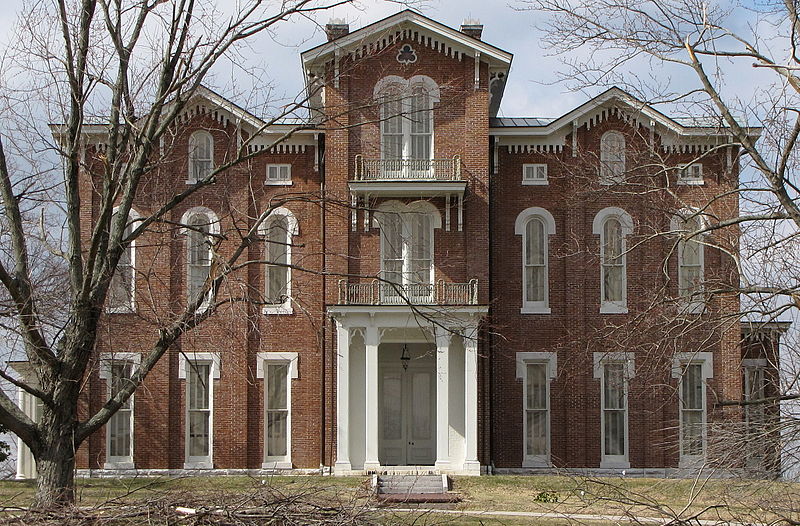
This huge Italianate mansion was the home of noted anti-slavery Kentucky legislator Cassius Clay. It remains the home of several ghosts including the possible spirit of the famed politician.
Sources
Landini, Leigh. “Things that go ‘bump’ in the night may be a mischievous may be a ghost in downtown Paducah.” The Paducah Sun. 31 October 1999.
Scottsville
Allen County War Memorial Hospital
99 Hill View Drive
Opened in 1952, this low-rise community hospital provided locals with medical attention for many years. Until it’s closure in 1994, many lives were brought into and exited life here, with spiritual reminders being left behind. Kentucky’s great collector of ghostlore, William Lynnwood Montell, notes the experiences of a nurse here in his 2001 Haunted Houses and Family Ghosts of Kentucky. This nurse spoke of hearing the crying of an infant coming from one of the rooms, though when she investigated, no one and nothing was found.
After the building was closed and abandoned, a local man leased the property for use as a haunted attraction, only to hear the same crying of an infant as they cleared the brush. As these stories began to emerge, many other locals began to speak of their strange experiences in the old hospital. The remains of the hospital have recently been renovated for use as apartments for low-income veterans.
Heading into the dramatic Red River Gorge on Kentucky Route 77, the road narrows at the Nada Tunnel. This roughly carved tunnel is only wide enough to allow a single car to pass at a time and doesn’t have lighting inside.
Nada Tunnel, 2010, by Patrick Mueller. Courtesy of Wikipedia.
Originally carved to allow trains to carry timber to Clay City, but over time it has come to carry automobile traffic. Legend says that one of the construction workers was killed here by a dynamite blast and that both a green orb seen near here and moaning heard inside the tunnel may be attributed to his restless spirit.
Van Lear Coal Miner’s Museum
78 Miller’s Creek Road
The community of Van Lear was incorporated as a coal mining town in 1912 and named for Van Lear Black, the director of the Consolidated Coal Company. The building housing the museum was constructed a year later as an office for the coal company, as well as housing the city hall and several businesses. The community is now unincorporated, and the building now serves as a museum. Along with artifacts detailing the area’s history the museum is in possession of a number of spirits.
Abner Gaines House, 2020, by Joekaush35. Courtesy of Wikipedia.
The oldest house in the town, the Abner Gaines House has served as a tavern, inn, private residence, and stagecoach stop in its early history. With so many people passing through, the house has experienced more than its fair share of violence, death, and suicide have left spiritual legacies that have manifested themselves as apparitions and odd sounds. The house has since been restored and is operated as the Gaines Tavern History Center.
Sources
“Mystery Monday: Real Haunted House.” 10 November 2014.
“Strange and Supernatural Happenings at The Abner Gaines House.” Boone County Reporter. 26 July 1899.
West Point
Fort Duffield Park & Historic Site
Fort Duffield Road
In the fall of 1861, Fort Duffield was built overlooking West Point to protect the Union’s supply base there. During the following winter, many succumbed to an outbreak of measles which took the lives of 61 soldiers. Possibly as a result, spirits of those soldiers remain around the site of the fort.
O’Neill, Tom. “Ghost walk to be held at Fort Duffield.” Courier-Journal. 31 October 2012.
Wilder
Bobby Mackey’s Music World
44 Licking Pike
Perhaps one of the most infamously haunted places in the country, this country-western bar, owned by singer Bobby Mackey, has been plagued with paranormal activity for years. While some of the legends of this place have been called in to question, there is little doubt that the activity is high, and the spirits of both kinds are plentiful.
Sources
Mayes, Cynthia Bard. “Just how haunted is the Bluegrass State?” com. 31 October 2012.