After my recent entry on Alabama, I had a comment on Facebook, “Interesting, but there’s more than the library in Birmingham…” Indeed.
I’ve previously covered two magnificent Birmingham theatres: the Alabama and Lyric; and the Tutwiler Hotel, in addition to the Linn-Henley Library which I covered in the Haunted Alabama entry. So here are a few more locations to add to the Birmingham list.
When Alan Brown wrote his 2009, Haunted Birmingham, he noted that this city’s ghostlore “is not nearly as rich as that found in much older cities.” Certainly, Birmingham is the youngest of Alabama’s large cities, having only been founded in 1871. Still, the city has some very interesting ghostlore including the iconic Sloss Furnaces.
Sloss Furnaces 20 32nd Street, North
Perhaps one of the most iconic haunted places in the whole state, this National Historic Landmark site is iconic of Birmingham’s history. Birmingham was built on industrial facilities like this producing iron during the latter half of the 19th and into the 20th centuries. While the facility opened in 1882, nothing remains of the original furnaces here. The oldest building on this site dates to 1902 with much equipment installed and added in later years. This facility closed in 1971 and local preservationists began work to save the facility. Their efforts paid off and the facility is open as a museum and events facility.
Sloss Furnaces, 2006. Photo by Timjarrett, courtesy of Wikipedia.
There is always a chance for death in industrial sites, even more so around molten metal in a furnace. In 1887, Theophilus Jowers, assistant foundryman at the Alice furnace (one of the first furnaces on this site) fell to his death into the molten iron in the furnace. Some of his remains—his head, bowels, two hip bones and some ashes—were fished out of the molten iron. Jowers’ death remains one of the most spectacular and grisly, though many more men died throughout the time that the furnaces were in operation.
After Jowers’ death, his spirit was observed by co-workers. Kathryn Tucker Windham quotes one former employee, “We’d be getting ready to charge the furnace, and we’d see something, something like a natural man walking around on the hearth. Just walking slow and looking around like he was checking to make sure everything was all right.” Windham describes the first time that Jowers’ son saw his father’s spirit in 1927. The now grown son took his son for a drive over the First Avenue Viaduct and there, while watching the action at the furnace, they observed a man walking through the showers of sparks and flames.
Two more spirits are believed to be in residence at this site, but less historically based. A white deer that has been seen on the grounds is believed to be the spirit of a pregnant girl who committed suicide by throwing herself into the furnace. The other “apocryphal”—as Alan Brown describes him—spirit is that of a fiendish foreman named James “Slag” Wormwood. Like Jowers and the pregnant girl, Wormwood supposedly fell to his death into one of the furnaces, though it is suspected that he was really pushed by an angry employee. It is Wormwood’s angry spirit that is responsible for pushing employees.
The furnaces are known as a hotbed of paranormal activity and were investigated for the first time in 2005 by Ghost Chasers International out of Kentucky. They were joined by psychic Chip Coffey who would soon make his name working on the A&E show, Paranormal State. During the investigation, Coffey made contact with the spirit of a man who had lost a limb in an accident there. Moments after losing contact with the spirit, team members noticed blood on Coffey’s hands. After investigating him for scratches or another injury that could have produced blood, nothing was found. Over the past 10 years of paranormal investigations at the site, a slag heap of evidence has been produced.
Sources
Brown, Alan. Haunted Birmingham. Charleston, SC: History Press, 2009.
“History.” Sloss Furnaces National Historic Landmark. Accessed 12 June 2015.
Parks, Megan. “Sloss Fright Furnace: The haunts heat up in Alabama.” USA Today. 14 October 2014.
Windham, Kathryn Tucker. The Ghost in the Sloss Furnaces. Birmingham, AL: Birmingham Historical Society, 2005.
East Lake Park 400 Graymont Avenue, West
On the 1st December 1888, Richard Hawes accompanied his daughter to the newly built lake here. Sometime later, he left without the seven-year-old. On December 4th, two boys playing on a boat in the lake discovered the child’s half-naked body in the water. The discovery caused a sensation among the citizens who thronged the funeral home where she was taken to view the body. Eventually, she was identified as May Hawes. As his train pulled into Birmingham, Richard Hawes, May’s father, was arrested.
May Hawes’ body as pictured in a local paper, 1888.
Richard Hawes was aboard the train with his new bride and still in his wedding suit. He told investigators that he had divorced his wife and was paying for the support of the children. His new wife, from Columbus, Mississippi, was described as being prostrate with grief after finding that her new husband was suspected of murder. Hawes’ wife Emma and daughter, Irene, age six. As newspapers stirred the city’s emotions, Emma’s body was found in a lake in the Lakeview neighborhood. Outrage overtook countless Birminghamians who gathered outside the city jail demanding Hawes be brought to justice immediately. A militia that had been called out to protect the jail eventually opened fire on the crowd killing ten including the city’s postmaster and wounding many others. A few days later, the pathetic body of Irene Hawes was found in the same lake where her mother had been found.
Postcard of East Lake from the roller coaster that once perched on the shores, 1909.
After a swift trial, Richard Hawes faced the gallows and was hung for the murder of his wife and two daughters. Hawes’ second wife was granted from her depraved husband. The lake in Lakeview where Emma and Irene were drowned is now a golf course while East Lake is the centerpiece of East Lake Park, which became a city park 1917. Little May Hawes is still seen in and around the lake where she is sometimes called the “Mermaid of East Lake.”
Sources
East Lake Park. Accessed 12 June 2015.
Jones, Pam. “The Hawes Murders.” Alabama Heritage. Spring 2006.
Kazek, Kelly. “’Tis the season: Haunting tales from ghost tours in 3 Alabama cities.” com. 2 October 2012.
Arlington Antebellum Home & Gardens 331 Cotton Avenue
Described as the “Birthplace of Birmingham,” Arlington is the oldest remaining home in Jefferson County. The core of this house was constructed in 1822 with additions being made to the house in 1842. As it served as the headquarters for Union General James H. Wilson during the closing months of the Civil War, the house was spared while the orders for the destruction of the University of Alabama, the arsenal at Selma and iron works throughout the region were issued from this home. As can be expected in a house of this age, there is some paranormal activity. Alan Brown notes that docents have heard doors slamming and witnessed rocking chairs rocking on their own accord.
Arlington by Jet Lowe. Photo for the Historic American Buildings Survey, courtesy of the Library of Congress.
Sources
Brown, Alan. Haunted Birmingham. Charleston, SC: History Press, 2009.
Floyd, W. Warner and Mrs. Catherine M. Lackmond. National Register of Historic Places nomination form for Arlington. 9 September 1970.
Carraway Methodist Medical Center 1600 Carraway Boulevard
This defunct hospital was, for many years, one of Birmingham’s leading medical facilities. In the 2000s, the hospital was plagued with financial difficulties that lead to its closure in 2008. The facility has been deteriorating since and it has attracted homeless people, vandals, copper thieves and some ghost hunters. A November 2014 article by Kelly Kazek reports on an investigation conducted by investigator and author, Kim Johnston. After touring the facility with the owner, Johnston reported that the Emergency Room had a “palpable heaviness.” Her group did have the experience of hearing muffled voices in the cardiac surgery area of the third floor. Even after bringing in local police, no one was found to be in that area. This building is closed and tresapssers will be prosecuted, please only observe from a distance.
Sources
Carraway Methodist Medical Center. Acc. 6 Jun 2015.
Kazek, Kelly. “Abandoned Alabama Part 2: The ghost of cities past.” com. 28 Nov 2014.
Hotel Indigo Birmingham Five Points South (formerly The Hotel Highland at Five Points South) 1023 20th Street, South
Originally constructed as the Medical Arts Building in 1931, this building served as offices for surgeons and dentists for many years. In the 1980s, a former cardiac surgeon renovated the Art Deco structure into a hotel, the Pickwick Hotel. During this time, stories emerged of a nurse still making rounds on the eighth floor. Sheila Turnage quotes a former director of sales who said that the elevator would mysteriously be called to the eighth floor unexpectedly. The hotel was transformed into a boutique hotel in 2007.
Sources
Turnage, Sheila. Haunted Inns of the Southeast. Winston-Salem, NC: John F. Blair, 2001.
“History of the Hotel” The Hotel Highland at Five Points South. Accessed 18 May 2015.
Old Biomedical Research (CREST) Building
Louisiana Tech University 711 South Vienna Street
If a building can resemble a person, then the CREST Building’s white brick and severe lines resemble the old fashioned, white-clad nurses of days gone by: stiff, strict, and starched. Author Jeanne Frois ascribes a more sinister appearance to the building’s windows as looking “like hollow eye sockets holding an empty presence within.”
Perhaps these nurses are still patrolling the halls of this former hospital. The building opened in 1928 as the Ruston-Lincoln Sanitarium. At that time, the morgue was located on the first floor with the hospital’s surgical suite located on the fourth floor. In 1963, the facility was transformed into a nursing home and served that purpose until the 1970s, when it was turned over for use by Louisiana Tech.
While the academic faculty and students are working to improve the lives of the disabled, it seems that the old nursing staff may continue to check up on them as well. In a 2007 article from the university’s newspaper The Tech Talk, one staff member reported that she believes the spirit may be the nursing home’s former director of nurses. According to the article, this woman had an apartment on the fourth floor so that she could respond quickly if there was a problem. This particular staff member worked under this nursing director whom she describes as “never mean,” though she was “strict and firm; she was a stickler for every detail.” She told the newspaper that, “She had a good heart, though, the patients all loved her, and the doctors loved her because she kept the patients happy.”
Perhaps this devoted nursing director has maintained her devotion in the afterlife, though none of the reports of paranormal activity point to a specific spirit haunting the building. The activity is varied and most commonly includes the sound of doors opening and closing. One staff member working in the building after hours heard the sounds of doors opening and closing all up and the down the hall on the fourth floor. Annoyed and curious, he checked all the doors on the hall to find them all closed and securely locked.
Electronic equipment also sometimes has odd issues. One student watched as a printing calculator began to print random numbers. Another person put fresh batteries in a number of toys in preparation for young patients only to find the batteries drained the next day.
There are also issues with the elevator which regularly makes the journey from the first floor to the fourth floor without being called. In his recently published book, The Ghost Will See You Now: Haunted Hospitals of the South, Randy Russell states that the ghost will often open the doors to anyone carrying doughnuts. It’s an absurd notion, but in the world of the paranormal, anything can happen.
UPDATE: It seems that Louisiana Tech has moved it’s Center for Biomedical Research to a new building on its campus. The old hospital building it once occupied is currently for sale.
Sources
Frois, Jeanne. “Around Louisiana: Northern Louisiana.” Louisiana Life. September-October 2009.
“History: Building.” Louisiana Tech University. Accessed 10 November 2014.
Jones, Davey. “Frightening encounters flourish in old Biomedical Engineering Building. The Tech Talk. 25 October 2007.
Russell, Randy. The Ghost Will See You Now: Haunted Hospitals of the South. Winston-Salem, NC: John F. Blair, 2014.
I’m feeling a bit of umbrage for the spirits of the Upstate region of South Carolina. A recent Halloween related article appeared on the website of a Charlotte, NC news station (I’d rather not just call them out) regarding haunted places in the region. Included with the article is a slideshow of 43 locations that are purported to be haunted. But that’s all that’s included: a slideshow. The slides show pictures of some of these haunted hotspots with a name and town, but no further information. While it’s all fine and good to say a place is haunted, it is a serious disservice to pronounce a place haunted but provide no further information regarding it.
There is a link within the article to a list of haunted places on the website of a local paranormal investigation organization. While it’s obvious that this list is the only source for the locations included in the slideshow, what I find so annoying is the fact that the organization’s source is the notorious Shadowlands Index of Haunted Places. After briefly comparing the lists, it became very clear that the paranormal organization’s list was simply cut and pasted from the Shadowlands list.
My problems with Shadowlands stems from the fact that it is made of user submitted entries. Someone, anyone, can go to the website and submit information on a haunted place. The information submitted is not checked or vetted, it is added to the list and readers often take this information as fact. It is such shoddy information gathering and publishing that I’m working hard to combat with this blog.
To post information about hauntings in such a willy-nilly manner is not just disrespectful for the spirits which may haunt these locations, but shows a lack of respect for the locations and their respective histories. Reputable sources on this region are not lacking and most are still in print. In fact, the article quotes the author of one of those primary sources. So, a much better list can be provided with a modicum of research.
While my coverage here is not as lengthy as the news station’s list, hopefully this article will help to provide a far better alternative. For your consideration, I’m presenting a few of the more interesting—and documented—stories from the Upstate region.
Abbeville County
Abbeville, the county seat and namesake for the county, is a fascinating town with a number of hauntings including its historic opera house which I covered a few years back.
Burt-Stark Mansion 400 North Main Street Abbeville
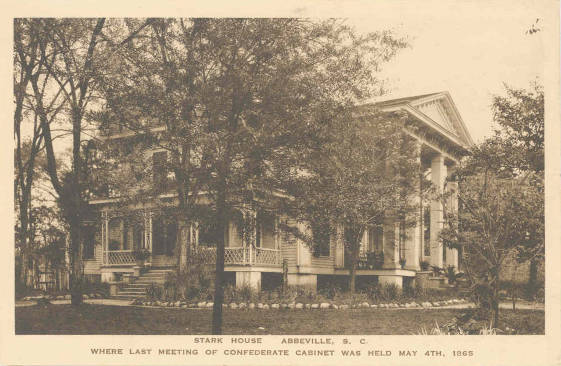
Sometimes called the “Grave of the Confederacy,” the Burt-Stark Mansion was the scene of the Confederacy’s final council of war; where Jefferson Davis met with some of his cabinet officials and generals following the fall of Richmond and General Lee’s surrender at Appomattox. The Confederate government was in disarray, and its officials on the run through the war-weary South.
Varina, Confederate President Jefferson Davis’ wife, had arrived at Major Armistead Burt’s elegant Abbeville home in mid-April with her family in tow. She stayed with the Burts for a little more than a week before continuing their journey into Georgia. On May 2nd, Jefferson Davis arrived in Abbeville. Stopping by a small cabin on the edge of town, Davis asked for a drink of water from the lady of the house. As he drank, a small child wandered across the porch towards him. The woman asked, “Ain’t you President Davis?” After he answered in the affirmative, the woman nodded at the child, “he’s named for you.”
Producing a small gold coin from his pocket, Davis handed it to the woman saying, “Please keep this for him and tell him about it when he’s old enough.” Davis whispered to Postmaster General John H. Reagan and told him that that was the last coin he had to his name.
Undated postcard image of the Burt-Stark Mansion. Published by the Echo Novelty Store, Albertype Company.
Soon after, Davis took up residence at the Burt home where his wife had stayed previously. Later that afternoon, the remaining cabinet met in the parlor. It was there that Davis responded, “all is indeed lost,” conceding to the loss of the Confederacy.
The mansion has been preserved as a museum, and due to the nature of the final meeting of the Confederate cabinet is now listed as a National Historic Landmark. Though very little paranormal activity had been witnessed in the mansion, due to the numerous other hauntings in Abbeville it was decided to allow a paranormal investigation team to investigate the home in 2007. According to John Boyanoski’s description of the investigation in his More Ghosts of Upstate South Carolina, the team came away with a great deal of evidence.
Members of the Heritage Paranormal team felt the presence of a man in the bedroom where Davis had slept. Moments later, one of the lead investigators witnessed the clear outline of a woman in period dress descending the staircase. Lending credence to his experience, the team’s equipment near the staircase registered some disturbances at the time the investigator saw the specter. In the separate kitchen building, the team detected two spirits, possibly those of slaves.
Sources
Bearss, Edwin C. National Historic Landmark nomination form forBurt-Stark Mansion. 28 April 1992.
Boyanoski, John. Ghosts of Upstate of South Carolina. Mountville, PA: Shelor & Son Publishing, 2006.
Burt-Stark Mansion. “About Us.” Accessed 13 October 2014.
Anderson County
Anderson Municipal Business Center 601 South Main Street Anderson
Unlike the Burt-Stark Mansion with its flood of history, the Anderson Municipal Business Center is a rather utilitarian government building with little history. The building opened in August 2008 and odd events began to occur less than a year after it opened. The security person in charge of the building—a 15 year veteran of the local police department—began to notice odd things on the security monitor installed in the Anderson credit union office. A white blur appeared on the video and would flit around the room. It returned night after night.
The room was checked for bugs and the camera was cleaned, but the white blurs continued to return. Workers in the office reported hearing odd sounds after hours including knocking and the sounds of furniture being moved. A customer, who supposedly knew nothing of the activity, reported the feeling of being grasped by the shoulder. The activity lasted for a few months, but then petered out by late 2009.
The property has a fairly quiet history, certainly nothing that would explain the odd white blurs that appeared for a period.
Sources
“Ghostly images leave people wondering.” 30 October 2011.
Smith-Miles, Charmaine. “Anderson employee to appear on TV’s ‘My Ghost Story.’” Anderson Independent Mail. 13 April 2011.
Cherokee County
Ford Road Bridge Ford Road at Peoples Creek Gaffney
It was obvious that the killer wanted to play when he called reporter Bill Gibbons of The Gaffney Ledger on a day in early February 1968. He instructed the reporter to pull out three pieces of paper and then gave the reporter directions to find the bodies of two of his victims. The killer even provided the victims’ names. The reporter summoned the sheriff and traveled to the two sites provided by the caller, finding bodies at each location. The body of the third victim had been previously found, and the woman’s husband had been convicted of the murder. Gaffney woke to the fact that it had a serial killer on its hands.
The Gaffney Ledger headline, 9 February 1968.
The killer would kill once more before he was arrested. Lee Roy Martin, the killer, was found guilty and sentenced to four terms of life imprisonment. He was killed by another inmate in 1972.
Just below the lonely Ford Road Bridge over Peoples Creek, one of Martin’s victims was found. Her nude body lay on the creek bank with her face in the water. She had been raped and strangled with a belt. Over the years, locals have reported hearing a woman screaming and moaning below the bridge where the body was found. An investigation conducted as part of the filming of Haunted Echoes: The Gaffney Strangler, a documentary that was posted on YouTube, did not hear any screams, just the trilling of bullfrogs in the creek.
Sources
Dalton, Robert W. “Gaffney Strangler terrorized town 40 years ago, murdering 4 women.” Spartanburg Herald-Journal. 5 July 2009.
Gibbons, Bill. “Search underway here for slayer of 2 women; Tip to newsman leads officers to scene.” The Gaffney Ledger. 9 February 1968.
Johnson, Tally. Ghosts of the South Carolina Upcountry. Charleston, SC: History Press, 2005.
Greenville County
Herdklotz Park 126 Beverly Road Greenville
Jason Profit, owner and operator of Greenville Ghost Tours, describes Herdklotz Park in his book, Haunted Greenville, South Carolina, as having “all the ingredients for an active paranormal soup.” This tranquil city park was once home to the Greenville Tuberculosis Hospital, which closed in the 1950s after operating for some 20 years. For some time, the building sat abandoned but was then reopened in the 1990s for a brief period of time as part of a prison work-release program.
As with many abandoned buildings of this nature, the building served as a playground for teens and the occasional vandal who would leave with stories of the supernatural there. Of course, the building also attracted the local homeless. It is believed that they may have accidentally caused the fire that destroyed the building in November of 2002. The remains of the building were demolished.
But, the spirits have remained. Jason Profit recounts an EVP session that he held on the steps of the old hospital (the building’s foundation remains intact) in 2008. He was able to capture the sounds of what he described as “a busy lunchroom. It sounded like the echoing of voices in a hallway or large room.” He reports that many residents of the neighborhood around the park have witnessed shadow people in their homes and in the area that may be related to the old hospital. In a 2009 report for the local CBS affiliate WSPA, Profit states, “I would have to say that beyond a shadow of a doubt that Herdklotz Park is one of the most haunted parks you’re going to find in Upstate South Carolina.”
Sources
Cato, Chris. “Greenville County Park Haunted by Hospital’s Ghosts?” WSPA. 31 October 2009.
Profit, Jason. Haunted Greenville, South Carolina. Charleston, SC: History Press, 2011.
Greenwood County
Ninety Six National Historic Site 1103 Highway 248 Ninety Six
Scholars still argue as to how Ninety Six got its odd name, some say it’s that the town was 96 miles from the Cherokee village of Keowee (which is incorrect) and some say that it’s a reference to the many creeks in the area. Nevertheless, this oddly named village was the scene of a siege during the American Revolution. General Nathanael Greene led his Patriot troops against loyalists entrenched in the village. Despite having far more troops, Greene’s 28-day siege failed to capture the village, and he withdrew his troops. Perhaps, though, he did leave some spirits behind. Residents living near the battlefield and re-enactors camping on the battlefield have heard voices throughout the site.
Siege of Ninety-Six. Wikipedia, the Free Encyclopedia. Accessed 24 February 2011.
Toney, B. Keith. Battlefield Ghosts. Berryville, VA: Rockbridge Publishing, 1997.
Pickens County
Colony Theatre 315 West Main Street Easley
Ghost stories often grow out of odd bits of natural phenomena. That may just well be the story behind this small town movie theatre in the Upstate. A member of the family who built this theatre in 1948 and owned it until it closed claimed the “ghost” was simply the curtains in the projection room being blown by air from the projector. Though, locals have a different theory: it’s the ghost of a woman who hanged herself on this site before the building of the theatre.
In his marvelous collection of ghost stories from the Upstate region, Ghosts of Upstate South Carolina, John Boyanoski documents the story of a passerby who saw the spirit peering from a window of the empty theatre one night. While driving home to Greenville from a football game in Clemson one night in 1989, the driver slowed to admire the old, art moderne-style theatre. Looking up, he saw a woman staring out of one of the building’s second floor windows. She didn’t move and she appeared to have a faint glow about her. He continued driving and then turned around to catch a second glimpse. The theatre was quiet and dark. Nothing appeared in the windows. Even after parking and walking around the front of the building, nothing stirred.
At the time of this writing the theatre serves as a church and remains as a landmark along South Carolina Highway-93 through Easley. The theatre is owned by Robinson’s Funeral Home and it plans to maintain the theatre as a local landmark.
Sources
Boyanoski, John. Ghosts of Upstate of South Carolina. Mountville, PA: Shelor & Son Publishing, 2006.
Robinson, Ben. “Colony Theater not in danger from Robinson’s expansion.” Easley Progress. 16 December 2011.
Spartanburg County
Old Main Building Campus of Wofford College Spartanburg
Wofford College, a private, independent school associated with the Methodist Church, has about 130 faculty and staff members, 1,500 students, and more than a handful of ghosts. The old campus features some noted historic structures including the campus’ centerpiece, the Old Main Building which may have a few of its own spirits flitting about the halls. South Carolina folklorist, Tally Johnson, an alumnus of the school, witnessed Old Main’s legendary “Old Green Eyes” when he was a student. He and another student crept into the auditorium one night and witnessed the odd pair of lights that appear above the drapes over one of the auditorium’s windows. The “eyes” appeared and Johnson and his companion were unable to find a source for the lights.
Old Main Building, 2010, by PegasusRacer28, courtesy of Wikipedia.
The odd, green orbs have not been identified and there’s no apparent explanation. Regardless, that’s not the only odd activity. The blog of the college’s archives recounts that the spirit of Dr. James Carlisle—one of the first faculty members and president of the school for the latter half of the 19th century—has been seen and heard prowling the halls.
Sources
Brabham, William C. National Register of Historic Places nomination form for the Wofford College Historic District. 29 August 1974.
Johnson, Tally. Ghosts of the South Carolina Upcountry. Charleston, SC: History Press, 2005.
Stone, Phillip. “Are there ghosts at Wofford?” From the Archives. 31 October 2011.
I recently had an inquiry from a friend who’s a student at Shenandoah University in Winchester, Virginia regarding a “haunted road trip” he and his friends want to take next month. After consulting my resources, I’ve devised a suitable tour of the area’s numerous haunts.
This tour makes a circle through the Shenandoah Valley, beginning and ending in Winchester. It heads south on I-81 towards Staunton with a few stops along the way. After Staunton the tour heads east to include the famous Exchange Hotel in Gordonsville before returning to Winchester. The tour includes a range of haunted places from historic homes to government buildings, churches, battlefields, commercial buildings, cemeteries, a train depot, a former mental hospital and a cave. Some of these locations are open to the public while a few are private and should only be viewed from the street.
N.B. This article has been reworked a bit and I have begun separating these cities into their own distinct articles.
Winchester
The Winchester section of this article has been broken off into its own, separate article, “The Wraiths of Winchester.”
Middletown
1797 WAYSIDE INN (7783 Main Street) This building sits at the core of history of this small town. The motley of old buildings forming the tavern were built over a period ranging from the 18th century through to the late 19th century. The oldest portion of the building, containing Larrick’s Tavern, may have been constructed around 1750. The road in front was once part of the Great Wagon Road—the road used by settlers pouring into the American “backcountry.” In this area, the Great Wagon Road was originally a Native American trail called the Great Indian Warpath and used by a multitude of Native American tribes including the Cherokee.
In 1797, this collection of buildings became an inn for the many travelers passing on the road. Leo Bernstein, the garrulous personality who took over the inn the latter half of the 20th century, would always claim that this inn was the oldest continuously operating inn in the nation. There does seem to be a good deal of truth behind his claim. It is known that this inn was in operation as war raged up and down the valley during the Civil War and that the inn served both sides.
Wayside Inn. Photo 2008, by DwayneP, courtesy of Wikipedia.
Like most buildings in the area, the inn has a number of Civil War related spirits, though there is the possibility that the inn may have been haunted before that time. Lord Fairfax, who had been given much the land in the area, did live nearby and died in Winchester (he’s buried at Christ Episcopal Church) is claimed as the spirit that moans on a nightly basis in the oldest portion of the inn. Bernstein describes the space in Sheila Turnage’s Haunted Inns of the Southeast, “Upstairs is about a three foot space. There was a set of steps going up there. The straw is still there.” The loft is located just above one of the bars and Turnage mentions that people gather to listen for the moan at 11:30 PM nightly.
Besides odd moans, the inn is home to numerous other spirits and employees and guests have witnessed much activity. Objects have moved on their own accord, a dishwasher had his apron untied repeatedly by unseen hands, and full apparitions have been seen including those of Civil War soldiers. Paranormal investigations have captured much evidence including EVPs of horses whinnying and photographs featuring specters.
WAYSIDE THEATRE (7853 Main Street, now closed) The sad fate of the Wayside Theatre echoes the fate of so many theatres throughout the country. The company was established in 1961, by Leo Bernstein, the owner of the Wayside Inn just down the street. The summer stock theatre provided training for actors such as Susan Sarandon, Peter Boyle, Kathy Bates and Donna McKechnie. After a precipitous drop in revenue, the theatre closed its doors in 2013.
The building was originally constructed as a cinema and it is from this period that the theatre’s ghost may come from. “George,” is supposedly the spirit of an African-American man who either worked in the theatre or was a caretaker at some point. His spirit is said to haunt the stage, balcony and basement of the building.
CEDAR CREEK AND BELLE GROVE NATIONAL HISTORICAL PARK (Belle Grove, 336 Belle Grove Road) Historically and architecturally, Belle Grove is one of the most important houses in the region and listed as a National Historic Landmark. It is currently owned and operated by the National Trust and most sources state that the docents are discouraged from talking about the spirits which still reside here.
Belle Grove, 2013, by AgnosticPreachersKid. Courtesy of Wikipedia.
The history of Belle Grove begins in the late 18th century with the land being acquired by Isaac Hite, the grandson of Jost Hite, a German immigrant and one of the early pioneers in this area. Construction of the house began in 1794 and ended in 1797. The house remained in the Hite family until just before the beginning of the Civil War when it was bought by John and Benjamin Cooley. The first of two ghost stories begin with this family. Not long after acquiring the house, Benjamin Cooley married a local woman named Hetty. Not long after her arrival in the home, Hetty became the subject of ire from one of the slave woman working there.
Though the details are unclear, Hetty was attacked by the slave and her beaten body was thrown either into the smokehouse or the icehouse on the property. Hetty’s spirit reportedly returns frequently and has been seen throughout the house. According to two sources, she actually let a deliveryman into the house one afternoon after the home had been closed for the day. The deliveryman was returning the antique carpets which had been removed for cleaning. After arriving late, he was let into the house by a woman in a period dress who did not speak but only gestured to where the carpets should be placed. When the staff discovered the carpets had been returned and put in place, they called the cleaning company who put the driver on the phone. They were shocked to hear about the woman who let him in.
A few years after Mrs. Cooley’s death, the estate became the scene of the Battle of Cedar Creek. During that battle, Major General Stephen Ramseur of North Carolina was gravely wounded. He was taken to a room at Belle Grove where he passed away the following morning surrounded by some of his former classmates from West Point from both armies including George Custer. This scene was witnessed by a gentleman some years ago. While idly passing through the house, he glanced into a room to see a group of Civil War soldiers in both blue and grey standing around someone in a bed. Later, when he asked who had been presenting the tableaux that day, he was informed that nothing of the sort was taking place in the house.
Employees have told various paranormal writers that voices and other odd noises are regularly heard in the house, while singing is heard in the slave cemetery on the property.
Early on the morning of October 19, 1864, Confederate General Jubal Early launched an attack upon Union forces camping in the area. These forces under General Sheridan (who was headquartered at the Lloyd Logan House in Winchester, see stop #3H) had spent their time clearing the Shenandoah Valley of Confederates. Known as “The Burning,” this period included the destruction of much of the area. Early’s early morning attack was one of the last chances for Confederates to stop the decimation of the valley.
While Early’s attack was initially successful in beginning to route the Federals, Sheridan, hearing the sounds of battle from Winchester, jumped upon his horse and made a triumphant ride to Middletown to rally his troops to victory. At the end of the day, Early’s forces had been driven from the field.
The stories of spirits on this battlefield began not long after the battle ended. These stories included spectral soldiers on the battlefield both singly and in groups and even stories of headless horsemen. Michael Varhola notes, however, that the gentlemen he met working in the visitor’s center, refused to answer his questions about the battlefield being haunted.
Grottoes
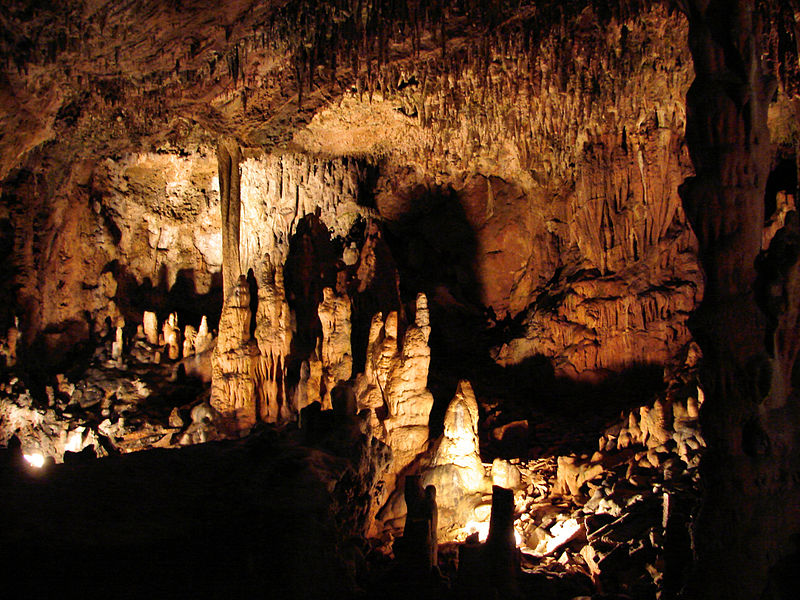
Formations within Grand Caverns. Photo 2010 by P199. Courtesy of Wikipedia.
GRAND CAVERNS (5 Grand Caverns Drive) From the oldest continuously operating inn in the country to the oldest operating show cave, Grand Caverns has been open for tourists since 1806. I’ve covered this cave and its ghosts in a blog entry here.
New Hope
PIEDMONT BATTLEFIELD (Battlefield Road) Outside of New Hope, near the community of Piedmont, is an open field that was the scene of a battle, the 5th of June 1864.
Around 5 AM, June 5, 1996, a group of reenactors camping on the southern edge of the battlefield were awakened by an unusual ruckus: the sounds of wagons approaching. In an effort to greet the approaching wagons, a few of the reenactors stepped towards a nearby fence. The sounds, the creak of wagon wheels, the tinkle of chains, the clop of horses hooves and their whinnies, increased for a moment as they apparently neared the awed witnesses then they suddenly ceased. Some of those present later discovered an overgrown trace or wagon road in the woods near the spot where they’d heard the sounds. It is believed that this road may have been in existence at the time of the battle.
Of course, there’s no way to know if the sounds were related to battle or simply spiritual residue from the road’s history. Either way, the reenactors will likely tell this story for years to come.
Staunton
Like Winchester, Staunton has a myriad of haunted locales and a ghost tour. Black Raven Paranormal presents a handful of different tours; see their website for further information.
MRS. ROWE’S FAMILY RESTAURANT (74 Rowe Road) This popular restaurant has been investigated twice in the past few years after employees and guests have had run-ins with spirits. In addition to activity in the building’s attic and basement, the back dining room and men’s room have reportedly had activity. Two local news articles describe the activity as ranging from full apparitions to employees being touched.
DeJARNETTE CENTER (located behind the Frontier Culture Museum, 1290 Richmond Avenue, the center is closed and private property though one of the tours offered by the Ghosts of Staunton tours the grounds, don’t ask for further information at the Frontier Culture Museum, they can’t tell you much of anything) There’s a good deal of misinformation about this location. Of course, mental and psychiatric hospitals tend to be haunted, along with other medical facilities. Among those with a paranormal bent, there is a tendency to exploit these types of places and often repeat misinformation.
DeJarnette Center. Photo 2011, by Ben Schumin, courtesy of Wikipedia.
With the DeJarnette Center, there is a tendency to confuse it with Western State Hospital, which also may be haunted. Though their histories are intertwined, these are two separate facilities. Western State was founded early in the 19th century to handle the overflow from the Williamsburg Hospital which handled the insane and mental cases. The complex that once house Western State has recently been converted into condominiums called The Villages at Staunton.
During the first half of the 19th century, Western State was under the aegis of Dr. Joseph DeJarnette, a revolutionary figure in the field of mental health. His controversial legacy included institutionalizing a eugenics program that forcibly sterilized numerous patients throughout the state.
This facility opened in 1932 originally as the DeJarnette State Sanitarium, a private pay unit of Western State. The state assumed control of this facility in 1975 and renamed it the DeJarnette Center for Human Development. The facility experienced severe budget cuts starting in the mid-70s and continuing until the patients were moved into a newer, smaller facility adjacent to Western State in 1996. Since 1996, the site has been abandoned and waiting for the wrecking ball. Countless ghost stories have been told about the facility, though few have actually been published.
DOWNTOWN STAUNTON Like downtown Winchester, Staunton has a number of haunted places, though the information on them is not as readily available (as opposed to Winchester with Mac Rutherford’s book on its hauntings). I imagine many of these locations will be presented on the Ghosts of Staunton tour.
STAUNTON COFFEE AND TEA (32 South New Street) This building was the scene of a homicide in August of 1951. Elmer Higgins, a heavy gambler who lived in an apartment on the building’s second floor was shot in the head, execution-style. The murder remains unsolved and it is believed his spirit remains on the premises.
AMTRAK STATION (1 Middlebrooks Avenue) There has been a train station on this site since 1854. The first station was burned during the Civil War while the second station was destroyed April 28, 1890 by train. The New York Times described the event, “This morning about 3 o’clock a railroad wreck occurred at the Staunton (Chesapeake and Ohio) Station. The vestibule train, due here from the west at 1 o’clocl was two hours late. About 3 o’clock it came whirling on at a speed of seventy miles an hour, the engine having the appearance of a sheet of fire…As the train reached the passenger station the rear sleeper careened, striking the platform covering, tearing away the iron posts, and demolishing the whole platform structure.”
Staunton Amtrak Station. Photo 2009, by Ben Schumin, courtesy of Wikipedia.
The train was carrying members of a traveling operatic troupe out of Cincinnati, Ohio. The only death to occur was one of the company’s singers, Miss Myrtle Knox who was badly mangled by the accident and bled to death.
Myrtle’s sad spirit has been spotted on the platform wearing a nightgown. Women with long blonde hair have had their hair tugged and it is believed that Myrtle’s spirit may be to blame for that as well.
An old rail car at the depot once contained a restaurant. Visitors to the station have seen odd lights, shadows and heard voices around the old Pullman car. Along the tracks the apparition of a Civil War soldier has been seen. A Confederate soldier was walking these tracks after having a bit too much to drink at a local saloon. He was hit by a train and killed.
THE CLOCK TOWER BUILDING (27 West Beverly Street) This 1890 structure has been the scene of at least three deaths. Two early deaths on the premises, which was originally constructed as a YMCA facility, include a heart attack and a young woman who fell down a coal chute. Recently, someone fell to their death from the third floor in a possible suicide. These spirits are still said to linger in this old building.
MARY BALDWIN COLLEGE (Intersection of Frederick Street and New Street) According to the National Register of Historic Places nomination form for this college’s main building, Mary Baldwin is the oldest women’s institution of higher learning associated with the Presbyterian Church. The school was opened in 1842 as the Augusta Female Seminary. In the midst of the Civil War, Mary Baldwin and Agnes McClung, former students of the seminary were appointed as principals. They would serve the school through the latter half of the 19th century and Mary Baldwin’s contribution would be recognized in 1895 when the school was renamed for her. The spirits of Mary Baldwin and Agnes McClung may remain on campus along with a few other assorted spirits.
In the old Main Building, one of the first buildings constructed on campus, a male spirit named Richard likes to occasionally cause trouble. McClung Residence Hall, just behind the Main Building includes the rooms where Baldwin and McClung lived during their tenure here. Students living there have reported the spirits of both women, with one student even waking up to find a white figure hovering over her as she slept. The Collins Theatre, located inside the Deming Fine Arts Center, also features a spirit, possibly that of one of Mary Baldwin’s most illustrious alums, the actress Tallulah Bankhead. The spirit in the theatre is known to mess with the stage lights.
Gordonsville
Exchange Hotel, 2008, by Rutke421. Courtesy of Wikipedia.
CIVIL WAR MUSEUM AND EXCHANGE HOTEL (400 South Main Street) The Exchange Hotel has, in recent years, become one of the Southern meccas for ghost hunters. Opened on the eve of the Civil War, this hotel became one of the premier hospitals for the wounded during the Civil War. With so many deaths here, it’s no wonder that the place is crawling with ghosts. In one of my early blog entries, I’ve covered this location. At one time, the museum offered ghost walks, but I can currently find no information about these. This haunting was also covered on the Biography Channel show, My Ghost Story, first season, episode six.
Sources
Abram’s Delight. Winchester-Frederick County Historical Society. Accessed 19 September 2014.
Armstrong, Derek Micah. “A true ghost story.” The News Virginian. 22 October 2012.
Ash, Linda O’Dell. “Respect the spirits, ‘Ghost Hunters International’ star Dustin Pari tells Wayside Inn paranormal investigators.” The Northern Virginia Daily. 7 November 2011.
Austin, Natalie. “Local ghost expert shares stories of the supernatural.” The Northern Virginia Daily. 30 October 2004.
Brown, Beth. Haunted Plantations of Virginia. Atglen, PA: Schiffer, 2009.
Rutherford, Mac. Historic Haunts of Winchester: A Ghostly Trip Through the Past. Charleston, SC: History Press, 2007.
Shulman, Terry. “Did ghostly soldiers pay reenactors a courtesy call?” The News Leader (Staunton, VA). 10 July 2004.
Smith, Morgan Alberts & Marisol Euceda. “The Ghosts of MBC.” Up Hill and Down. January/February 2003.
Stanley, K.W. “The history of Western State and the Dejarnette Sanitarium.” The News Progress. 20 May 2008.
Toney, B. Keith. Battlefield Ghosts. Berryville, VA: Rockbridge Publishing, 1997.
Tripp, Mike. “DeJarnette’s ugly, complicated legacy.” The Daily News Leader. 22 March 2014
“Trying to get a glimpse of a ghost at Staunton’s Mrs. Rowe’s.” News Leader. 24 June 2012.
Turnage, Sheila. Haunted Inns of the Southeast. Winston-Salem, NC: John F. Blair, 2001.
Varhola, Michael J. Ghosthunting Virginia. Cincinnati, OH: Clerisy Press, 2008.
Virginia Historic Landmarks Commission Staff. National Register of Historic Places nomination form for the Cedar Creek Battlefield and Belle Grove. 24 April 1969.
Virginia Historic Landmarks Commission Staff. National Register of Historic Places nomination form for Mary Baldwin College, Main Building. 26 July 1973.
Virginia Historic Landmarks Commission Staff. National Register of Historic Places nomination form for the Winchester Historic District. April 1979.
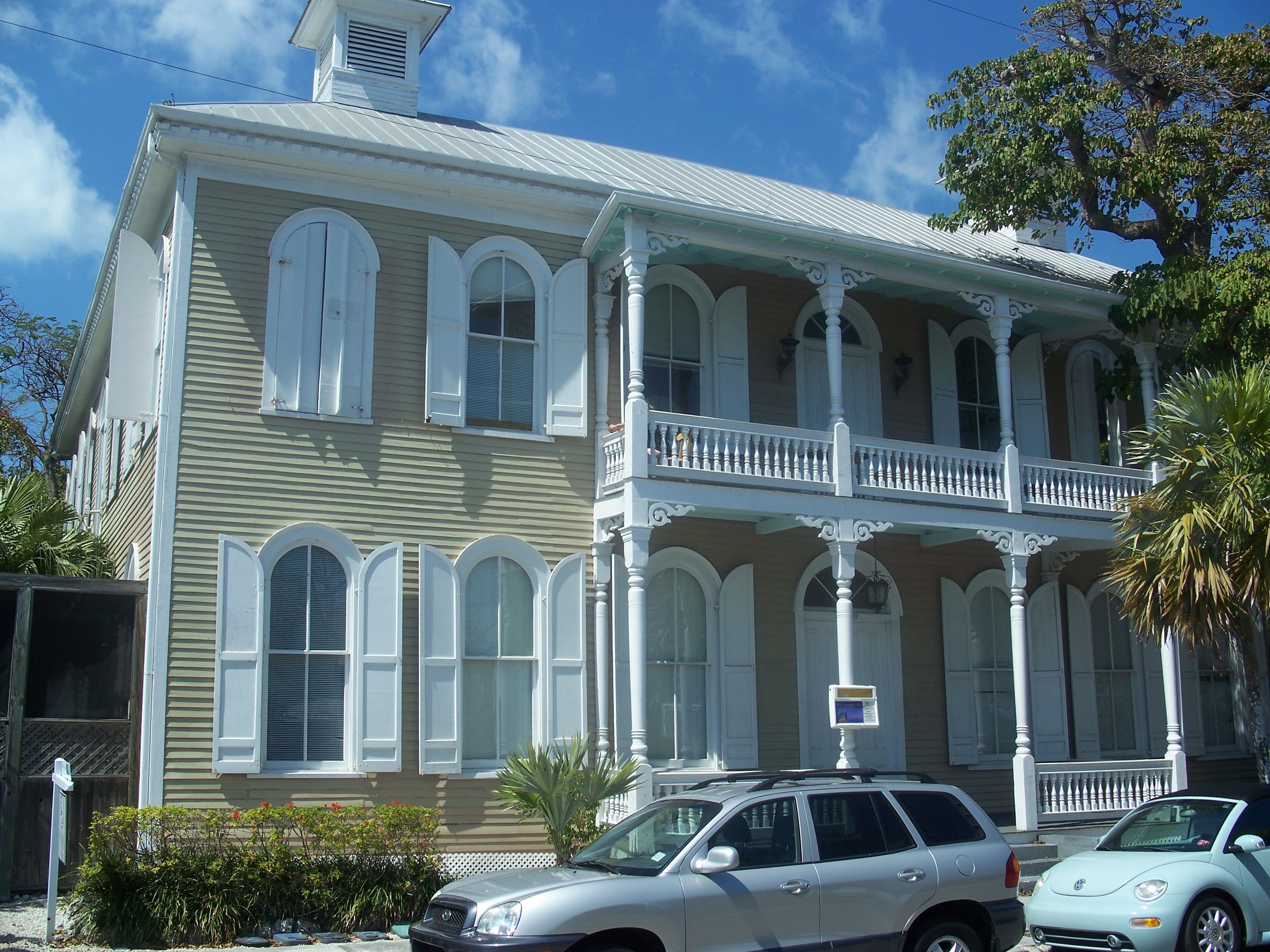
Eduardo H. Gato House 1209 Virginia Street Key West, Florida
A registered nurse who occupied a first floor apartment in this house in 1976 was awakened in the middle of the night. “I leaped with my hands over my face to protect myself. A white sort of energy was crossing from one end of the room to the other. I had the feeling of being invaded—that something that was not me was in the room.”
The Mercedes Hospital in the 1920s. Photo from the Monroe County Library Collection.
Some years later in another apartment, another woman was sleeping next to her boyfriend when she was suddenly awakened. “Something had touched her. She saw a short, stoutish woman at her bedside. The woman’s hair was in a bun, and she was wearing a grey dress with long sleeves and a high collar. Next to her was a man.” The figures seemed to be conferring about her as she lay in bed. The sleeper realized after a few moments that the woman was holding her wrist, checking her pulse.
Yet another woman in an apartment in the building experienced the ethereal nurse more recently. She had been sick with the flu and in bed for the day when she was started awake by something cold on her forehead. Waking, she found a nurse standing over her with her hand on her forehead while checking her pulse. She tried to scream and pull away but could not. The spirit quickly faded.
Courtyard of the Gato House in 1966 after the home’s conversion to apartments. Taken for the Historic American Buildings Survey, courtesy of the Library of Congress, Prints and Photographs Division.
The spirit, however, returned the next evening. After hearing about the spirit from another women living in the building, the woman was not so frightened. The woman addressed the spirit and said that while she appreciated the attention, she was frightened. “She took a step back from the bed, gave me an understanding smile and faded away.”
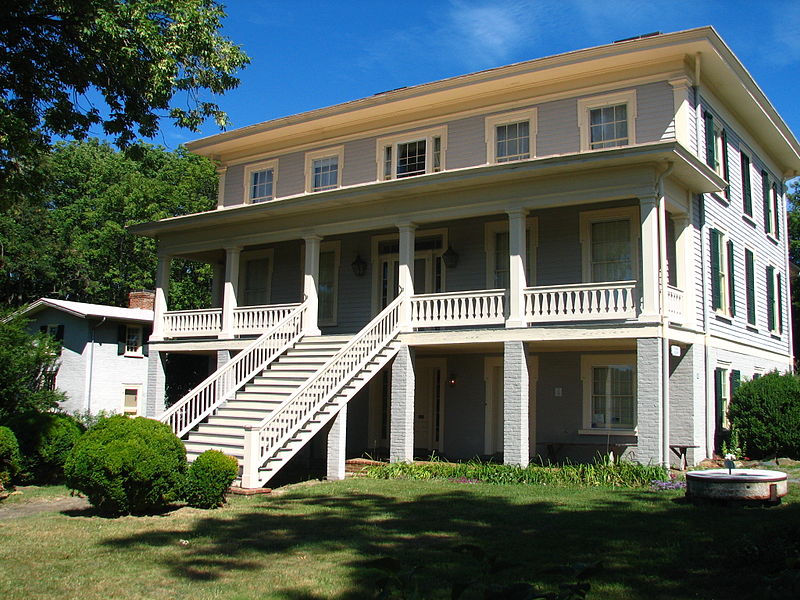
This large, grand home was not built to house the sick and the dying. It was a grand home for cigar magnate Eduardo Gato. At the outbreak of the Ten Years’ War—the first of three wars fought as Cuba tried to break away from Spain—Key West was filled with Cuban émigrés who built up the cigar-making industry on the island.
Eduardo Gato built the home around 1890 possibly using Cuban carpenters though he only lived in the house for a few years before returning to Cuba in 1898. The building was briefly used as a school, and then in 1911, the house opened as the Casa del Pobre (Home for the Poor) Mercedes Hospital.
Named for Eduardo Gato’s wife, the Mercedes Hospital was opened by Maria Valdez de Gutsens and a handful of other ladies who had been concerned with medical care for the poor and indigent. She was known around town as a marvelous fundraiser and personally collected money to keep the hospital running. Gutsens would haunt the exits of the local cigar factories on pay day asking for quarters for her beloved hospital.
While she was only an administrator, Gutsens aided the hospital’s small medical staff in their duties when needed. From 1911 until her death in 1941, Gutsens was a constant fixture in the hospital. She may still be there.
Gato House, 2011 by Ebyabe. Courtesy of Wikipedia.
The tale is told that just a few months after her death a patient was in the hospital with severe pneumonia. Not being in contact with his wife and children the man pleaded for help writing to his family. An older woman appeared at his bedside and calmly wrote the letter the man dictated. Feeling better the next morning, he asked who the kindly woman was so that he could offer his thanks. The night nurse insisted that she was the only person who had been on duty and she was shocked to see the letter the man had dictated in the hand of the late Maria de Gutsens.
A year after Gutsen’s death, the hospital closed its doors and cockfights were held in the building’s Spanish courtyard. The large home then was renovated into an apartment building and remains so to this day. Tenants still encounter the grey shade of the good Maria de Gutsens checking the pulses of the living while Dr. Fogarty—one of the many doctors who served the hospital—stands quietly by.
Sources
“Ghost of Nurse Haunts Key West House.” Playground Daily News. 4 November 1976.
Eyman, Scott. “Ghost Houses in Old Key West, The Walls Have Ears— And Eyes. Here Are Four Guests Whose Names You Won’t See on The Register. But They’re There.” Sun-Sentinel. 4 August 1985.
McCoy, Charles E., Jr. Report on Eduardo H. Gato House for the Historic American Buildings Survey. 16 Septrember 1966.
Amory Regional Museum 801 3rd Street South Amory, Mississippi
By Mississippi standards, the roots of the town of Amory—in the northeast part of the state, near the Alabama state line—by comparison, are not very deep. The town’s history dates to 1887 while the state’s history reaches back millennia towards Native American settlement and Hernando de Soto hacking his way through the region and the local inhabitants in the 16th century. Amory owes its creation to the railroad as it began to wend its way through the state following the Civil War.
The Frisco 1529 Locomotive, one of the trains that helped to create Amory, is preserved in Frisco Park, a few blocks from the Amory Regional Museum. Photo 2005, courtesy of Wikipedia.
When the Kansas City, Memphis & Birmingham Railroad needed a stop halfway between Memphis and Birmingham, a location in Monroe County was chosen and named for railroad magnate Harcourt Amory. As town lots were sold, citizens of nearby Cotton Gin Port slowly abandoned their much older town—established as a base for French explorations of the region in the early 18th century—to settle in the brand new planned town.
Much of this regional history is recalled in the Amory Regional Museum. The building housing the museum is woven into the history of the region as the birthplace of many locals including the museum’s director. The building originally served as the town’s hospital, the Gilmore Sanitarium, opened in 1916. It served as a hospital until 1961 when the hospital opened its current location. After that, it was converted into a nursing home for four years. After closing as a nursing home in 1965, the aging, though still vital, building stood empty until it opened as a museum in 1976.
It’s unclear when exactly the tales of the building being haunted began to spring up. One tale concerns Dr. M. Q. Ewing, the hospital’s chief of staff around the time the hospital closed. Supposedly, he’s still keeping watch over the old hospital and has been seen and heard around the building. Of course, like any hospital, birth and death are ever present and the veil between life and death here may be quite thin.
The activity within the facility is significant enough that the local paranormal investigation team, the Independent Paranormal Research Team, has hosted two public paranormal investigations in the museum. In December 2013, the group hosted a benefit investigation for a local child suffering from a rare illness.
An August 2013 article about the museum states, “Exhibits at the museum showcase Amory’s earliest inhabitants.” That statement is even more literal now that investigators are uncovering evidence that those inhabitants may still be around. The director notes a bit later in the article that, “Every town needs to preserve their heritage, it’s who you are. It’s where you come from.”
Sources
Amory, Mississippi. Wikipedia, the Free Encyclopedia. Accessed 31 December 2013.
“Amory Regional Museum.” Monroe County Magazine. 2009
Barnett, Sheena. “Join paranormal team on benefit investigation.” Northeast Mississippi Daily Journal. 12 December 2013.
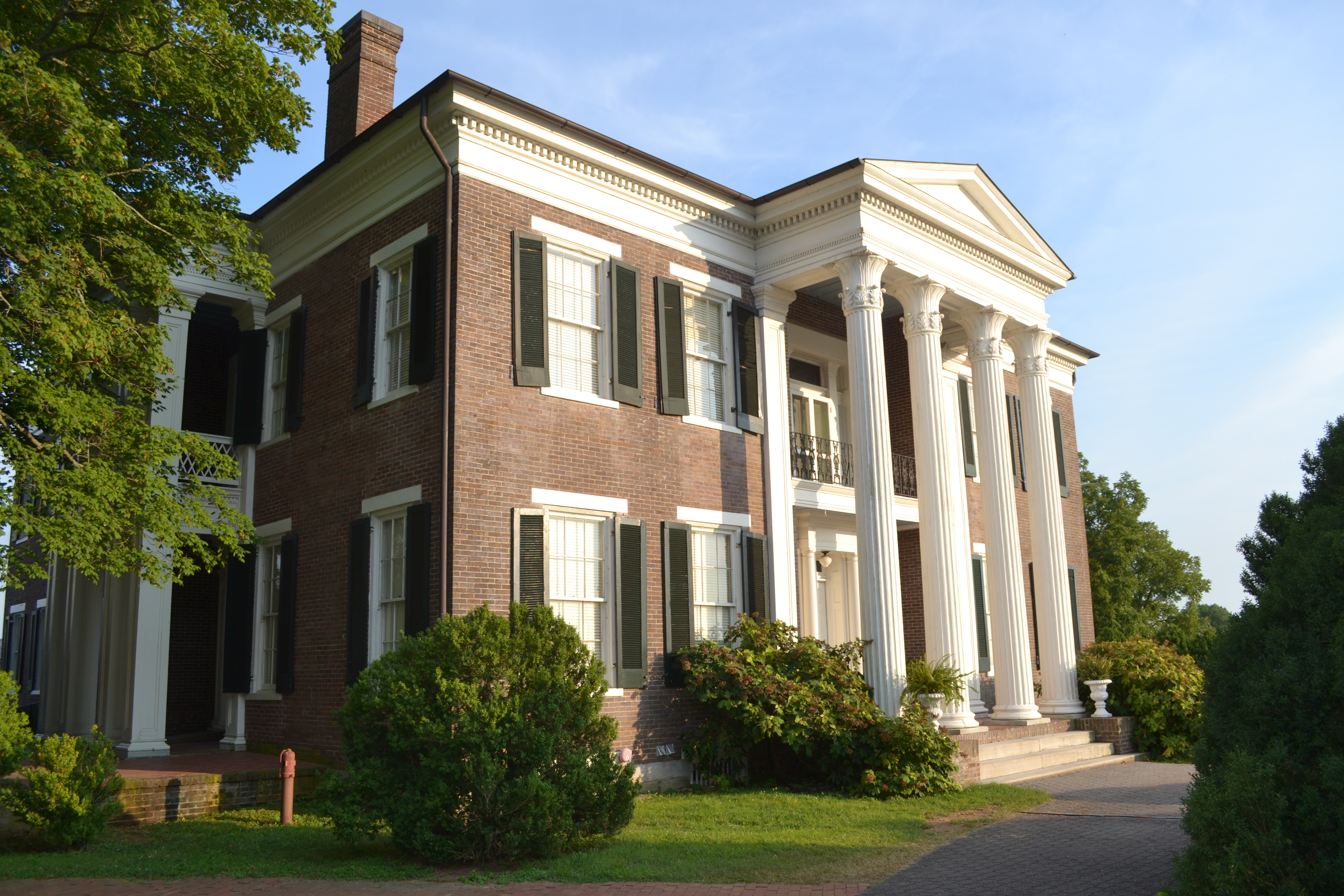
Rippavilla Plantation 5700 Main Street Spring Hill, Tennessee
N.B. This post was edited and revised 13 May 2019.
Phantoms and ghosts are very fickle things. Like birding for a rare species, it’s very difficult to find them even in their natural habitat. I was contemplating all of this as I sat alone in a bedroom at Rippavilla around 2:30 AM, towards the end of my first, formal paranormal investigation.
The facade of Rippavilla. Photo 2013 by Lewis O. Powell IV, all rights reserved.
As Nashville, Tennessee sprawls its fingers outwards, it’s beginning to take over middle Tennessee. Small towns like Franklin and Spring Hill have been caught up in the web of development as these charming, and once rural towns are paved over with asphalt and chain businesses. Franklin, just north of Spring Hill and closer to Nashville, has only in recent decades begun fighting back and working to preserve its historic and battle-scarred heart.
Middle Tennessee was one of the areas that saw the brunt of fighting during the Civil War. As the last state to join the waltz of the Confederacy, Nashville became an immediate target for the Union and was the first state capitol to fall into their hands. Those cities and towns south of Nashville—Franklin, Spring Hill and Columbia, among them—were captured and held by armies of both sides during this turbulent period. After Sherman’s capture of Atlanta, far south, the Confederates under General Hood—who had lost Atlanta—attempted to capture Nashville and redeem themselves in the eyes of the Confederates.
Spring Hill and its surrounding estates had seen an influx of Confederate wounded into the small town. Many of the homes—including Rippavilla—had been requisitioned for use as hospitals. According to my guides in the house, the house had seen a smallpox epidemic among the wounded in 1862. During Hood’s Nashville campaign, wounded soldiers once again began to pour in followed by a series of generals, including Hood himself. During the fighting here in Spring Hill, Rippavilla’s fields were the scene of fighting.
Spring Hill saw battle the day before the Battle of Franklin in 1864. While not a major battle, it did leave a few hundred dead or wounded on both sides. Spring Hill was just a stepping-stone in Confederate General Hood’s attempt to dislodge the Union army from Nashville. As the fighting edged on towards Christmas, hope for the Confederacy faltered. Sherman held Atlanta and was marching to the sea destroying much in his path to Savannah, while Hood was defeated at Nashville and routed to Tupelo, Mississippi.
Part of that battle was fought on the grounds of Rippavilla Plantation, just south of town and like so many buildings throughout the South, the house was used as a hospital. This house has many layers of history, each leaving spirits within the house. One source reports spirits from Native Americans, through the Civil War and a smallpox epidemic during that era through to the 20th century, when rumors indicate the house may have seen use as a brothel.
The Egyptian-Greek capitals of Rippavilla’s columns. Photo 2013 by Lewis O. Powell IV, all rights reserved.
The home is very similar to a number of other remaining plantation homes in the area in its brick construction and Greek Revival design. The columns, however, show the influence of Egyptian Revival design with capitals depicting papyrus but with the addition of the Greek-style acanthus leaf. This adds a unique touch. Apparently, while the exterior of the home has not changed much, the interior has changed greatly. Downtown Nashville’s First Presbyterian Church—now a National Historic Landmark—features Egyptian Revival elements, one must wonder if there’s a connection.
Visitors being shown inside will encounter a dramatic, sweeping staircase that splits at the landing to rise to the second floor. This feature was added in the early 20th century to replace the smaller, less dramatic staircase. Electricity, plumbing and air conditioning were installed in the house as well as bathrooms.
The home was built by Nathaniel Cheairs, a wealthy cotton planter. It was modeled on Ferguson Hall—the nearby home of his brother, Martin. Work was begun in 1851 and it took four years to complete. The large kitchen building behind the house was completed first and the family lived there until the mansion was finished. Legend holds that the mansion’s walls were pulled down three times to correct Nathaniel’s perceived deficiencies in the masonry.
Rippavilla flourished along with other nearby plantations owned by Cheairs, and by 1860, the census reports some 75 slaves working the estate. Though, with the coming war, all that would be swept away.
The back of the house from the courtyard. Photo 2013 by Lewis O. Powell IV, all rights reserved.
Many have automatically assumed that I’m a paranormal investigator. That’s not really the case. I consider myself a writer and researcher—more adept at sussing out information and presenting it in a palatable form—as opposed to an investigator tramping through historic places with loads of technology. I can say, that I’m very much a Luddite. Not that I reject technology, but I do grow weary of having to keep up with it.
This brings me to sitting alone in a bedroom at Rippavilla Plantation last weekend as the clock neared 3 AM. We’d been told to pick a room and then just sit for a little while and see what happens. Always being the “different” one, I chose the room that a number of people didn’t “like.” One of the volunteers helping with the investigation had told me that she could not enter this particular room. If she did, she’d usually end up having an emotional reaction.
This bedroom, in particular, had been used as a surgery. Blood stains on the floor attested to that fact. A military style bed had been installed in the room with soldier’s accoutrements sitting upon and around it. I found a single chair within in the room next to the door leading into the next bedroom. Through the door I could see the door of another bedroom, one that had bloodstains from a more recent murder still staining the floor.
All of this did make me uncomfortable. Glancing at the floor around my chair I did see about five drops of something staining the floor. My active imagination envisioned these drops possibly dripping from a surgeon’s knife or a spurting artery as a soldier writhed in pain. In fact, I had nothing to indicate it was actually even blood.
Still, sitting in this room, I found it hard to imagine the air filled with moans and cries, as it would have been during the war. Though, it seems that other, far more sensitive souls had had experiences in this room. Earlier in the evening, as I was awaiting the start of the investigation, a volunteer who had been working in the house that weekend began to report the smell of tobacco in that room along with the smell of an astringent—possibly witch hazel. She’d been one of the first people in the house that morning when it was discovered that the antique dresses so carefully laid on the beds had been moved.
Civil War hospital display in one of the bedrooms. This is the bedroom that staff members do not like. Photo 2013 by Lewis O. Powell IV, all rights reserved.
The senses can play tricks on you. At various times through the night, I was convinced that I saw things, but realized my eyes were fooling me. At times I may have heard things, but I was listening so hard my brain could have simply misinterpreted other, more common, sounds. For these reasons it is imperative for ghost hunters to obtain clear evidence and that exists for Rippavilla. During previous investigations, many Class A EVPs have been captured that point to the conclusion that this house is active. A haunting photograph with a couple of possible spiritual images and video of some type of phenomena that was captured on three different cameras also exists.
The investigation’s leader suggested that the site was very quiet that night. A fair had been held on the grounds of the house and many visitors had passed through the house in the days leading up to the investigation. Perhaps the spirits were resting?
The highlight of the evening took place in a small, modern building at the back of the property. Built on part of the battlefield, this structure is used for various meetings and consists of a large room with restrooms and a small kitchen. The entire group of investigators was seated in this room around an empty chair with a ball on it. Dudley Pitts, the lead investigator, encouraged the spirits to move the ball and we waited in earnest for something to happen. Mr. Pitts spoke up again, saying that if the ball moved, we would all leave. Not two seconds after he said that, a very small, male voice was heard from a side of the room where no one was sitting. The voice asked, “All of you?” A gasp went up among the group and, as promised, we made a quick exit.
As the group I was with concluded their first investigation of the second floor I walked through two of the bedrooms: the nursery and the master bedroom. We left the upstairs in the dark. We had not turned on any lights during the time we were up there. We returned to the kitchen and no one else was in the house. We returned to the upstairs about 15 minutes later to discover that lamps in both rooms were on. The lead investigator turned off the lamp in the master bedroom and then as he approached the lamp in the nursery it turned itself off. Were the spirits saying hello?
The evidence is still being reviewed. Personally, the experience was really wonderful. Though, in the words of one of the investigators, a paranormal investigation “is 7 hours of waiting and 60 seconds of a thrill.” To spend time in such a marvelous historic home, quietly contemplating darkened rooms is actually marvelous. Especially in today’s hyper world of fast technology, instant gratification and even quick tours of historic tours, the experience of sitting and listening and imagining is often lost.
This investigation at Rippavilla lead by Dudley Pitts of Innovative Paranormal Research (IPR) and resident paranormal investigator is held monthly. I’d like to thank Mr. Pitts and the investigators for their help and leadership during the investigation and especially Laura Bentley and Lisa Webber for their kindness. For further information, contact Rippavilla Plantation on their website or through their FaceBook page, “Whispers of the Past.”
N.B. This article has been revised and edited 24 September 2019.
Dear, when in your arms I creep, That divine rendezvous, Don’t wake me if I’m asleep, Let me dream that it’s true. –“How Long Has This Been Going On?” (1928) by George and Ira Gershwin
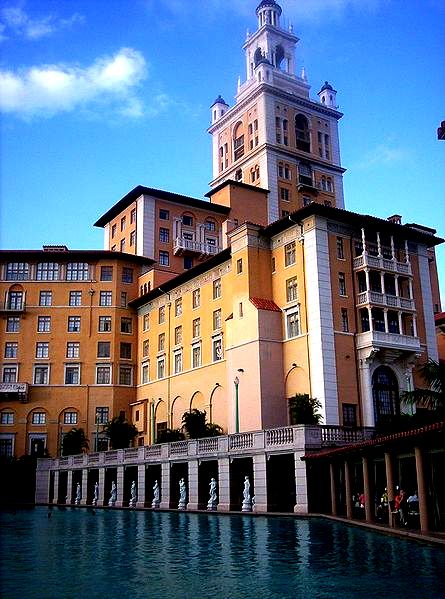
Biltmore Hotel 1200 Anastasia Avenue Coral Gables, Florida
When grandmama whose age is eighty In nightclub’s gettin’ matey With gigolos, Anything goes! –“Anything Goes” from the musical, Anything Goes (1934) by Cole Porter
N.B. Thank you for taking time to read through this experimental entry. I have a great love for music of the 1920s and 1930s and decided to see how much they could contribute to the narrative of this entry.
Biltmore Hotel by Milan Boers, 2009. Licensed under Creative Commons.
The cover of Leslie Rule’s Coast to Coast Ghosts, a marvelous collection of ghost stories from across America, features a lovely and haunting black and white photo of a colonnaded balcony. A door is open and the wind is pulling the sheer, white curtains outward. This photograph of a balcony at the Biltmore Hotel was shown by Rule to a psychic who exclaimed, “There has been a lot of raunchy activity here! A couple was murdered here. They were having an affair and were shot by the woman’s husband.” The psychic continued saying that the woman was naked except for her jewelry.
Photo by eflon, 2009. Licensed under Creative Commons.
In the mornin’, in the evenin’, Ain’t we got fun?
Night or daytime, it’s all playtime, Ain’t we got fun? Hot or cold days, any old days, Ain’t we got fun? –“Ain’t We Got Fun?” (1921) by Richard A Whiting, Raymond B. Egan, and Gus Kahn
Photo by eflon, 2009. Licensed under Creative Commons.
The Biltmore Hotel, in picturesquely named Coral Gables, was built as a beacon for fun and sumptuous pleasure at the height of the Roaring Twenties. With its Mediterranean Revival tower modeled on the Giralda Tower on Seville, Spain’s cathedral it featured the largest swimming pool in the world, containing 1,250,000 gallons of water, where synchronized swimmers and alligator wrestlers entertained guests. Johnny Weismuller, who would go on to portray Tarzan on the silver screen, taught and showed off his aquatic prowess in the gigantic pool. Luminaries gathered in the hotel’s ballrooms where they enjoyed top tier entertainment and even illegal gambling under the watchful eyes of gangsters Al Capone and Thomas “Fatty” Walsh. Popular bands of the era pumped out popular tunes with upbeat tempos, catchy lyrics, and jaunty tunes while couples danced foxtrots, the Charleston, tangos, and the Black Bottom under blazing chandeliers or glowing stars.
Photo by Averette, 2007. Courtesy of Wikipedia.
Stars fade but I linger on, dear… –“Dream a Little Dream of Me” (1931) by Fabian Andre, Wilbur Schwandt and
Gus Kahn
The hotel’s beauty began to fade when the United States War Department commandeered the hotel in 1942 for use as a convalescent hospital. Hotel rooms became rooms for patients and offices for doctors while public spaces became surgical suites. The floors were covered with linoleum, original furnishings were thrown out or painted over, windows were sealed with concrete, while the interior was painted a dismal, antiseptic green. Following the end of World War II, the hotel became an Army General Hospital and was later taken over by the Veterans Administration. Despite its utilitarian garb and atmosphere, the hospital attracted popular entertainers who performed for the patients. During its tenure as a VA hospital, the University of Miami established its medical school in the building. The grand hotel served as a hospital until 1968 when it was abandoned.
Sometimes I wonder why I spend The lonely nights Dreaming of a song. The melody haunts my reverie And I am once again with you. –“Stardust” (1927) by Hoagy Carmichael and Mitchell Parish
The now crumbling hotel sat abandoned while the City of Coral Gables attempted to save it as a historic structure. The city finally succeeded in 1973, but the building continued to sit empty while the city decided how best to utilize it. While empty, the building was used as a backdrop for the horror film, Shock Waves and can be seen briefly in the trailer. It also attracted attention for odd activity. In fact, Dennis William Hauck’s Haunted Places: the National Directory, states that, “Townspeople congregated on the golf course to observe the strange lights and eerie sounds coming from the empty building at night.”
The song is ended But the melody lingers on You and the song are gone But the melody lingers on. –“The Song is Ended” (1927) by Irving Berlin and Beda Loehner
Photo by tabitum, 2008. Licensed under Creative Commons.
While the locals who observed the activity in the abandoned building would often hear lingering melodies, that’s only part of the activity they witnessed. Greg Jenkins in his masterful three-volume series, Florida’s Ghostly Legends and Haunted Folklore, notes the witnesses as seeing windows opening and closing, figures within the building, and crashing sounds. The activity was so pronounced that in the summer of 1979 a team of policemen stormed the building in search of drug dealers and other malcontents believed to be hiding within. Their search turned up no one. When the humans failed to find anyone, a pair of police dogs was brought in only to have them flee after just five minutes, tails between their legs. After restoration began in the early 1980s, the activity increased.
Looking everywhere, Haven’t found him yet. –“Someone to Watch Over Me” (1926) by George and Ira Gershwin
Photo by Marc Kevin Hall, 2009. Licensed under Creative Commons.
A team of psychics and investigators visited the empty hulk in 1978. The psychics picked up on many energies throughout the building especially on the 13th floor and around the elevators. A recording device that was running during the investigation picked up a loud tapping that was not noticed by anyone present. Many of the psychics remarked that that floor possibly contained hundreds of spirits. Another group investigating in 1979 recorded the sounds of heavy breathing and a sigh. Could this be related to a tragedy from the hotel’s early years?
We lived our little drama… –“Stars Fell on Alabama” (1934) by Frank Perkins and Mitchell Parish
O, show us the way to the next whiskey bar. O, don’t ask why. –“Alabama Song” (1930) by Kurt Weill and Bertolt Brecht
In the late 1920s, a local gambler, Edward Wilson, rented out the suite on the 13th and 14th floors of the hotel and opened a speakeasy, This was a place where wealthy locals could drink and gamble away from the eyes of the law. Wilson became acquainted with New York mobster Thomas “Fatty” Walsh and his friend, Arthur Clark. Both had left the city to avoid an investigation in the death of an associate.
One evening in March of 1929, Wilson and Walsh began to argue in the speakeasy with nearly a hundred patrons in black-tie. Wilson pulled a gun and shot Walsh to death. When Clark rushed to his friend’s side, he was wounded. Police rushed to the hotel but it took some time to reach the murder scene. Once there, the room had been “cleaned” of any evidence of a speakeasy. Modern researchers believe the lack of police records on this event to be evidence of a police cover-up.
Now that I have found you, I must hang around you. Though you may refuse me… –“He Loves and She Loves” (1927) by George and Ira Gershwin
One popular tale about the suite on the 13th and 14th floor involves the private elevator leading to it. A young couple exploring the hotel somehow stumbled into the private elevator and was whisked to the dark, uninhabited suite though guests must have a key to operate the elevator. The young woman stepped off and the doors quickly shut behind her, leaving her husband wildly punching buttons as the elevator quickly descended to the lobby. The husband found a bellhop who used his passkey to get them back up to the empty suite. There they found the man’s wife standing in the dark, scared and befuddled.
Photo by eflon, 2009. Licensed under Creative Commons.
You must realize When your heart’s on fire Smoke gets in your eyes…
Now, laughing friends deride Tears I cannot hide. –“Smoke Gets in Your Eyes” from the operetta, Roberta (1933) by Jerome Kern and Otto Harbach
The young woman stated that when the doors closed behind her, she began walking through the silent suite calling, “Hello?” She heard the sound of distant conversation and occasionally people laughing. The sounds of things hitting the floor echoed from around her but nothing was out of place when she turned. She also remarked that there was the strong smell of cigar smoke with her throughout this experience. The elevator is still said to rise up to the suite on its own accord on a regular basis. This luxury suite (I checked the price and it’s around $1800 a night) is often used by celebrities, and President Bill Clinton stayed here in 1994. A number of sources note that he had troubled getting TV reception for a ball game he wanted to watch. His aides were unable to find a reason why the TV would not work properly.
It was just one of those nights, Just one of those fabulous flights, A trip to the moon on gossamer wings, It was just one of those things. –“Just One of Those Things” (1935) by Cole Porter
The apparition of a lady in white is also a part of the hotel’s folklore. According to legend, a couple was staying in the hotel with their young and very curious son. The child somehow made its way onto one of the hotel’s elaborate balconies and the child’s mother, fearing disaster, ran towards him. Unfortunately, she lost her balance reaching for her son and her body hurled over the railing towards certain death. Her spirit has been seen silently racing towards the balcony and at other times walking through nearby guest rooms.
Photo by Milan Boers, 2009. Licensed under Creative Commons.
There were chills up my spine And some thrills I can’t define. –“How Long Has This Been Going On?” (1928) by George and Ira Gershwin
There’s so much more still going on in the Biltmore Hotel. Numerous apparitions, often seen momentarily and disappearing, have been reported including a dancing couple in period attire, World War II era soldiers, and a man playing the piano in a top hat. The hotel actually employs a storyteller to keep up with the hotel’s histories: recorded, legendary, and paranormal. Perhaps the spirits have finally found their own, sumptuous heaven.
Photo by Ebyabe, 2011, courtesy of Wikipedia.
Heaven, I’m in heaven And my heart beats so that I can hardly speak And I seem to find the happiness I seek When we’re out together dancing cheek to cheek. –“Cheek to Cheek” (1935) by Irving Berlin
Old Phenix Regional Hospital 18th Street Phenix City, Alabama
A front page article in this past Tuesday’s Columbus (GA) Ledger-Enquirer featured this possibly haunted location and presented a number of interesting issues regarding ghosthunting. The article, entitled, “Haunted Hospital?” covers a recent incident where a couple entered the abandoned hospital. After neighbors summoned the police, the couple, who claimed to be conducting a séance, was asked to leave.
By default, it seems most hospitals have some spiritual activity; not only residual activity, but intelligent spirits that have not been able to leave the confines of the place where they died. Throughout the nation and, of course the South, there are numerous hospitals that are known for their spiritual activity. Among them are locations like Waverly Hills Sanatorium in Louisville, Kentucky, an abandoned tuberculosis hospital; the Old South Pittsburg Hospital in South Pittsburg, Tennessee, an abandoned regional hospital that closed fairly recently but is now open for paranormal investigations; and Milledgeville, Georgia’s Central State Hospital, once one of the largest mental institutions in the nation, it is now confined to a handful of buildings sitting on a mostly abandoned campus. Even hospitals still in operation may be counted among those that are haunted including Anniston, Alabama’s Stringfellow Memorial Hospital.
Phenix City, located just across the Chattahoochee River from Columbus, Georgia, is the product of the merger of two smaller towns, Girard and Brownsville, which consolidated in 1923. The city acquired a reputation as “Sin City, USA” in the first half of the twentieth century. Organized crime, prostitution and gambling were rampant in the city until a group of citizens banded together to reclaim the city. After the less moral elements of the city were done away with, the city has remained mostly a sleepy bedroom community for Columbus.
The large Phenix Regional Hospital facility opened in 1947 and was heavily in debt when Columbus Regional Health Systems purchased the hospital from the city in 1993. Columbus Regional intended on replacing the facility with a new hospital, but the plans fell through. When the hospital was closed in 2002, the land that had been purchased for the new hospital was used for a rehabilitation hospital instead with Phenix City residents having to seek medical attention in Columbus instead. The old hospital facility was boarded up and put up for sale. According to the article, neighbors have witnessed the homeless and vandals entering the deteriorating building.
Nationwide, ghosthunting is still considered by the general public to be the realm of thrill-seeking teenagers looking to scare themselves silly in dark, abandoned places. Certainly the couple conducting a séance in Phenix Regional doesn’t aid that reputation. With the rise in interest in the paranormal in recent years, many groups have been formed that are respectably investigating locations after procuring the proper permission to investigate. The investigations attempt to document hauntings using practices accepted by the paranormal community; a far cry from silly teenagers and off the cuff séances.
The article doesn’t cite any particular paranormal activity at the hospital. In fact, it is written from a rather close-minded point of view; discounting the mere existence of anything beyond this realm of possibility. I hope in the near future, the editors would take a more open-minded view of the supernatural.
Sources
Barnes, Kirsten J. “Haunted Hospital?” Columbus Ledger-Enquirer. 7 December 2010.
Lange, Jennifer. “Hospital was victim of economics.” Columbus Ledger-Enquirer. 9 April 2002.
Phenix City – Russell County Chamber of Commerce. History Highlights Phenix City, Alabama. Accessed 10 December 2010.
Gratz Park Historic District Bounded by Second Street, the Byway, Third Street and Bark Alley Lexington, Kentucky
Old Morrison Transylvania University Campus
Transylvania University was almost 40 years old when the European with the odd name of Constantine Samuel Rafinesque-Schmaltz strode into the large, Federal Main building. Rafinesque had journeyed “across the woods,” as the Latin name of the university implied, to take on a professorship of botany as well as teach Italian and French, languages from his broad repertoire.
Constantine Rafinesque from an 1820 publication. Courtesy of Wikipedia.
His Christian name belied his birthplace, Constantinople, where he was born to a French trader father and a Turkish-born German mother. His education was as mixed as his heritage and upbringing. A polymath autodidact, he taught himself Latin and early on began to collect natural specimens, ranging from plants to shells. Rafinesque spent time in the fledgling United States and in various locales in Europe returning to the States in 1815. Travelling throughout the states, he gathered, described and named an astounding array of species and studied the Native Americans who were just beginning to be pushed west of the Mississippi River.
His new employer was also on an upward trajectory. Transylvania University had grown in its forty years of existence into one of the premier universities in the U.S. As one of the nation’s top ranked schools, it produced and employed some of the greatest names of the day including lawyer and later statesman, Henry Clay who served as a professor; Stephen Austin, the “Father of Texas;” Jefferson Davis, the president of the Confederacy; and the fiery abolitionist, Cassius Clay. The medical school included in its faculty, smallpox vaccination pioneer Samuel Brown and Benjamin W. Dudley, the most imminent surgeon in the Mississippi Valley.
These two upward trajectories maintained a parallel course briefly and then collided in the spring of 1826 when university president Horace Holley dismissed Rafinesque. Officially, the reason was that Rafinesque had acted unprofessionally and had missed numerous classes, but the unofficial reason, according to campus gossip, was the affair that Rafinesque was carrying on with Holley’s wife. When informed of his dismissal, an incensed Rafinesque uttered a curse, “Damn thee and thy school as I place a curse upon you!”
Rafinesque quietly returned to Philadelphia where he lived the remaining years of his life. He died of stomach cancer some 14 years later. According to legend, friends of Rafinesque had to break into his home to steal his corpse as his landlord was planning to sell it to a local medical school in lieu of back rent. He was buried in Philadelphia, but, in 1924, a campus organization rallied to have his remains returned to rest on campus; an “Honor to Whom Honor is Overdue,” as the words are inscribed on his crypt in Old Morrison. The group, though, was somewhat unsuccessful. Recent tests on the remains have discovered that they are fact the remains of Mary Ann Passamore, one of the handful of others interred in Rafinesque’s plot in the cemetery.
Old Morrison. Photo taken for the Historic American Buildings Survey (HABS), courtesy of the Library of Congress, Prints and Photographs Division.
While Rafinesque still rests in Philadelphia, his curse still may linger in Lexington. President Horace Holley resigned the following year and died unexpectedly of yellow fever. Two years later, the main building was destroyed by fire. Following the destruction of the campus, the campus was moved across the street. The University’s upward momentum as one of the premier universities slowed as well, perhaps a result of the curse?
Old Morrison, designed by architect Gideon Shryock, was completed in 1834 and considered one of the finest examples of Greek Revival architecture in America. The edifice was restored to its original appearance in 1962 which removed unsympathetic additions added in the late nineteenth century. On January 27, 1969, a fire swept the newly restored building leaving only exterior walls standing, according to the National Register of Historic Places nomination form. Daniel Barefoot in his Haunted Halls of Ivy, points out that a little more survived: the crypt of Rafinesque was completely untouched by fire. Even more, he reports that firefighters saw the figure of a man standing in the doorway of the crypt while the fire raged around.
Old Morrison was restored and still stands a symbol of the school, though odd things still happen. A security guard in the buildings claims to have been tripped by something in the dark hall. Every few years, tragic things occur on campus and of course, the curse is invoked. But, Old Morrison faces a historic district where some even stranger events may occur.
Hunt-Morgan House 201 North Mill Street
Hunt-Morgan House, 2008, by Russell and Sydney Poore. Courtesy of Wikipedia.
Just a block down North Mill Street from Old Morrison sits one of the more historic structures in the region, the Hunt-Morgan House. Originally known as Hopemont, the house was built in 1814 by John Wesley Hunt. One of the first millionaires west of the Alleghenies, John Hunt Morgan was the head of an illustrious family that included his grandson, General John Hunt Morgan, a notable Confederate general and Dr. Thomas Hunt Morgan, the Nobel Prize-winning geneticist.
The legend of the Hunt-Morgan House dates to the Civil War. The Morgans had a slave named Bouviette James, known to the family as Ma’am Bette. Ma’am Bette served as the nursemaid to the Morgan’s children and by all accounts was a valued member of the family. Upon her death, she was laid out in the parlor and four of the Morgan’s sons, whom she had raised, served as pallbearers. She was even buried in the family plot, but, she would not rest there. After she passed, one of the children became grievously ill. The child’s nurse fell asleep at the child’s bedside and awoke to see a woman, wearing Ma’am Bette’s signature red shoes and turban sitting at the child’s side. The child died soon after, but the thought of Ma’am Bette guiding the child in the afterlife was comforting to the Morgans.
Maria Dudley House. Photo taken for the Historic American Buildings Survey (HABS), courtesy of the Library of Congress, Prints and Photographs Division.
Maria Dudley House 215 North Mill Street
Sitting among Federal and Greek Revival houses, the starkly Victorian Maria Dudley House stands out. This 1880 structure remains a private residence, but one that, according to Jamie Millard, author of the article that inspired this entry, possesses a dark energy. Millard describes a recent incident where a young man was apparently thrown over a stair railing which broke his arm. Indeed, others have felt a disturbing presence in the rear portion of the house and a family dog refused to go into that portion. Unfortunately, I have found no further information on this house.
John Stark House 228 Market Street
On the opposite side of Gratz Park, the John Stark House, also a private residence, was built in 1813 and was occupied by Gideon Shryock during the building of Old Morrison. Later, this house was the home of Dr. Robert Peter, Union Surgeon General during the Civil War. Perhaps the apparition of a Union soldier that has been seen here is one of Dr. Peter’s former patients.
Bodley-Bullock House 200 Market Street
Built around 1814-5, the Bodley-Bullock house has seen a range of owners in its history. The house was built by General Thomas Bodley, a veteran of the War of 1812. After losing the house in the financial crisis of 1819, the house passed through a series of hands. During the Civil War, the house was used as a headquarters for both Confederate and Union troops. It is noted that grand balls were held under both sides. The house’s illustrious history ended with Mrs. Minnie Bullock who purchased the house in 1912. Mrs. Bullock lived in this house longer than anyone and helped in the restoration of the Hunt-Morgan House. Upon her death, the house was restored and opened as a house museum as well.
Reports of spiritual activity have been reported by museum staff and visitors. A photographer taking a bridal portrait in the house apparently captured the image of a woman and a small child standing on the staircase behind the bride. Staff members believe the woman is Mrs. Bullock who is disapproving of some of the activity in her old home. In her will, Mrs. Bullock stipulated that there would be no drinking in the house, but the will was changed when it was decided the house would be used for events as well as a museum.
Gratz Park Inn 120 West Second Street
Hospitals almost invariably have haunting and the Gratz Park Inn, built as the Lexington Clinic, is no exception. With construction beginning in 1916 and opening its doors to the public in 1920, this structure is one of the few 20th century structures in the historic district and among the founders of the clinic was Dr. Waller Bullock, husband of Minnie, who resided in the Bodley-Bullock House just down the street. This building served as a clinic until 1958 when the clinic moved. The building was then used as the offices of an engineering firm which closed its doors in 1976. The building remained vacant until it was bought and renovated for use as an inn in 1987. It now ranks as one of the top inns in the region.
Among the inn’s non-paying guests are three spirits: a young girl, a man and a classic “lady in white.” The little girl is described differently in the two sources I have consulted. The Jamie Millard article names her “Little Annie” and states she plays quietly with her doll on the third floor. Alan Brown in his Haunted Kentucky, calls her Lizzie and says her voice is most commonly heard laughing and playing, though she did crawl in bed with a guest and fall asleep on evening. The Millard article goes on to describe the other two spirits: John is a humorous spirit and the “lady in white” is apparently looking for something or someone.
Sources
Brown, Alan. Haunted Kentucky: Ghosts and Strange Phenomena of the Bluegrass State. Mechanicsburg, PA: Stackpole, 2009.
Brown, Alan. Stories from the Haunted South. Jackson, MS: University Press of Mississippi, 2004.
National Park Service. “Bodley-Bullock House.” Lexington Kentucky: Athens of the West. National Register of Historic Places Travel Itinerary. Accessed 3 October 2010.
National Park Service. “Gratz Park Historic District.” Lexington Kentucky: Athens of the West. National Register of Historic Places Travel Itinerary. Accessed 3 October 2010.
National Park Service. “Hunt-Morgan House.” Lexington Kentucky: Athens of the West. National Register of Historic Places Travel Itinerary. Accessed 3 October 2010.
National Park Service. “Old Morrison, Transylvania College.” Lexington Kentucky: Athens of the West. National Register of Historic Places Travel Itinerary. Accessed 3 October 2010.
Rettig, Polly M. National Register of Historic Places Nomination Form for Old Morrison Building. Listed 15 October 1966.