Alabama Hauntings—County by County, Part I

Alabama Hauntings–County by County landing page.

One of my goals with this blog is to provide coverage of ghost stories and haunted places in a comprehensive manner. Perhaps one of the best ways to accomplish this is to examine ghost stories county by county, though so far, researching in this manner has been difficult. In my 2015 book, Southern Spirit Guide’s Haunted Alabama, I wanted to include at least one location for every county, though a lack of adequate information and valid sources prevented me from reaching that goal. In the end, my book was published covering only 58 out of 67 counties.

Further research has uncovered information for a few more counties and on Halloween of 2017, Kelly Kazek published an article on AL.com covering the best-known ghost story for every county. Thanks to her excellent research, I’ve almost been able to achieve my goal for the state.

Autauga County

Cross Garden
Autauga County Road – 86
Prattville

An odd collection of signs, crosses, and rusting appliances dots two hills along Autauga County Road 86; this is W. C. Rice’s Cross Garden, a testament to the South’s enduring religious fervor and one man’s personal religious devotion. After he was saved and healed of painful stomach issues in 1960, Rice began a journey to save those around him from eternal damnation. Created in 1976, the Cross Garden was maintained by Rice until his death in 2004.

Cross Garden, 2010, by Carol M. Highsmith. Courtesy The George F. Landegger Collection of Alabama Photographs in Carol M. Highsmith’s America, Library of Congress, Prints and Photographs Division.

Listed among Time Magazine’s “Top 50 American Roadside Attractions” in 2010, the Cross Garden has attracted a following fascinated with this place’s spiritual ambiance and the paranormal activity that supposedly permeates the area. There is a pair of visitors who claimed to have had their car held in place by an odd force. Others have heard strange sounds coming from some of the old appliances used in the display. Faith Serafin notes that in 2008 a man in a white robe seen stalking through the woods here.

Sources

  • Crider, Beverly. Legends and Lore of Birmingham and Central Alabama. Charleston, SC: History Press, 2014.
  • Cruz, Gilbert. “Miracle Cross Garden, Prattville, AL: Top 50 American Roadside Attractions.” Time Magazine. 28 July 2010.
  • Serafin, Faith. Haunted Montgomery, Alabama. Charleston, SC: History Press, 2013.

Baldwin County

Bay Minette Public Library
205 West 2nd Street
Bay Minette

Bay Minette Public Library, 2013, by Chris Pruitt. Courtesy of Wikipedia.

It is believed that the spirit of Bay Minette Public Library’s first librarian, Mrs. Anne Gilmer, is still on duty. A librarian recently encountered Mrs. Gilmer’s spirit while shelving books when she observed a book slowly pulling itself off a shelf and tumbling to the floor. This book was joined by others falling by themselves off the shelves. The librarian realizing these books had been mis-shelved returned the books to their proper places.

After her long tenure at the library, Mrs. Gilmer’s portrait was removed from its position above the library’s main desk. After some time, the portrait was returned to its original spot and employees began to notice the smell of roses. This same odor returns whenever something good happens in the library; perhaps as a sign of Mrs. Gilmer’s happiness. When the library was moved to the old Baptist church across the street, the librarian issued a verbal invitation for the ghost to join them in the new building just before workers moved Mrs. Gilmer’s portrait. When the elevator began to act strangely, librarians knew that Mrs. Gilmer was continuing her spectral duties in the new library.

Sources

  • Brown, Alan. The Haunted South. Charleston, SC: History Press, 2014.

Barbour County

Kendall Manor
534 West Broad Street
Eufaula

Crowning the hill of West Broad Street, Kendall Manor, with its white Italianate architecture and cupola resembles the front of a grand steamboat. It is certainly an architectural masterpiece among the hundreds of stately homes in Eufaula. The house, completed just after the Civil War, was constructed for James Turner Kendall, one of the few merchants and planters in the area whose fortune survived the war. A story circulated among the servants about a spirit that appeared near the house as a harbinger of bad luck. The Kendall family thought nothing of it until James Kendall’s manservant saw the spirit of a man in a gray uniform astride a white horse. Reportedly, James Kendall passed away the following day.
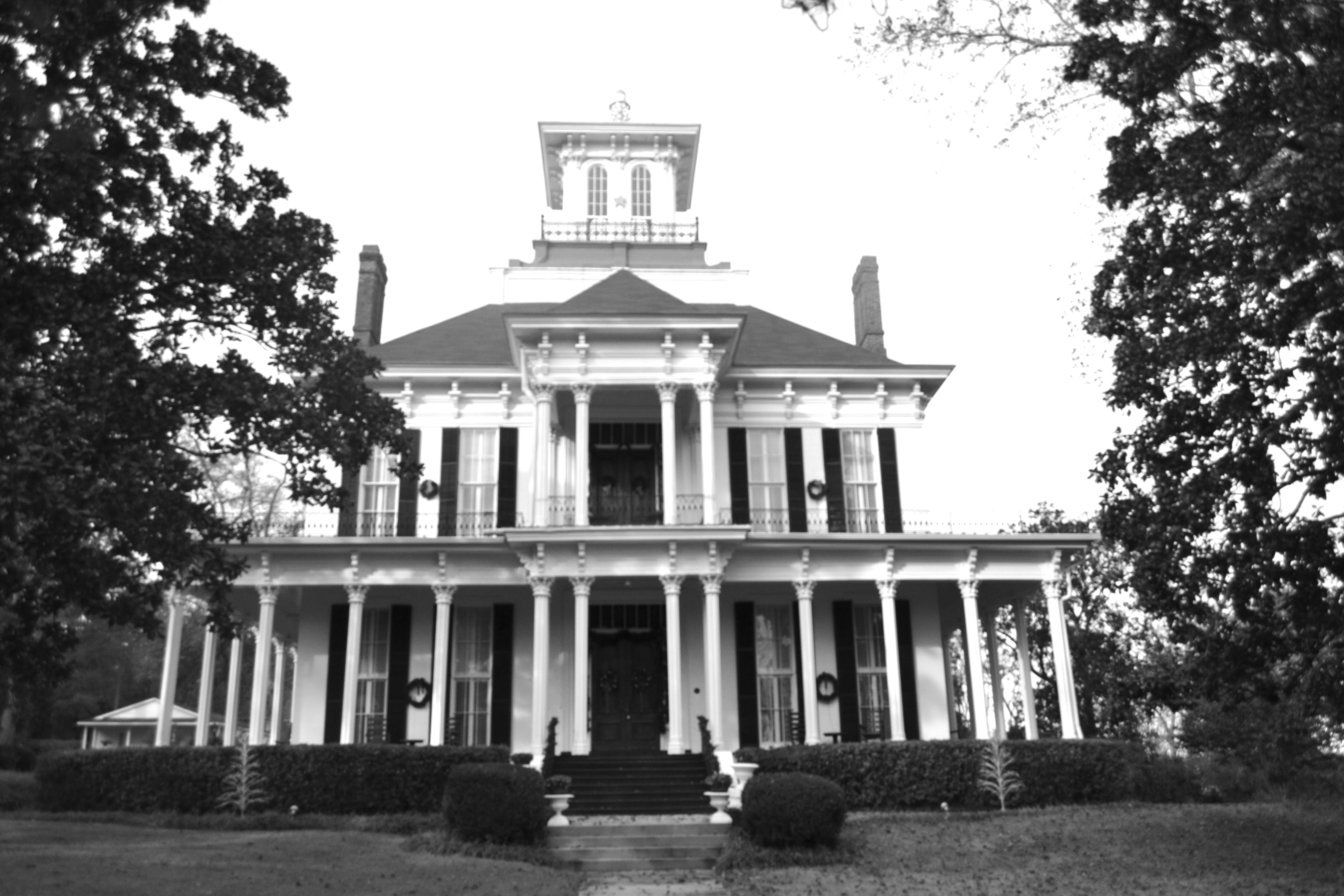
Kendall Manor, 2014, by Lewis O. Powell IV. All rights reserved.

For many years, this grand house served as a bed and breakfast with a unique staff member. A spectral nursemaid, known as Annie, is apparently on duty and has often been spotted by the children in the house. One family member told of seeing the specter wearing a black dress and starched white apron scowling at him as he and his siblings raced their tricycles on the home’s veranda. It seems Kendall Manor has returned to being a quiet, private residence in recent years, so please respect the home’s occupants.

Sources

  • Floyd, W. Warner. National Register of Historic Place Nomination form for Kendall Hall. 24 August 1971.
  • Mead, Robin. Haunted Hotels: A Guide to American and Canadian Inns and Their Ghosts. Nashville, TN: Rutledge Hill Press, 1995.

Bibb County

Brierfield Ironworks Historic State Park
240 Furnace Parkway
Brierfield

Founded by a group of local businessmen in 1862—as the Civil War was ramping up—the Brierfield Ironworks quickly attracted the attention of the Confederate Government which was interested in the high-quality pig iron produced here. During the war, the ironworks saw the production of about 1,000 tons of pig iron per year. Later in the war was Union General James H. Wilson swept through central Alabama, destroying targets of military importance, Brierfield was targeted and destroyed. Production resumed here after the war and continued until the ironworks was closed in 1894.
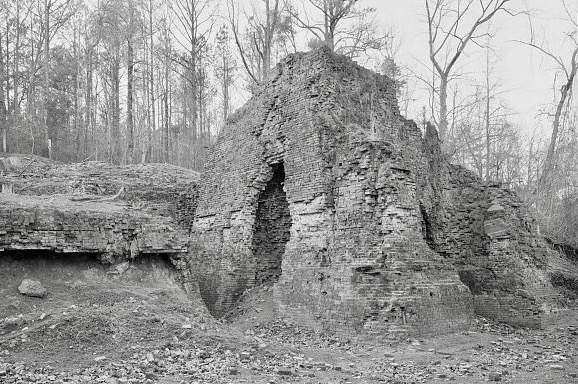
The ruins of the Brierfield Furnace by Jet Lowe. Photo taken for the Historic American Buildings Survey, 1993.

In 1976, the county heritage association turned the ruins into a heritage park. Two years later, the state took over the park, moving several historic structures here including Mulberry Church, which arrived here from its original site near Centreville. Built in 1897, this church is where tradition holds that the daughter of a moonshiner eloped despite her father’s disapproval of her fiancé. At the completion of the couple’s vows, the bride’s father appeared, firing his gun into the church door. The bullet struck both the bride and her new husband who was standing behind her. As a reminder of this tragic incident, the bullet hole remains in the door while the living have encountered the specter of the young bride at the site of her death.

Sources

Blount County

Old Garner Hotel
111 1st Avenue East
Oneonta

Built in 1915, the John Garner Hotel was built to accommodate guests arriving in town via the train depot located nearby. The building now serves as home to several businesses that occupy the first floor of this three-story building. Southern Paranormal Investigators spent an evening in the building in 2007 and were awed by the “findings and activity detected” within. Occupants had reported the smell of brewing coffee and tobacco smoke while the sounds of furniture moving and papers shuffling have also been heard here when the building was empty. The paranormal investigation team captured a few EVPs and photographic anomalies leading them to conclude that possibly three different spirits are present in this old hotel.

Sources

  • Blount County Heritage Book Committee. Heritage of Blount County, Alabama. Clanton, AL: Heritage Publishing Consultants, 1999.
  • Southern Paranormal Researchers. Paranormal Investigation Report on The Lobby. Accessed 29 November 2012.

Bullock County

Josephine Arts Center
130 North Prairie Street
Union Springs

The old Josephine Hotel is now home to the Josephine Arts Center. Built in 1880, the Josephine Hotel was a social center here in rural Southeast Alabama. Phantom odors of cigar and cigarette smoke are often encountered in this building along with the sounds of revelry from former patrons.

A 2012 investigation revealed some paranormal activity. At one point during the probe, members of the paranormal team witnessed an orb of light moving through a hallway which they captured on video.

Sources

  • Alabama Paranormal Research Team. Paranormal Investigation Report for the Bullock County Courthouse. Accessed 29 November 2012.
  • Higdon, David and Brett J. Talley. Haunted Alabama Black Belt. Charleston, SC: History Press, 2013.
  • Tour of Union Springs.” Union Springs, Alabama. Accessed 25 January 2013.

Butler County

Consolation Primitive Baptist Church and Cemetery
Oakey Streak Road
Red Level

On the morning of February 16, 2015, this historic church was lost to a fire. Local officials suspect that the church’s status as a haunted place led vandals to torch the small, rural building. Legend speaks of this place being the scene of a panoply of paranormal activity including demon dogs, or hellhounds; a banshee; and apparitions.

Organized in the 19th century, the church has not had an active congregation for many years, though a few locals maintained the building and cemetery and defended them against the rising tide of vandalism that had begun to overtake it. Teens and amateur “ghost hunters” had damaged the building by burning candles inside, carving their names on the structure, breaking windows, and even painting a pentagram on the floor of the lonely church. The Andalusia Star-News reports that 13 people were arrested in 2007 for burglary and criminal mischief after the police investigated reported illegal activity here.

Local investigator and author Shawn Sellers visited the church with his team in 2013. Upon arriving, two carloads of teens also appeared at the site. The group found the church standing open and showing signs of vandalism. One group of teens brought a Ouija board and attempted to make contact with spirits (something I cannot condone or recommend). A short time later, a man with a flashlight accosted the investigators and mysteriously disappeared after they attempted to speak with him.

Legends surrounding the church include the appearance of a banshee who wails as an omen that someone in the church will die. The grounds of the church are supposedly the domain of red-eyed “hellhounds,” as well as Confederate soldiers, two ghostly children, and a haunted outhouse where those who enter may be locked in. In 2012 reporters from The Greenville Advocate investigated the grounds and encountered nothing. In an article about the investigation, reporter Andy Brown suggested that the stories about this location are merely urban legend. Perhaps if there is paranormal activity here, it may have been drawn by irresponsible use of Ouija boards and rituals being performed here by amateurs attempting to summon spirits.

It is unknown if the loss of the church building has affected the spiritual activity here. Visitors should be warned to use extreme caution when visiting this location and to respect the site and the cemetery.

Sources

  • Bell, Jake. “The Church.” Shawn Sellers Blog. 18 January 2013.
  • Brown, Andy. “Butler County church haunted by tall tales.” Greenville Advocate. 5 October 2012.
  • Edgemon, Erin. “Church said to be haunted burns in Alabama.” com. 17 February 2015.
  • “Fire wasn’t first brush with vandalism for historic church.” Andalusia Star-News. 17 February 2015.
  • Higdon, David and Brett J. Talley. Haunted Alabama Black Belt. Charleston, SC: History Press, 2013.
  • Peacock, Lee. “Bucket List Update No. 165: Visit Consolation Church in Butler County.” Dispatches from the LP-OP. 28 July 2014.
  • Rogers, Lindsey. “Haunted Butler County church destroyed by fire.” WSFA. 16 February 2015.

Calhoun County

Boiling Springs Road Bridge
Boiling Springs Road over Choccolocco Creek
(This bridge is permanently closed to traffic)
Oxford

Known locally as “Hell’s Gate Bridge,” local lore related that visitors to this bridge at night could stop in the middle of the bridge, look back over their shoulders and see the fiery gates of Hell. Other lore tells of a young couple who drowned in the creek here. A traditional ritual said that stopping your car in the middle of the bridge and turning o the lights could summon one of the two people who drowned here. A sign of their presence would appear in the form of a wet spot left on the back seat of the car.

This wooden-decked, steel truss bridge was constructed between 1890 and 1930 and closed permanently in 2005. The Oxford Paranormal Society investigated the bridge in January 2007 and encountered an armadillo that was very much alive; no paranormal evidence was captured. When visiting this site, use extreme caution as the bridge is no longer maintained.

Sources

Chambers County

Oakwood Cemetery
1st Street
Lanett

Within this relatively modern cemetery stands a child-sized brick house complete with a front porch and chimney. The grave of Nadine Earles is among the most unique grave sites in the region. When four-year-old Nadine became ill with diphtheria just before Christmas in 1933, the child’s father had been building a playhouse as a gift for his daughter. After the child passed away on December 18th, the decision was made to erect the playhouse on the little girl’s grave. The playhouse has been well maintained ever since and remains filled with toys.

While not officially haunted, a recent interview with a friend revealed that she had a hard time photographing the grave when she visited. Using a smartphone camera, my friend’s attempts to photograph the grave resulted in black photographs. However, once she stepped away from the grave, the camera functioned properly.

Sources

  • Interview with Celeste Powell, LaGrange, GA. 23 July 2015.
  • Kazek, Kelly. “Alabama child’s playhouse mausoleum one of nation’s rare ‘dollhouse’ graves.” com. 5 June 2014.
  • Rouse, Kelley. “Little Nadine’s Grave.” Chattahoochee Heritage Project. 16 December 2011.
 

Cherokee County

Lost Regiment Legend
Lookout Mountain
Near the Blanche community

Extending from Chattanooga, Tennessee, through the northwest corner of Georgia, and into Alabama, the ridge of Lookout Mountain has played a prominent role in the history of the region. During the Civil War when its flanks were crawling with military activity, the mountain bore witness to several major battles and many skirmishes as the Union army attempted to extend its reach into the Deep South.

During this dark time, legend speaks of a group of Union soldiers getting lost in the mountain wilderness after a skirmish near Adamsburg, in DeKalb County. After retreating, the soldiers attempted to survive in the dangerous terrain. Fearful locals and enemy soldiers picked off a few of the men while others did not survive the harsh mountainous conditions. The last of these survivors was seen near the Blanche community in Cherokee County. Even decades after the disappearance of these soldiers, tales still circulate of sightings of the “Lost Regiment.” Others have discovered bootprints in the snow that suddenly stop, as if the men have vanished into thin air.

Sources

  • Hillhouse, Larry. Ghosts of Lookout Mountain. Wever, IA: Quixote Press, 2009.
  • Youngblood, Beth. Haunted Northwest Georgia. Atglen, PA: Schiffer, 2016.

Haunted Tennessee, Briefly Noted

Cherry Mansion
265 West Main Street
Savannah

The great Alabama storyteller, Kathryn Tucker Windham, provides the account of three people who witnessed an odd event while sitting on the porch of the Cherry Mansion one evening in 1976. Around 11 PM, the trio watched as a man in a white suit and wide-brimmed hat approached the historical marker in front of the house. The man read the marker and then, in full view of the spectators on the porch, vanished.

haunted Tennessee Cherry Mansion Savannah Civil War
Cherry Mansion, 1974, by Jack Boucher for the Historic American Buildings Survey (HABS). Courtesy of the Library of Congress, Prints and Photographs Division.

The house is magnificently sited on an ancient bluff overlooking the Tennessee River. This home was constructed around 1830 by David Robinson, possibly as a gift to his daughter who was the wife of businessman William Cherry. An ardent Unionist during the Civil War, Cherry offered the use of his home to several Union generals in 1862 who used it in the days leading up to the Battle of Shiloh, which took place about 9 miles south of Savannah. General Charles Ferguson Smith, suffering from a recent leg injury passed away in the house during that time.

On the morning of April 6th, legend holds that General Ulysses Grant’s breakfast was interrupted by an overture of cannon-fire announcing the Confederates’ surprise attack on Union forces camped at Pittsburg Landing on the Tennessee River. Furious fighting over a sunken road where Union Generals Benjamin Prentiss and W. H. L. Wallace defended their position against heavy artillery fire from Confederate batteries gave a head wound to Wallace and the area to be nicknamed, “The Hornet’s Nest.” Wallace was taken to Cherry Mansion to receive medical attention.

Legend holds that Wallace’s devoted wife, Martha Ann, had received a premonition of her husband’s death and traveled to Tennessee in hopes that he was unharmed. Arriving in the midst of the battle, she was stunned to find that her husband had been wounded and took up residence at his side in Cherry Mansion. When her husband died a few days later, she was still at his side. People passing the mansion have reported seeing the form of a gentleman in a uniform looking out one of the upstairs windows. This form is widely believed to be that of General Wallace.

This home is a private residence.

Sources

  • Brown, Alan. Haunted Tennessee: Ghosts and Strange Phenomena of the Volunteer State. Mechanicsburg, PA: Stackpole, 2009.
  • Charles Ferguson Smith. Wikipedia, the Free Encyclopedia. Accessed 30 December 2017.
  • Cherry Mansion. Wikipedia, the Free Encyclopedia. Accessed 30 December 2017.
  • Coleman, Christopher K. Ghosts and Haunts of Tennessee. Winston-Salem, NC: John F. Blair, 2010.
  • Hammerquist, Gail. National Register of Historic Places Nomination form for the Cherry Mansion. February 1976.
  • West, Mike. “Tennessee home to tragic Civil War ghost story.” Murfreesboro Post. 26 October 2008.
  • Windham, Kathryn Tucker. 13 Tennessee Ghosts and Jeffrey. Tuscaloosa, AL: U. of AL Press, 1977.

Cocke County Memorial Building
103 North Cosby Highway
Newport

This unassuming building in the small town of Newport in Eastern Tennessee bears the weight of a tragedy. The sadness of this tragic moment in the mid 1960s still echoes now, more than fifty years later.

haunted Tennessee Cocke County Memorial Building Newport ghosts
Cocke County Memorial Building, 2011, by Dwight Burdette. Courtesy of Wikipedia.

Opened in 1931 as an American Legion post, the Cocke County Memorial Building was constructed to memorialize locals who had given their lives in the First World War. The building includes a gym with a stage, as well as office and meeting space for the post and the community at large.

On July 9, 1964, near the Cocke County community of Parrottville, a witness observed a plane with a “violet red light burning on the fuselage.” A short time later other witnesses saw the plane flying low with smoke trailing from it. The plane veered off course and crashed on a wooded mountain slope. Moments before the impact, witnesses observed something falling from the aircraft. A search revealed that one of the plane’s emergency exits had been opened and a passenger had fallen. That passenger, as well as the plane’s remaining passengers and crew, a total of 39 souls, perished in the accident.

As Newport had no large facilities to accommodate the remains of the 39 who had died in the accident, investigators and rescue personnel commandeered the Cocke County Memorial Building for use during the operation. Since most of the bodies were in pieces, remains were spread out on the gym floor to aid in identification. After studying the wreckage of the plane and the remains, authorities ascertained that a fire had broken out in the passenger compartment in mid-air. After two weeks, the investigators and the human remains left the Memorial Building, but spirits have lingered.

Author John Norris Brown, who once maintained the excellent blog, Ghosts and Spirits of Tennessee (the website is no longer extant, though it can still be found on the Web Archive), was one of the first people to document this haunting in Newport. Though some of his facts about the plane crash were incorrect, he described some of the experiences visitors to the building have experienced: “[they have] felt presences, heard voices, as well as the screams of a woman, and the cries of babies. Feelings of being watched are said to be almost unbearable in the building.”

In an article in Supernatural Magazine, paranormal investigator Anthony Justus describes the experiences of him and his paranormal team during a 2008 investigation. While investigating the building’s sub-basement, Justus encountered an entity that he described as “an intelligence without form.” He eloquently continued: “I saw nothing, heard little but I felt it. A deep resonant cold that chilled me to the bone. I felt threatened and oppressed. As I left the area, I felt its heavy presence behind me, following up those rickety stairs, so close I could feel it on my neck. It was death, it was sadness and it was hate, a predatory thing that lurked in the darkness.”

Later, the team members found balls from a Bingo game being thrown from the bleachers in the gym, bouncing and rolling across the wooden floor. During this time, Justus caught a glimpse of a young boy standing in the corner of the room who disappeared as he approached. The most spectacular event of the evening was noted as being a moment when a set of doors that were locked violently threw themselves open gouging the plaster walls and cracking one of the wooden doors. It seems that the spirits from the plane crash are unhappy at being stuck in this plane of existence.

Sources

Cragfont
300 Cragfont Road
Castalian Springs

Cragfont was built to impress. Constructed of stone on a bluff over a spring that feeds into nearby Bledsoe’s Creek, this was the first stone house constructed on the Tennessee frontier. With craftsmen and artisans brought from Maryland, James Winchester began work on his home in 1798, finishing around 1802. Besides providing a fine home for his family, Cragfont served as a gathering spot for locals and as a stop for travelers.

haunted Tennessee Cragfont Castalian Springs ghosts
Cragfont, 2008, by Brian Stansberry. Courtesy of Wikipedia.

James Winchester was already an accomplished individual when he built his home, having served as a Patriot officer during the American Revolution. In the latter years of the 18th century, Winchester had served in the North Carolina Constitutional Convention and worked towards the establishment of the state of Tennessee, after which he served in the newly created legislature. During the War of 1812, Winchester left Cragfont to serve his country. He died here in 1826.

A home that has witnessed the whirlwind of history that Cragfont has witnessed must surely be haunted. Caretakers of the home have noted that furniture and objects apparently move during the night when the house is locked up, while beds will appear to have been slept in. Both visitors and staff have reported seeing apparitions and hearing disembodied footsteps and voices within the house.

Sources

  • Brown, John Norris. “Cragfont Mansion Hauntings.” Ghosts & Spirits of Tennessee. Accessed 31 January 2011.
  • Coop, May Dean. National Register of Historic Places Nomination form for Cragfont. 16 June 1969.
  • James Winchester. Wikipedia, the Free Encyclopedia. Accessed 31 December 2017.
  • Morris, Jeff; Donna Marsh; & Garett Merk. Nashville Haunted Handbook. Cincinnati, OH: Clerisy Press, 2011.
  • MTSU Center for Historic Preservation. Cragfont, Sumner County, Tennessee, Historic Structure Report. July 2012.

Hunt-Phelan House
533 Beale Street
Memphis

Legend holds that at the height of a yellow fever epidemic in 1873, the Hunt family fled their Memphis home after entrusting a chest of gold to a manservant, Nathan Wilson. Upon their return, Wilson was found dead in his room and the chest missing. The only clue to the whereabouts of the chest being mud on the servant’s boots indicating that he may have buried the chest. Stories have emerged that Wilson’s specter is sometimes seen around the house and will guide fortunate witnesses to the buried fortune.

haunted Tennessee Hunt-Phelan House Memphis ghosts
Hunt-Phelan House, 2010, by Thomas R. Machnitzki. Courtesy of Wikipedia.

Marking the Lauderdale Street end of the “infamous section” of Beale Street where Blues music first developed, the Hunt-Phelan House has just as infamous a history. Built in 1832 by George Wyatt, during the Civil War the house was used a headquarters for Confederate General Leonidas Polk while planning the Siege of Corinth, Mississippi and a few months later after the fall of Memphis, the house was headquarters for Union General Ulysses S. Grant while he planned the Vicksburg Campaign. The house then served as a Freedmen’s Bureau and was finally returned to the family by President Andrew Johnson in 1865. More recently, the house was operated as The Inn at Hunt-Phelan featuring four-star accommodations and restaurants.

Sources

  • Brown, Alan. Haunted Tennessee: Ghosts and Strange Phenomena of the Volunteer State. Mechanicsburg, PA: Stackpole, 2009.
  • Coleman, Christopher K. Ghosts and Haunts of Tennessee. Winston-Salem, NC: John F. Blair, 2010.
  • Lester, Dee Gee. “Hunt-Phelan House.” Tennessee Encyclopedia of History and Culture. 25 December 2009.
  • Lovett, Bobby L. “Beale Street.” Tennessee Encyclopedia of History and Culture. 25 December 2009.

Orpheum Theatre
203 South Main Street
Memphis

At the other end of the “infamous section” of Beale Street from the Hunt-Phelan House is the dazzling Orpheum Theatre. Opened in 1928, the “New” Orpheum replaced the opera house that originally occupied this site from 1890 until its destruction by a fire in 1923. The Orpheum is among the ranks of hundreds of theatres throughout the country designed by the Chicago architectural firm of Rapp and Rapp, which designed hundreds of theatres throughout the country some of which, like the Paramount in Ashland, Kentucky; and the Tivoli in Chattanooga, are known to be haunted.

haunted Tennessee Orpheum Theatre Memphis ghosts
The proscenium arch of the Orpheum Theatre, 2010, by Orpheummemphis. Courtesy of Wikipedia.

The Grand Opera House was added to the Orpheum circuit in 1907. Made up of the finest theatres from coast to coast, the Orpheum circuit featured the top vaudeville headliners, bringing them to Memphis audiences for almost two decades. Following a performance by singer Blossom Seeley on October 17, 1923, the theatre was gutted by a fire causing approximately $250,000 (about $3.5 million in today’s dollars) in damage. A new, state-of-the-art theatre was constructed on the site opening on November 19, 1928. This new theatre continued to bring cream of the crop stars to Memphis as well as films, which were accompanied by a huge Wurlitzer organ.

As any good theatre has a ghost, it’s no surprise that the Orpheum features some very well-known ghost stories. Around the time that the theatre was sold to the Memphis Development Foundation in 1976, Vincent Astor, a local historian, took some friends to the theatre to show them the Wurlitzer organ. While the group was watching him play, someone asked about the little girl they observed playing in the lobby. Wearing a white dress, black stockings, and with long braids, but no shoes, this girl was repeatedly seen in the theatre sometimes sitting in a specific seat in the balcony.

During an investigation by a class from the University of Memphis, a Ouija board was used to contact the playful spirit. At that time, the spirit was identified as “Mary,” a little girl who died in 1921. In a video posted by the theatre, Astor relates that, including Mary, there may be as many as seven spirits within the theatre.

Sources

  • Brown, Alan. Haunted Tennessee: Ghosts and Strange Phenomena of the Volunteer State. Mechanicsburg, PA: Stackpole, 2009.
  • Coleman, Christopher K. Ghosts and Haunts of Tennessee. Winston-Salem, NC: John F. Blair, 2010.
  • Orpheum Memphis. “Orpheum Ghost Stories with Vincent Astor.” YouTube. 29 October 2012.
  • Orpheum Theatre (Memphis). Wikipedia, the Free Encyclopedia. Accessed 2 January 2018.
  • Williamson, James Floyd, Jr. National Register of Historic Places nomination form for the Orpheum Theatre. January 1977.

From a dumpster fire to a Husk—Savannah

12 West Oglethorpe Avenue
Savannah, Georgia

In 2006, a ghost tour guide told a reporter from the Houston Chronicle that this one address in Savannah has seen “more conversions than Billy Graham,” a reference to the nationally known evangelist. Of course, these were conversions to one of Savannah’s true religions: belief in the paranormal. According to this tour guide, this site has played host to a panoply of tragedies and, as a result, now hosts paranormal activity.

During this particular tour, guests were allowed to step up to the front door of this forlorn house and take photographs in hopes of capturing evidence of the home’s ghosts. Reportedly, some guests experienced battery drain with their cameras and even motorized wheelchairs. Others were shocked at what appeared in their photos.

This particular site—within Savannah’s massive historic district—has seen a tremendous evolution since the city’s founding in 1733. As noted by a monument in the median of West Oglethorpe within sight of the house, this property was initially the city’s first Jewish cemetery. A burial spot for the local Jewish community was later established some distance away, though, the graves were left at this site, which evolved into a residential area.

12 West Oglethorpe Savannah Husk Restaurant
Husk in October of 2019. Photo by Lewis O. Powell IV, all rights reserved.

The house at 12 West Oglethorpe is an unassuming Georgian home with an elegant circular porch. Among the numerous homes in Georgia’s oldest city, the house is not as old as some of its neighbors, dating only to around 1898. Built as a home, the structure’s modest history includes the building’s use as an Elks Lodge and later, a performing arts school, until the building was abandoned in 1985.

During the time that the house sat boarded up, ghost stories began to circulate and the home became a fixture on many ghost tours. Here, guides would relate the sad tale of Dr. Brown, a physician who occupied the house in 1876, during the last of the yellow fever epidemics to strike the city. Patients visiting the house brought the illness into the home and one by one, the doctor’s family died after succumbing. Grief stricken, the good doctor sealed himself in one of the upstairs rooms and starved to death.

This is a great story, but total bunk. Yellow fever, which does feature in some local ghost stories, is not spread from human to human contact, but spread by mosquitos. Local tour guide and author, James Caskey was not able to locate any reference to a doctor living on this site (this house didn’t exist in 1876) or anywhere in this area named Brown. While this story isn’t true, that doesn’t discount the paranormal activity here. Some of the activity described by Caskey in his authoritative 2008 book, Haunted Savannah,  includes the apparition of an elderly man seen peering from an upstairs window—despite the fact that there was no floor underneath that particular window—odd sounds being heard by the neighbors, and several strange anomalies appearing in photographs.

A year after Caskey’s book was published, a dumpster fire set by teenage pranksters ignited the modern addition at the back of the house. Photos of the damage show the addition with broken, charred windows and a missing roof. Neighbors, worried about the building’s safety pressed the city for action, though they were thwarted by the slow-turning wheels of government and absentee owners.

Caskey makes an appearance in a recent episode of Haunted Towns on Destination America. The show follows the Tennessee Wraith Chasers as they visit cities and towns throughout the country with haunted reputations attempting to suss out why these places have earned such reputations. Their episode on Savannah concentrates on the legends surrounding Wright Square, located just around the corner from 12 West Oglethorpe. Caskey is interviewed early in the episode where he notes that legend of the square and the house may be connected.

Wright Square, just around the corner from 12 West Oglethorpe. Photo by XEON, 2013, courtesy of Wikipedia.

He also remarks that the house has never been investigated, spurring the show’s investigators to investigate themselves. In fact, another local guide and investigator, Ryan Dunn, explored the house in 2010 and had a frightening encounter. On the second floor Dunn’s camera “powered down for no apparent reason.” He continues, “As I looked up, I saw a black shadow person cross the hallway in front of me from one bedroom to the other.” He describes the shadow figure as being three dimensional and roughly shaped like a person, but with no discernable features.

Dunn also includes a fascinating tale from the 2009 fire. After extinguishing the fire, local firefighters held a fire watch in order to ensure that the fire did not reignite. Staying in the house overnight, the firefighters began to tell ghost stories and daring each other to creep up the stairs to the “haunted room” where Dr. Brown supposedly died. One firefighter bravely entered the room and let out a scream. Dashing down the stairs, the firefighter remained in his vehicle out front for the rest of the evening, refusing to reveal what he encountered in the room.

During the Tennessee Wraith Chasers’ investigation, they meet a property manager working on the renovation of 12 West Oglethorpe who told them the story of Dr. Brown. While the story is being told, the crew’s camera unexpectedly cuts out. After getting their camera up and running, the property manager tells the investigators that he had had one peculiar incident while working in the house where his name had been called by a disembodied voice. The paranormal team did a sweep of the house including the basement where a temperature gauge registered a temperature of 66.6 degrees. During the evening investigation, the group experienced battery drain, captured a few EVPs, and heard a disembodied voice.

The building opened its doors on January 5th as the Savannah outpost of the Charleston restaurant Husk. In the award-winning hands of chefs Sean Brock and Tyler Williams, Husk opened in Charleston, South Carolina in 2010 in a historic haunted home next door to haunted landmark, Poogan’s Porch. Serving Nouveau Southern cuisine, the chefs playfully rework classic Southern dishes and ingredients bolstered by research into the gastronomic history of the region. The restaurant has also made a point to occupy historic structures in order to preserve the historic built environments in addition to food ways and incidentally, the spirits, of each city where it operates.

Sources

  • Caskey, James. Haunted Savannah: The Official Guidebook to Savannah Haunted History Tour, 2008. Savannah, GA: Bonaventure Books, 2007.
  • Cowen, Diane. “Spirited Savannah.” Houston Chronicle. 19 March 2006.
  • Curl, Eric. “Three downtown Savannah historic commercial buildings closed to public and awaiting restoration.” Savannah Morning News. 16 November 2013.
  • Dunn, Ryan. Savannah’s Afterlife: True Tales of a Paranormal Investigator. Atglen, PA: Schiffer, 2014.
  • “Savannah.” Haunted Towns. Season 1, Episode 3. Originally aired 9 August 2017.
  • Whiteway, Maria. “Husk is here!” Connect Savannah. 10 January 2018.

‘Twas the Night Before Halloween—Recycled Revenants

‘Twas the night before Halloween and all through the blog, little was stirring…

This move from Blogger to this new site has been tedious and time-consuming. I’ve tossed out a great deal of junky posts and put many posts aside that need to be updated and refreshed leaving me with many bits and pieces that should be republished in a different context. This is a selection of recycled pieces for Halloween.

East Coast/West Coast
138 St. George Street
St. Augustine, Florida

This modest commercial building once housed Kixie’s Men’s Store and some odd activity. The shop employed a young tailor, Kenneth Beeson who would later serve as mayor for the city. While working late one evening he noticed a door opening by itself followed by the sweet scent of funereal flowers. After experiencing odd activity for a while, Beeson put out a tape recorder and set it to record just before he left. When he returned the following morning, he was shocked to discover a plethora of sounds including marching feet and guttural growls. Disturbed by these incidents, Beeson had a priest exorcise the building. The activity ceased.

Sources 

  • Cain, Suzy & Dianne Jacoby. A Ghostly Experience: Tales of St. Augustine, Florida. City Gate Productions, 1997.
  • Lapham, Dave. Ghosts of St. Augustine. Sarasota, FL: Pineapple Press, 1997.

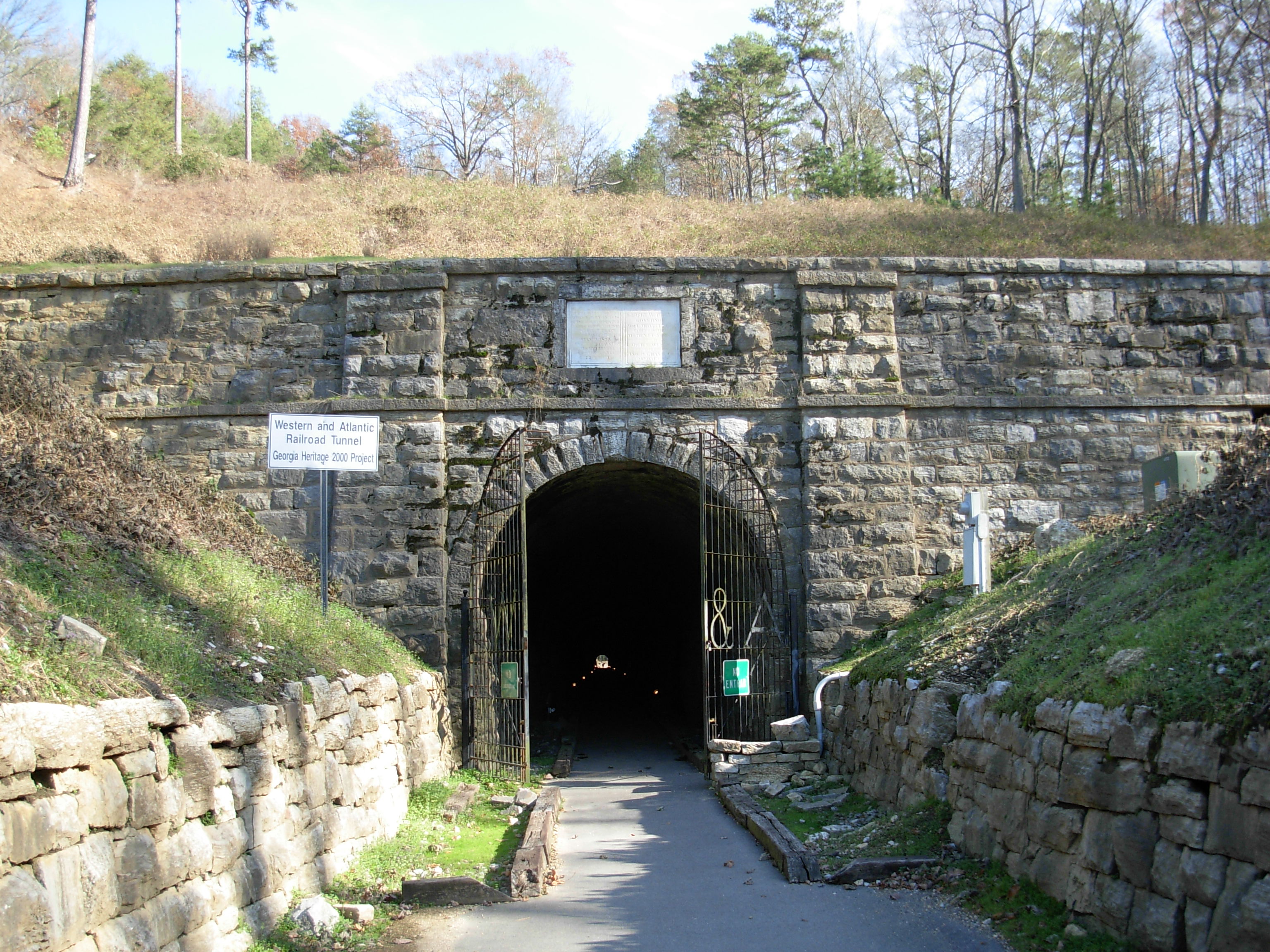
Western & Atlantic Railroad Tunnel
Chetoogeta Mountain
Tunnel Hill, Georgia

As the railroad spread its tentacles throughout the nation before the tumult of the Civil War, a route was needed from Augusta, Georgia to Chattanooga, Tennessee. Numerous obstacles stood in the way, but the biggest was Chetoogeta Mountain. Plans for a railroad tunnel dated to the second half of the 1830s, but work did not commence until 1848 with work completed two years later. The new tunnel was instrumental in Atlanta’s growth as a railroad hub and was a strategic feature for the Confederacy to protect during the Civil War.

The tunnel’s strategic importance led to a series of skirmishes being fought here leading up to the Battle of Atlanta. Following the war, the tunnel remained in service until 1928 when a new tunnel was built a few yards away. The old tunnel became overgrown with kudzu and was largely forgotten until 1992 when preservationists fought to save the tunnel. It is now the centerpiece of a park that features reenactments of the skirmishes fought at the site.

Entrance to the old Western & Atlantic Railroad Tunnel, 2011. Photo by Lewis O. Powell, IV, All rights reserved.

It is often re-enactors who have encountered anything supernatural at the site. I’ve been pleasantly surprised by the number of documented accounts of spirits at Tunnel Hill. At least four books and a handful of good articles document the high levels of activity at this site. Accounts include the apparitions of soldiers seen both inside the tunnel and around it. Ghostly campfires, disembodied screams, spectral lantern light and the smell of rotting flesh (minus the presence of actual rotting flesh) have all been reported by re-enactors and visitors alike.

Sources

  • DeFeo, Todd. “Antebellum railroad tunnel still a marvel after all These years.” com. 22 June 2009.
  • Kotarski, Georgiana C. Ghosts of the Southern Tennessee Valley. Winston-Salem, NC: John F. Blair, 2006.
  • Underwood, Corinna. Haunted History: Atlanta and North Georgia. Atglen, PA: Schiffer, 2008.
  • Western and Atlantic Railroad Tunnel. Tunnel Hill Heritage Center. Accessed 28 November 2010.

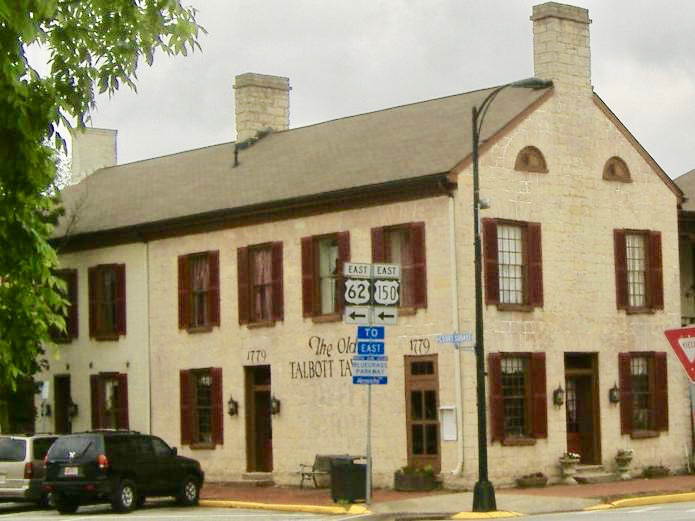
Old Talbott Tavern
107 West Stephen Foster Avenue
Bardstown, Kentucky

Old Talbott Tavern, 2008, by C. Bedford Crenshaw. Courtesy of Wikipedia.

Continuously open since the late 18th century except for a period in the late 1990s when the tavern was being renovated following a disastrous fire, the Old Talbott Tavern has hosted an impressive array of visitors ranging from Daniel Boone to General George Patton. Perhaps one of the famous guests who has never checked out is outlaw Jesse James who stayed frequently in the tavern while visiting his cousin who was the local sheriff. With the claims of Jesse James’ spirit which may also roam the halls of Selma, Alabama’s St. James Hotel, James’ spirit may split the hereafter between two favorite locales. But James’ spirit is not the only spirit acting up in the Old Talbott Tavern. Other ghosts may include formers guests, owners and their families.

Sources

  • Brown, Alan. Haunted Kentucky. Mechanicsburg, PA: Stackpole Books, 2009.
  • Brown, Alan. Stories from the Haunted South. Jackson, MS: University Press of Mississippi, 2004.
  • Starr, Patti. Ghosthunting Kentucky. Cincinnati, OH, Clerisy Press, 2010.

Old Louisiana State Capitol
100 North Boulevard
Baton Rouge, Louisiana

When the state capitol was moved from New Orleans to Baton Rouge in 1846, the city donated land atop a bluff over the Mississippi for the capitol building. Architect James Dakin designed a Neo-Gothic building very much unlike the other state capitols which were often modeled on the U.S. Capitol building in Washington. The magnificent crenellated and be-towered structure was used as a prison and garrison for soldiers under the city’s Union occupation and during this time it caught fire twice leaving it a soot-stained shell by the war’s end. The building was reconstructed in 1882 but abandoned in 1932 for Governor Huey Long’s new state capitol.

Old State Capitol, 2009, by Avazina. Courtesy of Wikipedia.

Even before the capitol burned during the war, there was a ghost gliding through its halls. Pierre Couvillon, a legislator representing Avoyelles Parish, enraged by his colleagues’ corruption, suffered a heart attack and died. Though he was buried in his home parish, his spirit was said to reside in the capitol; perhaps checking up on his colleagues. When the capitol building underwent restoration in the 1990s, the spirit or spirits in the building were stirred up and activity has increased. Staff members and visitors have reported odd occurrences. One security guard watched as movement detectors were set off through a series of rooms while nothing was seen on the video.

Two organizations investigated the building in 2009 and uncovered much evidence. Louisiana Spirits Paranormal Investigations picked up a number of interesting EVPs including someone singing the old song, “You Are My Sunshine.” Everyday Paranormal, in their investigation had a few encounters in the basement of the building, the area used as a prison during the Union occupation. It seems that there are many spirits within the crenellated walls of the Old Capitol.

Sources

  • Duvernay, Adam. “Several Baton Rouge sites said to be haunted.” The Daily Reveille. 27 October 2009.
  • Dwyer, Jeff. Ghost Hunter’s Guide to New Orleans. Gretna, LA: Pelican, 2007.
  • Louisiana Spirits Paranormal Investigations. Old State Capitol, Baton Rouge, LA. Accessed 11 November 2011.
  • Manley, Roger. Weird Louisiana. NYC: Sterling Publishers, 2010.
  • Old Louisiana State Capitol. Wikipedia, the Free Encyclopedia. Accessed 9 November 2011.
  • Southeastern Students. “Old State Capitol Still Occupied by Former Ghosts.” com. 29 October 2009.

Jericho Covered Bridge
Jericho Road at Little Gunpowder Falls
Harford County Near Jerusalem, Maryland

Jericho Covered Bridge, 2009, by Pubdog. Courtesy of Wikipedia.

Straddling the county line between Harford County and Baltimore County over the Little Gunpowder Falls is the Jericho Covered Bridge, constructed in 1865. According to Ed Okonowicz in his Haunted Maryland, there are legends of people seeing slaves hanging from the rafters inside this nearly 88-foot bridge. Certainly, there is an issue with this as the bridge was constructed in 1865, after the end of both slavery and the Civil War. Other, more realistic legends, speak of a woman seen on the bridge wearing old-fashioned clothing and people having their cars stop inexplicably in the middle of the bridge.

Sources

  • Jericho Covered Bridge. Wikipedia, the Free Encyclopedia. Accessed 20 January 2011.
  • Ed. Haunted Maryland. Mechanicsburg, PA: Stackpole Books, 2007.
  • Varhola, Michael J. and Michael H. Varhola. Ghosthunting Maryland. Cincinnati, OH: Clerisy Press, 2009.

Corinth Battlefield
Corinth, Mississippi

Following the Confederate’s disastrous attack in April of 1862 on the Union forces at Shiloh, Tennessee (for a battle description see my entry on the Beauregard-Keyes House in New Orleans), the Union army laid siege for two days to the vital railroad town of Corinth, just over the state line. To save his army from annihilation, General P.T.G. Beauregard gave the appearance of reinforcement troops arriving and being put in place while efficiently moving his troops out of the city to nearby Tupelo. The Union army entered the city the following day to find it devoid of Confederates. In October of the same year, Confederates tried once again and failed to capture the city losing some 4,000 men (including dead, wounded and missing) in the process.

The railroad junction at the heart of Corinth. Photo 2013, by Ron Cogswell. Courtesy of Wikipedia.

The battlefield on which these two battles were fought is now incorporated into the mid-sized city of Corinth. Portions of the battlefield and earthworks are now preserved as the Corinth unit of Shiloh National Military Park. As one might expect, some of those portions have spiritual artifacts remaining. Some of the best stories from Civil War battlefields come from re-enactors who have experiences while re-enacting battles and one of the primary reports of ghosts from the Corinth battlefield comes from a re-enactor whose story was documented by Alan Brown. This particular re-enactor heard the sound of a phantom cavalry and a few nights later, the sound of someone rummaging through her tent while camping on the battlefield.

Sources

  • Brown, Alan. Stories from the Haunted Southland. Jackson, MS: University Press of Mississippi, 2004.
  • Second Battle of Corinth. Wikipedia, the Free Encyclopedia. Accessed 27 January 2011.
  • Siege of Corinth. Wikipedia, the Free Encyclopedia. Accessed 27 January 2011.

North Carolina Zoological Park
4401 Zoo Parkway
Asheboro, North Carolina

North Carolina lawyer and folklorist Daniel Barefoot has done much to preserve North Carolina and Southern legends and ghost stories in his books. His series, North Carolina’s Haunted Hundred provides a single ghost story or legend from each of the state’s one hundred counties. From Randolph County, smack dab in the middle of the state, comes the legend of the aptly named, Purgatory Mountain, now home to the NC Zoo. The state-owned zoo is the largest walk-through habitat zoos in the world and a major attraction in the region.

NC Zoo sign, 2010, by Eleazar. Courtesy of Wikipedia.

During the Civil War, much of rural North Carolina was resistant to seceding from the Union and, as a result, the state was the final state to secede. Still, many citizens, including the peaceable Quakers of Randolph County resisted joining the butternut ranks. Recruiters were sent to these areas to nudge and sometimes force the inhabitants to join. One particular recruiter in this area earned the nickname, “The Hunter,” for his harsh methods.  He rounded up a group of Quaker boys, tied them roughly and marched them to Wilmington to join the army, but a few escaped and returned, bedraggled to their rural homes. When the recruiter returned, this group of escaped boys shot him outside of his cabin at Purgatory Mountain. His malevolent spirit is still supposedly stalking the crags of his mountain home.

Sources

  • Barefoot, Daniel W. North Carolina’s Haunted Hundred, Vol. 2: Piedmont Phantoms. Winston-Salem, NC, John F. Blair, 2002.
  • North Carolina Zoo. Wikipedia, the Free Encyclopedia. Accessed 11 April 2012.

Carter House
1140 Columbia Avenue
Franklin, Tennessee

By some accounts, the Battle of Franklin, November 30, 1864, was one of the bloodiest battles of the war. Some historians have even deemed it the “Gettysburg of the South.” Fought right on the edge of the town of Franklin, the battle hit very close to the home front and absolutely hammered the farm of the Carter family which was located at the center of the main defensive line. During the furious fighting, the Carters, neighbors and slaves cowered in the basement of the house, emerging after the battle to witness the carnage spread through their yard and around their house. The house and outbuildings still bear bullet holes, attesting to their experience.

Fanny Courtney Carter, who was 8 years old when the battle overtook her family’s farm, later recalled the day following the battle: “Early the next morning after the Battle I went to the field. The sight was dreadful. It seemed I could scarcely move for fear of stepping on men either dead or wounded. Some were clod and stiff, others with the lifeblood ebbing out, unconscious of all around, while others were writing in agony and calling ‘Water! Water!’ I can hear them even now.” Fanny’s brother, Tod, who had enlisted in the Confederate army was found some yards from the house, his body riddled with eight bullets, but still clinging to life. The family brought him into the parlor of his home where he died on December 2.

Carter House by Hal Jesperson, 2009. Courtesy of Wikipedia.

The pastoral fields that once surrounded the Carter House as well as the town of Franklin that saw so much blood that November day have mostly been lost to development though the spiritual imprint of the battle is still felt throughout the city. The spirit of Tod Carter may be one of the more active spirits at the Carter House. He has been seen sitting on the edge of the bed where he may have died and according to Alan Brown, he took a tour of the house, correcting the tour guide when she didn’t use the correct name or date and disappearing before he and the guide could descend to the basement.

Apparently he’s not the only lingering spirit. Poltergeist activity in the house has been attributed to Tod’s sister, Annie. Objects have moved from room to room and one visitor on a tour watched a figurine that jumped up and down.

Sources

  • Battle of Franklin (2009). Wikipedia, the Free Encyclopedia. Accessed 13 December 2010.
  • Brown, Alan. Haunted Tennessee: Ghosts and Strange Phenomena Of the Volunteer State. Mechanicsburg, PA: Stackpole, 2009.
  • O’Rear, Jim. Tennessee Ghosts. Atglen, PA: Schiffer, 2009.

Rockledge Mansion
440 Mill Street
Occoquan, Virginia

The town website for Occoquan (pronounced OK-oh-qwahn), Virginia states that the city, “has an inordinate amount of spooks per capita” and then goes on to list a number of locations in the town with ghosts. Among this remarkable collection of haunted locations is the magnificent Georgian mansion, Rockledge, which commands a literal rock ledge above Mill Street. The town was founded in the mid-eighteenth century as a port on the Occoquan River and during the Civil War this northern Virginia town served as a post office between the North and the South.

Rockledge Mansion by AlbertHerring, 2008. Courtesy of Wikipedia.

Quite possibly the work of colonial architect, William Buckland, Rockledge was built in 1758 by local industrialist John Ballandine. In the yard of this house the ghost of a Confederate soldier has been seen and possibly heard. One witness saw the soldier then noticed peculiar wet footprints on the front steps that appeared to be from hobnail boots, the kind that would have been worn by soldiers during the war. Many people have heard loud footsteps in the house as well as someone knocking at the door. So far, no source has identified this soldier.

Sources 

  • Occoquan History. com. Accessed 16 November 2010.
  • Occoquan, Virginia. Wikipedia, the Free Encyclopedia. Accessed 13 December 2010.
  • Streng, Aileen. “Benevolent ghost believed to haunt mansion.” com. 27 October 2010.
  • Virginia Historic Landmarks Commission. National Register of Historic Places Nomination Form for Rockledge Mansion. Listed 25 June 1973.

Berkeley Castle
WV-9
Berkeley Springs

Berkeley Castle by Jeanne Mozier. Courtesy of Wikipedia.

Berkeley Springs, also known as “Bath,” has attracted visitors who come to take the waters of the mineral springs located there. Overlooking this quaint town from a commanding position on Warm Spring Mountain sits Berkeley Castle, seemingly a piece of medieval Britain transplanted. Modeled and named after Britain’s own Berkeley Castle, the castle was built as a wedding gift from Colonel Samuel Suit for his bride, Rosa Pelham. The Colonel, who was quite a bit older than his bride, died before the castle was finished and his widow finished the building. She lived in the castle after his death and squandered the fortune she inherited and died penniless well away from the castle, but legends speak of her return.

The castle was purchased by paranormal investigators in 2000 but sold fairly shortly after that. Once open for tours, the castle is now primarily a private residence, though it may be rented for weddings, parties and other events.

Sources

  • Fischer, Karin. “Castle in Eastern Panhandle could be in need of a new lord this spring.” Charleston (WV) Daily Mail. 21 November 2000.
  • History Berkeley Castle. Berkeley Castle. Accessed 19 March 2011.
  • Robinson, James Foster. A Ghostly Guide to West Virginia. Winking Eye Books, 2008.

“Ghosts in High Carnival”—Atlanta, 1904

According to two 1904 editions of Atlanta Constitution, Atlanta’s phantasmagoric scene was in “high carnival.” The first article that appeared towards the end of January tells of an African-American family who was evidently plagued with a poltergeist. Generally, poltergeist activity centers on an adolescent female who may project the fears and confusion she is experiencing onto the physical environment around her, though, in this account the activity revolves around a young boy. The details of the story certainly show that this child’s situation was not ideal and likely put this young boy under a huge amount of stress.

Atlanta at this time, in fact, much of the South as a whole, was not a pleasant place for a young, poor, African-American child. The racism that permeated all levels of life is quite obvious here, but there is a much crueler subtext in the play on words in the title. “Spook” is not only a synonym for ghost but also a pejorative term for African-Americans.

The rental house where this took place does not appear to exist, and the address points to an area that is now quite developed.

 Atlanta Constitution

28 January 1904

 SPOOKS PLAY QUEER PRANKS

 Remarkable Ghost Story in Which Police Took a Hand.

 A remarkable spook story developed yesterday in a negro house at 360 Chapel street, in the rear of Smith & Simpson’s lumber yard. This spook story differs from the ordinary tales of the kind in that police officers took a hand and two of them actually saw the ghost doing his supernatural stunts.

Fully a thousand people visited the scene during the day and stories are told which have some very extraordinary features.

In the house there lived an old negro man, his aged wife and a little boy. The family moved into the house only a few days ago. Two nights ago, the table began to dance, the old man was hurled from a trunk and chairs in the house cut up all sorts of antics.

The negro told his neighbors about it and a large number of people saw the table moving about the house yesterday morning. The excitement became so great that three or four policemen went to the place. Among them was Call Officer Luck, who states that he saw the table jump about the floor, and, finally, turn over, breaking a lot of dishes. Sergeant Beavers also witnessed the remarkable phenomenon. What caused the table to move no one can say.

The old negro states that he has moved eighteen times during the past 12 months in order to get rid of spooks. In every house he has lived the table and chairs have moved about of their own free will, so he claims, and every dish he buys is broken. Chairs have also taken a notion to dancer over the house.

Yesterday afternoon the old man moved again, and the rent which he had paid in advance, was returned to him.

Sergeant Beavers says he believed the work is done by the negro child, for he noticed that whenever the boy approached a piece of furniture it began to move. He thinks the boy is possessed with some subtle electric power, such as made the exhibitions of Lula Hurst so remarkable.

When police officers saw the table skip across the room and beheld it overturned and all the dishes on it broken, they made an investigation, and could find nothing which would explain the matter.

The negroes in the neighborhood are greatly excited over the affair, and they believe firmly that the old negro is followed by ghosts. Somebody offered $100 to any negro who would sleep in the house last night, and the offer was not taken up.

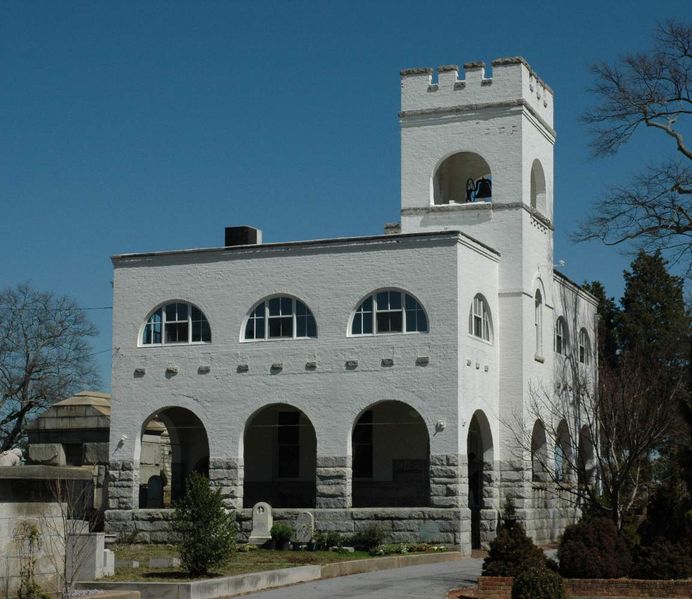
It’s also interesting to see the police investigating this odd case. Stories of similar poltergeist cases have also been investigated by law enforcement and sometimes even they come away having witnessed things they cannot explain. The next story from the Constitution also involves the police, but in this case this one officer was scared out of his wits by odd sounds within Oakland Cemetery. The keeper’s lodge where this officer had been stationed during his cemetery vigil remains and is now occupied by the offices of the Historic Oakland Foundation and visitors center. This building was still fairly new in 1904, having only been constructed in 1899.

The Oakland Cemetery Bell Tower and Keeper’s Lodge where a police officer heard disembodied footsteps in 1904. Photo 2005, by AUTiger, courtesy of Wikipedia.

Atlanta Constitution

25 May 1904

 GHOSTS IN HIGH CARNIVAL AROUND OAKLAND CEMETERY


According to all reports there are ghosts in Oakland cemetery, and even the members of the police department are giving the place a wide berth after nightfall.

Curious noises in all parts of the cemetery during the night are said to have been heard as of late, and at the keeper’s lodge, near the center of the burial place, the sound of footsteps can be heard stairs at all hours of the night. When these are investigated, no trace of anything living or moving can be found. As soon as those interested return to the office below the noise starts again.

A policeman, detailed for duty at the cemetery a few nights ago, tells an interesting story of his experience with the thing supernatural.

“I was in the keeper’s lodge, just starting to eat a lunch that had been brought me,” said the officer, “when I heard footsteps upstairs. Thinking possibly my ears were deceiving me, I refrained from speaking to the lad who had brought my lunch, but an instant later he called my attention to the fact that there was someone walking around on the upper floor.

“I drew my revolver and walked up the stairs, the boy folloing me. We searched every nook and corner of the place, but failed to find anything living, not even a fly being visible. We returned to the lower floor and no sooner had I resumed the eating of my lunch than the footsteps were heard again, this time even more distinct than on the first occasion.

“Thinking possibly I could see from the outside, I rushed into the open air, and as I stopped, when a few feet away, and turned to look at the upper story of the keeper’s house, I heard a slab fall in the one of the nearby vaults.

“Hurrying in the direction of the vault from which the sound came, thinking to surprise grave robbers at work, I was astounded to find the door to the vault securely locked, and not a trace of anything living in the neighborhood. This, despite the fact that I had heard, very distinctly, but an instant before, the falling of a marble slab in the vault.

“After a thorough search of the surrounding lots, I returned to the keeper’s house and the first thing that greeted my ears when I entered the door was the sound of footsteps upstairs again.

“For the second time I hurried to the upper floor and made a thorough search. Diligent, careful and complete as it was, I failed to find even a suspicion of a living object.

“I endured the unearthly noises until time for my relief next morning, but there can be no more Oakland cemetery jobs for me. The next time I am detailed to the graveyard I am certainly going to be sick. I can stand up and fight a live man and take the whipping, if he is the best man, but I absolutely refuse to have to treat with things that make all manner of noises and peculiar sounds but do not show anything to the eye.

Others in addition to this officer, have told of peculiar noises in Oakland at night, and quite a stir has been created among those living in the vicinity of the cemetery.

Oakland Cemetery is indeed believed to be haunted and I have written about some of the more recent experiences here.

Sources

  • “Ghosts in high carnival around Oakland Cemetery.” Atlanta Constitution. 25 May 1904.
  • “Spooks play queer pranks.” Atlanta Constitution. 28 January 1904.

Just whistling Dixie—Rural Hall, North Carolina

Payne and Edwards Roads
Rural Hall, North Carolina

The ritual is thus: drive out at night to the bridge where Edwards Road crosses over Payne Branch, stop your car in the middle of the bridge, and put it into neutral. Open the windows and begin to whistle “Dixie.” Supposedly your engine will die and you will be unable to restart the car until it is pushed from the bridge.

Author Michael Renegar tells of a friend of his who performed this ritual with frightening results. This young man and two female companions ventured out to haunted Payne Road one night looking for a thrill. After performing the ritual their car sputtered and died. After the young man pushed the car off the bridge, he was able to crank the car, though while he was outside of the car he was spooked by a feeling of being watched.

Reportedly, the vehicle never acted the same after that. Besides the scary moments on the bridge, the three also noted that when they drove past one of the old cemeteries an angel on the edge of the cemetery faced away from the road, but was facing them the second time they passed it.

Authors Burt Calloway and Jennifer FitzSimons record an earlier encounter on the bridge where a young man was trying to impress his date. The couple performed the ritual, and the young man left his date sitting in the car as he strutted around the lonely bridge provoking the spirits. As lightning lit up the night’s sky, it revealed something to the young man.

Stumbling  back to the car, he attempted to crank it. It refused to start and the young man just sat stunned in the driver’s seat. His date, not too pleased with his sudden fear, cranked the car and drove them away from the bridge. Only after leaving the haunted spot, did the man reveal that he saw a ghost during the lightning’s flash.

The stories of Payne and Edwards Roads have circulated in this rural area of Forsyth and Stokes counties for decades. The legendary history has entered the digital realm where it is discussed and argued among the more than 4000 members of the Legend of Payne Road group on Facebook. To add more fuel to the fiery legends, the viral website Only In Your State recently published an article repeating many of the lurid, and oft disputed legends of these haunted roads.

First off, there is a great deal of confusion regarding the exact location of the hauntings. Edwards Road branches off from Broad Street within the Rural Hall city limits. Google Maps notes that the road is NC 1903 until after it intersects Forsto Road at which point it combines with NC 1961. Apparently, the haunted portion of the road is located south of Payne Branch where the road curves before crossing over Payne Branch. Edwards Road terminates at Payne Road just north of the bridge. Payne Road continues east as NC 1961, while the western section is NC 1962. At some point, part of Payne Road may have been renamed Edwards Road, but that is only speculation, however the roads do appear to have been named for the families that once owned the land: the Paynes and the Edwards.

The Only In Your State article notes three legends associated with this road, though, like all legends, these legends change from storyteller to storyteller and article to article. The first legend involves the story of Payne Edwards, a cruel plantation owner whose daughter was impregnated by a slave. After killing the slave, Edwards began to practice devil worship and eventually killed his entire family. He also burned the plantation killing all the remaining slaves.

A different version of the story casts Payne Edwards as the head of a large household here in the 1930s. After losing his mind he decided to murder his family and tied his wife to a chair in the living room. One by one he took his children to kiss their mother before he took them upstairs and slit their throats. The mother was able to escape, but was beheaded by her husband who dumped their infant child into a well.

While these stories are both grotesquely fascinating, they are utter balderdash. One of the best sites for a well-researched view of this story is the blog of the North Carolina Room of the Forsyth County Public Library. Last Halloween, one of the research librarians presented these two stories from Payne Road and checked their validity against the historic records. She found no record of Payne Edwards, though an early settler in the area, Robert Payne, owned land in the area. According to the Federal Census, Robert Payne was also a slave owner and had several children, though most apparently survived him.

The detail of a man murdering his entire family is also quite interesting. This detail is borrowed from an actual murder that occurred nearby in 1929. On Christmas Day, Charlie Lawson systematically killed his wife and six of his seven children (his oldest son was away from the family farm) and then shot himself a short time later. Lawson’s reasons for the murders went to the grave with him, though family and acquaintances have speculated that domestic issues, including possible incest, may have led to the tragedy. This gruesome mass murder elicited awe and curiosity from locals for many years and the family’s farmhouse was open as a tourist attraction for many years. Interestingly, these murders occurred roughly 5 miles from Payne and Edwards Roads on Brook Cove Road outside of Germanton. Though the family’s ramshackle farmhouse was demolished decades ago, there are still reports of paranormal activity in the area linked to the family’s murder.

While this tragedy did not occur in the Payne/Edwards Road area, there are a number of documented tragedies that have occurred here. In 1955, Milus Frank Edwards—who lived at the curve in Edwards Road just south of the bridge—committed suicide with a stick of dynamite. From the Gastonia Gazette, 7 October 1955:

Man Takes Life with Dynamite

Danbury—(AP)—A 73-year-old Stokes county man committed suicide yesterday with a dynamite explosion.

Sheriff Harvey Johnson said Milus Frank Edwards of Rt. 1, Rural Hall, apparently parked his pickup truck in a shed at his home, climbed into the truck bed and set off a stick of dynamite near his head.

A coroner’s jury ruled that death was self-inflicted.

Aubrey Edwards, son of the dead man, said his father had made several threats to end his life.

Sadly, this was among a handful of suicides to plague this family. According to the North Carolina Room blog, Mr. Edwards had four siblings also take their own lives. The blog poster further speculates that this is the beginning of the urban legends that surround these roads.

A more recent misdeed in the area can only be used to back up the tragic nature of this place. In December 1992 several men picked up a young woman in Winston-Salem. The young woman was driven to an old logging road off Payne Road. She was tied to a tree, raped, possibly tortured, and stabbed to death. More than a decade later one of the men involved was found guilty, though that conviction was later overturned based on DNA evidence.

This photograph appears in the 1990 book, Triad Hauntings, and is identified as the “Payne Road House,” though I cannot positively identify it as the haunted farmhouse.

While many of the legends that have accumulated around this area appear to be mostly fantasy embellished with fact, the experiences of locals and investigators cannot be denied. Writer Edrick Thay includes an interesting post-script to this research in his 2005 book, Ghost Stories of North Carolina. In a chapter entitled “The Haunted Farmhouse,” Thay recounts an investigation of an abandoned farmhouse by Haunted North Carolina Paranormal Investigators and Research that the group first looked into in 2002. Thay attempts to disguise the location saying that the lead investigator “refuses to disclose the farm’s location, except to say that it may or may not be around Winston-Salem.” Later details of the history make it certain that this is the old Edwards farmhouse outside of which Frank Edwards died by his own hands. “With this abandoned farm, the sheer number of the deaths from suicide and foul play over the last 50 years is staggering.” The investigator continues noting “gruesome accounts of people exploding themselves with sticks of dynamite, of the Mafia-style executions of two individuals beneath the awnings of an outbuilding and of the torture and grisly murder of a prostitute.”

During the several investigations the group has conducted here they have encountered high levels of activity in and around the old farmstead. On the first investigation several investigators were touched by unseen hands. One had their backpack grabbed and a nearby video camera proved her experience while another was touched on the hand leaving a red welt. Voice recorders used throughout the investigation recorded a number of EVPs including one with “many plaintive voices calling ‘help us!’” Perhaps the most interesting moment occurred when four investigators simultaneously witnessed a shadowy apparition moving along the banks of the nearby creek.

This investigation was conducted some years ago before the farmhouse and outbuildings were destroyed by vandals and an arsonist. Payne and Edwards Roads have both been paved and the mysterious haunted bridge has been replaced by a culvert. Despite these intrusions of modernity, teens and the curious still drive this road at night legend tripping. Hopefully they’re not just whistling Dixie.

Sources

  • Breedlove, Michael. “Local Haunts: Investigating the haunted side of the Twin Cities.” Winston-Salem Monthly. 29 September 2014.
  • Calloway, Burt & Jennifer FitzSimons. Triad Hauntings.Winston-Salem, NC: Bandit Books, 1990.
  • The Legend of Payne Road.” North Carolina Room— Forsyth County Public Library. 29 October 2015.
  • “Man takes life with dynamite.” Gastonia Gazette. 7 October 1955.
  • “Prosecutors confident they can convict Penland anew.”Asheville Citizen-Times. 1 August 2005.
  • Rakestraw, Emory. “Driving down this haunted North Carolina road may give you nightmares.” Only In Your State. 26 August 2016.
  • Renegar, Michael. Roadside Revenants and Other North Carolina Ghosts and Legends. Fairview, NC: Bright Mountain Books, 2005.
  • Renegar, Michael. Tar Hell Terrors: More North Carolina Ghosts and Legends. Fairview, NC: Bright Mountain Books, 2011.
  • Thay, Edrick. Ghost Stories of North Carolina. Auburn, WA: Lone Pine Publishing, 2005.
  • Whitmire, Tim. “Lawyers: DNA tests show Penland wrongly Convicted in ’92 killing.” Asheville Citizen-Times. 9 July 2005.

Sunrise to sunrise in Fort Pierce, Florida

The sun was rising on what had been a small backwater town in the early twentieth century. The population was growing rapidly and one of the most prominent of local businessmen, Rupert Koblegard, wanted to invest some of his fortune into something that would benefit the citizens of what was being called, “The Sunrise City.” When he approached the city council, the response was, “build a theatre.” After getting a design from architect John N. Sherwood, Koblegard presented the plans to the city council again. He was told that the theatre was too big, to which he replied, “better too large than too small.”

Described as the largest theatre between Jacksonville and Miami, the SUNRISE THEATRE (117 South 2nd Street) opened on 1 August 1923 with a grand parade through downtown. Onstage, the Fort Pierce Band gave a concert. On screen, the newsreel was followed by a pair of films including a Charlie Chaplin comedy, The Vagabond. The opening of this grand, vaudeville theatre was heralded by the local paper as, “one of the most important events in the development of the town into a wide-awake city.”

Sunrise Theatre, 2009, by SebasTorrente. Courtesy of Wikipedia.

The stage attracted some of the top vaudeville acts including cowboy entertainer Tom Mix and his wonder horse, fan-dancer Sally Rand and actor Edward G. Robinson. Management passed from Rupert Koblegard, Sr. to his son, Rupert Jr. in 1928 just as the first talking picture equipment was installed in the theatre. Even as other businesses generally limped through the Depression and through World War II, the theatre remained quite vital. The theatre closed in 1983 when its business was sapped by strip malls and development away from downtown.

After sitting derelict for many years, the theatre was purchased by the St. Lucie Preservation Association and was restored in 2006 as a centerpiece for a renovated downtown. The theatre features top-rung entertainment and, quite possibly, some resident spirits. In 2009, three years after its grand reopening, paranormal investigators from the Florida Ghost Team explored the theatre.

In two investigations, the team found evidence to support the assertion that the theatre had paranormal activity. While a group of investigators were investigating the third floor apartment of the theatre’s founder and owner, Rupert Koblegard, Sr., several members of the group had the batteries in the cameras drain. Shortly after, knocking was heard in possible response to an investigator’s questions. Another team member watched as an exit door opened and closed on its own volition. While the evidence is scant, it may very well prove the existence of some spiritual activity within the theatre.

From the stage of the Sunrise Theatre, one must only make a short jaunt to see real sunrises over the Atlantic Ocean from the steps of the majestic BOSTON HOUSE (239 Indian River Drive) which has wistfully been staring out to sea since 1909. Now sidled up next to a starkly modern neighbor, the house seems to retain its peaceful, old-fashioned aura as well as some of its tales. Like the Sunrise Theatre, these tales originate in the sunrise of the city of Fort Pierce.

Along the Atlantic Coast of Florida, many tales begin with Henry Morrison Flagler. Originally a partner of John D. Rockefeller in Standard Oil, two visits to Florida in the late 1870s provided him with the impetus to develop this rural state into a vacationer’s paradise. Flagler’s project built a railroad line, the Florida East Coast Railroad (FEC), from Jacksonville all the way to Key West. Along the way, the trains stopped in towns and cities graced with Flagler’s grand hotels. This little Florida project for Flagler developed into a lifelong obsession for him and a coup for a backwater state that has turned it into one of America’s greatest “Vacationlands.”

It was the FEC that brought William Turpin Jones to Florida, initially as a mechanic but he rose to be an engineer and was relocated to Fort Pierce. Around this time, Jones was an engineer on a train that struck dynamite that was left on the tracks by careless workers. Jones was seriously injured but after his recovery he returned to work. He was awarded a settlement of $6000 for his injuries. With this princely settlement Jones constructed a magnificent home in Fort Pierce which he named Cresthaven. The house was completed in 1909 and William Jones moved in with his wife and five children.
The Boston House, 2009, by SebasTorrente. Courtesy of Wikipedia.

It was the FEC that brought William Turpin Jones to Florida, initially as a mechanic but he rose to be an engineer and was relocated to Fort Pierce. Around this time, Jones was an engineer on a train that struck dynamite that was left on the tracks by careless workers. Jones was seriously injured but after his recovery he returned to work. He was awarded a settlement of $6000 for his injuries. With this princely settlement Jones constructed a magnificent home in Fort Pierce which he named Cresthaven. The house was completed in 1909 and William Jones moved in with his wife and five children.

Jones retired from the FEC and worked on maintaining his groves of oranges and pineapples and selling real estate until he was unexpectedly appointed as sheriff of St. Lucie County in 1915. This unexpected turn of events took place after the previous sheriff, D.S. Carlton, was shot to death downtown by Marshall D.J. Disney in what was described as a “wild west shootout.” Known for his honesty, the governor appointed Jones to the position and he held it until he resigned in 1920. Though he had commanded much respect as sheriff, Jones’ business interests were taking a financial loss and he resigned to turn his attention back to those interests. Eventually, he returned to work for the FEC.

During his time as sheriff, a shade of tragedy was drawn over this home. In 1918, Jones’ 10-year-old son, Clifford, was involved in an incident with one of his playmates. The boys were playing in the home’s living room. Clifford reached for his father’s gun and it fired striking his young friend, William Fee. The young friend was mortally wounded and died later that evening in the hospital.

After the Depression hit, Jones struggled just as many did throughout the country. From a friend he accepted a loan using his home as collateral. The friend passed away and the note on Cresthaven passed to Rose Whitney, a sister of the friend. Unable to meet the terms of the loan, Jones was forced to sell the house to Ms. Whitney who moved in with her sister. Since the sale of the house to the sisters, the house has passed through a series of owners. Subsequent owners have used the large house for offices and most recently it housed law offices. The grand edifice is currently for sale.

Some of the earliest stories of paranormal activity in the house date back to the early 1970s. These reports include the sightings of Native Americans on the home’s front lawn, a red-haired maiden and “hanging victims.” There is also mention made of possible séances being held in the house, though there is no record to support that assertion.

The activity that seems more believable (to me, at least) is the activity reported while the house was occupied by law offices for almost 30 years. During that time employees would sometimes open the building in the morning to be greeted by the odor of coffee brewing. The smell of flowery perfume has also been associated with activity.

The second and third floors seem to have hosted much of the activity. One office employee was shocked as her keyboard levitated and a plant bent over. The daughter of one of the partners watched as random letters appeared on the screen of a word processor monitor, though it was turned off. Lights would turn off and on and on one occasion a passerby called one of the lawyers to report that every light in the building was on late one night. When the lawyer opened the building the next morning, not one light was on.

Even more curious is the apparition of a woman. One poor copy machine repairman was surprised to see a woman in Victorian clothing on the third floor. The figure disappeared into a wall. One of the lawyers watched as the silhouette of a woman appeared in a third floor window. He was standing with a group of eight people and all but one saw the shadow.

At some point in the past few decades a story has sprung up to explain this feminine shade. The story states that the elderly spinsters who took over the house after William Jones lost it utilized the house as a bed and breakfast. Among the vacationers staying there was a family named Perkins. The father and his young son went fishing and did not return. The spirit of the wife, Mrs. Aleacon Perkins, is still waiting for her family to return.

Research conducted by members of the GRIM (Ghostly Research into the Metaphysical) Society has found no historical record to support this tragic story. However, the group has compiled an impressive history of house, some of which was used in compiling this profile. So for now, the lady staring into the sunset from the upper windows of the Boston House remains lost in the twilight of history.

Sources

  • Brown, Alan. Stories from the Haunted Southland. Jackson, MS: University Press of Mississippi, 2004.
  • Grigas, Catherine Enns. “Living History: Boston House Home to Haunting Tales.” Indian River Magazine. 21 January 2011.
  • GRIM Society. “The Historic Boston House.” GRIM Society Blog. 14 October 2007.
  • Harrington, Tim; W. Carl Shiver and Brent A. Tozzer. National Register of Historic Places Nomination form for the Sunrise Theatre. September 2001.
  • “Koblegard Theatre Interests Sold.” The News Tribune (Fort Pierce, FL). 3 April 1955.
  • Mattise, Jonathan. “At Sunrise Theatre, things did go ‘bump’ in the night, Paranormal investigators said.” Fort Pierce Tribune. 28 September 2009.
  • Mattise, Jonathan. “Unsettling experiences noted when Florida Ghost Team returns to Sunrise Theatre in Fort Pierce.” Fort Pierce Tribune. 5 October 2009.
  • Pincus, J.h. and Michael F. Zimny. National Register of Historic Places nomination form for Boston House. 20 February 1985.
  • “The Restoration of the Sunrise Theatre.” Palm Beach Post. 19 February 2006.
  • Sunrise Theatre. “History.” Accessed 5 April 2013.

Greystone ghosts–Knoxville, Tennessee

WATE-TV Studios in Greystone Mansion
1306 North Broadway Street, Northeast
Knoxville, Tennessee

N.B. This article was revised and expanded 31 January 2019 and 13 June 2021.

Throughout the South, hauntings can be found in unlikely places: Walmart stores, fast food restaurants (I’ve covered the haunted McDonald’s in Hermitage, Tennessee), and amusement parks among them. Some years ago, WATE-TV 6, the Knoxville ABC affiliate, revealed that their own studios may be haunted.

The studios occupy a rambling Victorian mansion that resembles a classic haunted house. The Richardsonian Romanesque mansion was constructed for Major Eldad Cicero Camp, Jr., the wealthiest man in East Tennessee at the time. He initially arrived in the area towards the end of the Civil War while he was serving Ohio Volunteer Infantry. Impressed at the region’s untapped mineral resources, he decided to make Knoxville his permanent home

Eldad Cicero Camp Knoxville Tennessee
Major Eldad Cicero Camp, circa 1917. From Knoxville Men of Affairs.

Camp settled here when the city was still reeling from the divisions brought about by the war, and Camp had his own lingering dispute to settle. During the war, a number of men under his command had been held as prisoners of war under Colonel Henry Ashby in atrocious conditions. Camp held Ashby personally responsible for their mistreatment and, after the war, pressed charges of war crimes and treason against him. Ashby fled Knoxville but returned when the charges were eventually dropped.

On the afternoon of July 9, 1868, Ashby ran into Camp on the street. The gentlemen struggled as Ashby struck Camp with his cane while Camp fought back with his umbrella. The following day, Ashby appeared at Camp’s law office near the corner of Walnut and Main Streets. The two took their quarrel outside where Camp drew his revolver and fired. Henry Ashby was struck in the chest and killed. Camp was arrested and charged with murder, but the charges were dropped.

The following year, President Grant appointed him as the United States Attorney for the Eastern District of Tennessee. Taking advantage of the region’s natural resources, he organized the Coal Creek Coal Company and served as president of two other companies, building a name for himself as a businessman.

With his wealth, Camp began building Greystone Mansion in 1885. The home took five years to construct and featured elaborate woodwork, jeweled stained glass windows, and imported marble mantelpieces. He lived in the house for some 30 years until his death in 1920. He was buried in Old Gray Cemetery not far from where Henry Ashby was also laid to rest. The house remained in the family until 1935 when it was sold and divided into apartments. WATE-TV purchased the house in the 1965, restoring it and adding studio space at the back.

haunted Greystone WATE-TV studios ghosts
Oblique view of Greystone. Photo 2010 by Brian Stansberry.
Courtesy of Wikipedia.

Since moving in, station employees have had experiences throughout the old house. Footsteps and other odd noises have been heard, and a door on the second floor closes by itself. Several years ago, a custodian filmed something moving on the second floor with her phone.

The building has been investigated by Appalachian Paranormal Investigations several times with the group capturing video and audio evidence. According to a WATE, that evidence points to the presence of four possible spirits on the premises.

Sources

  • Booker, Robert J. “Greystone Mansion builder shot, killed man downtown.” Knoxville News-Sentinel. 26 February 2018.
  • Greystone (Knoxville)Wikipedia, the Free Encyclopedia. Accessed 30 January 2019.
  • Eldad Cicero Camp. Wikipedia, the Free Encyclopedia. Accessed 30 January 2019
  • History of Greystone and WATE-TV 6: Greystone. WATE-TV 6. Accessed 30 September 2012.
  • Price, Charles Edwin, Haunted Tennessee. Johnson City, TN: Overmountain Press, 1995.
  • Williams, Bo. “Paranormal investigators check 6 News home Greystone.” WATE-TV 6. 24 September 2012.

“Lord willing and the creek don’t rise!”—Lake Washington, Mississippi

The marvelous phrase, “Lord willing and the creek don’t rise,” occurs frequently in Southern dialogue with some changes (i.e. “God” or “Good Lord” instead of just “Lord” and sometimes plural creeks or “Creek” capitalized). Initially, this phrase did not refer to “creek” as in a body of water, but to the Creek People (now known as the “Muscogee”). According to Google Knol, this phrase originated with the great Indian Agent, Benjamin Hawkins, in the 18th century when he responded to a presidential request to travel to Washington with, “God willing and the Creek don’t rise.”

In a recent news piece from WLBT News, the NBC station in Jackson, Mississippi, a mistake in the spelling of a word made me think of this wonderful turn of phrase. A reporter from the station spent an evening investigating one of the historic showplaces on Lake Washington. He described the group as hearing “a few knocks and creaks downstairs,” though the article reads “a few knocks and creeks downstairs.” It certainly made me chuckle.

The group was investigating the exceedingly atmospheric Susie B. Law House. Neglected for quite some time, this house now hides under a shroud of vines. Underneath this organic, house-shaped shroud is a two-story, white Greek revival house with a columned portico extending from the front. Barbara Sillery in her magisterial The Haunting of Mississippi (which I reviewed here), mentions that a smaller version of the house exists as a playhouse not far from the main house and crushed by a tangle of vines. The house’s appearance has led to its use as a filming location twice, though I cannot find the identities of either film.

Vines cover the portico of the Susie B. Law House. Photo 2010 by Tinkerbrad. Released under a Creative Commons License.

The reporter, Walt Grayson, and the paranormal team, Delta Paranormal, investigating the house recently encountered more than groans and creaks from downstairs. An upstairs door closed itself and was moments later caught on tape opening and closing. The proprietor of a local bait shop, Bait n’ Thangs, who is interviewed in the video also appears in Sillery’s book. He had an odd experience while passing by the Law House a few years ago before the house became so covered in vines. He saw a light in the empty house and as he got closer witnessed a little old lady in a white nightgown ascending the staircase with an oil lamp in her hand. He considered calling the sheriff, but he knew the house was empty and something just wasn’t right. After reporting the woman to descendants of the Law family, he discovered that he’d seen the apparition of Susie B. Law.

The house is one of the showplaces built near Lake Washington, considered the “most beautiful lake in the world.” In the early 19th century many families were attracted to the oxbow lake and built magnificent mansions on its shores along East Lake Washington Road in the hamlet of Glen Allan. Among the most important homes was the Italianate red-brick house, MOUNT HOLLY. It was important enough that the 1938 WPA guide to the state devotes a paragraph to describing the home’s “walls […] 2 feet thick and the ceilings 14 feet high.” It goes on to note the “rosewood staircase, rounded niches for statuary, frescoes, walnut woodwork and great oven.” The circa 1856 home was placed on the National Register of Historic Places in 1973, but more recently, it has become known for its ghosts.

Mount Holly, 2010, by Tinkerbrad. Released under a Creative Commons License.

Like the nearby Law House, Mount Holly sits derelict. It is here that the bait shop owner also had a bizarre experience. Whilst showing a couple historians through the house, the local fishing guide had a door slammed in his face. Moments later, he witnessed a figure running away from the door. Evidently, spirits in both houses enjoy their door closing abilities.

Neglect shows on both of these magnificent homes. Neither is currently open to the public so I have not added addresses to this entry. In the video, the bait shop owner mentions that he hopes paranormal investigations could provide the money to at least stabilize the Law House. Mount Holly needs just as much work and could also benefit from paranormal investigations. It’s also noted in the video that the area has received a great deal of rain recently; rain that can cause damage to both edifices. Lord willing and the creeks don’t rise these houses can be saved.

Sources

A Mansion in Marianna, Florida

Joseph Russ Jr. House
310 West Lafayette Street
Marianna, Florida

One of the issues I consistently encounter in researching the South is the lack of resources on hauntings in the rural South. Many major Southern cities have at least some resource on their ghosts, but beyond those city limits, the resources become fewer. Florida is fairly well covered in its well populated areas, particularly Southern Florida, but its northern section is not so well covered. The Panhandle is very sparsely covered and in my list of hauntings, I have no locations listed in Jackson County…until now.

Sitting just below the line separating Alabama and Georgia, Jackson County, Florida is a reminder of Florida before the building booms of the 20th century. The county seat, Marianna, “The City of Southern Charm,” was founded in 1828 and is currently home to around 6200 people. I’ve just realized that I passed through Marianna on the way to nearby Florida Caverns a few years ago. I remember the town being a very pleasant and typical small southern town, but I certainly would have paid more attention had I known of the ghosts.

The home to Marianna’s Chamber of Commerce, the magnificent Joseph W. Russ Jr. House, is apparently haunted. Appearing today in the Jackson County Floridian is a nice article recounting an investigation of the Russ House. As is typical in these types of stories, a reporter tagged along while a group of paranormal investigators, Emerald Coast Paranormal Concepts from Panama City in this case, investigate a local landmark. The reporter describes how the ghost hunters investigate, their beliefs about ghosts and may briefly describe the investigation itself. This article, however, spends a bit more time discussing the investigation and some of the activity the group encountered.

The Russ House’s unusual porch is the first thing that draws visitors. Fanning out from the main house, the porch is supported by Corinthian columns and topped with a cupola. This porch is part of an extensive remodel of the house that took place in 1910. The home was originally built in the Queen Anne style between 1892 and 1895. The property on which the house was built had been owned by the Russ family since they first settled in Marianna and family constructed homes around this house. The home remained in the family for many years. Parts of the property were sold off when the family’s fortunes soured after the Crash of 1929 including part of the front yard which served as a gas station and a series of businesses.

The Russ House, 2007, by Ebyabe. Courtesy of Wikipedia.

Still, the house attracted visitors. Merritt Dekle, a descendant of Joseph Russ, writes of his grandmother dealing with visitors who would pull over and knock on the door of the intriguing house. Sometimes they would just ask of its history, but other times they would beg for a tour, to which she would decline politely with “I’m sorry, there’s sickness in the family.” By the time the house passed out of the family, much of it had been neglected. The house was deeded to the Marianna Chamber of Commerce in 1996 and has since been renovated for that purpose.

Employees and visitors to the house have reported a variety of odd phenomena. Footsteps, objects apparently moving on their own accord and the voices of children have been heard. According to the article, the house has been investigated by three other groups, though “minimal spirit activity” was reported. In his history of the house, Merritt Dekle mentions that the house has been considered haunted by locals for many years. He recalls staying in the house as a child and later as an adult and while the house was creepy, he didn’t have any unusual experiences.

During the investigation last Saturday, the group had a few odd experiences. Among the more unusual occurrences were a scraping sound and the word “help” being uttered both heard by the reporter and an investigator. A few other odd incidents were reported and the investigators will review the evidence captured during the evening.

Stay tuned for the results!

Sources