This is part one of a project to examine a ghost story from every single county in Florida.
See part I (Alachua-Brevard Counties) here.
See part II (Broward-Clay Counties) here.
Alachua County
Beaty Towers
University of Florida
Gainesville

Built in 1967, this modern student dormitory building is supposedly the domain of the spirit of a young woman who committed suicide. Local lore relates that this young woman, distraught over a failed relationship or a pregnancy leapt to her death from her dorm room window. The spirit has been heard sobbing and seen walking the halls. She also gets the blame when student’s things go missing. When pressed, most university officials have denied that anyone has died in this building, though Tom Ogden notes that a university historian spoke of a suicide here.
Sources
- Dailey, Erin. “Feeling brave? Gainesville’s greatest haunts.” Gainesville Scene. 30 October 2013.
- Enkerud, Mark. “UF campus holds decades of legends, ghost stories.” Independent Florida Alligator. 16 August 2009.
- Ogden, Tom. Haunted Colleges and Universities. Guilford, CT: Globe Pequot Press, 2014.
- Williamson, Amanda. “Gainesville and surrounding areas boast a collection of haunted tales.” Gainesville Sun. 28 October 2012.
Baker County
Olustee Battlefield Historic State Park
US-90
Olustee
In February of 1864, Union forces set out from occupied Jacksonville, Florida with the intent of making inroads into the state to cut supply lines, free slaves, and possibly recruit African-Americans for service in the Union army. Heading west towards Lake City, the Union forces under Brigadier General Truman Seymour encountered entrenched Confederates under the command of Brigadier General Joseph Finegan at Olustee Station near Ocean Pond. Among the union forces involved in this battle was the 54thMassachusetts Volunteer Infantry Regiment, one of the first and most well-known African-American units.

Fighting through the thick forest of palmetto and pine, the almost equally pitted troops (5,000 Confederates versus 5,500 Union troops) fought throughout the afternoon of February 20. The Confederates repulsed the Union troops and inflicted heavy casualties, causing the Union to lose some 40% of their forces (203 killed, 1,152 wounded, and 506 missing, a total of 1,861 men) while the Confederates lost about 20% of their forces (93 killed, 847 wounded, and 6 missing, a total of 946 casualties in all). Union forces retreated to Jacksonville after being beaten back.
The battlefield, created as Florida’s first state park in 1912, is home to an annual reenactment during which re-enactors have had a number of odd experiences primarily involving full-bodied apparitions. One of the more interesting of these was an encounter between a re-enactor on a horse and a spectral Union soldier. The specter appeared and tripped the horse throwing the rider. Before the re-enactor could recover, he was smacked in the face by a rifle butt. Looking around, the shaken re-enactor searched for evidence of the soldier who tripped him, no footprints or any evidence was found. While no other documented encounters have been as violent, many have seen apparitions of soldiers.
Other tales recall the spectral sounds of war frequently heard here including the sounds of men shouting and gunfire. Investigators here have also captured some very interesting EVPs including a voice that responded, “Damn, I’m dead” when told that the spirit died in battle here.
Sources
- Battle of Olustee. Wikipedia, the Free Encyclopedia. Accessed 27 November 2010.
- Brown, Alan. Stories from the Haunted South. Jackson, MS: University Press of Mississippi, 2004.
- Lapham, Dave. Ghosthunting Florida. Cincinnati, OH: Clerisy Press, 2010.
- Messick, Bonnie. “’Local Haunts’ TV show features Jacksonville ghost hunters.” 29 September 2010.
Bay County
Holiday Inn Resort
11127 Front Beach Road
Panama City Beach
Panama City Beach is often associated with the rowdy Spring Break activities of high school and college students. Over the past few decades as Spring Break has become more and more a riotous celebration, young men, feeling invincible thanks to youth and fortified by alcohol, have engaged in “balcony diving.” Climbing up buildings Spiderman-like, despite state laws banning the practice, some have fallen and been seriously injured or killed. The spirit that has been seen on the upper floors of this modern resort is reportedly decked out in typical Spring Break attire—a white t-shirt, colorful shorts, and sunglasses on a cord around his neck—but the figure is missing his head. Perhaps this spirit remains to warn others to not engage in the same dangerous behavior.
Sources
- Lewis, Chad and Terry Fisk. The Florida Road Guide to Haunted Locations. Eau Claire, WI: Unexplained Research Publishing Company, 2010.
Bradford County
Florida State Prison
7819 Northwest 228th Street
Raiford
When they find me they must kill me,
Oh Jesus, save my soul!
I can’t go back down to Raiford,
I can’t take that anymore.
–Lynyrd Skynyrd, “Four Walls of Raiford” (1987)
Shortly before his execution in the electric chair here, serial killer Ted Bundy confessed that he was afraid to die. Despite his personal fear, Bundy led more than 30 victims to face death throughout the west and in Florida. It was at the Chi Omega sorority house at Florida State University in Tallahassee in 1978 where Bundy attacked four sisters killing two of them and disappeared into the night. A few weeks later, Bundy abducted and killed a 12-year-old girl from her junior high school in Lake City. After being found guilty of these murders, Bundy was incarcerated here while he awaited his appointment with the electric chair, January 24, 1989.
A former guard reported in 2001 that several guards witnessed the apparition of Bundy “sitting casually on the electric chair,” smirking at them. So many staff members encountered the spirit that the warden could not find anyone willing to enter the execution chamber alone. Others saw Bundy in his former holding cell on death row. Blogger Lon Strikler of the blog, Phantoms and Monsters, published two emails he received regarding the spirit of Bundy. One email was from a local construction worker who saw a spirit resembling Bundy walk past him accompanied by the form of a young woman. Another email from an inmate reveals that inmates have frequently seen Bundy’s smirking spirit strolling through one of the housing units.
Sources
- Ramsland, Katherine. “Ted Bundy’s Ghost.” Psychology Today. 27 October 2012
- Strikler, Lon. “Recent ‘Ted Bundy’ Ghost Sighting.” Phantoms and Monsters Blog. 17 August 2015.
- Word, Ron. “Survivors are haunted by memory of Ted Bundy 10 years after execution.” Seattle Times. 24 January 1999.
Brevard
Ashley’s of Rockledge
1609 US-1
Rockledge
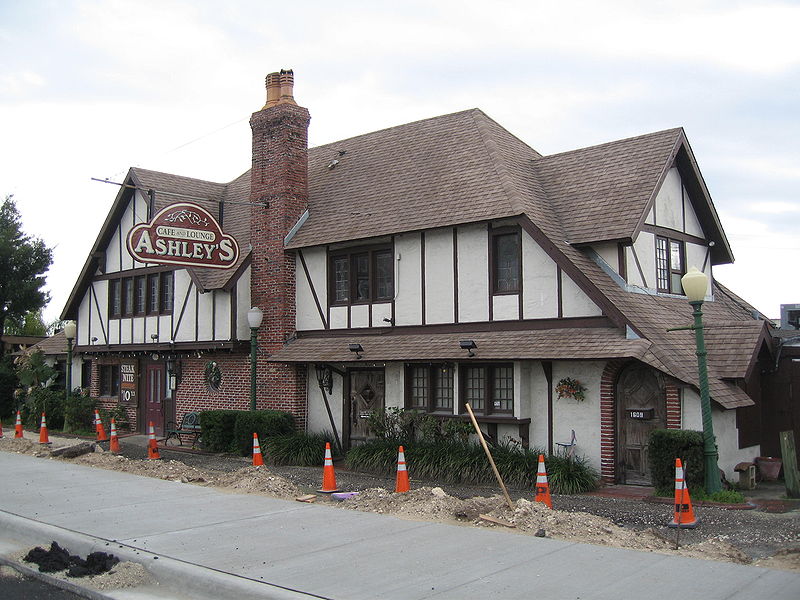
Some believe that Ethel Allen’s rough road to her grave included a stop at Jack’s Tavern, her favorite local hangout. Several years ago, I wrote about paranormal investigators conducting an EVP session at Ms. Allen’s grave in the Crooked Mile or Georgiana Cemetery on Merritt Island. After asking if she was present, investigators received a reply, “yes.”
On November 21, 1934, Ethel Allen’s mutilated body was found on the banks of the Indian River in Eau Gallie, some 16 miles away. The nineteen-year-old had been seen just a few days before when she stopped at a local packing house to say goodbye to a friend. Ethel was leaving to visit her mother, accompanied by a male acquaintance and she may have also stopped by her favorite local hangout, Jack’s Tavern, now Ashley’s of Rockledge. The Tudor-style restaurant has paranormal activity, some of which has been attributed to Ethel Allen.
A variety of sources state that Ethel may have been murdered within the walls of the restaurant in a storeroom (possibly near the famously haunted ladies restroom) or just outside the building. A local genealogy blog makes no mention of where Ethel may have met her end, but I get the feeling it probably was not in or around the busy tavern. The stories of the restaurant’s haunting are readily available though they seem to perpetuate different variations of the murder.
The activity runs the gamut from simple, cold breezes to voices and screams to full apparitions being seen and captured on film. Some sources also note that the activity does not seem to be limited to just the possible shade of Ethel Allen. There are other possible spirits including a child and an adult male. It seems that Ashley’s may be one of the most paranormally active restaurants in the state.
Sources
- Boonstra, Michael. “1934 Murder of Cocoa’s Ethel Allen.” Michael’s Genealogy and Brevard County History Blog. 9 April 2011.
- History. Ashley’s of Rockledge. Accessed 3 November 2014.
- Jenkins, Greg. Florida’s Ghostly Legends and Haunted Folklore: Vol. 1 South and Central Florida. Sarasota, FL: Pineapple Press, 2005.
- Neale, Rick. Brevard’s spookiest spots are dead center for teams of specter-spotters.” Florida Today. 27 October 2013.
- Thuma, Cynthia and Catherine Lower. Haunted Florida. Mechanicsburg, PA: Stackpole, 2008.
- Walls, Kathleen. Finding Florida Phantoms. Global Authors Publications, 2004.
Street Guide to the Phantoms of the French Quarter—Chartres Street
N.B. This article was edited and revised 30 April 2020.
This article is part of my series, Street Guide to the Phantoms of the French Quarter, which looks at the haunted places of this neighborhood in a street by street basis. Please see the series main page for an introduction to the French Quarter and links to other streets.
Chartres Street
Chartres Street, which is often pronounced CHAR-terz or CHAR-trez, was named for the Duc de Chartres in 1724 and is among several of the earliest streets in town. Initially, Chartres only ran from Canal Street to Jackson Square. From Jackson Square to Esplanade, the street was called Condé.
Mahogany Jazz Hall Burlesque and Absinthe House
125 Chartres Street

This 19th century building served as a boarding house for many years during which two tenants committed suicide. In 1892, a laborer was shot to death in front of the building with his murderer escaping into the dark of night. These deaths may contribute to the building’s haunted reputation with patrons and staff witnessing shadowy figures, hearing disembodied whispers, and feeling the cold touch of hands from the other side.
Sources
- “Murder in New Orleans.” The Daily Commercial Herald. 22 November 1892.
- Pinheiro, Maria. “Four little-known paranormal hotspots in New Orleans.” Malay Mail Online. 11 October 2016.
204 Chartres Street

Formerly the home to Crescent City Books, one of the more prominent second-hand bookstores in the city, this late 19th century commercial building is apparently haunted by ghosts on every floor, including the specter of a young boy on the first floor. An investigation by the New Orleans based International Society for Paranormal Research (ISPR) identified a number of children’s spirits on the first and second floor as spirits that may also haunt Le Petite Theatre de Vieux Carré on St. Peter Street. Other spirits were discovered on the third floor and attic.
Sources
- Dwyer, Jeff. Ghost Hunter’s Guide to New Orleans, Revised Edition. Gretna, LA: Pelican, 2016.
- Montz, Larry and Daena Smoller. ISPR Investigates the Ghosts of New Orleans. Atglen, PA: Schiffer, 2000.
W New Orleans – French Quarter
316 Chartres Street
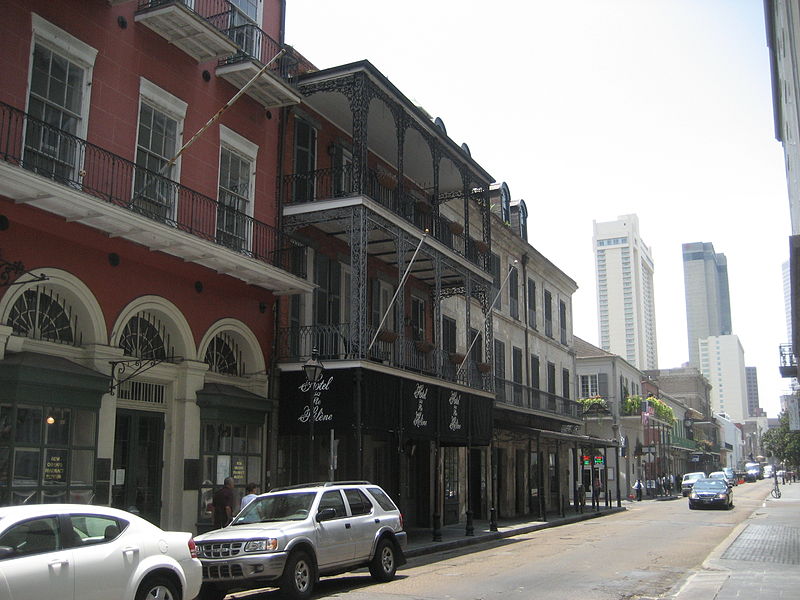
Formerly the Hotel de la Poste, the W Hotel is made up of a collection of old buildings many of which are occupied by their own collections of spirits. ISPR investigated the hotel in July of 1996. On the second floor of the hotel, investigators encountered the spirit of a white woman in her 30s who may be causing some activity there. In another section of the building which may have once held slave quarters, the spirits of three enslaved children were discovered. A middle-aged enslaved man, Gerald, was found by the group near the hotel’s parking garage, which may have been the site of stables were this man labored.
Sources
- Duplechien, Brad. “Haunted Louisiana Honorable Mentions Part 2.” Haunted Nation. 5 November 2016.
- Montz, Larry and Daena Smoller. ISPR Investigates the Ghosts of New Orleans. Atglen, PA: Schiffer, 2000.
The Bottom of the Cup Tearoom
327 Chartres Street
Since 1929, The Bottom of the Cup Tearoom has served as one of New Orleans’ psychical landmarks. The tearoom popularly featured psychics who would read the tea leaves left at the bottoms of customers’ teacups. Over time, the shop has added other forms of divination and psychic readings including tarot cards to its menu. While the shop’s second location (open from 1972-2003) at 734 Royal Street possessed the well-known spirit of Julia, there are no documented ghost stories associated with this building, though Jeff Dwyer has noted that the spirit may have moved to the shop after the closure of the Royal Street location. A quote from the shop’s manager indicates there may be some activity there, telling Country Roads Magazine, “There’s a lot of history ground into this neighborhood. Each decade leaves its traces and emotional resin, which helps us tune into the intuitive mind.”
Sources
- Dwyer, Jeff. Ghost Hunter’s Guide to New Orleans, Revised Edition. Gretna, LA: Pelican, 2016.
- McGunnigle, Nora. “The Bottom of the Cup.” Country Roads Magazine. 21 September 2018.
Williams Research Center
410 Chartres Street
The Williams Research Center occupies one of three campuses that houses parts of The Historic New Orleans Collection, which preserves and collects historic items and archives covering the history of the city and the region. The largest items in this collection are a number of historic properties including the building that houses the research collection. Built in 1915, this Beaux-Arts structure originally housed the Second City Criminal Court and the Third District Police Station. The Historic New Orleans Collection purchased the building in 1993 after it had been vacant for many years.
The renovation of this structure required gutting the interior at which time construction workers began to have odd experiences. These included hearing the slamming of cell doors, despite the doors having been removed, and seeing apparitions of police officers in old-fashioned uniforms.
Sources
- “Chartres Street Campus.” Historic New Orleans Collection. Accessed 14 January 2020.
- Montz, Larry and Daena Smoller. ISPR Investigates the Ghosts of New Orleans. Atglen, PA: Schiffer, 2000.
Napoleon House
500 Chartres Street

Built in 1797, this home was significantly expanded for early mayor, Nicholas Girod, who served from 1812-15. According to local lore, offered it as a refuge for Napoleon after he was exiled from France. While he died before he could travel, the house still bears his name. In 1834, some thirteen years after Napoleon’s death, his former physician, Dr. Antommarchi, opened a free clinic in the building, thus continuing its association with the deposed emperor. During the Civil War, wounded soldiers were treated in a hospital that operated on the second floor. In 1914, the Impastato family acquired the property and opened the restaurant and bar that remains in operation.
The over 200-year old history of the building has left spiritual activity. Some stories speak of a Confederate soldier who is seen to stroll the Chartres Street balcony before vanishing or hiding. Another story tells of an old lady who is spotted sweeping on the second floor. While yet others have witnessed the apparition of an enslaved woman in the courtyard.
Over the years, guests and staff have been surprised by lights turning off and on, sometimes on request. During a renovation of the building in the mid-1990’s the spirits expressed their displeasure with a heavy and oppressive feeling throughout. Bartenders also reported that bottles would occasionally fall from their perch behind the bar during this time. A paranormal group that investigated the building recently noted several entities on the property including a young lady in the courtyard who may have died in an accident and an old sailor who drinks at the bar late at night.
Sources
- Bailey, Shan. “Strange ghosts: Drinking sailor, sweeping lady haunt the Napoleon House.” NOLA Weekend. No Date.
- Brown, Alan. The Haunted South. Charleston, SC: History Press, 2014.
- Duplechien, Brad. “Napoleon House Bar – New Orleans, LA (A Ruler’s Hideout).” Haunted Nation Blog. 26 September 2016.
- Dwyer, Jeff. Ghost Hunter’s Guide to New Orleans, Revised Edition. Gretna, LA: Pelican, 2016.
- Montz, Larry and Daena Smoller. ISPR Investigates the Ghosts of New Orleans. Atglen, PA: Schiffer, 2000.
- “Napoleon House Historic Past.” Napoleon House. Accessed 2 June 2016.
New Orleans Pharmacy Museum (La Pharmacie Francais)
514 Chartres Street
When Louis Dufilho opened his pharmacy here in 1823, this was the first licensed pharmacy established in the country. Dr. Dufilho operated his business here for some 35 years before retiring and selling his business to Dr. Joseph Dupas. Many sources suggest that Dupas performed medical experiments on slaves, especially pregnant slave women.
Tour guide Katherine Smith suggested in her book, Journey Into Darkness: Ghosts and Vampires of New Orleans, that Dupas also treated wounded soldiers here during the Civil War. Perhaps the pain and death from the medical experiments and the soldiers being treated have left a mark on the energy of this building. Some visitors have reported being suddenly overcome with nausea while others have encountered a figure in a brown suit and white lab coat that may be the spirit of Dr. Dupas.
Sources
- Dwyer, Jeff. Ghost Hunter’s Guide to New Orleans. Gretna, LA: Pelican Publishing, 2007.
- Oldfield, Eileen. “Things that go bump in the haunted pharmacy.” Pharmacy Times. 30 October 2014.
- Smith, Katherine. Journey Into Darkness: Ghosts & Vampires of New Orleans. New Orleans, LA: De Simonin Publications, 1998.
Chartres House (Gally House)
540 Chartres Street
The large building occupying this corner of Chartres and Toulouse Streets is sometimes known as Keuffers Building. Built sometime after 1830, the building was intended to house businesses on the first floor with apartments on the second and third floors. If you walk alongside the building on Toulouse Street, you can see the separate slave quarters at the back of the building. Some passersby have noticed a young lady peering from the upper windows on this side of the building, despite the fact that these rooms were vacant at the time. Venture into the parking lot off Toulouse Street and look at the first small window. Tour guides will point out this window and encourage visitors to plunge their hand in. Some visitors have felt the feeling of their hands being grasped by small hands. Jeff Dwyer notes that these hands may belong to slave children who were housed in this room.

Recently, the Chartres House restaurant, which opened originally in the former Reynes Mansion (see below) across the street, relocated into the majestic Gally House.
Sources
- Dwyer, Jeff. Ghost Hunter’s Guide to New Orleans. Gretna, LA: Pelican Publishing, 2007.
- History. Chartres House. Accessed 30 April 2020.
Reynes Mansion (formerly the Chartres House)
601 Chartres Street
Originally built as a residence for the Reynes family following the Great Fire of 1788, this home was eventually occupied by the popular Victor’s Café in the late 19th century. Known as a hangout for artists and bohemians, Victor’s was a favorite of the writer William Faulkner.
An apartment located on the second-floor was the scene of a shooting death in the 1970s. The young man who lived there is supposed to have been involved in drugs. Following his death, the building’s owners had trouble renting the apartment as prospective tenants often detected bad energy and some became physically ill while touring the apartment.

This building was occupied by the Chartres House restaurant until it relocated across the street to the Gally House (see above).
Sources
- “Chartres House’s French Quarter History.” Chartres House. Accessed 2 June 2016.
- Muro, Maria. “Haunted Eats.” New Orleans Living. 9 October 2012.
Bosque House
617 Chartres Street, private

This classic late 18th century Creole townhouse was built to replace a home destroyed in the Great Fire of 1788. Legend holds that this fire started on this site. Don Vicente Jose Nuñez, the army treasurer, owned the house at this site where curtains caught fire from a candle on the family’s personal altar on Good Friday. Tradition prohibited the ringing of bells on this most holy day and the priests of St. Louis Church would not allow the church’s bells to be rung to alarm the citizens. The fire eventually destroyed the church and nearly 900 other buildings in the city. Residents of this private home have heard the sounds of muffled bells. Perhaps better late than never?
Sources
- Klein, Victor C. New Orleans Ghosts III. Metarie, LA: Lycanthrope Press, 2004.
- Smith, Katherine. Journey Into Darkness: Ghosts & Vampires of New Orleans. New Orleans, LA: De Simonin Publications, 1998.
The Cabildo
701 Chartres Street
The younger twin of The Presbytère, The Cabildo was constructed to replace the city hall that was destroyed in the Great Fire of 1788. Of all the buildings in this city, this building has witnessed more important historic events than any other. Within the walls of the Cabildo the Louisiana Purchase was finalized in 1803. During the building’s time housing the Louisiana Supreme Court, the case of Plessy v. Ferguson was heard before it headed to the U.S. Supreme Court where it enshrined the concept of “separate but equal” into American racial law. The building became a part of the Louisiana State Museum in 1908.
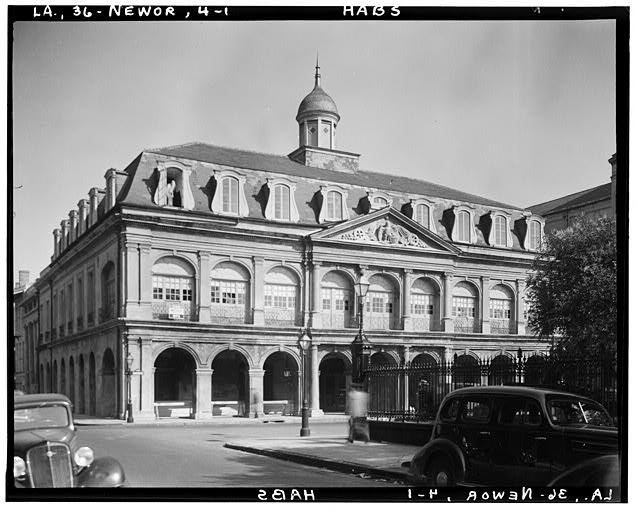
Buildings Survey (HABS). Courtesy of the Library of Congress,
Prints and Photographs Division.
While this building served as a seat of government for many years, a prison once stood behind it (see my entry on Pirate Alley for more information on this structure) which may explain the presence of a young soldier. Legend holds that the young man was imprisoned in the prison and, after a trial before a military tribunal, was summarily executed in the courtyard. Some of the museum’s staff and visitors have felt the sensation of someone rushing past them. Others have seen the pathetic form of a soldier in a ragged uniform.
Sources
- The Cabildo. Louisiana State Museums. Accessed 2 June 2016.
- Dwyer, Jeff. Ghost Hunter’s Guide to New Orleans. Gretna, LA: Pelican Publishing, 2007.
St. Louis Cathedral
Jackson Square

Courtesy of the Carol M. Highsmith Archive, Library of Congress, Prints and Photographs Division.
The Grande Dame of New Orleans, St. Louis Cathedral has stood at the sacred heart of this city since the construction of the first church on this site in 1718. The current building was originally constructed between 1789 and 1794 and heavily reconstructed in the mid-19th century. Legend holds that the black-robed form of Father Antonio de Sedella, often known by his French moniker, Père Antoine, appears during the Christmas Midnight Mass. The specter of this most beloved of curates appears to the left of the altar holding a candle.
Sources
- Brown, Alan. The Haunted South. Charleston, SC: History Press, 2014.
- “Our History.” Cathedral Basilica of Saint Louis. Accessed 2 June 2016.
The Presbytère
751 Chartres Street

The Presbytère is one of the pair of buildings flanking St. Louis Cathedral. Originally constructed in 1791 to match The Cabildo, this structure was known as “Casa Curial” or “Ecclesiastical House,” and provided housing for the Capuchin monks who ran the cathedral. In 1911, the building was taken over to house the Louisiana State Museum. The museum houses two permanent exhibits: one commemorating Hurricane Katrina and the other celebrating the city’s Mardi Gras traditions. While visiting the museum should you see a tall and slim maintenance man in a dark uniform with curly brown hair, be assured that you have just seen a ghost.
Sources
- Dwyer, Jeff. Ghost Hunter’s Guide to New Orleans. Gretna, LA: Pelican Publishing, 2007.
- The Presbytère. Louisiana State Museums. Accessed 2 June 2016.
Muriel’s Jackson Square
801 Chartres Street
Originally built as a grand residence for the noted Destrehan family (who also owned haunted Destrehan Plantation found along the famed River Road), the building that now houses Muriel’s partially burned in the Great Fire of 1788 that ravaged the city. Supposedly, the burned house was purchased by Pierre Antoine Lepardi Jourdan who restored the home but sadly lost it in a card game. Not willing to simply leave the home, he quietly resigned to the second floor where he committed suicide in what is now known as the Séance Lounge.

At least this is the story that is commonly told about this building. It is even included on the restaurant’s website. According to a 2013 blog post entitled, “The ‘Ghost’ of Muriel’s Restaurant,” this story is partially bunk. The blog notes that the current building was constructed sometime around the turn of the 20th century after the house on that site was torn down. While the history may not match up to the legend, there still may be paranormal activity with staff and visitors hearing knocking from inside the brick walls of the Séance Lounge, and disembodied voices, while encountering shadowy figures throughout the building. In order to keep some of the activity at bay, the restaurant maintains a special table for the ghost of Monsieur Jourdan.
Sources
- Brown, Alan. The Haunted South. Charleston, SC: History Press. 2014.
- Dwyer, Jeff. Ghost Hunter’s Guide to New Orleans. Gretna, LA: Pelican Publishing, 2007.
- “The ‘Ghost’ of Muriel’s Restaurant.” Myth Busters! 4 July 2013.
- “Our Ghost.” Muriel’s Jackson Square. Accessed 2 June 2016.
- Tipping, Joy. “Ghost trails and Halloween haunts in New Orleans.” Dallas Morning News. 23 October 2008.
Hotel Provincial
1024 Chartres Street

Like many hotels throughout the quarter, this hotel consists of an amalgam of different buildings, each with different histories. The 500 building seems to be the one with activity. The building was constructed on a site that was originally occupied by an Ursuline Hospital. It was here that the wounded from the 1814 Battle of New Orleans were treated. During the Civil War the buildings on the site were commandeered for use as a military hospital. That building burned and was replaced by the current structure. Guests and staff have, according to tradition, encountered bloodstains that disappear before their eyes, wounded soldiers in the rooms and corridors, doctors and nurses in bloodstained clothing, and one unlucky security guard using an elevator had the doors open to reveal the scene of a Civil War era surgery.
Sources
- Brown, Alan. The Haunted South. Charleston, SC: History Press. 2014.
- Dwyer, Jeff. Ghost Hunter’s Guide to New Orleans. Gretna, LA: Pelican Publishing, 2007.
- “The Hauntings of the Provincial Hotel.” Ghost Eyes Blog. 20 August 2009.
Old Ursuline Convent
1100 Chartres Street
One of the oldest buildings in New Orleans, the old Ursuline Convent has survived hurricanes, fires, and the nuns have provided aid during plagues and epidemics. It’s no surprise that their old convent would house spirits. According to Jeff Dwyer, the spirits of Ursuline sisters have been seen gliding throughout the building while the spirit of a Civil War era soldier has been seen in the garden. (For a couple photos of the Old Ursuline Convent see my entry here.)
Sources
- Dwyer, Jeff. Ghost Hunter’s Guide to New Orleans. Gretna, LA: Pelican Publishing, 2007.
Beauregard-Keyes House
1113 Chartres Street
See my entry, “Creepiness on Chartres Street,” for an in depth look at the history and hauntings of this famous home.
Le Richelieu Hotel
1234 Chartres Street
Housed in two buildings, one dating from 1845, the other from 1902, the Le Richelieu Hotel occupies the site where five French patriots were executed in the late 18th century. The spirits of these five men may still reside here. For further pictures see, “A Handful of Haunts—Photos from New Orleans.”
Sources
- “A Brief History.” Le Richelieu. Accessed 3 June 2016.
- Smith, Katherine. Journey Into Darkness: Ghosts & Vampires of New Orleans. New Orleans, LA: De Simonin Publications, 1998.
The Battlefield on Chartres Street
Beauregard-Keyes House
1113 Chartres Street
New Orleans, Louisiana
N.B. This article was edited and updated 8 August 2019.
For information on neighboring spirits see my Chartres Street guide and the main page for my Phantoms of the French Quarter series.
The sunny, yellow façade of the Beauregard-Keyes House on a relatively quiet section of Chartres Street does not belie the sometimes tragic history that has taken place within its walls. That quiet demeanor is shattered frequently by tour guides, with gawking tourists in tow, intoning one of the many “legends” about this house as they pass. According to their spiels, the house is inhabited by a pantheon of shades, some quite famous.

General Pierre Gustave Toutant-Beauregard, who occupied the house for about three years following the Civil War, was supposedly haunted by his defeat at the Battle of Shiloh. “…it’s General Beauregard whose presence at 1113 Chartres Street, and whose ghost seems obsessed with returning to the bloody scene of battle that traumatized him for the rest of his life—and beyond.”
Mary Beth Crain in her 2008 book, Haunted U.S. Battlefields continues, “In 1893, the year of the general’s death, people walking by the house late at night reported hearing ‘the voice.’ Someone seemed to be gasping ‘Shiloh…Shiloh’ over and over in a raspy chant that sounded as if it were coming from a great distance…Who else could ‘the voice’ belong to but General P.G.T. Beauregard, the man who throughout his life was haunted by the demons of the battle he needlessly lost? …There was terror in that one word, a sense of horror that was so convincing, those who heard it bolted as fast as they could.”

A Haunting Battle
For a name that is Hebrew for “place of peace,” Shiloh, Tennessee is associated with the stench of death and quite possibly haunted Beauregard after his defeat there. The battle, fought in early April, 1862, is often described as the first of the many bloody battles that would be fought during the Civil War.
Union troops under General Ulysses S. Grant were encamped on the banks of the Tennessee River near Pittsburg Landing, Tennessee, while some twenty-odd miles away Confederate troops under General Albert Sidney Johnston and Beauregard, his second in command, were camped at Corinth, Mississippi. Union reinforcements under General Don Carlos Buell were expected to arrive from Columbia, Tennessee after which Grant would sweep down into Mississippi to begin slow disemboweling the Confederacy. Johnston, over Beauregard’s objections, aimed at attacking Grant’s forces before Buell’s arrival. Beauregard bowed to Johnston’s commands and prepared a battle plan along the lines of Napoleon’s advance at the Battle of Waterloo. Coincidently, Beauregard, due to his short stature and French heritage was known as “The Little Napoleon.”
The first assault hit the Union camps around 9:30 on the morning of April 6. Union troops were taken by surprise in the middle of breakfast as Confederate troops charged into their camps bearing the red battle flag emblazoned with the blue, starred St. Andrews Cross that had been designed by Beauregard. Many troops on both sides along the three-mile battle line were still green, and scared by the ferocity of battle, fled, with many of the Union troops fleeing towards the safety of the Tennessee River where they cowered under the bluffs. But one Union line held: composed mainly of Illinois and Iowa farmers. This line, along a sunken road through thick woods and a peach orchard under the command of Brigadier General Benjamin M. Prentiss, kept the Confederates at bay for some six hours. They endured charge after charge and almost point blank artillery fire. General Johnston led the final Confederate charge when a bullet severed his femoral artery from which he died a short time later. Command then passed to Beauregard.

Prentiss’ division maintained their position along the sunken road where the ferocity of fighting was dubbed “The Hornet’s Nest.” Confederates surrounded the area on three-sides and they massed artillery onto the position, pouring volley upon volley of cannon-fire onto the Union troops. At 5:30 in the afternoon, Prentiss and his remaining 2,200 troops surrendered. The remaining Yankees had been pushed back to the Tennessee. Surveying the situation, Beauregard surmised that he could easily wipe out the remaining troops the following morning.
The sun rose the next day on a Federal force of nearly 50,000 as Buell’s reinforcements had arrived during the night. This huge force now faced Beauregard’s 30,000 troops. Slowly but surely, Union forces sliced into the Confederates with the troops falling back all the way to Corinth, Mississippi. The battlefield was thoroughly littered with the dead and dying, more than had ever been killed in any war previously fought by the United States: some 3,477 dead with some 23,000 wounded.
Historian Shelby Foote described the battle as “a disorganized, murderous fistfight of one hundred thousand men slamming away at each other.” It was this murderous and costly battle that sickened Beauregard so that he took immediately sick leave without permission of Jefferson Davis, who demoted him. Grant’s responsibility in the blood bath led to his being replaced by General Henry Wager Halleck.
Beauregard’s Haunting Legacy
After losing his military rank, Beauregard’s rank was restored and he went on to serve admirably through the end of the war. He retired to the house in New Orleans that now bears his name where his lived quietly for three years. Over time, legend has risen speaking of a more sinister legacy left by Beauregard in the house. Some tenants of the house have spoken of hearing the sounds of battle, perhaps from Shiloh, within and without the house. Even more interesting is the story that tenants being awakened by the sound of battle have stepped into the ballroom only to walk into the midst of the battlefield of Shiloh. While perhaps the story of the battlefield appearing in the ballroom may be only the product of the story passing through a “multi-generational telephone game.”

House, 2011. Photo by Benjamin Lewis,
all rights reserved,
Of course the lone, contemplative shade of Beauregard has also been reported throughout the house. Jeff Dwyer in his Ghost Hunter’s Guide to New Orleans reports that the General’s spirit has been seen peering out the home’s windows, even seen waltzing with a female, most likely his second wife (his first wife, Marie, died in 1850), Caroline. Interestingly, Beauregard and his wife, Caroline, never lived in the house together. The dashing military man and his bride married in 1860 on the eve of the war. The young couple spent much of the war apart and Caroline died in New Orleans in March of 1864 while it was under Union occupation. After receiving news of his wife’s passing, the stunned Beauregard continued to carry out his duties.
Following the war, without a job, money, or a wife, a chastened Beauregard refused to take the loyalty oath until after he was counseled to do so by his former Confederate peers, Generals Robert E. Lee and Albert Sidney Johnston. He took the oath before the mayor of New Orleans around the time he took up residence in the elegant house on Chartres Street. He was offered positions in the militaries of Brazil, Romania and Egypt but refused the offers saying, “I prefer to live here poor and forgotten, than be endowed with honor and riches in a foreign country.” Perhaps he spent his time in the house in Chartres pining for his darling Caroline and regretting his military blunders, but that is only speculation. Novelist Frances Parkinson Keyes, who lived in the house in the mid-20th century promulgated this mythos in her 1962 novel, Madame Castel’s Lodger. The novel portrays a defeated Beauregard looking back over the remains of his life.
History of 1113 Chartres
Besides it’s three-year occupation by Beauregard, the home possesses quite an illustrious history. Built by Joseph Le Carpentier, an auctioneer, the house was designed by Francois Correjolles incorporated elements of Roman and Greek architecture. Le Carpentier is said to have started his business selling goods for the pirate, Jean Lafitte (who, incidentally, figures into many local ghost stories and legends), and was also grandfather to the master chess player Paul Morphy, who was born in the house.
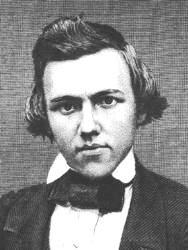
A few writers mention Morphy among the pantheon of spirits in the house, though much of their information appears to be incorrect. Mary Beth Crain refers to Morphy as “Paul Munni,” though I can’t discern why. It states that he went insane while living in the house. While I have been able to determine that Morphy was in fact born in the house, his mother was Le Carpentier’s daughter, I can find nothing about his residency in the house as an adult. He returned to New Orleans towards the latter part of his life and “retired” from chess, having been victorious over all the world’s chess masters. While I’ve yet to find anything that specifically states that Morphy lost his sanity, he did live his life in seclusion. Morphy died at his home, which is now Brennan’s Restaurant at 417 Royal Street (which has a number of spirits, possibly even Morphy’s), after taking his usual afternoon constitutional and then taking a cold bath.
After leaving the hands of the Le Carpentier family, the house passed through a number of hands including those of Swiss Consul, John A Merle, whose wife created the garden surrounding the house. As the owners changed, the neighborhood changed; filling with Italian immigrants towards the end of the nineteenth century. The house was bought by Sicilian wine merchant, Pietro Giacona in 1904.

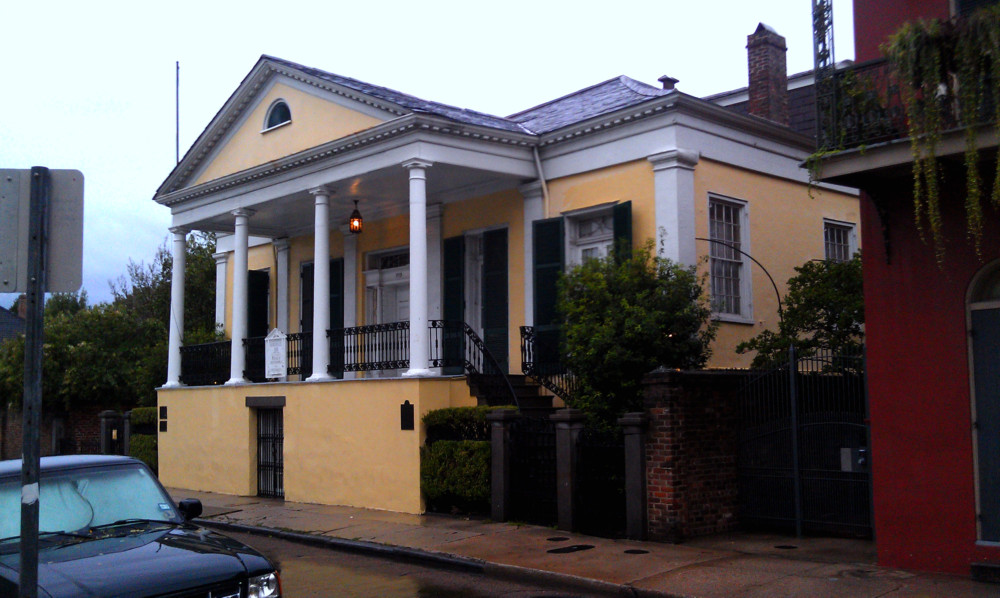
Keyes House, 2011. Photo by Benjamin Lewis, all rights reserved.
The Battle of Chartres Street
The Black Hand or La Mano Nero was an extortion racket commonly used among Italians and Italian Americans throughout the nineteenth and into the early part of the twentieth century, when the Mafia took on subtler methods of crime. New Orleans had already seen the tragic effects of such crime in 1890 with the assassination of police chief David Hennessy. The most common modus operandi for The Black Hand was to send the victims a letter, signed with a black handprint, threatening harm unless a specific amount of money was paid.
The Giacona family while living here found themselves victims of The Black Hand, in 1908, after receiving a letter demanding payment of $3000 or certain death. Events reached a zenith in the early morning hours of June 17. When Commander Thomas Capo of the Third Precinct Station arrived at the house around 2:45 AM, he witnessed everything in confusion:
I saw the old man standing on the gallery with the shotgun in his hand, while his son stood almost in the doorway with a rifle in his hands. On the gallery, two of the men were stretched out in death. Their shirts were covered with blood. In the yard, at the foot of the stairs, another man was lying. From its position in the yard, I judged that he was shot while running down the stairs, and had rolled to the ground. The table around which the men were seated before the shooting commenced was littered with watermelon rind and egg shells. Some half-filled wine goblets were also on the table.
A trail of blood led from the yard, over a wall and up and down a number of streets in the area. The trail led to Francisco Vitale who was found wounded at Bourbon and Ursulines Streets.
Pietro Giacona, his son Corrado, and a nephew, Pietro Bellonde, were all arrested for the murders of the Barraca brothers, Giovanni and Nuncy, and Cero Cusimano. Eventually, the Giaconas and the nephew were released. Upon their return, it is said that the house was turned into a fortress. The events of that early June morning were not easily forgotten and may continue to be re-enacted. Reports from people passing the house late at night have included the sounds of gunfire and shouting, the acrid smell of gunpowder and shadowy figures flitting around the fountain in the garden.

When the house was sold in 1925, Antonio Mannino, the new owner considered demolishing the house for either a warehouse or a macaroni factory. This possibility riled local preservationists who were disturbed by the loss of such a landmark. Beauregard House Inc. took over the house and in 1944, the group rented the house to novelist Frances Parkinson Keyes who occupied the house for some 25 years. During this time, she spearheaded a major renovation of the house while writing novels that included the house and former residents. She also created the Keyes Foundation which bought and now operates the house as a museum.
Spiritual remnants from this era may include Mrs. Keyes’ beloved cocker spaniel, Lucky. The dog died only a few days after his mistress’ death. Stories also tell of a large cat that is seen darting through and around the house but then disappearing. The cat is likely the shade of Caroline, a cat that took up in the house museum’s garden. Guests and guides in the house have felt a feline rubbing against their legs.
Though the current directors of the Beauregard-Keyes House deny the existence of spiritual activity in the house, it apparently hosts a legion of spirits. These denials keep investigators at bay, though the city’s many tour operators still walk and drive tourists past the house spinning creepy, and somewhat fictional tales battles on Chartres Street.
Sources
- Battle of Shiloh. Wikipedia, the Free Encyclopedia. Accessed 2 December 2010.
- Bruno, Stephanie. “A House Where the Tall-Tales Are True.” The Times-Picayune. 5 March 2005.
- Crain, Mary Beth. Haunted U. S. Battlefields. Guilford, CT: Globe Pequot Press, 2008.
- “Death of Paul Morphy.” The Daily Picayune. 11 July 1884.
- Dwyer, Jeff. Ghost Hunter’s Guide to New Orleans. Gretna, LA: Pelican Press, 2007.
- Frances Parkinson Keyes. Wikipedia, the Free Encyclopedia. Accessed 23 May 2016.
- “Giacona hearing fixed for Thursday.” The Daily Picayune. 7 July 1908.
- “Giaconas held, but allowed bail.” The Daily Picayune. 10 July 1908.
- “Giaconas held without bond.” The Daily Picayune. 19 June 1908.
- Klein, Victor C. New Orleans Ghosts. Chapel Hill, NC: Professional Press, 1993.
- Paul Morphy. Wikipedia, the Free Encyclopedia. Accessed 2 December 2010.
- G. T. Beauregard. Wikipedia, the Free Encyclopedia. Accessed 2 December 2010.
- Sillery, Barbara. The Haunting of Louisiana. Gretna, LA: Pelican Publishing, 2001.
- Ward, Geoffrey C., Ric Burns and Ken Burns. “A Bloody Affair (1862). The Civil War. American Documentaries, Inc. 1990.
- Ward, Geoffrey C., Ric Burns and Ken Burns. The Civil War: An Illustrated History. NYC: Knopf, 1990.
Apparitions at Allatoona—Cartersville, Georgia
Allatoona Pass Battlefield
Old Allatoona Road
Cartersville, Georgia
Despite Atlanta’s sprawl and the construction of the nearby I-75 corridor, Allatoona Pass Battlefield remains as one of the most pristine battlefields in the country. Located about a mile and a half from bustling I-75, the battlefield seems remote and almost lost in time. The village of Allatoona that existed in 1864 is mostly gone, replaced instead by the Lake Allatoona reservoir and a few buildings of more recent vintage. Even the railroad has abandoned the area, having been rerouted with the building of the reservoir.


At the time of the Civil War, the Western & Atlantic Railroad provided the vital link between Atlanta and Chattanooga, Tennessee which found itself very close to Union territory following the Confederate defeat at Shiloh. This somewhat mountainous region provided one of the first obstacles as the railroad made its way north. Just north of the tiny village of Allatoona slave labor was used to dig a cut through the Allatoona Mountains allowing trains to move easily towards Chattanooga. The village at the south end of the cut mostly consisted of a depot, some warehouses and an odd assortment of houses and shops. After the pass was captured by Federal forces in June of 1864, Sherman ordered that the pass be heavily fortified and three star-shaped earthen forts were constructed to stand guard.


In a last-ditch attempt by the Confederates to capture and destroy Sherman’s supply line to federally held Atlanta, they attacked these forts on October 5th. Under the command of Major General Samuel G. French, the Point Coupee Artillery from Louisiana poured shells onto the well-entrenched units from Illinois, Wisconsin and Minnesota under the command of Brigadier General John M. Corse. After two hours, French sent an order for Corse to surrender, which was refused.

Legends at this site date to not long after the war when a Confederate soldier (believed to be the spirit of an unknown soldier buried next to the tracks) was seen. More recently, the sounds of battle, cries of the wounded, spectral soldiers and an overpowering sense of dread have been reported here.
Sources
- Battle of Allatoona. Wikipedia, the Free Encyclopedia. Accessed 15 April 2011.
- Lake Allatoona. Wikipedia, the Free Encyclopedia. Accessed 8 April 2011.
- Scaife, William R. Allatoona Pass Battlefield: The Official Website. 2000.
- Underwood, Corinna. Haunted History: Atlanta and North Georgia. Atglen, PA: Schiffer, 2008.
Montgomery, Alabama’s Haunted Five
N.B. This article was edited and revised 18 May 2019.
Alabama’s state capital, Montgomery, appears to play second fiddle to Birmingham, the largest city in the state. But Montgomery has a complex history that has put it often at the forefront of many historical movements in the South. Starting as a frontier trading post, the city served as the first capital of the young Confederacy until the rebel government moved to Richmond, Virginia.
After the Civil War, the city became known for technological achievements in the form of an electric trolley system, and in 1910, a flying school opened by the Wright brothers. In the mid-20th century, the city’s sad racial history placed it at the forefront of the Civil Rights movement presenting us with a mighty lion in the form of a petite seamstress named Rosa Parks.

Paranormally speaking, the city has a fascinating panoply of spirits, many of which have been covered in two recent books: Faith Serafin’s Haunted Montgomery and Shawn Sellers and Jake Bell’s Montgomery: A City Haunted by History, both published in 2013.
Capital Towers Apartments
7 Clayton Street, private
On February 7, 1967, fire ravaged the swanky restaurant on the top floor of this building. Dale’s Penthouse restaurant was one of the most fashionable dining options at the time in Montgomery. As the fire broke out on this frigid February night, rapidly moving flames blocked the elevator and the stairwell, trapping and killing 26 patrons including several well-known politicians and local personalities. While some conspiracy theories exist as to the origin of the fire, the official explanation points to a lit pipe left in a coat pocket.


The building itself only received slight damage and the penthouse that once housed the restaurant is now a private residence. Former residents of the building have reported hearing screams of “help,” while residents in the penthouse have spotted misty, black forms. Shawn Sellers notes that passersby near the building have smelled smoke and heard screams coming from near the top floor.
Sources
- Hull, Christine Kneidinger. “26 died in Dale’s Penthouse fire in Montgomery 44 years ago today.” AL.com. 7 Feb 2011.
- Sellers, Shawn & Jake Bell. Montgomery: A City Haunted by History. Shawn Sellers, 2013.
- Serafin, Faith. Haunted Montgomery, Alabama. Charleston, SC: History Press, 2013.
Chris’s Hot Dogs
138 Dexter Avenue
While the hot dogs are legendary around these parts, the good food is not the only reason Montgomery citizens still flock to Chris’ Hot Dogs, it’s the atmosphere; an atmosphere still punctuated by spirits. Founded in 1917 as the Post Office Café, this restaurant has become an institution in its 98 years of business. For three decades, this café was a popular late night hotspot serving hot dogs and liquor and attracting the likes of country singer, Hank Williams.
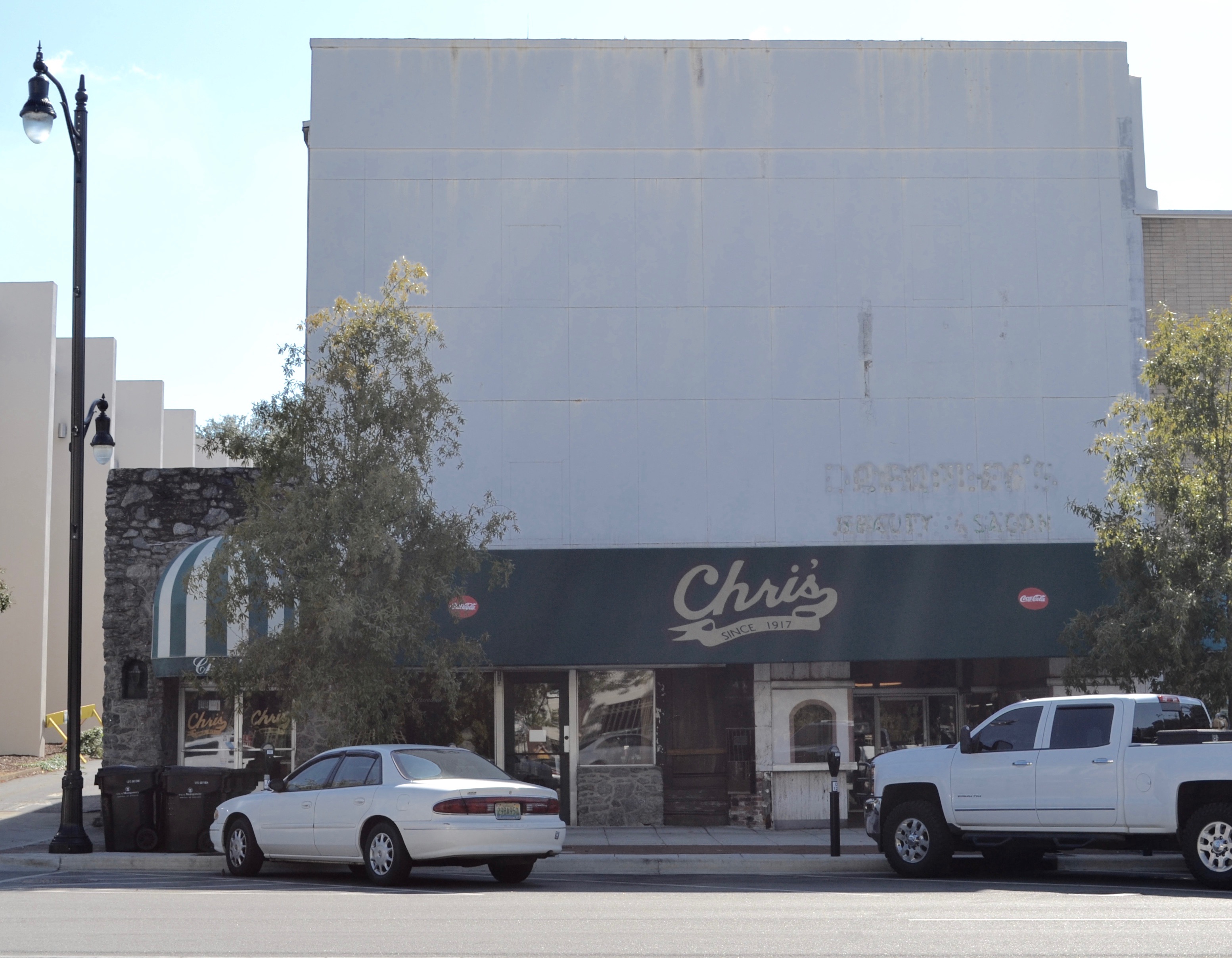
Shawn Sellers and his investigation team explored the restaurant and discovered that the staff has countless stories about employees still working their shifts from beyond the grave. Perhaps Hank Williams can be heard still singing under the green and white striped awning?
Sources
- Cumuze, Greg. “My Immutable Heaven.” Chris’ Hot Dogs History. Accessed 26 May 2015.
- Sellers, Shawn & Jake Bell. Montgomery: A City Haunted by History. Shawn Sellers, 2013.
Downtown Montgomery’s Lady in White

The identity of this mysterious woman is unknown, but her apparition is quite frightening. Seen throughout downtown Montgomery, the Lady in White is dressed entirely in white with long and dark hair and animal-like, ferocious teeth. In a 2013 article, Shawn Sellers is quoted as saying, “She’s actually the most reported ghost of anywhere in downtown Montgomery. She’s always seen outside. She’s never looking at anybody. She’s just always walking up the street, and people say they feel her before they see her. She’s just a creepy, creepy energy.”
Sources
- Sellers, Shawn & Jake Bell. Montgomery: A City Haunted by History. Shawn Sellers, 2013.
- Sutton, Amber. “Ghosts, curses and more: Take a walk on the supernatural side with Haunted Montgomery Tours.” AL.com. 2 Oct 2013.
F. Scott and Zelda Fitzgerald Museum
919 Felder Street
In Fitzgerald’s classic novel of the Jazz Age, The Great Gatsby, Daisy Buchanan remarks on the birth of her daughter, “I’m glad it’s a girl. And I hope she’ll be a fool—that’s the best thing a girl can be in this world, a beautiful little fool.” Some suspect that Fitzgerald’s Montgomery-born wife, Zelda, may have made a similar remark on the birth of their daughter. Zelda, whose zest for life strongly influenced her husband as well as legions of young women, lived her life as the epitome of the “foolish” Flapper.
Zelda and her husband lived in this house for a scant five months—October 1931 to February 1932—but during that time F. Scott Fitzgerald completed his novel, Tender is the Night, while Zelda outlined her one and only novel, Save Me the Waltz. The house was saved from demolition in 1986, and later opened as a museum to the literary couple. The upper floor of the house now has several private apartments, and residents there have reported hearing faint jazz music and disembodied footsteps. The museum’s director has reported that Zelda’s “foolish” spirit has remained active in the house and is believed to be the spirit responsible for flinging a painting from the wall while a staff member watched.
Sources
- Curnutt, Kirk. “Zelda Sayre Fitzgerald.” Encyclopedia of Alabama. 15 Mar 2007.
- Herbert, Katherine. “Scott and Zelda Fitzgerald Museum.” Encyclopedia of Alabama. 14 Aug 2014.
- Sellers, Shawn & Jake Bell. Montgomery: A City Haunted by History. Shawn Sellers, 2013.
- Serafin, Faith. Haunted Montgomery, Alabama. Charleston, SC: History Press, 2013.
Montgomery Riverwalk Stadium
200 Coosa Street
Home to the Montgomery Biscuits, the city’s minor league baseball team, Riverwalk Stadium is located on the site of a former Civil War prisoner of war camp. During the war, this site was occupied by a cotton warehouse. After the Battle of Shiloh in April of 1862, Union prisoners were housed in the warehouse in reportedly deplorable conditions until they were moved to Tuscaloosa in December of that year. Faith Serafin notes that some 200 prisoners died while in captivity at this site.

According to Shawn Sellers, before groundbreaking took place for the ballpark, this site was occupied by a hotel. Maids would sometimes find rooms disturbed after they had cleaned them, while guests observed mysterious figures in their rooms. After the hotel closed, the building was occupied by offices where similar activity was reported. The stadium may host activity including shadow figures, the sounds of weeping and screaming, and the occasional apparition.
Sources
- Sellers, Shawn & Jake Bell. Montgomery: A City Haunted by History. Shawn Sellers, 2013.
- Serafin, Faith. Haunted Montgomery, Alabama. Charleston, SC: History Press, 2013.
Other Montgomery Hauntings
Several other Montgomery hauntings have been covered elsewhere in this blog. Coverage of Alabama’s State Capitol Building can be found in my “Southern Spirit Guide to Haunted Alabama.” Two locations at Huntingdon College have been covered: Houghton Memorial Library in my “Guide to the Haunted Libraries of the South –Alabama,” and Pratt Hall as the representative haunting for Montgomery County in my “Alabama Hauntings–County by County, Part VI.”
A Not So Colonial Haunting–Williamsburg, Virginia
Williamsburg Theatre
formerly the Kimball Theatre
428 West Duke of Gloucester Street
N.B. This article was updated and edited 17 February 2019.
Williamsburg is more reconstruction than restoration. The passage of time had taken its toll on the city when John D. Rockefeller, Jr. and W. A. R. Goodwin began their project to return part of the town to what it had been in the mid-18th century. Some buildings were long gone and had to be reconstructed, while others had modern additions that needed removal. Plus, there was a need to provide accommodations and conveniences that modern visitors would expect.

Rockefeller envisioned Merchant’s Square as providing modern shopping and entertainment conveniences while still maintaining a colonial atmosphere. Among the entertainment options was the Williamsburg Theatre which offered live performances and films in a graceful and air-conditioned Georgian structure.
The theatre opened in January of 1933, with a performance of George Farquhar’s Restoration Comedy, The Recruiting Officer. According to the Colonial Williamsburg Foundation, this play was the first play performed in British North America when it was produced in Williamsburg. Interestingly, this play was the first play performed in the haunted Dock Street Theatre in Charleston, South Carolina, which is also a reconstruction for that matter. The Williamsburg Theatre was restored in 2000 and named for Bill and Gretchen Kimball, who sponsored the restoration.
As of 2017, the College of William & Mary has signed a lease to the Kimball as a production space for its Department of Theatre & Dance.
As one might expect, not all the spirits in Colonial Williamsburg are from the 18th century. As Virginia was at the heart of much of the fighting during the Civil War, that conflict has left a spiritual impression on the area. Legend holds that the spirit within the Kimball is a Union soldier.
The land now occupied by the Kimball Theatre was once the home of the Ware family. During the Civil War, the women of the family, as many did during the war, took in and nursed wounded soldiers. They took in a young Confederate soldier who had been wounded in the Battle of Williamsburg, though their care was in vain. The soldier passed away and the ladies took his body to the parlor to await removal.
After Union soldiers captured the town, they went house to house in search of Confederates hiding among the civilians. Upon reaching the Ware House, one soldier was shown to the parlor and the sheet covering the young soldier’s body pulled back. The young Union soldier was horrified to see the body of his own brother who with his different political biases had joined the Confederate army. Sadly, the young Union soldier was not long for this earth and was killed not long afterwards.
A blue-clad spirit, possibly that of the Union soldier, has been seen within the theatre. He appears to be frantically searching for something among the backstage rooms and then suddenly disappears.
Other, colonial spirits may be found in my “Haunts of Williamsburg” entry.
Sources
- Behrend, Jackie Eileen. The Hauntings of Williamsburg, Yorktown, and Jamestown. Winston-Salem, NC: John F. Blair, 1998.
- Chappell, Edward, Mary Harding Sadler and Llewellyn Jewell Hensley. National Register of Historic Places nomination form for Merchants Square and Resort Historic District. 28 February 2006.
- Colonial Williamsburg. “Kimball Theatre.” Accessed 6 April 2013.
The Fickleness of Phantoms—Rippavilla Plantation
Rippavilla Plantation
5700 Main Street
Spring Hill, Tennessee
N.B. This post was edited and revised 13 May 2019.
Phantoms and ghosts are very fickle things. Like birding for a rare species, it’s very difficult to find them even in their natural habitat. I was contemplating all of this as I sat alone in a bedroom at Rippavilla around 2:30 AM, towards the end of my first, formal paranormal investigation.
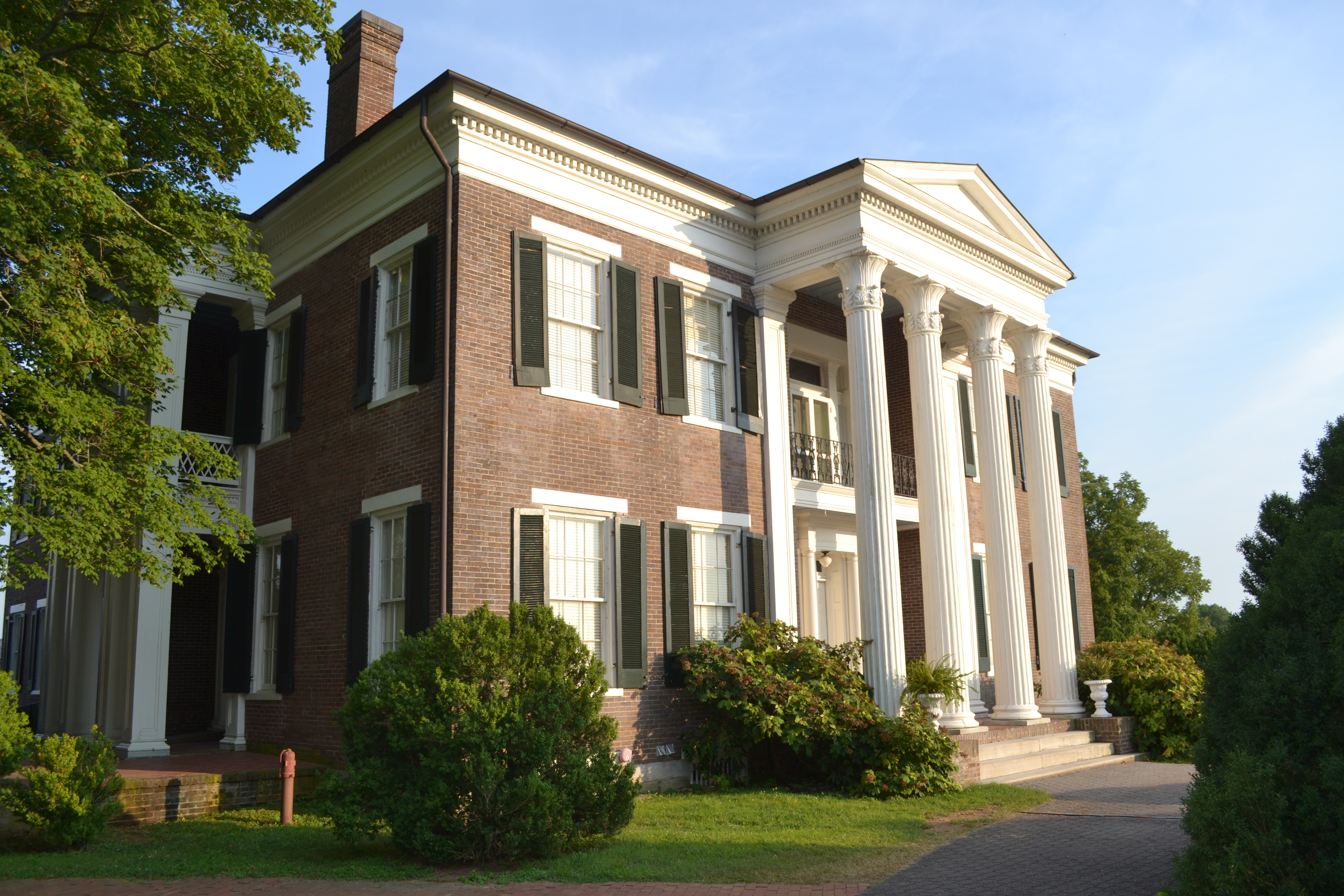
As Nashville, Tennessee sprawls its fingers outwards, it’s beginning to take over middle Tennessee. Small towns like Franklin and Spring Hill have been caught up in the web of development as these charming, and once rural towns are paved over with asphalt and chain businesses. Franklin, just north of Spring Hill and closer to Nashville, has only in recent decades begun fighting back and working to preserve its historic and battle-scarred heart.
Middle Tennessee was one of the areas that saw the brunt of fighting during the Civil War. As the last state to join the waltz of the Confederacy, Nashville became an immediate target for the Union and was the first state capitol to fall into their hands. Those cities and towns south of Nashville—Franklin, Spring Hill and Columbia, among them—were captured and held by armies of both sides during this turbulent period. After Sherman’s capture of Atlanta, far south, the Confederates under General Hood—who had lost Atlanta—attempted to capture Nashville and redeem themselves in the eyes of the Confederates.
Spring Hill and its surrounding estates had seen an influx of Confederate wounded into the small town. Many of the homes—including Rippavilla—had been requisitioned for use as hospitals. According to my guides in the house, the house had seen a smallpox epidemic among the wounded in 1862. During Hood’s Nashville campaign, wounded soldiers once again began to pour in followed by a series of generals, including Hood himself. During the fighting here in Spring Hill, Rippavilla’s fields were the scene of fighting.
Spring Hill saw battle the day before the Battle of Franklin in 1864. While not a major battle, it did leave a few hundred dead or wounded on both sides. Spring Hill was just a stepping-stone in Confederate General Hood’s attempt to dislodge the Union army from Nashville. As the fighting edged on towards Christmas, hope for the Confederacy faltered. Sherman held Atlanta and was marching to the sea destroying much in his path to Savannah, while Hood was defeated at Nashville and routed to Tupelo, Mississippi.
Part of that battle was fought on the grounds of Rippavilla Plantation, just south of town and like so many buildings throughout the South, the house was used as a hospital. This house has many layers of history, each leaving spirits within the house. One source reports spirits from Native Americans, through the Civil War and a smallpox epidemic during that era through to the 20th century, when rumors indicate the house may have seen use as a brothel.

The home is very similar to a number of other remaining plantation homes in the area in its brick construction and Greek Revival design. The columns, however, show the influence of Egyptian Revival design with capitals depicting papyrus but with the addition of the Greek-style acanthus leaf. This adds a unique touch. Apparently, while the exterior of the home has not changed much, the interior has changed greatly. Downtown Nashville’s First Presbyterian Church—now a National Historic Landmark—features Egyptian Revival elements, one must wonder if there’s a connection.
Visitors being shown inside will encounter a dramatic, sweeping staircase that splits at the landing to rise to the second floor. This feature was added in the early 20th century to replace the smaller, less dramatic staircase. Electricity, plumbing and air conditioning were installed in the house as well as bathrooms.
The home was built by Nathaniel Cheairs, a wealthy cotton planter. It was modeled on Ferguson Hall—the nearby home of his brother, Martin. Work was begun in 1851 and it took four years to complete. The large kitchen building behind the house was completed first and the family lived there until the mansion was finished. Legend holds that the mansion’s walls were pulled down three times to correct Nathaniel’s perceived deficiencies in the masonry.
Rippavilla flourished along with other nearby plantations owned by Cheairs, and by 1860, the census reports some 75 slaves working the estate. Though, with the coming war, all that would be swept away.

Many have automatically assumed that I’m a paranormal investigator. That’s not really the case. I consider myself a writer and researcher—more adept at sussing out information and presenting it in a palatable form—as opposed to an investigator tramping through historic places with loads of technology. I can say, that I’m very much a Luddite. Not that I reject technology, but I do grow weary of having to keep up with it.
This brings me to sitting alone in a bedroom at Rippavilla Plantation last weekend as the clock neared 3 AM. We’d been told to pick a room and then just sit for a little while and see what happens. Always being the “different” one, I chose the room that a number of people didn’t “like.” One of the volunteers helping with the investigation had told me that she could not enter this particular room. If she did, she’d usually end up having an emotional reaction.
This bedroom, in particular, had been used as a surgery. Blood stains on the floor attested to that fact. A military style bed had been installed in the room with soldier’s accoutrements sitting upon and around it. I found a single chair within in the room next to the door leading into the next bedroom. Through the door I could see the door of another bedroom, one that had bloodstains from a more recent murder still staining the floor.
All of this did make me uncomfortable. Glancing at the floor around my chair I did see about five drops of something staining the floor. My active imagination envisioned these drops possibly dripping from a surgeon’s knife or a spurting artery as a soldier writhed in pain. In fact, I had nothing to indicate it was actually even blood.
Still, sitting in this room, I found it hard to imagine the air filled with moans and cries, as it would have been during the war. Though, it seems that other, far more sensitive souls had had experiences in this room. Earlier in the evening, as I was awaiting the start of the investigation, a volunteer who had been working in the house that weekend began to report the smell of tobacco in that room along with the smell of an astringent—possibly witch hazel. She’d been one of the first people in the house that morning when it was discovered that the antique dresses so carefully laid on the beds had been moved.

The senses can play tricks on you. At various times through the night, I was convinced that I saw things, but realized my eyes were fooling me. At times I may have heard things, but I was listening so hard my brain could have simply misinterpreted other, more common, sounds. For these reasons it is imperative for ghost hunters to obtain clear evidence and that exists for Rippavilla. During previous investigations, many Class A EVPs have been captured that point to the conclusion that this house is active. A haunting photograph with a couple of possible spiritual images and video of some type of phenomena that was captured on three different cameras also exists.
The investigation’s leader suggested that the site was very quiet that night. A fair had been held on the grounds of the house and many visitors had passed through the house in the days leading up to the investigation. Perhaps the spirits were resting?
The highlight of the evening took place in a small, modern building at the back of the property. Built on part of the battlefield, this structure is used for various meetings and consists of a large room with restrooms and a small kitchen. The entire group of investigators was seated in this room around an empty chair with a ball on it. Dudley Pitts, the lead investigator, encouraged the spirits to move the ball and we waited in earnest for something to happen. Mr. Pitts spoke up again, saying that if the ball moved, we would all leave. Not two seconds after he said that, a very small, male voice was heard from a side of the room where no one was sitting. The voice asked, “All of you?” A gasp went up among the group and, as promised, we made a quick exit.
As the group I was with concluded their first investigation of the second floor I walked through two of the bedrooms: the nursery and the master bedroom. We left the upstairs in the dark. We had not turned on any lights during the time we were up there. We returned to the kitchen and no one else was in the house. We returned to the upstairs about 15 minutes later to discover that lamps in both rooms were on. The lead investigator turned off the lamp in the master bedroom and then as he approached the lamp in the nursery it turned itself off. Were the spirits saying hello?
The evidence is still being reviewed. Personally, the experience was really wonderful. Though, in the words of one of the investigators, a paranormal investigation “is 7 hours of waiting and 60 seconds of a thrill.” To spend time in such a marvelous historic home, quietly contemplating darkened rooms is actually marvelous. Especially in today’s hyper world of fast technology, instant gratification and even quick tours of historic tours, the experience of sitting and listening and imagining is often lost.
This investigation at Rippavilla lead by Dudley Pitts of Innovative Paranormal Research (IPR) and resident paranormal investigator is held monthly. I’d like to thank Mr. Pitts and the investigators for their help and leadership during the investigation and especially Laura Bentley and Lisa Webber for their kindness. For further information, contact Rippavilla Plantation on their website or through their FaceBook page, “Whispers of the Past.”
Sources
- History of Nashville, Tennessee. Wikipedia, the Free Encyclopedia. Accessed 20 July 2013.
- Logsdon, David R. “Rippavilla.” Middle Tennessee Eyewitness to the Civil War.
- Morris, Jeff, Donna Marsh and Garett Merk. Nashville Haunted Handbook. Cincinnati, OH: Clerisy Press, 2011.
- Rippavilla Plantation. “History.” Accessed 20 July 2013.
A Sunless Sea—Craighead Caverns and the Lost Sea
In Xanadu did Kublai Khan
A stately pleasure-dome decree:
Where Alph, the sacred river, ran
Through caverns measureless to man
Down to a sunless sea.
–Samuel Taylor Coleridge, “Kublai Khan” (1797)
The Lost Sea
140 Lost Sea Road
Sweetwater, Tennessee
Many moons ago a large, prehistoric jaguar stumbled into this cave in eastern Tennessee between the modern metropolises of Chattanooga and Knoxville. The large cat may have wandered in but it never saw the light again. Lost in the inky darkness of the cave, the cat stumbled, fell and died. Its remains and a couple paw prints remained undisturbed until two curious cavers discovered them in Craighead Caverns in 1939. Since then, according to Christopher Coleman’s Ghosts and Haunts of Tennessee, “visitors have felt something akin to the tail of a large animal brush against them. Locals swear that a phantom jaguar haunts the cave.”

On a weekday morning in early December, I was visiting the cave long past the usual tourist season. The visitor’s center was quiet with a few employees putting up Christmas decorations. As a child, I always collected travel brochures when I went on family vacations and brochures for The Lost Sea were always available. I was thrilled to be finally visiting and even more thrilled to see that I was getting a private tour as one of the few visitors that morning.

I descended the futuristic tunnel with my guide to the caverns and he began his spiel: explaining the stalagmites and stalactites and how they were formed. We entered a round room called the “Council Room” where the Cherokee who once owned the cave may have gathered. The ceiling of this room bears beautiful and rare ornamentations known as “anthodites,” a fragile, flower-like formation. The Cherokee were among the earliest explorers of the cave and they left behind some artifacts. In the 1820s, the property was owned by a Chief Craighead for whom the cave was named. At some point after this time the cave was “discovered” by the white pioneers moving into the old Cherokee lands. Initially, families living in the area used the large, cold and dark cave rooms for food storage, but eventually an operation was set up to extract saltpeter for gunpowder.

As with so many caves throughout the South, during the Civil War the cave’s saltpeter works became strategically important. In fact, the ceilings still bear signatures that were left there by soldiers and visitors. According to an old diary from the period, the cave’s guard was infiltrated by a Union spy who intended on blowing up the whole operation. Once discovered, the spy was dragged out of the cave, tied to a large gum tree and shot. Of course, some have tied this story with the spirits that may haunt the cave, though, as of yet, there’s no real evidence to make that connection.


Following the tumult of the Civil War, the cave saw a variety of uses including mushroom farm, a setting for moonshine operations and as a fallout shelter during the Cold War. In 1947, the cave opened as the Cavern Tavern, a nightclub in the Big Room just inside the historical entrance of the cave. The tavern owners installed a bar and a dance floor with a band in an adjacent room which aided the acoustics. Patrons entering the tavern would traverse a steep staircase to descend into the club and once they’d had a few drinks and danced the night away, would again have to traverse the staircase again. According to the guide, resulting injuries from drunk patrons forced the closer of the club after a few months.

We were standing in the Hanging Rock Chamber (a round room created by a whirlpool with a ceiling of jagged rock) as the guide told me about the club in the adjacent Big Room. The room is not usually open during regular tours, though it is used as part of the Wild Cave Tours and groups spending the night within the cave stay here. No mention of legends had come up at this point, so I decided to ask about ghosts.
“I’ve read that there are a few legends of ghosts associated with this cave.”
The guide looked rather uneasy so I added a postscript, “I’d be interested in hearing anything you may know if you’re not forbidden to talk about it.” The guide relaxed a bit.
“I’ve had some experiences here.” He went on to explain that he had had an experience in the Big Room. He was in the cave with a group spending the night and was seated on the infamous staircase reading. He was startled by a sudden drop in temperature at which point he said he heard voices around him whispering. He jumped up and went outside for a little while.

He went on to relate the experience of a maintenance man who was gathering bags of trash in the same room. The maintenance man heard the sound of footsteps following him as he moved through the room. As he began to leave, a voice uttered his name from just behind him. He fled.
The guide and I began to leave the Hanging Rock Chamber, but I wanted to get a photograph of the entrance to the Big Room. Since we were on a private tour, I was allowed to venture into the room to see the dance floor and the staircase. The way into the room was steep and I was out of breath by the time we were inside. The room felt colder and there was an odd, possibly chaotic energy there. My instincts said, “You shouldn’t be here.” I ignored them and took a few pictures, though I could tell the guide wanted to go as well. As we hurried out, I remarked on the energy. He felt it too.

I recalled something a guide said when I was visiting Kentucky’s monstrous Mammoth Cave last year. After turning out the lights we were treated to the pitch black darkness that can only be found in caves and at the deepest reaches of the ocean. The guide spoke of how caves can wreck havoc on the senses, especially where there is the sound of water: the ears can be tricked into hearing voices. In the case of Craighead Caverns, the cave is quite humid and there are large amounts of water, though mostly in the lower reaches. In the upper reaches, I occasionally heard water dripping, but it was fairly sporadic and not noisy enough to be mistaken for voices.

We discussed spirits as we moved through the caverns towards the Lost Sea. My guide mentioned that he occasionally saw shadowy figures dart through the caverns. I inquired about the spirits of the ancient jaguar and the Union spy. He had heard the stories but didn’t elaborate any further.
The guide returned to his spiel about the discovery of the Lost Sea. As it turns out, the sea really was lost for quite a time. A young man playing in the cave in 1905 was the first to discover the large, flooded chamber. When he told others about it, they tried to find the room, but were met only with passages that were flooded. As Ben Sands grew older he continued to tell about the lost sea that only he had seen. It wasn’t until many years later that the sea was found and the entire cave developed as a commercial “show cave.” It opened as The Lost Sea in 1965.
The sea itself is immense. The only words I could utter when it was first revealed were, “Oh my!” As we got out on the second largest underground lake (as they call it) in the world, I did feel a bit of a chill peering into the darkness beyond the boat. The lake is lit with occasional lights along the edge and this allows visitors to see the large Rainbow Trout that have been stocked within the lake, but it is still fairly dark. Seeing the large, dark shape in the water of the first trout approaching the boat was a bit disconcerting and soon the water around the boat was swarming with them. They’re fed on every tour and that has contributed to their large size.

After exiting the boat the guide and I began our ascent back to the entrance. We paused for a moment near a dark, narrow passage that was another part of the Wild Cave Tour. The guide mentioned that he didn’t like to walk that area alone and he offered to let me take a quick look. We walked a few yards into the passage and something in the back of my mind kept repeating, “You don’t need to be here.” My guide remarked that he felt another energy change and felt a heaviness in his chest. I didn’t sense any of that, but it felt warmer in the space, a feeling that I somehow equated in my mind with hot breath. I knew I did not want to go any further so I took a quick picture and we returned to the trail.
Overall, the cave tour is quite pleasant. Where some cave experiences can be overdone (using music, colored lights and other nonsense), this cave is perfectly lovely and it has been left in its mostly natural state. The wonder of nature’s creation and the cave’s unique history shows through. My guide (and he knows who he is) was friendly and very interesting. I’m grateful he shared his experiences with me. If you’re looking for an interesting tour in East Tennessee, be sure to stop at Exit 60 for The Lost Sea!
A reader of this blog provided me with a fascinating encounter she had at the Lost Sea.
Sources
- Coleman, Christopher K. Ghosts and Haunts of Tennessee. Winston-Salem, NC: John F. Blair, 2010.
- The Lost Sea Adventure. The History of The Lost Sea Adventure: America’s Largest Underground Lake. Sweetwater, TN, No date.
- Matthews, Larry F. Caves of Knoxville and the Great Smokey Mountains. Huntsville, AL: National Speleological Society, 2008.
Atlanta’s Great Cemetery—Oakland Cemetery
Oakland Cemetery
248 Oakland Avenue, SE
Atlanta, Georgia
On March 14, 2008, Oakland Cemetery was awakened from its eternal slumber. A tremendous tornado bore down on downtown Atlanta damaging landmarks such as CNN Center and the Peachtree Plaza Hotel. After ripping its way through downtown, the twister ripped through peacefully dreaming Oakland Cemetery, one of Atlanta’s oldest and certainly its grandest burial ground. The winds toppled many majestic namesake oaks which toppled and broke fragile marble monuments. The Archangel Gabriel, trumpet in hand to summon forth the sleeping masses for Judgment Day, atop the monument for Governor Joseph E. Brown, was thrown to the ground along with obelisks and columns throughout the cemetery.
Hundreds of monuments were damaged, but the Historic Oakland Foundation immediately went to work repairing and restoring the cemetery. Since the cemetery was listed on the National Register of Historic Place in 1979, the foundation has worked to maintain Oakland’s peaceful slumber. In fact, they have worked to improve the beauty of that slumber.


I knew nothing of this when I visited today to photograph this haunted cemetery and I was very pleasantly surprised. It’s been a very hot summer in the South and I expected to find an ancient, baking cemetery with dry patches of grass in the plots. To my relief, the cemetery is being transformed into a garden with lush plantings surrounding the ancient monuments. The effect is quite lovely. Lush magnolias and oaks (those not completely taken out by the tornado) shade lovingly restored memorials with rose bushes, juniper and flowers covering and in between the graves. Birds fill the trees and peer from perches atop statues and mausoleums. While only part of the cemetery has been restored to its garden-like setting, the work continues.


Founded in 1850 as the Atlanta Graveyard or City Burial Place, the cemetery began on just 6 acres and over time it expanded to the current 48 acres. Much of the expansion took place during the Civil War when the city’s military hospitals required a place to bury the dead. Following the fierce fighting around the city, space was needed as bodies were recovered from the battlefields. Confederate dead, both known and unknown found their final repose in the cemetery’s garden-like grounds. Near the south-east corner of the cemetery, the seven Union operatives who participated in the famous Great Locomotive Chase were hung before they were buried on the cemetery grounds.


In 1872, the name of the cemetery was changed to Oakland to recognize the majestic oaks that shaded the grounds. Statesmen, governors, businessmen, generals, clergy and their families found their final rest here side by side with unknown military dead and the indigent that were laid in the potter’s field. African-Americans and Jews also found their place within the walls of Oakland. But with the arrival of the mid-20th century, vandals and neglect began to take a toll. Now in the loving hands of the Historic Oakland Foundation, the cemetery has passed into its third century and its beautiful and peaceful slumber continues.
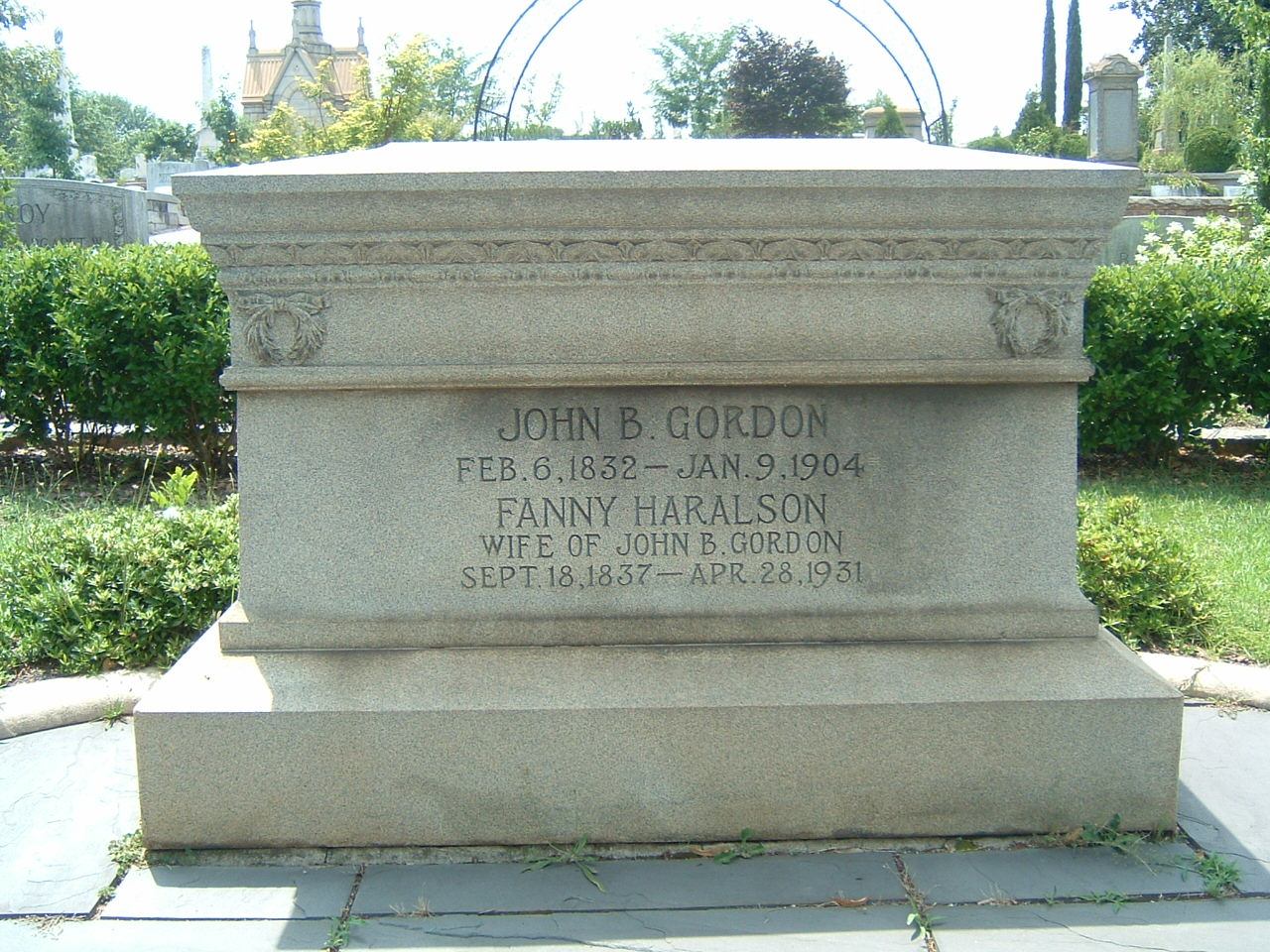
all rights reserved.
In such a grand cemetery, a place with some 70,000 interments, it’s no surprise that spiritual activity has been reported. Most of the stories seem to revolve around the Civil War. The most famous story is that of the roll call of the dead. A young man visiting the Confederate portion of the cemetery on a December day reported hearing soldiers’ names being called with faint voices answering “heah” and “present.” According to William Bender, the young man even heard his own name called. Alan Brown reports that one visitor witnessed the blue-clad figure of a soldier hanging in a tree, possibly one of the Union conspirators in the Great Locomotive Chase, while another witnessed a bleeding Confederate lying atop a grave.


all rights reserved.
Bender also relates a legend of the spirit of Jasper Newton Smith, a real estate investor whose likeness now sits in a chair atop his mausoleum. Legend tells that his spirit climbs out of his chair at night and walks the grounds, though Bender found no eyewitness accounts of this activity. Reese Christian does report a shadowy figure that was seen in the cemetery by a cemetery staff member at night.

all rights reserved.
In October of 2008, the statue of the Archangel Gabriel was restored to its perch atop the Brown monument. He stands, trumpet in hand, to call the dreaming citizens forth. Until that moment, he silently watches over the gardens of Oakland.

Sources
- Bender, William N. Haunted Atlanta and Beyond. Toccoa, GA: Currahee Books, 2005.
- Brown, Alan. Haunted Georgia. Mechanicsburg, PA: Stackpole Books, 2008.
- Brown, Robbie. “Atlanta Saves Battered Gem, a Home for the Dead That’s Prized by the Living.” New York Times. 10 October 2008.
- Christian, Reese. Ghosts of Atlanta: Phantoms of the Phoenix City. Charleston, SC: History Press, 2008.
- Davis, Mark. “Heavenly herald of restoriation.” The Atlanta Journal-Constitution. 11 October 2008.
- “History.” Historic Oakland Foundation. Accessed 29 June 2011.
- Oakland Cemetery (Atlanta). Wikipedia, the Free Encyclopedia. Accessed 29 June 2011.
- Roberts, Nancy. Georgia Ghosts. Winston-Salem, NC: John F. Blair, 1997.
Of Fowl and Phantoms–Haunted Dauphin Island, Alabama
Whenever I visit the coast, I find myself thinking about the impermanence of things. As someone who has always believed in historic preservation, I’m always saddened when I see historic places destroyed, especially through the ignorance or perhaps the arrogance of man. Of course, when the destruction is wrought by nature, it’s sad as well. Along the coast, there’s always a threat of hurricanes and now add the threat of rising sea levels with global warming and I’m deeply saddened for beautiful places like Dauphin Island.
Hurricane Katrina roared ashore at Dauphin Island in 2005 and decimated the western end of this barrier island. A further barrier island, Sand Island, protected the eastern end of the island from the devastation. When I visited the island in 2008, the western end had been mostly rebuilt and I could only shake my head and wonder if these homes would survive the next big hurricane. Of course, since my visit, the sugar-white sands have been spoiled by oil from the BP spill, though I hope much of that has been cleaned up.
On the lush eastern end of the island, the section that survived the wrath of Katrina, Dauphin Island boasts nationally known birding habitat. The island is one of the first bits of land spotted by neo-tropical migrants as they migrate from their wintering grounds in Central and South America and take flight over the Gulf of Mexico. Many of these species alight to rest in the parks and bird sanctuaries among the vacation homes and birders flock to the island to see this plethora of warblers, tanagers, vireos and thrushes. There’s a large Audubon Bird Sanctuary adjacent to Fort Gaines that attracts birders throughout the year and where I saw my first pair of Black-throated Green Warblers (Dendroica virens); two perky brightly colored fellows that had attracted a good deal of attention from birders who had gathered nearby.
Indian Shell Mound Park
Cadillac Avenue
While my interest in ghosts predates my interest in birds, I didn’t do any research on the island’s legends before my trip. The purpose of the trip was solely to add birds to my life list; otherwise, I would have paid more attention to the island’s more historic and haunted features. I’m sure the thought passed through my mind that there might be more to the Shell Mound than just history and birds. I have a distinct memory of feeling an odd chill upon arrival. As birds are most active in the hours just before and after dawn, I arrived fairly early at the Shell Mound to start birding. Stepping out of the car into the cool of an April morning I was flabbergasted by the sound of calling owls.

The owls, it turns out, were cooing Eurasian Collared Doves (Streptopelia decaocto), a non-native species that has begun spreading through the Southeast.
Even in full daylight, the park is a bit creepy. The mounds are covered in dense undergrowth and massive ancient oaks laden with Spanish moss. I realized fairly quickly that I was apparently alone in the park and I felt a bit of trepidation exploring the winding park paths by myself. After reading one of the historical signs, the thought that here I was among hundreds of years of history sent a chill down my spine. My attention was quickly diverted (ADD perhaps?) by some slight movement near the top of one of the looming oaks. Picking it up with my binoculars, it was my first Blackpoll Warbler (Dendroica striata), the first bird of a day that would add some 40 new species to my life list.
The shell mounds are evidence of hundreds of years of human visitations to Dauphin Island. These mounds are known as middens, which are basically ancient trash heaps. The island was visited by Native Americans beginning during the Mississippian period (roughly 1100 to 1500 C.E.) who harvested oysters and fish probably during the summer months. Both the oysters and fish could be consumed on the spot or dried for later use. The oysters would be steamed by wrapping them in seaweed and placing them on heated coals. The steam would cause the oysters to open and the shell would be discarded near the fire. One writer suggested that one of the mounds of the six in the park may have reached a height of 50 feet.
With them, the natives also brought a variety of plants to the area, many of which, while not native, have thrived in the semi-tropical environment of the island. Even centuries after the native’s final visit to the island, these plants remain. The magnificent live oak trees on and around the middens are believed to have witnessed the native’s oyster and fish roasts and the first arrival Spanish in 1519. Over the centuries, these branches have hosted nearly 400 different species of birds as they passed the island on their migrations.
Certainly, the oaks may still witness the spirits of natives who still stalk the humid nights. There are tales of strange goings on after dark in the park, though I have not been able to locate any specific reports of these nocturnal activities. Indeed, there is a possibility that native spirits and others may be still rambling about, but I have found no distinct evidence of this.
While the idyllic life of the natives could have continued for centuries, the Mississippian period ended shortly after the Spanish began exploring the Southeast hacking their way through the forests and the natives. Around this time, the Mississippian peoples were replaced by the Choctaw and Muskhogee (also known as the Creek) Peoples who visited the island like their previous brethren. The French first visited the island in 1699 under Pierre Le Moyne d’Iberville, who would establish the city of Mobile and the entire Louisiana colony. Upon arrival, d’Iberville encountered a number of human skeletons and named the island “Massacre Island.” Some historians speculate that a hurricane had eroded a burial mound exposing the skeletons that the French discovered. The name would stick for some time but was later changed to honor the son of the French king, the Dauphin. Of course, the pronunciation has been eroded over time with the final nasal syllable being replaced by an anglicized “fin” so the name sounds more akin to the word “dolphin.”
Fort Gaines
51 Bienville Boulevard
After visiting the Shell Mounds and seeing a few birds, I moved on to try my luck at the Audubon Bird Sanctuary. My path took me through the forest of the sanctuary and through the campground on the opposite side and towards the eastern tip of the island around Fort Gaines. While the fort may look intimidating from both land and sea, the real threat is the sea. When construction on the fort began in 1819, the project quickly ran over budget and the plans had to be redrawn as the fort sat too close to the water and high tides would flood the construction.
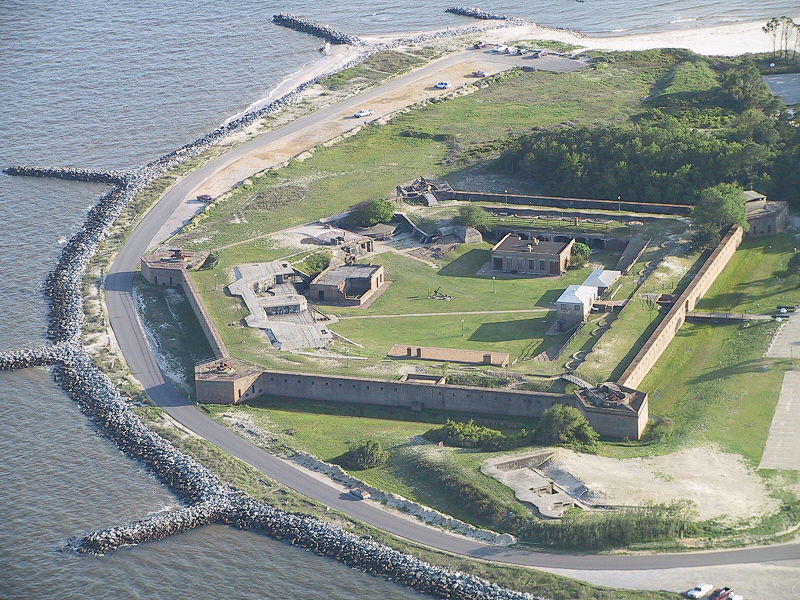
Over time, the threat from the sea has been constant. Hurricanes have eroded the beach next to the fort causing parts of the masonry to collapse. The collapsed portions have been repaired, but the fort is still under threat from nature just as it was under threat from Admiral David Farragut’s Union naval forces in August of 1864.
With the tide of war turning against the Confederacy, the Union fleet under Farragut set out to capture the ports of Mobile thus tightening the vice grip they held on the Confederacy. Fort Gaines to the west and Fort Morgan to the east guarded the entrance to Mobile Bay. Mines or “torpedoes,” as they were called in that period, were scattered in fields across the entrance forcing ships into a narrow channel near the heavily fortified and gunned Fort Morgan. When the Union fleet arrived on the morning of August 5, the guns of Fort Morgan opened fire. Even losing the USS Tecumseh, the Union fleet continued into the bay with Farragut famously lashed to the rigging of the USS Hartford yelling, “Damn the torpedoes! Full speed ahead!”

Upon entering the bay, the specter of the ironclad CSS Tennessee loomed ahead. Fighting just a mile north of Fort Gaines, the Tennessee and a number of smaller gunboats took on the Union fleet. Finally, exhausted and basically dead in the water, the Tennessee surrendered. The fight turned towards Fort Gaines and volleys of ammunition were poured onto the masonry structure for almost three days. It is said that at one point in the fighting, the monitor gunboats fired upon the fort from almost point blank range. On August 8, battered into submission, Colonel Charles Anderson surrendered the fort and the nearly 800 men inside.
Since that day of defeat, the fort served as a military post through World War II, but it has not again seen action. The cries of men and the boom of guns have been replaced by the gentle susurrant sea breeze and the cries of wheeling seabirds. But still, spiritual elements still linger.
In researching the haunting of Fort Gaines, I’ve only come across one specific sighting. Many sites online describe Fort Gaines as being haunted but don’t venture into specifics. An article by Michael Baxter, “Ghostly Getaway to Dauphin Island,” describes the experience on one island resident driving past the fort at night. The resident and a friend witnessed the apparition of a woman walking along the battlements. She walked for a bit, stopped, looked at her observers and faded slowly. A number of sources also speak of paranormal investigations on the fort, but I can find no actual reports of such. Like Shell Mound, there is certainly a reason that Fort Gaines could be haunted, but little specific evidence.
There are other stories of ghosts walking the beaches and streets of Dauphin Island, but again, little that is verifiable or specific. Michael Baxter’s article, really one of the best sources of island tales speaks of a number of wandering spirits but these are hard to pin down. Of course, as the island continues into another century eroded by wind and sea I wonder if the birds or even the spirits will remain.
Sources
- Baxter, Michael. “Ghostly Getaway to Dauphin Island.” Dauphin Island Chamber of Commerce. Accessed 28 March 2011.
- Cox, Dale. “Fort Gaines Historic Site – Dauphin Island, Alabama.” ExploreSouthernHistory.com. Accessed 30 March 2011.
- Cox, Dale. “The Battle of Mobile Bay – Mobile, Alabama.” ExploreSouthernHistory.com. Accessed 31 March 2011.
- Dauphin Island, Alabama. Wikipedia, the Free Encyclopedia. Accessed 29 March 2011.
- Fort Gaines (Alabama). Wikipedia, the Free Encyclopedia. Accessed 29 March 2011.
- Indian Mound Park (Dauphin Island, Alabama). Wikipedia, the Free Encyclopedia. Accessed 29 March 2011.