Bethesda Presbyterian Church Russellville, Tennessee
Pardon my absence, please. Initially, I was busy working on some new articles, but after lightning struck and killed my router and Internet; my time for work was limited. I’m getting back to work now. Since I haven’t done a good newsbyte in awhile, I’m doing one now; and boy, it’s a doozy.
You may notice that I have not included the exact location of this church, there’s a good reason for that. After recent events, I have a feeling the people working to protect Bethesda Presbyterian Church really don’t want ghost hunters around. According to an article and video from KSDK in St. Louis, Missouri, the church was vandalized recently by teen “ghost hunters.”
This is utterly ridiculous. Unfortunately, these teens have given real ghost hunters and others with an interest in the paranormal a bad name. Two teenage boys spent time in this historic church overnight burning candles on floors that once held wounded from the Civil War. Windows were shattered and they spray-painted and toppled a number of monuments in the adjacent cemetery. As the idiots did leave a bicycle on the property, the police were able to apprehend these young hooligans.
Reading about such an event makes me livid, especially when “ghost hunting” is involved. A ghost hunter should have utmost respect for the places they investigate as well as for the dead. Part of that respect for the dead is by protecting the places where they once walked or are buried.
Please do check out the video for some wonderful shots of this historic structure. The reporter does state that the church is on the “National Registry of Historic Landmarks.” This is incorrect. It is called the “National Register of Historic Places.” There are places that are known as National Historic Landmarks, but that is a step up from the National Register and reserved for those places of national importance.
Magnolia Cemetery 70 Cunnington Street Charleston, South Carolina
A moss-draped drive through the cemetery. Photo 2011, by Lewis Powell IV, all rights reserved.
After wandering through Magnolia Cemetery in awe for almost two hours, I began to make my way out. The cemetery has winding drives through its oak shaded acres with a posted speed limit of 15 miles per hour. Not wanting to miss anything, I was probably driving slower than that when I approached the massive cemetery gates. The gates were closed with a chain and large padlock securing them. A number of expletives left my mouth and panic quickly set in. A couple of Northern Mockingbirds (Mimus polyglottis) loudly scolded me from atop an adjacent tombstone. The welcome sign listed rules for the cemetery but no number in the event that you’re locked in with the dead. As I dialed 911, I prayed that I would not face a fine or worse for missing the very obvious sign stating that the gates would close at 6PM. It was 6:15.
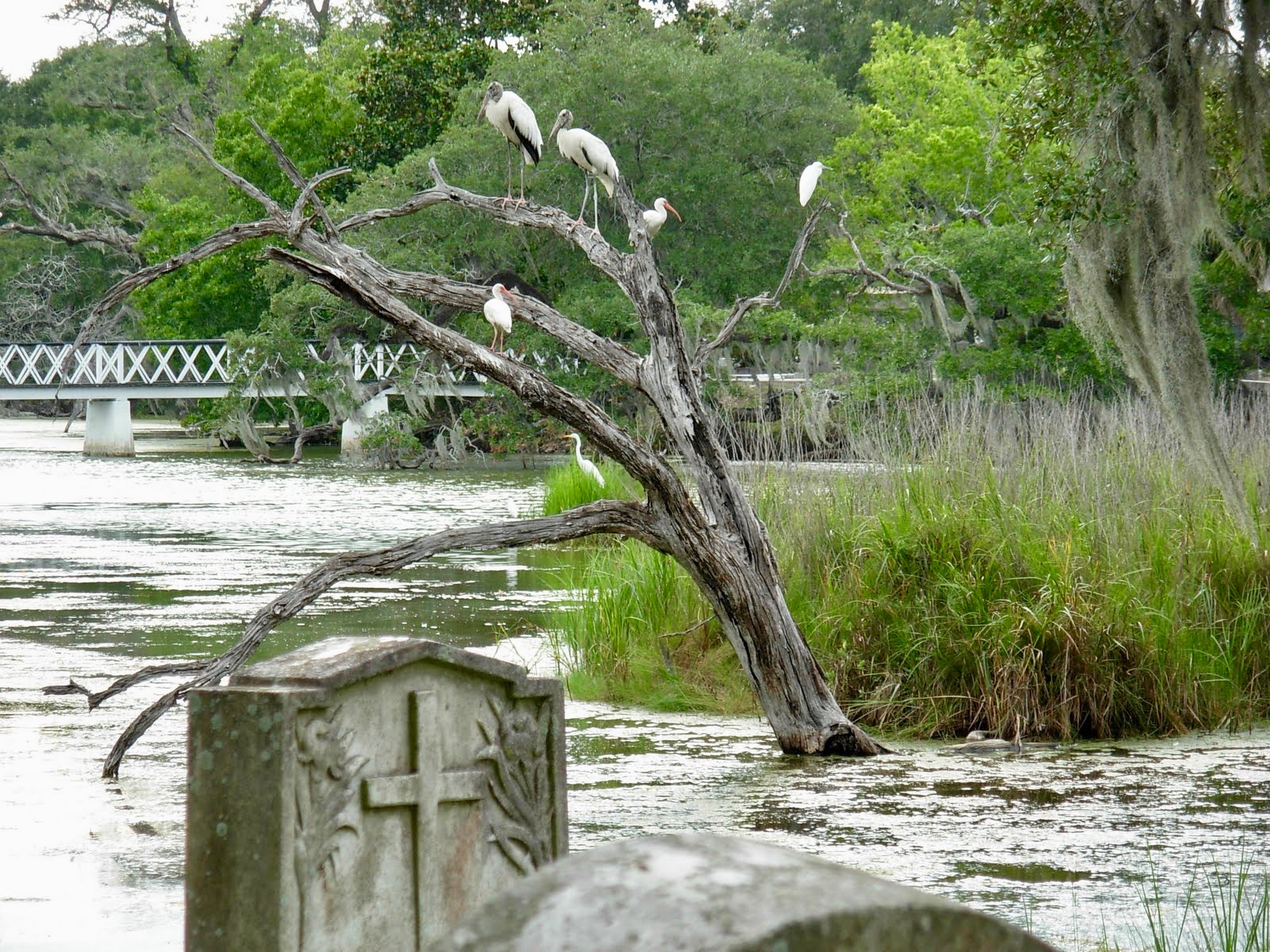
In this city of so many fine homes and buildings, only I would first head to the cemetery. But, this place is so much more than just a resting place for the dead, it’s truly an art museum, a guide to three centuries of art and architecture and a habitat for native plants and wildlife. Wandering among the graves were Domestic and Canada Geese (Branta canadensis) and Mallards (Anas platyrhynchos). I passed a couple of ponds within the cemetery and was excited to see a dead tree in the center of one pond with a number of water birds perching on it. Even better, were the two “Life Birds” I saw there: Wood Stork (Mycteria americana) and American White Ibis (Eudocimus albus).
A snag in the main pond with perching waterbirds. Two Wood Storks are perched at the top with two White Ibises underneath. A Cattle Egret is perched on the right with a Great Egret in the background. Photo 2011, by Lewis Powell IV, all rights reserved.
For a taphophile, Magnolia Cemetery is heavenly. Everywhere there is marvelous funerary art and symbolism. As I walked and was fed upon by legions of mosquitoes (I won’t acknowledge their scientific name as they don’t deserve it) I had to pass graves that in most cases I would be drawn to in order to pursue more interesting graves. By the end of the first hour, I took to riding in my car to avoid the mosquitoes and trying to photograph the most interesting graves closest to the drive.
The large, Gothic Revival monument to Elbert P. Jones, died 1 April 1852. Designed by architect Francis D. Lee and constructed by E. Greble of Philadelphia. Photo 2011, by Lewis Powell IV, all rights reserved.
Among the more notable monuments is the grave of Rosalie Raymond White. Situated next to one of the ponds, the White family plot has some fascinating art, but particularly interesting is the grave of young Rosalie who died less than a year after her birth. There is a hooded cradle and under the hood, the likeness of the child. According to Denise Roffe in her Ghosts and Legends of Charleston South Carolina, the likeness is a death mask and one of the few such things on a grave in the United States.
Grave of Rosalie Raymond White. Photo 2011, by Lewis Powell IV, all rights reserved.
The death mask of Rosalie Raymond White. Photo 2011, by Lewis Powell IV, all rights reserved.
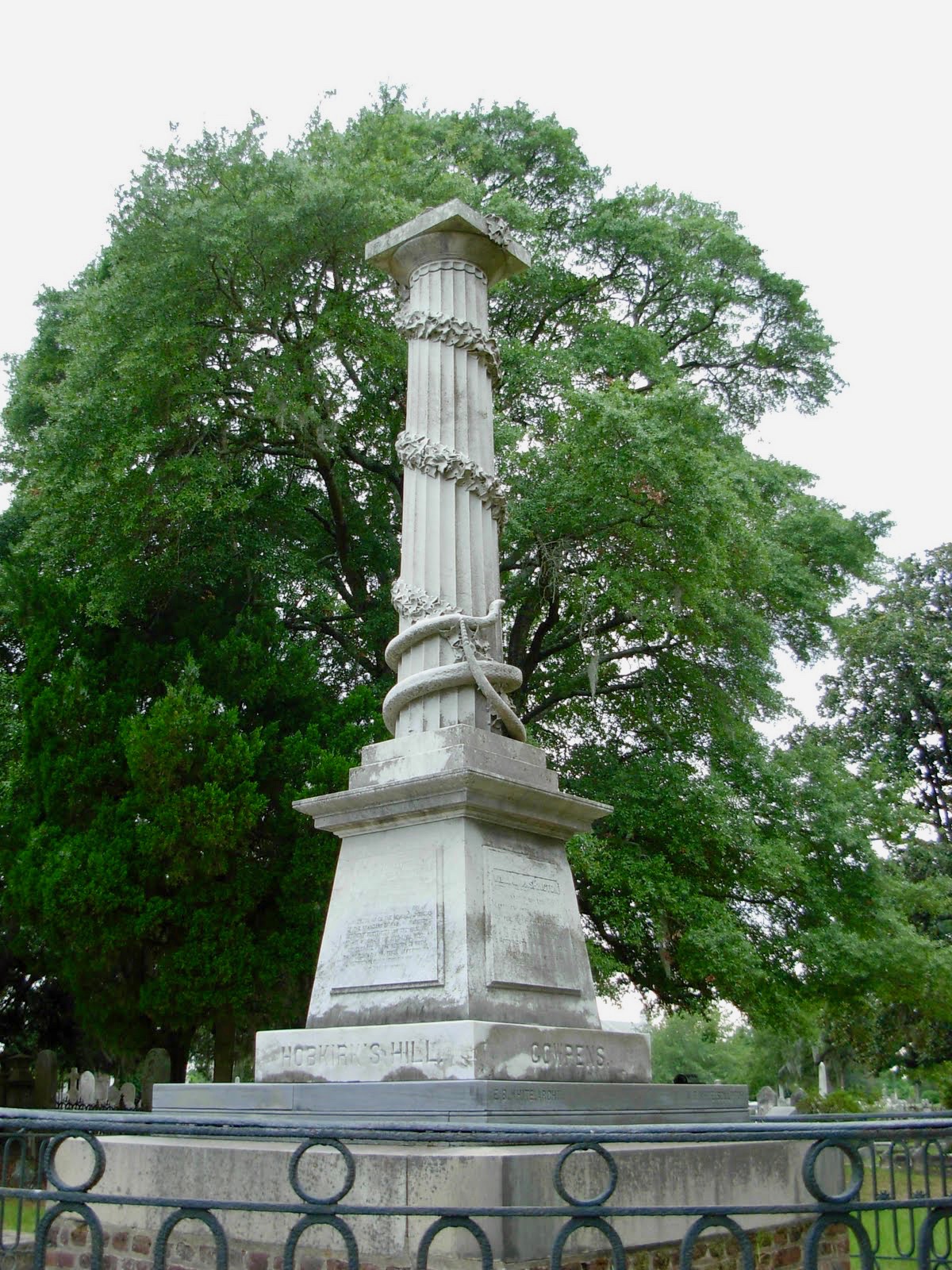
Another prominent monument is that William Washington. I viewed this one from the car, so I couldn’t get all the information, but it appears to be a cenotaph (a monument to someone who is buried elsewhere) to this notable figure from the American Revolution. The monument, surrounded by an unusual circular iron fence (I’ve not seen one, though they were numerous in this cemetery), is a large marble column with an ivy garland wrapped around it. At the base of the column is a rattlesnake, a creature I’ve not seen at all in funerary art. The snake is taken from the early American Gadsden flag, the first flag carried into battle by the Continental Marine Corps during the American Revolution, which bears the words, “Don’t Tread On Me.” This flag has most recently been adopted by the Tea Party.
The monument to William White; a Doric column with a rattlesnake entwined at the base. Photo 2011, by Lewis Powell IV, all rights reserved.
This monument was designed by E.B. White and constructed by W.T. White, the city’s most prominent stone carver and monument builder. As I wandered the cemeteries of Charleston, in nearly every graveyard I found monuments with White’s signature.
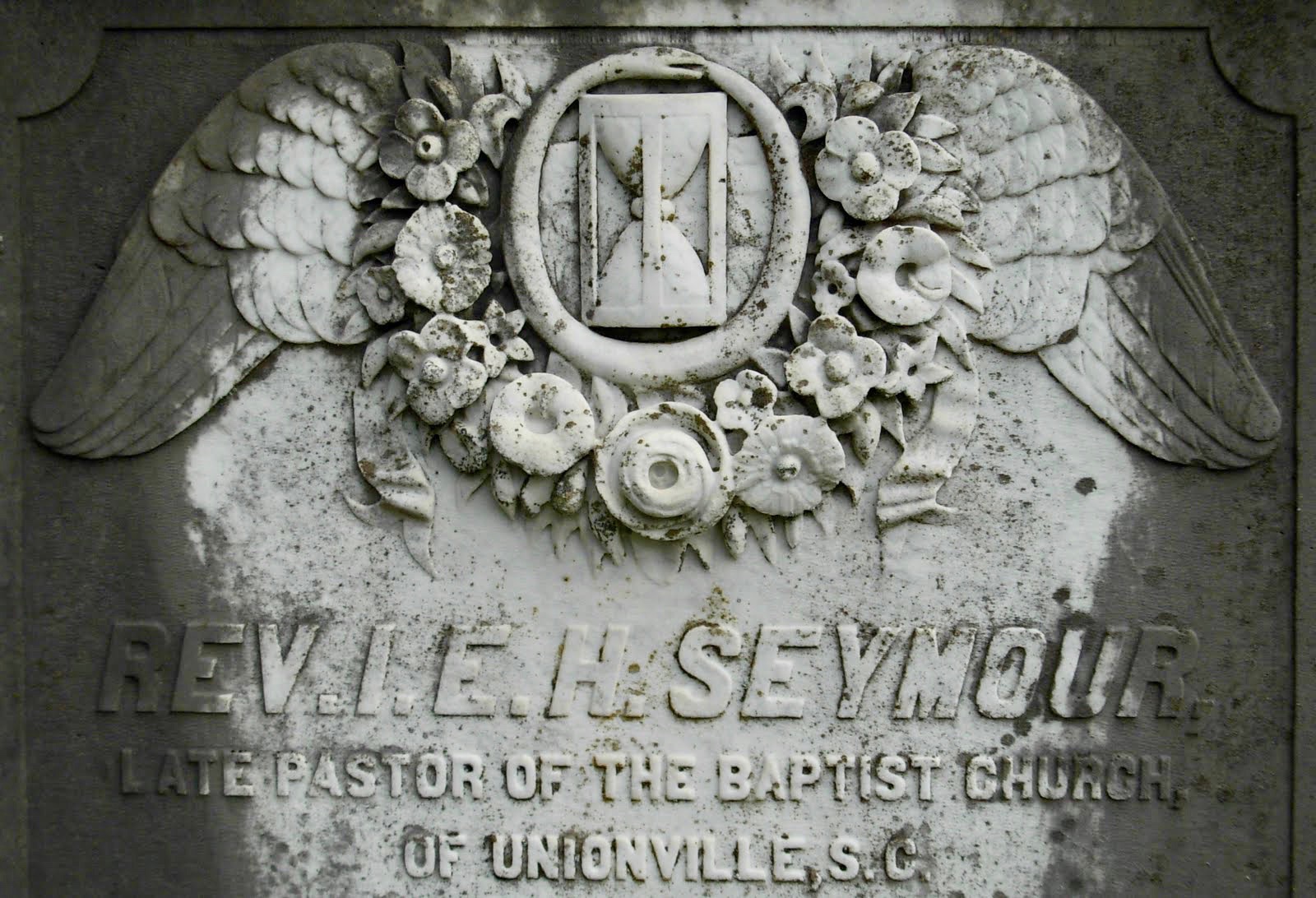
Nearby, another marvelous monument by White is the stone for the Rev. I. E. H. Seymour. Topped with the statue of a praying woman, the stone bears a wonderful crest. An hourglass is encircled by an ouroboros, an ancient symbol meaning cyclicality; thus in this, the cyclicality of time or that even in death, life is created. This idea is strengthened by a wreath which can mean victory in death. The wings, of course, reference the wings of angels.
The crest of the Seymour monument. Photo 2011, by Lewis Powell IV, all rights reserved.
Not far away is the monument for Hugh Swinton Legare, who served two years as a state legislator, South Carolina Attorney General, then as a state Representative to the United States House, and then United States Attorney General under President John Tyler. The monument consists of a large marble Corinthian column sitting on a large base. One side of the base is carved with the national crest with a bald eagle, while the opposite site bears images from the South Carolina state crest with a wonderfully carved palmetto tree with a pair of shields underneath back with 12 spears (representing the other 12 colonies); all sitting on a fallen tree. The palmetto’s significance comes from a battle fought on Sullivan’s Island near Charleston, June 28, 1776, between colonists and the British. The colonists had built a fort of palmetto logs and the British cannon fire seemed to bounce right off. The dead tree represents the defeated British fleet. This monument was also built by White and is signed “W.T. White/Steam Marble Works/115 Meeting St”.
The Legare monument. Photo 2011, by Lewis Powell IV, all rights reserved.
The South Carolina crest on the Legare monument. Photo 2011, by Lewis Powell IV, all rights reserved.
Lagare died in 1840 in Boston, Massachusetts while attending ceremonies for the unveiling of the monument at Bunker Hill. He was buried in the Mount Auburn Cemetery there. Interestingly, this is one of the cemeteries upon which the designs for Magnolia Cemetery are based. Mount Auburn, coupled with New York City’s Greenwood Cemetery, provided the inspiration for the “Garden Cemetery,” a type of cemetery found throughout the United States. These cemeteries, created in park and garden-like settings were a departure from the usual churchyards where most people were buried. In 1857, Lagare’s remains were exhumed and he was re-interred here amongst the lush magnolias.
Magnolia Cemetery was founded in 1850 on the grounds of the former Magnolia Umbra plantation. The old plantation house still stands in the center of the cemetery. Laid out by South Carolina architect Edward C. Jones, the rules for governing the cemetery were copied from those of Mount Auburn and Greenwood. This sacred parcel of land has become the resting place of many of Charleston’s most prominent people.
Nearby is another stone carved with state symbolism including a wonderful, freestanding palmetto. The monument is for James Brown Boyd, Sergeant of the Palmetto Guards of the 2nd South Carolina Regiment. He was killed at the battle of Sharpsburg, Maryland (usually called Antietam), September 17, 1862. This is not a White monument and is signed “D.A. Walker.” The palmetto sculpture is signed, “A. F. Chevreaux, Sculptor”.
The Confederate section. Photo 2011, by Lewis Powell IV, all rights reserved.
According to Denise Roffe, this cemetery may have a few spirits wandering around. In one story, a brother and sister were fishing in the nearby Cooper River. When the little girl’s favorite doll fell in the water, she dove in to retrieve it and her body was found later clutching the doll. Her spirit has been seen in the company of a Civil War soldier, said to be her father. When the two are approached, they both vanish as the little girl giggles. Another spirit is also a young girl seen near the burial site of Annie Aiken.
Part of the burial lot for the crew of the CSS Hunley, the Confederate submarine that sank in Charleston harbor after sinking the USS Housatonic. Photo 2011, by Lewis Powell IV, all rights reserved.
The cemetery is massive and I easily could have spent many hours here, but the swarms of mosquitoes feeding on me every time I got out of the car began to be too much. That’s when I decided to leave, and good thing, as I found the locked gates.
The Egyptian Revival W.B. Smith mausoleum. Photo 2011, by Lewis Powell IV, all rights reserved.
A jolly man in a pickup truck pulled up as I spoke to the 911 operator. He had the key. Thank God. I told him I was so bowled over with Magnolia Cemetery that I had lost track of time. Smiling he listed some facts about the place: it contained around 33,000 interments (a number that is still growing) on 154 acres. I’m glad I’m not yet one of those who have found their rest here.
Sources
Hugh Swinton Legare. Wikipedia, the Free Encyclopedia. Accessed 30 July 2011.
Jacoby, Mary Moore and John W. Meffert. Charleston: An Album from The Collection of the Charleston Museum. Dover, NH: Arcadia Press, 1997.
McNulty, Kappy and Nenie Dixon. National Register of Historic Places Nomination form for Magnolia Cemetery. 23 August 1976.
Roffe, Denise. Ghosts and Legends of Charleston, South Carolina. Atglen, PA: Schiffer, 2010.
Oakland Cemetery 248 Oakland Avenue, SE Atlanta, Georgia
On March 14, 2008, Oakland Cemetery was awakened from its eternal slumber. A tremendous tornado bore down on downtown Atlanta damaging landmarks such as CNN Center and the Peachtree Plaza Hotel. After ripping its way through downtown, the twister ripped through peacefully dreaming Oakland Cemetery, one of Atlanta’s oldest and certainly its grandest burial ground. The winds toppled many majestic namesake oaks which toppled and broke fragile marble monuments. The Archangel Gabriel, trumpet in hand to summon forth the sleeping masses for Judgment Day, atop the monument for Governor Joseph E. Brown, was thrown to the ground along with obelisks and columns throughout the cemetery.
Hundreds of monuments were damaged, but the Historic Oakland Foundation immediately went to work repairing and restoring the cemetery. Since the cemetery was listed on the National Register of Historic Place in 1979, the foundation has worked to maintain Oakland’s peaceful slumber. In fact, they have worked to improve the beauty of that slumber.
Lush plantings at Oakland, 2011. Photo by Lewis O. Powell IV, all rights reserved.
An attractive gravesite at Oakland, 2011. Photo by Lewis O. Powell IV, all rights reserved.
I knew nothing of this when I visited today to photograph this haunted cemetery and I was very pleasantly surprised. It’s been a very hot summer in the South and I expected to find an ancient, baking cemetery with dry patches of grass in the plots. To my relief, the cemetery is being transformed into a garden with lush plantings surrounding the ancient monuments. The effect is quite lovely. Lush magnolias and oaks (those not completely taken out by the tornado) shade lovingly restored memorials with rose bushes, juniper and flowers covering and in between the graves. Birds fill the trees and peer from perches atop statues and mausoleums. While only part of the cemetery has been restored to its garden-like setting, the work continues.
Oakland, 2011. Photo by Lewis O. Powell IV, all rights reserved.
One of the many mausoleums, 2011. Photo by Lewis O. Powell IV, all rights reserved.
A MARTA train passes by Oakland, 2011. Photo by Lewis O. Powell IV, all rights reserved.
Founded in 1850 as the Atlanta Graveyard or City Burial Place, the cemetery began on just 6 acres and over time it expanded to the current 48 acres. Much of the expansion took place during the Civil War when the city’s military hospitals required a place to bury the dead. Following the fierce fighting around the city, space was needed as bodies were recovered from the battlefields. Confederate dead, both known and unknown found their final repose in the cemetery’s garden-like grounds. Near the south-east corner of the cemetery, the seven Union operatives who participated in the famous Great Locomotive Chase were hung before they were buried on the cemetery grounds.
A pigeon peers down from atop a statue pointing towards heaven, 2011. Photo by Lewis O. Powell IV, all rights reserved.Monument to the Confederate Dead, 2011. Photo by Lewis O. Powell IV, all rights reserved.
Rows of Confederate dead, 2011. Photo by Lewis O. Powell IV, all rights reserved.
In 1872, the name of the cemetery was changed to Oakland to recognize the majestic oaks that shaded the grounds. Statesmen, governors, businessmen, generals, clergy and their families found their final rest here side by side with unknown military dead and the indigent that were laid in the potter’s field. African-Americans and Jews also found their place within the walls of Oakland. But with the arrival of the mid-20th century, vandals and neglect began to take a toll. Now in the loving hands of the Historic Oakland Foundation, the cemetery has passed into its third century and its beautiful and peaceful slumber continues.
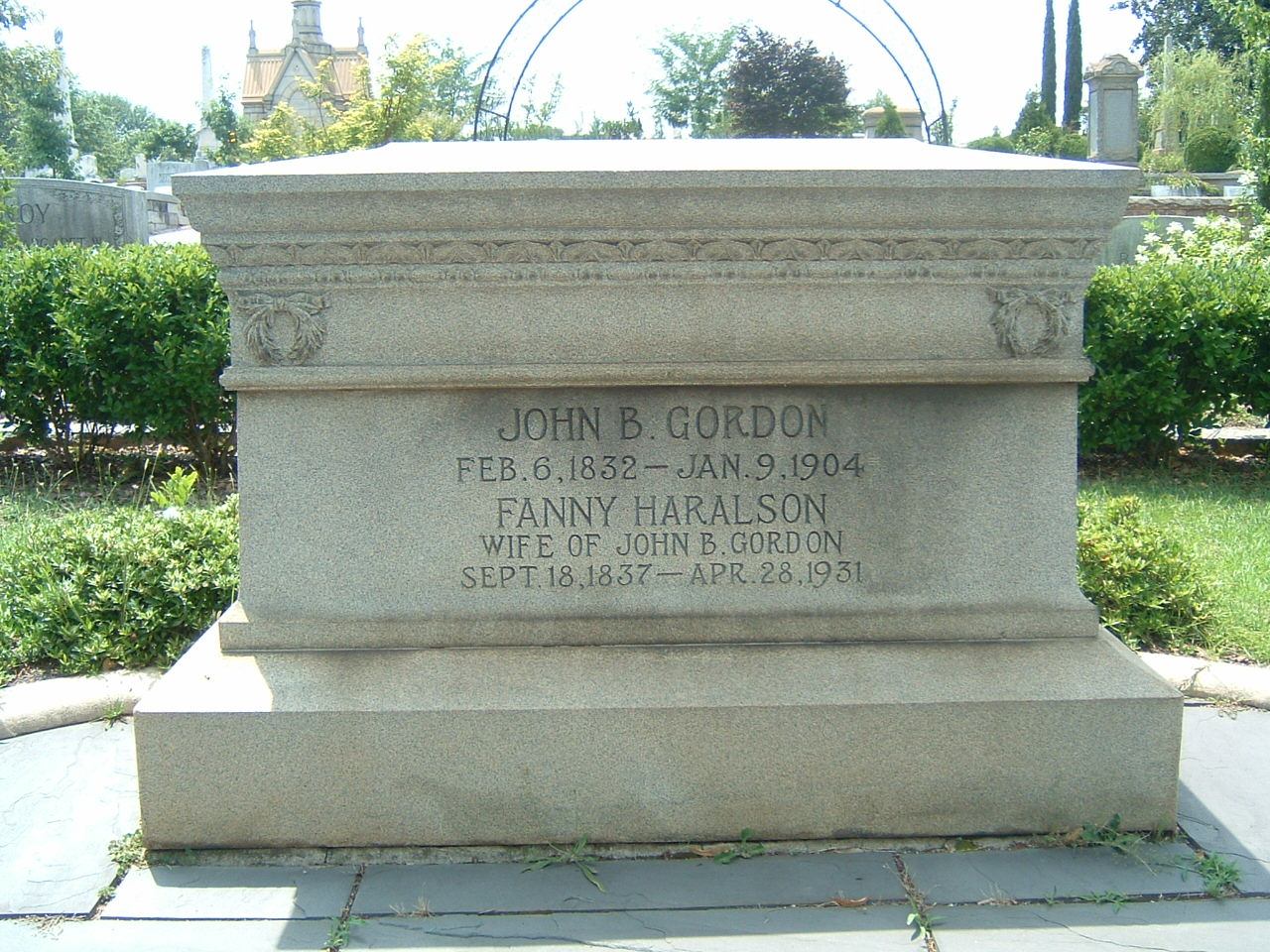
Grave of Confederate General John B. Gordon, Oakland, 2011. Photo by Lewis O. Powell IV, all rights reserved.
In such a grand cemetery, a place with some 70,000 interments, it’s no surprise that spiritual activity has been reported. Most of the stories seem to revolve around the Civil War. The most famous story is that of the roll call of the dead. A young man visiting the Confederate portion of the cemetery on a December day reported hearing soldiers’ names being called with faint voices answering “heah” and “present.” According to William Bender, the young man even heard his own name called. Alan Brown reports that one visitor witnessed the blue-clad figure of a soldier hanging in a tree, possibly one of the Union conspirators in the Great Locomotive Chase, while another witnessed a bleeding Confederate lying atop a grave.
Mausoleum of Confederate Vice President, Alexander Stephens, 2011. Photo by Lewis O. Powell IV, all rights reserved.
The lion guarding the unknown Confederate dead, 2011. Photo by Lewis O. Powell IV, all rights reserved.
Bender also relates a legend of the spirit of Jasper Newton Smith, a real estate investor whose likeness now sits in a chair atop his mausoleum. Legend tells that his spirit climbs out of his chair at night and walks the grounds, though Bender found no eyewitness accounts of this activity. Reese Christian does report a shadowy figure that was seen in the cemetery by a cemetery staff member at night.
The Brown Monument, 2011. Photo by Lewis O. Powell IV, all rights reserved.
In October of 2008, the statue of the Archangel Gabriel was restored to its perch atop the Brown monument. He stands, trumpet in hand, to call the dreaming citizens forth. Until that moment, he silently watches over the gardens of Oakland.
Statue atop a child’s grave, 2011. Photo by Lewis O. Powell IV, all rights reserved.
Sources
Bender, William N. Haunted Atlanta and Beyond. Toccoa, GA: Currahee Books, 2005.
This article is a part of an occasional blog series highlighting Southern hauntings or high strangeness associated with specific days. For a complete listing, see “A Haunted Southern Book of Days.”
The roots of both Athens and the University of Georgia are inextricably linked. Land for the university was purchased in 1801 by John Milledge who would later serve the state as governor. The land, on a hill overlooking Cedar Shoals on the Oconee River, was to house the state-supported university and parcels of land adjacent to the campus were sold to private interests. The town was incorporated as “Athens” in 1806 with a handful of residents, faculty and students. Athens grew quickly into a regional center for trade and education as well as a social center.
After the Civil War and the emancipation of slaves, Athens became a regional center for the African-America community. A school, The Knox School, was created and a prosperous African-American middle class emerged towards the end of the 19th century. The entire city saw rapid growth throughout the 20th century, some of it tied with the growth of the university. The city continues to expand with the university which has brought a world-class cultural experience to the region.
Alpha Gamma Delta House (Thomas-Carithers House) 530 South Milledge Avenue
Alpha Gamma Delta House, 2011. Photo by Lewis Powell IV, all rights reserved.
Alpha Gamma Delta House showing the bas-relief that gives the house its wedding cake appearance, 2011. Photo by Lewis Powell IV, all rights reserved.
Built as a private home in 1896 and used as a sorority house since 1939, this exuberant wedding-cake like house is now listed on the National Register of Historic Places. William Winstead Thomas, a local engineer, built the house which was later bought by James Yancey Carithers as a wedding gift for his daughter, Susie. As legend tells, when Susie’s groom failed to show up for the ceremony on time, the distraught woman hung herself in the attic. The groom finally did show, having been delayed on the way to the nuptials, but Susie was dead. Her spirit has been seen throughout the house while girls living in her old room often become engaged, thus the suite’s name, “The Engagement Suite.”
Classic Center 300 North Thomas Street
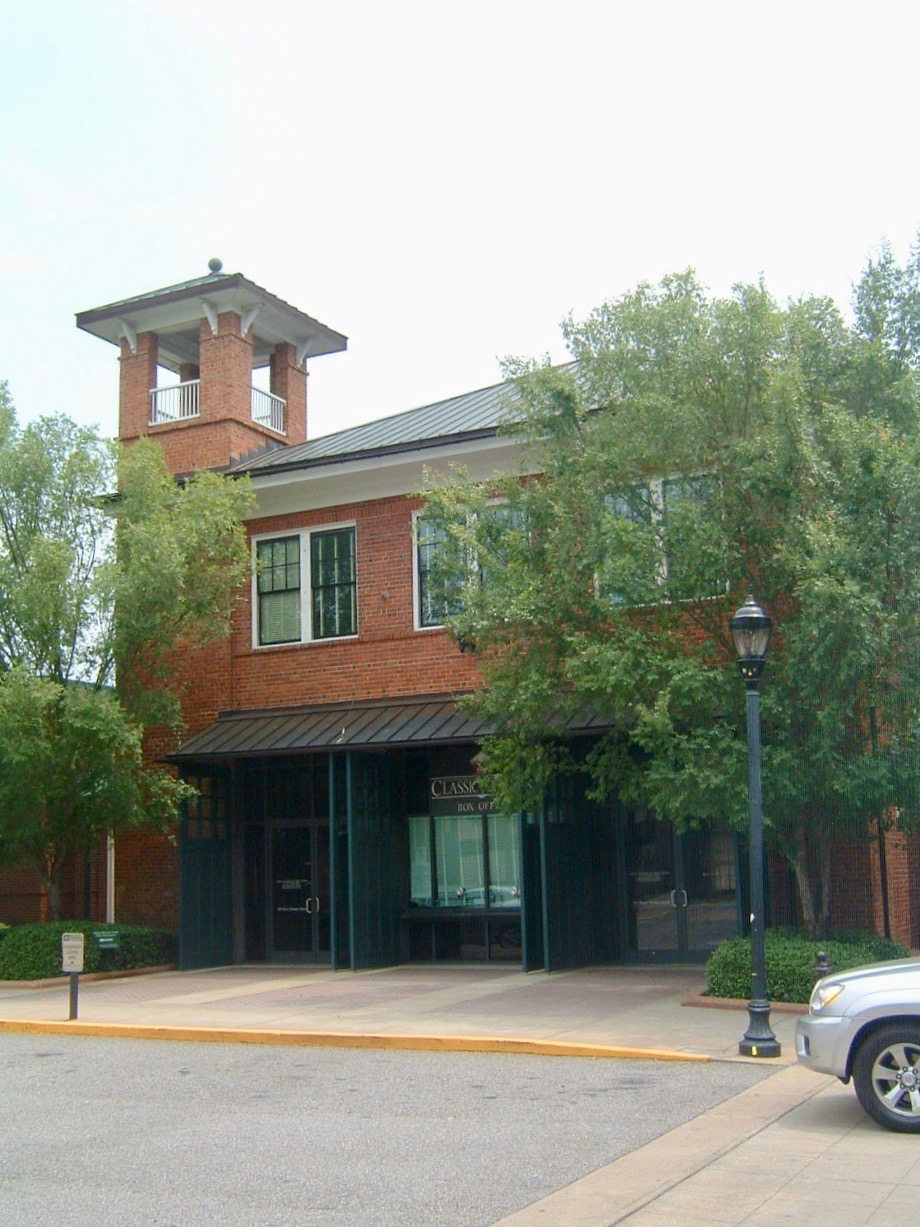
Firehouse No. 1, now the Classic Center, 2011. Photo by Lewis Powell IV, all rights reserved.
When it was decided to build a performing arts center in Athens, the original plans called for the demolition of the warehouses and the old 1912 Firehouse Number 1 which were standing on the site. However, local citizens fought to have the firehouse incorporated in the design. The firehouse was remodeled and now serves as a box office for the performing arts center that stands around it. Captain Hiram Peeler had had a distinguished career as head of the Athens Fire Department when he plunged to his death in an elevator shaft in 1928. It is believed to be his spirit that remains in the firehouse. Reports of activity were reported in the building while it still served as a firehouse. The activity continued through the building’s use as the Chamber of Commerce and has continued while it serves as the Classic Center.
Morton Theatre, 2011. Photo by Lewis Powell IV, all rights reserved.
Actors in the dressing room of this restored theatre have reported odd activity in the dressing room. Sadly, that’s all the information I can find in terms of the paranormal. The Morton Theatre was built by African-American businessman Monroe Bowers “Pink” Morton starting in 1909. The theatre was one of the main anchors of “Hot Corner,” the intersection of Washington and Hull Streets, that was the center of African-American life in Athens. It opened as a vaudeville house for the black community and such names as Butterbeans and Susie, Louie Armstrong and Cab Calloway appeared there. The building has since been restored as a performing arts center for the community and is one of the few remaining black vaudeville houses in the nation.
Oconee Hill Cemetery 297 Cemetery Street
Oconee Hill Cemetery, 2011. Photo by Lewis Powell IV, all rights reserved.
When the main city cemetery (now known as the Old Athens Cemetery) began sprawling close to the campus and the homes of the university president and professors, steps were taken to create a new cemetery nearby. Since it’s opening in 1855, the university has sprawled close to the cemetery with massive Sanford Stadium now looming across the street. The cemetery now hosts a number of prominent Georgians including two governors, eight university presidents and at least one ghost. The legend exists of a ghostly carriage appearing on the bridge between the old and newer portions of the cemetery.
View from Oconee Hill Cemetery towards Sanford Stadium, 2011. Photo by Lewis Powell IV, all rights reserved.
Old Athens Cemetery Jackson Street
Old Athens Cemetery, 2011. Photo by Lewis Powell IV, all rights reserved.
The original city cemetery before Oconee Hill Cemetery was created; the cemetery was created around 1810. The last burial occurred in 1898, not long after the university first tried to reclaim the land. This would be a struggle that would continue through the 1980s. The cemetery was deeded back to school in 2004 and in 2006 a preservation program was instituted under the university’s grounds department. Kathleen Wall mentions that the ghost of a young girl has been seen in the cemetery. The location was investigated by the Georgia Haunt Hunters team in 1998 and the team discovered some temperature fluctuations.
Grave at the Old Athens Cemetery, 2011. Photo by Lewis Powell IV, all rights reserved.
Phi Kappa Psi House 398 South Milledge Avenue
Phi Kappa Psi House, 2011. Photo by Lewis Powell IV, all rights reserved.
In researching Athens, I keep coming across locations that are mentioned as being haunted, but there are few specifics given. This is one location that is briefly mentioned. Daniel Barefoot mentions that the brothers in this house have heard the crying of a baby. This Queen Anne style home was built in 1890.
Phi Mu House (Hamilton-Phinizy-Segrest House) 250 South Milledge Avenue
Phi Mu House, 2011. Photo by Lewis Powell IV, all rights reserved.
The legend of the Phi Mu House, according to the sorority, concerns a young woman named Anna Powell. Her husband shot himself, either purposefully or accidentally at the bottom of the stairs. At times, it is said, a cross will appear on the floor where this horrific incident took place. Anna’s spirit has been encountered frequently by sisters in the house. Knocking and sobbing have been heard in the house and one young woman had the door unlocked for her late one night by unseen hands. The house was constructed by Colonel Thomas Hamilton, reportedly Georgia’s first millionaire, and finished in 1858 by his widow, Sarah. It has served as a sorority house since 1964.
Taylor-Grady House 634 Prince Avenue
Taylor-Grady House, 2011. Photo by Lewis Powell IV, all rights reserved.
Built by Irish immigrant turned cotton merchant and planter, Robert Taylor, in 1844, the Taylor-Grady House was purchased by Major William S. Grady in 1863, at the height of the Civil War which he was fighting in. Major Grady was killed in the Battle of Petersburg and his spirit is said to have returned to his family’s home. Henry Grady, the major’s son, was a staunch advocate for the “New South” as managing editor for the Atlanta Constitution and a famed orator. As the only existing of Grady’s homes, the Taylor-Grady House was named a National Historic Landmark in 1976.
T. R. R. Cobb House 175 Hill Street
T. R. R. Cobb House, 2011. Photo by Lewis Powell IV, all rights reserved.
This noteworthy home with octagonal wings took the scenic route in its move from nearby Prince Avenue. It faced the wrecking ball in 1985, and was moved to Stone Mountain Park, just outside of Atlanta, to be restored as a part of the living history village there (which also has some notable haunted structures). After languishing 20 years, the home was returned to Athens and restored. A ghost story from this house was collected as part of the WPA Writers’ Project and recalls the spirit of “a gentleman wearing a gay dressing gown” who is seen descending the stairs and sitting in front of the fire in the drawing room. For further information, see my in-depth entry on this home, “A firebrand phantom.”
University of Georgia Campus
Joe E. Brown Hall
Joe E. Brown Hall, 2011. Photo by Lewis Powell IV, all rights reserved.
This 1932 building, built as a dormitory is home to a staircase to nowhere. Legend states that not long after the building was built, a student hung himself during Christmas break. His decomposing body was found when students returned. Though the mess was cleaned up, the blood stains were said to return. According to Daniel Barefoot, when the building was remodeled for office space, the room was sealed and the staircase leading to it blocked. In an article in the university newspaper, The Red and Black, a photograph of the staircase to nowhere was published in an article on campus legends. Supposedly knocking still issues from the sealed room.
Lustrat House
Lustrat House, 2011. Photo by Lewis Powell IV, all rights reserved.
Like many of the oldest campus buildings, the Lustrat House has served a variety of functions. Currently the office of Legal Affairs, the building initially served as a residence for professors. Towards the end of the 19th century, it was home to Dr. Charles Morris, chair of the English Department. When the university decided to relocate the house in 1903, Dr. Morris attempted to assuage officials away from that plan. He refused to move with the home. After his death, the family of Professor Joseph Lustrat began to see Dr. Morris has surprisingly taken up residence, sitting in his favorite chair by the fire.
Waddel Hall
Waddel Hall, 2011. Photo by Lewis Powell IV, all rights reserved.
The oldest building on campus still in its complete form according to Daniel Barefoot, Waddel Hall was built in 1821 as Philosophical Hall. The sounds of a tragic lovers quarrel are still heard in this building that now houses the university special events office. During World War I, a young man left his female love who fell for another in his absence. When he returned, he confronted his beloved and the quarrel ended in a murder-suicide.
Barefoot, Daniel W. Haunted Halls of Ivy: Ghosts of Southern Colleges and Universities. Winston-Salem, NC: John F. Blair, 2004.
Bender, William N. Haunted Atlanta and Beyond. Toccoa, GA: Currahee Books, 2005.
Beynon, Valerie. “Morton Theatre.” The New Georgia Encyclopedia. 26 March 2005.
Burnett, Daniel. “Mythbusters UGA.” The Red and Black. 28 January 2009.
Hendricks, Bill. “Ghost trackers look for proof of afterlife: Athens haunt club checks Georgia sites.” The Atlanta Journal and Constitution. 1 December 1998.
“History.” The Classic Center. Accessed 17 June 2011.
“History.” Oconee Hill Cemetery. Accessed 17 June 2011.
“History.” The Taylor-Grady House. Accessed 21 June 2011.
It’s hard to imagine among all the modernity that is South Florida that this area has been settled for many centuries. Native Americans lived here until pressure from the government and white settlers began forcing them out starting in 1822, just after Florida became a state. With most of the Native Americans gone white settlers began building cabins and farming, some with slaves. The area would remain a quiet backwater until Henry Flagler began shaping Florida’s new image in the latter part of the century and speculators and developers began buying land.
Bit by bit, the old Florida succumbed to developers’ vision and disappeared under new construction. Pinewood Cemetery, a piece of Old Florida, disappeared in a forest with its tombstones and graves weathering then later broken and vandalized by hoodlums in search of a thrill. The cemetery was forgotten by most of the living and left for some time to the vigilant care of the cemetery’s own spirits.
Pinewood Cemetery’s air of desolation and dereliction has spawned mysterious stories and legends. A 2006 article on the cemetery in The Miami Herald mentions that neighbors have spoken of midnight burials in the cemetery. Ghost tales have also emerged telling of shadow people, strange noises and, more commonly, odd feelings. One paranormal investigation discovered a large cleared circular patch where nothing was growing, possible evidence that late night rituals may also be held there. The group’s psychic investigators felt that some animal sacrifices may have been conducted there. Regardless, according to evidence gathered by investigators, most of the spirits in the cemetery seem to simply be curious residents intending no harm to the living.
Graves in the forest at Pinewood Cemetery. Photo 2007, by Deathbecomezher, courtesy of Find-A-Grave.
Before the establishment of the large City Cemetery (which may also be haunted) in Miami and the city’s official incorporation in 1896, Pinewood was the main cemetery south of the Miami River. Once the city cemetery established, most of the burials north of the river were removed there, while Pinewood remained quietly in its forest home. Some legends speak of the Pinewood site as originally a burial ground for the area’s Tequesta Indians, though there’s no hard evidence of this. The first pioneer burials are said to have occurred around 1855 and included some of the area’s earliest settlers. The cemetery’s “official” history does not appear in the historical record until the land was deeded to the Trustees of Pinewood Cemetery in 1897.
Over the next 30 or so years the cemetery accepted burials. Included among those buried during this time were Dora Perry Suggs, a young mother who disappeared during a walk from the local general store. Her body was discovered in deep woods by a search party and she was interred in Pinewood in 1905. The cemetery was cleaned up following the great 1926 Miami hurricane, a category four storm that did considerable damage and caused between 250 and 350 deaths. Over time, the cemetery was neglected and trees and legends grew up around it.
Monument erected to the unknown dead of Pinewood Cemetery. Photo 2007, by Deathbecomezher, courtesy of Find-A-Grave.
Some notice was taken of the cemetery’s plight in the 1960s, but no action was taken. Development also began to encroach on the 4 acre cemetery. Stories have appeared of construction workers finding bones as they dug foundations adjacent to the cemetery. At the time, only a small portion of the possibly 250 burials in the cemetery were even marked, many tombstones having been stolen or broken. In 1983, the City of Coral Gables created an advisory board to oversee the cemetery and steps have been taken to preserve and restore the cemetery. Headstones have been erected to replace missing stones. Interestingly, current plans leave the cemetery in its wooded, natural state rather than clearing it. This preserves the more park-like setting and creates a place where local students and residents can explore nature and Old Florida history side by side.
Bonawit, Oby. “History of Pinewood (Cocoplum) Cemetery.” Tequesta: The Journal of the Historical Association of Southern Florida. Vol. 1, No. 38. 1978.
Del Marmol, Sebastian. “Spend a Spooky Morning at Pinewood Cemetery for Pioneer Day This Saturday.” Miami New Times. 18 March 2011.
Herrera, Ana I. “Pioneers remembered at Pinewood Cemetery celebration.” GablesHomepage.com. 20 March 2011.
History of Florida. Wikipedia, the Free Encyclopedia. Accessed 24 March 2011.
League of Paranormal Investigators, Inc. Investigation Report for Pinewood Cemetery, October 2008. Accessed 25 March 2011.
McGrory, Kathleen. “Pioneering Spirits.” The Miami Herald. 27 August 2006.
Miami. Wikipedia, the Free Encyclopedia. Accessed 25 March 2011.
Marietta City Cemetery 381 Powder Springs Street Marietta, Georgia
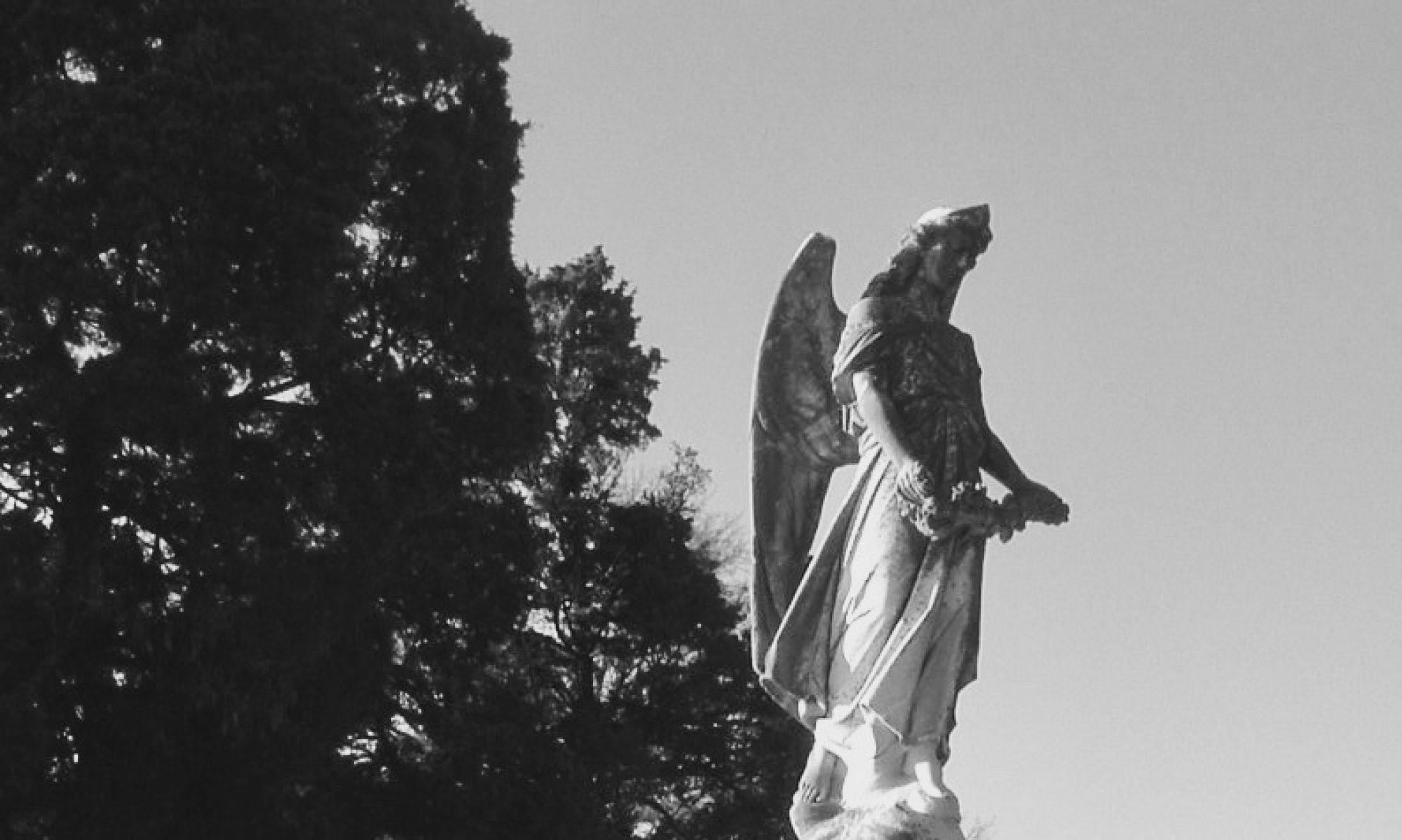
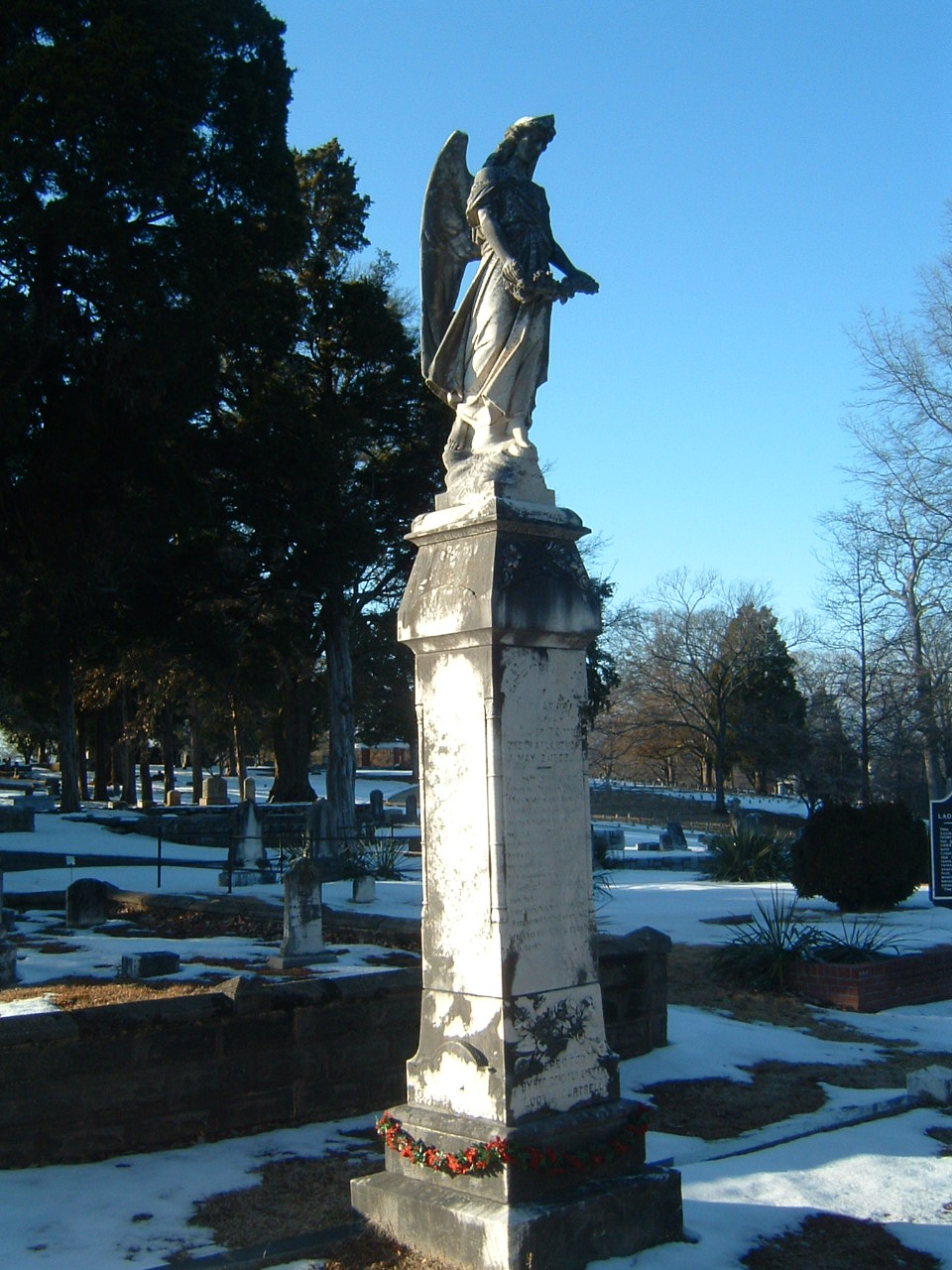
Thanks to a wonderful friend of mine, I now have a marvelous new blog header. The angel tops a monument to Mary Annie Gartrell erected by her sister Lucy. Tradition has it that Lucy visited her sister’s grave twice a week dressed in black mourning clothes. Over time, with Lucy’s biweekly appearances, she became known around town as the “Lady in Black.”
Gartrell Monument, 15 January 2011, the snow is not a usual occurrence in Georgia. Photo by Lewis O. Powell, IV, all rights reserved.
Marietta, located northwest of Atlanta and now a part of a the Atlanta metro area, was chartered in 1834, sometime before the creation of Atlanta. Of course every growing town needs a burying ground and the City Cemetery was established around the time the city was chartered. Over time, it has become the resting place for a cross-section of Marietta’s citizens and during the Civil War, many Confederate soldiers from throughout the South were buried in the adjoining Confederate Cemetery.
The ranks of Confederate Dead in the Confederate Cemetery adjoining the Marietta City Cemetery, 15 January 2011. Photo by Lewis O. Powell, IV, all rights reserved.
Over time, ghosts have been reported in the cemetery. The earliest reports, according to the cemetery brochure published by the Marietta Department of Parks and Recreation, come from a cemetery sexton in 1895 who reported a number of figures in the cemetery. Legend holds that the Gartrell Monument is still visited by a “Lady in Black” over a half-century after the death of Lucy, the original Lady in Black.
Update: 1 November 2017. Since the changeover to a new blog, I have retired my original header, though I’m still using a picture of the Gartrell Monument.
Sources
Akamatsu, Rhetta. Haunted Marietta. Charleston, SC: History Press, 2009.
Marietta City Cemetery and Confederate Cemetery Brochure. Marietta, GA: Marietta Department of Parks and Recreation. No Date.
Scott, Thomas A. “Marietta.” New Georgia Encyclopedia. 30 September 2003.
N.B. This article was edited and revised 2 September 2020.
Though I haven’t really touched on it much yet, the geographical region for this blog includes the District of Columbia. When it was established in 1790, the district was not based in a specific state and instead is under the direct supervision of the Federal Government. With the drama that has and continues to occur in this monumental city, it’s no surprise that there are spiritual remnants. The spirits of past presidents, politicians and their families, civil servants and common people are found throughout the city, from the White House to the Capitol and beyond.
Congressional Cemetery 1801 E Street, SE
Congressional Cemetery, 2008. Photo by AgnosticPreachersKid, courtesy of Wikipedia.
Established as a private burying ground in 1807, this cemetery was later deemed the Washington Parish Burial Ground. About ten years later, space was designated for the burial of government officials and legislators. Cenotaphs, monuments to persons buried elsewhere, were also erected here to memorialize certain notables. Over time, as the burial spot for many of Washington’s elite, this became known as the Congressional Cemetery, though it was not officially a congressional entity.
Among the many famous people who rest here are three who are believed to remain in this plane of existence. John Philip Sousa, was a bandleader and composer known for such patriotic standards as The Washington Post March and Stars and Stripes Forever, he also invented the sousaphone, a type of marching tuba. Legend has it that the bass tones of a sousaphone are sometimes heard around Sousa’s grave.
Famed Civil War-era photographer Mathew Brady, whose stunning images captured the horrors of war is also buried here. After the war, Brady expected that the government would purchase his photographs. When they declined to do so, Brady was left in a penurious state. After being forced to sell his New York studio, he died penniless. His spirit has been reported wandering among the graves of some of those same government officials who denied him compensation.
In 1824, Choctaw Chief Pushmataha, considered by some historians to be the greatest of the chiefs to serve this particular tribe, journeyed to Washington to argue against further concessions of his tribal lands. While on this trip, he fell ill and died and was given full military honors in his burial in this cemetery. Despite his eloquent arguments against the removal of his people, the Choctaw were removed from their homeland. It is possible that his spirit remains here causing trouble at the graves of those who spurned his people after his death.
Hauck, Dennis William. Haunted Places: The National Directory. NYC: Penguin, 2002.
John Philip Sousa. Wikipedia, the Free Encyclopedia. Accessed 20 December 2010.
Mathew Brady. Wikipedia, the Free Encyclopedia. Accessed 20 December 2010.
Ogden, Tom. Haunted Washington, DC: Federal Phantoms, Government Ghosts, and Beltway Banshee. Guilford, CT: Globe Pequot, 2016.
Pushmataha. Wikipedia, the Free Encyclopedia. Accessed 2 September 2020.
Taylor, Troy. Beyond the Grave: The History of America’s Most Haunted Graveyards. Alton, IL: Whitechapel Press, 2001.
Decatur House 1610 H Street, NW
Decatur House, 2009. Photo by Tim1965, courtesy of Wikipedia.
Overlooking Lafayette Park and situated just down the street from the White House stands the Decatur House which is open as the National Center for White House History, a joint effort of the National Trust for Historic Preservation and the White House Historical Association. Built in 1818 by Commodore Stephen Decatur, a naval hero of the War of 1812, the house was designed by Benjamin Henry Latrobe, America’s first professional architect and the designer of the U.S. Capitol Building. Decatur lived in the house only a little more than a year before he was killed in a duel with Commodore James Barron. Decatur’s spirit has been seen standing at a window perhaps contemplating the duel that would end his life while his wife’s piteous spirit has been heard and felt throughout the house.
Sources
Hauck, Dennis William. Haunted Places: The National Directory. NYC: Penguin, 2002.
Decatur House. Wikipedia, the Free Encyclopedia. Accessed 2 September 2020.
McCurry, Jason. “Decatur House” in Jeff Belanger’s Encyclopedia of Haunted Places. Franklin Lakes, NJ: New Page Books, 2005.
Independence Avenue In the vicinity of FAA Headquarters
FAA Headquarters on Independence Avenue, 2009. Photo by Matthew Bisanz, courtesy of Wikipedia.
Much of early Washington was built on the backs of African-American slaves. Two of the most notorious slave markets, the Williams Slave Pen and the Robey Slave Pen were ironically located along Independence Avenue near what is now the headquarters of the Federal Aviation Administration. Witnesses in the area report the clanking of chains and screams in this area.
Indonesian Embassy (Walsh-McLean Mansion) 2020 Massachusetts Avenue, NW
Indonesian Embassy (Walsh-McLean Mansion), 2008. Photo by Josh Carolina, courtesy of Wikipedia.
The Walsh-McLean Mansion is an architectural gem and currently the home to the Indonesian Embassy and several mysteries. The home was owned by the wealthy Edward Beale McLean, owner and publisher of The Washington Post. In 1911, he purchased the famed Hope Diamond, which he presented to his wife, socialite Evelyn Walsh McLean. The purchase went through despite the rumors of a curse attached to the stone.
For eight years the McLeans avoided any tragedy that could be blamed on the stone. As a series of misfortunes befell the family, the press labeled the diamond a “talisman of evil.” These tragedies included the death of the McLean’s son in an automobile accident, their eventual divorce, their daughter from an overdose of sleeping pills, Edward’s dive into insanity, and Evalyn’s demise from disease in 1947. It is Evelyn’s spirit that is supposedly seen descending the grand staircase of the house.
Sources
Edward Beale McLean. Wikipedia, the Free Encyclopedia. Accessed 2 September 2020.
Ganschinietz, Suzanne. National Register of Historic Places Nomination form for Indonesian Embassy. Listed 18 January 1973.
Hauck, Dennis William. Haunted Places: The National Directory. NYC: Penguin, 2002.
Holzer, Hans. Where the Ghosts Are: The Ultimate Guide To Haunted Houses. Secaucus, NJ: Citadel Press, 1995.
Hope Diamond. Wikipedia, the Free Encyclopedia. Accessed 22 December 2010.
National Building Museum (Old Pension Building) 440 G Street, NW
National Building Museum, 2010. Photo by AgnosticPreachersKid, courtesy of Wikipedia.
The faux-onyx Corinthian columns in the National Building Museum, 1918. Photo by National Photo Company, courtesy of Library of Congress, Prints and Photographs Division.
Some of the first paranormal phenomena witnessed in the 1885 Old Pension Building were odd faces appearing on the simulated onyx Corinthian columns in the main court of the building. In 1917, on the eve of the death of “Buffalo” Bill Cody, a guard saw the veins in the onyx take on the shape of a Native American head and a buffalo. Other faces seen on the columns include George and Martha Washington and eventually got so bad the columns were painted over. Following the painting, the spirits took to the halls in the form of shadowy figures.
Sources
Hauck, Dennis William. Haunted Places: The National Directory. NYC: Penguin, 2002.
The Octagon House, 2009. Photo by AgnosticPreachersKid, courtesy of Wikipedia.
The Octagon House is described by the National Park Service as “a zenith in Federal architecture in the United States, through its brilliant plan which combines a circle, two rectangles, and a triangle, and through the elegance and restraint of the interior and exterior decoration.” Construction on this magnificent manse began in 1798 and was completed two years later. The house was home to Colonel John Tayloe, one of the wealthiest planters in Virginia and his spirit as well as the spirits of two of his daughters have been seen in the house. One daughter died after plunging over the stair’s railing. Among other spirits reported is that of Dolley Madison who spent time in house when it served temporarily as Executive Mansion after the White House was burned by the British.
Sources
Holzer, Hans. Where the Ghosts Are: The Ultimate Guide To Haunted Houses. Secaucus, NJ: Citadel Press, 1995.
National Park Service. “Octagon Hall.” Accessed 22 December 2010.
United States Capitol Building Capitol Hill
Among the more interesting legends of this most legendary city is that of Statuary Hall in the Capitol. The magnificent domed chamber originally served as the chamber for the House of Representatives in the first half of the nineteenth century. When the House of Representatives moved into a new chamber, legislation was put forth to use the room to celebrate prominent Americans with each state adding statues of two of its most prominent citizens. The collection of statues has grown to the point where only 38 are actually located in the hall with the remainder of the collection scattered throughout the Capitol. The legend associated with this room is that on the stroke of midnight on New Year’s Eve, the statues all climb down from their pedestals and dance to celebrate another year of the Republic’s survival. According to Dennis William Hauck, the guard who swore he saw this happen was dismissed.
For information on a ghost from the Library of Congress’ original location within the Capitol that may continue to haunt the building see my article on the haunted libraries of D.C.
Sources
Hauck, Dennis William. Haunted Places: The National Directory. NYC: Penguin, 2002.
Woodrow Wilson House, 2008. Photo by AgnosticPreachersKid, courtesy of Wikipedia.
The shade of our 28th president, Woodrow Wilson apparently appears in two places: Blair House and his home in the northwestern part of the city. Also facing Lafayette Square near the Decatur, Cutts-Madison and White Houses, all of which are haunted, the Blair House is now the official state guest house. According to Michael Varhola, Wilson’s spirit has been seen rocking in a rocking chair in one of the bedrooms. His spirit is also seen in the home he occupied following his presidency and where he subsequently died in 1924. Wilson’s “slow shuffle” aided by a cane, which he used following a stroke in 1919, has been heard frequently in this house.
Sources
Blair House. Wikipedia, the Free Encyclopedia. Accessed 22 December 2010.
Hauck, Dennis William. Haunted Places: The National Directory. NYC: Penguin, 2002.
Varhola, Michael J. Ghosthunting Virginia. Cincinnati, OH: Clerisy Press, 2008.