Southern Spirit Guide to Haunted Alabama

N. B.  This article was overhauled 8 December 2019.

Shortly after starting this blog, I created a series of articles covering each state. When I moved this blog, I removed those articles and I have slowly, but surely reposted edits of these articles. The only article to remain intact is the one I created for Washington, D.C. Some of the edited articles have been reposted for Florida, North Carolina, South Carolina, Tennessee, and Virginia.

After publishing my Haunted Alabama book as an eBook in 2015, I redid the haunted Alabama article using entries from the original manuscript. When I republished the book in print, the text received a major overhaul, though this article wasn’t updated. Now, in 2019, I’m finally getting around to updating this article.

Alabama State Capitol
600 Dexter Avenue
Montgomery

One of the most important sites in the entire state stands on a place called Goat Hill. This building is the second capitol building on this site, the first having been destroyed by fire in 1849. The current building opened in 1851 and has witnessed a panorama of much of Alabama’s history. It was here in 1861 that representatives of six Southern states met to create the Confederate government. Later that year, Jefferson Davis and Alexander Stephens were inaugurated here, respectively, as the President and Vice President of the Confederacy. A little more than a hundred years later, Martin Luther King, Jr. would lead a civil rights march to the steps of this building.

With such history, it’s no surprise that spirits may still wander the capitol’s corridors. One legend concerns a Confederate widow. Desperate to find where her husband had died and the location of his grave, she made inquiries, but no information was forthcoming. She continued haunting the corridors in life and, evidently, in death. Security guards and staff members have seen this desperate woman and continue to hear her footsteps.

haunted Alabama State Capitol Montgomery ghost
Alabama State Capitol, 2006, by Jim Bowen. Courtesy of Wikipedia.

A security guard is quoted in a 1994 Birmingham News article as having seen a female spirit standing near the statue of Governor Lurleen Wallace. The woman was wearing white opera-length gloves which are reminiscent of the gloves Wallace is wearing in her official state portrait.

Faith Serafin notes in her book Haunted Montgomery, Alabama that bathroom sinks near the offices of the state board of convicts are often found with the water running. This activity may be related to a 1912 murder that occurred here. When a property dispute did not turn out in his favor, Will Oakley shot and killed his stepfather, P. A. Woods, in the offices of the president of the convict board. Legend holds that Will Oakley’s spirit may still be trying to wash the blood off his hands.

Sources

  • Lindley, Tom. “Ghosts or good stories haunt Capitol’s halls: This Confederate widow will never tell.” The Birmingham News. 27 November 1994.
  • Schroer, Blanche Higgins. National Register of Historic Place nomination form for the Alabama State Capitol. 29 September 1975.
  • Serafin, Faith. Haunted Montgomery, Alabama. Charleston, SC: History Press, 2013.

Bear Creek Swamp
County Road 3
Prattville

On Halloween of 2014, twenty-one dolls tied to bamboo stakes appeared in Bear Creek Swamp. The Autauga County Sheriff’s Office thought they were simply a harmless Halloween prank, but after reports of the dolls began to spread through the media, the sheriff’s office decided to remove them. The reason for the dolls’ placement in the swamp remains mysterious, but then again, Bear Creek Swamp abounds in mystery.

A newspaper article regarding the incident described the swamp as “a massive bog with a bit of a reputation locally.” The article continues, “As a rite of passage, generations of teenagers have entered the area at night looking for the creatures and haints said to roam the mist-covered realm. And it’s not unusual to hear reports of loud booms coming from its depths.”

Before the arrival of white settlers, local Native Americans knew the swamp as a place with pure water and medicinal springs. This area was once the home of the Autauga or Tawasa Indians who were members of the Muscogee Creek Confederacy. The Muscogee Creek were removed by force in the 1830s and forced west on the Trail of Tears.

Some Native spirits may have remained in the swamp. A hunter told author Faith Serafin about seeing a female apparition with- in the swamp while tracking a deer. A couple hiking through the area encountered a wild-looking woman with a gaunt face who screamed and disappeared into the underbrush when they approached. Others, including an investigation team from Southern Paranormal Researchers, have witnessed strange orbs of light in the depths of this mysterious bog.

Sources

  • Roney, Marty. “21 dolls on bamboo stakes found in Alabama swamp.” Hattiesburg American. 27 November 2014
  • Serafin, Faith. Haunted Montgomery, Alabama. Charleston, SC: History Press, 2013.
  • Sutton, Amber. “Officers remove more than a dozen dolls from Autauga County swamp.” AL.com. 25 November 2014.
  • Southern Paranormal Researchers. “Bear Creek Swamp—September 3, 2006.” Accessed 29 November 2012.

Belle Mont
1569 Cook Lane
Tuscumbia

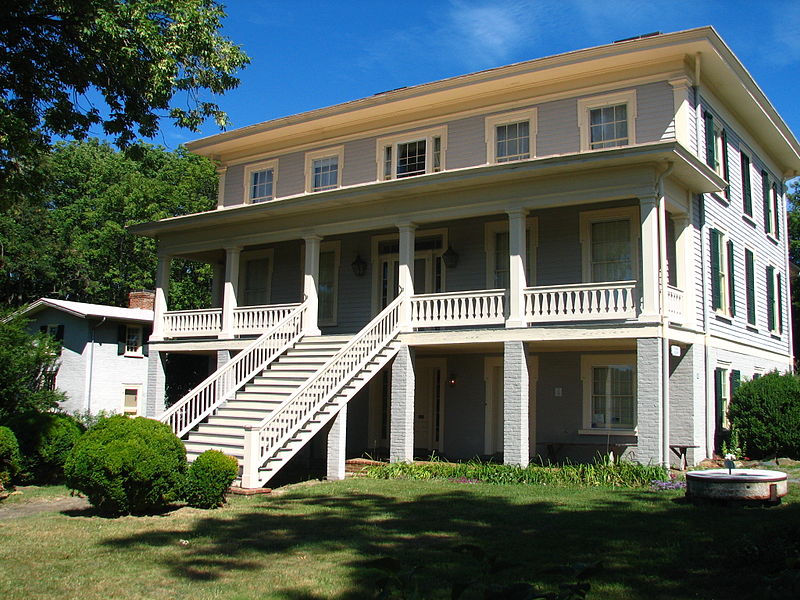
Built between 1828 and 1832 by Dr. Alexander Mitchell, Belle Mont is now a house museum owned by the Alabama Historical Commission. This house represents a rare example of what is sometimes termed “Jeffersonian Classicism,” the distinctive style of Palladian architecture created by Thomas Jefferson. While most likely not directly designed by Jefferson himself, the house may be the work of one of his disciples.

haunted Belle Mont Tuscumbia Alabama ghosts
Belle Mont, 2010, by Carol M. Highsmith. Courtesy of the Library of Congress, Prints and Photographs Division.

Around the time the house was completed Dr. Mitchell lost his wife and both daughters to a fever, and he subsequently sold the property. A family renting this house in 1938 had a frightening experience. Just after moving their things into the house, the family began to hear sounds throughout the house including footsteps and voices crying “help me.” Time passed with these events growing more and more frightening until one rainy night when the family watched with horror as a group of apparitions: a man, a woman and one, possibly two, small girls, appeared at the top of the staircase. The woman and children, dressed in night- clothes that were dirty and torn, wore expressions of horror as they descended the staircase and out the front door. After this frightening vision, the family continued to hear odd sounds. The last reported paranormal incident is recorded in 1968 with nothing seen or heard since.

Sources

  • Gamble, Robert S. National Register of Historic Places nomination form for Belmont. Jan. 1981.
  • Belle Mont. Alabama Historical Commission. Accessed 16 December 2010.
  • Belle Mont (Tuscumbia, Alabama). Wikipedia, the Free Encyclopedia. Accessed 16 December 2010.
  • Johnston, Debra. Skeletons in the Closet: True Ghost Stories of The Shoals Area. Debra Johnston, 2002.

Bragg-Mitchell Mansion
1906 Springhill Avenue
Mobile

haunted Bragg-Mitchell Mansion Mobile Alabama ghosts
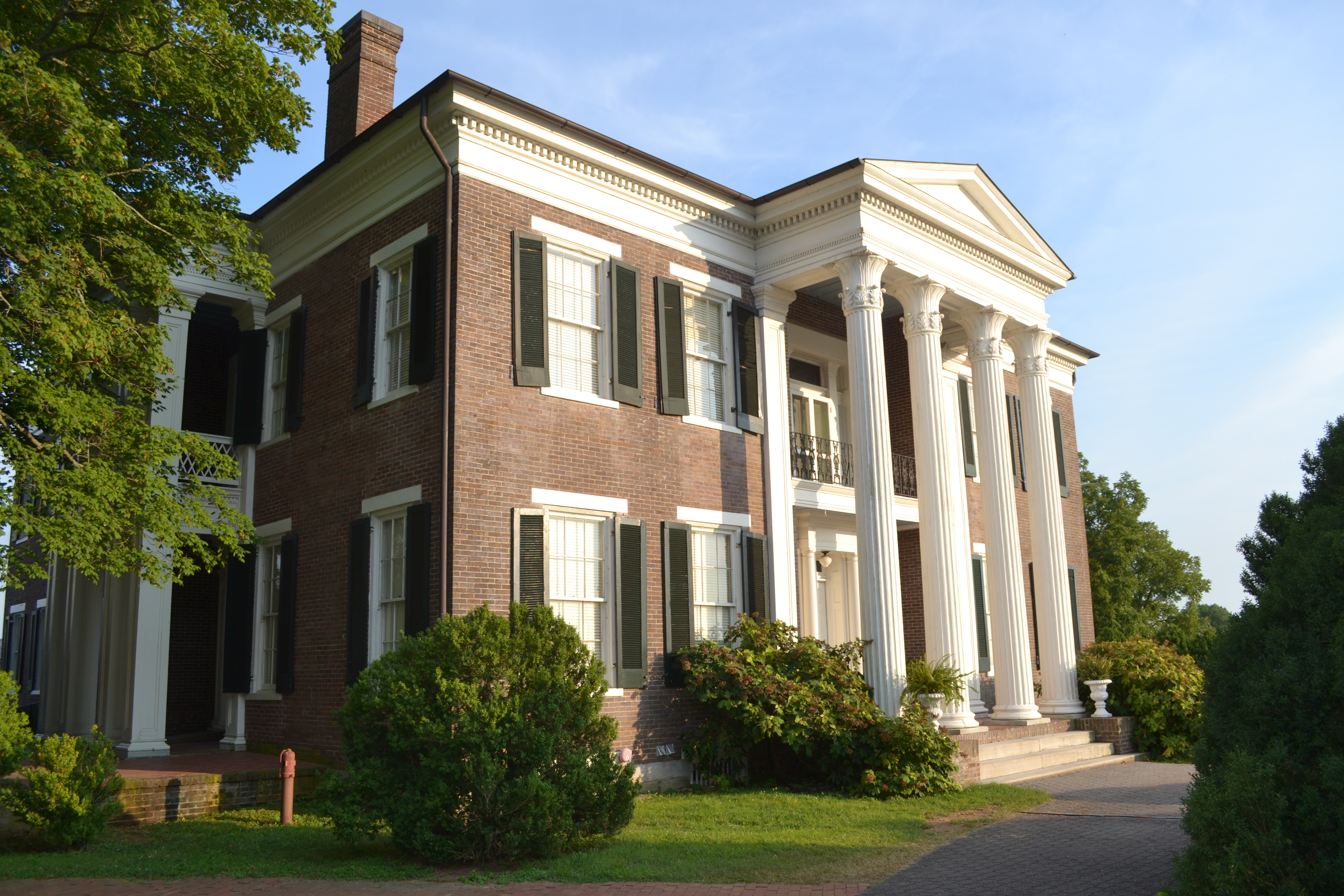
Bragg-Mitchell Mansion, 2006, by Altairisfar. Courtesy of Wikipedia.

In the years following the Civil War, General Braxton Bragg was considered one of the most inept generals to have served in the Confederate Army. Bragg had earned victories though lost tactically in battle at Perryville, Kentucky; Chickamauga, Georgia, and Stones River (Murfreesboro), Tennessee. He lived here in the home once occupied by his brother Judge John Bragg, from 1869 until he moved to Texas in 1874. He would die in Galveston two years later having found about as much success in civilian life as he found in military life. From time to time, docents and visitors to the Bragg-Mitchell Mansion have seen the gray form of a man, believed to be the form of General Bragg. Once, as a docent was opening the house for wedding photographs, she saw a man striding across the parking lot behind the house. The strange man neared the tool shed and vanished. A thorough search of the property by the docent and the wedding party did not uncover the gentleman.

The Bragg-Mitchell House was built by Judge John Bragg in 1855. After construction, the house was the scene of gatherings by prominent Alabamians of the period and members of the Bragg family including John’s brothers: Braxton, former North Carolina governor Thomas Bragg, Captain William Bragg, and Alexander Bragg, who may have had a hand in designing his brother’s home. During the Civil War, Judge Bragg’s wife anxiously sent the family’s furnishing and many of their possessions to the family’s inland cotton plantation for safe keeping. Unfortunately, the estate was destroyed along with the contents of her city home, something from which Mrs. Bragg never quite recovered. After Judge Bragg’s death in the late 1870s, the house passed through a few different hands before being purchased by the Mitchell family who lovingly restored the home and left it to the City of Mobile.

The house has served as a wedding venue and events facility for many years. Over time, guests and docents have had many encounters with the spectral residents of the house including a ghostly feline that was first noted by Mrs. Mitchell when she owned the house. A spectral woman, possibly Judge Bragg’s wife, has been seen peering from one of the upstairs windows. Others have had more mischievous encounters including an AC installer who was locked in the attic and others who have been irritated by the ghosts turning lights on just after they have been turned off.

Sources

  • Coleman, Christopher K. Dixie Spirits: True Tales of the Strange and Supernatural, 2nd Edition. Nashville, Cumberland House, 2002.
  • Parker, Elizabeth. Mobile Ghosts: Alabama’s Haunted Port City. Apparition Publishing, 2001.

Fort Morgan State Historic Site
51 AL 180
Baldwin County

Along with Fort Gaines on Dauphin Island, Fort Morgan guards the entrance to Mobile Bay. Construction of the fort began in 1819, following the British capture of the area in 1815, during the misnamed War of 1812. Using slave labor, this enormous masonry fort was constructed in 1834. With rising tension after Alabama’s secession from the Union, the fort was peacefully turned over to the state’s Confederate militia.

haunted Fort Morgan Alabama ghosts
Fort Morgan, 2002, by Edibobb. Courtesy of Wikipedia.

The fort saw action on August 5, 1864, during the Battle of Mobile Bay when it was attacked and besieged by Union warships; the fort surrendered a few days later. It remained in operation until it was abandoned by the military in 1924. It was then re-militarized during World War II and turned over to the State of Alabama in 1946.

Southern Paranormal Researchers investigated the fort in 2006 and witnessed a bevy of activity including disembodied voices, fleeting shadow figures, and having fully charged batteries drained. They also captured a few anomalies in photographs and one EVP. Visitors to the fort have encountered phantom smells of gunsmoke, the sounds of battle, and figures in period clothing.

Sources

  • Langella, Dale. Haunted Alabama Battlefields. Charleston, SC: History Press, 2013.
  • Schroer, Blanche Higgins. National Register of Historic Places nomination form for Fort Morgan. 4 Oct 1975.
  • Southern Paranormal Investigation Team. Fort Morgan Investigation. 16 Dec 2006.

Horseshoe Bend National Military Park
11288 Horseshoe Bend Road
Dadeville 

A bend on the Tallapoosa River formed an ideal site for the Muscogee Creek village of Tohopeka. During the Creek War of 1813-14—a civil war within the Muscogee Creek Nation that eventually embroiled the American government—a band of Red Stick Creeks under Chief Menawa defended this position against American troops and Native American allies under the command of General Andrew Jackson. Some 800 Red Stick warriors were slaughtered here on March 27, 1814, bringing an end to the Creek War of 1813-14 and leaving the Tallapoosa River at Horseshoe Bend stained red with blood.

With the slaughter that occurred here, it’s no wonder that visitors have reported a plethora of paranormal activity here ranging from smells and odd noises to full apparitions. A paranormal investigation by the Alabama Paranormal Research Team produced some photographic anomalies as well as the sound of someone screaming in the vicinity of the Muscogee Creek village site.

haunted Horseshoe Bend Battlefield Dadeville Alabama ghosts
The riverbank at the Horseshoe Bend Battlefield, 2015. Photo by Lewis Powell IV, all rights reserved.

Sources

  • Langella, Dale. Haunted Alabama Battlefields. Charleston, SC: History Press, 2013.
  • Alabama Paranormal Research Team. Investigation of Horseshoe Bend National Military Park. Accessed 18 Dec 2010.
  • Jensen, Ove. “Battle of Horseshoe Bend.” Encyclopedia of Alabama. 26 Feb 2007.

Linn-Henley Research Library
2100 Park Place
Birmingham

haunted Linn-Henley Library Birmingham Alabama ghosts
Linn-Henley Library, 2009, by DwayneP. Courtesy of Wikipedia.

This building opened in 1927 as the Birmingham Public Library and now houses archives, government documents, a southern history library, and a ghost. Blogger Jessica Penot visited in 2012 and noted the “uncanny quiet that fills the building like a tangible presence.” The spirit of Fant Thornley, the library’s dedicated director from 1953 until the 1970s, still makes occasional appearances here. The spirit has been seen by an electrician, and library staffers have smelled the smoke from his cigarettes.

Sources

Monroe County Heritage Museum
(Old Monroe County Courthouse)
31 North Alabama Avenue
Monroeville

In 1903, this structure was constructed as the Monroe County Courthouse. It was here that a young Harper Lee, Monroeville’s most famous resident and author of the classic novel, To Kill a Mockingbird, would watch her attorney father as he argued cases. When Hollywood put the story on celluloid, the set designers replicated the courtroom on a California sound stage. This building was used by Monroe County as a courthouse until 1967.
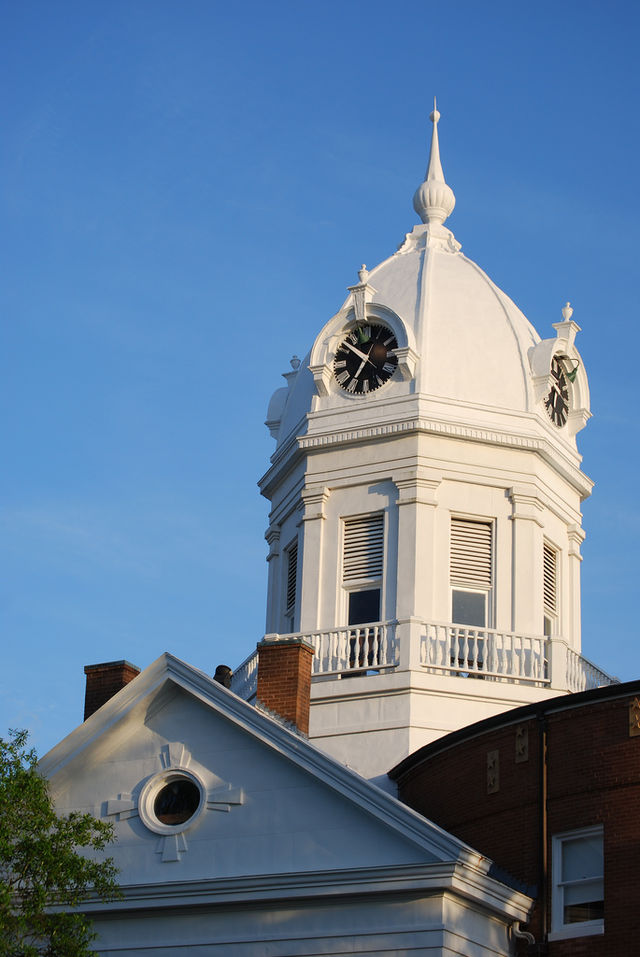
haunted Old Monroe County Courthouse Monroeville Alabama ghosts
Dome of the Old Monroe County Courthouse, 2008, by Melinda Shelton. Courtesy of Wikipedia.

The upper floors of this building still seem to retain some of the energy from the building’s judicial use. Blogger Lee Peacock quotes one man as saying, “Things blow in the breeze but there is no breeze. You hear sounds that don’t belong, and I have smelled pipe tobacco smoke when no one was smoking or there to be smoking.” Staff members working late here often get the feeling of not being alone and have heard mysterious sounds within this storied building.

Sources

  • Higdon, David & Brett Talley. Haunted Alabama Black Belt. Charleston, SC: History Press, 2013
  • Peacock, Lee. “Ten new locations make list of “Spookiest Places in Monroe County.” Dispatches from the LP-OP. 31 October 2014.
  • W. Warner Floyd. National Register of Historic Places nomination  form for Old Monroe County Courthouse. 29 March 1973.

Moundville Archaeological Park
634 Mound State Parkway
Moundville

Between approximately 1120 C.E. and 1450 C.E., Moundville was the site of a large city inhabited by the Mississippian people, predecessors to the tribes that the Europeans would encounter when they began exploring the South about a century later. At its height, this town was probably home to nearly 1,000 inhabitants. Stretching to 185 acres, the town had 29 mounds of various sizes and uses: some were ceremonial while others were topped with the homes of the elite.
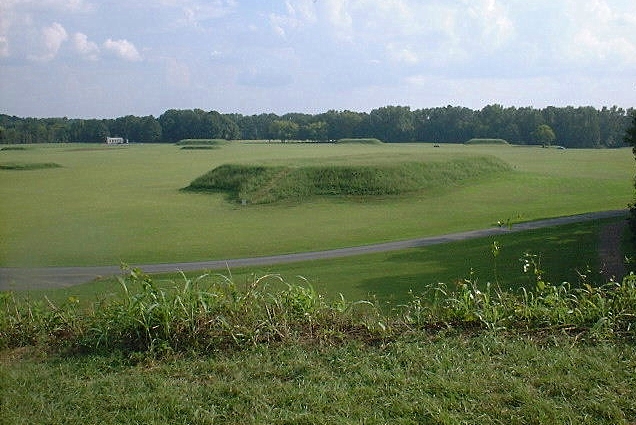
haunted Moundville Archaeological Park Moundville Alabama ghosts
One of the mounds at Moundville, 1998, by Altairisfar. Courtesy of Wikipedia.

Visitors and staff have often mentioned a certain energy emanating from this site. A Cherokee friend of mine visited and while atop one of the mounds let out a traditional Cherokee war cry. Afterward, he noted that there was a palpable change in the energy. Dennis William Hauck speaks of the “powerful spirit of an ancient race” that “permeates this 317-acre site” in his Haunted Places: The National Directory. Southern Paranormal Researchers notes that park staff has witnessed shadow figures, odd noises, and doors opening and closing by themselves in the buildings on the site. Higdon and Talley add orbs and cold spots found throughout the location to the list of paranormal activity here.

Sources

  • Hauck, Dennis William. Haunted Places: The National Directory. NYC: Penguin, 2002.
  • Southern Paranormal Researchers. Investigation Report for Moundville Archaeological Park. Investigated 10 February 2007.
  • Higdon, David & Brett Talley. Haunted Alabama Black Belt. Charleston, SC: History Press, 2013.
  • Blitz, John H. “Moundville Archaeological Park.” Encyclopedia of Alabama. 26 February 2007.

Old Depot Museum
4 Martin Luther King, Jr. Street
Selma

haunted Old Depot Museum Selma Alabama ghosts
Old Depot, 2010, by Carol M. Highsmith. Courtesy of Library of Congress, Prints and Photographs Division.

A part of the Alabama Ghost Trail, a series of haunted places linked by the Southwest Alabama Regional Tourism and Film Office, the Old Depot Museum features a ghost that reportedly has an affinity for the museum’s elevator. The museum occupies the Romanesque Revival circa 1890 Louisville & Nashville Railroad Depot.

Sources

  • Besser, Susan A. National Register of Historic Places nomination form for the Water Street Historic District. March 2002.
  • Old Depot Museum. Alabama Ghost Trail. YouTube. Posted 19 July 2009.

Timmons Cemetery
Buxton Road
Redstone Arsenal

When the Army took over some 40,000 acres in Huntsville in 1941, it swallowed up many old farms and plantations including some 46 cemeteries. Located in the woods off of Buxton Road, the Timmons Cemetery is considered, by some, the spookiest place on the Arsenal. Guards patrolling Buxton Road at night have seen a little girl running across the road near the cemetery.

To explain the little girl’s spirit, a legend has surfaced, though apparently not backed up by historical documentation. Margaret Ann Timmons was an energetic child and sometimes difficult to control. When work required the family to be in the fields, Margaret would be tied to a chair inside the house. The energetic child wiggled out of her restraints, and kicked over an oil lamp that destroyed the house and killed the child. Now, not even death and the stone wall that surrounds the family’s cemetery can restrain her.

Sources

  • “Does a little girl really haunt Redstone Arsenal.” WAAY. 31 Oct 2014.
  • “Redstone Report: Ghost story still haunts Redstone Arsenal.” WAFF. 31 Oct 2011.

A Spectral Tour of the Shenandoah Valley

I recently had an inquiry from a friend who’s a student at Shenandoah University in Winchester, Virginia regarding a “haunted road trip” he and his friends want to take next month. After consulting my resources, I’ve devised a suitable tour of the area’s numerous haunts.

This tour makes a circle through the Shenandoah Valley, beginning and ending in Winchester. It heads south on I-81 towards Staunton with a few stops along the way. After Staunton the tour heads east to include the famous Exchange Hotel in Gordonsville before returning to Winchester. The tour includes a range of haunted places from historic homes to government buildings, churches, battlefields, commercial buildings, cemeteries, a train depot, a former mental hospital and a cave. Some of these locations are open to the public while a few are private and should only be viewed from the street.

N.B. This article has been reworked a bit and I have begun separating these cities into their own distinct articles.

Winchester

The Winchester section of this article has been broken off into its own, separate article, “The Wraiths of Winchester.”

Middletown

1797 WAYSIDE INN (7783 Main Street) This building sits at the core of history of this small town. The motley of old buildings forming the tavern were built over a period ranging from the 18th century through to the late 19th century. The oldest portion of the building, containing Larrick’s Tavern,  may have been constructed around 1750. The road in front was once part of the Great Wagon Road—the road used by settlers pouring into the American “backcountry.” In this area, the Great Wagon Road  was originally a Native American trail called the Great Indian Warpath and used by a multitude of Native American tribes including the Cherokee.

In 1797, this collection of buildings became an inn for the many travelers passing on the road. Leo Bernstein, the garrulous personality who took over the inn the latter half of the 20th century, would always claim that this inn was the oldest continuously operating inn in the nation. There does seem to be a good deal of truth behind his claim. It is known that this inn was in operation as war raged up and down the valley during the Civil War and that the inn served both sides.

Wayside Inn. Photo 2008, by DwayneP, courtesy of Wikipedia.

Like most buildings in the area, the inn has a number of Civil War related spirits, though there is the possibility that the inn may have been haunted before that time. Lord Fairfax, who had been given much the land in the area, did live nearby and died in Winchester (he’s buried at Christ Episcopal Church) is claimed as the spirit that moans on a nightly basis in the oldest portion of the inn. Bernstein describes the space in Sheila Turnage’s Haunted Inns of the Southeast, “Upstairs is about a three foot space. There was a set of steps going up there. The straw is still there.” The loft is located just above one of the bars and Turnage mentions that people gather to listen for the moan at 11:30 PM nightly.

Besides odd moans, the inn is home to numerous other spirits and employees and guests have witnessed much activity. Objects have moved on their own accord, a dishwasher had his apron untied repeatedly by unseen hands, and full apparitions have been seen including those of Civil War soldiers. Paranormal investigations have captured much evidence including EVPs of horses whinnying and photographs featuring specters.

WAYSIDE THEATRE (7853 Main Street, now closed) The sad fate of the Wayside Theatre echoes the fate of so many theatres throughout the country. The company was established in 1961, by Leo Bernstein, the owner of the Wayside Inn just down the street. The summer stock theatre provided training for actors such as Susan Sarandon, Peter Boyle, Kathy Bates and Donna McKechnie. After a precipitous drop in revenue, the theatre closed its doors in 2013.

The building was originally constructed as a cinema and it is from this period that the theatre’s ghost may come from. “George,” is supposedly the spirit of an African-American man who either worked in the theatre or was a caretaker at some point. His spirit is said to haunt the stage, balcony and basement of the building.

CEDAR CREEK AND BELLE GROVE NATIONAL HISTORICAL PARK (Belle Grove, 336 Belle Grove Road) Historically and architecturally, Belle Grove is one of the most important houses in the region and listed as a National Historic Landmark. It is currently owned and operated by the National Trust and most sources state that the docents are discouraged from talking about the spirits which still reside here.

Belle Grove, 2013, by AgnosticPreachersKid. Courtesy of Wikipedia.

The history of Belle Grove begins in the late 18th century with the land being acquired by Isaac Hite, the grandson of Jost Hite, a German immigrant and one of the early pioneers in this area. Construction of the house began in 1794 and ended in 1797. The house remained in the Hite family until just before the beginning of the Civil War when it was bought by John and Benjamin Cooley. The first of two ghost stories begin with this family. Not long after acquiring the house, Benjamin Cooley married a local woman named Hetty. Not long after her arrival in the home, Hetty became the subject of ire from one of the slave woman working there.

Though the details are unclear, Hetty was attacked by the slave and her beaten body was thrown either into the smokehouse or the icehouse on the property. Hetty’s spirit reportedly returns frequently and has been seen throughout the house. According to two sources, she actually let a deliveryman into the house one afternoon after the home had been closed for the day. The deliveryman was returning the antique carpets which had been removed for cleaning. After arriving late, he was let into the house by a woman in a period dress who did not speak but only gestured to where the carpets should be placed. When the staff discovered the carpets had been returned and put in place, they called the cleaning company who put the driver on the phone. They were shocked to hear about the woman who let him in.

A few years after Mrs. Cooley’s death, the estate became the scene of the Battle of Cedar Creek. During that battle, Major General Stephen Ramseur of North Carolina was gravely wounded. He was taken to a room at Belle Grove where he passed away the following morning surrounded by some of his former classmates from West Point from both armies including George Custer. This scene was witnessed by a gentleman some years ago. While idly passing through the house, he glanced into a room to see a group of Civil War soldiers in both blue and grey standing around someone in a bed. Later, when he asked who had been presenting the tableaux that day, he was informed that nothing of the sort was taking place in the house.

Employees have told various paranormal writers that voices and other odd noises are regularly heard in the house, while singing is heard in the slave cemetery on the property.

Early on the morning of October 19, 1864, Confederate General Jubal Early launched an attack upon Union forces camping in the area. These forces under General Sheridan (who was headquartered at the Lloyd Logan House in Winchester, see stop #3H) had spent their time clearing the Shenandoah Valley of Confederates. Known as “The Burning,” this period included the destruction of much of the area. Early’s early morning attack was one of the last chances for Confederates to stop the decimation of the valley.

While Early’s attack was initially successful in beginning to route the Federals, Sheridan, hearing the sounds of battle from Winchester, jumped upon his horse and made a triumphant ride to Middletown to rally his troops to victory. At the end of the day, Early’s forces had been driven from the field.

The stories of spirits on this battlefield began not long after the battle ended. These stories included spectral soldiers on the battlefield both singly and in groups and even stories of headless horsemen. Michael Varhola notes, however, that the gentlemen he met working in the visitor’s center, refused to answer his questions about the battlefield being haunted.

Grottoes

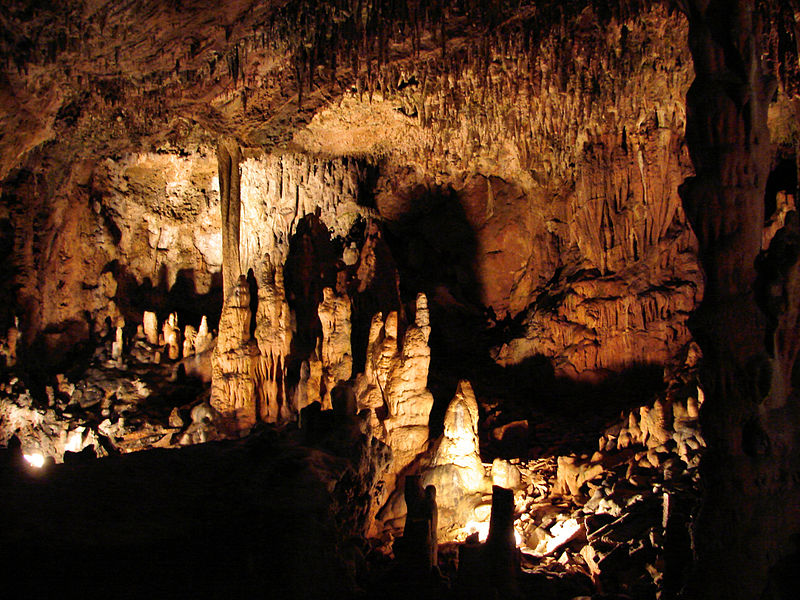
Formations within Grand Caverns. Photo 2010 by P199. Courtesy of Wikipedia.

GRAND CAVERNS (5 Grand Caverns Drive) From the oldest continuously operating inn in the country to the oldest operating show cave, Grand Caverns has been open for tourists since 1806. I’ve covered this cave and its ghosts in a blog entry here.

New Hope

PIEDMONT BATTLEFIELD (Battlefield Road) Outside of New Hope, near the community of Piedmont, is an open field that was the scene of a battle, the 5th of June 1864.

Around 5 AM, June 5, 1996, a group of reenactors camping on the southern edge of the battlefield were awakened by an unusual ruckus: the sounds of wagons approaching. In an effort to greet the approaching wagons, a few of the reenactors stepped towards a nearby fence. The sounds, the creak of wagon wheels, the tinkle of chains, the clop of horses hooves and their whinnies, increased for a moment as they apparently neared the awed witnesses then they suddenly ceased. Some of those present later discovered an overgrown trace or wagon road in the woods near the spot where they’d heard the sounds. It is believed that this road may have been in existence at the time of the battle.

Of course, there’s no way to know if the sounds were related to battle or simply spiritual residue from the road’s history. Either way, the reenactors will likely tell this story for years to come.

Staunton

Like Winchester, Staunton has a myriad of haunted locales and a ghost tour. Black Raven Paranormal presents a handful of different tours; see their website for further information.

MRS. ROWE’S FAMILY RESTAURANT (74 Rowe Road) This popular restaurant has been investigated twice in the past few years after employees and guests have had run-ins with spirits. In addition to activity in the building’s attic and basement, the back dining room and men’s room have reportedly had activity. Two local news articles describe the activity as ranging from full apparitions to employees being touched.

DeJARNETTE CENTER (located behind the Frontier Culture Museum, 1290 Richmond Avenue, the center is closed and private property though one of the tours offered by the Ghosts of Staunton tours the grounds, don’t ask for further information at the Frontier Culture Museum, they can’t tell you much of anything) There’s a good deal of misinformation about this location. Of course, mental and psychiatric hospitals tend to be haunted, along with other medical facilities. Among those with a paranormal bent, there is a tendency to exploit these types of places and often repeat misinformation.

DeJarnette Center. Photo 2011, by Ben Schumin, courtesy of Wikipedia.

With the DeJarnette Center, there is a tendency to confuse it with Western State Hospital, which also may be haunted. Though their histories are intertwined, these are two separate facilities. Western State was founded early in the 19th century to handle the overflow from the Williamsburg Hospital which handled the insane and mental cases. The complex that once house Western State has recently been converted into condominiums called The Villages at Staunton.

During the first half of the 19th century, Western State was under the aegis of Dr. Joseph DeJarnette, a revolutionary figure in the field of mental health. His controversial legacy included institutionalizing a eugenics program that forcibly sterilized numerous patients throughout the state.

This facility opened in 1932 originally as the DeJarnette State Sanitarium, a private pay unit of Western State. The state assumed control of this facility in 1975 and renamed it the DeJarnette Center for Human Development. The facility experienced severe budget cuts starting in the mid-70s and continuing until the patients were moved into a newer, smaller facility adjacent to Western State in 1996. Since 1996, the site has been abandoned and waiting for the wrecking ball. Countless ghost stories have been told about the facility, though few have actually been published.

DOWNTOWN STAUNTON Like downtown Winchester, Staunton has a number of haunted places, though the information on them is not as readily available (as opposed to Winchester with Mac Rutherford’s book on its hauntings). I imagine many of these locations will be presented on the Ghosts of Staunton tour.

STAUNTON COFFEE AND TEA (32 South New Street) This building was the scene of a homicide in August of 1951. Elmer Higgins, a heavy gambler who lived in an apartment on the building’s second floor was shot in the head, execution-style. The murder remains unsolved and it is believed his spirit remains on the premises.

AMTRAK STATION (1 Middlebrooks Avenue) There has been a train station on this site since 1854. The first station was burned during the Civil War while the second station was destroyed April 28, 1890 by train. The New York Times described the event, “This morning about 3 o’clock a railroad wreck occurred at the Staunton (Chesapeake and Ohio) Station. The vestibule train, due here from the west at 1 o’clocl was two hours late. About 3 o’clock it came whirling on at a speed of seventy miles an hour, the engine having the appearance of a sheet of fire…As the train reached the passenger station the rear sleeper careened, striking the platform covering, tearing away the iron posts, and demolishing the whole platform structure.”

Staunton Amtrak Station. Photo 2009, by Ben Schumin, courtesy of Wikipedia.

The train was carrying members of a traveling operatic troupe out of Cincinnati, Ohio. The only death to occur was one of the company’s singers, Miss Myrtle Knox who was badly mangled by the accident and bled to death.

Myrtle’s sad spirit has been spotted on the platform wearing a nightgown. Women with long blonde hair have had their hair tugged and it is believed that Myrtle’s spirit may be to blame for that as well.

An old rail car at the depot once contained a restaurant. Visitors to the station have seen odd lights, shadows and heard voices around the old Pullman car. Along the tracks the apparition of a Civil War soldier has been seen. A Confederate soldier was walking these tracks after having a bit too much to drink at a local saloon. He was hit by a train and killed.

THE CLOCK TOWER BUILDING (27 West Beverly Street) This 1890 structure has been the scene of at least three deaths. Two early deaths on the premises, which was originally constructed as a YMCA facility, include a heart attack and a young woman who fell down a coal chute. Recently, someone fell to their death from the third floor in a possible suicide. These spirits are still said to linger in this old building.

MARY BALDWIN COLLEGE (Intersection of Frederick Street and New Street) According to the National Register of Historic Places nomination form for this college’s main building, Mary Baldwin is the oldest women’s institution of higher learning associated with the Presbyterian Church. The school was opened in 1842 as the Augusta Female Seminary. In the midst of the Civil War, Mary Baldwin and Agnes McClung, former students of the seminary were appointed as principals. They would serve the school through the latter half of the 19th century and Mary Baldwin’s contribution would be recognized in 1895 when the school was renamed for her. The spirits of Mary Baldwin and Agnes McClung may remain on campus along with a few other assorted spirits.

In the old Main Building, one of the first buildings constructed on campus, a male spirit named Richard likes to occasionally cause trouble. McClung Residence Hall, just behind the Main Building includes the rooms where Baldwin and McClung lived during their tenure here. Students living there have reported the spirits of both women, with one student even waking up to find a white figure hovering over her as she slept. The Collins Theatre, located inside the Deming Fine Arts Center, also features a spirit, possibly that of one of Mary Baldwin’s most illustrious alums, the actress Tallulah Bankhead. The spirit in the theatre is known to mess with the stage lights.

Gordonsville

Exchange Hotel, 2008, by Rutke421. Courtesy of Wikipedia.

CIVIL WAR MUSEUM AND EXCHANGE HOTEL (400 South Main Street) The Exchange Hotel has, in recent years, become one of the Southern meccas for ghost hunters. Opened on the eve of the Civil War, this hotel became one of the premier hospitals for the wounded during the Civil War. With so many deaths here, it’s no wonder that the place is crawling with ghosts. In one of my early blog entries, I’ve covered this location. At one time, the museum offered ghost walks, but I can currently find no information about these. This haunting was also covered on the Biography Channel show, My Ghost Story, first season, episode six.

Sources

  • Abram’s Delight. Winchester-Frederick County Historical Society. Accessed 19 September 2014.
  • Armstrong, Derek Micah. “A true ghost story.” The News Virginian. 22 October 2012.
  • Ash, Linda O’Dell. “Respect the spirits, ‘Ghost Hunters International’ star Dustin Pari tells Wayside Inn paranormal investigators.” The Northern Virginia Daily. 7 November 2011.
  • Austin, Natalie. “Local ghost expert shares stories of the supernatural.” The Northern Virginia Daily. 30 October 2004.
  • Brown, Beth. Haunted Plantations of Virginia. Atglen, PA: Schiffer, 2009.
  • Commonwealth Center for Children and Adolescents. Wikipedia, the Free Accessed 29 September 2014.
  • Daly, Sean. “In Strasburg, a Medium Well Done.” The Washington Post. 31 July 2002.
  • Demeria, Katie. “Joe’s Steakhouse opens new location in Winchester.” The Northern Virginia Daily. 20 June 2014.
  • “A haunting reminder of a darker past at the DeJarnette complex.” The Daily News Leader. 15 September 2012.
  • History. Cork Street Tavern. Accessed 17 September 2014.
  • History. Mount Hebron Cemetery. Accessed 21 September 2014.
  • History of Our Building. Brewbaker’s Restaurant. Accessed 24 September 2014.
  • Klemm, Anna and DHR Staff. National Register of Historic Places nomination form for Mount Hebron Cemetery. 25 July 2008.
  • Lamb, Elizabeth. “Paranormal Activity Hunters Investigate Restaurant for Ghost Activity.” 11 January 2013.
  • Lee, Marguerite Du Pont. Virginia Ghosts. Berryville, VA: Virginia Book Company, 1966.
  • Lowe, F.C. “Final curtain falls on Wayside Theatre; ending 52-year run.” Winchester Star. 8 August 2013.
  • Middletown Heritage Society. National Register of Historic Place nomination form for Middletown Historic District. 7 May 2003.
  • Peters, Laura. “What goes bump in the night.” The Daily News Leader. 9 October 2013.
  • Powell, Lewis O. “An Independent Spirit—Winchester, Virginia.” Southern Spirit Guide. 31 March 2014.
  • Rutherford, Mac. Historic Haunts of Winchester: A Ghostly Trip Through the Past. Charleston, SC: History Press, 2007.
  • Shulman, Terry. “Did ghostly soldiers pay reenactors a courtesy call?” The News Leader (Staunton, VA). 10 July 2004.
  • Smith, Morgan Alberts & Marisol Euceda. “The Ghosts of MBC.” Up Hill and Down. January/February 2003.
  • Stanley, K.W. “The history of Western State and the Dejarnette Sanitarium.” The News Progress. 20 May 2008.
  • Toney, B. Keith. Battlefield Ghosts. Berryville, VA: Rockbridge Publishing, 1997.
  • Tripp, Mike. “DeJarnette’s ugly, complicated legacy.” The Daily News Leader. 22 March 2014
  • “Trying to get a glimpse of a ghost at Staunton’s Mrs. Rowe’s.” News Leader. 24 June 2012.
  • Turnage, Sheila. Haunted Inns of the Southeast. Winston-Salem, NC: John F. Blair, 2001.
  • Varhola, Michael J. Ghosthunting Virginia. Cincinnati, OH: Clerisy Press, 2008.
  • Virginia Historic Landmarks Commission Staff. National Register of Historic Places nomination form for the Cedar Creek Battlefield and Belle Grove. 24 April 1969.
  • Virginia Historic Landmarks Commission Staff. National Register of Historic Places nomination form for Mary Baldwin College, Main Building. 26 July 1973.
  • Virginia Historic Landmarks Commission Staff. National Register of Historic Places nomination form for the Winchester Historic District.  April 1979.
  • The Wayside Theatre—Middletown, VA.” Haunted Commonwealth. 15 May 2010.
  • Westhoff, Mindi. “Paranormal group presents downtown ghost tour.” The Daily News Leader. 24 September 2008.
  • Williams, J.R. “Paranormal investigators examine Cork Street Tavern for ghost activity.” The Northern Virginia Daily. 3 August 2009.
  • Winchester-Frederick County Convention and Visitors Bureau. Winchester Historic Sites. Accessed 19 September 2014.
  • “A Young Singer Killed.” New York Times. 29 April 1890.

Apparitions of Atlanta

N.B. Last Thursday, I did a presentation on Atlanta ghosts for the Atlanta History Center’s event, Party with the Past. The presentation began with the 1908 New York Times story of a ghost in the governor’s mansion. This has since been broken out into its own article here.

Atlanta doesn’t have a very good record of preserving its historic environments. Historic preservation not only preserves the historic fabric of a location, but the spiritual fabric as well. That can most certainly explain cities such as Savannah, New Orleans, Charleston, SC and St. Augustine—cities known for their ghosts.

Disturbances in the historic fabric of a location can also uncover spirits. This is evident throughout the Atlanta area as the sacred ground where many gave their lives during the Civil War is developed. One of the better documented occurrences of this phenomenon took place on a development called Kolb Creek Farm in Marietta, just north of here.

Valentine Kolb House, 2011, Photo by Lewis O. Powell IV, all rights reserved.

This house and a small family cemetery on Powder Springs Road in Marietta are all that remain of the Valentine Kolb farm where a minor battle was fought June 22, 1864, a battle leading up to the vicious Battle of Kennesaw Mountain which would be fought a few days later.

Behind this house, the farm fields have been developed into subdivisions. A couple, James and Katherine Tatum, purchased a home in the neighborhood in 1986. After a quiet first year in the house, the couple began to experience unexplained activity. The television show Unsolved Mysteries publicized their story and they were interviewed by Beth Scott and Michael Norman, interviews that were included in their 2004 book, Haunted America.

The first encounter occurred early one morning. “My husband and I had gotten up to go to the bathroom at the same time, about 2:30 AM. Our bedroom is upstairs. My husband used the bedroom bath and I went into the hall bath. The bathroom door was open. I saw a man walking down the hall in front of the open bathroom door. I assumed it was my husband looking for me since I was not in bed.”

After calling out to her husband with no response, Mrs. Tatum returned to the bedroom where she found her husband and asked if he’d been in the hall. He had not and he was disturbed by the idea that someone else might be in the out. Climbing out of bed, he retrieved his gun and searched the house to no avail, no one else was there.

Mrs. Tatum realized that the figure she had seen was wearing a hat and a coat. “I came to realize that when the man walked past me there had been no sound, as you would normally hear whenever someone is walking down the hall.”

For the Tatums, this would begin a series of odd events including something playing with an electric drill, pocket change on a dresser jingling on its own accord and a small bell ringing by itself.

Sources

  • Battle of Kolb’s Farm. Wikipedia, the Free Encyclopedia. Accessed 28 October 2013.
  • Scott, Beth and Michael Norman. Haunted America. NYC: Tor, 2004.

Apparently, this isn’t the only modern house with spiritual residue possibly left over from the war, homes and businesses throughout the area have activity as well.

Among the multiple stories coming out of the area, one recent story stands out.

On the night of October 8, 2007, a gentleman and his teenage son were driving across one of the many roads that cross the battlefield at Kennesaw Mountain. They spotted something about to cross the road and were amazed to see a horse with a Union cavalry officer upon it appear in their headlights.

“I quickly locked on my brakes as the horse proceeded to come right in front of us,” the anonymous driver told 11 Alive News, an Atlanta news station. The father and son watched in awe as the figure moved across the road and through a fence opposite before fading into the night.

Keep in mind, as you traverse Atlanta’s battlefield, keep on the lookout for ghosts.

Sources

  • Crawley, Paul. “Ghost rider at Kennesaw Mtn.?” 11 Alive News. 1 November 2007.

The Civil War left a heavy, spiritual pall around the city, a pall that has been detected by visitors to Atlanta’s great necropolis, Oakland Cemetery.

[I have covered Oakland in depth here]

[the section that once covered the Ellis Hotel, formerly the Winecoff, has been broken out into its own article.]

Moving on to a happier place on Peachtree in Midtown, we find ourselves at the Fabulous Fox which may possess a handful of “phantoms of the opera.” When this building opened, Christmas Day, 1929, one of the local papers called it “a picturesque and almost disturbing grandeur beyond imagination.” The grandeur, however did not last and the theatre floundered during the Depression. Under threat of demolition in the 1970s, Atlantans banded together to save the theatre and it has since been restored.

Fox Theatre, 2005. Photo by Scott Ehardt, courtesy of Wikipedia.

Some of the mysteries among the minarets include the holy grail of ghost hunting, a full body apparition seen by an investigator. An investigator with the Georgia Ghost Hounds, Denise Roffe (who, incidentally, wrote a book on the ghosts of Charleston, SC), had to use the restroom during an investigation. In the dark she found her way to the ladies restroom and upon entering a stall was shocked to see a young woman. “She was just standing there wearing a long, period dress and a hat.”

Startled, she screamed and other members of the group quickly joined her but the image was gone.

Another popular story involves a man hired to stoke the theatre’s furnaces. He lived down in the basement with a cot and his few, meager possessions. After his death, he has possibly continued to stay in the basement. He is said to like women and when they enter the basement they will, at times, detect a peaceful and relaxing atmosphere while men are sometimes harassed by the spirit.

Sources

  • Fox Theatre (Atlanta, Georgia). Wikipedia, the Free Encyclopedia. Accessed 28 October 2013.
  • Underwood, Corinna. Haunted History: Atlanta and North Georgia. Atglen, PA: Schiffer, 2008.

Just before Peachtree crosses over I-85, visitors to the city may be surprised to see what appears to be a castle looming above the road. Built with granite supplied from Stone Mountain, Rhodes Memorial Hall was constructed in 1904 for local furniture bigwig, Amos Rhodes. After serving as the home of the State Archives the building played a haunted house for a few years in the 1980s and 90s, despite actually being haunted.

Rhodes Hall in an undated photo from the Georgia Trust for Historic Preservation. Courtesy of Wikipedia.

The house was investigated by the Atlantic Paranormal Team from SyFy’s paranormal investigation show, Ghost Hunters. To aid in this endeavor, the show’s producers called in the Real Housewives of Atlanta to perhaps scare up a few ghosts with their attitudes and fashion sense. While some scant evidence was uncovered, Rhodes Hall got to show off its ghostly activity which includes the typical unexplained footsteps, doors opening and closing by themselves and apparitions, though with a sardonic sense of humor that includes a bouquet of dead flowers supposedly being left on the desk of a staff member in the house.

Sources

  • Merwin, Laura. “Ghost Hunters meet Real Housewives of Atlanta and nothing.” com. 2 December 2010.
  • Rhodes Hall. Wikipedia, the Free Encyclopedia. Accessed 28 October 2013.

In terms of Atlanta hauntings, these are just the very tip of the iceberg. While some of these hauntings have been documented, I believe there are many more that should be documented from private homes to office complexes. 

A MARTA train passes by Oakland Cemetery. Photo 2011, by Lewis Powell IV, all rights reserved.

I’d like to leave you with one final story. Ghosts do not just appear in old houses or buildings, but they’re also found in planes, trains and automobiles. Curt Holman in an article a few years ago from Creative Loafing Atlanta relates a story from MARTA, the Metro-Atlanta Rapid Transit Authority which operates a system of trains and buses throughout the city.

Holman relates that a young man riding on a nearly empty train on a winter’s afternoon. The young man was absorbed in the music he was listening to on his headphones and was startled to feel someone sit next to him. Looking at his reflection in the window, the young man saw a man in his 40s with dark hair and wearing a business suit sitting next to him.

Turning to speak to the man he found the seat empty.

Thank you very much and support your local ghosts!

Sources

  • Holman, Curt. “The hauntings of Atlanta.” Creative Loafing Atlanta. 27 October 2011.

The Fickleness of Phantoms—Rippavilla Plantation

Rippavilla Plantation
5700 Main Street
Spring Hill, Tennessee

N.B. This post was edited and revised 13 May 2019.

Phantoms and ghosts are very fickle things. Like birding for a rare species, it’s very difficult to find them even in their natural habitat. I was contemplating all of this as I sat alone in a bedroom at Rippavilla around 2:30 AM, towards the end of my first, formal paranormal investigation.

Rippavilla Plantation Spring Hill Tennessee ghosts haunted
The facade of Rippavilla. Photo 2013 by Lewis O. Powell IV, all rights reserved.

As Nashville, Tennessee sprawls its fingers outwards, it’s beginning to take over middle Tennessee. Small towns like Franklin and Spring Hill have been caught up in the web of development as these charming, and once rural towns are paved over with asphalt and chain businesses. Franklin, just north of Spring Hill and closer to Nashville, has only in recent decades begun fighting back and working to preserve its historic and battle-scarred heart.

Middle Tennessee was one of the areas that saw the brunt of fighting during the Civil War. As the last state to join the waltz of the Confederacy, Nashville became an immediate target for the Union and was the first state capitol to fall into their hands. Those cities and towns south of Nashville—Franklin, Spring Hill and Columbia, among them—were captured and held by armies of both sides during this turbulent period. After Sherman’s capture of Atlanta, far south, the Confederates under General Hood—who had lost Atlanta—attempted to capture Nashville and redeem themselves in the eyes of the Confederates.

Spring Hill and its surrounding estates had seen an influx of Confederate wounded into the small town. Many of the homes—including Rippavilla—had been requisitioned for use as hospitals. According to my guides in the house, the house had seen a smallpox epidemic among the wounded in 1862. During Hood’s Nashville campaign, wounded soldiers once again began to pour in followed by a series of generals, including Hood himself. During the fighting here in Spring Hill, Rippavilla’s fields were the scene of fighting.

Spring Hill saw battle the day before the Battle of Franklin in 1864. While not a major battle, it did leave a few hundred dead or wounded on both sides. Spring Hill was just a stepping-stone in Confederate General Hood’s attempt to dislodge the Union army from Nashville. As the fighting edged on towards Christmas, hope for the Confederacy faltered. Sherman held Atlanta and was marching to the sea destroying much in his path to Savannah, while Hood was defeated at Nashville and routed to Tupelo, Mississippi.

Part of that battle was fought on the grounds of Rippavilla Plantation, just south of town and like so many buildings throughout the South, the house was used as a hospital. This house has many layers of history, each leaving spirits within the house. One source reports spirits from Native Americans, through the Civil War and a smallpox epidemic during that era through to the 20th century, when rumors indicate the house may have seen use as a brothel.

Rippavilla Plantation Spring Hill Tennessee ghosts haunted
The Egyptian-Greek capitals of Rippavilla’s columns. Photo 2013 by Lewis O. Powell IV, all rights reserved.

The home is very similar to a number of other remaining plantation homes in the area in its brick construction and Greek Revival design. The columns, however, show the influence of Egyptian Revival design with capitals depicting papyrus but with the addition of the Greek-style acanthus leaf. This adds a unique touch. Apparently, while the exterior of the home has not changed much, the interior has changed greatly. Downtown Nashville’s First Presbyterian Church—now a National Historic Landmark—features Egyptian Revival elements, one must wonder if there’s a connection.

Visitors being shown inside will encounter a dramatic, sweeping staircase that splits at the landing to rise to the second floor. This feature was added in the early 20th century to replace the smaller, less dramatic staircase. Electricity, plumbing and air conditioning were installed in the house as well as bathrooms.

The home was built by Nathaniel Cheairs, a wealthy cotton planter. It was modeled on Ferguson Hall—the nearby home of his brother, Martin. Work was begun in 1851 and it took four years to complete. The large kitchen building behind the house was completed first and the family lived there until the mansion was finished. Legend holds that the mansion’s walls were pulled down three times to correct Nathaniel’s perceived deficiencies in the masonry.

Rippavilla flourished along with other nearby plantations owned by Cheairs, and by 1860, the census reports some 75 slaves working the estate. Though, with the coming war, all that would be swept away.

Rippavilla Plantation Spring Hill Tennessee ghosts haunted
The back of the house from the courtyard. Photo 2013 by Lewis O. Powell IV, all rights reserved.

Many have automatically assumed that I’m a paranormal investigator. That’s not really the case. I consider myself a writer and researcher—more adept at sussing out information and presenting it in a palatable form—as opposed to an investigator tramping through historic places with loads of technology. I can say, that I’m very much a Luddite. Not that I reject technology, but I do grow weary of having to keep up with it.

This brings me to sitting alone in a bedroom at Rippavilla Plantation last weekend as the clock neared 3 AM. We’d been told to pick a room and then just sit for a little while and see what happens. Always being the “different” one, I chose the room that a number of people didn’t “like.” One of the volunteers helping with the investigation had told me that she could not enter this particular room. If she did, she’d usually end up having an emotional reaction.

This bedroom, in particular, had been used as a surgery. Blood stains on the floor attested to that fact. A military style bed had been installed in the room with soldier’s accoutrements sitting upon and around it. I found a single chair within in the room next to the door leading into the next bedroom. Through the door I could see the door of another bedroom, one that had bloodstains from a more recent murder still staining the floor.

All of this did make me uncomfortable. Glancing at the floor around my chair I did see about five drops of something staining the floor. My active imagination envisioned these drops possibly dripping from a surgeon’s knife or a spurting artery as a soldier writhed in pain. In fact, I had nothing to indicate it was actually even blood.

Still, sitting in this room, I found it hard to imagine the air filled with moans and cries, as it would have been during the war. Though, it seems that other, far more sensitive souls had had experiences in this room. Earlier in the evening, as I was awaiting the start of the investigation, a volunteer who had been working in the house that weekend began to report the smell of tobacco in that room along with the smell of an astringent—possibly witch hazel. She’d been one of the first people in the house that morning when it was discovered that the antique dresses so carefully laid on the beds had been moved.

Rippavilla Plantation Spring Hill Tennessee ghosts haunted
Civil War hospital display in one of the bedrooms. This is the bedroom that staff members do not like. Photo 2013 by Lewis O. Powell IV, all rights reserved.

The senses can play tricks on you. At various times through the night, I was convinced that I saw things, but realized my eyes were fooling me. At times I may have heard things, but I was listening so hard my brain could have simply misinterpreted other, more common, sounds. For these reasons it is imperative for ghost hunters to obtain clear evidence and that exists for Rippavilla. During previous investigations, many Class A EVPs have been captured that point to the conclusion that this house is active. A haunting photograph with a couple of possible spiritual images and video of some type of phenomena that was captured on three different cameras also exists.

The investigation’s leader suggested that the site was very quiet that night. A fair had been held on the grounds of the house and many visitors had passed through the house in the days leading up to the investigation. Perhaps the spirits were resting?

The highlight of the evening took place in a small, modern building at the back of the property. Built on part of the battlefield, this structure is used for various meetings and consists of a large room with restrooms and a small kitchen. The entire group of investigators was seated in this room around an empty chair with a ball on it. Dudley Pitts, the lead investigator, encouraged the spirits to move the ball and we waited in earnest for something to happen. Mr. Pitts spoke up again, saying that if the ball moved, we would all leave. Not two seconds after he said that, a very small, male voice was heard from a side of the room where no one was sitting. The voice asked, “All of you?” A gasp went up among the group and, as promised, we made a quick exit.

As the group I was with concluded their first investigation of the second floor I walked through two of the bedrooms: the nursery and the master bedroom. We left the upstairs in the dark. We had not turned on any lights during the time we were up there. We returned to the kitchen and no one else was in the house. We returned to the upstairs about 15 minutes later to discover that lamps in both rooms were on. The lead investigator turned off the lamp in the master bedroom and then as he approached the lamp in the nursery it turned itself off. Were the spirits saying hello?

The evidence is still being reviewed. Personally, the experience was really wonderful. Though, in the words of one of the investigators, a paranormal investigation “is 7 hours of waiting and 60 seconds of a thrill.” To spend time in such a marvelous historic home, quietly contemplating darkened rooms is actually marvelous. Especially in today’s hyper world of fast technology, instant gratification and even quick tours of historic tours, the experience of sitting and listening and imagining is often lost.

This investigation at Rippavilla lead by Dudley Pitts of Innovative Paranormal Research (IPR) and resident paranormal investigator is held monthly. I’d like to thank Mr. Pitts and the investigators for their help and leadership during the investigation and especially Laura Bentley and Lisa Webber for their kindness. For further information, contact Rippavilla Plantation on their website or through their FaceBook page, “Whispers of the Past.”

Sources

  • History of Nashville, Tennessee. Wikipedia, the Free Encyclopedia. Accessed 20 July 2013.
  • Logsdon, David R. “Rippavilla.” Middle Tennessee Eyewitness to the Civil War.
  • Morris, Jeff, Donna Marsh and Garett Merk. Nashville Haunted Handbook. Cincinnati, OH: Clerisy Press, 2011.
  • Rippavilla Plantation. “History.” Accessed 20 July 2013.

Revisiting Ezekiel Harris—The Ezekiel Harris House, Augusta, Georgia

N.B. This is an edit and repost of the very first location I wrote about for this blog, back in August of last year. I’ve combined what was originally two separate entries, updated some information and added pictures.

Ezekiel Harris House
1822 Broad Street
Augusta, Georgia

One of the very first books of ghost I read was the late Kathryn Tucker Windham’s 13 Georgia Ghosts and Jeffrey. Windham’s books covering various Southern states broke ground as some of the first books on the folklore of many of these areas. These books create an important foundation for writing about Southern ghosts. Being among the first stories I read a child, I figured this would be a good location to start with. We’ll start with the history books.

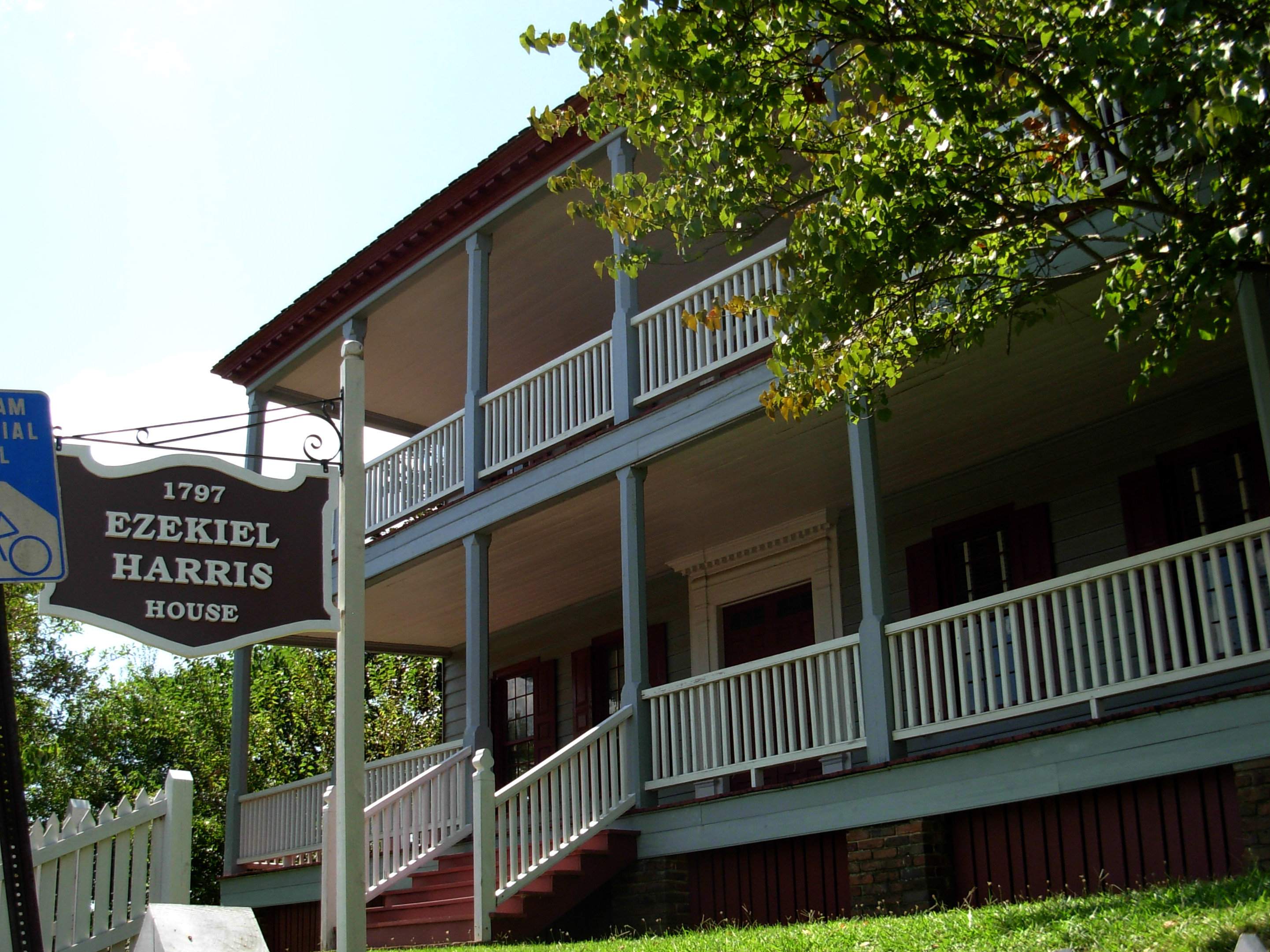
Sign on the back gate of the Ezekiel Harris House, 2011. Photo by Lewis Powell IV, all rights reserved.

The city of Augusta was laid out on the orders of the founder of Georgia, General James Oglethorpe, in 1736, three years after the establishment of the Georgia colony. Named for Princess Augusta of Saxe-Gotha, wife of the Prince of Wales, the city was one of the first inland cities founded in the colony. It is located roughly 127 miles northwest of Savannah at the end of the navigable portion of the Savannah River. The city briefly became the capital of Georgia in 1779 after the fall of Savannah during the American Revolution, but the city also soon fell to British forces. The British held the city briefly and then recaptured and held it from May 1780 to June 1781.

Just before the outbreak of hostilities, the Augusta region was placed under the purview of Thomas Brown by Royal Governor James Wright. Brown was a wealthy Englishman who, with a boatload of indentured servants, created the settlement of Brownsborough, north of Augusta. Anti-British sympathy had begun to smolder in the area and Brown worked hard to stamp out the rebellious feelings of groups like the Sons of Liberty. As an example to other Loyalists, the group captured Brown and subjected to tarring and feathering, a horrifically painful and sometimes fatal ordeal. Escaping the city, Brown travelled to South Carolina where, upon recovery, he began to gather Loyalists about him to fight the revolutionary threat. Brown returned to the city with troops in tow in May of 1780 quite possibly hell-bent on revenge.

Upon entering Augusta again, Brown began quickly exacting measures against its patriot inhabitants, stripping those families of their possessions and expelling them from the colony. Others were arrested and put to death. These actions soon spread beyond the limits of Augusta and throughout British-controlled Georgia and South Carolina. Under Brown’s orders, a contingent of soldiers travelled north of the city to what is now Lincoln County, Georgia and murdered revolutionary leader Colonel John Dooley in his home.

On September 14th, 1780, Colonel Elijah Clarke, commander of the revolutionary forces that had been dogging the British in the area for some time, attacked an Indian village near Augusta, this putting Brown in notice that they were in the area. American forces pushed towards Mackay’s Trading Post, also called the White House, situated outside the city of Augusta near the Savannah River. Brown reinforced his forces which held the trading post with British regulars and allied Native Americans. The Americans laid siege to the trading post and the surrounding area, a siege that would last nearly four days.

The American forces retreated in the morning of the 18th having sustained nearly sixty casualties, but it’s the proceeding events that really concern us. Charles C. Jones, Jr. spells the story out quite grotesquely in his 1890 Memorial History of Augusta, Georgia:

Thus did Captain Ashby, an officer noted for his bravery and humanity, and twenty-eight soldiers fell into the hands of the enemy. He and twelve of the wounded prisoners were forthwith hung upon the staircase of the White House, where Brown was lying wounded, that he might enjoy the demonical pleasure of gloating over their expiring agonies. Their bodies were then delivered to the Indians, who, after scalping and mutilating them, threw them into the river. Henry Duke, John Burgamy, Scott Reeden, Jordan Ricketson, Darling, and the two brothers Glass, youths seventeen and fifteen years of age, were choked to death under a hastily constructed gibbet. Their fate, however, was mild when contrasted with that reserved for the other prisoners who were delivered into the hands of the Indians that they might be avenged of the losses which they had sustained during the siege.

Back of the house. The staircase is behind the horizontal beams. Photo 2011, by Lewis Powell IV, all rights reserved.

This event was noted in a letter by Governor Wright to King George III: “Thirteen of the Prisoners who broke their Paroles & came against Augusta have been hang’d, which I hope will have a very good effect.” Windham notes that the number thirteen represented each of the rebellious American colonies. Though the Americans were repelled after this first siege and Thomas Brown was able to construct a small fortress closer to town, named Fort Cornwallis, British controlled Augusta was eventually broken following a siege in May of 1781.

Ezekiel Harris House, 1934 before it was purchased and restored. Photo by Branan Sanders for the Historic American Building Survey (HABS), courtesy of the Library of Congress, Prints and Photographs Division.

Fast forwarding ahead 165 years to 1946, the Richmond County Historical Society purchased an 18th century house near the river believing it to be the infamous Mackay Trading Post. According to Cherie Pickett, an associate with Historic Augusta in a 1999 article in The Augusta Chronicle (notably one of the oldest American newspapers still in print), historians clung steadfastly to the idea that this building was the Mackay Trading Post for many years, with architectural historians and archaeologists possibly skewing their results to lend credence. Even more importantly to our cause, the Writers’ Project of the WPA recorded stories about the “White House” haunting in 1938 among many other noted Georgia ghost stories.

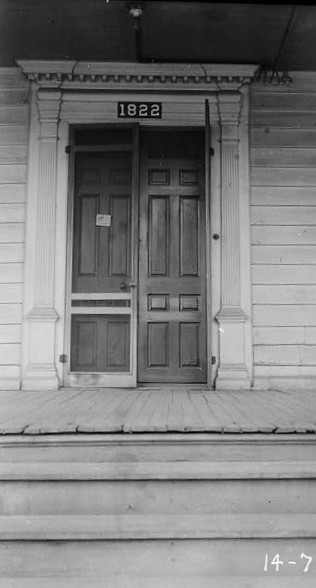
Front door, 1934. Photo by Branan Sanders, for HABS, courtesy of the Library of Congress, Prints and Photographs Division.
Front door, 2011. Photo by Lewis Powell IV, all rights reserved.

Mrs. Windham’s 1973 book gave wings to the story, enshrining it in the Southern folklore tradition. Windham recounts the legends that had grown up about the house. These legends state that visitors standing in the stairwell and slowly counting to thirteen would sometimes hear the thud of the thirteen men as they are hung or moaning of the dying men. Additionally, a female spirit has been seen wandering the second story as if searching for someone. Many have identified this spirit as Mrs. Glass, the mother of the two executed brothers. Windham adds wistfully that this spirit is said to hold her hands out in supplication, perhaps begging the spirit of Colonel Brown for a reprise for her sons.

But, there’s a problem. There had been questions for many years about the history of the building preserved and identified as the Mackay Trading Post. Mary Mackay, mother-in-law to the post’s owner, Andrew McLean, remarked upon seeing the damaged structure after the battle, “I have never seen such destruction.” The building identified as the trading post, however, showed no evidence of damage. A 1975 study by the state of Georgia confirmed that the house was not the Mackay Trading Post and that the misidentified house was likely built almost two decades later. As a result, the house was renamed the Ezekiel Harris House after the first known owner and the possible builder. Interestingly, some have said that the house, which was called by the Smithsonian Institute’s Guide to Historic America, “the finest 18th Century house in the state of Georgia,” would likely have never been purchased and restored had it not been mistakenly identified as the scene for such the bloody events of the American Revolution.

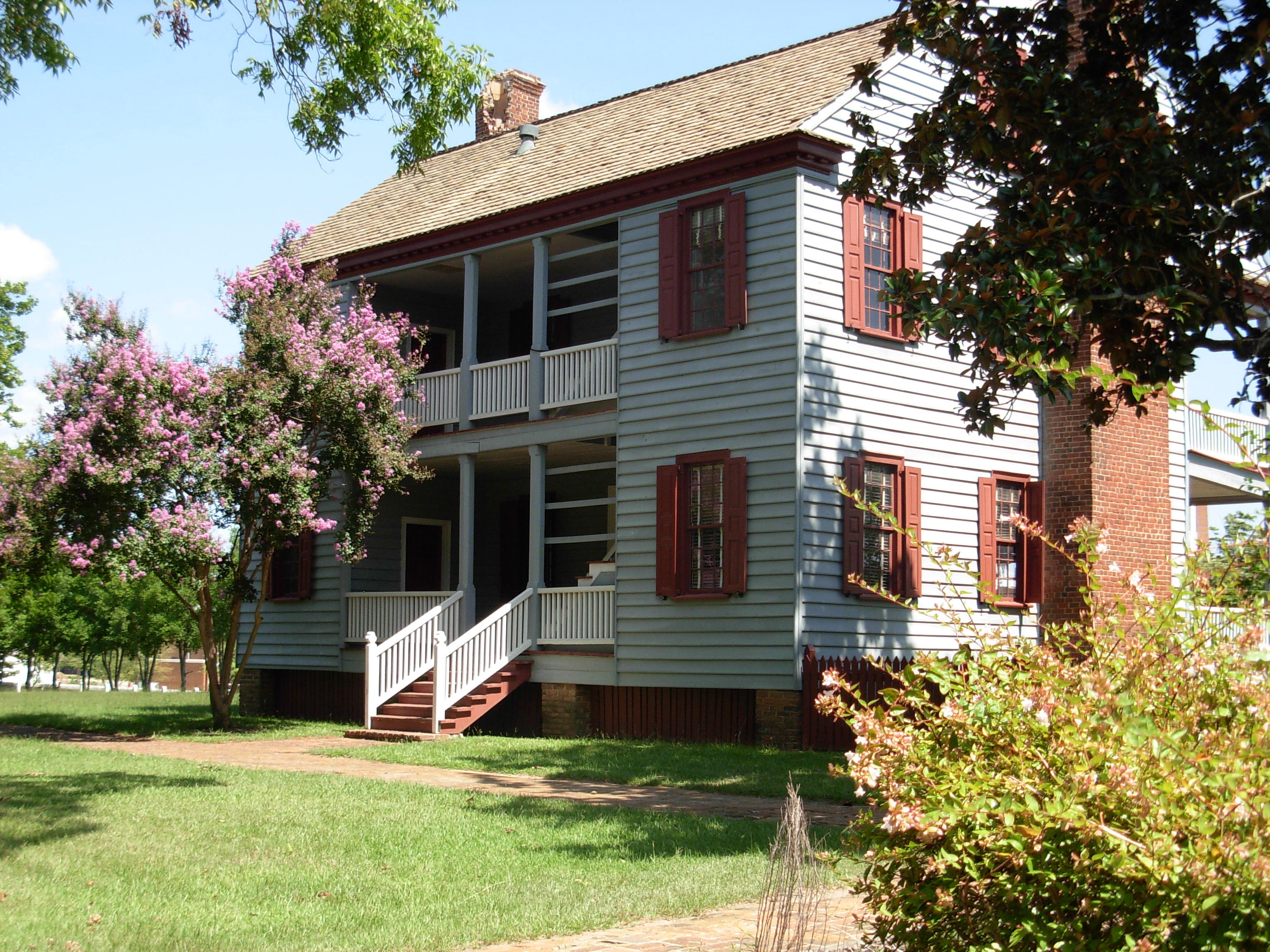
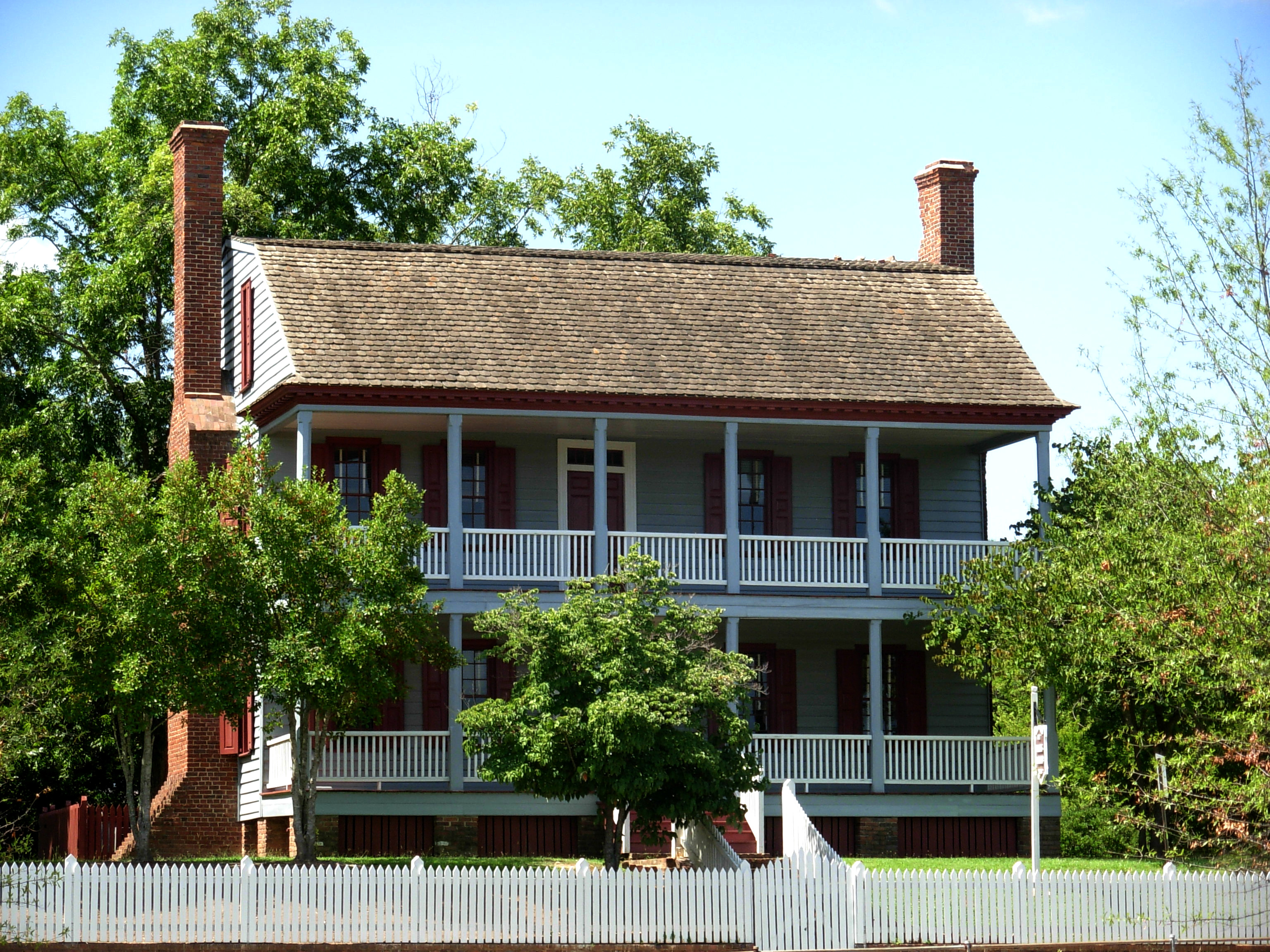
The Harris House today. Photo 2011, by Lewis Powell IV, all rights reserved.
Another view of the front. Photo 2011, by Lewis Powell IV, all rights reserved.

So, if the Ezekiel Harris House is not the Mackay Trading Post, are there still ghosts? Well, historians researching this first siege of Augusta have noted that the trading post was located somewhere in the vicinity of the Harris house, though the exact spot is unknown. We do know, however, that Ezekiel Harris, a tobacco merchant, built this house around 1797, though the exact date is unknown. Scott A. Johnson, author of The Mayor’s Guide to the Stately Ghosts of Augusta, posits that the ghosts may simply have taken up in the house after its construction. According to him, visitors still report odd occurrences on the staircase that includes the feeling of having a rope about your neck. He also reports that the female ghost is commonly seen as well.

It’s not uncommon for spirits to take up in a nearby structure if their regular haunt has been destroyed, but some remained unconvinced that this is the case here. Ben Baughman, manager of the house for the Augusta Museum, which has controlled the property since 2004, stated that he has had no experiences in the house. In 2006, two videos appeared on YouTube showing an investigation of the house. The first part of the video shows part of the usual tour of the house being led by Mr. Baughman as well as his docent’s spiel about the house’s history. The second video shows the beginning of a night investigation involving a Ouija board. The video ends just as the Ouija board is produced and there is no part II. So there is no indication that anything was discovered.

Interestingly, one of the females on the video states that the female apparition is probably not Mrs. Glass, but more likely Mrs. Ezekiel Harris. History may back her up on that assumption. While there are few records relating to either Mr. or Mrs. Harris, those that remain on Mr. Harris reveal that he was an ambitious businessman with some legal problems including an accusation of murder. In one surviving letter from 1805, Mr. Harris describes his wife as having breast cancer. She died the following year, quite possibly in the house. This does leave open the possibility that the spirit may be her still worrying over her husband’s troubles or the cancer in her breast.

The remainder of the home’s history may be relatively free of violence. The house was owned by two other families before being bought by the company constructing the Sibley Mill. The house was turned into a boarding house and the porch of the upper story was enclosed. Of course, as a boarding house, there may have been some violence and some tenants may not have left.

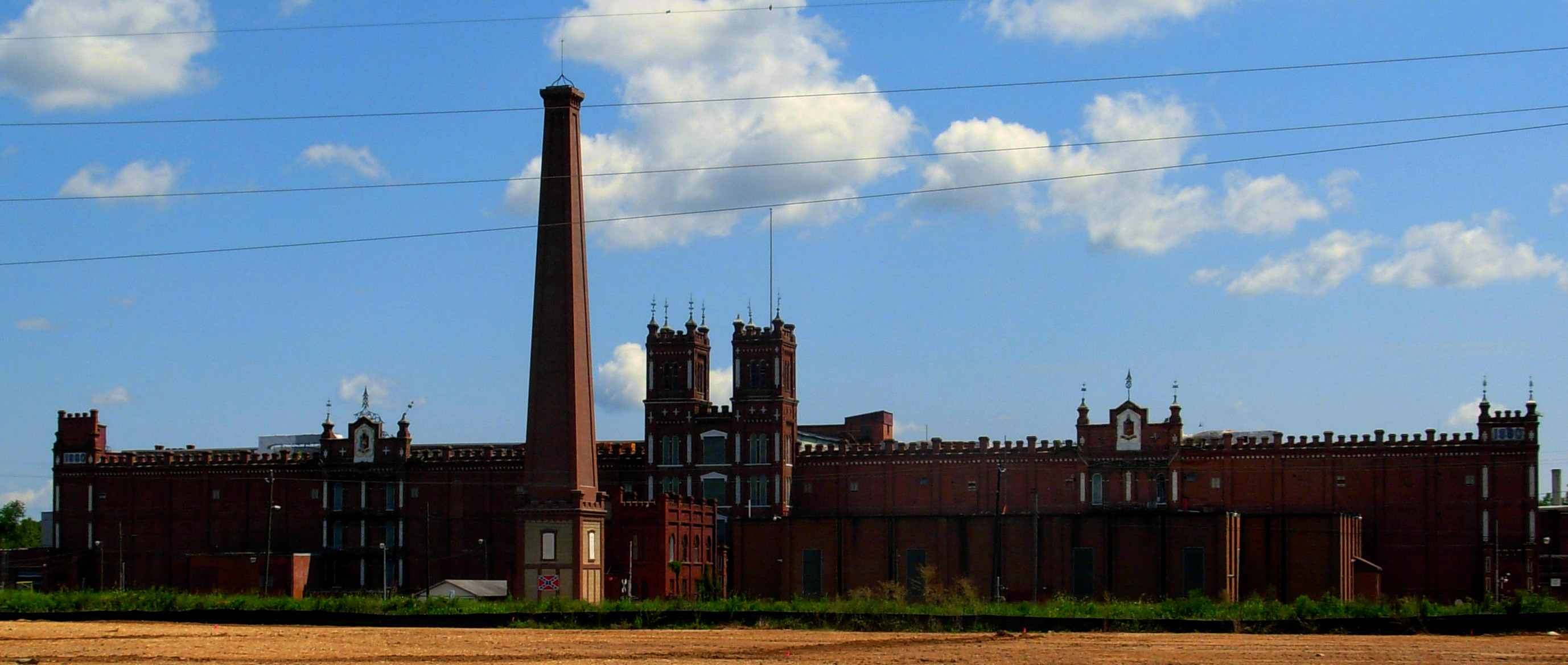
Mill in view of the house. Photo 2011, by Lewis Powell IV, all rights reserved.

As for the question of whether this house is haunted, I cannot say. I would be interested in seeing the results of any paranormal investigations on the location. Certainly, with its age and history ghosts are likely, but I have not seen a single, identifiable report of paranormal activity. In other words, the descriptions of activity are always general and cannot be linked to any specific individual.

Postscript 

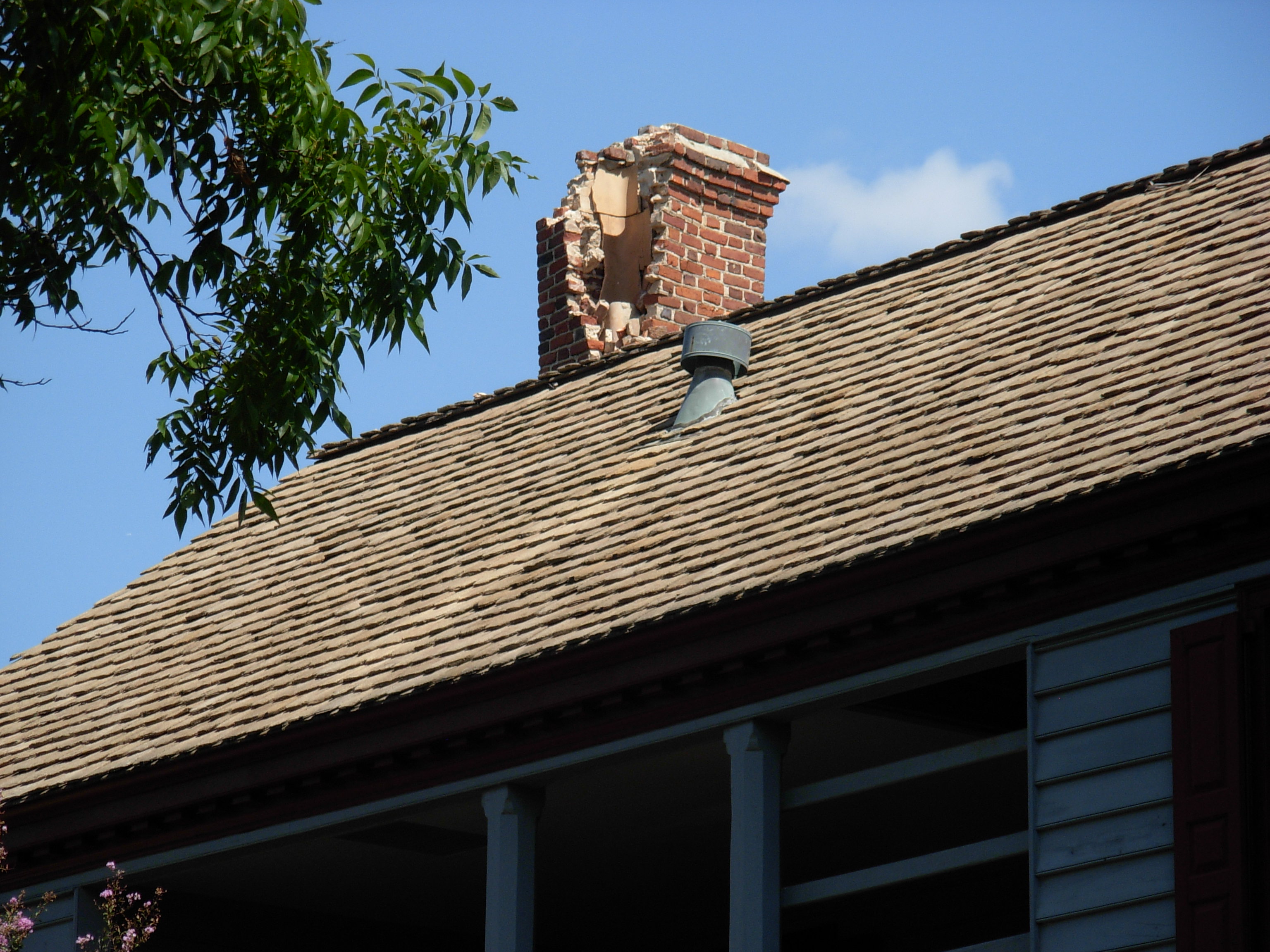
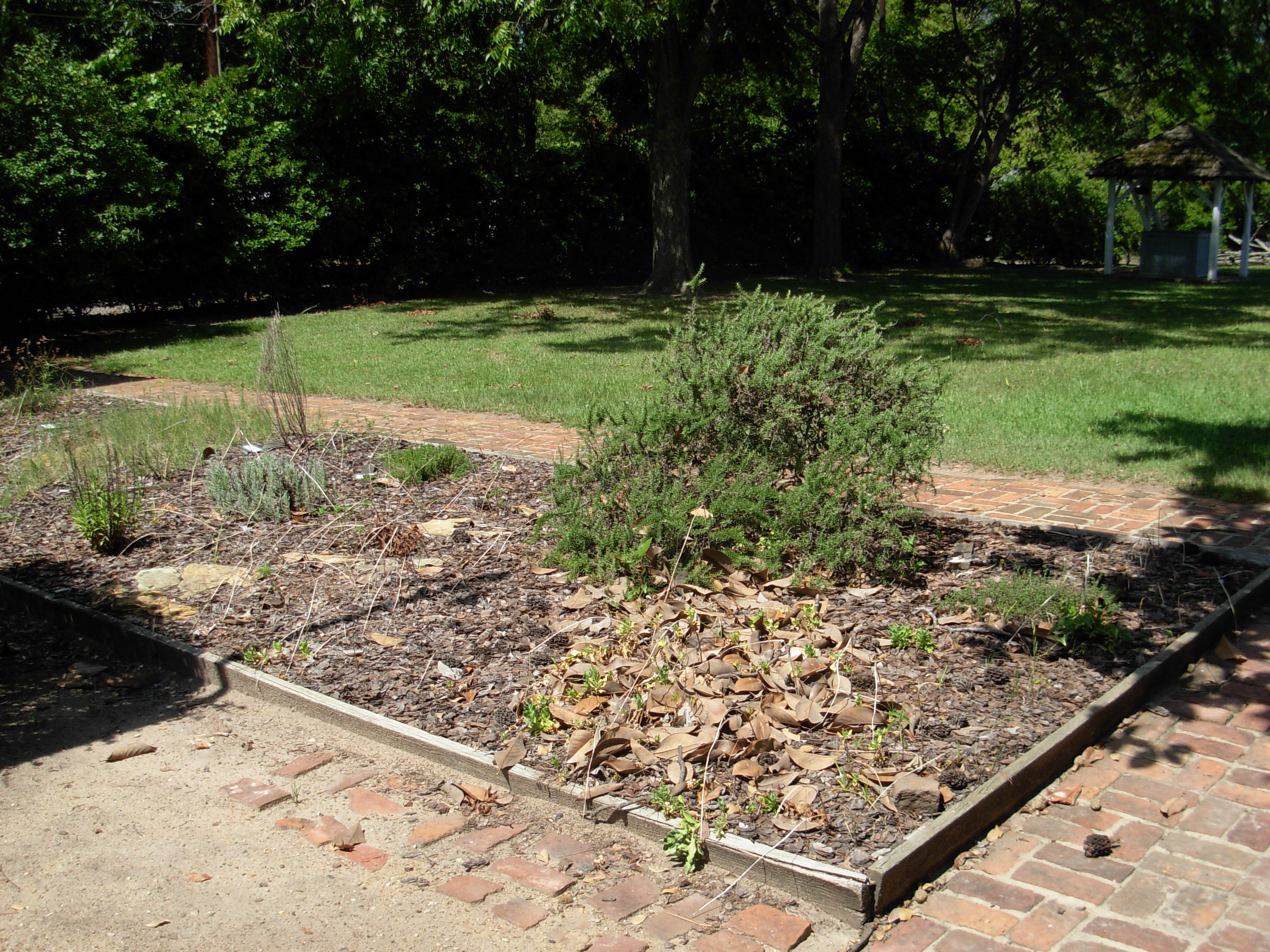
Back in July, I finally visited the Ezekiel Harris House for the first time. Presumably, due to budget cuts, tours of the house are now by appointment only and I only had time to take a few pictures and ponder the forlorn house from outside the white picket fence surrounding it. The house is a bit unkempt with grass needing mowing, a dead kitchen garden and a falling chimney. Even in that state, the house is a commanding presence, situated on a high hill with a vista of the grand Sibley Mill in the distance. I wonder if the spirits enjoy the solitude.

Crumbling chimney. Photo 2011, by Lewis Powell IV, all rights reserved.
Dying kitchen garden. Photo 2011, by Lewis Powell IV, all rights reserved.

Sources

  • Ghosthunting—Ezekiel Harris House Daytime Tour.” YouTube. 12 September 2006.
  • Ghosthunting—Ezekiel Harris House Nighttime Investigation.” YouTube. 9 December 2006.
  • Cashin, Edward J. “Augusta.” The New Georgia Encyclopedia. Accessed 19 February 2007.
  • Johnson, Scott A. The Mayor’s Guide to the Stately Ghosts of Augusta. Augusta, GA: Harbor House, 2005.
  • Jones, Charles C. Jr. and Samuel Dutcher. Memorial History Of Augusta, Georgia. Syracuse, NY: D. Mason & Co., 1890.
  • Killion, Ronald G. and Charles T. Waller. A Treasury of Georgia Folklore. Atlanta, GA: Cherokee Publishing, 1972.
  • Kirby, Bill. “The legend of this old house.” The Augusta 24 July 2010.
  • “Urban legends add mystique to Harris House.” The Augusta Chronicle. 20 June 1999.
  • Windham, Kathryn Tucker. 13 Georgia Ghosts and Jeffrey. Tuscaloosa, AL: The U. of Alabama Press, 1973.

“We fired our guns and British kept a’comin”–Chalmette Battlefield

We fired our guns and the British kept a’comin.
There wasn’t nigh as many as there was a while ago.
We fired once more and they began to runnin’ on
Down the Mississippi to the Gulf of Mexico.
from “The Battle of New Orleans” by Jimmie Driftwood, recorded by Johnny Horton in 1959.

Jean Lafitte National Historic Park and Preserve
8606 West St. Bernard Highway
Chalmette, Louisiana

A Haunted Southern Book of Days–8 January

This article is a part of an occasional blog series highlighting Southern hauntings or high strangeness associated with specific days. For a complete listing, see “A Haunted Southern Book of Days.”

The Battle of New Orleans by American painter, Thomas Moran, 1910.


Situated a few miles southeast of the city of New Orleans, the Chalmette Battlefield is the site of America’s greatest victory in the War of 1812. The British first threatened the city with the arrival of a flotilla just off of Lake Pontchartrain. The Americans attempted to block the British from landing but were defeated in the brief Battle of Lake Borgne on December 18, 1814. An attack by the Americans on the British position, once they landed on the 23rd, was successful only in keeping the British on their toes, though their maintained their position. General Andrew Jackson’s American troops dug in and created earthworks on Chalmette Plantation right along the Rodriguez Canal and bounded on both sides by cypress swamps and the Mississippi River that became known as “Line Jackson.”

Undated map of the battle line and line of attack. Courtesy of Wikipedia.

At the Ursuline Convent in New Orleans (see my entry on the convent here), prayers were raised by the sisters to the Virgin Mary to ensure an American victory and protect the city. The sisters had prayed a few years earlier in 1812 when fire ravaged the city. Miraculously, the flames were swept away from the convent by a sudden change in direction. The sisters’ prayers were answered on the morning of January 8th when the British launched their main attack in darkness and heavy fog. Perhaps as an answer to the sisters’ prayers, the fog lifted to reveal the troops marching towards the American’s fortifications. Exposed to brutal artillery fire, the British lost many of their senior officers quite early on leaving the soldiers in the field without direction. Despite being outmanned by British forces, the Americans held their ground and incurred few losses. The British, on the other hand, lost 291 soldiers including two generals with over 1,200 wounded and nearly 500 captured or missing.

This decisive American victory served as the final engagement of the War of 1812, despite its occurrence after the end of the war. The war officially ended in Belgium with the signing of the Treaty of Ghent on Christmas Eve, 1814, some two weeks previous to the battle. Following the tumult of battle, the site returned to its agrarian origins and the Beauregard House was built on part of the battlefield around 1830. The entrenchments, especially those in the area around the National Cemetery, were reused by Confederate and later, Union, forces during the Civil War. Towards the end of the war, a national cemetery was established for the burial of Union troops who had died in the area. The cemetery has seen over 15,000 burials and is now closed. Attempts to memorialize the site date to 1855 when construction began on a marble tower on the battlefield which was completed in 1908.

Modern photo of the battlefield with the remains of the “Line Jackson” earthworks, battle monument and the Beauregard House. From the National Park Service.

The Battlefield and National Cemetery now comprise a unit of the Jean Lafitte National Historic Park and Preserve, which preserves a series of cultural and natural resources that represent the rich history and ecology of the region. The park is named for the nineteenth century pirate, Jean Lafitte, who worked in some of the areas preserved in the park and who also came to the aid of the American’s before and during the battle. The spirit of Lafitte is one of the spirits that is said to haunt Destrehan Plantation which I wrote about in the entry on the River Road plantations of Louisiana.

Battlefields appear frequently in paranormal literature. Seemingly, the more important the battle, the more haunted the battlefield and the Chalmette Battlefield is no exception. Though finding good information on the haunting of this battlefield is not as easy. There are two primary sources for information on the ghosts of the battlefield: Jeff Dwyer’s excellent Ghost Hunter’s Guide to New Orleans and a blog from the Southern Area Paranormal Society. Outside of these sources, there is information on the haunted, but its validity is questionable.

Jeff Dwyer’s book provides good information on the battle, but he doesn’t say too much about what supernatural elements have been experienced there. He states that cold spots have been felt and that sensitive people have felt a “pulling sensation as if gravity has increased many times.” My skeptical side is apt to not usually believe “feelings” that people may get in a location, especially if that’s the only indication of paranormal activity.

The other main source for what is taking place in the battlefield involves a good deal more information. The Southern Area Paranormal Society discusses the battlefield and two nearby forts in their blog. Activity they mention on the battlefield include apparitions and voices. They also mention that activity has been reported in the Beauregard House including the sound of footsteps and possible shadow people.

Sources

  • The Battle of New Orleans. Wikipedia, the Free Encyclopedia. Accessed 19 November 2010.
  • Dwyer, Jeff. Ghost Hunter’s Guide to New Orleans. Gretna, LA: Pelican, 2007.
  • Greene, Jerome A. National Register of Historic Places Nomination Form for Chalmette Unit. Listed 6 July 1987.
  • Jean Lafitte. Wikipedia, the Free Encyclopedia. Accessed 22 November 2010.
  • Manley, Roger. Weird Louisiana: Your Travel Guide To Louisiana’s Local Legends and Best Kept Secrets. NYC: Sterling, 2010.
  • Southern Area Paranormal Society. Fort Beivnue, Chalmette Battlefield & Fort Pike. 19 May 2009.